
Gathering Empirical Evidence and
Building a Business Case for
Software Reference Architectures in
Industry
— PhD Thesis —
S
ilverio
M
art
´
inez
-F
ern
andez
´
Advised by C
laudia
A
yala
and X
avier
F
ranch
A thesis submitted in partial fulfillment of the requirements for the degree of Doctor of Philosophy in Computing
Department of Computer Science Barcelona, Spain
Abstract
Background: Software reference architectures are becoming widely adopted by organizations that need to support the design and maintenance of software applications of a shared domain. For organizations that plan to adopt this architecture-centric approach, it becomes fundamental to understand how software reference architectures are engineered, and to know their return on investment. Unfortunately, there is a lack of evidence-based support to help organizations with these challenges.
Goal:The main goal of this PhD thesis is to support organizations making informed decisions about software reference architecture acquisition, design, and use based on empirical evidence.
Methods: To accomplish this goal, we have conducted an action research
approach in an industry-academia collaboration between everis (a
multina-tional IT consulting firm based in Spain) and our Research Group of Software and Service Engineering (GESSI).
Results: The results from our industry-academia collaboration led to un-cover novel evidence on the use of software reference architectures in practice. The procedures and evidence obtained have been packaged to design guide-lines that could be used in similar contexts as the one ofeveris.
Conclusions: This PhD thesis supports organizations to acquire and en-gineer software reference architectures by providing evidence-based support. Such evidence-based support consists of the results of the empirical studies conducted in this PhD thesis, and the presented guidelines for gathering new corporate evidence.
Keywords: software architecture; reference architecture; software refe-rence architecture; empirical software engineering; experimental software engineering; reference architecture acquisition benefits; business case; cost-benefit analysis; industry-academia collaboration.
Case for Software Reference Architectures in Industry Author: Silverio Martínez-Fernández
Department: Service and Information System Engineering (ESSI) Group of Software and Service Engineering (GESSI)
Address: UPC-Campus Nord, Omega building, room S206 c/Jordi Girona 1-3, 08034 Barcelona (Spain)
Co-Authorship Statement
Most of the contents in this PhD thesis are based on published papers authored by the candidate. The content of the papers included in this PhD thesis has been adapted with respect to the published version. In some cases, the papers have been co-authored with other authors. We indicate below the co-authors of such works.
All Chapters
Dr. Claudia Ayala and Dr. Xavier Franch, as supervisors, have contributed to all research described in this PhD thesis. Their guidance, supervision, and active role during these years have been fundamental.
Chapter 3
This chapter is partially based on the work performed during my research stay at the LabES research group at the University of Sao Paulo (Brazil). It has also been supervised by Dr. Elisa Y. Nakagawa, and jointly performed with Dr. Lucas Bueno Ruas de Oliveira and Lina Garcés.
Chapters 4, 5, 9, 10, and 13
These chapters are based on the research performed inside the “Cátedra
everis-UPC” project. Helena M. Marques, Xavier Terradellas Fernández, and Miguel
Ángel González Amate have contributed stating the research goals, with their participation at many meetings, and cooperation to gather evidence for the empirical studies.
In the beginning of this PhD thesis, Dr. David Ameller participated in the “ Cá-tedra everis-UPC” project, contributing to the initial versions of the guidelines.
Chapter 7
Dr. Elisa Nakagawa presented the survey performed to AUTOSAR practitio-ners in the First International Workshop on Automotive Software Architecture (WASA).
Chapter 8
This chapter is based on the work performed during my research visit at the Experimental Software Engineering group of the Federal University of Rio de Janeiro (UFRJ). It has also been supervised by Dr. Guilherme Horta Travassos, and jointly performed with Dr. Paulo Sérgio Medeiros dos Santos.
QuPreSS Reference Model
Acknowledgments
I would like to express my sincere gratitude to all people who have shared some time with me in the way to my PhD thesis. I am grateful for learning from them as a professional and as a person.
First of all, I want to thank my advisors, Claudia Ayala and Xavier Franch, for their guidance. A PhD thesis introduces you in a no existing road, but I walked on their previous footsteps. They have always been there providing inspiring knowledge and extremely useful assistance. There have been many meetings, many papers, many funny e-mails, many conference trips... but what made them different was their ability to lead this project by engaging me on the research, and improving the quality of the work.
To the whole GESSI research group, I need to say that I have been lucky to work here. The work atmosphere has been excellent, getting their friendly
cooperation whenever I needed it, especially from my mates at the office:
David Ameller, Óscar Cabrera, Montse Estanyol, Óscar Hernán, Lidia López, Marc Oriol, Xavier Oriol, and Cristina Palomares.
One of the most enriching parts of the PhD has been to do empirical research inside the “Cátedraeveris-UPC” project. Thanks to alleveris’ employees who have participated in the studies, and to the people from the architecture group (ARCHEX). Special thanks to Xavier Terradellas and Miguel Ángel González, who helped to define the research problem in the very beginning; and to
Helena M. Marques, the champion at theeverisside of the industry-academia
collaboration. She has always been willing to cooperate to gather evidence for the empirical studies.
To colleagues and researchers abroad, I am mainly thankful to Elisa Yumi Nakawaga from the University of Sao Paulo (USP) for giving me the oppor-tunity to learn the working philosophy of her group. To all members from USP for their kind hospitality and cooperation during my research stay there, especially to my office mates Lucas Bueno and Lina Garcés. Also to Guilherme
de Janeiro (UFRJ), for impressing upon me the importance of aggregation and meta-analysis.
I would like to thank to the anonymous reviewers as well as to researchers from many conferences, who provided great ideas and priceless feedback in different stages of this work.
I devote this PhD thesis to my mom and my sister for their love, affection, and support. They are always there to encourage me to follow my goals and believing in me. Especially for instilling me in the values that have made me the person I am today. Also, I devote the PhD thesis to the ones who joined the family in the last years, David and Adán.
Last but not least, I would also like to thank my friends, and all my flatmates in Can Bruixa and Casa da Vó, who have kept the home in Barcelona and São Carlos always worm. They have given me a hand whenever I needed, especially Elena, Jesús, Jovan, Laia, Pedro, and Rebecca. I particularly thank Petar Jovanovic for all his support since we started our PhDs. He has not only been a real friend, but also contributed to this work with abundantly feedback, proof-readings, nights and weekends in the research hub of our living room,
y fleje cosas más. Thanks to all!
Curriculum Vitae
Silverio Juan Martínez Fernández
Silverio Juan Martínez Fernández was born on October 29th, 1987, in Almería.
He graduated in Bachelor of Computer Science in June 2008 and in Com-puter Science Engineering in September 2010, both by University of Almeria (Spain). During his engineering studies, he spent the 2008-2009 academic year at University of Ghent (Belgium), awarded with an Erasmus grant.
In 2010, he was awarded with a “la Caixa” grant to study a master for the academic year 2010-2011. During this period, he studied the Master in Com-puting (Information Systems’ specialization) at UPC-BarcelonaTech (Spain).
Before starting the PhD, he was a developer in two software projects. First, “Chess League Game”, a chess online game that simulates team competitions (his final project degree). Second, “Mercury”, a tool that measures weather predictive services’ quality and automates the context-dependent selection of the most accurate predictive service to satisfy a customer query (his master thesis).
Since the end of 2011, he joined the Research Group of Software and Service Engineering (GESSI) at UPC-BarcelonaTech to carry out his doctoral studies. To this end, he got the first year and a half a FPI-UPC grant, and then a FPU grant from the Spanish Goverment. His research areas in the PhD have mainly been software reference architectures and empirical software engineer-ing. During the three first years, he also earned industrial experience as a part of the research conducted in the “Cátedraeveris-UPC” project.
grants for researching and teaching. On the one hand, he was awarded with a Santander Grant for Young Lecturers and Researchers (Santander JPI 2014), which enabled him to make a research stay at the University of Sao Paulo (Brazil) in Sao Carlos, Brazil. On the other hand, he got an Erasmus+grant for teaching mobility, which enabled him to teach a part of a software architecture course in 2015 at Fontys University of Applied Sciences (The Netherlands).
Contents
List of Figures xvii
List of Tables xix
I
Introduction and State of the Art
1
1 Introduction 3
1.1 Software Reference Architectures . . . 3
1.1.1 Importance of Software Reference Architectures . . . 4
1.2 Research Context . . . 6
1.2.1 everis, a Multinational Consulting Firm . . . 7
1.2.2 Software Reference Architectures ineveris. . . 7
1.3 Research Problem . . . 8
1.3.1 The Problem at the “Cátedra everis-UPC” Project . . . . 9
1.4 Research Goal . . . 11
1.5 Research Methodology . . . 12
1.5.1 Tasks and Results . . . 13
1.6 List of Publications . . . 21
1.7 Structure of this Document . . . 24
2 Background 25 2.1 Architecture Disciplines Basic Concepts . . . 25
2.1.1 Relationships Between Architecture Disciplines . . . 26
2.1.2 Where Software Reference Architecture Belongs To . . . 27
2.2 Software Reference Architecture Essentials . . . 29
2.2.1 Definition of Software Reference Architecture . . . 29
2.2.2 Types of Software Reference Architecture . . . 29
2.2.3 Elements that Compose an SRA . . . 30
2.3 The Boundaries of SRAs with Respect to Related Terms . . . 32
2.3.1 Reference Model and SRA . . . 32
2.3.2 Concrete Software Architecture and SRA . . . 33
2.3.3 Product Line Architecture and SRA . . . 34
2.4 The Industrial Context of SRAs ineveris . . . 36
2.4.1 Reference Model Projects . . . 38
2.4.2 Software Reference Architecture Projects . . . 38
2.4.3 Concrete Architecture Projects . . . 39
3 State-of-the-Art 41 3.1 Research Method . . . 42
3.1.1 Search Process . . . 42
3.1.2 Inclusion and Exclusion Criteria . . . 44
3.1.3 Data Extraction and Synthesis . . . 47
3.2 Results . . . 47
3.2.1 SRA Basic Concepts . . . 49
3.2.2 SRA Adoption . . . 50
3.2.3 SRA Information Source Investigation . . . 50
3.2.4 SRA Requirements Elicitation . . . 51
3.2.5 SRA Design . . . 51
3.2.6 SRA Evaluation . . . 52
3.2.7 SRA Usage . . . 53
3.2.8 SRA Evolution . . . 53
3.3 Focusing on the Topics of this PhD Thesis . . . 54
3.3.1 Literature on Artifacts of SRAs . . . 54
3.3.2 Literature on Benefits and Drawbacks of SRAs . . . 57
3.3.3 Business Case Analysis and Return-On-Investment . . . 59
3.3.4 Economic Models for SRAs . . . 60
II Empirical Evidence of Software Reference Architectures
65
4 Identifying Practical Criteria for SRA Engineering 67 4.1 Summary of the First Cycle of RQ 1 . . . 705 Gathering Evidence of SRA Engineering 71 5.1 Research Methodology . . . 72
C
ontents
xiii5.1.2 Research Questions . . . 73
5.1.3 Research Design and Sampling . . . 76
5.1.4 Data Collection and Instruments . . . 77
5.1.5 Data Analysis . . . 80
5.1.6 Limitations of the Study . . . 81
5.2 Analysis of Motives to Use SRAs . . . 84
5.2.1 Results . . . 84
5.3 Analysis of Artifacts of SRAs . . . 85
5.3.1 Results . . . 85
5.3.2 Discussions . . . 92
5.4 Analysis of Benefits and Drawbacks of SRAs . . . 98
5.4.1 Results . . . 98
5.4.2 Discussions and Comparison with the Literature . . . 108
5.5 Analysis of Benefits of Reference Models . . . 113
5.5.1 Results . . . 113
5.5.2 Discussions . . . 115
5.6 Summary of the Second Cycle of RQ 1 . . . 116
6 Guidelines for Gathering Evidence of SRAs 117 6.1 Similar Contexts of SRAs in Practice . . . 118
6.2 Formative Stage: Evolution of the Guidelines . . . 120
6.3 Packaging the Guidelines . . . 121
6.3.1 Relevant Criteria of SRAs for an Organization . . . 122
6.3.2 Evidence to Improve SRA Engineering . . . 122
6.4 Summative Stage: Validating the Guidelines . . . 124
7 The Benefits and Drawbacks of AUTOSAR 125 7.1 Background on Automotive Software and AUTOSAR . . . 125
7.1.1 AUTOSAR Software Reference Architecture . . . 127
7.2 Research Method . . . 129
7.2.1 Research Questions . . . 129
7.2.2 Research Design and Sampling . . . 129
7.2.3 Data Collection and Instruments . . . 130
7.2.4 Data Analysis . . . 130
7.3 Results . . . 131
7.3.1 Results on AUTOSAR Benefits . . . 134
7.3.2 Results on AUTOSAR Drawbacks . . . 137
7.3.3 Highlights of the Results . . . 138
7.4.1 Construct Validity . . . 139
7.4.2 Internal Validity . . . 140
7.4.3 External Validity . . . 141
7.5 Summary of the Third Cycle of RQ 1 . . . 141
8 Aggregating Empirical Evidence of SRAs 143 8.1 Methodology . . . 144
8.1.1 Step 1: Selecting Primary Studies . . . 145
8.1.2 Step 2: Evidence Representation . . . 146
8.1.3 Step 3: Evidence Synthesis . . . 150
8.2 Representation of SRA Effects . . . 151
8.3 Results of the Aggregation . . . 154
8.3.1 Effects of SRAs that Increased their Belief . . . 156
8.3.2 Effects of SRAs that Slightly Increased their Belief . . . . 157
8.3.3 Effects of SRAs that did not Change their Belief . . . 157
8.3.4 Effects of SRAs that Decreased their Belief . . . 158
8.4 Discussions . . . 158
8.4.1 Effects of SRAs Present in Different Contexts . . . 158
8.4.2 Contradictory SRA Effects from Different Studies . . . . 159
8.4.3 Contribution of this Aggregation to the Theory on SRAs 161 8.5 Validity . . . 161
8.6 Summary of the Fourth Cycle of RQ 1 . . . 163
III The Business Case for Software Reference Architectures
165
9 A Survey to Discover Existing Data in SRA Projects 167 9.1 Results: Costs and Benefits Metrics for SRAs . . . 1689.2 Next Steps and Lessons Learned . . . 169
9.3 Summary of the First Cycle of RQ 2 . . . 170
10 REARM: Calculating the ROI on SRA Adoption 171 10.1 A Method for Formulating an Economic Model . . . 172
10.2 REARM: the Economic Model for SRAs . . . 173
10.2.1 Step 1 for Formulating an Economic Model . . . 173
10.2.2 Step 2 for Formulating an Economic Model . . . 175
10.2.3 Step 3 for Formulating an Economic Model . . . 175
10.3 Preliminary Validation . . . 178
C
ontents
xv10.3.2 Scenario 2 . . . 181
10.4 Discussion . . . 182
10.5 Summary of the Second Cycle of RQ 2 . . . 183
11 Guidelines for Building a Business Case for SRAs 185 11.1 Formative Stage: Evolution of the Guidelines . . . 186
11.2 Packaging the Guidelines . . . 186
11.2.1 Existing Value-driven Data in Projects . . . 188
11.2.2 Calculating the ROI of Adopting an SRA . . . 188
11.3 Summative Stage: Validating the Guidelines . . . 189
12 Workshops to Evaluate the Business Case for SRAs 191 12.1 REARM Validation at aneverisClient Organization . . . 192
12.2 REARM Validation at the ICSR 2013 . . . 192
12.3 REARM Validation at another Research Group . . . 194
12.4 Summary of the Third Cycle of RQ 2 . . . 195
IV Conclusions and Future Work
197
13 Discussion: Evaluating our Collaboration 199 13.1 Models for Technology Transfer . . . 20013.2 The Collaboration . . . 200
13.3 Collaboration Evaluation . . . 205
13.3.1 Research Activity . . . 206
13.3.2 Research Result . . . 206
13.4 Lessons Learned . . . 207
13.4.1 Challenges . . . 207
13.4.2 Mutual Benefits from Collaboration . . . 210
13.5 Contributions of the Evaluation of the Collaboration . . . 210
13.5.1 Future Steps . . . 211
14 Conclusions and Future Work 213 14.1 Conclusions and Answers to RQ 1 and RQ 2 . . . 213
14.2 Contributions to the SRA and ESE Theories . . . 215
14.2.1 Contributions to the SRA Theory . . . 215
14.2.2 Contributions to the ESE Theory . . . 218
14.2.3 Overall Contributions . . . 218
References 219
Appendix A Glossary 235
Appendix B Included Studies in the Systematic Review 239
Appendix C Materials for Gathering Evidence of SRAs 245
C.1 Relevant Aspects of SRAs . . . 245 C.2 Template Survey for Gathering Evidence of SRAs . . . 246 C.2.1 Questions about Personal Data, Project, and Experience . 246 C.2.2 Questions about the Relevant Aspects of SRAs . . . 247
Appendix D Materials for Building the Business Case for SRAs 253
List of Figures
1.1 Reference model, SRA, and concrete architecture . . . 5
1.2 The five steps of an action research approach. . . 13
1.3 Action-research cycles of RQ 1. . . 16
1.4 Action-research cycles of RQ 2. . . 19
2.1 Relationship between architecture disciplines. . . 28
2.2 Co-existence of diverse reference architectures . . . 28
2.3 RAModel: Reference model for SRAs . . . 31
2.4 Reference models, architectural patterns, and software architectures 32 2.5 SRA and product line architecture . . . 35
2.6 everisreference model for modern information systems . . . 37
2.7 An SRA designed with the help of theeverisreference model . . . . 38
2.8 Stakeholders and their roles in each type of project . . . 40
3.1 Search process and study selection . . . 45
3.2 Number of studies divided by topic and the maturity of each study 48 5.1 Key stakeholders ineveris’ SRA projects. . . 73
5.2 What stakeholders think about SRA reuse in other domains. . . 90
5.3 Popularity of SRAs’ cross-cutting software elements. . . 92
5.4 Benefits of the use of SRAs in organizations. . . 101
5.5 Comparison of SRA benefits between designers and users. . . 102
5.6 Drawbacks of the use of SRAs in organizations. . . 105
5.7 Comparison of SRA drawbacks between designers and users. . . . 106
5.8 Identified to-do improvements ineveris’ SRAs. . . 107
5.9 Benefits foreverisfrom designing SRAs. . . 114
6.1 Previous version of the guidelines to gather empirical evidence . . 120
6.2 Guidelines to gather empirical evidence of SRAs in industry. . . 121
7.1 AUTOSAR layered ECU component-based software architecture. . 128
7.2 Education area of respondents. . . 133
7.3 Pie chart with the role of the company of respondents . . . 133
7.4 Box plot of the years of experience of respondents. . . 134
7.5 Results of “Which are the benefits of using AUTOSAR?” . . . 135
7.6 Results of “Which are the drawbacks and risks of using AUTOSAR?”137 8.1 Evidence model representing the results of the study S1. . . 148
10.1 Summary financial results. . . 181
10.2 ROI of developing and maintaining SRA-based applications . . . . 182
11.1 Previous version of the guidelines to build the business case . . . . 186
11.2 Guidelines to build the business case for SRAs in industry. . . 187
13.1 An activity model for technology transfer . . . 201
13.2 A relational model for industry-academia research . . . 202
List of Tables
1.1 Initial tasks of the PhD thesis . . . 14
1.2 Tasks related to gathering empirical evidence of SRAs (RQ1). . . 17
1.3 Tasks related to the business case for SRAs (RQ2) . . . 18
1.4 Tasks related to discussions and conclusions. . . 20
3.1 Selection by title and abstract by two reviewers. . . 47
4.1 Summary of relevant aspects for SRA engineering . . . 70
5.1 Research questions of the case study . . . 74
5.2 Overview of the selectedeveris’ SRA projects. . . 78
5.3 Quotes from respondents about SRA use benefits. . . 100
5.4 Quotes from respondents about SRA use drawbacks. . . 104
5.5 Quotes from respondents about improvements. . . 107
5.6 Summary of benefits of using SRAs. . . 110
5.7 Summary of drawbacks of SRAs. . . 111
5.8 Summary of improvements and trade-offanalysis . . . 113
5.9 Quotes from respondents about SRA design benefits. . . 115
7.1 Group 1 of questions (mandatory). . . 131
7.2 Group 2 of questions (optional). . . 132
8.1 Primary studies . . . 147
8.2 SRAs effects as reported in selected studies. . . 153
8.3 Aggregated effects of SRAs (ordered by belief strengthening). . . . 155
10.1 Basic parameters in order to feed the factors of Table 10.2. . . 176
10.2 Cost-benefit factors to calculate the ROI . . . 177
10.3 Example of design of a business case . . . 177 10.4 Values of the basic parameters in the study . . . 179 10.5 Values of the cost-benefit factors in the study . . . 180
C.1 Summary of relevant aspects for SRA engineering . . . 245
Part I
Introduction and State of the Art
Chapter 1
Introduction
This document represents my PhD thesis at the PhD in Computing program at Barcelona School of Informatics (Facultat d’Informàtica de Barcelona, FIB) of BarcelonaTech (Universitat Politècnica de Catalunya, UPC). The research of this PhD thesis had its origin in the “Cátedra everis-UPC” project, an
industry-academia collaboration amongeveris(a multinational IT consulting firm based
in Spain)1, and our Research Group of Software and Service Engineering
(GESSI).
In this chapter, we respectively introduce the topic of the PhD thesis (Sec-tion 1.1), the research context (Sec(Sec-tion 1.2), the research problem (Sec(Sec-tion 1.3), the research goal (Section 1.4), the research tasks and contributions (Section 1.5), the list of publications (Section 1.6), and the structure of the rest of the document (Section 1.7).
1.1
Software Reference Architectures
Every software system has a software architecture [1]. “The software archi-tecture of a system is the set of structures needed to reason about the system, which comprise software elements, relations among them, and properties of both” [1]. Nowadays, the size and complexity of software systems, together with critical time-to-market needs, demand new Software Engineering (SE) approaches to design their software architectures [2].
Many today’s organizations face the development and maintenance of big and complex software families, rather than single software systems. A
1There is an introduction abouteverisin Section 1.2
software family is composed by many software systems or software appli-cations. These software applications are developed at multiple locations, by multiple vendors and across multiple organizations [3]. Despite the multi-plicity of this scenario, all software applications from the same family share similar architectural needs and belong to the same domain. In this context,
or-ganizations may build a central asset calledSoftware Reference Architecture
(SRA).
An SRA “encompasses the knowledge about how to design concrete archi-tectures of systems of a given application domain; therefore, it must address the business rules, architectural styles, best practices of software development, and the software elements that support development of systems for that do-main. All of this must be supported by a unified, unambiguous, and widely understood domain terminology” [2].
An SRA is used as a foundation for the design of concrete software archi-tectures of a class of software applications in a cost-effective manner [4, 5]. Therefore, SRAs are very attractive when organizations become large and distributed in order to develop new systems or new versions of systems [6].
The idea of using SRAs is not new for the SE community, nor the software industry. Since 1976, the idea of application families was described by Parnas [7], and more than a decade ago, Bass et al. defined SRAs in their seminal book [1] as: “a reference model mapped onto software elements (that cooperatively implement the functionality defined in the reference model) and the data flows between them”. Thus, a reference model could be mapped to many SRAs. Likewise, SRAs serve as a reference for the design of the concrete architecture of the software applications of an information system. These three artifacts go from a high level of abstraction to a low level of abstraction. Figure 1.1 shows these relationships among reference model, SRAs and concrete software architecture of applications.
1.1.1
Importance of Software Reference Architectures
Several potential benefits of using SRAs have been claimed, by both industry and academia.
1.1. S
oftware
R
eference
A
rchitectures
5Figure 1.1: Relationships among reference model, SRA, and concrete archi-tecture.
organizations that lack architecture and configuration standards [...] have higher costs and less agility that those with enforced standards” [8].
On the other hand, much has been written in the scientific literature about the goals of SRAs [9], which aims:
• to ensure standardization and interoperability [4];
• to facilitate reuse, and thereby harvest potential savings through reduced
cycle times, cost, risk and increased quality [3];
• to help with the evolution of a set of systems that stem from the same
SRA [10];
• to manage design complexity and improve development productivity
[11];
• and to ensure that resulting applications’ software architecture are
con-sistent with respect to an SRA [12].
well-known SRAs classified by their application domain: platform-specific SRAs, industry-specific SRAs, and industry-cross-cutting SRAs [10].
First, there are SRAs that target a technological domain (also called plat-form-specific SRAs [10]). Examples are The Open Group standard for SOA reference architecture that is a blueprint that provides guidelines to adopt a service-oriented approach to information technology [14], and the IBM big data reference architecture that provides integrated capabilities for the adoption of information governance in the big data landscape [15]. There are also SRAs from academia to solve well-known technological problems (e.g., web browsers [16], and software testing tools [17]).
Second, there are other types of SRAs that focus on a specific business domain (also called industry-specific SRAs). These SRAs can either target many organizations (whose applications share the business domain), or target a specific single organization (which aims to standardize or facilitate the de-velopment and maintenance of its own applications). An example of an SRA that targets many organizations is AUTOSAR [18], which focuses on the auto-motive domain and is being used by many car manufacturers and suppliers in order to standardize the software in modern vehicles. An example of SRAs for a single organization is the SRA for NASA’s earth science data systems, which facilitates and homogenizes the development of this type of applications [19]. Third, the aforementioned SRAs target a single domain (e.g., the automo-tive or aerospace industry), what makes them hard to be applied to other domains. In this context, the goal of some European industrial research pro-grams [20] is to enable their use across disparate domains. Also, the AUTOSAR consortium plans to adapt its SRA for other commercial sectors, such as such as railway, agriculture and forestry machinery [18]. This last type of SRAs that cover more than one industry are called industry-cross-cutting SRAs.
1.2
Research Context
As it was aforementioned, the research of this PhD thesis had its origin in the “Cátedra everis-UPC” collaboration. The collaboration was composed of three partners: the architecture group ofeveris, the Barcelona School of Informatics (FIB) at UPC, and the GESSI research group at UPC. The collaboration, which
was funded byeveris, started in May 2011 and had a duration of three years.
1.2. R
esearch
C
ontext
71.2.1
everis
, a Multinational Consulting Firm
everisis a multinational consulting firm providing business and strategy so-lutions, application development, maintenance, and outsourcing services.
Es-tablished in 1996, everishas averaged 20% annual growth in revenues and
became part of NTT Data in January, 2014. At the time of starting the industry-academia collaboration of this PhD thesis, everishad offices in 12 countries. One ofeverisareas of business is Information Technology (IT) services. In IT
services,everisdesigns and implements technological solutions (among them
SRAs) and manages applications, infrastructures and outsourcing processes2.
1.2.2
Software Reference Architectures in
everis
Having seen the general context of SRAs in the industry and their importance, in this subsection we analyze the context of SRA projects from our experience witheveris. As a consulting company,everisoffers solutions for big businesses (e.g., banks, insurance companies, public administration, utilities, and indus-trial organizations) that provide a wide spectrum of services to their clients. Given the complexity of the resulting software applications, which integrate bespoke applications with commercial packages, these organizations need high-quality software architectures, and this is the service that they hire to
everis. The solution provided byeverisis based on the adoption of an SRA in the client organization, from which concrete software architectures are derived and used in a wide spectrum of applications.
We focus on the case in whicheverisdesigned an SRA with the purpose
of deriving concrete architectures for each application of a client organization. This usually happens wheneverisis regularly contracted to create or maintain information systems in client organizations. Each information system of a client organization is built upon the SRA and includes many software applica-tions. SRAs enable reuse of architectural knowledge and software components (normally associated to particular technologies) for the design of concrete ar-chitectures in client organizations. Therefore, SRAs provide a baseline that facilitates standardization and interoperability as well as the attainment of business goals during applications’ development and maintenance.
previous successful experiences, which serve as a reference for new SRAs that inherit a certain level of quality. Details of the type of projects and stakeholders ateveriscan be found in Section 2.4, and Figure 2.8.
The context ofeverisis very similar to other IT consulting firms. As a re-cent Gartner report shows, IT consulting firms “leverages industry-specific or industry reference models to accelerate client delivery and ensure quality and consistency across client engagements” [21]. However, “clients must ensure that generic industry or reference models [...] are sufficiently customized and tailored to enable their unique business capabilities and environments” [21], so that the reference model does not stifle competitive advantage of the SRA.
1.3
Research Problem
As we have seen in Section 1.1.1, the adoption of an SRA might lead to plenty of theoretical benefits (e.g., standardization in a software family). However, it also implies several challenges, such as the ability to get real evidence for driving its design and use [22], and the need for an initial investment [5]. Cur-rently, organizations have little support for dealing with these two challenges. This problem originates from the specific features of SRAs with respect to soft-ware architectures [23], such as the need of an initial investment, their generic nature, the wide group of stakeholders that they involve, their high level of abstraction, or their instantiation in the organization’s portfolio of software systems. Therefore, as Angelov et al. point out,practitioners face difficulties in working with SRAs[22]. This PhD thesis aims to cope with the following two problems to help practitioners in their daily work with SRAs.
First,there is a shortage of experience reports about the context of SRAs in industry and how they are currently being designed and used. For instance, a recent literature review about evidence in software architecture, in which only two papers were about SRAs, shows that there is limited knowledge about SRAs [24]. As a result, academics’ perspective of SRA is not always in line with the industry’s practice, and practitioners usually find the current literature about SRA scarce and abstract [4], limiting the industrial uptake of research results in the field. This situation triggers the following questions:
• How can an organization get corporate evidence to support SRA
engi-neering1?
1.3. R
esearch
P
roblem
9• How different stakeholders perceive the potential benefits and
draw-backs of SRAs?
• Which are the artifacts that compose an SRA in the industrial practice
and what is their potential reuse across domains?
In this scenario, we argue that in order to enable practitioners to fully exploit the benefits of SRA adoption and usage, the research community must clarify the diverse contexts of SRA in practice, as well as the characteristics (e.g., benefits, drawbacks, and challenges) of such contexts. This situation could be addressed by conducting empirical studies to accumulate real evidence and understand the context of SRAs from essential types of stakeholders. Such evidence might help practitioners to better understand SRA engineering and, then, to identify the current challenges to improve these engineering practices in their organization.
Second,there is a shortage of economic models to precisely evaluate the
benefit of SRAs in order to make informed decisions about their adoption in an organization[5]. Organizations with a wide portfolio of applications, which may consider adopting an existing or new SRA to create and maintain such applications, lack an approach to know whether it is worth for them to invest on the adoption of an SRA. This situation triggers specific questions that have not been addressed yet:
• Is it worth to invest on the adoption of an SRA?
• How is it possible to calculate the Return-on-Investment (ROI) of the
adoption of an SRA in an organization?
• Which commonly available data do organizations have to quantitatively
calculate the costs and benefits of adopting an SRA in an organization?
• Which are the cost and benefit factors of acquiring an SRA in an
organi-zation?
This situation could be addressed by making a business case with the help of an economic model that perform cost-benefit analysis about the adoption of an SRA [25].
1.3.1
The Problem at the “Cátedra everis-UPC” Project
1. Gathering Evidence of SRAs (technical): systematically gathering evi-dence of SRAs projects that they conducted at their client organizations. The objective is identifying strengths and weaknesses of SRA engineer-ing in SRA projects in order to disseminate and improve them.
2. Building the Business Case for SRAs (strategic/organizational): building the business case and calculating the ROI that their client organizations get after adopting an SRA. It aims to provide quantitative evidence to its clients about the potential economic benefits of applying an SRA.
Next, we describe the rationale of these two tasks, and their importance foreveris.
Gathering Evidence of SRAs
The architecture group ofeveriswanted to capture empirical evidence and the
architectural knowledge of years of work in a congruent vision, so that it can helpeveris’ employees in the inception, design, and application of both current and prospective SRAs. To gather such empirical evidence, it is necessary to contact SRA stakeholders andeveris’ employees [26].
In this context, it becomes necessary to support practitioners in their daily work when working with SRAs.
Building the Business Case for SRAs
The architecture group ofeverisexperienced the inability to calculate the ROI derived from SRAs that they create (or plan to create) for client organizations. Reifer defines a business case as the “materials prepared for decisions makers to show that the idea being considered is a good one and that the numbers that surround it make financial sense” [25]. That is, business cases enable to justify investments in technology. Spending in the adoption of an SRA without a previous and trustworthy analysis seems to be reckless and can lead to a disaster.
In the SRA context, an economic model is needed to help making business cases. An economic model should take into account costs, benefits, risks, and schedule implications. An economic model to perform cost-benefit analysis on the adoption of software reference architecture is a key asset for optimizing architectural decision-making.
To sum up, software reference vendors (e.g., software companies and
organiza-1.4. R
esearch
G
oal
11tions lack of support for dealing with these two problems: gathering empirical evidence and building a business case for SRA engineering. Next, we show the goal of this PhD thesis, which attempts to ameliorate these two problems present ineverisand other companies with a similar context.
1.4
Research Goal
Having seen the importance of SRAs in the industry and the research problems described at Section 1.3, this section presents the objectives of the PhD thesis. The main goal of this PhD thesis is to package the knowledge and evidence gathered during our industry-academia collaboration in order:
To support organizations making informed decisions about SRAs acquisition, design, and use based on empirical evidence.
In this context, this PhD thesis supports organizations to deal with the following Research Questions (RQ):
RQ 1: How can an organization get corporate evidence that is useful for the SRA engineering? The objective of the RQ 1 consists of gathering, increas-ing and disseminatincreas-ing empirical evidence about relevant aspects of SRAs to improve SRA engineering practices in an organization. Among the relevant
aspects of SRAs, we have focused on how different stakeholders perceive the
potential benefits and drawbacks of SRAs, and which are the artifacts that compose an SRA in the industrial practice as well as their potential reuse across domains.
RQ 2: Is it worth for an organization to invest on the adoption of an SRA?
1.5
Research Methodology
In order to answer our RQs, we have performed an empirical research. Em-pirical research is a way of gaining knowledge by means of direct and indirect observation or experience3. One of the objectives of Empirical Software Engi-neering (ESE) is to gather and utilize evidence to advance software engiEngi-neering methods, processes, techniques, and tools [27]. Since empirical studies help
to solve the industrial problems, this PhD thesis fosters the conduction of
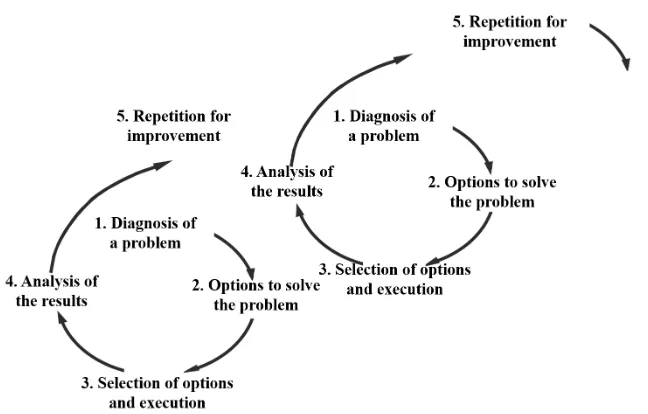
empirical studies as a way to increase the empirical evidence about SRAs. We followed an action research approach. Action research is “learning by doing”: a group of people identify a problem, do something to resolve it, see how successful their efforts are, and if not satisfied, try again [28]. The action research cycle consists of five steps (see Figure 1.2):
Step 1: diagnosis of a problem,
Step 2: examination of options to solve the problem, Step 3: selection of options and execution,
Step 4: analysis of the results, and, Step 5: repetition for improvement.
Due to the practical nature of this PhD, which is highly bound to the software industry, and to the data that we needed to gather and analyze from
everis and other organizations, ESE studies are ideal to solve the research problem stated in Section 1.3. The empirical studies of our action research process drove the establishment of the guidelines to gather empirical evidence and to build a business case for SRAs. We distinguish among two stages in our research: formative and summative.
First, the formative stage involves the evolution of the research work. The central role of the formative stage is shaping the proposed empirical studies and guidelines. It is called formative because it serves as the origin and evolution of the ideas and concepts presented in this PhD thesis. The last step of our formative stage is packaging guidelines with the aim of being applied in prospective SRA projects and also in similar organizations.
Second, once the guidelines were adequately shaped and improved, the summative stage aims to evaluate them. The central role of the summative
1.5. R
esearch
M
ethodology
13Figure 1.2: The five steps of an action research approach.
stage is integrating successful results from formative stages, and to validate
them with practitioners (which may come fromeverisor even other
organiza-tions). Such validation consists of using the guidelines to design and conduct empirical studies. Organizations facing the design and use of SRAs, and ana-lyzing whether to make the strategic move to SRA adoption based on evidence, benefit from these guidelines.
The next subsection describes the tasks of the action research initiative of this PhD thesis. All empirical studies designed and conducted are a cycle inside our action research initiative, and belong to either the formative or summative stages.
1.5.1
Tasks and Results
Having established the RQs, the tasks and results of this PhD thesis can be grouped in four parts:
• Part II: Gathering empirical evidence of SRAs (RQ1). • Part III: Building the business case for SRAs (RQ2). • Part IV: Discussions and conclusions.
Part I: Incubation of the PhD thesis
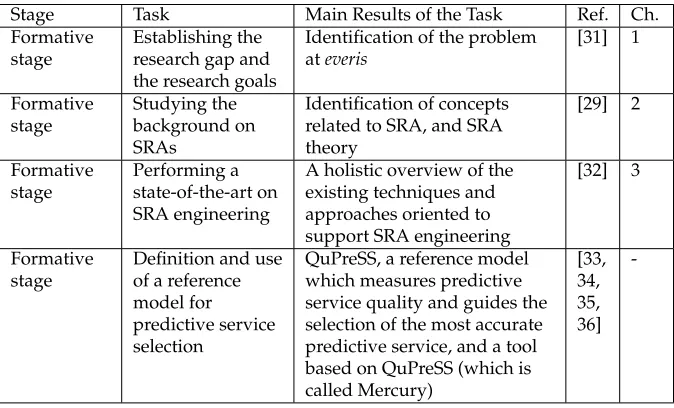
The starting point of this PhD thesis was its incubation, which ended up with the PhD proposal [29, 30]. This incubation had four main tasks (see Table 1.1). First, this PhD started by analyzing the problems identified in our action
research collaboration with everis (see Section 1.3.1). During this task, we
identified the research gaps about SRAs and propose the research goals of this PhD thesis.
Second, we studied the basic background on SRAs (see Chapter 2). In this stage, we stated the borders of SRA with regard to similar architectural con-cepts, such as enterprise reference architecture and product line architecture.
Third, to have an unbiased view of the state-of-the-art and current research on SRA engineering, we designed and conducted a Systematic Literature
Re-Table 1.1: Initial tasks of the PhD thesis
Stage Task Main Results of the Task Ref. Ch.
Formative stage
Establishing the research gap and the research goals
Identification of the problem ateveris [31] 1 Formative stage Studying the background on SRAs
Identification of concepts related to SRA, and SRA theory [29] 2 Formative stage Performing a state-of-the-art on SRA engineering
A holistic overview of the existing techniques and approaches oriented to support SRA engineering
[32] 3
Formative stage
Definition and use of a reference model for predictive service selection
[image:36.499.80.417.387.591.2]-1.5. R
esearch
M
ethodology
15view (SLR), which is presented in Chapter 3. This work was jointly done with the LabES research group from the University of Sao Paulo (Brazil).
Fourth, we needed to conduct empirical studies to observe how
practitio-ners fromeverisdesign and use reference models and SRAs. However, we had
no experience on designing and using reference models nor SRAs. For this reason, we decided to design QuPreSS, a reference model for predictive ser-vices selection. Also, we used QuPreSS to create Mercury, a tool for evaluating predictive services customized to the weather forecast domain. This work has been jointly performed with a researcher from the Universitat Pompeu Fabra.
Part II: Gathering empirical evidence of SRAs (RQ1).
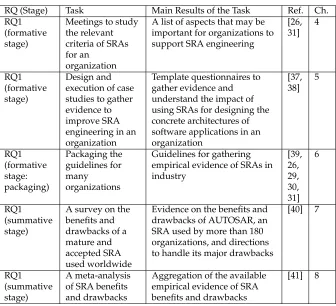
This part details our action research initiative with regard to the RQ 1 (defined in Section 1.4). To answer RQ 1, we conducted five tasks (see Table 1.2). These tasks are cycles of the action research conducted in order to answer RQ 1. Such cycles are depicted in Figure 1.3, which explains the formative stage to create the guidelines to gather relevant evidence from SRA projects (above), and how such guidelines were validated in the summative stage (below).
In the first cycle of the RQ 1, we diagnosed the need of knowing about the state of past and current SRA projects ineverisin order to reuse architectural knowledge and improve SRA engineering. As a consequence, we planned to identify a set of criteria about SRAs that are relevant for practitioners. As a result, we identified five aspects that indicate what evidence to gather in order to support SRA engineering, which are presented in Chapter 4.
In the second cycle of RQ 1, we planned to gather evidence about the aspects identified in the first cycle. We designed interview guides and on-line questionnaires to gather mostly qualitative evidence about such aspects. Then,
we executed them in a case study with several SRA projects ineveris. As a
consequence, we obtained results about whyeveris’ clients adopted SRAs, the
artifacts of SRAs, and the benefits and drawbacks of SRAs. These results are reported in Chapter 5.
With the above two tasks/cycles, which belong to the formative stage, we
shaped the template surveys to gather empirical evidence. The guidelines to gather empirical evidence of SRAs are presented in Chapter 6.
Then, at the third cycle of the RQ 1, we needed to validate these guidelines and their template surveys. We decided to execute the same survey out of our
industry-academia collaboration witheveris. Then, as part of the validation
1.5. R
esearch
M
ethodology
17Table 1.2: Tasks related to gathering empirical evidence of SRAs (RQ1).
RQ (Stage) Task Main Results of the Task Ref. Ch.
RQ1 (formative stage)
Meetings to study the relevant criteria of SRAs for an
organization
A list of aspects that may be important for organizations to support SRA engineering
[26, 31] 4 RQ1 (formative stage) Design and execution of case studies to gather evidence to improve SRA engineering in an organization
Template questionnaires to gather evidence and understand the impact of using SRAs for designing the concrete architectures of software applications in an organization [37, 38] 5 RQ1 (formative stage: packaging) Packaging the guidelines for many organizations
Guidelines for gathering empirical evidence of SRAs in industry [39, 26, 29, 30, 31] 6 RQ1 (summative stage)
A survey on the benefits and drawbacks of a mature and accepted SRA used worldwide
Evidence on the benefits and drawbacks of AUTOSAR, an SRA used by more than 180 organizations, and directions to handle its major drawbacks
[40] 7
RQ1 (summative stage)
A meta-analysis of SRA benefits and drawbacks
Aggregation of the available empirical evidence of SRA benefits and drawbacks
[41] 8
for automotive applications used worldwide by more than 180 organizations. This work has been jointly done with the University of Sao Paulo (Brazil). The results are depicted in Chapter 7.
Despite our work on the benefits and drawbacks of SRAs at everis and
Part III: The business case for SRAs (RQ2).
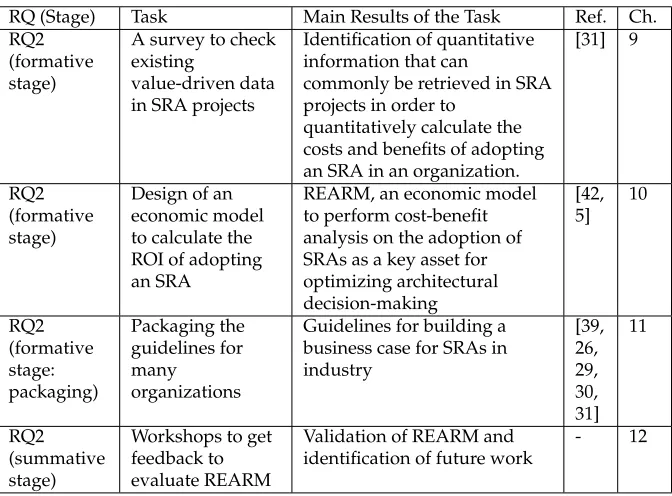
This part details our action research initiative with regard to RQ 2, which is intended to quantify the benefits and costs of SRAs through a business case. To answer RQ 2, we conducted four tasks (see Table 1.3). These tasks are cycles of the action research conducted in order to answer RQ 2. Such cycles are depicted in Figure 1.4, which explains the formative stage to create the guidelines to build the business case for SRAs (above), and how such guidelines were validated in the summative stage (below).
[image:40.499.81.417.342.590.2]In the first cycle of the RQ 2, we diagnosed the problem of the lack of ap-proaches to justify the investment on SRAs toeveris’ clients in monetary terms. As a consequence, we designed online questionnaires to ask stakeholders the metrics available in SRA projects and conducted them in several SRA projects from everis. As a result, we observed that effort metrics could be derived from time tracking practices and that cost-benefit factors could be computed
Table 1.3: Tasks related to the business case for SRAs (RQ2)
RQ (Stage) Task Main Results of the Task Ref. Ch.
RQ2 (formative stage)
A survey to check existing
value-driven data in SRA projects
Identification of quantitative information that can
commonly be retrieved in SRA projects in order to
quantitatively calculate the costs and benefits of adopting an SRA in an organization.
[31] 9
RQ2 (formative stage)
Design of an economic model to calculate the ROI of adopting an SRA
REARM, an economic model to perform cost-benefit analysis on the adoption of SRAs as a key asset for optimizing architectural decision-making [42, 5] 10 RQ2 (formative stage: packaging) Packaging the guidelines for many organizations
Guidelines for building a business case for SRAs in industry [39, 26, 29, 30, 31] 11 RQ2 (summative stage)
Workshops to get feedback to evaluate REARM
Validation of REARM and identification of future work
1.5. R
esearch
M
ethodology
19Figure 1.4: Action-research cycles of RQ 2.
by using reuse-based metrics from the source code of the SRA projects. The results from the online questionnaires to study the metrics available in SRA projects are reported in Chapter 9.
In the beginning of the second cycle of RQ 2, we diagnosed the need of ha-ving an economic model that would use the available data. Then, we identified
economic functions meaningful toeveristo justify SRA investments. We also
acronym comes from REference ARchitecture Model, an economic model to quantitatively analyze the adoption of SRAs in organizations.
The above two first tasks/cycles are in the formative stage, because their feedback contributed to incrementally design the guidelines to build a business case. For this reason, these two tasks were best characterized as formative studies due to their central role in shaping the guidelines. The guidelines to build the business case for SRAs are presented in Chapter 11.
Once the guidelines were packaged, it was necessary to validate the results got and to analyze lessons learned. The third cycle of RQ 2 is best characterized as summative, since it focus on validating the economic model and identifying further areas of improvement (see Chapter 12).
Part IV: Discussions, conclusions, and future work.
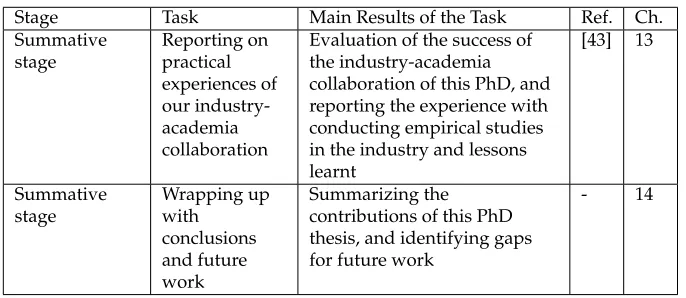
[image:42.499.78.421.357.506.2]In this part, we present the lessons learnt in our industry-academia collabo-ration, and the conclusions of this PhD thesis. The two tasks of this part are shown in Table 1.4.
Table 1.4: Tasks related to discussions and conclusions.
Stage Task Main Results of the Task Ref. Ch.
Summative stage
Reporting on practical experiences of our industry-academia collaboration
Evaluation of the success of the industry-academia collaboration of this PhD, and reporting the experience with conducting empirical studies in the industry and lessons learnt
[43] 13
Summative stage
Wrapping up with
conclusions and future work
Summarizing the contributions of this PhD thesis, and identifying gaps for future work
- 14
First, we evaluated our collaboration with an existing model for technology transfer, and performed a focus group discussion to identify challenges that we faced. The results are presented in Chapter 13.
1.6. L
ist of
P
ublications
211.6
List of Publications
This section enumerates and summarizes the work that has been published. For a better representation of the work done, in what follows, we show these publications grouped by the type of publications: journals, conferences, doc-toral symposiums, workshops, technical reports, other publications, and on-going journals (which have either been submitted or will be submitted soon).
Among the 12 peer-reviewed publications, the most notable ones are:1 JCR
indexed Elsevier journal, 1 Springer journal, 3 full-papers at the main track of CORE-A conferences, and 1 best paper award(at the ESELAW workshop).
Journals
1. S. Martínez-Fernández, X. Franch, and J. Bisbal, “Mercury: Using the
QuPreSS Reference Model to Evaluate Predictive Services,” Journal of
Science of Computer Programming (SCP), To appear [JCR 2014, Q3, IF: 0.715]. [36]
2. S. Martínez-Fernández, C. P. Ayala, X. Franch, H. Martins Marques, and D. Ameller, “Towards Guidelines for Building a Business Case and Gathering Evidence of Software Reference Architectures in Industry,”
Journal of Software Engineering Research and Development (JSERD), vol. 2, iss. 7, 2014. A SpringerOpen Journal. [31]
Conferences
1. S. Martínez-Fernández, P. S. Medeiros Dos Santos, C. Ayala, X. Franch, and G. H. Travassos, “Aggregating Empirical Evidence about the Benefits
and Drawbacks of Software Reference Architectures,” inProceedings of
the ACM/IEEE International Symposium on Empirical Software Engineering and Measurement (ESEM), 2015, pp. 154-163 [CORE2013: A]. [38] 2. S. Martínez-Fernández, C. Ayala, X. Franch, and H. Martins Marques,
“Artifacts of Software Reference Architectures: A Case Study,” in
Pro-ceedings of the 18th International Conference on Evaluation and Assessment in Software Engineering (EASE), 2014, p. 42:1-42:10. [CORE2013: A]. [38] 3. S. Martínez-Fernández, C. Ayala, X. Franch, and H. Martins Marques,
4. S. Martínez-Fernández, C. Ayala, X. Franch, and H. Martins Marques,
“Benefits and Drawbacks of Reference Architectures,” in 7th European
Conference on Software Architecture (ECSA), 2013, pp. 307-310 (research in progress short paper). [CORE2013: A]. [37]
5. S. Martínez-Fernández, J. Bisbal, and X. Franch, “QuPreSS: A Service-Oriented Framework for Predictive Services Quality Assessment,” in
7th International Conference on Knowledge Management in Organizations: Service and Cloud Computing (KMO), 2012, pp. 525-536. [34]
Doctoral Symposium
1. S. Martínez-Fernández, “Towards Supporting the Adoption of Software Reference Architectures: An Empirically-Grounded Framework,” in
11th International Doctoral Symposium on Empirical Software Engineering (IDoESE) hosted at the International Symposium on Empirical Software Engi-neering and Measurement (ESEM), 2013. [CORE2013: A]. [30]
Workshops
1. S. Martínez-Fernández, C. P. Ayala, X. Franch, and E. Y. Nakagawa, “A
Survey on the Benefits and Drawbacks of AUTOSAR,” inProceedings of
the 1st International Workshop on Automotive Software Architecture (WASA), 2015, pp. 19-26. [40]
2. S. Martínez-Fernández, C. Ayala, X. Franch, and H. Martins Marques, “Practical Experiences in Designing and Conducting Empirical Studies in Industry-Academia Collaboration,” inProceedings of the 2nd International Workshop on Conducting Empirical Studies in Industry (CESI), 2014, pp. 15-20. [43]
3. S. Martínez-Fernández, X. Franch, and J. Bisbal, “Verifying predictive services’ quality with Mercury,” in4th International Workshop on Academic Software Development Tools and Techniques (WASDeTT), 2013. [35]
4. S. Martínez-Fernández, C. Ayala, X. Franch, H. Martins Marques, and D. Ameller, “A framework for software reference architecture analysis
and review,” in Memorias del X Workshop Latinoamericano de Ingeniería
en Software Experimental (ESELAW)- ISBN 978-9974-8379-3-5, 2013, pp.
1.6. L
ist of
P
ublications
23Technical Reports
1. S. Martínez-Fernández, C. Ayala, and X. Franch, “A Reuse-Based Eco-nomic Model for Software Reference Architectures,” Departament ESSI. Universitat Politècnica de Catalunya (UPC). BarcelonaTech, ESSI-TR-12-6, 2012. [42]
2. S. Martínez-Fernández, D. Ameller, C. Ayala, X. Franch, and X. Terradel-las, “Conducting Empirical Studies on Reference Architectures in IT Con-sulting Firms,” Departament ESSI. Universitat Politècnica de Catalunya (UPC). BarcelonaTech, ESSI-TR-12-2, 2012. [39]
Other publications
1. S. Martínez-Fernández, “A Framework for Software Reference
Archi-tecture Analysis and Review,”PhD Proposal. Universitat Politècnica de
Catalunya, 2013. Advisors: Xavier Franch and Claudia Ayala. [29] 2. S. Martínez-Fernández, L. B. Ruas de Oliveira, C. P. Ayala, X. Franch, and
E. Y. Nakagawa, “Planning a Systematic Review on Business Case for
Reference Architectures,” Poster Session from Component-Based Software
Engineering and Software Architecture federated conference (CompArch), 2014. [CORE2013: A]. [32]
3. S. Martínez-Fernández, J. Bisbal, and X. Franch, “Accuracy Assessment of Forecasting Services (poster),”1st European Business Intelligence Sum-mer School (eBISS), 2011. [33]
Ongoing Journals
1. S. Martínez-Fernández, C. P. Ayala, X. Franch, and H. Martins Marques, “Benefits and Drawbacks of Software Reference Architectures: A Case Study,”ACM Transactions on Software Engineering and Methodology Journal (TOSEM),(submitted, currently under review).
2. S. Martínez-Fernández, L. Bueno, L. Garcés, C. P. Ayala, X. Franch, and E. Y. Nakagawa, “Reference Architecture Engineering: A Mapping Study,”
Journal to be decided,(to be submitted).
Empirical Evidence about the Benefits and Drawbacks of Software Refe-rence Architectures,”[38]Journal to be decided,(to be submitted).
Besides the publication of research papers, I have used my personal page
of UPC as an open science tool: http://www.essi.upc.edu/~smartinez/.
Throughout the course of this PhD thesis and as it progressed, I have up-loaded pre-prints and publications to disseminate the work. Therefore, author versions of all these publications can be downloaded from there.
1.7
Structure of this Document
The main contributions of this PhD thesis are divided in four parts (see Section 1.5.1): introduction, RQ1, RQ2, and conclusions:
1. Part I shows this introduction, basic concepts related to SRA, and an SLR with the current state-of-the-art in SRA engineering (see Table 1.1). 2. Part II presents the five tasks about gathering empirical evidence to
support the design and use of SRAs in an organization (see Table 1.2). 3. Part III discusses the four tasks related to build the business case for
SRAs (see Table 1.3).
4. Part IV presents discussions about our industry-academic collaboration, and ends up with conclusions and future work (see Table 1.4).
Chapter 2
Background
This chapter presents basic concepts related to SRA. The first section introduces the different disciplines around the concept “architecture”. The second section includes the rudiments of SRAs (i.e., definitions, types, and elements). The third section defines the boundaries of concrete architectures and product line architectures with regard to SRAs. Finally, the fourth section provides the
everisindustrial view about the types of projects and stakeholders.
2.1
Architecture Disciplines Basic Concepts
The term “architecture” has been used extensively, but not always together with software. Two architecture disciplines related to software architecture are system architecture and enterprise architecture [1]. “Asystem’s architecture
is a representation of a system in which there is a mapping of functionality onto hardware and software components, a mapping of the software architecture onto the hardware architecture, and a concern for the human interaction with these components” [1]. “Enterprise architectureis a description of the struc-ture and behavior of an organization’s processes, information flow, personnel, and organizational subunits, aligned with the organization’s core goals and strategic direction” [1].
Next, we discuss the relationships and boundaries between these three architecture disciplines, and where SRA belongs to.
2.1.1
Relationships Between Architecture Disciplines
Software architecture is different from other architecture disciplines (e.g., sys-tem architecture and enterprise architecture). The main objects of study of a software architecture are: the abstraction of a software system that consists of three components: elements, form, and rationale [44]; and the set of significant decisions about the organization of such software system [45].
However, system architecture and enterprise architecture “have broader concerns than software and affect software architecture through the establish-ment of constraints within a software system must live” [1]:
• a system architecture is concerned with a total system, including
hard-ware, software and humans [1].
• an enterprise architecture is concerned with how an enterprise’s software
systems support the business processes and goals of the enterprise [1].
To sum up, software is only one concern of system architecture and enter-prise architecture.
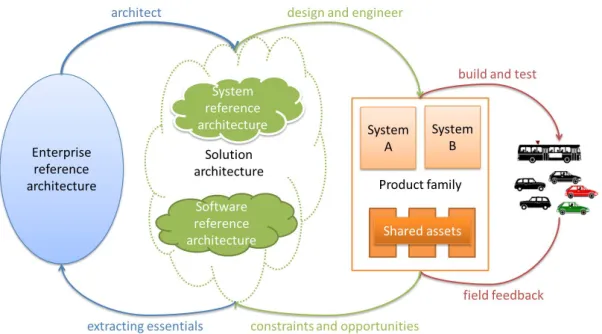
In spite of being different architecture disciplines, software architecture and system architecture share their support to software systems. Inside the context of enterprise architecture, they are indistinguishably referred to as solu-tion architectures. The Open Group Architecture Framework (TOGAF) defines a solution architecture as “a description of a discrete and focused business operation or activity and how IS/IT supports that operation. A Solution Archi-tecture typically applies to a single project or project release, assisting in the translation of requirements into a solution vision, high-level business and/or IT system specifications, and a portfolio of implementation tasks”1. Poort et al. [46] also use the term solution architecture to group various architecture “genres” with the common denominator of finding a solution to a particular set of stakeholders’ needs. Such common denominator is shared by software architecture and system architecture, so we can consider that both of them are solution architectures.
2.1. A
rchitecture
D
isciplines
B
asic
C
oncepts
272.1.2
Where Software Reference Architecture Belongs To
A reference architecture provides a prescriptive way (a template solution) for an architecture for a particular domain [47, 48, 49]. Reference architectures can be found in the aforementioned architecture disciplines, leading to:
• SRA, such as RACE [50], which addresses the engine software for
docu-ment processing systems.
• System reference architecture, such as a distributed system reference
architecture for adaptive QoS and resource management [51].
• Enterprise reference architecture, such as PERA [52], which is a complete
enterprise reference architecture as defined by the IFAC/IFIP Task Force on Enterprise Integration.
Figure 2.1 shows the relationship between software architecture, system ar-chitecture and enterprise arar-chitecture. There are three aar-chitecture disciplines: software architecture, system architecture and enterprise architecture. The so-lution architecture includes two architecture disciplines (software architecture and system architecture) as it is seen in the enterprise architecture context. SRA is a sub field inside the software architecture discipline (reference architectures are also studied in the system and enterprise disciplines).
Although all of them are different architecture disciplines, they are inter-connected, e.g., “the software architect for a system should be on the team that provides input into the decisions made about the system or the enterprise” [1]. For example, an enterprise could adopt an enterprise architecture as an strategic activity, but needs also to have a solution architecture (i.e., system ar-chitecture and/or software architecture) that deepens in the structure of a each system. This scenario is depicted in Figure 2.2. Another example is that the software architecture of a system needs to be in compliance with the system architecture (e.g., software systems’ technologies need to be compatible with the hardware architecture).
Figure 2.1: Relationship between architecture disciplines.
2.2. S
oftware
R
eference
A
rchitecture
E
ssentials
292.2
Software Reference Architecture Essentials
This section focuses on SRA and studies:
• the definition of SRA;
• the types of SRAs; and,
• the elements of SRAs.
2.2.1
Definition of Software Reference Architecture
As we have already stated in Chapter 1.1, Nakagawa et al. [2] define an SRA as “an architecture that encompasses the knowledge about how to design con-crete architectures of systems of a given application [or technological] domain; therefore, it must address the business rules, architectural styles (sometimes also defined as architectural patterns that address quality attributes in the reference architecture), best practices of software development (for instance, architectural decisions, domain constraints, legislation, and standards), and the software elements that support development of systems for that domain. All of this must be supported by a unified, unambiguous, and widely under-stood domain terminology”.
SRAs are attractive when enterprises have many software systems that have very similar structure and share a technological or business domain. Then, a common SRA to such software systems can be designed. The SRA defines a standard structure of systems.
2.2.2
Types of Software Reference Architecture
Angelov et al. [4] distinguish between five types of SRAs. They define a multi-dimensional space to classify these types of SRAs, which is composed of 3 main dimensions: context (C1), goal (G1), and design (C3). Next, all dimensions and their possible values are summarized:
• Context dimension (C)
– C1: Where will the SRA be used? Values: single organization,
multiple organizations.
– C2: Who defines the SRA? Values: software groups, user groups,
– C3: When is the SRA defined? Values: preliminary, classical.
• Goal dimension (G)
– G1: Why is the SRA defined? Values: standardization, facilitation.
• Design sub-dimensions (D)
– D1: What is described in the SRA? Values: components and
con-nectors, interfaces, protocols, algorithms, policies and guidelines.
– D2: How detailed is it described? Values: detailed, semi-detailed,
and aggregated.
– D3: How concrete is it described? Values: abstract, semi-concrete,
and concrete.
– D4: How is it represented? Values: informal, semi-formal, formal.
The values of an SRA are mutually exclusive for the G1, C1, and C3 dimension (i.e., an SRA can be attributed only one value from these sub-dimensions). It leads to five congruent types of SRAs [4]:
• Type 1) Classical, standardization SRAs to be implemented in multiple
organizations;
• Type 2) Classical, standardization SRAs to be implemented in a single
organization;
• Type 3) Classical, facilitation SRAs for multiple organizations designed
by a software organization in cooperation with user organizations;
• Type 4) Classical, facilitation SRAs designed to be implemented in a
single organization;
• Type 5) Preliminary, facilitation SRAs designed to be implemented in
multiple organizations.


![Figure 2.3: RAModel: Reference model for SRAs [13].](https://thumb-us.123doks.com/thumbv2/123dok_es/5317130.98597/53.499.80.419.116.375/figure-ramodel-reference-model-for-sras.webp)
![Figure 2.5:Similarities and differences between SRA, product line architec-tures, and software product lines [5].](https://thumb-us.123doks.com/thumbv2/123dok_es/5317130.98597/57.499.81.417.287.536/figure-similarities-dierences-product-architec-tures-software-product.webp)
