FROM CLICK CHEMISTRY TO CATALYTIC CLEAVAGE OF UNSTRAINED C-C BONDS
Míriam Sau Roca
ADVERTIMENT. L'accés als continguts d'aquesta tesi doctoral i la seva utilització ha de respectar els drets de la persona autora. Pot ser utilitzada per a consulta o estudi personal, així com en activitats o materials d'investigació i docència en els termes establerts a l'art. 32 del Text Refós de la Llei de Propietat Intel·lectual (RDL 1/1996). Per altres utilitzacions es requereix l'autorització prèvia i expressa de la persona autora. En qualsevol cas, en la utilització dels seus continguts caldrà indicar de forma clara el nom i cognoms de la persona autora i el títol de la tesi doctoral. No s'autoritza la seva reproducció o altres formes d'explotació efectuades amb finalitats de lucre ni la seva comunicació pública des d'un lloc aliè al servei TDX. Tampoc s'autoritza la presentació del seu contingut en una finestra o marc aliè a TDX (framing). Aquesta reserva de drets afecta tant als continguts de la tesi com als seus resums i índexs.
ADVERTENCIA. El acceso a los contenidos de esta tesis doctoral y su utilización debe respetar los derechos de la persona autora. Puede ser utilizada para consulta o estudio personal, así como en actividades o materiales de investigación y docencia en los términos establecidos en el art. 32 del Texto Refundido de la Ley de Propiedad Intelectual (RDL 1/1996). Para otros usos se requiere la autorización previa y expresa de la persona autora. En cualquier caso, en la utilización de sus contenidos se deberá indicar de forma clara el nombre y apellidos de la persona autora y el título de la tesis doctoral. No se autoriza su reproducción u otras formas de explotación efectuadas con fines lucrativos ni su comunicación pública desde un sitio ajeno al servicio TDR. Tampoco se autoriza la presentación de su contenido en una ventana o marco ajeno a TDR (framing). Esta reserva de derechos afecta tanto al contenido de la tesis como a sus resúmenes e índices.
DOCTORAL THESIS
From Click Chemistry to catalytic cleavage of
unstrained C-C bonds
Míriam Sau Roca
Supervised by Prof. Miquel. A. Pericàs Brondo and Prof. Ruben Martin Romo
Institut Català d’Investigació Química (ICIQ)
UNIVERSITAT ROVIRA I VIRGILI
Tarragona, 2016
Av. Països Catalans 16 Departament de Química
43007, Tarragona Analítica i Química Orgànica
Telf. 977 920 200 c/ Marcel.lí Domingo s/n
Fax. 977 920 222 Campus Sescelades
43007, Tarragona Tel. 977 55 97 69
Fax. 977 55 84 46
Prof. MIQUEL A. PERICÀS, group leader at the Institute of Chemical Research of Catalonia (ICIQ) and Prof. RUBEN MARTIN, ICREA Research Professor and group leader at the Institute of Chemical Research of Catalonia (ICIQ),
CERTIFY, that the present Doctoral Thesis entitled “FROM CLICK CHEMISTRY TO CATALYTIC CLEAVAGE OF UNSTRAINED C-C BONDS” presented by Míriam Sau Roca to obtain the degree of Doctor, has been carried out under their supervision at the Institute of Chemical Research of Catalonia (ICIQ).
Tarragona, June 2, 2016
PhD Thesis supervisors
1
Acknowledgements
Primer de tot m’agradaria donar les meves més SINCERES GRÀCIES als meus directors de tesi en Miquel i en Ruben! Miquel, mil gràcies per donar-me l’oportuntat d’aterrar a l’ICIQ i de saber què és treballar en un centre d’alt nivell com és aquest. Per permetre’m formar part del teu grup de recerca primer com a tècnica i després com a doctorant. Ha estat un gran plaer conèixe’t, tenir-te com a jefe i també poder mantenir converses sobre el Barça jejejeje! Ruben, a tu agrair-te aquest dos darrers anys de la meva tesi que de ben segur no oblidaré mai! Gràcies per acceptar-me i fer-me un lloc al teu lab tot i venir d’un altre grup. Moltísssisssimes gràcies per la teva gran ajuda en aquest tram final de la meva tesi i per deixar-me-la escriure des de casa i no haver d’agafar la Renfe cada dia!Moltes gràcies a tots dos!
2
La gent del grup del Rubén que tot i incorporar-me al Martin group a la meitat de la meva tesi i viure a Barcelona em van acollir des del primer dia i m’han fet sentir una més del grup des del minut 0. A l’Areli, a l’Asraa, a lAlvaro, a la Caye, a la Elo, al Francisco, al Xue, al Xiang-Wei, al Daniel, al Marino, al Yangyang, a l’Andreu, a la Rosie i al Masaki donar-vos les gràcies!! Agrair a l’Arkaitz per totes les converses i tots els moments divertits, però plens de caràcter eh!!! Morgane i Toni agrair-vos la bona connexió que he tingut amb vosaltres i també el fer-me més fácil el dia a dia al lab. Pep Cornellà conjuntament amb en Toni M, quines converses de futbol i de política més apassionants i quantes òsties que us heu endut per encardar-vos-en de mi eh!!! jejejejejeje. Ingrid tot i que ens vam conèixer no fa massa temps, ha estat més que suficient per establir una conexión diferent, agrair-te tota l’ajuda relacionada amb la paperassa de la tesi però també tots els moments de riures i de xerrades durant l’hora de dinar.
No vull deixar de nombrar la Ferreres amb qui no he perdut el contacte i no deixaré que mai el perdem! Només agrair-te tota la teva ajuda amb les anàlisis però sobretot amb aquelles converses inoblidables i per sempre. ;)
A la Lídia, aquella amiga que sempre hi és! Moltes gràcies!
Agrair a la meva nova família, a la Fina, a en Juani, a la Iaia Rossita, a l’Avi Joan, a la Iaia Isabel, a l’avi Tino, a l’Anna M, a en Jordi, a en Roger, a la Georgina i evidentment a l’Afra i a l’Isaac per haver-me acollit tant bé, per haver-me ajudat i donat soport durant aquests anys.
Al meu tiet Pini per està amb mi i per ajudar-me quan el necessito.
3
sempre em tindràs! A la Mònica, que tot i ser molt diferents, l’estimo infinit i que ja sap que aquí estic per tot el que necessiti! A l’Òscar cunyat, moltes gràcies per estar sempre al costat de la meva germana i de les nenes i formar part de la meva family! A les meves xinxetes (els meus amors, els meus sols!) que tot i que són molt petites és indescriptible el que les arribo a necessitar! Juguem?? Les estimo infinit i sense elles saber-ho m’han ajudat com el que més!!
4
Abbreviations
AAC Alkyne and azide cycloaddition
CuAAC Copper alkyne and azide cycloaddition
t-BuOH tert-butanol
DMF Dimethylformamide
MeCN Acetonitrile
THF Tetrahyfrofuran
DCE Dichloroethane
TBHP tert-butyl hydroperoxide
MW Microwave irradiation
rt room temperature ( approx 22-25ºC)
TMS Trimethyl silyl ether
δ Chemical shift
J Coupling constant
CDCl3 Deuterated chloroform
d Doublet
s Singulet
t Triplet
m Multiplet
NMR Nuclear magnetic resonance
ppm Parts per million
PPTS Pyridinium p-toluenesulfonate
mCPBA Meta-chloroperbenzoic acid
NaClO2 Sodium chlorite
5
Publications
1) Copper-free Intramolecular Alkyne-Azide cycloadditions leading to seven membered heterocycles.
Sau, M.; Escrich. C. R.; Pericàs, M. A. Org. Lett. 2011, 13, 5044-5047.
2) Palladium catalyzed arylative functionalization of unsatrained bonds of 1,2-amino alcohols.
6
Table of Contents
Acknowledgements ... 1
Abbreviations ... 4
Publications ... 5
Chapter 1: General introduction to Click Chemistry ... 9
1.1 Triazole as essential scaffold ... 10
1.2 Click Chemistry concept ... 11
1.3 Cu(I)-catalyzed 1,3-dipolar cycloaddition between an alkyne and an azide (CuAAC) ... 13
1.3.1 Proposed mechanism for CuAAC ... 16
1.4 Ru(II)-catalyzed 1,3-dipolar cycloaddition between an alkyne and an azide (RuAAC) ... 19
1.4.1 Proposed mechanism for RuAAC ... 21
1.5 Drawbacks for Click Chemistry ... 22
1.6 Cu(I)-stabilization through protecting ligands ... 23
1.7 Copper-free alkyne-azide cycloaddition for biological applications ... 26
1.7.1 Copper-free intermolecular processes ... 26
1.7.2 Copper-free intramolecular processes ... 31
Chapter 2: Copper-free intramolecular alkyne-azide cycloaddition ... 37
2.1 Objectives ... 38
2.2 Benzodiazepines and their derivatives ... 39
2.3 Results and discussions ... 40
2.3.1 Synthesis of the model substrate ... 41
2.3.2 Optimization of the reaction conditions with 54 ... 41
2.3.3 Synthesis of different internal alkynes ... 43
2.3.4 Scope with different internal alkynes ... 44
2.3.5 Synthesis of starting materials containing nitrogen and sulfur ... 45
2.3.6 Scope with starting materials containing nitrogen and sulfur ... 49
2.3.7 Expanding the scope with larger size heterocycles ... 50
2.4 Conclusions ... 52
2.5 Experimental section ... 53
2.5.1 General considerations ... 53
2.5.2 Synthesis of starting materials ... 53
2.5.3 Isolated intermediate ... 64
7
2.5.5 Selected NMR spectra ... 73
2.5.6 X-Ray crystallographic data for 70 ... 80
Chapter 3: General introduction to C-C bond cleavage ... 81
3.1 Introduction to C-C bond cleavage ... 82
3.2 Stoichiometric approaches for the activation of C-C single bonds ... 84
3.3 Catalytic approaches for the activation of unstrained C-C single bonds ... 94
3.3.1 Chelation assisted transformations ... 94
3.3.2 Polarized C-C single bonds ... 101
Chapter 4: Palladium catalyzed cross-coupling reaction of phenyl(piperidin-1-yl) carbanions with aryl halides ... 111
4.1 Objectives ... 112
4.2 β-Amino alcohols as useful scaffolds for organic synthesis ... 113
4.3 General overview for the obtention of α-amino carbanions ... 118
4.4 Results and discussions ... 123
4.4.1 Synthesis of 1,2-amino alcohols ... 124
4.4.2 Study of the fragmentation of 1,2-amino alcohols ... 126
4.4.3 Alkylation of α-amino carbanion with benzyl bromide ... 132
4.4.4 Pd-catalyzed cross-coupling reaction with 153 ... 135
4.5 Conclusions ... 146
4.6 Experimental section ... 147
4.6.1 General considerations ... 147
4.6.2 Synthesis of β-amino alcohols ... 148
4.6.3 Fragmentation reaction ... 151
4.6.4 Alkylation reaction with benzyl bromide ... 152
4.6.5 Pd-catalyzed cross-coupling reaction of phenyl(piperidin-1-yl) carbanion with aryl halides ... 153
Chapter 5: Formal β-arylation of aldehydes via Pd-catalyzed C-C bond cleavage of 1,2-amino alcohols ... 154
5.1 Objectives ... 155
5.2 Retroallylation in C-C bond cleavage strategies ... 156
5.2.1 Catalytic transformations using retro-allylation techniques ... 158
5.3 Results and discussions ... 165
5.3.1 Optimization of the reaction conditions ... 166
8
5.3.3 Formal obtention of α,β-functionalized aldehydes via Pd-cat. C-C bond cleavage of 260 followed by
enamine alkylation ... 185
5.3.4 Enantioselective β-arylation of aldehydes via C-C bond cleavage of N-allyl amino alcohols ... 188
5.4 Conclusions ... 198
5.5 Experimental section ... 199
5.5.1 General considerations ... 199
5.5.2 Synthesis of N-allyl 1,2-amino alcohols ... 199
5.5.3 Blank experiments ... 209
5.5.4 Synthesis of β-arylated aldehydes ... 210
5.5.5 Enamine alkylation; synthesis of α,β-functionalized aldehydes (one pot procedure) ... 222
5.5.6 Seleted NMR spectra ... 225
5.5.7 Selected HPLC analysis ... 244
9
10
1.1 Triazole as essential scaffold
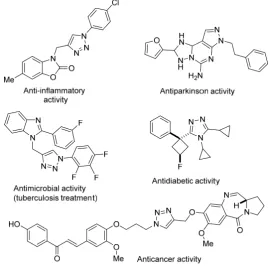
Nowadays it is known that Nature is able to carry out from the simplest to the most challenging transformation in an efficient and straightforward manner. It is the most perfect chemist there will ever be because it has the ability to perform and to control an astonishing range of chemical reactions in a very selective way using extremely efficient catalysts. This notion has arisen an interest within the scientific community to try and mimic Nature’s approach to chemical synthesis. Although the formation of the C-C bond is the most widely applied process by Nature and consequently one of the most studied processes by humans, the creation of the C-heteroatom bonds is a close competitor in the field of organic chemistry. C-Heteroatom bond making strategies are essential for the building of biomolecules. Particularly, the presence of N-heterocyclic compounds is really abundant in drugs and biological natural products such as amino acids (proline or histidine), pyrimidines or purines among others. In particular, triazoles are one of the most relevant and well known heterocycles present like vital structural motive in many of different drug categories such as anti-inflammatory, analgesic, antihypertensive or antiparkinson among many others (Figure 1.1).1 This broad and potent biological activity2 is the reason why, still nowadays, they are extensively investigated. In addition to their powerful pharmacological activity, they are also used in a wide range of
1 a) Kharb, R.; Sharma, P. C.; Yar, M. S. J. Enzym. Inh. Medic. Chem. 2011, 26, 1-21. b)
Almerico, A.; Barone, G.; Martorana, A.; Terenzi, A.; Mingoia, F.; Delisi, R.; Lauria, A.
Eur. J. Org. 2014, 3289-3306.
2 a) Alvarez, R.; Velázquez, S.; Félix, A.; Aquaro, S.; Clercq, R.; Perno, C.; Karlsson, A.;
Balzarini, J.; Camarasa, M. J. Med. Chem. 1994, 37, 4185-4194. b) Velázquez. S.; Alvarez, R.; Pérez, C.; Gago, F.; Clercd, E.; Balzarini, J.; Camarasa, M. Antivir. Chem. Chemother.
11
[image:22.595.161.432.121.396.2]industrial applications like dyes, corrosion inhibition, photostabilization or agrochemicals.3
Figure 1.1
1.2 Click Chemistry concept
Different strategies are reported in the literature for the synthesis of triazoles.4 Among them, the 1,3-dipolar cycloadditions between an azide and an alkyne is the most widely used. This reaction was discovered at the beginning of 20th century but it was not until 1960’s that Huisgen and co-workers proposed a more accurate mechanism.5 Theoretically, 1,3-dipolar cycloadditions could provide a wide variety of functionalized
3 Fan, W. Q.; Katritzky, A. R. In comprehensive heterocyclic chemistry II. Elsevier Science:
Oxford, 1996, 4, 1-126.
12
membered heterocycles combining a 1,3-dipole with a dipolarophile to form an uncharged five-membered ring (Figure 1.2).
Figure 1.2
An important set of 1,3-dipoles are described in the literature6 but without any doubt the azide functional group is the most relevant and commonly used in combination with an alkyne (Figure 1.3).
Figure 1.3
Even though this is a very efficient and straightforward methodology for the preparation of triazoles, associated drawbacks like the lack of regioselectivity (mixtures of 1,4 and 1,5 regioisomers are normally obtained), the need of long reaction time and also the use of high temperatures blocked its application until the beginning of the present century.
In 2001, the group of Sharpless reported the Click Chemistry concept.7 This term is again an inspiration from the nature and is based in a rapid assembly of potential interesting compounds. Aside from straightforward reactions, Click Chemistry transformations must meet a set of requirements. According with the definition of Sharpless, all transformations included in the Click Chemistry concept should be carried out with:
- Available starting materials
- Simple reaction conditions (not sensitive to water or oxygen)
6 Huisgen, R. Angew. Chem. In. Ed. 1963, 2, 565-632.
13 - Without the use of protecting group And the reaction should be:
- Modular
- Wide in reaction scope - With high yields
and only inoffensive by-products, easily removable by crystallization or distillation, should be formed.
Different methodologies are included in the Click Chemistry field such as addition to multiple carbon-carbon bonds (epoxidation, dihydroxylation or aziridination), nucleophilic ring opening reactions of strained heterocycles (epoxides, aziridines), non-aldol carbonyl chemistry like formation of ureas, thioureas or hidrazones and cycloaddition reactions like Diels Alder or 1,3-dipolar cycloadditions. 8
1.3 Cu(I)-catalyzed 1,3-dipolar cycloaddition between an alkyne and an azide (CuAAC)
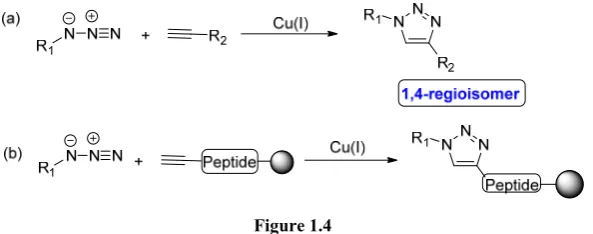
In 2002, Sharpless9 and Meldal10 independently found out that Cu(I) is able to catalyze 1,3-dipolar cycloadditions reactions between an azide and an alkyne (Figure 1.4). This fact implied the development of a very general and useful tool for organic chemists and it contributed to the popularization of the Click Chemistry concept. This Cu(I)-catalyzed azide-alkyne cycloaddition (CuAAC) provides 1,4-substituted triazoles with complete regioselectivity and is by far the most used and representative reaction belonging to Click Chemistry (to the point that both concepts tend to be mixed up in the recent literature). Meldal reported the synthesis of peptidotriazoles on solid support via Cu(I)-catalyzed 1,3-dipolar
8 Kolb, H. C.; Finn, M. G.; Sharples, K. B. Angew.Chem. Int. Ed. 2001, 40, 2004-2021. 9 Rostovtsev, V. V.; Green, L. G.; Fokin, V. V.; Sharpless, K. B. Angew.Chem. Int. Ed. 2002,
41, 2596-22599.
14
[image:25.595.151.448.138.255.2]cycloaddition of an azide and a peptide previously functionalized with an alkyne moiety (Figure 1.4 (b)).
Figure 1.4
15
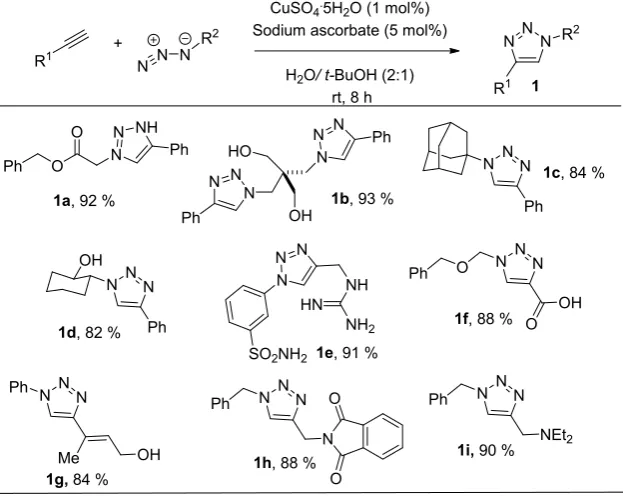
Figure 1.5
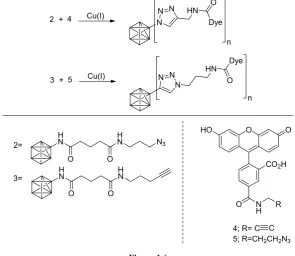
Despite the initial reluctance to use azides, probably because of safety concerns associated with their handling, nowadays they are the most popular moiety to carry out 1,3-dipolar cycloadditions. Azide functionality is special because it is stable towards water, oxygen, the most common reaction conditions (wide variety of solvents and temperature) and even inside the living cells. Both azide and alkyne, are not present in nature, they are very selective in terms of reactivity and it is really easy to introduce them into organic compounds. In this manner, exclusive reaction sites are created for further transformations. This is especially interesting when working with complex biological systems. Sharpless in 2003, reported the introduction of azide or alkyne functionalities in the coat protein of CPMV (cowpea mosaic virus, a plant virus) 2 or 3. They followed the degree of functionalization through the fluorescein derivatives obtained after the click
R1 +
N N N R2
CuSO4.5H2O (1 mol%)
Sodium ascorbate (5 mol%)
H2O/ t-BuOH (2:1) rt, 8 h
N N
N R2
R1 Ph O O N NH N Ph N N N N N N Ph Ph OH HO
N NN
Ph
N NN
Ph OH
1a, 92 % 1b, 93 %
1c, 84 %
1d, 82 %
N N N NH HN NH2
SO2NH2 1e, 91 %
NNN
1f, 88 % O OH O
Ph
NNN
1g,84 % Me Ph
OH
NNN
N O
O Ph
1h, 88 %
NNN
NEt2
Ph
16
[image:27.595.149.445.140.396.2]reaction with the corresponding counter partner 4 or 5 (Figure 1.6). 11 They demonstrated that this methodology is also reliable for complex and real systems.
Figure 1.6
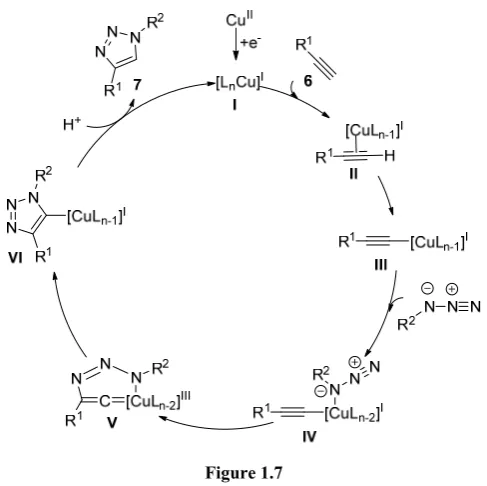
1.3.1 Proposed mechanism for CuAAC
Some time later, the same group reported a propousal stepwise mechanism for the CuAAC.12
11 Wang, Q.; Chan, T. R.; Hilgraf, R.; Fokin, V. V.; Sarpless, K. B.; Finn, M. G. J. Am.
Chem. Soc.2003, 125, 3192-3193.
12 Himo, F.; Lovell, T.; Hilgraf, R.; Rostovtsev, V. V.; Noodleman, L.; Sharpless, K. B.;
Fokin, V. V. J. Am. Chem. Soc.2005, 127, 210-216. H N O H N O N3 H N O H N O
2 + 4 N
N
N HN O
Dye
n
3 + 5
N N N HN n Dye O 2= 3= O
CO2H
O
N H
O R
HO
4; R= C 5; R=CH2CH2N3 Cu(I)
Cu(I)
17
Figure 1.7
18
Later, further mechanistic investigation from the same group and others exposed that this reaction apparently elapses through dinuclear or tetranuclear Cu(I) species.13 Indeed, the facility of copper to form aggregates is well known. Straub showed that the cycloaddition through a hypothetical mononuclear Cu-complex (Figure 1.8 (black pathway)) is disfavored because it entails much higher energetic barriers than the one obtained with the hypothetical polynuclear copper intermediates (Figure 1.8 (blue pathway)).13c
Figure 1.8
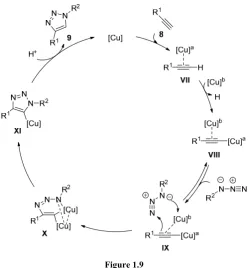
In 2013, Fokin et al. made a step further and proposed another catalytic cycle based on dinuclear copper species (Figure 1.9). The authors
13 a) Rodionov, V.V.; Fokin, V. V.; Finn. M. G. Angew.Chem. Int. Ed. 2005, 44, 2210-2215.
b) Ahlquist. M.; Fokin, V.V. Organometallics2007, 26, 4389-4391. c) Straub, B. F. Chem. Commun. 2007, 3868-3870.
Free Gibbs Energy [KJ mol-1] 298 K
19
[image:30.595.173.424.193.462.2]demonstrated that the two copper atoms have different roles in the course of the reaction. They proposed first formation of σ-bond Cu-acetylide complex followed by the incorporation of the second copper atom through π-interaction forming the catalytic active species VIII. Subsequently, azide coordination to the triple bond takes place followed by the stepwise annulation events to obtain the triazole 9.14
Figure 1.9
1.4 Ru(II)-catalyzed 1,3-dipolar cycloaddition between an alkyne and an azide (RuAAC)
Shortly after the impressive success of Cu(I)-catalyzed cycloaddition of alkynes and azides to afford 1,4-disubstituted 1,2,3-triazoles, the same
20
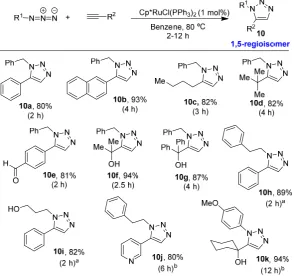
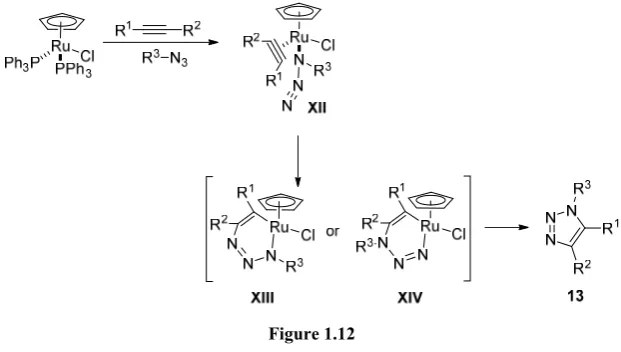
[image:31.595.152.447.121.397.2]group reported the obtention of the other regioisomer (1,5-disubstituted triazoles) using the Cp*RuCl(PPh3)2 complex as a catalyst (Figure 1.10).15
Figure 1.10
As shown in Figure 1.10, this transformation has also a wide substrate scope. Aryl and alkyl azides as well as different alkynes were successfully employed. Also different functional groups were well tolerated.
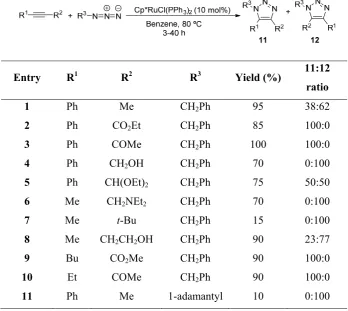
The same publication features one example with the use of an internal alkyne, but the scope with such species would be widely extended in a paper reported by Weinreb16 in 2006. Therein, the cycloaddition reaction
15 a) Zhang, Li.; Chen, X.; Xue, P.; Sun, H. H. Y.; Williams, I. D.; Sharpless, K. B.; Fokin,
V. V.; Jia, G. J. Am. Chem. Soc.2005, 127, 15998-15999.
21
with a wide set of internal alkynes is reported, affording in general good regioselectivities (Figure 1.11).
Entry R1 R2 R3 Yield (%) 11:12
ratio
1 Ph Me CH2Ph 95 38:62
2 Ph CO2Et CH2Ph 85 100:0
3 Ph COMe CH2Ph 100 100:0
4 Ph CH2OH CH2Ph 70 0:100
5 Ph CH(OEt)2 CH2Ph 75 50:50
6 Me CH2NEt2 CH2Ph 70 0:100
7 Me t-Bu CH2Ph 15 0:100
8 Me CH2CH2OH CH2Ph 90 23:77
9 Bu CO2Me CH2Ph 90 100:0
10 Et COMe CH2Ph 90 100:0
[image:32.595.123.472.122.433.2]11 Ph Me 1-adamantyl 10 0:100
Figure 1.11
1.4.1 Proposed mechanism for RuAAC
22
Figure 1.12
1.5 Drawbacks of Click Chemistry
Despite the fact that CuAAC has very important practical advantages such as the mild temperatures required for reactions, wide range of pH tolerance, broad substrate scope and high chemoselectivity, among others, it has also some associated disadvantages. The most important are the following:
1. Azide and alkyne have to be introduced into the target molecules when working in a biological field. Unlike the case of amines or carboxylic acids, azides and alkynes are hardly found in Nature.
2. Instability of the copper catalysts.17 Copper(I) in aqueous solution is unstable toward disproportionation, which leads to inactive Cu(0) and Cu(II) species. It is also known that copper(I)-complexes are oxidized to Cu(II) and really reactive oxygen species such as peroxides or hydroxyl radicals. This can result, on the one hand, in a loss of active Cu(I) complex, although it has already been mentioned that some reducing agents like sodium ascorbate are added to reduce the obtained Cu(II) species. On the other hand, and probably the most important inconvenient, the formation of
17 a) Simons, M. G. et al. J. Chem. Soc., Dalton Trans. 1980, 1827-1838. b) Merrill, C. L. et
23
extremely reactive oxygen species is an issue, since they are able to oxidize an important variety of molecules like biomolecules.
3. Copper toxicity is also a remarkable drawback when biological systems are employed. It is well known that copper is cytotoxic in micromolar concentration. Despite the fact that a lot of applications have been developed with Click Chemistry methodology, the toxicity of copper has been a significant handicap for medicine and biological applications.
1.6 Cu(I)-stabilization through protecting ligands
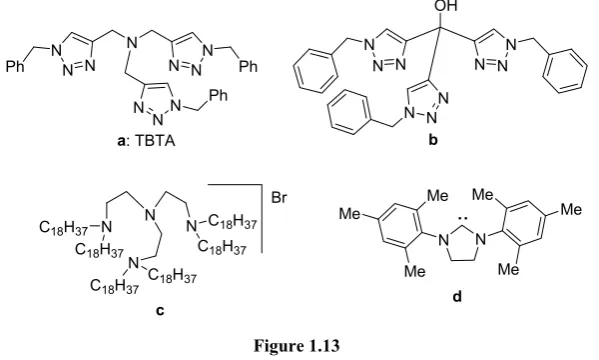
[image:34.595.149.449.315.495.2]With the aim of solving this problem, organic chemists have developed better catalytic systems with the use of different ligands to try to stabilize Cu(I) against oxidation (Figure 1.13).18-24
Figure 1.13
In 2004, the group of Sharpless studied the metal binding character of different ligands as well as their catalytic activity. They realized that polytriazole species could enhance the reactivity at the same time that Cu(I) was better protected in front of oxidation. Among all ligands tested, tris -(benzyltriazolylmethyl) amine (TBTA) (a in Figure 1.13) exhibited the best results in terms of reactivity and stability. Probably, their tetradentate binding ability occupying all possible coordination sites, is the responsible
N
N NN
N NN N
N N Ph
Ph Ph
N N N
C18H37
C18H37
C18H37
C18H37
N C18H37
C18H37
OH
N N N N
N N
N NN
a: TBTA b
24
[image:35.595.206.394.254.350.2]for the Cu(I) stabilization.18 Shortly after, mechanistic insights were reported revealing that in this case the prediction of the process was even more difficult that in the previous case (CuAAC without stabilizing ligands). The rate of the reaction depens on a lot of variables such as concentration of the ligand and the Cu(I), the binding affinity and the lability of the copper complexes among others.19 More recently, the X-ray structure of Cu(I)-TBTA was reported showing a dimeric copper species (Figure 1.14). It is shown that the tertiary amine is not directly attached to the Cu atom and one triazole is the bridge between both copper atoms.20
Figure 1.14
The group of Nolan also proved that [(IMes)CuBr] is also a reliable catalyst for CuAAC (d Figure 1.13). This catalyst meets all requirements of Click Chemistry. The excellent yields and extremely high reactivities together with the fact that this catalyst is useful both for terminal and for internal alkynes make it is a strong competitor for TBTA.21 The following year, Straub et al. isolated and characterized a mononuclear Cu complex proving that at least in this case a mononuclear copper intermediate is possible for CuAAC (Figure 1.15).22
18 Chan, T. R.; Hilgraf, R.; Sharplese, K. B.; Fokin, V. V. Org. Lett. 2004, 6, 2853-2855. 19 Rodionov, V. O.; Presolski, S. I.; Díaz, D. D. Fokin, V. V.; Finn, M. G. J. Am. Chem. Soc.
2007, 129, 12705-12712.
20 Dannelly, P. S.; Zanatta, S. D.; Zammit, S. C. White, J. M.; Williams, S. J. Chem.
Commun. 2008, 2459-2461.
25
Figure 1.15
Tetradentate tripodal ligands (c in Figure 1.13) are another class of copper stabilizing agent. Their higher stability allows their preparation in open air conditions, improving other ligands where an in situ preparation is required. It has been shown that [Cu(C186tren)]Br (c in Figure 1.13) is also useful for internal alkynes, in addition to terminal ones.23
Our group has also developed a ligand with a powerful complexing character for Cu(I) (b in Figure 1.13). The ligand contains two well differentiated parts: a hydrophilic zone established by a hydroxyl group and the rest of the ligands possessing more strong hydrophobic character. The hydroxyl provides good conditions to work in water, as well as an anchoring point. This fact allows attaching the catalyst onto polymeric supports offering the possibility of easy recovering of the catalyst. This catalyst can also be easily fine-tuned by changing the nature of the azide and alkyne in a simple and efficient CuAAC reaction.24
23 Candelon, N.; Lastécouères, D.; Diallo, A. K.; Aranzaes, J. R.; Astruc, D.; Vincent, J. M.
Chem. Commun. 2008, 741-743.
24 a) Özçubukçu, S.; Ozkal, E.; Jimeno, C.; Pericàs. M. A. Org. Lett. 2009, 11, 4680-4683. b)
26
1.7 Copper-free alkyne azide cycloaddition for biological applications
The previously mentioned toxicity of copper has prevented the development in vivo applications of Click Chemistry like labeling of biomolecules or monitoring cell processes. We have previously shown that this can be partially controlled and improved by using some Cu-stabilizing ligands that prevent the interaction of the copper with the biological system (section 1.6). However, the ideal approach should consist in the development of copper free methodologies useful for in vivo applications. Recently, different possibilities have been reported using 1,3-dipolar cycloaddition reactions between an azide and an alkyne without the use of copper. Different inter- and intramolecular proposals have been developed, which are compatible with biological and medicinal chemistry.
1.7.1 Copper-free intermolecular processes
Indeed Huisgen was the pioneer for 1,3-cycloaddition reaction but the need of too high temperatures blocked the development of this methodology in 1960’s. In 2004, the group of Bertozzi, reported the use of the Cu-free AAC for the selective modification of biomolecules and labeling of live cells. On the one hand, they synthesized biotinylated cyclooctyne 14 and, on the other, the modified GlyCAM-Ig (15;protein from Chinese hamster ovary cells) for the further AAC reaction (Figure 1.16). They realized that with the use of strained alkynes the AAC was viable (faster than with a terminal alkyne) and a good alternative to Cu(I) catalysis for biological systems without apparent cytodamage.25
25 a) Agard, N. J.; Prescher, J. A.; Bertozzi, C. R. J. Am. Chem. Soc. 2004, 126,
27
Figure 1.16
Although the transformation was feasible, the reaction was not fast and sensitive enough for useful applications (sensitivity is described as the number of azides that are reacted in a period of time). To try to circumvent these drawbacks, the same group reported that the introduction of electron withdrawing fluorine atoms in the propargylic position of the cyclooctyne (DIFO, (16)) accelerated up to 63 times the rate of the reaction, compared with the simple cyclooctyne (Figure 1.17).26 The combination of ring strain and electron withdrawing groups in the adjacent carbon of the alkyne produce a drastic energy decrease in the LUMO of the alkyne, favoring the cycloaddition.
26 a) Agard, N. J.; Baskin, J. M.; Prescher, J. A.; Lo, A.; Bertozzi, C. R. Chem. Biol. 2006, 1,
28
Figure 1.17
The in vivo labelling of molecules such as glycans, lipids or proteins in more complex systems like living cells is essential for biological chemistry (Figure 1.18). One known and useful approach is called biorthogonal reporter strategy.26a It consists in the introduction of the reporter (azide group) through metabolic strategies or chemical transformations and then the covalent labelling of the reporter with a probe through a selective reaction like cycloaddition with the proper cyclooctyne (e.g. DIFO). Azides are the most widely used chemical reporters because of their small size and metabolic stability. This technique helps in the labeling of targets in vivo without the requirement of genetic manipulation. Following this procedure, the Bertozzi group labeled living cells of mice and living zebrafish as well as different types of biomolecules such as glycans or lipids. They introduced the azide through the metabolism due to their stability and lack of reactivity with natural biofunctionalities. Then, labelling through 1,3-dipolar cycloaddition reaction with the strained cyclooctynes like DIFO produced a system ready to be visualized (Figure 1.18).27
27 a) Chang, P. V.; Prescher, J. A.; Sletten, E. M.; Baskin, J. M.; Miller, I. A.; Agard, N. J.;
29
Figure 1.18
Nevertheless, this approach is not free of inconvenients: the labeling agent requires a long synthesis and low yields are obtained. Other strategies have been reported in the literature improving the alkyne moiety for the cycloaddition. In the first one, the cyclooctyne is fused with two phenyl rings with the purpose that the aromaticity of the arenes rings could enhance the reactivity of the cycloalkyne (Figure 1.19 a). The second one is a combination of DIFO and the previous one (Figure 1.19 b). It has two fluorine atoms in the carbon adjacent to the alkyne and also contains one fused benzene ring. And in the last case (Figure 1.19 c), the cyclooctyne possesses an amido group fused with two benzene rings. These molecules are termally stable, much more reactives in front of azides than simple cyclooctyne and their syntheses are easier. 28 In spite of the great
28 a) Chenoweth, K.; Chenweth, D.; Goddard III, W. A. Org. Biomol. Chem. 2009, 7,
5255-5258. b) Ning, X.; Guo, J.; Wolfert, M. A.; Boon, G. Angew. Chem. In. Ed. 2008, 47, 2253-2255. c) Jewett, J. C.; Sletten, E. M.; Bertozzi, C. R. J. Am. Chem. Soc. 2010, 132, 3688-3691. d) Codelli, J. A.; Baskin, J. M.; Agard, N. J.; Bertozzi, C. R. J. Am. Chem. Soc. 2008,
30
improvement achieved, these reagents have not found general application up to date. In any case, it seems easy to predict that they will play a central role in an interesting methodology for further in vivo applications in the field of biochemistry.
Figure 1.19
[image:41.595.181.419.156.233.2]In 2010, the group of Ma reported another copper-free strategy in the solid state (Figure 1.20).29 They exploited the known arene-perfluoroarene interactions to facilitate the 1,3-dipolar cycloaddition reaction at room temperature. Displaying the corresponding azide and alkyne in the proper position allows the 1,3-dipolar cycloaddition reaction to take place with high levels of regioselectivity towards the 1,4-triazole product. This strategy was based in an imine linkage between both arene rings, which upon hydrolysis gave rise to the triazole monomer product.
Figure 1.20
These transformations based on supramolecular interactions will offer new ways to control and promote chemical reactions.
31
1.7.2 Copper-free intramolecular processes
Intramolecular cycloadditions belong to a type of essential transformations.30 They represent a really versatile strategy, providing a huge range of fused rings. Different approaches have been developed to force the cycloaddition reaction such as the use of a catalyst or high temperatures among others. The spatial distribution is another resource available that can facilitate the cycloaddition by avoiding the activation entropy related with intermolecular processes. Targets functional groups, in this case, an azide and an alkyne are already installed in the proper position to favor the reaction (Figure 1.21). An increase in the reaction rate is produced due to the more facile interaction between both functional groups when they are tethered to the same backbone.
[image:42.595.210.387.394.486.2]In 1993, the group of Sharpless reported a work based on intramolecular 1,3-dipolar cycloaddition reactions between an azide and an alkyne in a simple chemical system (Figure 1.21). In this case both functional groups were linked to a benzene ring in o-position through two different arms. 31
Figure 1.21
They also studied the steric effect of different substitution patterns, observing different result in the rate of the reaction. Having both arms in close proximity (o-substituted) together with the fact that R1 and R2 do not allow their free rotation, enhanced the reaction rate through some kind of Thorpe-Ingold effect.
32
[image:43.595.135.464.164.299.2]The group of Hotha reported an intramolecular 1,3-dipolar cycloaddition reaction on carbohydrates. Sugar derivatives bearing either an azide or an alkyne functionality undergo the 1,3-dipolar cycloaddition reaction affording the corresponding chiral fused polycyclic triazole (Figure 1.22).32
Figure 1.22
In 2006, the group of Eycken, reported the synthesis of bisbenzocyclooctadiene-aza analogues of (–)-Steganacin, (–)-Steganone displaying high antileukemic activity (Figure 1.23).
Figure 1.23
They proposed an approach for the synthesis of Steganacin and Steganone 7-aza derivatives (26-27) (Figure 1.24). This methodology consists in (a) Suzuki-Miyura coupling, (b) proper introduction of the azide and the alkyne moieties in the resulting biaryl and (c) the cycloaddition reaction.33
32 Natu, A. A.; Anegundi, R. I.; Hotha, S. Tetrahedron Lett. 2005, 4585-4588. b) Anegundi,
R. I.; Puranki, Puranik, V. G.; Hota, S. Org. Biomol. Chem. 2008, 6, 779-786.
33 Beryozkina, T.; Appukkuttan, P.; Mont, N.; Eyecken, E. V. Org. Lett. 2006, 8, 487-490.
O O O O OAc H H MeO MeO MeO O O O O H H MeO MeO MeO O
(-)-Steganacin,24 (-)-Steganone,25
N NN
MeO MeO
Aza-derivatives of (-)-Steganacin26and (-)-Steganone27
Ph R2
[image:43.595.144.452.332.477.2]33
Figure 1.24
Although the synthesis is not straightforward they realized that the use of microwave irradiation enhanced both the rate of the Suzuki-Miyaura reaction and the rate of the 1,3-dipolar cycloaddition.
In 2008, our group published another intramolecular 1,3-dipolar cycloaddition reaction in the absence of copper.34 This strategy started from the corresponding pyrrolidine-fused epoxide 28 followed by azidolysis (29), propargylation of the resulting alcohol 30 and finally intramolecular cycloaddition (31) (Figure 1.25). The sequence could be easily adapted to the preparation of enantiopure tricyclic systems by performing a Jacobsen-type desymmetrization of the starting meso epoxide 28.
Figure 1.25
One year later, the group of Datta reported a similar investigation, using Boc-protected propargylamines instead of propargylic ethers.35 They carried
34 Oliva, A. I.; Christmann, U.; Font, D.; Cuevas, F.; Ballester, P.; Buschmann, H.; Torrens,
A.; Yenes, S.; Pericàs, M. A. Org. Lett. 2008, 10, 1617-1619.
35 Li, R.; Jansen, D. J.; Datta, A. Org. Biomol. Chem. 2009, 7, 1921-1930.
R1
R2
N NN R4
R3
R5
R1
N3 R 5 R4 R3 R2 R1 OH R2 O O B(OH)2 Br OH R2 R1 MW MW
(a) (b)
[image:44.595.147.453.403.510.2]34
[image:45.595.137.464.120.267.2]out a systematic research providing an important set of new heterocycles (Figure 1.26).
Figure 1.26
In the same year, Taddei and co-workers, presented a microwave assisted intramolecular 1,3-dipolar cycloaddition reaction on propargyl α-azido amides 35 (Figure 1.27).36
Figure 1.27
Almost simultaneously, the group of Lamaty described a sequential azidation, alkylation and intramolecular cycloaddition process starting from SES-protected aza-Baylis-Hillman β-amino ester 37 (Figure 1.28).37
36 Balducci, E.; Bellucci, L.; Petricci, E.; Tafi, A.; Taddei, M. J. Org. Chem. 2009, 74,
1314-1321.
37 Declerck, V.; Toupet, L.; Martinez, J.; Lamaty, F. J. Org. Chem. 2009, 74, 2004-2007.
BocN
N NN Me
DPPA, TPP
DIAD
i) BrCH2C
NaH, THF
n = 1 o 2 NHBoc
OH
NHBoc
N3
32 33 34
DPPA = diphenylphosphoryl azide, TPP = triphenylphosphine derivative, DIAD = diisopropyl azodicarboxylate
CMe
ii) Toluene, 100 ºC
N N O O Me Me O O Me Me P Ph Ph O P O O N3 Ph Ph
C8H17
DPPA
TPP
[image:45.595.174.425.392.466.2]35
Figure 1.28
In 2010, the Panek research group used enantioenriched allenylsilanes 41 as starting materials for the preparation of fully functionalized triazoles 42 with excellent diastereoselectivities (≥ 20:1) (Figure 1.29).38
Figure 1.29
Just one year later, the Martin group reported the first obtention of 1,2,3-triazolo-1,4-benzodiazepine scaffolds 44 from α-azido benzaldehyde derivatives 43. Interestingly, these building blocks admitted further functionalization (Figure 1.30).39
[image:46.595.154.446.332.434.2]
36
37
38
2.1 Objectives
The objectives of the research described in this chapter are the following:
1- To develop a new straightforward methodology to obtain enantiopure triazole rings fused to seven-membered heterocycles.
39
2.2 Benzodiazepines and their derivatives
[image:50.595.216.380.448.554.2]A wide range of existing drugs contain a core structure based on a series of consecutive fused rings. Different strategies have been developed for their construction but as it was already mentioned the cycloaddition reaction is one of the most useful. In particular, the 1,3-dipolar cycloaddition between and alkyne and an azide has played an important role for the synthesis of complex molecules bearing a large and sophisticate scaffolds with fused rings. Among others, benzodiazepines and derivatives are commonly used drugs for the treatment of central nervous system disorders and they are an example of structures that contain different fused rings in their cores.40 Due to the high pharmacological activity associated to 1,4-benzodiazepines and to their economical impact, the synthesis of these compounds has gained an enormous interest in the last decades. One of the most common modification of the benzodiazepine scaffold is the introduction of another fused heterocycle. For instance, Alprazolam or Estazolam posses a triazole ring fused to the seven-membered ring of the benzodiazepine core structure (Figure 2.1). Despite the significant interest for their preparation, synthetic methods leading to them are still limited.31, 37-39
Figure 2.1
As it was already mentioned in the general introduction of Click Chemistry (Chapter 1) the ideal synthetic protocol for compounds with
40 Villalgordo, J. M.; Pastor, A.; Cabrera, J.; Alajarín, M. Tetrahedron Lett. 2007,
40
biological applications are those avoiding the use of metals. The preparation of potentially useful scaffolds with the total warranty that not even traces of metals are present in those materials represents a significant advantage in view of the implementation of production processes. Purification for the removal of metal traces is compulsory from the regulatory point of view and often represents an important added cost.
2.3 Results and discussions
[image:51.595.147.455.393.514.2]At this point, we realized that a new metal-free strategy for the synthesis of triazole-fused rings to seven-membered heterocycles could be an interesting expansion of the range of synthetic methods. Thus, we envisioned a simple and new approach starting with optically pure propargyl ethers of phenylglycidol (50), followed by epoxide ring opening (51) and 1,3-dipolar cycloaddition reaction (52) (Figure 2.2).41 According to our plans, the intramolecular AAC was expected to take place without the involvement of any catalyst.
Figure 2.2
41 Sau, M.; Escrich. C. R.; Pericàs, M. A. Org. Lett. 2011, 13, 5044-5047.
N X N N R Ph HO X= N, O, S
Ph N3 OH X R Ph X R O Ph OH O 50 Goals;
- Easy and general synthetic methodology for the obtention of starting materials - Azide introduction and 1,3-cycloaddition reaction in one-pot procedure - Metal-free transformation
- Wide substrate scope
52
51
41
2.3.1 Synthesis of the model substrate
[image:52.595.141.459.246.367.2]We chose 54 as our model substrate because it is the easiest one to prepare (Figure 2.3). The first step involves the enantioselective epoxidation of the commercially available trans-cinnamyl alcohol (53), following the classic protocol reported by Sharpless.42 In this manner we could obtain the enantiopure phenylglycidol (49) in large scale (42 g) using a Labmax reactor. We next carried out the propargylation with sodium hydride and proparyl bromide to obtain the desired starting material 54.
Figure 2.3
2.3.2 Optimization of the reaction conditions with 54
With a substantial amount of terminal alkyne 54 in hand, we started with the optimization of the reaction conditions for the epoxide ring opening with sodium azide (Figure 2.4). In the first tests, the azido-alcohol intermediate 55 was always observed together with the desired final product 56. It is worth noting that 55 was never detected as the only product in the crude of the reaction mixture.
42 Gao, Y.; Klunder, J. M.; Hanson, R. M.; Masamune, H.; Ko, S. Y.; Sharpless, B. K. J. Am.
42
Figure 2.4
We quickly realized that this fact could play to our advantage, since with an appropriate fine tuning of reaction conditions it could be possible to carry out both reactions (azide introduction and 1,3-dipolar cycloaddition) in a one pot procedure. Thus, it would be possible to avoid the isolation of potentially dangerous organic azides 55, increasing the safety of the process.
43
Table 1. Optimization of the reaction conditions using 54
Entry Solvent T (ºC) t 54:55:56
c ratio (%)
1 MeCN 100a 12 h 100:0:0
2 t-BuOH/H2O 100a 18 h 0:0:100
3 DMF 95b 30 min 100:0:0
4 t-BuOH/H2O 95b 40 min 24:67:9
5 t-BuOH/H2O 95/ 120b 60/ 30 min 0:18:82
6 t-BuOH/H2O 95/ 120b 45/ 60 min 0:4:96
7 t-BuOH/H2O 110b 3h 0:0:100
a) Normal heating. b) Microwave irradiation. c) Starting material:intermediate:product ratio, determined by 1H NMR of the crude of the reaction mixture.
After the optimization carried out for the terminal alkyne we set out to test the reaction with internal alkynes.
2.3.3 Synthesis of different internal alkynes
First of all, we synthesized a set of internal alkynes. Two different synthetic methodologies were used to obtain them (Table 2). Route a, was the same employed for the preparation of the model substrate, using sodium hydride to deprotect the alcohol of the phenylglycidol (49) followed by alkylation with the corresponding propargyl bromide to obtain 57-60. Route b entails first monoprotection of the commercially available but-2-yne-1,4-diol (63) with 4-methoxybenzyl chloride (PMBCl), followed by the deprotonation of the alcohol with sodium hydride and the alkylation of the phenylglycidol tosyl derivative 65 to obtain 61-62.
N O Ph HO N N 56 Ph O
O NaN3
T (ºC), solvent
44
Table 2. Starting materials with internal alkynes
Product R Method Yielda (%)
57 Me a 80
58 Ph a 78
59 1-naphthyl a 80
60 n-pentyl a 85
61 CH2OPMB b 53
62 CH2OH bb 74
a) Isolated yields. b) Obtained by deprotection of 61 with DDQ.
2.3.4 Scope with different internal alkynes
45
Table 3. Scope of 1,3-cycloaddition reaction with internal alkynes
Product R t (min) Yielda (%)
66 Me 150 60
67 Ph 90 80
68 1-naphthyl 120 68
69 n-pentyl 90 70
70 CH2OPMB 90 63
71 CH2OH 120 60
a) Isolated yields
It is worth highlighting that only one diastereomer was observed in all cases. A cristal of 70 was obtained and X-ray diffraction analysis was used to confirm the relative configuration (Figure 2.5).
Figure 2.5
2.3.5 Synthesis of starting materials containing nitrogen and sulfur
46
to install other heteroatoms such as nitrogen or sulfur instead of the oxygen derived from the ether (Figure 2.6). With this aim, we strived to place a nitrogen or sulfur atom between the epoxide and the alkyne moieties.
Figure 2.6
2.3.5.1 Synthesis of propargylic secondary amines (72-75) and propargylic thiol (76)
With this idea, it was first essential to synthesize a set of representative secondary propargyl amines (Figure 2.7) and a propargyl thiol (Figure 2.8). Four representative secondary propargyl amines were prepared (Figure 2.7). In the first two cases, a and b in Figure 2.7, reductive amination was used to obtain the desired propargyl amine 72 and 73. Using benzaldehyde, formation of the undesired dialkylated product was observed, which accounts for the drop in the obtained yield (37%). In the second case, with butanal, dialkylation was never observed and as a consequence the yield was higher (65%). In Figure 2.7c, a simple acylation of propargylamine with acetyl chloride takes place to obtain 74, whereas process d, is a copper catalyzed three component coupling under microwave irradiation following a procedure described in the literature (75).43
43 Pereshivko, O. P.; Peshkov, V. A.; Van der Eycken, E. V. Org. Lett. 2010, 12, 2638-2641.
Ph OTs O + N H R2 SH R1 Ph
or Ph X
O
R1
R2
X= N or S 65
72-75
76
47
Figure 2.7
Next, the preparation of phenylpropargyl thiol 76 was carried out from the corresponding chloride 81 and thiourea (82), following a procedure reported in the literature.44 Although a mixture of the desired product with little amounts of disulfide 83 was always observed (Figure 2.8).
Figure 2.8
2.3.5.2 Synthesis of arylglycidol-derived propargylic amines and thiols
With the secondary amines 72-75 and the phenylpropargyl thiol (76) in hand, the next step was to assemble them with the phenylglycidyl p -toluenesulfonate (65) to form the desired starting materials. In the case of
44 Zheng, Y. F.; Oehlschlager, C. A.; Georgopapadakou, H. N.; Hartman, G. P.; Scheliga, P.
48
the amines, four different strategies were used to this end; a, b, c or d method (Table 4).45
Table 4. Starting materials with propargyl amines
Amine Method used R1 R2 Product
(Yielde(%))
84 a H H 77 (20)
72 a H CH2Ph 78 (70)
73 a H C4H9 79 (80)
74 a, b, c H Ac 0
75 a, d 0
Method a) KI, DMF, 3 days. Method b) KOH, TBAI, THF, rt, 12 h. Method c) NaH, DMF, rt, 12 h. Method d) Et3N, MW, 100 ºC. e) Isolated yields.
For the preparation of thioethers, three different sets of conditions were employed: e, f or g method using the mixture obtained in the propargyl thiol preparation (76+83) (Table 5). The best conditions (entry 3) involved the use of an aqueous solution of NaOH and toluene while heating the reaction mixture at 40 ºC for 3.5 h.
45 Thurner, A.; Faigl, F.; László, T.; Mordini, A.; Valacchi, M.; Reginato, G.; Czira, G.
49
Table 5. Starting materials with propargyl thioethers
Entry Base Solvent T (ºC) t (h) Yield
a
80 (%)
1 Et3N CH2Cl2 0 12 0
2 NaH THF 0 3.5 0
3 NaOH,
(n-Oct)4NBr H2O/Toluene 40 3.5 76
a) Isolated yields
2.3.6 Scope with starting materials containing nitrogen and sulfur
With our desired starting materials 77-80 in hand, we then set out to study the azide introduction and cyclization in one pot procedure. Initially, these starting materials were submitted to the previously optimized reaction conditions, albeit some parameters (namely, temperature and time) had to be reoptimized for the achievement of satisfactory yields (Table 6).
Table 6. Two-step one pot procedure with different heteroatoms
Product X R T (ºC) t (min) Yield a (%)
85 NH H 110 150 60
86 NBn H 130 180 70
87 NBu H 130 180 85
88 S Ph 140 90 53
50
As shown in Table 6, for the propargyl amine derivative starting materials good yields were obtained although the temperature had to be fine-tuned for each N-protecting group. The thioether starting material being an internal alkyne, required temperatures even a little bit higher to get full conversions, but only moderate yields were obtained anyway (53%).
2.3.7 Expanding the scope with larger size heterocycles
Encouraged by these good results, we thought to expand the reaction scope focusing our attention on the synthesis of heterocycles with larger ring size.
2.3.7.1 Synthesis of starting material
To try the reaction for the formation of a triazole system fused to a larger heterocycle, the corresponding starting material was first prepared (Figure 2.9). The employed methodology was the alkylation with phenylglycidyl tosylate (65) of 5-hexyn-1-ol (89)under Williamson conditions to afford 90 in 73% yield.
Figure 2.9
2.3.7.2 Azide introduction and click reaction for the preparation of triazoles fused to ten-membered heterocyclic rings
With 90 in hand, we set out to study the desired azide substitution and 1,3-cycloaddition reaction (Figure 2.10). Although different attempts were tried, we were never able to observe the triazole fused to the ten-membered ring. Indeed, the two-step one pot procedure with and without copper, as
Ph OTs
O
+ HO
NaH (1.2 eq.)
DMF 3 h,_20 ºC
24 h, rt
Ph O
O
90, 73 % 89
51
well as the reaction in two steps, were tested without success. The only product observed was the intermediate 91, isolated in 93% yield, but the cyclization product 92 was never observed.
Figure 2.10
Ph O
O
90 4
NaN3(3 eq.)
t-BuOH/H2O (1:1)
MW (1.5 h, 130 ºC)
Ph O 4
N3
OH
O N N N
H
Ph
HO 91, 93%
52
2.4 Conclusions
- An efficient intramolecular metal-free cycloaddition reaction for the generation of triazole fused to seven members heterocycles has been developed.
- The procedure allows the introduction of an azide and the 1,3-dipolar cyclization in a one pot transformation under microwave irradiation using simple precursors.
- A wide substrate scope was achieved and the resulting molecules are stable.
53
2.5 Experimental section
2.5.1 General considerations
Reagents. Reagents were weighed in open air. All reagents were purchased and directly used from commercial sources. Flash column chromatography was carried out with ultra pure silica gel flash 60 (230-240 mesh)
Analytical methods. 1H NMR, 13C NMR and melting point, where applicable, are attached for all compounds. 1H NMR and 13C NMR were recorded on a 300 MHz and 400 MHz Bruker apparatus at 20 ºC. All NMR spectra are presented in part per million (ppm) and were measured relative to the signal of CHCl3 (7.27 ppm in the case of 1H NMR and 77.0 ppm for the 13C NMR). All 13C NMR were obtained with 1H decoupling. Coupling constants (J), are reported in hertz. Melting points were measured using open glass capillaries in a Mettler Toledo MP70 apparatus. Infrared spectra were carried out on a Bruker Tensor 27. Mass spectra were recorded on a Waters LCT Premier spectrometer.
2.5.2 Synthesis of starting materials
2.5.2.1 Large scale synthesis of (2S,3S)-phenylglycidol (49)42
In a Labmax reactor, at room temperature, molecular sieves (30 g) were introduced, followed by the addition of dry CH2Cl2 (3 L), via canula. The
54
to avoid the reaction mixture to warm up. The reaction was stirred at 20 ºC for 4 h following the reaction progress by TLC. The reaction was quenched with a solution containing NaOH (2.5 g) and NaCl (2.5 g) in water (25 mL) and diethyl ether (330 mL). The system was warmed up to 10 ºC over 25 min and stirred at this temperature for additional 10 min. Then, Celite and MgSO4 were added and the mixture was warmed up to 25 ºC over 10 min and stirred at this temperature for 10 min more. At this point, the reaction mixture was filtered through Celite, washed with diethyl ether and the filtrate was concentrated under reduced pressure, yielding a yellow oil which contained the epoxide with excess of TBHP. TBHP was then removed by azeotropic distillation with toluene yielding a yellow oil which became solid slowly. Finally, the product was purified by crystallization from hexanes/Et2O (1:1), yielding 49 in 73% (34.4 g, 0.637 mols) as a pale yellow powder. As the enantiomeric excess of 49 was 97%, it was recrystallized again with hexanes/Et2O (1:1) obtaining 60% yield (28.4 g, 0.526 mols) of the enantiopure product (49) (99.9% ee).
49
1H NMR (400 MHz, CDCl3): δ 7.52-7.20 (m, 5H), 4.18 (dd, J = 13.1, 3.2 Hz, 1H), 3.95 (d, J = 3.2 Hz, 1H), 3.81 (dd, J = 13.1, 5.0 Hz, 1H), 3.25-3.32 (m, 1H), 2.24 (br s, 1H) ppm. 13C NMR (101 MHz, CDCl3): δ 138.5, 128.5, 128.3, 125.7, 62.5, 61.2, 55.6 ppm.
2.5.2.2 Synthesis of (2S,3S)-3-phenyl-2-tosyloxymethyloxirane (65)46
Triethylamine (3.3 mL, 22.6 mmol) and 4-dimethylaminopyridine (DMAP) (199 mg, 1.55 mmol) were introduced in a flame-dried flask under
46 Marcos, R.; Rodríguez-Escrich, C.; Herrerías, I.; Pericàs. M. A. J. Am. Chem. Soc. 2008,
55
argon. A solution of tosyl chloride (2.8 g, 14.6 mmol) in dry CH2Cl2 (60 mL) was added to the mixture and cooled to 20 ºC. Then, a solution of (2S,3S)-3-phenyl-2,3-epoxipropan-1-ol (49) (2.0 g, 13.3 mmol) in dry CH2Cl2 (4 mL) was added and the solution was stirred for 16 h at this temperature. Afterwards, the reaction mixture was washed with 10% aqueous tartaric acid solution (3 x 5 mL), saturated aqueous NaHCO3 solution (3 x 5 mL) and brine (3 x 5 mL). The organic phase was dried with anhydrous MgSO4 and the solvent was removed under reduced pressure. The solid obtained was purified by flash column chromatography on silica get treated with Et3N 2.5% (hexanes/EtOAc (80:20)). The desired product was obtained as a white solid in 82% yield (3.3 g, 12.5 mmol)
65
1H NMR (400 MHz, CDCl3): δ 7.82 (d, J = 8.4 Hz, 2H), 7.37-7.19 (m, 7H), 4.33 (dd, J = 11.4, 3.6 Hz, 1H), 4.14 (dd, J = 11.4, 5.8 Hz, 1H), 3.75 (d, J = 2.2 Hz, 1H), 3.24 (ddd, J = 5.8, 3.6, 2.2 Hz, 1H), 2.45 (s, 3H) ppm. 13C NMR (101 MHz, CDCl3): δ 145.2, 135.5, 132.6, 130.0, 128.6, 128.5, 128.0, 125.7, 69.4, 58.5, 56.4, 21.7 ppm.
2.5.2.3 Synthesis of phenylglycidyl propargyl ethers (54, 57-62)
General procedure I46
A solution of (2S,3S)-phenylglycidol (49) (500 mg, 3.33 mmol) in DMF (6 mL) was added dropwise to a suspension of NaH (96 mg, 4.0 mmol) in
DMF (8 mL) under nitrogen at 20 ºC. The reaction mixture was stirred for 20 min, then a solution of the corresponding propargylic halide (4.3 mmol)
56
filtered and removed under reduced pressure. Purification by flash column chromatography on silica gel afforded the desired products 54, 57-62.
54
(2S,3S)-2-Phenyl-3-((prop-2-yn-1-yloxy)methyl)oxirane (54). General procedure I was followed using propargyl bromide (482 µL, 4.33 mmol). Column chromatography: silica gel (hexanes/EtOAc (90:10), Rf = 0.40).
Pale yellow oil, yield = 86% (540 mg). [α]D: 81.0 (c 0.12, CH2Cl2). 1H NMR (400 MHz, CDCl3): δ 7.38-7.25 (m, 5H), 4.26 (d, J = 2.4 Hz, 2H), 3.92 (dd, J = 11.4, 3.1 Hz, 1H), 3.82 (d, J = 2.0 Hz, 1H), 3.70 (dd, J = 11.4, 5.3 Hz, 1H), 3.24 (m, 1H), 2.47 (t, J = 2.4 Hz, 1H) ppm. 13C NMR (101 MHz, CDCl3): δ 137.0, 128.9, 128.7, 126.1, 79.6, 75.3, 69.7, 61.0, 58.9, 56.2 ppm. IR (neat, cm-1): 2857, 1461, 1099. MS (ESI+) m/z (%) 211 (M+Na). HRMS calcd. for (C12H12NaO2): 211.0735, found 211.0727.
57
(2S,3S)-2-((But-2-yn-1-yloxy)methyl)-3-phenyloxirane (57). General procedure I was followed using 1-bromo-2-butyne (391 µL, 4.33 mmol). Column chromatography: silica gel (hexanes/EtOAc (90:10), Rf = 0.45).