Applications of Biased Randomization
and Simheuristic Algorithms to Arc
Routing and Facility Location Problems
Sergio González-Martín
Department of Computer Science, Multimedia and Telecommunication Universitat Oberta de Catalunya – Internet Interdisciplinary Institute (UOC-IN3)
Advisors: Dr. Angel A. Juan & Dr. Daniel Riera
PhD. Thesis Dissertation
Information and Knowledge Society Doctoral Programme
Network and Information Technologies
i
Abstract
Most metaheuristics contain a randomness component, which is usually based on uniform randomization –i.e., the use of the Uniform probability distribution to make random choices. However, the Multi-start biased Randomization of classical Heuristics with Adaptive local search framework (MIRHA, Gonzalez-Martin et al., 2014a; Juan et al. ,2014a) proposes the use of biased (non-uniform) randomization for the design of alternative metaheuristics -i.e., the use of skewed probability distributions such as the Geometric or Triangular ones. In some scenarios, this non-biased randomization has shown to provide faster convergence to near-optimal solutions. The MIRHA framework also includes a local search step for improving the incumbent solutions generated during the multi-start process. It also allows the addition of tailored local search components, like cache (memory) or splitting (divide-and-conquer) techniques, that allow the generation of competitive (near-optimal) solutions. The algorithms designed using the MIRHA framework allows to obtain ‘high-quality’ solutions to realistic
problems in reasonable computing times. Moreover, they tend to use a reduced number of parameters, which makes them simple to implement and configure in most practical applications. This framework has successfully been applied in many routing and scheduling problems.
One of the main goals of this thesis is to develop new algorithms, based in the aforementioned framework, for solving some combinatorial optimization problems that can be of interest in the telecommunication industry (Figure 1). One of the current issues in the telecommunication sector is that of planning of telecommunication networks. For instance, finding the best placements of base station on a mobile network, the placement of optical fiber networks or selecting the servers which could provide a given service with the lowest network latency, are examples of these problems. Two known families of combinatorial optimization problems that can be used for modeling the aforementioned problems are the Facility Location Problems (FLP) and the Arc Routing Problems (ARP). In this thesis we will propose new algorithms based on the MIRHA framework for problems belonging to these two families.
ii
The ARP is similar to the well-known Vehicle Routing Problem (VRP), but its nature makes it also a good candidate for modeling certain real-life telecommunication problems. While the VRP has been extensively studied in the literature -mainly because of its applications to logistics and transportation-, there is much less research in the ARP and its potential applications to other fields.
Regarding the ARP, we will work with several variations in order to model a wide range of real-life problems. Thus, we will also consider the ARP under uncertainty conditions. In this scenario, Simheuristics (the combination of simulation with metaheuristics, Juan et al., 2011a) is a useful tool that can be combined with the MIRHA framework in order to obtain robust solutions to the stochastic version of the problem.
Keywords: Biased Randomized Heuristics, Simheuristics, Arc Routing Problem, Facility Location Problem, Optimization, Telecommunication applications, Logistic & Transportation.
iii
Resum
La majoria de metaheuristiques tenen una component aleatori, que normalment està basada en aleatorització uniforme –i.e., l’ús de la distribució de probabilitat uniforme per fer seleccions aleatòries. Per altra banda, el marc Multi-start biased Randomization of classical Heuristics with Adaptive local search (MIRHA, Gonzalez-Martin et al. 2014a; Juan et al., 2014a) proposa l’ús de aleatorització esbiaixada (no uniforme) per al disseny de algoritmes metaheuristics alternatius –i.e., l’ús de distribucions de probabilitat esbiaixades com la geomètrica o la triangular. En algunes situacions, aquesta aleatorització no uniforme ha obtingut una convergència més ràpida a la solució quasi òptima. El marc MIRHA també inclou un pas de cerca local per a millorar les solucions generades durant el procés iteratiu. També permet afegir passos de cerca adaptats al problema, com cache (memòria) o splitting (dividir i conquerir), que permeten la generació de solucions competitives (quasi òptimes). Els algoritmes dissenyats amb el marc MIRHA permeten obtenir solucions d’alta qualitat a problemes
realistes en temps de computació raonables. A més, tendeixen a utilitzar un nombre reduït de paràmetres, el que els fa simples d’implementar i configurar en la majoria d’aplicacions pràctiques. El marc s’ha aplicat exitosament a diversos problemes d’enrutament i planificació.
Un dels principals objectius d’aquesta tesi és desenvolupar nous algoritmes , basats en el marc mencionat, per solucionar problemes d’optimització combinatòria que poden ser d’interès a la industria de les telecomunicacions (Figure 1). Un dels
problemes actuals en el sector de les telecomunicacions es aquell de la planificació de xarxes de telecomunicació. Per exemple, trobar les millors situacions per les estacions base en una xarxa mòbil, la ubicació de xarxes de fibra òptica, o la selecció dels servidors que poden proveir un determinat servei amb la menor latència de xarxa, són exemples d’aquest problemes. Dues famílies conegudes de problemes d’optimització
iv
El FLP es un problema de localització on l’objectiu es trobar les millors ubicació
de uns nodes proveïdors de serveis que minimitzin el cost de proveir aquest servei a tots els clients. El ARP és un problema semblant al conegut Vehicle Routing Problem (VRP), però la seva natura el fa també útil per modelar alguns problemes reals de telecomunicacions. Mentre que el VRP s’ha estudiat extensivament en la literatura existent –principalment per les seves aplicacions al transport i la logístics-, per a l’ARP
hi ha molta menys investigació existent.
En quant a l’ARP, treballarem amb diverses variacions del problema per tal de poder modelar un rang més ampli d’aplicacions a la vida real. Així, també considerarem el ARP sota condicions d’incertesa. En aquest escenari, Simheuristics
(la combinació de simulació i metaheuristics, Juan et al. 2011a) en una eina molt útil que es pot combinar amb el marc MIRHA per a obtenir solucions robustes per a la versió estocàstica del problema.
v
Acknowledgements
First of all, I would like to thank my thesis advisors Dr. Angel A. Juan and Dr. Daniel Riera for their always valuable support, motivation, enthusiasm and continuous guidance during the elaboration of this thesis. Without their help, this thesis would not have been possible. Also I would like to thank Dr. Juan J. Ramos for accept being the external advisor of this thesis and his insightful comments.
I would like to thank also to all the people in the IN3-UOC with I have had the opportunity to collaborate in one or other way during these years. Special mentions to my fellows from the PhD studies Jose Caceres and Guillem Cabrera who have made me feel part of the department despite being a part-time student. To David Fernandez, Quim Castella and Enoc Martinez for their help and support in the development of different parts of this work. To Alejandra Perez for being always open to discus and clarify different concepts.
Lots of thanks also to my friends Oriol, Jordi, David, Albert and Vero for always being open to hear my problems, and always giving good advices. Also to a long list of colleagues from Presence Technology first, and Roche Diagnostics now, for encouraging me to reach the end of this work.
vii
Contents
1 Introduction ... 1
1.1 Structure of this Thesis ... 2
1.2 Motivation ... 4
1.3 Research Objectives ... 5
1.4 Original Contributions ... 6
1.5 Chapter Conclusions ... 7
2 MIRHA Framework and Simheuristics ... 9
2.1 The Methodology ... 10
2.1.1 Background ... 10
2.1.2 MIRHA ... 11
2.2 Logic Behind our Approach ... 12
2.2.1 Benefits of Biased-Randomization Approaches ... 15
2.2.2 Examples of Use ... 16
2.3 Simheuristics ... 17
2.3.1 An Integrated Simulation-based Framework ... 19
2.3.2 Examples of Use ... 21
2.4 Chapter Conclusions ... 22
3 Capacitated Arc Routing Problem ... 23
3.1 Literature Review ... 24
3.1.1 Approaches for Solving the CARP ... 24
3.1.2 Problem variations ... 26
3.1.3 Applications ... 26
3.2 Problem Description ... 27
3.2.1 Basic description ... 27
3.2.2 Mathematical model ... 28
3.3 Classical heuristics for the CARP ... 30
3.3.1 The Path Scanning heuristic for the CARP ... 30
3.3.2 The SHARP heuristic for the CARP ... 31
3.4 Randomized algorithms for the CARP ... 33
3.4.1 The RandPSH algorithm ... 33
3.4.2 The RandSHARP algorithm ... 34
3.5 Results ... 34
3.5.1 Comparison using the BEST10 and AVG10 metrics ... 36
3.5.2 A comparison using time-evolution of the gap... 39
3.6 Chapter Conclusions ... 42
4 Arc Routing Problem with Stochastic Demands ... 43
4.1 Literature Review ... 44
4.2 Our Approach ... 45
4.3 Implementation details of our Approach ... 47
4.4 Results ... 50
4.4.1 A Numerical Example ... 51
4.4.2 Computational Results ... 51
4.4.3 Results Analysis ... 54
4.5 Chapter Conclusions ... 55
viii
5.1 Literature Review on Non-Smooth Problems ... 58
5.2 The Non-Smooth CARP... 59
5.3 The RandSHARP algorithm ... 60
5.4 Results ... 61
5.5 Chapter Conclusions ... 63
6 Facility Location Problem ... 65
6.1 Literature Review ... 66
6.1.1 Solutions to the problem ... 66
6.1.2 Problem variations ... 68
6.1.3 Applications ... 69
6.2 Problem Description ... 70
6.2.1 Basic notation ... 70
6.2.2 Mathematical model ... 71
6.3 The RandCFH-ILS Algorithm ... 72
6.3.1 Implementation details ... 74
6.4 Results ... 79
6.5 Real Case Scenario: Minimizing Network Distance to Services ... 84
6.6 Chapter Conclusions ... 88
7 Conclusions and Contributions Derived from this Thesis ... 91
7.1 Conclusions ... 91
7.2 Future Work ... 92
7.3 Publications derived from this thesis ... 94
7.3.1 Publications ... 94
7.3.2 Presentations... 96
7.3.3 Other contributions ... 96
References ... 99
A. Appendix ... 111
ix
List of Figures
Figure 1. Summary of the key topics discussed on this dissertation. ...ii
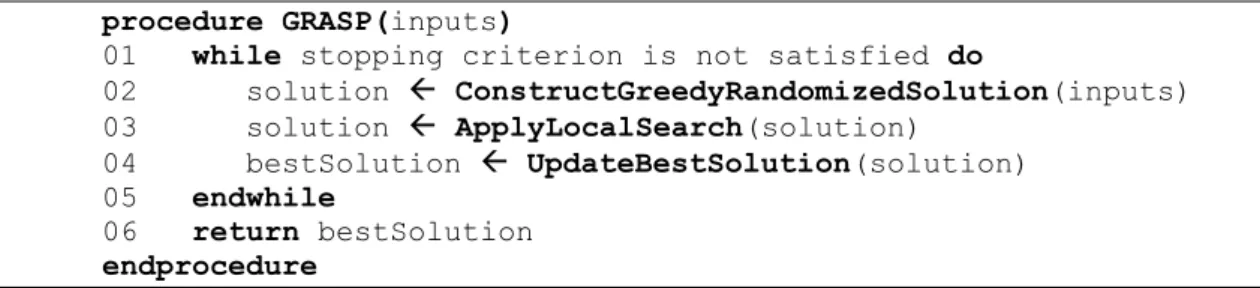
Figure 2. General pseudo-code for GRASP ... 11
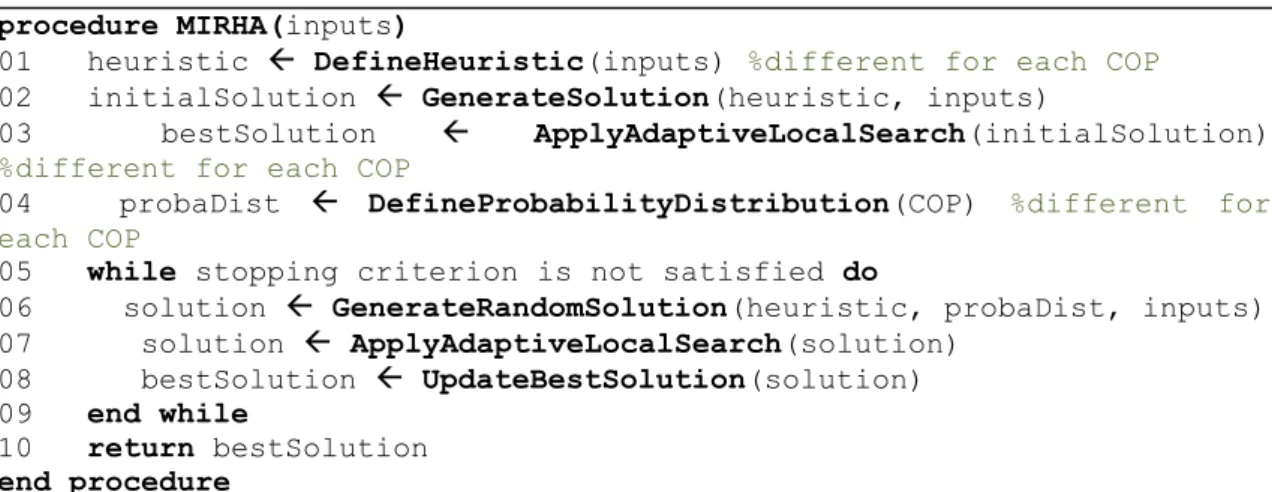
Figure 3. General pseudo-code for MIRHA ... 12
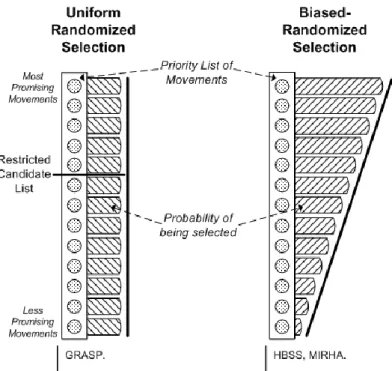
Figure 4. Uniform randomization vs. biased randomization ... 13
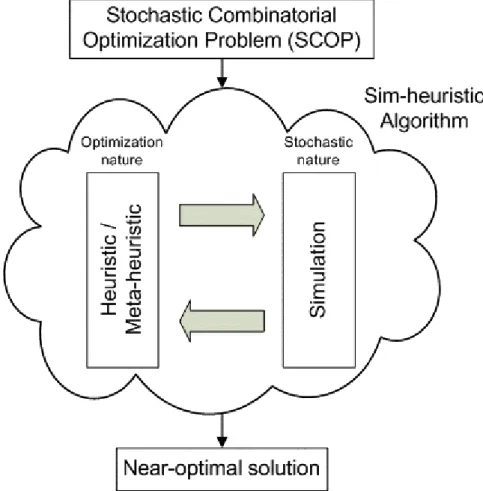
Figure 5. Overview scheme of the Simheuristic approach ... 18
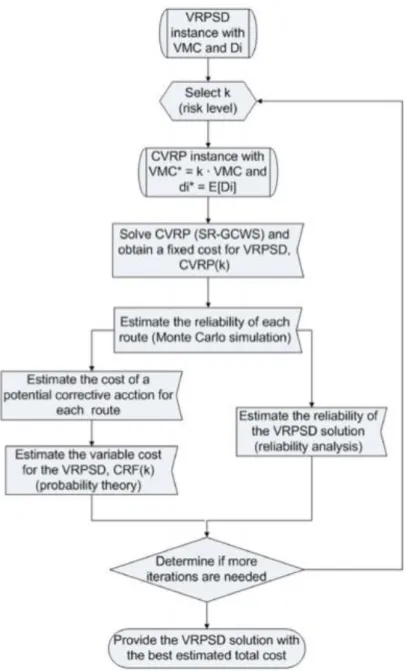
Figure 6. Flow diagram for the described methodology ... 20
Figure 7. Pseudo-code of the SHARP heuristic... 32
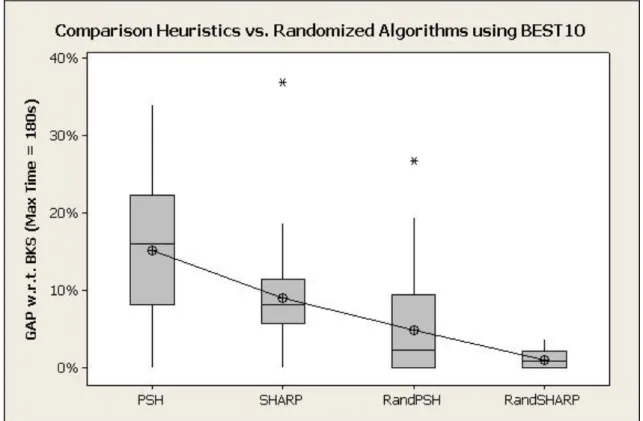
Figure 8. Visual comparison of the different approaches. ... 39
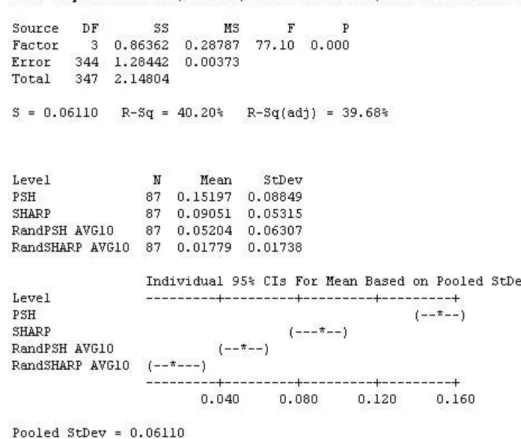
Figure 9. ANOVA for comparing performances. ... 40
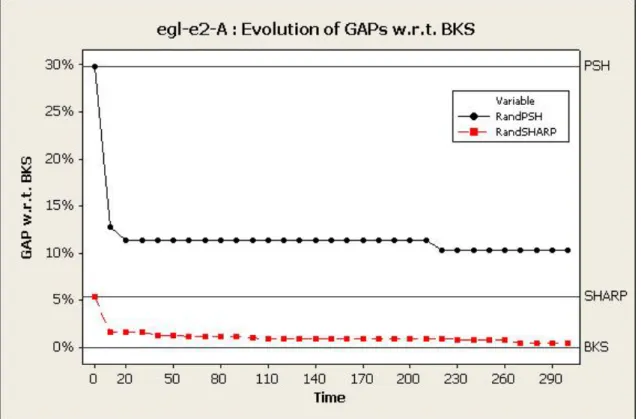
Figure 10. GAP time-evolution for the egl-e2-A instance. ... 41
Figure 11. GAP time-evolution for the gdb8 instance. ... 41
Figure 12. Flowchart diagram of our Simheuristic algorithm ... 47
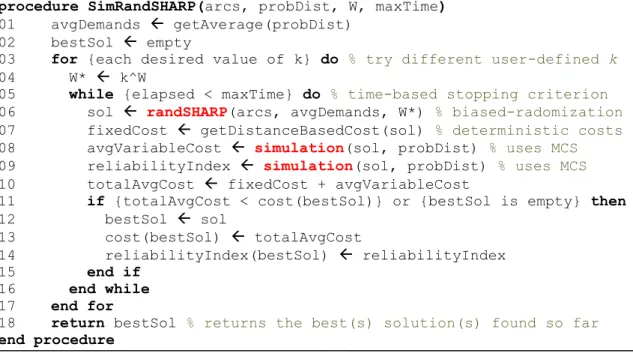
Figure 13. SimRandSHARP algorithm main procedure ... 48
Figure 14. RandSHARP procedure ... 49
Figure 15. Simulation procedure to estimate variable cost and reliability index ... 49
Figure 16. Average gaps with respect to ARPSD lower bound (BKS CARP). ... 54
Figure 17. Average reliability indices. ... 54
Figure 18. Example of FLP problem instance (a) and solution (b) ... 70
Figure 19. Flow diagram of the proposed approach (RandCFH-ILS) ... 73
Figure 20. RandCFH-ILS algorithm main procedure ... 75
Figure 21. getInitRandSol method... 76
Figure 22. perturbate method ... 76
Figure 23. localSearchTiny algorithm main procedure ... 77
Figure 24. localSearchDeep algorithm main procedure ... 78
Figure 25. Cumulative distribution function of the distance to the closest replica from each client. ... 86
Figure 26. Cost distribution comparison of the different deployments obtained by the described allocation methods ... 86
Figure 27. Cost distribution function of the mean network distances from each node to its closes replica. ... 87
x
List of Tables
Table 1. List of abbreviation used on this dissertation ... xi
Table 2. Average characteristics of problem datasets ... 35
Table 3. Experimental results for gdb instances. ... 36
Table 4. Experimental results for kshs instances. ... 36
Table 5. Experimental results for egl instances. ... 37
Table 6. Experimental results for val instances. ... 38
Table 7. Summary of experimental results by dataset. ... 38
Table 8. Results for the egl-s4-B instance with Var[Qi]=0.25·E[Qi]. ... 51
Table 9. Summary of results when Var[Qi] = 0.05·E[Qi] ... 53
Table 10. Summary of results when Var[Qi] = 0.25·E[Qi]... 53
Table 11. Summary of results when Var[Qi] = 0.75·E[Qi]... 53
Table 12. Summary of results when Var[Qi] = 2·E[Qi] ... 53
Table 13. Evaluated gdb instances and obtained results. ... 63
Table 14. Termination criteria for every class of instances. ... 81
Table 15. Results obtained for the 22 BK subsets of instances. ... 82
Table 16. Results obtained for GAP subsets of instances. ... 82
Table 17. Results obtained for FPP subsets of instances. ... 82
Table 18. Results obtained for MED subsets of instances. ... 83
Table 19. Network topology trait overview ... 84
Table 20. Results for egl dataset when Var[Qi] = 0.05·E[Qi] ... 111
Table 21. Results for gdb dataset when Var[Qi] = 0.05·E[Qi] ... 112
Table 22. Results for kshs dataset when Var[Qi] = 0.05·E[Qi] ... 112
Table 23. Results for val dataset when Var[Qi] = 0.05·E[Qi] ... 113
Table 24. Results for egl dataset when Var[Qi] = 0.25·E[Qi] ... 114
Table 25. Results for gdb dataset when Var[Qi] = 0.25·E[Qi] ... 114
Table 26. Results for kshs dataset when Var[Qi] = 0.25·E[Qi] ... 115
Table 27. Results for val dataset when Var[Qi] = 0.25·E[Qi] ... 115
Table 28. Results for egl dataset when Var[Qi] = 0.75·E[Qi] ... 116
Table 29. Results for gdb dataset when Var[Qi] = 0.75·E[Qi] ... 116
Table 30. Results for kshs dataset when Var[Qi] = 0.75·E[Qi] ... 117
Table 31. Results for val dataset when Var[Qi] = 0.75·E[Qi] ... 117
Table 32. Results for egl dataset when Var[Qi] = 2·E[Qi] ... 118
Table 33. Results for gdb dataset when Var[Qi] = 2·E[Qi] ... 118
Table 34. Results for kshs dataset when Var[Qi] = 2·E[Qi] ... 119
xi
Glossary
Abbreviation Description
ARP Arc Routing Problem
ARPSD Arc Routing Problem with Stochastic Demands
BKS Best Known Solution
CFLP Connected Facility Location Problem COP Combinatorial Optimization Problem
CVOP ConVex Optimization Problem
DPCS Distributed Parallel and Collaborative Systems
FLP Facility Location Problem
FTTH Fiber To The Home
GRASP Greedy Randomized Adaptive Search Procedure
HAROSA Hybrid Algorithms for solving Realistic rOuting, Scheduling and Availability problems.
HBSS Heuristic Biased Stochastic Sampling
ILP Integer Linear Programming
IN3 Internet Interdisciplinary Institute
MCS Monte-Carlo Simulation
MDVRP Multi Depot Vehicle Routing Problem
MIRHA Multi-start bIased Randomization of classical Heuristics with Adaptive local search
NCVOP Non-ConVex Optimization Problem
OBS Our Best found Solution
PON Passive Optical Network
PSH Path Scanning Heuristic
RNG Random Number Generator
SA Simulated Annealing
Simheuristic Simulation-optimization using Heuristics
STP Steiner Tree Problem
T&L Transportation and Logistics
TS Tabu Search
TSP Traveling Salesman Problem
UOC Universitat Oberta de Catalunya
VPN Virtual Private Network
VRP Vehicle Routing Problem
VRPSD Vehicle Routing Problem with Stochastic Demands
WCN Wireless Community Network
WSN Wireless Sensors Network
1
1
Introduction
Combinatorial problems involve finding a grouping, ordering or assignment of a discrete, finite set of objects that satisfies given conditions. Combinatorial Optimization Problems (COPs) consist on finding the optimal or near-optimal solution for a given cost function. In the case of NP-hard problems, metaheuristics are usually a good alternative to exact methods in order to find near-optimal solutions in reasonable computing times. Metaheuristics are a class of algorithms which provide approximation solutions of certain quality, while having relatively low execution times even for large-scale NP-hard problems. Many metaheuristics contain a randomness component, which in most of the cases is based on Uniform randomization -i.e., the use of the Uniform probability distribution to make random choices. However, as showed in different works related to this thesis, use of biased (non-uniform) randomization -i.e., random variates generated from skewed probability distributions- can become a more efficient strategy when introducing randomness into a metaheuristic. The Multi-start biased Randomization of classical Heuristics with Adaptive local search (MIRHA, Gonzalez-Martin et al., 2014a; Juan et al. ,2014a), is a general framework to develop biased-randomized metaheuristics. MIRHA has demonstrated to be helpful for defining competitive algorithms in a wide range of vehicle routing and scheduling problems.
2
50% in 2006”. The growth of the sector in the last two decades has been very fast.
Apart from the market liberalization, it can be explained by the advances in telecommunication technology, and the market privatization (Lam et al. 2010). This makes the advances in telecommunications technology one of the driving forces of globalization and the rapid growth of the world’s economy.
This importance and the sector’s fast growth, has brought with it new
optimization problems in several related fields. In Partridge (2011), up to forty open research questions in the telecommunications arena are presented. They represent big challenges for the future: to define a network topology which can vary over the time, to define a new network addressing paradigm or to provide networks with resource auctions which could allow service providers to shift resources among customers in real time, among others. Most of these research questions have associated different combinatorial optimization problems and, in particular, routing, assignment, availability, and scheduling ones.
Likewise, transportation and logistics also has a great economic importance in most countries. The costs associated with transportation have growth considerably over the last decade, especially due to the raise of petroleum prices. Also environmental policies, like the Kyoto protocol, are forcing enterprises to consider these environmental conditions when planning routes, in addition to the direct costs associated with the transport (Vieira et al. 2007).
Both T&L and telecommunication routing and assignment problems are suitable to be studied with optimization (exact and approximate methods) and simulation techniques. Also, distributed and parallel-computing systems allow the practical development of new solutions to these problems which are considered to be computationally very difficult, being many of them proven to be NP-hard (e.g. Al-Karaki et al. 2004). The MIRHA approach for solving deterministic NP-hard problems in the telecommunications and L&T areas, as well as its natural extension throughout the concept of Simheuristics (Juan et al., 2011a) for solving stochastic versions of these problems, are the main pillars over which this thesis is based.
1.1
Structure of this Thesis
3
Chapter 2: MIRHA Framework and Simheuristics. This dissertation will start by
introducing the MIRHA framework and the concept of Simheuristics. Both are closely related as they are based on the use of biased randomization for solving complex optimization problems. They have been proven to be useful for solving routing, scheduling and availability problems, especially in the field of Transportation and Logistics. With this thesis we are aiming to adapt these algorithms to be applied in other optimization problems which are more suitable in other field like is the case of Telecommunications.
Chapter 3: Capacitated Arc Routing Problem. The first problem studied is the
Capacitated Arc Routing Problem or CARP. This is a deterministic routing problem very similar to the Capacitated Vehicle Routing Problem or CVRP, but which is more suitable for modeling certain telecommunication routing optimization problems. The MIRHA framework has been successfully used for defining algorithms for the CVRP, but has never been used for defining algorithms for the CARP. In this chapter we will propose a new heuristic for the CARP, the SHARP heuristic, and use it as a base heuristic for the MIRHA framework in order to define a new competitive algorithm. We will compare the performance of our new proposed heuristic and the randomized algorithm with a classical heuristic, and also with the best known solutions available in the literature.
Chapter 4: Arc Routing Problem with Stochastic Demands. In this chapter we
will introduce a stochastic component in the customer demands which is also more suitable for modeling certain real-life telecommunication routing problems, where usually the customer demands cannot be known beforehand, but can be modeled using data from the past. In this case we will combine the algorithm defined for the deterministic problem in Chapter 3 with the Simheuristics framework to define a robust algorithm for the ARPSD. We will evaluate the robustness and performance of the proposed methodology using different datasets available on the literature.
Chapter 5: Non-smooth Arc Routing Problem. An additional variation of the
4
Chapter 6: Facility Location Problem. The final problem of study is the Facility
Location Problem or FLP. This problem is an assignment problem which is very useful for modeling telecommunication problems like finding the best placements of servers for providing some services to a set of customers. For this problem we will completely define a new algorithm based on the MIRHA framework and will assess its performance with some data sets available on the literature.
Chapter 7: Conclusions and Contributions Derived from this Thesis. On this
chapter we will extract some conclusions from the research work and state some open points to be considered by future researches. Also, this final chapter collects all the publications that have been produced as a result of the work carried on with this thesis.
In all these chapters we can appreciate the adaption of some heuristics to different optimization contexts and constraints. We explore how the integration of heuristics, simulation, biased randomization and parallel computing, can help to design high quality algorithms for problems which have real-life application in the Telecommunication arena (see section 1.2 for specific examples). The algorithms are tested with different benchmarks available in the literature, comparing the results with the state of the art. Some quantitative methods are used to analyze the generated results where we remark the high quality of the proposed methods, especially in terms of execution times and gaps with respect to the best known solution.
1.2
Motivation
5
One important Telecommunication problem in real life is that of planning and deployment of telecommunication networks, both physical (by means of physical cable connection) and virtual (by means of service providing). In this thesis we will focus on problems which are suitable for modeling those kinds of problems. For instance, the Arc Routing Problem (which is introduced on Chapter 3) can be used for minimizing the total length of cable for deploying an optical fiber network in order to interconnect all the required cabinets in a Fiber-To-The-Home (FTTH) scenario. Another example is the Facility Location Problem (which is introduced on Chapter 6), which can be useful for determining the best locations of optical splitter that provide optical connectivity to subscribers in a given service area of a FTTH-Passive Optical Network (FTTH-PON).
Extending the MIRHA framework to new problems which have applications in other fields in addition to T&L, like is the case of Telecommunications, will make it more interesting as will increase the number of possible applications. Real-life applications make the problems more interesting to be studied, as it can get the attention of companies which can combine efforts with researchers and practitioners in order to produce more interesting results. Also, it can help to improve the evaluation of the algorithm under real world constraints, as the companies can provide researchers with such information. Usually results produced under real-life scenarios are not exactly the same as the ones produced using artificially generated data, so this will improve the performance evaluation of the algorithms.
1.3
Research Objectives
In general, a desirable or efficient optimization algorithm for a computational optimization problem should be able to generate results in a short period of time; should produce good or high quality solutions; should be simple to configure; flexible to be adapted to new constraints or new computing architectures; and easy to understand and implement (Cordeau et al., 2002). One of the main goals of this thesis is the proposal of new algorithms based on the MIRHA framework and Simheuristics, for the Arc Routing Problem (ARP) and the Facility Location Problem (FLP). Neither MIRHA framework nor Simheuristics have been used previously for defining algorithms for both problems. The new problems to be studied have the common characteristic that they are suitable for modeling real-life Telecommunications problems, such as the deployment of an optical fiber network or the design of a Wireless Sensors Network (WSN).
6
problems. These hybrid algorithms will be based on the MIRHA framework. To this end, for every problem we will present the application of the methodology to the problem at a higher level, and then we will introduce the pseudo-code of the proposed algorithm. The pseudo-code will be implemented as an application and executed with benchmarks extracted from the literatures. Secondly, the results produced by the algorithm will be collected and analyzed using statistical methods. With this, we will be able to compare the algorithm performance with the state of the art, being able to analyze the quality of the designed algorithms.
Finally, we also are willing to evaluate the performance of the algorithm under uncertainty scenarios, when combined with Simheuristics. For this, we will propose an algorithm which combines the algorithm designed for the deterministic problems with ideas from the Simheuristics framework. We will then evaluate the performance with a set of benchmarks available on the literature adapted for the uncertainty scenario, using statistical techniques for evaluate the performance and reliability of the designed solution.
1.4
Original Contributions
In the process of achieving the objectives described in previous section, we generate a series of original contributions. Among them, we summarize next the most relevant ones, which will be detailed in deep in the next chapters:
1. The SHARP heuristic for the Capacitated Arc Routing Problem (CARP): We define a savings heuristics for the ARP, based on the Clarke and Wright Savings (CWS) heuristic for the CVRP. This heuristic has the characteristic of being fast to execute while obtain relatively good results, which makes it suitable to be used within the MIRHA framework.
2. The RandPSH and RandSHARP algorithm for the CARP: We propose two new randomized algorithms based on the MIRHA framework. Mainly they are defined using the same approach, but they only differ on the base heuristic being used. For the first, the classical Path Scanning Heuristic (PSH) is used; for the later, our original SHARP heuristic is used as the base heuristic. Our SHARP heuristics demonstrates to have a better performance when combined with MIRHA framework than the PSH, thus SHARP is more suitable for our MIRHA framework.
7
randomized algorithm proposed for the deterministic problem with the Simheuristics concept. With that, we are able to obtain robust solutions for the problem. We also introduce a concept of upper and lower bound for evaluating the quality of the results obtained with our algorithm.
4. The RandSHARP algorithm for the Non-Smooth Arc Routing Problem: We have adapted the RandSHARP algorithm for the non-smooth variation of the ARP and evaluated its performance. With that we demonstrate that ideas from MIRHA framework also fit perfectly when the cost function being optimized is non-smooth.
5. The RandCFH-ILS algorithm for the Facility Location Problem (FLP): We propose a new randomized algorithm based on the MIRHA framework for the FLP. The algorithm is able to compete with state of the art algorithms for the problem, with relatively low execution times.
1.5
Chapter Conclusions
9
2
MIRHA Framework and Simheuristics
In this chapter, we will present the basic ideas that define the Multi-start biased Randomization of classical Heuristics with Adaptive local search (MIRHA) framework. Also, we will introduce the concept of Simheuristics, which is the combination of simulation with heuristics to solve problems which have some uncertainty component. The MIRHA framework offers a clear guidance for designing biased randomized heuristics based on classical problem-specific heuristics. The designed algorithms can be used in many deterministic optimization problems. Also, the algorithms can be combined with Simheuristics to cope with optimization problems which have a stochastic component.
Combinatorial Optimization Problems (COPs) have posed numerous challenges to the human mind over the past decades. From a theoretical perspective, they have a well-structured definition consisting of an objective function that needs to be minimized or maximized, and a series of constraints that must be satisfied. From a theoretical point of view, these problems have an interest on their own due to the mathematics involved in their modeling, analysis and solution. However, the main reason for which they have been so actively investigated is the tremendous amount of real-life applications that can be successfully modeled as a COP. Thus, for example, decision-making processes in fields such as logistics, transportation, and manufacturing contain plentiful hard challenges that can be expressed as COPs (Faulin et al. (2012); Montoya et al. (2011)). Accordingly, researchers from different areas –e.g. Applied Mathematics, Operations Research, Computer Science, and Artificial Intelligence–
have directed their efforts to conceive techniques to model, analyze, and solve COPs.
A considerable number of methods and algorithms for searching optimal or near-optimal solutions inside the solution space have been developed. In some small-sized problems, the solution space can be exhaustively explored. For those instances, efficient exact methods can usually provide the optimal solution in a reasonable time.
10
Unfortunately, the solution space in most COPs is exponentially astronomical. Thus, in medium- or large-size problems, the solution space is too large and finding the optimum in a reasonable amount of time is not a feasible task. An exhaustive method that checks every single candidate in the solution space would be of very little help in these cases, since it would take exponential time. Therefore, a large amount of heuristics and metaheuristics have been developed in order to obtain near-optimal solutions, in reasonable computing times, for medium- and large-size problems, some of them even considering realistic constraints.
The main goal of this chapter is to present a hybrid scheme which combines classical heuristics with biased-randomization processes. As it will be discussed later, this hybrid scheme represents an efficient, relatively simple, and flexible way to deal with several COPs in different fields, even when considering realistic constraints.
2.1
The Methodology
2.1.1
Background
In the context of this chapter, we will refer to any algorithm which makes use of pseudo-random numbers to perform random choices during the exploration of the solution space by the term randomized search method, or simply randomized algorithm. This includes most current metaheuristics and stochastic local-search processes. Thus, since it does not follow a determinist path, even for the same input, a randomized search method can produce different outputs in different runs. Within these types of algorithms we can include, among others:
Genetic and Evolutionary algorithms (Reeves, 2010). Simulated Annealing (Nikolaev and Jacobson, 2010).
Greedy Randomized Adaptive Search Procedure or GRASP (Festa and
Resende, 2009a, 2009b).
Variable Neighborhood Search (Hansen et al., 2010). Iterated Local Search (Lourenço et al., 2010).
Ant Colony Optimization (Dorigo and Stützle, 2010).
Probabilistic Tabu Search (Lokketangen and Glover, 1998). Particle Swarm Optimization (Kennedy and Eberhart, 1995).
11
new solution by randomizing a classical heuristic; and (ii) a local search phase, which aims at improving the previously constructed solution. At the end of the multi-start process, the best solution found is kept as the current solution.
procedure GRASP(inputs)
01 while stopping criterion is not satisfied do
02 solution ConstructGreedyRandomizedSolution(inputs) 03 solution ApplyLocalSearch(solution)
04 bestSolution UpdateBestSolution(solution) 05 endwhile
06 return bestSolution endprocedure
Figure 2. General pseudo-code for GRASP
It is interesting to notice that most of the work on randomized algorithms is based on the use of uniform randomness, i.e., randomness is generated throughout a symmetric (non-biased) uniform distribution. Thus, when we talk about biased randomization, we refer to the use of probability distributions, other than uniform, which do not distribute probabilities in a symmetric shape but in a non-symmetric or skewed one. Of course, these skewed distributions can also be used to induce biased randomness into an algorithm. As a matter of fact, as far as we know, the first approach based on the use of biased randomization of a classical heuristic is due to Bresina (1996). The author proposed a methodology called Heuristic-Biased Stochastic Sampling (HBSS), which performs a biased iterative sampling of the search tree according to some heuristic criteria. Bresina applies the HBSS to a scheduling problem, and concludes that this approach outperforms greedy search within a small number of samples.
2.1.2
MIRHA
12
procedure encapsulates the randomization of a heuristic, but this time a non-symmetric distribution will be employed instead. At each iteration, two processes are carried out. First, a new solution is constructed using a biased randomization version of the selected classical heuristic –which will depend on the particular problem being considered. Secondly, an adaptive local search is employed in order to improve the randomized solution. Notice that both the randomization effect and the multi-start process work together to reduce the probabilities that the procedure gets trapped into a local minimum, while ensuring that different feasible regions in the solution space are sampled and explored.
The common aspects of MIRHA with GRASP are the construction of an initial solution using randomization and, afterwards, the application of a local search. But there are relevant differences: (a) MIRHA does not use a restrictive candidate list, one main characteristic of the GRASP algorithm; and (b) MIRHA uses a non-symmetric distribution to select the next element to be included in the solution, while most GRASP implementations only consider uniform distributions. The HBSS proposed by Bresina is similar to MIRHA since it uses a biased distribution function combined with a sampling methodology. In fact, MIRHA can be seen as a natural extension/enhancement of the HBSS methodology, one which incorporates a local search step after each solution obtained by the biased sampling.
procedure MIRHA(inputs)
01 heuristic DefineHeuristic(inputs) %different for each COP
02 initialSolution GenerateSolution(heuristic, inputs)
03 bestSolution ApplyAdaptiveLocalSearch(initialSolution)
%different for each COP
04 probaDist DefineProbabilityDistribution(COP) %different for each COP
05 while stopping criterion is not satisfied do
06 solution GenerateRandomSolution(heuristic, probaDist, inputs) 07 solution ApplyAdaptiveLocalSearch(solution)
08 bestSolution UpdateBestSolution(solution) 09 end while
10 return bestSolution end procedure
Figure 3. General pseudo-code for MIRHA
2.2
Logic Behind our Approach
13
Problem (Nawaz et al., 1983), or the Path Scanning procedure for the Arc Routing Problem (Golden et al., 1983). Typically, a ‘priority’ list of potential movements is traversed during the iterative process, i.e., at each iteration, the next constructive movement is selected from this list, which is sorted according to some criteria. The criteria employed to sort the list depends upon the specific heuristic being considered. Thus, any constructive heuristic could be seen as an iterative greedy procedure, which constructs a feasible ‘good’ solution to the problem at hand by selecting, at each iteration, the ‘best’ option from a list, sorted according to some logical criterion. Notice
that this is a deterministic process, since once the criterion has been defined, it provides a unique order for the list of potential movements. Of course, if we randomize the order in which the elements of the list are selected, then a different output is likely to occur each time the entire procedure is executed. However, a uniform randomization of that list will basically destroy the logic behind the greedy behavior of the heuristic and, therefore, the output of the randomized algorithm is unlikely to provide a good solution –in fact, we could run the randomized algorithm thousands of times and it is
likely that all the solutions generated would be significantly worse than the one provided by the original heuristic. To avoid losing the ‘common sense’ behind the
heuristic, GRASP proposes to consider a restricted list of candidates –i.e. a sub-list including just some of the most promising movements, that is, the ones at the top of the list–, and then apply a uniform randomization in the order the elements of that
[image:27.595.167.432.492.741.2]restricted list are selected (Figure 4).
14
This way, a deterministic procedure is transformed into a randomized algorithm –which can be encapsulated into a multi-start process–, while most of the logic or common
sense behind the original heuristic is still respected. The MIRHA approach goes one step further, and instead of restricting the list of candidates, it assigns different probabilities of being selected to each potential movement in the sorted list. In this way, the elements at the top of the list receive more probabilities of being selected than those at the bottom of the list, but potentially all elements could be selected. Notice that by doing so, we are not only avoiding the issue of selecting the proper size of the restricted list, but we also guarantee that the probabilities of being selected are always proportional to the position of each element in the list. Thus, it is possible to identify the following steps when transforming a classical heuristic into a probabilistic algorithm by means of biased randomization:
1. Given a COP, select a deterministic and constructive heuristic with the following characteristics –which most classical heuristics already satisfy: (a) it should be
able to run quite fast –typically in less than a second– even for large-size problems –this is a critical requirement since the probabilistic algorithm relies in
executing over and over a randomized version of the heuristic; (b) it should provide, by design, some stage able to be randomized –e.g. a priority list as the one described before; and (c) it should provide ‘good’ solutions which are not
too far from the ones generated with more complex and time-consuming metaheuristics –e.g. average gap about 5-10%.
2. Once the base heuristic is selected, the new probabilistic algorithm should follow some kind of multi-start process –e.g. a pure multi-start or an iterated local search. At each round of this multi-start process, a new complete solution would be generated. For the construction of this solution, the base heuristic is randomized –e.g. its priority list is randomized– using a non-symmetric probability distribution. The specific distribution to employ will depend upon the specific COP being considered. Some candidate distributions to be considered are the geometric and a discrete version of the descendent triangular.
3. Optionally, a local search process can be added to the algorithm in order to improve the solution provided at each round of the multi-start process. This local search is COP-tailored, meaning that it will be different for each COP.
The approach described above is able to quickly generate several feasible solutions with different properties. Therefore, a list containing the top ‘best-found’ solutions – each of them having different characteristics– can be saved and considered by the
15
2.2.1
Benefits of Biased-Randomization Approaches
The main motivation behind designing biased-randomized heuristics is to meet many of the desirable features of a metaheuristic as described by Cordeau et al. (2002), i.e.: accuracy, speed, simplicity, and flexibility. Most of the metaheuristics in literature are measured against accuracy –the degree of departure of the obtained solution value from the optimal value–, and against speed –the computation time. However, there are
two other important attributes to be considered in any optimization method: simplicity and flexibility. Simplicity is related to the number of parameters to be set and the facility of implementation. This is an important feature since the method can be applied to different instances than the ones tested without losing quality or performance and without the need of performing a long run test. Flexibility is related to the possibility of accommodating new side constraints and also with the adaptation to other similar problems.
Having in mind these measured attributes; we list the main benefits of biased-randomized heuristics over other related approaches:
They allow a simplification of the fine-tuning process, since typically the
employed probability distributions require just one (e.g. the geometric) or zero parameters (e.g. the descendent triangular). This is not common in most current metaheuristic approaches, which usually employ many parameters and, therefore, require from difficult and time-expensive fine-tuning processes to adjust their associated values.
Being based on classical well-tested heuristics, they are relatively simple and
easy to implement methods, which can be adapted to account for new constraints (flexibility). Thus, when facing a combinatorial-optimization problem with already existing heuristics, some of the most efficient of these heuristics can be selected and enhanced throughout biased randomization.
Using non-uniform (skewed) distributions rather than uniform ones, they offer a
more natural and efficient way to select the next movement from the priority list, since biased randomization allows keeping the logic behind the heuristic by assigning more probabilities of being selected to those movements which better fulfill the heuristic. Notice that a uniform randomization does not respect the ‘common sense’ of the heuristic, since it assigns equal probabilities of being
selected to all potential movements.
By combining randomization with a multi-start-like process, they promote
16
two features –randomization and multi-start approach– help the algorithm to escape from local minimums and also increase diversification during the exploration of the solution space.
Likewise, the combination of randomization with a multi-start-like process
promotes parallelization in an easy and natural way (Juan et al., 2011c). Notice that the odds of finding ‘good’ solutions increase as more parallel runs of the
algorithm are executed.
Finally, the biased-randomized heuristics can also be combined with other
techniques, such as Monte Carlo simulation, in order to consider stochastic variants of COPs, as we discuss in later in this chapter.
2.2.2
Examples of Use
In general, probabilistic algorithms have been widely used to solve many combinatorial optimization problems such as, for example: Sequencing and Scheduling Problems (Pinedo, 2008), Vehicle Routing Problems (Laporte, 2009), or Quadratic and Assignment Problems (Loiola et al., 2007). They have also been used to solve real combinatorial optimization problems that arise in different industrial sectors, e.g.: Transportation, Logistics, Manufacturing, Aeronautics, Telecommunication, Health, Electrical Power Systems, Biotechnology, etc.
17
Search framework and combines the NEH heuristic (Nawaz et al, 1983) with a biased randomization process guided by a descending triangular distribution.
All in all, the proposed methodology can be used to improve the efficiency of most existing heuristics for solving combinatorial-optimization problems. This is done by transforming the greedy deterministic behavior of the heuristic into a probabilistic behavior which still follows the logic behind the heuristic but randomizes the construction process using a biased, non-uniform, distribution.
2.3
Simheuristics
There is an emerging interest on introducing randomization into combinatorial optimization problems as a way of describing new real problems in which most of the information and data cannot be known beforehand. This tendency can be observed in Van Hentenryck and Bent (2010), which provides an interesting review of many traditional combinatorial problems with stochastic parameters. Thus, those authors studied Stochastic Scheduling, Stochastic Reservations and Stochastic Routing in order to make decision on-line, i.e., to re-optimize solutions when their initial conditions have changed and, therefore, are no longer optimal.
The Simheuristic approach (Figure 5) is a particular case of simulation-optimization which combines a heuristic/metaheuristic algorithm with simulation methodologies – e.g. Monte-Carlo, discrete-event, agent-based, etc… - in order to efficiently deal with the two components in a Stochastic Combinatorial Optimization Problem (SCOP) instance: the optimization nature of the problem and its stochastic nature. Examples of Simheuristics applications to different fields can be found in the optimization-simulation literature. For instance, Juan et al. (2011b) combined Monte Carlo Simulation (MCS) with routing metaheuristics in order to solve the Vehicle Routing Problem with Stochastic Demands (VRPSD); Peruyero et al. (2011) combined MCS with a scheduling metaheuristic for solving the permutation flow-shop problem with stochastic processing times; and Caceres et al. (2012) combined also MCS with a routing metaheuristic for solving the inventory routing problem with stock-outs and stochastic demands.
18
[image:32.595.133.457.306.633.2]advantage of the capabilities simulation methods offer to manage randomness. Of course, other approaches can also be used instead of simulation –e.g. dynamic programming, fuzzy logic, etc. However, under the presence of historical data on stochastic behavior, simulation allows the development of both accurate and flexible models. Specifically, randomness can be modeled throughout a best-fit probability distribution –including parameterization– without any additional assumptions or constraints. Thus, simulation is usually integrated with the heuristic/meta-heuristic approach and it frequently provides dynamic feedback to the searching process in order to improve the final outcome. In some sense, simulation allows to extend already existing and highly efficient meta-heuristics –initially designed to cope with deterministic problems– so that they can also be employed to solve SCOPs.
Figure 5. Overview scheme of the Simheuristic approach
19
simple and flexible methods which are able to provide near-optimal solutions to complex real-life problems in reasonable computing times.
2.3.1
An Integrated Simulation-based Framework
The solution proposed for the VRPSD in Juan et al. (2011b) was based on the same framework, which will be described in this section. The methodology is based in two facts: (a) the stochastic problem can be seen as a generalization of the deterministic problem where the random value has zero variance; and (b) efficient meta-heuristics already exist for the deterministic problems while the stochastic problems are an emerging field. Accordingly, the key idea behind this framework is to transform the stochastic instance into a new problem which consists of solving several conservative instances of the deterministic problem, each of the characterized by a specific risk of showing routing failures. The term conservative refers to the fact that only a certain percentage of the vehicle capacity is considered during the route design phase, so the rest of capacity is considered as safety stock. So, this remaining capacity of the vehicle will be available in case the actual demand of the route is greater than expected.
The methodology consists on the following steps (see Figure 6):
1. Consider a problem instance with a set of customers. Each customer has associated a stochastic demand characterized by its mean and probability distribution.
2. Compute the value of the safety stock given by a percentage of the vehicle capacity. This percentage will be a parameter defined for the algorithm.
3. Consider the deterministic instance of the problem, consisting on the same problem instance than the stochastic version, but where the demands are deterministic and equal to the mean, and the vehicle capacity is restricted to the value computed on step 2.
4. Solve previous instance using a biased randomized algorithm (e.g. SG-GCWS for CVRP or RandSHARP for CARP). This solution will be an aprioristic solution for the original problem instance. Furthermore, it will be a feasible solution as long as there are not any route failures.
20
its expected value can be calculated. Then, the expected total costs due to possible route failures can be computed by addition of these variable costs and the costs of the deterministic solution obtained during the design phase.
6. Using the deterministic solution, obtain an estimate for the reliability of each route of the solution. In such context, the reliability index is defined as the
[image:34.595.178.449.188.634.2]probability that a route will not fail. This route reliability index is computed by direct Monte Carlo simulation using the probability distributions that model customer demands in each route. Remark that in each route, over-estimated demands could sometimes be compensated by under-estimated demands.
21
7. The reliability index for the total solution is computed as the multiplication of the value for each route in the solution. This value can be considered as a measure for the feasibility for the solution in the context of the stochastic problem.
8. Depending on the total costs and the reliability indices associated with the solutions already obtained, repeat the process from Step 1 with a different value of the value used for the safety stock.
9. Finally, the best solution found so far is returned as solution to the problem, as well as its corresponding properties such cost or reliability index.
2.3.2
Examples of Use
The Vehicle Routing Problem with Stochastic Demands (VRPSD) is a NP-hard problem in which a set of customers with random demands must be served by a fleet of homogeneous vehicles departing from a depot, which initially holds all available resources (Novoa and Storer, 2009). Obviously, there are some tangible costs associated with the distribution of these resources from the depot to the customers. In particular, it is usual for the model to explicitly consider costs due to moving a vehicle from one node – customer or depot – to another. These costs are often related to the
total distance traveled, but they can also include other factors such as number of vehicles employed, service times for each customer, etc. The classical goal here consists of determining the optimal solution (set of routes) that minimizes those tangible costs subject to the following constraints: (i) all routes begin and end at the depot; (ii) each vehicle has a maximum load capacity, which is considered to be the same for all vehicles; (iii) all (stochastic) customer's demands must be satisfied; (iv) each customer is supplied by a single vehicle; and (v) a vehicle cannot stop twice at the same customer without incurring in a penalty cost.
The random behavior of customers’ demands could cause an expected feasible
22
to a certain limit, they can be satisfied without incurring in a route failure. Using safety stocks not only contributes to reduce variable costs due to route failures but, related to that, it also increases the reliability or robustness of the planned routes, i.e.: as safety stock levels increase, the probability of suffering a route failure diminishes. Notice, however, that employing safety stocks also increases fixed costs associated with aprioristic routing design, since more vehicles and more routes are needed when larger buffers are considered. Therefore, when minimizing the total expected cost a tradeoff exists between its two components, fixed costs and expected variable costs. Thus, the challenge relies on the selection of the appropriate buffer size.
Given a VRPSD instance, Juan et al. (2011b) consider different levels of this buffer size and then solve the resulting scenarios. This is performed by employing Monte Carlo simulation, which allows estimating the variable costs associated with each candidate solution. Thus, among the multiple solutions generated for each scenario, the ones with lowest total expected costs are stored as the best-found result associated with the corresponding safety-stocks level. Once the execution of the different scenarios ends, the corresponding solutions are compared to each other and the one with the lowest total expected costs is selected as the best-found routing plan.
2.4
Chapter Conclusions
23
3
Capacitated Arc Routing Problem
The Capacitated Vehicle Routing Problem, or simply CVRP, is a well-known combinatorial optimization problem in which a fleet of homogeneous vehicles, initially located at a single depot with unlimited capacity, has to be routed so that all customers’
demands are served at a minimum cost and without violating the loading capacity of each individual vehicle (Toth and Vigo, 2002). In the CVRP, it is assumed that the road network is a complete graph containing nodes (vertices) representing the customers and the depot. Also, it is assumed that the customers’ demands are located
at these nodes. Being a NP-hard problem studied for several decades already, the CVRP is still attracting researchers’ attention due to its potential applications both to
real-life scenarios and to the development of new algorithms, optimization methods and metaheuristics. A related but different problem is the so-called CARP, in which the demands are located over the network edges or arcs (instead of at nodes), and in which the completeness of the road network is no longer guaranteed, i.e. not all pair of nodes are connected by an edge. The capacity restriction refers to the maximum load that each vehicle can carry. Sometimes other constraints also apply, e.g., maximum distance that can be covered by any single vehicle, the maximum time a vehicle can be operating, etc.
This chapter will introduce the first problem of study in this thesis, the CARP. The CARP, due to its characteristics, is also suitable for modeling certain Telecommunication problem, when compared to the CVRP. Having the demands located in the arcs of the graph instead of the nodes, for instance, we can think on them as telecommunications cables which should provide certain services to the users. Usually telecommunications users do not have a demand located on a single point, but a bandwidth required in the connection (arc) to the centralizer node.
24
3.1
Literature Review
Vehicle Routing Problems (VRPs) constitute a relevant topic for current researchers and practitioners. In fact, according to Eksioglu et al. (2009), the number of related articles published in refereed journals has experienced an exponential growth in the last fifty years. However, although the existing literature on the CVRP field is quite extensive and includes a wide range of efficient approaches, this is not the case with the CARP. One of the basic references on the CARP is the book “Arc Routing: Theory,
Solutions and Applications” (Dror, 2000). This book, which contains twelve chapters devoted to different CARP-related topics, describes theoretical aspects associated with arc traversal, solution methodologies, and also a number of representative applications.
3.1.1
Approaches for Solving the CARP
Since the CARP was first described in by Golden and Wong (1981), a wide range of both exact and approximate methods have been suggested for solving it. For extensive surveys on the arc routing field, including CARP and some of its variations, the reader is referred to Assad and Golden (1995) or Wøhlk (2008). Among the exact approaches, Branch and Bound and Cutting Plane are the most common methods employed in the CARP literature. Branch-and-bound methods for the CARP were proposed by Hirabayashi et al. (1992) and Kiuchi et al. (1995). In Cutting Plane, a Linear Programming relaxation of the problem is solved. Belenguer and Benavent (2003) presented a Cutting Plane algorithm for the CARP, which is partly based on several classes of valid inequalities presented earlier by the same authors in Belenguer and Benavent (1998). Using their algorithm, these authors are able to reach the best existing lower bounds for all test instances, even improving the existing lower bounds for several instances. Branch-and-Cut-and-Price based algorithms were suggested by Letchford and Oukil (2009). However, algorithms that guarantee finding the optimal solution can be used only for relative small and medium-small instances.
A different strategy for solving the CARP is based on transforming the problem into a Capacitated Vehicle Routing Problem (CVRP), which is in turn solved by state-of-the-art CVRP algorithms, as described in Eglese and Letchford (2000), Longo et al. (2006), and Baldacci and Maniezzo (2006). Results reported in those works are highly competitive compared to the previously existing ones. Likewise, methods providing lower bounds for the CARP were put forward by Golden et al. (1983), Pearn et al. (1987), Pearn (1988), Win (1988) or Amberg and Voß (2002).
25
26
3.1.2
Problem variations
There are multiple variations of the CARP existing in the literature, each of them reflecting different real-life scenarios. Among the most popular variations, it is possible to cite the following ones:
The CARP defined on a directed graph or Directed Capacitated Arc Routing
Problem (Maniezzo and Roffilli, 2008).
The CARP defined on mixed graphs or Mixed Capacitated Arc Routing Problem
(Belenguer et al. 2006).
The CARP with objective functions other than one based on total traveling
costs, i.e., minimizing the total number of vehicles, minimizing the length of the longest tour, etc. For instance, Ulusoy (1985) considers minimizing the traveling costs plus some fixed costs associated with the use of different types of vehicles.
The CARP with multi-objective functions. For instance, Shang et al. (2014)
consider a multi objective CARP that can be viewed as a mix between the CARP and the Min-Max K-Chinese Postman Problem. The Min-Max K-Chinese Postman Problem (Frederickson, 1978) is a CARP-like problem where the vehicle loading capacity is infinite.
The CARP with Time Windows, considered by Reghioui et al. (2007) and by
Wøhlk (2007).
The CARP with time-dependent service costs, as considered by Tagmouti et
al. (2011).
The CARP with multiple depots, proposed by Cattrysse et al. (2002). There is
also a variant with mobile depots, proposed by Del Pia et al. (2006).
The Periodic CARP, studied by Chu et al. (2003) and by Lacomme et al.
(2005).
The CARP with profits, in which the objective is to maximize the profit collected
from a set of potential customers as described in Zachariadis and Kiranoudis (2011).
The CARP with Stochastic Demands (ARPSD), where the customer’s demands
are not known beforehand (Gonzalez-Martin et al., 2014b).
3.1.3
Applications
27
activity requires finding minimum-cost routes in a transportation network can be found in: refuse collection, snow removal, inspection of distributing systems, routing of street sweepers, routing of electric meter readers, school bus routing, etc.
For example, Beltrami and Bodin (1974) describe a computer system for garbage collection planning that was applied in New York city; Eglese and Li (1992) study the problem of spraying roads with salt to prevent ice in the Lancashire County Council; Bodin and Kursh (1979) develop a computer assisted system for the routing and scheduling of street sweepers; Stern and Dror (1979) describe an arc routing problem associated with electric meter reading in the city of Beersheba (Israel). In most applications, several vehicles are involved and there may be a number of restrictions on capacity, travel distance, or travel times, among others.
More recently, we can find applications of the CARP to the Telecommunications field. One example, it is useful for the planning of the placement of optical cable network. In this problem, the objective is to decide for which streets the cable should be installed in order to provide access to all the customers which are distributed along the streets (and thus we consider that demand is located in the arcs).
3.2
Problem Description
3.2.1
Basic description
The CARP is a combinatorial optimization problem that can be informally described as follows (Golden and Wong (1981)): Let be an undirected graph, where:
i. V is a set of nodes, including the one representing the depot or distribution center
ii. E is a set of edges or arcs connecting some nodes in V.
iii. C is a costs matrix representing the positive costs of moving from on node to another – these costs are usually based on distances or travel times between a
pair of nodes.
iv. Q is a demands vector representing the non-negative demands associated with each arc.
Consider also a set of identical vehicles (homogeneous fleet), each of them with a maximum loading capacity . Under these circumstances, the usual