Economic evaluation of duloxetine in the treatment of
chronic low back pain in Mexico
Fernando Carlos Rivera
1, Jocelyn Ramírez Gámez
2, Ignacio Ruiz
2Artículo original
ABSTRACT
Objective: to compare the costs and efficacy results of duloxetine 60 mg QD/BID (DUL) and the fixed combination of tramadol/paracetamol 37.5/325 mg every 4 to 6 hours (TMD/PCM) in the pharmacological treatment of chronic
low back pain (CLBP) from the perspective of public and private healthcare systems in Mexico. Material and methods:
we per formed a systematic search of all the multicenter, double-blind, randomized and placebo-controlled studies evaluating DUL and TMD/PCM in CLBP. By using the adjusted indirect comparison, we determined the likelihood of
achieving satisfactory response (defined as pain relief 30 and 50% -compared to baseline) and early withdrawal.
The time horizon of the study was 3 months. All the drugs acquisition costs, intolerable adverse event attention costs and medical management according to response type, were analyzed and expressed in Mexican pesos. Information sources included official listings and published literature. The sensitivity analysis was deterministic and
probabilistic. Results:for both perspectives public and private, DUL resulted to be a dominant option (less costly,
more effective) than TMD/PCM. Mean savings in patient receiving DUL were $203 pesos (1.5%) and $1,545 pesos (8.6%) for public and private perspectives, respectively. This means that for every 10,000 patients treated with DUL there would be a gain of 3 quality-adjusted life years (QALY). The model remains robust and DUL was the preferred
choice in 59% (public perspective) and 90% (private perspective) of the generated simulations. Conclusion:DUL
offer impor tant savings in the management of LBP and represents a more-convenient regimen for patients.
Key words: economic evaluation, duloxetine, low back pain, Mexico.
Evaluación económica de la duloxetina en el tratamiento del dolor de espalda crónico en México
Objetivo: comparar costos y resultados de la eficacia asociadas de duloxetina 60 mg QD/BID (DUL), combinación fija de tramadol/paracetamol 37.5/325 mg cada 4 a 6 horas (TMD/PCM ) en el tratamiento farmacológico del dolor de espalda crónico (DLC) desde la perspectiva de los sistemas de salud públicos y privados de México.
Material y métodos: se realizó una búsqueda sistemática de todos los estudios multicéntricos, doble ciegos, aleatorizados y controlados con placebo que evaluaron DUL y TMD/PCM en el DLC. Mediante el uso de la comparación indirecta ajustada, a fin de determinar la probabilidad de lograr una respuesta satisfactoria (definida como el alivio del dolor³ 30 y 50 %³ en comparación con la basal) y el abandono de tratamiento. El horizonte temporal del estudio fue de 3 meses. Todos los costos de adquisición de medicamentos, eventos adversos grado 3/4, atención de eventos y atención médica de acuerdo al tipo de respuesta, fueron analizados y expresados en pesos mexicanos. Las fuentes de información incluyen listados oficiales y publicados en la literatura. El análisis de sensibilidad fue
determinístico y probabilístico. Resultados: para ambas perspectivas pública y privada, DUL resulto ser una opción
dominante (menos costosa, más eficaz) comparada con TMD/PCM. El ahorro promedio en los pacientes que reciben DUL fue $ 203 pesos (1.5 %) y $ 1.545 pesos (8.6 %) para las perspectivas públicas y privadas, respectivamente. Esto significa que por cada 10,000 pacientes tratados con DUL habría una ganancia de 3 años de vida ajustados por calidad (AVAC). El modelo sigue siendo robusto y DUL era la opción preferida en 59 % (perspectiva pública) y 90 %
(punto de vista privado) de las simulaciones generadas. Conclusión: resultados del presente estudio, sugieren que
DUL podría ofrecer importantes ahorros en el tratamiento del dolor lumbar y lograr más años de vida con calidad para el paciente.
Palabra clave: evaluación económica, duloxetina, dolor lumbar, México.
ow back pain (LBP) is a lumbo-sacral pain, located at the level of the iliac ridge or lower, which can
irradiate down to the knee1.LBP is a complex and
heterogeneous medical condition which includes a great
variety of symptoms2. The etiological factors include
changes in the central nervous system such as neuronal hyperactivity, membrane excitation, inhibitor y-system dysfunction, sensitization and expression of new genes
which modulate inflammatory factors3. In the general
population, up to 16% of LBP cases can be attributable
to psychological factors such as anxiety4.
Around 60-80% of people will present a LBP
episode on their lifetime1,5,6.The LBP prevalence reported
in literature varies from 1.0 to 58.1%, with a mean value
of 18.1% (median 15.0%)5. In Mexico, LBP prevalence
has been repor ted in a range from 5.8 to 6.3%7,8. LBP
presents spontaneous resolution within 1-3 months in most of the cases. However, up to 15% of patients
show persistent pain 1 year after the initial episode3.
Indeed, LBP is recognized as one of the most frequent
causes of non-oncologic pain9. The list of potential risk
factors to undergo chronicity includes several aspects such as demographical, environmental and lifestyle, including smoking, obesity, manual activity occupations, driving vehicles for long periods and job dissatisfaction
and stress3,5.
Due to its high prevalence and the risk to become chronic, LBP entails a considerable economic impact at personal, family and social levels. It is estimated that all back pain (including LBP) consume nearly one fifth of the health expenses, which is equivalent to 1.5% of the
gross domestic product10. The mean total cost of
patients with chronic LBP (CLBP) tends to be twice as
high compared to the respective cost for acute LBP11.
A typical patient with CLBP in the United States has
7,500 USD of direct medical costs every 6 months2. It
is also known that LBP constitutes one of the main reasons of medical consultation at the first-level (i.e.,
family medicine) in Mexico. Sánchez-Hernández et al.
reported that the mean cost for every LBP case ranges
from 7,896 to 13,237 Mexican pesos (2006 values)12.
Literature data shows that the indirect costs related to loss of labor productivity caused by LBP are generally higher than the direct medical costs, representing
between 46 to 85% of total cost13-16. Evidence also
shows that the economic impact of LBP is related to its severity, duration and the age at presentation, among
other factors16,17. The components with greater load for
L
Recibido: 25 abril 2013. Aceptado: 8 de mayo 2013.
1R A C Salud Consultores S.A. de C.V. 2Eli Lilly de México S.A.
de C.V. Correspondence: Fernando Carlos Rivera. R A C Salud Consultores S.A de C.V. Insurgentes Sur # 598 P-2 204 Mz A, Col. del Valle. 03100 México, D.F. México; E-mail: fernando. [email protected]; [email protected]
direct medical cost are physiotherapy sessions, medical
treatment and hospitalization time16,18. The health-related
quality of life (HRQoL) in patients with CLBP tends to be low due to the pain and its effect on the sleeping
patterns19, and also because people affected with this
condition generally present mood disorders, with
frequent episodes of stress and anxiety20,21.
The main objective of CLBP treatment is to prevent, reduce, or (if possible), eliminate the pain. Concomitant objectives include improvement of quality of life, functional capacity and ability to recover
independence22. Therapeutic approach for CLBP must be
individualized, with a multidisciplinar y scope and comprised by pharmacological and non-pharmacological
strategies1,22-25. Non pharmacological strategies include
education, orientation, cognitive-behavioral therapy, exercise, physiotherapy, multidisciplinar y intensive rehabilitation, acupuncture, spinal manipulation, yoga and
progressive relaxation1,22-26. Pharmacological treatment
of CLBP includes the use of several agents such as paracetamol, NSAIDs, tricyclic antidepressants, sero-tonin selective reuptake inhibitors (SSRI), serosero-tonin and noradrenaline selective reuptake inhibitors (SNRI),
benzodiazepines, tramadol and opioid analgesics1,22-25,27-29.
Duloxetine and the fixed combination of tramadol 37.5 mg/paracetamol 325 mg (TMD/PCM) provide ef fective analgesia in patients with pain of var ying
degrees caused by diverse pathologies, including LBP29-33.
The objective of the present study is to compare the costs and health outcomes of duloxetine and TMD/PCM in the treatment of CLBP from the public and private healthcare perspectives in Mexico.
MATERIAL AND METHODS
A complete cost-utility evaluation was performed33.
Competitive strategies
least 30% from baseline after 7 weeks of therapy) or 120 mg (in non-responders) from week 8 to end of treatment, and (ii) TMD/PCM administered in the following dosage: 1-2 tablets every 4-6 hours according to response (pain relief) with a maximum of 8 tablets per day. Both drugs are orally administered and the dosages were established according to the reco-mmendations found in the Pharmaceutical Specialties
Dictionary (DEF, 2012 edition) in Mexico34.
Target population
Adult patients with diagnosis of CLBP, eligible to receive duloxetine or TMD/PCM. These usually include patients who were non-responders to paracetamol or another NSAID or patients in which NSAIDs are
contraindicated29,35.
Perspective
The analysis was per formed from two different perspectives: (i) public healthcare system in Mexico; (ii) private healthcare system in Mexico.
Time horizon
The time horizon for this study was set at 3 months, reasonable time period concordant with other
clinical studies of interest29-32. Because of the time
horizon is less than 1 year, it was not necessary to apply any discount rate to reflect the inter temporal
preferences of the population36,37.
Decision model
Figure 1 shows a simplified structure of the analy-tical decision model used in this study. At the beginning of the study, the patients were assigned to either therapeutic alternative considered in this study. Because some patients withdraw study treatment prematurely, we
assumed that this dropout occurs around the middle of the treatment period (approximately 1.5 months) and that such patients do not achieve a satisfactor y response with the given drug (therapy). Those patients who completed 3 months of therapy had the possibility
of achieving pain relief of 30% to 49% and even 50%
from baseline.
Systematic review
With the aim of identifying all relevant clinical information in terms of efficacy and withdrawal rates concerning the agents used in this study, we performed a systematic search in the PubMED/Medline website. The strategy consisted in the following searching chain:
(«Duloxetine» [Supplementary Concept] OR «Tramadol» [Mesh] AND «Acetaminophen»[Mesh]) AND «Low Back Pain» [Mesh]. The search was limited to human-population studies published in English or Spanish. Sixteen references were obtained. When selecting the studies who evaluated the drugs of interest in patients with CLBP, reporting efficacy and safety at three months, a total of 5 studies were selected as potentially relevant. Finally, to guarantee more comparability among the competitive strategies, we selected only those studies with flexible dosage. For that reason, two studies with fixed doses of duloxetine and per formed by Skljarevski
et al. were excluded38,39. The study led by Peloso40 was
also excluded because of the results repor ted for the placebo group were substantially different from the other 2 selected studies, situation that may implicate
consi-Figure 1. Simplified structure of the decision model: management of chronic LBP.
Characteristics Skljarevski,et al.(2010a)41 Ruoff,et al.(2003)42
Study design DB-R-PC-MS DB-R-PC-MS
Localization of participating
centers
Brazil, France, Germany, Mexico
and Netherlands
United States
Active treatment Duloxetine 60/120mga TMD/PCMb
Treatment duration 3 months 3 months
Pain measuring scale Brief Pain Inventory (BPI) Pain Visual Analogue Scale (VAS)
Number of patients 236 318
Age (mean) 51 years 54 years
Female (%) 61% 63%
Caucasian /white 75% 90%
Baseline pain score BPI = 6c Pain VAS = 70.0d
DB-R-PC-MS: Double blind, randomized, placebo-controlled, multicenter study; TMD/PCM: Fixed dose combination of tramadol 37.5mg and paracetamol 325mg.
a.Initial daily dose was 30mg during the first week; then the dose was adjusted to 60mg per day. Those patients not showing pain relief 30% after 7 weeks of treatment were given 120mg per day from week 8.≥
b.Initial daily dose was 1 to 4 tablets for 10 days; then, the dose was adjusted up to a maximum of 8 tablets per day, according to the needs of every patient.
c.Mean value of the severity score reported in the BPI (weekly mean value). Comprising 11 categories (0-10) with 0 representing “no pain” and 10 representing the “worst imaginable/possible pain”. Inclusion criteria baseline BPI score 4.≥ d.Pain score corresponding to mean value during 48 hours. Scores reorted by the patient by pointing or marking on a VAS, 100mm length where 0mm corresponds to “No Pain” and 100mm corresponds to the “Maximum pain”. Inclusion criteria: VAS >40mm at baseline.
by 1.36 we obtained the probability of reaching pain
relief 50% from baseline in the TMD/PCM.
Resource usage and unitary costs
Only direct medical costs comprising the acquisition cost of study drugs, the cost of medical care due to intolerable AE and the cost of routine management associated with ever y type of response were analyzed. The cost of duloxetine in the public healthcare perspective was obtained directly from the manufacturer; the cost of TMD/PCM was obtained from the public bids for 2013 in the Mexican Social Security
Institute (IMSS) purchase website44. In the analysis
per formed for the private healthcare perspective, the drug prices correspond to the values reported as «normal
price» in the «paciente plus» website45. According with a
document presented by Eli Lilly and Company to the FDA, 27 (23.48%) patients assigned to duloxetine required
dose augmentation from the 8 week of study46. These
patients received 120mg per day until the end of the
study41,46. In the other hand, Ruoff et al42 reported that
the mean number of daily tablets of TMD/PCM per patient was 4.2. We assumed that patients in the public healthcare system presenting intolerable AE attend to the «family medicine» medical visit service. The unitary cost of this medical visit was obtained from the
cost listings of the IMSS47 and was updated to 2013
values considering the cumulative inflation between
December 2011 and December 2012 in Mexico48. It
was also assumed that the cost of a general practitioner (GP) medical visit in the private healthcare system is 10% higher. Regarding the drug consumption, it was determined that patients who withdrew due to intolera-ble AE received treatment only for the half of the treatment period (i.e., first 6.5 weeks).
The cost for every non-responder patient (i.e., pain
relief < 30% at three months vs. baseline) was
determined based on the results presented by
Sánchez-Hernández et al12 and updated to 2013 values
considering the cumulative inflation between December
2006 and December 201248.The costs per patient
associated to complete and par tial response were
estimated with the information published by Beard et
al49. According to this publication, patients with
fibromyalgia who achieved pain relief from 30 to 49% at
three months of treatment (vs baseline) presented
costs 19% lower than patients not reaching even 30% of pain relief. Thus, in an analogous way, patients with
pain relief 50% presented costs 35% lower than
patients with pain relief under 30% (vs baseline)49. As it
happened with the GP medical visit, we assumed that the cost of the chronic LBP management in the private derable bias when attempting to make a
placebo-adjusted indirect comparison. Both selected clinical
studies41,42 were comparable in terms of design and
demographic characteristics of the patients enrolled (table 1).
Probabilities of achieving satisfactory response and withdrawal of therapy
Given that none of the selected studies reported a direct comparison of DUL and TMD/PCM, it was
necessary to make an indirect-adjusted comparison43 to
determine the probabilities of reaching partial or complete response and therapy withdrawal with every treatment evaluated. In this case, the common comparator corres-ponds to the placebo group in the study per formed by
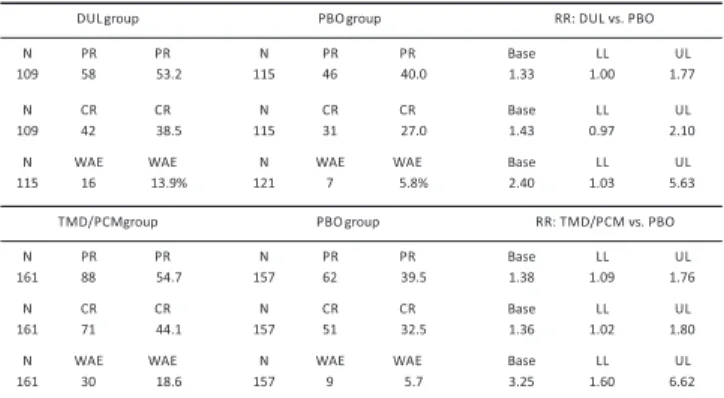
Skljarevski (2010a)41. Such study refers that 46 (40%)
out of the 115 patients in the placebo group evaluated
with the BPI instrument achieved an improvement 30%
in pain intensity from baseline, including 31 (27%)
patients who achieved an improvement 50%. The
authors also reported that 7 (5.8%) of the 121 patients assigned to the placebo group had early withdrawal due
to intolerable adverse events (AE)41. After determining
the probabilities of achieving pain relief 30% and 50%
from baseline and of therapy withdrawal due to AE with the common comparator (i.e., the placebo group in the DUL study), we then calculated the risk ratio or relative risk (RR) for each treatment intervention with their res-pective placebo groups (table 2). The probabilities of
achieving pain relief 30 and 50% (vs baseline) and
withdraw therapy with DUL or TMD/PCM (due to into-lerable AE), were determined as the result of the probability with the common comparator (placebo) multiplied by the RR value, according to every treatment of interest (table 2). For example, when multiplying 27%
healthcare system is 10% higher (with respect to the public system).
Health outcomes
As intermediate ef fectiveness outcomes we considered the propor tion of patients with par tial response and complete response, defined as pain relief
from 30 to 49% and 50% at three months (vs.
baseline), respectively. The quality-adjusted life years (QALY) was the measure used in the cost-utility analysis. Because we did not find specific data for the evaluated responses such as percentage of pain relief in patients with CLBP, we made an adjustment to the
utility scores published by Beard, et al49. In order to
make such adjustment, we used the baseline values of HRQoL and pain intensity from the DUL group in the
study by Skljarevski et al (2010a)41, identified in the
«Clinical Study Website» of the USA government50. When
comparing the baseline HRQoL scores in patients with
chronic LBP (BPI score =6)50 with the same scores in
patients with fibromyalgia49, we observed similarity, and
the value for chronic LBP was 5.8% lower than the
fibromyalgia value (0.49 vs 0.52).
According to Skljarevski et al. (2010a)41 and Ruoff
et al42 we established that a 6.5 score in the baseline
BPI can be considered as adequate for our study
population. Beard et al49 reported that patients in the
categories of 30-49% and 50% pain relief had an
ave-rage reduction of 38 and 70% their level of pain intensity
(vs baseline), respectively, and for patients with
response < 30%, no improvement was observed. Thus, for a baseline BPI score of 6.5, we estimated that patients with partial or complete response would have final BPI values of approximately 4.0 and 2.0, respectively, whereas patients with no response (non-responders) would remain in the same value as baseline. Taking into account the previously mentioned information and based in the table 4, presented in the
study by Beard, et al49 which associates some HR-QOL
scores to some BPI scores, we determined the utility values for patients with chronic LBP according to response-type. For this, we multiplied the scores of 0.46 (mean 0.40-0.52) in patients with fibromyalgia and no response, scores of 0.63 in patients with fibromyalgia and par tial response and 0.74 in patients with fibromyalgia and complete response by a fixed factor of 0.942 (equal to 1-0.058) in order to obtain the respec-tive HR-QOL scores in patients with chronic LBP. We included the disutility (loss of utility) caused by adverse events.
Incremental analysis
According to the recommendations of the General Health Council, the threshold for the incremental cost-utility ratio was fixed 144,052 Mexican pesos, this value is equivalent to the Gross Domestic Product
(GDP) per capita, projected for 2013 in Mexico51.
Sensitivity analysis
To evaluate the robustness of the results seen with the base-case we conducted an exhaustive
Parameter Base case
value Range Distribution Reference
Probability of reaching pain relief =
30% with placebo 40.00% 31.05% – 48.95% Beta [41]
RR of reaching pain relief = 30% with:
DUL vs. Placebo
TMD/PCM vs. Placebo 1.33
1.38
1.00 – 1.77
1.09 – 1.76
Log‐Normal
Log‐Normal [41]a
[42]a
Probability of reaching pain relief =
50% with placebo 26.96% 18.85% – 35.07% Beta [41]
RR of reaching pain relief = 50% with:
DUL vs. Placebo
TMD/PCM vs. Placebo 1.43
1.36
0.97 – 2.10
1.02 – 1.80
Log‐Normal
Log‐Normal
[41]a
[42]a
Probability of early withdrawal due to
adverse events with placebo 5.79% 2.36% – 11.56% Beta [41]
RR of early withdrawal with:
DUL vs. Placebo
TMD/PCM vs. Placebo
2.40
3.25
1.03 – 5.63
1.60 – 6.62
Log‐Normal
Log‐Normal
[41]a
[42]a
Acquisition cost in public healthcare
system in Mexico ($):
DUL 60mg, 14‐tablet package
TMD/PCM, 20‐tablet package
292.86
123.55
BCV ± 10%
BCV ± 10%
Uniform
Uniform
Eli Lilly
[44]
Acquisition cost in private healthcare
system in Mexico ($):
DUL 60mg, 14‐tablet package
TMD/PCM, 20‐tablet package
574.00
309.00
BCV ± 20%
BCV ± 20%
Uniform
Uniform [45]
[45]
Percentage of patients treated with
DUL needing to adjust their daily dose
to 120mgb
23.48 15.73 – 31.23 Beta [46]
TMD/PCM daily tablets (mean) 4.2 ‐ ‐ ‐ ‐ ‐ ‐ [42]
Mean treatment duration in those
withdrawing due to adverse events 6.5 weeks ‐ ‐ ‐ ‐ ‐ ‐ Calculated
“Family Medicine” additional medical
visits due to AE 1 ‐ ‐ ‐ ‐ ‐ ‐ Caclulated
Cost per medical visit (public sector) 499.21 BCV ± 10% Uniform [47, 48]
Cost per medical visit (private sector) 549.13 BCV ± 10% Uniform Calculatedc
Quarterly cost of chronic LBP
management according to response:
(public system): No response Partial response Complete response 13,579 10,973 8,786
10,147 – 17,011
8,199 – 13,746
6,565 – 11,006
Gamma
Gamma
Gamma
[12, 48]d
Calculatedd
Calculatedd
Quarterly cost of chronic LBP
management according to response:
(private system): No response Partial response Complete response 14,936 12,070 9,664 11,161– 18,712
9,019 – 15,121
7,222 – 12,107
Gamma Gamma Gamma Calculatedc Calculatedc Calculatedc
Annual utility/savings according to
response: No response Partial response Complete response 0.43 0.59 0.70
BCV ± 10%
BCV ± 10%
BCV ± 10%
Beta
Beta
Beta
[49, 50]e
[49, 50]e
[49, 50]e
Disutility (loss of utility) due to
intolerable adverse events (%)f 10 5 – 15 Uniform [65]
BCV: Base case value; RR: Relative risk; DUL: Duloxetine 60/120mg/day; TMD/PCM: Fixed combination of tramadol 37.5mg and paracetamol 325mg; AE: Adverse events. a: see table 2; b: from week 8; c: it was assumed that this value is 10%
higher in the private system; d: it was assumed that the cost reported by Sánchez‐Hernández et al.12corresponds to those
cases with no response (updated by the inflation rate), and patients with partial response and complete response report
19% and 35% lower costs than patients with no response, respectively. ; e: Calculated by our investigators (see text); f:49
Refers to the lost utility attributable to intolerable adverse events.
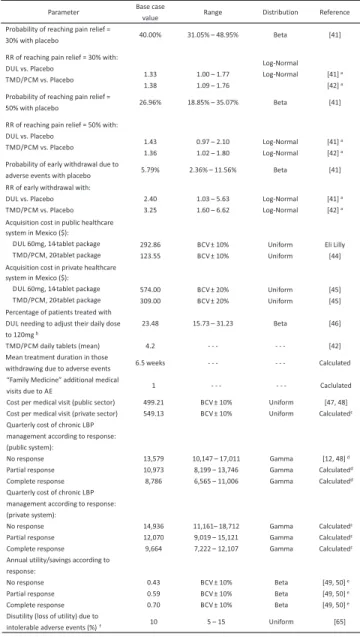
sensitive analysis process. First, we generated a univariate deterministic sensitivity analysis. Then, we per formed a probabilistic sensitivity analysis using a second-order Monte Carlo simulation with 10,000 interactions, which results are presented as accepta-bility curves. Table 3 shows the parameters used for the base case and sensitivity analysis. The gamma distributions were approximated with the mean and the standard deviation, calculated with the range data. All the analysis was performed using the TreeAge Pro 2013 software (TreeAge Software Inc., Williamstown, MA, USA).
RESULTS
Base case
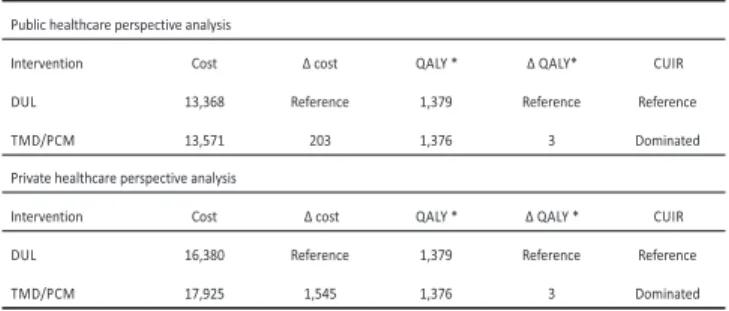
From the public healthcare system perspective in Mexico, the use of DUL led to net savings of 203 pesos per patient (table 4); this number is equivalent to reducing 1.5% the average cost per patient receiving TMD/PCM. From the private healthcare system perspective, savings attributable to DUL reach 1545 pesos per patient (table 4); this figure is equivalent to reducing 8.6% the average cost per patient receiving TMD/PCM. With both treatment drugs and for all analysis perspectives, the most impor tant expense-heading corresponds to the routine management of CLBP, followed by the acquisition cost of study medications and the cost of treating adverse events. Nonetheless, the difference in the acquisition costs of DUL and TMD/PCM was the main factor which determined the absolute difference in the mean total costs per patient with each treatment strategy evaluated. As a matter of fact, in the private healthcare sector, the study medication costs were 40% higher in the TMD/PCM group with respect to DUL group, whereas in the public healthcare system these costs were 10% higher in the TMD/PCM group compared to DUL group.
The percentage distribution of patients according to response type resulted very similar in both strategies. The propor tion of patients showing response to
treatment (relief 30% in pain intensity at three months
vs. baseline) was slightly higher in the TMD/PCM group
(55.4 vs 53.2%). However, the proportion of patients
with complete response (relief 50% in pain intensity at
three months vs. baseline) was higher in patients treated
with DUL (38.6%) compared to those patients who received TMD/PCM (36.7%). When transforming these efficacy results into HRQoL indicators, the number of estimated QALYs for every 10,000 patients is superior for DUL than for TMD/PCM (table 4). Thus, in
pharmacoeconomic terms, DUL constitutes a dominant healthcare intervention (i.e., less costly and with gain in QOL, compared to TMD/PCM). This latter is true for both the public and private healthcare systems in Mexico.
Table 4. Cost-utility analysis: DUL vs TMD/PCM (base case).
Sensitivity analysis
According to the deterministic sensitivity analy-sis, the five parameters generating more uncertainty regarding the results in both perspectives (public and private) were: the usual cost of CLBP management in non-responder patients; the probability of pain relief
30% in the reference -placebo- group; the RR of
achieving pain relief 30% with DUL; the utility score
assigned to complete response; and the cost of CLBP management in patients with complete response.
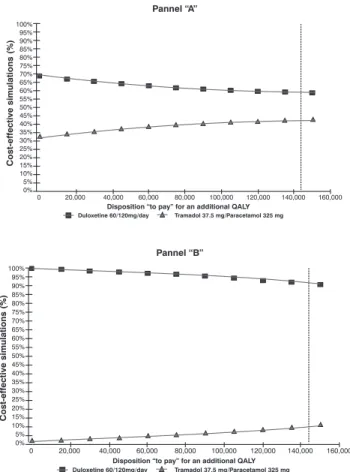
Figure 2 show the acceptability cur ves for the cost-utility analysis, derived from the probabilistic sensitivity analysis. This analysis shows that the probability of treatment with DUL to be less costly than treatment with TMD/PCM is 69% for the public healthcare system and 99% for the private healthcare system in Mexico. Also, the probabilistic sensitivity analysis indicates that the probability for DUL to be the preferred alternative (i.e., more cost-effective strategy, taking 1 GDP [in Mexico] as the maximum limit of acceptability) is approximately 59% for the public healthcare system and 90% for the private healthcare system in Mexico.
DISCUSSION
important role in the evolution of patients, thus
genera-ting important impact on the costs52. In a context of
scarcity of medical resources it is important to identify favorable and convenient treatment strategies for public healthcare institutions and general population. Both duloxetine and fixed combination of tramadol 37.5mg and paracetamol 325mg are agents used for the treatment of different types of moderate-severe pain, including musculoskeletal pain. Never theless, only duloxetine has the approved indication for LBP treatment in the Pharmaceutical Specialties Dictionary (DEF, 2012
edition) in Mexico34.
Strictly speaking, the results obtained in the present study suggest that duloxetine in a dominant healthcare inter vention for both perspectives. Net savings of using DUL instead of TMD/PCM for a maximum period of 3 months were $ 203.00 and $1,545.00 per patient from the public and private healthcare perspectives, respectively. This is equivalent to a 1.5% (public system) and 8.6% (private system) reductions in total cost per patient receiving TMD/PCM.
The great majority of savings are just evident, because they come from the difference in acquisition costs and the average daily consumption. In the public healthcare system and taking into account the rate of early withdrawal due to intolerable adverse events (before three months of treatment), mean daily cost of giving duloxetine 60/120 mg was 21.42 pesos per patient. This same cost was 23.50 pesos for TMD/PCM, almost a 10% difference in favor of DUL. For the private health-care system, the mean daily cost of giving TMD/PCM was nearly 40% higher than for duloxetine 60/120 mg per day. The other heading where duloxetine showed several advantages was the treatment of intolerable adverse events, although absolute advantages were of reduced magnitude.
The results of the indirect comparison show that the analgesic effectiveness of both agents (DUL and TMD/PCM) is very similar. The propor tion of patients with pain relief of at least 30% at three months of treatment from baseline was slightly higher with TMD/ PCM (55.4%) compared to DUL (53.2%). On the other hand, the proportion of patients with the best analgesic
response (relief 50% in pain intensity at three months
vs baseline) was higher for DUL than for TMD/PCM
(38.6 vs 36.7%). These numbers make the HRQoL
com-parable among both strategies. By incorporating quality of life deterioration due to adverse events it was possible to determine the number of QALY in every strategy. The results of the base case show that both DUL and TMD/ PCM lead to almost identical HRQoL scores; for every 10,000 patients (in each group), there would be a gain of 3 QALY in favor of duloxetine treatment.
With the information mentioned above and speaking in pharmacoeconomic terms, it can be stated that duloxetine constitutes a dominant healthcare strategy over TMD/PCM, due to the important and con-siderable savings and the better quality of life offered. Because of the narrow difference in utility, another way of analyzing the results would be to determine that both strategies are comparable in terms of number of QALY they provide and thus, to base the results only in the comparison of costs. Either way –by making cost-utility evaluation or cost-minimization analysis- DUL would continue as the preferred strategy.
Besides the economic advantages over TMD/ PCM, there are some other aspects favorable to DUL which are wor th to mention. First, almost 75% of patients par ticipating in the duloxetine clinical study
used for the analysis,41 remained in the 60 mg daily
dose and only 25% required 120 mg. According to the
study protocol41, patients received 120 mg in one
admi-nistration. In the other hand, the pharmaceutical specialties dictionary (DEF) mentions that daily 120 mg
Pannel A shows the analysis of the public healthcare perspective in Mexico. Pannel B shows the analysis of the private healthcare perspective in Mexico. QALY: Quality-adjusted life years. Vertical lines indicate the estimated value of the gross domestic product for 2013 ($144,052 Mexican pesos). 100% 95% 90% 85% 80% 75% 70% 65% 60% 55% 50% 45% 40% 35% 30% 25% 20% 15% 10% 5% 0%
0 20,000
Disposition“topay” foranadditional QALY
Cost -e ff ect iv e s i mu l at i ons (%)
Pannel “A”
Duloxetine 60/120mg/day Tramadol 37.5 mg/Paracetamol 325 mg
40,000 60,000 80,000 100,000 120,000 140,000 160,000
100% 95% 90% 85% 80% 75% 70% 65% 60% 55% 50% 45% 40% 35% 30% 25% 20% 15% 10% 5% 0%
0 20,000
Disposition“topay” foranadditional QALY
Cost -e ff ect iv e s i mu l at i ons (%)
Pannel “B”
Duloxetine 60/120mg/day Tramadol 37.5 mg/Paracetamol 325 mg
40,000 60,000 80,000 100,000 120,000 140,000 160,000
dosage must be given in two 60mg administrations
(every 12 hours)34. Either way, duloxetine administration
results more convenient for patients in comparison with TMD/PCM, which has to be administered ever y 4-6 hours, which also means that patients can receive 4 or even 6 doses per day. It is widely demonstrated that patients with chronic diseases who are submitted to therapeutic approaches using fewer daily doses present higher compliance levels, situation which can also
increase their effectiveness53-55.Because the analysis of
the present study is based on the results of controlled clinical trials, it is possible to assume that –in the daily practice- the convenience of an easier dosage could also
lead to better results in pain relief in favor of DUL versus
TMD/PCM.
The safety profile of DUL seems to be better than TMD/PCM. In the clinical trials who evaluated duloxetine in musculoskeletal pain (osteoarthritis and chronic LBP), the adverse events reported with more frequency were nausea (13.9%), dry mouth (7.0%), constipation (6.9%), insomnia (6.6%), diarrhea (5.7%), dizziness (5.7%),
somnolence (5.6%) and fatigue (5.0%)56. In the study by
Ruoff et al42 the more-frequently reported adverse events
were nausea (13.0%), somnolence (12.4%), constipa-tion (11.2%), headache (8.7%), dr y mouth (8.1%), dizziness (7.5%), pruritus (6.8%), fatigue (6.8%), upper airway infection (5.6%) and sinusitis (5.0%). Whereas the incidence of adverse events (leading to treatment withdrawal) in the placebo groups of these clinical studies was almost identical (5.7% in the study by
Ruoff42 and 5.8% in the study by Skljarevski41), the
incidence for TMD/PCM was higher than it was for DUL
(18.6% vs 13.9%, non-adjusted values)41,42. Early
withdrawal due to intolerable adverse events is usually accompanied by extra expenses generated by these events. Besides the HRQoL deterioration due to lack of efficacy (in this particular case, not achieving significant pain relief), the occurrence of intolerable adverse events provoke even more deterioration of their HRQoL. Another advantage of duloxetine is that it can be administered for long term periods. One clinical study with 41-week follow up showed that those patients who initially
res-ponded to duloxetine in the study by Skljarevski et al
(2010a)41, reported improved efficacy, good tolerability
and non-occurrence of new adverse events57.
The results of the present study contribute to the cumulative evidence about pharamcoeconomic advantages of duloxetine in the management of moderate-severe pain. Different publications underline that duloxetine is a cost-effective agent in the treatment
of patients with peripheral diabetic neuropathy52,58-60,
osteoar thritis61 and fibromyalgia49,62. One recently
published study investigated 6 drugs which may be used
for the second-line treatment of CLBP in Canada63. The
results of this study show that duloxetine constitutes a dominant intervention (i.e., less costly, more effective) than hydromorphone, pregabalin and extended-release oxicodone, whereas amitriptyline was dominated by naproxen and celecoxib. Of the three non-dominated agents, naproxen was the less costly, followed by celecoxib and duloxetine. In the other hand, duloxetine resulted the most-effective intervention of all. The cost
for ever y additional QALY provided by duloxetine vs.
celecoxib was 43,437 Canadian dollars (2011 values) and being considered as a moderately cost-effective healthcare intervention. The results were more favorable for some population subgroups such as >65 years and patients with high risk of presenting cardiovascular or gastrointestinal adverse events. In these scenarios, the
cost-utility ratios of using duloxetine vs. celecoxib were
just 21,567 and 18,726 Canadian dollars for ever y
additional QALY63.
One of the main strengths of our study consisted of using statistic methods recommended in specialized literature to per form an indirect placebo-adjusted
comparison43. This type of techniques is used to obtain
standard estimations and minimize bias risk64. Also, the
similarity of the results obtained in the placebo groups in the 2 analyzed clinical studies is a fact that increases confidence about these results. Another strength is the reliability of the sources where acquisition costs were
obtained44,45.This is impor tant because the main
component of the difference between the total costs of DUL and TMD/PCM lies precisely in the acquisition cost of these agents. Finally, the exhaustive sensitivity analysis can be considered as other strength. The results of such analysis allow us to establish that the model is robust to parameter variations within a reasonable range. In the sensitivity analysis we observed that variables causing more uncertainty were the cost of managing CLBP in «non-responder» patients and in patients with complete response, the probability of reaching response with duloxetine and the utility score assigned to complete response. Duloxetine was dominant or at least cost-effective in 59% of the simu-lations performed as part of the probabilistic sensitivity analysis in the public healthcare perspective in Mexico. For the private healthcare perspective, 90% of the per formed simulations showed that duloxetine was dominant or at least cost-effective.
publications. For example, the study by Peloso et al40
has a similar design and patient characteristics to the
study by Ruoff et al42. Nevertheless, the efficacy results
in the placebo group in the study by Peloso et al40 are
significantly different from those in the study by Ruoff
et al42 and Skljarevski et al (2010a)41. In this case it
was better not to incorporate results which can lead to bias rather than trying to increase the sample size. In
the same way, two clinical studies led by Skljarevski38,39
were not incorporated in the analysis because they included fixed doses, whereas the selected studies used
flexible doses41,42. However, it must be mentioned that
ef ficacy and withdrawal rates (due to AE) in the
duloxetine 60 mg groups of the discarded studies38,39,
are consistent with the results reported in the flexible
dose study (60/120 mg/day) 41.
Another limitation is the time horizon, because it was restricted to the approximate duration of the double-blind and placebo-controlled analysis-phase of the
selected clinical trials41-42. To broaden this horizon might
need to define cer tain treatment sequences, being a difficult situation due to the multiple combinations which can be made with the available drugs and their different
dosages64,65. In the other hand, the authors which have
chosen to apply treatment sequences have assumed (necessarily), that the ef ficacy and safety of the therapeutic agents remains unaltered, regardless of their
place in the sequence49,61, this assumption is debatable.
Despite of being a very frequent chronic condition, there is scarse information related to the costs of routine management of CLBP. We found only one Mexican study
which mentions the average cost for ever y case12.
Unfor tunately nor in that publication or any other reported in literature was possible to determine the real consumption of medical resources according to
response type (pain relief <30%, 30 to 49% and 50%).
In front of this situation we assumed that the average
cost for every published case by Sánchez-Hernández et
al12 corresponds to the most-severe cases, this
assumption seems reasonable because this were patients with prolonged incapacity and required medical rehabilitation services. Due to the lack of data, the costs related to the other responsetypes were configured according to the published data of other disorder
(fibromyalgia)49. In addition, the cost attributable to
in-tolerable adverse events was determined as the cost of a «family medicine» medical visit (in the public system) and the cost for the private system was adjusted according to the public system weighting. It is true that these parameters must be used with caution and most important is to mention that the vast majority of the differences in total costs per patient correspond to the
acquisition costs and not to these items, whose really impact is minimal. All utility scores had to be estimated under several assumptions. We have also to underline that all HRQoL parameters were not collected in Mexican population, which also is another limitation. Nonetheless and because all health results are similar between both groups, the most important aspect for the decision-taking is the cost rather than quality of life.
CONCLUSION
The results of the present study suggest that duloxetine and TMD/PCM offer similar health outcomes in the treatment of chronic LBP, but duloxetine is associated to lower total costs, from both, the public healthcare system perspective and the private healthcare system perspective in Mexico. Duloxetine also presents a more convenient administration profile which can turn duloxetine into the preferred strategy.
DISCLAIMER
This study was sponsored by an unrestricted grant from Eli Lilly y Compañía de México S.A. de C.V., without any le-gal obligation or string concerning the results. At the moment of the study, Jocelyn Ramírez Gámez and Ignacio Ruíz were employees of Eli Lilly y Compañía de México S.A. de C.V.
REFERENCES
1. Diagnóstico, tratamiento y prevención de lumbalgia aguda y
crónica en el primer nivel de atención. México: Secretaría de Salud. 2009.
2. Ivanova JI, Birnbaum HG, Kantor E, Schiller M, Swindle RW.
Duloxetine use in chronic low back pain: treatment patterns
and costs. Pharmacoeconomics 2012;30(7):595-609.
3. Atkinson JH. Chronic back pain: searching for causes and
cures. J Rheumatol 2004:31(12):2323-5.
4. Croft PR, Papageorgiou AC, Ferr y S, Thomas E, Jayson MI,
Silman AJ. Psychologic distress and low back pain. Evidence
from a prospective study in the general population. Spine
1995;20(24):2731-7.
5. Hoy D, Brooks P, Blyth F, Buchbinder R. The epidemiology of
low back pain. Best Pract Res Clin Rheumatol 2010;24(6):769-81.
6. Manchikanti L. Epidemiology of low back pain. Pain Physician
2000;3(2):167-92.
7. Peláez-Ballestas I, Sanin LH, Moreno-Montoya J,
Alvarez-Nemegyei J, Burgos-Vargas R. Epidemiology of the rheumatic diseases in Mexico. A study of 5 regions based on the
COPCORD methodology. J Rheumatol Suppl 2011;86:3-8.
8. Cardiel MH, Rojas-Serrano J. Community based study to
estimate prevalence, burden of illness and help seeking behavior in rheumatic diseases in Mexico City. A COPCORD
study. Clin Exp Rheumatol 2002;20(5):617-24.
9. Woolf AD, Pfleger B. Burden of major musculoskeletal
conditions. Bull World Health Organ 2003;81(9):646-56.
10. Phillips CJ. Pain management: health economics and quality
of life considerations. Drugs 2003;63(2):47-50.
C, et al. Low back pain in primar y care: costs of care and
prediction of future health care utilization. Spine (Phila Pa 1976)
2010;35 (18):1714-20.
12. Sánchez-Hernández MA, Ibarra-Ramírez CT, Vilchis-Aguado M del R. Impacto del ser vicio de rehabilitación en el primer nivel
de atención. Rev Med Inst Mex Seg Soc 2008;(4):391-6.
13. Juniper M, Le TK, Mladsi D. The epidemiology, economic burden, and pharmacological treatment of chronic low back pain in France, Germany, Italy, Spain and the UK: a literature-based
review. Expert Opin Pharmacother 2009;10(16):2581-92.
14. Wieser S, Horisberger B, Schmidhauser S, Eisenring C, Brügger
U, Ruckstuhl A, et al. Cost of low back pain in Switzerland in
2005. Eur J Health Econ 2011;12(5):455-67.
15. Becker A, Held H, Redaelli M, Strauch K, Chenot JF, Leonhardt
C, et al. Low back pain in primar y care: costs of care and
prediction of future health care utilization. Spine (Phila Pa 1976)
2010;35(18):1714-20.
16. Ekman M, Jönhagen S, Hunsche E, Jönsson L. Burden of illness of chronic low back pain in Sweden: a cross-sectional,
retrospective study in primar y care setting. Spine (Phila Pa
1976) 2005;30(15):1777-85.
17. Depont F, Hunsche E, Abouelfath A, Diatta T, Addra I, Grelaud
A, et al. Medical and non-medical direct costs of chronic low
back pain in patients consulting primar y care physicians in
France. Fundam Clin Pharmacol 2010;24(1):101-8.
18. Dagenais S, Caro J, Haldeman S. A systematic review of low back pain cost of illness studies in the United States and
internationally. Spine J 2008;8(1):8-20.
19. Jain R. Pain and the brain: lower back pain. J Clin Psychi 2009;
70(2):e41.
20. Keeley P, Creed F, Tomenson B, Todd C, Borglin G, Dickens C. Psychosocial predictors of health-related quality of life and health ser vice utilisation in people with chronic low back pain.
Pain 2008;135(1-2):142-50.
21. Chou R, Shekelle P. Will this patient develop persistent
disabling low back pain? JAMA 2010;303(13):1295-302.
22. Witte AP. Treatment options in managing chronic low back pain. Disponible en http://www.usphar macist.com/ continuing_education/ceviewtest/lessonid/107595/
23. Chou R, Qaseem A, Snow V, Casey D, Cross JT Jr, Shekelle P, et
al. Clinical Efficacy Assessment Subcommittee of the American
College of Physicians; American College of Physicians; American Pain Society Low Back Pain Guidelines Panel. Diagnosis and treatment of low back pain: a joint clinical practice guideline from the American College of Physicians
and the American Pain Society. Ann Intern Med
2007;147(7):478-91.
24. Airaksinen O, Brox JI, Cedraschi C, Hildebrandt J, Klaber-Moffett
J, Kovacs F, et al. COST B13 Working Group on Guidelines for
Chronic Low Back Pain. Chapter 4. European guidelines for
the management of chronic nonspecific low back pain. Eur
Spine J 2006;15 Suppl 2:S192-300.
25. National Collaborating Centre for Primar y Care. NICE clinical guideline 88: Low back pain. Early management of persistent non-specific low back pain. London: National Institute for Health and Clinical Excellence. 2009.
26. Chou R, Huf fman LH, American Pain Society, American College of Physicians. Nonpharmacologic therapies for acute and chronic low back pain: a review of the evidence for an American Pain Society/American College of Physicians clinical practice
guideline. Ann Intern Med 2007;147(7):492-504.
27. Chou R, Huf fman LH, American Pain Society, American College of Physicians. Medications for acute and chronic low back pain: a review of the evidence for an American Pain Society/ American College of Physicians clinical practice guideline.
Ann Intern Med 2007;147(7):505-14.
28. Kuijpers T, van Middelkoop M, Rubinstein SM, Ostelo R,
Verhagen A, Koes BW, et al. A systematic review on the
effectiveness of pharmacological inter ventions for chronic
non-specific low-back pain. Eur Spine J 2011;20(1):40-50.
29. Smith HS, Smith EJ, Smith BR. Duloxetine in the management
of chronic musculoskeletal pain. Ther Clin Risk Manag
2012;8:267-77.
30. Pergolizzi JV Jr, Raffa RB, Taylor R Jr, Rodriguez G, Nalamachu S, Langley P. A review of duloxetine 60 mg once-daily dosing for the management of diabetic peripheral neuropathic pain, fibromyalgia, and chronic musculoskeletal pain due to chronic
osteoarthritis pain and low back pain. Pain Pract 2012 Jun 21.
doi: 10.1111/j.1533-2500.2012.00578.x.
31. Dhillon S. Tramadol/paracetamol fixed-dose combination: a review of its use in the management of moderate to severe
pain. Clin Drug Investig 2010;30(10):711-38.
32. Pergolizzi JV Jr, van de Laar M, Langford R, Mellinghoff HU,
Merchante IM, Nalamachu S, et al. Tramadol/paracetamol
fixed-dose combination in the treatment of moderate to severe
pain. J Pain Res 2012;5:327-46.
33. Drummond MF, O´Brien BJ, Stoddar t GL, Torrance GW. Métodos para la evaluación económica de los programas de atención de la salud. Ed. Díaz de Santos. S.A. España 1991.
34. Diccionario de especialidades farmacéuticas PLM Thompson 2012. Disponible en http://www.facmed.unam.mx/bmnd/ dirijo.php?bib_vv=6
35. National Horizon Scanning Centre. Duloxetine (Cymbalta) for chronic somatic pain. University of Birmingham and National Institute for Health Research. 2010.
36. Consejo de Salubridad General. Guía para la conducción de estudios de evaluación económica para la actualización del Cuadro Básico de Insumos del Sector Salud en México. México, D.F. Agosto 2008. Disponible en http://www.csg.salud.gob. mx/descar gas/pdfs/cuadr o_basico/GUxA_EVAL_ECON 25082008_ 2_ech.pdf
37. International Society for Pharmacoeconomics and Outcomes Research. Pharmacoeconomic Guidelines Around The World. Available at http://www.ispor.org/peguidelines/index.asp 38. Skljarevski V, Ossanna M, Liu-Seifer t H, Zhang Q, Chappell A,
Iyengar S, et al. A double-blind, randomized trial of duloxetine
versus placebo in the management of chronic low back pain.
Eur J Neurol 2009;16(9):1041-8.
39. Skljarevski V, Zhang S, Desaiah D, Alaka KJ, Palacios S,
Miazgowski T, et al. Duloxetine versus placebo in patients
with chronic low back pain: a 12-week, fixed-dose, randomized,
double-blind trial. J Pain 2010;11(12):1282-90.
40. Peloso PM, For tin L, Beaulieu A, Kamin M, Rosenthal N, Protocol TRP-CAN-1 Study Group. Analgesic efficacy and safety of tramadol/ acetaminophen combination tablets (Ultracet) in treatment of chronic low back pain: a multicenter, outpatient,
randomized, double blind, placebo controlled trial. J Rheumatol
2004;31(12):2454-63.
41. Skljarevski V, Desaiah D, Liu-Seifer t H, Zhang Q, Chappell AS,
Detke MJ, et al. Efficacy and safety of duloxetine in patients
with chronic low back pain. Spine (Phila Pa 1976)
2010;35(13):E578-85.
42. Ruoff GE, Rosenthal N, Jordan D, Karim R, Kamin M, Protocol CAPSS-112 Study Group. Tramadol/acetaminophen combination tablets for the treatment of chronic lower back pain: a multicenter, randomized, double-blind,
placebo-controlled outpatient study. Clin Ther 2003;25(4):1123-41.
43. Bucher HC, Guyatt GH, Griffith LE, Walter SD. The results of direct and indirect treatment comparisons in meta-analysis of
randomized controlled trials. J Clin Epidemiol 1997;50(6):683-91.
45. Por tal de paciente plus. Disponible en http://www. pacienteplus.com/tienda/index.php
46. Eli Lilly and Company. Duloxetine for the management of chronic pain. Disponible en http://www.fda.gov/downloads/Advisor y Committees/CommitteesMeetingMaterials/Drugs/Anesthe ticAndLifeSuppor tDrugsAdvisor yCommittee/UCM225311.pdf 47. Instituto Mexicano del Seguro Social. Costos unitarios por nivel de atención médica para el año 2012. Diario Oficial de la Federación, Miércoles 9 de mayo de 2012.
48. Instituto Nacional de Estadística y Geografía. Calculadora de inflación. Disponible en http://www.inegi.org.mx/sistemas/ indiceprecios/CalculadoraInflacion.aspx
49. Beard SM, Roskell N, Le TK, Zhao Y, Coleman A, Ang D, et al.
Cost effectiveness of duloxetine in the treatment of
fibromyal-gia in the United States. J Med Econ 2011;14(4):463-76.
50. Por tal de ensayos clínicos del gobierno de Estados Unidos de América. Disponible en: http://www.clinicaltrials.gov/ct2/ s h o w / r e s u l t s / N C T 0 0 4 2 4 5 9 3 ? t e r m = d u l o x e t i n e + AND+chronic+ low+back+pain&rank=4
51. International Monetar y Fund. World Economic Outlook Database, October 2012. Available at http://www.imf.org/ external/pubs/ft/weo/2012/02/weodata/index.aspx 52. Asche CV, Kirkness CS, McAdam-Marx C, Fritz JM. The societal
costs of low back pain: data published between 2001 and
2007. J Pain Palliat Care Pharmacother 2007;21(4):25-33.
53. Claxton AJ, Cramer J, Pierce C. A systematic review of the associations between dose regimens and medication
compliance. Clin Ther 2001;23(8):1296-310.
54. Saini SD, Schoenfeld P, Kaulback K, Dubinsky MC. Effect of medication dosing frequency on adherence in chronic diseases.
Am J Manag Care 2009;15(6):22-33.
55. Coleman CI, Limone B, Sobieraj DM, Lee S, Rober ts MS, Kaur
R, et al. Dosing frequency and medication adherence in chronic
disease. J Manag Care Pharm 2012;18(7):527-39.
56. Skljarevski V, Zhang S, Iyengar S, D’Souza D, Alaka K, Chappell
A, et al. Efficacy of duloxetine in patients with chronic pain
conditions. Curr Drug ther 2011;6(4):296-303.
57. Skljarevski V, Zhang S, Chappell AS, Walker DJ, Murray I, Backonja M. Maintenance of effect of duloxetine in patients with chronic low back pain: a 41-week uncontrolled,
dose-blinded study. Pain Med 2010;11(5):648-57.
58. Wu EQ, Birnbaum HG, Mareva MN, Le TK, Robinson RL, Rosen
A, et al. Cost-ef fectiveness of duloxetine versus routine
treatment for U.S. patients with diabetic peripheral neuropathic
pain. J Pain 2006;7(6):399-407.
59. O’Connor AB, Noyes K, Holloway RG. A cost-utility comparison of four first-line medications in painful diabetic neuropathy.
Pharmacoeconomics 2008;26(12):1045-64.
60. Beard SM, McCrink L, Le TK, Garcia-Cebrian A, Monz B, Malik RA. Cost ef fectiveness of duloxetine in the treatment of
diabetic peripheral neuropathic pain in the UK. Curr Med Res
Opin 2008;24(2):385-99.
61. Elizondo-Cano M, Carlos F, Ramírez-Gámez J, Dueñas H. Evaluación económica del uso de duloxetina en el tratamiento del dolor causado por osteoar tritis en el sistema privado de salud en México. Manuscrito enviado a publicación en la
revista PharmacoEconomics-Spanish Res Art.
62. Carlos-Rivera F, Ramírez-Gámez J, Ruiz I, Or tiz-Escalante K. Costo-efectividad del uso de duloxetina en el tratamiento farmacológico de fibromialgia en México. Manuscrito que será
enviado a publicación a la Revista de Archivos de Neurociencias.
63. Wielage R, Bansal M, Wilson K, Klein R, Happich M. The cost-effectiveness of duloxetine in chronic low back pain: a Quebec
Societal Perspective. Spine (Phila Pa 1976). 2012 Dec 17. [Epub
ahead of print].
64. Gar tlehner G, Moore CG. Direct versus indirect comparisons:
a summar y of the evidence. Int J Technol Assess Health Care
2008;24(2):170-7.
65. Carlos F, Ramírez-Gámez J, Dueñas H, Galindo-Suárez RM, Ramos E. Economic evaluation of duloxetine as a first-line treatment for painful diabetic peripheral neuropathy in Mexico.