Otras secciones de este sitio:
☞ ☞ ☞ ☞
☞ Índice de este número ☞
☞ ☞ ☞
☞ Más revistas ☞
☞ ☞ ☞
☞ Búsqueda
Others sections in this web site:
☞ ☞ ☞ ☞
☞ Contents of this number
☞ ☞ ☞ ☞
☞ More journals
☞ ☞ ☞ ☞ ☞ Search
Artículo:
Current concepts in alcohol m e t a b o l i s m
Copyright © 2003: Mexican Association of Hepatology
ANNALS OF HEPATOLOGY
Number 2 April-June 2003
Volume 2
Annals of Hepatology 2(2) 2003: 60-68 60
edigraphic.com
Concise reviewCurrent concepts in alcohol metabolism
Juan Caballería MD1
Annals of Hepatology 2003; 2(2): April-June: 60-68
Annals of Hepatology
Abstract
Alcohol metabolism is a complex process with large individual variations related to absorption, distribu-tion and eliminadistribu-tion. Among the multiple factors which influence these variations, genetic factors espe-cially those related to the different alleles of ADH2 and ALDH2, are the most well known and are related to the development of alcohol dependence, particular-ly in some populations such as those of Asian origin. The importance of new polymorphisms such as those in the ALDH promotor region requires further study. Furthermore, the importance of other factors such as nutrition and gastric metabolism should be taken into account to explain the variations in ethanol metabo-lism. The metabolic alterations produced by alcohol in the liver are responsible for liver damage. The indi-vidual variations in the metabolism of alcohol are re-sponsible for the different toxicity of alcohol in both the liver and other organs.
Key words: Alcohol metabolism, Liver, Genetic factors.
In most countries chronic alcohol consumption is a medical problem of great magnitude with important so-cio-economic repercussions.1 Liver cirrhosis is one of the first causes of death among middle-aged subjects, espe-cially males, and, in several populations studied, the evo-lution of the rate of mortality by cirrhosis is parallel to the rate of alcohol intake.2 Apart from the liver involvement, alcohol often causes neurologic, cardiac, muscular and
pancreatic disease as well as a greater incidence of neo-plasms in the digestive and respiratory tracts.
The toxic effects of alcohol are directly related to the plasma levels achieved after alcohol intake. Three as-pects should be taken into account on studying the phar-macokinetics of alcohol: its absorption in the stomach and the small intestine, its distribution throughout the organism and its elimination or metabolism. Practically all the alcohol absorbed is metabolized in the liver where it undergoes two oxidative processes during which it is first converted into acetaldehyde, its toxic metabolite, and afterwards, into acetate.3,4 As a conse-quence of the hepatic metabolism of alcohol a series of metabolic alterations take place which are responsible for liver damage.4 In addition, there are many factors which may influence alcohol metabolism and, conse-quently, modulate its toxic effect.5,6
The present review analyses the hepatic metabolism of alcohol, the metabolic changes produced in the liver dur-ing alcohol metabolism and their relationship with the pathogenesis of the disease and, finally, the different fac-tors which may influence alcohol metabolism.
Alcohol metabolism
In the hepatocyte there are three systems which are able to metabolize ethanol and these are located in three differ-ent cellular compartmdiffer-ents: alcohol dehydrogenase (ADH) located in the cytosol, the microsomal ethanol oxidazing system (MEOS) situated in the endoplasmic reticulum and catalase located in the peroxisomes. Each of these systems causes specific metabolic and toxic alterations which all lead to acetaldehyde production, being acetaldehyde the toxic metabolite of ethanol. In the second oxidative step, acetaldehyde is quickly metabolized to acetate by mito-chondrial acetaldehyde dehydrogenase (ALDH) action. Fi-nally, the acetate produced in the liver is released into the blood and is oxidized by peripheral tissues to carbon diox-ide, fatty acids and water3(Figure 1).
Alcohol dehydrogenase system
Genetic polymorphism of ADH
Human ADH is a dimeric zinc dependent methaloen-zyme for which five different classes, encoded in seven genes, from ADH1 to ADH7, have been described.7
Howe-1Liver Unit. Institut de Malaties Digestives. Hospital Clínic. IDIBAPS. Barcelona. Spain
Address for correspondence: Juan Caballería M.D. Liver Unit
Hospital Clínic Villarroel 170 08036 Barcelona Spain
Phone: 34 93 227 5499 Fax: 34 93 451 5522
J Caballería. Current concepts in alcohol metabolism 61
edigraphic.com
ver, the isoenzymes, which are important for the alcoholme-tabolism are of the classes I, II and IV. Class I isoenzymes have a low Km for ethanol, are found in the liver and consist of homo or heterodimeric forms of three subunits: α, β, and
γ, ADH1, ADH2 and ADH3, respectively. Class II ADH is a homodimeric ππ form, ADH4, with a relatively high Km for ethanol (34 mM) and is found in the liver. The class IV isoenzyme, ADH7, is a homodimeric σσ found in the stom-ach and has a very high Km for ethanol. The class III isoen-zyme (χADH), ADH5, has a very low affinity for ethanol and therefore, does not participate in its oxidation in the li-ver. Finally, the recently described class V isoenzyme, ADH6, is found in both the stomach and the liver.
There are genetic variations for ADH2 and ADH3 en-coded by different alleles. Alleles ADH2*1, ADH2*2 and ADH2*3 have subunits β1, β2 and β3 respectively. Alleles ADH3*1 and ADH3*2 have subunits γ1 and γ2, respectively. The frequency of the different ADH alleles has ethnic variations. Thus, the ADH2*1 allele predomi-nates in black and white races, the ADH2*2 allele in ori-ental subjects and the distribution of ADH2*3 is found in about of 25% of black subjects. With regard to the ADH3 polymorphism, ADH3*1 and ADH3*2 appear with about equal frequency among Caucasian subjects while the ADH3*1 allele predominates among black and oriental races. The affinity for alcohol and the metabolic rate among the different isoenzymes differ, and, as will be shown later, these genetic differences have been implicat-ed in the pathogenesis of alcoholic liver disease.
Influence of the genetic ADH polymorphism in alcohol metabolism8,9
Several studies have attempted to relate the genetic polymorphism of ADH to alcohol dependence. In Asian population alcoholics were found to present a lower
preva-lence of the ADH2*2 and ADH3*1 isoenzymes which have the subunits β2 β2 and γ1 γ1 which oxidize alcohol the most rapidly, producing a greater concentration of ace-taldehyde which in turn, produces an uncomfortable sensa-tion with facial flushing and tachycardia.10 Other studies did not find any differences in relation to ADH3 in Asian subjects.11 On the other and, the same population of indi-viduals with these isoenzymes would have a greater risk of developing organic lesions, especially hepatic,12 The rela-tionship between the ADH isoenzymes, alcohol metabo-lism and liver damage in the European population is not as clear, possibly due to the low prevalence of the ADH2*2 isoenzyme in Caucasians.13 Only a recently published mul-ticenter study showed a lower frequency of ADH2*2 in al-coholics than in non alcoholic individuals including healthy controls and patients with cirrhosis of viral etiolo-gy. In this study an association was also found between the ADH2*2 and ADH3*1 alleles reflecting a linkage disequi-librium between both genes.14 In this study the distribution of ADH3 alleles was also homogeneous among the differ-ent European populations, with no differences among con-trols, alcoholics with normal liver and alcoholics with cir-rhosis, suggesting that ADH3 does not play a causative role in the development of alcohol-induced cirrhosis as previously reported.15 Moreover, the influence of ADH3 polymorphism on predisposition to alcohol abuse was small in agreement with other European studies.16 In a study carried out by our Unit including a population of 327 chronic alcoholics, no differences were observed in regard to the prevalence of the ADH2 and ADH3 isoenzymes be-tween alcoholics and controls or bebe-tween alcoholics in re-lation to the presence and severity of the liver lesions.17
Contrary to what was expected, no differences were found in relation to the alcohol elimination rate among the individuals with the ADH2*1 allele and with the ADH2*2 allele.18 And thus, the mechanism of the protector effect of the ADH2*2 allele remains unclear. Since the gene of the ADH2 is expressed in many tissues, including the blood vessels,19 it has been suggested that the greater extraheptic metabolism of alcohol in individuals with the ADH2*2 al-lele, although small in relation to hepatic metabolism, may explain the uncomfortable cutaneous effects, and thus, the protector effect on alcohol dependence.
Gastric ADH
In the human stomach the presence of class I, III and IV ADH isoenzymes of both low and high Km for etha-nol has been demonstrated.20-22 The serum levels of alco-hol are significantly lower when alcoalco-hol is administered orally than when the same amount is given intravenously. This difference is known as first pass metabolism (FPM) of alcohol. It was initially believed that similar to what happens with other substances, the FPM was of hepatic origin. Posterior studies in experimental animals and in man have shown that the stomach plays a fundamental
Figure 1. Hepatic metabolism of ethanol. (MEOS: microsomal
etha-nol oxidizing system).
Hepatic ethanol metabolism
Ethanol
NAD
NADH Alcohol
dehydrogenase
NADP
MEOS
NADPH
H O2 2
H O2
Acetaldehyde
NAD
NADH Aldehyde
dehydrogenase
Acetate
62
edigraphic.com
role in FPM.23 To this effect, the gastric mucosa has beenshown to have ADH isoenzymes such as σ ADH which are able to metabolize alcohol at the high concentrations observed at this level after ingestion and that FPM com-pletely disappears in patient undergoing gastrectomy, when the gastric emptying is accelerated or when alcohol is administered directly to the duodenum.24
Gastric ADH is responsible for some of the ethnic and gender variations observed in alcohol metabolism which may favor its toxicity. The σ ADH is present in most Cau-casian subjects while in most Asians its activity is very low or undetectable, making the FPM very reduced in this po-pulation group.25
Marked differences have also been reported in relation to gender. To this effect, when the same dose of alcohol is administered intravenously, the serum concentrations are similar in both males and females. To the contrary, when the same dose is administered orally, the serum alcohol levels are significantly greater in women than in men, al-though these differences disappear after the age of 50 years.26 This lower FPM in women is related to their lower gastric ADH activity, especially of the class III isoen-zyme.27 In addition, the differences in FPM between wom-en and mwom-en are exacerbated in chronic alcoholism and, in alcoholic women, for the same dose of alcohol blood levels were the same, whether given intravenously or orally. Thus, alcoholic women have a total loss of the gastric pro-tective barrier provided by the FPM.28 This fact may be one of the factors which contributes to the greater susceptibili-ty of women to the toxic effects of alcohol.
The importance of the gastric metabolism of alcohol is also supported by the fact that commonly used drugs such a aspirin and some H2 receptor antagonists of histamine reduce the activity of gastric ADH and/or accelerate gas-tric emptying and, consequently, decrease FPM increas-ing the serum concentrations of alcohol and favorincreas-ing its toxic effects.29-31 These effects are more evident after the consumption of moderate doses of alcohol.
Role of bacterial and colonic ADH in alcohol metabo-lism
ADH can be detected both in human and rat colon mu-cosa.32 Moreover, many colonic bacteria representing the normal human flora may possess high ADH activity and produce acetaldehyde from ethanol.33 Thus, it has been suggested that there is a bacteriocolonic pathway for eth-anol oxidation. In this pathway etheth-anol is oxidized by bacterial ADH to acetaldehyde. Then acetaldehyde is ox-idized by colonic mucosa or bacterial ALDH to acetate.34 Part of the intracolonic acetaldehyde is absorbed to the portal vein and oxidized in the liver. The ALDH activity of colonic mucosa is low and during ethanol oxidation acetaldehyde accumulates in the colon, being one of the factors related to the pathogenesis of alcohol-related gas-trointestinal symptoms and diseases.34 However, the
con-tribution of the bacteriocolonic pathways to extrahepatic ethanol metabolism remains to be established.
Metabolic changes related to ethanol oxidation by ADH
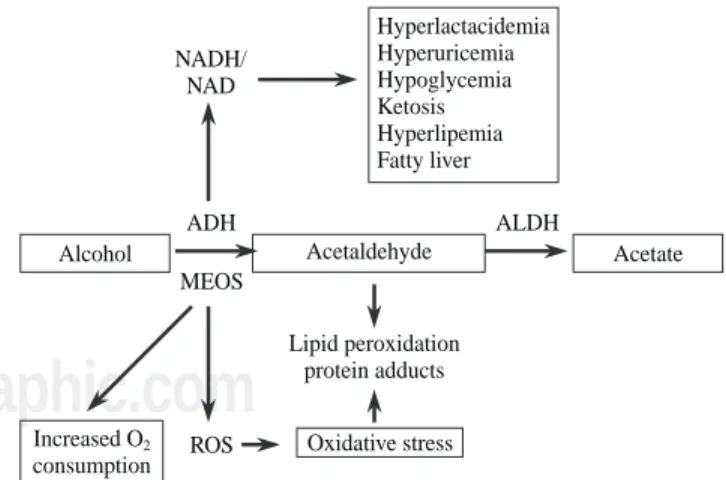
During ethanol oxidation mediated by ADH, hydrogen is transferred from the substrate to the cofactor nicotinamide adenine dinucleotide (NAD), converting it to its reduced form (NADH). The excess of reduced equivalents, mainly NADH, produces a change in the redox system of the cyto-sol which is demonstrated by a change in the lactate pyru-vate ratio. This redox imbalance is responsible for a series of metabolic alterations which favor liver damage. Hyperlact-acidemia contributes to acidosis and reduces the capacity of the kidney to excrete uric acid leading to hyperuricemia.
The increase in the NADH/NAD ratio raises the α -glycerophosphate concentrations which favor the depos-its of triglycerides in the liver. Moreover, the excess of NADH favors the synthesis of fatty acids. There is also a reduction in the activity of the citric acid cycle. The mechanism by which fatty acids are accumulated in the liver in the form of triglycerides is complex and is related to different metabolic alterations such as increase in he-patic synthesis, a decrease in hehe-patic lipoprotein secre-tion, a greater mobilization of fatty acids from adipose tissue favoring their hepatic uptake and a decrease in fat-ty acid oxidation.35
In subjects with a depletion in glycogen deposits or who have pre-existing abnormalities in carbohydrate me-tabolism, alcohol intoxication may be cause of severe hy-poglycemia due, at least in part, to a blockade of neo-glucogenesis by the increase in the NADH/NAD ratio. On other situations alcohol may favor rather than inhibit neoglucogenesis and alcoholism may, therefore, be cause of hyperglycemia35 (Figure 2).
Figure 2. Hepatic metabolic changes associated to ethanol
metabo-lism. (ADH: alcohol dehydrogenase; ALDH: acetaldehyde dehydroge-nase; MEOS: microsomal ethanol oxidizing system; ROS: reactive oxygen species).
NADH/ NAD
ADH
MEOS
ROS
ALDH
Alcohol Acetaldehyde Acetate
Increased O consumption
2
Lipid peroxidation protein adducts
J Caballería. Current concepts in alcohol metabolism 63
edigraphic.com
Microsomal ethanol oxidazing system (MEOS)
The microsomal ethanol oxidazing system (MEOS) constitutes a second mechanism that is able to oxidize al-cohol. The MEOS shares many properties with other mi-crosomal drug metabolizing enzymes such as utilization the cytochrome P-450, NADPH and oxygen.36 In addi-tion, an increase in MEOS activity is produced as a con-sequence of chronic alcohol consumption and this affects the CYP2E1 which is the ethanol inducible fraction of the cytochrome P-450 and is also capable of activating other hepatotoxic agents.37 The Km of MEOS is relatively high in relation to that of ADH making ADH the most impor-tant mechanism in the presence of low concentrations of alcohol. To the contrary, at high concentrations of alcohol and in chronic alcoholism, the importance of MEOS is creased, especially in reference to its capacity to be in-duced, contrasting with ADH which is not inducible.
Different polymorphisms of the humans CYP2E1 gene have been reported, particularly in the 5’-flanking38 region and some authors have attempted to related these polymorphisms to a greater susceptibility to develop liver lesions. However, to date the results of the different stud-ies have been negative or inconclusive.40,41 Neither did we find any relationship between the c1/c1 polymorphism of the CYP2E1 and chronic alcoholism or liver damage.17
Consequences of alcohol oxidation by MEOS and its induction
The CYP2E1 has a relatively high redox potential which, on using NADP as a cofactor, leads to the forma-tion of free oxygen radical, oxidative stress and lipid per-oxidation42(Figure 2). Oxidative stress induces the acti-vation of Kupffer cells, increasing the expression of sev-eral cytokines such as transforming growth factor beta, tumoral necrosis factor alpha and interleukin 1. All of this mechanisms contributes to the activation of stellate cells with the consequent increase in collagen synthesis favor-ing the progression of alcoholic liver disease.43
Interaction between alcohol and the metabolism of other drugs
Acute alcohol inhibits the metabolism of other drugs. The main mechanism is a competitive inhibition for the binding of both substances with cytochrome P-450. Other mechanisms may be the release of steroid hormones which may inhibit some microsomal enzymes and an in-hibition of the activity of the citric acid cycle due to the excess production of NADH. This competitive inhibition may occur with high or low levels of ethanol, depending on the drug.44
In addition to tolerance to alcohol, chronic alcoholics develop tolerance to different drugs. This fact that was initially attributed to an adaptation of the central nervous
system is due, at least in part, to metabolic adaptation. To this effect, an increase in the plasma clearance of many drugs of up to 50% has been observed.45 This increase in plasma drug clearance may be due to the induction of the microsomal enzymes, which metabolize the drugs, and a greater content of cytochrome P-450. These effects of chronic alcohol intake may be partially modulated by diet and the influence of carbohydrate,46 lipid47 and protein48 content has been demonstrated in animal models. This metabolic tolerance may persist for days or even weeks after cessation of alcohol intake and this should be taken into account when establishing the dosage of some drugs. The induction of cytochrome P-4502E1 does not only influence the oxidation of ethanol but is also capable of converting many xenobiotics into their toxic metabo-lites, increasing the vulnerability of chronic alcoholics.44 Among other substances, some industrial solvents such as bromobenze or vinyl chloride, anesthetics, cocaine, medications of common use such as isoniazid, phenylb-utazone and analgesics such as paracetamol are sub-strates for cytochrome P4502E1 and, thus, affected by alcohol consumption.49 Usual doses of paracetamol (2 to 4 g/day) may cause severe hepatitis in alcoholics, espe-cially in the first days of abstinence when the microsom-al system remains induced and the competitive effect of alcohol is lacking.50
There appears to be an association between chronic al-cohol consumption and the incidence of neoplasms, espe-cially of the digestive and respiratory tract.51 One of the mechanisms may be the effect of alcohol on enzymatic systems depending on cytochrome P-450 which are capa-ble of activating carciogens.49,51 Another mechanism may be a synergistic effect between alcohol and smoking since most alcoholics are smokers.52 Another factor which may contribute may be a deficit in vitamin A.53 Alcoholics have a greater microsomal degradation of vitamin A which is necessary to maintain mucosal integrity and avoid the activation of carciogens. However, the adminis-tration of supplements of vitamin A or beta carotenes should be carefully undertaken since alcohol potentiates their hepatoxicity.
Catalase
Catalase is capable of oxidizing ethanol in vitro in the presence of a generating system of hydrogen peroxide. However, in physiological conditions, catalase plays a very small role in alcohol metabolism.4
64
edigraphic.com
hydrogen peroxide leading to significantly diminishedrates of peroxidation of alcohols via catalase.55 Other studies have confirmed that oxidation of the fatty acids in the peroxisomes is of little importance in alcohol metabo-lism. Finally, the scarce role of catalase in alcohol metab-olism has been demonstrated by the practically lack of ef-fect of the administration of the catalase inhibitor aminot-riazol on alcohol metabolism.56 In chronic alcoholics catalase may contribute to the oxidation of fatty acids compensating, in part, the lower oxidation due to mito-chondrial damage.
Non oxidative metabolism of alcohol
Laposata and Lange described a non oxidative metab-olism of alcohol which is capable of forming ethyl esters from the fatty acids.57 On comparing subjects with acute alcohol intoxication with control subjects, these authors found a significantly high concentration of fatty acid eth-yl esters in different organs such as the pancreas, liver, heart and adipose tissue which are organs in which alco-hol induced lesions are often present and some of which also lack an oxidative system to metabolize alcohol. Thus, fatty acid ethyl esters may play a role in the patho-genesis of the lesions induced by alcohol consumption, although studies are required to confirm this hypothesis.
Acetaldehyde metabolism
Aldehyde dehydrogenase
Acetaldehyde is rapidly metabolized to acetate by the action of aldehyde dehydrogenase (ALDH). There are two classes of ALDH, ALDH1 located in the cytosol with a high Km for acetaldehyde and ALDH2 or mitochondri-al ALDH with a low Km for acetmitochondri-aldehyde which is the class of the greatest importance in the metabolism of ace-taldehyde. ALDH2 also presents a genetic polymorphism with two alleles, ALDH2*1 and ALDH2*2, with there also being homo and heteroxygotes for each. ALDH2*2 is a physiologically inactive form.5,6 A recent study has shown that the administration o a dose of ethanol produc-es an area under the curve (AUC) for plasma concentra-tions of alcohol 2-3-fold greater in the ALDH2*2 ho-mozygotes than in the ALDH2*1 hoho-mozygotes while the AUC for acetaldehyde in the ALDH2*2 homozygotes was 220-fold and 5-fold greater than in the ALDH2*1 homozygotes and heterozygotes, respectively.58 The slower elimination of alcohol in subjects with the ALDH2*2 genotype is due to the inhibition of ADH ac-tivity by the accumulated acetaldehyde. These data sug-gest that in ALDH2*1 homozygotic subject, mitochon-drial ALDH is sufficient to oxidate all the acetaldehyde produced by ADH, and that there is possibly enough mi-tochondrial ALDH in the heterozygotes to metabolize the acetaldehyde,59 although more slowly, while the cytosolic
ADLH1 is responsible for the oxidation of acetaldehyde in the ALDH2 homozygotes in which practically no mito-chondrial ALDH activity is detected.60
The prevalence of the different ALDH genotypes var-ies according to the populations studied so that in Cauca-sian subjects the ALDH2*2 genotype is not detected while its prevalence is high among Asians, ranging from 10% to 44% of the population.59,61
The elevated levels of acetaldehyde achieved in ALDH2*2 homozygotic subjects, even after the ingestion of a small or moderate amount of alcohol, produce circu-latory changes which may be translated into a reaction of discomfort with tachycardia and facial flushing. All of this leads to aversion to alcohol and has a protector effect versus alcohol dependence in Orientals in which the prevalence of the ALDH2*2 genotype is much lower in alcoholics than in the general population.62 In recent years a trend towards an increase in the prevalence of ALDH2*2 heterozygotes has been observed among ori-ental alcoholic subject. This indicates that the protection versus alcohol dependence in heterozygotes is not com-plete and environmental and sociocultural factors also in-fluence in these subjects.5
A new polymorphism has recently been described in the promotor region of the ALDH2. This polymorphism is an A/G mutation which is less active in the A than in the G al-lele and it has been detected with variable frequency in dif-ferent population groups, including Caucasians.63 In a study carried out in a Japanese group, no significant differ-ences were found between the A/G allelic frequency among chronic alcoholics and the control population.64
In our group of chronic alcoholics we have also inves-tigated the ALDH2 polymorphism as well as the mutation in the promotor region. Similar to other Caucasian popu-lation studied we did not detect the ALDH2*2 genotype. In regard to the promotor polymorphism, the A allele fre-quency was similar in chronic alcoholics (15%) and con-trols (23%). Neither did we detect significant differences between alcoholics with or without liver lesions, or be-tween those with initial lesions or cirrhosis.17 Neverthe-less, further studies are required to elucidate the possible influence of the A/G polymorphism of the promotor as well as other possible polymorphisms in this region in the metabolism of alcohol and, thus, in alcohol dependence.
Metabolic alterations produced by acetaldehyde and acetate
The metabolites of ethanol, acetaldehyde and, to a lesser extent, acetate, are responsible for most of the met-abolic effects of ethanol, not only in the liver but also in other organs such as the heart and blood vessels, adipose tissue and the brain.65
mem-J Caballería. Current concepts in alcohol metabolism 65
edigraphic.com
branes, particularly in chronic alcoholics, leading to theformation of acetaldehyde-protein complexes which are responsible for the appearance of antibodies versus these complexes (Figure 2). The appearance of circulating anti-bodies is related to the degree of liver lesion and is also observed in liver diseases of non alcoholic etiology, with the imunocomplexes which are formed being one of the immunologic mechanisms which may contribute to the pathogenesis of alcoholic liver disease.68
As previously mentioned, the ALDH responsible for the metabolism of acetaldehyde is mitochondrial and, moreover, the reoxidation of the NADH cofactor to NAD also depends on mitochondrial integrity. Acetaldehyde diminishes the capacity of the mitochondria to oxidize fatty acid as well as other functions. This mitochondrial dysfunction leads to higher levels of acetaldehyde in the plasma causing a vicious circle which thereby contributes to the progression of liver damage.69
Factors influencing alcohol and acetaldehyde me-tabolism
The plasma concentration of ethanol, and thus, its tox-icity, depends on the absorption of alcohol in the upper gastrointestinal tract, its distribution throughout the or-ganism and its hepatic metabolism. All these steps may be influenced by genetic and environmental factors.
Gastric emptying and ethanol absorption depend on the concentration of alcohol in the drinking beverage, the speed with which it is drunk and whether the alcohol is taken while fasting or with a meal.70 Some studies have demonstrated that food increases the ethanol elimination rate by around 50% and this effect is similar in men and women and it is independent of the composition of the meal.6 Apart from the effect on first pass metabolism, the effect of food may be related to an increase in hepatic blood flow, the activation of enzymes or the capacity of the reoxidation of NADH. Likewise, as indicated, first pass metabolism is due to the action of gastric ADH which is adequate to oxidate alcohol at the high concen-trations achieved in the stomach. First pass metabolism is reduced in Asian subjects, in women and in cirrhotic al-coholics. In all these situations there is lesser activity, whether genetic or acquired of ADH, especially with re-gard to the isoenzymes of high Km for ethanol such as σ and χ ADH. Gastric ADH activity and thus, first pass me-tabolism are also affected by other drugs.
Alcohol is homogeneously distributed throughout body water. The plasma concentration of alcohol depends on weight and the amount of body water.71 Thus, the vol-ume of distribution of alcohol is, in general, lower in women than in men and this factor, together with the low-er first pass metabolism contributes to the greatlow-er suscep-tibility of women to the toxic effect of alcohol.
Different factors influence the hepatic metabolism of alcohol and acetaldehyde. Among these, environmental
and genetic factors, chronic alcohol intake and the liver disease itself should be considered.
Genetic and environmental factors
As indicated in the corresponding section, the genetic variations of the main enzymes involved in alcohol me-tabolism, cytosolic ADH and mitochondrial ALDH, greatly influence alcohol metabolism and the different prevalence of the different isoenzymes explains the great-er or lessgreat-er susceptibility of developing an alcohol depen-dence syndrome according to the population studied. To the contrary, the genetic polymorphism of the CYP2E1 does not appear to be of great importance in the greater or lesser susceptibility of liver damage produced by alcohol. Alcohol metabolism may be influenced by the nutri-tional state since malnutrition diminishes ADH activity, similar to what occurs with high concentrations of alco-hol.72 Changes have been described in the metabolism of alcohol related to hepatic flow73 and circadian rhythm.74 The effect of different drugs on alcohol metabolism is of little importance and only fructose has been found to sig-nificantly increase alcohol metabolism.75
Influence of chronic alcohol consumption
Chronic alcoholics show greater tolerance to alcohol. This is due to an adaptation of the central nervous system, but also to an increase in the ethanol elimination rate or met-abolic tolerance.76 The mechanisms for the increased ethanol metabolic rate observed in chronic alcoholics are not com-pletely known and this phenomenon has been attributed to increased ADH activity, to increased mitochondrial reoxida-tion of NADH, to a hypermetabolic state in the liver, to in-creased microsomal oxidation and to catalase.3
Most studies have shown that chronic alcohol intake does not increase ADH activity but rather, may be dimin-ished even in the absence of liver involvement.77 Ethanol induces an increase of Na, K, ATPase, followed by en-hanced ATP consumption, increased oxygen consump-tion, and increased mitochondrial NADH reoxidation providing the basis for the hypermetabolic state of the liv-er, which has been suggested as responsible for the ad-aptative increase in ethanol elimination.78 However, this findings have not been confirmed by other studies.79
66
edigraphic.com
The increase in the ethanol oxidation rate in chronicalcoholics results in increases of both blood and tissue ac-etaldehyde concentrations. In this regard, we have report-ed that in chronic alcoholics blood acetaldehyde level correlated with the rates of ethanol elimination.77 Chronic alcohol consumption also produces a significant reduc-tion in the mitochondrial capacity to oxidize acetalde-hyde.69 This is due to a lower capacity of the mitochon-dria to reoxidize NADH and possibly to a lower mito-chondrial ALDH activity.80
During ethanol oxidation blood acetate levels are also higher in alcoholics than in controls, and there is a high significant positive correlation between blood acetate concentration and the rate of ethanol elimination in chronic alcoholics. Thus, increased blood levels of ace-tate in the presence of ethanol indicate metabolic toler-ance to alcohol and has been proposed as a laboratory marker of alcoholism.81
Influence of liver lesions
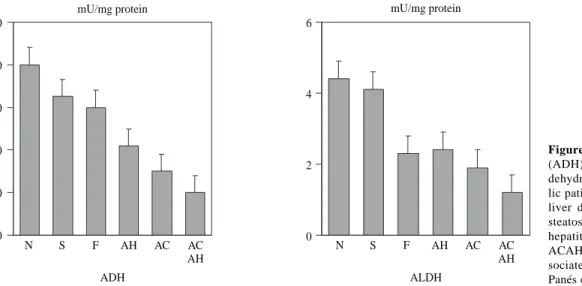
Liver involvement is one of the factors which may in-fluence in alcohol metabolism. To this effect, the adapta-tive increase in alcohol metabolism observed in chronic al-coholics disappears in patients with advanced liver disease. In a study carried out in our Liver Unit we determined the hepatic activity of a low and high Km ADH and ALDH in a series of chronic alcoholics with different degree of liver involvement, from normal liver to cirrhosis. In this study, a decrease was observed in both ADH and mitochondrial ALDH activity which was proportional to the severity of the liver lesions82(Figure 3). The activity of these two en-zymes also correlated with the values of serum bilirubin, albumin and prothrombin index. These results have been confirmed by other authors and indicate that the decrease in ADH and ALDH activity in chronic alcoholics is not a primary defect in these patients, but rather, is secondary to liver lesion. A decrease in the hepatic activity of
mitochon-drial ALDH was also observed in this study in patients with liver damage of non alcoholic etiology.82 This fact may explain the increase in the levels of acetaldehyde of endogenous origin83 as well as the presence of antibodies versus the acetaldehyde-protein complexes described in patients with non alcoholic liver disease.84 This difficulty in metabolizing acetaldehyde may justify the recommenda-tion of avoiding alcohol intake in patients with non alco-holic liver disease.
Acknowledgements
The research work of the authors was supported in part by a grant from Ministerio de Sanidad y Consumo (FIS 98/1082).
References
1. Simpura J. Trends in alcohol consumption in EU countries. In Peters TJ de. Alcohol misuse: An European perspective. Amsterdam, Harwood Academic Publishers, 1996: 1-22.
2. Grant BF, Dufour MC, Harford TC. Epidemiology of alcoholic liver disease. Sem Liver Dis 1988; 8: 12-25.
3. Salaspuro M. Epidemiological aspects of alcoholic liver disease, etha-nol metabolism and pathogenesis of alcoholic liver injury. In Bircher J, Benhamou JP, McIntyre N, Rizzetto M and Rodés J eds, Oxford Text Book of Clinical Hepatology, 2nd de. Oxford, Oxford University Press, 1999: 1157-1178.
4. Lieber CS. Ethanol metabolism, cirrhosis and alcoholism. Clin Chim Acta 1997; 257: 59-84.
5. Bosron WF, Ehrig T, Li T-K. Genetic factors in alcohol metabolism and alcoholism. Sem Liver Dis 1993; 13: 126-135.
6. Li T-K, Yin S-J, Crabb D, O’Connor S, Ramchandani VA. Genetic and enviromental influences on alcohol metabolism in humans. Al-cohol Clin Exp Res 2001; 25: 136-144.
7. Jornvall H, Höög J-A. Nomenclature of alcohol dehydrogenases. Al-cohol 1995; 30: 153-161.
8. Bosron WF, Li T-K. Genetic polymorphisms of human alcohol and aldehyde dehydrogenase, and their relationship to alcohol metabo-lism and alcohometabo-lism. Hepatology 1986; 6: 502-510.
9. Li T-K. Pharmacokinetics of responses to alcohol and genes that in-fluence alcohol drinking. J Stud Alcohol 2000; 61: 5-12.
Figure 3. Alcohol dehydrogenase
(ADH) and low Km acetaldehyde dehydrogenase (ALDH) in alcoho-lic patients with different degree of liver damage: N: normal liver; S: steatosis; F: fibrosis; AH: alcoholic hepatitis; AC: alcoholic cirrhosis; ACAH: alcoholic cirrhosis with as-sociated alcoholic hepatitis. (from Panés et al, ref. 82).
50
40
30
20
10
0
6
4
2
0
mU/mg protein mU/mg protein
N S F AH AC AC
AH
N S F AH AC AC
AH
J Caballería. Current concepts in alcohol metabolism 67
edigraphic.com
10. Shen YC, Fan JH, Edenberg HJ, Li T-K, Cui Y-H, Wang Y-E et al. Polymorphism of ADH and ALDH genes among four ethnic groups in China an effects upon the risk for alcoholism. Alcohol Clin Exp Res 1997; 21: 1272-1277.
11. Chao Y-C, Young TH, Tang H-S, Hsu CT. Alcoholism and alcoholic organ damage and genetic polymorphisms of alcohol metabolizing enzymes in chinese patients. Hepatology 1997; 25: 112-117. 12. Couzigou P, Coutelle C, Fleury B, Iron A. Alcohol and aldehyde
dehydrogenase genotypes, alcoholism and alcohol related diseases.
Alcohol Alcohol 1994; 2: 21-27.
13. Whitfield JB. Meta-analysis of the effects of alcohol dehydrogenase genotype on alcohol dependence and alcoholic liver disease. Alco-hol AlcoAlco-hol 1997; 32: 613-619.
14. Borras E, Coutelle C, Rosell A, Fernandez-Muixi F, Broch M, Crosas B, Hjelmqvist L et al. Genetic polymorphism of alcohol dehydroge-nase in europeans: The ADH2*2 allele decreases the risk for alcohol-ism and is associated with ADH3*1. Hepatology 2000; 31: 984-989. 15. Poupon RE, Nalpas B, Coutelle C, Fleury B, Couzigou P, Higueret D
and the French Group for Research on Alcohol and Liver. Polymor-phism of alcohol dehydrogenase, alcohol and aldehyde dehydroge-nase activities: implications in alcoholic cirrhosis in white patients.
Hepatology 1992; 15: 1017-1022.
16. Parés X, Farrés J, Parés A, Soler X, Panés J, Ferré JL, Caballería J et al. Genetic polymorphism of liver alcohol dehydrogenase in Spanish subjects: significance of alcohol consumption and liver disease. Al-cohol AlAl-cohol 1994; 29: 701-705.
17. Blasco C, Caballería J, Parés A, Lligoña A, Deulofeu R, Lluis J, Caballería L et al. Genetic polymorphisms of alcohol metabolizing enzymes do not influence the development of alcoholic liver disease.
J Hepatol 2002; 36 (suppl 1): 143.
18. Mizoi Y, Yamamoto K, Ueno Y, Fukunaga T, Harada S. Involvement of genetic polymorphism of alcohol and aldehyde dehydrogenases in individual variation of alcohol metabolism. Alcohol Alcohol 1994; 29: 707-710.
19. Allali-Hassani A, Martinez SE, Peralba JM, Vaglenova J, Vidal F, Richart C, Farrés J et al. Alcohol dehydrogenase in human and rat blood vessels. FEBS Lett 1997; 405: 26-30.
20. Hernández-Muñoz R, Caballería J, Baraona E, Uppal R, Greenstein R, Lieber CS. Human gastric alcohol dehydrogenase: Its inhibition by H2-receptor antagonists and its effect on the bioavailability of ethanol. Alcohol Clin Exp Res 1990; 14: 946-950.
21. Moreno A, Parés X. Purification and characterization of a new alco-hol dehydrogenase from human stomach. J Biol Chem 1991; 266: 1128-1133.
22. Yin S-J, Wang M-F, Liao C-S, Chen C-M, Wu C-W. Identification of a human stomach alcohol dehydrogenase with distinctive kinetic prop-erties. Biochem Int 1990; 22: 829-835.
23. Julkunen RJH, DiPadova C, Lieber CS. First pass etabolism of nol: a gastrointestinal barrier againts the systemic toxicity of etha-nol. Life Sci 1985; 37: 567-573.
24. Caballería J, Frezza M, Hernández-Muñoz R, DiPadova C, Korsten MA, Baraona E, Lieber CS. The gastric origin of the first-pass metabolis of ethanol in humans: effect of gastrectomy. Gastroenter-ology 1989; 97: 1205-1209.
25. Dohmen K, Baraona E, Ishibashi H, Pozzato G, Moretti M, Matsunaga C, Fujimoto K, Lieber CS. Ethnic differences in gastric sigma alco-hol dehydrogenase activity and ethanol first-pass metabolis. Alcohol Clin Exp Res 1996; 20: 1569-1576.
26. Seitz HK, Egerer G, Simanowski UA, Waldherr R, Eckey R, Agarwal DP, Goedde HW, Von Warburg JP. Human gastric alcohol dehydro-genase activity: effect of age, gender and alcoholism. Gut 1993; 34: 1433-1437.
27. Baraona E, Abittan CS, Dohmen K, Moretti M, Pozzato G, Chayes ZW, Schaefer C, Lieber CS. Gender differences in pharmacokinetics of alcohol. Alcohol Clin Exp Res 2001; 25: 502-507.
28. Frezza M, DiPadova C, Pozzato G, Terpin M, Baraona E, Lieber CS. High alcohol blood levels in women: the role of decreased gastric alcohol dehydrogenase activity and first-pass metabolism. N Engl J Med 1990; 322: 95-99.
29. Roine RP, Gentry RT, Hernández-Muñoz R, Baraona E, Lieber CS. Aspirin increases blood alcohol concentrations in human after inges-tion of ethanol. JAMA 1990; 264: 2406-2408.
30. Caballería J, Baraona E, Rodamilans M, Lieber CS. Effects of cimetidine on gastric alcohol dehydrogenase activity and blood etha-nol levels. Gastroenterology 1989; 96: 388-392.
31. Hernández-Muñoz R, Caballería J, Uppal R, Greenstein R, Lieber CS. Human gastric alcohol dehydrogenase: its inhibition by H2-re-ceptor antagonists, and its effects on the bioavailability of ethanol.
Alcohol Clin Exp Res 1990; 14: 946-950.
32. Pestalozzi DM, Buhler R, von Warburg JP, Hess M. Immunohis-tochemical localization of alcohol dehydrogenase in the human gas-trointestinal tract. Gastroenterology 1983; 85: 1011-1016. 33. Jokelainen K, Siitonen A, Jousimies-Somer H, Nosova T, Heine R,
Salaspuro M. In vitro alcohol dehydrogenase-mediated acetaldehyde production by aerobic bacterial representing the normal colonic flora in man. Alcohol Clin Exp Res 1996; 20: 967-972.
34. Salaspuro M. Bacteriocolonic pathway for ethanol oxidation. Ann Med 1996; 28: 195-200.
35. Lieber CS. Hepatic metabolic and toxic effects of ethanol: 1991 up-date. Alcohol Clin Exp Res 1991; 15: 573-592.
36. Lieber CS. Microsomal ethanol-oxidizing system (MEOS): the first 30 years (1968-1998)-a review. Alcohol Clin Exp Res 1999; 23: 991-1007. 37. Lieber CS, DeCarli LM. Hepatic microsomal ethanol oxidizing sys-tem: In vitro characteristics and adaptative properties in vivo. J Biol Chem 1970; 245: 2505-2512.
38. Hu Y, Hakkola J, Oscarson M, Ingelman-Sundberg M. Structural and functional characterization of the 5’ flanking region of the rat and human cytochrome P450 2E1 genes: identification of a polymorphic repeat in the human gene. Biochem Biophys Res Commun 1999; 263: 286-293.
39. Maezawa Y, Yamauchi M., Toda G. Association between restriction fragment length polymorphism of the human cytochrome P450IIE1 gene and susceptibility to alcoholic liver cirrhosis. Am J Gastroenterol
1994; 89: 561-565.
40. Carr LG, Hartleroad JY, Liang Y, Mendenhall C, Moritz T, Thomasson H. Polymorphis at the P450IIE1 locus is not associated with alco-holic liver disease in caucasian men. Alchol Clin Exp Res 1995; 19: 182-184.
41. Lucas D, Ménez C, Floch F, Gourlaouen Y, Sparfel O, Joannet I, Bodénez P et al. Cytochromes P4502E1 and P4501A1 genotypes and susceptibility to cirrhosis or upper aerodigestive tract cancer in alcoholic caucasians. Alcohol Clin Exp Res 1996; 20: 1033-1037. 42. Dupont I, Lucas D, Clot P, Menez C, Albano E. Cytochrome P4502E1
inducibility and hydroxyeyhyl radical formation among alcoholics.
J Hepatol 1998; 28: 564-571.
43. Nieto N, Friedman SL, Greenwel P, Cederbaum AI. CYP2E1-medi-ated oxidative stress induces collagen type I expression in rat hepatic stellate cells. Hepatology 1999; 30: 987-996.
44. Lieber CS. Interaction of ethanol with drugs, hepatotoxic agents, carcinogens and vitamins. Alcohol Alcohol 1990; 25: 157-176. 45. Kater RMH, Roggin G, Tobon F, Zieve P, Iber FL. Increased rate of
clearance of drugs from the circulation of alcoholics. Am J Med Sci
1969; 258: 35-39.
46. Teschke R, moreno F, Petrides AS. Hepatic microsomal ethanol oxi-dizing system (MEOS): respective role of ethanol and carbohydrates for the enhanced activity after chronic alcohol consumption. Biochem Pharmacol 1981; 30: 45-51.
47. Joly J-G, Hetu C. Effects of chronic ethanol administration in the rat: relative dependency on dietary lipids. Biochem Pharmacol 1975; 124: 1475-1480.
48. Mitchell JR, Mack C, Mezey E, Maddrey WC. The effects of varia-tion in dietary protein and ethanol on hepatic microsomal drug me-tabolism in the rat. Hepatology 1981; 1: 336-340.
49. Badger TM, Ronis MJJ, Seitz HK, Albano E, Ingelman-Sunberg M, Lieber CS. Alcohol metabolism: role in toxicity and carcinogenesis.
Alcohol Clin Exp Res 2003; 27: 336-347.
68
edigraphic.com
51. Seitz HK, Pöschl G, Simanowski UA. Alcohol and cancer. Recent Dev Alcohol 1998; 14: 67-95.
52. Lieber CS, Garro A, Leo MA, Mak KM, Worner TM. Alcohol and cancer. Hepatology 1986; 6: 1005-1019.
53. Seitz HK. Ethanol and retinoid metabolism. Gut 2000; 748-750. 54. Handler JA, Thurman RG. Fatty acid dependent ethanol metabolism.
Biochem Biophys Res Commun 1985; 133: 44-51.
55. Handler JA, Thurman RG. Redox interactions between catalase and alcohol dehydrogenase pathways of ethanol metabolism in perfused rat livers. J Biol Che 1990; 265: 1510-1515.
56. Kato S, Alderman J, Lieber CS. Respective roles of ethanol oxidixing system (MEOS) and catalase in ethanol metabolism by deermice lack-ing alcohol dehydrogenase. Arch Biochem Biophys 1987; 586-591. 57. Laposata EA, Lange LG. Presence of nonoxidative ethanol metaolis
in human organs commonly damaged by ethanol abuse. Science 1986; 231: 497-499.
58. Peng G-S, Wang –F, Chen C-Y, Luu S-U, Chou H-C, Li T-K, Yin S-J. Involvement of acetaldehyde for full protection against alcoholism by hoozygosity of the variant allele of aldehyde dehydrogenase gene in Asians. Pharmacogenetics 1999; 9: 463-476.
59. Crabb DW, Edenberg HJ, Bosron WF, Li T-K. Genotypes for alde-hyde dehidrogenase deficiency and alcohol sensitivity: The inactive ALDH2 allele is dominant. J Clin Invest 1989; 83: 314-316. 60. Farrés J, Wang X, Takahashi K, Cunningham SJ, Wang TT, Weiner
H. Effects of changing glutamate 487 to lysine in rat and human liver aldehyde dehydrogenase. A model to study (Oriental type) class 2 aldehyde dehydrogenase. J Biol Che 1994; 269: 13854-13860. 61. Yoshida A. Molecular genetics of human aldehyde dehydrogenase.
Pharacogenetics 1992; 2: 139-147
62. Okamoto K, Murawaki Y, Yuasa I, Kawasaki H. Effect of ALDH2 and CYP2E1 gene polymorphisms on drinking behaviour and alco-holic liver disease in Japanese male workers. Alcohol Clin Exp Res
2001; 25: 19S-23S.
63, Chou W_Y, Stewart MJ, Carr LG, Zheng D, Stewart TR, Williams A, Pinaire j et al. An A/G polymorphism in the promoter of mitochon-drial aldehyde dehydrogenase (ALDH2): Effects of the sequence variant on transcription factor binding and promoter strength. Alco-hol Clin Exp Res 1999; 23: 963-968.
64. Harada S, Okubo T, Nakamura T, Fujii C, Nomura F, Higuchi S, Tsutsui M. A novel polymorphism (-357 G/A) of the ALDH2 gene: Linkage disequilibrium and an association with alcoholism. Alcohol Clin Exp Res 1999; 23: 958-962.
65. Lieber CS. Acetaldehyde and acetate. In Lieber Cs de, Medical and nutritional complications of alcoholism. Mechanisms and manage-ment. New York, Plenum Medical Book Company 1992: 37-57. 66. Tsukamoto H, Lu SC. Current concepts in the pathogenesis of
alco-hol liver injury. FASEB J 2001; 15: 1355-1349.
67. Fernández Checa JC, Bellentani S, Tiribelli C. Alcohol-induced liver disease: from molecular damage to treatment. Rev Med Chile 2002; 130: 681-690.
68. Hoerner M, Behrens UJ, Worner T, Lieber CS. Humoral immuneresponses to acetaldehyde adducts in alcoholic patients. Res Commun Chem Pathol Pharmacol 1986; 54: 3-12.
69. Hasamura Y, Teschke R, Lieber CS. Acetaldehyde oxidation by he-patic mitochondria. Decrease after chronic etahnol consumption.
Science 1975; 189: 727-729.
70. Gentry RT. Effects of food on the pharmacokinetics of alcohol ab-sorption. Alcohol Clin Exp Res 2000; 24: 403-404.
71. Marshall AW, Kingstone D, Boss M, Morgan MY. Ethanol elimina-tion in males and females: Relaelimina-tionship to menstrual cycle and body composition. Hepatology 1983; 3: 701-706.
72. Wilson JS, Korsten MA, Lieber CS. The combined effects of protein deficiency and chronic ethanol administration on rat ethanol metabo-lism. Hepatology 1986; 6: 823-829.
73. Carmichael FJ, Saldivia V, Varghese GA, Israel Y, Orrego H. Etha-nol-induced increase in portal blood flow. Role of acetate And A1 and A2 adenosine receptors. Am J Physiol 1988; 2225: G417-G423. 74. Pinkston JN, Soniman KFA. Effect of lifgt and fasting on the circa-dian variation of ethanol metabolism in the rat. J Interdisc Cycle Res
1979; 10: 185-193.
75. Brown SS, Forrest JAH, Roscoe P. A controlled trial of fructose in the treatment of acute alcoholic intoxication. Lancet 1972; 2: 898-900. 76. Eriksson CJP, Deitrich RA. Metabolic mechanisms in tolerance and
physical dependence on alcohol. In Kissin B and Begleiter H eds.
The pathogenesis of alcoholism: biological factors. New York, Ple-num Press, 1983: 253-283.
77. Panes J, Caballería J, Guitart R, Parés A, Soler X, Rodamilans M, Navasa M et al. Determinants of ethanol and acetaldehyde metabo-lism in chronic alcoholics. Alcohol Clin Exp Res 1993; 17: 48-53. 78. Bernstein J, Videla L, Israel Y. Metabolic alterations produced in
liver by chronic ethanol administration. Changes related to energetic parameters of the cell. Biochem J 1973; 134: 515-522.
79. Cederbaum AI, Dicker E, Lieber CS, Rubin E. Factors contributing to the adaptative increase in ethanol metabolism due to chronic con-sumption of ethanol. Alcohol Clin Exp Res 1977; 1: 27-31. 80. Nuutinen H, Lindros K, Salaspuro M. Determinants of blood
acetal-dehyde level during ethanol oxidation in chronic alcoholics. Alcohol Clin Exp Res 1983; 7: 163-168.
81. Korri UM, Nuutinen H, Salaspuro M. Increased blood acetate: A new marker of alcoholism and heavy drinking. Alcohol Clin Exp Res 1985; 9: 468-471.
82. Panés J, Soler X, Parés A, Caballería J, Farrés J, Rodés J, Parés X. Influence of liver disease on hepatic alcohol and aldehyde dehydro-genases. Gastroenterology 1989; 97: 708-714.
83. Matthewson K, Almardini H, Bartlett K, Record CO. Impaired ac-etaldehyde metabolism in patients with non-alcoholic liver disorders.
Gut 1986; 27: 756-764.