Treatment of recurrent genotype 4 hepatitis C after liver
transplantation: early virological response is predictive of
sustained virological response. An AISF RECOLT-C Group Study
Francesca Romana Ponziani,* Alessandro Milani,* Antonio Gasbarrini,* Raffaella Zaccaria,* Raffaella Viganò,† Maria Francesca Donato,‡ Maria Cristina Morelli,§ Lucia Miglioresi,|| Luisa Pasulo,¶ Maria Rendina,** Daniele Di Paolo,†† Maria Marino,‡‡ Pierluigi Toniutto,§§ Stefano Fagiuoli,¶ Maurizio Pompili*
* AISF RECOLT-C group: *Catholic University of Rome. Italy. † Niguarda Ca’ Granda Hospital. Italy. ‡ Policlinico of Milan. Italy. § Sant’Orsola Malpighi Hospital. Italy. || S. Camillo-Spallanzani Hospital. Italy. ¶ Ospedali Riuniti of Bergamo. Italy. ** University of Bari. Italy.
†† University of Rome Torvergata. Italy. ‡‡ University of Modena. Italy. §§ University of Udine. Italy.
ABSTRACT
Introduction. Hepatitis C virus genotype 4 is predominant in the Middle East and Northern Africa, even if it has recently spread to Southern Europe. Data about the treatment of post-liver transplantation (LT) geno-type 4 hepatitis C recurrence are scarce. We report a retrospective analysis of post-LT genogeno-type 4 hepa-titis C treatment in 9 Italian transplant centres, focusing on the overall survival rates and treatment outcome. Results. Among 452 recipients, we identified 17 HCV genotype 4 patients (16 males, 1 female) transplanted between 1998 and 2007. All patients received combined antiviral treatment with conventional doses of interferon (recombinant or pegylated) and ribavirin after histological diagnosis of hepatitis C re-currence. The observed overall survival after LT was 100% at 1 year and 83.3% at 5 years. More than 1/3 (35.3%) of patients achieved a sustained virological response (SVR) and 40% (data available in 15 subjects) an early virological response (EVR), which was significantly associated with the achievement of SVR (overall accuracy: 85.7%; predictive values of EVR absence/presence 80/88.8%; chi-square p < 0.05). Conclusion. In conclusion, in post-LT genotype 4 hepatitis C treatment, SVR rates are similar to genotype 1. Patients who don’t show an EVR are not likely to achieve a SVR.
Key words. HCV recurrence. Liver transplantation. HCV treatment. Genotype 4. EVR.
Correspondence and reprint request: Dr. Francesca Romana Ponziani, M.D. UOC Internal Medicine and Gastroenterology
Policlinico A. Gemelli,
Catholic University of Rome. largo A. Gemelli 8 00168, Rome-Italy. Ph.: +39-347-1227242/ +39-06-30156018
E mail: [email protected]
Manuscript received: October 17, 2011. Manuscript accepted: November 01, 2011.
INTRODUCTION
Hepatitis C virus (HCV) has 6 major genotypes
and over 76 subtypes.1,2 Genotype 4 is widely
preva-lent in the Middle East and Northern Africa and is predominant in Egypt, where accounts for more
than 90% of HCV infections.3,4 Genotype 4 HCV
in-fection has a low prevalence in Europe, ranging bet-ween 0 and 19%, even if, in Mediterranean countries such as France, Spain, Greece and Italy, a trend towards an increasing prevalence has been recently
observed.5,6 The main reasons for this phenomenon
appear to be the increased immigration from high prevalence areas and the diffusion among intrave-nous drug abusers.
Early reports have shown that patients with ge-notype 4 chronic hepatitis C respond as poorly as those with genotype 1 to conventional interferon (IFN) alpha and to combined IFN alpha plus
ribavi-rin therapy.7-10 More recently, a few trials on the
treatment of genotype 4 chronic hepatitis C using pegylated (PEG) IFN alpha 2b or alpha 2a plus riba-virin have been published, reporting highly variable rates of sustained virological response (SVR),
ran-ging from 33 to 69%.11-17 On the whole, the SVR
rate of patients with chronic genotype 4 hepatitis C treated with PEG-IFN plus ribavirin seems to be slightly higher than that observed for genotype 1 (42–46%), but lower than that observed for
genoty-pes 2 and 3 (76–82%).18,19 Furthermore, recent data
suggest that, in genotype 4 patients, the
achieve-ment of a rapid virological response (RVR).14,20 or
an early virological response (EVR)21 may be highly
SVR rate can be observed in Egyptian patients
com-pared to matched European patients.15
Only a few data about the clinical course and the treatment outcome of patients with genotype 4 chronic hepatitis C recurrence after liver transplantation (LT) are still currently available, especially in Europe.
The aim of this study is to retrospectively evalua-te the effectiveness of the antiviral treatment in an Italian multicentric cohort of patients with genotype 4 chronic hepatitis C recurrence after LT.
MATERIAL AND METHODS
Seventeen patients (16 males and 1 female) aged from 39 to 59 years and affected by genotype 4-rela-ted chronic hepatitis C recurrence after LT were en-rolled in the study. Five of them were native to Egypt, the remainders were Caucasian. All patients were followed-up in 9 Italian Transplant centres, du-ring the period 1996-2010; and the time between LT and the clinical recurrence of hepatitis C ranged from 4 to 67 weeks (mean 25.1 weeks). None of the investigated patients had experienced a pre-LT treatment for HCV infection.
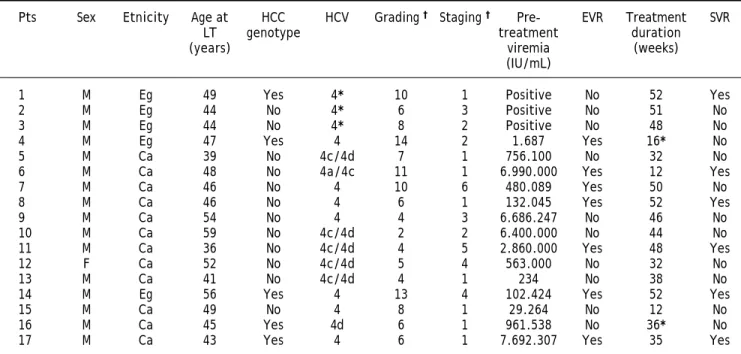
The outstanding clinical characteristics of the in-vestigated patients are summarized in table 1.
The quantitative value of pre-treatment HCV-RNA was available in 14 out of 17 patients (mean
vi-remia 2.423.235 IU/mL, range 234-7.692.307 IU/ mL), and a high viral load (more than 600.000 IU/ mL) was detected in 7/14 cases. In the remaining 3 patients, transplanted before 2000, only a positivity for serum HCV-RNA was available.
Hepatocellular carcinoma (HCC) before LT was diagnosed in five patients (29.4%).
Patients were treated with conventional doses of recombinant (2 cases) or PEG-IFN (15 cases) alpha plus ribavirin for a scheduled period of 48-weeks.
RESULTS
The main results of the study are shown in table 1. We did not find any significant difference in the immunosoppressive regimen scheduled for these pa-tients, since 8 received cyclosporine, 8 tacrolimus and 1 rapamcycine as the main immunosuppressive agent. The mean donor age was 46.6 (16-86 yrs); do-nors were 9 males and 8 of females; a donor-reci-pient gender mismatch was present in 7 case, always of the type female donor in male recipient.
Antiviral treatment duration was of at least 24 weeks in 14 subjects (82.3%), and 8 of them (47%) completed a standard 48-week course of treatment. Three patients received less than 24 weeks of antivi-ral treatment; in particular, patient n. 4 withdrew the treatment at week 16 for urgent abdominal
sur-Table 1. Demographic and clinical features of the 17 investigated patients.
Pts Sex Etnicity Age at HCC HCV Grading † Staging † Pre- EVR Treatment SVR
LT genotype treatment duration
(years) viremia (weeks)
(IU/mL)
1 M Eg 49 Yes 4* 10 1 Positive No 52 Yes
2 M Eg 44 No 4* 6 3 Positive No 51 No
3 M Eg 44 No 4* 8 2 Positive No 48 No
4 M Eg 47 Yes 4 14 2 1.687 Yes 16* No
5 M Ca 39 No 4c/4d 7 1 756.100 No 32 No
6 M Ca 48 No 4a/4c 11 1 6.990.000 Yes 12 Yes
7 M Ca 46 No 4 10 6 480.089 Yes 50 No
8 M Ca 46 No 4 6 1 132.045 Yes 52 Yes
9 M Ca 54 No 4 4 3 6.686.247 No 46 No
10 M Ca 59 No 4c/4d 2 2 6.400.000 No 44 No
11 M Ca 36 No 4c/4d 4 5 2.860.000 Yes 48 Yes
12 F Ca 52 No 4c/4d 5 4 563.000 No 32 No
13 M Ca 41 No 4c/4d 4 1 234 No 38 No
14 M Eg 56 Yes 4 13 4 102.424 Yes 52 Yes
15 M Ca 49 No 4 8 1 29.264 No 12 No
16 M Ca 45 Yes 4d 6 1 961.538 No 36* No
17 M Ca 43 Yes 4 6 1 7.692.307 Yes 35 Yes
*Non-Pegylated IFN. †††††According to Ishak score. M: male. F: female. Eg: Egyptian. Ca: Caucasian. HCC: hepatocellular carcinoma. EVR: early virologic
gery due to laparocele, while patients n. 6 and n. 15 suspended the treatment after 12 weeks for personal choice and for severe anemia, respectively. Six pa-tients withdrew the treatment after 24 weeks, for the occurrence of neuropsychiatric symptoms, seve-re neutropenia, cholangitis, hepatocellular carcino-ma recurrence and, finally, in two cases, lack of virological response.
A SVR was achieved in more than one third (35.3%) of the investigated patients, with a negative HCV-RNA persisting for at least 3 years (long term response) in all of them.
An EVR was achieved in 7 out of the 17 patients (41.1%). In the 14 patients who completed at least 24 weeks of treatment, we could also assess the abi-lity of EVR in predicting the occurrence of SVR; 80% (4/5) of the patients exhibiting an EVR achieved a SVR, while it occurred in only one patient without EVR. In this way, EVR was significantly associated with the occurrence of SVR (overall accuracy: 85.7%; predictive values of EVR absence/presence 80/88.8%; chi-square p < 0.05).
Interestingly, one of the 3 patients who did not complete a 24-week course of treatment (Table 1, pa-tient n. 6), achieved an EVR together with a SVR.
The observed overall survival rates (Kaplan-Meier method) were 100% at 1 year and 83.3% at 5 years after LT. No significant differences were found among the survival rates of patients with or without SVR, probably due to the low number of investigated subjects.
DISCUSSION
End stage HCV-related liver cirrhosis is the
most common indication for LT in Europe.22
Howe-ver, HCV reinfection of the graft occurs almost universally, leading to graft cirrhosis within 5 years after LT in 10-30% of recipients and to an
im-paired survival.23 At present, the gold-standard of
antiviral therapy is the combination of PEG-IFN plus ribavirin, administered, in most centres, after the histological diagnosis of infection recurrence in the graft. However, the reported SVR rates that could be achieved with the combined treatment are significantly lower than 50%, least of all in
genoty-pe 1 patients.24-26
Similarly to immunocompetent subjects with chronic hepatitis C, SVR rates in transplanted pa-tients are significantly lower in genotypes 1 and 4
(25-40%) than in genotypes 2 and 3 (53-76%).24-29
Despite the increasing diffusion of genotype 4 HCV in the Mediterranean countries, only a few data
about its response to antiviral treatment after LT
are available so far.4 Selzner, et al.24 treated with
conventional or PEG- IFN 119 patients with geno-type 1 and 4 recurrent hepatitis C after LT; SVR was achieved in 40% of cases but no data about the response of the 9 patients with genotype 4 HCV in-fection were reported. Similarly, Jimenez-Perez, et
al.30 reported a 41% rate of SVR in 41 patients
transplanted for recurrent hepatitis C; only in 4 ca-ses graft reinfection was due to HCV genotype 4, but no data about their response to treatment were pro-vided. The only available literature series specifica-lly concerning transplanted patients with recurrent genotype 4 chronic hepatitis C is those published by
Mudawi, et al.,31 who treated 17 patients from Saudi
Arabia with a 48-week course of PEG-IFN alpha 2a plus ribavirin, achieving a SVR in 7 of them (41%)
and Al-Hamoudi, et al.,32 who treated 25 patients
from Saudi Arabia with a 48-week course of PEG-IFN alpha 2a plus ribavirin, achieving a SVR in 14 of them (56%).
Therefore, our study, despite the small number of enrolled patients, represents to our knowledge the largest available series in Europe regarding post-LT genotype 4 recurrent hepatitis C antiviral treat-ment.
According to the rates reported in patients with genotype 1, a SVR was achieved in 35.3% of our pa-tients with recurrent genotype 4 chronic hepatitis C. Overall, EVR was able to predict the occurrence of SVR (p < 0.05) in 80% of patients with more than 24 weeks of therapy, while, in absence of EVR, a SVR was achieved only in one case. The SVR rate reported by our study is lower than that reported by
Al-Hamoudi, et al.,33 mainly because the authors
ex-cluded difficult-to-treat patients (those who failed previous pre- or post-transplant treatment, with renal failure, and pretreatment cytopenia), reporting only one case of treatment withdrawal. Moreover, in immunocompetent patients, Egyptian origin has been reported to be associated to higher SVR proba-bilties. Although the number of our transplanted pa-tients is too low to draw any firm conclusion, we were not able to find a statistical difference (Chi-square 0.07; 1 d.f.) between SVR rates among Egyptian patients (40%) and the Italian ones (33.3%) (Table 1).
It is well known that, in immunocompetent sub-jects with genotype 1 chronic hepatitis C, the absen-ce of EVR is a very strong predictor of treatment failure, since more than 90% of patients who do not
reach EVR fail to achieve SVR.33 Some recent papers
sub-sequent SVR also in transplanted patients undergo-ing antiviral treatment for recurrent hepatitis C,
mostly genotype 1-related.24,25,28 Al-Hamoudi, et
al.,32 also confirmed that the probability of
achie-ving SVR was related to achieachie-ving a negative HCV RNA at week 12. Our experience supports this evi-dence also in genotype 4 transplanted patients; the-refore, in the subgroup of genotype 4 patients treated after liver transplantation who do not achie-ve an EVR, treatment discontinuation may be consi-dered.
Literature data highlight that, independently from HCV genotype, the achievement of SVR seems to improve significantly the long term survival of pa-tients with post-LT recurrent hepatitis C
undergo-ing antiviral treatment.27,34 However, our series
cannot support these data, since we were not able to find a statistical difference between the cumulative survival of subjects with or without SVR, probably due to the relatively low number of investigated pa-tients. Furthermore, we included in our retrospecti-ve multicentric series only genotype 4 patients who were treated for HCV gen 4 recurrence after liver transplantation. Unfortunately, due to the study de-sign, we were not able to collect data about those patients who did not receive the treatment, either due to mild hepatitis C recurrence or to contraindica-tions to combined antiviral treatment. Therefore, we cannot provide any comparison regarding survival of these two groups.
As a last consideration, a recent meta-analysis re-ported that more than 84% of Egyptians with HCC
are positive for genotype 4 HCV.35 In our series,
HCC was diagnosed in five patients (29.4%) and three of them were Egyptians. Then, HCC was pre-sent in 3 out of 5 Egyptian patients (60%) and in only 2 out of 12 Caucasians (16.7%). In particular, one of the 5 patients with HCC achieved a SVR but died 8 months after the end of the antiviral treat-ment due to HCC recurrence. However, in the other 4 cases, no HCC recurrence was observed. However, the small number of patients included in our retros-pective series does not allow us to draw any epide-miologic conclusion.
CONCLUSION
In conclusion, our study shows that transplanted patients with genotype 4 recurrent hepatitis C un-dergoing antiviral treatment achieve SVR in about one third of cases, and that EVR is a strong predic-tor of subsequent SVR.
REFERENCES
1. Simmonds P. Viral heterogeneity of the hepatitis C virus. J Hepatol 1999; 31: 54-560.
2. Simmonds P, Buck J, Combet C, et al. Consensus proposals for a unified system of nomenclature of hepatitis C virus genotypes. Hepatology 2005; 42: 962-73.
3. Kamal SM, Imad AN. Hepatitis C genotype 4: what we know and what we don’t yet know. Hepatology 2008; 47: 1371-83.
4. Khattab MA, Ferenci P, Hadziyannis SJ, et al. Management of hepatitis C virus genotype 4: recommendations of an international expert panel. Hepatology 2011; 54: 1250-62. 5. Ansaldi F, Bruzzone B, Salmaso S, Rota MC, Durando P, Gas-parini R, Icardi G. Different seroprevalence and molecular epidemiology patterns of hepatitis C virus infection in Italy. J Med Virol 2005; 76: 327-32.
6. Antaki N, Craxi A, Kamal SM, Moucari R, Van der Merwe S, Haffar S, Gadano A, et al. The neglected hepatitis C virus genotypes 4, 5 and 6: an international consensus report.
Liver Int 2009; 10: 335-42.
7. El-Zayadi A, Simmonds P, Dabbous H, Prescott L, Selim O, Ahdy A. Response to interferon-alpha of Egyptian patients infected with hepatitis C virus genotype 4. J Viral Hepat
1996; 3: 261-4.
8. El-Zayadi A, Selim O, Haddad S, Simmonds P, Hamdy H, Ba-dran HM, Shawky S. Combination treatment of interferon alpha-2b and ribavirin in comparison to interferon mono-therapy in treatment of chronic hepatitis C genotype 4 patients. Ital. J Gastroenterol Hepatol 1999; 31: 472-5. 9. Kamal SM, Madwar MA, Peters T, Fawzy R, Rasenack J.
In-terferon therapy in patients with chronic hepatitis C and schistosomiasis. J Hepatol 2000; 32: 172–4.
10. Koshy A, Madda JP, Marcellin P, Martinot M. Treatment of hepatitis C virus genotype 4-related cirrhosis: Ribavirin and interferon combination compared with interferon alo-ne. J ClinGastroenterol 2002; 35: 82-5.
11. Alfaleh FZ, Hadad Q, Khuroo MS, Aljumah A, Algamedi A, Alashgar H, Al-Ahdal MN, Mayet I, Khan MQ, Kessie G. Peg-interferon alpha-2b plus ribavirin compared with interfe-ron alpha-2b plus ribavirin for initial treatment of chinterfe-ronic hepatitis C in Saudi patients commonly infected with geno-type 4. Liver Int 2004; 24: 568–74.
12. Hasan F, Asker H, Al-Khaldi J, Siddique I, Al-Ajmi M, Owaid S, Varghese R. Peginterferon alfa-2b plus ribavirin for the treatment of chronic hepatitis C genotype 4. Am J Gas-troenterol 2004; 99: 1733-7.
13. Kamal SM, El Tawil AA, Nakano T, He Q, Rasenack J, Hakam SA, Saleh WA, et al. Peginterferon {alpha}-2b and ribavirin therapy in chronic hepatitis C genotype 4: Impact of treatment duration and viral kinetics on sustained virolo-gical response. Gut 2005; 54: 858-66.
14. Kamal SM, El Kamary SS, Shardell MD, Hashem M, Ahmed IN, Muhammadi M, Sayed K, et al. Pegylated interferon alpha-2b plus ribavirine in patients with genotype 4 chronic he-patitis C: The role of rapid and early virologic response.
Hepatology 2007; 46: 1732-40.
15. Roulot D, Bourcier V, Grando V, Deny P, Baazia Y, Fontai-ne H, Bailly F, et al; Observational VHC4 Study Group. Epi-demiological characteristics and response to peginterferon plus ribavirin treatment of hepatitis C virus genotype 4 infection. J Viral Hepat 2007; 14: 460-67. 16. El Makhzangy H, Esmat G, Said M, Elraziky M, Shouman S,
17. Elefsiniotis IS, Pavlidis C, Dimitroulopoulos D, Vezali E, Mi-has C, Mariolis-Sapsakos T, Koutsounas S, Paraskevas E, Saroglou G. Differential viral kinetics in treated genotype 4 chronic hepatitis C patients according to ethnicity. J Viral Hepat 2009; 16: 738-42.
18. Manns MP, McHutchison JG, Gordon SC, Rustgi VK, Shiff-man M, Reindollar R, GoodShiff-man ZD, et al. Peginterferon alfa-2b plus ribavirin compared with interferon alfa-alfa-2b plus ribavirin for initial treatment of chronic hepatitis C: A randomised trial. Lancet 2001; 358: 958-65.
19. Fried MW, Shiffman ML, Reddy KR, Smith C, Marinos G, Goncales FL Jr., HaussingerD, et al. Peginterferon alfa-2a plus ribavirin for chronic hepatitis C virus infection. N Engl J Med 2002; 347: 975-82.
20. Ferenci P, Laferl H, Sherzer TM, Gschwantler M, Maieron A, Brunner H, Stauber R, et al; Austrian Hepatitis Study Group. Peginterferon alfa-2a and ribavirin for 24 weeks in hepatitis C type 1 and 4 patients with rapid virological response. Gastroenterology 2008; 135: 451-8.
21. Elefsiniotis IS, Vezali E, Mihas C, Saroglou G. Predictive value of complete and partial early virological response on sustained virological response rates of genotype-4 chronic hepatitis C patients treated with PEG-interferon plus ri-bavirin. Intervirology 2009; 52: 247-51.
22. Adam R, McMaster P, O’Grady JG, Castaing D, Klempnauer JL, Jamieson N, Neuhaus P, et al. Evolution of liver trans-plantation in Europe: report of the European Liver Trans-plant Registry. Liver Transpl 2009; 12: 1231-43.
23. Berenguer M. What determines the natural history of re-current hepatitis C after liver transplantation? J Hepatol
2005; 42: 448-56.
24. Selzner N, Renner EL, Selzner M, Adeyi O, Kashfi A, Thera-pondos G, Nigel Girgrah N, et al. Antiviral treatment of re-current hepatitis C after liver transplantation: predictors of response and long-term outcome. Transplantation
2009; 88: 1214-21.
25. Lodato F, Berardi S, Gramenzi A, Mazzella G, Lenzi M, Mo-relli MC, Tame MR, et al. Clinical trial: peg-interferon alfa-2b and ribavirin for the treatment of genotype-1 hepatitis C recurrence after liver transplantation. Ali-ment Pharmacol Ther 2008; 28: 450-7.
26. Cescon M, Grazi GL, Cucchetti A, Vetrone G, Ravaioli M, Ercolani G, Morelli MC, et al. Predictors of sustained
viro-logical response after antiviral treatment for hepatitis C recurrence following liver transplantation. Liver Transpl
2009; 15: 782-9.
27. Berenguer M, Palau A, Aguilera V, et al. Clinical benefits of antiviral therapy in patients with recurrent hepatitis C following liver transplantation. Am J Transplant 2008; 8: 679-87.
28. Berenguer M, Aguilera V, Prieto M, Rayón JM, Juan FS, Prieto M. Worse recent efficacy of antiviral therapy in li-ver transplant recipients with recurrent hepatitis C: im-pact of donor age and baseline cirrhosis. Liver Transpl
2009; 15: 738-46.
29. Dinges S, Morard I, Heim M, Dufour JF, Müllhaupt B, Gios-tra E, Clavien PA, Mentha G, Negro F; Swiss Association for the Study of the Liver (SASL 17). Pegylated interferon-alpha2a/ribavirin treatment of recurrent hepatitis C after liver transplantation. Transpl Infect Dis 2009; 11: 33-9. 30. Jiménez-Pérez M, Sáez-Gómez AB, Pérez-Daga JA,
Loza-no-Rey JM, De la Cruz-Lombardo J, Rodrigo-López JM. He-patitis C virus recurrence after liver transplantation: analysis of factors related to sustained viral response.
Transplant Proc 2010; 42: 666-8.
31. Mudawi H,Helmy A, Kamel Y, Al Saghier M, Al Sofayan M, Al Sebayel M, Khalaf H, et al. Recurrence of hepatitis C virus genotype-4 infection following orthotopic liver transplan-tation: Natural history and predictors of outcome. Ann Saudi Med 2009; 29: 91-7.
32. Al-Hamoudi W, Mohamed H, Abaalkhail F, Kamel Y, Al-Masri N, Allam N, et al. Treatment of genotype 4 hepatitis C re-curring after liver transplantation using a combination of pegylated interferon alfa-2a and ribavirin. Dig Dis Sci
2011; 56: 1848-52.
33. Ghany MG, Strader DB, Thomas DL, Seeff LB. Diagnosis, management, and treatment of hepatitis C: an update.
Hepatology 2009; 49: 1335-74.
34. Picciotto FP, Tritto G, Lanza AG, Addario L, De Luca M, Di Costanzo GG, Lampasi F, et al. Sustained virological response to antiviral therapy reduces mortality in HCV reinfection af-ter liver transplantation. J Hepatol 2007; 46: 459-65. 35. Lehman EM, Wilson ML. Epidemiology of hepatitis viruses