
Synthesis of chloro and methyl imido cyclopentadienyl molybdenum and tungsten complexes X ray molecular structures of [WCp*C13(NtBu)], [MoCp*C1Me2(NtBu) ] and [WCp*C1Me2(NtBu) ]
9
0
0
Texto completo
(2) 271. P. G6mez Sal et al. I lnorganica Chimica Acta 273 (1998) 270-278 R. MeCN/o,. NCMe [ ,~t~NCMe "W". @. NaCp. ~-. .Ac. CO. W. ........ O~. PCI5. =. ~. /,4. R. ] M. C i ~ CI. / u.. u.. u,, c o Me. '~PCOOC/. Bu xxNt. /,~ 7n, M~". J,. .. ". M ~. W,R=Me3. ;~I-~C i t. ] NH2Bu. l'c,~/. \. '. Me. M=Mo,R=Mei W,R=H 2. R. Me. Me. M=Mo,R=Me4 W,R=H 5 W,R=Me6 I PCIs CI Me. M;. R. /~.M.. R. C!. Ci. CI. NtBu. Scheme1. NaCp and subsequent addition of acetic acid in THF without isolation (Scheme I ). The compounds [ MCp*(CO)2 ] 2 (M = Mo, W) were prepared as previously described [ 14]. Treatment of [WCp(CO)3H] and [MCp*(CO)2]2 (M = Mo, W) with an excess of PCI5 in dichloromethane and toluene respectively followed by filtration afforded the almost insoluble complexes [ MCp'C14 ], (M = Mo, Cp' = @-CsMet (1) [ 10a I; M = W, Cp' = "05-C5H5 (2) [ 11 ], r/5-CsMe5 (3) [ 10b] ) in yields higher than 90%. Reaction of complexes 1-3 with tert-butylamine led to the reported complexes [MCp'CI2(NtBu)] ( M = M o , C p ' = r/5-C~Me5 (4) [7e,15]; M =W, Cp' = r/5-CsH5 (5) 17a, 161, "qs-C~Me5 (6) 17e]). 2.2. Oxidation o['/MCp' CI2(N'Bu)] Addition of 0.5 mol of PCl5 to a dichloromethane solution of complex [ MoCp*CI2 (N'Bu) ] (4) led to the formation of the trichloro imido molybdenum(VI) complex [MoCp*CI.~(N1Bu) ] (7) [7a], which could also be obtained by reaction of the imido molybdenum(IV) derivatives cis-trans[MoCp*CI(N~Bu) ]2 [ 15] with I mol of PCIs. Oxidation of complexes 5-6 with 1 equiv, of PCI 5 led to the formation of the reported 17al IWCp'C13(NtBu)] (Cp'=@-CsH5 (8), Cp'=r/5-CsMe5 (9)) (Scheme 1). Related molybdenum and tungsten complexes containing different cyclopentadienyl rings were also isolated using chlorine gas as the oxi-. dizing agent [16] and by selective reaction of the diimidometal (VI) derivatives [ MCp*CI(NtBu) z ] with HCI [ 7a]. However, the oxidation of the imidomolybdenum(V) complexes described here is the most direct and easiest method to prepare the corresponding molybdenum (VI) compounds in high yield. Complexes 7-9 were isolated as crystalline solids which were characterized by elemental analysis and IR and NMR spectroscopy (see Section 3 ) and the molecular structure of complex 9 was studied by X-ray diffraction methods. The molecular structure of complex 9 is shown in Fig. 1 along with the labelling scheme. Selected bond distances and angles are presented in Table 1. The molecule shows a pseudo-square pyramidal coordination where the lout square planar positions are occupied by the three chlorine atoms and the nitrogen atom of the imido N'Bu group. The Cp(centroid)-W distance is a normal 2.121 A, but the W-C(Cp) distances range from 2.297(6) to 2.595(6), showing an important trans influence of the N'Bu substituent which is responsible for the longest C3-W l distance. All the W-CI distances are similar. The W1-NI distance of 1.736(4) A and the WI-N1-C21 angle 174.8(4) ° confirm the linear coordination of the formally triple bonded imido group. This structure is similar to that found for MoCp*CI3 (N'Bu). The W I-N 1 distance is even shorter than that found [17] for W(r/5-CsMes)( =NAr)2CI where the.
(3) 272. P. (;6meg Salet al. /hu,~2~anica (7fimica Acla 273 (1998) 270-278. )C(71C(2)~ -3'--"-"-"-£ . ~ C 1 6 1. C(9}. ~. X '~. ~. _. )C(23} C1(1). C 241 l ~ j (2(22} Fig. I. Perspective view of the molecular structure ol I WCp*CI~( NtBu } (9) with thc atom-numbering scheme. Hydrogen atoms are omitted for clarity. Table I Selected bond lengths {A ) and angles (~) for 9 Will N{It W I I ) C1{2) W(I} (hi) W( I l-C{ t) W{I} (7(5) C( I ~-('(5} C(21 ('{~} ( ' ( 4 ) ('(5} ('i21} (7!23} W( I )-('p( I ). 1.736(4} 2.402(2) 2.302(5 ~ 2.595(5) 2.297(5) 1.416(8) 1.416(8) 1.425{ 8} 1.509(12) 2.121. W( I ) - C h I } W(I)-CI{3} W( 1 )-C( 2l W( 1 )-C(41 N( I)-C(21 } C(1)-C(2) C{3) C(4~ C(21 ) - C ( 2 2 ) C( 21 ) - C ( 2 4 ). 2.410(2) 2.402(2} 2.496(5) 2.488(5) 1.444{ 7 } 1.425(8} 1.407{8) 1.529{ I I 1.473{ 12. N { I } - W i l ) C1{2} {'1{ 2}-Wt I }-C1{3} ('1( 2 ) - W ( I )-CI{ I ) ('(21) N( 1 }--W{I }. 86.4(2} 145.77(7) 79.03(7) 174,8{4). N ( I ) - W ( I } C1(3) N( I )-W( I }-Ch I ) C1(3 l-W( 1 )-Cl{ I }. 87.1(2) 128.8{2) 79.11{8. {'pi t ) is the Celltruid ul'thc C( I ) to ( ' i 5 ) ring.. W - N distance is 1.785(41 A and the proposed bond order is greater than two.. 2.3. Alkylation o/' [MCp' CIXN'Bu) / Alkylation of complex 7 with 2 equiv, of LiMe in diethylether gave the dimethyl complex [MoCp*CIMe_,(N'Bu)] { 10), which was isolated as a crystalline yellow solid after cooling the solution to - 78°C ( Scheme 2). The analogous reaction using 3 equiv, of the same alkylating agent led to the trimethyl complex [ MoCp*Me~(N'Bu)] (13) as a microcrystalline orange solid. Both alkyl compounds 10 and 13 were moderately air-stable in the solid and very soluble in all organic solvents although they decomposed on heating their solutions above 70°C to give unidentified brown paramagnetic products. They were characterized by elemental analyses, IR and NMR spectroscopy and the molecular structure of complex 10 was determined by X-ray diffraction. The molecular structure of 10 is shown in Fig. 2, along with the labelling scheme. Only one of the enantiomers was. observed. Selected bond distances and angles are presented in Table 2. The coordination of the Mo atoms is similar to that described for complex 9. In this case the unique chlorine atom is located trans to the N~Bu group and together with the other two trans methyl groups complete the square base of the pseudo-square pyramid whose apex is occupied by the rt 5pentamethylcyclopentadienyl ligand. The Cp(centroid)Mo-CII and C p ( c e n t r o i d ) - M o - N angles are 110.3 and 126.3 °, respectively. They are larger than the other two ( mean 108.0 °) and the N atom is slightly out-of-the plane of the base of the pyramid, probably due to the steric requirement of the bulky NtBu group. The (tans influence due to the imido N'Bu is also remarkable, giving rise to the largest M o C I 2 ( C p ) distance oi' 2.53(I) A. The M o ( l ) - C ( m e t h y l ) distances of 2.25( 1 ) ]k, correspond to normal single bonds and the Mo( 1)-N( I ) distance of 1.706(8) ,~ and the M o N( I ) - C ( 3 ) angle of 175. I (9)° are consistent with the triple bond character of the Mo N bond. The methylation of complexes 8 and 9 was studied using different molar ratios of LiMe and MgCIMe as alkylating agents. Addition of 1 equiv, of the alkylating agent to suspensions of complexes 8 and 9 in THF or toluene always led to unresolvable mixtures containing the unreacted starting complex and variable amounts of the dialkyl and trialkyl derivatives together with traces of a paramagnetic component, which is probably the reduced tungsten(V) complex when LiMe was used. The addition of 2 equiv, of MgCIMe to a toluene suspension of [WCpCI3(N'Bu) ] (8} led after stirring for 16 h at room temperature to a green solution, which after purification by chromatography afforded the dimethyl complex [WCpCIMe+(N¢Bu)] (11) as a green crystalline solid in 409~ yield. The same reaction carried out with I WCp*CI3(N¢Bu) ] (9) in THF allowed us to isolate the related complex [ WCp*CIMe2(N'Bu) ] (12) as yellow crystals in 45~} yield. LiMe can be alternatively used to prepare complex 12 under the same conditions, whereas a.
(4) 273. P. G S m c : .S'o/ ct at. I hmr.,ani( a ('himic a ,4~ la 273 ¢1998) 2 7 0 27h'. R. I". R. ". M Cl'~eMe~ "~NtBu M = Mo, R = Me 10 W,R=H I1 W, R = Me 12. R. M=Mo.R=Me7 W,R=H 8 W,R=Me9. M eJJ Me N,Bu M#. R. M = Mo, R = Me 13 W,R=H 14 W, R = Me 15. J7%,° NB. ArN=C M#. At=-2 6-Me2C~H ~ 16. C(161 . ~ ~ RC(I~(ll) ~/ ,~. C[17t. ~C{181. ~. C(201. i , ) CI4). 02~. U5). ['lg. _. Pcrspccti~ c x ie~ o f lhc inolcctlh.lr Mrl.lCltlrc ill I MOClY {.'IMc ,i N ' B u ) I ( 1 0 ) ~sith the a t o m - n u m b e r i n g s c h c m c , t]) dlogell a t o m s are olnillcd ['or clarit).. lower yield due to the forination of other unidentitied products was obtained when this alkylating agen! was used !o prepare complex 11. Addition of 3 equiv, of MgCIMc to a THF suspension of lWCpCl~CN~Bu)] (8) led to an unre+ solvable mixture of alkylated products, but the related trimethyl derixativc [WCpMe~(N'Bu! ] ( 141 could be easily prepared in 50<A yield as a yellov,-brown solid hy reacting the prcviously isolated dimethyl complex 11 with I equi\, of MgCIMe in toluene. The same nlethyhltion of [WCp*-. CI~(N'Bu) I (9) with 3 equiv, of MgCIMe or LiMe produced tin initially green solution, which after warming and stirring at 0°C changed to give a brown solulion which after purilication by chromatography provided yellow crystals of the trimethyl complex [ W C p * M e J N ' B u ) ] 15 [181 in 359,~ yield. Complex 15 is a rather stable 18-electron compound. which reacts very slowl 5, with an excess of CN(2,6Me,(7~,H~I when heated in it sealcd ampoule to 65°C tk~r more than 10 days, al:iording the trans-dimethylinfinoacyl.
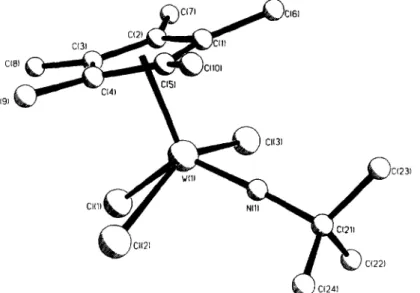
(5) 274. P. G6me: Sal el al./ Inorganica Chimica Acta 273 (1998) 270-278. Table 3 Selected bond lengths (A) and angles (°) for 12. Table 2 Selected bond lengths (A) and angles (°) for l0. Mo(I)-N(I) Mo(I)-C(2) Mo(I)-C(II) Mo(I)-C(13) Mo(I!-C(15) C(3)-C(5) C(3)-C(4) C(11)-C(15) C(13)-C(14). Mo(l)-Cp(l). 1.706(8) 2.256(13) 2.46(1) 2.40(1) 2.34(1) 1.27(3) 1.50(3) 1.47(2) 1.40(2) 2.096. Mo(I)-C(I) Mo(I)-CI(1) Mo(I)-C(12) Mo(I)-C(14) N(I)-C(3) C(3)-C(6) C(11)-CI12) C(t2)-CI13) C(14)-CI15). 2.252(12) 2.481(3) 2.53(I) 2.31(I) 1.46(2) 1.38(3) 1.38(2) 1.36(2) 1.40(2). N(I)-Mo(1)-C(I) C(1)-Mo(I)-C(2) C(I)-Mo(I)-CI(I) Cf3)-N( I )-Mo( 1) Cp( l)-Mo( I)-N( I ) Cp( I )-Mo( 1)-C(2). 88.4(5) 137.1(51 73.1(41 175.1(9) 126.3 107.5. N(I)-Mo(II-C(2) N(I)-Mo(I)-CI(1) C(2)-Mo(I)-CI(I) Cp(I)-Mo(I)~CI(I) Cp(I)-Mo(1)-C(I). 88.6(5) 123.3(3) 73,2(4) 110.3 108.5. Cp(I) is the centroid of the C(. ~. I 1) to C(15) ring.. "~ll~"~l. W(I)-C(I) W(I)-CI(I) N(I)-C(16) C(11)-C(15) C(13)-C(14) C(16)-C(19) C(16)-C(17). 2.205(8) 2.474(2) 1.439(11) 1.414(10) 1.437(11) 1.47(2) 1.54(2). N(I)-W(I)-C(1) C(I)-W(I)-C(2) C(I)-W(I)-CI(I) W( 1)-N( 1)-C(16) Cp( I )-W(I)-N(I) Cp( I I-W( 1)-C(2). 88.2(3) 140.0(4) 73.9(3) 177.2(6) 125.5 107.5. N( I )-W( l )-C(2) N( I)-W( I)-CI(I) C(2)-W( I )-CI(1) Cp( I )-W( I )-Cl( I ) Cp( I )-W( I l-C( I ). 88.4(3) 123.4(2) 75.0(3) I11.1 106.8. labelling scheme employed and selected bond distances and angles are presented in Table 3. Complex 12 shows a pseudo-square pyramidal coordination analogous to that described for complex 10, with the chlorine atom t r a n s to the imido NtBu group with the N atom out of the plane defined by the other three ligands. The W IN1 bond distance of 1.739(6) A is almost the same as that found for complex 9 and the W I-N1-CI6 bond angle of 177.2(6) ° is slightly larger. The only remarkable difference is the W-CI bond distance which at 2.474(2) ~,, is significantly larger than the distance observed in complex 9 (mean 2.404 A) consistent with the shorter Cp*(centroid)-W distance of 2.097 ,~.. C~"~5'l. 1). ~1[c1131 ~1~C(131). l. 1.739(6) 2.221(8) 2.539(71 1.412(11) 1.424(11) 1.410(11) 1.53(2) 2.097. Cp( I ) is the centroid of the C( I I ) to C( 15 ) ring.. ~-~ c11511. C(1111~C1111. W(I) N(I) W(I)-C(2) W(I)-C(I1) C(11)-C(12) C(12)-C(13) C(14)-C(15) C(16)-C(18) W(1)-Cp(I). .....y. C(lfl) 3. Experimental. Fig. 3. Perspective view' of the molecular structure of [WCp*CIMe2(N'Bu ) ] (12) with the atom-numbering scheme. Hydrogen atoms are omitted for clarity.. complex [WCp*{C(Me) =N(2,6-Me2C6H3)}Me2(N'Bu) ] (16) as a red crystalline solid. Formulation of complex 16 containing the monohapto-coordinated iminoacyl ligand and two t r a n s W-bonded methyl groups is consistent with its analytical composition and the observed ~H and J3C NMR spectra which show the low-field resonance of the migrated methyl group displaced to 6 2.39, one singlet at ~5 1.15 for the other two equivalent metal-bonded methyl substituents and the low-field resonance due to the iminoacyl carbon atom at ~5 230.0. Complex 16 is a very air-sensitive compound soluble in all alkanes and aromatic solvents. All tile di- and tri-methyl tungsten complexes 11-12, 14-15 were characterized by their analytical composition and IR, ~H and ~3C NMR spectroscopies, and the molecular structure of the dimethyl complex 12 was studied by X-ray diffraction methods. The molecular structure is shown in Fig. 3 with the. All manipulations were carried out under a dry argon atmosphere either in a Vacuum Atmosphere Dri-lab or by standard Schlenk techniques. Solvents were dried and freshly distilled: hexane from sodium-potassium alloy, diethyl ether and THF from sodium-benzophenone, toluene from sodium and dichloromethane from calcium hydride. Reagent grade LiMe ( 1.6 M in OEt2, Aldrich), MgCIMe (3.0 M in THF), PCI~ ( Aldrich ), acetic acid (Panreac) and NtB uH2 ( Aldrich ) were purchased from commercial sources and were used without further purification. NaCp and the complexes MoCp*CI2(N'Bu) [7el, [MoCp*CI(N~Bu)]2 [15], W(CO)3(NCMe)3 [12], WCpC12(N'Bu) [16], [MoCp*(CO)2]2 and [WCp*(CO)2]2 [ 14b] were prepared following modified reported methods. IR spectra were recorded on a PerkinElmer 583 spectrophotometer (4000-200 cm- ~) as Nujol mulls between Csl or polyethylene pellets. ~H and ~3C NMR spectra were recorded on Varian Unity VXR 300 MHz and Varian Unity FF 500 MHz instruments. Chemical shifts were measured relative to residual resonances in the deuterated solvents C(,D6 (~i 7.15 ), CDCI~ ( 6 7.24) and C 6 D 6 ( 6 128.0), CDCI3 (~ 77.0), respectively. Mass spectra were recorded.
(6) P. G6mezSal et al. /Inorganica ChimicaActa273 (I 998)270-278. 275. on an HP 5988 A instrument. C, H, and N analyses were carried out with a Perkin-Elmer 240C microanalyzer.. 92%. Anal. Calc. for C mHIsCI4W: C, 26.05; H, 3.25. Found: C, 26.03; H, 3.61%.. 3.1. Preparation (~[[WCp( CO).¢H]. 3.5. Preparation of lMoCp*Cl dNrBu)] (7). This compound was isolated by a method analogous to that reported by Fischer [13], using W(CO) 3(NCMe)~ instead of W (CO) 6. To a suspension of W (CO) 3(NCMe) 3 (6.00 g, 15.3 retool) in THF (200 ml) was added freshly prepared NaCp ( 1.35 g, 15.3 mmol) and the mixture was stirred at 25°C for 2 h. The mixture was then treated with acetic acid (0.92 g, 0.88 ml, 15.3 retool) and vigorously stirred for 10 rain. After elimination of volatiles under vacuum the solid residue was extracted into pentane ( 2 × 2 5 ml) to give a solution which by evaporation under vacuum aftorded a yellow crystalline solid identified as WCp( CO)3H by elemental analysis and comparison of its IR and NMR spectra with reported data [ 13]. Yield 4.86 g, 14.6 retool, 95%.. 3.2. Preparation of [MoCp*CI4l (1) A solution of [MoCp*(CO)2]2 ( 1.00 g, 1.72 mmol) in toluene (40 ml) was slowly added to a solution of PCI5 ( 1.50 g, 7.2 retool) in toluene (50 ml) and the mixture was stirred at 25°C for 2 h and then at 75°C for 1 day to give a purple solid which was filtered, washed with dichloromethane ( 2 × 10 ml) and dried under vacuum to be characterized as the title compound. Yield 1.20 g, 1.61 retool, 93%. Anal. Calc. for C,~HL~CI4Mo: C, 32.19: H, 4.02. Found: C, 31.74; H. 4.00%.. 3.3. Preparation of [WCpCl4] (2) This compound was prepared following a method similar to that described by Green et al. [ 1I ] but using WCp(CO) 3H instead of WCp(CO)~Me. A solution of WCp(CO)3H (4.00 g, 12.0 retool) in dichloromethane (100 ml) was added dropwise to a stirring solution of phosphorus pentachloride (7.48 g, 36.0 retool) in the minimum amount ofdichloromethane at 25°C with evolution of a colourless gas. The mixture was stirred for 20 h. Then the solvent was removed by filtration leaving a red-brown solid which was washed with dichloromethane (3 × 20 ml) dried in vacuoand identified as complex 2 by elemental analysis and comparison of its IR spectrum with reported data [ 11 ]. Yield 4.59 g, 11.5 retool, 98%.. 3.4. Preparation of [WCp*Clu] (3) A solution of [WCp*(CO)2]2 (2.00g, 2.66mmol) in toluene (40 ml) was slowly added to a solution of PCl5 (2.35 g, I 1.3 retool) in toluene (50 ml) and the mixture was stirred at 25°C for 2 h and then at 75°C for 2 days to give a yellow-orange solid which was filtered, washed with dichloromehane ( 2 × 10ml) and dried under vacuum to be characterized as the title compound. Yield 2.25 g, 2.44 retool,. A CH2Ch (50ml) solution of complex 4 (0.59g, 1.58 retool) was prepared and the stoichiometric amount of PC15 (0.17 g, 0,81 mmol) was added. The solution colour changed quickly from the initial brown to orange-red. The solution was stirred for 2 h and then filtered. After removal of the solvent, an orange-red solid was obtained. The residue was washed whith ~ 15 ml of pentane and extracted with toluene (2 × 30 ml). The solution was concentrated to give a microcrystalline orange solid identified as 7. Yield 0.56 g, 1.37 retool, 87%. The same procedure can also be used starting from the imidomolybdenum (IV) complex [ MoCp*CI(N'Bu)]2 [15]. IR (Nujo[ mull, u ( c m - ~ ) ) : 1212 (sh), 1201 (vs), 1031 (m),793 (m), 369 (w),349 (s), 324 (vs), 297 (w). IH NMR (6 ppm, in C6D(~) : 1.79 (s, 15H, CsMes), 1.23 (s, 9H, NCMe3). Anal. Calc. for Cj4H24NCI~Mo: C, 41.13; H, 5.87; N, 3.43. Found: C, 4t.33; H, 5.93; N, 3.29%.. 3.6. Preparation of lWCpCl~(N'Bu)] (8) Following the method reported by Green et al. [16], WCpCI2(NtBu) was prepared by addition of NH~tBu ( 2.52 g, 3.6ml, 34.5mmol) to a toluene (150ml) solution of WCpCI4 (4.5 g, 11.5 retool) and used in situ by adding PCI5 ( 1.20 g, 5.8 mmol). After stirring for 20 h at 25°C the insoluble residue was removed by filtration and the toluene solution together with that obtained after washing the solid with dichloromethane (2 × 50 ml) was evaporated to dryness to afford a solid, which after being washed with pentane was identified as complex 8 (4.17 g, 9.8 mmol, 81% yield). ~H NMR (6 ppm, in CDC13): 6.69 (s, 5H, C5H5), 1.51 (s, 9H, NCMe~). t3C{IH} NMR (6 ppm, in CDCI~): 115.2 (s, CsH~), 77.5 (s, CMe3), 28.4 (s, CMe3). Anal. Calc. for C,~H~4CI~NW: C, 25.41; H, 3.32; N. 3.31. Found: C, 26.06; H. 3.75; N, 3.50%.. 3.7. Preparation of [WCp*Cl3(N'Bu)] (9) A solution of WCp*CI2(N'Bu) prepared by reacting WCp*CI 4 (1.00 g, 2.2 retool) with NHJBu (0.69 ml, 6.6 retool) in toluene (50 ml) was treated with PCl5 (0.23 g, 1.08 retool). The colour of the solution changed from green to yellow and alter stirring for 4 h at 25°C the insoluble solid was removed by filtration. The toluene solution was cooled to - 3 5 ° C to give orange crystals of complex 9 (1.0 g, 2.0 mmol, 92%). ~H NMR ( 6 ppm, in CDCI3) : 1.96 (s, 15H, CsMes), 1.22 (s, 9H, NCMe~). 13C{IH} NMR (6 ppm, in CDCI~ ) : 125.4 ( s, CsMe~ ), 76.0 ( s, CMe 3), 28.9 ( s, CMe 3), 12.7 (s, CsMes). Anal. Calc. Jot CI4H4oCI3NW: C, 33.87; H, 4.83: N, 2.82. Found: C, 34.16: H, 4.82; N, 2.97%..
(7) 276. P. G6n~e:Net/etot. /h~orq,aHi{a ChimicoAcla 273 (1998) 270+278. 3.8. Preparation r#/'/MoCp* CI MeJN'Bu) / ~10) A suspension of 7 (0.40 g, (/.98 mmol) in Et,O t60 mll was cooled to approximately - 65°C, then 2 equiv. ( 1.22 ml ) of a LiMe ( 1.6 M in EL, O ) solution were added. The mixture was stirred at room temperature for 3 h. After filtration the solution was concentrated to - 10 ml giving an orange crystalline compound identified its complex l 0 (0.31 g, 80~/+ yield). 'H NMR (/3 ppm, in C,D+,): 1.55 Is, 15tt, C>Me~). 1.99 (s. 9H, NCMe+), 1.53 Is. 6H. Mo Me+_l. Anal. Calc. li)r C++,H~oNC1Mo: C, 52.25: H, 8.16: N, 3.81. Found: C, 52.41 : tl, 8.1 I: N, 3.899+.. 3.9. PreparatioH q[/WCpCIMee(N'Bu)/ (111 To a suspension of WCpCI3(N'Bu) ( 1.00 g, 2.34 mmol) in toluene (50 ml) was added a 3.0 M solution of MgCIMe in THF ( 1.56 ml, 0.35 g, 4.68 mmol ) a! - 78°C and the mixture was warmed to 25:~(_" and stirred tor 4 h. The solution was filte.'ed and the solvent removed under vacuunl to give a solid, which after being washed with pentane ( 2 :X 20 ml) was dissolved in toluene and purified by chromatography ( Shefadex ) using toluene as eluent. The resulting green solution was concentrated and cooled to - 35:'C to afford complex I ! as a crystalline green solid ( 0.36 +,o 0.94 mlnol, 40c/,~ yield). ~H NMR (+3 ppm, in CDCI+): 5.92 (s, 5H, CsH~I, 1.28(s. 9H, NCMe~), 1.23(s, 6H, W-Me_,). I+C{IH} NMR (~ ppm, in CDCI~): 104.9 (s, C+~Hs), 70.6 (s, ('Me+i, 28.4 ( s, CMe+), 24.4 ( s, W Me+_)./tmzl. Calc. l+orC.,H+uCINW: C. 34.26: H, 5.23: N, 3.63. Found: C, 32.72: tt, 5.00: N, 3.28q.. 3.10. Prepatz+lion o/[ W('I)* CIMe,(N'Bu)] (12) To a solution of WCp*CI.~(N~Bu) (9} ( I . l l g , 2.22 retool) in THF (5CI ml) cooled to 7 8 ( ' a 3.0 M solution of MgCIMe in THF ( 1.50 ml, 4.47 retool) v+,as added, then warmed to 25<>C and stirred lor 4 h. The solvent was removed under vacuum and the resulting solid was extracted with pentane to give a red solution. The solution w a s concentrated under vacuum to mire a crystalline yellov+ solid identiffed as complex 12 (0.45 g, 0.99 retool, 44.69+ yield). ;H NMR (~ ppm, in CDCI:+): 1.63 (s, 15H, C+Me~), 130 Is, 6H, W-Me,_), 1.03 ( s, 9H. NCMe+). I+C{ +H } NMR ( i~ppm, in CDCI+): 113.2 (s, CsMes), 7(/.5 (s, CMe+i, 32.2 !s. W Me:), 28.7 (s, CMe~), 11.3 (s, CsMes). Anal. Calc. for C~+,H +,.CINW: C, 42.19: H, 6.59: N, 3.07. Found: C. 41.40: H, 6.8(/: N, 2.87~/,.. 3. l I. Preparatiotz q//MoCl/+:Me+(N'Bu)/ (13 A suspension ol +complex 7 (0.44 g, 1.077 retool) in nhexane ( 50 ml) was prepared and a 1,6 M solution of l,iMe in OEt, (2.22 ml, 3.55 mlnol) was added at - 6 5 " C . The reaction mixture was warmed to 25°C and slirred lk)r 2 h. The red solution was liltered and evaporated to dryness and the. orange oil residue was partially crystallized in the minimum amount of Et+O by cooling at - 78°C. bH NMR ( 6 ppm, in C+,D,): 1.55 (s, 15H, C+Me,)+ 1.05 (s, 9H, NCMe+), 0.96 (s, 6H, M o - M e e ) , 0.29 (s, 3H, trans M o - M e ) . Amd. Calc. for C,TH~NMo: C, 58.79: H. 9.51: N. 4.{)3. Found: C, 58.99: H. 9.37: N, 3.99~/+.. 3.12. Prelmralion oI[ WCpMe+(N'Bu)/ (14) To a solution o f W C p C I M e 2 ( N ' B u l ( 1 2 ) ( I . 5 8 , 3.9 nlmol ) in toluene (50 ml t a 3.0 M solution of MgCIMe in THF ( 0.30 g, 1.3 ml, 3.9 mmol) was added al - 78°C and then warmed to 25~C and slirred for 4 h. After lillration the solvent was removed under vacuum and the resulting brown solid was extracted into pentane. Evaporation of the solvent afforded a brown solid identified as complex 14 (0.72 g, 1.95 mmol, 50% yield). 'I-t NMR (6 ppm, in CDCI3): 5.12 (s, 5H, CsHs), 1.08 (s, 6H, ~+i,v W-Me++), 1.02 (s, 9H, NCMe~), 0.79 ( s, 3 H. lr+ms W - M e ). ' ~C { ' H } N M R ( + ppm, in CDCI~ ): 103.4 ( s. C5H5/, (+9. I ( s, CMe~ ), 28.8 ( s+CMe:+)+ 21. I ( s, lran.+ W Me), 14.3 ( s. ci.~ W-Me++). Anal. Calc. l\w (7,eH~+NW: C, 39.44: H. 6.35: N, 3.84. Found: C. 39.16; H, 6.59: N, 3.73~A.. 3. 13. Preparation ,~(1 WCp*Me +(N'Bu)/ (15) To a solution of WCp*CI+(N~Bu) (9) ( 1 . 3 3 g , 2.68 retool) in THF (50 ml+ was added a 3.0 M sohttion of MgCIMe in THF (2.68 ml. 8.04 retool) at --78°C. The mixlure was warmed to 25°(7 and stirred for 4 h. After renaoving the solvent trader vacutlm lhe resulting solid residue was extracted inlo pentane to give a red solution which was evaporated to dryness. T h e solid was purilied by chromatography (ilorisil) ttsing hexane as eluent to afford after evaporation and cooling a red crystalline solid identified as complex 15 (0.4()g, 0.92retool, 359/ yield). 'H NMR (r3 ppm, in CDCI~): 1.60 (s, 1511, CsMcs). 1.09 is, 9H, NCMe~), 0.89 (s, 6H, cis W - M e , ) , 0.34 (s, 3H. Irans W - m e ) . ~3C{ 'H} NMR ( 8 ppm, in CI)CI~ ): 109.6 I s, CsMes). 69.8 ( s. CMe, ), 28.6 ( s, CMe~). 27.6 ( s, cis W - M e , ), 21.2 ( s, trans W - M e ) , 1(/.7 (s, CsMes). Amd. Calc. for CtvH~NW: C, 46.93: H, 7.58: N. 3.22. Found: C, 46.39; H, 7.63: N, 2.9W/~.. 3. I4. Preparation q/[ WCI/I:Me./rl-C(Me) = N(2,6.. Me+C,,H O](N'tht)] (16) An ampoule containing a solution of W C p * M e ~ ( N ' B u ) (15t (0.92~, "+ 12mmol~ and an excess of CN(2,6Me,C+.H~/ ( 1 . 4 0 o 10.56nmlol) in toluene (5()ml) was sealed under vacuum. By heating to 65°C a very slow reaction wits observed, that required 15 days to be complete, the colour of the solution changing from an orange to a deep red colour. After liltering the solvent was removed under vacttum and the resulting solid residue was recrystallized from hexane to give a red solid identified as complex 16 in 60+~+ yield. 'H NMR (a ppm, in C+,D+,): 7.10 (d, 2It, m-Ph)+ 6.91 (t, IH, p-.
(8) P. G(;~+rc 5'(~1 ~'~ (~/. / IH(~rx(mi('d Clfi, li('(~ A('tu 27.? (19t;??) 270 27<%'. 277. \/. i. V ,j. x. v'-, "--. II. 5<. •. +7. -. ~. v. ,.+. E z. I. ~K £. N > t~. v. ~. rk. x~. 1"7 .- ~. ,.-,. ~ r--,-<.c. /2. r. 2-1. 7c-i v. 2. v. ~:2. r,¢ N. ,-ir,',. 5. E. v%. 5. 5+. ~j. '.=.. ,J. ,~-. +7. >.. ~. +. ~_. t:. "J tJ. p-. :.,.! ¢J. a-_ ,~. ~., , ~. ~J 5. =. .-. slj =. ~. _- II. :,~. L;. :; S. B ~. ,. .-~.. ~j. C,. ~.
(9) 278. P. G6me: Sal et al. / Inorganica Chimica Acta 273 (1998) 270-278. P h ) , 2.39 is, 3H, C - M e ) , 2.33 i s , 6H, Me2C6H3), 1.71 is, 15H, CsMes), 1.15 is, 6H, WMe,_), 0.95 is, 9H, N C M e ~ ) . 13C{ IH} N M R ( 6 p p m , in C6D6) : 2 3 0 . 0 ( s, N = C M e ) , 154.0 is, N - P h - i p s o ) , 128.0 is, o - P h ) , 126.7 i s , m - P h ) , 120.8 is, p - P h ) , 1 12.1 is, C s M e s ) , 69.5 is, C M e : 0 , 33.0 is, W - M e 2 ) , 28.9 ( s, C M e 3 ) , 19.8 is, Me2C~,H3), 17.0 is, N = C M e ) , 10.9. ( s, CsMes). 3.15. Co,stal structure determinations Suitably sized o r a n g e crystals o f 9 w e r e o b t a i n e d by crystallization f r o m t o l u e n e ; crystals of 10 were o b t a i n e d by cooling a diethyl e t h e r solution to - 40°C a n d crystals o f 12 were o b t a i n e d by c o o l i n g its h e x a n e solution. T h e crystals were m o u n t e d in sealed t u b e s u n d e r A r g o n in an E n r a f - N o n i u s C A D - 4 a u t o m a t i c four-circle d i f f r a c t o m e t e r with b i s e c t i n g geometry, using graphite-oriented monochromator and M o Kc¢ ( A = 0 . 7 1 0 7 3 A ) radiation. C r y s t a l l o g r a p h i c a n d e x p e r i m e n t a l details are s u m m a r i z e d in T a b l e 4. Data were c o l l e c t e d at r o o m t e m p e r a t u r e . Intensities were c o r r e c t e d for L o r e n t z and p o l a r i z a t i o n effects in the usual m a n n e r . A b s o r tion was c o r r e c t e d b y Psi scans in 9 a n d 12. E x t i n c t i o n correction was m a d e in 12 with e x t i n c t i o n coefficient o f 0 . 0 3 6 ( 3 ) w h e r e F~.*=kF~[ I +O.O01F~?A3/sin(20)] ~/4 T h e structures w e r e s o l v e d by a c o m b i n a t i o n of h e a v y atoms, direct m e t h o d s , a n d F o u r i e r s y n t h e s i s by S H E L X 9 0 [20] p r o g r a m a n d refined on F 2 by f u l l - m a t r i x least-squares calc u l a t i o n s ( S H E L X 9 3 ) 1211. All n o n - h y d r o g e n a t o m s were refined a n i s o t r o p i c a l l y . In the last cycle of r e f i n e m e n t h y d r o gen a t o m s were i n t r o d u c e d from g e o m e t r i c c a l c u l a t i o n s and with fixed t h e r m a l p a r a m e t e r s . All c a l c u l a t i o n s were p e r f o r m e d on an A l p h a A X P Digital Workstation.. 4. Supplementary material T a b l e s o f a t o m i c c o o r d i n a t e s , c o m p l e t e lists o f b o n d distances and angles, a n i s o t r o p i c d i s p l a c e m e n t p a r a m e t e r s , h y d r o g e n c o o r d i n a t e s and isotropic d i s p l a c e m e n t p a r a m e t e r s a n d structure factors for 9, 10 a n d 12 are a v a i l a b l e f r o m the authors on request.. Acknowledgements The authors acknowledge DGICYT (Project PB92-0178C ) a n d C A M (I + D 0 0 3 3 / 9 4 ) for financial support.. References [ I ] ( a ) R.R. Schrock, S. Luo, N.C. Zanetti and H.H. Fox, Organometallics. 13 (1994) 3396; (b) W.J. Feast, V.C. Gibson, K.J. lvin, A.M. Kenwrigbt and E. Khosravi, J. Chem. Soc., Chem. Commun., (1994) 1399: (c) H.H. Fox, R.R. Schrock and R. O'Dell, Organometallics. 13 ( 1994 ) 635; ( d ) W.M. Vaughan, K.A. Abboud and J.M. Boncella, J. Organomet. Chem., 485 (1995) 37; (e) F.J. Schaltermann, R.R. Schrock and W.M. Davis, J. Am. Chem. Sot., [ 18 (1996) 3295; if) A. Bell, US Patent 5 194 534 (1993).. [2] H.H. Fox, M.O. WolL R. O'Dell, B.L. Lin, R.R. Schrock and M.S. Wrighton, J. Am. Chem. Soc., 116 (1994) 2827. [31 (a) D.M.-T. Chang, W.C. Fultz, W.A. Nugent, D.C. Roe and T.H. Tulip, J. Am. Chem. Soc., 107 (1985) 251 ; (b) J.D. Burrington, C.T. Kartisek and R.K. Grasselli, J. Catal., 87 (1984) 363. 141 (a) D.L Morrison and D.E. Wigley, Inorg. Chem., 34 (1995) 2610; (b) P.W. Dyer, V.C. Gibson, J.A.K. Howard, B. Whittle and C. Wilson, Polyhedron, 14 ( 1995 ) 103; ( c ) P.W. Dyer. V.C. Gibson and W. Clegg, J. Chem. Sot., Dalton Trans., (1995) 3313; ( d }T.A. Coffey and G. Hogarth, Polyhedron, 16 (1996) 165; (el V.C. Gibson, C. Redshaw, W. Clegg, M.R.J. Elsegood, U. Sieme[ing and T. Ttirk, J. Chem. Sot., Dalton Trans., (1996) 4513; if) V.C. Gibson, E.L. Marshall, C. Redshaw, W. Clegg and MR.J. Elsegood, J. Chem. Sot., Dalton Trans., (1996) 4197. [5] (a) D.D. van der Leude. K.A. Abboud and J.M. Boncella. Organometallics, 13 (1994) 3378: (b) K.R. Powell, P.J. Pdrez, L. Luden, S.G Feng, P.S. While, M. Brookhardt and J.l.. Templeton, Organometallics, 13 (1994) 1851; (c) P.C. McGowan, S.T. Massey, K.A. Abboud and L. McEIwee-White. J. Am. Chem. Soc., 116 (1994) 7419; (d) G.D. Forsler and G. Hogarth, J. Organomet. Chem., 471 (1994) 161; (el W.M. Vaughan, K.A. Abboud and J.M. Boncella, J. Am. Chem. Sot., 117 (1995) 11015; if) D.L Morrison, P.M. Rodgers, Y.W. Chao, M.A. Bruck, C. Grittini, T.L. Tajima, S.J. Alexander, A.L Rheingold and D.E. Wigley, Organometallics, 14 (1995) 2435: (g) G.R. Clark, A.J. Nielson and C.E.F. Rickard, J. Chem. Sot., Dalton Trans., (1995) 1907. 16] D.E. Wigley, Prog. lnorg. Chem., 42 (1994) 239. 17] (a) J. Sundermeyer, U. Radius and C. Burschka, Chem. Ber., 125 ( 1992 ) 2379; ( b ) W.A. Hen'mann, G. Weichselbaumer, R.A. Paciello, R.A. Fischer. E. Herdtweck, J. Okuda and D.W. Marz. Organometallics, 9 (1990) 489; (c) M.S. Rau, C.M. Kretz, G.L. Geoffrey, A.L. Rheingo[d and B.S. Haggerty, Organometallics. 13 (1994) 1624; (d) M.L.H. Green, P.C. Konidaris and P. Mountford, J. Chem. Sot., Dalton Trans., ( 1994 ) 2975; ( e ) K. K6hler, H.W. Roesky, A. Herzog, H. Gornitzka, A. Steinet and 1. Usdn, Inorg. Chem., 35 { 1996) 1773; if) P. Bhattacharyya, J. Fawcett, J.H. Holloway, E.G. Hope and G.C. Saunders, J. Chem. Sot.. Dalton Trans., (1997) 199. 181 (a) M. G6mez and P. Royo, Bull. Pol. Acad. Sci. Chem.. 42 (1995) 422: (b) M.V. Galakhov, M. Gdmez, G. Jim6nez and P. Royo, Organometallics, 14 ( 19951 2843; (c) M. G6mez, P. G6mez-Sal, G. Jimdnez. A. Martfn, P. Royo and J. S~inchez-Nieves, Organometallics, 15 (1996) 3579. [ 9 ] F. Amor, P. G6mez-Sal, E. de Jesfis, A. Martin, A.I. P6rez, P. Royo and A. Vfizquez de Miguel, Organometallics, 15 (1996) 2103. 10] /a) R.C. Murray, L. Blum, A.H. kiu and R.R. Schrock, Organometallics, 4 ( 1985 ) 953; ( b ) A.H. Liu, R.C. Murray, J.C. Dewan, B.D. Santarsiero and R.R. Schrock, J. Am. Chem. Soc., 109 (1987) 4282. I 1 ] M.L.H. Green, J.D. Hubert and P.J. Mountford, Chem. Soc., Dalton Trans.. (1990) 3793. 121 U. Behrens. J. Organomet. Chem., 310 (1986) 335. 131 E.O. Fischer, lnorg. Synth., 7 (1978) 136. 141 (a) M.D. Curtis and R.J. Klingler, J. Organomet. Chem., 161 (1978) 23; (bl R.B. King, M.Z. lqbal and A.D. King, J. Organomet. Chem., 171 (1979) 53. 15l T. Pedraz, M.A. Pellinghel[i, P. Royo, A. Tiripicchio and A. V~zquez de Miguel, J. Organomet. Chem., 534 (1997) 27. 161 M.LH. Green, P.C. Konidaris. P. Mountford and S.L Simpson, J. Chem. Soc.. Chem. Commun., (1992) 256. 17] S.H. Hober, T.C. Baldwin and D.E. Wigley, Organometallics, 12 (1993) 91. 118] T.E. Glassman, M.G. Vale and R.R. Schrock, Organometallics, 10 (1991) 4046. [ 191 N. Walker and D. Stewart, DIFABS. Acta Crystallogr., Sect. A, 39 (1983) 158. 1201 G.M. Shetdrick, Acta Crysta[logr., Sect. A, 46 (1990) 467. 121] G.M. Sheldrick, SHELXL93. University of G6ttingen. Germany, 1993..
(10)
Figure
![Fig. 3. Perspective view' of the molecular structure of [WCp*CI- Me2(N'Bu ) ] (12) with the atom-numbering scheme](https://thumb-us.123doks.com/thumbv2/123dok_es/7336378.360030/5.897.80.428.436.725/fig-perspective-view-molecular-structure-wcp-numbering-scheme.webp)
Documento similar
The turbid yellow supernatant was removed and the black solid was washed twice with 9 mL of acetone and twice with 9 mL of THF, isolating it by means of centrifugation for 5 min at
1. S., III, 52, 1-3: Examinadas estas cosas por nosotros, sería apropiado a los lugares antes citados tratar lo contado en la historia sobre las Amazonas que había antiguamente
Since such powers frequently exist outside the institutional framework, and/or exercise their influence through channels exempt (or simply out of reach) from any political
In the previous sections we have shown how astronomical alignments and solar hierophanies – with a common interest in the solstices − were substantiated in the
For the optimisation of [1] + and [1-dmad] + with the PBE0 functional and various basis set systems, summary of mean unsigned errors (MUEs) with respect to their X- ray
While Russian nostalgia for the late-socialism of the Brezhnev era began only after the clear-cut rupture of 1991, nostalgia for the 1970s seems to have emerged in Algeria
(A –C) Numerical solution of the model equations showing the time evolution of healthy (blue line) and unhealthy (red line) cells after treatment with different combinations
After filtration of the drying agent, the solvent was removed under reduced pressure, and the residue purified by column chromatography on silica gel (eluent: heptane/ethyl
