R E S E A RC H P A P E R
Global Ecology & Biogeography (2003) 12, 119– 129
Blackwell Science, Ltd
Glacial refugia of temperate, Mediterranean and
Ibero-North African flora in south-eastern Spain: new evidence
from cave pollen at two Neanderthal man sites
JOSÉ S. CARRIÓN*, ERRIKARTA I.YLL†, MICHAEL J. WALKER‡, ALFONSO J. LEGAZ‡, CELIA CHAÍN§ and ANTONIO LÓPEZ‡
*Area de Botánica, Facultad de Biología, Universidad de Murcia, 30100 Murcia, Spain; †Area de Botánica, Facultad de Ciencias, Universidad Autónoma de Barcelona, 01893 Bellaterra, Barcelona, Spain; ‡Area de Antropología Física, Departamento de Zoología y Antropología Física, Facultad de Biología, Universidad de Murcia, 30100 Murcia, Spain; §Departamento de Información y Documentación, Facultad de Ciencias de la Documentación, Universidad de Murcia, 30100 Murcia, Spain
ABSTRACT
Aim To locate glacial refugia of thermophilous plant species in Spain.
Location Two south-eastern Spanish Neanderthal man sites
in Murcia; namely, the inland Cueva Negra del Estrecho del Río Quípar and the coastal Sima de las Palomas del Cabezo Gordo.
Methods We use pollen found in cave sediments as a source
of palaeobotanical and palaeoecological information. The findings are discussed with regard both to animal remains from both sites, and also to other refugia in south-eastern Spain and elsewhere in the Iberian Peninsula.
Results Both sequences show persistence of abundant
mes-othermophilous trees during the last glacial stage, suggesting both localities were reservoirs of phytodiversity and wood-land species. At both sites, deciduous and evergreen oaks are the most abundant components, followed by a wide variety
of deciduous trees and sclerophyllous shrubs, including Ibero-North African xerothermic scrub near the coast.
Conclusions Incomplete information underlies a common
misapprehension that Iberian glacial refugia were confined to southernmost parts of the peninsula. A rather different picture of Quaternary refugia emerges from consideration of pollen sequences from caves (and other inputs such as macroscopic charcoal, spatial genetic structure of present-day populations, faunal remains, and present-day distribution of thermophilous species). This picture offers a view of numer-ous viable areas for woodland species in southern Spain, in addition to others in the mountain ranges, both in continental central Spain and those of northern Spain: these stretch from the Mediterranean coast of Catalonia to the westernmost extent of the Bay of Biscay.
Key words archaeobotany, glacial refugia, historical
bio-geography, Neanderthal, palaeoecology, Pleistocene, pollen analysis, Spain.
INTRODUCTION
It is of palaeoecological, biogeographical and evolutionary interest when pollen analysis identifies localities where tem-perate and Mediterranean woodland species survived during the last ice age (Comes & Kadereit, 1998; Willis & Whittaker, 2000). Although the Iberian Peninsula may have retained sclerophyllous and some broad-leaved species, the main
refugia for deciduous trees lay further east in the Italian and Balkan Peninsulas (Bennett et al., 1991; Magri & Parra, 1997). This picture implies Europe-wide migration of temperate woodland species during lateglacial and early Holocene times (Huntley, 1990; Brewer et al., 2002). However, new palaeo-botanical findings and reinterpretation of old ones sit uneasily with this model — in particular, anthracological findings from Hungary (Willis et al., 2000) indicate more northerly wood-land survivals than hitherto supposed. This raises a worrying question of whether low tree-pollen percentages owe less to long-distance transport than to so-called ‘deficient’ pollen dis-persal or production; central European pollen sites might thus Correspondence: José S. Carrión, Area de Botánica, Facultad de
120 J.S. Carrión et al.
be explained in terms of lateglacial regional expansion of ‘sta-tionary’ populations, rather than of continent-wide spread from distant southern refugia.
What light can southern regions of the Iberian Peninsula throw on this question? Phytodiversity there today is remark-able with respect to the rest of Europe, in both arid Mediter-ranean south-eastern areas (Mota et al., 1997; Sánchez-Gómez et al., 1998) and humid Atlantic south-south-western ones (Ojeda et al., 1996). Southern Spain today, moreover, has several thermophilous species of undoubtedly tropical or sub-tropical origin (e.g. Maytenus europaeus, Withania frutescens, Periploca angustifolia, Ziziphus lotus, Chamaerops humilis, Tetraclinis articulata, Myrtus communis, Halogeton sativus, Launaea arborescens, Rhododendron ponticum, Myrica gale, Prunus lusitanica, Cosentinia vellea, Culcita macrocarpa), implying the presence of Pleistocene refuges in the Iberian Peninsula that most likely were vestigial relics of an African Miocene biogeographical expansion into Europe during the so-called Messinian ‘crisis’ (Arroyo, 1997). How far does palaeopalynological research corroborate these inferences?
Upper Pleistocene palaeobotanical findings from Spain have tended to be somewhat patchy up to now. New pollen findings are discussed here from two south-eastern Spanish caves. Both have Neanderthal human remains, Middle Palaeo-lithic artifacts, and wide faunal variety. Together with findings at other sites, they show that south-eastern Spain contained significant centres of diversity during the last glacial stage for both deciduous and sclerophyllous trees and shrubs, includ-ing thermophilous Ibero-North African species.
Study sites
Cueva Negra del Estrecho del Río Quípar (‘Black Cave of the River Quípar Gorge’) is near the hamlet of La Encarnación within the township of Caravaca de la Cruz (Murcia) (Fig. 1). Today the climate is subhumid to semiarid, with 2600–2800 h of sunshine annually, mean January temperatures of 2°− 4 °C, and mean July ones of 20°− 22 °C. The north-facing rock-shelter extends some 12 m backwards from a 12-m-wide mouth, 4–5 m high.
The sedimentary fill represents both erosion products of the fossiliferous sandy limestone in which the cave was formed and a significant proportion of fine, angular, microscopically pitted, silt-sized particles, similar to wind-blown loess. There are no sorted river gravels, but thermoclastic scree is very abundant. Five lithostratigraphical units are present in the cave (Fig. 2). Unit 1 is superficial, disturbed, powdery soil of grey hues containing modern artifacts and sheep droppings. Unit 2 is a compact yellowish layer comprising diffuse reddish brown lateritic lenses, eroded sand and bioclasts, and 15% of loess-size particles. Its upper part is cemented by calcium car-bonate. Unit 3 is a yellow to greyish sediment with 10–15% loess-size wind-blown particles and thermoclastic scree. At
the top, it shows calcrete breccia layers. Unit 4 includes bro-ken calcrete slabs covering sediments similar to the preceding unit. Unit 5 comprises allochthnous cobbles, and calcrete slabs in a loess-size mattrix (Walker et al., 1998, 1999).
Some 8 teeth and bones of Homo sapiens neanderthalensis, numerous Middle Palaeolithic artifacts, and abundant faunal remains have been recovered from units 2–5 within an area of 25 square metres under methodical excavation since 1990 (Walker et al., in press).
Glacial refugia of thermophilous flora in Spain 121
et al., 1986). This chronostratigraphic context, together with the type of Palaeolithic industry, and the abundance of ther-moclastic scree, suggest that the study deposit is of last glacial age, most likely early to mid Upper Pleistocene (Walker et al., in press).
Sima de las Palomas del Cabezo Gordo (‘Dove Hole on Big Hill’) is at 0°53′53′′W, 37°47′54′′N, in Torre Pacheco township (Fig. 1), at 80 m above sea level on the S-facing
122 J.S. Carrión et al.
of sunshine annually, a winter temperature never below 10 °C, and a mean July temperature of 26 °C.
Two lithostratigraphical units have been recognized in the uppermost 1.8 m of the column under excavation since 1994. Unit 1 is a yellowish cemented breccia and scree adhering to the overhang. Unit 2 is characterized by horizontal accumula-tion of angular scree in a clayey matrix with fine layers of burnt soil. Both units are rich in bones, including remains of Homo sapiens neanderthalensis, and Mousterian artifacts. Thorium-Uranium and AMS radiocarbon dating assign these deposits to about 60 000–40 000 years ago. The bottom of the column, below unit 2, has Thorium-Uranium determina-tions of about 125 000 years (Walker et al., in press). The study deposit is therefore likely to be synchronous with the Cueva Negra section, that is, early to mid Upper Pleistocene. Details on the chronological context of both sites are pre-sented elsewhere (Walker et al., in press).
METHODS
Sampling of vertical sections was done in close relationship to the stratigraphy; each recognizable archaeological bed
was sampled, generally only one sample per bed, that is at 3–5 cm intervals. Control for modern pollen rain was done by means of two samples, each made up of 5 subsamples from the surface of the soil at the respective sites. Laboratory treatment was performed following the conventional HCl, HF and KOH method, and Lycopodium clavatum tablets containing a known quantity of spores were added to each sample prepared to enable estimation of pollen concentra-tion. Pollen grains were concentrated by heavy-liquid flotation. Residues were mounted in silicone oil. Pollen iden-tification was performed by comparison with the reference collection at Murcia University. Identification criteria for conflicting taxa are described elsewhere (Carrión, 2002a). Total sums of 230–490 and 351–536 pollen grains and spores were obtained for Cueva Negra and Sima de las Palomas, respectively. Pollen diagrams were constructed by using progressively the programs Tilia, TiliaGraph, TGView, and CorelDraw 9.0 (Figs 2 and 3). Internal separa-tion of pollen zones has not been undertaken for the pollen diagrams, because visual inspection reveals only slight varia-tion. Nomenclature for plant taxa follows Sánchez-Gómez et al. (1998).
Glacial refugia of thermophilous flora in Spain 123
RESULTS
Cueva Negra pollen records
Pollen spectra are codominated by two well-differentiated groups of Quercus, with percentages of around 15% and 35%, respectively (Fig. 2). One is of deciduous species which, given the local limestone substrate, was no doubt mainly Quercus faginea. The other is an evergreen group, which could indicate the presence of Quercus ilex/rotundifolia or Q. coccifera. Quercus is more abundant than any other tree or shrub species, although pine (Pinus), juniper (Juniperus), and wild olive (Olea), consistently reach levels over 2–3%. Low frequency oscillations throughout the sections are shown for hazel (Corylus), birch (Betula), cluster pine (Pinus pinaster), ash (Fraxinus), elm (Ulmus), willow (Salix), lentisk (Pistacia), and Phillyrea. Sporadically present are field maple (Acer), yew (Taxus), strawberry tree (Arbutus), ivy (Hedera), and rock-roses (Cistus). Although there is a significant herbaceous component of wormwood (Artemisia), Poaceae, and Asteraceae, and to a lesser extent Chenopodiaceae, Lamiaceae, and Cyperaceae, the abundance of those taxa is nonetheless low when compared to Pleistocene pollen spectra from other Mediterranean parts of Spain (Carrión et al., 2000).
Pollen analyses at Cueva Negra show steppe vegetation coexisting with woodland species. Determining the geograph-ical location of plant species through pollen analysis is complicated due to methodological pitfalls (Birks, 1993), so we can but speculate about the composition of plant forma-tions at the time, although some light may be shed on this matter by regional topography and the ecology of those taxa identified. Thus, it seems likely that upland plateaus were open ground where grasses and wormwood scrub (Artemisia) predominated, sometimes with juniper bushes and occasion-ally pine trees, whilst valleys and gorges (like that of the Quípar) gave shelter to most of the woodland flora and mesothermophilous shrubs. Thus, Cueva Negra pollen frequencies imply mixed copses of both deciduous and evergreen oaks with cluster pines for the most part, along with representatives of other deciduous species such as hazel or beech that are no longer found there and only linger on in sheltered valleys of the high Sierra del Segura, 50 km away to the NW (Fig. 1). Many of these trees probably behaved as phreatophytes, growing on river banks and valley floors near water-courses. Thermophilous taxa such as Olea, Pistacia and Phillyrea show striking abundance for the last glacial-stage mesomediterranean enclave around Cueva Negra.
Sima de las Palomas pollen records
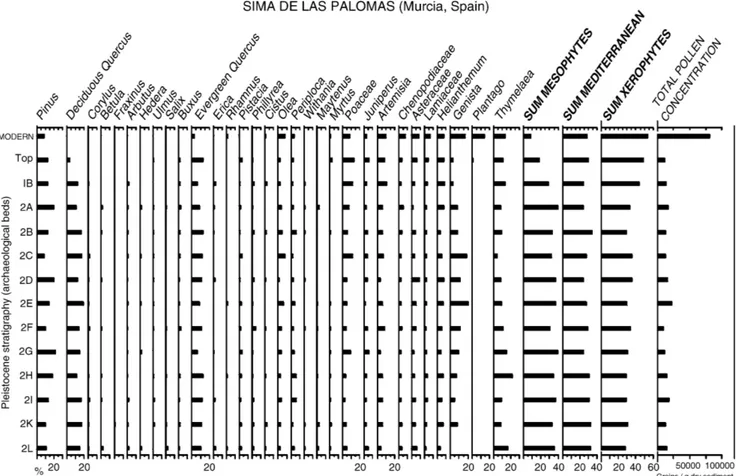
Sima de las Palomas pollen spectra are dominated by two groups of Quercus as at Cueva Negra (Fig. 3). The deciduous
palynotype is more variable in shape, size, and exine orna-mentation, perhaps reflecting a mosaic of underlying ecolo-gical factors, or several species coexisting in a context where soils show greater diversity than at Cueva Negra (in more humid mountainous regions than Murcia Q. faginea, Q. canariensis and Q. pyrenaica occur today in southern regions of the Iberian Peninsula). Pine is more prominent than at Cueva Negra, but which species cannot yet be determined. Likely candidates are black pine (P. nigra), Aleppo pine (P. halepensis), and umbrella pine (P. pinea); anthracology has shown P. nigra occurred from c. 25 000–13 000 year BP in Palaeolithic settlements in Alicante and Valencia (Badal & Carrión, 2001).
Given that today large parts of coastal Murcia on average get less than 200 mm of rain a year, with very high levels of evapo-transpiration (Sánchez-Gómez et al., 1998), it is strik-ing that Pleistocene pollen spectra show abundant pollen of deciduous oaks at Sima de las Palomas, alongside trees re-quiring damp-temperate conditions such as Corylus avellana, Fraxinus, Arbutus unedo, Buxus, and Betula. The oaks most likely grew nearby because their pollen frequencies of 15– 20% exceed those involving long-distance pollen transport to south-eastern Spanish caves (Navarro et al. 2001). Was local climate damper than now in the upper Pleistocene? Or is a combination of Holocene climate changes and anthro-pogenic intervention to blame for the recent decline in decid-uous trees? These are not exclusive possibilities, but the latter is supported (Carrión et al., in press) by a Holocene sequence from Gádor (Almería), by archaeological findings, and by historical evidence (García Latorre & García Latorre, 1996; Giménez, 2000).
124 J.S. Carrión et al.
DISCUSSION
Palaeoecological value of the cave pollen spectra studied
Doubts have been raised about the palaeoecological value of palynological information obtained from archaeological studies from caves and rock-shelters (e.g. Turner & Hannon, 1988), but this issue has been discussed elsewhere (Davis, 1990; Carrión & Scott, 1999; Carrión et al., 1999a). Four palaeopalynological aspects need stressing with regard to our region. First, it lacks lake, swamp, or peat deposits, hence vegetational reconstruction must resort to either marine sequences (Targarona, 1997) or deposits in caves or rock-shelters. Secondly, there are no reasons, a priori, to dismiss results obtained from considerations of pollen-rain repres-entativeness as regards the external vegetation. At least, this is what can be concluded experimentally after analysing surface sediments at caves of different shapes and sizes, both within our region (Navarro et al., 2000, 2001) and outside it (Burney & Burney, 1993). Thirdly, with regard to conventional sediments, those from the very same caves have an advantage in that they are able to collect those ento-mophilous species that make up most of the local vegetation but are conspicuous by their absence from lake-bed deposits (Carrión, 2002a): here, indeed, any chance at all of biotic transport to a site is of far more help than hindrance to palaeopalynologists.
Lastly, it is essential that there are palynological indicators both for analytical quality and palaeoecological coherence, so as to be able to detect possible skewing of pollen spectra due to such postdepositional processes as destruction of pollen, percolation, or reworking (Sánchez-Goñi, 1994). In this regard, it is noteworthy that in both series analysed (Figs 2 and 3) have been identified very many types, including some not always readily preserved (e.g. Taxus, Genisteae, Buxus, Calicotome, Periploca), or whose identification demands pre-cise exine characteristics, available only in nonoxidized paly-nomorphs (e.g. Coris, Smilax, Maytenus, Withania). Total concentrations of pollen are not especially high, being greater at Sima de las Palomas (between c. 9487 and 23 137 grains g−1)
than at Cueva Negra (between c. 2342 and 5150 grains g−1),
but they are nevertheless comparable to those often reported from surface sediments in caves (Davis, 1990; Navarro et al., 2001), so there is no need to interpret them as being due to loss caused by destructive processes.
At both sites, surface pollen spectra reflect wholly modern, but never Pleistocene, vegetation. Cueva Negra surface samples predominantly show Pinus (including considerable amount of P. pinaster type), Helianthemum, Genisteae and Plantago, whilst Pleistocene ones show clear-cut predominance of Quercus, Poaceae, Artemisia and Asteraceae (Fig. 2). Sima de las Palomas surface samples show greater percentage sim-ilarity, but while its surface sediment lacks Quercus (absent today in this coastal reagion), Quercus pollen nevertheless is
very abundant in Pleistocene samples from the site. Likewise utterly absent from surface samples are other minority pollen grains identified nonetheless in the Pleistocene samples, such as Corylus, Betula, Fraxinus, Arbutus, Ulmus, Salix, Erica and Ephedra distachya-nebrodensis (Fig. 3). Last, but not least, our failure to detect either bed-rock Miocene spores at Cueva Negra, or Permo-Triassic ones at Sima de las Palomas is worth mentioning; nor were there differences in staining or preser-vation in pollen spectra from either site, such as are common when reworking or sediment mixing have taken place in a cave (Carrión et al., 1995).
The new findings in the context of previous palynological studies
Cueva Negra pollen results are comparable with those slightly further west, from Siles, at 1320 m above sea level in an intermontane valley of the Sierra de Segura in Jaén (Carrión, 2002b) (Fig. 4). In deposits dating from upper pleniglacial times (c. 20 000–17 000 cal year BP), were found Pinus pinaster, deciduous Quercus, evergreen Quercus, Ericaceae, Corylus, Betula, and Fraxinus, in pollen percentages always above 2%, and frequently also Acer, Taxus, Arbutus, Buxus, Salix, Ulmus, Phillyrea, Pistacia, and Olea. All of these con-tingents were better represented at Siles in lateglacial times (c. 17 000–11 900 cal year BP) and especially in mid-Holocene times (c. 7400–5300 cal year BP), although pine woods appear to have predominated during the early Holocene (c. 11 900–7400 cal year BP).
Although not being synchronous, the similarity between the Cueva Negra and Siles spectra is important because both sites lie in closely related biogeographical areas between which migration is eminently feasible (Fig. 1); not for nothing have mountains near Cueva Negra been regarded by some plant biogeographers as an eastern extension of the Sierra de Segura (Sánchez-Gómez & Alcaraz, 1993). The Siles and Cueva Negra pollen records show that tree species survived at quite high places in southern European mountains during the last glacial stage. This agrees with a hypothesis put for-ward by Bennett et al. (1991) that tree survival would have been especially important in mountain ranges, such as those of the Balkans, allowing rapid altitudinal displacements of tree populations in response to climatic pulses (Willis, 1994). Owing to their roughly N-S orientation, the Segura moun-tains, like the Balkans, would have readily allowed altitudinal movements of tree populations to take place. Moreover, other indications that mountains in southern Spain contained significant tree reservoirs during the last ice age come from consideration of the genetic structure of European tree populations today (Herrán et al., 1999; Jiménez, 2000; Salvador et al., 2000).
Glacial refugia of thermophilous flora in Spain 125
Cueva Negra, only occur at lower altitudes, as is the norm elsewhere in southern Europe (Willis, 1994; Leroy et al., 1996; Van Andel & Tzedakis, 1996; Magri & Parra, 1997). The Murcian coast offers another important pollen record from the Middle-Upper Palaeolithic transition at Cueva Perneras (Carrión et al., 1995). Although tree pollen was less important than at Sima de las Palomas, Cueva Perneras deposits contained abundant pollen of Pinus, Quercus ilex-coccifera and Oleaceae, and continuous or frequent presence of broad-leaved trees (Fraxinus, Alnus, Corylus, Juglans, Ulmus, Salix) and thermophytes (Myrtus, Erica arborea,
Pistacia, Buxus, Periploca, Withania, Lycium, Ephedra fragilis, Cosentinia vellea, Selaginella denticulata, Ruta).
126 J.S. Carrión et al.
with Betula, Abies, Corylus, Alnus, Acer, Taxus, Myrtus, Buxus, Sorbus, Olea, Erica arborea, Pistacia, Ephedra fragilis, Viburnum, Sambucus, Cistus and Rhamnus.
To the north of Murcia, relevant pollen findings come from sites in inland Mesomediterranean environments, namely, the dated Middle-Upper Palaeolithic transition at Cova Beneito in Alicante (Carrión & Munuera, 1997), and the Navarrés peat bog in Valencia (Carrión & van Geel, 1999). However, their thermophilous components show oscillations rather than uninterrupted presence: indeed, most of their deciduous trees and Mediterranean shrubs fell away markedly during the upper pleniglacial stage, after having advanced together during oxygen-isotope stage 3. In the north-eastern Medi-terranean part of the Iberian Peninsula, Abric Romaní, near Barcelona, shows tree pollen percentages of 40–60% between about 70 000 and 40 000 year BP, with continuous presence of Juniperus, Rhamnus, Quercus, Olea-Phillyrea, Syringa, Alnus, Salix, Juglans, Betula, Fagus, Betula, Coriaria, Pistacia and Vitis (Burjachs & Julià, 1994).
Further afield, even the Cantabrian coast and adjacent mountain ranges seem to have offered refuges for trees during the last ice age, according to pollen analyses (Dupré, 1988; Ramil-Rego et al., 1998a,b) and macroscopical charcoal (Uzquiano, 1992). Pleniglacial pollen samples include low frequencies of Pinus, Betula, Juniperus, Corylus, Quercus, Fraxinus, Alnus, Ulmus, Tilia, Juglans, Fagus and Castanea. Charcoal samples contain Pinus sylvestris, P. uncinata, Juniperus, Betula alba, B. pendula, Corylus avellana, Quercus robur, Q. petraea, Tilia platyphyllos, T. cordata, Fraxinus excelsior, Sambucus nigra, Viburnum tinus, Cornus sanguinea, Quercus ilex, Fagus sylvatica, Sorbus aria, S. aucuparia, S. torminalis, S. domestica, Castanea sativa, Quercus suber, Arbutus unedo, Erica arborea, Crataegus monogyna, and several species of Prunus and Rhamnus. Hunter-gatherers may have gathered hazelnuts, acorns and wild fruit (e.g. mazzard, Prunus avium) (Uzquiano, 1992). The palaeobotan-ical findings concur with the genetpalaeobotan-ical structure of popula-tions of Iberian brown oak (Olalde et al. 2002), and some palaeoecological inferences drawn from the abundant mega-fauna of the Biscay coast (Altuna, 1972).
For continental parts of the Iberian Península, there exists both pollen and palaeobotanical evidence of mesophilous taxa in glacial and late glacial contexts (Dupré, 1988; Pons & Reille, 1988; García-Antón et al., 1990; García-Antón & Sainz-Ollero, 1991; Carrión & Sánchez-Gómez, 1992; Pérez-Obiol & Julià, 1994; Blanco et al., 1997). When cave pollen is considered along with reference pollen sequences and charcoal findings, everything seems to point less to refugia restricted to the far south (Brewer et al., 2002), than to survival of stationary tree populations in many parts of the Peninsula, particularly in intramontane valleys in the Baetic, pre-Baetic, Iberian and other coastal ranges, with expansion and contraction in the central uplands.
To conclude, palynology at archaeological cave sites often raises doubts over contemporaneity between pollen and the layer containing it, and anthracology often seems closer to palaeobotanical orthodoxy than to palaeoecology. Neverthe-less, both approaches together can build up a solid weight of evidence. Furthermore, some reference pollen sequences have undeniable counterparts in some cave pollen sequences (Carrión, 2002b) (Fig. 4). Our models about glacial refugia require far more information; several sites need to be restudied, their chronologies need refinement, and the present estimates of continental palaeotemperatures during the upper Pleistocene should be viewed with caution. Moreover, faunal remains, especially birds and small mammals, must be taken far more into consideration whenever revision of glacial refugia of temperate trees is undertaken, concerning palaeoclimatic inferences.
Relationships with palaeontological findings and human remains
Palynological findings at Cueva Negra del Estrecho del Río Quípar and Sima de las Palomas del Cabezo Gordo sit easily with the faunal evidence. At Cueva Negra, avian palaeonto-logist Anne Eastham’s findings (Walker et al., 1998; in press), point to five different environmental biotopes coexisting near this upland site, which today is in an open, arid landscape crossed by a small stream undeservedly called the ‘River’ Quípar. These are: (i) wetlands with a depth of lake-water necessary for ruddy shelducks, mallards, wigeons, teals, gad-walls, red-crested pochards, common pochards, ferruginous ducks, wild geese, little stints, and sandpipers; (ii) riverine and damp valley floors where soft sediments offered cover suit-able for the bee-eaters and sand martins at Cueva Negra; (iii) Quercus woodland suitable for autumnal acorn-eaters such as the cave’s Pleistocene jays and woodpigeons, where its owls, nightjars, woodpeckers, woodlarks, and several species of thrushes finches must have found their prey; (iv) steppe and open country preferred by larks, partridges, plovers, choughs, eagles, buzzards, kestrels, and falcons, whose bones are all well represented; and (v) the craggy mountainsides and cliffs around the cave itself, offering roosting places for the omnipresent choughs, rock doves, crag martins, swallows, swifts, and rock thrushes. Reptiles are especially well repres-ented by tortoise remains. Numerous skeletal parts of small and large mammal species excavated support such a variety of biotopes around the rock-shelter: carnivores such as hyaena, brown bear, wolf, a small feline, omnivores such as macaque and wild boar; herbivores such as steppe rhinoceros, elephantids, giant deer, red deer, a smaller cervid, aurochs, bison, horse, and wild goat. Bats, hedgehogs, and shrews were also found.
Glacial refugia of thermophilous flora in Spain 127
less clear-cut. Cementation of excavated breccia makes for slow progress in palaeontological research. Fewer bird species have been identified than at Cueva Negra (13 species as against 66) (Walker et al., in press). There are, of course, craggy mountainsides around the cave. Below the site, the coastal plain surrounding Cabezo Gordo, nowadays dry and open, must have contained mixed woodland and grassland, with gallery woodland and swamps beside erstwhile streams feeding nearby wetlands and saltmarshes behind coastal sand dunes (where the Mar Menor coastal lagoon is today), even though marine regressions must have repeatedly drained these for many millennia each time. Mammals include carni-vores such as panther, lynx, spotted hyaena, brown bear, fox and badger, and herbivores such as hippopotamus, elephantids, wild horses and asses, aurochs, red deer, wild goats and abundant lagomorphs. Tortoise is again common in the deposits.
The two Upper Pleistocene sites considered here from a palaeoecological standpoint of flora and fauna corroborate a proposal that long-term human presence may occur prefer-entially where several different biotopes coincide.
ACKNOWLEDGMENTS
Michèle Dupré assisted with laboratory processing. Keith Bennett and an anonymous referee provided useful sugges-tions on an earlier draft. Research funding was provided by the Spanish Ministerio de Educación y Ciencia and the Murcian regional authority’s Fundación Seneca (projects BOS2000-0149, PI-17/00739/FS/01, PB92-0971, PB98-0405).
REFERENCES
Altuna, J. (1972) Fauna de mamíferos de los yacimientos prehistóricos de Guipúzcoa. Munibe, 24, 1–464.
Arroyo, J. (1997) Plant diversity in the region of the Strait of Gibraltar: a multilevel approach. Lagascalia, 19, 393–404.
Badal, E. & Carrión, Y. (2001) Del glaciar al interglaciar. Los paisajes vegetales a partir de los restos carbonizados hallados en las cuevas de Alicante. De Neandertales a Cromañones. El inicio del pob-lamiento humano en las tierras valencianas (ed. by V. Villaverde), pp. 21–40. Universidad de Valencia, Valencia.
Bennett, K.D., Tzedakis, P.C. & Willis, K.J. (1991) Quaternary refugia of north European trees. Journal of Biogeography, 18, 103– 115.
Birks, H.J.B. (1993) Quaternary palaeoecology and vegetation science-current contributions and possible future developments. Review of Palaeobotany and Palynology, 79, 153–177.
Blanco, E., Casado, M.A., Costa-Tenorio, M., Escribano, R., García-Antón, M., Génova, M., Gómez, A., Gómez, F., Moreno, J.C., Morla, C., Regato, P. & Sainz, H. (1997) Los bosques ibéricos. Una interpretación geobotánica. Planeta, Barcelona.
Brewer, S., Cheddadi, R., de Beaulieu, J.L., Reille, M. & Data Con-tributors. (2002) The spread of deciduous Quercus throughout
Europe since the last glacial period. Forest Ecology and Management,
156, 27–48.
Burjachs, F. & Julià, R. (1994) Abrupt climatic changes during the last glaciation based on pollen analysis of the Abric Romani, Catalonia, Spain. Quaternary Research, 42, 308–315.
Burney, D.A. & Burney, L.P. (1993) Modern pollen deposition in cave sites: experimental results from New York State. New Phytolology,
124, 523–535.
Carrión, J.S. (2002a) A taphonomic study of modern pollen assemblages from dung and surface sediments in arid environ-ments of Spain. Review of Palaeobotany and Palynology, 120, 217–232.
Carrión, J.S. (2002b) Patterns and processes of Late Quaternary environmental change in a montane region of southwestern Europe. Quaternary Science Reviews, 21, 2047–2066.
Carrión, J.S., Dupré, M., Fumanal, M.P. & Montes, R. (1995) A palaeoenvironmental study in semi-arid southeastern Spain: the palynological and sedimentological sequence at Perneras Cave (Lorca, Murcia). Journal of Archaeological Science, 22, 355–367. Carrión, J.S. & Munuera, M. (1997) Upper Pleistocene palaeoenvi-ronmental change in eastern Spain: new pollen analytical data from Cova Beneito (Alicante). Palaeogeography, Palaeoclimatology, and Palaeoecology, 128, 287–299.
Carrión, J.S., Munuera, M., Navarro, C., Burjachs, F., Dupré, M. & Walker, M.J. (1999a) The palaeoecological potential of pollen records in caves: the case of Mediterranean Spain. Quaternary Science Reviews, 18, 1061–1073.
Carrión, J.S., Munuera, M., Navarro, C. & Sáez, F. (2000) Paleo-climas e historia de la vegetación cuaternaria en España a través del análisis polínico. Viejas falacias y nuevos paradigmas. Complutum,
11, 1–28.
Carrión, J.S. & Sánchez-Gómez, P. (1992) Palynological data in sup-port of the survival of walnut (Juglans regia L.) in the western Mediterranean area during last glacial times. Journal of Biogeography,
19, 623–630.
Carrión, J.S. & Scott, L. (1999) The challenge of pollen analysis in palaeoenvironmental studies of hominid beds: the record from Sterkfontein caves. Journal of Human Evolution, 36, 401–408. Carrión, J.S. & van Geel, B. (1999) Fine-resolution Upper Weichselian
and Holocene palynological record from Navarrés (Valencia, Spain) and a discussion about factors of Mediterranean forest succession. Review of Palaeobotany and Palynology, 106, 209– 236.
Comes, H.P. & Kadereit, J.W. (1998) The effect of Quaternary cli-matic changes on plant distribution and evolution. Trends in Plant Science, 3, 432–438.
Cuenca, A., Pomery, P.J. & Walker, M.J. (1986) Chronological aspects of the Middle Pleistocene in the coastal belt of southeastern Spain. Quaternary climate in Western Mediterranean (ed. by F. López-Vera), pp. 353–363. Universidad Autónoma, Madrid. Davis, O.K. (1990) Caves as sources of biotic remains in arid western
North America. Palaeogeography, Palaeoclimatology, and Palae-oecology, 76, 331–348.
Dupré, M. (1988) Palinología y paleoambiente. Nuevos datos españoles. Referencias. Valencia, Diputación de Valencia, Servicio de Investigación Prehistórica, Serie de Trabajos Varios, no. 84. García Latorre, J. & García Latorre, J. (1996) Los bosques ignorados
128 J.S. Carrión et al.
medio ambiente en el territorio almeriense (ed. by A. Sánchez-Picón), pp. 99–126. Universidad de Almería, Servicio de Publicaciones, Almería.
García-Antón, M., Morla, C. & Sainz-Ollero, H. (1990) Considera-ciones sobre la presencia de algunos táxones relictos terciarios durante el Cuaternario en la Península Ibérica. Boletín de la Real Sociedad Española de Historia Natural (Sección de Biología), 86, 95–105.
García-Antón, M. & Sainz-Ollero, H. (1991) Pollen records from the Middle Pleistocene Atapuerca site (Burgos, Spain). Palaeogeogra-phy, Palaeoclimatology, and Palaeoecology, 85, 199–206. Giménez, E. (2000) Bases botánico-ecológicas para la restauración
de la cubierta vegetal de la Sierra de Gádor (Almería). PhD Thesis, Universidad de Almería.
Herrán, A., Espinel, S. & Goicoechea, P.G. (1999) Utilización del polimorfismo del ADN de cloroplastos para definir regiones de procedencia materna en los robles blancos de la Península Ibérica. Investigación en Agronomía y Recursos Forestales, 8, 139–150.
Huntley, B. (1990) Dissimilarity mapping between fossil and con-temporary pollen spectra in Europe for the past 13 000 years. Quaternary Research, 33, 360–376.
Jiménez, M.P. (2000) Genetic variability of Quercus suber (cork oak) studied by isozymes and chloroplast DNA. Design of conservation strategies. PhD Thesis, Universidad Politécnica de Madrid. Leroy, S.A.G., Giralt, S., Francus, P. & Seret, G. (1996) The
high-sensitivity of the palynological record in the Vico Maar lacustrine sequence (Latium, Italy) highlights the climatic gradient through Europe for the last 90 ka. Quaternary Science Reviews, 15, 189– 201.
Magri, D. & Parra, I. (1997) Rifugi mediterranei di vegetazione arborea nel Tardo-Quaternario. Atti del 4° Colloquio su Approcci metodologici per la definizione dell’ambiente fisico e biologico mediterraneo, pp. 1–17, Castro Marina.
Mota, J., Cabello, J., Cueto, M., Gómez, F., Giménez, E. & Peñas, J. (1997) Datos sobre la vegetación del sureste de Almería (Desiertos de Tabernas, Karst en Yesos de Sorbas y Cabo de Gata). Universidad de Almería, Servicio Publicaciones, Almería.
Navarro, C., Carrión, J.S., Munuera, M. & Prieto, A.R. (2001) Cave surface pollen and the palynological potential of karstic cave sediments in palaeoecology. Review of Palaeobotany and Palynology,
117, 245–265.
Navarro, C., Carrión, J.S., Navarro, J., Munuera, M. & Prieto, A.R. (2000) An experimental approach to the palynology of cave deposits. Journal of Quaternary Science, 15, 603–619.
Ojeda, F., Marañón, T. & Arroyo, J. (1996) Patterns of ecological, chorological, and taxonomic diversity at both sides of the Strait of Gibraltar. Journal of Vegetation Science, 7, 63–72.
Olalde, M., Herrán, A., Espinel, S. & Goicoechea, P. (2002) White oaks phylogeography in the Iberian Peninsula. Forest Ecology and Management, 156, 89–102.
Pantaleón-Cano, J., Yll, E.I., Pérez-Obiol, R. & Roure, J.M. (in press) Palynological evidence for vegetational history in semi-arid areas of the western Mediterranean (Almería, Spain). The Holocene, in press.
Pérez-Obiol, R. & Julià, R. (1994) Climatic change on the Iberian Peninsula recorded in a 30 000-yr pollen record from lake Banyoles. Quaternary Research, 41, 91–98.
Pons, A. & Reille, M. (1988) The Holocene and Upper Pleistocene pollen record from Padul (Granada, Spain): a new study. Palaeo-geography, Palaeoclimatology, and Palaeoecology, 66, 243– 263.
Ramil-Rego, P., Muñoz-Sobrino, C., Rodríguez-Guitián, M. & Gómez-Orellana, L. (1998a) Differences in the vegetation of the North Iberian Peninsula during the last 16 000 years, Plant Ecology,
138, 41–62.
Ramil-Rego, P., Rodríguez-Guitián & M.Muñoz-Sobrino, C. (1998b) Sclerophyllous vegetation dynamics in the north of the Iberian Peninsula during the last 16,000 years. Global Ecology Biogeographical Letters, 7, 335–351.
Salvador, L., Alía, R., Agúndez, D. & Gil, L. (2000) Genetic variation and migration pathways of maritime pine (Pinus pinaster Ait) in the Iberian Peninsula. Theoretical and Applied Genetics, 100, 89– 95.
Sánchez-Gómez, P. & Alcaraz, F. (1993) Flora, vegetación y paisaje vegetal de las Sierras de Segura Orientales. Instituto de Estudios Albacetenses, Albacete.
Sánchez-Gómez, P., Guerra, J., Coy, E., Hernández, A., Fernández, S. & Carrillo, A.F. (1998) Flora de Murcia. Diego Marín, Murcia. Sánchez-Goñi, M.F. (1994) The identification of European upper
palaeolithic interstadials from cave sequences. Aspects of archaeo-logical palynology: methodology and applications (ed. by O.K. Davis). AASP Contribution Series, 29, 161–182.
Targarona, J. (1997) Climatic and oceanographic evolution of the Mediterranean Region over the last Glacial-Interglacial transition. A palynological approach. LPP Contribution Series 7. Utrecht.
Turner, C. & Hannon, G.E. (1988) Vegetational evidence for late Quaternary climatic changes in southwest Europe in relation to the influence of the North Atlantic Ocean. Philosophical Transactions of the Royal Society of London, Series B, 318, 451–485. Uzquiano, P. (1992) The Late Glacial / Postglacial transition in the
Cantabrian Cordillera (Asturias and Cantabria, Spain) based on charcoal analysis. Palaios, 7, 540–547.
Van Andel, T.H. & Tzedakis, P.C. (1996) Palaeolithic landscapes of Europe and environs, 150 000–25 000 years ago: an overview. Quaternary Science Reviews, 15, 481–500.
Walker, M.J. & Cuenca, A. (1977) Nuevas fechas C-14 para el sector de Murcia y Alicante. Trabajos Sobre Neogeno-Cuaternario, 6, 309–317.
Walker, M.J., Gibert, J., Rodríguez Estrella, T., Eastham, A., Carrión, J.S., Yll, E., Legaz, A., López, A., López, M. & Romero, G. (in press) Neanderthals and their landscapes: aspects of research at Sima de las Palomas del Cabezo Gordo and Cueva Negra del Estrecho del Río Quípar in the context of middle palaeolithic and Neanderthal sites in the Segura drainage basin and adjacent areas of southeastern Spain. Dynamics in the Middle Paleolithic and Middle Stone Age, Vol. 2 (ed. by N. Conard). Tübingen: Kerns Verlag, ‘Tübingen Studies in Prehistory’.
Glacial refugia of thermophilous flora in Spain 129
Walker, M.J., Gibert, J., Sánchez, F., Lombardi, A.V., Serrano, I., Gómez, A., Eastham, A., Ribot, F., Arribas, A., Cuenca, A., Albadalejo, S. & Andreu, J.A. (1999) Excavations at new sites of early man in Murcia: Sima de las Palomas del Cabezo Gordo and Cueva Negra del Estrecho del Río Quípar de la Encarnación. Human Evolution, 14, 99–123.
Willis, K.J. (1994) The vegetational history of the Balkans. Quaternary Science Reviews, 13, 769–788.
Willis, K.J., Rudner, E. & Sümegi, P. (2000) The full-glacial forests of central and southeastern Europe. Quaternary Research, 53, 203– 213.
Willis, K.J. & Whittaker, R.J. (2000) The refugial debate. Science,
287, 1406–1407.
BIOSKETCH
José S. Carrión teaches plant evolution in the University of Murcia. His research has focused on Quaternary