
Synthesis, characterization and photocatalytic evaluation of MWO4 (M = Ni, Co, Cu and Mn) Tungstates
9
0
0
Texto completo
(2) Advances in Hydrogen Energy-2015. 1. Introduction Catalysis is called to the change in reaction rate due to a participation of an agent called catalyst. This catalyst not only makes possible the chemical reaction to occur in a faster rate, but also lowers the activation its energy, while not being part as a reactant or product. When the catalytic reaction is activated through light absorption it is called phtotocatalysis, [1] and this is defined as a chemical reaction induced by photo iradiation in the presence of a photocatalyst [2]. Such a material facilitates chemical reactions whitout being consumed or transformed. This process starts when a semiconductor material is iluminated with a suitable wavelenght of light that must be equal or higher to the size of the band gap energy of a semiconductor. The general idea of using a fotocatalyst to split the molecule of water consists in use the oxydizing and reducing effect of the charges that are generated in a semiconductor [1]. Photocalysis can be applied to solve enviromental and energy problems [3-5], such as hydrogen production from water splitting. Some of the advantages of the photocatalysys are: low processing costs, the capability of hydrogen and oxygen evolution during the water splitting reaction and suitable small reactor systems for domestic applications, thus providing a huge potential market [2]. Scheelite and wolframite type compounds such as tungstates (AWO4) are part of an important family of materials from a technogical point of view. According to the literature, Rajagopal et. [6] tungstates present different and interesting properties, that draw attention, because they exhibit potential applications in different technological areas [7], such as; state solid laser [8], microwave, scintillation [9], optoelectronic devices, optic fibers [6], humidity sensors and fluorescent lamps due to their photoluminicense appeling properties, meanwhile some others tungstates are of special interest due to their conductivity and electrical properties [10]. According to the above, these materials could be considered as potential photocatalysts towards the hydrogen production. Moreover, the coprecipitation synthesis route is a simple, fast and a soft chemical method. Furthermore, it has many advantages such as; low calcination temperature, low cost ,and above all it does not require special operating conditions [11]. This technique is probably the most used to prepare ceramic powders [12]. Garcia-Perez et al. [13] carried out the synthesis of bivalent transition metal tungstates such as; Co2+, Cu2+, Mn2+ and Ni2+ prepared through coprecipitation, where CuWO4 series presented the greatest photocathalytic activity. Therefore, the objective of the present work is the synthesys, characterization and photocatalytic evaluation of materials of the tungstate family MWO4 (M=Cu, Co, Ni and Mn) through the water splitting reaction towards the hydrogen production under the visible light irradiation. 2. Experimental 2.1. Synthesis of precursor solutions The synthesis of MWO4 compounds was caried out by the reaction in solution method. This technique consists in a disolution-precipitation reaction of salts containing the metals of interest; this method may lead, sometimes, to amorphus materials that through an adequate thermal treatment, can be transformed into crystalline materials with an optimal.
(3) Advances in Hydrogen Energy-2015 morphology and microstructure. Initially, the equivalent amount of 0.4 moles of Na2WO4·2H2O were weighed in grams and dissolved in 1000 mL of distilled water (solution A). Then, four 0.4 M solutions of divalent cations (0.4 mol/1000 mL in distilled water) were prepared separately, using as reactants their hydrated nitrates: Mn(NO3)2·4H2O, Cu(NO3)2·2.5H2O, Co(NO3)2·6H2O and Ni(NO3)2·6H2O (solution B). Next, solution A was slowly added to solution B at room temperature and under vigorous stirring. The general chemical reaction that dictates the dissolution-precipitation method is the following: M(NO3)2 + Na2WO4 → MWO4 (↓) + 2 NaNO3 (M = Co2+, Cu2+, Mn2+ y Ni2). (1). When mixing of both solutions in a 1:1 molar ratio took place, a precipitate was spontaneously formed. This was washed four times with DI water and filtered, whereas pH of the solutions was not adjusted. The obtained precipitates were dried at 100°C for 24h, grounded in an agate mortar, and finally calcined at 400°C during 4h. Sample nomenclature was set as follows: (a) CoWO4, (b) MnWO4, (c) NiWO4 and (c) CuWO4. 2.2. Characterization of materials The MWO4 (Co2+, Cu2+, Mn2+ y Ni2+) powders were characterized using in X-ray diffraction (XRD), Breunner-Emmet-Teller Surface area (BET), diffuse reflectance spectroscopy (UV-Vis) and scanning electron microscopy (SEM) techniques to study their physical and chemical properties. The synthesized powders were analyzed to determine their crystalline structure, through the X-ray diffraction technique, using a D8 Advance Bruker Axs diffractometer with Cu-Kα (λ = 1.5418 Å) radiation, scintillation detector and a Ni filter. Measurements were performed in a 2θ interval from 10 to 80° and using a step size of 0.016°/sec in an acrylic sample holder. The powders surface area was studied by the nitrogen physisorption technique at a degasification temperature of 180°C, using a Quantachrome Autosorb-1. For the measurement of the bandgap energy a UV-Vis Perkin Elmer (Lambda-10) spectrophotometer equipped with an integration sphere for the diffuse reflectance studies was used. While morphological characterization of the synthetized materials was carried out by scanning electron microscope technique using a SU 3500 HITACHI equipment. While, samples were chemically analyzed by dispersive spectroscopy (EDS) and chemical mapping using secondary electrons (SE) at 2 kX. 2.3. Photocatalytic evaluation Photocatalytic evaluation of the synthesized samples towards the hydrogen production by water splitting was performed using a 250W mercurial lamp and 0.2 g of tungstate sample suspended in 200 mL of DI water and 4 mL of methanol in the reactor system as sacrificial agent (2% vol). The suspension was placed inside quartz photo reactor with a length and diameter of 19 and 5 cm, respectively, then it was hermetically sealed and placed 7cm away from the 250W mercury lamp. The photoreactor was kept under constant stirring and irradiated for 8h [14]. The reaction was monitored by gas chromatography using a gas chromatograph (GC) Perkin Elmer Clarus 500. The experimental setup employed for carrying out the photocatalytic evaluation of the materials is presented in Figure 1. This setup is composed by a photoreactor, artificial lighting, and GC analysis.
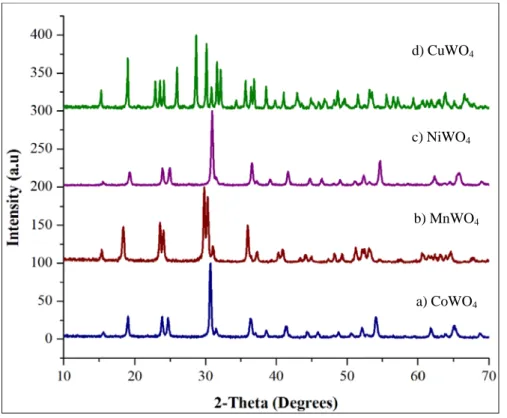
(4) Advances in Hydrogen Energy-2015 equipped with a personal computer data collection. In order to monitor the photocatalytic reaction, gas samples were taken at regular time intervals using a 1mL syringe for gases through a septum located at the upper section of the photoreactor. A sample under darkness was taken at the initial concentration and then the sampling took place every hour up to a total of 8 hours of continuous irradiation.. Fig. 1. Experimental setup for the photocatalytic evaluation of the tungstate samples.. 3. Results and discussion 3.1. X-ray diffraction tests. Bivalence metal tungstate powders derived from the synthesis by the dissolutionprecipitation technique were structurally characterized using XRD. Figure 2 shows the difractogram peaks of the synthetized photocatalysts (Co2+, Cu2+, Mn2+ and Ni2+). XRD technique showed that for the four thermally treated metals at 400°C for 4h, the obtained products are crystalline, meaning, that the XRD spectrum of every sample showed the principal reflections reported in the literature [11, 13, 15]. The XRD diffractograms showed that the CoWO4, NiWO4 and MnWO4 powders present a crystalline monoclinic structure [11], whereas CuWO4 powders exhibit a triclinic crystalline structure [11]. The results show evidence that working with a subsequent thermal treatment at 400°C temperature for 4 h, is possible to achieve the formation of the desired tungstate metal samples..
(5) Advances in Hydrogen Energy-2015. d) CuWO4. c) NiWO4. b) MnWO4. a) CoWO4. Fig. 2. XRD diffractograms of the synthesized tungstate samples by the dissolutionprecipitation technique followed by a thermal treatment at 400°C during 4 h; a) CoWO4, b) MnWO4, c) NiWO4, d) CuWO4. 3.2. UV-Vis Spectra. Figure 3 presents the tungstate diffuse reflectance spectra (UV-Vis) of CoWO4, MnWO4, NiWO4 and CuWO4 samples; results were converted to Kubelka-Munk units [16] through to the following expression: (2) In order to determine energy band gap of the samples, a lineal region from the inflection point of the diffuse reflectance spectrum is considered, which represents the absorption energy above the border. Extrapolating the lineal slope until the interception to the photonic energy axes (X axes), this point provides the optical band gap value of the material. The estimated energy band gap values were 2.20 eV (Co), 2.56 eV (Mn), 2.46 (Ni), and 2.24 (Cu), which are similar to the ones reported in the literature for these materials [16-18]..
(6) Advances in Hydrogen Energy-2015. MnWO4. (F(R∞)hν)2. (F(R∞)hν)2. CoWO4. Eg = 2.56 eV. Eg = 2.20 eV. 1.5. 2.0. 2.5. hν (eV). 3.0. 3.5. 1.5. NiWO4. 2.0. 2.5. hν (eV). 3.0. 3.5. 3.0. 3.5. (F(R∞)hν)2. (F(R∞)hν)2. CuWO4. Eg = 2.46 eV. 1.5. 2.0. 2.5. hν (eV). 3.0. Eg = 2.24 eV. 3.5. 1.5. 2.0. 2.5. hν (eV). Fig. 3. UV-Vis spectra of samples CoWO4, MnWO4, NiWO4 and CuWO4. 3.3. BET surface area The specific surface area of the samples was determined by N2 physisorption. Table 1, presents the materials BET surface areas and band gap energy of the synthesized samples. The results show the difficulty that exists to obtain large values of surface areas and this will become an issue towards the hydrogen production through water splitting [19]. 3.4. Scanning electron microscopy Scanning electron microscopy provided important information related to their morphology as and well as the apparent particle size and elemental composition present in the samples. Figure 4 shows SEM images of the obtained tungstates treated at 400°C for 4h. In Figure 4 (a, b and c), similar morphologies were observed, with particles presenting a high degree of agglomeration and large sizes. CoWO4 particles show agglomerates of particles of around 20 µm, while sample MnWO4 show different sizes of agglomerates varying from 10-30 µm. NiWO4 sample show a mixture of small particles of around 5µ to large particle agglomerates of around 30 µm. Finally, sample CuWO4 presents very evident signs of sintering with particles as large as 50 µm with no apparent porosity. While other samples present a rough surface morphology. This behavior can be attributed to the.
(7) Advances in Hydrogen Energy-2015. a). 2 kX. b). 20 µm. c). 2 kX. 2 kX. 20 µm. d). 20 µm. 2 kX. 20 µm. Fig. 4. SEM images of the synthesized tungstates: a) CoWO4, b) MnWO4, c) NiWO4, d) CuWO4. intrinsic nature of these materials. Furthermore, the EDS analysis resulted in the expected the molar ratios of the crystalline phase for each sample, thus corroborating the obtained XRD results. 3.5. Photocatalytic evaluation The photocatalytic evaluation of the different samples was performed by measuring the hydrogen evolution produced by the reaction of the splitting of the water molecule and results are shown in Table 1. The highest hydrogen production was achieved by MnWO4 with 139 µmoles H2/gcat. While the lowest H2 produced corresponded to the sample CuWO4 with only 7 µmoles H2/gcat. Other samples fell in between these values. The behavior observed in the hydrogen production of the samples can be attributed, presumably, to the particle size here presented, as it was observed in the SEM images, there were agglomerates and large particle sizes, therefore at the irradiation time these particles did not have enough contact time to produce a major hydrogen quantity..
(8) Advances in Hydrogen Energy-2015 Table 1. BET surface area, band gap energy and hydrogen production for the synthesized samples. Sample CoWO4 MnWO4 NiWO4 CuWO4. BET surface area (m2/g) 23 22 11 8. Band Gap Energy (eV) 2.20 2.56 2.46 2.24. H2 Production µmoles H2/gcat 24 139 17 7. 4. Conclusion and recommendation Divalent tungstates of transition metals were successfully synthetized using an effective synthesis method, followed by calcination at 400°C. The photocatalytic activity of CoWO4, CuWO4, NiWO4 and MnWO4 was investigated, obtaining higher H2 production with compounds CoWO4 and MnWO4. The dissolution-precipitation method allowed to obtain the desired crystalline phase. However, it is important to optimize conditions to decrease the particle size and increase the available superficial area. The energy band gap of these tungstates fell within the visible light spectrum. Transition metal tungstates can be considered potential candidates for the water splitting of the water molecule under visible light irradiation. Finally, future work will concentrate in further characterization, to elucidate the decisive properties responsible for the photocatalytic activity of these materials.. References [1].. Peral J., Ollis D.F. TiO2 photocatalyst deactivation by gas-phase oxidation of heteroatom organics. Journal of Molecular Catalysis A: Chemical 115 (1997) 347. [2]. López Chávez E. Guzmán Pantoja J. Peña Castañeda Y. A., Castillo Alvarado F. Nuevos Materiales para el Desarrollo de Celdas de Combustible en México. 137 (2014) 5-205 [3]. Herrmann J.M. Heterogeneous photocatalysis:state of the art and present applications,48 (2005). [4]. Fujishima A., Honda K., Electrochemical Photolysis of Water at a Semiconductor ElectrodeNature 238 (1972) 37. [5]. Malato S., Blanco J., Alarcon D.C., Maldonado M.I., Fernandez Ibañez P., Gernjak W., Photocatalytic decontamination and disinfection of water with solar collectors. Catalysis Today 122 (2007) 137. [6]. Rajagopal S., Nataraj D., Mangalaraj D., Djaoued Y. Robichaud J. Yu O. Nanoscale Ress Lett. 1335 (2009) 1335-1342. [7]. Naik S.J., Salker A.V. Solid state studies on cobalt and copper tungstates nanomaterials 2065 (2010). [8]. Jani M.G., Naranjo F.L., Barnes N.P., Murray K.E., Lockard G.E., ”Diode-pumped longpulse-length Ho:Tm:YLiF4 laser at 10 Hz. Opt.Lett. 20 (1995). [9]. Nikl M., Bohacek P., Mihokova N., Kobayashi M., Ishii M., Usuki Y., Babin V., Stolovich A., Zazubovich S., Bacci M.. Excitonic emission of scheelite tungstates AWO4 (A = Pb, Ca, Ba, Sr). J.Lumin. 87 (2000). [10]. Montini T. Gombac V. Hameed A. Felisari L. Adami G. Fornasiero P. Synthesis, characterization and photocatalytic performance of transition metal tungstates. Chem Phys Lett 498, (2010)..
(9) Advances in Hydrogen Energy-2015 [11].. [12]. [13]. [14]. [15].. [16]. [17].. [18]. [19].. Montemayor S. M., Fuentes A. F., Electrochemical characteristics of lithium insertion in several 3D metal tungstates (MWO4, M=Mn, Co, Ni and Cu) prepared by aqueous reactions. Ceramics International 30 (2004) 393-400. Pathank A., Pramanik P. Nano-particles of oxides through chemical methods. Nanomaterials: Special issue of The Indian National Science 51 (2001) 47-70. Garcia-Perez U.M., Martinez-de la Cruz A., Peral J., Transition metal tungstates synthesized by coprecipitation method: Basic photocatalytic properties. Electrochimica Acta 81 (2012) 227– 232. Guzmán-Velderrain V. Enhanced Photocatalytic Hydrogen Production Under Visible Light over Ag Doped TiO2. XIV International Congress of the Mexican Hydrogen Society. Pourmortazavia S. M. Rahimi-Nasrabadi M. Khalilian-Shalamzari M. Zahedi M. M., Hajimirsadeghi S. S. Omrani I. Synthesis, structure characterization and catalytic activity of nickel tungstate nanoparticles. Applied Surface Science 749 (2012) 745-752. Back S. Wenderich K. Mul G. Synthesis of bimetallic tungstates for finding photocatalytic active compounds with a smaller band gap than tungsten oxide. University of Twente Student Theses 5 (2014). Doping effect on optical band gap and luminescence of pure and Nd-doped CoWO4 wolframite nanostructure synthesized by chemical precipitation. Chapter 4. 88, 87-104. Avaliable at: http://ir.inflibnet.ac.in:8080/jspui/bitstream/10603/35486/9/09_chapter4.pdf Priyanka K. P., Sabu N. A. Sunny A. T. Sheena P. A., Varghese T. Effect of Electron Beam Irradiation on Optical Properties of Manganese Tungstate Nanoparticles. Journal of Nanotechnology 4 (2013) 1-6. García Pérez U. M. Síntesis de m-BiVO4 por los métodos de combustión, co-precipitación e hidrotermal en presencia de agentes estructurantes y evaluación de sus propiedades fotocatalíticas. Tesis UANL 5 (2011) 1-200..
(10)
Figure



Documento similar