
Senior civil service in Argentina: creating an elite managerial corps
22
0
0
Texto completo
(2) AG's) are recruited through a very strict, competitive system, following a complex selection process and a specialized training program. Upon entering the Corps, AG's are destined to various staff, consulting, and managerial positions within the public service, while maintaining a double dependency with both, the Secretary of the Public Service and the official in charge of the unit to which the AG has been assigned. A public sector wide, career civil service, is much more costly and difficult to implement. It requires a radical shrinking in the size of personnel and sophisticated management tools to deal with the new rules and procedures established under a meritocratic system. Bolivia is presently embarked in the establishment of a programme of this sort, while Argentina, under the so-called SINAPA (National System for the Administrative Profession), has also started a similar experience. Finally, almost every government in the region has introduced, to a lesser or greater extent, an employment mechanism of medium and top level specialists (even in high managerial positions), through parallel contracting by international donor or financial agencies. In some countries, as their number grew in significance, 1 these positions began to create problems of equity, discrimination, double loyalty, and sometimes serious disruption of day-to-day activities, leading to the search of more permanent solutions. Interestingly enough, Argentina is probably the only country in the region where all four systems are presently in force. The purpose of this paper is to examine one of these systems -the Cuerpo de Administradores Gubernamentales or CAG-, in order to reflect upon the potential strengths and weaknesses of using this approach to civil service improvement. Almost nine years have elapsed since this experiment was started--a period not long enough but adequate to justify a preliminary evaluation and possibly draw some lessons for similar endeavors. The other institutionalized approaches (i.e. service wide and critical positions) are still very recent as to assess their possible success, failure or potential. In turn, parallel contracting of experts through international organizations is widely regarded as a non-permanent, undesirable solution. This paper will describe the experience of the CAG, taking those other civil service regimes as part of its relevant context. The first section examines the special political and economic circumstances under which the idea of creating this sort of civil service system was conceived. The following sections contain a detailed description of the recruitment and selection process of future AGs; the characteristics of the training activities; the main features of the Corps' career path; the field activities performed; the values and attitudes exhibited by its members; and a few concluding remarks which mainly emphasize the need of further research to reach more definitive conclusions on this experience. 2. Democracy and public sector management upgrading Ever since the times of Aristotle, merit has been a guiding principle for selecting the best talented men to manage public affairs (Hood and Jackson, 1991). By and large, programs designed to raise the standards of leadership positions in government and business have resorted to the rhetoric of 1. In Bolivia, for example, over 800 consultants, representing about 7% of the total central administration staff, are being employed under this system.. 2.
(3) merit. Such was the case of James Carter, who reintroduced merit as a guiding principle of the Senior Executive Service created under his administration (Lynn, 1981). However, there are certain political circumstances in which the appeal of this principle becomes paramount. This was the case of the transition from authoritarianism to democracy, initiated in Argentina after the Malvinas war. This experience involved an extraordinary effort at reconstructing the cultural and institutional fabric of the Argentine society. With the advent of the Alfonsín government at the end of 1983, long decades of alternation of political regimes, policy orientations, and public sector management styles, came to an end. State reform during this transition period pursued very limited objectives. Instead of dismantling the state apparatus, there was still hope of improving its capacity and performance. Rising social expectations under stringent critical economic conditions demanded more, not less, state provided goods and services. Privatization carried the stigma of the military-inspired motto "to shrink the state is to enlarge the nation," as well as negative connotations attached to some ill-fated experiences under military rule. Decentralization was still a major step along a road where rebuilding federalism and local governments stood as a priority. Streamlining was ruled out: while the democratic government needed to bring highly motivated, loyal, and dependable personnel into the civil service, stability in public employment was still considered a most valued right. In turn, authoritarianism was heavily embedded in the bureaucratic culture, remaining as a dead weight and a severe challenge to most reform efforts. Under these circumstances, it is quite understandable that reforming the state took mainly the form of long-term, carefully designed initiatives deemed to transform rigid organizational structures, deviant behavior, and ill-administrative practices over long periods of time. Among these initiatives, the creation of the CAG was probably one of the best indications that administrative reform under the Radical Party government was geared towards technical, incremental, and long-run changes, instead of heading towards the swift and drastic transformations that occurred under its successor Peronist Party government. The CAG was seen as a way to bridge the century-old politics-administration dichotomy. The endless sequence of military and civilian governments had turned top public managerial positions the realm of whimsical and short-lived incumbent regimes. Since the early 40's, the average tenure of ministers, governors, and secretaries of state had been about one year in office. Turnover in top level positions in the civil service was comparable to this figure. Discontinuity was the natural companion of ineffectiveness. Professional public management had been neglected, until then, the opportunity to take root in administrative practice. By placing highly trained and motivated young professionals in key positions of government, a new breed of public managers would be disseminated across the bureaucracy, thus providing both, a critical mass of experts and numerous focal points from which new cultural and professional patterns could be diffused. The philosophy of the project was quite clear. It was not a matter of training new cadres to do the routine work of government better, but rather to train them in doing things not done before, and with a totally new style. The professional profile of the future AGs stressed a service orientation, a basic commitment to solving the country's hard-pressing problems, and an unfailing allegiance to democratic values as desirable features. Openness, intelligence, and common sense -rather than 3.
(4) previous expertise in highly specialized fields- were held as a preferable background for these future agents of change. The project also aimed at solving the absence of legislation allowing the creation of positions subject to free appointment. Under the existing rigid structural arrangement, there was a strict correspondence betweeen directorships and directors: these functionaries could not be assigned to any other functions. Hence, if the government decided to make a political appointment to fill a position of high responsibility, it was faced with a dilemma: it would either have to dismiss the incumbent director, thus violating the constitutionally guaranteed stability of public employment; or create new positions and, at the same time, displace the existing directors to "advisory" posts. It was very difficult to find those who would meet the three required conditions: personal and political trust, professionality and experience. Insofar as the CAG attained a plural political composition and a comparable level of training, future democratic governments would be free to choose within that corps, those who would fill certain positions on the bases of personal or political affinity, but the spirit of administrative continuity would be preserved (Groisman, 1988). 3. The creation of the CAG The CAG was created on November 23, 1984 (Decree 3687). The new legislation put into effect a system for selecting and training high civil servants, but the ultimate goal of the new system was defined as achieving an overall change in values, systems, and criteria prevalent within the state apparatus (Groisman, 1988). Looking backwards, the CAG can be conceived of as one of the pillars of the state reform strategy followed by the Radical administration. 2 Soon after the democratic government was installed, a mission of the Secretaría de la Función Pública (SFP), headed by one of its Undersecretaries, visited France to gather background information about the ENA system. The French government provided an important assistance to the mission, although the idea of imitating the ENA corps was discarded from the outset. As in the case of France, where the ENA had been created at a period of reconstruction following World War II, Argentina undertook this project at the time it was confronting its deepest economic crisis and a difficult return to democracy. The new government found a demoralized bureaucracy, featured by a generalized evasion of responsibility. To impose new rules of the game upon a state apparatus so heavily loaded with institutional and cultural remains of endless political regimes, was considered an impossible task. The original project consisted of creating a new civil service regime (escalafón), characterized by a transparent and objective system of open competitions and regular evaluations, as well as by the organization of training activities at all levels. In fact, the present SINAPA system, introduced by the Menem government, follows quite closely the blueprint of that project. 2. Jorge Roulet, one of the main intellectuals of the Radical party in the field of administrative reform, who was to become Alfonsín's first Secretary of the Public Service, stated during the presidential campaign that it was necessary "to improve the quality and capabilities of the higher civil servants." (Roulet, 1988).. 4.
(5) At the opening ceremony of the Inaugural AG's Training Course (PROFAG, Programa de Formación de Administradores Gubernamentales), Jorge Roulet -the first Secretary of the SFPindicated that the Argentine public administration was in need of a new paradigm of civil servant--a servant of the country. The AGs would embody the new paradigm. They were supposed to act as agents of change and as the source of a necessary cultural transformation. In due time, the corps would serve as a model to be extended to the whole civil service. In Roulet's words, the importance of the AG's role derived not only from their mission but from what they symbolized as the new paradigm of what was foreseen to be a new model of civil servants: people reassured of having been recruited because of their own efforts and merit, proud of working for the public sector, imbued of a sense of mission, of commitment, of an esprit de corps (Roulet, 1988). Members of the CAG would carry out planning, advisory, steering, organizational and high level coordination functions, at all sorts of institutions of the National Public Administration. The AGs would be assigned with specific missions to be discharged at different destinations. Once completed, rotation among assignments would expose AGs to new managerial responsibilities and broaden their experience. As it was pointed out at the presentation of the CAG statute (Decree 2098/87), the functioning of the corps would break the traditional distinction between political and administrative roles, acting as an interface between the two. Horizontal mobility was intended to overcome the institutional disarticulation caused by the existence of true administrative feuds. The initial selection of postulants was widely publicized by the mass media. Paraphrasing Napoleon, the operation was compared to the recruitment process for entrance examinations of the Imperial Guard (INAP, 1985). The size of the CAG was intended to reach and become stabilize around a total of 1100-1300 agents--a number not enough to replace all upper level managers at the central administration, estimated at about 8000. A 30-month program of instruction was designed for those candidates approving the selection process, whose maximum number was set at 60. This meant that the target of 1200 would only be attained after, at least, 25 years. In August 1985, at the opening ceremony of the first PROFAG, President Alfonsín pointed out that the visible consequences of the project would become apparent only in a very distant future. The full functioning of the CAG would take place beyond the year 2000, so that the overwhelming majority of the graduates would end up serving future democratic governments instead of his (Alfonsín, 1986). This was an explicit indication of the long run character of the initiative which, in this regard, represented a major breakthrough when compared with the traditional style and timing of previous administrative reform projects. In sum, with the creation of the CAG, it was expected that a critical mass of hihgly trained and motivated young administrators would start a chain reaction within the public sector which, eventually, would lead to the institutionalization of a new culture and a new style of public management. The value attached to pluralism and professionalism was to be preserved by an open and competitive system of examination and selection. 3 However, the possibility of AGs to become politically active was not dismissed. On the contrary, it was even conceived that some of them could 3. At one point, it was alleged that Radical party members or sympathizers were comparatively few (Stuhlman, 1988).. 5.
(6) act as "civilizers" of political parties. Furthermore, when the system became fully operational, it was expected that future governments would place a sizable number of AG party militants in cabinet or other political positions (Stuhlman, 1988). 4. Selecting AGs The approval of a study program -both, theoretically and action oriented- was established as the only way of entrance to the CAG. In order to take the PROFAG training course, candidates are rigorously selected through a process that includes two general examinations and a series of interviews and psychological tests. 4 The selection process is designed to identify candidates meeting the required standards and values: intelligence, openness, common sense, strong vocation, democratic beliefs, problemsolving orientation. Prerequisites for admission include (a) Argentine nationality; (b) a maximum age of 35; (c) meeting the entrance regulations established by the Basic Statute of the Civil Service; and (d) to have graduated from a university career of at least 4-years of instruction. 5 The selection process begins with a test that includes exercises of text comprehension, general knowledge and logical reasoning. A minimum score is established on the basis of the number of candidates. Those passing to the second stage, are faced with the resolution of a case-study over a fixed time span. Each candidate receives a file containing various sorts of documents, some of which are useful for the diagnostic and problem-solving work required to pass the test. In the initial two calls, the first 180 candidates to approve the two tests were admitted to a 3-month Preparatory Course, designed to level their knowledge and homogeneize the variety of professional backgrounds. However, these Prep courses were also used as another stage in the selection process. Candidates coming from the public service received a special leave of absence with full salary, but in certain cases, their superiors considered that applying for the CAG competition was a signal of disloyalty and sometimes, they objected to or rejected the leave of absence altogether. The rest of the candidates took the course without receiving any salary. The contents of the course varied in each case, and included, among others, modules dealing with Law, Methodology, Economics, History, Management, Written and Oral Communication, etc. Grades obtained weighed 60% in the total score of the candidate (70% in the second course), whereas the remaining 30% applied to an oral interview with members of the Board of the National Institute of Public Administration (INAP). This interview was structured around a subject chosen at 4. In order to insure transparency and prevent any kind of interference or external influences along the selection process, tests were designed to be completely anonymous. Each candidate is supposed to carefully seal his/her test with a special sticker. The identity of the author of each test is revealed in an open session, once the previously evaluated exams are unsealed by a self-appointed group of candidates. 5 This latter requirement does not apply to permanent staff of the Federal, Provincial or Municipal Public Administration who can submit as credits, a full secondary education and certification of having held for at least one year, an executive position within the civil service not lower than Director. The age limit of 35 did not apply to candidates of the first PROFAG. The ceiling was placed at 45 years of age for civil servants and 40 years for non-civil servants. The exception was due to the previous lack of opportunities for older civil servants. For the second call for candidates, the age limits were set at 44 and 39, respectively. In the last call, the age limit for candidates coming from the public sector has been 40.. 6.
(7) chance from a prepared list, and served to assess the candidate's capacity for analysis, argumentation or reaction in the face of unexpected stimula. The final selection considered the total number of vacancies established for each PROFAG class. A separate order of merit was set for civil servants and non-civil servants, so that half of the vacancies were assinged to each group. The experience with the Preparatory Course was not considered very positively and was abandoned in the third call for candidates. The training goal pursued by the Course was, in fact, subordinated to the other, selecting purpose. Competition for scarce vacancies, within a group where only one-third was to be chosen for entrance into the real training program, introduced a level of stress which proved incompatible with the learning process. In addition, the fact that 60 frustrated civil servants (out of the 120 candidates to be eliminated) were doomed to return to their agencies after failing to pass the preparatory course, became a source of dispair and resentment. After describing some of these findings, an INAP report, written in 1987, proposed a more adequate methodology to complete this third stage of the selection process (INAP, 1987). A number of intellectual, axiological, and attitudinal variables were given a proper weight in the newly established guidelines. For instance, the capacity of the candidates in terms of comprehension, reasoning, oral and written expression; their conception of social and political life in terms of allegiance to democracy and solidarity; their orientation towards change, decision making, or teamwork; the possesion of a level of knowledge about the socio-political reality sufficient enough as to make sure that the work of the prospective AG would adequately consider the environmental constraints of his work. In line with these criteria, the new selection strategy included: (a) a questionnaire composed of close-ended questions for evaluating academic aspects; (b) a half-hour interview with each candidate, following a thorough analysis of his/her C.V.; (c) Group workshops for assessing candidates regarding their capacity to work in a team; (d) an individually written test; and (e) a psychological test designed to detect any possible pathologies. Once this preparatory evaluation was finished, a new interview and a second workshop were conducted before the final evaluation. Table I contains statistical data on the various stages of the selection process, classified by Class. 6 A first observation is the striking difference in numbers between those who attended the first test and those who applied (36%, 33% and 36% in each of the calls)--a finding which casts some doubts about the degree of real motivation behind the massive number of applicants. The proportion of those showing up in the second test was higher. The admittance rate, based on the number of candidates who took the first test, was 3.7%, 11% and 4.6% in each case. The sheer numbers attest the extremely rigorous and competitive nature of the selection process, and can be considered a fair indicator of the high level of capacity and potential needed for admittance to the PROFAG.. 6. It does not include the Fourth Class, which is being recruited at the time of writing this paper.. 7.
(8) TABLE I PROFAG CANDIDATES CLASSIFIED BY CLASS AND PERFORMANCE Number of Candidates. 1st Class. 2nd Class. 3rd Class. Total registered Showed up at 1st. Test Approved 1st. Test Showed up at 2nd. Test Approved 2nd. Test Admitted to PROFAG*. 2.491 1.596 838 723 184 60. 840 553 321 296 180 60. 2.506 1.614 405 383 133 75. * Upon approval of Prep Course or series of tests and interviews. Table II presents a distribution of PROFAG trainees by sex, origin (public or private sector) and class. Among the male participants, those employed in the public sector ranged between 48% and 60% of the total, while among female participants, the proportion varied between 24% and 40% according to class. Male students predominated over female, particularly in the Third Class (55%, 56% and 72%, respectively). TABLE II DISTRIBUTION OF PROFAG TRAINEES BY CLASS, GENDER AND ORIGIN Class First Second (*) Third. C. Serv 20 20 26. Male Non-CS 13 15 28. Total 33 35 54. C. Serv 10 11 5. Female Non-CS 17 16 16. Total 27 27 21. Total 60 62 75. * It includes two invited participants. SOURCE: Own elaboration on the basis of data provided by SFP. The average age in each Class, shown in Table III, ranged between 29,5 and 32. Additional data on the composition of these cohorts by age may be found in Table IV.. 8.
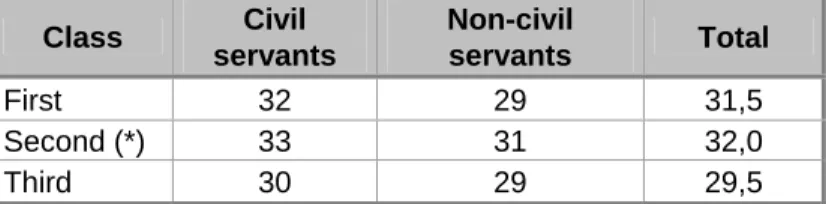
(9) TABLE III AVERAGE AGE OF PROFAG TRAINEES, BY CLASS AND ORIGIN. Class First Second (*) Third. Civil servants 32 33 30. Non-civil servants 29 31 29. Total 31,5 32,0 29,5. * Including two invited participants to PROFAG SOURCE: Own elaboration, on the bases of data provided by the SFP. TABLE IV AGE AND ORIGIN OF AGs AT THE TIME OF PROFAG TRAINING. Age Group 20-24 25-29 30-34 35 o +. C.S 1 9 9 11. First Class n-C.S Total 3 4 13 22 10 19 4 15. Second Class (*) C.S n-C.S Total 1 5 6 8 7 15 7 10 17 15 9 24. Third Class C.S n-C.S Total 7 7 13 15 28 18 18 36 4 4. * It includes two trainees invited to PROFAG SOURCE: Own elaboration based on data provided by the SFP With regard to professional background, absolute frequencies found among PROFAG trainees can be observed in Table V, where the data has been classified according to Class and origin. Law graduates were the most representative group in the First Class, either among participants coming from the public or the private sector. In the Second Class, accountants, administrators and economists ranked first in the list whereas in the third one, the engineers and system analysts composed the most sizable group of professionals. Beyond the relative predominance of one discipline or another, it is worth noting the widely varied professional profile of the future AGs.. 9.
(10) TABLE V PROFAG TRAINEES BY CLASS, ORIGIN AND ACADEMIC DISCIPLINE Discipline Law Economics Pol.Sci.& Fgn.Rel. Sociology Other Soc. Cs Engineering-Systems Arquitecture Basic Sciences Agrarian Science Health Secondary Studies. First Class C.S n-C.S Total 6 8 14 5 2 7 3 3 6 2 1 3 1 2 3 4 4 8 3 2 5 3 2 5 4 4 1 2 3 2 2. Second Class (*) C.S n-C.S Total 5 6 11 8 6 14 4 4 1 3 4 6 3 9 5 2 7 1 5 6 2 2 1 1 2 1 1 2 1 1. Third Class C.S n-C.S Total 4 8 12 3 13 16 1 3 4 1 1 3 3 6 13 8 21 1 3 4 3 1 4 4 2 6 1 1 -. * It includes two invited trainees to PROFAG SOURCE: Own elaboration on the basis of data provided by the SFP As mentioned before, calls for PROFAG candidates were widely publicized by the mass media. Part of the promotion strategy consisted of mailing applications to all university graduates registered with professional boards. Except for the Second Class, and despite the low rate of test attendance mentioned before, the response was unusual. At the end of 1992, with only 30 vacancies offered instead of the usual 60-, the number of applicants reached a 3,317 figure, that is, an over 100 to 1 proportion. 7 In view of this massive response, INAP decided to carry out a study in order to find out what motivates postulants to enter the Corps. A survey conducted among the universe of applicants to the second PROFAG shows that 13.3% had already tried to be admitted in the First Class. When asked open-endedly about their motives to become an AG, 35% of the candidates indicated "professional interest" as the most salient consideration, followed by "eagerness to debureaucratize" (25%), the "possibility of acquiring new knowledge" (15%), "access to a stable job" (11%), a "desire to serve the country" (8%) and "consolidate democracy" (6%) (Alvarez et al, 1985). Interviews recently conducted by the authors with a group of AGs have also considered the motivation question. Their interest in joining the CAG appears to have been threefold: (a) try to improve the public bureaucracy; (b) take advantage of an opportunity for professional advance; and (c) find a honorable job. Although not mutually exclusive, these factors are in line with the findings of the previously mentioned survey. One of the interviewees indicated that, broadly speaking and 7. The call for the Fourth Class was made in 1989 and suspended shortly after taking the first test. President Menem's administration was not fully convinced about the usefulness of maintaining the CAG. The competition was reopened at the end of 1992.. 10.
(11) on the basis of frequent talks with past classmates and present colleagues, finding a decent job could be considered the utmost motivating factor among non-civil servants, whereas improving the state apparatus was the predominant driving motive among civil servants. 8 5. The career path The PROFAG is the chrysalid phase in the process of becoming an AG. And it is so in more than a figurative sense. As with butterflies, PROFAG trainees must spend a considerably long process of hybernation whereby those selected in the "larval phase" must start a 30-month full time program of instruction before officially entering the CAG. Trainees are incorporated as a non-permanent personnel of INAP and assigned a salary presently estimated at US$ 920. Those who already are public employees are given a special leave of absence at their institution and continue to receive a salary. If the amount is lower than that received by non-civil servants, INAP pays them the difference. The design of the program has changed in each of the three PROFAGs offered so far, but the main areas of instruction have remained almost unchanged: logic and mathematics, sociology and political science, economics, law, public administration, public policy and planning, management technologies, oral and written communication. Courses on a foreign language are also offered. A group of AGs is presently designing a program of instruction for the Fourth Class. Like in the past, the program includes a 6-month internship, aimed at providing trainees with a first-hand experience of participation in relevant projects or activities of a given public institution. The interns' performance is evaluated by a team composed of an outside well known expert and a representative of INAP's Internship Program. The final evaluation is made by this team and INAP's top authorities. Approval of the training program does not provide any academic credentials. As put by the first Director of the Program, "the instruction is worth the value that will be attached to those receiving it; its prestige will also be commensurate to that assigned to the future performance of the trainees" (Groisman, 1988). Of the 195 participants trained at the first three PROFAGs, only 173 were finally admitted into the CAG. 9 Many abandonned the course due to family or personal reasons; some of them made it to the end but decided to stay at their previous jobs probably because their salaries were higher than the amount established for the first step of the Corps salary system; only a few participants failed to pass the course. 10 Upon being admitted into the PROFAG, each participant must formally declare that in case of approving the program, he/she will serve within the public administration for at least six years. In 8. This is quite understandable, considering that this group already enjoyed a stable employment. The salary level, however, should also be considered as a decisive factor. 9 As a result of the great interest created by the PROFAG, many functionaries were invited to attend the courses without becoming members of the CAG. 10 The CAG statute stipulates that non-civil servants who, at any time, abandon the PROFAG without any justified reason, are liable to repay the Government the amount of the salary received over the number of months elapsed since the beginning of the training program.. 11.
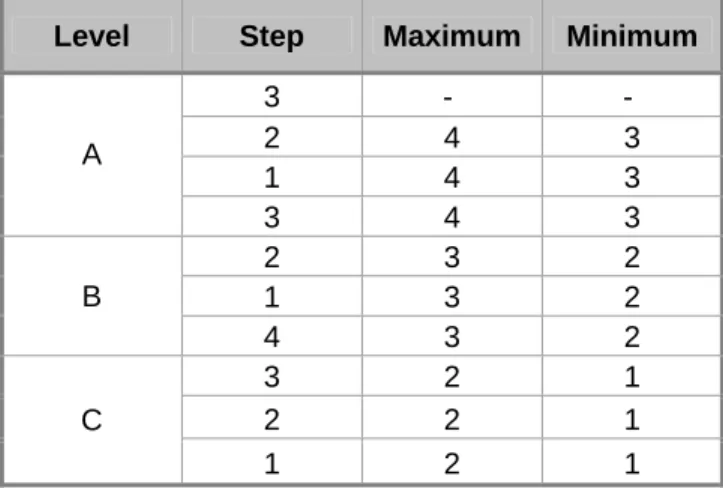
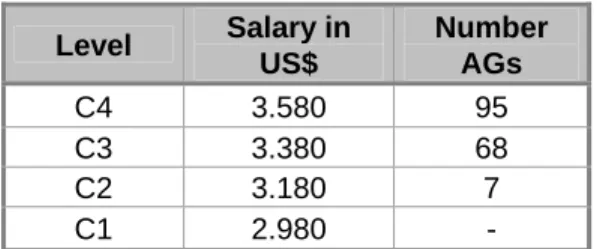
(12) case of resignation before this period is due, the AG must pay the Government an indemnity of 50% of the latest salary received, multiplied by the number of months still remaining until the sixyear period is completed. The norm is intended to retain the Corps members for at least a period that would guarantee a minimum rate of return of the investment. Obviously, the salary received by an AG should be competitive with the level offered in the private sector for a similar job. It should also be compatible with the hierarchy attached to steering, advisory, managerial and upper level coordination functions. Salaries depend upon grade level and step. The Corps' statute (escalafón) establishes three levels (A, B, C) and three to four steps at each level, but there is no relationship between the hierarchy of the functions performed and the grade level in the escalafón. Promotion into a higher step requires a minimum period of permanence in the lower step and a score at performance evaluation above the minimum established. Promotion to a higher level demands not only meeting the requisites just described, but also completing the training and development activities to be introduced according to Decree 2098/87. Table VI details the various levels, steps and their respective maximum and minimum periods of permanence. In all cases, the difference between these periods is one year. If an AG exceeds the maximum period of permanence at a given step and is not included in the Promotion List, he/she is subject to dismissal. TABLE VI CAG: YEARS OF PERMANENCE AT DIFFERENT LEVELS AND STEPS Level. A. B. C. Step. Maximum. Minimum. 3 2 1 3 2 1 4 3 2 1. 4 4 4 3 3 3 2 2 2. 3 3 3 2 2 2 1 1 1. SOURCE: Own elaboration on the basis of SFP data. Table VII shows the distribution of AGs by level and step. It can be observed that most members have already reached the upper two steps of level C. The system clearly privileges automatic promotion by seniority. Unfavorable evaluations are seemingly few and at worst, they may produce a one-year delay in the promotion. Until now, no cases of removal from the Corps have been registered. The distribution may lead to two different conclusions: either members belonging to the different classes have a positive and homogeneous performance; or the evaluation system does not discriminate the quality of performance well enough. 12.
(13) TABLE VII DISTRIBUTION OF AGs BY SALARY LEVEL Level C4 C3 C2 C1. Salary in US$ 3.580 3.380 3.180 2.980. Number AGs 95 68 7 -. SOURCE: Own elaboration based on data provided by the AG Coordination (SFP) A comparison of the present salary levels of AGs, 11 and those paid to similar personnel within the public administration and the private sector, is presented in Table VIII. Salaries considered for the public sector include only those paid to personnel that has been incorporated into the SINAPA and the Executive Positions regimes. These systems have been created only two years ago and are still in the process of implementation. If compared with salaries paid under the "dry escalafones" -which still apply to a large segment of the bureaucracy but have not been included in Table VIII-, AGs receive several times the salary of the highest grade. 12 TABLE VIII LEVELS OF SALARIES FOR AGs AND OTHER COMPARATIVE PERSONNEL CAG Level C4 C3 C2 C1. US$ 3.580 3.380 3.180 2.980. SINAPA Level US$ A2 2.660 A1 2.464 B2 1.820 B1 1.660. EXEC. POS. Level US$ I 4.900 II 4.400 III 3.900 IV 3.400 V 2.900. PRIVATE SECTOR Level Administration Manager Plann.& Control Manager Personnel Admin.Manager Internal Audit Manager Department Chief(*) Senior Internal Auditor Mgment.Control Analyst. * Average salary of Department heads on General Accounting, O&M, Recruitment, Internal Audit, Budgeting and Economic-Financial Analysis. SOURCE: Own elaboration based on data of the SFP, Decree 2807/92, 2712/91, 2129/91, 1512/92 and the Price Waterhouse Salary Survey, as of February 28, 1993.. 11. Since categories A and B are still empty, salaries are quoted only for the C level. Before the creation of SINAPA, the highest category of the civil service regime (24) was comparable to the A2 level of the CAG. The salary assigned to that category (including bonuses for university title and 25-years of seniority) was below that assigned to the lowest (C1) level of the CAG (one-half during the hyperinflation of February-March, 1989). 12. 13. US$ 7.767 8.901 6.665 7.338 3.854 2.965 2.246.
(14) Salaries fixed for Executive (or "critical") Positions are above those paid to AGs, except for levels III, IV and V. However, the monthly salary for levels B and A of the CAG statute have not been set yet. In 1994, many AGs will be promoted to level B. Hence, their salary may increase substantially. In turn, AGs receive higher salaries than officials belonging to SINAPA, who must also be university graduates and perform similar organization, planning, and control functions (Decree 992/91). Comparisons with the salaries paid in the private sector are more difficult, due to the wide disparities found in this market. The Price Waterhouse salary survey shows that private sector top managers, in any functional area, receive a much higher income than the AGs. If we consider the medium level managers, their salaries are comparable to those of the C4 level. Analysts in the private sector, with several years of work experience and a university degree, are paid a much lower salary than the AGs. Beyond the salary level, vocation seems to play a major role. Provided the minimum six-year service was not applicable, our interviewees considered that in order to induce them to move into the private sector, it would be necessary to at least double their present salaries. One of the AGs even considered that it was not a matter of salary: her main motivation had to do with the actual possibilities of reforming the state apparatus. However, the salary level was a major source of concern and lack of motivation when, at the beginning of 1990, AG's income dropped considerably. An AGs Association was established at that time to collectively represent its members in salary negotiations and other welfare-related aspects. Although the Association presently performs a wide range of activities, its origin was apparently due to the need of organizing efforts to deal with the salary level problem. With respect to promotion-related training, programs have not been defined yet. The CAG Coordination Board is presently designing a permanent training plan. To date, each AG has tried to meet his training needs according to professional interests and activities. Many of them have participated in seminars, workshops, conferences and courses offered by INAP, the University of Buenos Aires Master Program in Public Administration and other institutions. A couple of AGs have continued their post-graduate training abroad. According to a recent report, permanent training, updating and specialization seems to be most valued goals of the CAG. 13 Performance evaluation of AGs is critical for deciding upon promotions to higher grades or dismissals. In case they receive a low score for two consecutive years or five alternate years, or whenever they reach the maximum period of permanence in a given grade but are excluded from the Promotion List, they may be liable for discharge. Initially, the CAG statute indicated that evaluation scores were to be given by the Secretary of the Public Service himself, on the basis of reports prepared by the CAG Coordination and the AG's supervisor at the post of destination. 14 This system has been substituted by an Evaluation Board composed of eight members, all of them AGs. Four of the members are appointed by the Secretary 13. The report details some of the training activities in which AGs have participated actively (Falivene et al., 1992). There seems to be a certain degree of dissatisfaction regarding the evaluating role played by political appointees. Several members of the CAG submitted appeals for review of scores received. One interviewee considered that leaving this responsibility up to the political appointees may entail a total loss of objectivity. 14. 14.
(15) of the Public Service and four by their peers. The CAG Coordination is now responsible for field monitoring of AGs' performance. Supervisors are consulted and periodical reports from the AGs are obtained. With this background information, the Board submits a non-mandatory pre-scoring opinion to the Secretary of the Public Service, who is responsible for the final score. It would be interesting to find out whether final scores differ from those assigned in the previous evaluation stage. Or, put differently, to determine the extent to which the actual scoring attribute is or is not in the hands of the AGs. 6. The CAG field activities The CAG began to function as a Corps once the first PROFAG Class finished its training in January, 1988. The high expectations created during the instruction period as a result of frequent signs of reassurance received from the political authorities about the elite character and the transcendental mission of the Corps, were soon adjusted to a new reality. As an AG put it, "after being 'the President's men', the 'top of the Administration', we simply became another group of policy implementators". Important changes occurred in the political environment may partly account for this change. The Radical Party had experienced a heavy loss in the 1987 parliamentary elections. The government's economic plan had started to meet with increasing difficulties and the moving of the capital city to Viedma -a project in which AGs were expected to play a leading role- had been abandoned. Nevertheless, the missions assigned to the AGs were carried out rather smoothly and the Corps began to be known throughout the entire public sector. Expectations about their future role were much clearer when the Third Class of PROFAG trainees started the instruction period. In 1989, the recruitment of the Fourth Class was suspended after taking the first test. The Radical Party was defeated at the presidential elections and the change of government had to be anticipated in view of the unmanageable situation created by the hyperinflation of May-June, 1989. Initially, the new Secretary of the Public Service was not very enthusiastic about the CAG. The incoming political appointees looked upon the AGs with distrust. "They believed we were all Radicals," commented one CAG member. But in her opinion, the overall performance of the Corps was decisive for conquering their own legitimate domain and dispelling unsustained preconceptions. Soon the CAG began to be considered by the Secretary of the SFP as a positive instrument for attaining political goals. However, the new authorities decided to discontinue the PROFAG training program. In their view, the civil service regime introduced by the newly adopted SINAPA system, with its emphasis on performance evaluation and permanent training, made it unnecessary to increase the number of Corps' members. As a matter of fact, they were offered to be reclassified in the SINAPA under a separate new grade system (escalafón), but the proposal was rejected. The Justicialista government put into effect an ambitious state reform program. AGs found in this program an opportunity to demonstrate their technical competence. Some of them believe that, along the reform process, the Corps has gained greater saliency and recognition on the part of the political authorities. Among the variety of projects to which AGs were assigned, some of them are worth mentioning: 15.
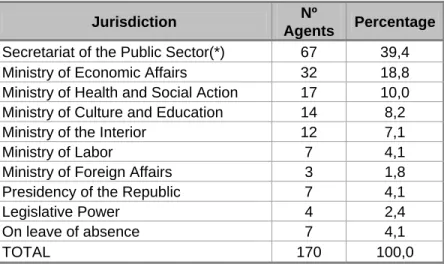
(16) * Monitoring and evaluation of some privatizations, at the Ministry of Economic Affairs; * Technical assistance to Provinces and Municipalities; * Intervention at the Deregulation, Decentralization, and Destatization Program; * Restructuring of several ministries and state secretariats at the Central Government; * Design of a computerized information system for managing organizational structures; * Participation in the Administrative Reform Committees created in each jurisdiction of the public sector; * Elaboration of the SINAPA system; * Coordinating and support team at the Administrative Reform Control Committee; * Participation in 31 delegations of the SINAPA Permanent Career Committee, representing the SFP; * Performance of several advisory, project design and managerial functions at institutions such as the National Grain Board, the Water and Sanitation State Company, the Central Bank, the Municipality of Buenos Aires, various ministries of the National Government, and the National Audit Board. The preceding listing constitutes a clear indication that the activity of the AGs has been quite conspicuous. Nevertheless, the recall of the PROFAG Fourth Class -made at the end of 1992- put a ceiling for admittance of 30 trainees. This means that the original target aimed at stabilizing the Corps' size around 1200 members has been dropped altogether. The AGs themselves believe that 200 members are enough to do their job within the new state emerging after the reform process. The assignment of destinations begins with a request for technical assistance made by a state institution. The application form distributed by the SFP includes an indicative list of assistance modalities, such as cabinet advice, project management, program coordination, planning, monitoring and control, normative reform, design of manuals and procedures, information systems consulting, modification and redesign of organizational structures, institutional diagnoses and organizational development. Decisions on applications are made by the SFP following a routine evaluation. If assistance is granted, an interview is arranged between members of the CAG Coordination and the requesting party, in order to reach an agreement on the desired profile of the AG (or AGs) to be assigned to the mission. A search is then made among AGs who are about to finish their duties elsewhere, interviews are held with one or several candidates, and a final assignment is made. To the extent possible, responsibilities are assigned on the basis of compatibility with the AG's professional interests. The final decision as to who is assigned what mission is made by the Secretary of the SFP, based on the information provided by the CAG Coordination. To ensure rotation, present regulations establish that no assignment can last more than three years. Table IX shows the distribution of AGs by destination. The largest proportion is found at the SFP, where -as the same Table indicates- their main duty consists of implementing policies made by this institution. Even those agents assigned to provinces and municipalities are commissioned to carry out programs originated at the SFP and INAP. Assignments can also be classified according to the type of functions performed. Table X offers information upon the number of AGs in charge of substantive (i.e. production of goods, services and regulations) and support (i.e. O&M, human resources management, accounting, budgeting) 16.
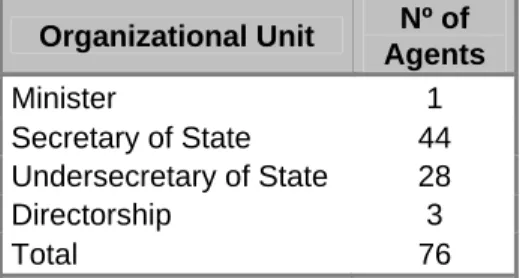
(17) functions, indicating how many of them fill upper managerial or advisory/executing positions. The figures suggest a trend that seems to run counter to one of the main goals pursued with the creation of the CAG: since an overwhelming majority of assignments are found in the advisory/executing cells, it would appear that the original purpose of assigning AGs to upper level management positions has been either reconsidered or taken over by the Executive Positions regime. TABLE IX DISTRIBUTION OF AGs BY INSTITUTION OF DESTINATION, FEBRUARY 1993. Jurisdiction Secretariat of the Public Sector(*) Ministry of Economic Affairs Ministry of Health and Social Action Ministry of Culture and Education Ministry of the Interior Ministry of Labor Ministry of Foreign Affairs Presidency of the Republic Legislative Power On leave of absence TOTAL. Nº Agents 67 32 17 14 12 7 3 7 4 7 170. Percentage 39,4 18,8 10,0 8,2 7,1 4,1 1,8 4,1 2,4 4,1 100,0. (*) It includes INAP, Delegations of SINAPA and INAP Programs at Provinces and Municipalities SOURCE: Own elaboration on the basis of data from AG Coordination. TABLE X DISTRIBUTION OF AGs BY AREA OF ACTIVITY AND TYPE OF FUNCTION (AUGUST 1992) Area of activity Support Sustantive. Function Conduct Advice/Implem. 2 52 4 62. Note: An AG may perform more than one task in the same or in a different institution. SOURCE: Own elaboration based on data provided by the CAG Coordination. Another way of judging the importance of the role played by AGs is by observing the organizational level to which they are assigned. The CAG Coordination shows a keen interest in assessing the strategic position of the Corps members within the organization, assuming that it increases proportionately to the level of insertion. Tables XI and XII provide information on this subject for both, centralized and decentralized institutions. 17.
(18) TABLE XI DISTRIBUTION OF AGs BY LEVEL OF INSERTION AT THE CENTRAL ADMINISTRATION (AUGUST 1992) Organizational Unit Minister Secretary of State Undersecretary of State Directorship Total. Nº of Agents 1 44 28 3 76. SOURCE: Own elaboration based on data provided by the CAG Coordination.. TABLE XII DISTRIBUTION OF AGs BY LEVEL OF INSERTION Organizational Unit Presidency Board of Directors Directorship Total. SOURCE:. Own. elaboration. based. on. data. Nº of Agents 35 16 19 70. provided. by. the. CAG. Coordination.. A typical problem encountered in work arrangements of the CAG kind is double dependency. AGs are hierarchically linked to the SFP on a permanent basis, while at the same time, they are functionally linked to the institution of destination on a temporary basis. Members of the Corps contend that "this work arrangement avoids both the development of perverse routines and the possibility of AGs being trapped by the very organizational culture they are supposed to change" (Falivene et al., 1992). In addition, it helps to diversify their professional experience and create a generalist profile fitted to multiple work situations. In practice, however, double dependency may become a source of conflict. Although not as a rule, conflicts do arise in isolated cases, particularly when the implementation of SFP policies is at stake. It happens that assignments have turned up to fall into one of two categories: (a) those in which the task consists of carrying out, at a given institution, policies formulated by the SFP; and (b) those in which AGs are more directly concerned with policies exclusively made at the agency of destination. In the first case, the political level of the two institutions may pursue diverging goals, so that the possibility of conflict is higher. In the second case, the SFP is usually not concerned and conflicts 18.
(19) are unlikely. In any case, AGs are continuously reminded by the CAG Coordination about the "operational autonomy of the Corps". Hence, in situations where the level of conflict between political goals becomes too high, the AGs involved are given a new destination. To round up the discussion on this point, it seems that Menem's government is using the CAG to execute policies made by the SFP itself, whereas the previous Radical government foresaw a more diversified technical role for the AGs. According to one interviewee, "the SFP sees the performance of the Corps in terms of its rate of political return: what is important is not the technical aspect of the work, but rather the possibility of monitoring and influencing policy implementation in other public institutions." 7. A note on values and attitudes After two years of training, the different PROFAG classes develop very close ties and strong feelings of solidarity. Upon entering the Corps, these feelings are extended to, and shared with, other peer members. Therefore, "a sense of belonging" becomes generalized throughout the entire Corps. Members are perceived by outsiders as a closed and elitist group. Their Association serves as "a home and a club"--to use an AG's expression. 15 In his well known study on management ideologies, Bendix (1956) observed that training activities for future leaders may produce, among trainees, an exaggerated belief about their true importance. This may or may not be the case of the AGs. They do consider themselves an elite corps, but probably not an elitist body in the pejorative sense of the term. They look upon themselves as a highly professionalized cadre of functionaries who defend their career, training and incumbencies. In this latter respect, the new Executive Positions created by Decree 2129/91 are regarded as competitive, because they narrow their own opportunities of occupying such positions in the future. However, many AGs believe that they could easily and successfully apply for any executive post opened for competition within the new regime. 16. 8. Final remarks The CAG is the only experience of upper management training and creation of a critical mass of higher civil servants that has survived political alternation in the Argentine government. On the average, and measured by any standards of comparison, the level of training and the capacity of its members is quite high. The Corps has carried out a variegated and intensive activity. The question is, has the experience been successful?. 15. In addition to its representational role, the Association publishes a journal containing articles, technical information and reports on concrete reform experiences. It also organizes workshops and seminars for its members. 16 It is interesting to point out that some AGs specialized in personnel selection have been responsible for developing technical instruments applied in the selection and recruitment of civil servants under the Executive Positions regime (Cambours et al., 1992).. 19.
(20) Given the descriptive nature of this paper, the answer must await a much more thorough evaluation. Besides, the time elapsed since the CAG started its normal operation is still insufficient as to draw any conclusive opinion. Nevertheless, what can be safely affirmed is that the role of the Corps will hardly be as important as it was foreseen in the original project. If not for any other reason, it is unlikely that its size will ever be over 1000 agents and it is hard to tell how frequently (if this occurs at all) new vacancies will be opened in the future. It appears that the positions filled by AGs in the public sector will mainly fall within the advisory/executing category, rather than the command functions. The creation of SINAPA and, especially, the Executive Positions regime -with its emphasis on merit, competitive examinations, and adequate pay- seems to have put some limits on the prospects of AG's to be the unique source of supply of top managers for the public sector. Rather, the Executive Positions are probably curtailing, to some extent, the very possibility of AGs' performing this kind of role. There are indications that the CAG has gained certain prerogatives, insofar as its members are solely responsible for the selection of new trainees, the coordination of the Corps and the preliminary evaluation of AG's performance. It seems to be an organization that virtually reproduces itself. This may not necessarily be negative, in view of the competence and capacity of its members. But considering the solidarity and esprit de corps that characterizes it, and the fact that permanence within the Corps depends heavily on performance evaluation, it is quite likely that the discharge of this responsibility by peer members may not be entirely objective. Paradoxically, it may also signal a possible loss of status: any institution is central to a political project is usually brought under strict supervision by those in power. Future research on this experience should consider a number of issues that have only been touched upon cursorily: (a) the perceptions about the AG's role among members of the institutions of destination; (b) the extent to which their intervention brings about effective changes in the organizational culture of those institutions, through the transfer of new work styles and methodologies; (c) the dynamics of double dependency, including possible benefits or frustrations; (d) the role played by AGs within political parties; (e) the motivations behind entering the Corps and the attitudes observed upon becoming members thereof; and (f) the legitimacy of the CAG within the new context of an extended professional civil service. Whether the Corps will become a key dynamizing element of public sector management; will be disactivated; or will end up developing its own style of a bureaucratic culture, akin to that it tried to eradicate, is still an open question. Monitoring the future operation of the CAG may be important to draw useful lessons for comparative experiences.. 20.
(21) REFERENCES Alvarez Omar, Antelo Marcela y Groisman Martín (1985). Análisis de la Segunda Convocatoria a Integrar el Cuerpo de Administradores Gubernamentales, INAP, Bs. As. Alfonsín, Raúl (1985). "Discurso de Apertura", Discursos Pronunciados en la Apertura del Primer Curso de Formación de Administradores Gubernamentales, INAP, Bs. As. Asoc. de Adm. Gubernamentales (1990). "Qué es el Cuerpo de Administradores Gubernamentales", Aportes Metodológicos para Transformar la Administración Nº 1:83. Bendix, Reinhard (1956). Work and Authority in Industry, John Wiley, New York. Cambours, Enrique, Cuñamo, Alicia, Iacovello, Marcela, Martínez, María Inés, Pulido, Noemí, Rodríguez Pérez, María, Soccone, Irene AND Subi Carbonell, Fernando (1992). Selección de Gerentes: Una Metodología para el Estado, presented at the IX Congreso Nacional de Administración Pública, Mendoza, Argentina. Falivene, Graciela, Gramón, Celia, March, Dolores and Piemonte, Víctor (1992). El Cuerpo de Administradores Gubernamentales. Inserción y Crecimiento en la Administración Pública Nacional, presented at the IX Congreso Nacional de Administración Pública, Mendoza, Argentina. Groisman, Enrique (1988). El Proyecto de Formación del Cuerpo de Administradores Gubernamentales. Análisis de una Experiencia, Centro de Participación Política, Buenos Aires. Hood, Christopeher and Jackson, Michael (1991). Administrative Argument, Dartmouth, Aldershot. INAP (1985). "Carrera de Administradores Gubernamentales: Editoriales, Publicaciones, Notas y Avisos Periodísticos", Buenos Aires. INAP (n.d.). "Curso de Formación de Administradores Gubernamentales", A report presented at the "Coloquio Técnico de la XVII Reunión del Congreso Directivo del CLAD". INAP (1987). Proyecto de Selección y Curso de Nivelación para los Ingresantes al III Curso de Formación de Administradores Gubernamentales, Buenos Aires. INAP (1988). Normativa del Cuerpo de Administradores Gubernamentales, Buenos Aires. Lynn, Laurence E. (1981). Managing the Public Business. The job of the Government Executive, Basic Books, New York. Oszlak, Oscar (1980). Políticas Públicas y Regímenes Políticos, CEDES, Buenos Aires. Oszlak, Oscar (1987). La Modernización del Estado América Latina: Diagnóstico y Estrategia, Washington, IDB. Reid, Gary J. (1992). "Civil Service Reform in Latin America: Lessons from Experience", UNDP, Doc.No.4, prepared for UNDP Regional Workshop on Public Sector Management Development in 21.
(22) Latin America and the Caribbean, Santiago, Chile, 23-25 March. Roulet, Jorge (1988). El Estado Necesario, Centro de Participación Política, Buenos Aires. Stuhlman, Luis (1988). "Entrevista: Los Administradores Gubernamentales, Una innovación?" Información Empresaria Año XVIII Nº 237:15-18.. 22.
(23)
Figure
+2
Documento similar
Government policy varies between nations and this guidance sets out the need for balanced decision-making about ways of working, and the ongoing safety considerations
Method: This article aims to bring some order to the polysemy and synonymy of the terms that are often used in the production of graphic representations and to
Source: Authors’ own creation based on data contained in the EGM 2009. The analysis was applied to 100% of the alcohol-related journalistic texts published by the selected
In the “big picture” perspective of the recent years that we have described in Brazil, Spain, Portugal and Puerto Rico there are some similarities and important differences,
16 It is especially noteworthy that there were guilds of journeymen (though not from the maritime cargo-handling guilds). The relevance of this fact is the
Illustration 69 – Daily burger social media advertising Source: Own elaboration based
50 The goal is to help people to reach an optimum level in the dimensions of psychological well- being: environmental mastery, personal growth, purpose in life,
In the previous sections we have shown how astronomical alignments and solar hierophanies – with a common interest in the solstices − were substantiated in the
