
Learning strategies to foster vocabulary in EFL
69
0
0
Texto completo
(2) 2. Declaration We hereby declare that our research report entitled: Learning strategies to foster vocabulary in EFL is the result of our own work and includes nothing which is the outcome of work done in collaboration except as declared and specified in the text; is neither substantially the same as nor contains substantial portions of any similar work submitted or that is being concurrently submitted for any degree or diploma or other qualification at the Universidad de La Sabana or any other university or similar institution except as declared and specified in the text; complies with the word limits and other requirements stipulated by the Research Subcommittee of the Department of Languages and Cultures; has been submitted by or on the required submission date.. Date: November 6th, 2018. Signature: Full name: Tatiana Paola Ariza Amador. Signature: Full name: Edna Rocio Celis Gómez. Signature: Full name: Silvia Juliana García Ortiz.
(3) 3. Acknowledgements. First, we would like to express our deep gratitude to God for giving us strength, guiding and blessing us in all this process. We also thank our families who were always there to support us. Thanks to all the professors who were involved in this process with us, especially to Jermaine McDougald and Claudia Acero for their patience and encouragement.. Also, we would like to show our greatest appreciation and gratefulness to our professor, Rocio Mongui, who was always there supporting, guiding and believing in us. We would like to thank our friends too and all the people around us that know how hard this path was and how gratifying is to see that it comes to an end..
(4) 4. Abstract. Learning strategies to foster vocabulary in EFL, is a systematic literature review that focuses on updated research papers from 2012 to 2016, with the objective of identifying and analyzing learning strategies that are used to foster vocabulary in basic EFL students. In order to achieve the aim of this research, a systematic literature review was followed. This type of research is a method of gathering, analyzing and presenting the implications of different strategies for enhancing vocabulary. The investigation focuses on the latest literature on vocabulary learning and learning strategies that examine differentiated ways for learning and applicable tools, more specifically the literature on vocabulary learning strategies. Rubin’s taxonomy was used to organize the findings and draw conclusions. It can be determined, based on the main findings, that the mixture of regular and particular strategies, the teacher’s awareness of the target vocabulary plus student’s motivation make in all an appreciable difference in vocabulary learning.. Key words: Vocabulary learning, Vocabulary learning strategies, EFL learning, strategies, Vocabulary..
(5) 5. Resumen. Las estrategias de aprendizaje para fomentar el vocabulario en EFL, es una revisión sistemática de la literatura que se centra en los trabajos de investigación actualizados de 2012 a 2016, con el objetivo de identificar y analizar las estrategias de aprendizaje que se utilizan para fomentar el vocabulario en los estudiantes de EFL básicos. Para lograr el objetivo de esta investigación, se realizó una revisión sistemática de la literatura. Este tipo de investigación es un método para recopilar, analizar y presentar las implicaciones de diferentes estrategias para mejorar el vocabulario. La investigación se centra en la literatura más reciente sobre aprendizaje de vocabulario y estrategias de aprendizaje que examinan formas diferenciadas de aprendizaje y herramientas aplicables, más específicamente la literatura sobre estrategias de aprendizaje de vocabulario. Se utilizó la taxonomía de Rubín para organizar los hallazgos y sacar conclusiones. Se puede determinar, en base a los hallazgos principales, que la combinación de estrategias regulares y particulares, la conciencia del profesorado del vocabulario objetivo más la motivación del estudiante hacen en toda una diferencia apreciable en el aprendizaje del vocabulario.. Palabras clave: Aprendizaje de vocabulario, Estrategias de aprendizaje de vocabulario, Aprendizaje de lengua extranjera, Estrategias, Vocabulario..
(6) 6. Table of Contents. List of tables ................................................................................................................................................ 7 List of figures .............................................................................................................................................. 7 List of Annexes ............................................................................................................................................ 8 Chapter 1: Introduction .............................................................................................................................. 8 1.1 Introduction to the study .................................................................................................................. 8 1.2 Problem statement ......................................................................................................................... 10 1.3 Strategy selected to address problem............................................................................................. 11 1.4 Review question(s) and objective(s) ............................................................................................... 12 1.4.1 General objective ..................................................................................................................... 12 1.4.2 Specific objectives .................................................................................................................... 12 Chapter 2: Relevant Theoretical Bases for the Review ............................................................................. 13 2.1 Introduction .................................................................................................................................... 13 2.2 Vocabulary ...................................................................................................................................... 13 2.3 Vocabulary learning ........................................................................................................................ 14 2.4 Vocabulary Learning Strategies ....................................................................................................... 18 Chapter 3: Research Design ...................................................................................................................... 20 3.1 Introduction .................................................................................................................................... 20 3.2 Systematic literature review ........................................................................................................... 21 3.2.1 Phases for a systematic literature review ................................................................................ 23 3.3 Research process ............................................................................................................................ 24 3.3.1 Mapping the field through a scoping review ............................................................................ 24 3.3.2 Comprehensive search ............................................................................................................. 26 3.3.3 Quality assessment .................................................................................................................. 27 3.3.4 Data extraction ........................................................................................................................ 28 3.3.5 Synthesis .................................................................................................................................. 29 3.3.6 Write up ................................................................................................................................... 29 Chapter 4: Results and Data Analysis ........................................................................................................ 30 4.1 Introduction .................................................................................................................................... 30 4.2 Results of the database search ....................................................................................................... 30 4.3 Interpretation of findings ................................................................................................................ 35.
(7) 7 4.4 Research questions ......................................................................................................................... 51 4.4.1 Research question: ................................................................................................................... 51 Chapter 5: Conclusions and Pedagogical Implications .............................................................................. 55 5.1 Significance of the results ............................................................................................................... 55 5.2 Limitations of the present study ..................................................................................................... 57 5. 3 Further Research ............................................................................................................................ 57 References ................................................................................................................................................ 59 Annex 1. Appendix A ................................................................................................................................. 65 Annex 2. Appendix B. Inclusion and Exclusion Sheet ............................................................................... 66 Annex 3. Flow chart .................................................................................................................................. 68. List of tables. Table 1. What is involved in knowing a Word?. 9. Table 2. Picot. 18. Table 3. Inclusion and Exclusion Criteria. 20. Table 4. General information of the studies. 23. Table 5. Aims and findings as reported in the studies. 28. List of figures. Figure 1.Rubin´s Taxonomy.. 51. Figure 2.Research paper focus on Cognitive Strategies. 53. Figure 3.Research paper focus on Metacognitive Strategies.. 54.
(8) 8. List of Annexes Annexes 1. Appendix A.. 72. Annexes 2. Appendix B.. 74. Annexes 3. Appendix C Flow chart. 78. Chapter 1: Introduction. Learning a language is a process that implies skills listening, writing, reading and speaking, but each of them is linked with other micro-skills, which are vocabulary, grammar and pronunciation. This chapter provides important aspects, which main purpose is to identify vocabulary as a vital link in the communication process.. 1.1 Introduction to the study. Vocabulary is recognized as being one of the pillars in language learning hence its importance in the communication process. Wilkins (1972) states “...while without grammar very little can be conveyed, without vocabulary nothing can be conveyed” (p111-112). This suggests that in a communicative process, it is more important to focus on vocabulary rather than grammar. This literature review aims to dig into different strategies to enhance vocabulary in order to improve student’s skills in a foreign language. Along with this idea, Guo (2010) suggests “the first task of vocabulary instruction is to enlarge learners’ vocabulary” (p61). Vocabulary is central to English language because without sufficient vocabulary students cannot understand others or express their own ideas. In other words, for a successful communicative.
(9) 9. process, vocabulary should be taught gradually taking into account students’ singularities and in such a good way that learners can understand it and use it properly according to their needs and purposes.. Consequently, this study uses a systematic literature review to address one of the main issues identified within Rosario school context. A systematic literature review attempts ‘to identify, appraise and synthesize all the empirical evidence that meets pre-specified eligibility criteria to answer a given research question’ (Chandler, 2013). Therefore, one of the main problems identified throughout this study and the essence of it, was students’ reading comprehension process due to their lack of vocabulary. This systematic literature review investigates latest literature on vocabulary learning and learning strategies that examine differentiated ways to learn and tools to apply, more specifically the literature on vocabulary learning strategies. This study addresses research reports from the last 5 years on vocabulary learning and learning strategies in learners with a basic level of proficiency, in order to identify and analyze resources and strategies, indicating their effectiveness and learning outcomes of such studies. This thesis is divided into five chapters. Chapter 1 is about the need for analysis, which provides a problem statement and problem significance. This chapter also includes the main research question and its objectives. Then, in Chapter 2 a literature review focusing mainly on vocabulary learning and learning strategies is provided. In Chapter 3, researchers explain the importance of systematic reviews and outline the steps followed to obtain the data for analysis of this specific study. Chapter 4 contains a characterization of the studies obtained and provides a.
(10) 10. description of the findings. Finally, Chapter 5 offers the main conclusions and the pedagogical implications of this documental research.. 1.2 Problem statement. While the world is experiencing an accelerated age of changes, learning English has become a crucial competence around the world and non-English speakers have the need of going along with these changes, in order to be able to read any kind of texts and increase their competences. One concern in Colombian education is the lack of understanding while reading. Researchers have highlighted that a variable, which is remarked in the role of a main factor in reading comprehension, is vocabulary. It is also affirmed that a child should know 90 - 95% of word meanings in a text to be able to infer the main idea of a text. In addition, other researchers contend that vocabulary is the strongest variable associated with comprehension. (Yildirim, 2011) The lack of vocabulary is a challenge for teachers due to its impact in the students’ academic processes of reading comprehension and writing. According to what has been observed within English classes at Rosario School in Barrancabermeja, most of the new requirements that students have nowadays, include having several words at their disposal for describing an event or emotion, when sharing their ideas and opinions of a text. In addition, as it.
(11) 11. has already been stated, vocabulary is the foundation for comprehension: unfamiliar words become holes in the text, preventing learners from learning and recalling what they have just read. In other words, lack of vocabulary had a negative effect on students’ performance in listening, reading comprehension and conversation classes. In summary, the purpose of this literature review is to investigate which strategies currently in use to foster vocabulary learning in basic EFL students as to provide a critical analysis and revealing connections among the different findings that may be useful for teachers in Colombian context to address the identified problems that may provide implications for later research. 1.3 Strategy selected to address problem Due to the negative impact caused by students’ short vocabulary on the second language skills, the selected object to be researched are the strategies for vocabulary learning. Consequently, in this research, different strategies conducted on vocabulary learning research will be evaluated, letting readers know which strategies are being used by teachers to increase and improve students´ performance on vocabulary related issues. Firstly, some important constructs are defined, the main constructs for this study are: vocabulary, vocabulary learning and vocabulary learning strategies. These concepts are crucial in order to define the inclusion and exclusion criteria used in this literature review. The inclusion criteria are a characteristic that the review paper must have if it is to be added in the study, while the exclusion criteria is one of those characteristics that disqualify the studies from being included in the project, the inclusion criteria refer to those aspects considered of relevance for the study. For this particular study, such criteria consist of: population (basic level students),.
(12) 12. intervention (strategies), comparator (impact on vocabulary learning), outcomes (how effective strategies are), time of publications revised (2012 to 2016), type of publication (academic papers), context (EFL). Immediately after, academic articles are reviewed from different online databases with the purpose of looking for effective language learning strategies in the context and according to this study's objective. Consequently, the number of articles that will be analyzed will depend on the purpose and relevance for the study. The findings from each reviewed study are analyzed having as reference Rubin’s Taxonomy (1987), which classifies language learning strategies and makes dissimilarities between strategies which contribute directly to learning and those which do not. Rubin classifies the strategies into three categories; learning strategies, communication strategies and social strategies. The learning strategies taken into account to classify the findings of this present study are the cognitive and metacognitive. Concretely, this study analyzes the evidence for more detailed research on vocabulary learning strategies applying the method of literature review, which highlights the strategies used with basic level students in order to foster their vocabulary understanding. 1.4 Review question(s) and objective(s). Which learning strategies contribute to successful vocabulary learning in EFL basic level students according to research reports published from 2012 to 2016? 1.4.1 General objective To classify the most successful strategies to foster vocabulary learning in EFL basic students according to research reports published from 2012 to 2016. 1.4.2 Specific objectives.
(13) 13 ●. To characterize the most widely used strategies to foster vocabulary learning of EFL in basic students.. ●. To interpret the most notable features of research studies from 2012 to 2016 focused on learning strategies to foster vocabulary learning of EFL basic students.. ●. To analyze the evidence of learning strategies, present on the studies to validate their effectiveness to foster vocabulary learning in foreign language teaching and learning environments.. Chapter 2: Relevant Theoretical Bases for the Review 2.1 Introduction. This chapter provides a theoretical overview of the most important constructs, which have been crucial in this study in order to find which strategies to foster vocabulary learning in EFL basic students have been the most used by teachers according to recent study papers. These constructs were Vocabulary, Vocabulary learning and Vocabulary learning strategies. 2.2 Vocabulary. Defining vocabulary is an essential factor in this research project, as a process where students’ knowledge is a pivotal piece for learning in the second language because it will be the successful tool in the communication process. In general, vocabulary is defined as “a list of words for a particular language or a list or set of words that individual speakers of language might use” (Hatch, 1995). In addition, “vocabulary is knowledge; the knowledge of a word not only implies a definition, but also implies how that word fits into the world (Stahl, 2005)”. This.
(14) 14. is significant because it embraces all the words students must know to have a background knowledge, express ideas, communicate effectively, and learn about new concepts. This study was looking for ways to enhance vocabulary in order to have a better understanding of English in an academic context, facilitating reading comprehension. “Vocabulary is the glue that holds stories, ideas and content together… making comprehension accessible for children (Rupley, 1999).” In accordance with this idea, vocabulary is not only words in isolation, it makes the whole language, and by understanding the relation between vocabulary and language, teachers can facilitate learning. Consequently, the aim of this study was to look for some effective strategies to help teachers in their pedagogical practice. Related with this idea, the relationship between vocabulary knowledge and language use as something complementary in order to let language use and vice versa, language use leads to an increase in vocabulary knowledge (Nation, 2001). Therefore, the outcome of many studies analyzed within this systematic literature review has demonstrated that the achieving learners, in an academic context, are those who possess sufficient vocabulary. 2.3 Vocabulary learning. In order to accomplish the objective of this literature review, it was greatly important to understand that vocabulary is a necessary element to language learning. “The building blocks of language learning and communication are not grammar, function, notions, or some other unit of planning and teaching but lexis, that is, word and word combinations”. Considering this and the relationship between vocabulary knowledge and language learning, it is impossible for us to evade the fact that vocabulary knowledge is necessary to have competence in a language ability (Richards, J. 2001)..
(15) 15. According to the class observations that were made, by the researchers within the classroom, in order to identify the struggle that students had while learning vocabulary, it can be said that addressing memory is not enough. When teachers plan to show their students an important vocabulary bank where the words need to be learned, sometimes the strategy points to the repetition and memorization of these without taking into account how important other variables are. Then, a technique related to the dictionary use appears. However, knowing what each word means, implies going beyond its mere definition or translation to L1: it’s necessary to know how to use it in a context, use appropriately according to the intention in the text and taking into account that it can be interpreted in several ways.. It is known that there are two basic ways of vocabulary learning, which are incidental and intentional vocabulary learning. For this reason, it is crucial to know the difference in between, so the vocabulary learning process could be addressed in an accuracy way. Incidental learning is the process of learning something without the intention of doing so. It is also learning one thing while intending to learn another. In other words, incidental learning is viewed as learning from context; on the contrary, intentional vocabulary learning refers to “any activity aiming at committing lexical information to memory” (Robinson, 2001). Specifically, intentional vocabulary is based on synonyms, antonyms, word substitution, multiple choice, scrambled words and crossword puzzles, regardless of context. Moreover, pointing out that teachers emphasize the importance of guessing-from-context skills by drawing students’ y Attention to the value of good sentence examples that provide grammatical and pragmatic information about words as well as collocations. Similarly, combining contextual and.
(16) 16. morphemic cues in vocabulary learning and teaching processes is beneficial during incidental vocabulary acquisition (Hunt, 2005) (Brusnighan & Folk, 2012).. The present study suggested that making connections between words and context is crucial in an academic environment in order to know their function in a sentence. According to this, the type of learning in academic settings should be intentional, where students look for synonyms and the usage in a specific field. As stated that the meaning, the use and the form of a word work together to make the complete concept of it (Nation, 2001). To this extend, table 1 shows to clarify the relation between form, meaning and use.. Table 1. What is involved in knowing a word? Aspect. Form. Component. Spoken. Receptive. Productive. Knowledge. Knowledge. What does the word sound like?. How is the word pronounced?. What does the word look like?. How is the word written and spelled?. Written. Word parts. What parts are recognizable in this word?. What word parts are needed to express the meaning?.
(17) 17. Meaning Form and meaning. What meaning does this word form signal?. What is included in this concept? Concepts and referents. What other words does this make people think of?. What word form can be used to express this meaning? What items can the concept refer to?. What other words could people use instead of this one?. Associations Use. Grammatical functions. In what patterns does the word occur?. In what patterns must people use this word?. What words or types of words occur with this one?. What words or types of words must people use with this one?. Collocations Where, when and how often would people expect to meet this Word?. Where, when, and how often can people use this Word?. Constraints on use (Register, frequency…) Source: adapted from Nation (2001, p 27). On the other hand, it is explained that “words should be drawn from authentic experiences in reading and listening, where students encounter words in the various contexts of language” (Fisher. U, 1994). In other words, students can understand certain words, taking into.
(18) 18. account the context, in order to relate them to a story or sentence and that these should be directly involved with real life situations in order to be more significant for them.. In order to start analyzing and describing the different types of strategies selected in this study, it was necessary to examine a particular taxonomy which gave this literature review an objective way to classify the findings. It also ensures that the study has consulted related literature about vocabulary learning strategies, and takes into account the different types of strategies to identify the aim, process and findings.. Taxonomy refers to the development of classification according to a predetermined system. In this way, one of the most famous taxonomies of vocabulary learning strategies is Rubin´s taxonomy (1987) taxonomy, where there are two main types of strategies: discovery strategies and consolidation strategies. Discovery strategies (strategies for the discovery of a new word’s meaning) and Consolidation strategies (strategies for consolidating a word once it has been found). The first group consisted of determination strategies and social strategies while the second includes social strategies, memory strategies, cognitive strategies, and metacognitive strategies. It is also noted, that social strategies are found in both categories because they can be used at any stage of vocabulary learning. In addition, the implementation of a taxonomy has been a support to understand how each person’s mind works while acquiring new vocabulary and to determine the type of strategies used in the selection process of studies and documents for this research.. 2.4 Vocabulary Learning Strategies.
(19) 19. One of the conclusions drawn by the researchers through informal class observations is that students do not stop learning vocabulary; it is a continuing process and despite all the research conducted through the last years and the great contributions made about it, vocabulary learning is still an unfinished subject. As Schmitt (2000) declares, the mechanics of vocabulary learning has not been understood fully so far. On the other hand, it is known that L2 vocabulary cannot be acquired instantaneously or simultaneously, as mastering a word completely requires various component types of word knowledge and even learning of individual word knowledge is incremental in nature being a gradually developing continuum (Schmitt, 2000).. Additionally, it can be stated that students who struggle to acquire new vocabulary have demonstrated poor learning strategies and require instruction that is more explicit and intensive practice in order to master key vocabulary based on informal class observations. This issue can be outlined by delimiting effective strategies for learning vocabulary hence focusing students on understanding and learning new terminology and words, by integrating it with what they already know, and recalling the meaning of words when encountered on a later date or in new material. In fact, students need to understand what a strategy is and how to choose one based on their characteristics and needs. Wenden and Rubin (1987) define learning strategies as "... any sets of operations, steps, plans, routines used by the learner to facilitate the obtaining, storage, retrieval, and use of information” (p19). The definition given by Wenden and Rubin (1987) is taken as a reference to understand that while some students are typically performing in a satisfying level, others may not, despite the teacher’s effort and time invested towards this objective. This trouble could be caused by an absent or inaccurate use of strategies during learning, causing learners not to understand, master, or remember new information. Additionally, Oxford (1990) developed a.
(20) 20. taxonomy, which divides language strategies into two main groups: direct and indirect strategies. Language learning strategies that directly involve the target language are called direct strategies. According to the review done throughout the literature, there is not a single plan to follow when choosing or applying a strategy, in behalf of the wide variety of them for teachers and students. Likewise, several factors are taken into account to analyze and select one strategy. The most effective type of strategy will depend on the nature of the group, students’ needs, level and the goal that has been set. (p12).. Chapter 3: Research Design. 3.1 Introduction A considerable amount of research has been done around vocabulary learning; the results sometimes showed contradictions that cause an unclear view of the facts. Impartial research has been necessary in order to improve education standards and the quality of teaching, therefore researchers have deployed different studies around education issues since education needs to be built as a result of objective investigation and evidence, so it would not take the risk of being based on beliefs and personal thoughts. Consequently, this study intended to contribute to the understanding of strategies that have proven to be effective to foster vocabulary, as well as to provide the implications in both short and long term..
(21) 21. 3.2 Systematic literature review. A literature review is used as the method to gather, analyze and present the implications of. different strategies in enhancing learning vocabulary. According to Jesson (2011), “systematic reviews are useful tools for those seeking to promote research knowledge and put it in action, also they can help to identify gaps in knowledge as well as clarify where nor further research is needed for the time being (Cronin, 2011).” This description carries a relevance within this research, since it has identified similarities in the beliefs and concerns about strategies used in learning vocabulary, so these can be used as a starting point for a research process. Moreover, one of the aims of this systematic literature review was to determine, classify and give a general view of the strategies that were used for teachers in order to enhance vocabulary. Thus, systematic literature review allowed us to fulfill the purpose of this study. Chandler (2013) states “A systematic literature review attempts ‘to identify, appraise and synthesize all the empirical evidence that meets pre-specified eligibility criteria to answer a given research question”. (Section 1.2). According to R. Mallett (2012) “a systematic review emphasizes more strongly on evidence, impact, validity and causality. By extracting information on research design (sampling strategy and data collection methods), analytical methods and causal chains, systematic reviews are effective at gauging the robustness of evidence. Classifying the quality and characteristics of impact studies against standardized criteria also enables the possibility of producing cross-study comparisons and meta-analyses, which are valuable for evidence-informed policy making”. (p448). In other words, a strong backup for this research project is given with the implementation of a systematic literature review based on empirical evidence throughout the different studies.
(22) 22. with a critical eye of the experts. Finally, it is stated that the use of a clear systematic review protocol is effective not only in guiding researchers throughout the process – keeping them ‘on track’ – but also in improving the methodological transparency of the review and in enabling future replication. Furthermore, systematic reviews are able to ensure objective basis for future research (Elbourne, 2002). A systematic literature review must achieve most of the following aspects (Baumeister, 1997) (Bem, 1995): Establish to what extent existing research has progressed towards clarifying a particular problem; Identify relations, contradictions, gaps, and inconsistencies in the literature, and explore reasons for these (e.g. by proposing a new conceptualization or theory which accounts for the inconsistency); Formulate general statements or an overarching conceptualization (make a point, rather than summarizing all the points everyone else has made; (Bentler, 1992); Comment on, evaluate, extend, or develop theory; In doing these things, provide implications for practice and policy and describe directions for future research. This suggests that the outcomes of this systematic literature review would help future researchers to establish a starting point; since few studies were focused on analyzing and giving a critical view of the research made so far..
(23) 23. 3.2.1 Phases for a systematic literature review. To conduct a literature review, it is necessary to go through different stages which are followed in this research project. As the different phases in a systematic literature paper review described below:. Phase 1: Mapping the field through a scoping review. As an initial process, it is necessary to frame this systematic literature review. This literature is defined, as a crucial matter of review, strategies widely used to enhance vocabulary. In this stage, the protocol and the method are selected as well as the inclusion and exclusion criteria.. Phase 2: Comprehensive search. In this stage, key words are selected in order to search and delimit the results when accessing some electronic databases. According to Jesson, findings must be analyzed in accordance to their relevance to the study (Cronin, 2011). Then, results must be documented in a table. This systematic literature reviews used as a gathering tool a widespread sheet, which is explained in detail below in 3.3.2. Phase 3: Quality assessment. Documents and results are read and classified. This research has applied an inclusion and exclusion table based on Picot’s criteria adapted from Boland (Khan, 2003)..
(24) 24. Phase 4: Data extraction. A pre-designed extraction sheet is used to summarize the results of the previous process. An electronic format is used to record the results of this systematic literature review.. Phase 5: Synthesis. In this stage, the data is synthesized from each individual article into one. As a result, the use of Rubin’s taxonomy to organize the findings and present them in a systematic way is mandatory.. Phase 6: Write up. The aim of this stage is to write up a balanced, impartial and comprehensive report, using a systematic review format, presenting the process reports that will enable another researcher to replicate the review. This thesis draws some conclusions and implications for future research about vocabulary learning and strategies to foster it.. 3.3 Research process The following section describes the process followed during research keeping in mind the steps proposed by Jesson (Cronin, 2011).. 3.3.1 Mapping the field through a scoping review A first draft of the research question was formulated it has been clarified that a question should be clear and concise in order to identify relevant reports, appraise their quality and summarizes the evidence by use of explicit methodology (Khan, 2003). This step is considered as the key of.
(25) 25. the research due to the way it determines the main objective and delimits the boundaries of the research. Additionally, keywords were used for searching information related to learning strategies and vocabulary learning strategies in order to get an overall picture of the research topic. Moreover, the protocol was determined as well as the inclusion criteria; academic articles were selected as the main source of data extraction.. Furthermore, it was necessary to determine the population and the type of outcomes in order to answer the research question. As the main objective of this review is to identify which strategies teachers are recently using to enhance vocabulary, the dates between 2012 and 2016 determined the limit for the publication of articles. The criteria to address this research were based on vocabulary learning and effective learning strategies to foster vocabulary in context of teaching EFL. Articles that would not potentially refer to teaching English as a foreign language were immediately discarded. Other criteria of inclusion required articles with qualitative, quantitative, or mixed methods. Besides, articles to be included in the review needed to focus only on basic students. The following table describes the selected research question of this review, the key components and its analysis through the PICOT table (Elbourne, 2002).. Table 2. Picot..
(26) 26. Research question. Which learning strategies are more effective to foster vocabulary in EFL basic level students based on studies between 2012 to 2016?. Population. English basic level students: Beginner and Elementary English. Intervention. Studies related to vocabulary learning and learning strategies. Context. English as a foreign language (EFL). Outcome. Learning strategies to foster vocabulary. Time. Papers published between 2012 and 2016. Note. Adapted from Gough et al., 2012. 3.3.2 Comprehensive search Searches were conducted electronically by taking into account the searching criteria, which mainly consisted of three key concepts: vocabulary, learning strategies and vocabulary learning strategies. The aim of using keywords is to frame and focus the results according to the research question and the objectives of this review. The search was conducted electronically and three databases were selected; the databases used in this review were: E-book Academic Collection EBSCO.
(27) 27. Intellectum Google Academic These search databases allowed to this review to extract and sort references into relevant groups that later determined the learning strategy used to evaluate the vocabulary learning. Information was gathered in an excel spreadsheet that was used to keep a track of all sources and information searched (Appendix A).. 3.3.3 Quality assessment In this stage, a first search was conducted were more than 1700 results were generated, approximately 1600 were excluded as they did not focus on learning strategies related to basic level students. Consequently, 656 results of learning strategies and 451 results on vocabulary learning were selected for screening of inclusion criteria. Afterwards, only 21 articles fulfilled the selection criteria. This search was conducted for 7 months from January to July 2017.. Table 3 shows the specific criteria of inclusion and exclusion implemented in this review. Table 3. Inclusion and Exclusion Criteria.
(28) 28. Criteria. Inclusion. Exclusion. English basic level students: Beginner and Elementary English Other levels of proficiency. Population Studies related to vocabulary learning and learning strategies. Studies not related to vocabulary learning. English as a foreign language (EFL). English as a first/second language or other languages. Outcome. Learning strategies to foster vocabulary. Learning strategies in another topic. Time. Papers published between 2012 and 2016. Papers published before 2012. Types of Publication. Thesis Academic. Newspaper. Journal. Magazines. Research. Monograph. Intervention. Context. Papers Source: Adapted from Using the PICOTS Framework to Strengthen Evidence Gathered in Clinical Trials—Guidance from the AHRQ’s Evidence-based Practice Centers Program.. 3.3.4 Data extraction.
(29) 29. In this stage, detailed reading was conducted in order to identify the main features of the articles that fulfill the inclusion criteria. The data was classified into five segments: the source, keyword used in the search, participants, methodology or strategies used in the study and the results. Twenty- four articles were analyzed with the tool (Appendix A). Designed to gather and scan the main features of them in order to analyze whether their outcomes were relevant or not to this review. Even though all twenty- four articles fulfilled the criteria, only sixteen papers were considered relevant since their outcome answered the research question. 3.3.5 Synthesis. At this point, researchers needed to identify, organize and analyze different parts of the researched material under review in a coherent order finding similarities and points of convergence to see the selected material as a whole. A deep analysis of the related literature enhances the relevance and quality of the information included in this research, giving basis for the subsequent chapter; hence, the use of a taxonomy to organize the data becomes mandatory. For this purpose, several taxonomies were researched and analyzed in order to find the most appropriate after trying to review the information under the light of each of them. Finally, Rubin´s taxonomy was chosen due to the support it gave to the research project matter.. 3.3.6 Write up. In this final section, researchers shaped the information and the evidence obtained from the data extraction stage into the conclusions that will answer the research question in order to interpret the data obtained and draw conclusions based on the analysis of the data..
(30) 30. Chapter 4: Results and Data Analysis. 4.1 Introduction This chapter includes a record of the searching process that allows gathering the studies for this review. It also describes the studies, which have been included, stating their characteristics in order to analyze them and state an answer for the research question. The following sections describe in detail the filters implemented in this investigation.. 4.2 Results of the database search Once the first search was conducted by using the terms Learning strategies and Vocabulary learning, providing as a result 1107 reports, a second search within the database was conducted by using the terms Learning strategies to foster vocabulary and vocabulary learning strategies having this time less than 400 reports found. However, the number of entries was significantly reduced when only strategies to increase vocabulary was considered and the outcome from the study was focused in vocabulary only. After conducting the search, with the different terms and combinations, inclusion and exclusion criteria were applied and only 21 reports fulfilled with the inclusion criteria, so they were taken in consideration. Consequently, around 1500 reports were excluded, as they were not focused on learning vocabulary. In the following flow chart, the process and results obtained during the search are shown (Figure 1). Within each database, three phases were carried out using the agreed terms to find the outcomes for this research: In the first phase, 179 reports were found in INTELLECTUM, 156 in EBSCO and 772 in GOOGLE ACADEMIC using Learning strategies and Vocabulary learning.
(31) 31. as key words. In the second phase, 94 reports were found in INTELLECTUM, 39 in EBSCO and 78 in GOOGLE ACADEMIC using Learning strategies to foster vocabulary and vocabulary learning strategies as key words. Some of the results found in the second phase were located in the first phase as well; therefore, they were not included in the final selection. The 21 final reports were read and analyzed to assess their usefulness in this review by using a screening and selecting tool as a final filter (Appendix B). After conducting the complete selecting process, only 16 reports were relevant to this project since they were focused on vocabulary learning strategies which is the main objective in this research, therefore 5 reports were finally excluded. To conclude, the 16 reports were completely analyzed in order to answer the research question “Which learning strategies are more widely used to foster vocabulary in EFL basic level students according to research reports published from 2012 to 2016 and how vocabulary learning strategies are classified according to its effectiveness in vocabulary learning”. Table 4 shows an overall view of the general information of the reports that were (Ghamrawi, 2014) taken under further consideration. Table 4. General information of the studies Author / year. Research Title. Country. Education sector. Population. Age. Strategy/ Resource. (Ghamraw i, 2014). Multiple Intelligences and ESL Teaching and Learning Picture-Based eLearning of English Phrasal Verbs:. Beirut, Lebanon. Kindergarten. kindergarten. 5 years old. Multiple Intelligence (MI) classes.. Edinburgh. College. College freshmen students. Not indicated. Web application; picture-based elearning.. (Sasaki, 2013).
(32) 32. (Michael J. Kennedy, 2013). (Pérez, 2017). A Comparative Study of the Use of Pictures and L1 Glosses The Effects of Strategic Morphological Analysis Instruction on the Vocabulary Performance of Secondary Students with and without Disabilities The acquisition of vocabulary through three memory strategies. USA. High School. High School students. Not indicated. Mnemonic strategy. Colombia. Public School. Teenagers with a lowlevel of English proficiency. Age between 11 and 16. Memory strategies (Word cards, Word association with pictures, words association with a topic) Webquest strategy(direct tasks based on scaffolding activities which provides to the student a structure of work that serves as guide during the development of the activities in online) Mnemonics and verbal repetition strategies (estorybooks, online dictionary, -mnemonics, verbal repetition). (Martínez, 2013). Metacognitive learning strategies: their influences on vocabulary learning through a web quest. Colombia. Public School. Average proficiency level A1 according to the Common European Framework of Reference (CEFR). Age between 12 and 15. (Charria, 2014). Supporting incidental vocabulary in young learners by means of strategy training and online resources while reading estorybooks. Colombia. Private School. Pre-A1 level. Age between 7 and 8.
(33) 33 (Sánchez Luján, 2012). The Influence of Self-monitoring on Vocabulary Learning and Selfefficacy in an A1 Teenage Group of Colombian State School Students. Colombia. State School. Students’ tenthgradersA1 level. Age between 15 and 16. (Restrepo Reyes, 2016). The use of vocabulary selfcollection strategy to enhance selfdirected vocabulary learning of A1 EFL students. Colombia. Private school. Pre-A1 level. Age between 8 & 10. (Duran, 2016). Incidental and intentional vocabulary learning strategy instruction to promote vocabulary retention and selfdirectedness. Colombia. Public University. A1 level according to the Common European Framework of reference for language. Students between 16 and 21. (Lagos Torres, 2013). Vocabulary learning through story reading. Colombia. Private School. Fourth Graders-A1 level. Students between 6 and 9. Self - monitoring strategy (Suffixes, making a personal dictionary, making semantic maps and using English language media (Internet resources), Checklist to selfmonitor their vocabulary learning process Self-Collection Strategy (Choosi ng words Choosing the aspects of word knowledge Choosing strategies Planning repetition) Incidental and intentional vocabulary learning strategy instruction -An online reading platform -Extra activities -E-diaries, Psycholinguistic guessing approach -Dictionary use -Semantic maps -Concordances Short Story Readings -Short stories using the website Story board.
(34) 34. (Alonso, 2016). (Barrios Altamiran da & Correa Narváez, 2016) (Yulaida, 2014 ). (Orjuela, 2013). The impact of guided vocabulary practice through board games to enhance A1 sixth graders’ oral production in English Self-directed learning tasks through ICT in the development of vocabulary for speaking performance Flashcards as a means to improve EFL learners’ vocabulary mastery Effects of the implementations of a tasks continuity chain to develop vocabulary ability. (Ahangari, 2015). (Blanco, 2016). Development of A1 L2 Learners’ Literal Reading Comprehension of Short Online, Animated Stories through Vocabulary PreReading Activities. Colombia. Public School. English level was A1. Students between 10 and 13. Board game strategy (Tasks). Colombia. Private school. A2 English level.. Students between 13 and 15. Self-directed learning tasks supported by ICT (Tasks through ICT).. Indonesia. High school. Seventh grade students. Not indicated. Flashcards. Colombia. Kindergarten. Kindergarten. 3 to 5. -Games: Memory game, Charades, Pictograph. -Building sentences -ICT’s Learning objects. Iran. University. First Year students. Between 19-27. Colombia. Bilingual School. Third Graders. Between 8 years. -Monolingual dictionary -Bilingual dictionary. -Pre-reading activities and online animated stories to foster literal reading comprehension.
(35) 35 Source: adapted from Appendix B: Literature Review Methods.. 4.3 Interpretation of findings. It was noteworthy to mention that according to the number of papers and publications found during the searching process, there was a considerable number of researchers interested in vocabulary as it seems to be a research topic of great interest. Since vocabulary is a key aspect in second language acquisition adding support to attach significant importance on a vocabulary learning research. Additionally, it was important to point out that according to the information from the previous chapters, most of the studies were conducted in Colombia due to the large amount of papers focused on the research topic, which were taken from a specific database (Intellectum) that joins mostly Colombian researchers which gave us an idea about the common interest in Colombia on this topic. In this way, a remarkable quantity of Colombian researchers has focused the attention on vocabulary siding with the worldwide concern about the importance of vocabulary knowledge for overall academic success, especially in the area of reading and oral comprehension. During the search in the different databases, a particular region in the world was not identified as a predominant region; quite the opposite researches were found in the different countries around the world. The aims of the analyzed articles are located in the table 5 in which the objectives are directly focused on learning strategies.. Table 5..
(36) 36. Aims and findings as reported in the studies. Article / Study (Ghamrawi, 2014). Aim To examine how the application of the MI theory in one school’s KG II ESL classrooms impact students’ acquisition of vocabulary.. (Sasaki, 2013). To investigate the effectiveness of the use of pictures in learning Phrasal Verbs. (Monica L. Harris, 2012). To develop and test the effects of an intervention for teaching high school students with disabilities and other students enrolled in heterogeneous general education English classes a morphemic analysis strategy for analyzing and predicting the meaning of words. To explore the implications of applying three vocabulary strategies: word cards, association with pictures, and association with a topic through fables in the acquisition of vocabulary.. (Pérez, 2017). (Martínez, 2013). To examine how the use of metacognitive strategies, through a web quest called “The world in our hands” in which students carried out tasks complementary to classroom instruction, influenced vocabulary learning.. (Charria, 2014). To promote autonomous learning of incidental vocabulary when reading estorybooks, this strategy training is an instructional technique aimed to empower learners to acquire new words. Findings Students who were taught via traditional methods acquired the greatest number of new vocabulary words, however, students who were enrolled in MI classes were better able to retain new vocabulary 1 month after the inception of the theme. 1) Participants were better at producing L1 equivalents and poorer at writing example sentences. 2) Participants who use e-picture strategy perform in a better way that those who use L1 glosses. 1) The results showed that participants made significant gains in vocabulary. 2) Participants learnt meaning of isolated words at a socially significant level.. The results showed that these strategies were effective to enable students to expand their range of words progressively and improve the ability to recall words. The study also found that these strategies involve cognitive and affective factors that can affect students’ perceptions about the strategies The use of metacognitive strategies in a CALL environment was likely to influence vocabulary learning positively since it promoted the participants’ awareness and autonomy. Findings also indicated that such strategies helped students get better results in their learning process as they became aware of what practices to follow in order to learn new words effectively. At the end of the interventions learners were able to plan, monitor and evaluate their word knowledge progress, which led them to achieve most of the learning goals and enhance their lexical competence. As a result, it was evident that training learners on looking up words in an online dictionary, mnemonics and verbal repetition strategies boosted their learning of incidental vocabulary, to.
(37) 37 in English on their own, especially during extensive reading, when it is believed learners incidentally acquire a large amount of vocabulary.. (Sánchez Luján, 2012). (Restrepo Reyes, 2016). (Duran, 2016). (Lagos Torres, 2013). To implement a self-monitoring strategy influences students' vocabulary learning and self-efficacy. To examine the outcomes of an action research about how adapting and implementing the self-collection strategy influences students' selfdirected vocabulary learning through sessions where the effectiveness of the proposed strategy in fostering selfdirected vocabulary learning. To focus on measuring the impact of the implementation of a Free Voluntary Reading program in a virtual environment on students’ active vocabulary use and immediate word retention, self-direction and reading habits based on incidental and intentional vocabulary learning strategy instruction. To explore how reading short stories can provide useful pedagogical support for the enhancement of the vocabulary learning.. engage learners in the learning of new vocabulary while they are reading estorybooks because it gives learners the opportunity to learn by doing, taking into account that technology facilitated and supported learners’ access to the implementation of the strategies simultaneously. The strategy was beneficial and provided significant results since the students initiated a process of reflection about the role they should take in vocabulary learning as well as the implications regarding the strengthening of their selfefficacy.. The use of self-collection strategy was helpful and provided significant outcomes since the students initiated a process of reflection about their responsibility to learn vocabulary independently. The results revealed that the study was moderately successful at improving vocabulary retention, and significantly effective at promoting self-directedness and reading habits.. The participants of this study acquired new words, which later were used in their productions; so it was evident that short stories can be used as a tool to learn vocabulary instead of designing and memorizing decontextualized lists of words. Reading increased learners’ vocabulary knowledge, stories introduced them to new words and in some cases, students could infer word meaning from the written context. The use of short stories promoted vocabulary learning and increased students’ motivation that would be important for the students as language learners.
(38) 38 (Alonso, 2016). To check the effectiveness of guided vocabulary practice through board games as a strategy to improve students’ level of oral production in English. (Barrios Altamiranda & Correa Narváez, 2016). To describe student vocabulary development for speaking performance when implementing Self-Directed learning tasks supported by ICT, such as Facebook, as a useful environment to deliver instruction and communicate in the target language. To determine how multimodal technologies accompanied with vocabulary pre-reading activities affect the development of L2 A1 learners’ literal comprehension of animated stories To describe the impact of using photography-based language learning activities (PBLLA) in the acquisition of school- related vocabulary. To know whether the use of flashcards can improve the vocabulary mastery.. (Blanco, 2016). (Sánchez Luján, 2012). (Yulaida, 2014 ). (Orjuela, 2013). To use tasks to assist vocabulary building to move to the following task. Building sentences: This task challenged students to use the vocabulary learned through the previous games. ICT’s – Learning objects: In these tasks students drilled, practiced or be challenged to use their built up vocabulary knowledge or speaking skills development.. The evidence is that students increased their vocabulary in English as they improved their attitude towards oral activities in the target language. The results of this study provided a pedagogical alternative for the development of oral production skills in second language learners. The strategy selected allowed students to work with real tasks while interacting with others to promote communication.. The results obtained showed that the performance of the children in literal reading comprehension improved, and also their positive perception about the use of multimodal technologies to learn English. The results demonstrated that students’ motivation was enhanced through the PBLLA, which facilitated vocabulary acquisition. This study provides more evidence that the implementation of flashcard can improve not only students’ vocabulary mastery, but also students’ activeness in the process of teaching and learning. Based on the result of this research, the researcher concluded that the implementation of flashcards media can improve the students’ vocabulary mastery in the procedure text. Through the tasks continuity chain systematic application, it was evident that most of the students improved their performance, especially when supported by parents, and when motivated to learn autonomously, using the tasks continuity chain as a continuum at home. The tasks continuity chain, when implemented as a habit at home, had a positive learning effect, which could be applied as a self-access reinforcement continuum.. Source: adapted from Appendix B: Literature Review Methods..
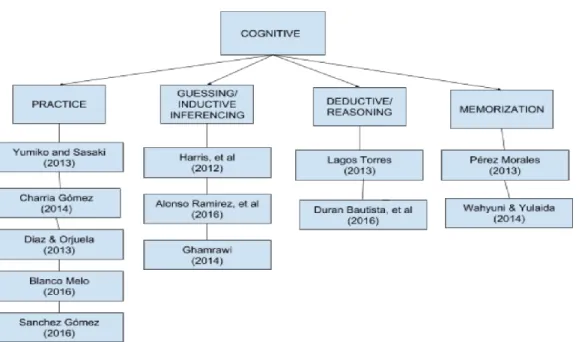
(39) 39. To have a better understanding of the different learning strategies found in the review, a significant part of the analysis based on Rubin’s taxonomy (Figure 2). Rubin made the distinction between strategies contributing directly to learning and those contributing indirectly to learning. Based on this, learning strategies classified into two categories: cognitive and metacognitive. Rubin identified six main cognitive learning strategies contributing directly to language learning, such as clarification, guessing, deductive/reasoning, practice, memorization and monitoring. Rubin claimed that cognitive learning strategies refer to the steps or operations used in learning or problem solving that require direct analysis, transformation, or synthesis of learning materials. (Figure 1) Each one refers to a specific process where the language learning was achieved.. While Metacognitive Learning Strategies can be stated as a term to express executive function, strategies which require planning for learning, thinking about the learning process as it is taking place, it is used to oversee, regulated or self-directed language learning. They involve various processes as planning, prioritizing, setting goals, and self-management. Figure 1. Rubin´s Taxonomy..
(40) 40. Source: adapted from Language Learning Strategies: A General Overview.. The studies included in the literature review contain strategies from each one of the groups named (Rubin, 1987). After classifying the obtained results and based on the chosen taxonomy, strategies divided into two groups: cognitive and metacognitive, finding an outstanding predominance in the first group as it shown in figure 3 and 4. Metacognitive strategies related to those strategies helping students to become aware of their learning processes, these strategies designed to help students to learn how to learn. This type of strategies includes organizing material, arranging schedule and evaluating tasks. It is worth.
(41) 41. mentioning that these types of strategies are not used in isolation, in other words this kind of strategies are used with cognitive strategies; the first step is to teach learners how to learn so they can choose the right cognitive strategy to learn. Rubin classified these strategies into three: self-management, planning and setting goals. Therefore, four papers classified in these types of strategies, the articles that focused on learner’s autonomy and the ones that focused on the ability to plan, organize and follow some steps to enhance their vocabulary. Figure 2. Research paper focused on Cognitive Strategies. Source: adapted from Language Learning Strategies: A General Overview. Figure 3. Research paper focused on Metacognitive Strategies..
(42) 42. Source: adapted from Language Learning Strategies: A General Overview.. According to the findings (figure 3), the majority of the strategies are focused on Practice, which is the first group within the cognitive strategies, where learners are directly involved in their own learning process and work systematically doing things for themselves. This way, students are more likely to retain what they have learnt while they use the same words and terms in different contexts and exercises. In the next section the structure of the different pieces of research, including the aim of the studies, are shown, as well as the positive impact and the strategies used by each researcher. (Appendix C) In the vast majority of the reports, the researchers emphasized the importance of motivation in learning and avoiding learning vocabulary in isolation. Yumiko and Sasaki showed a comparison between two strategies (e-picture and L1 glosses) through a web application. The results showed that participants who used E-picture strategy performed in a better way (Sasaki, 2013), which is significant as it helps students who are visually oriented to engage and recall easily the words they have practiced, As stated, “the more.
(43) 43. strongly you imagine… a situation, the more effectively it will stick in your mind for later recall” (Goll, 2004). Which illustrates that this type of strategy is effective since all the participants showed an increase in their vocabulary. On the other hand, the effective in the increase of vocabulary size was where the three learning strategies (mnemonics, verbal repetition and use of online dictionary) were implemented (Charria, 2014). However, the emphasis on the results were made in the use of an online dictionary in order to take advantage of technological resources, notwithstanding the learner's motivation towards technology, her study showed that this kind of strategies are not appropriate for young learners since some images could not be appropriate for their age. Additionally, her study makes clear that students get distracted for the vast amount of images and take longer to complete the activities. It may have been more appropriate to build a glossary bank in order to avoid distractions and it would be useful in moments when internet access is not possible. However, it is worth to mention that a training stage was implemented before starting the study, Charria (2014) affirms that “The results of the present research reinforce the fact that when learners are taught how to implement and use these strategies to learn new vocabulary while using a computer, an improvement in the size of learners’ vocabulary occurs.”(p55). This was significant as learners get involved in their own learning process. Díaz & Orjuela (2013), attempted to introduce participants to a method named '“Task Continuity Chain” which focus is Task Based Learning – Task-continuity – “chaining of activities” (Nunan, 1989, p.119), in which skills are acquired and practiced in one step and extended in succeeding steps. Through the tasks continuity chain systematic application, it was evident that most of the students improved their performance, especially when supported by parents, and when motivated to learn autonomously, using the tasks continuity chain as a continuum at home. As a result, this.
(44) 44. study showed that tasks based learning is useful as a strategy to foster comprehension, production, communication and reflection in their own learning. The tasks continuity chain, when implemented as a habit at home, had a positive learning effect, which could be applied as a self-access reinforcement continuum. Based on that, this study shows that language learning is fluent when the child is actively involved in the learning process as well; also, that it is the learner who does the learning and the teacher's role is to facilitate the learning process in a structured way (Orjuela, 2013). On the other hand, Blanco (2016) determines how multimodal technologies accompanied with vocabulary pre-reading activities affect the development of L2 A1 learners’ literal comprehension of animated stories. This way, the results obtained showed that the performance of the children in literal reading comprehension improved, and their positive perception about the use of multimodal technologies to learn English. Sanchez Gómez (2016) showed that motivation through photography based language learning activities fostered vocabulary learning. Students learnt vocabulary and were highly motivated because of the novelty and autonomy of producing and displaying their own learning materials with their educational community, these findings are crucial as they highlighted a significant factor in the learning process: motivation, which has a strong link with learning. Thornbury (2007) supports this idea; he claims that “strong motivation makes it possible that the learner spends more time on rehearsal and practice, which in the end will pay off in terms of memory. (p. 25) Based on this, it can be stated that the more engaged students become in their learning the better they will perform.. In the second group, the papers that were focused on guessing/inductive inference were Harris et al. (2012), Ghamrawi (2014), and Ramirez et al (2016). The first research conducted by.
(45) 45. Harris et al. used a word mapping strategy, which is a set of cognitive and behavioral steps that students can use to predict the meanings of unknown words. Moreover, doing so, suggests that students learn and remember the names of the steps. The strategy involves (a) Step 1 - breaking words into their morphemic parts (i.e., prefix, suffix, root); (b) Step 2 - attaching meaning to each word part; (c) Step 3 - making a prediction about the meaning of the unknown word based upon the meaning of each part; and (d) Step 4 - checking the dictionary for the definition. It is noteworthy to mention that this strategy helps students to understand the origin of words. Other authors showed that the results of the intervention enabled students to identify more word parts, and their meanings; additionally, to predict the meaning of more words than the VL and TO groups, however, there is a concern with this kind of approach as learning in isolation has showed great disadvantages in the learning process, a number of researchers have explored the effectiveness of this approach but little can be demonstrated (Monica L. Harris, 2012). The second research which was conducted by Ghamrawi (2014) is based on Gardner’s Intelligences; workshops were used to involve a variety of multiple intelligences activities; in which students should write sentences using keywords, order amounts using pictures, drawing predictions related to the topic, pantomime a song, work in groups, hunt for objects in the classroom, create stories and express their personal interest using drawings. Therefore, the researcher concluded that using MI strategies helped learners to retain the vocabulary longer which is significant to this research because one of the major problems that learners face is the ability to retain a great amount of words (Ghamrawi, 2014). It is worth noting that MI strategies addressed the differences among students helping them to learn and be aware of their learning process. However, the weakness with this strategy is that the increment of the size of vocabulary was not significant..
(46) 46. The use of board games, a strategy which allows students to practice words and expressions in order to create a communicative environment and a context where students had the chance to interact and use the target vocabulary, and in doing so, suggests that vocabulary learning implies more than just identifying the literal meaning of words. This understanding is pivotal because it is nothing to know a large amount of words if they do not know how or when to use them (Alonso, 2016). The researcher makes clear that interaction was significant for the study as it helped students to build communicative skills. As a result, this study showed that through games the learners are at ease when interacting and participating, which is significant in promoting collaborative learning. As illustrated by mentioned authors, who claims that real vocabulary, learning comes through its use and practice, in environments that facilitate the learners’ internalization and use of words (Nation, 2001).. In the third group; the papers were focused on deductive reasoning process in which a conclusion is based on the concordance of multiple premises that are generally assumed to be true, where it is possible to infer from the observed; Lagos Torres (2013) explored how reading short stories can provide useful pedagogical support for the enhancement of the vocabulary learning. Nevertheless, it is worth saying that the results showed students increased their vocabulary, so it was evident that short stories can be used as a tool to learn vocabulary instead of designing and memorizing decontextualized lists of words, which is significant because one of the initial concerns of this research was helping students to recall words and use them in context and thus it was demonstrated that reading with strategies that motivate the student to learn, their significant learning becomes visible. Whereas, Duran (2016) focused on measuring the impact of the implementation of a free voluntary reading program in a virtual environment on students’ active.
(47) 47. vocabulary use and immediate word retention, self-direction and reading habits based on incidental and intentional vocabulary learning strategy instruction. The results revealed that the study was moderately successful at improving vocabulary retention. However, it is worth to mention that the results also showed it was significantly effective at promoting self-directedness and reading habits. This could be useful in future studies, which focus on self-directedness and reading.. Finally, the third category in cognitive strategy was memorization which was focused on the premise of repetition creating mental linkages where students group, associate, elaborate and place new words into context; Perez Morales (2013) stated that a single episode of vocabulary instruction might not be enough for vocabulary learning, but intentional vocabulary learning and repeated encounters with the word can bring a better chance of retention. This was significant because according to the experience inside English classes, the more students are in constant contact with an expression or a word the more retention of this they would achieve and they will have a better chance of understanding. Furthermore, Schmitt (2008) stated that “words will have to be met in many different contexts in order to develop mastery of the different word knowledge types, and this entails a long-term recursive approach to vocabulary learning” (p341), which reinforces the idea of the necessity of having direct contact and continuous practice of words throughout different circumstances to reach the dominance of vocabulary.. Other researches such as Wahyuni & Yulaida (2014), had the objective of knowing whether the use of flashcards can improve the vocabulary mastery of population. The implementation of.
Figure
Documento similar
In order to answer research question number 5, that is to say, to what extent students with higher productive vocabulary knowledge acquire more vocabulary than those with
Also, It has vocabulary, some examples and exercises that will help the learner to understand the topic.. Keywords: EFL,verb
porpuses such as; reviewing vocabulary already checked or for introducing new vocabulary about food and drink and as a support for teaching how to order food in a
In relation to the learning strategies scales, EMI students have better learning strategies due to metacognitive self- regulation, time study management and effort regulation
In sum, metaphorical linguistic expressions may vary widely cross- culturally but many conceptual metaphors appear to be potentially universal or near-universal.. This
ABSTRACT: This study examined the effect of classifying vocabulary into parts of speech using Google Drive sheets in order to improve reading comprehension.. Participants were 20
• While undergraduate students in Saudi universities are expected to have desired English language skills in order to further advance in their specialized areas of study, writing
Almost all Neurobel variables have a strong association with the Peabody, indicating that vocabulary comprehension is strongly related to having good results in language
