TEACHERS’ BELIEFS AND PRACTICES TOWARDS ENGLISH LANGUAGE
METHODOLOGY & COMPLEMENTING TEACHING PROFILES AND THE 21ST
CENTURY SKILLS
CÉSAR DANIEL BARRAGÁN MALDONADO
Research Study to obtain a Masters in Foreign Language Teaching
Advisors: Lida Rincón & Carlos Martínez
UNIVERSIDAD PEDAGÓGICA NACIONAL
Table of Contents
ABSTRACT ... 1
INTRODUCTION ... 2
STATEMENT OF THE PROBLEM ... 6
FOCUS OF THE STUDY ... 16
GENERAL OBJECTIVE ... 17
Specific objectives ... 17
RESEARCH QUESTION ... 17
THEORETICAL FRAMEWORK ... 18
English as a Foreign Language ... 19
EFL Teaching Methodology ... 21
Beliefs ... 29
METHODOLOGICAL FRAMEWORK ... 41
Scientific Research Paradigm ... 41
Type of Study: Qualitative Study ... 42
Setting ... 43
Participants ... 45
Researcher’s Role ... 47
Data gathering tools and procedures ... 47
Questionnaire ... 48
Observations ... 54
Semi-structured interviews ... 57
Data Analysis Organization ... 59
Triangulation Process ... 61
RESULTS & ANALYSIS ... 63
Questionnaire ... 63
Observations ... 71
Class development - Presentation ... 71
Class development – Practice ... 73
Language Teaching Methodology ... 76
Regarding Individual Cases ... 83
Claire (Former Teacher) ... 83
Lorelei (Former Teacher) ... 98
Oliver (New Teacher)... 102
Jürgen (New Teacher) ... 107
Taylor (New Teacher) ... 111
PROFILES DISCUSSION ... 116
The Empathetic Teacher ... 116
The Musical Teacher ... 118
The Dynamic Teacher ... 120
CONCLUSIONS ... 122
LIMITATIONS ... 125
FURTHER RESEARCH ... 126
REFERENCES ... 127
APPENDIXES ... 134
Appendix 1 ... 134
Appendix 2 ... 137
Appendix 3 ... 138
Appendix 4 ... 140
Appendix 5 ... 142
Appendix 6 ... 143
Appendix 7 ... 145
Appendix 8 ... 146
Appendix 9 ... 148
Appendix 10 ... 150
Appendix 11 ... 152
Appendix 12 ... 154
Appendix 13 ... 156
Appendix 14 ... 158
List of Tables
Table 1. Time distribution and number of students ... 44
Table 2. Summary of participants ... 46
Table 3. Cronbach's Alpha Piloting Session ... 51
Table 4. Questionnaire Final Version ... 52
Table 5. Questionnaire General Results... 54
Table 6. Observation grid categories ... 57
Table 7. Interviews categories ... 59
Table 8. Language Learning Aptitude Results ... 63
Table 9. Language Learning Difficulty Results ... 65
Table 10. Language Teaching Methodology Results ... 66
Table 11. English Teaching Techniques ... 68
Table 12. Use of English and Language Skills Difficulty ... 69
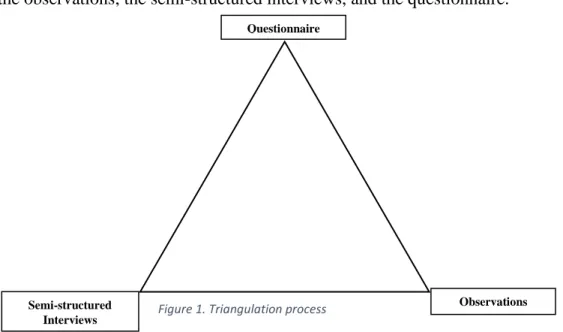
List of Figures Figure 1. Triangulation process ... 62
Figure 2. Presentation Tools Percentage of use ... 73
Figure 3. Practice Stage Exercises ... 74
Figure 4. Production Exercises Average per Class ... 76
Figure 5. Techniques used for clarifying doubts ... 77
Figure 6. Informal Assessment procedures ... 78
Figure 7. Error Correction Focus ... 79
Figure 8. Average per Class of Other Class Development Aspects ... 81
1
ABSTRACT
This research study aims at identifying the relation between EFL teachers’ practices and
their beliefs towards teaching methodology in the first and third levels of English at American
School Way institute, taking into account the effect of these beliefs in EFL classes. This study is
intended to identify and describe the EFL teachers’ practices in the classes and to establish the
relation between the participant teachers’ beliefs and practices and how those beliefs may affect
time management, use of resources, and teaching strategies in EFL classes according to the
assigned level. The researcher draws on relevant literature to develop a theoretical framework
which includes English as a Foreign Language, English teaching methodology and beliefs. It also
draws on data gathered through an adapted questionnaire, a semi-structured interview, and some
classroom observations to the six participant teachers. Findings showed that the students’ level
did not play a relevant role on the teachers’ practice. Each participant teacher was a completely
interesting teaching world with some beliefs that matched their practices and others that differed
from it. This research study made the researcher conscious about other interesting aspects related
to the teaching beliefs and how relevant the teachers’ academic background and the impact it had
on their beliefs and their practice was
2
INTRODUCTION
This research presents a description and comparison between the teachers’ beliefs and
their practices at a language institute and proposes some teaching profiles that are connected to
some of the 21st century skills. The idea to carry out this research study came from the
researcher’s personal experience when observing the class development of some teachers, the
training and re-training of the teachers at the language institute where he worked, also from his
own practice as an English teacher, and finally, for the need of developing a research study that
complements the existing literature related to EFL beliefs. All these elements combined lead the
researcher to think there can be connections established between what teachers believe, their
learning background, their professional training, their teaching experience, and the
methodologies sometimes established by institutions. This idea is deeply developed on the
statement of the problem and the explanation of the process that was followed and that allow the
researcher to establish a set of objectives and a research question.
The data were obtained through the use and implementation of three different instruments
that allowed the researcher to triangulate, verify and complement the information obtained from
each of the instruments. Using an adapted questionnaire, a first approach to the teachers’ beliefs
was obtained, this was complemented with a semi-structured interview done to the participant
teachers. These interviews allowed the researcher to have a closer and more complete
perspective about the teachers’ beliefs regarding the L2 teaching methodology. Finally, a set of
class observations was done in order to get a closer view about the teachers’ practices.
Postliminary, the information gathered was organized and analyzed using some categories
established by the researcher. With the aim of presenting the whole process done in this research
3
In the first chapter, the statement of the problem is presented from two perspectives, the
specialized literature and the real context. The problematic situation revolves around the
similarities and differences between the teachers’ beliefs and their practice and the way they are
connected or not, to an established methodology. The previous aspects lead the researcher to
define the research question and the objectives that aimed at identifying and describing the EFL
teachers’ practices related to their beliefs towards teaching methodology in the first and third
levels of English at American School Way institute, taking into account how these beliefs affect
EFL classes. In terms of the specialized literature, the researcher presents the perspective and
topics of study when talking about L2 teachers’ beliefs and the historical evolution on this field
of study. Among the different studies, it was possible to find the following ones: Brown (1969)
and McDonald (1976); Johnson (1992) and Wilson, Konopak and Readence (1992); Richardson
and Lloyd (1991) and Ng and Farrell (2003); Farrell & Lim (2005), Borg (2011), Gao (2014) and
Diaz Larenas, Alarcón Hernandez, and Ortiz Navarrete (2015). These background studies present
an international, national and local perspective through different periods of time about the study
of beliefs.
In the second chapter, the theoretical framework is presented together with the main
concepts related to English as a foreign language, EFL teaching methodology, teachers’ practices
and beliefs, this last concept is first presented from a general perspective and then it is connected
to the field of languages. These four concepts are the axis of this research study. Related to
English as a Foreign Language, the authors that defined this concept are Campbell (1996); León
Manjarres (2006); Gunderson, D'Silva, and Murphy (2009) and Wright (2010). In terms of EFL
teaching methodology a general review of the language teaching methodologies is presented
4
Marsh (2002), are the key authors for this second concept. Thirdly, regarding the concept of
Teachers’ practices Wang, Haertel, and Herbert (1993); Scheerens and Bosker (1999) Cohen,
Manion, Morrison, and Wyse, (2010) provide useful insights about this concept.
Finally, regarding the key concept of Beliefs, Goodenough (1963), Green (1971),
Eisenhart, Shrum, Harding, and Cuthbert (1988), Johnson (1994) and Borg (2011), are the key
authors who conceptualized this one. In addition, on this last concept different international and
national studies are presented.
In the third chapter, the methodological framework is presented. First, this study follows
a qualitative approach to research with some strategies taken from the quantitative approach to
analyze the data. In addition, the research paradigm that guided the study is the interpretivism
with some aspects taken from the pragmatic paradigm, which are explained in more detail in this
chapter. Second, this study was carried out at ‘North Branch’ of a well-known English academy,
American School Way, where six language teachers were chosen following the criteria of two
features as follows: A1 and B1 groups assigned and time with the company. These six cases
were analyzed deeply in order to accomplish the objectives established for this study. Finally, a
complete description of the data gathering tools, the procedures followed in order to obtain the
information from the participants, and the categories assigned to each of the instruments are
presented. The description and definition of the triangulation process is also included in this
chapter.
In the fourth chapter, the corresponding results and analysis of the data gathered taken
from the different instruments are presented following two specific lines of analysis. The first
one comes from a quantitative perspective from the results obtained on the questionnaire and the
5
the data obtained on the above-mentioned instruments. The second line of analysis follows a
qualitative approach that aimed at providing a deep and detailed analysis for each of the
participant teachers combining all the information obtained from the different instruments. This
analytical process led to the presentation of three teaching profiles that could complement the
teaching profiles presented by Harden and Crosby (2000), and connect them with the 21st century
skills, which is one of the new tendencies presented on teaching. Lastly, in the fifth chapter, the
conclusions from the study are developed. The aim of these conclusions is to answer the
objectives established in the first chapter. Finally, the researcher presents also the limitations that
6
STATEMENT OF THE PROBLEM
The field of teachers’ beliefs has been studied for decades. Different perspectives and
approaches have been taken along the way. It can be said that there have been three important
moments on this field of research as stated by Gao (2014) on his historical review of language
teachers’ beliefs and practices. The first moment corresponds to the studies done between the
1960s and 1980s, the second moment was between the 1990s and the 2000s, and finally, the third
moment which corresponds to the studies carried after the 2000s.
During the first moment on this field, it can be said that the researchers agreed on the fact
that there was a unidirectional relationship between teachers’ behaviors and students’
achievements, studies such as Brown (1969) and McDonald (1976) are examples of this first
moment of teachers’ beliefs research. Between the 1990s and 2000s, there were two new
perspectives towards the research related to teachers’ beliefs. On the one hand, there were studies
such as Johnson (1992) and Wilson, Konopak, and Readence (1992) where it is stated that there
is a consistent relationship between teachers’ beliefs and practices. On the other hand, it can be
found a perspective where the connection between teachers’ beliefs and instruction is
inconsistent, studies such as Richardson and Lloyd (1991) and Ng and Farrell (2003) are
researches that followed this line of thought. Finally, there is a third moment where researchers
centered their studies on exploring language teachers’ beliefs and practices from a sociocultural
perspective. This means to regard the relationship between teachers’ beliefs and actual teaching,
as an interactive and complex one. Two research studies with this perspective are Farrell and
Lim (2005) and Borg (2011).
Even though the research on the topic of teachers’ beliefs has been studied for decades,
7
studies on teachers’ beliefs have been carried out with a limited number of research methods.
Therefore, more various and in-depth approaches are highly suggested. Instead of using an
inventory of beliefs and case studies, more reflection and interpretative approaches should be
taken to address the issues in the field of teachers’ beliefs and practices to get a deeper
understanding of these aspects that impact English language learning and teaching.
After having presented a general overview on how language teachers’ beliefs have been
studied, it is important to introduce a setting where language teachers’ beliefs could be deeply
described and discussed. This study took place at a language institute called American School
Way. It was founded in 2002 in Bogota. The institute aims at training students, so they can be
proficient and competent in a foreign language. Therefore, students can integrate and actively
participate in the economic and cultural fields of the context they are part of. According to the
institute’s mission, a flexible and innovative educative project is implemented to develop equity,
productivity, and competence in our society.
The focus of the study was the teachers of American School Way, particularly the ones
who work in the North and Downtown branches. By August 2018, there were around 130
teachers; more than 50% are EFL teachers according to the information provided by the human
resources department. According to the company’s document D048-25 ‘Perfil Docente’, the
profile required for new teachers is stated and divided into three components: professional
background, experience, and language proficiency. Teachers ought to have a degree on foreign
language teaching; it is expected that they have more than two-year experience on language
teaching; and an official language proficiency test certifying B2 or C1 is either required or asked
8
According to the data base used by the Human Resource office of the franchise at least 80
to 90 percent of teachers who were currently working there fulfill the profile requested by the
company. This meant that they were licensed teachers and in addition, they have an international
exam that certifies at least a B2 on English or French.
It is important to present some methodological and special features that characterize this
setting. First of all, the English classes can only have a maximum of six students per class, these
students should be on the same level (book), but they do not need to be on the same class (pages,
video, skills assessment, speaking test). According to the institute’s philosophy each class should
be divided into three important sections: review or reinforcement, presentation of new
information, and advancement.
Secondly, the English course is divided into six levels that correspond to A1-C1,
according to the MCER language levels. Each level is split into seventy to eighty classes, which
include different types of activities. Most of the classes are regular ones in which the students
work on a particular topic depending on their planner: ‘Video’ classes in which the students will
watch a video and will respond to a set of questions; ‘Skills assessment’ & ‘Speaking Test’
classes in which students will be tested on their ability to perform role play activities by using
the contents of the corresponding unit; and ‘Immersion’ classes where the students will improve
their different language skills. Besides, there are other types of classes in which students work
pages from the book, these pages can be about a grammar topic, or about reading and vocabulary
related to the general topic for the unit. It is important to clarify that even though there is a fixed
methodology established to consider real contexts in the development of the classes, it will also
9
In the position that I had in this company at the time of the research, some of my duties
were to be in charge of observing classes, training new teachers, re-training the ones who have
been in the company for a while, and I should always be aware about changes in procedures. For
example, the ‘speaking test’ and ‘skills assessment’ formats, and the place where the students
need to take these exams was one of those changes in procedures. Thanks to the responsibilities,
I was able to identify different aspects related to language teaching that are interesting, such as
how a specific institutional methodology employed for the development of a class can impact the
teacher’s performance, or how teachers’ beliefs can be influenced by the teacher’s profile the
company aims to establish or its methodology itself.
One of the aspects that called the author’s attention the most was teachers’ beliefs and
their practices in the classroom. This was identified thanks to a set of questions asked in a
re-training carried out in December 2017 and along different re-trainings in 2018, and systematic
observations that were carried out in different months by the end of 2017, and in June and July in
2018. To begin with, during the trainings and re-trainings that teachers have received it was
possible to identify some aspects related to their beliefs, image and role as teachers. The
researcher designed a set of four questions that was asked to almost 120 teachers, the questions
were designed with the aim of approaching to their beliefs about language teaching, English
learners, classroom management, among others. The questions that were asked were the
following: 1) why did you become a teacher? 2) Think about the best teacher you had. Why was
(s)he the best teacher? 3) Which student do you remember the most? Why? 4) How are you
making a difference on your students right now?
Each of these questions focused on a topic. The first question was related to the
10
to the features of what a great or excellent teacher has. The third question allowed the reseacher
to know a little about the teachers’ vision related to the students, and the features they consider
the most important (learning styles, students’ knowledge, students’ process, among others).
Finally, the fourth question was more into getting to know the didactics and their way of
teaching.
As a first step, the answers given by teachers to the first question ‘why did you become a
teacher?’ were grouped into some categories based on the teachers’ role proposed by Harden and
Crosby (2000) which presented some teachers’ roles and their corresponding features. The roles
can be grouped into six areas: the teacher as assessor; the teacher as planner; the teacher as
resource developer; the teacher as information provider; the teacher as role model and the teacher
as facilitator.
Harden and Crosby (2000) characterized each of the roles as follows: the teacher as
assessor is someone who has the role of passing judgement on the student by ensuring that
assessment of students is valid, open, fair, and congruent with the course objectives. The teacher
as planner is someone who tackles issues such as the needs that the curriculum should meet, the
expected learning outcomes, the content to be included in the curriculum, the organization of the
content, among others. Finally, the teacher as resource developer is someone who could be
considered an activity designer, a creator of new learning environments. Even though these roles
are features of teachers in any field of knowledge, none of the answers provided by the teachers
on the questionnaire can be organized under these roles as they were not explicitly mentioned or
addressed. Each of the answers provided by teachers were classified into the main features or
ideas they highlighted and then grouped according to the six roles, however, none of the answers
11
Regarding the other three roles previously mentioned, most of the answers obtained could
be grouped under those. Firstly, in the information provider role we can find two sub-roles, the
lecturer and the practical teacher. 18% of the teachers’ answers could be grouped under the
sub-role as lecturer, since one of the reasons for becoming a teacher was to share their knowledge
with others. Besides, 29% of the teachers said they like the language and they feel passion when
teaching. However, none of the answers could be grouped under the practical teacher label since
according to the authors on this role the teacher selects, organizes and delivers information, but
none of the asked teachers answered in this sense.
Secondly, in the role of teacher as role model, 21% of the teachers’ answers could be
grouped under this label since they explicitly stated that they wanted to be role models for their
students, or/and they wanted to be guides for new generations by helping the students and doing
something for the people. In addition, it was found that around 8% of the teachers stated that
they dreamt about becoming teachers or that they were motivated by either a relative or a teacher
they got to know during their learning process, and therefore decided to pursue this career. As
stated by Harden & Crosby (2000) students learn not just from what their teachers say but from
what they do in their practice and the knowledge, skills and attitudes they exhibit.
Last but not least, under the role of teacher as facilitator, 18% of the teachers stated their
reasons for becoming teachers were to change students’ lives and therefore the country, impact
students’ lives, and construct knowledge with them, so they could find better job opportunities.
Finally, 6% of the answers could not be grouped under any of these roles because teachers stated
that they became teachers since they did not have any other option, or it was an easy job
12
Regarding the second question ‘Think about the best teacher you had. Why was (s)he the
best teacher?’ the answers were classified into two big groups, attitudes, and pedagogy. In
addition, attitudes towards the class, the student, and the society were considered in this first
group. To begin with about 24% of the teachers characterized the best teacher they had had as
someone who was very passionate about teaching and who turned the class into a meaningful
one. Related to attitudes towards the students, 36% of the teachers highlighted features as
patience, love, kindness, strictness, and politeness as key characteristics of the teachers they
remembered the most. Furthermore, 12% of the answers showed the best teacher they had had
was more a friend than a teacher, and someone who cared about their learning process and got
the best out of them thanks to the motivation. In addition, 28% of the teachers focused their
answers on the methodology and development of the class, by highlighting aspects like dynamic
classes, going beyond the topics, connecting the topic to their realities, connecting different
subjects, and relating their likes to the topic of the class, as key features of the best teacher they
had.
It is also important to present which responses teachers gave to the third question ‘Which
student do you remember the most? Why?’. The answers given by the teachers were classified
into two categories, one centered on the positive aspects of the student or the experience, and the
other centered on the negative aspects. Most of the responses that teachers provided were closer
to a positive feeling towards the student and the class with about 91% of the answers
highlighting these aspects. Features such as curiosity, willingness and eagerness to learn,
improvement throughout the classes, feeling challenged by a student, hard-working students, the
best student in the class, and students that got great results at the end of the process, were the
13
answers collected from teachers, only around 9% of these were centered on negative aspects.
Features as rudeness, hatred, misbehavior, lack of interest, or learning difficulties could be
grouped under the negative label.
Finally, related to the answers obtained in the fourth question ‘How are you making a
difference on your students right now?’ the answers were grouped into three main categories:
students’ needs, didactics & methodology, and classroom vision. 60% of the teachers answered
that the way to make a difference in their classes is by caring about their students’ needs and
relating the class topics to their reality, so at the end they are closer to achieve their dreams and
goals. 27% of the teachers answered that the way they make a difference is by having dynamic
classes with creative activities that connect and engage the students with the class, and that
encourages them to learn more every day. Finally, 13% of the teachers answered they are making
a difference on their students by creating a safe, nice, and comfortable environment where
students can enjoy learning.
As it was possible to accomplish by checking these answers, the reseaecher was able to
have a first approach to teachers’ beliefs. Beliefs about their role in the classroom, beliefs about
their students, beliefs about the learning process and about the classroom were identified. These
beliefs where then contrasted with the class observations. These observations were carried as a
company procedure and the relevant aspects of the observations were written as field notes on a
grid, we are asked to follow1. The grid used to assess the teachers’ classes can be grouped into
aspects related purely to methodology, others to language proficiency, and some even to
14
customer service. However, it was possible to identify that there was no room on this evaluation
format to see or identify teachers’ beliefs.
During these observations some aspects caught the researcher’s attention, such as the
students’ participation during the class. It was interesting to see how students’ participation and
interaction were impacted by the teacher talk-time and the type of activities teachers use in the
classroom to engage them (some of the activities came from the material used in class and other
from the teachers’ own planning). This first aspect can be connected to one of the roles
mentioned before, the information provider, since the classes showed a teacher-centered
development of the class. In addition, this “students’ participation” aspect is also connected to
the fourth question of the questionnaire, ‘How are you making a difference on your students right
now?’ because the answers provided by teachers showed how they are willing to have
meaningful activities, dynamic classes, and caring about the students’ needs. In that way, by
contrasting both the questionnaire and the observations, it can be said that in some cases their
practice differed from what was said on the questionnaire. Having an established methodology
might impact aspects mentioned by the teachers such as having meaningful activities and
focusing on students’ needs.
It was also possible to notice the different students’ learning strategies, some were more
into taking notes, others into listening to the teachers’ explanation, other ones related to visual
aids to learn new vocabulary, among others. This aspect could be contrasted with two of the
preliminary questionnaire questions, think about the best teacher you had. Why was (s)he the
best teacher? and which student do you remember the most? Why? By observing their classes, it
was possible to contrast the features teachers have and the ones they mentioned about the best
15
learning strategies of students can be contrasted with the other question in the sense that it lets us
see if the reason for remembering a student is because the way they learn a foreign language, the
way the students behaved in their classes or even the commitment they showed during the
classes.
Finally, the fixed and specific methodology used in the classes allowed the researcher to
notice teachers were sometimes out of time and opportunities to work all the skills during the
class. As language teachers, we are aware that learning a foreign language implies several
aspects that include not only the grammatical features but also the sociocultural characteristics.
This implies a complementary work where reading, writing, speaking, listening, and grammatical
aspects are all as important and should be worked as a whole. Therefore, with this aspect we can
contrast the teachers’ practice and their beliefs about teaching methodology towards language
learning mediated by different factors such as an established methodology by the company, the
level and number of students, the time they must develop a class, among others. As stated by
Diaz, Alarcón, and Ortiz (2015) teachers’ beliefs have been a fascinating topic for researchers for
the amount of input they can provide for reflection and the improvement of the teaching and
learning of English. Hence, there is an opportunity to deeply describe and analyze how teachers’
practices are related to their beliefs about the teaching methodology towards the first and third
level of English at the institute, and how these beliefs might impact the development of their
16
FOCUS OF THE STUDY
By taking all the issues mentioned before, it was important to think about a deep
description related to the way teachers develop the classes and how their practice is affected by
their beliefs. That is the reason why a conscious, informative and complete identification and
description of the relation between the teachers’ beliefs and the EFL teachers’ methodology is
done. In addition, it is important to state the objectives and research questions that guided this
17
GENERAL OBJECTIVE
To identify the relation between EFL teachers’ practices and their beliefs towards
teaching methodology in the first and third levels of English at American School Way institute,
taking into account the way these beliefs might affect the EFL classes.
Specific objectives
*To identify and describe the EFL teachers’ practices in the classes of A1 and B1 at
American School Way.
* To identify and describe the EFL teachers’ beliefs who are in charge of A1 and B1
levels at the institute towards the institutionally established teaching methodology.
*To establish the relation between the participant teachers’ beliefs and practices and how
those beliefs may affect time management, use of resources, and teaching strategies in EFL
classes according to the assigned level.
RESEARCH QUESTION
The research question that guided this study was: How are the EFL teachers’ practices
related to their beliefs towards teaching methodology in the first and third levels of English at
18
THEORETICAL FRAMEWORK
This section introduces the main concepts that allowed the researcher to develop and
accomplish the objective of the research study that aims at identifying the relation between EFL
teachers’ practices and their beliefs towards teaching methodology in the first and third levels of
English at American School Way institute, considering the effect of these beliefs in EFL classes.
There are four main concepts that weave the most important information of this research study.
The first concept is English as a Foreign Language (EFL); the second concept is EFL teaching
methodology, the third concept is teacher’s practices, and the fourth concept is beliefs in English
Language Teaching, a concept which is the core of this research study.
Regarding the concept of EFL, it was chosen because in Colombia this is the vision of the
language learning that applies to our context. In Colombia, English plays a role of foreign
language since it is not the official or main language of the country. In the same line of thought,
it is important to talk about the different methodologies that have been used to teach English as a
foreign language along time. This concept is relevant because of the importance that it has as one
of the variables for the analysis of this proposal, and it is one of the elements of description and
deep interpretation. It is also necessary to keep in mind that when the concept methodology is
presented, aspects such as: resources, time management, teaching strategies, assessment, among
others are included here. By having these concepts clear, it allows the researcher to establish
possible relations between the teachers’ practices and their beliefs. Finally, ‘beliefs in English
Language Teaching’ is the key concept of this study because there is a direct relation between
this concept and the objectives established by this study, since it aims at identifying and
describing the EFL teachers’ beliefs towards the teaching methodology. In addition, there have
19
of the language (language skills, assessment, learning, among others), but there is a need to carry
out more studies in the Colombian context regarding beliefs and language teaching methodology
in general.
English as a Foreign Language
To begin with, this study presents the difference from a theoretical perspective about two
of the visions regarding English learning. English as a second language (ESL) and English as a
foreign language (EFL). It is important to define and develop the concept of English as a Foreign
Language and contrast it with the national policies that are implemented in the country, since
there is a big difference in terms of both concepts. According to the Cambridge Online
Dictionary (n.d.), English as a foreign language is “English as taught to people whose main
language is not English and who live in a country where English is not the official or main
language”. In addition, according to the Collins Online Dictionary (n.d.), it is defined as “the
practice and theory of learning and teaching English for use in countries where it is not an
official medium”. Taking these definitions into account, we can say this is the English learning
perspective that applies for the Colombian context, the place where this study was carried out.
However, most of the national policies about English education in Colombia point to a
view of English as a Second Language and to Bilingualism2. Therefore, it is necessary to present
the main feature that makes ESL and EFL differ from one another. According to Gunderson,
D'Silva, and Murphy (2009), ESL is based on the premise that students have access to English
20
models and English is the language of the community, while EFL is usually learned in
environments where English is not the language of the community. On the EFL field, language
teachers have the difficult task of finding access to and providing their students with English
models.
In addition, even though some of the methods and approaches used for teaching ESL and
EFL are the same, they do differ greatly because of the context where they are applied, the
quality of input that students receive, and even the type of materials teachers have access to
teach. It can be said that the above-mentioned aspects might have an impact on the students’
learning process. Methods of learning English are highly variable depending on the students’
level of English proficiency and the manner and setting in which they are taught, which can
range from formal classes at schools, private classes to self-directed study at home. According to
Wright (2010) regarding the classroom materials, in some cases, they are provided in a mixture
of English and the students’ native language. In other cases, they are always in English, but the
vocabulary, grammar, and context clues may be modified to be easily comprehended by students
with varying levels of comprehension. Furthermore, Wright (2010) also considers that adapting
comprehension, insight-oriented repetitions and recasts are some of the methods used in
teachers’ training. However, the author states that the associated language habits and reference
points of the host country are not completely transferred through these programs without proper
cultural immersion.
The major engines that influence the language are the United States and the United
Kingdom and they both have assimilated the language differently (Campbell, 1996). They differ
in expressions and usage, but there are more accents and types of English that nowadays have
21
English is taught all over the world. In countries where English is not usually a native language,
there are different purposes for learning English. One is educational programs for students who
want to move to English-speaking countries, other programs are for students who do not intend
to move but who want to understand English content for the purposes of education or
entertainment, and others related to specific requirements at work or for conducting international
business (León Manjarres, 2006). This study is carried out in a context where the population is
variable and has different goals in mind, this means that the English program works for diverse
students. The population starts with people who are 12 and ranges in different backgrounds,
school students, university students, professional in different areas, unemployed, among other
people (American School Way, 2017)
As it was stated before, the methodologies for English differ based on the vision of the
language. Therefore, the one that is used on this study is English as Foreign Language (EFL),
even though the country is applying policies that talk about bilingualism this context leads us to
think about an EFL context. Taking this into account, it is important to present the different and
most famous methodologies that have been used for teaching English. The following concept is
presented from the view of different authors and their approaches and perspectives.
EFL Teaching Methodology
After having introduced the first concept and clarified its main features, it is necessary to
move on with a key aspect of EFL, and this is the EFL teaching methodology. Along history,
different methodologies towards teaching a foreign language have been developed and applied in
the English classroom all over the world. Different authors have presented these methodologies
and have grouped them in different ways. Therefore, it is important to highlight from different
22
To begin with, one key aspect about the EFL teaching methodology is the approach
towards the language. An approach is a way of looking at teaching and learning. Underlying any
language teaching approach is a theoretical view of what language is, and of how it can be learnt.
An approach gives rise to methods, the way of teaching something, which use classroom
activities or techniques to help learners learn (British Council, 2008).
Some authors developed and characterized these approaches. One of them, Rivers (1981)
gathers and summarizes the information regarding EFL methodology by presenting two
approaches, that in general terms lead the path of EFL teaching up to the year 1980. These
approaches were the formalist and the activist, each of these approaches considered some aspects
of the language in a different way. On the one hand, the formalist approach relates to the
deductive approach while the activist approach relies on the inductive approach. On the other
hand, in the formalist approach the grammatical aspects of the language are worked from a
detail-centered perspective, while on the activist side it is worked from a functional perspective.
Last but not least, while the formalist centers their attention on the writing and reading skills, the
activists focuses on the speaking skill. Finally, on the formalist approach the classroom has a
passive attitude and it is focused on language teaching, whereas the activist approach has an
active attitude in the classroom and centers its attention on language learning.
After checking these two approaches, it is also important to mention other approaches
such as the natural approach, the communicative approach, and the intercultural approach. Each
of these approaches has its own key aspects. The natural approach emphasizes on exposure, or
input, rather than practice where the language is viewed as a vehicle for communicating
23
hypothesis; the monitor hypothesis; the natural order hypothesis; the input hypothesis; and the
affective filter hypothesis (Richards & Rodgers, 1999).
Regarding the communicative approach, it can be said that it aims at improving
interaction and communication by developing what Hymes (1972) referred to as ‘communicative
competence’. On this approach language is seen as communication rather than just grammatical
and structural features (Richards & Rodgers, 1999). Finally, in terms of the intercultural
approach, it can be said that its goal is to train learners to be ‘diplomats’, this means they should
be able to view different cultures from a perspective of informed understanding (Corbett, 2003).
After visiting the website of different language institutions in Bogota3, and checking the
methodological aspects each one of them offers in their classes, it can be said these three
approaches are the ones considered on this study, since they are the most commonly used by
language institutions to develop their classes. Even though these are some of the approaches seen
in the EFL classroom since the 80’s and still evidenced and applied, it is possible to see some of
these traits of the above-mentioned approaches in the EFL classes almost forty years later
(Assalahi, 2013; Liao, 2006; Furuhata, 1999).
After having introduced the main aspects of the approaches that influence and guide the
way up to a point in the foreign language teaching field, and which became, as it is stated by the
British Council, an approach is the starting point for developing a methodology (British Council,
2008). Before starting to develop and presenting some of the most well-known teaching
methodologies and their most important traits presented by different authors, it is necessary to
define the concept of ‘methodology’ since it is a key concept for the analysis on this research as
3 For more information about the language institutions, you can visit the following websites: https://www.britishcouncil.co/ingles;
https://www.berlitz.com.co/; https://www.canadiancollege.edu.co/; https://www.colombobogota.edu.co/; https://wse.edu.co/;
24
it was mentioned before. A methodology is a system of practices and procedures that a teacher
uses to teach. It will be based on beliefs about the nature of language, and how it is learnt, in
other words the ‘approach’ (British Council, 2015). It can also be defined as stated by Westwood
(2008):
a set of principles, procedures or strategies to be implemented by teachers to achieve
desired learning in students. These principles and procedures are determined partly by the
nature of the subject matter to be taught, and partly by our beliefs or theories about how
students learn (Westwood, 2008, p. V)
To continue with the development of this concept, it is necessary to see the main features
of the most well-known methodologies referenced by authors such as: Larsen-Freeman (2000),
Richards & Rodgers (1999), Harmer (2001), and Marsh (2002). These authors present the
following EFL teaching methodologies: grammar-translation method, direct method,
audio-lingual method, the silent way method, suggestopedia method, community language learning,
total physical response, task-based learning, communicative language teaching, and Content and
Language Integrated Learning. Each of these methodologies has its own set of features for
developing a class, and some of them are presented as follows.
To begin with, the grammar-translation method has been used for many years all over the
world, and its main goal is to help students read and appreciate foreign language literature by
working mainly on vocabulary and grammar of the corresponding target language. It views
language learning as consisting of little more than memorizing rules and facts in order to
understand and manipulate the morphology and syntax of the foreign language.
(Larsen-Freeman, 2000; Richards & Rodgers, 1999). This method goes in the opposite direction of the
25
in the target language through the use of tools such as demonstrations and visual aids. Teachers
help learners to think and communicate in the target language and here the students’ role is less
passive than in the Grammar-Translation Method, since both teachers and the students are more
like partners in the teaching/learning process. Another methodology that can be a little
teacher-centered is the audio-lingual method, which according to Richards and Rodgers (1999) (see also
Larsen-Freeman, 2000; Harmer,2001) aims at preparing students to be able to use the target
language communicatively by forming new habits and overlearning the target language, so they
can use it automatically without stopping to think. The teacher’s role is the one of role model,
teachers provide their students with a good model for imitation while students follow their
directions and respond fast and accurately. However, language is de-contextualized and carries
little communicative function, but still habit-formation drills have remained popular among
teachers and students.
In addition, it is also possible to find two methodologies that took elements from
psychology and applied them to the language learning process. The suggestopedia method
according to Richards and Rodgers (1999) (see also Larsen-Freeman, 2000; Harmer,2001) it
aims at removing the psychological barriers learners bring to the classroom by using techniques
to activate the 'paraconscious' part of the mind, all this in order to obtain better learning results.
On this methodology the teachers’ role is to be the authority in the classroom and students must
trust and respect the teacher considering that students will retain information better from
someone in whom they have confidence, and who suggests how easy it will be for them to
succeed. The other one is the total physical response (TPR), according to Richards and Rodgers
(1999) (see also Larsen-Freeman, 2000; Harmer,2001) this methodology is built around the
26
which holds that the more often or the more intensively a memory connection is traced, the
stronger the memory association will be and the more likely it will be recalled. On TPR the
teachers’ role is more like of a director, since they direct all students’ behavior, and students are
imitators of their nonverbal modelling.
Even though, the abovementioned methodologies tend to be teacher-centered, some
methodologies are more student-centered and move towards a more communicative approach to
learning. To begin with, moving from a role model teacher, it is possible to find another
teacher’s role in the silent way method. According to Richards and Rodgers (1999) (see also
Larsen-Freeman, 2000; Harmer,2001) its main goal is making students use the language to
express their own thoughts, perceptions, and feelings. The teacher only provides the students
with what they need to learn, s/he relies on what students already know and gives them what is
missing. This methodology sees learning as a problem-solving, creative, discovering activity, in
which the learner is a principal actor rather than a bench-bound listener.
Another methodology that has a student-centered perspective is the community language
teaching. According to Richards and Rodgers (1999) (see also Larsen-Freeman, 2000;
Harmer,2001) on this methodology, students learn how to use the target language
communicatively, they learn about their own learning, and also how to learn from one another.
The teacher understands and supports students in their struggles to master the target language. It
advocates a holistic approach to language learning, since human learning is both cognitive and
affective. On the same line of thought, regarding the communicative approach, there is the
communicative language Teaching where the goal is to enable students to communicate in the
target language. In order to do this, students need to be able to manage the process of negotiating
27
s/he is in charge of establishing situations likely to promote communication by using authentic
materials and the activities are often carried out by students in small groups (Larsen-Freeman
,2000; Harmer, 2001).
Finally, there are two methodologies that take English beyond the regular class and use it
to achieve tasks or learn other subjects, in which English is considered a mean rather than an
end. The first one is the task-based learning, according to Harmer (2001) in this method students
are presented with a task they have to perform or a problem they have to solve. Students are
presented the language that is used and are corrected about their performance only when the task
has been completed. Task-based learning implies a shift away from some traditional teacher
roles. Tasks are used in language teaching, in some cases as the basis of language and in other
cases as one of its components. The other methodology is the Content and language integrated
learning (CLIL) that is defined by Marsh (2002) as a dual-focused educational context where an
additional language, not usually the first language of the learners involved, is used as a medium
in the teaching and learning of non-language content. It is dual-focused because whereas
attention may be predominantly on either subject-specific content or language, both are always
accommodated. It is also known as ‘Content Based Instruction’. All the methodologies
mentioned above can still be found in some of the language institutions and schools in Colombia
as it was mentioned before.
As presented by Usma (2009) his study explored the connection that exists between
economic, political, and cultural globalization processes and recent education and language
reforms in Colombia. The author attempted to demonstrate that the educational policies in our
country do not necessarily represent a real benefit for the majority of the population, but, instead,
28
plan for the improvement of language teaching and learning in Colombia in a way that considers
local priorities of economic development, respects local knowledge and culture, and accounts for
a systemic and fundamental improvement of the public system based on the dissimilar conditions
that affect schools, teachers, and students in both the private and the public sectors in the
country. Even though, this study focused mainly on the educational aspects of public and private
it allowed the researcher to once again identify the need to expand language reseach studies in
other context where English is also taught.
After having presented some of the most well-known methodologies (to know other
relevant aspects of these methodologies see appendix 3) and one study that presented a general
view of how English is managed in Colombia, it is important to define and present the most
relevant aspects related to teachers’ practices.
Teachers’ Practices
‘Teachers’ practices’ is a concept that is directly connected to the previous ones since this
concept is the way in which the theoretical aspects are applied in the real learning context.
Before presenting the definition that is used on this study it is necessary to clarify there are
different ways of understanding this concept. To begin with, some literature and sources
understand the concept of teachers’ practice as the part of an education degree in which students
perform supervised teaching at a school (Finlay, 2018) or as the instruction of a subject that takes
place in a real classroom environment (Incikabi & Kacar, 2017), but the definition that is
consider for this study is the one present by Hunter and Thurber (2018), which one of the
keywords of their study was teachers’ practice, and it is defined as the ways in which faculty
understand and implement instruction. In addition, teaching practices generally reflect beliefs
29
Moreover, as Wang, Haertel, & Herbert (1993) stated teachers’ practices are related to
effective classroom learning and student outcomes, and as presented by Cohen, Manion,
Morrison, & Wyse (2010) these practice will differ on each teacher based not only on the type of
learning of the students but also on the instructional strategies teachers use. By taking all these
ideas into account it can be said that teachers’ pratices may differ not only among countries but
also among teachers within a country, which in order words is connected and help accomplish
the goal of identifying the relation between EFL teachers’ practices and their beliefs towards
teaching methodology in the first and third levels of English at American School Way institute,
taking into account the effect of these beliefs in EFL classes.
Beliefs in the English Language Learning Process
After having presented the introductory concepts of this research, it is important to
present the core concept of this study that is ‘beliefs. It is a core concept that is defined by
different authors and is also an aspect of EFL that has been studied in different ways. That is the
reason why it is important to identify and describe the beliefs of language teachers about EFL
teaching methodology. ‘Beliefs’ is the main theoretical category that embraces the main concept
for this research study. Therefore, different authors are mentioned in order to clarify concepts
and consequently establish a theoretical support that is used throughout this research work.
Along history several authors have defined the concept and presented it as follows.
Goodenough (1963) defines beliefs “as propositions that are held to be true and are accepted as
guides for evaluating the future, are cited in support of decisions, or are referred to in passing
judgment on the behavior of others” (Goodenough, 1963, p. 151). In addition, Green (1971)
considers a belief as a proposition that is accepted as true by the individual holding the belief in a
30
is, both argue that these are statements which are right about a particular subject and in some
way affect the decision-making process of the people involved.
Moreover, Eisenhart, Shrum, Harding, and Cuthbert (1988) define beliefs as a way to
describe a relationship between a chore, an action, an occurrence, or another person, and an
attitude of a person toward it. These authors introduced an aspect that was not mentioned on the
previous definitions and is related to how beliefs also affect the way people are and act towards a
particular subject. Even though these previous conceptions have some bases in common, the
definition that guides the study is the one provided by Borg (2011) who presents ‘beliefs’ as
“propositions that people contemplate to be true and which are often tacit, have a strong
evaluative and affective component, provide a basis for action, and are resistant to change”
(p.370). This last definition provides a more complete approach to beliefs, in some way it gathers
all the features presented by different authors, and it adds aspects that were not mentioned before
such as how tacit and resistant to change a belief can be. Besides Borg’s definition is quite recent
and has been used as a reference in other research studies related to beliefs.
Through the pass of time beliefs are seen to be a key element in teaching and learning
English and have become an important focus of research. According to Johnson (1994)
educational research on teachers' beliefs share three basic assumptions: Teachers' beliefs
influence perception and judgment, teachers' beliefs play a role in how information on teaching
is translated into classroom practices and understanding teachers' beliefs is essential to improve
teaching practices and teacher education programs. These assumptions support the relevance of
carrying out studies related to beliefs and other to aspects of the language such as language skills
(Anders & Tidwell, 1991; Richardson, Farrell & Lim, 2005; Graham, Santos & Francis-Brophy,
31
Navarrete, 2015), use of technology in the class (García Chamorro & Rey, 2013), among others.
That is why throughout the years, the research about beliefs and their influence in the foreign
language teaching and learning processes in different contexts has increased (Ormeño & Rosas,
2015).
After having presented the different definitions of beliefs, the one used on this study is
the one provided by Borg (2011). It is important to present the way how beliefs have been
studied, which instruments have been used, which types of beliefs have been studied, among
other aspects that are important to highlight and that provide useful information for the
development of the theoretical framework that guide this study about the beliefs teachers have
towards the teaching methodology of L2. It is important to present relevant studies highlighting
the type of study, main findings, limitations, and how these studies contribute to develop this
current study.
To begin with, Assalahi (2013) aimed at exploring the interplay between EFL teachers’
beliefs about grammar teaching and their reported practices in public schools in Saudi Arabia,
and the extent of influence of teacher education programmes in informing such beliefs. The
participants were four male Saudi EFL teachers in public schools. They all had a major in
English language teaching and their teaching experiences ranged from 3 to 10 years.
Semi-structured interviews were undertaken with the informants to understand how they approached
grammar teaching, and what sources of Language Teaching Education informed their teaching
practices.
Findings showed teachers' beliefs about grammar teaching and their teaching practices
were both aligned and paradoxical. On one hand, they were aligned in the sense that all four
32
terminologies, and they corrected errors. On the other hand, the practices were paradoxical
because teachers' beliefs included meaning-focused and communication oriented practices. In
addition, the participants' belief system was dominated by a mechanical forms-focused approach
to grammar teaching. Explicit grammar teaching appeared in the data as the core teaching
strategy for grammar instruction among all the participants. The use of L1 was reported to be
used in giving instructions to students as well as in transferring the meaning of grammar rules
from L1 to L2. Finally, grammar instruction was dominated by a teacher-centered interaction,
and there was a forms-focused approach where the target was the comprehension of discrete
rules and production of correct forms, rather than communication or meaningful language.
In the field of language skills and beliefs it is possible to find the study carried out by
Graham, Santos, and Francis-Brophy (2014). Using a questionnaire, this study investigated the
stated beliefs and stated practices of 115 foreign language teachers in England regarding
listening pedagogy. Their objective was to explore the nature and extent of the understanding of
foreign language listening pedagogy held by teachers in England.A mixed method approach was
employed, with a questionnaire at the start of the study, followed by lesson observations of a
smaller sample of teachers and post-lesson teacher interviews, alongside a textbook analysis. The
research questions that guided the study were what teachers stated listening instructional
practices are, what teachers’ stated beliefs about how listening should be taught are, and how
teachers’ stated beliefs are related to their stated practice.
The main findings suggest teachers shared the view of the research literature that
effective listening is teachable, and they also saw the development of effective listening as the
main reason for carrying out listening activities. However, ‘Listen effectively’ also seemed to be
33
items or pieces of information. Teachers infrequently reported that using approaches and
activities that the literature suggests will lead to effective listening skill development. This study
addressed an important gap in the international literature on language teacher cognition and adds
to the understanding of the complex relationship between beliefs, stated practices, and contextual
factors. It provides evidence of the existence of an approach to the teaching of listening that
focuses on comprehension.
In the same line of thought, Richardson, Anders, and Tidwell (1991), presented the
findings of a study designed to determine the relation between teachers' beliefs about the
teaching of reading comprehension and their classroom practices. The study looks quantitatively
at the overall relation between beliefs and practices, and qualitatively at the case data to develop
an understanding of situations in which beliefs and practices do not match. The data used for this
analysis were taken from a larger 3-year study that included an action research component. The
participants of the study were teachers from 4th, 5th, and 6th grades.
Despite prior work on the relation between classroom practices and beliefs in the area of
reading has produced contradictory results, this study demonstrated that the teachers’ beliefs
show there is actually a relation between their classroom practices and beliefs about reading
comprehension. The interviews were quite revealing for the researchers to find the
abovementioned findings and allowed the current study to identify that the presence of a gap is
not as clear as it was on the study carried out by Graham, Santos, and Francis-Brophy (2014).
Therefore, it is possible to think that not only the context, population, data gathering tools, are
factors that need to be considered but also the type of language skill that is worked might affect