
Design, development and optimization of buccal bioadhesive tablets of diclofenac sodium for the treatment of odontalgia
10
0
0
Texto completo
(2) Ars Pharmaceutica Design, development and optimization of buccal bioadhesive tablets of diclofenac sodium for the treatment of odontalgia Edavalath S,1 Rao BP.2 1. Department of Pharmaceutics, Nehru College of pharmacy, Pampady, Thrissur, Kerala, India. 2. Department of Pharmaceutics, Karnataka College of Pharmacy, Thirumenahalli, Bangalore, India. Original Paper Artículo Original. Correspondence: Mr. Sudeesh Edavalath Dept. of Pharmaceutics, Nehru College of Pharmacy. Pampady, Thiruvilwamala. Thrissur, Kerala-680597. India e-mail: [email protected] Phone: + 091 9895802979 Received: 25.02.2011 Accepted: 28.03.2011. ABSTRACT. The buccal tablets were formulated using the rate controlling polymers such as carbopol 974 P and Hydroxy propyl methyl cellulose K4M (HPMC K4M) or Sodium alginate in various ratios by D-Optimal design. Numerical optimization technique was applied to find out the best formulation by using the software Design Expert. All the formulations were evaluated and it was found that the carbopol 974P have good bioadhesion property but the HPMC K4M controls the drug release. In vitro drug release and release exponent were considered as dependent variables for optimization. The ideal formulation was undergone in vitro diffusion studies and stability studies. KEY WORDS: Buccal tablet, Diclofenac sodium, D-Optimal design, Optimization. RESUMEN. Para la formulación de los comprimidos orales se usó la tasa de control de polímeros tales como carbopol 974P e hidroxipropilmetilcelulosa K4M (HPMC K4M) o alginato de sodio en varias proporciones, mediante el método de diseño D-Optimal. Se utilizó el programa Design Expert para aplicar la técnica de optimización numérica y encontrar la formulación óptima. Después de evaluar todas las formulaciones, se encontró que el carbopol 974P tiene propiedades de bioadhesión buenas pero el HPMC K4M controla la liberación del fármaco. In vitro, la liberación del fármaco y el exponente de liberación se consideraron variables dependientes para la optimización. La formulación ideal se realizó mediante estudios de difusión y de estabilidad in vitro. PALABRAS CLAVE: Comprimido oral, Diclofenaco sódico, Diseño D-Optimal,. Optimización.. Ars Pharm. 2011; 52(2): 05-13.. 05.
(3) Edavalath S, Rao BP.. INTRODUCTION Among the various transmucosal routes, buccal mucosa has excellent accessibility, an expanse of smooth muscle and relatively immobile mucosa, hence suitable for administration of retentive dosage forms. Direct access to the systemic circulation through the internal jugular vein by passes drugs from the hepatic first pass metabolism leading to high bioavailability. Other advantages such also enzymatic activity, suitability for drugs or excipients that mildly and reversibly damages or irritates the mucosa, painless administration, easy drug withdrawal, facility to include permeation enhancer/enzyme inhibitor or pH modifier in the formulation and versatility in designing as multidirectional or unidirectional release systems for local or systemic actions etc, opts buccal adhesive drug delivery systems as promising option for continued research.1,2 Mucoadhesive drug delivery system which utilize the property of bioadhesion of certain polymers, which become adhesive on hydration. Bioadhesion is an interfacial phenomenon in which two materials, at least one which is biological, are held together by means of interfacial force.3 Within the oral mucosal cavity, the buccal region offers an attractive route of administration for systemic drug delivery. The mucosa has a rich blood supply and it is relatively permeable.4 Permeability of the buccal mucosa is 4-4000 times greater than that of the skin. As indicated by a wide range in this reported values, there are considerable differences in permeability between different regions of the oral cavity. The saliva pH ranges from 5.8 to 7.4 depending on the flow rate. Absorption is maximum at the un-ionized form of drug in salivary pH. Systemic availability of drugs that bind to oral mucosa is poor.5,6 Faster turnover of buccal mucosal epithelium (3-8 days) relative to the skin (about 30 days) may affect drug absorption by continually changing permeability characteristics. Conventionally used buccal dosage forms have serious drawbacks like the salivary scavenging effect. In the present investigation to prevent this effect by designing a mucoadhesive dosage form that delivers the drug unidirectionally and improve the rate of penetration of diclofenac sodium by the inclusion of penetration enhancer like sodium lauryl sulphate.6-8. Diclofenac sodium is a non steroidal anti-inflammatory analgesic with potent cyclooxygenase inhibition activity and also commonly used for pain control and the treatment of rheumatic diseases. Diclofenac sodium has biological half life of 2 h and it absorbs throughout the intestinal tract. Diclofenac is 100% absorbed after oral administration. However, due to first pass metabolism, only about 50% of the absorbed dose is systemically available.8 The complete 100% absorption classifies diclofenac as highly permeable. To prolong the drug release and to reduce dosing 06. frequency, a suitable formulation was required with a controlled rate to treat dental pain and inflammation. In the present study, controlled release buccoadhesive tablets of Diclofenac sodium mainly for the treatment of odontalgia were designed using hydrophilic polymers such as HPMC K4M, Sodium alginate and Carbopol 934 P to get controlled release. MATERIALS AND METHODS Materials: Diclofenac sodium was donated by Novartis pharmaceutical Ltd (Mumbai, India). HPMC K4M by Colorcon Asia, india. Carbopol 934 P and sodium alginate was received as gift sample from Strides Arco labs LTD (Bangalore, India). Mannitol and Sodium lauryl sulphate was purchased from S. D. fine Chem. LTD (Mumbai, India). All other chemicals and reagents used were of analytical grade and purchased from Merck Ltd., India. Methods: Experimental design: D-Optimal design was applied using the software Design-Expert software (Stat-Ease Inc, Minneapolis, USA). Factors taken as A & B. ‘A’ is the HPMC K4M or Sodium alginate, ‘B’ is the Carbopol 934P9. Fourier Transform Infrared Spectroscopy (FT-IR): Physical mixtures of drug and excipients were prepared to study the drug polymer interaction. Drug polymer interaction studies were carried out using FT-IR spectrophotometer (Bruker, Tensor-27).10,11 Buccoadhesive tablets preparation: Buccoadhesive belayed tablets are prepared by direct compression method in two steps. Diclofenac sodium was mixed manually in glass mortar with different ratios of HPMC K4M or Sodium alginate and Carbopol 934 P as mucoadhesive polymers and mannitol as diluents and all other ingredients except magnesium stearate (Table 1) for 10 min. The blend was lubricated with magnesium stearate for 4 min and then compressed by using 10 mm flat-faced punches. The upper punch was raised and the backing layer of ethyl cellulose (20 mg) was then added on the above compact and the two layers were compressed in to bilayered tablets. The tablets were compressed using a Cadmach rotary tablet machine (Cadmach Machinery, India). The weight variation of the tablets was determined using a digital balance (Shimadzu Japan) and thickness with a screw gauge.12 Powder flow properties: The angle repose, bulk density, porosity and carr’s index for all the formulations were determined.13 Evaluation of Buccoadhesive Tablets: Physical properties of tablets: The thickness, hardness, Ars Pharm. 2011; 52(2): 05-13..
(4) Design, Development and Optimization of Buccal bioadhesive tablets of diclofenac sodium for the treatment of odontalgia. Table 1. Master formula (Quantity for one tablet) Formulation code. HPMC K4M (mg). Carbopol 934 P (mg). Sodium alginate(mg) Mannitol (mg). F1. 20. 20. -. 78. F2. 40. 20. -. 58. F3. 60. 20. -. 38. F4. 20. 35. -. 63. F5. 40. 35. -. 43. F6. 60. 35. -. 23. F7. 20. 50. -. 48. F8. 40. 50. -. 28. F9. 60. 50. -. 8. F10. -. 20. 20. 78. F11. -. 20. 40. 58. F12. -. 20. 60. 38. F13. -. 35. 20. 63. F14. -. 35. 40. 43. F15. -. 35. 60. 23. F16. -. 50. 20. 48. F17. -. 50. 40. 28. F18. -. 50. 60. 8. Each formula also contains: Diclofenac sodium 50 mg; Sodium Lauryl Sulpahte 5 mg; Magnesium stearate 2 mg; Aspartame 5 mg, Ethyl cellulose 20 mg.. friability and weight uniformity of all the formulations were analyzed as per USP standards.13 Assay of Diclofenac sodium: Ten tablets were accurately weighed and powdered. A quantity of the powder equivalent to 100 mg of Diclofenac sodium was weighed accurately and extracted in 100 ml methanol by shaking for 20 min. After filtration through whatmann filter paper no.1 and sufficient dilution with methanol, samples were analyzed spectrophotometrically at 283 nm. Amount of drug present was determined from the calibration curve of Diclofenac sodium in methanol.14 In vitro release studies: The drug release rate from buccal tablets was studied using the USP 28 type II dissolution test apparatus (Electrolab, India). To release the drug from one side the impermeable backing layer side of the tablet was fixed to a 2x2 cm glass slide with a solution of cyanoacrylate adhesive. Then it was placed in the dissolution apparatus. The dissolution medium was 500 mL of phosphate buffer pH 6.8. The release was performed at 37±0.5°C, with a rotation speed of 50 rpm. Samples of 5mL were collected at different time intervals up to 8 h and analyzed spectrophotometrically. Stability Study in Human Saliva: The stability study of optimized buccal adhessive tablets was performed in natural human saliva. The human saliva was collected Ars Pharm. 2011; 52(2): 05-13.. from humans (age18-50 years). Buccal tablets were placed in separate petridishes containing 5mL of human saliva and placed in a temperature controlled oven (Hicon, Groover Enterprises, Delhi, India) at 37°C± 0.2°C for 6 h. At regular time intervals (0, 1, 2, 3, and 6 h), the tablets were examined for changes in color and shape, collapsing of the tablets, and drug content.12 Analysis of Release Mechanism: The in vitro release data were treated to different equations and kinetic models to explain the release kinetics of Diclofenac sodium from the buccal tablets. The kinetic models were used a zero order equations, first order equations. Higuchi release, Korsmeyar and Peppas models.15,16. Tissue isolation: Porcine buccal tissue from domestic pigs was obtained from a local slaughter house and used within 2 h of slaughter. The tissue was stored in Krebs buffer pH 7.4 at 4°C after collection. The epithelium was separated from the underlying connective tissue with a surgical technique and the delipidized membrane was allowed to equilibrate for approximately 1 h in receptor buffer to regain lost elasticity.16,17 In vitro drug permeation through porcine buccal membrane: The diffusion study was carried out by using a K-C diffusion Cell. This study from buccal tablets of different formulations through porcine buccal membrane 07.
(5) Edavalath S, Rao BP.. was mounted over a K-C Cell whose internal diameter is 2.1 cm and a buccal tablet was placed over it. Reservoir compartment containing 25 ml phosphate buffer (pH 7.4) and donor compartment containing phosphate buffer (pH 6.8). Diffusion cell was thermo stated at 37 ±1°C and stirred at a rate of 50 rpm. Sink condition was maintained throughout the study. Aliquots of 1 ml of sample were withdrawn with pipette at every 1 h time intervals up to 12 h with equal volume of phosphate buffer. Aliquots were diluted and analyzed spectrophotometrically at 277 nm and the cumulative amount of drug diffused at various time intervals was calculated.16 Surface pH: A combined glass electrode was used for this purpose. The buccal tablets were kept in contact with 0.5 ml of distilled water for 1 h. pH was noted by bringing the electrode near the surface of the formulations and allowing it to equilibrate for 1 min.18,19 Ex vivo Mucoadhesive Strength: Bioadhesive strength of the buccal tablets was measured on the “Modified Physical Balance method”. The method used porcine buccal membrane as the model mucosal membrane. The two sides of balance were balanced with 20 g weight on the right hand side. A pieces of fresh membrane was hold by the help of pins, which was then filled with isotonic phosphate buffer (pH 6.8) kept at 37± 1º C, such that the buffer solution just reaches the surface of mucosal membrane, keep it moist, this was then kept below the left hand setup of the balance. The test tablet was glued with adhesive to a rubber block hanging on the left side and the balance beam raised with the 20 g weight on the right pan was removed off the weight. The balance was kept in this position for 5 minutes and then slowly added in the right pan. The addition of weight was stopped as soon as the detachment of two surfaces was obtained. The excess weight in the pan that is total weight minus 20 g is the force required to separate the tablet from the mucosa was measured. This gave the bioadhesive strength of the buccal tablet in grams.20,21 Swelling Study: Agar (5%, m/V) was dissolved in hot water. It was transferred into petridishes and allowed to solidify. Six buccal tablets from each formulation were placed in a vacuum oven over night prior to the study to remove moisture, if any, and laminated on one side with a water impermeable backing membrane. They were then placed on the surface of the agar and incubated at 37°C for 1 h. Then the tablets were removed and weighed and the percentage of moisture absorption was calculated.16 %Swelling index =. 08. (Final weight - Initial weight) × 100 Initial weight. Ex vivo Mucoadhesion Time: The in vitro residence time was determined using a locally modified USP disintegration apparatus. The disintegration medium was 800 ml isotonic phosphate buffer solution pH 6.8, maintains at 37°C ± 1°C. A segment of porcine buccal mucosa was glued to glass slide, attached to glass slab which is vertically attached to apparatus. The buccal tablet was hydrated from one surface using little amount of isotonic phosphate buffer solution, and then the hydrated surface was brought into the contact with the mucosal membrane. The glass slab was vertically fixed to the apparatus and allows moving up and down so that the tablet was completely immersed into the solution at lowest point and was out at highest point. The time necessary for complete erosion or detachment of the tablet from the mucosa surface were recorded.22 Optimization: In the numerical optimization techniques, the desirability approch was used to generate the optimum settings for the formulation. For the optimized formulation, the drug release at 2 h, 4 h, 8 h, release exponent(n) were kept in target. The drug release target was kept according to the USP standards and release exponent(n) kept in maximum value. The optimization process was carried out using Design-Expert software (Stat-Ease Inc, Minneapolis, USA). The responses such as drug release at 2 h, 4 h, 8 h represented by R1, R2, R3 and release exponent(n) by R4. Regression analysis: The response parameters were statistically analyzed by applying one way ANOVA at 0.05 levels using commercially available software DesignExpert software (Stat-Ease Inc, Minneapolis, USA). The individual parameters were evaluated using the F test and Linear, 2FI, Quadratic models were generated for each response parameter using the multiple linear regression analysis (MLRA) equation: R = b0 + b1 A+ b2B + b3AB + b4A2 + b5B2 + b6AB2 + b7A2B Where, R is the level of measured response, b0 is the intercept of the arithmetic mean response of the 13 runs, A and B are the coded level of the independent variables. The AB is the interaction term, show how response changes when two factors are simultaneously used. A2, B2 are quadratic terms of the independent variables to evaluate the nonlinearity. Stability studies: Stability studies were carried out on the buccal tablet of most satisfactory as per ICH Guidelines Q1C. The most satisfactory formulation stored in sealed in aluminum foil. These were stored at 30oC ± 2ºC, 65% ± 5% RH and 40oC ± 2ºC, 75% ± 5% RH for 2 months. Tablets were evaluated for physical characteristics, mucoadhesive properties, in vitro drug release and ex vivo diffusion study.. Ars Pharm. 2011; 52(2): 05-13..
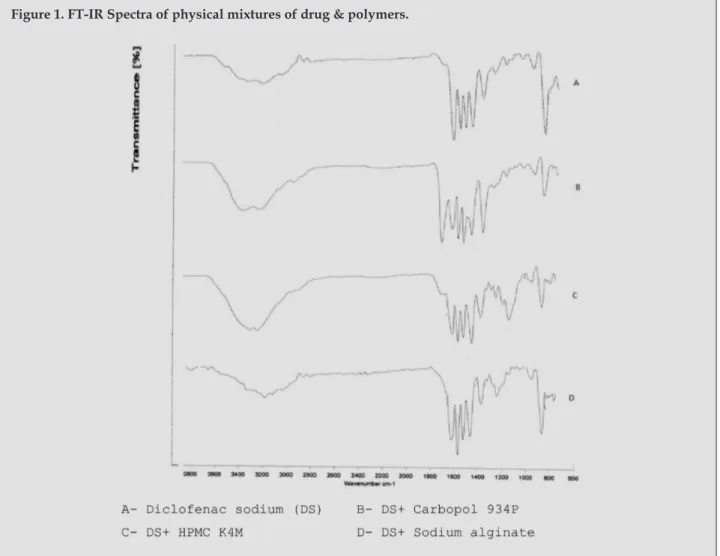
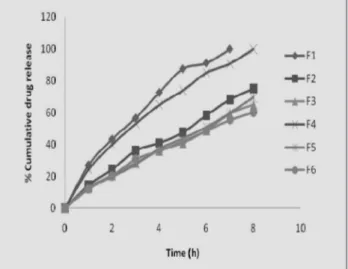
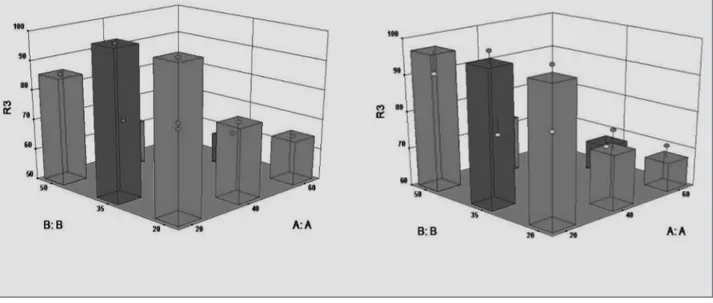
(6) Design, Development and Optimization of Buccal bioadhesive tablets of diclofenac sodium for the treatment of odontalgia. Figure 1. FT-IR Spectra of physical mixtures of drug & polymers.. RESULTS AND DISCUSSION The FT-IR studies it was revealed that there was no drug and excipient interaction. The spectra are given in Fig.1. The powder flow properties were found to be good. The hardness, friability, thickness, weight and drug content of prepared buccal tablets were found to be in the range of 3-4 kg/cm2, 0.12-0.65% w/w, 1.5-2 mm, 198-203 mg and 98.09-100.94% respectively. Surface pH: The surface pH of all the formulations was found to be within neutral pH with ±1 and hence, these formulations should not cause any irritation in the buccal cavity. In vitro dissolution study: In vitro drug release study after 2 h (R1), 4 h (R2), 8 h (R3): The cumulative amount of drug released in all the formulations ranges from 19.65 to 47.35%, 32.44 to. 79.25% and 56.25 to 100% in 2 h, 4 h and 8 h respectively. The drug release was affected by the concentration of the polymers such as HPMC K4M and sodium alginate. The concentration of Carbopol 934P also controls the drug release. The effect of release rate controlling polymers can be explained by mathematical equation in terms of actual factors (Table 2). The in vitro drug release profile of all the formulations are given in Fig. 2A, 2B & 2C. The effect of A and B can be further elucidated with the help of 3D surface plot (Fig.3A-3F). It shows the drug release directly affects the concentration of factor ‘A’. If the concentration of factor ‘A’ increases the drug release decreases proportionally but the factor ‘B’ shows non linear effect. It clearly shows the influence of rate controlling polymer (Factor A) on the drug release.. Table 2. Mathematical equation of drug release In vitro drug release time. Ars Pharm. 2011; 52(2): 05-13.. Mathematical equation in terms of actual factors Formulation F1 to F9. Formulation F10 to F18. 2h. R1 = 26.96 + 11.66 x A - 5.21 x B. R1 = 33.01+ 9.28 x A - 3.21 x B. 4h. R2 = 45.95 + 18.16 x A - 7.02 x B. R2 = 55.05 + 15.24 x A 5.93 x B. 8h. R3 = 75.24 + 20.09 x A - 5.36 x B. R3= 79.93 + 16.99 x A - 5.01 x B 09.
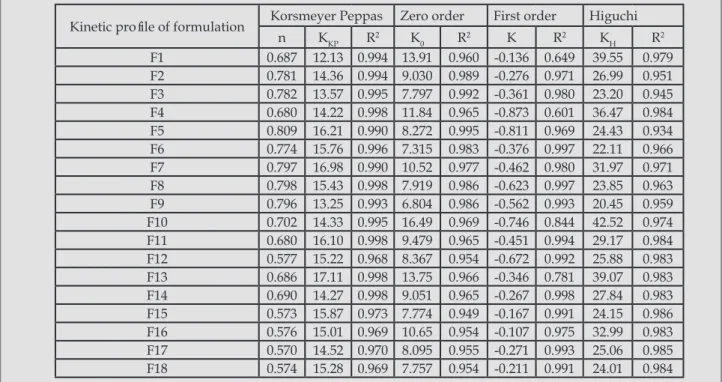
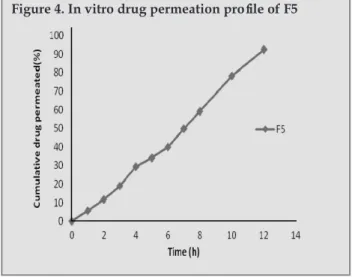
(7) Edavalath S, Rao BP.. Figure 2a. Dissolution profile of formulation F1-F6. Figure 2b. Dissolution profile of formulation F7-F12. Figure 2c. Dissolution profile of formulation F13-F18. comparatively poor linearity, with regression value of 0.969; whereas the regression value for zero-order equation was 0.990, which indicated that drug release was independent of drug concentration. The ‘n value’ for Peppas model was found to be in between 0.45 and 0.89, indicates that the drug released from the formulation by anomalous (nonFickians) mechanism and also the maximum ‘n value’ observed in F5 (table 3). ANOVA: The result of ANOVA demostrate all the independent variables were found to be significant for response R1, R2, R3 & R4. The linear model were found to be significant for all responses. Above result indicate the factors A&B (Factor A is HPMC K4 or Sodium alginate, Factor B is Carbopol 934P) play an important role in the formulation. In vitro drug permeation: The in vitro permeation studies shown that the released drug permeates the buccal membrane linearly. Good correlation was obtained between in vitro drug release and in vitro drug permeation study with the correlation coefficient of 0.994 (Fig.4). Ex vivo mucoadhesive strength: The mucoadhesive strength of the formulations were directly proportional to the concentration of HPMC or Sodium alginate. Compare to the sodium alginate the HPMC K4M containing formulations shown good mucoadhesive strength. The carbopol 934 P has the main effect in mucoadhesive strength which increases the strength with increase in concentration. Results are given in table 4. Swelling study: The swelling index of all the formulations were increased with increase in the concentration of cabopol, HPMC or sodium alginate. The HPMC is a swellable rate controlling polymer, it absorbs the moisture and swells according to its concentration. In the case of sodium alginate based formulation, the swelling with erosion was taken place. The results are given in table 4.. Stability studies in human saliva: The stability studies in human saliva shows no colour change and the tablets was not collapsed. The thickness and diameter of the tablets were increased with time and the drug content was with in the limit. Analysis of release mechanism: In the case of optimized formulation (F5) when the data were plotted according to the first-order equation, the formulations showed a 10. Ex vivo mucoadhesion time: The mucoadhesion time of the HPMC K4M based formulations increases with increase in concentration of the Carbopol and HPMC. The mucoadhesion time of the sodium alginate based formulations also increases with increase in concentration of the carbopol and sodium alginate. From the observations (table 4) it was clear that the Carbopol 934 P provides better mucoadhesion property than HPMC and sodium alginate. Optimization: It was concluded that the formulation F5 is the most satisfactory formulation for the buccal delivery of Diclofenac sodium. A good releationship between the experimental and predicted values (Table 5), which confirms the practicability and validity of the model. Ars Pharm. 2011; 52(2): 05-13..
(8) Design, Development and Optimization of Buccal bioadhesive tablets of diclofenac sodium for the treatment of odontalgia. Table 3a. 3D surface plot showing the effect of factor A and factor B on drug release after 2 h in formulation F1- F9. Table 3b. 3D surface plot showing the effect of factor A and factor B on drug release after 2 h in formulation F10- F18. Table 3c. 3D surface plot showing the effect of factor A and factor B on drug release after 4 h in formulation F1- F9. Table 3d. 3D surface plot showing the effect of factor A and factor B on drug release after 4 h in formulation F10- F18. Table 3e. 3D surface plot showing the effect of factor A and factor B on drug release after 8 h in formulation F1- F9. Table 3f. 3D surface plot showing the effect of factor A and factor B on drug release after 8 h in formulation F10- F18. Ars Pharm. 2011; 52(2): 05-13.. 11.
(9) Edavalath S, Rao BP.. Table 3. Summary of drug release kinetics of formulations Kinetic profile of formulation F1 F2 F3 F4 F5 F6 F7 F8 F9 F10 F11 F12 F13 F14 F15 F16 F17 F18. Korsmeyer Peppas n 0.687 0.781 0.782 0.680 0.809 0.774 0.797 0.798 0.796 0.702 0.680 0.577 0.686 0.690 0.573 0.576 0.570 0.574. KKP 12.13 14.36 13.57 14.22 16.21 15.76 16.98 15.43 13.25 14.33 16.10 15.22 17.11 14.27 15.87 15.01 14.52 15.28. Zero order. First order. Higuchi. K0 13.91 9.030 7.797 11.84 8.272 7.315 10.52 7.919 6.804 16.49 9.479 8.367 13.75 9.051 7.774 10.65 8.095 7.757. K -0.136 -0.276 -0.361 -0.873 -0.811 -0.376 -0.462 -0.623 -0.562 -0.746 -0.451 -0.672 -0.346 -0.267 -0.167 -0.107 -0.271 -0.211. KH 39.55 26.99 23.20 36.47 24.43 22.11 31.97 23.85 20.45 42.52 29.17 25.88 39.07 27.84 24.15 32.99 25.06 24.01. R2 0.994 0.994 0.995 0.998 0.990 0.996 0.990 0.998 0.993 0.995 0.998 0.968 0.998 0.998 0.973 0.969 0.970 0.969. R2 0.960 0.989 0.992 0.965 0.995 0.983 0.977 0.986 0.986 0.969 0.965 0.954 0.966 0.965 0.949 0.954 0.955 0.954. R2 0.649 0.971 0.980 0.601 0.969 0.997 0.980 0.997 0.993 0.844 0.994 0.992 0.781 0.998 0.991 0.975 0.993 0.991. R2 0.979 0.951 0.945 0.984 0.934 0.966 0.971 0.963 0.959 0.974 0.984 0.983 0.983 0.983 0.986 0.983 0.985 0.984. Drug release exponents (n), Korsmeyer Peppas release constant (KKP), Correlation coefficient (R2) of different models, Zero order release rate constants (K0), First order release rate constant (K), Higuchi release rate constant (KH).. Table 4. Mucoadhesive properties of buccal tablets Formulation Code F1 F2 F3 F4 F5 F6 F7 F8 F9 F10 F11 F12 F13 F14 F15 F16 F17 F18. Mucoadhesive strength (g) 17.34 ± 1.10 18.32 ± 1.24 20.17 ± 1.30 22.43 ± 1.02 24.45 ± 1.35 25.36 ± 1.30 28.33 ± 1.13 29.40 ± 1.25 33.55 ± 1.40 16.23 ± 1.15 16.54 ± 1.21 17.56 ± 1.05 20.23 ± 1.19 22.54 ± 1.34 23.11 ± 0.95 24.52 ± 1.22 25.25 ± 1.34 26.20 ± 1.12. Mucoadhesion time (h) 10.10 ± 0.14 10.45 ± 0.20 11.14 ± 0.22 11.30 ± 0.15 12.10 ± 0.20 12.30 ± 0.18 12.55 ± 0.25 13.15 ± 0.15 13.40 ± 0.24 9.05 ± 0.16 9.25 ± 0.22 9.45 ± 0.26 10.45 ± 0.30 11.05 ± 0.25 11.20 ± 0.20 11.55 ± 0.18 12.10 ± 0.15 12.24 ± 0.10. % Swelling index 16.11 ± 1.14 18.24 ± 1.11 20.35 ± 0.57 20.13 ± 1.15 24.18 ± 1.20 26.20 ± 1.05 26.04 ± 0.98 28.15 ± 1.12 30.05 ± 1.25 15.20 ± 1.02 17.31 ± 1.22 19.20 ± 1.32 19.25 ± 1.21 21.20 ± 1.22 22.15 ± 1.08 22.32 ± 0.78 23.43 ± 1.32 25.33 ± 1.27. Table 5. Comparison of experimented and predicted values of optimized formulation using Design expert software Optimized formula F5. 12. Dependable variables Drug release at 2 h. Drug release at 4 h. Drug release at 8 h. Release exponent. Predicted. 21.7533. 38.9333. 69.55. 0.767111. Experimental. 19.65. 37.23. 69.55. 0.809. Ars Pharm. 2011; 52(2): 05-13..
(10) Design, Development and Optimization of Buccal bioadhesive tablets of diclofenac sodium for the treatment of odontalgia. Stability studies: After the 6 months storage of formulation F5, values of all parameters like hardness, diameter, thickness, % drug content, friability were evaluated periodically and found to be almost similar to the initial values. The drug dissolution and permeation profile were similar to the initial profile and also no changes in the physical appearance. So it can be said that formulation is stable. Data is not shown.. Figure 4. In vitro drug permeation profile of F5. CONCLUSIONS The observed independent variables were found to be very close to predicted values of optimized formulation which demostrates the feasibility of the optimization procedure in successful development of Buccal bioadhesive tablets of Diclofenac sodium (50 mg) by using HPMC K4M (40mg) as release rate controlling polymer and Carbopol 934 P(35mg) as mucoadhesive polymer. The stability studies revealed that optimized formulation is stable.. 12. Vishnu MP, Bhupendra GP, Madhabhai MP. Formulation, Evaluation, and Comparison of Bilayered and Multilayered Mucoadhesive Buccal Devices of Propranolol Hydrochloride. AAPS Pharm Sci Tech. 2007;8(1).. REFERENCES 1. Silvia R, Giuseppina S, Carla MC. Buccal drug delivery: A challenge already won? Drug Discovery Today: Technologies. 2005;2:59-65.. 13. Hamdy A, Ossama Y A, Hesham S. Formulation of controlled release baclofen matrix tablets: influence of some hydrophilic polymers on the release rate and in vitro evaluation. AAPS Pharm Sci Tech. 2007;8(4):E1-11.. 2. Yajaman S, Ketousetuo K, Bandyopadhyay AK. Buccal bioa dhesive drug delivery - A promising option for orally less efficient drugs. J Control Release. 2006;114:15–40.. 14. Ayhan S, Yalcin O, Askin I¸ Imer. Preparation and in vitro evaluation of sustained release tablet formulations of Diclofenac sodium. Farmaco. 2005;60:171-7.. 3. Chowdhary KPR, Srinivas L. Mucoadhesive drug delivery systems: A review of current status. Indian Drugs.. Tech. 2007;8(4):E1-9.. 2000;. 37(9):400-406. 4. Vyas SP, Roop KK. Controlled Drug Delivery Concepts and Advances. 2002. Delhi.Vallabh Prakashan.pp.257-61.. 15. Donald LW. Hand book of Pharmaceutical Controlled Release Technology. New York: Marcel Dekker; 2000.pp.183-8, 225-54, 431-436. 16. Rao YM, Vishnu YV, Chandrasekhar K, Ramesh G. Development of Mucoadhesive patches for buccal administration. 5. Swarbrick J, Boylan CJ. Encyclopedia of pharmaceutical. of Carvedilol. Current Drug Delivery. 2007;4:27-39.. technology. Marcel Decker. New York 1990.. 17. Isabel DC, Francoise F, Richard HG, Yves J. Ex vivo. 6.Amir HS. Buccal mucosa as a route for systemic drug delivery:. evaluation of bioadhesive films for buccal delivery of fentanyl. J. A review. J Pharm Pharma Sci. 1998;1(1):15-30.. Control Release. 2007;122:135-140.. 7. Pulak KM, Amal KB, Yakugaku Z. In vitro evaluation of novel. 18. Doijad RC, Manvi FV, Malleshwara R, Patel PS. Buccoadhesive. mucoadhesive buccal tablet of oxytocin prepared with diospyros. Drug Delivery System of Isosorbide Dinitrate: Formulation and. peregrine fruits mucilages. Ind J Pharm Sci. 2008;128(4):603-9.. Evaluation. Ind J Pharm Sci. 2006;68(6):744-748.. 8.Vamshi VY, Chandra SK, Bhanoji R. Madhusudan RY.. 19. Khurana R, Ahuja A, Khar RK. Development and Evaluation. Development and in vitro evaluation of buccoadhesive. of mucoadhesive Films of Miconazole Nitrate. Ind J Pharm Sci.. Carvedilol tablets. Acta Pharm. 2007;57:185–97.. 2000;447-53.. 9. James S. Encyclopedia of pharmaceutical technology. 3rd. 20. Choy FW, Yuen KH, Peh KF. An in- vitro method for buccal. ed.vol4. 2007.New York. Informa healthcare.pp.2452-2466.. adhesion studies: importance of instrument variables. Int J. 10. Kanagale P, Lohray BB, Misra A, Davadra P, Kini R.. Pharm. 1999;180: 47-57.. Formulation and optimization of porous osmotic pump–based. 21. Gupta A, Garg S, Khar RK. Mucoadhesive Buccal Drug. controlled release system of oxybutynin. AAPS Pharm Sci Tech.. Delivery Systems: A Review. Indian Drugs 1992;29(13):586-593.. 2007;8(3):E1-7.. 22. Noha AN. Mucoadhesive drug delivery systems. I. Evaluation. 11.Punna RR, Sindhura G, Ranendra NS. Design and study of. of mucoadhesive polymers for buccal tablet formulation. Drug. lamivudine oral controlled release tablets. AAPS Pharm Sci. Dev Ind Pharm. 2004;30(9):985-93.. Ars Pharm. 2011; 52(2): 05-13.. 13.
(11)
Figure
+2
Documento similar