
Efectos del extracto de té verde sobre los daños oxidativos inducidos por cisplatino en riñones y testículos de ratas
14
0
0
Texto completo
(2) 6. res de cabeza y cuello, de testículos, de ovarios, vejiga y cáncer pulmonar de células pequeñas1. Sin embargo, el uso de este agente está limitado por el desarrollo de nefrotoxicidad y ototoxicidad2,3, que provocan alteraciones en los sistemas defensivos 4,5 antioxidantes . Se ha observado que el cisplatino también altera los niveles de hormona luteinizante (LH) y de la hormona estimulante del folículo (FSH), reduciendo la testosterona intratesticular y disminuyendo la motilidad y el recuento de los espermatozoides6,7. Las alteraciones de la función renal inducidas por cisplatino se caracterizan por señales de daños, como cambios en el volumen de la orina y en el estado del glutatión. La nefrotoxicidad inducida por cisplatino está estrechamente relacionada con un aumento en la peroxidación lipídica 8,9. El cisplatino pudo generar especies reactivas de oxígeno, como aniones de superóxido y radicales hidroxi10,11,12, y también inhibió la actividad de enzimas antioxidantes en el tejido renal 9. La quimioterapia con cisplatino indujo a una caída en los niveles de antioxidante en plasma, que pueden reflejar un fallo del mecanismo de defensa contra los daños oxidativos inducidos por fármacos antitumorales utilizados habitualmente 13. El tratamiento previo con diversos antioxidantes como ebselen 14 , vitamina C 15 y selenio16, 17 ha demostrado ofrecer protección frente a la nefrotoxicidad inducida por cisplatino en humanos y en animales de laboratorio. El té verde es una excelente fuente de antioxidantes de polifenol, especialmente de los del grupo conocido como catecoles del té verde (GTC) 18. Los polifenoles son metabolitos de las plantas presentes en gran número de alimentos vegetales que poseen excelentes propiedades antioxidantes y frente a los efectos de barrido de los radicales libres19,20. Los taninos del té verde también tienen un efecto protector frente a nefropatías inducidas por cisplatino, en células LLC-PK1 y en ratas21. El té verde reduce la peroxidación lipídica inducida por el hierro en homogeneizados del cerebro y en astrocitos C6 cultivados y células pulmonares 22,23 . Además, también ha demostrado reducir la formación de aductos de espín de radicales hidroxilo y de la ruptura de cadenas de ADN inducida por radicales hidroxilo in vitro24. Se ha observado que el té Ars Pharm 2005; 46 (1): 5-18.. LEENA P, BALARAMAN R. testicular, ovarian, bladder and small cell lung cancers 1. However, the use of this agent is limited by the development of nephrotoxicity and ototoxicity2,3, toxicities which involve alterations in the antioxidant defense systems4,5. Cisplatin has also been shown to alter the levels of luteinizing hormone (LH) and FSH, to reduce intratesticular testosterone, and to decrease sperm motility and count6,7 .The alterations in kidney function induced by cisplatin are characterized by signs of injury, such as changes in urine volume and in glutathione status. Cisplatin induced nephrotoxicity is closely associated with an increase in lipid peroxidation 8,9. Cisplatin was able to generate reactive oxygen species, such as superoxide anions and hydroxyl radicals 10,11,12, and it also inhibited the activity of antioxidant enzymes in renal tissue9. Cisplatin chemotherapy induced a fall in plasma antioxidant levels, which may reflect a failure of the antioxidant defense mechanism against oxidative damage induced by commonly used antitumor drugs13. The nephrotoxicity induced by cisplatin in human and experimental animal has been shown to be protected by the prior treatment of various antioxidans like ebselen 14 , vitamin C 15 and selenium 16, 17. Green tea is an excellent source of polyphenol antioxidants, particularly of group known as green tea catechins (GTCs) 18 . Polyphenols are plant metabolites occurring widely in plant food and possess outstanding antioxidant and free radical scavenging properties19,20.Green tea tannin protects cisplatin induced nephropathy in LLC-PK1 cells and in rats21 . Green tea reduces iron-induced lipid peroxidation in brain homogenates as well as in cultured C6 astrocytes and lung cells22,23 . In addition, green tea has also been shown to reduce the formation of the spin-adducts of hydroxyl radicals and hydroxyl radical to induced DNA strand breakage in vitro24 . Green tea has been found to have inhibitory effects on the chemical-induced lung tumorigenesis25. There is also considerable epidemiological evidence suggesting that the consumption of green tea lowers the risk of several types of cancer incidences as a result of these antioxidant mechanisms26 .So far, studies have not carried out on antioxidant effect of green tea extract on cisplatin induced oxidative damage. Therefore, the present study was aimed to.
(3) EFECTOS DEL EXTRACTO DE TÉ VERDE SOBRE LOS DAÑOS OXIDATIVOS INDUCIDOS POR CISPLATINO EN RIÑONES... EFFECT OF GREEN TEA EXTRACT ON CISPLATIN INDUCED OXIDATIVE DAMAGE ON KIDNEY AND TESTES OF RATS. verde también tiene efectos inhibidores de la tumorogénesis pulmonar inducida químicamente 25 . También existen considerables pruebas epidemiológicas que sugieren que el consumo de té verde reduce el riesgo de incidencia de varios tipos de cáncer como resultado de sus mecanismos antioxidantes 26 .Hasta la fecha no se han realizado estudios sobre el efecto antioxidante del extracto de té verde en los daños oxidativos inducidos por cisplatino. Por tanto, la finalidad del presente estudio era investigar los efectos protectores del extracto de té verde en los daños oxidativos inducidos por cisplatino en riñones y testículos de ratas.. 2. MATERIALES Y MÉTODOS 2.1. Productos químicos El extracto de acetato de etilo de hojas de té verde (Camellia sinensis) estandarizado en polvo fue una muestra proporcionada gratuitamente por Cherain Chemicals, Baroda, India, con un contenido total en polifenoles del 35%. La inyección de cisplatino fue una muestra proporcionada gratuitamente por la empresa Serum Institute of India Ltd., Pune, India. El resto de las sustancias químicas utilizadas fueron de grado analítico.. 2.2. Animales En el estudio se utilizaron ratas albinas macho adultas (de raza Wistar) con un peso de entre 175 y 225 g. Los animales se alimentaron ad líbitum con dieta estándar de bolitas de pienso y tuvieron agua a su disposición en todo momento. Todos los experimentos y protocolos descritos en el presente informe fueron aprobados por el Comité de Ética Animal Institucional (Institutional Animal Ethics Committee, IAEC) de la universidad M. S. University, Baroda, India, y cumplen las indicaciones del Comité de Control y Supervisión de Experimentos en Animales (Committee for the Purpose of Control and Supervision of Experiments on Animals, CPCSEA), del Ministerio de Justicia Social y Autorizaciones (Ministry of Social Justice and Empowerment) del Gobierno de India.. 7. investigate the protective effects of green tea extract on cisplatin induced oxidative damage on kidney and testes of rats.. 2. MATERIAL AND METHODS 2.1. Chemicals Standardized powdered, ethyl acetate extract of green tea leaves ( Camellia sinensis) was gift sample from Cherain Chemicals, Baroda, India with total polyphenolic content 35%. Cisplatin injection was gift sample from Serum Institute of India Ltd., Pune, India. All other chemicals used were of analytical grade.. 2.2. Animals Adult male albino rats (Wistar strain) weighing between 175 and 225 g were used for the study. The animals were fed ad libitum with standard pellet diet and had free access to water. All experiments and protocols described in present report were approved by the Institutional Animal Ethics Committee (IAEC) of M. S. University, Baroda and are in accordance with guidance of Committee for the Purpose of Control and Supervision of Experiments on Animals (CPCSEA), Ministry of Social Justice and Empowerment, Government of India.. 2.3. Experimental Procedure The animals were divided into five groups each consisting of six rats and received following treatment. Group I: Control group, received distilled water (3ml/kg /day p.o. for 30 days) and sterile water for injection (3ml/kg, i.p.) on day 1,7,14,21,28. Group II: Received distilled water (3ml/kg/ day p.o. for 30days) and cisplatin injection (3 mg/kg i.p.) on day 1,7, 14, 21, 28. Groups III: Green tea extract (25 mg/kg/ day p.o.for 30 days) and cisplatin injection (3 mg/kg i.p.) on day 1,7,14,21,28.. Ars Pharm 2005; 46 (1): 5-18.
(4) 8. 2.3. Procedimiento experimental Los animales se dividieron en cinco grupos, cada uno formado por seis ratas, que recibieron los tratamientos siguientes. Grupo I: Grupo de control, recibió agua destilada (3ml/kg /día por vía oral durante 30 días) y agua esterilizada para inyección (3ml/ kg, intraperitoneal) los días 1,7,14,21 y 28. Grupo II: Recibió agua destilada (3ml/kg/ día por vía oral durante 30 días) e inyecciones de cisplatino (3 mg/kg por vía intraperitoneal) en los días 1,7, 14, 21 y 28. Grupo III: Extracto de té verde (25 mg/kg/ día por vía oral durante 30 días) e inyecciones de cisplatino (3 mg/kg por vía intraperitoneal) en los días 1,7,14,21 y 28. Grupo IV: Extracto de té verde (50 mg/kg/ día por vía oral durante 30 días) e inyecciones de cisplatino (3 mg/kg por vía intraperitoneal) en los días 1,7,14,21 y 28. Grupo V: Extracto de té verde (100mg/kg/ día por vía oral durante 30 días) e inyecciones de cisplatino (3 mg/kg por vía intraperitoneal) en los días 1,7,14,21 y 28. Transcurridas 48 horas desde la última dosis de cisplatino, se extrajo una muestra de sangre mediante punción retroorbital y se separó el suero para las estimaciones de creatinina, urea, ácido úrico y nitrógeno ureico en sangre (NUS). Estos valores se determinaron mediante un kit de Span Diagnostics (India) Pvt. Ltd., India. A continuación, se sacrificaron los animales y los riñones y los testículos se diseccionaron, pesaron y homogeneizaron en tampón Tris frío (10 mM, pH 7.4) con una concentración del 10% (p/v). Los homogenatos se centrifugaron a 10.000xg a una temperatura de 0 æ%C durante 20 minutos en una centrifugadora refrigerante de alta velocidad Remi C-24. El sobrenadante transparente se utilizó para los ensayos de las enzimas antioxidantes endógenas de la peroxidación lipídica (contenido de MDA)27, superóxido dismutasa (SOD)28, catalasa (CAT)29 y glutatión reducido (GSH) 30. El sedimento se volvió a introducir en suspensión en tampón Tris helado (10 mM, pH 7.4) para obtener una concentración final del 10% y se utilizó para la estimación de las distintas enzimas vinculadas a la membrana como la Na+K+AT Pasa31,. Ars Pharm 2005; 46 (1): 5-18.. LEENA P, BALARAMAN R. Group IV: Green tea extract (50 mg/kg/ day p.o.for 30 days) and cisplatin injection(3 mg/kg i.p.) on day 1,7,14,21,28. Group V: Green tea extract (100mg/kg / day p.o.for 30 days) and cisplatin injection(3 mg/kg i.p.) on day 1,7,14,21,28. After 48 hours of the last dose of cisplatin, blood sample was withdrawn by retroorbital puncture and serum was separated for estimations of creatinine, urea, blood urea nitrogen (BUN) and uric acid. These values were determined by using kit of Span Diagnostic Pvt. Ltd, India. The animal were then sacrificed and the kidney and testes were dissected out ,weighed and homogenized in chilled Tris buffer (10 mM, pH 7.4) at a concentration of 10% (w/v). The homogenates were centrifuged at 10,000xg at 0æ% C for 20 min using Remi C24 high speed cooling centrifuge. The clear supernatant was used for the assays of lipid peroxidation (MDA content) 27 endogenous antioxidant enzymes, superoxide dismutase (SOD)28, catalase (CAT)29 and reduced glutathione (GSH)30. The sediment was resuspended in ice-cold Tris buffer (10 mM, pH 7.4) to get a final concentration of 10% and was used for the estimation of different membrane bound enzymes such as Na + K + AT Pase 31 , Ca2+ATPase32 and Mg2+ATPase33 and Total proteins 34 .. 2.4. Statistical análisis Results of all the above estimations have been indicated in terms of mean±S.E.M. Difference between the groups was statistically determined by analysis of variance (ANOVA) followed by Tukey –Kramer multiple Comparisons test with the level of significance set at P ≤ 0.05..
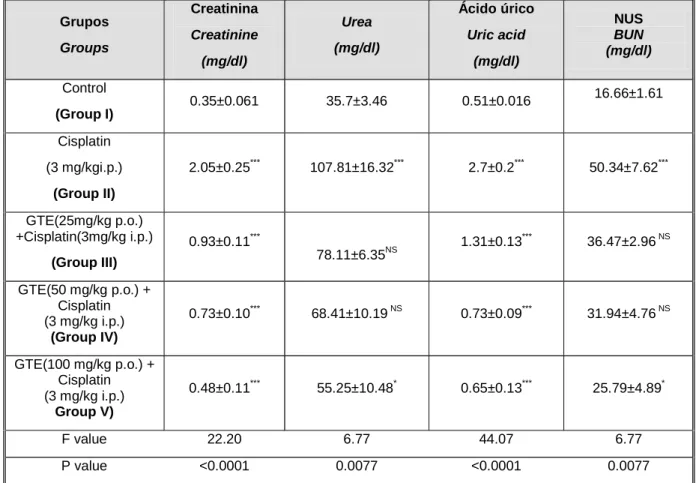
(5) 9. EFECTOS DEL EXTRACTO DE TÉ VERDE SOBRE LOS DAÑOS OXIDATIVOS INDUCIDOS POR CISPLATINO EN RIÑONES... EFFECT OF GREEN TEA EXTRACT ON CISPLATIN INDUCED OXIDATIVE DAMAGE ON KIDNEY AND TESTES OF RATS. Ca2+ATPasa32 y Mg2+ATPasa33 y las proteínas totales 34. 2.4. Análisis estadístico Los resultados de todas las estimaciones anteriores se han indicado en términos de media ± E.S.M. La diferencia entre los grupos se determinó estadísticamente por análisis de varianza (ANOVA) seguido de una prueba de comparación múltiple Tukey–Kramer con un nivel de significación de P ≤ 0,05. TABLA 1: 1 Efecto del extracto de té verde (GTE) (30 días) junto con la administración crónica de cisplatino (3mg/kg por vía intraperitoneal) en los días 1, 7, 14, 21 y 28 en los niveles séricos de creatinina, urea, ácido úrico y NUS TABLE 1: 1 Effect of green tea extract(GTE) (30 days) along with chronic administration of cisplatin (3mg/kg i.p.) on day 1,7,14, 21and 28 on the serum levels of creatinine, urea, uric acid and BUN Creatinina Grupos. Ácido úrico Urea. Creatinine Groups. Uric acid (mg/dl). (mg/dl). (mg/dl). Control. NUS BUN (mg/dl) 16.66±1.61. 0.35±0.061. 35.7±3.46. 0.51±0.016. 2.05±0.25***. 107.81±16.32***. 2.7±0.2***. 50.34±7.62***. 1.31±0.13***. 36.47±2.96 NS. (Group I) Cisplatin (3 mg/kgi.p.) (Group II) GTE(25mg/kg p.o.) +Cisplatin(3mg/kg i.p.). 0.93±0.11***. NS. 78.11±6.35. (Group III) GTE(50 mg/kg p.o.) + Cisplatin (3 mg/kg i.p.) (Group IV). 0.73±0.10***. 68.41±10.19 NS. 0.73±0.09***. 31.94±4.76 NS. GTE(100 mg/kg p.o.) + Cisplatin (3 mg/kg i.p.) Group V). 0.48±0.11***. 55.25±10.48*. 0.65±0.13***. 25.79±4.89*. F value. 22.20. 6.77. 44.07. 6.77. P value. <0.0001. 0.0077. <0.0001. 0.0077. Los valores están expresados como media ± ESM (n = 6). El Grupo II se comparó con el Grupo I. Los grupos III, IV y V se compararon con el Grupo II. *P<0,05, **P <0,01, ***P <0,001, NS = No significativo. Values are expressed as mean ± SEM (n = 6).Group II was compared with Group I. Group III, IV and V compared with Group II.. *P<0.05, **P <0.01, ***P <0.001, NS = Non significant.. Ars Pharm 2005; 46 (1): 5-18.
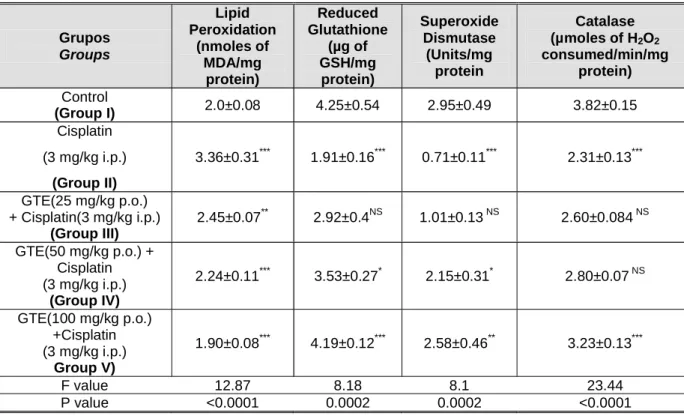
(6) 10. LEENA P, BALARAMAN R. 3. RESULTADOS. 3. RESULTS. 3.1. Nefrotoxicidad inducida por cisplatino. 3.1. Cisplatin induced nephrotoxicity. La administración de inyecciones de cisplatino sola (Grupo II) en los días 1, 7, 14, 21 y 28 provocaron un aumento significativo (P<0,001) de los niveles de creatinina, urea, ácido úrico y NUS, los marcadores del daño renal. La administración de extracto de té verde (Grupos III, IV y V) durante 30 días junto con cisplatino en los días 1, 7, 14, 21 y 28 disminuyó significativamente (P<0,001, P<0,05) los niveles de creatinina, ácido úrico, urea y NUS en comparación con los animales tratados con cisplatino sola (Grupo II). (Tabla 1) Se observó una reducción significativa (P<0,001) de los niveles de SOD, CAT y GSH en los riñones de los animales tratados con cisplatino sola (en los días 1, 7, 14, 21 y 28) (Grupo II) en comparación con el grupo de control (Grupo I) y un aumento significativo (P<0,001) en la peroxidación lipídica (contenido de MDA) en los riñones de los animales tratados con cisplatino sola (Grupo II) en comparación con el grupo de control (Grupo I). Tras la administración de extracto de té verde en dosis de 100 mg/kg durante 30 días junto con inyecciones de cisplatino en los días 1, 7, 14, 21 y 28 se observó un aumento significativo (P<0,001 , P<0,01) en los niveles de GSH, CAT y SOD y una reducción significativa (P<0,001) en la peroxidación lipídica (contenido de MDA) en comparación con los animales a los que sólo se había administrado cisplatino (Grupo II). (Tabla 2). Administration of cisplatin injection alone (Group II) on 1 st ,7 th ,14 th ,21th,and 28 th day resulted in a significant (P<0.001) elevation in the levels of creatinine, urea, uric acid and BUN, the markers of renal injury. Administration of green tea extract(Group III,IV,V) for 30 day along with cisplatin on 1 st , 7 th, 14 th , 21th,and 28 th day significantly (P<0.001,P<0.05)) decreased the levels of creatinine, uric acid, Urea and BUN as compared to animals treated with cisplatin alone (Group II). (Table 1) There was a significant (P<0.001) reduction in levels of SOD, CAT and GSH was observed in kidney of animals treated with cisplatin alone (on 1st,7th,14th,21th,and 28th day) (Group II) as compared to control(Group I) and a significant (P<0.001) elevation in lipid peroxidation (MDA content) was observed in kidney of animals treated with cisplatin alone (Group II) as compared to control(Group I). Administration of green tea extract at dose of 100 mg/kg for 30 day along with cisplatin injection on 1 st , 7 th , 14 th ,21th,and 28 th day showed significant (P<0.001 , P<0.01) increase in GSH,CAT and SOD and significant (P<0.001) decrease in lipid peroxidation (MDA content) as compared to animals treated with cisplatin alone (Group II).(Table 2). Ars Pharm 2005; 46 (1): 5-18..
(7) 11. EFECTOS DEL EXTRACTO DE TÉ VERDE SOBRE LOS DAÑOS OXIDATIVOS INDUCIDOS POR CISPLATINO EN RIÑONES... EFFECT OF GREEN TEA EXTRACT ON CISPLATIN INDUCED OXIDATIVE DAMAGE ON KIDNEY AND TESTES OF RATS. TABLA 2: 2 Efecto del extracto de té verde (GTE)(30 días) junto con la administración crónica de cisplatino (3 mg/kg i.p.) en los días 1, 7, 14, 21 y 28 sobre los niveles de peroxidación lipídica (contenido de MDA), el glutatión reducido, la superóxido dismutasa y la catalasa en los riñones de las ratas TABLE 2: 2 Effect of green tea extract(GTE)(30 days) along with chronic administration of cisplatin(3 mg/ kg i.p.) on day 1,7,14,21,and 28 on the levels of lipid peroxidation (MDA content), reduced glutathione, superoxide dismutase and catalase in kidney of rat. Grupos Groups Control (Group I) Cisplatin (3 mg/kg i.p.) (Group II) GTE(25 mg/kg p.o.) + Cisplatin(3 mg/kg i.p.) (Group III) GTE(50 mg/kg p.o.) + Cisplatin (3 mg/kg i.p.) (Group IV) GTE(100 mg/kg p.o.) +Cisplatin (3 mg/kg i.p.) Group V) F value P value. Lipid Peroxidation (nmoles of MDA/mg protein). Reduced Glutathione (µg of GSH/mg protein). Superoxide Dismutase (Units/mg protein. Catalase (µmoles of H2O2 consumed/min/mg protein). 2.0±0.08. 4.25±0.54. 2.95±0.49. 3.82±0.15. ***. ***. ***. ***. 1.91±0.16. 0.71±0.11. 2.45±0.07**. 2.92±0.4NS. 1.01±0.13 NS. 2.60±0.084 NS. 2.24±0.11***. 3.53±0.27*. 2.15±0.31*. 2.80±0.07 NS. 3.36±0.31. 1.90±0.08 12.87 <0.0001. ***. ***. 4.19±0.12 8.18 0.0002. 2.58±0.46 8.1 0.0002. **. 2.31±0.13. ***. 3.23±0.13 23.44 <0.0001. Los valores están expresados como media ± ESM (n = 6). El Grupo II se comparó con elGrupo I. Los grupos III, IV y V se compararon con el Grupo II. *P<0,05, **P <0,01, ***P <0,001, NS = No significativo. Values are expressed as mean ± SEM (n = 6).Group II was compared with Group I. Group III, IV and V compared with Group II. *P<0.05, **P <0.01, ***P <0.001, NS = Non significant.. Las ratas tratadas con cisplatino (Grupo II) en los días 1, 7, 14, 21 y 28 mostraron un descenso significativo (P<0,01, P<0,05, P<0,001) en la actividad de las enzimas Na+K+ATPasa, Ca2+ATPasa y Mg2+ATPasa en comparación con el grupo de control (Grupo I). La administración de extracto de té verde durante 30 días junto con cisplatino en los días 1, 7, 14, 21 y 28 aumentó significativamente (P<0,01, P<0,05, P<0,001) la actividad de las enzimas Na +K +ATPasa, Ca2+ATPasa y Mg 2+ATPasa en comparación con los animales a los que sólo se les administró cisplatino (Grupo II). (Tabla 3). 3.2. Toxicidad testicular inducida por cisplatino Las ratas a las que se administró cisplatino (Grupo II) en los días 1, 7, 14, 21 y 28 mos-. Cisplatin treated rats(Group II) on 1st,7th,14 th,21th,and 28th day showed a significant (P<0.01,P<0.05,P<0.001) decrease in the activities of Na +K + ATPase, Ca 2+ ATPase and Mg2+ATPase enzymes as compared to control (Group I). Administration of green tea extract for 30 day along with cisplatin on 1 st ,7 th ,14 th ,21th,and 28 th day significantly (P<0.01,P<0.05,P<0.001) increased the activities of Na + K + ATPase, Ca 2+ ATPase and Mg2+ATPase enzymes as compared to animal treated with cisplatin alone(Group II).(Table 3). 3.2. Cisplatin induced testicular toxicity Cisplatin treated rats (Group II) on 1st,7th,14 th,21th,and 28th day showed a significant (P<0.001,P<0.001) decrease in the levels Ars Pharm 2005; 46 (1): 5-18.
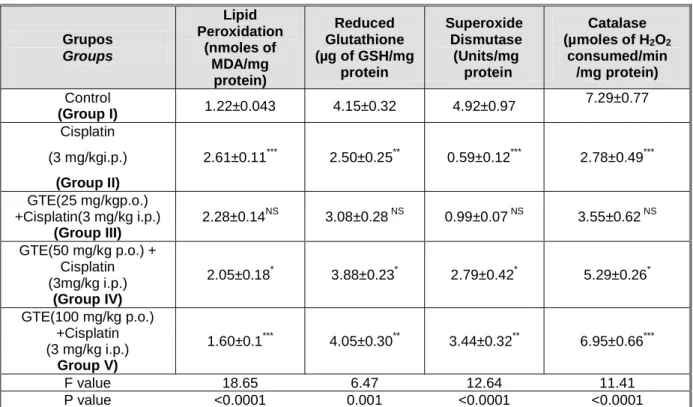
(8) 12. LEENA P, BALARAMAN R. traron una reducción significativa (P<0,001, P<0,001) en los niveles de SOD, CAT y GSH y un aumento significativo (P<0,001) de la peroxidación lipídica en los testículos, en comparación con el grupo de control (Grupo I). La administración de extracto de té verde (Grupos III, IV, V) durante 30 días junto con cisplatino en los días 1, 7, 14, 21 y 28 provocó un aumento significativo (P<0,01, P<0,001) en los niveles de SOD, GSH y CAT y una reducción significativa (P<0,001) de la peroxidación lipídica en los testículos en comparación con los animales a los que sólo se administró cisplatino (Grupo II), lo que implica un efecto antioxidante del extracto de té verde.(Tabla 4). of SOD,CAT and GSH and significant (P<0.001) increase in lipid peroxidation in testes, as compared to control (Group I) Administration of green tea extract (Group III,IV,V) for 30 day along with cisplatin on 1 st , 7 th , 14 th , day caused a significant 21th,and 28 th (P<0.01,P<0.001) increase in SOD, GSH and CAT and a significant(P<0.001) decrease in lipid peroxidation in testes as compared to animals treated with cisplatin alone(Group II) implying an antioxidant effect of green tea extract.(Table 4). TABLA 3: 3 Efecto del extracto de té verde (GTE)(30 días) junto con la administración crónica de cisplatino (3 mg/kg por vía intraperitoneal) en los días 1, 7, 14, 21 y 28 en los niveles de Na+K+ATPasa, Ca2+ATPasa y Mg2+ATPasa en los riñones de ratas. TABLE 3: 3 Effect of green tea extract(GTE) (30 days) along with chronic administration of cisplatin (3 mg/kg i.p.) on day 1,7,14,21,and 28 on the levels of Na+K+ATPase, Ca2+ATPase and Mg2+ATPase in kidney of rat. +. Grupos Groups Control (Group I) Cisplatin (3 mg/kgi.p.) (Group II) GTE(25 mg/kgp.o.) +Cisplatin(3 mg/kg i.p.) (Group III) GTE(50 mg/kg p.o.) + Cisplatin (3 mg/kg i.p.) (Group IV) GTE(100 mg/kg p.o.) +Cisplatin (3 mg/kg i.p.) Group V) F value P value. +. 2+. Na K ATPase (µmoles of inorganic phosphorus liberated/min/mg protein. Ca ATPase(µmoles of inorganic phosphorus liberated/min/mg protein. 12.67±0.61. 6.98±0.24. **. 5.34±0.54. 8.22±1.08. 10.10±0.89. *. 4.25±0.24. ***. NS. 6.02±0.26. NS. 5.58±0.41. NS. *. NS. 7.02±0.26. ***. 6.84±0.25. **. 7.07±0.5. *. 7.32±0.41. ***. 11.44±0.61. 12.12±0.21 5.66 0.0022. 2+. Mg ATPase(µmoles of inorganic phosphorus liberated/min/mg protein 9.98±0.38. 3.68 0.0172. 37.25 <0.0001. Los valores están expresados como media ± ESM (n = 6). El Grupo II se comparó con el Grupo I. Los grupos III, IV y V se compararon con el Grupo II. *P<0,05, **P <0,01, ***P <0,001, NS = No significativo. Values are expressed as mean SEM (n = 6).Group II was compared with Group I.Group III, IV and V compared with Group II .*P<0.05, **P <0.01, ***P <0.001, NS = Non significant.. Ars Pharm 2005; 46 (1): 5-18..
(9) 13. EFECTOS DEL EXTRACTO DE TÉ VERDE SOBRE LOS DAÑOS OXIDATIVOS INDUCIDOS POR CISPLATINO EN RIÑONES... EFFECT OF GREEN TEA EXTRACT ON CISPLATIN INDUCED OXIDATIVE DAMAGE ON KIDNEY AND TESTES OF RATS. TABLA 4: 4 Efecto del extracto de té verde (30 días) junto con la administración crónica de cisplatino (3 mg/kg i.p.) en los días 1, 7, 14, 21 y 28 sobre los niveles de peroxidación lipídica (contenido de MDA), el glutatión reducido, la superóxido dismutasa y la catalasa en los testículos de las ratas TABLE 4: 4 Effect of green tea extract(30 days) along with chronic administration of cisplatin(3 mg/kg i.p.) on day 1,7,14,21,and 28 on the levels of lipid peroxidation (MDA content), reduced glutathione, superoxide dismutase and catalase in testes of rat. Grupos Groups Control (Group I) Cisplatin (3 mg/kgi.p.) (Group II) GTE(25 mg/kgp.o.) +Cisplatin(3 mg/kg i.p.) (Group III) GTE(50 mg/kg p.o.) + Cisplatin (3mg/kg i.p.) (Group IV) GTE(100 mg/kg p.o.) +Cisplatin (3 mg/kg i.p.) Group V) F value P value. Lipid Peroxidation (nmoles of MDA/mg protein). Reduced Glutathione (µg of GSH/mg protein. Superoxide Dismutase (Units/mg protein. 1.22±0.043. 4.15±0.32. 4.92±0.97. 2.61±0.11. 2.28±0.14. ***. NS. 0.59±0.12. 3.08±0.28. NS. 0.99±0.07. *. 3.88±0.23. ***. 2.05±0.18. 1.60±0.1. **. 2.50±0.25. Catalase (µmoles of H2O2 consumed/min /mg protein) 7.29±0.77. ***. 2.78±0.49. NS. 3.55±0.62. NS. *. 2.79±0.42. 4.05±0.30. **. 3.44±0.32. 6.95±0.66. 6.47 0.001. 12.64 <0.0001. 11.41 <0.0001. 18.65 <0.0001. *. ***. *. 5.29±0.26. **. ***. Values are expressed as mean ± SEM(n = 6).Group II was compared with Group I.Group III, IV and V compared with Group II. *P<0.05, **P <0.01, ***P <0.001, NS = Non significant. Los valores están expresados como media ± ESM (n = 6). El Grupo II se comparó con el Grupo I. Los grupos III, IV y V se compararon con el Grupo II. *P<0,05, **P <0,01, ***P <0,001, NS = No significativo.. Se observó un aumento significativo (P<0,01, P<0,05, P<0,001) en la actividad de las enzimas Na+K+ATPasa, Ca2+ATPasa y Mg2+ATPasa en los animales a los que sólo se administró cisplatino (Grupo II) en los días 1, 7, 14, 21 y 28, en comparación con el grupo de control (Grupo I). La administración de extracto de té verde (Grupos III, IV y V) durante 30 días junto con inyecciones de cisplatino en los días 1, 7, 14, 21 y 28 aumentó significativamente (P<0,01, P<0,05, P<0,001) la actividad de las enzimas Na + K + ATPasa, Ca 2+ ATPasa y Mg2+ATPasa en los testículos en comparación con los animales a los que sólo se les administró cisplatino (Grupo II). (Tabla 5). A significant (P<0.01,P<0.05,P<0.001) decrease in activities of Na + K + ATPase, Ca2+ATPase, Mg2+ATPase enzymes was observed in animals treated with cisplatin alone(Group II) on 1st,7th,14th,21th,and 28th day as compared to control (Group I). Administration of green tea extract (Group III,IV,V) for 30 day along with cisplatin injection on st th th th 1 ,7 ,14 ,21th,and 28 day significantly (P<0.01,P<0.05)increased activities of Na +K +ATPase, Ca 2+ATPase, Mg 2+ATPase enzymes in testes as compared to animals treated with cisplatin alone(Group II).(Table 5). Ars Pharm 2005; 46 (1): 5-18.
(10) 14. LEENA P, BALARAMAN R. TABLA 5: Efecto del extracto de té verde (GTE)(30 días) junto con la administración crónica de cisplatino (3 mg/kg por vía intraperitoneal) en los días 1, 7, 14, 21 y 28 en los niveles de Na+K+ATPasa, Ca2+ATPasa y Mg2+ATPasa en los testículos de ratas. TABLE 5: Effect of green tea extract(GTE)(30 days) along with chronic administration of cisplatin (3 mg/kg i.p.)on day 1,7,14,21,and 28 on the levels of Na+K+ATPase, Ca2+ATPase and Mg2+ATPase in testes of rat. +. Grupos Groups. +. (Group II) GTE(25 mg/kgp.o.) +Cisplatin(3 mg/kg i.p.) (Group III) GTE(50 mg/kg p.o.) + Cisplatin (3 mg/kg i.p.) (Group IV) GTE(100 mg/kg p.o.)+Cisplatin (3 mg/kg i.p.) Group V) F value P value. 2+. Ca ATPase(µmoles of inorganic phosphorus liberated/min/mg protein. Mg ATPase(µmoles of inorganic phosphorus liberated/min/mg protein. 8.5±0.34. 4.24±0.57. 6.56±0.40. Control (Group I) Cisplatin (3 mg/kgi.p.). 2+. Na K ATPase (µmoles of inorganic phosphorus liberated/min/mg protein. 5.77±0.44. 6.78±0.38. **. 2.80±0.22. *. 3.26±0.31. ***. NS. 3.32±0.23. NS. 3.69±0.17. NS. *. 3.77±0.26. NS. 4.51±0.51. NS. 7.80±0.49. 8.43±0.51. **. 6.95 0.0006. 4.30±0.20 3.62 0.018. *. **. 5.48±0.45 11.67 <0.0001. Values are expressed as mean ± SEM (n = 6).Group II was compared with Group I.Group III, IV and V compared with Group II . *P<0.05, **P <0.01, ***P <0.001, NS = Non significant.. Los valores están expresados como media ± ESM (n = 6). El Grupo II se comparó con el Grupo I. Los grupos III, IV y V se compararon con el Grupo II. *P<0,05, **P <0,01, ***P <0,001, NS = No significativo.. 4. DISCUSIÓN. 4. DISCUSSION. El cisplatino genera especies reactivas de oxígeno, como radicales hidroxilo y aniones superóxido, y estimula la peroxidación lipídica35,36. Aunque no se conoce bien el mecanismo exacto de la nefrotoxicidad inducida por cisplatino, varios estudios sugieren que está relacionado con la formación de radicales libres. Se acepta que ambos están relacionados con el estrés oxidativo y provocan un desequilibrio entre la formación de radicales derivados del oxígeno y el potencial antioxidante del organismo. Varios estudios han demostrado que la administración de cisplatino está asociada a un aumento en la formación de radicales libres y con un fuerte estrés oxidativo15,17. Como resultado del incremento en la formación de radicales libres en la toxi-. Cisplatin generates reactive oxygen species such as superoxide anion and hydroxyl radicals, and stimulates lipid peroxidation 35,36 . Although the exact mechanism of cisplatininduced nephrotoxicity is not well understood, several studies have suggested the involvement of free radical formation. It is accepted that both correlate to oxidative stress and cause an imbalance between the generation of oxygen derived radicals and the organism’s antioxidant potential. It has been shown in various studies that cisplatin administrations are associated with increased formation of free radicals, and with heavy oxidative stress15,17. As a result of an increase in the formation of free radicals in cisplatin-induced toxicity, the balance normally present in cells between. Ars Pharm 2005; 46 (1): 5-18..
(11) EFECTOS DEL EXTRACTO DE TÉ VERDE SOBRE LOS DAÑOS OXIDATIVOS INDUCIDOS POR CISPLATINO EN RIÑONES... EFFECT OF GREEN TEA EXTRACT ON CISPLATIN INDUCED OXIDATIVE DAMAGE ON KIDNEY AND TESTES OF RATS. cidad inducida por cisplatino, el equilibrio entre la formación de radicales y la protección frente a ellos existente en las células en condiciones normales se ve alterado37,38. Esto provoca daños oxidativos en componentes de las células como proteínas, lípidos y ácidos nucleicos39. Existen evidencias de que el cisplatino causa un profundo deterioro en el sistema reproductor y en el potencial de fertilidad de las ratas6,49. El cisplatino inhibe la actividad de las enzimas antioxidantes (SOD, CAT y GSH) y se produce una reducción de los tioles celulares40 en los riñones y testículos de las ratas que sugiere que la citotoxicidad del cisplatino se deriva de la formación de especies reactivas de oxígeno (ROS) 9. Los resultados obtenidos en este estudio concuerdan con estos informes previos, que indican que el aumento de la peroxidación lipídica y la disminución del glutatión reducido y de las enzimas antioxidantes (SOD y catalasa) contribuyen a los daños oxidativos inducidos por cisplatino. Como resultado, se alteran los niveles séricos de creatinina, urea, nitrógeno ureico en sangre (NUS) y ácido úrico, que son indicadores para el diagnóstico de la nefrotoxicidad. En línea con nuestro estudio, se ha averiguado que diversos antioxidantes como el hidroxianisol butilado (BHA) y el glutatión (GSH) previenen la peroxidación lipídica inducida por cisplatino y la reducción del glutatión41 y las enzimas antioxidantes. El extracto de té verde contiene galocatequina (GC), epigalocatequina (EGC), epicatequina (EC), galato de epigalocatequina (EGCg) y galato de epicatequina (ECg). Los componentes del té tienen efectos antioxidantes, antimutagénicos y anticarcinogénicos que podrían proteger a los humanos frente al riesgo de cáncer ocasionado por agentes medioambientales42. Sano et al43 estudiaron los efectos inhibidores de las hojas de té verde en la peroxidación lipídica inducida por tert-butil y observaron un efecto antioxidante similar tras la administración oral de los principales polifenoles del té. Shim et al 44 estudiaron el efecto quimiopreventivo del té verde en los fumadores de cigarrillos y observaron que bloqueaba el aumento inducido por los cigarrillos de la frecuencia de intercambio de cromátidas hermanas. El efecto antihiperglucémico del té negro ya había sido comunicado anteriormente por Gomes et al45. Las ratas. 15. radical formation and protection against them is disturbed 37,38. This will lead to oxidative damage of cell components, e.g. proteins, lipids, and nucleic acids39 .There are evidences that cisplatin has a profound deleterious effect on the reproductive system and fertility potential in rat6,49.Cisplatin inhibits activities of antioxidant enzymes (SOD CAT and GSH) and there is depletion of cellular thiols 40 in rat kidney and testes suggesting that cisplatin cytotoxicity results from generation of reactive oxygen species (ROS)9 . The results obtained in this study is in agreement with these previous reports, that the enhancement in lipid peroxidation, and decrease in reduced glutathione and antioxidant enzymes (SOD and catalase) contributes to cisplatin induced oxidative damage. This has resulted in the altered levels of serum creatinine, urea, blood urea nitrogen (BUN) and uric acid which are the diagnostic indicator of nephrotoxicity. In line with our study, it has been found that several antioxidants like butylated hydroxyl anisole (BHA) and glutathione (GSH) prevented the cisplatin induced lipid peroxidation and depletion of glutathione 41 and antioxidant enzymes. Green tea extract contains gallocatechin (GC), epigallocatechin (EGC), epicatechin (EC), epigallocatechin gallate (EGCg) and epicatechin gallate (ECg). Tea components possess antioxidant, antimutagenic and anticarcinogenic effects and could protect humans against the risk of cancer by environmental agents 42 . Sano et al 43 studied the inhibitory effects of green tea leaves against tert-butyl hydroperoxide induced lipid peroxidation and a similar antioxidant effect on the kidney was observed after oral administration of a major tea polyphenols. Shim et al44 studied the chemopreventive effect of green tea among cigarette smokers and found it block the cigaretteinduced increase in sisterchromatid exchange frequency. Anti-hyperglycemic effect of black tea has been reported earlier by Gomes et al45. Streptozotocin diabetic rats showed increased sensitivity to platelet aggregation and thrombosis and this abnormality could be improved by dietary catechin of green tea46,47. Green tea polyphenols has the antioxidant properties that result from their ability to sequester metal ions and to scavenge reactive oxygen species48. In the present study, treatment with green tea Ars Pharm 2005; 46 (1): 5-18.
(12) 16. LEENA P, BALARAMAN R. con diabetes por estreptozotocina presentaron una mayor sensibilidad a la agregación de plaquetas y a la trombosis, lo que se podía mejorar mediante la administración de catequinas de té verde en la dieta46,47. Los polifenoles del té verde tienen propiedades antioxidantes derivadas de su capacidad para secuestrar iones metálicos y barrer especies reactivas de oxígeno48. En el presente estudio, la administración de extracto de té verde ofreció una protección significativa frente a los daños oxidativos inducidos por cisplatino en riñones y testículos. La administración de extracto de té verde redujo significativamente la peroxidación lipídica y aumentó los niveles de glutatión, catalasa y SOD en los daños oxidativos inducidos por cisplatino. La reducción en los niveles séricos de creatinina, urea, nitrógeno ureico en sangre (NUS) y ácido úrico son indicativos del efecto protector del extracto de té verde. La Na + K + ATPasa, la Ca2+ATPasa y la Mg2+ATPasa son las enzimas ligadas a la membrana, y los niveles de Na+K+ ATPasa, Ca++ ATPasa y Mg++ ATPasa se redujeron en los riñones y testículos de las ratas tratadas con cisplatino. Como estas enzimas ligadas a la membrana son grupos tioles que contienen enzimas dependientes de los lípidos 50, la recuperación de la actividad de las enzimas ATPasa sugiere la capacidad del extracto de té verde para proteger al grupo de tioles frente a los daños oxidativos mediante la inhibición de la peroxidación lipídica.En conclusión, la administración de extracto de té verde durante el tratamiento con cisplatino reduce el riesgo de daños oxidativos inducidos por cisplatino, protección que se puede atribuir a un descenso en la peroxidación lipídica y a la recuperación de la actividad de las enzimas ligadas a la membrana y antioxidantes.. extract offered a significant protection from the cisplatin induced oxidative damage to kidney and testes. Green tea extract treatment significantly reduced lipid peroxidation and increased the levels of glutathione, catalase and SOD in cisplatin induced oxidative damage. The reduction in serum levels of creatinine, urea, blood urea nitrogen (BUN) and uric acid indicates protective effect of green tea extract. Na + K + ATPase, Ca 2+ATPase and Mg2+ATPase are the membrane bound enzymes and the levels of Na +K + ATPase, Ca ++ ATPase and Mg ++ ATPase were reduced in kidney and in testes of cisplatin treated rats. Since these membranes bound enzymes are thiol group containing enzymes, that are lipid dependant50 and hence the restoration of the activities of ATPase enzymes suggest the ability of green tea extract to protect the thiol group from oxidative damage through inhibition of lipid peroxidation.In conclusion, green tea extract administration during cisplatin therapy reduces the risk of cisplatin induced oxidative damage and the protection can be attributed to a decrease in lipid peroxidation, restoration of activities of antioxidant and membrane bound enzymes.. BIBLIOGRAFÍA/BIBLIOGRAPHY 1. Rosenberg B. Fundamental studies with cisplatin. Cancer1985; 55: 2303–15. 2. Ward JM, Fauvie KA. The nephrotoxic effects of cis-diam- mine- dichloroplatinum IIin male F344 rats. Toxicol. Appl. Pharmacol. 1976; 38: 535–547. 3. Loehrer PJ, Einhorn LH. Drugs five years later. Cisplatin. Ann. Intern. Med. 1984; 100: 704–713. 4. Somani SM, Ravi, R, Rybak LP. Diethylthiocarbamate protection against cisplatin nephrotoxicity. Drug Chem. Toxicol. 1995; 18: 151–170. 5. Husain K, Morris C, Whitworth C, Trammel GL, Rybak LP, Somani SM. 4-Methylthiobenzoic acid protection against cisplatin nephrotoxicity: antioxidant system. Fundam. Appl. Toxicol. 1996; 32: 278–284.. Ars Pharm 2005; 46 (1): 5-18..
(13) EFECTOS DEL EXTRACTO DE TÉ VERDE SOBRE LOS DAÑOS OXIDATIVOS INDUCIDOS POR CISPLATINO EN RIÑONES... EFFECT OF GREEN TEA EXTRACT ON CISPLATIN INDUCED OXIDATIVE DAMAGE ON KIDNEY AND TESTES OF RATS. 17. 6. Seethalakshmi L, Flores C, Kinkead T, Carboni AA, Malhotra RK, Menon M. Effects of subchronic treatment with cisplatinum on testicular function, fertility, pregnancy outcome, and progeny. J. Androl. 1992;13: 65–74. 7. Aydiner A, Aytekin Y, Topuz E. Effects of cisplatin on testicular tissue and the Leydig cell–pituitary axis. Oncology 1997; 54:74–78. 8. Hannemann J, Baumann K. Cisplatin-induced lipid peroxidation and decrease of gluconeogenesis in rat kidney cortex: different effects of antioxidants and radical scavengers. Toxicology 1988; 51: 119–32. 9. Sadzuka Y, Shoji T, Takino Y. Effect of cisplatin on the activities of enzymes which protect against lipid peroxidation. Biochem Pharmacol 1992; 43: 1873–5. 10. Masuda H, Tanaka T, Takahama UT. Cisplatin generates superoxide anion by interaction with DNA in a cell-free system. Biochem Biophys Res Commun 1994;203:175–80. 11. Baliga R, Zhang Z, Baliga M, Ueda N, Shah S. In vitro and in vivo evidence suggesting a role for iron in cisplatininduced nephrotoxicity.Kidney Int 1998; 53: 394– 401. 12. Matsushima H, Yonemura K, Ohishi K, Hishida A. The role of oxygen free radicals in cisplatin-induced acute renal failure in rats. J Lab Clin Med 1998; 131:518–26. 13. Weijl NI, Hopman GD, Wipkink-Bakker A, Lentjes EG, Berger HM, Cleton FJ,Osanto S. Cisplatin combination chemotherapy induces a fall in plasma antioxidants of cancer patients. Ann Oncol 1998; 9:1331–7. 14. Yoshida M, Itzuka K, Hara M, Nishijima H, Shimada A, Nakada K, Satoh Y,kama Y, Terada A. Prevention of nephrotoxicity of cisplatin by repeated oral administration of ebselen in rats. Tohoku J. Exp. Med. 2000;191: 209– 220. 15. Antunes LMG, Darin JDC, Bianchi Mde LP. Protective effect of vitamin C against cisplatin induced nephrotoxicity and lipid peroxidation in adult rats: a dose dependant study. Pharmacol. Res 2000.; 41: 405– 411. 16. Caffrey PB, Frenkel GD. Selenium compounds prevent the induction of drug resistance by cisplatin in human ovarian tumor xenografts in vivo. Cancer Chemother.Pharmacol 2000; 46:74–78. 17. Antunes LMG, Darin JDC, Bianchi M de LP. Effect of the antioxidants curcumin or selenium on cisplatin induced nephrotoxicity and lipid peroxidation in rats. Pharmacol. Res. 2001; 43: 145 – 150. 18 .Zhu QY, Zhang A, Tsang D, Huang Y, Chen Z Y. Stability of green tea catechins. J Agric Food Chem1997; 45: 4624– 4628. 19. Harbone JB. General procedures and measurement of total phenolics. In: Harbone J. B., ed. Methods in Plant Biochemistry1989, Vol. 1. New York:Academic Press, pp. 1–28. 20. Scott BC, Butler J, Halliwell B, Aruoma O I. Evaluation of the antioxidant action of ferulic acid and catechin. Free Radic Res Commun 1993; 19: 241–253. 21. Yokozawa T, Nakagawa T, KyeoungI M, Eun JC, Shigeya T, Terasawa K. Effect of green tea tannin on cisplatin induced nephropathyin LLC-PK1 cells and rats. J Pharm.Pharmacol 19995;1: 1325-1331. 22. Lin AM, Chyi BY, Wu LY, Hwang LS, Ho LT. The antioxida-tive property of green tea against iron-induced oxidative stress in rat brain. Chin. J Physiol 1998;41:189–194. 23. Mazzio EA, Harris N, Soliman KF. Food constituents attenuate monoamine oxidase activity and peroxide levels in C6 astrocyte cells. Planta Med 1998; 64:603–606. 24.Hiramoto K, Ojima N,Sako K, Kikugawa K. Effect of plant phenolics on the formation of the spin-adduct of hydroxyl radical and the DNA strand breaking by hydroxyl radical. Biol. Pharm. Bull. 1996;19: 558–563. 25. Xu Y, Ho CT, Amin SG, Han C, Chung FL. Inhibition of tobacco-specific nitrosamine-induced lung tumorigenesis in A/ J mice by green tea and its major polyphenol as antioxidants. Cancer Res. 1992; 52: 3875–3879. 26. Ahmad N, Mukhtar H. Green tea polyphenols and cancer: biologicmechanisms and practical implications. Nutr. Rev. 1999; 57: 78–83. 27. Slater TF, Sawyer BC. The stimulatory effects of carbon tetrachloride and other halogenoalkanes or peroxidative reactions in liver fractions in vitro. Biochemical Journal 1971;123: 805–814. 28. Misra H P, Fridovich I.The role of superoxide anion in the autooxidation of epinephrine and a simple assay of SOD. J Biol.Chem. 1972; 247: 3170-3175. 29. Colowick SP, Kaplan NO, Packer L. Methods in Enzymology, 1984 Vol. 105 .Academic Press, London, pp. 121–125. 30.Moron MS, Depierre JW, Mannervik B.Levels of glutathione, glutathione reductase and glutathione S-transferase activities in rat lung and liver. Biochimica et Biophysica ACTA 1979;582: 67–78. 31. Bonting SL. Presence of Enzyme System in Mammalian Tissues. Membrane and Ion Transport. Wiley 1970, London, pp. 257–263. 32. Hjerten S, Pan H. Purification and characterization of two forms of a low affinity Ca2+ATPase from erythrocyte membranes. Biochimica et Biophysica ACTA1983;728: 281–288. 33.Ohnishi T, Suzuki T, Suzuki Y, Ozawa K. A comparative study of plasma membrane Mg2+ATPase activities in normal, regenerating and malignant cells. Biochimica et Biophysica ACTA1982; 684: 67–74. 34. Lowry OH, Rosenbrough NJ, Farr AC, Randell RJ. Protein measurement with folin-phenol reagent. J Biol Chem 1975; 193: 265–275. 35.Halliwell B, Gutteridge JMC. Lipid peroxidation: a radical chain reaction. In:Halliwell B., Gutteridge J.M.C.(Eds.), Free radicals in biology and medicine1999.Clarendon Press,Oxford, UK, pp. 188–276. 36. Weijl NI, Cleton FJ, Osanto S. Free radicals and antioxidants in chemotherapy –induced toxicity. Cancer Treat.Rev. 1997; 23; 209–240. 37. Kuhlmann MK, Burkhardt G, Köhler H. Insights intopotential cellular mechanisms ofcisplatin nephrotoxicity and their clinical application. Nephrol. Dial. Transplant.1997; 12: 2478–2480.. Ars Pharm 2005; 46 (1): 5-18.
(14) 18. LEENA P, BALARAMAN R. 38. Conklin KA. Dietary antioxidants during cancer chemotherapy: impact on chemotherapeutic effectiveness and development of side effects. Nutr. Cancer 2000; 37:1–18. 39. Packer L, Landvik S. Vitamin E in biological systems.In: Emerit, I., Packer,L.,Auclair, C. (Eds). Antioxidants in therapy and preventive medicine 1990. Plenum Press, New York, pp. 93–104. 40. Zhang JG, Lin dupWE. Cisplatin nephrotoxicity decreases in mitochondrial protein sulfhydryl concentration and calcium uptake by mitochondria from rat renal cortical slices. Biochem Pharmacol1992; 47: 1127-35. 41. Kim YK, Jung JS, Lee SH, Kim YW. Effects of antioxidants and calcium in cisplatininduced renal injury in rabbit renal cortical slices. Toxicol. Appl. Pharmacol. 1997;146: 261-269. 42. Mukhtar H, Wang ZY, Katlya SK, Agarwal R. Tea components: antimutagenic and anticarcinogenic effects. Preventive Medicine 1992;21: 351-/360. 43. Sano M, Takahashi Y, Yoshino K, Shimoi K, Nakamura Y,Tomita I, Oguni I Konomoto H. Effect of tea (Camellia sinensis L.) on lipid peroxidation in rat liver and kidney: a comparison of green and black tea feeding. Biol Pharma Bull 1995;18: 1006-1008. 44. Shim JS, Kang MH, KimYH, Roh JK, Roberts C, Lee IP. Chemopreventive effect of green tea (Camellia sinensis )among cigarette smokers. Cancer Epidemiol Biomarkers Prev 1995; 4: 387-/391. 45. Gomes A, Vedasiromoni JR, Das M, Sharma RM, GangulyDK. Anti-hyperglycemic effect of black tea (Camellia sinensis ) in rat. J Ethnopharmacology 1995;45:223-/226. 46. Yang JA, Choi JH, Rhee SJ. Effects of green tea catechin on phospholipase A2 activity and antithrombus in streptozotocin diabetes rats. Journal of Nutrition Science Vitaminol 1999; 45:, 337-/346. 47. Choi JH, Cha BK, Rhee SJ. Effect of green tea catechin on hepatic microsomalphospholipase A2 activities and changes of hepatic phospholipid species in streptozotocin-induced diabeticrats. Journal of Nutrinitiol Science and Vitaminol 1998;44: 673-/683. 48.Wiseman S A, Balentine D A, Frei B. Antioxidants in tea tea. Crit. Rev. Food Sci Nutr.1997; 37: 705-718. 49. Huang HF, Pogach LM, Nathan E,Giglio W. Acute and chronic effect of cisplatinum upon testicular function in the rats. J Androl 1990; 11(5):436-45. 50. Gubdjorson S,Halligrimson J,Skuldottir G.Properties of transport adenosine Triphosphatase. In: Peter H.,Gresham G A., Paoetti R., Arterial pollution. 1983 NewYork, Plenum Publishing Corp., pp.101.. Ars Pharm 2005; 46 (1): 5-18..
(15)
Figure

Documento similar