
Collaboration between social NGOs and companies: comparative analysis of three study cases
43
0
0
Texto completo
(2) TABLE OF CONTENTS 1. Introduction ..........................................................................................................3 2. Collaborations between social NGOS and companies ....................................4 2.1 Collaborations ..................................................................................................4 2.2 Types of collaborations .......................................................................................... 6 2.3 Steps in a collaboration .................................................................................10 2.4 Benefits and impulses in collaboration for companies and NGOs ...............13 2.5 Difficulties and risks in collaboration for companies and NGOs ...................15 2.6 Success factors .............................................................................................16 3. Study cases ........................................................................................................18 3.1 ING and UNICEF ...........................................................................................19 3.2 DKV Seguros and Oxfam Intermon...............................................................23 3.3 Inditex and Doctors Without Borders ............................................................28 3.4 Comparative analysis among the three study cases ....................................30 4. Conclusions .......................................................................................................36 5. Bibliographic references ..................................................................................38. 1.
(3) TABLE OF FIGURES 1. The methods used by stakeholders to put pressure on multinationals .......5 2. The sectors of society and the different types of partnership .......................7 3. Percentage of the different types of partnerships in 2011 .............................7 4. Differences between the three stages...............................................................9 5. Projects undertaken in these countries .........................................................22 6. The main projects carried out in this collaboration .....................................30 7. Comparative analysis among the three study cases ...................................31. 2.
(4) 1. INTRODUCTION In recent decades, the main mission of many global institutions and organizations is to create an environmentally and socially sustainable world. In fact, the problem of sustainability is significantly recognized by world leaders and a subject of discussion among journalists, researchers and citizens around the world (Adams, 2006). In recent years there has been a strong setback when it comes to getting eradicate poverty largely due to rising unemployment and income inequality (United Nations, 2002). For this reason, some international institutions and non-governmental organizations have proposed programs with the aim of improving the economic and social situation in which we are through collaboration (Abenoza et al., 2015). The main reason to investigate these issues comes from the passage of the new Sustainable Development Goals last year. After getting good results with the above objectives, the UN decided to take another step to end poverty, reduce inequality and combat climate change (Carra, 2015). However, according to United Nations Development Programme (2015) growth and sustainable development can only be achieved with the commitment of collaborations at the global, national, regional and local levels. During the last decades, cooperation between different types of organizations has evolved to become a frequent phenomenon. In fact, in recent years collaboration have increased significantly in the NGOs sector mainly. According to Carreras and Iglesias (2013) a large number of non-governmental organizations are being practically forced to resort to collaborations as a way to achieve their goals more quickly and successful and to have a significant impact on society. For this reason, more and more studies have appeared to investigate this new and permanent tool used in many economic sectors (Marco et al., 2002). This work proposes to analyze deeply the collaborations between NGOs and private organizations because these relationships are those that have grown most in recent years. Specifically, the objective of this study is to identify those key factors affecting the longevity of these relationships due to the increasing number of collaborations. To achieve this purpose, it will be necessary to analyze three study cases in order to find common aspects. Therefore, this paper proposes to know they have to have these relationships to achieve long-term beneficial results for both society and the organizations involved.. 3.
(5) This paper is structured as follows. On the one hand, we will analyse the main concepts that will help us to understand the real cases of collaborations between NGOs and companies. In this part, we will focus on comment the concept of cooperation and the current situation of this practice. Later, we will analyse some matters that envelop to collaboration as the different types of collaborations, the steps to carry out this practice, the benefits and difficulties for participating organizations, or the factors of successful collaboration. On the other hand, we will investigate three real collaboration agreements between NGOs and companies as from the theory developed above. In this section, we will begin with description of each organization and after we will analyse the execution of the collaboration and the results achieved. Finally, we will point out the main conclusions obtained of the study. 2. COLLABORATIONS BETWEEN SOCIAL NGO S AND COMPANIES 2.1 Collaborations Before starting to comment this section would be advisable to know in greater depth the term of collaboration which has been defined in various ways over time. In this case we are going to focus on the definition that Mattessich et al. (2001, p.4) provides us: Collaboration is a mutually beneficial and well-defined relationship entered into by two or more organizations to achieve common goals. The relationship includes a commitment to mutual relationship and goals; a jointly developed structure and shared responsibility; mutual authority and accountability for success; and sharing of resources and rewards. This concept can be extended for example commenting some of the main features that stand out from the cooperation agreements according to Marco et al. (2002): Organizations cooperate only in the tasks that are object of the agreement while that compete in the rest of activities carried out by the partners. Organizations do not lose their administrative autonomy and their legal independence while they are in a collaboration. The collaboration is based on a horizontal relationship not subordination. The collaboration is a strategic decision with a long temporal duration. The cooperation may be composed of several organizations of different sizes and areas. Nowadays we are in an interdependent, innovative and global environment in which to develop projects jointly is an essential tool to increase social impact (Carreras and. 4.
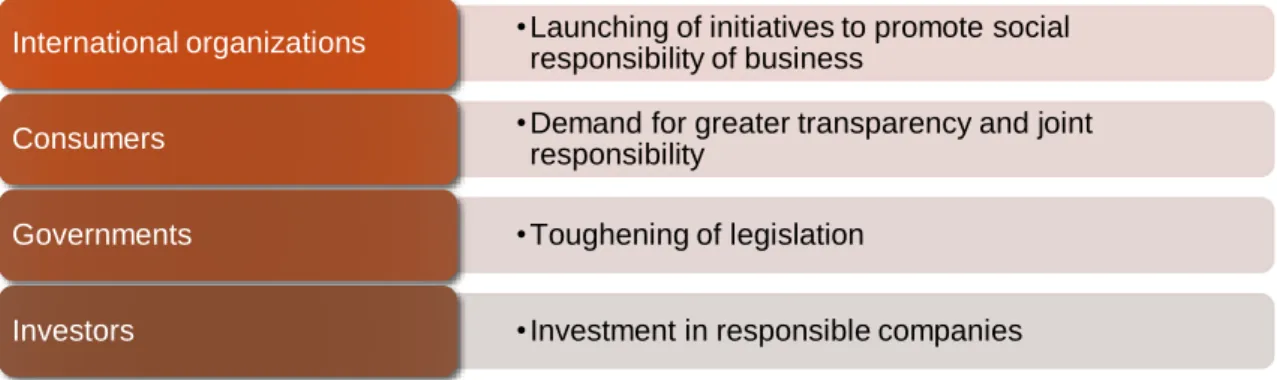
(6) Iglesias, 2013). Companies are an indispensable part to develop strategic collaborations and thus create a social and environmentally sustainable world as outlined by Arenas et al. (2009). Although there are still a lot of reticence to collaboration, companies are becoming more aware of what happens around them and the impact of their activities on the environment and society. According to Arenas et al. (2009) one of the main consequences of globalization has been the greatly increased power of corporations, especially multinationals. Currently, companies influence policy decisions of governments through lobbies or threats to business relocation. But at the same time, companies are receiving more pressure from international organizations, governments, consumers and investors to attempt to solve social and environmental problems (Abenoza et al., 2015) (Figure 1). This pressure from society can become a threat to the organization but also an opportunity. If companies are able to follow the model of responsible and sustainable business will be able to achieve different competitive advantages from a higher reputation, innovation and adaptation to changes (Arenas et al., 2009). Figure 1. The methods used by stakeholders to put pressure on multinationals. International organizations. • Launching of initiatives to promote social responsibility of business. Consumers. • Demand for greater transparency and joint responsibility. Governments. • Toughening of legislation. Investors. • Investment in responsible companies. Source: Own elaboration based on information from Abenoza et al. (2015). Therefore, the company has ceased to be an economic simple agent which manufactures products and provides services for the consumer to become a subject who interacts with the social and environmental surroundings. In recent years, it has developed Corporate Social Responsibility (CSR) which represents a new philosophy for businesses. The main idea of CSR is that an organization has an obligation to work to achieve a breakthrough in social welfare. (Rodriguez et al., 2008). More and more companies that promote social responsibility strategy in response to various social pressures and expect to increase their profitability mainly (Abenoza et al., 2015).. 5.
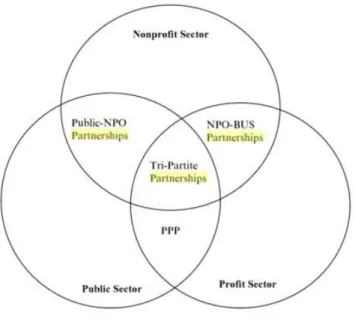
(7) As already mentioned previously nowadays the society is confident that companies contribute to economic growth by ensuring a lower social inequality and conserving the environment. In the last decade, collaborations between civil society and multinationals have increased therefore the hostility that reigned between them has decreased (Abenoza et al., 2015). However, confidence in companies remains low and cooperative relations remain difficult. Already the early 21st century, the report of the World Summit on Sustainable Development (United Nations, 2002) showed that environmental, social and economic problems both current and future can only be solved through collaborations to pool resources, knowledge and skills. In fact, this meeting concluded that a new era for the collaboration between companies and NGOs, in particular, was beginning because these types of collaborations have a greater impact in terms of image and relevance. Although companies and NGOs have had historically a distant and difficult relationship it seems that this situation has begun to change in the last decade (Abenoza et al., 2015). Both sides have realized that they need to collaborate rather than fight each other if they want to solve the problems that affect them both. On the one hand, NGOs have learned that they need to join forces to achieve the objectives. On the other hand, companies have realized that the enormous power that they have implies a great responsibility and have begun to show more interest in the problems that today exist in the world (Carreras and Iglesias, 2013). Therefore, the new global trend in all types of organizations is based on achieving collaboration both in the business and in the social field. It has started a path in which is necessary teamwork, empathize, share ideas and in this way achieve their goals. In fact, in the future it is expected that the companies will have to collaborate more if they want to generate products and services with superior value to competition (Suberviola, 2013). Once it is clear the concept of cooperation and the need to cooperate among organizations, the objective of this section is to know, as already mentioned, some important aspects that are related to this term and which affect NGOs and companies that collaborate together. 2.2 Types of collaborations There are many ways in which two organizations with different characteristics and objectives can collaborate. According to May (2010) there may be collaborations between three basic sectors: public sector, private sector and non-profit sectors (Figure 2). Therefore, we can speak of four types of collaborations depending on the sector in which individual organizations are found: cooperation between public and private. 6.
(8) organizations, between public and non-profit organizations, between private and nonprofit organizations, and finally, collaborations where the three sectors are involved. Figure 2. The sectors of society and the different types of collaboration.. Source: May (2010). As mentioned above, this study focuses on learning more about the relationship between NGOs and businesses because these types of collaborations are widely used and are quite common despite the discrepancies. In fact, in 2011 these relationships became about half of those carried out during that year (Figure 3). Figure 3. Percentage of the different types of collaborations in 2011. 26% 43% 5%. 26% Business-NGO. Government-NGO. Tripartite. Other. Source: The Partnerships Resource Centre (2011). 7.
(9) As previously mentioned, collaborations have evolved in recent decades through different stages. As Beitia et al. (2007) declare relations between NGOs and businesses started from the enmity by carrying out campaigns or lodging complaints against the activities of the companies. Gradually, both sides began to know the advantages that provided them collaboration and went to another stage in which distrust, prejudice and disinterest prevailed. Currently, relations between these two organizations have improved so has managed to pass to the last stage in which collaboration between them develops. According to what is said in some studies (Nelson, 2007; Carreras and Iglesias, 2013) the ways that companies and NGOs collaborate are very diverse and even get to develop collaborations at different levels. Next, I am going to analyse in depth these different levels in which a cooperation may be progressing over time: 1). Philanthropic level The first level of collaboration between NGOs and companies is considered the most basic and traditional which is based on philanthropy. At this level we find ways to collaborate such as sponsorship or patronage (Nelson, 2007). In this case, NGOs intend to find financing for their main objectives and simply perceive companies as a way to get the necessary financial resources. On the other hand, the companies intend to, in most cases, improve their image or even get a tax benefit for the economic support (Beitia et al., 2007). Therefore, this philanthropic level limits collaborative efforts, does not share all resources and acts in one direction because NGOs are recipients of financial contributions or in kind made by companies (Nelson, 2007). 2). Transactional level At this level, relations between companies and NGOs evolve into collaborations more committed and which are among the most basic and more advanced levels. In this second level, there are some methods of collaboration such as cause-related marketing, corporate volunteer projects or fair trade among others (Nelson, 2007). On the one hand, NGOs seek a closer relationship with the company as they begin to realize the possibilities that can get through collaboration. This is the reason that, at this level, NGOs choose the projects where companies can make a great job because they are more interested in the activity and have the resources and capabilities needed to develop these projects. On the other hand, companies try to become more involved in projects affecting staff and the company itself especially and thus get the satisfaction of employees and consumers (Beitia et al., 2007). In this way, companies increase their reputation and acquire a competitive advantage. Therefore, this form of collaboration. 8.
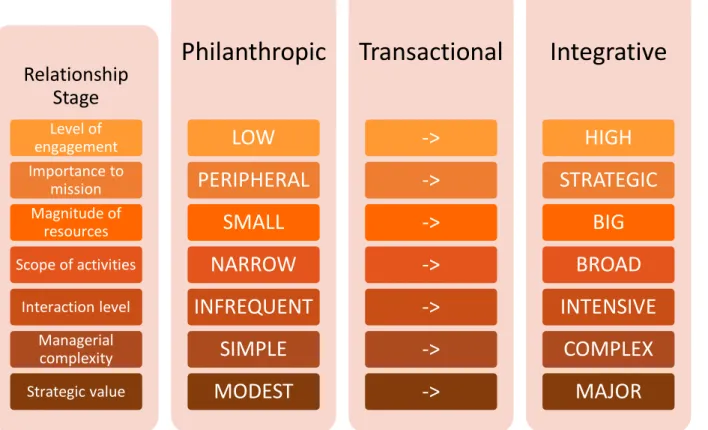
(10) generates in companies a stronger link with the activity carried out and produces a twoway relationship by exchanging resources and services (Carreras and Iglesias, 2013). 3). Strategic collaboration level At this level of collaboration, companies and NGOs work together and are committed to long term in order to generate value for its stakeholders and society. In the strategic partnership there are two main ways to collaborate: Partnership and strategic alliances (Carreras and Iglesias, 2013). These collaborations are established between solidary, accountable and transparent organizations and that have an organizational culture marked by the high values of cooperation (Abenoza et al., 2015). In fact, in recent years it has increased the number of organizations which inform, through the sustainability report, about the global impact that they have had their performances. This voluntary report evaluates the results achieved in the process of collaboration in social, environmental or economic issues (Beitia et al., 2007). Therefore, this model is useful to measure the depth of collaborations through the existing level in several dimensions. The next figure (Figure 4) shows the differences that exist between the seven main characteristics of the three stages according to Austin (2000). Figure 4. Differences between the three stages. Relationship Stage. Philanthropic. Transactional. Integrative. Level of engagement Importance to mission Magnitude of resources. LOW. ->. HIGH. PERIPHERAL. ->. STRATEGIC. SMALL. ->. BIG. Scope of activities. NARROW. ->. BROAD. Interaction level. INFREQUENT. ->. INTENSIVE. Managerial complexity. SIMPLE. ->. COMPLEX. Strategic value. MODEST. ->. MAJOR. Source: Own elaboration based on Austin (2000). 9.
(11) 2.3 Steps in a collaboration In most cases, NGOs and companies follow a few basic steps when they perform a collaboration with the purpose of obtaining better results. As described in previous works (Jamali and Keshishian, 2009; Boué and Kjær, 2010) most collaborations divide their life cycle in 3 steps: initial phase, implementation phase and results phase. Therefore, in this section we are going to comment the different steps that exist in a collaboration from the moment of creation, to continue with the implementation and evaluation of the results and finally with the future expectations of the collaboration. Step 1. Beginning of collaboration All collaboration process begins with a period of internal reflection so that each organization establish before first contact, the motivations that lead him to undertake this project, the objectives and values that has its organization and resources that it can bring to the collaboration (Boué and Kjær, 2010). Therefore, in this first phase, organizations have to delve into the following key issues before starting the project in order to improve the situation of collaboration. Choice of collaborator Organizations should use their resources and their time looking for the right collaborator in the implementation phase. This will make it easier to walk away from failure and generate a common understanding (Boue and Kjær, 2010). So, every organization has some own criteria at the time of choosing the most appropriate and committed collaborator, so they may vary. In any case, some of the criteria that companies and NGOs take into account at the time of collaborator selection according to Beitia et al. (2007) are: -. The behaviour that each organization has during the performance of their activity. On the one hand, NGOs do not usually work with companies that do not respect the rules or agreements on human, environmental or labour rights. On the other hand, companies often shy away from NGOs that do not respect some business working methods.. -. The compatibility on the goals to be achieved and the resources they have both. In addition, these two aspects must be related to the common project that is sought.. -. The interest groups that surround each organization to determine the degree of participation of the same in the various projects.. 10.
(12) -. Other criteria that organizations tend to value are transparency, the degree of sustainability of the organization, professionalism, reputation or degree of involvement in to get specific benefits. Motivations. During the initial phase, organizations have to find out the reasons that lead them into a collaboration. Each one may have a different motivations for undertaking this path but there are some reasons that are more commonly cited. Aspects such as the improvement of the reputation or the increase of credibility in the community prevail for companies (Jamali and Keshishian, 2009). By contrast, NGOs tend to develop a cooperation with a private organization to obtain funding mainly. At the time of creating a collaboration, it is interesting to know the motivations of each one to build a relationship of beneficial collaboration. (Beitia et al., 2007). Design of the project According to Beitia et al. (2007), it is necessary to develop the first matters about the project during the initial phase such as knowing the characteristics of the project, the needs and goals of doing it or even the manner of carrying out specific project activities. Once defined project expectations, leaders of both organizations have to establish the objectives and the resources needed to develop the collaborative project in the best way. In fact, organizations have to know more about the resources that they will be able to contribute to the project because it is necessary to know the feasibility of such collaboration (Arenas et al., 2009). Alignment of the target The objectives to be achieved with the collaboration can be defined with greater security when each one has clear their motivations, their resources and the expected benefits. These goals should be deep to create a closer collaboration and should be established since prudence and coherence with the process carried out (Beitia et al., 2007). According to Boué and Kjær (2010) the success or failure of collaborations resides in discovering the interests of each party and from there they develop common goals. It is essential to build a common understanding on collaboration in order to develop a sense of co-dependency with collaboration. In addition, Austin (2000) states that the achievement of these objectives must produce some mutual benefits which lead to create a set value. This value is generated exclusively by the collaboration. According to Beitia et al. (2007) the collaborating organizations indicate different types of objectives. 11.
(13) at the time to undertake this process such as social development, equality in the work environment, progress in service to disadvantaged groups, employee satisfaction, and many more. Step 2. Execution of the collaboration Once the member organizations of the collaboration choose the perfect project and establish appropriate objectives to achieve this, it is time to move into action. In this next phase, collaboration has to take into account some key issues which are important to promote good performance of partners (Boue and Kjær, 2010). First, these authors claim that top management has to take a step forward and commit with the cooperation during this stage. Thus, more confidence and participation in the collaboration is achieved. In addition, these leaders must encourage interaction between organizations through open and frequent communication. In fact, these authors assure that employees must continually exchange their knowledge and skills to improve the activities of the collaboration during this phase and consequently a more fruitful and durable relationship is achieved. Step 3. Outcome of the collaboration In this last stage, members of the collaboration evaluate the performance and results achieved in the process. According to Beitia et al. (2007) both organizations have to carry out continuous tracking of collaboration to check whether are being achieved objectives and to ensure that the project progresses. Also, the benefits that have been obtained for both the stakeholders of organizations and the society in general are checked (Boue and Kjær, 2010). Future expectations Most of the collaborations tend to make a break for reflecting on the terms of collaboration and resolve any possible controversy once the project has completed. Subsequently, the collaborating organizations decide if they want continue with a new project, if they prefer to perform an existing project or if on the contrary they take the decision to separate at least for a while (Jamali and Keshishian, 2009). Therefore, the last step of the collaboration is to decide whether the period of collaboration is finished or is extended. (Boue and Kjær, 2010).. 12.
(14) 2.4 Impulses and benefits in collaboration for companies and NGOs During the last years, companies and NGOs have discovered that there are some elements that drive the development of collaborations between them. These motivations that lead organizations to promote collaborations are quite diverse. In addition, participants in the collaboration get a valuable experience and some particular benefits when the collaboration achieves the objectives. In this section it is time to try to learn more about some of the main reasons that lead an organization to want to be part of a collaboration and some of the benefits achieved after the completion of the project. Obtaining resources The main reason by which NGOs decide to undertake a project with some companies is for obtaining both financial and in-kind resources in accordance with Abenoza et al. (2013). During these years of crisis, social demands have grown and resources available to meet these needs have declined dramatically. This has led to organizations to seek new ways for funding. In fact, collaborations have managed to become the main way to get the necessary resources in recent years. In addition, these social demands are increasingly complex so that it is difficult that a single organization has the resources, knowledge or skills necessary to resolve social problems. Therefore, Iglesias and Carreras (2013) indicate that organizations are being forced to form a collaboration to achieve the proposed targets due to the inability to resolve existing demands by themselves. As has been mentioned previously, collaborations are an excellent way to get private funding and to diversify the sources of funding. Therefore, one of the main benefits for NGOs is to obtain financial sustainability. However, there are more benefits for NGOs because working with private companies makes it possible non-profit organizations learn new management skills. In general, the private sector has great knowledges in areas such as financial management, long-term planning, marketing and investigation and development among others (Damlamian, 2006). This experience is very useful for NGOs when it comes to achieve their goals more efficiently. Pressure from society Society in general is pressuring NGOs especially to make a greater number of collaborations. According to Iglesias and Carreras (2013), in recent years the perception of society towards NGOs has changed. In some cases, people have questioned the value generated, their legality and even the excessive number of such organizations that generates duplication and higher costs. Therefore, NGOs are virtually forced to make collaborations with both public and private sector.. 13.
(15) Development of joint projects. According to Abenoza et al. (2013) NGOs and companies may be motivated to develop joint projects for various reasons. First, this collaboration can help them fulfill their mission and achieve their goals more quickly and efficiently. In fact, according to Iglesias and Carreras (2013) are becoming more the collaborations that arise with the idea of being facilitators mechanisms to achieve their goals. Also, to bet on carrying out joint projects can be understood as a challenge for organizations and as a way to have new experiences. Finally, some collaborations seek to influence some actions of the other organization and try to sensitize with some actions to society in general (Abenoza et al., 2013). Improvement in image of the company. Companies that collaborate with NGOs substantially improve the corporate image and reputation. This is possible because consumers believe in NGOs and they know that these organizations seek the benefit of society so confidence in the company increases simultaneously (Damlamian, 2006). Nowadays this fact is very important for companies because the high number of competitors makes it necessary to generate a competitive advantage to be different from others. Therefore, a company begins to work with an NGO in order to aspire to improve its reputation and to be believable in commitment to social responsibility. Improvement of company CSR. In recent years, companies have simply ceased of making donations and have begun to carry out activities in which they are more involved in the social problems (Beitia et al., 2007). Companies have realized that after doing a collaboration with an NGO contribute in a better way to their CSR policies. This is mainly due to the ability of NGOs to propose innovative ways to businesses in order to solve social problems because of their extensive experience in these issues (Damlamian, 2006). Therefore, collaborations generate an improvement in CSR policies of corporation due to the increase in the number of collaborations together with ONGs. Apart from these benefits, collaborations can generate many other positive values for the participating organizations. According to Beitia et al. (2007) the company can achieve the acquisition of new knowledge for management, access to new markets, and increased motivation of its employees with the development of sustainable practices, among many others. On the other hand, according to these authors NGOs can improve. 14.
(16) transparency, designing new projects and establish new channels to spread their message, among others. 2.5 Impediments and risks in collaboration for companies and NGOs In recent years, collaborations have increased mainly because they have high benefits for society and for those involved as we have seen above. However, certain barriers that prevent the growth of such collaborations appear at the time of thinking about making a cooperation. In addition, collaboration have a key feature which is about sharing the benefits but also the risks. In this section it is time to try to learn more about some of the main barriers that prevent organizations at the moment of wanting to be part of a collaboration and those risks that are generated after the collaboration in participating organizations. Negative experiences. In recent years there has been a large number of collaborations that have not been very important and effective, so that certain doubts and fears have spread especially in the time of forming new collaborations. According to Beitia et al. (2007), in some organizations there is a strong fear of compromising resources or time. This fear appears especially when the objectives are not specifically defined or when there is no guarantee of success. In addition, there are some organizations that have had a bad experience with collaboration and prefer not promote new projects. In fact, these organizations are posed if it is really significant to develop some collaborative projects, because the results achieved are not always proportional to the investment made (Iglesias and Carreras, 2013). In the case of NGOs there is a great fear to risk his reputation at the time of collaborating with companies. Before carrying out a collaboration, NGOs have to do a good job of research to collaborate with companies that have an ethically correct behaviour during the practice of their activity. In this way, NGOs avoid endangering their own image. According to Smuts (2010) NGOs can be compromised in the case of being financed by a company with questionable behaviour because they endanger their own image. Organization not prepared for a collaboration. During the collaboration, organizations must be prepared to lose some autonomous when it comes of making decisions mainly, and to share benefits but also risks and image (Beitia et al., 2007). Collaborate involves taking decisions on a shared basis so for some leaders of the participating organizations, this aspect can be difficult to them. In addition, organizations have a culture and a strong values which make it difficult to enter a. 15.
(17) collaboration for fear of sullying or even lose that identity (Iglesias and Carreras, 2013). For these reasons, many organizations are not seen prepared to adapt to new changes brought by collaboration. Not perform efficiently the proposed project. Collaborations between private sector organizations and non-profit sector tend to be complicated because there are usually a number of issues that must be resolved from the beginning of collaboration to accomplish the project properly. For example, Beitia et al. (2007) point out that the interests of both sides must be aligned correctly to generate common goals and to coordinate policy development among organizations. Also, Boué and Kjær (2010) indicate that employees of both organizations have to participate and feel committed to the collaboration. Therefore, it is necessary that from the first moment all staff know which the proposed objectives are. Another important factor to consider for Damlamian, C. (2006), is to develop a collaboration from the trust and honesty to achieve good communication between participating organizations. In conclusion, these are some of the issues that organizations have to take into account from the first moment because any of these can lead to complications, lead to failure the collaboration and get a negative experience. 2.6 Success factors The success of a collaboration according to Carreras and Iglesias (2013) lies in efficiently and effectively achieve the desired objectives and assess the impact on participating organizations and society in general. Therefore, know what will be the success of a collaboration is quite complicated because each collaboration is unique and the success factors may be different depending on the organizations and people that make possible such collaboration. Anyway, some studies about these issues (Tennyson et al., 2008; Abenoza et al., 2016) are sure that it is possible to identify some factors that promote the successful development of partnerships. Then we are going to remark four key issues affecting generally to collaboration: 1). Recognition of advantages that are generated by the collaboration. All members of collaborations must value the positive aspects that are generated by the union of their organizations. Such a union creates superior value as a result of the combination of different skills and resources that provide the participating organizations (Abenoza et al., 2015). At first to generate a commitment to collaboration is necessary that the main leaders of the respective organizations demonstrate their categorical support to the collaboration. This support is crucial to drive change (Carreras and. 16.
(18) Iglesias, 2013). In this way, leaders should have decision-making power in the organization, experience from previous collaborations and a positive attitude towards the changes in order to increase the chances of getting a successful collaboration (Beitia et al., 2007). 2). A relationship of respect and trust. The collaborations are possible when the involved organizations respect each other (Tennyson et al., 2008). This respect generates a more compact union among the participants of the collaboration which leads to share their skills, knowledge and resources with the other organization. In this way, it is possible to build a relationship of trust between organizations. On the other hand, collaborations must be carried out under an honest and transparent relationship in order to achieve greater effectiveness. Although some writers think that NGOs and businesses will never get trust each other, the truth is that honest, transparent and open communication between organizations will get to establish a fruitful relationship of long-term (Carreras and Iglesias, 2013). This transparency is generated from the exchange of information to know the motivations of each one, the results they expect to get and the contribution of resources to the collaboration, among other things (Beitia et al., 2007). In this way, collaborations will be stronger and will survive to the inevitable difficulties that will experience. 3). Common objectives. It is clear that companies and NGOs have different objectives but in a collaboration is essential to have common objectives (Beitia et al., 2007).The advancement in organizations towards the achievement of common goals makes the relationship be strengthened and those involved are committed more strongly. Those collaborations without a common goal tend to break easily as they do not have a direction in which to focus. Also, it is essential to have the signed agreements on paper in order to strictly follow the objectives described there and able to use them at times when the direction of the collaboration is lost (Carreras and Iglesias, 2013). On the other hand, for a successful cooperation it is essential to have a clear distribution of roles between the parties, and so everyone knows well what to do. It is also interesting to have a fluid communication channels between the organizations of a collaboration from the first moment in order to to avoid some misunderstandings, resolve some operational problems and maintain the union of organizations stronger (Abenoza et al., 2015).. 17.
(19) 4). Commitment to the collaboration. Success in these relationships is greater when the participants of a collaboration feel integrated in it and believe they have a key role in the development towards the achievement of the objectives (Tennyson et al., 2008). In addition, the organizations involved in a collaboration have to be committed to making a change in themselves. Participation in a cooperation entails the integration of common objectives on their core business as a minimum (Carreras and Iglesias, 2013). Therefore, the success of a collaboration lies in finding the right partner who is committed and prepared to change some things in their business to get a greater impact on the proposed objectives of the collaboration. Also, organizations have to consider those other success factors more specific to each collaboration such as equality of power between the two organizations or the evolution of the relationship into new areas of collaboration (Tennyson et al., 2008). However, having these factors does not mean that collaboration is going to achieve great successes. In a few words, these key aspects provide greater security at the time of reaching the objectives (Carreras and Iglesias, 2013). On the other hand, organizations have to consider the possibility of continuous tracking during the execution of the collaboration to achieve greater success, especially during the start-up phases. However, many effective monitoring tools do not exist yet in collaborations because these types of relationships between organizations are a recent method from which have not been able to extract many conclusions (The Partnerships Resource Centre, 2011). 3. STUDY CASES After discussing the main aspects that it is necessary to take into account at the moment of analysing the collaborations between NGOs and companies, it is time to move on to examine the study objective. The main question of this study is "what are the key factors that affect longevity and positive results in the collaborations?” To do this, we will analyse how different collaborations are created and developed and then we will perform a comparative analysis. Therefore this paper proposes to analyse three case studies of collaborations in order to know common aspects that promote good relations between NGOs and companies. In this work, we are going to use the research method "case study" because it is the most suitable to the characteristics that are going to study. This is because in this work we are going to provide answers to some questions which are more suitable for this research methodology. According to Yin (1989) the method of case study aims to answer. 18.
(20) the "how" or "why". These questions try to identify the central problem of research. In addition, during the study we will use a lot of documents and secondary data for elaboration of the investigation therefore we will bet by using a qualitative method. In this research a positive influence on the reputation and motivation of employees of the companies is expected. In this case, we will study three cases since according to Yin (1989) you have more chances of making a good study and get stronger results depending on the number of cases studied. Therefore, if the three cases show the same pattern, the conclusion of the investigation will be strengthened. On the other hand, the choice of cases has been an expensive task since these have been carefully selected to comply with the established criteria. First, collaboration must be between NGOs working with predominantly social projects and large companies operating in Spain. In addition, information on this collaboration must be accessible in order to get enough to analyse the various cases more properly. In this study, we have chosen three large companies which have a great possibility of getting a similar conclusion to reality. Therefore, to perform this task, we have started looking for a list where the main companies operating in Spain appear and at that point we have continued researching on the websites of each company to see the collaborations they have made. In particular, we have been researching through annual reports or CSR reports to know the involvement of these companies with social problems essentially. After having a massive list of collaborations that were within the proposed criteria, we have chosen those cases in where projects were already completed to discover the possible outcomes. Specifically, the three collaborations that we are going to study in this research are: UNICEF and ING, Intermon Oxfam and DKV, and Doctors Without Borders and Inditex. 3.1 ING and UNICEF ING is a global financial institution with headquarters in Amsterdam whose main function is to carry out banking, insurance and investment services. According to the annual review (ING Bank, 2016), ING has a skilled workforce of more than 50,000 people who try to meet the needs to over 34 million clients located in over 40 countries from around the world. On the other hand, UNICEF is a non-profit organization founded in 1946 and present in more than 190 countries which is dedicated to the promotion and defence of the rights of all children in the world. It is one of the main humanitarian and development agencies that collaborates with others to work for the education, the health, the protection and the equal of every child (Van der Giessen, 2015).. 19.
(21) The collaboration of ING and UNICEF seeks to help children from developing countries for going to school. Thus, the young people from countries like Ethiopia, Zambia, India, Brazil and the Philippines can receive an education and increase the probability of escaping poverty and of building a better future thanks to the efforts of these organizations (Netherlands National Committee for UNICEF, 2015). In fact, collaboration between ING and UNICEF contributed to achieve the Millennium Development Goal 2: "Achieve universal primary education" (UNICEF, 2012). During 2005, ING employees chose to promote this project with UNICEF to develop an interest experience and achieve this fundamental objective. According to ING (2015) both ING and its employees have come to intensely be involved and have created a strong strategic collaboration, even they have donated their time and money to help get this project. Beginning of collaboration. During the years before 2005, the company ING had been carried out some local and specific initiatives with the participation of their employees in those countries where it operated in order to develop beneficial programs for children especially (ING Group, 2005). However, the company wanted to go a step further and to focus on global education initiatives in order to help more people. For that reason, ING began investigating possible candidates for collaboration in 2005. Finally, they chose for UNICEF because this organization is present throughout the world, is transparent and honest so it is easier to completely rely on it, and its main task is to protect the rights of children around the world so it has the knowledge and skills necessary to perform largescale projects (Van der Giessen, 2015). This collaboration was positive for both sides. On the one hand, UNICEF needed new collaborators to get more resources and thus be able to help more children. On the other hand, ING supported this project with the idea of showing some of its local programs, of improving the lives of many children with few resources and of making known the image of socially responsible company (ING Group, 2005). In addition, ING employees were committed with the project, with the idea of participating in a collaboration with UNICEF and with the task of helping children (Van der Giessen, 2015). In this way, it is like program "Chances for Children" appeared with the support of UNICEF. This project is built on a vision of making a favourable contribution to the education of children in many areas of the world in which both ING and UNICEF are present (ING Bank, 2015). According to vice president of ING (Van der Giessen, 2015) "Both organizations are united by a belief that education is a fundamental element for the development of children and their societies". Therefore, both organizations had some. 20.
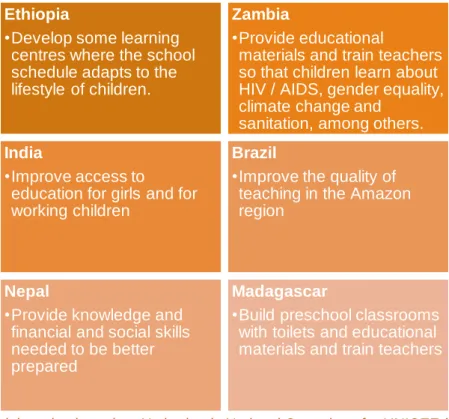
(22) similar interests and a strong commitment in improving the welfare of the children so they created a common understanding quickly. Execution of the collaboration The collaboration between ING and UNICEF has evolved over the years and have added new programs and activities with the aim of raising funds to provide quality education and better living conditions. From the beginning of this collaboration, the staff of ING has had a great responsibility in the success of the project since all economic contributions they do, are matched by the company (ING Bank, 2015). Also, employees have the opportunity to be part of volunteering of collaboration and perform any of their capacities as financial advisory services for example (UNICEF, 2012). Therefore, the staff of ING donates both money and time in carrying out some campaign or volunteering. In addition to employees, ING also involves to the clients by performing donations in several different ways. On the other hand, ING raises funds internally through raffles, auctions or performing some internal events such as the Marathon ING or ING Golf Tournament. Also, the company sponsors other events, provides logistical support for some projects or sells some of its products or services to benefit the NGO (UNICEF, 2012). Therefore, this collaboration is in a transactional level at which sponsorships, some cause-related marketing activities and volunteering among others, are performed. All funds raised by the above mentioned practices have been for improving the lives of those children who live in underdeveloped places. From the first moment, the collaboration between ING and UNICEF aimed to develop a basic project in 6 countries: Ethiopia, Zambia, India, Brazil, Nepal and Madagascar (Figure 5). As the goals of these projects have been achieved, new activities in these countries have been proposed. According to Netherlands National Committee for UNICEF (2015) the main objective of these projects is to improve the education of children but also other support activities are proposed to improve their basic needs in reference to food, health care or drinking water. Also, ING has collaborated with UNICEF in some emergency situations to urgently help children as are the cases of Ebola in Africa, the earthquake in Haiti, the food crisis in the Horn of Africa, the great floods in Pakistan or the typhoon in the Philippines.. 21.
(23) Figure 5. Projects undertaken in these countries. Ethiopia •Develop some learning centres where the school schedule adapts to the lifestyle of children.. Zambia •Provide educational materials and train teachers so that children learn about HIV / AIDS, gender equality, climate change and sanitation, among others.. India •Improve access to education for girls and for working children. Brazil •Improve the quality of teaching in the Amazon region. Nepal •Provide knowledge and financial and social skills needed to be better prepared. Madagascar •Build preschool classrooms with toilets and educational materials and train teachers. Source: Own elaboration based on Netherlands National Committee for UNICEF (2015).. Outcome of the collaboration This collaboration with more than 10 years of life has achieved a better quality education for further than 1 million children of the most remote areas of the world mainly. During these years, ING has raised more than 29 million euros to improve educational programs (Netherlands National Committee for UNICEF, 2015). Some of that money has been earmarked with efforts by the employees of the company who have obtained great personal satisfaction after seeing the results achieved (ING Bank, 2015). In fact, the annual report of ING (ING Bank, 2014) showed a positive trend in the level of employee commitment toward the company, becoming 75 percent two years ago. In addition, the commitment in the collaboration has increased because initially six projects were realized, but seven new projects have been added until 2015 (Netherlands National Committee for UNICEF, 2015). Therefore, both organizations were satisfied with the relationship and were continually looking for new challenges. The projects established during this decade have achieved the following results which are analysed and explained by Netherlands National Committee for UNICEF (2015). In the case of Ethiopia a total of 458 basic education centres have been built to provide education to over 50,000 children. On the other hand, in Zambia 13 new schools that provide quality education to over 84,000 children have been created and 344 teachers have been formed in order to have superior knowledge.. Thanks to the project. 22.
(24) established in India it has been possible to reduce by 63 percent the number of child workers and provide free transport to more than 37,000 girls who have school far away from home. In addition, more than 3,000 schools have received new teaching materials and teachers have been trained to teach in a more stimulating way. In the case of Brazil, the quality of education has improved considerably so more than 550,000 children in the Amazon region are benefiting. Moreover, illiteracy and truancy has decreased and academic achievement has increased. On the other hand, new materials to educate teens about social and financial issues have been developed in Nepal. In addition, this knowledge is disseminated through the national radio to reach more than 7 million teens. In Madagascar, have been built 32 classrooms preschool that also can be used as a shelter for hurricanes and 20 preschool teachers have been trained to provide an educational base to more than 1,000 children. These are some of the results of major projects where ING has participated with UNICEF, but it is noteworthy that during this decade other activities have been carried out around the world and have been achieved other positive results. Therefore, after knowing the success that “Chances for Children" campaign has achieved, ING and UNICEF have decided to expand their cooperation and create new projects for the future. The new objective of this collaboration is to teach more than 335,000 adolescents from Indonesia, Kosovo, Montenegro, Nepal, the Philippines and Zambia until the end of 2017 (ING Bank, 2015). This new campaign with the slogan "Power of Youth" intends to provide adolescents with the tools and skills needed to build a better future. According to UNICEF (2015) the idea of this project is to teach young people everything they need to get ahead as training for entrepreneurs, psychological support and employment orientation, among others. Thus, this project invests in a generation of young people at the time that most need help. 3.2 DKV and Oxfam Intermon DKV Group is a Spanish subsidiary of Deutsche Krankenversicherung AG (DKV), a company specializing in health insurances. According to the Sustainability Report 2014 (DKV Seguros, 2015) DKV has a specialized staff of over 2000 employees who try to meet the needs of more than 1.6 million clients through its more than 60 offices located all around the Spanish territory. On the other hand, Oxfam Intermon is a nonprofit organization which forms part of Oxfam, an international confederation of 17 organizations around the world. More than 1700 Spanish volunteers are dedicated to working for the rights and welfare of those people who are in situations of exclusion (Oxfam Intermon, 2015).. 23.
(25) The collaboration of DKV and Intermón Oxfam tries to help all those people who live in poverty in order to be able to have a decent life for themselves. This collaboration promotes social awareness campaigns and humanitarian aid. Since 1998 with the signing of the first cooperation agreement, it has been positive developments in the commitment and trust (Europa Press, 2005). Thanks to the good work of senior executives of both organizations, this relationship has gone through the various levels of collaboration and has been noted by some experts in corporate social responsibility as an example for other companies (Corella, 2005). Beginning of collaboration. DKV Seguros had supported some solidarity activities such as donations or food sending in previous years and both employees and the leadership of the organization were excited about collaborate with an NGO (Planellas et al., 2008). In addition, DKV wanted to improve its image as a responsible company and teach some values to their employees. Moreover, Intermon Oxfam needed private funds to finance their projects because as the annual reports of the NGO show (Oxfam Intermon, 2015) more than 60 percent of its funding comes from private companies. In addition, DKV was within the basic parameters that any collaborating company had to possess. In 1998 the first cooperation agreement between the two organizations was signed because a former employee of the DKV group happened to comprise of the leadership of Intermon Oxfam of Aragon and managed to bring positions between them (Planellas et al., 2008). In those 3 years of agreement, DKV Seguros became the sponsor of the Trail Toys and became one of the main sponsors of "one day for hope" where the NGO is made known through playful activities. In addition, the company began to spread advertising of Intermon Oxfam and started to buy fair trade products for corporate gifts and Christmas baskets. On the other hand, DKV was interested in getting more involved in collaboration and it was demonstrated when he collaborated in some emergency cases such as Hurricane Mitch and the floods in Mozambique (Abenoza et al. 2015). During this stage, the collaboration was on a philanthropic level because the company conducted primarily sponsorships and donations. Therefore, there was not much communication between the two organizations because there was no trust and each was concerned by define their own goals (Planellas et al., 2008). At the beginning it was very important the role of both directives, those who trusted in this collaboration. But it was really in 2001 when both organizations realized that might arise an excellent collaboration.. 24.
(26) After 3 years, the two organizations wanted to renew and establish a long-term relationship but this time DKV Seguros sought stronger cooperation with the NGO in order to spread some values among its employees (Oxfam Intermon, 2001). At that moment Oxfam Intermon analysed in depth to private enterprise to know if they respect and share those values for which Intermon Oxfam struggle and thus be able to establish a deeper collaboration (Abenoza et al. 2015). So, once the objectives of each organization were clear, they signed an agreement for another 3 years in order to carry out awareness raising activities and humanitarian aid. Execution of the collaboration In this new phase of collaboration, DKV Seguros was committed to donate 108,000 euros which were allocated to activities such as the celebration of "One day for Hope" and the trail of toys in Zaragoza among others. Another part of the donation was used for reconstruction projects in India and El Salvador after earthquake (Oxfam Intermon, 2001). In addition, the company continued by reporting on campaigns and activities that the NGO was carrying out, and then disseminating fair trade through the purchase of these products for corporate gifts. On the other hand, in 2001 the employees of the company created a volunteer group to participate in those social projects that they sponsored (Planellas et al., 2008). Therefore, the commitment of time and effort of employees increased significantly during the year. At this stage both directives began to interact more between them so a better relationship was generated. In fact, many decisions were made jointly and any initiative was consulted before carrying it out so that an atmosphere of trust and understanding was created (Abenoza et al. 2015). During these years, the collaboration happened to be at a transitional level as the company became more involved with the proposed activities, encouraged a more participatory environment and created a volunteer group. In addition, some activities were undertaken in order to exploit to the maximum the collaboration. On the one hand, Intermon Oxfam began to make a report with different information about sponsored activities DKV Seguros in order to assess the results and know the objectives that had been achieved (Planellas et al., 2008). On the other hand, DKV Seguros started working in its Sustainability Report with the help of an Intermon Oxfam representative on the Board. In fact, DKV Seguros was the first insurer in the world to present a sustainability report "in accordance" which is based on compliance of five basic conditions information, in order to be more transparent (Europa Press, 2004). Therefore, different interactions and exchange of knowledge between the two organizations generated different benefits in the collaboration.. 25.
(27) In 2005, the two organizations decided to continue with the collaboration because of the close relationship that they had at that time and the good results they had obtained. In this case, they signed a 5-year agreement and the relationship was seeking a greater degree of involvement. According to Europa Press (2005) the collaboration continued with the diffusion of information on collaboration, with the purchase of fair trade products and the realization of its two main projects: the trail of toys Zaragoza and "One day for Hope". However, in this agreement, both organizations decided to select a main project in order to send the majority of the contributions. This project had to be related to health because has consistency with line of business of DKV. Finally, they chose the construction of maternal and infant area of Regional Hospital of Ambato in Ecuador. Thus, the objectives of both organizations were aligned and a project that was related to the strategy of both was developed. In addition, Intermon Oxfam had new advertising avenues by means of two sports teams sponsored by DKV: DKV Joventut basketball, and DKV Seguros Zaragoza futsal (Planellas et al., 2008). On the other hand, the economic contributions to carry out the projects established, were almost entirely a donation of 387,000 euros made by DKV Seguros. In addition, the company allocated 0.7 percent of annual turnover of the product "Life Retirement Plus" to the Project of Ambato. Also, DKV employees decided to donate one of his day’s wages to any of the projects (Corella, 2005). During these years the exchange of knowledge and level of communication between the two organizations was at a high level so they wanted to expand that relationship to its stakeholders (Planellas et al., 2008).. In this case, it was decided to improve the. connection of the employees of DKV with the collaboration and for this purpose several activities were undertaken such as organizing informational meetings to know the assessment of projects, the realization of tours for workers of DKV to area of the project in order to see with their own eyes the progress, dissemination campaigns and specific activities to encourage volunteerism or invitation to employees of the insurance company to lectures and exhibitions organized by the NGO. Outcome of the collaboration Collaboration between DKV and Intermón Oxfam has been focused on reconstructing all those places that have been affected by some natural disaster like India and El Salvador after earthquakes or Mozambique after floods. According to Europa Press (2005) their goal is to provide humanitarian aid to those affected and work on getting basic services as soon as possible. Thus, this collaboration has managed to productively reactivate these areas quickly in order to return to a similar level of development to which they had. 26.
(28) before the disaster. In addition, projects have also focused on improving the lives of those who are in underdeveloped areas by building hospitals for example. On the other hand, this collaboration has generated significant benefits for both organizations. According to Planellas et al. (2008) "DKV relationship with Oxfam Intermon increases the credibility and confidence of the stakeholders of DKV, that is, increases the values of reputation." This happens because the company is recognized as a strategic partner of Oxfam Intermon so the image of the company is strengthened. In addition, the commitment in the relationship has been increased because in 1998 they were carried out four activities and in 2010 they developed 21. (Planellas et al., 2008). Therefore, both organizations were satisfied with the relationship and were continually looking for new challenges. Moreover, according to Abenoza et al. (2015) DKV was convinced that collaboration with the NGO was the necessary form to transmit certain values to employees as solidarity, responsibility and participation. In fact, it can be stated that collaboration with NGOs has strengthened these values since the number of employees of DKV who is committed to some of the corporate volunteer activities has increased to 60 percent, one of the highest percentages (DKV Seguros, 2015). In addition, 91% of employees is committed to this insurance company according to index Towers Watson in 2015 (DKV Seguros, 2015). For Oxfam International, collaboration with DKV has generated him the opportunity to achieve more effectively the objectives set and has served him to demonstrate to society that it is possible to make a collaboration with private organizations (Planellas et al., 2008). In the past these two organizations were able to align the goals of the collaboration with its strategic objectives so that nowadays this relationship continues to grow. Currently and since 2011, this collaboration believes in a very interesting new project which is sponsored by DKV Seguros. According to Oxfam Intermon (2016) The Intermon Oxfam Trailwalker is a sports career that is done by teams of 4 people who have to cover 100 km. Before the event, each team must raise at least 1500 euros to participate. All money raised is used by Intermon Oxfam to ensure access to safe drinking water and to improve hygiene to the most disadvantaged people of countries such as Ethiopia, Chad and Central African Republic. Since the first edition in Spain, in this event have already participated more than 1792 teams that have disbursed more than 3.5 million euros. In the future, DKV and Intermón Oxfam are going to continue carrying out projects together and are going to maintain that relationship of trust and mutual respect (Planellas et al., 2008).. 27.
(29) 3.3 Inditex and Doctors Without Borders Inditex is a group headquartered in Galicia that provides quality fashion products around the world through its more than 7,000 stores. According to its website, more than 150,000 employees work to design, manufacture, distribute and sell through the different fashion brands: Zara, Pull & Bear, Massimo Dutti, Bershka, Stradivarius, Oysho, Zara Home and Uterqüe. On the other hand, Doctors Without Borders is a nonprofit international organization with more than 30,000 employees working in projects distributed over 60 countries according to its website. Its main objective is to attend to those people who are in situations of armed conflicts, natural disasters, exclusion of medical care and epidemics. Inditex collaborates with Doctors Without Borders in social activities since 2008 (Europa Press, 2008). All projects carried out have focused on improving the health of those people who live in places that are going through a time of emergency. According to Europa Press (2014) Inditex had collaborated through Doctors Without Borders projects in 26 countries and 19 emergency areas with more than 14 million euros until 2014. Beginning of collaboration. During the early years of the 21st century, the Inditex group began to participate in some projects promoted by non-profit organizations in order to encourage the development of the population in a precarious situation. These projects promoted education and learning in those areas where Inditex was present through its business activities as Venezuela, Peru and Brazil (Urriolagoitia et al., 2008). In addition, the Spanish multinational participated through monetary donations in some emergency projects such as the reconstruction of the area in Southeast Asia after the tsunami in 2004 and the cleaning of the Galician coast after the sinking of the Prestige in 2002. Therefore, as indicates the annual report (Inditex, 2007) over 23 million euros have been donated by this company to different projects proposed during those years. Along 2007, Inditex was looking for new social projects to get involved and reinforce its image due to the good results and interesting experience that they had achieved in previous projects undertaken. Finally this Spanish multinational chose Doctors Without Borders because according to its website it was an organization with strong principles, with various social projects in progress and experienced in the place where the actions are developed. On the other hand, Doctors Without Borders needed large donations to carry out different medical and humanitarian aids because according to its website, 90 percent of their income come from private sources. This NGO decided to collaborate with. 28.
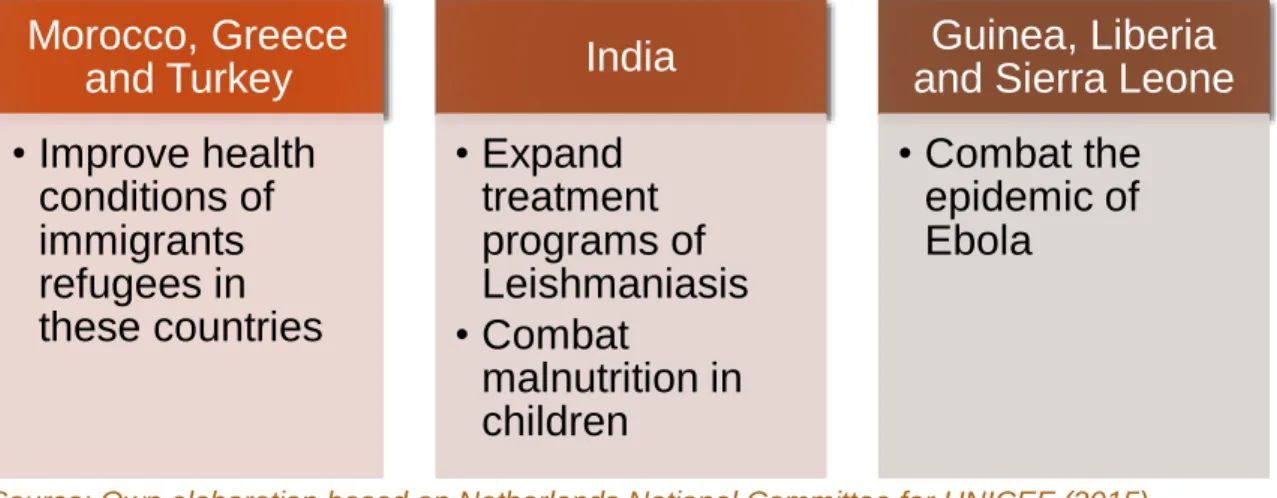
(30) Inditex because it was not in contradiction with its code of ethics and in order to provide its experience in selection of social projects. Therefore, in 2008 Inditex and Doctors Without Borders signed a collaboration to encourage health projects in some precarious areas. During that year, it was carried out a project in order to fund certain activities to improve primary health and child nutrition and to provide basic health education in various areas of Somalia (Urriolagoitia et al., 2008). To do this, Inditex promised to invest over 1.5 million euros. In addition, Doctors Without Borders became part of the Social Council of Inditex to decide new activities as regards to corporate social responsibility (Europa Press, 2008). Therefore, this collaboration was in a philanthropic level during the first year because Inditex simply carried out donations. Execution of the collaboration Inditex and Doctors Without Borders have expanded the collaboration agreement since 2008. Each year, a new social project is added to the collaborative program due to the good relationship that has arisen between them and the good results they have been getting (Inditex, 2013). In the following figure (Figure 6), the main projects that the NGO has been working with Inditex donations are observed. In addition to monetary donations, Inditex has sent more than half a million pieces of clothing to Syrian refugees in Lebanon and put on sale in some of the stores of Inditex a storage device of music in which choirs of Zimbabwe have participated to send a message of support to the fight of HIV (Europa Press, 2011; Martinez, 2016) On the other hand, from the beginning both organizations have had an ongoing dialogue and has been a strong commitment to the participation in various projects. In fact, the Inpulse portal was created in 2011 so that the workers of Inditex could find the latest news about Corporate Social Responsibility initiatives carried out (Inditex, s.f.). Since then, the employees of this company have the opportunity to present their own social initiative and in case of obtaining the necessary votes, Inditex helps to carry out these projects through monetary contributions and time for employees for implementation. Therefore the relationship improved and collaboration began to be in a transactional level because the company became increasingly involved with more projects and new ways to collaborate and encouraged employees to create new initiatives.. 29.
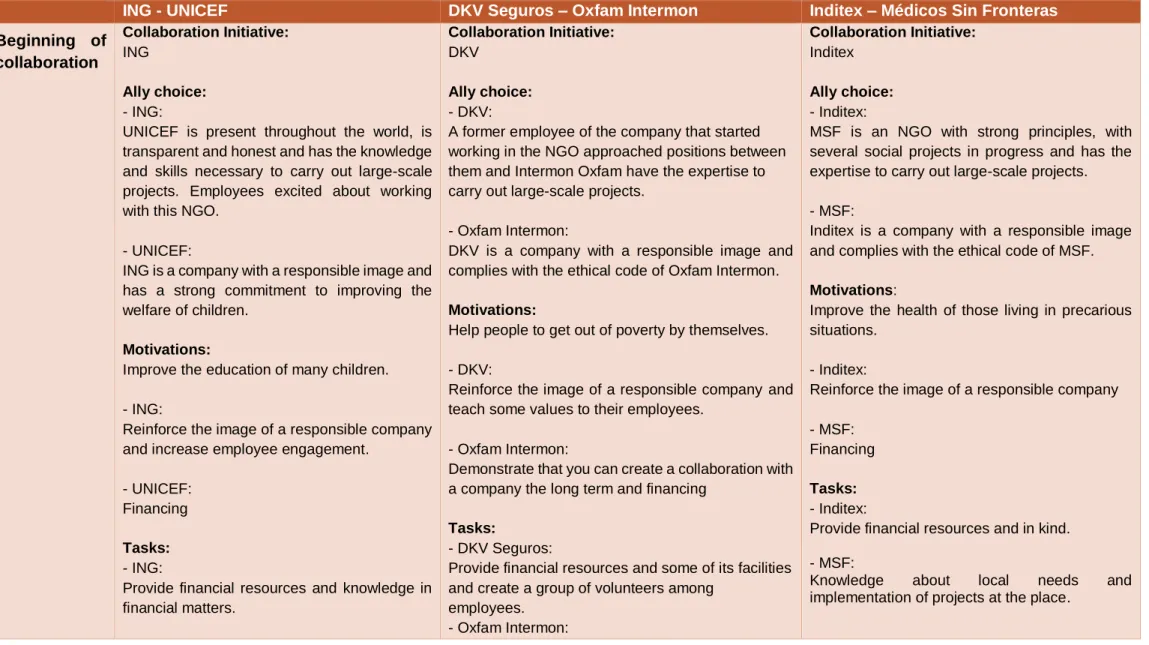
(31) Figure 6. The main projects carried out in this collaboration.. Morocco, Greece and Turkey • Improve health conditions of immigrants refugees in these countries. India • Expand treatment programs of Leishmaniasis • Combat malnutrition in children. Guinea, Liberia and Sierra Leone • Combat the epidemic of Ebola. Source: Own elaboration based on Netherlands National Committee for UNICEF (2015).. Outcome of the collaboration This collaboration with more than 5 years of existence has managed to help more than 1.3 million people from countries in situations of sanitary emergency which are caused by conflicts, epidemics, food crises or natural disasters (Europa Press, 2014). Its aim has been to respond as quickly as possible to the distribution of humanitarian aid in order to help greatest number of people. Thus, Doctors Without Borders has achieved the objectives set more effectively thanks to the collaboration with the Spanish multinational. On the other hand, Inditex has shown its commitment to sustainable management among stakeholders and has improved its reputation. In addition, the commitment in the relationship has been increased because in 2008 was carried out an activity and Inditex invested 1.5 million euros, while in 2015 Inditex invested 2.3 million euros for four projects. (Europe Press, 2008; 2015). Therefore, both organizations were satisfied with the relationship and were always looking for new challenges. Nowadays this collaboration continues to carry out some of the main projects. This past year, Inditex has allocated 2.3 million euros to some of the projects of Doctors Without Borders such as the support for Syrian refugees, the aid to the Emergency Unit of the NGO and the fight against child malnutrition and disease Kala Azar in India (Europa Press, 2015). In the future, Doctors Without Borders and Inditex are going to continue to carry out projects together and are going to keep that relationship of commitment and trust. 3.4 Comparative analysis among the three study cases After identifying the activities that both organizations have made during the collaboration, it is time to proceed to analyse the results of the three study cases.. 30.
(32) Figure 7. Comparative analysis among the three study cases. Beginning of collaboration. ING - UNICEF. DKV Seguros – Oxfam Intermon. Inditex – Médicos Sin Fronteras. Collaboration Initiative: ING. Collaboration Initiative: DKV. Collaboration Initiative: Inditex. Ally choice: - ING: UNICEF is present throughout the world, is transparent and honest and has the knowledge and skills necessary to carry out large-scale projects. Employees excited about working with this NGO.. Ally choice: - DKV: A former employee of the company that started working in the NGO approached positions between them and Intermon Oxfam have the expertise to carry out large-scale projects.. Ally choice: - Inditex: MSF is an NGO with strong principles, with several social projects in progress and has the expertise to carry out large-scale projects.. - UNICEF: ING is a company with a responsible image and has a strong commitment to improving the welfare of children. Motivations: Improve the education of many children. - ING: Reinforce the image of a responsible company and increase employee engagement. - UNICEF: Financing Tasks: - ING: Provide financial resources and knowledge in financial matters.. - Oxfam Intermon: DKV is a company with a responsible image and complies with the ethical code of Oxfam Intermon. Motivations: Help people to get out of poverty by themselves. - DKV: Reinforce the image of a responsible company and teach some values to their employees. - Oxfam Intermon: Demonstrate that you can create a collaboration with a company the long term and financing Tasks: - DKV Seguros: Provide financial resources and some of its facilities and create a group of volunteers among employees. - Oxfam Intermon:. - MSF: Inditex is a company with a responsible image and complies with the ethical code of MSF. Motivations: Improve the health of those living in precarious situations. - Inditex: Reinforce the image of a responsible company - MSF: Financing Tasks: - Inditex: Provide financial resources and in kind. - MSF: Knowledge about local needs implementation of projects at the place.. and.
(33) - UNICEF: Knowledge about local needs and implementation of projects at the place. - Collaboration agreement 3 years generated by top management in 2005.. Knowledge about local needs and implementation of projects at the place.. lives of children in 6 countries chosen by UNICEF: Ethiopia, Zambia, India, Brazil, Nepal and Madagascar. (Philantrropic Level). activities, and disseminates advertising NGO in order to improve the lives of all those people who live in poverty. (Philantrropic level).. - Renewal of collaboration agreement in 2008 by the good results and the confidence generated.. - Renewal of collaboration agreement 3 years by the good role of both directives although first the NGO evaluated the objectives of DKV to ensure that your own image would not be affected by a collaborative relationship.. - Collaboration agreement 3 years by a former. Execution of employee who approached postures in 1998. the collaboration ING donates financial resources to improve the DKV donates financial resources, sponsors certain. ING sponsors events, provides logistical support, sells products in favor of the NGO, creates a group of volunteer and donates financial resources to undertake new activities in these 6 countries together with employees and customers (Transactional level). - Renewal of the agreement for another 3 years looking for new challenges due to the high commitment of ING.. DKV donates financial resources, sponsors certain activities, disseminates advertising and creates an NGO volunteer group. In addition, Oxfam helped DKV in the creation of the Sustainability Report and on a Code of Conduct. (Transactional level). - Collaboration agreement 1 year generated by top management in 2008. Inditex donates financial resources to improve primary health of children in Somalia and introduces to a member of MSF in the Inditex Social Council. (Philantrropic Level) - Renewal of collaboration agreement annually since then which is generated by the good results. Inditex donates financial resources to carry out new health activities in other countries, sends some clothes to Syrian refugees, sells products in favor of NGO and provides funds for social initiatives of its employees (Transactional level).. - Renewal collaboration agreement in 2015 by the good results and looking for new challenges .. - Renewal of collaboration agreement for 5 years by the good relationship between top managers although DKV asked encourage a project with coherence with its line of business. DKV donates financial resources, sponsors certain activities, disseminates advertising of NGO, promotes the volunteer group, and promotes the connexion of employees DKV with the collaboration through certain activities (Transactional level).. 32.
Figure
+3
Documento similar
Since such powers frequently exist outside the institutional framework, and/or exercise their influence through channels exempt (or simply out of reach) from any political
As regards to the influence of reuse activities within the company, those companies analyzed in this field consider that this activity has supposed the opening and maintaining
After the analysis of the product portfolio, and everything previously seen in this Marketing Plan, it can be affirmed that it is a sporadic or comparative purchase good,
Whereas a high level of theoretical and prac- tical knowledge must be required to carry out statutory audits of the accounts of limited li- ability companies and
Scarcity: The resources available Albani, are not very difficult to achieve, since with regard to human resources, with a good selection and training of its employees
The objective of this study is to carry out a descriptive analysis in order to define and understand the concept of corporate social impact and analyze different methodologies
Additionally, slightly negative relationship between the level of regional inequality and the level of economic development is found out regarding regional inequality within
This study opted for a quantitative methodology and in particular for content analysis to carry out the systematic examination of the number of videos published on the home page
