
TítuloCharacterization of hot mix asphalt made with recycled concrete aggregates that have been cured for 4 hours in the oven
7
0
0
Texto completo
(2) Porous attached mortar Original aggregate. Figure 1: Recycled concrete aggregates used in this investigation. Since moisture damage is one of the most important factors that contribute to the premature deterioration of flexible pavements [17], the aim of this investigation is to improve the water resistance of HMA made with RCA. In this way, HMA with percentages of 5%, 10%, 20% and 30% of RCA as coarse aggregate in place of natural aggregate were manufactured at optimum Marshall bitumen content. The loose mixtures were cured in an oven for 4 hours at mixing temperature before compaction. During the curing time the bitumen can be absorbed by the pores of the attached mortar, obstructing them and also strengthening the mortar and thus, preventing the water pathways. Stiffness and resistance to permanent deformation of such mixtures were also studied. Materials and methods Aggregates. In this investigation two types of aggregates were used: hornfels as natural aggregates and RCA. RCA were supplied by a CDW recycling plant in Madrid (Spain). As can be seen in figure 2 the RCA were mainly formed by petrous materials (89.3%) such as concrete or aggregates. The rest of the constituents of RCA were bituminous materials (6.5%), bricks (3.6%) and impurities (0.6%) such as gypsum, glass or wood. Binder and filler. A B50/70 binder from Venezuela was used to manufacture the mixtures. Gray Portland cement type CEM II/B-M (V-L) 32.5N) was used as filler. Marshall mix design. The Marshall mix design with 75 blows per face was used to manufacture the HMA cylindrical samples (ϕ101.6mmx63.5mm) and to determine the optimum bitumen content, following NLT-159/86 [18]. The mixing temperature was 170ºC while the compaction temperature was 165ºC. As said before, the loose mixtures with 5%, 10%, 20% and 30% of RCA were cured in the oven at mixing temperature for 4 hours before compaction. In addition mixtures without curing time were also designed to compare with the mixtures that had been left in the oven for 4 hours. The substitution of natural aggregate for RCA was made in coarse fractions 4/8 mm (only for 30% of RCA substitution) and 8/16 mm. The aggregate gradation of HMA, an AC 22 base G, for base layers in road pavement construction, was selected according to the Spanish General Technical Specifications for Roads, also known as PG-3 [19]..
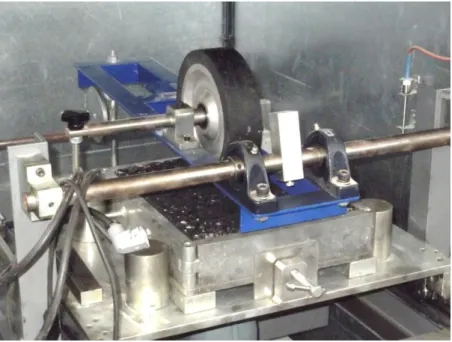
(3) Petrous materials Ceramics Gypsum Wood Asphalt Glass Figure 2: Constituents of RCA used in this investigation. Water resistance. To evaluate the stripping potential of HMA made with RCA the UNE-EN 12697-12 [20] was followed. In this research, eight sets (HMA cured in the oven for 4 hours and HMA without curing time and percentages of 5%, 10%, 20% and 30% of RCA ) of ten cylindrical Marshall samples each (compacted with 50 blows per face and manufactured with optimum Marshall bitumen content) were tested. Each set was subdivided into two subsets: the “dry” subset and the “wet” subset. The “dry” subset was kept at room temperature while the “dry” subset was saturated and held in a water bath for 3 days at 40ºC. After this time, the two subsets were left at 15ºC for a minimum of 2 hours, the “dry” samples in air and the “wet” samples in water. To determine the water resistance of the mixtures, the loss of indirect tensile strength was calculated as follows: TSR . ITSW x100 . ITSD. (1). where TSR = the tensile strength ratio (%), ITSW = the average tensile strength of “wet” subset (MPa) and ITSD = the average tensile strength of “dry” subset (MPa). TSR≥80% is required by PG3 specifications [19] for HMA for use in base layers. Stiffness. The indirect tensile stiffness modulus test (ITSM) was used to determine the resilient modulus of HMA Marshall samples (compacted with 75 blows per face at optimum Marshall bitumen content and cured in the oven for 4 hours) in accordance with UNE-EN 12697-26 Annex C [21]. HMA made with 5%, 10%, 20% and 30% of RCA in place of natural aggregates were tested at the temperature of 20ºC. The resilient modulus was determined following the equation: MR . F (ν 0.27) . zh. (2). where MR = the resilient modulus (MPa), F = the maximum repeated load (N), z = the horizontal recoverable deformation (mm), h = the thickness of the specimen (mm) and = Poisson’s ratio (an assumed Poisson’s ratio of 0.35 for all of the test temperatures [21] was used). Spanish specifications [19] have no requirements for conventional mixtures in terms of resilient modulus. Resistance to permanent deformation. To evaluate the resistance to permanent deformation of the mixtures made with RCA and cured for 4 hours in the oven at the optimum Marshall bitumen content, the wheel tracking test following UNE-EN 12697-22:2008+A1 [22] was conducted (figure.
(4) 3). In this test two prismatic specimens for each RCA percentage (5%, 10%, 20% and 30%) were placed inside a climatic chamber at 60ºC and subjected to the alternating passage of a wheel for 10,000 cycles. The accumulated permanent deformation versus the number of load cycles is measured. The average slope of accumulated permanent deformation between cycles 5,000 and 10,000 is finally determined. According to PG-3 [19] this slope must be lower than 0.07 mm/10 3 cycles.. Figure 3: wheel tracking test. Test results and discussion Marshall mix design. Table 1 [23] shows the optimum bitumen content for the HMA made with RCA and cured in the oven for 0 hours and 4 hours. As can be seen, in all cases the bitumen content tends to increase as the RCA percentages increase. Moreover, mixtures manufactured with 4 hours of curing time present greater optimum bitumen content than those made without curing time. It is due to the bitumen absorption onto the pores of the aggregates that takes place during the curing time. RCA [%]. 5. 10. 20. 30. Bo [%] Bo [%]. 3.7 3.8. 3.7 3.9. 3.8 4.4. 4.0 4.3. Curing time [hours] 0 4. Table 1: optimum Marshall bitumen content of HMA made with RCA that have been left in the oven for 0 hours and 4 hours at mixing temperature before compaction. Water resistance. Figure 4 shows the tensile strength ratio (TSR) of the mixtures that have been left in the oven for 0 hours and the mixtures that have been left in the oven for 4 hours. As can be seen, HMA that have been cured in the oven for 0 hours don´t comply with the Spanish minimum requirement of 80% of TSR for base layers while the mixtures that have been left in the oven for 4 hours before compaction loosely exceed this value. It demonstrates that the curing time treatment improves the water resistance of the mixtures made with RCA..
(5) 105 100 95 TSR (%). 90. TSR - 0 hours TSR - 4 hours TSR PG-3 requirement (base). 85. 80 75 70 65 5. 10. 15. 20 RCA (%). 25. 30. Figure 4: Tensile strength ratio of HMA made with RCA manufactured with 0 hours and 4 hours of curing time.. ITS (MPa). In addition, as can be seen in figure 5, the indirect tensile strength of the “dry” and the “wet” subset of HMA manufactured with 4 hours of curing time is higher than that of mixtures made without curing time. Moreover, the increase in the TSR value of HMA cured for 4 hours in the oven is due to the greater increase in the indirect tensile strength of the wet subset. That is, the moisture damage performance of HMA cured for 4 hours in the oven improves without being detrimental to their resistance. 2,5 2,3 2,1 1,9 1,7 1,5 1,3 1,1 0,9 0,7 0,5. ITSd - 0 hours ITSd - 4 hours ITSw - 0 hours ITSw - 4 hours 5. 10. 15. 20. 25. 30. RCA (%). Figure 5: Indirect tensile strength of HMA made with RCA manufactured with 0 hours and 4 hours of curing time. Stiffness. Table 2 shows the resilient modulus at 20ºC of HMA made with RCA and cured in the oven for 4 hours. On the one hand, the PG-3 [19] have no specifications for the acceptance of conventional mixtures in terms of resilient modulus, but indicates that for high-modulus mixtures the resilient modulus must be higher than 11,000 MPa. On the other hand, in Spain, an AC 22 base G as used in this research, has a typical mean resilient modulus of 5,000 MPa at 20ºC [24]. As can be seen in table 2, the resilient modulus values of tested HMA are loosely higher than 5,000 MPa and almost reach the minimum value of 11,000 MPa. This indicates that the studied mixtures will be stiffer than conventional mixtures and will perform similarly to high-modulus mixtures. RCA [%] MR [MPa]. 5 9,532.0. 10 10,316.0. 20 10,826.5. 30 10,527.0. Table 2: resilient modulus at 20ºC of HMA made with RCA that have been left in the oven 4 hours at mixing temperature before compaction..
(6) Resistance to permanent deformation. Table 3 shows the average slope of the accumulated permanent deformation at 60ºC between cycles 5,000 and 10,000 at wheel tracking test of HMA made with RCA cured for 4 hours in the oven. As can be seen, all tested mixtures present an average slope lower than the maximum PG-3 requirement thus, the HMA made with 5%, 10%, 20% and 30% of RCA and cured for 4 hours in the oven will perform well against rutting. RCA [%] Slope [mm/103 cycles] PG-3 requirements. 5 0.04. 10 0.04. 20 0.06 ≤0.07. 30 0.05. Table 3: average slope of accumulated permanent deformation at 60ºC between cycles 5,000 and 10,000 at wheel tracking test of HMA made with RCA cured for 4 hours in the oven. Conclusions HMA made with 5%, 10%, 20% and 30% of RCA in place of natural aggregates cured in the oven for 4 hours at mixing temperature have been evaluated. The mixtures were manufactured with Marshall optimum bitumen content. The mixtures displayed a very good water resistance, higher than that of mixtures made without curing time in the oven. In all cases, mixtures that were left in the oven for 4 hours achieved the minimum tensile strength ratio of 80% required by Spanish specifications. In addition, the improvement of moisture damage performance was achieved without being detrimental for indirect tensile strength resistance. The HMA cured for 4 hours in the oven were stiffer than that made without curing time, with a performance similar to high-modulus mixtures. Moreover, the HMA made with RCA and a curing time of 4 hours presented an adequate resistance to permanent deformation. Aknowledgements The authors wish to acknowledge the Spanish Ministry of Education and Science for sponsoring this research through Project BIA2010-17751. The authors would like to thank Nynas bitumen for supplying the binder required for this study, TEC-REC for supplying RCA and Cosmos for supplying the Portland cement. References [1]. V.W.Y. Tam, X.F. Gao, C.M. Tam, K.M. Ng, Physio-chemical reactions in recycled aggregate concrete, J Hazard Mater 163.2 (2009), 823-828. [2]. M. Arm, Self-cementing properties of crushed demolished concrete in unbound layers: results from triaxial tests and field tests, Waste Management 21 (2001) 235-239. [3]. A. Symonds, Cowi, PRC Bouwcentrum, Construction and Demolition Waste Management Practices, and Their Economic Impacts, Report to DGXI European Commission (1999). [4]. Y.D. Wong, D.D. Sun, D. Lai, Value-added utilisation of recycled concrete in hot-mix asphalt. Waste Manage 27 (2007) 294-301. [5]. D. Shen, J. Du, Evaluation of building materials recycling on HMA permanent deformation, Constr Build Mater 18 (2004) 391-397. [6]. D. Shen, J. Du, Application of Gray Rational Analysis to Evaluate HMA with Reclaimed Building Materials, J Mater Civil Eng 17 (2005) 400-406. [7]. A.H. Aljassar, K.B. Al-Fadala, Recycling building demolition waste in hot-mix asphalt concrete: a case study in Kuwait, J Mater Cycles Waste 7 (2005) 112-115. [8]. J. Mills-Beale, Z. You, The mechanical properties of asphalt mixtures with recycled concrete aggregates, Constr Build Mater 24 (2010) 340-345. [9]. A.K. Mukhopadhyay, B.J. Geiger, J. Button, Use of Alkali-Silica Reaction-Affected Recycled Concrete Aggregate in Hot-Mix Asphalt. Transport Res Rec 2179 (2010) 1-9..
(7) [10]. S. Bhusal, X. Li, H. Wen, Haifang, Evaluation of Effects of Recycled Concrete Aggregate on Volumentrics of Hot-Mix Asphalt, Transport Res Rec 2205-3 (2011) 36-39. [11]. M. Chen, J. Lin, S. Wu, Potential of recycled fine aggregates powder as filler in asphalt mixture, Constr Build Mater 25 (2011) 3909 - 3914. [12]. S. Paranavithana, A. Mohajerani, Effects of recycled concrete aggregates on properties of asphalt concrete, Resour Conserv Recy. Nº 48 (2006) 1-12. [13]. I. Pérez, M. Toledano, J. Gallego, J. Taibo, Mechanical properties of hot mix asphalt made with recycled aggregates from reclaimed construction and demolition debris, Mater Construcc 57285 (2007) 17 – 29. [14]. I. Pérez, J. Gallego, M. Toledano, J. Taibo, Asphalt mixtures with construction and demolition debris, Proc Inst Civ Eng. Transp 163 (2010) 165 – 174. [15]. I. Pérez, A.R. Pasandín, L. Medina, Hot mix asphalt using C&D waste as coarse aggregates, Mater Design 36 (2012) 840-846. [16]. I. Pérez, A.R. Pasandín and J. Gallego, Stripping in hot mix asphalt produced by aggregates from construction and demolition waste, Waste Manage Res 30-1 (2012) 3 - 11. [17]. S. Caro, E. Masad, A. Bhasin, D.N. Little, Moisture susceptibility of asphalt mixtures, Part 1: mechanisms, Int J Pavement Eng 9-2 (2008) 81-88. [20]. Ministerio de Obras Públicas y Transportes. Normas NLT. Ensayos de carreteras. Dirección General de Carreteras, second edition, Madrid, Spain; 2002. [19]. MINISTERIO DE FOMENTO. O.C. 24/08 sobre el Pliego de Prescripciones Técnicas Generales para obras de carreteras y puentes (PG-3). Artículo: 542-Mezclas bituminosas en caliente tipo hormigón bituminoso; 2008. [20]. AENOR. Asociación Española de Normalización y Certificación. UNE-EN 12697-12 “Métodos de ensayo para mezclas bituminosas en caliente. Parte 12: Determinación de la sensibilidad al agua de las probetas de mezcla bituminosa”. Madrid, Spain; 2006. [21]. AENOR. Asociación Española de Normalización y Certificación. UNE-EN 12697-26 “Métodos de ensayo para mezclas bituminosas en caliente. Parte 26: Rigidez”. Madrid, Spain; 2006. [22]. AENOR. Asociación Española de Normalización y Certificación. UNE-EN 1269722:2008+A1 “Métodos de ensayo para mezclas bituminosas en caliente. Parte 22: Ensayo de rodadura”. Madrid, Spain; 2008. [23]. Pasandín A.R., Pérez I. “Laboratory evaluation of hot-mix asphalt containing construction and demolition waste “. Constr Build Mater 2013; 43: 497-505. [24]. Ministerio de Fomento. CEDEX. IECA. Manual de firmes con capas tratadas con cemento. 2003..
(8)
Figure



Documento similar
DEFORMATION.. Throughout this point different methods to calculate Young’s modulus are presented, as well as the value for each of the cycles in each of the samples. a)
No obstante, como esta enfermedad afecta a cada persona de manera diferente, no todas las opciones de cuidado y tratamiento pueden ser apropiadas para cada individuo.. La forma
The Dwellers in the Garden of Allah 109... The Dwellers in the Garden of Allah
Meanwhile, the results observed for the introduction of nitrogen were consistent with those obtained previously for oxynitride glasses: increased glass compactness, Young
In comparison with sample with 5 phr of ZnO (SZNO_5), the differences in the tensile moduli and in the elongation at break reached are not very pronounced although the
- The lower density and higher water absorption values of the TCWA recycled aggregates, compared with the natural limestone and siliceous aggregates, mean that it is necessary to
X, Y, and Z-components of the surface displacement and traction fields for loads with magnitudes of 15%, 10% and 5% of the substrate Young ’s modulus, aligned with the X
Experimental results with 17 leather samples in an pre-industrial installation have verified the capabilities of the proposed model for the 18 estimation of optimum non-variable
