Jiménez Torres, N.; San-Martín, S.; Rodríguez-Torrico, P.; & Jerónimo Sánchez-Beato, E. (2019). The most waited engagement in higher education: teachers and students’ committed with e-learning. Journal of Management and Business Education, 2(3), 232-249.
https://doi.org/10.35564/jmbe.2019.0016
*Corresponding author: [email protected]
www.redaedem.org/?seccion=revistas_jmbe ISSN: 2444-8834
Published by Academia Europea de Dirección y Economía de la Empresa. This is an open access article under the CC BY-NC license.
THE MOST WAITED ENGAGEMENT IN HIGHER
EDUCATION: TEACHERS AND STUDENTS’
COMMITTED WITH E-LEARNING
EL ENGAGEMENT MÁS ESPERADO EN EDUCACIÓN
SUPERIOR: PROFESORES Y ESTUDIANTES
COMPROMETIDOS CON EL E-LEARNING
Nadia Jiménez Torres
https://orcid.org/0000-0001-5771-2971 (ORCID iD) Universidad de Burgos, España
Sonia San-Martín
https://orcid.org/0000-0002-5030-9669 (ORCID iD) Universidad de Burgos, España
Paula Rodríguez-Torrico*
https://orcid.org/0000-0001-9750-7104 (ORCID iD) Universidad de Burgos, España
Estefanía Jerónimo Sánchez-Beato
https://orcid.org/0000-0001-9919-5255 (ORCID iD)Universidad de Burgos, España
ABSTRACT
Nowadays, it is essential for institutions of higher education to enhance the continuance commitment of users toward e-learning programs to promote and ensure the sustainability of those programs over time. The aim of this research is to identify the factors that might contribute to deepening user commitment toward e-learning systems from key agents’ perspectives (students and teachers). Information was collected from 146 students and 124 teachers participating in e-learning programs in higher education. The results showed that perceived
organizational impact is the most important antecedent of continuance commitment. System quality had the highest impact on perceptions of organizational impact among both groups of users.The study showed the need for reconsideration of the role of instructor and system quality in the new educational paradigm, since both variables had no significant direct effect on the continuance commitment of users. This research shows managerial recommendations and directions for deepening commitment toward e-learning systems.
KEYWORDS
e-learning; commitment; higher education; teachers; students
RESUMEN
Actualmente es esencial para las instituciones de educación superior fomentar un compromiso duradero de los usuarios hacia los programas de enseñanza online para promover y asegurar su sostenibilidad en el tiempo. El objetivo de este trabajo es identificar los factores que contribuyen a reforzar al compromiso del usuario con los sistemas de enseñanza online desde la perspectiva de los agentes implicados (estudiantes y profesores). Se recogió información de 146 estudiantes y 124 profesores que participan en programas universitarios de enseñanza online. Los resultados indican que el impacto organizacional percibido es el determinante más importante del compromiso temporal. La calidad del sistema muestra una gran influencia en las percepciones de compromiso organizacional en ambos grupos de usuarios. El estudio muestra la necesidad de reconsiderar el rol del profesor y de la calidad del sistema en este nuevo tipo de enseñanza, dado que ambas variables no muestran un efecto directo significativo en el compromiso temporal de los usuarios. Esta investigación permite derivar recomendaciones para la gestión y direcciones para generar compromiso hacia los sistemas de enseñanza online.
PALABRAS CLAVE
enseñanza online; compromiso; educación superior; profesores; estudiantes
INTRODUCTION
Extraordinary technological advances have introduced critical change in the field of education: from the very first distance courses when voice recordings were mailed to a student’s home, and educational programs broadcast at certain times on the radio and TV, to the most modern e-learning courses based on electronic Learning Management Systems (LMS) (online) (Jamlan, 2004; Muller, 2015).
initiatives have also encouraged the implementation of more complex LMS, although at the beginning there was some reticence among teachers, due to their unfamiliarity with e-learning techniques (Barajas, 2002). Internet, electronic devices, and online communities have changed the organization and promotion of education programs and have created formerly unthinkable learning opportunities. These particular initiatives have provoked changes in technology and its application in higher educational institutions, the dynamics of their organizational structures, and even the educational paradigm (Duart and Mengual-Andrés, 2015; Jamlan, 2004; Moreira, 2012).
E-learning has transformed the situation and created a new model to access higher education programs. With the use of specific LMS greater importance is attached to the personalization of the e-learning process, because formal and informal educational processes happen at the same time over electronic channels. Moreover, students and teachers develop tasks (anywhere and anytime), analyze and co-create information through electronic devices and systems (experiential e-learning), and employ new channels through which to communicate and to interact with their targets (social networking).
There is an extensive amount of research on user perceptions of e-learning platforms, but most studies have focused on a single perspective, the perspective of either the student or the teacher. On the one hand, student perceptions have attracted attention in the past (El-Zeftawy and Hassan, 2016; Lee, Yoon, & Lee, 2009; Sun, Tsai, Finger, Chen, & Yeh, 2008). On the other hand, although with marginal attention, some other studies have explored the perceptions of teachers (Jamlan, 2004; Yuen and Ma, 2008). By combining both approaches, this research seeks to analyze the perceptions of both students and teachers as the key actors in the e-learning system. A dual perception that has rarely been explored in the previous literature (Navas, 2016; San Nicolás, Vargas, & Moreira, 2013). Thus, the objective of the study is to identify the factors of e-learning systems that would contribute to enlarging user commitment toward this system from both perspectives (students and teachers).
The structure of this article will be as follows: the next section will contain a brief review of e-learning in the context of higher education. The third section will be dedicated to explaining the proposed hypotheses. The fourth section will describe the methodology and will present the results, and the discussion in the last section will lead on to the main conclusions.
E-LEARNING IN THE CONTEXT OF HIGHER EDUCATION
There is a consensus among scholars over the need to combine technological progress with learning models of proven utility to each educational community and society (Barajas, 2002; Duart and Mengual-Andrés, 2015). E-learning success often depends on the implementation of a pedagogical model that is focused on matching the objectives and the necessities of both students and teachers (Bartolomé and Aiello, 2006; Lee, et al., 2009), rather than seeking to cultivate other institutional interests. It is therefore essential for the institution to maintain its educational quality regardless of the teaching modality (Parahoo, Santally, Rajabalee, & Harvey, 2016; Rodríguez, 2013).
often denying the importance of the pedagogical adaptations needed for this educational electronic modality (Bartolomé and Aiello, 2006). Hence, some researchers have called for critical reflection that can address this gap and identify all the positive and the negative consequences of e-learning adaptation in systems of higher education (Hara and Kling, 2001).
There are some generally perceived advantages with regard to the implementation of e-learning programs in higher education (Moreira, 2012): (1) It facilitates access to the information. (2) It creates a collaborative relationship between students and teachers that is no longer limited by time and space. (3) It helps to offer personalized attention and promotes student autonomy, essential in the development of their confidence and self-efficacy in a future workspace (Henri, Morrell, & Scott, 2018). Moreover, (4) it offers a range of tools that enable synchronic and asynchronous channels of communication between participants in higher educational systems.
The theories that set out a path toward the comprehension of e-learning at higher education institutions have sought to explain the adoption of user technology in the first place, addressing barriers and drivers of e-learning, such as the Technology Acceptance Model (TAM), the Unified Theory of Acceptance and Use of Technology (UTAUT) and the Information System Success Model (ISSM) (Mohammadi, 2015). Other theoretical approaches, such as the Information Systems Continuance Model (ISCM), focus on predicting individual continuance with e-learning systems as proposed by Bhattacherjee (2001). This ISCM framework, also called the “post-adoption model”, informs us that the initial adoption of an Information System (IS) is not sufficient to guarantee continuance with an e-learning system in the future. The only parameter that will affirm the success of an e-learning system is its continuance use (Kang and Lee, 2010). The same theory, originally employed in consumer behavior literature, has been embraced by e-learning researchers (Ifinedo, 2017; Lin, 2012; Udo, Bagchi, & Kirs, 2011), to highlight the need to study which factors incite the commitment of participants toward innovative educational models.
ANTECEDENTS OF E-LEARNING COMMITMENT IN
HIGHER EDUCATION
Instructor quality
E-learning researchers have reported that when learners are presented with a new learning system, their decision to use it is affected by several factors. Due to its importance, one of the most well-recognized factors is instructor quality (Petruzzellis, D'Uggento, & Romanazzi, 2006). Instructor quality is a variable that has been studied in the ISSM framework. Cheng, Wang, Moormann, Olaniran, & Chen (2012) included instructor quality in their study that examined the quality factors that can affect student intention to use e-learning systems. They concluded that information, service, system and instructor quality were key drivers of student perceptions of e-learning acceptance. Kim, Trimi, Park, & Rhee (2012) found that instructional quality combined with system and information quality positively influenced user satisfaction. In recent research, Farr-Wharton, Charles, Keast, Woolcott, & Chamberlain (2018) have found that the lecturer-student relationship positively reinforced their engagement with the university and was essential to encourage students to continue their formal education within the institution. Similarly, Bigné, Badenes, Ruiz, & Andreu (2018) captured the importance of teacher skills to enhance student engagement.
The instructor is a multidimensional construct shaped by three variables: instructor assurance, instructor empathy, and instructor responsiveness (Cao, Zhang, & Seydel, 2005; Udo, et al., 2011). According to Cao, et al. (2005), instructor assurance discloses both the knowledge and the skills of the teacher that inspire confidence as professionals; empathy includes concern and individualized attention that the teacher can offer the student; and, instructor responsiveness reflects a willingness to help students and to provide a prompt service. These three dimensions were selected from the original constructs, due to their proven significance in the e-learning context (Udo, et al., 2011). All three characteristics influence how e-learners perceived teacher quality in online education (Liaw, 2008).
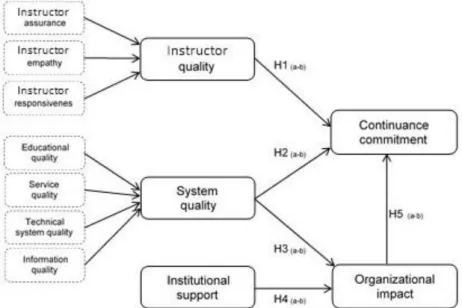
H1. The quality of the instructor will influence continuance commitment toward the e-learning system among students (H1a) and teachers (H1b) in a positive manner.
E-Learning system quality
As previously mentioned, the ISSM is one among a few of the most accepted models that identify the essential characteristics of an IS and that investigate how those characteristics can influence its use. When researching the e-learning context, the contemplation of IS quality as a complex factor is inevitable, due to the characteristics of the IS, which is specifically designed to create an online learning space for the most effective means of information exchange (Ćukušić, et al., 2010; Löfström and Nevgi, 2007). For that reason, the dimension of system quality is analyzed on the LMS by the following variables: educational quality, information quality, technical system quality, and service quality (Mohammadi, 2015).
Educational quality can be defined in this context as the ability of the LMS to provide a proper learning environment for students committed to collaborative learning (Hassanzadeh, Kanaani, & Elahi, 2012; Kim, Lee, & Rha, 2017). This aspect displays how the interactive capacity of the LMS influences the perception of e-learning as a useful learning tool (Wang and Chiu, 2011). The information quality dimension shows the usefulness of the information that both students and teachers generate on the LMS (Mohammadi, 2015) regarding information completeness, relevance, and trendiness. In an e-learning system, information quality is extremely important to the student, as the informational groundwork for learning is contained in the system (Aparicio, Bacao, & Oliveira, 2017). The variable service quality refers to the support the users receive when they access the e-learning system and how the technical infrastructure may face a problem (Wang and Wang, 2009). In this case, it is important that technical support staff provide the right attention and a proper service to address user difficulties (Headar, Elaref, & Yacout, 2013; Wang and Chiu, 2011). Lastly, technical system quality, dependent on the accuracy and the efficiency of the LMS, is defined as its functional success at reproducing and delivering the information (DeLone and McLean, 1992).
The e-learning system use may be encouraged, if the contents are easy to access and the platform is well structured (Petter, DeLone, & McLean, 2008). Moreover, system quality has been shown to have the strongest positive impact on participant intention to reuse an e-learning management system (Almarashdeh, 2016; Hassanzadeh, et al., 2012; Mohammadi, 2015). This initial acceptance and intention to use an IS are the predecessors of the post-acceptance phase of the implementation of an IS (Bhattacherjee, 2001), where the use of the LMS continues over time fostering continuance commitment among its users. Along these lines, recent research on the continuance use of online learning environments suggests that information quality, system quality, and service quality positively affect the continuance commitment of students (Dağhan and Akkoyunlu, 2016) and that information and system quality affect the continuance commitment of teachers (Zheng, Zhao, & Stylianou, 2013). Therefore:
toward the e-learning system among students (H2a) and teachers (H2b) in a positive manner.
E-Learning organizational impact and institutional support
The implementation of a high-quality information system in the context of higher education promotes global improvements in the institution (Kimiloglu, Ozturan, & Kutlu, 2017). Along those lines, McGill, Klobas, & Renzi (2014) suggested that when a user perceives that an e-learning initiative has a positive impact on the organization, it follows that its usage will be ‘promoted’ within the organization. In the e-learning context, the organizational impact is defined by a measured improvement in the global institutional results that can be attributed to the LMS (Gable, Sedera, & Chan, 2008), with regard to competitiveness, service quality, and communication between users (Ashrafzadeh and Sayadian, 2015).
Gorla, Somers, & Wong (2010) found a clear linkage between system quality and organizational impact, confirming increasing organizational dependency on quality information systems and the need for evidence on the perception of quality systems and their improvement in an educational context. Alkhalaf, Drew, AlGhamdi, & Alfarraj (2012) found that LMS system quality has an organizational impact on the institutions that not only helps teachers to improve their performance, but also the organizational services that are provided to all users. Student perceptions might also affect e-learning system quality, in view of the net benefits of those systems relating to competitiveness, easier access to education and cost savings - also associated with the organizational impact of a higher educational institution. Consequently:
H3. The quality of the e-learning system will influence the perceived organizational impact of the e-learning system among students (H3a) and teachers (H3b) in a positive manner.
Complementing that idea, the previous literature has also identified another key variable to be integrated as an antecedent to organizational impact: institutional support. In the e-learning context, institutional support is defined as the support that e-learning initiatives receive from the organization. It implies financial support and institutional recognition of the time and experience that is necessary to develop innovative initiatives and to maintain them (McGill, et al., 2014). Nijman and Gelissen (2011) suggested that institutional support represents assistance to users of IS that can be in terms of instrumental guidance, as much as information, emotional support, and appraisal. Therefore, recognition of the effort associated with making an e-learning system work can be added to the provision of resources and solutions for the active use of this initiative. A variable that has been proven to be one of the critical factors that ensures the initial adoption (Cheng, et al., 2012) of any e-learning system used in higher education institutions, for both teachers and students, and its continuance (Gunn, 2010; McGill, et al., 2014). Hence:
As previously mentioned, organizational impact is the perception of the general improvement that an IS has stimulated in the organization (Gable, et al., 2008). Previous research (Alkhalaf, et al., 2012) has suggested that the perception of benefits for the organization enhances continuance commitment with the e-learning program among teachers and students, as they perceive that their contribution adds to the general value of the organization. Aparicio, et al. (2017) stated that continuance commitment must develop to assure the success of an e-learning system over time, a development that takes place if the benefits of the e-learning system are perceived within the organization. Thus, organizational impact, whether technological or pedagogical, can influence the continuance commitment of users toward the e-learning systems (Krotov, 2015). Therefore:
H5. Perceived organizational impact will influence continuance commitment toward the e-learning system among students (H5a) and teachers (H5b) in a positive manner.
The whole set of hypotheses are presented in Figure 1.
Figure 1. Research model.
METHODOLOGY AND RESULTS
answered the questionnaire were also asked to contact their online students to invite them to participate in the study.
270 valid questionnaires were collected (124 from teachers and 146 from students). The response rates were higher than 80%. As for the teacher sample, 56% are male and 61% are between 44 and 55 years old, which is very similar to the online teachers’ national profile (most of them are male and are between 40 and 59 years old; Ministerio de Ciencia, Innovación y Universidades, 2018). As for the students sample, 55% are female and 50% are between 23 and 38 years old, which is similar to the online students’ national profile, with a more female students and of that age interval (Ministerio de Ciencia, Innovación y Universidades, 2017).
Scales taken from the previous literature were used to design the survey and to ensure the content validity of the measures (see Table 1 and 2 for details). The questionnaire design was distributed into five blocks and 5-point Likert scales were employed (from 1 = ‘strongly disagree’ to 5 = ‘strongly agree’). The first block refers to instructor quality, a higher-order construct (Kim, et al., 2012; Udo, et al., 2011) that consists of instructor assurance, instructor empathy and instructor responsiveness, adapted from Udo, et al. (2011). System quality was also measured as a higher-order construct and represents the second block (Hassanzadeh, et al., 2012; Mohammadi, 2015). It consists of educational quality, service quality, technical system quality and information quality, adapted from Mohammadi (2015). The third block, institutional support was adapted from McGill, et al. (2014). The fourth block that refers to organizational impact was taken from Alkhalaf, et al. (2012). Finally, continuance commitment with the e-learning system was adapted from Kang and Lee (2010).
Measurement model
The Partial Least Squares (PLS) bootstrapping approach was used to analyze the data, employing the statistics software SmartPLS 3.0. (Gudergan, Ringle, Wende, & Will, 2008). This method is useful to test the measurement validity of the reflective (i.e., continuance commitment) and formative constructs (i.e., instructors’ quality, system quality, institutional support, and organizational impact), and is less affected by a small sample size (Hair et al., 2016).
Table 1. First-order measurement model.
Items Weight t-value VIF TI
Instructor quality Instructor assurance
The instructor is fair and impartial in grading. 0.761 1.866 1.135 0.684 The instructor answers all the questions thoroughly.a - - - - The instructor has an expert understanding of the material. 0.437 0.974 1.135 0.687 Instructor empathy
The instructor is genuinely concerned about the students.
0.323 1.771 2.468 0.278 The instructor understands the individual needs of students. 0.452 2.459 2.387 0.343 The instructor has the students’ best long-term interests in
mind. -0.138 0.731 3.027 0.293
The instructor encourages and motivates students to do
their best. 0.467 2.249 3.100 0.236
Instructor responsiveness
The instructor quickly and efficiently responds to students’
needs. 0.428 2.358 1.927 0.293
The instructor always welcomes students’ questions and
comments. 0.655 3.972 1.927 0.322
System quality Educational quality
E-learning provides incentives to the student. 0.129 1.891 1.346 0.683 E-learning provides collaborative learning. 0.249 3.384 1.589 0.473 E-learning provides required facilities such as chats and a
forum.a - - - -
E-learning provides the possibility of communicating with
other students. 0.244 3.470 1.369 0.597
E-learning provides the possibility of learning evaluation.a - - - - E-learning provides a good learning style. 0.622 8.903 1.634 0.331 Information quality
E-learning provides information that is relevant to the
students’ needs. 0.410 4.068 2.114 0.339
E-learning provides complete information.
-0.023 0.222 1.929 0.381 E-learning provides the information the students’ wants. 0.311 2.156 3.609 0.234 E-learning provides organized content and information.
0.126 1.474 1.680 0.488 E-learning provides up to date content and information.a - - - - E-learning provides required content and information. 0.332 2.618 3.509 0.219 Service quality
E-learning provides proper online assistance and
explanation. 0.504 6.535 1.515 0.352
E-learning department staff respond in a cooperative
manner. 0.332 3.710 1.327 0.496
E-learning provides the opportunity of reflecting views. 0.404 4.756 1.436 0.520 E-learning provides is a good management tool for the
courses.a - - - -
Technical system quality
The e-learning platform optimizes response time. 0.135 0.756 2.025 0.455 The e-learning platform is user friendly. 0.038 0.188 2.358 0.392 The e-learning platform offers interactive features between
users and the system. 0.362 2.314 1.576 0.581
The e-learning platform possesses a structured design. 0.250 1.509 1.709 0.508 The e-learning platform has flexible features.a - - - - The e-learning platform has attractive features. -0.065 0.310 2.319 0.385 The e-learning platform is reliable. 0.334 1.656 3.472 0.263 The e-learning platform is secure. 0.198 1.062 2.690 0.320
a Deleted items.
In the higher-order measurement model, instructor quality and system quality are formative higher-order constructs as are institutional support and organizational impact. Continuance commitment toward the e-learning system is considered a reflective construct (Table 2). Multicollinearity was ruled out in the formative constructs, as VIF values below 5 and IT values above 0.10 (Petter, Straub, & Rai, 2007) were corroborated. The convergent validity of the reflective scales was confirmed, because the values of their average variance extracted (AVE) at all times showed values higher than 0.5; their composite reliability (CR) had values in excess of 0.6; and, the Cronbach Alpha (α) values were higher than 0.7. The evaluation of discriminant validity is not required for formative constructs in the PLS path model (Hair, et al., 2016).
Table 2. Higher-order measurement model.
Dimensions Weight t-value VIF Tolerance
Instructor quality
Instructor assurance 0.605 3.298 2.222 0.733
Instructor empathy 0.498 2.436 2.426 0.231
Instructor responsiveness -0.094 0.746 1.185 0.268
System quality
Educational quality 0.359 4.591 2.042 0.292
Information quality 0.319 4.146 2.181 0.329
Service quality 0.428 5.291 2.370 0.295
Technical system quality 0.072 1.078 1.206 0.624
Items Weight t-value VIF Tolerance
Institutional support
The University supports the continuance of this innovation.
0.051 0.482 2.979 0.304 The University supports the initiatives of
innovation in e-learning.
0.234 2.381 2.623 0.343 There is financial support for the development of
this innovation.
0.239 2.904 2.317 0.388 There is technical support for the development of
this innovation.
-0.002 0.021 2.503 0.314 There are human resources for the ongoing
development of the innovation.
The e-learning system helps to improve my performance.
0.080 1.348 1.761 0.429 The e-learning system helps the organization
save on delivery costs.
Structural multigroup analysis
Having validated the measurement model, a multigroup analysis was performed. A multigroup model was estimated addressing the different perspectives for two differentiated users: students and teachers. The two groups were similar in size, as 54.1% of the respondents were students and the 45.9% were teachers. The Welch-Satterthwaite MGA test showed that there was no significant difference in the strength of the effect studied for both groups (students and teachers) (Table 3). Hence, the model was considered suitable to evaluate the antecedents of continuance commitment with the e-learning system for both user groups. The standardized root mean square residual (SRMR) was 0.066, suggesting that the fit of the model was acceptable (Haenlein and Kaplan, 2004).
Table 3. PLS multi-group analysis and Welch-Satterthwait Test.
Students
The e-learning system helps me think through problems.
0.120 1.678 2.389 0.350 The e-learning system helps the organization
enhance its competitiveness.
0.268 3.719 2.551 0.336 The e-learning system helps the organization to
respond quicker to change.
0.269 3.696 3.011 0.281 The e-learning system helps to deliver better
teaching performance to the students.
0.041 0.567 2.435 0.368 The e-learning system facilitates communication
between users.
0.325 5.007 2.235 0.371 The e-learning system helps the organization to
achieve its goals.
0.120 1.782 1.870 0.442
Items Loading t-value
Continuance commitment (α=0.830, CR=0.900, AVE=0.751)
I would like to continue being an online teacher. 0.925 71.310 My intentions are to continue being an online
teacher. 0.915 70.291
I prefer online teaching rather than offline
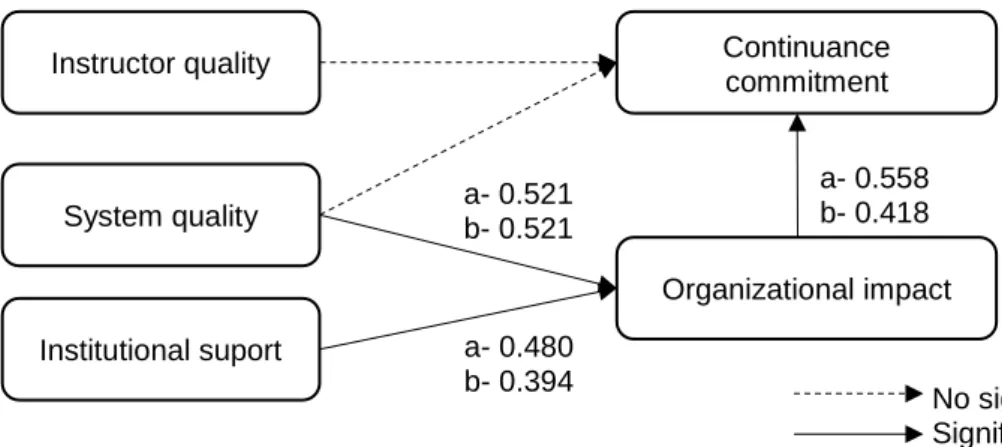
The results showed that instructor quality had no influence on continuance commitment toward the e-learning system, neither among students nor among teachers. Hypotheses H1 (a-b) were therefore not supported. Likewise, hypotheses H2 (a-b) were rejected, as the variable system quality showed no significant effects on the continuance commitment of both teachers and students. However, system quality showed a significant and positive effect on organizational impact, thereby supporting hypotheses H3 (a-b). The results also showed that institutional support positively influenced organizational impact, which supports H4 (a-b) both for students and for teachers. Finally, organizational impact positively affected continuance commitment among students and teachers, lending support to H5 (a-b). These results lead the research toward a deeper comprehension of continuance commitment toward e-learning systems in higher education and its initiation. The robustness model considers two important user groups that further our understanding of commitment toward educational initiatives, such as e-learning. Figure 2 graphically summarizes these results.
Figure 2. Results of the structural multigroup analysis.
DISCUSSION AND CONCLUSION
The contributions of this study to the literature cover several aspects. First, our approach supports the ISSM model developed by DeLone and McLean (1992) and updated by Gable, et al. (2008); it is a useful framework to analyze the e-learning characteristics of relevant stakeholders, in this case teachers and students, in a post-adoption scenario (Aparicio, et al., 2017; Gunn, 2010; McGill, et al., 2014). The proposed hypotheses suggest a generalization of the impact of e-learning system quality and institutional support within the organization, and the positive effect of the organizational impact on continuance commitment from both user group perspectives. The evidence reinforces the conceptualization of e-learning as a multidimensional system where each dimension must be individually evaluated by all participants (Gable, et al., 2008).
Our results have suggested that the perception of the e-learning system is a decisive factor in promoting a positive impact within higher education institutions and in enhancing continuance commitment. This finding is hardly surprising from the perspective of the teachers, because they usually depend on the success of the e-learning system to reduce the uncertainty that surrounds their position as online teachers (Ortlieb and Weiss, 2018). Organizational improvements
Instructor quality
System quality
Institutional suport
Continuance commitment
Organizational impact a- 0.521
b- 0.521
a- 0.480 b- 0.394
a- 0.558 b- 0.418
No significant path Significant path
R2 = 0.378
promoted through the e-learning system would also allow higher education institutions to save costs, to improve academic performance, and to sharpen their competitiveness. These factors indicate the success of these innovative teaching initiatives (Aparicio, et al., 2017) and the probability of an e-learning program continuing over time (McGill, et al., 2014). From the students’ perspective, the perception of e-learning success could be related to the global organizational image, which is essential for higher education institutions that usually strive to create a positive image among their students (Polat, 2011). In fact, University image has proven itself to be a key factor for students when enrolling on a program and deciding to continue at university (Sung and Yang, 2008).
System quality is the factor that has the highest impact on the perceived organizational impact of e-learning systems. This result points to the importance of assessing the quality of the whole e-learning system at higher education institutions (Bhattacherjee, 2001). In addition, the institutional support of e-learning initiatives impacts positively on the organization, which highlights the importance of developing innovative initiatives that meet the needs of teachers and students including financial and technological support and assistance and recognition. These results are consistent with other studies, given the fact that system quality is an important factor in assessing the perceived benefits of e-learning system for students (Mohammadi, 2015) and teachers (Almarashdeh, 2016). The perception that the institution is involved in the program and supports e-learning initiatives will encourage its participants to develop their continuance commitment. This evidence is consistent with the concerns recognized in the previous literature (Gunn, 2010; McGill, et al., 2014), which has pointed out that ongoing institutional support is essential to continue an e-learning initiative over time. The financial and technical support provided by the institution, as well as the capability to involve human resources to maintain this educational initiative, has a direct impact on the organization, which, in turn, has a positive effect on continuance commitment toward the use of an LMS among students and teachers.
Surprisingly, some of our results proved contradictory with previous research findings (Udo, et al., 2011) (i.e. the non-significant direct effect of instructor quality and system quality on continuance commitment), one possible explanation might be the transcendental change in the educational paradigm, especially reflected in e-learning education. Teachers have to manage the design of their courses and are in charge of monitoring the learning process, but they play the role of facilitators rather than authorities (Duart and Mengual-Andrés, 2015). These results reinforce the need for a new conceptualization of the figure of the teacher in the e-learning context (McConnell, 2018), as neither students nor teachers found that their continuance commitment was significantly influenced by the perceived quality of the instructor. Moreover, system quality is not a direct driver of continuance commitment, which could be explained by the multidimensional nature of e-learning systems. Recent research has pointed to the possibility that factors related to individual values, such as personal grit (Aparicio, et al., 2017) and personal autonomy (Henri, et al., 2018), are more important than system quality in the post-adoption phase of an e-learning system.
consider individual values as essential constructs of continuance commitment among users. Third, this study undoubtedly highlights the need to improve our knowledge of how the positive organizational impacts of both e-learning and continuance commitment could influence the image and the reputation of higher education institutions; both factors should be contemplated in future research on e-learning systems at institutions of higher education. Fourth, other users (i.e. managers and administrative staff) must also be given due consideration.
REFERENCES
Alkhalaf, S., Drew, S., AlGhamdi, R., & Alfarraj, O. (2012). E-Learning System on Higher Education Institutions in KSA: Attitudes and Perceptions of Faculty Members. Procedia - Social and Behavioral Sciences, 47, pp. 1199-1205.
doi:10.1016/j.sbspro.2012.06.800 Retrieved from
https://doi.org/10.1016/j.sbspro.2012.06.800
Almarashdeh, I. (2016). Sharing instructors experience of learning management system: A technology perspective of user satisfaction in distance learning course. Computers in Human Behavior, 63, pp. 249-255.
doi:10.1016/j.chb.2016.05.013 Retrieved from
https://doi.org/10.1016/j.chb.2016.05.013
Aparicio, M., Bacao, F., & Oliveira, T. (2017). Grit in the path to e-learning success. Computers in Human Behavior, 66, pp. 388-399. doi:10.1016/j.chb.2016.10.009 Retrieved from 10.1016/j.chb.2016.10.009 Ashrafzadeh, A., & Sayadian, S. (2015). University instructors’ concerns and
perceptions of technology integration. Computers in Human Behavior, 49, pp. 62-73. doi:10.1016/j.chb.2015.01.071
Barajas, M. (2002). Restructuring Higher Education Institutions in Europe: The case of virtual learning environments. Interactive educational multimedia:
IEM(5), pp. 1-28. Retrieved from
http://diposit.ub.edu/dspace/handle/2445/109823
Bartolomé, A., & Aiello, M. (2006). Nuevas tecnologías y necesidades formativas. Blended Learning y nuevos perfiles en comunicación audiovisual. Telos. Cuadernos de Comunicación e Innovación(67), pp. 1-13.
Bhattacherjee, A. (2001). Understanding information systems continuance: an expectation-confirmation model. MIS quarterly, 25(3), pp. 351-370. doi:10.2307/3250921
Bigné, E., Badenes, A., Ruiz, C., & Andreu, L. (2018). Virtual classroom: teacher skills to promote student engagement. Journal of Management and Business Education, 1(2), pp. 87-105.
Cao, M., Zhang, Q., & Seydel, J. (2005). B2C e-commerce web site quality: an empirical examination. Industrial Management & Data Systems, 105(5), pp. 645-661. doi:10.1108/02635570510600000
Ćukušić, M., Alfirević, N., Granić, A., & Garača, Ž. (2010). e-Learning process management and the e-learning performance: Results of a European empirical study. Computers & Education, 55(2), pp. 554-565. doi:10.1016/j.compedu.2010.02.017
Dağhan, G., & Akkoyunlu, B. (2016). Modeling the continuance usage intention of online learning environments. Computers in Human Behavior, 60, pp. 198-211. doi:10.1016/j.chb.2016.02.066
DeLone, W. H., & McLean, E. R. (1992). Information systems success: The quest for the dependent variable. Information systems research, 3(1), pp. 60-95. doi:10.1287/isre.3.1.60
Duart, J. M., & Mengual-Andrés, S. (2015). Tranformaciones en la universidad hoy: integración de modalidades formativas. Revista Española de Educación Comparada(26), pp. 15-39. doi:10.5944/reec.26.2015.14447
Dyson, B., Vickers, K., Turtle, J., Cowan, S., & Tassone, A. (2015). Evaluating the use of Facebook to increase student engagement and understanding in lecture-based classes. Higher Education, 69(2), pp. 303-313. doi:10.1007/s10734-014-9776-3
El-Zeftawy, A. M. A., & Hassan, L. A. E.-W. A. E.-A. (2016). Perception of students regarding blended learning implementation of community health nursing course at faculty of nursing, Tanta University, Egypt. Journal of Nursing Education and Practice, 7(3), pp. 83-93. doi:10.5430/jnep.v7n3p83 Farr-Wharton, B., Charles, M. B., Keast, R., Woolcott, G., & Chamberlain, D.
(2018). Why lecturers still matter: the impact of lecturer-student exchange on student engagement and intention to leave university prematurely. Higher Education, 75(1), pp. 167-185. doi:10.1007/s10734-017-0190-5
Gable, G. G., Sedera, D., & Chan, T. (2008). Re-conceptualizing information system success: The IS-impact measurement model. Journal of the association for information systems, 9(7), p 18. doi:10.17705/1jais.00164 González, A., Conde, Á., Díaz, P., García, M., & Ricoy, C. (2018). Instructors’
teaching styles: Relation with competences, self-efficacy, and commitment in pre-service teachers. Higher Education, 75, pp. 625-642. doi:10.1007/s10734-017-0160-y
Gorla, N., Somers, T. M., & Wong, B. (2010). Organizational impact of system quality, information quality, and service quality. The Journal of Strategic Information Systems, 19(3), pp. 207-228. doi:10.1016/j.jsis.2010.05.001 Gudergan, S. P., Ringle, C. M., Wende, S., & Will, A. (2008). Confirmatory tetrad
analysis in PLS path modeling. Journal of Business Research, 61(12), pp. 1238-1249. doi:10.1016/j.jbusres.2008.01.012
Gunn, C. (2010). Sustainability factors for e-learning initiatives. ALT-J, 18(2), pp. 89-103. doi:10.1080/09687769.2010.492848
Haenlein, M., & Kaplan, A. M. (2004). A beginner's guide to partial least squares analysis. Understanding statistics, 3(4), pp. 283-297. doi:10.1207/s15328031us0304_4
Hair, J., Joseph, F., Hult, M, G. T., Ringle, C., & Sarstedt, M. (2016). A primer on partial least squares structural equation modeling (PLS-SEM). Thousand Oaks, US: Sage Publications.
Hara, N., & Kling, R. (2001). Student distress in web-based distance education. Educause Quarterly, 24(3), pp. 68-69. doi:10.1080/13691180010002297 Hassanzadeh, A., Kanaani, F., & Elahi, S. (2012). A model for measuring
e-learning systems success in universities. Expert Systems with Applications, 39(12), pp. 10959-10966. doi:10.1016/j.eswa.2012.03.028
226-257. doi:10.1080/08841241.2013.867919 Retrieved from https://doi.org/10.1080/08841241.2013.867919
Henri, D., Morrell, L., & Scott, G. (2018). Student perceptions of their autonomy at University. Higher Education, 75(3), pp. 507-516. doi:10.1007/s10734-017-0152-y
Ifinedo, P. (2017). Examining students' intention to continue using blogs for learning: Perspectives from technology acceptance, motivational, and social-cognitive frameworks. Computers in Human Behavior, 72, pp. 189-199. doi:10.1016/j.chb.2016.12.049
Jamlan, M. (2004). Faculty opinions towards introducing e-learning at the University of Bahrain. The International Review of Research in Open and Distributed Learning, 5(2), pp. 1-14. doi:10.19173/irrodl.v5i2.185
Kang, Y. S., & Lee, H. (2010). Understanding the role of an IT artifact in online service continuance: An extended perspective of user satisfaction. Computers in Human Behavior, 26(3), pp. 353-364. doi:10.1016/j.chb.2009.11.006 Kim, H.-J., Lee, J.-M., & Rha, J.-Y. (2017). Understanding the role of user
resistance on mobile learning usage among university students. Computers & Education, 113, pp. 108-118. doi:10.1016/j.compedu.2017.05.015
Kim, K., Trimi, S., Park, H., & Rhee, S. (2012). The impact of CMS quality on the outcomes of e‐learning systems in higher education: an empirical study. Decision Sciences Journal of Innovative Education, 10(4), pp. 575-587. doi:10.1111/j.1540-4609.2012.00360.x
Kim, S. S., & Malhotra, N. K. (2005). A longitudinal model of continued IS use: An integrative view of four mechanisms underlying postadoption phenomena. Management science, 51(5), pp. 741-755.
Kimiloglu, H., Ozturan, M., & Kutlu, B. (2017). Perceptions about and attitude toward the usage of e-learning in corporate training. Computers in Human Behavior, 72, pp. 339-349. doi:10.1016/j.chb.2017.02.062
Krotov, V. (2015). Critical Success Factors in M-Learning: A Socio-Technical
Perspective. CAIS, 36, p 6. Retrieved from
http://aisel.aisnet.org/cais/vol36/iss1/6
Lee, B.-C., Yoon, J.-O., & Lee, I. (2009). Learners’ acceptance of e-learning in South Korea: Theories and results. Computers & Education, 53(4), pp. 1320-1329. doi:10.1016/j.compedu.2009.06.014
Liaw, S.-S. (2008). Investigating students’ perceived satisfaction, behavioral intention, and effectiveness of e-learning: A case study of the Blackboard system. Computers & education, 51(2), pp. 864-873. doi:10.1016/j.compedu.2007.09.005
Lin, W.-S. (2012). Perceived fit and satisfaction on web learning performance: IS continuance intention and task-technology fit perspectives. International
Journal of Human-Computer Studies, 70(7), pp. 498-507.
doi:10.1016/j.ijhcs.2012.01.006
Löfström, E., & Nevgi, A. (2007). From strategic planning to meaningful learning: diverse perspectives on the development of web‐based teaching and learning in higher education. British Journal of Educational Technology, 38(2), pp. 312-324. doi:10.1111/j.1467-8535.2006.00625.x
Mansor, A. Z. (2012). Managing student's grades and attendance records using google forms and google spreadsheets. Procedia-Social and Behavioral Sciences, 59, pp. 420-428. doi:10.1016/j.sbspro.2012.09.296
McConnell, D. (2018). E-learning in Chinese higher education: the view from inside. Higher Education, 75(6), pp. 1031-1045. doi:10.1007/s10734-017-0183-4
McGill, T. J., Klobas, J. E., & Renzi, S. (2014). Critical success factors for the continuation of e-learning initiatives. The Internet and Higher Education, 22, pp. 24-36. doi:10.1016/j.iheduc.2014.04.001
Mohammadi, H. (2015). Investigating users’ perspectives on e-learning: An integration of TAM and IS success model. Computers in Human Behavior, 45, pp. 359-374. doi:10.1016/j.chb.2014.07.044
Moreira, M. A. (2012). La formación y el aprendizaje en entornos virtuales: potencialidades, debilidades y tendencias. Critica: La Reflexion Calmada Desenreda Nudos, 62(982), pp. 33-36.
Muller, J. (2015). The future of knowledge and skills in science and technology higher education. Higher Education, 70(3), pp. 409-416. doi:10.1007/s10734-014-9842-x
Navas, M. F. (2016). Estudio de un caso de buenas prácticas de enseñanza virtual en educación superior: El PPSC. Revista de Formación e Innovación Educativa Universitaria, 9(1), pp. 50-66.
Nijman, D.-J., & Gelissen, J. (2011). Direct and indirect effects of supervisor support on transfer of training Supporting workplace learning (pp. 89-106): Springer.
Oliver, R. L. (1999). Whence consumer loyalty? Journal of Marketing, 63, pp. 33-44.
Ortlieb, R., & Weiss, S. (2018). What makes academic careers less insecure? The role of individual-level antecedents. Higher Education, 76(4), pp. 571-587. doi:10.1007/s10734-017-0226-x
Parahoo, S. K., Santally, M. I., Rajabalee, Y., & Harvey, H. L. (2016). Designing a predictive model of student satisfaction in online learning. Journal of
Marketing for Higher Education, 26(1), pp. 1-19.
doi:10.1080/08841241.2015.1083511 Retrieved from
https://doi.org/10.1080/08841241.2015.1083511
Petruzzellis, L., D'Uggento, A. M., & Romanazzi, S. (2006). Student satisfaction and quality of service in Italian universities. Managing Service Quality: An International Journal, 16(4), pp. 349-364. doi:10.1108/09604520610675694 Petter, S., DeLone, W., & McLean, E. (2008). Measuring information systems
success: models, dimensions, measures, and interrelationships. European journal of information systems, 17(3), pp. 236-263. doi:10.1057/ejis.2008.15 Petter, S., Straub, D., & Rai, A. (2007). Specifying formative constructs in
information systems research. MIS quarterly, 31(4), pp. 623-656.
Polat, S. (2011). The Relationship between University Students' Academic Achievement and Perceived Organizational Image. Educational Sciences: Theory and Practice, 11(1), pp. 257-262.
Rodríguez, J. C. F. (2013). Educación eLearning. Calidad y eficacia educativa para la sociedad del S. XXI. Sociedad y utopía: Revista de ciencias sociales(42), pp. 36-52.
caso de la Universidad de La Laguna. Revista Historia de la Educación Latinoamericana, 14(19), pp. 227-245. doi:10.19053/01227238.1993
Stodnick, M., & Rogers, P. (2008). Using SERVQUAL to measure the quality of the classroom experience. Decision Sciences Journal of Innovative Education, 6(1), pp. 115-133. doi:10.1111/j.1540-4609.2007.00162.x
Sun, P.-C., Tsai, R. J., Finger, G., Chen, Y.-Y., & Yeh, D. (2008). What drives a successful e-Learning? An empirical investigation of the critical factors influencing learner satisfaction. Computers & education, 50(4), pp. 1183-1202. doi:10.1016/j.compedu.2006.11.007
Sung, M., & Yang, S.-U. (2008). Toward the model of university image: The influence of brand personality, external prestige, and reputation. Journal of
public relations research, 20(4), pp. 357-376.
doi:10.1080/10627260802153207
Udo, G. J., Bagchi, K. K., & Kirs, P. J. (2011). Using SERVQUAL to assess the quality of e-learning experience. Computers in Human Behavior, 27(3), pp. 1272-1283. doi:10.1016/j.chb.2011.01.009
Wang, H. C., & Chiu, Y. F. (2011). Assessing e-learning 2.0 system success.
Computers & Education, 57(2), pp. 1790-1800.
doi:10.1016/j.compedu.2011.03.009
Wang, W.-T., & Wang, C.-C. (2009). An empirical study of instructor adoption of web-based learning systems. Computers & Education, 53(3), pp. 761-774. doi:10.1016/j.compedu.2009.02.021
Yuen, A. H., & Ma, W. W. (2008). Exploring teacher acceptance of e‐learning technology. Asia‐Pacific Journal of Teacher Education, 36(3), pp. 229-243. doi:10.1080/13598660802232779
Zheng, Y., Zhao, K., & Stylianou, A. (2013). The impacts of information quality and system quality on users' continuance intention in information-exchange virtual communities: An empirical investigation. Decision Support Systems, 56, pp. 513-524. doi:10.1016/j.dss.2012.11.008
DECLARATION OF CONFLICTING INTERESTS
The author declared no potential conflicts of interest with respect to the research, authorship, and/or publication of this article.
FUNDING
The author received no financial support for the research, authorship, and/or publication of this article.
Cita recomendada
Jiménez Torres, N.; San-Martín, S.; Rodríguez-Torrico, P.; & Jerónimo Sánchez-Beato, E. (2019). The most waited engagement in higher education: teachers and students’ committed with e-learning. Journal of Management and