Synthesis of bench-stable solid triorganoindium reagents and reactivity in
palladium-catalyzed cross-coupling reactions
*José M. Gil-Negrete, José Pérez Sestelo
†and Luis A. Sarandeses
‡Centro de Investigaciones Científicas Avanzadas (CICA) and Departamento de Química, Universidade da Coruña, E-15071 A Coruña, Spain
Chemical Communications, volume 54, issue 12, pages 1453–1456, 11 February 2018 Received 5 December 2017, accepted 11 January 2018, first published 12 January 2018
How to cite:
Synthesis of bench-stable solid triorganoindium reagents and reactivity in palladium-catalyzed
cross-coupling reactions.J. M. Gil-Negrete, J. Pérez Sestelo and L. A. Sarandeses, Chem. Commun., 2018, 54,
1453–1456. DOI: 10.1039/C7CC09344F.
Abstract
Bench-stable solid triorganoindium compounds have been prepared by coordination with
4-(dimethylamino)pyridine (DMAP). The solid R3In(DMAP) complexes are obtained from the corresponding
solution of R3In in quantitative yield and can be stored for up to several weeks. These reagents show
excellent reactivity in palladium-catalyzed cross-coupling reactions with organic electrophiles.
Keywords: indium organometallics; cross-coupling reactions; palladium catalysis; bench-stable reagents
In recent years, indium(III) organometallics have become an attractive alternative to classical organometallic
species in organic synthesis.1 In 1999, we discovered the palladium-catalyzed cross-coupling reactions of
triorganoindium reagents R3In,
2
which is probably the most relevant reaction and whose utility in organic
synthesis is continuously increasing.3 In this reaction the R3In species show high atom efficiency as all three
organic groups are transferred from indium to the electrophile with excellent selectivity, high versatility and,
in general, low toxicity.4 Triorganoindium reagents are commonly prepared by transmetallation from the
corresponding organolithium or organomagnesium reagents, although other protocols have also been
developed.5 A significant limitation for the use of these organometallic species is associated with their
preparation and use as solutions, since attempts to isolate and store these reagents led to decomposition.6
The preparation of solid-salt stabilized reagents is an interesting research topic that allows the use of
organometallic and other nucleophilic species as solid reagents. Organotrifluoroborates,7
MIDA-boronates8 and stable siloxanes9 are useful examples of solid-salt stabilized reagents, whereas among the
main-group metal derivatives, organozinc pivalates have emerged as interesting reactive solid species.10
In the field of indium chemistry, Schumann and co-workers reported an extensive study on the characterization of indium organometallics stabilized by intramolecular coordination using nitrogen or
phosphorus atoms.11 The isolation and characterization of allyl and 1-butenylindium halides stabilized by
complexation with phosphine and pyridine ligands were also reported by Baba.6,12 Trimethylindium
complexes have also been characterized but their reactivity and synthetic utility remains
coordination with 4-(dimethylamino)pyridine (DMAP) and their reactivity in palladium-catalyzed cross-coupling reactions.
Bearing in mind the stabilization of Group 13 derivatives by nitrogen ligands, our research started with the
preparation of stable solid triphenylindium complexes by the addition of different pyridines L1–L5 to Ph3In
in THF solution and removal of the solvent. In general, this procedure afforded a solid material that could be manipulated in air and whose reactivity was tested in a Pd-catalyzed cross-coupling reaction with
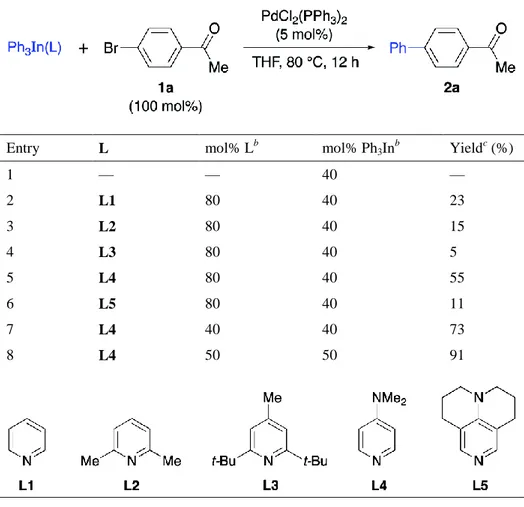
4-bromoacetophenone (1a, Table 1). Initial studies using a 1 : 2 ratio of Ph3In and DMAP as ligands gave the
coupling product (2a) in moderate yield (Table 1, entries 2–6). Interestingly, on using the 1 : 1 ratio complex
(Ph3In/DMAP) 2a was obtained in 73% yield with 40 mol% of the complex and PdCl2(PPh3)2 (5 mol%) as
the catalyst (Table 1, entry 7), while the use of a 50 mol% of the complex led to an excellent 91% yield
of 2a (Table 1, entry 8). The use of lower amounts (<50 mol%) of Ph3In(DMAP) afforded lower yields,
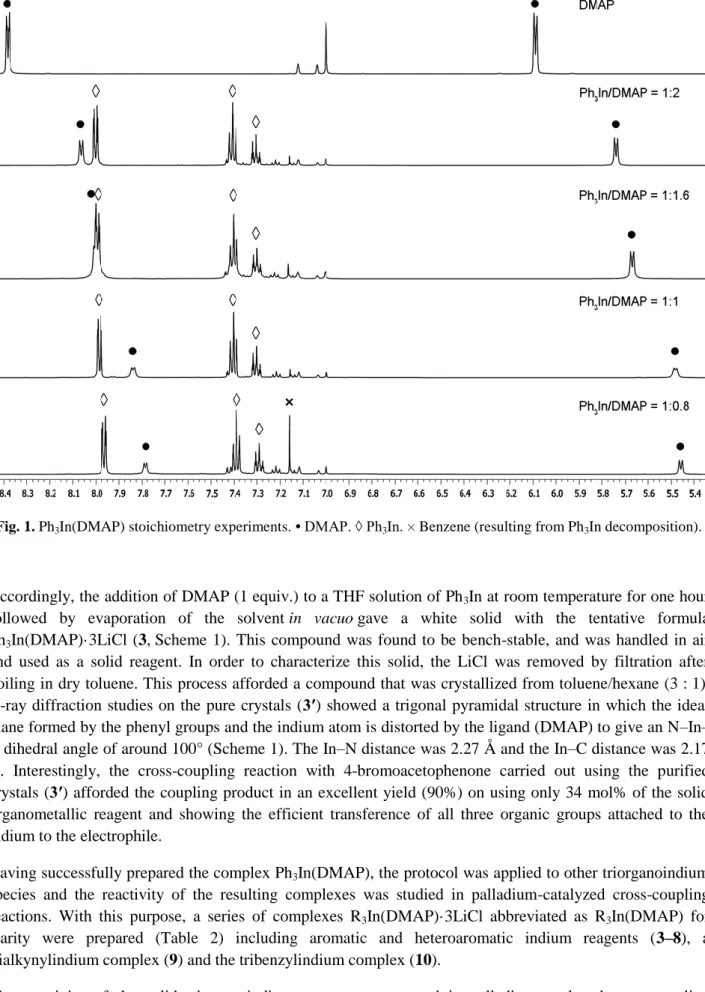
probably due to some decomposition of the complex during the process. The stoichiometry of the complex
was studied by NMR spectroscopy and a 1 : 1 ratio of Ph3In/DMAP was found, whereas the use of larger
amounts of DMAP gave rise to an equilibrium between ligated and non-ligated DMAP. Additionally, the use
of a substoichiometric amount of DMAP (ratio Ph3In/DMAP 1 : 0.8) resulted in the appearance of benzene
due to the decomposition of non-ligated organometallic complexes (Fig. 1).
Table 1. Ligand optimization studiesa.
Entry L mol% Lb mol% Ph3In
Fig. 1. Ph3In(DMAP) stoichiometry experiments. • DMAP. ◊ Ph3In. × Benzene (resulting from Ph3In decomposition).
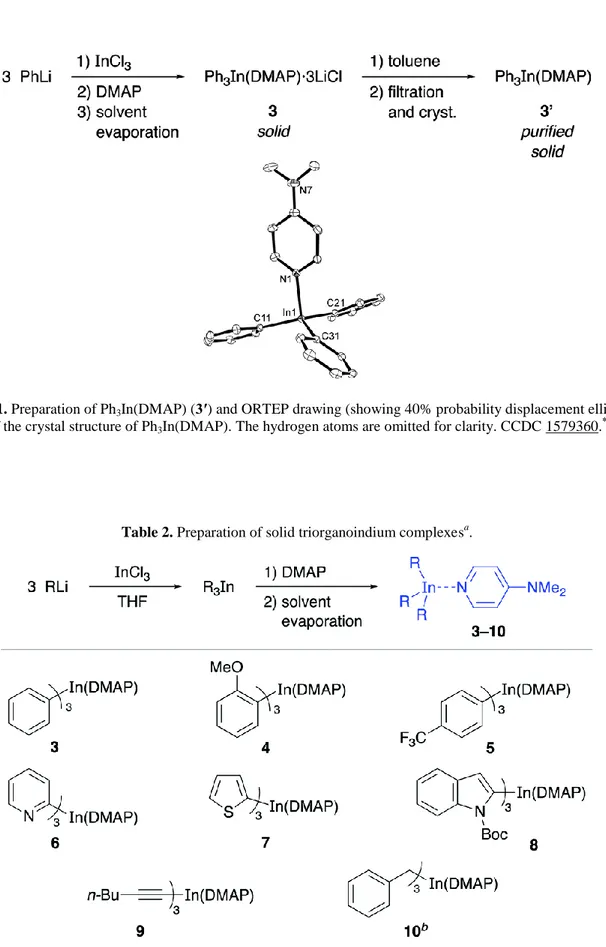
Accordingly, the addition of DMAP (1 equiv.) to a THF solution of Ph3In at room temperature for one hour
followed by evaporation of the solvent in vacuo gave a white solid with the tentative formula
Ph3In(DMAP)·3LiCl (3, Scheme 1). This compound was found to be bench-stable, and was handled in air
and used as a solid reagent. In order to characterize this solid, the LiCl was removed by filtration after boiling in dry toluene. This process afforded a compound that was crystallized from toluene/hexane (3 : 1).
X-ray diffraction studies on the pure crystals (3′) showed a trigonal pyramidal structure in which the ideal
plane formed by the phenyl groups and the indium atom is distorted by the ligand (DMAP) to give an N–In– C dihedral angle of around 100° (Scheme 1). The In–N distance was 2.27 Å and the In–C distance was 2.17 Å. Interestingly, the cross-coupling reaction with 4-bromoacetophenone carried out using the purified
crystals (3′) afforded the coupling product in an excellent yield (90%) on using only 34 mol% of the solid
organometallic reagent and showing the efficient transference of all three organic groups attached to the indium to the electrophile.
Having successfully prepared the complex Ph3In(DMAP), the protocol was applied to other triorganoindium
species and the reactivity of the resulting complexes was studied in palladium-catalyzed cross-coupling
reactions. With this purpose, a series of complexes R3In(DMAP)·3LiCl abbreviated as R3In(DMAP) for
clarity were prepared (Table 2) including aromatic and heteroaromatic indium reagents (3–8), a
trialkynylindium complex (9) and the tribenzylindium complex (10).
The reactivity of the solid triorganoindium reagents was tested in palladium-catalyzed cross-coupling
reactions using common electrophiles under the established conditions reported for R3In prepared in situ in
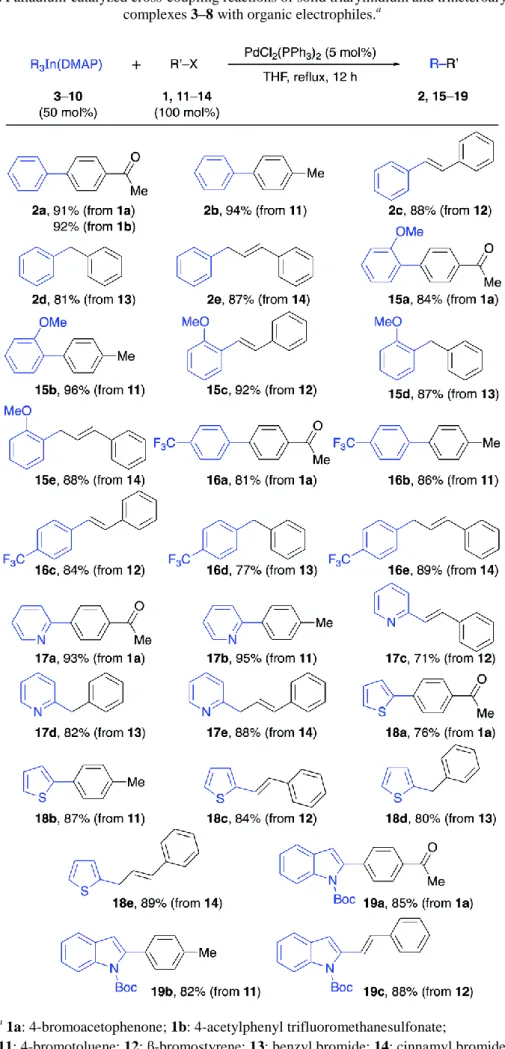
THF solution. The reaction of the Ph3In(DMAP) complex (3) with aryl triflate 1b or aryl
β-bromostyrene and benzyl bromide also gave the corresponding products 2c–d in good yields (81–88%).
Additionally, the Pd-catalyzed allylic substitution14 with cinnamyl bromide gave regioselectively the
α-substitution product 2e in excellent yield (87%).
Scheme 1. Preparation of Ph3In(DMAP) (3′) and ORTEP drawing (showing 40% probability displacement ellipsoids)
of the crystal structure of Ph3In(DMAP). The hydrogen atoms are omitted for clarity. CCDC 1579360.*
Table 2. Preparation of solid triorganoindium complexesa.
Table 3. Palladium-catalyzed cross-coupling reactions of solid triarylindium and triheteroarylindium complexes 3–8 with organic electrophiles.a
a
1a: 4-bromoacetophenone; 1b: 4-acetylphenyl trifluoromethanesulfonate;
To our delight, other solid derivatives of triarylindium reagents, such as the
tri(2-methoxyphenyl)indium(DMAP) (4) and tris(4-trifluoromethylphenyl)indium(DMAP) (3) also reacted
efficiently with the electrophiles 1a and 11–14 to give the corresponding cross-coupling products in good to
excellent yields (81–96%, Table 3). In all cases the reaction proceeded under mild reaction conditions and in short reaction times using 50 mol% of the solid indium reagents, thus showing the feasibility of using these compounds in cross-coupling reactions. The presence of DMAP as a ligand does not interfere with the reactivity of the organoindium compound since the yields are comparable to those obtained in reactions in
which the R3In was generated in situin solution.
Then, we proceeded to study the reactivity of the solid heteroaryl indium compounds 6–8. As can be seen
from the results in Table 3, coupling reactions between these compounds and electrophiles 1a and 11–14 also
proceeded in good yields (71–95%, Table 3) under the same experimental conditions as before. Interestingly, the reactions involving aryl halides and also a vinyl halide, benzyl bromide and an allylic bromide as electrophiles, showed the versatility of the solid indium reagents. Furthermore, the efficient coupling
achieved using pyridylindium complex 6 showed that the nitrogen lone pair does not interfere in the
complexation process with DMAP and the reactivity remains similar to that of the tripyridylindium in solution.
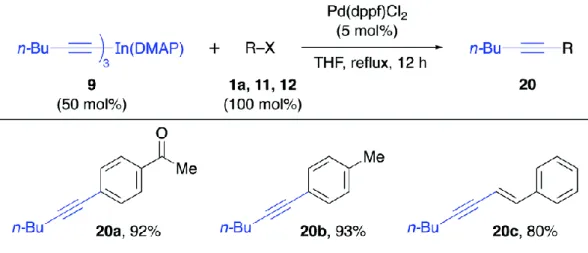
The reactivity of the solid alkynylindium complex 9 was also studied with aryl and alkenyl
halides 1a, 11 and 12 under standard reaction conditions. These coupling reactions also proceeded efficiently
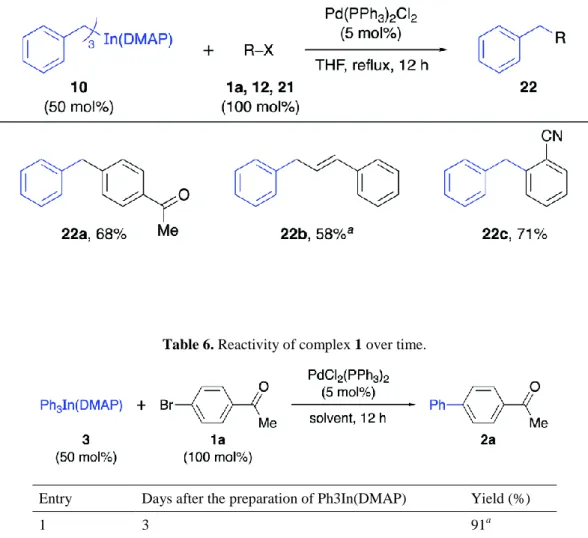
to give excellent yields (80–93%, Table 4). Finally, the reactivity of the tribenzylindium(DMAP) complex
(10) was tested. In this case, it was found that the coupling reactions with aryl bromide 1a, β-bromostyrene
(12) and 2-bromobenzonitrile (21) gave satisfactory yields (58–71%, Table 5). In this case, 10 was prepared
from benzylmagnesium bromide.
Table 4. Palladium-catalyzed cross-coupling reactions of solid alkynylindium complex 9 with organic electrophiles.
The synthetic utility of the novel solid triorganoindium species was demonstrated not only in terms of their reactivity but also due to their integrity against decomposition over time. In this respect,
Ph3In(DMAP)·3LiCl (3) was stored on the laboratory bench at room temperature under Ar and the stability
of the complex evaluated by means of palladium-catalyzed cross-coupling reactions over time. The results are presented in Table 6 and it can be seen that one month after the preparation of the complex, the solid
reagent remained highly reactive (78% yield of 2a, Table 6, entry 6). Interestingly, the use of purified
complexes prepared in this study generally show high stabilities under Ar at room temperature. The stability ranges from weeks for 4 and 7, days in the case of 5, 9 and 10, and >6 h for the nitrogen heterocyclic
derivatives 6 and 8 (tested by studying a Pd-catalyzed cross-coupling reaction, Table S1, ESI*).
Table 5. Palladium-catalyzed cross-coupling reactions of solid tribenzylindium(DMAP) complex (10) with organic electrophiles.
Table 6. Reactivity of complex 1 over time.
Entry Days after the preparation of Ph3In(DMAP) Yield (%)
1 3 91a
In general, the use of organoindium species is limited to ethers as solvents, and to their preparation from the corresponding organolithium or organomagnesium reagents. For this reason, we studied the reactivity of the
solid-stable R3In complexes in non-ethereal solvents. The palladium-catalyzed coupling reaction of
Ph3In(DMAP) with 1a in various solvents, such as toluene, chloroalkanes or DMF, generally afforded good
In conclusion, a variety of bench-stable solid triorganoindium reagents have been prepared by complexation
with DMAP in a 1 : 1 stoichiometry. The stability of the R3In complexes ranges from days to weeks
depending on the nature of the R groups. These reagents reacted with organic electrophiles under palladium catalysis to afford the coupling products in good yields. Interestingly, only 50 mol% of the solid Galicia (GRC2014/042) and EDRF funds for financial support. We also thank Dr Antonio L. Llamas-Díaz (RIAIDT, Universidade de Santiago de Compostela, Spain) for the X-ray structure analysis.
Conflicts of interest
A. Sarandeses and J. Pérez Sestelo, Adv. Synth. Catal., 2017, 359, 1388, and references therein.
Ed., 2011, 50, 511; (e) L. Adak and N. Yoshikai, J. Org. Chem., 2011, 76, 7563; (f) S. Bernhardt,
Z.-10. Selected references: (a) S. Bernhardt, G. Manolikakes, T. Kunz and P. Knochel, Angew. Chem., Int.
Ed., 2011, 50, 9205; (b) J. R. Colombe, S. Bernhardt, C. Stathakis, S. L. Buchwald and P.
Mitzel, Organometallics, 2005, 24, 5294.
14. (a) L. Baker and T. Minehan, J. Org. Chem., 2004, 69, 3957; (b) D. Rodríguez, J. Pérez Sestelo and
L. A. Sarandeses, J. Org. Chem., 2004, 69, 8136; (c) R. Riveiros, R. Tato, J. Pérez Sestelo and L. A.
Sarandeses, Eur. J. Org. Chem., 2012, 3018.
*
Electronic supplementary information (ESI) available: Tables S1 and S2, experimental procedures, compound characterization data, and copies of NMR spectra. CCDC 1579360. For ESI and crystallographic data in CIF or other electronic format see DOI: 10.1039/c7cc09344f.