PENINSULA OF SANTA ELENA STATE UNIVERSITY
FACULTY OF EDUCATION AND LANGUAGES
ENGLISH TEACHING CAREER
“ONLINE JOURNALS TO IMPROVE THE WRITING SKILLS IN THE
STUDENTS OF TENTH GRADE AT UNIDAD EDUCATIVA WALT
WHITMAN. SALINAS, PROVINCE OF SANTA ELENA. SCHOOL YEAR
2015–2016”.
RESEARCH PAPER
As a prerequisite to obtain a:
BACHELOR´S DEGREE IN ENGLISH
AUTHOR: Xiomara Elizabeth Lucas Chabla.
ADVISER: MSc. Leonardo Chávez Gonzabay.
CoverPENINSULA OF SANTA ELENA STATE UNIVERSITY
FACULTY OF EDUCATION AND LANGUAGES
ENGLISH TEACHING CAREER
“ONLINE JOURNALS TO IMPROVE THE WRITING SKILLS IN THE
STUDENTS OF TENTH GRADE AT UNIDAD EDUCATIVA WALT
WHITMAN. SALINAS, PROVINCE OF SANTA ELENA. SCHOOL YEAR
2015-2016”.
RESEARCH PAPER
As a prerequisite to obtain a:
BACHELOR’S DEGREE IN ENGLISH
AUTHOR:
Xiomara Elizabeth Lucas Chabla
ADVISER:
MSc. Leonardo Chávez Gonzabay
La Libertad, May 3rd 2016.
ADVISER’S APPROVAL
In my role as Adviser of the research paper under the title “ONLINE
JOURNALS TO IMPROVE THE WRITING SKILLS IN THE STUDENTS
OF TENTH GRADE AT UNIDAD EDUCATIVA WALT WHITMAN.
SALINAS, PROVINCE OF SANTA ELENA.SCHOOL YEAR 2015-2016”,
prepared by XIOMARA ELIZABETH LUCAS CHABLA undergraduate student of the English Teaching Career, Faculty of Education and Languages at Peninsula of Santa Elena State University, I declare that after having guided, studied and reviewed the project, I approve it in its entirety, because it meets the requirements and is sufficient for its submission to the evaluation of the academic tribunal.
Sincerely
La Libertad, May 3rd 2016.
STATEMENT OF AUTHORSHIP
I, XIOMARA ELIZABETH LUCAS CHABLA with ID number 092508567-2 undergraduate student from the Peninsula of Santa Elena State University, Faculty of Education and Languages, as a prerequisite to obtain a Bachelor´s degree in English, in my role as author of the research paper “ONLINE JOURNALS TO
IMPROVE THE WRITING SKILLS IN THE STUDENTS OF TENTH
GRADE AT UNIDAD EDUCATIVA WALT WHITMAN. SALINAS,
PROVINCE OF SANTA ELENA.SCHOOL YEAR 2015-2016”, certify that this work is of my authorship, except for the quotes and reflections used in this research paper.
________________________________ Xiomara Elizabeth Lucas Chabla
BOARD OF EXAMINERS
_______________________________ Dra. Nelly Panchana Rodríguez, MSc.
FACULTY OF EDUCATION AND LANGUAGES DEAN
_______________________________ Lcda. Glenda Pinoargote Parra, M.A.
ENGLISH TEACHING CAREER DIRECTOR
_______________________________ MSc. Leonardo Chávez Gonzabay
ADVISER
_______________________________
Lcdo. Byron Villacreses Santillán, MBA AREA PROFESSOR
______________________________ Ab. Joe Espinoza Ayala
DEDICATION
I dedicate this work to my beloved parents who have always given me their support and understanding during all my years in the university. A special gratitude to my dear uncle who constantly encouraged me to be a professional and doing what I love.
ACKNOWLEDGMENT
I express my gratitude to all my English career professors for their dedication, patience and knowledge shown during all these years for preparing us as capable professionals. Especially, I thank my advisor who guided me throughout this process and who would have never accepted anything less than my best efforts.
DECLARATION
“The content of the following research paper is my responsibility; the intellectual property belongs to the Peninsula of Santa Elena State University.”
Xiomara
________________________________ Xiomara Elizabeth Lucas Chabla
TABLE OF CONTENT
COVER ... ii
ADVISER’S APPROVAL ... iii
STATEMENT OF AUTHORSHIP ... iv
BOARD OF EXAMINERS ... v
DEDICATION ... vi
ACKNOWLEDGMENT ... vii
DECLARATION ... viii
CHARTS CONTENT TABLE PAGE ... xiv
GRAPHS CONTENT TABLE PAGE ... xvi
ILLUSTRATIONS CONTENT TABLE PAGE ... xvii
ABSTRACT ... xviii
INTRODUCTION ... 1
CHAPTER I: THE PROBLEM 1.1. Title ... 3
1.2. Statement of the problem ... 3
1.3. Scientific problem ... 5
1.4. Research object ... 5
1.5. Action research ... 5
1.7. General objective. ... 7
1.8. Idea to defend. ... 7
1.9. Scientific tasks. ... 8
CHAPTER II: THEORETICAL FRAMEWORK 2.1. Previous research ... 9
2.2. Philosophical basis ... 10
2.2.1. Brief history of the english language. ... 10
2.2.2. Teaching English ... 12
2.2.3. The Importance of Learning English... 14
2.2.4. Information and Communications and Technology in Education... 14
2.2.5. Collaborative Web Tools 2.0 ... 15
2.2.6. E-Blogger ... 18
2.2.7. Educational Philosophy: Learning and Acquisition ... 19
2.2.8. The Four Skills ... 21
2.2.9. The Writing Skill ... 23
2.3. Pedagogical basis ... 24
2.3.1. What is a Blog? ... 24
2.3.2. Blogs in Education ... 25
2.3.3. Types of Blogs in Education ... 26
2.3.4. Blogs to teach writing. ... 27
2.3.6. What is writing? ... 32
2.3.7. Formal, Informal And Academic Writing ... 33
2.3.8. Academic and reflective writing ... 34
2.3.9. The writing process ... 35
2.3.10. Writing approaches ... 37
2.3.11. Journals for writing ... 39
2.3.12. Writing for learning and writing for writing ... 40
2.3.13. Blogs as online journals for writing ... 40
2.4. Legal basis ... 42
2.4.1. Modelo del Sistema de Educación Intercultural Bilingue 2013 (MOSEIB) ... 42
2.4.2. Ecuadorian constitution (2008) ... 43
2.4.3. Ley orgánica de educación intercultural 2011 (loei) ... 44
2.4.4. Codigo de la niñez y la adolescencia (2014) ... 44
CHAPTER III: METHODOLOGY 3.1. Research approach ... 45
3.2. Basic research modality ... 45
3.3. Type of research ... 46
3.4. Methods ... 48
3.5. Population and sample ... 49
3.7. Techniques and instruments ... 53
3.7.1. Techniques ... 53
3.7.2. Instruments ... 55
3.8. Data collection plan ... 56
3.9. Data procesing plan ... 57
3.10. Interview results ... 58
3.10.1. Interview applied to the director of unidad educativa “walt whitman”. ... 58
3.10.2. Interview applied to the specialist in technological resources. ... 61
3.10.3. Interview applied to the specialist in teaching english. ... 65
3.11. Analysis and data interpretation ... 69
3.12. Conclusions and recommendations ... 79
CHAPTER IV: PROPOSAL 4.1. Informative data ... 81
4.2. Proposal background ... 82
4.3. Significance ... 83
4.4. Objectives ... 84
4.4.1. General objetive ... 84
4.5. Basis ... 85
4.5.1. Philosophical basis ... 85
4.6. Methodology (action plan) ... 86
4.7. Design and development of the proposal ... 87
4.7.1 What is an online journal? ... 88
4.7.2 What is blogger? ... 88
4.7.3 Steps for setting up a blog: ... 88
4.7.4 “Let´s write” teacher’s blog ... 92
4.7.5 Description of “let’s write” teacher’s blog... 93
4.7.6 Description of the students’ online journals... 96
4.7.7 Activities designed by the teacher that were inside of the teacher’s blog 99 4.7.8 Students’ online journals performances ... 110
4.8. Strategies of improvement ... 112
4.9. Conclusions and recommendations ... 116
GLOSSARY ... 118
TIME TABLE ... 119
ECONOMIC BUDGET ... 120
BIBLIOGRAPHY ... 121
CHARTS CONTENT TABLE PAGE
Chart # 1: Problem tree ... 4
Chart # 2: Kachru’s Circles ... 11
Chart # 3: Common European Framework. ... 13
Chart # 4: Learning Acquisition. ... 20
Chart # 5: The four skills. ... 21
Chart # 6: Kinds of blogs. ... 27
Chart # 7: Blogging five steps. ... 28
Chart # 8: Formal and informal writing... 33
Chart # 9: Academy and reflective writing. ... 35
Chart # 10: The writing process. ... 37
Chart # 11: Online journals. ... 42
Chart # 12: Population. ... 49
Chart # 13: Independent variable... 51
Chart # 14: Dependent variable. ... 52
Chart # 15: Data Collection Plan. ... 56
Chart # 16: Data Processing Plan. ... 57
Chart # 17: Question No. 1: Do you like English? ... 69
Chart # 18: Question No. 2: How do you consider your English classes? ... 70
Chart # 19: Question No. 3: How often do you use internet to study English? .. 71
Chart # 21: Question No. 5: Have you ever heard about Web tools 2.0?... 73
Chart # 22: Question No. 6: How do you consider the use of web tools 2.0 in the English Learning Process? ... 74
Chart # 23: Question No. 7: Do you consider that the implementation of online journals could help you to improve your writing skills? ... 75
Chart # 24: Question No. 8: How often do you write in English by yourself? ... 76
Chart # 25: Question No. 9: Do you practice English grammar at home? ... 77
Chart # 26: Question No. 10: Would you like to use online journals for improving your writing skills at home? ... 78
Chart # 27: Informative Data ... 81
Chart # 28: Action Plan ... 86
Chart # 29: Final results ... 114
GRAPHS CONTENT TABLE PAGE
Graph # 1: Preference of English Language ... 69
Graph # 2: English importance in classes ... 70
Graph # 3: Use of Internet to study English ... 71
Graph # 4: Frequency of the use of Internet in the English classes ... 72
Graph # 5: Previous knowledge about web tools 2.0 ... 73
Graph # 6: Web tools 2.0 importance in the English learning process ... 74
Graph # 7: Implementation of online journals... 75
Graph # 8: Students’ English writing frequency. ... 76
Graph # 9: English Grammar practice at home ... 77
Graph # 10: Use of online journals to improve the writing skills ... 78
ILLUSTRATIONS TABLE CONTENT
Illustration No. 1: Blogger Logo. ... 88
Illustration No. 2: Setting up a blog ... 89
Illustration No. 3: Selecting blogger ... 89
Illustration No. 4: Completing a profile ... 90
Illustration No. 5: Creating a blog... 90
Illustration No. 6: Selecting a sample ... 91
Illustration No. 7: Posting an entry ... 91
Illustration No. 8: Teacher’s blog home page. ... 92
Illustration No. 9: Unit # 1 Verb to be ... 93
Illustration No. 10: Worksheet to download ... 94
Illustration No. 11: There is/ there are Videos ... 94
Illustration No. 12: Simple past feedback ... 95
Illustration No. 13: Unit # 6 Links for online exercises ... 95
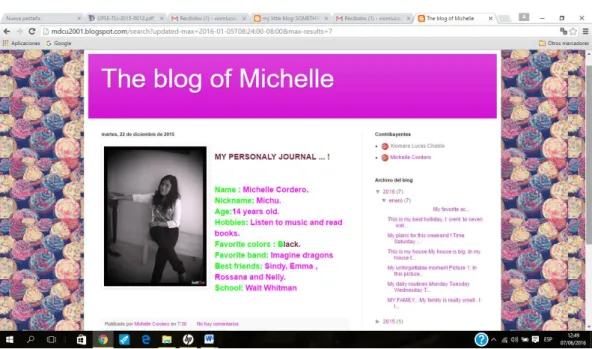
Illustration No. 14: Students’ online Journals ... 96
Illustration No. 15: Students’ online journals ... 97
Illustration No. 16: Students’ online Journal ... 97
Illustration No. 17: Students’ online Journal ... 98
Illustration No. 18: Students’ online Journal ... 98
Illustration No. 19: Luis Palma’s online journal “My family” ... 110
PENINSULA OF SANTA ELENA STATE UNIVERSITY FACULTY OF EDUCATION AND LANGUAGES
TEACHING CAREER
“ONLINE JOURNALS TO IMPROVE THE WRITING SKILLS IN THE STUDENTS OF TENTH GRADE AT UNIDAD EDUCATIVA WALT WHITMAN. SALINAS, PROVINCE OF SANTA ELENA.SCHOOL YEAR 2015-2016”
Author: XIOMARA LUCAS CHABLA. Advisor: MSc. LEONARDO CHÁVEZ GONZABAY.
ABSTRACT
INTRODUCTION
Since writing is such a vital skill to develop, it is necessary to find out the best alternatives for teaching it. This project explores many interesting areas about the use of web tools such as online journals for the improvement of the writing skills. Many educators or students who want to benefit or learn more about the use of web tools 2.0 in the educational field will find here valuable information and up dated content that can be used in a wide range of classroom settings.
In a technological world the use of ICT’s has been increasing and allowing people to interact, find information and learn from the privacy of their own homes. Teachers of this digital era must use all available resources in order to offer an innovative education to their students and encourage them to practice, discover and learn anywhere.
The writing skill allows people to communicate in a written way every day. Due to high-tech advances there are many web tools 2.0 that can be used for the enhancement of it. Although, this skill could be hard to learn, with the implementation of online journals, it can be mastered over time.
the use of online journals. These web tools 2.0 offer many alternatives for teaching English writing.
The following research paper is divided in four chapters such as:
Chapter I, The problem: Describes and explains the statement of the problem, scientific problem, research object, action research, significance, general objective, idea to defend and scientific tasks, which contribute to determine what the problem is and why it is important in order to solve it. Also it allows understanding the possible causes of the problem and its possible solutions.
Chapter II, Theoretical Framework: Supports the research paper with details of previous research. The philosophical, pedagogical and legal basis facilitates knowing if there are enough similar material involved with the object of study and its validity.
Chapter III, The Methodology: Explains the methodological strategies in order to conduct a successful research. It contains the research modality, type of research, population and sample, variable operationalization, techniques and instruments, data collection, and data processing plan.
CHAPTER I
THE PROBLEM
1.1. TITLE:
“ONLINE JOURNALS TO IMPROVE THE WRITING SKILLS IN THE
STUDENTS OF TENTH GRADE AT UNIDAD EDUCATIVA WALT
WHITMAN. SALINAS, PROVINCE OF SANTA ELENA.SCHOOL YEAR
2015-2016”
1.2. STATEMENT OF THE PROBLEM
Uncooperative parents who cannot guide their children due to time or lack of English knowledge.
According to the Ministry of Education and its standards of English learning based on the Common European Frame Work of Language Reference (CEFR), students who finished the ninth grade must be at least at the A1 level and students who finished the first BGU must get an A2 level, so learners who are in the tenth grade will be in the middle of both levels which involves the basic understanding of the skills in a correct way. In order to improve these basic skill educators must use innovative and modern ways for catching the students’ attention meaningfully.
Chart # 1: Problem tree
1.3. SCIENTIFIC PROBLEM
The tenth grade students at Unidad Educativa “Walt Whitman” are unable to write English properly using the correct grammar tenses and writing procedures.
1.4. RESEARCH OBJECT
The implementation of online journals to improve the writing skills in the students of tenth grade at Unidad Educativa Walt Whitman.
1.5. ACTION RESEARCH
The improvement of the writing skills in the students of tenth grade at Unidad Educativa Walt Whitman.
1.6. SIGNIFICANCE
According to Harmer (2004), “Writing, like any other skill, has its ‘mechanical’
components. These include handwriting, spelling, punctuation, and the construction of well-formed sentences, paragraphs, and texts” (44). The writing ability is one of the most relevant abilities that learners must master for learning a second language, which belongs to the productive skills. Although, students speak English there are some of them who cannot write correctly their intentions. Learners must understand a grammar structure then they produce their own sentences by writing them and finally they can talk about it. For improving the writing skills it is essential to establish good writing habits, consequently the learners start writing everyday about something they like, such as: a supermarket list, a letter for their friends and relatives, English text messages, etc.
Nowadays, technology offers a lot of new alternatives for teaching English and at the same time for developing the skills needed individually or in groups. In order to develop the writing skill there are different kinds of personal online journals that can be used for assessing and measuring the students’ progress, in addition the learners can work at their own homes and establish a schedule for doing autonomous or independent work. These kinds of web tools belong to the new educational era where students and teachers interact outside of a classroom.
learners is to write. There is a place where people can manage a personal online journal called “Google Site” that can be created with educational purposes. It allows uploading files, tutorial videos, worksheets, posts with several topics, and more in order to comment a reproduce what the learners have been studied in the classroom.
“Blogger” is a very useful tool that engages students, teachers and technology for achieving an established goal. By using this web tool students can practice their writing ability and correct their mistakes with short feedbacks that can be uploaded in the personal online journal as an extra material for doing the activities established by the teacher. The usage of this modern tool catches the students’ attention because it is an interactive way for learning English and developing the writing skills.
1.7. GENERAL OBJECTIVE.
To determine the effect of online journals to improve the writing skills on tenth grade students at U.E Walt Whitman through the use of a Google Site.
1.8. IDEA TO DEFEND.
1.9. SCIENTIFIC TASKS.
1. To examine all available literature about the use of online journals for the improvement of writing skills
2. The examination of the students’ motivation and knowledge about technological tools and its educational importance.
CHAPTER II
THEORETICAL FRAMEWORK
2.1. PREVIOUS RESEARCH
The implementation of technology for teaching English is a great step which is changing the educational field and beneficiating it. Theories and studies done in other countries demonstrated the effectiveness of the use of blogs also known as online journals for improving the writing skill in the learners.
A study conducted by Zhang (2009), demonstrated that the application of blogs or is a potential tool in the educational field to improve the writing skills and at the same time motivate the learners’ autonomy by increasing their writing habits.
According to Zhang’s research, the use of the weblogs in education for improving English writing offers many learning opportunities such us:
Students can create their own blogs as online journals that can demonstrate the students’ progress in their writing ability over time.
Nowadays social media websites are being used for learning and teaching English. Downs (2004), asserts that Personal Learning Environments (PLE) such as educational websites, online journals or blogs, and educational platforms contributes to the learning process. PLE involves the content and the practice which combine support the improvement of the writing skills.
In tenth basic grade at Unidad Educativa “Walt Whitman” in Santa Elena province, there is a deficient English writing ability that could be avoided by the implementation of online journals. This research paper will direct that concern by examining the philosophical, pedagogical and legal theoretical foundations that support the use of technology through online journals to improve the writing skill.
2.2. PHILOSOPHICAL BASIS
2.2.1. Brief History of the English Language.
Mexico, Poland, Japan, etc.
India, Nigeria, Singapore, etc. Great Britain,
USA, Canada, etc.
Kachru (1985), proposed three English circles according to the people who spoke English around the world. These three circles were:
Chart # 2: Kachru’s Circles
Author: Xiomara Lucas Chabla
The inner circle referred to the native speakers in countries such as: Canada, USA, Great Britain, Australia, etc. In 1985 Kachru estimated between 320 and 230 million native speakers around the world.
Finally the expanding circle referred to the countries where English language had been taught and learnt as a foreign language in countries such as: Poland, Mexico, Japan, etc.
The English language has grown during the last decades very quickly; its rapid spread represents the necessity of other countries for learning a second language for communication around the world. Mollin (2006), points that the increasing of the English language use as a lingua franca must be involved inside of the expanding circle as a variety of the English speakers.
2.2.2. Teaching English
The significance of English teaching radiates in the importance of its universal use. However, Peenycook (1998), argues that for some students the fact of learning a second language involves its culture and assumptions that not all the learners feel the necessity to learn, although some English learners could think English language is unpleasant, but necessary for their educational and professional development.
According to the government requirements, English teachers in Ecuador need to have a B2 level or at least a B1 level for teaching English, also students of tenth grade at the end of their studies must achieve an A1 or A2 English level. The Common European Framework of References describes these two levels:
Chart # 3: Common European Framework.
Source: Council of Europe
Author: Xiomara Lucas Chabla
The emergence of English as a global language is a reality that requires people to communicate, to work, to live and to study in other places. Because English is used around the world it should be taught as a second language in Ecuador. The use of technology for teaching English is very important. Dudeney and Hockley (2007), claims that in the language teaching process, technology has been present during decades since tape recorders, videos, projectors, until the web 2.0 tools now.
LEVEL A2
People at this level can deal with simple information that is familiar for them. They can write about their routines or any familiar topic.
LEVEL A1
2.2.3. The Importance of Learning English
Because English language is a global language, Graddold (1997), considers many future possibilities of the expansion of English as a one world language. He claims that the rapid spread of English will continue specially in sub developed countries. Graddold also pointed out those other languages such us Mandarin, Hindu and French would increase, but not with the intensity of English.
Harmer (2012), considered that it is important to learn English because it is present in different countries around the world and the fact of being bilingual gives the learners more opportunities for better jobs and increases their cultural knowledge. People are experimenting changes in different fields such as: medicine, science, politics, education, etc. and in all of these fields the English language is involved.
Learning this language allows students to interact in different fields and better their lives. For example, learners can exchange information with people of other countries through social networks or in real life; moreover, students can travel and put in practice what they learn and the learners can know more about other cultures and increase their knowledge.
2.2.4. ICT’s in Education
innovative and moderns tools that make the learning process more interactive.
According to Pere (2011), “Computer programs are those created for the specific purpose of being used as a teaching tool, i.e. to facilitate the teaching and learning”. (p.4). Pere explains that technology can be used in the learning process too. Teachers can surf on the net and find a lot of useful tools in order to teach or reinforce their classes; moreover they can improve through these modern tools a specific skill of the four skills at the same time.
Ricardo (2012), in a conference emphasizes: “ICTs have features of a constructive learning environment as the stakes allow experimentation and problem solving, involving the student in the learning project and generate autonomous environments”.(p.286) learners have a significance learning through the use of ICTs because they belong to this new technological era and absorb what it implies in a constructive and autonomous way.
2.2.5. Collaborative Web Tools 2.0
skills (Listening and reading). On the other hand for improving the productive skills (writing and speaking) there are another kind of web tools for example social networks, language learning communities, writing online clubs, speaking online clubs, etc. As a result students can practice English not only at school, but at home too.
The impact of web tools in the teaching learning process is evident. Each new change in the people’s lives carries a solution or a problem. Nomass (2013), explained that the use of web tools for teaching English as a second language has some advantages. For instance, students that use web tools can improve their four skills (speaking, writing, listening and reading) and at the same time the learners can increase their vocabulary. Moreover, students get along with technology and develop other skills. However there are some disadvantages too, for example, the use of internet in a bad way produces distraction and a waste of time; furthermore, some teachers do not encourage students to use technology for practicing what they learn in the school. Consequently students do not understand the importance of web tools in their education.
them with their teachers and classmates; moreover, students can interact in the same document by correcting it, while the others are writing on it.
Another useful web tool 2.0 offered by Google apps is E-blogger, with this web tool teachers can create a blog where they can upload information as grammar exercises, audios, photos and more in order to reinforce the class given in the classroom. For instance, students can comment in the blog, listen to the audio, describe photos, read a text and upload videos for improving their four skills. However there is another kind of web tool such as platforms where educators can measure and control their students’ progress. Edmodo and Moodle are good examples of virtual platform used by schools and universities for assessing the learners.
The importance of the use of web tools 2.0 in an English classroom has increased, even public schools try to offer an education based on innovation. Some of the benefits are:
Web tools make the learning process more interesting. Students learn how to manage their time on the internet. Teachers can interact with their learners more actively.
Because it is a reality that education is always changing, the use of web tools is essential as a way for teaching English outside the classrooms, as a result future education involves the use of technology and of course the use of web tools will be present in all the subjects imparted in the school.
In conclusion, web tools are programs created for testing the learning process. They have provoked a big impact in the educational area; moreover, there are some advantages and disadvantages that people must considerer when they use this kind of tools for teaching English. The use of web tools for teaching English must be implemented inside the classroom and followed outside the classroom in order to reinforce the classes given and for creating a habit of autonomous work in the students. It’s essential to use modern methods for teaching English such as web tools that can make the learning process more enjoyable.
2.2.6. E-Blogger
In the educational field, E-Blogger offers a lot of designs that can be modified according to the model selected by their owners. Educators and pupils can create their own blogs trough this platform in order to upload information and share it with their classmates, helping improve the four skills specially the writing skill. Campbell (2004), considers that writing skills can be improved and developed through the use of blogs as a modern way to deliver an interesting learning environment and help them in their learning process continuously.
2.2.7. Educational Philosophy: Learning and Acquisition
Education should reach everybody. There are two kinds of people that learn a second language according to Harmer (2012), the first kind of people learn a second language without formals classes it means that they do not take language classes; On the other hand, the other kind of people learn a second language by going to classes for studying the English language. Harmer explained that for some people is very simply to absorb a second language, for example, people who live in an English community can learn from it without formal attention to study the language involved. The other kind of people need a formal education to acquire a second language by going to classes and learning reading, writing, speaking, grammar and vocabulary.
subconsciously. Palmer advised that the spontaneous language acquisition is necessary for the development of the English mastery.
Krashen (1981), demanded that language acquired subconsciously can be easily used in spontaneous group conversations. Consequently, this kind of acquisition can be available instantly when people with this capability need it. In contrast, people that need a formal education for acquiring a second language cannot use this spontaneous ability; they use what they have learned in their classes in order to have a conversation pre-programmed.
In conclusion, acquisition and learning of English as a second language are very close terms that work together. There are two kinds of learners that must be identified for the teachers in order to use the correct tools, methods, and strategies to achieve the acquisition and learning of English in both of them.
Chart # 4: Learning Acquisition.
They do not go to formal classes. This kind of people learns English on their own. They learn English through the contact with the target-language community.
SUBCONSCIOUSLY
They study the grammar, vocabulary, and all of the parts involved for speaking a second language. They study English for learning it, and go to formal classes.
PRODUCTIVE SKILLS
RECEPTIVE SKILLS
2.2.8. The Four Skills
When people are learning an additional language, there are four skills that have to be mastered. The receptive skills such as: reading and listening; and the productive skills such as: writing and speaking. According to Harmer (1991), the use of these skills is essential for acquiring the knowledge required in order to communicate effectively. Richards (2006) defined the four skills as essential parts of the development of the communication. For communicating people must talk or write and at the same time they need to understand what they read and listen.
Chart # 5: The four skills.
Elaborated by: Xiomara Lucas Chabla THE FOUR SKILLS
READING
LISTENING
Burns & Joyce (1997), in their book called “Focus on speaking” claimed: “Speaking is an interactive process that involves words meaning construction for the language production and the reception of it through information processing”. The ability to speak in other words is a communicative skill that involves an interaction and construction of what the people want to express in a coordinated way by keeping its sense. According to Hammer (2007), on his book called “How to teach English” claims “Good speaking tasks must be highly sympathetic for learners, so that students participate as a whole. These activities must have been set correctly for pupils would be able to give the comprehensible regeneration and feel satisfied about it”. (p. 123).
The other productive skill is the writing skill, according to Longman Advanced American Dictionary third edition (2013), writing is: “words those have been written or printed, also is the activity of making words on a page with a pen or pencil, furthermore the activity of writing books, poems, stories, essays, etc. The process of the writing skills involves the practice, presentation and production.
The last receptive skill is listening which is defined by Purdy (1991), as a primary skill, because people listen before they speak, write or read. For Purdy, the role of listening is very important in the language acquisition. Moreover, the fact of listening helps in the construction of good relationships. Purdy differentiated between hearing and listening. Hearing is a natural act while listening requires attention.
2.2.9. The Writing Skill
Harmer (2007), in his book “how to teach writing” says: “writing is frequently useful as preparation for some other activity, in particular when students write sentences as a preamble to discussion activities” (p. 35). The writing skill in other words is the ability to communicate something in a written way, for example, a letter, memos, e-mails, text messages, etc.
This productive skill is one of the most important skills because involves the production of something. People write every day; as a consequence, it is essential to learn to write correctly for communication.
the written way for communicating what they think or feel. As a consequence the writing skills are presented in people’s lives every day and it must be encouraged to be practiced by the learners in order to acquire good writing habits.
2.3. PEDAGOGICAL BASIS
2.3.1. What is a Blog?
Campbell (2003), defines the word ‘Blogs’ as ‘online journals’ that can be used in an individual or collective way for sharing information as an online social software; furthermore, these online journals can be updated by their authors with their own words, thoughts, and ideas. The use of this social media has increased during the last years.
Johnson (2004), argues that blogs are electronic journals that allow people who use them to keep their own progress of their writing ability. He claims that the use of these electronic journals are been used in the educational area for many years and are considered as useful technological tools.
available on the internet. The term ‘blog’ was initiated by Barger in 1997 and is defines as a website that contents entries, videos, posts, etc.
2.3.2. Blogs in Education
Bartlett-Brag (2003), refers the use of blogs in education as a modern strategy that allows the interaction between teachers and students outside the classroom. She believes that blogging strategies in the educational field enriches the experience of learning and at the same time gives the advantage of increasing the writing learners’ ability. Bartlett-Brag defines the use of blogs as software learning where students can practice and complete their previous knowledge by different tasks at the commodity of their homes in order to encourage the learners’ autonomy.
Dudeney and Hockly (2014), in their book “Teaching English with Technology” describes the blogs in language teaching as technological resources that consists in written text only that can include some pictures, audio, and videos. The learners can read and comment on blog entries; moreover they can interact in this social software and share information that they consider important by writing about their experiences, thoughts, etc.
can write every day in their blogs and become better writers. He believes that the use of blogs for teaching English writing is a useful way for monitoring the students’ writing progress.
2.3.3. Types of Blogs in Education
Dudeney and Hockly (2014), describe three kinds of blogs in the educational area that provides the teachers and learners the opportunity to practice, keep record of their progress.
The Tutor or Teachers Blogs: These kinds of blogs are managed by the educators. They can select the topics in order to post them in their blogs and invite their students to comment about the information uploaded. Furthermore, the teachers through their blogs can follow and monitor the students’ writing process and give them feedback trough appropriate online tasks.
Students or Learner Blogs: The learners with the supervision of their teachers can create their own blogs as an online journal where they can improve their writing skill by writing every day about their lives. This kind of blog allows the learners to write and share about what they like; besides, the students can interact between their classmates and teacher in a virtual social community. The Class Blog: It can be created by a teacher or students in order to be used
practicing what they have learned in classes, also they can receive a feedback as a previous knowledge for doing the required task.
Chart # 6: Kinds of blogs.
Source: Dudeney and Hockly
Elaborated by: Xiomara Lucas Chabla
2.3.4. Blogs to teach writing.
According to Bartlett-Brag (2003), pedagogical and teaching practices are connected with new technology resources; educators have the opportunity to better their teaching strategies by using potential technological tools such as blogs. She defines the word ‘Blogging’ as the use of blogs and presents alternatives for the implementation of blogging inside of the teaching practices in order to improve the writing skills.
Kennedy (2003), points out that the implementation of blogs inside of English classes “gives students a real audience to write to and, when optimized, a
Created by the learners.
Students write what they think.
Autonomy work involved.
STUDENTS BLOG
Teacher or students can create it. It is used for the
whole class. Reinforcement of a
class given.
CLASS BLOG
Managed by the teacher.
Teachers select the topics.
Feedback involved.
1st level: Establishment 2nd level: Instrospection 3rd level: Reflective monologue 4th level:Reflective conversation 5th level: Knowledege artefacts
collaborative environment where they can give and receive feedback, mirroring the way professional writers use a workshop environment to hone their craft” (p. 11). This kind of teaching practice encourages students to use their personal blogs in order to practice and improve their writing skills.
Bartlett-Brag (2003), considers that blogging has a process of five levels:
Chart # 7: Blogging five steps.
Source: Bartlett–Brag.
Elaborated by: Xiomara Lucas Chabla.
2. Introspection: In this second level learners must continue recording, and collecting information; they pay attention to their feelings and estimate their learning process. Teachers can suggest questions at this stage where most students’ writing are short and could be negative feelings.
3. Reflective monologues: The third level involves the reflective writing which means to think before writing. Teachers at this stages use structured questions by considering the students’ preferences and emotions in order to allow them to be more conscious and responsible for their comments and entries. The learners can write short paragraph about their experiences by using reflective writing as a reflective monologue.
4. Reflective dialogue: Pupils have to consider their style of expression or communication according to their readers in order to publish their thoughts in a correct way. Each class must discuss a specific topic or issue that can be added in the blogs for encouraging students’ reflection about what they read and write what they think about it. It develops responsibility. Learners that reach this fourth stage develop their self-confidence and they become in active writers by publishing, commenting or posting their ideas, opinions, and thoughts in their own blogs with their own words.
5. Knowledge Artefacts: At the final level learners can read their classmates’
agreements, disagreements, opinions, experiences and advises. Students writing at this stage can be strong and the writing habit can be well-constructed to continue writing.
According to Bartlett-Brag (2003), As a consequence the learners that pass through all of these stages better their personal knowledge and acquire a reflective writing and thinking base on the knowledge before established and practiced in the blogs.
2.3.5. Advantages of blogs to improve the writing skill
According to Zhang (2009), the use of blogs in students for English writing has some advantages such as:
Blogs for improving English writing facilitates the learners’ critical thinking skill abilities.
Online journals provide good examples and a lot of values that the students will use during their lives.
Blogging provides a lot of information and facilitates its significant learning to the pupils. Learners can exchange cultural information and write about it.
Of equal importance, Johnson (2004), considers the advantages of blogs for improving the writing skill for both people involved in the learning process: Educators and learners. Inside of the teacher advantages for teaching writing trough blogs are:
Using blogs allows teacher to measure the students’ writing process.
Through blogs the educators can give feedback to students before sending writing tasks.
Teachers can use blogs as a modern way to teach writing to the students and at the same time get engaged to students with the tasks.
Educators can see all of the students’ writings and keep them as an evidence of the student’s progress.
On the other hand, Johnson describes the following points as advantages of blogs for improving the writing skill in the students:
Learners can access to online English dictionaries and use them when they are writing.
Students have the possibility to express their feelings, experiences and desires by writing in their own blogs and at the same time they can practice their writing skill.
The pupils can develop autonomy and self-confidence. Furthermore, they can develop good writing habits.
2.3.6. What is writing?
Writing is a daily activity that people do every day even when they prepare a grocery shopping list. According to Nunan (1999), there are different kinds of writing and each one is characterized by different structures which “can be observed within the sentence at the level of grammar, and beyond the sentences at the level of structure” (p. 275); thus, all kinds of writing need a basic or an advanced skill in other words the more structured the writing the more advance writing skills are.
2.3.7. Formal, Informal And Academic Writing
Harmer (2004), arguments two styles of writing: formal and informal writing. The first one avoids the use of colloquial expressions, clichés and contractions. Moreover, this style of writing uses a lot of technical words and the level of sentences is more complex. It is used in advance levels for specific or professional purposes.
In contrast, informal writing allows the use of colloquial expressions. It is simpler than formal writing and reflects empathy and emotion. Furthermore, it is a good example of the writing used in blogs because it permits learners to write every day and improve this skill according to Harmer.
Chart # 8: Formal and informal writing.
Source: Jeremy Harmer Teaching English
Elaborated by: Xiomara Lucas Chabla.
It allows the use of colloquial phrases, contractions and
abbreviations. It uses simple words and reflects empathy and
emotions. It is used every day.
Avoid the use of colloquial phrases and contractions. It is more
technical and complex. It used for academic or professional
purposes.
INFORMAL WRITING
2.3.8. Academic and reflective writing
Academic writing; in brief refers to it as an advanced writing which involves tasks in a complex level. It uses eclecticisms for permitting students to build up texts by their own; also, it raises the students’ self-awareness and self-confidence by identifying their strengths and weakness in writing.
Academic writing benefits students to understand the writing process and develop it step by step. According to Alexander (2008), academic writing must considerer its readers. Writers have to transmit their intentions clearly in order to reach the desires audience. Finally Hyland (2006), refers academic writing as an advance writing used in higher education.
Express reflection throught: experiences, opinions, thoughts, etc. Specific purposes: academic essays, research papers, formal letters, etc.
Chart # 9: Academy and reflective writing.
Source: Giles.
Elaborated by: Xiomara Lucas Chabla.
2.3.9. The writing process
Eves-Bowden (2001), interviewed basic writer learners and explored the basic writers’ thought about their personal writing process and their experiences while they were performing it in order to examine the best ways to develop the writing skill. She discussed about the cognitive writing process which points out the productions and the writing process; moreover, Eves-Bowden referred the importance of the process of writing and the product as a result of the goals reached.
However, Murray (1972), claimed that teaching writing is a process and not a product. He divided the writing process in 3 important stages:
REFLECTIVE WRITING ACADEMY
Writing. Rewriting.
Furthermore, Murray expressed that the significance of the development of the English writing skill depends on the learners’ attitudes and how much time they dedicate to write. He advised that the writing process must be pleasant in order to encourage learners to write every day about their interest, experiences or preferences.
Shaughnessy (1976), agreed that teaching writing must be concentrated as a process more than a product. In her studies, she proved that when educators monitor their students learning increases a lot, due to the fact, that students feel the pressure of being observed.
2.3.10.Writing approaches
Harmer (2012), proposes four kinds of approaches:
PROCESS AND PRODUCT: According to Harmer this kind of approach focuses on the product of writing. It values the construction of a product (essay, letter, poem, etc.) as the principal goal of the writing process. It is complex and the production of writing is the proof that it works.
However, White and Arndt (1991) points that writing includes rewriting which means a revision of what the learner have constructed. They describe the writing as a wheel process that is constantly working. It starts with planning, then drafting, after editing and finally the last version which is the product that Harmer pointed in a different way. The product in this case can change constantly by the editing.
Chart # 10: The writing process.
Source: White and Arndt.
Elaborated by: Xiomara Lucas Chabla.
Drafting the writing
Editing the writing
It can be modified by repeating the steps.
Planning a writing
CREATIVE WRITING: According to Harmer (2012), the term suggests ingenious tasks, for example, poetry, plays, stories, etc. Gaffield-Vire (1998), claims that creative writing is ‘a journey of self-discovery. And self-discovery promotes effective learning’ (31). The creativity or imagination is a useful tool that helps teachers to encourage students to write every day in different ways. The learners can use their imagination for writing and at the same time they feel motivated.
GENRE: This approach represents the rules used by the different kinds of writing (narrative, descriptive, expository, etc.). According to Tribble (1996), when educators use this kind of approach, the learners study texts according to the genre selected that they are going to write, but using their own words. He suggests the use of data collection as a good strategy for improving the writing skill.
2.3.11.Journals for writing
Walker (2005), describes the use of journals to improve the writing skill as a tool that allows students to express emotions and feelings about their educational experiences. In addition, Kessler (2004), mentions the use of journals for improving reflecting writing as a kind of writing base on experiences and emphasizes the use of blogs for improving it and developing the writing habits too.
Boud (2009), claims that journal writings for learning English are used to “capture an experience, record an event, explore our feelings, or make sense of what we know” (p. 9) he refers journals as tools used for creating contexts and meanings according to events and past experiences. The learners can write in their journals and create new situations and meanings for improving and developing the reflective writing.
According to Walker (2006), journal writing is being used in the educational field during the last decades. For teaching writing trough journals the topics must be selected from experiences in order to facilitate the critical thinking and for improving the reflective writing.
thinking of the students, also is essential to pre-assigned topics because it helps learners think before writing.
2.3.12.Writing for learning and writing for writing
Harmer (2012), makes a difference between writing for learning and writing for writing in order to promote and improve the writing skills. He defines the first one as a help to the learners for improving their grammar skills in order to be tested. It serves to remember grammar structures and rules through the activity of writing, for example, teachers ask the learners for writing sentences in simple past tense or using will.
In contrast, the second kind: Writing for writing involves the learners’ creativity and ability for writing a story or narrative that tells something; it does not focus on the grammar structures only. It works as a contrasting for constructing the learners’ writing habits by writing by their own.
2.3.13.Blogs as online journals for writing
study he describes how the application of blogs as online journals improved the writing skill in students of Taiwan who at the beginning had writing deficiency that was avoided with the use of blogs.
According to Blood (2000), defines blogs as online journals that can be updated at any time with information that people considerer as important. In the educational field they can be used for teaching English specially for improving the writing skill. Online journals help students to develop their self-confidence and write about their lives.
Bernstein (2004), believes that the following actions improve the writing skills: the use of laptops, handwriting and blog freelancing. In order words Bernstein supports that the improvement of writing skills is more effective when learners used technology in order to write what they like.
BLOGS AS ONLINE JOURNALS Improve writing skills Give feedback to the learners. Develop self-awareness and self-condifence Motivate students to write
Chart # 11: Online journals.
Source: Campbell.
Elaborated by: Xiomara Lucas Chabla.
2.4. LEGAL BASIS
2.4.1. Modelo del Sistema de Educación Intercultural Bilingüe 2013
(MOSEIB)
It establishes some articles that defend the learning of a foreign language and sublanguages in Ecuador as a prerequisite that all of the students must get during their educational process.
language and it is going to increase eventually; at the end of the students’ education they are going to get a 20% increase of the foreign language as a requisite to finish high school.
2.4.2. Ecuadorian Constitution (2008)
Article 27.- The education in Ecuador must be available for everyone in order to develop politeness, respect for values and nature and for promoting democracy. Furthermore, it will be mandatory for promoting the equity, justice and peace. Education will stimulate the Ecuadorian culture for the development of human beings with capabilities to create and work.
Article 343.- The National System of Education has to develop abilities and capabilities in a collective and individual way in order to facilitate the learning process in education. It will implement an intercultural vision according to the different Ecuadorian races by respecting all of the human rights involved in the diverse communities and nationalities that exist inside the country.
care of the learners and their physical and mental health. Furthermore, it assures a bilingual education.
2.4.3. Ley Orgánica de Educación Intercultural 2011 (LOEI)
ARTICLE 2 - BASIS
Multilingualism recognizes all the people’s rights and their diversity according to their communities and nationalities to learn in their proper language and in the languages used in their cultures; however, it emphasizes the right for learning other language in relation with the international community.
2.4.4. CODIGO DE LA NIÑEZ Y LA ADOLESCENCIA (2014)
CHAPTER III
METHODOLOGY
3.1. RESEARCH APPROACH
This research paper is exploratory, qualitative, using observation, interviews, and surveys. It is considering that all of the activities will be implemented in order to improve the writing skills of the tenth grade students from Unidad Educativa “Walt Whitman”. The results were obtained through observations, interviews to specialists and focus group. This chapter explains the results before mentioned.
This project observed the students’ writing improvement and the students’ reaction about the use of blogs, with the purpose of evaluating the use of technology to overcome the problems found. The principal goal of improving the writing skills through the use of online personal journals better known as blogs is for learners to improve their writing skills.
It is necessary to mention that in this chapter it has taken into consideration, the investigation methods, techniques and instruments that will be applied during the research.
3.2. BASIC RESEARCH MODALITY
solution to the problem by the use of online journals for improving the writing skills with the intention of facilitating the use of technology in the educational process.
3.3. TYPE OF RESEARCH
The qualitative model has been selected for reaching the purpose of this research paper and they will use the following types of researches: field, descriptive, and documentary.
Field research:
This kind of research is qualitative based on the collection of primary data in a natural setting by observing and interactive with the people involved in the research. Field research uses various methods such as: direct observation, interviews face to face, collective discussions and analysis from the technological activities performance.
Descriptive research:
It is a useful type of research that describes the reactions and behaviors of the subject of the study. Furthermore, it provides the characteristics of the components that are involved in the problem being studied. The principal purpose of this research is to observe, describe and document all of the information obtained. It allows identifying and analyzing the possible relationship between the variables of the study proposed. Descriptive research involves the use of some techniques such as observation, interviews and surveys in order to collect data and provide a description of the phenomenon studied.
Documentary research:
Documentary research allows the use of books, texts, researches, documents, and more as sources materials for any kind of investigation. It provides the investigators examples, comparisons, percentages, statistics and different information for clarifying the principal subject of study.
Applied research:
It is used for finding solutions in order to solve a specific problem. Applied research begins with the description of the problem or issue in a systematic way, then, it finds a theory in order to frame the problem, after that, the described situation is analyzed and evaluated according to the theory chosen and finally it is proposed a solution for the problem exposed.
Applied research will allow the implementation of online journals to improve the writing skills in students of tenth grade at Unidad Educativa “Walt Whitman”.
3.4. METHODS
Qualitative Method
It is a method which refers to collect data and present it without statistics. It refers to the description and interpretation of the information obtained in a narrative way. Qualitative research involves the following methods for collecting information: observations, notes, journals and interviews.
Observation Method
This method has the purpose of observing the phenomena of study carefully in the place where it is happening. It permits to examine people in their natural settings or situations. Researchers need to use their senses in order to observe correctly the population that is being studied. It requires the use of a formal observation instrument such as observation sheets.
Observation method was selected and used to observe the students’ behaviors and attitudes about the implementation of blogs and the activities involved in order to determinate their writing skills improvement.
3.5. POPULATION AND SAMPLE
Population
The population of this research paper is based on the following participants:
Chart # 12: Population.
Population
No. Description Quantity Percentage
1 Authorities 1 8.33 %
2 Teachers 1 8.33 %
3 Students 10 83.33 %
TOTAL 12 100%
Sample
3.6. VARIABLES OPERATIONALIZATION
Chart # 13: Independent variable.
Independent variable: Online journals.
CONCEPTUALIZATION DIMENSIONS INDICATORS ITEMS TECHNIQUES AND
INSTRUMENTS
Online journals are web tools 2.0 that allow people to interact in a personal learning environment.
Meaningful Learning
Personal learning
environments
Written performance
Technological web tools engage students’ attention and interest.
That the students practice what they learn in the classroom at their homes in an interactive way.
That the students create their own blogs according to their characteristics and preferences.
That the students feel motivated to write about their lives in their own blogs.
That the topics proposed
contribute to the improvement of the writing skills of the students.
What are students’
perceptions towards the
implementation of
technological web tools?
What are learners’
attitudes concerning the creation of their own online journals?
What impact does the use of blogs have on students’ writing skills performance? Questionnaire Survey Camera Interviews Observation Camera Online test. Video camera
VARIABLES OPERATIONALIZATION
Chart # 14: Dependent variable. Dependent variable: Writing skills.
CONCEPTUALIZATION DIMENSIONS INDICATORS ITEMS TECHNIQUES AND
INSTRUMENTS
Writing skills which allow students to write about specifics topics of the units seen during the school year in order to improve these abilities.
Writing process
Teaching
methodology and strategies.
Writing competence
90% of students noticed the importance of having good writing habits in order to improve them in a correct way.
That teacher use innovative strategies to motivate students and at the same time translate theory in practice.
90% of students improve their writing skills.
What do students think about writing in English? Why is important for the students to have good writing habits?
How can students improve their writing skills?
What are students’ reactions about teacher’s methodology?
What impact does grammar instruction have on the improvement of the writing skills?
Diagnostic test Observation Camera Observation camera Written test camera
3.7. TECHNIQUES AND INSTRUMENTS
3.7.1. Techniques
Survey
A survey is a method that serves for gathering information from a group of selected participants. This information is gathered with the support of systematic procedures through the use of a structured format that each person involved in the study must respond the questions involved on it.
This technique was applied to collect important information through direct and closed questions concerning the problem, and it permitted to obtain results about the implementation of the use of online journals to improve the writing skills in the students of tenth grade.
Semi-structured interview
This interview provided extra information to the research such as explanations, beliefs, advices, experiences, and attitudes to give to the teacher different perspectives concerning to use of blogs for improving writing skills.
Questionnaires
Questionnaires contain a group of questions or statements concerning both variables in order to be measured. This technique collects, quantifies and compares the necessary information or data to reach the objectives of the project. Questionnaires were applied in this research paper to tenth grade students in order to examine and determine their point of views about the use of online journals and their writing status before and after the implementation of the proposal of this research.
Written tests
3.7.2. Instruments
Diagnostic Test
This kind of instrument is very useful and helps to measure the students’ previous knowledge and later compare it with the posttest in order to find out the percentage of the improvement. This project applied a diagnostic test which contains some basic writing exercises to be measured and later reinforced with the implementation of the proposal.
Observation Guide
Observation guide allows keeping a complete record of the research process. Observation guides were very useful tools applied since the beginning of this research paper and during the implementation of the online journals to examine the learners’ writing progress.
Video Camera
3.8. DATA COLLECTION PLAN
Chart # 15: Data Collection Plan.
BASIC QUESTIONS EXPLANATION
1. What for? To improve the writing skills.
2. For which people? The tenth grade students from Unidad Educativa “Walt Whitman”. 3. About what aspects? Online journals and writing activities.
4. Who? Xiomara Elizabeth Lucas Chabla.
5. To whom? Students and director of Unidad Educativa “Walt Whitman”.
6. When? School year 2015-2016
7. Where? At Unidad Educativa “Walt Whitman” located in Salinas, Santa Elena Province.
8. What data collection techniques?
Interviews, surveys, questionnaires, and observation.
9. With what? Observation guides, questionnaires and video camera.