
Towards an understanding of target language use in the EFL classroom: a report from Norway
16
0
0
Texto completo
(2) Anna Krulatz, Georgios Neokleous & Frøydis Vik Henningsen. curriculum in Wales (ACCAC, 2000), for instance, states that “pupils should be expected and encouraged to use and respond to the target language for most of the time… [L1] may be required, but should only be used when necessary” (p. 28). Similarly, the current English language curriculum guide in Hong Kong prescribes teachers to develop a setting which would make extensive use of the TL. In particular, the guide urges teachers to "teach English through English and encourage learners to interact with one another in English" (The Curriculum Development Council, 2004, p. 109). In the Norwegian curriculum for the subject of English (Norwegian Directorate for Education and Training, 2013), however, there are no direct statements instructing teachers to employ the L2 as the sole or principal language in their lessons. As a matter of fact, there is no clear guidance as to the amount of TL and MT that should be used in the EFL classroom. The only reference that the English subject curriculum makes regarding the medium of instruction is in its introductory section where it emphasizes that the objective of the course is to “build up general language proficiency through listening, speaking, reading and writing, and provide the opportunity to acquire information and specialized knowledge through the English language” (Norwegian Directorate for Education and Training, 2013, p. 2). On the other hand, the curriculum stresses that students should be able to draw on their MT knowledge in the process of acquiring English. Considering the absence of detailed teaching guidelines and expectations, the rationale behind this study is to investigate Norwegian EFL teachers’ language use practices in their classrooms. In fact, it specifically focuses on Norwegian EFL primary school teachers, and its purpose, after a short review of the associated literature, is to explore through self-reporting the extent to which they employ the TL in their lessons.. 2. Literature review 2.1 Monolingual principle origin The belief that EFL teachers should maximize their TL usage and even strive for an all-TL classroom owes its origin to the decline of the Grammar-Translation method and the rise in popularity of Krashen’s (1985) input hypothesis (Hall & Cook, 2012). Krashen considers input crucial for language acquisition, and in monolingual settings, the language classroom constitutes the main source of input (Halliwell & Jones, 1991; Kharma & Hajjaj, 1989; Swain & Lapkin, 1995; Turnbull & Arnett, 2002). As the input hypothesis holds that second language acquisition parallels first language acquisition, it is believed that students should immerse themselves in an environment with a sufficient quantity of comprehensible TL input for acquisition to take place. When EFL teachers heavily rely on the MT, exposure to comprehensible input decreases significantly (Chambers, 1991; Duff & Polio, 1990; Halliwell & Jones, 1991; Krashen & Terrell, 1983; MacDonald, 1993; Pennycook, 1994). With the monolingual principle gaining widespread recognition and language institutions proceeding with the rejection of the Grammar-Translation method, the alternative approaches that emerged, such as Communicative Language Teaching and the Direct Method, support L2 exclusivity, lack of translation, and the prohibition of the MT in the foreign and second language classroom. 2.2 Advantages of extensive TL use What expanded the popularity of all-TL approaches, and ultimately cemented the prevalence of the monolingual principle in EFL settings, was the assumption that students’ exposure to the TL, not only outside but also inside the classroom, is limited, and TL use in the classroom should, therefore, be maximized. (Bateman, 2008; Crichton, 2009; Duff & Polio, 1990; Hitotuzi, 2006; Levine, 2003; Macaro, 2000; Meiring & Norman, 2002; Schmidt, 1995; Turnbull, 2001). Meiring and Norman’s (2002) study, for instance, conducted amongst FL learners in schools throughout Britain, showed that less TL was produced by students than was expected given the number of years of language learning they had undergone. Macaro (2000), however, highlighted that language learners can only attain high levels of communicative competence if they employ the TL. Elaborating on this further, Meiring and Norman (2002) argued that while research findings have not conclusively supported exclusive use of the TL, its integration in the classroom positively affects language acquisition. This is because, Macaro (2001) added, “teaching entirely through the TL makes the language real, allows learners to experience unpredictability, and develops the learners’ own in-built language system”. 138. International Journal for 21st Century Education, vol. 3, Special Issue ‘Language Learning and Teaching’, 2016, 137-152..
(3) Towards an Understanding of Target Language Use in the EFL Classroom: A Report from Norway. (p. 531). Pinter (2006) claimed that the latter is particularly true for young learners as it helps them familiarize themselves with the phonological system of the TL. It is precisely for the reasons outlined above that Orland-Barak and Yinon (2005) stressed the teachers’ key role in increasing opportunities for TL exposure. Evidently, even though emphasis should be placed on students’ usage of the TL, teacher usage of the TL is equally important (Meiring & Norman, 2002). This is because, Chaudron (1988) underlined, instructors are responsible for offering students a setting that makes extensive use of the TL not only in direct teaching but also in classroom management practices. This idea was also mirrored in Turnbull’s (2001) study, which also supported the significance of providing students with sufficient TL, especially in situations where students’ only opportunity to practice the language is in the classroom. Understanding the restrictions of practicing the TL in monolingual environments, the student participants in Brown’s (2009) study postulated that in an ideal learning environment, teachers should force students to employ the TL outside the classroom. Turnbull (2001), too, acknowledged that prompting teachers to integrate more TL usage in the EFL classroom to enhance student learning does not suffice, yet he proposed that further studies should explore the topic before drawing final conclusions. It is vital, he persisted, for future research to define “maximized and optimal TL use by teachers … in terms of quantity of its use and in terms of when it is acceptable and/or effective for teachers to draw on the students’ [MT]” (p. 537). Extensive use of the TL in the lesson is also believed to eradicate possibilities of heavy dependence on the MT (Orland-Barak & Yinon, 2005; Turnbull, 2001). If teachers fail to make students understand the role of the TL, Harbord (1992) warned, the interaction with their teachers and their peers will take place in the MT even if learners are able to utter what they wish to convey in the TL. This seems to chime with the findings of a study conducted by Hitotuzi (2006), which stressed the significance of prompting EFL learners to use the TL from the early learning stages to help them evade their resorting to their MT. Furthermore, the use of the TL was underlined in the literature as one of the factors that contributes towards mitigating MT interference (Halasa & Al-Manaseer, 2012; Hitotuzi, 2006; Ross, 2000). Interference occurs when “an item or structure in the second language manifests some degree of difference from, or some degree of similarity with the equivalent item or structure in the learner’s first language” (Jackson, 1981, p. 101). Such possibilities were identified in the literature as early as 1937 (Keating, 1937). Instances of MT interference, Ross (2000) argued, vary widely, and perceived similarities with learners’ MT can prove a hindrance to the mastering of TL grammatical structures, stylistic features, and pronunciation. While teachers are often aware of interference issues, many of them feel they are unable to help students eradicate them (Ross, 2000). Hitotuzi (2006), on the other hand, and despite popular belief, highlighted that MT interference in the TL learning process “is just one minuscule source of error” (p. 165). In addition, Kavaliauskiene et al. (2010) found that negative transfer was reduced whenever students were provided with information regarding links between the two languages. Emphasizing the practical aspect, Meiring and Norman (2002) proposed strategies which promote student TL use in the EFL classroom. For example, they suggested a practice of inducements offered by teachers which could contribute towards increasing TL usage. To help students surmount the obstacle imposed by unfamiliar vocabulary, the two authors encouraged them to incorporate body language to express themselves instead of resorting to the MT at once. Some of the further methods they proposed included the consistent use of the MT for explanation and contrasting purposes to enhance student language awareness, as well as frequent use of the TL when furnishing students with instructions or in other regular classroom activities to activate increased TL output. Yet, as a first step, Oxford (1999) underlined, teachers should allow students to employ the TL “with less than perfect performance” (p. 67) to reduce their potential fear of making mistakes. 2.3 Teacher anxiety and TL use In an attempt to maximize opportunities for TL exposure, some institutions, as well as individual EFL teachers, proceeded to adopt radical measures. Some of the participants in Duff and Polio’s (1990) study, for instance, stated that they were advised against the use of the MT in the classroom, while Orland-Barak and Yinon (2005) pinpointed that their participants’ curriculum encouraged maximum use of the TL instead of the MT. Similarly, the participants in Ford’s study (2009) favoured an English-only approach, with some. International Journal for 21st Century Education, vol. 3, Special Issue ‘Language Learning and Teaching’, 2016, 137-152.. 139.
(4) Anna Krulatz, Georgios Neokleous & Frøydis Vik Henningsen. teachers extending this to a complete prohibition of the MT. Studies have revealed, however, that teachers in monolingual settings had recourse to the students’ MT in their lessons (Kim & Elder, 2005; Macaro, 2001; White & Storch, 2012). Correspondingly, studies conducted in Norwegian EFL classrooms have reported heavy reliance on the MT, which is frequently employed for translation purposes (Drew, 2004; Drew, Oostdam, & Toorenburg, 2007; Eikrem, 2012; Mehl, 2014). In the last two decades, research investigating teachers’ beliefs regarding the use of the MT in the EFL classroom in different cultural settings elicited the participants’ idealized perceptions towards the exclusive use of the TL (Al-Shidhani, 2009; Crawford, 2004; Drew, Oostdam, & Toorenburg, 2007; Duff & Polio, 1990; McMillan & Rivers, 2011; Peng & Zhang, 2009; Polio & Duff, 1994; Turnbull & Arnett, 2002; Wang & Kirkpatrick, 2012). The argument these researchers put forward supported the assumption that using the MT would discourage learners from focusing on handling TL information in particular when they were aware that they would be furnished with clarifications in their MT. For this reason, Sharma (2006) argued, some teachers chose not to use the MT even if it would be advisable for practical reasons. Overall, it seemed that teachers idealized the all-TL classroom based on prescriptions sourced in beliefs and maxims, which, because of a lack of research, are still embedded in their minds, while these unfounded assumptions are also cultivated and encouraged by curricula across the world (Inbar-Lourie, 2010; White & Storch, 2012). Liebscher and Dailey-O’Cain (2005) ascribed similar views to “the single tenet [that] has persisted throughout the Western language pedagogy revolutions of the 20th century and beyond,” namely “that the use of L1 is to be avoided in the FL classroom” (p. 235). The idealization of TL exclusivity is an attitude that still seems to be instilled in teachers and influence EFL settings (Imran & Wyatt, 2015). In spite of this idealization, policies mandating English-through-English instruction are also associated with increased teacher anxiety levels over not being able to adhere to the guidelines (Kim, 2008; Lai, 1996). Kim’s (2008) study conducted in Korea, for instance, where English is prescribed as the medium of instruction from primary to secondary school, revealed the presence of anxiety about using the TL among teachers. This lack of confidence triggered by similar policies was linked with teachers of higher grades who had to cover more demanding and advanced topics than in the early years of English while they also experienced “additional pressures [from their duty] to prepare their students [for a] college entrance exam”(Kim, 2008, p.63). The participants underlined that this policy created “a psychological barrier” (p. 53), while 40% of the teachers identified it as “painful” (p. 60). Teachers with increased TL and EFL teaching experience, however, reported less anxiety. This is because, as Littlewood and Yu (2011) along with Pachler, Evans, and Lawes (2007) underlined, adopting an all-TL environment presupposes a dedication and firmness which can only be founded on “a long-term view of language learning” (Pachler, Evans, & Lawes, 2007, p. 31). The latter, the two research studies concluded, can only be acquired by increased experience, which also contributes towards boosting teachers’ confidence in employing the TL as the main medium of instruction. Furthermore, teachers’ quest to transform their classrooms into what Wingate (1993) labelled a “little corner of an English-speaking country” (p. 22) often leads to striking discrepancies between actual and reported classroom practices, with the range of MT use being underreported (Kim & Elder, 2005). In their study, White and Storch (2012) found that teachers were influenced by beliefs about what makes a good EFL lesson, resulting in their idealising all-TL settings, which often did not reflect their actual classroom behaviour. Despite teachers highlighting their preference for an all-TL approach, studies that examined the teachers’ stance on TL usage revealed the participants’ reliance on the MT in their lessons (Al-Shidhani, 2009; McMillan & Rivers, 2011; Wang & Kirkpatrick, 2012). In some cases, the discrepancy between teachers’ idealized views and their classroom behaviour, as illustrated in the literature, could generate a feeling of guilt for not being able to abide by the institutional requirement policy that mandates English-only teaching (Burden, 2000; Butzkamm, 2003; Gulzar, 2010; Trent, 2013). 2.4 MT and TL use in the classroom Evidently, despite teachers often stating otherwise, studies investigating MT usage by teachers in monolingual settings demonstrated its presence in the classroom. Research conducted in classrooms across the globe identified that the purposes for which teachers choose to have recourse to the MT fell into three categories: (1) developing productive classroom relationships between teachers and students, (2). 140. International Journal for 21st Century Education, vol. 3, Special Issue ‘Language Learning and Teaching’, 2016, 137-152..
(5) Towards an Understanding of Target Language Use in the EFL Classroom: A Report from Norway. exemplifying difficult TL concepts, and (3) establishing discipline in the classroom (Bateman, 2008; Littlewood & Yu, 2011). Complex grammar concepts which were deemed too difficult to be expressed in the TL constituted the main reason for initiating MT exchanges (Cianflone, 2009; Duff & Polio, 1990; Littlewood & Yu, 2011; Kim & Elder, 2005; Polio & Duff, 1994). This choice was triggered by two factors: students’ limited proficiency level and the ensuing difficulty in grasping abstract ideas and/or concepts, especially when there were no similarities with the MT. However, it was also linked to the need to save classroom time, as explaining complex concepts in the TL was often perceived as something that takes undue time. Littlewood and Yu (2011) even proceeded to stress that an insistence on the TL during grammar explanations might be a “possible source of demotivation” (p. 70). Precisely because of its helpful role when dealing with complex language concepts in the classroom, the MT has been described as an important “psychological tool” (Antón & DiCamilla, 1998, p. 314) used to lower anxiety. This seems to correspond with quantitative studies conducted in university settings which revealed students’ preference towards the MT for grammar exemplifications, as they believed it assisted in the comprehension process and in imparting knowledge (Dujmović, 2007; Raschka, Sercombe & Chi-Ling, 2009; Rolin-Ianzity & Varshney, 2008; Sharma, 2006; Tang, 2002). Additionally, the MT has been found to assist in creating good teacher-student relationships and a relaxed environment (Littlewood & Yu, 2011; Pachler & Field, 2001; Polio & Duff, 1994; Qian, 2009; Rolin-Ianzity & Varshney, 2008). Pachler, Evans, Redondo and Fisher (2001), for instance, found that a lack of the MT prevented teachers from making connections with their learners and instead contributed towards setting up a barrier. In addition, the MT is considered particularly effective when employed by teachers to discipline students and maintain order when they fail to comply with instructions (Macaro, 2001; Polio & Duff, 1994; Tang, 2002). In these studies, students were more obedient and willing to conform to their teachers’ guidelines whenever told to do so in their MT. The effectiveness of this approach constituted the third main reason teachers opted for the MT. The TL, on the other hand, has almost unanimously been found essential when used by teachers to map out and conduct tasks and drills (Chavez, 2003; Duff & Polio, 1990; Rolin-Ianzity & Varshney, 2008). Because of the limited opportunities available to practice the TL outside the classroom, both teachers and students feel that the TL should always be used in oral activities including presentations, discussions, and role plays (Cole, 1998; Macaro, 2001). Such possibilities are also believed to enable students to practice pronunciation and familiarize themselves with the phonological system of the TL (Chavez, 2003; RolinIanzity & Varshney, 2008). For this reason, students and teachers tend to agree that the use of MT for procedural purposes is “too good an opportunity to expose students to … the TL to waste on the mother tongue” (Prodromou, 2002, p. 7). Most teachers, therefore, select the TL for classroom management including providing students with feedback and instructions (Macaro, 1997; Macaro, 2001; Polio & Duff, 1994; Rolin-Ianzity & Varshney, 2008). 2.5 Bilingual approaches to EFL teaching Current research has deviated from the teachers’ preference of the monolingual principle in support of a bilingual approach to EFL teaching, an approach, in other words, that strives to strike a balance between TL and MT use in the language classroom. The gradual shift away from an English-only classroom is mirrored in recent studies conducted in EFL monolingual settings, pinpointing the “fundamentally flawed argument” (Weschler, 1997, p. 79) governing all-TL environments which predetermined such setting as a prerequisite for successful learning (Dujmović, 2007; Ford, 2009; Hall & Cook, 2012). These studies highlighted that such inferences were based on unfounded educational hypotheses rather than meticulous research. EFL pedagogy has overlooked, and in some cases subdued effective bilingual approaches favouring instead the monolingual principle which was associated with “good teaching” (Inbar-Lourie, 2010, p. 351). In light of an increasingly widespread belief embracing the benefits of multilingualism (Cenoz & Hoffmann, 2003; Cook, 2009), current research promotes judicious integration of the MT while encouraging teachers to adopt a bilingual pedagogy to EFL teaching and prompting them to work with students’ languages to develop the TL (Creese & Blackledge, 2010; Garcia et al., 2011; Halasa & Al-Manaseer, 2012; Hornberger & Link, 2012; Lin & Wu, 2015; Littlewood & Yu, 2011). Codeswitching has been acknowledged as an inescapable process in EFL environments, and the conviction that bilingual approaches can be detrimental to language learning has been reconsidered. Time, therefore, seems to be ripe to abandon the International Journal for 21st Century Education, vol. 3, Special Issue ‘Language Learning and Teaching’, 2016, 137-152.. 141.
(6) Anna Krulatz, Georgios Neokleous & Frøydis Vik Henningsen. monolingual principle which has for years governed second language teaching and to embrace students’ linguistic repertoires as an asset in the acquisition of consecutive languages (Creese & Blackledge, 2010; Cheng, 2013; Halasa & Al-Manaseer, 2012; Hall & Cook, 2012; Lin & Wu, 2015).. 3. Methodology 3.1 The research context In Norway, English is taught as an obligatory school subject beginning in grade one. Universities and university colleges offer teacher education programs in three tracks: grades 1–7, 5–10 and 8–13. The national guidelines specify that teacher education students are required to take core courses in pedagogy, and students in the 1–7 track are also required to obtain credits in Norwegian and mathematics. To obtain an English endorsement, 60 credits in English are required at the middle and secondary school level. Up until 2015, however, when the new guidelines requiring elementary school teachers to obtain 30 credits in English to receive an EFL teaching endorsement were introduced, no credits in English were requisite in the 1–7 track. Consequently, in elementary grades, English is often taught by teachers without formal qualifications in the subject (Drew et al., 2007; Lagerstrøm, 2007). To date, research on TL use has mostly been conducted in contexts in which authorities mandate the monolingual principle (Duff & Polio, 1990; Giannikas, 2011; Orland-Barak & Yinon, 2005). The amount of TL use has been found to vary and to be associated with teachers’ personal views on language teaching and years of teaching experience, with increased teaching experience leading to increased TL use (InbarLourie, 2010; Kim, 2008; Littlewood & Yu, 2011; Pachler, Evans, & Lawes, 2007). The particularity of the Norwegian context is that curriculum guidelines for the subject of English not only do not explicitly require exclusive TL use in the classroom but also instruct that students should be able to draw on their MT skills in acquiring English and “see relationships between English, one’s native language, and other languages” (Directorate for Education and Training, 2013, p. 2). In grade five, for example, a student is expected to “find similarities between words and expressions in English and his/her own native language” (p. 4). At the same time, many primary EFL teachers working in Norwegian classrooms do not have formal qualifications in teaching English (Drew et al., 2007). Finally, most research to date has inquired into teachers’ use of the MT, whereas the goal of the present study was to investigate the issue from the TL perspective. 3.2 Research questions To investigate the extent of TL use in contexts in which the curriculum does not prescribe it as the sole medium of instruction, the present study probed into EFL teachers’ beliefs about oral and written TL use and the specific contexts in which the TL is employed in primary schools in Norway. To this end, the study collected data through an online survey. This method was selected to obtain results from a large number of participants across the country. The study addressed the following research questions: 1. To what extent do EFL teachers in Norway employ the TL in oral and written communication in the classroom? 2. In what situations and for what purposes is the TL used? 3. Is there a correlation between years of teaching experience and the amount of TL use in the classroom? 4. Do teachers who have college credits in English employ the TL to a larger extent than the teachers who do not have such credits? 3.3 Data collection and participants The online survey, administered in Norwegian, included items that elicited information about the participants’ background and their self-report about their use of English in the classroom. Information about the age and gender of the teachers was also collected. In addition, the teachers were asked about their. 142. International Journal for 21st Century Education, vol. 3, Special Issue ‘Language Learning and Teaching’, 2016, 137-152..
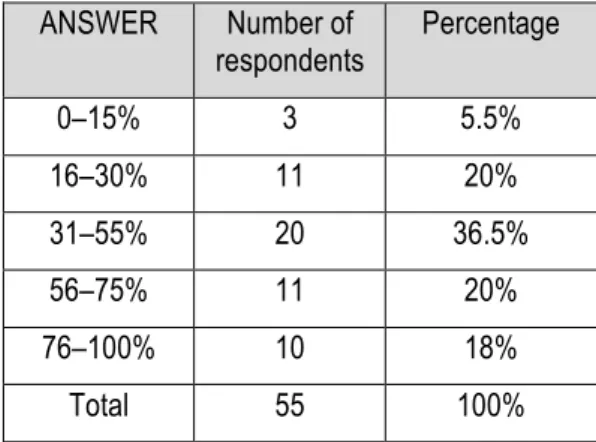
(7) Towards an Understanding of Target Language Use in the EFL Classroom: A Report from Norway. formal education in English. This is because until 2015, as stated earlier, primary school teachers in Norway were not required to obtain credits in English or foreign language pedagogy, but only credits in general education studies. The participants were also instructed to provide general information about their teaching background including the part of the country in which they have been teaching, their years of teaching experience, the grade level(s) in which they have been teaching, and the length to which they have been involved in teaching English. Questions pertaining to TL use in the classroom were as follows: 1. In your opinion, what percentage of oral communication is performed in English? 2. In your opinion, what percentage of written communication is performed in English? 3. In what situations do you use English in your EFL classroom at different grade levels? (Multiple answers possible; answer choices: grades 1–7; announcements, instructions, criticism/discipline, praise, activities, everyday conversations, routines, lesson plan and objectives, introduction of topics and activities, lectures, I do not use English). To obtain generalizable results, respondents from all over the country were invited to participate. The survey was sent to five schools in each of the country’s 19 counties, located in five different regions, and the only primary school on Svalbard, which amounted to 96 different schools. Sixty-six teachers responded, but eleven of the responses were incomplete and were, therefore, removed from the study. Thus, a total of 61 responses were included in the analysis. In total, five males and 50 females from all five regions of Norway submitted complete survey responses. The majority of the respondents were 31 years of age or older, with only seven being 30 or younger. Only six of the participants could be considered novice teachers, with 0–2 years of teaching experience. The majority (30 teachers) had more than 10 years of experience, and 19 of the participants had completed 3– 9 years of teaching at the primary level. In addition, over half of the participants had six or more years of experience teaching English. Only 10 of the participants taught English between 0 and 2 years, and 14 between 3 and 5 years. However, of all respondents, only 26 (about 47%) indicated that they had received credits in English. One of the respondents reported no teaching degree. Because the survey did not specifically ask about the municipalities in which the teachers have been working, it is not possible to determine if and to what degree each municipality is represented in the study. The researchers did, however, collect information about the regions in which the respondents have been working: 26 respondents were from Eastern Norway, 10 from Trøndelag, nine from Western Norway, nine from Northern Norway, and one from Southern Norway. 3.4 Data analysis It was hypothesized that the reported TL use would be lower and less extensive than in contexts in which the monolingual principle was mandated by national curricula. It was also hypothesized that teachers with less teaching experience and those who did not have formal qualifications in English would use the TL to a lesser extent than those with more years of teaching experience or formal qualifications in English. Finally, it was expected that TL use would increase with grade level. To allow for a quantitative analysis, only closed-ended questions were used. The survey was completely anonymous and participants’ IP addresses were not stored. The data were coded in Excel and analyzed using the SPSS analytical software. In addition to descriptive statistics, chi-square tests were used to investigate whether there was a significant correlation between reported TL use and years of teaching experience as well as between reported TL use and whether or not teachers had college credits in English. 3.5 Findings As this study aimed to explore the extent to which the TL is used and the situations in which primary school EFL teachers in Norway employ the TL in the classroom, the first two questions asked the participants about their estimated use of English for oral and written communication. The majority of the teachers estimated their oral TL use at 31% or higher. However, only 38% of the respondents claimed that more than 55% of oral language use in their classroom is performed in English (Table 1).. International Journal for 21st Century Education, vol. 3, Special Issue ‘Language Learning and Teaching’, 2016, 137-152.. 143.
(8) Anna Krulatz, Georgios Neokleous & Frøydis Vik Henningsen. Table 1. Self-reported percentage of oral TL use ANSWER. Number of respondents. Percentage. 0–15%. 3. 5.5%. 16–30%. 11. 20%. 31–55%. 20. 36.5%. 56–75%. 11. 20%. 76–100%. 10. 18%. Total. 55. 100%. The reported TL use for written communication was lower than for oral communication. In fact, over half of the respondents estimated less than 55% of written communication in their classes to be in English, with 27% claiming between 0 and 15% of written communication to be performed in the TL. Only about a third of the teachers reported frequent use of the TL for written communication (56% or higher). In all, the findings suggest that English is used more frequently for oral than for written communication with students.. Table 2. Self-reported percentage of written TL use ANSWER. Number of respondents. Percentage. 0–15%. 15. 27%. 16–30%. 12. 22%. 31–55%. 8. 14.5%. 56–75%. 14. 25.5%. 76–100%. 6. 11%. Total. 55. 100%. It was hypothesized that teachers with college credits in English use TL to a higher degree. A chi-square test was used to examine whether teachers who had credits in English employ the TL in oral and written interactions more than 55% of time. The results indicate that there was no significant association between the amount of oral TL used and whether or not the teacher had credits in English or not χ2(1)=3,28, p=,063. Similarly, no association was found between written TL use and credits in English χ2(1)=,86, p=,26. Additional chi-square tests were run to examine whether the number of years of experience teaching EFL is correlated with the amount of oral and written TL used. As highlighted in the literature review section, increased teaching experience has been associated with increased TL usage in the classroom (Kim, 2008; Lai, 1996; Littlewood & Yu, 2011; Pachler, Evans, & Lawes, 2007). The results of the present study, however, indicate that no such relationship existed in our data. Neither oral nor written TL use was associated with greater EFL teaching experience (Table 3).. 144. International Journal for 21st Century Education, vol. 3, Special Issue ‘Language Learning and Teaching’, 2016, 137-152..
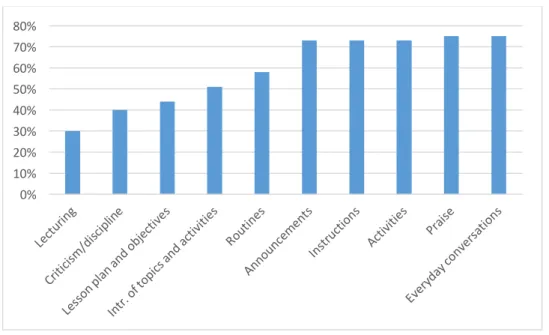
(9) Towards an Understanding of Target Language Use in the EFL Classroom: A Report from Norway. Table 3. Chi-square results: correlation between oral and written TL use and EFL teaching experience Oral TL use. Written TL use. χ=1.872. χ=0.003. df=1. df=1. p=0.14. p=0.59. The third question in the survey focused on the various situations in which English is employed, as well as how the use varies at different grade levels. Multiple answer choices were possible, as primary teachers in Norway can teach in more than one grade.. 80% 70% 60% 50% 40% 30% 20% 10% 0%. Graph 1. Amount of TL use in diverse situations Overall, it can be noted that the highest percentage of teachers reported TL use during praise and everyday conversations (Graph 1). Relatively frequent use of English was also reported for routines, announcements, instructions, and activities, while the situations in which English was employed the least included lecturing, criticising/disciplining, presenting lesson plans, and stating lesson objectives.. International Journal for 21st Century Education, vol. 3, Special Issue ‘Language Learning and Teaching’, 2016, 137-152.. 145.
(10) Anna Krulatz, Georgios Neokleous & Frøydis Vik Henningsen. 100% 80% 60% 40% 20% 0% 1st. 2nd. 3rd. 4th. 5th. 6th. Announcements. Instructions. Criticism/discipline. Praise. Activities. Everyday conversations. Routines. Lesson plan and objectives. Introduction of topics and activities. Lecturing. 7th. I do not use English. Graph 1. Amount of TL use in diverse situations in different grade levels. The lowest use of the TL was reported by first-grade teachers. Only in the category “everyday conversations” did more than 50% of these teachers indicate that they use English. First-grade teachers appeared to use English to some extent in announcements, instructions, praise, and routines. However, very few of them employ English to criticise/discipline, to state lesson plans and objectives, to introduce topics and activities, and to lecture. In second grade, an increase in the TL use was indicated. In particular, a high percentage of secondgrade teachers reported the use of English to make announcements, provide instructions, conduct activities, deliver praise, and conduct routines, and hold everyday conversations. Very few second-grade teachers used the TL in criticism and discipline, in stating lesson plans and objectives, and in lecturing. Similar patterns were also noted in the case of teachers working with fourth- and sixth-grade students. Fifth- and seventh-grade teachers, on the other hand, reported a more frequent use of English for criticism and discipline as compared to the other grade levels. Fifty-percent or more of these teachers stated that they use English in all situations, except for lecturing in fifth grade. The majority of sixth-grade teachers also reported frequent use of the TL, with a particularly high number (over 90%) employing it in everyday conversations.. 4. Discussion and conclusions This study set out to continue the line of research that explores the extent of TL use in foreign language classrooms. Specifically, it focused on a teaching context in which the exclusive use of the TL is not mandated by national curricula, in comparison with previous findings established for classrooms guided by the monolingual principle. Previous studies have identified a range of self-reported TL use in different settings from 10% to 100%, (Crawford, 2004; Dickson, 1996; Peng & Zhang, 2009; Polio & Duff, 1994). Whereas the participants in this study reported more TL use in oral than in written communication, the majority of them indicated that between 15 and 75% of their classroom communication is conducted in the TL. Thus, the amount of TL use appears to be highly individualized. This finding conforms to previous. 146. International Journal for 21st Century Education, vol. 3, Special Issue ‘Language Learning and Teaching’, 2016, 137-152..
(11) Towards an Understanding of Target Language Use in the EFL Classroom: A Report from Norway. research, and the hypothesis that Norwegian EFL teachers use less TL than teachers who are required to do so by national curriculum regulations is neither supported nor rejected. The participants in this study reported more TL use in older grades. Whereas in all grade levels English is used most often for praise, everyday conversations, routines, announcements, instructions and activities, a steady increase occurs from first to seventh grade. The hypothesis that the TL use increases with grade level is thus supported. In addition, the participants reported that they rarely use the TL to criticize or discipline students, to present lesson plans and objectives, to provide introduction to topics and activities, and to lecture. This finding confirms the results of former studies, which have found that teachers often choose to perform these classroom functions in the MT (Macaro, 1997; Orland-Barak & Yinon, 2005). In contrast with previous research, however, this study revealed no correlation between the amount of teaching experience and TL use. Research suggests that more experienced teachers employ the TL to a higher degree than do novice teachers (Kim, 2008; Lai, 1996; Littlewood & Yu, 2011; Pachler, Evans, & Lawes, 2007). In the present study, no relationship was found between the extent of TL use and whether teachers had formal qualifications (and thus potentially more confidence in their own language skills) or whether they had more than five years of language teaching experience. Thus, the hypothesis that TL use increases with teaching experience is rejected. It is possible that the relationship between teaching experience and TL use is more complex than formerly assumed, but because the present study did not investigate factors such as teacher perceptions of what constitutes the best teaching practice in terms of TL and MT or other confounding variables, a more lucid explanation of this phenomenon is not possible at present. There is a reason to believe that Norwegian is relatively common as the language of instruction in English classrooms (Drew, 2004; Drew et al., 2007; Eikrem, 2012) including, heavy reliance on translation between the two languages (Mehl, 2014). Our findings indicate that some teachers employ the TL for less than 50% of classroom communication. It can thus be inferred that either Norwegian or other MTs (e.g., Sami, another official language in Norway, or other minority languages present in the classroom) are used alongside the TL. This may in part be due to teachers’ low competence in English, especially in primary schools where until recently, there were no formal requirements for an English endorsement (Drew et al., 2007; Lagerstrøm, 2007). However, it is also possible that Norwegian EFL teachers employ the MT judiciously in order to raise language awareness and enhance the comparison between the TL and the MT, as prompted by the national curriculum guidelines. As learning environments in Norway are becoming increasingly multilingual (Surkalovic, 2014), it is important to ensure that all students’ linguistic repertoires are utilized as a valuable learning resource in the acquisition of additional languages, such as English. It is important to acknowledge that this study has some limitations, in particular the sample size and the constraints inherent in the use of surveys as a data collection method. Future research in similar contexts should be conducted with larger sample sizes and include questions about both TL and MT use. Questionnaires should also be administered to students, whose viewpoint on the MT/TL debate is scarce. Observations could also be conducted to identify whether reported classroom behaviour reflects actual classroom realities. Other variables such as teachers’ and learners’ levels of language proficiency, teacher views on the right balance between the TL and the MT, and teachers’ attitudes to multilingualism in the EFL classroom need to be included in the analysis. With Kim and Elder’s (2005) and Carless’s (2008) stressing the impact that teachers’ language choice could have on increased TL use by students, a new avenue of exploration can be opened in this regard. Notwithstanding its limitations, this study is an important contribution to the research on TL use in foreign language classrooms. It confirms that complete reliance on the TL mandated by the monolingual principle is undergoing a shift towards more balanced approaches and classrooms in which teachers practice balanced, judicious TL and MT use. Language teaching pedagogy can no longer “ignore or even suppress bilingual or multilingual options endorsing a predominantly monolingual policy, one which equates “‘good teaching’ with exclusive … target language use” (Inbar-Lourie, 2010, p. 351). On the contrary, the MT should have a critical role in enhancing the students’ learning experiences. Understanding this could also contribute towards removing the stigma with which the MT is associated, as well as the guilt triggered by the difficulty of maintaining an all-TL environment. It is thus important to provide teachers in Norway and other European countries that have recently experienced a rapid increase in their immigrant populations, and thus in the number of non-majority language students in the classroom, with professional training that targets better International Journal for 21st Century Education, vol. 3, Special Issue ‘Language Learning and Teaching’, 2016, 137-152.. 147.
(12) Anna Krulatz, Georgios Neokleous & Frøydis Vik Henningsen. multilingual awareness and ability to draw on students’ multilingual competence as a valuable resource (Cook, 2005;). The time has come to embrace multilingualism and to develop MT-inclusive approaches to foreign language instruction.. 5. References ACCAC/National Assembly for Wales (2000). Modern foreign languages in the national curriculum in Wales. Cardiff: ACCAC Publications. Al-Shidhani, A. (2009). Teachers’ beliefs about using Arabic in the English classroom. In S. Borg (Ed.), Researching English language teaching and teacher development in Oman (pp.184-191). Muscat: Ministry of Education, Oman. Antón, M. & DiCamilla, F. (1998). Socio-cognitive functions of L1 collaborative interaction in the L2 classroom. Canadian Modern Language Review, 54(3), 314-342. Bateman, B.E. (2008). Student teachers' attitudes and beliefs about using the target language in the classroom. Foreign Language Annals, 41(1), 11-28. Brown, A.V. (2009). Students’ and teachers’ perceptions of effective foreign language teaching: A comparison of ideals. The Modern Language Journal, 93(1), 46-60. Burden, P. (2000). The use of the students’ mother tongue in monolingual English “conversation” classes at Japanese universities. The Language Teacher, 24(6), 5-10. Butzkamm, W. (2003). We only learn language once. The role of the mother tongue in FL classrooms: Death of a dogma. Language Learning Journal, 28(1), 29-39. Carless, D. (2008). Student use of the mother tongue in the task-based classroom. ELT Journal, 62(4), 331338. Cenoz, J. & Hoffmann, C. (2003). Acquiring a third language: What role does bilingualism play? International Journal of Bilingualism, 7(1), 1–5. Chambers, F. (1991). Promoting use of the target language in the classroom. Language Learning Journal, 4(1), 27-31. Chaudron, C. (1988). Second language classrooms: Research on teaching and learning. Cambridge: Cambridge University Press. Chavez, M. (2003). The Diglossic Foreign-Language Classroom: Learners' Views on L1 and L2 Functions. In C. Blyth (Ed.), The sociolinguistics of foreign-language classrooms: Contributions of the native, near-native, and the non-native speaker (pp.163-208). Boston: Heinle. Cheng, X. (2013). Research on Chinese college English teachers’ classroom code-switching: Beliefs and attitudes. Journal of Language Teaching and Research, 4(6), 1277-1284. Cianflone, E. (2009). L1 use in English courses at university level. ESP World, 8(22), 1-6. Cole, S. (1998). The use of L1 in communicative English classrooms. Language Teacher, 22, 11-14. Cook, V. (2009). Multilingual Universal Grammar as the norm. In Y.I. Leung (Ed), Third Language Acquisition and Universal Grammar (pp. 55–70). Bristol: Multilingual Matters. Crawford, J. (2004). Educating English learners: Language diversity in the classroom. Los Angeles, CA: Bilingual Education Services. Creese, A. & Blackledge, A. (2010). Translanguaging in the bilingual classroom: A pedagogy for learning and teaching. The Modern Language Journal, 94(1), 103-115. Crichton, H. (2009). ‘Value added’ modern languages teaching in the classroom: An investigation into how teachers’ use of classroom target language can aid pupils’ communication skills. Language Learning Journal, 37(1), 19-34.. 148. International Journal for 21st Century Education, vol. 3, Special Issue ‘Language Learning and Teaching’, 2016, 137-152..
(13) Towards an Understanding of Target Language Use in the EFL Classroom: A Report from Norway. Dickson, P. (1996). Using the target language: a view from the classroom. Slough: NFER. Directorate for Education and Training (2013). English Subject Curriculum. Retrieved on August 20, 2015 from http://www.udir.no/kl06/eng1-03/Hele/?lplang=eng Drew, I. (2004). Survey of English teaching in Norwegian primary schools. Stavanger: Stavanger University College. Drew, I., Oostdam, R. & Toorenburg, H.Vv. (2007). Teachers’ experiences and perceptions of primary EFL in Norway and the Netherlands: A comparative study. European Journal of Teacher Education, 30(3), 319-341. Duff, P. & Polio, C. (1990). How much foreign language is there in the foreign language classroom? The Modern Language Journal, 74(2), 154-166. Dujmović, M. (2007). The use of Croatian in the EFL classroom. Metodički obzori, 2(3), 91-101. Eikrem, B.O. (2012). "Betre å vere stor enn liten". Korleis elevane opplever engelskfaget, sett i lys av arbeidsmåtane som vert nytta. In P. Haug (Ed.), Kvalitet i opplæringa: Arbeid i grunnskulen observert og vurdert (pp. 101-121). Oslo: Det norske samlaget. Ford, K. (2009). Principles and practices of L1/L2 use in the Japanese university EFL classroom. JALT Journal, 31(1), 63-80. García, O., Makar, C., Starcevic, M. & Terry, A. (2011). The translanguaging of Latino kindergartners. In J. Rothman and K. Potowski (Eds.). Bilingual youth: Spanish in English-speaking societies (pp.33-55). Amsterdam: John Benjamins. Giannikas, C.N. (2011). L1 in English language learning: A research study in a Greek regional context. International Journal of Applied Linguistics, 21(3), 319-339. Gulzar, M.A. (2010). Code-Switching: Awareness about Its Utility in EFL/ESL Classroom Discourse. Bulletin of Education and Research, 32(2), 1-14. Halasa, N H. & Al-Manaseer, M. (2012). The use of the first language in second language learning reconsidered. College Student Journal, 46(1), 71. Hall, G., & Cook, G. (2012). Own-language use in language teaching and learning. Language Teaching, 45(3), 271-308. Halliwell, S. & Jones, B. (1991). On target. Teaching in the target language. London: CILT. Harbord, J. (1992). The use of the mother tongue in the classroom. ELT Journal, 46(4), 350-355. Hitotuzi, N. (2006). The learner’s mother tongue in the L2 learning-teaching symbiosis. Profile, 7, 161-171. Hornberger, N.H. & Link, H. (2012). Translanguaging and transnational literacies in multilingual classrooms: A biliteracy lens. International Journal of Bilingual Education and Bilingualism, 15(3), 261-278. Imran, S. & Wyatt, M. (2015). Pakistani university English teachers’ cognitions and classroom practices regarding their use of the learners’ first languages. Asian EFL Journal, 17(1), 138-179. Inbar-Lourie, O. (2010). English only? The linguistic choices of teachers of young EFL learners. International Journal of Bilingualism, 14(3), 351-367. Jackson, H. (1981). Contrastive analysis as a predictor of errors, with reference to Punjabi learners of English. In J. Fisiak (Ed.), Contrastive linguistics and the language teacher (pp. 195-205). Oxford: Pergamon. Kavaliauskienė, G., Mažeikienė, V. & Valūnaitė-Oleškevičienė, G. (2010). Role of Native Language in Learning English. Coactivity: Philology, Educology/Santalka: Filologija, Edukologija, 18(2), 35-42. Keating, L.C. (1937). The incompetent student raises a problem for the language teacher. The Modern Language Journal, 22(1), 38-40.. International Journal for 21st Century Education, vol. 3, Special Issue ‘Language Learning and Teaching’, 2016, 137-152.. 149.
(14) Anna Krulatz, Georgios Neokleous & Frøydis Vik Henningsen. Kharma, N.N. & Hajjaj, A.H. (1989). Use of the mother tongue in the ESL classroom. International Review of Applied Linguistics, 27(3), 223-235. Kim, S. (2008). Five years of teaching English through English: Responses from teachers and prospects for learners. English Teaching, 63(1), 51-70. Kim, S. & Elder, C. (2005). Language choices and pedagogic functions in the foreign language classroom: A cross-linguistic functional analysis of teacher talk. Language Teaching Research, 9(4), 355-380. Krashen, S.D. (1985). The input hypothesis: Issues and implications. New York: Longman. Krashen, S.D. & Terrell, T.D. (1983). The natural approach: Language acquisition in the classroom. CA: Alemany Press. Lagerstrøm, B.O. (2007). Kompetanse i grunnskolen: Hovedresultater 2005/2006 Rapporter. OsloKongsvinger: Statistisk sentralbyrå. Lai, M.L. (1996). A reality shock- teaching English through English or Chinese? Education Journal, 24(2), 173-191. Levine, G.S. (2003). Student and instructor beliefs and attitudes about target language use, first language use, and anxiety: Report of a questionnaire study. The Modern Language Journal, 87(3), 343-364. Liebscher, G. & Dailey-O’Cain, J. (2005). Learner code-switching in the content-based foreign language journal. The Modern Language Journal, 89(2), 234-247. Lin, A.M. & Wu, Y. (2015). ‘May I speak Cantonese?’–Co-constructing a scientific proof in an EFL junior secondary science classroom. International Journal of Bilingual Education and Bilingualism, 18(3), 289-305. Littlewood, W. & Yu, B. (2011). First language and target language in the foreign teaching classroom. Language Teaching, 44(1), 64-77. Macaro, E. (1997). Target language, collaborative learning, and autonomy. Clevedon, UK: Multilingual Matters. Macaro, E. (2000). Issues in target language teaching. In K. Field (Ed.), Issues in modern foreign languages teaching (pp. 171-189). London: Routledge/Falmer. Macaro, E. (2001). Analysing student teachers’ codeswitching in foreign language classrooms: Theories and decision making. The Modern Language Journal, 85(4), 531-549. Macaro, E. (2005). Codeswitching in the L2 classroom: A communication and learning strategy. In E. Llurda (Ed.), Non-native language teachers: Perceptions, challenges and contributions to the profession (pp. 63-84). New York: Springer. MacDonald, C. (1993). Using the target language. Cheltenham: Mary Glasgow Publications. McMillan, B.A. & Rivers, D.J. (2011). The practice of policy: Teacher attitudes toward “English only”. System, 39(2), 251-263. Mehl, T.H. (2014). Attitudes and awareness around code switching. What are teachers’ and students’ attitudes towards codeswitching in the English learner classroom in Norway, and what can influence the teachers’ utilization of it? Master’s thesis retrieved from: http://www.duo.uio.no/handle/10852/40548 Meiring, L. & Norman, N. (2002). Back on target: repositioning the status of target language in MFL teaching and learning. Language Learning Journal, 26(1), 27-35. Norwegian Directorate for Education and Training. (2013). English subject curriculum. Retrieved from http://www.udir.no/kl06/eng1-03/Hele/?lplang=eng Orland-Barak, L. & Yinon, H. (2005). Different but similar: Student teachers’ perspectives on the use of L1 in Arab and Jewish EFL classroom settings. Language, Culture and Curriculum, 18(1), 91-113.. 150. International Journal for 21st Century Education, vol. 3, Special Issue ‘Language Learning and Teaching’, 2016, 137-152..
(15) Towards an Understanding of Target Language Use in the EFL Classroom: A Report from Norway. Oxford, R. (1999). Anxiety and the language learner: New insights. In J. Arnold (Ed.), Affect in language learning (pp. 58-67). Cambridge, UK: Cambridge University Press. Pacek, D. (2005). Personality not nationality: Foreign students’ perceptions of a non-native speaker lecturer of English at a British university. In E. Llurda (Ed.). Non-native language teachers: Perceptions, challenges and contributions to the profession (pp. 243-262). New York: Springer. Pachler, N., Evans, M. & Lawes, S. (2007). Modern foreign languages: teaching school subjects 11-19. Abingdon: Routledge. Pachler, N., & Field, K. (2001). From mentor to co-tutor: Reconceptualising secondary modern foreign languages initial teacher education. Language Learning Journal, 23(1), 15-25. Pachler, N., Evans, M., Redondo, A. & Fisher, L. (2001). Learning to teach foreign languages in the secondary school: A companion to school experience. Abingdon: Routledge. Peng, J. & Zhang, L. (2009). An eye on target language use in elementary English classrooms in China. In M. Nikolov (Ed.). Early learning of modern foreign languages (pp. 212-228). Bristol: Multilingual Matters. Pennycook, A. (1994). The cultural politics of English as an international language. Abingdon: Routledge. Pinter, A. (2006). Teaching young language learners. Oxford: Oxford University Press. Polio, C.P. & Duff, P. A. (1994). Teachers’ language use in university foreign language classrooms: A qualitative analysis of English and target language alternation. The Modern Language Journal, 78, 311-326. Prodromou, L. (2002). The role of the mother tongue in the classroom. IATEFL Issues, 6-8. Qian, X.F. (2009). Codeswitching in teacher talk of primary English teachers in China. In B. Beaven (Ed.), IATEFL 2008: Exeter conference selections (pp.101-102). Canterbury: IATEFL. Raschka, C., Sercombe, P. & Chi-Ling, H. (2009). Conflicts and tensions in codeswitching in a Taiwanese EFL classroom. International Journal of Bilingual Education and Bilingualism, 12(2), 157-171. Rolin-Ianziti, J. & Varshney, R. (2008). Students' views regarding the use of the first language: An exploratory study in a tertiary context maximizing target language use. Canadian Modern Language Review, 65(2), 249-273. Ross, N.J. (2000). Interference and intervention: Using translation in the EFL classroom. The Modern Language Journal, 9(3), 61-66. Sampson, A. (2012). Learner code-switching versus English only. ELT Journal, 66(3), 293-303. Schmidt, K. (1995). Use of Japanese in the EFL classroom: Which way to go? ETAPS Journal, 63-79. Sharma, K. (2006). Mother tongue use in English classroom. Journal of NELTA, 11(1-2), 80-87. Surkalovic, D. (2014). Forbereder grunnskolelærerutdanningen engelsklærere for undervisning i engelsk som tredjespråk i Norge? Acta Didactica Norge, 8(2). Retrieved from https://www.journals.uio.no/index.php/adno/article/view/1129 Swain, M. & Lapkin, S. (1995). Problems in output and the cognitive processes they generate: A step towards second language learning. Applied Linguistics, 16(3), 371-391. Tang, J. (2002). Using L1 in the English classroom. English Teaching Forum, 40(1), 36-43. The Curriculum Development Council (2004). English language curriculum guide. Retrieved from http://www.edb.gov.hk/attachment/en/curriculum-development/kla/eng-edu/primary%201_6.pdf Thornbury, S. (2006). An A-Z of ELT. Oxford: Macmillan. Trent, J. (2013). Using the L1 in L2 teaching and learning: What role does teacher identity play?. Asian EFL Journal, 15(3), 217-247.. International Journal for 21st Century Education, vol. 3, Special Issue ‘Language Learning and Teaching’, 2016, 137-152.. 151.
(16) Anna Krulatz, Georgios Neokleous & Frøydis Vik Henningsen. Turnbull, M. (2001). There is a role for the L1 in second and foreign language teaching, but…. Canadian Modern Language Review, 57(3), 531-540. Turnbull, M. & Arnett, K. (2002). Teachers’ uses of the target land first languages in second and foreign language classrooms. Annual Review of Applied Linguistics, 22, 204-218. Wang, D. & Kirkpatrick, A. (2012). Code choice in the Chinese as a foreign language classroom. Multilingual Education, 2(1), 1-18. White, E. & Storch, N. (2012). En français s'il vous plaît: A longitudinal study of the use of the first language (L1) in French foreign language (FL) classes. Australian Review of Applied Linguistics, 35(2), 183202. Weschler, R. (1997). Uses of Japanese (L1) in the English classroom: Introducing the functional-translation method. The Internet TESL Journal, 3(11). Retrieved from http://iteslj.org/Articles/WeschlerUsingL1.html Wingate, J. (1993). Getting beginners to talk. Hemel Hempstead, UK: Prentice Hall International.. Received: 12/03/2016 Accepted: 20/05/2016. 152. International Journal for 21st Century Education, vol. 3, Special Issue ‘Language Learning and Teaching’, 2016, 137-152..
(17)
Figure
Documento similar
Keywords: Metal mining conflicts, political ecology, politics of scale, environmental justice movement, social multi-criteria evaluation, consultations, Latin
Recent observations of the bulge display a gradient of the mean metallicity and of [Ƚ/Fe] with distance from galactic plane.. Bulge regions away from the plane are less
The spatially-resolved information provided by these observations are allowing us to test and extend the previous body of results from small-sample studies, while at the same time
The analysis revealed significant differences in categories such as word count, clout, emotional tone, or analytical thinking when comparing the texts written by an
In the edition where the SPOC materials were available, we have observed a correlation between the students’ final marks and their percentage rate of
(hundreds of kHz). Resolution problems are directly related to the resulting accuracy of the computation, as it was seen in [18], so 32-bit floating point may not be appropriate
Una vez el Modelo Flyback está en funcionamiento es el momento de obtener los datos de salida con el fin de enviarlos a la memoria DDR para que se puedan transmitir a la
Even though the 1920s offered new employment opportunities in industries previously closed to women, often the women who took these jobs found themselves exploited.. No matter
