Implementation of an end-to-end standard-based
patient monitoring solution
I. Martmez, J. Fernandez, M. Galarraga, L Serrano, P. de Toledo, S. Jimenez-Fernandez, S. Led, M. Martfnez-Espronceda and J. Garcfa
Abstract: A proof-of-concept design of a patient monitoring solution for intensive care unit environments has been presented. It is end-to-end standard-based, using ISO/IEEE 11073 (X73) in the bedside environment and EN13606 to communicate the information to an electronic health-care record (EHR) server. At the bedside end, the system is a plug-and-play sensor network com-municating with a gateway that collects medical information and sends the data to a monitoring server. The monitoring server transforms this information into an END 606 extract to be stored on the EHR server. The system has been implemented to comply with the last X73 and EN13606 available versions and tested in a laboratory environment to demonstrate the feasibility of an end-to-end standard-based solution.
1 Introduction
Advances in technology have implemented many changes in the bedside environments of hospitals. Medical devices (MDs), computers and sensors at the point of care (PoC) end are now part of the intensive care unit (ICU) Moreover, technology possibilities continue growing as sizes and costs shrink These devices and sensors acquire huge amounts of very valuable information, without the need for manually writing down each measure-ment, contributing to the generation of the electronic health-care record (EHR)
The communications and interfaces among components of patient monitoring systems, and between these systems become now very important in exploiting all the possibili-ties offered by the information gathered [10-12]. However, different manufacturers use their own software and communication protocols; building proprietary sol-utions that can only work alone or inside a single-vendor system. As each device speaks a different language, an important interoperability problem emerges, leading to dif-ficulties when a part of a system must be replaced as well as high costs Furthermore, the information acquired cannot easily be integrated into and exchanged with EHRs.
There is a need for developing open sensors and middle-ware components that allow transparent integration and
plug-and-play interoperability of monitoring devices and systems (see Fig.l). The use of communications standards seems to be an efficient way to solve these problems
Most stakeholders in hospital information systems, medical devices and telemedicine scenarios agree that standard-based solutions are needed to foster the devel-opment of these markets and improve the service provided to patients. However, it is frequently claimed that it is not feasible to develop such systems because of either costs or lack of development of the standards.
Scale ECG monitor Blood pressure Puke oximeter
£>
*"•* *:?
* * ! plug-and-play \
\ interoperability?
HEALTHCARE INFORMATION SYSTEM
Fig. 1 Interoperability among medical devices and healthcare
information systems
knowledge evolves). A key feature in the standard is the communication model, which specifies how to exchange information among clinical information systems. The element exchanged is the extract, a document that may contain any type of clinical information, generated on the basis of the different archetypes previously denned. To interpret an extract, the receiving system may look up these archetypes in a common repository.
In the field of patient monitoring MDs, there have been several implementation experiences based on standards, even commercial devices compliant -to different degrees- with standards, and demo experiences where the interoperability was tested Most of these implementations were done using the pre-11073 standards (VITAL or VSIR [25, 28-31], INTERMED or MIB [32-35]). The X73 family of standards is changing very fast, because of both the market and industry demand to adapt it to new functional requirements (especially those arising from its use in telemedicine and home monitoring scenarios), and to the wireless communication technologies zoo (i.e. Bluetooth, Zigbee, Wibree, WiFi, RFID etc.) [36, 37]. The implementation of the X73 standard is not trivial, and this complexity is one of the reasons why some manufacturers are still reluctant to adopt it.
The field of EHRs has also brought several implemen-tations of standard-based systems allowing the sharing of EHR between hospitals and addressing challenges for all healthcare organisations, such as accessibility and rel-evance. HL7 is a widely adopted standard, with implemen-tations in most hospitals around the world
However, HL7 integration is based on the exchange of mess-ages, and has several limitations for the implementation of a higher level interoperable EHR and, unlike HL7, there are a few implementations of EN13606
To the best of our knowledge, there is no experience where the full chain from bedside monitoring devices to EHR has been implemented using standards. Even though there have been some initiatives to combine different standards, the vision of an entire end-to-end standard system is not yet a fact.
The system presented is a proof-of-concept design to show that it is feasible to create a patient monitoring sol-ution for ICU environments that is end-to-end standard-based. We have used ISO/IEEE 11073 (X73) in the bedside environment and END606 to communicate the information to an EHR server. The components of this system (sensors, gateway, EHR server etc.) can be replaced individually by equivalent standard-based devices with no need of system reconfiguration. In the case of bedside moni-toring devices, this interoperability is plug-and-play.
This work aims to generate know-how and implemen-tation guidelines to be used in future developments and detect requirements that have not been addressed up to now. The feed-back results will be used to analyse how these implementations must be adapted to follow the stan-dard and how the stanstan-dard can be modified to better fit real-world needs, especially keeping in mind telemedicine and home monitoring scenarios.
The paper is organised as follows. First, an overview of the architecture and design of the proposed system is given in Section 2. The implementation experience according to X73 and EN13606 standards is detailed in Sections 3 and 4, respectively. Results obtained are discussed in Section 5.
2 System architecture and design
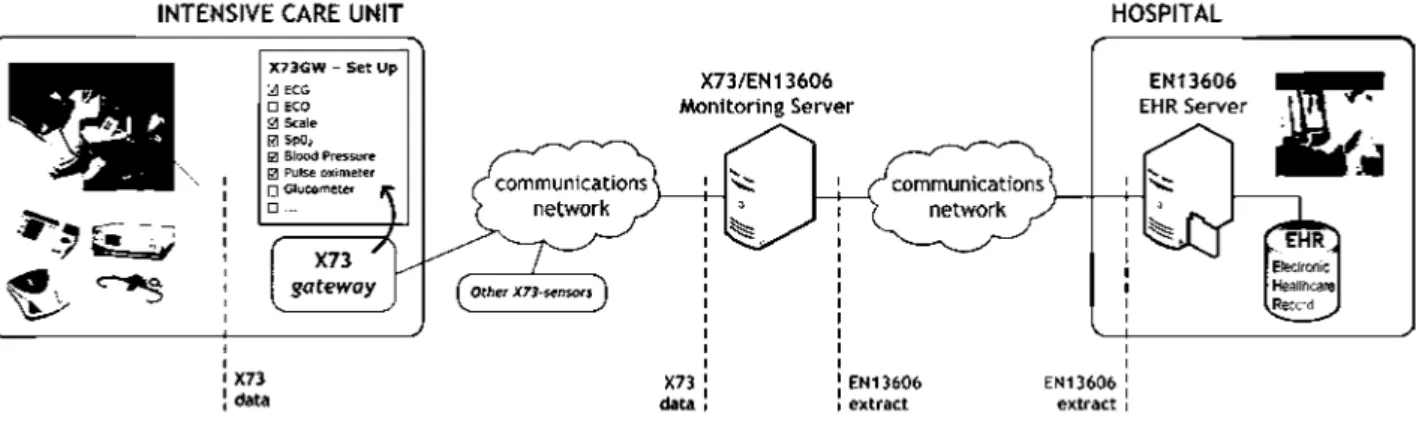
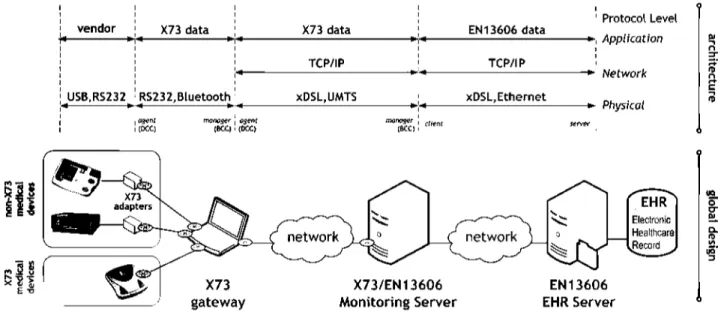
The proposed system architecture, including the fully standard-based prototype composed of independent and interoperable modules, is presented in Fig. 2. The generic design consists of a PoC (in the ICU) based on a X73 gateway that receives and integrates the information col-lected with several X73 MDs. These X73 gateways from each PoC (even from others X73-sensors networks) intercon-nect with the monitoring server to manage the e-Health service. Moreover, this monitoring server can send the acquired patient information to the EHR server according to the EN 13 606 standard. Fig. 3 shows the mapping of this proposal and our implementation. The specific technical characteristics of each architecture element are:
2.7 X73 MDs and adapters
The existence of X73 MDs is strongly conditioned to the vendors and manufacturers. Currently there are no 100% X73 compliant MDs, but the proposed architecture will allow to integrate them as soon as they are available. Moreover, it is difficult to find MDs with an
INTENSIVE CARE UNIT HOSPITAL
vendor X73 data
USB,RS232 RS23 2, Bluetooth
1 asenl mpnaser , flsenr I (DCt) (fcCC) i 10CQ
X73 data
TCP/IP
xDSL,UMTS i
nwnojer ] ^ [SCO i
EN 13606 data
TCP/IP
xDSL, Ethernet
1
1 1
server
Protocol Level
Application
*- Network
Physical
X73 gateway
Fig. 3 Proposed end-to-endX73/EN13606 design scheme
X73/EN13606 Monitoring Server
EN13606 EHR Server
I
X73-compatible physical output (i.e. MIB or Bluetooth); the most extended interfaces (i.e. USB or serial line) are not included at this moment in the X73 standard (only RS-232 and IrDA). Thus, in this development, proprietary MDs with X73-adapters have been used. These adapters, on one side, implement the standard X73 and, on the other, proprie-tary interfaces that can only be modified by knowing the vendor's programming codes. These MDs are OMRON 705IT (blood-pressure and pulse measurements, with a 28 acquisitions memory) and DATEX-Ohmeda 3900 (pulse oxi-meter with a serial-port output each 2 s that includes blood oxygen saturation (Sp02), heart rate values and alarms).
2.2 X73 gateway
The designed gateway is an X73 access point. It supports a network of X73-compatible MDs measuring vital signs from different patients in different locations. The data acquired from the different sensors are transmitted to the X73 gateway, which can be personalised by configuring its working mode (by setting the buffering frequency, the synchronisation and transmission techniques used, or the type of X73-sensors, as it is shown in X73GW-SetUp, see
Fig. 2). The X73 gateway provides a logic module for
medical data information base (MDIB) that allows monito-ring and obtaining alerts and measurements. Thus, follow-ing the X73 nomenclature, this gateway is represented like a medical device system (MDS): when each MDs is connected or disconnected (plug-and-play) the MDIB is automatically adjusted, a MDS is created or destroyed in the object hierarchy and the changes are propagated to the clients. In this implementation, for example, the MDS has two channel objects: pulse-oximeter channel (with two metrics: oxygen saturation information (Sp02) and the
plethysmograph waveform), and pulse-rate channel (with a unique metric: pulse rate information).
2.3 X73/EN13606 monitoring server
The monitoring server provides a double role: manager of the communications with the X73 gateways, and client of the connections to the EHR server. Thus, it may belong to the ICU, the reference hospital or even it can be an external man-agement server. The plug-and-play functionality is remark-able in this element because it receives the measurements from different X73 gateways (associated to diverse patients
and sensors) and through different technologies. The most usual transmission lines in ICU environments are RS-232 RJ-45, or USB, but the use of cables is actually being substi-tuted by other wireless solutions: infrared (IrDA), RF WLAN (802.11x), wPAN (Bluetooth) orZigbee (802.15.4). Some of these technologies are currently not included in X73, but their future development is foreseen (see Table 1).
As a manager of the X73 gateways, the monitoring server manages the decision making in an intelligent way through several functions: automation of the data acquisition process, technological transparency (independent of the transmission modes of the X73 gateways), pattern's defi-nition to identify, detect and manage anomalies (alarms, failures), patient specifications (decision thresholds, oper-ation limits), updates and so on.
As a client of the EHR server, the monitoring server creates an EN13606 extract (from X73 data of the MDs) which is transmitted to the EN13606 EHR server in an inter-mediate archetype file format.
2.4 EN 13606 EHR server
The EHR server is a clinical information storage system where the data associated with each patient are added. It adapts the incoming information from the MDs to an EN13606 compliant format. Thus, it receives the archetype files together with the EN13606 extract, validates this extract according to EN13606 standard, stores it in the appropriate EHR database and sends an acknowledgment back to the client. This process has been traditionally studied in an isolated way as an EHR communications inter-operability problem, but in this implementation experience it is integrated with the monitoring process to propose an end-to-end standard-based complete solution.
Table 1: Available X73 connectivity technologies
Technology Standard Status
RJ-45 (IRDA-based)
infrared (IRDA)
IP-based
RFWLAN (802.11x)
wPAN (Bluetooth)
Zigbee (802.15.4)
11 073-30 200
11 073-30 300
11 073-30 400
11 073-30 501
11 073-30 502
11 073-30 505
available
available
future work
future work
future work
3 X73 Implementation. Gateway and monitoring server
3.1 Implementation methodology
Currently, the X73 standard is in the development phase; indeed, many of its parts are still in draft status. It includes a family of standards that can be jointly used at different levels providing connectivity to the involved devices and giving a complete solution from the lowest levels (the wire itself and the connector) to the highest levels (abstract representation of information and services). These standards are divided into the following main groups: device data (object-oriented model and terminology for data represen-tation), services of general application (events or polling), transport (wired or wireless), network communication (several networks interconnected) and gateway standards (DICOM or HL7 messages). Thus, any implementation experience should require a structured design following a top-down process within the stack layers. The most relevant X73 modules to be considered are:
- Medical device data language (MDDL): it is the X73 nomenclature that stands for the semantics and syntax used in the fields of the protocol data unit (PDU), usually with object-oriented attributes.
- Static model/domain information model (DIM): it is the object-oriented model to represent any device, element or metric that is going to be communicated. It is presented in the following packets: virtual medical or device objects, channel, metric or numeric objects, sample arrays, enumer-ation, complex metric and so on.
- Dynamic model: it provides a communication model based on the ISO concept of agent-manager with a 'device communication controller' (DCC) and a 'bedside communication controller' (BCC) for agent and manager, respectively (see Fig. 3). The X73 communication between two devices (DCC and BCC) follows four synchro-nised steps: 1-connection, 2-association, 3-configuration and 4-operation, using a finite states machine.
3.2 Implementation experience
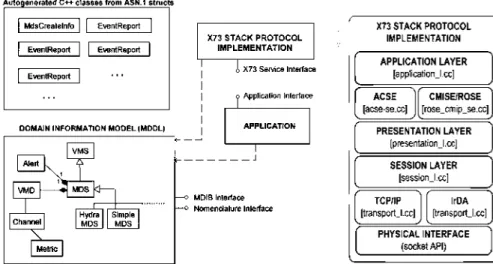
Following this methodology, the complete implementation experience scheme is shown in Fig. 4, where each element has been considered individually to facilitate a
progressive development directly led by X73. The program-ming languages used have been: Java and C/C + + (Cygwin and GNU GCC 3.4 environments). Various tools also were needed such as ANTLR 2.7, Java SDK 5.0 and ASN.lc 0.9.22 compiler. Abstract Syntax Notation One (ASN.l) is a language to define standards regardless of implementation (it defines what is a 'type', a 'module', how to 'label' a type so it can be correctly codified etc.). Basic encoding rules (BER) are a set of rules to codify ASN. 1 data in a sequence of octets that can be transmitted through a communications' link (it defines the methods to codify ASN.l values, rules to decide the use of each method, the data format etc.). Thus, with the ASN.lc 0.9.22 compiler, the X73 specifications for message exchange among layers are translated into BER codification and ASN. 1 structures and functions (which are packed into a static ASNX library). Moreover, MDER are the proposed codification rules for X73 specialised MDs (they define methods to transform ASN.l in a byte stream ready for the communication and they are optimised for managing X73 objects). Because the ASN.lc compiler does not support the MDER transfer syntax, an ad hoc translator (ANTLR-based) has been developed for working with MDER and BER. Thus, the translator generates a syntactic tree from an ASN.l grammar that allows defining the ASN.l structures (specified by X73) and writing the C + + source code and the Java utilities.
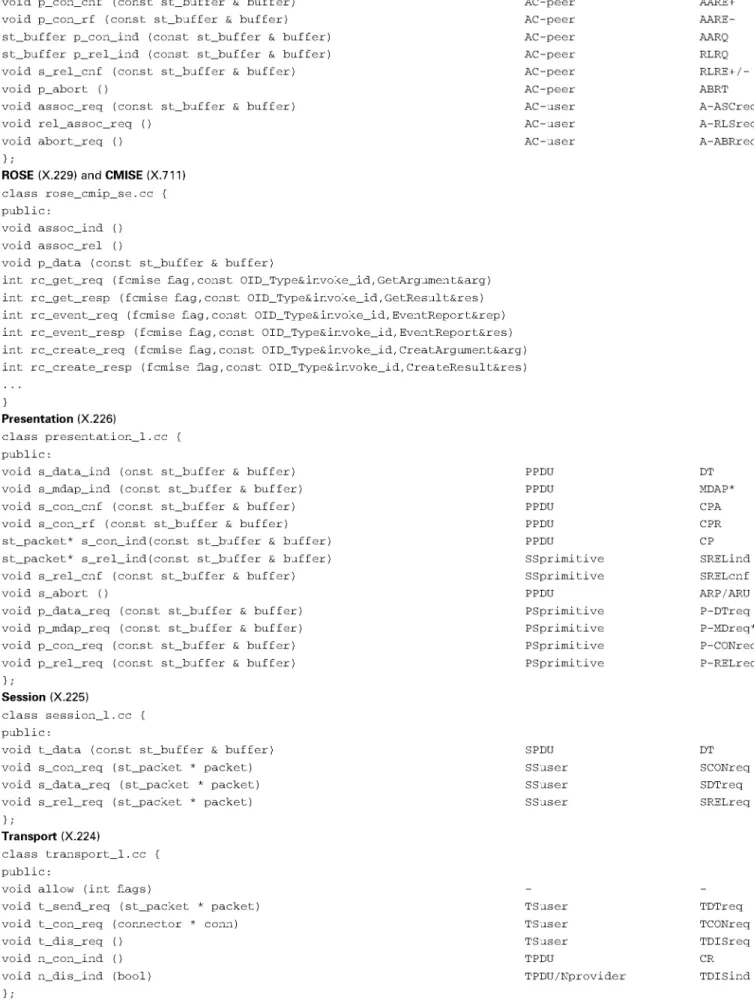
Following the top-down process, the protocol stack ASN.l implementation is described in Table 2:
- Firstly, the application layer is defined by several proto-cols: ACSE (for association control), CMISE (for the basic services defined in VITAL) and ROSE (for the link between call requests and responses). In this proposal, CMISE and ROSE service elements have been grouped in the CMDISE interface defined by X73. MDER syntax uses a set of ASN. 1 data types, and redefines the bit-pattern enco-ding of the types. The ASN. 1 structures are automatically generated using the ANTLR parser and each ASN.l data type is mapped to a C + + class.
- Secondly, the presentation layer is mainly a negotiation mechanism for the syntaxes used by higher layers: the abstract syntax (which set of messages are to be exchanged) and the transfer syntax (how the messages are encoded); therefore the MDER syntax has been designed in order to reduce com-plexity of the message processing implementation.
Autogensrated C++ classes hem ASN. 1 structs
MdsCrealelnfo EventReport
Eve nl Report E re n I Repod
EvenlReport • • •
X73 STACK PROTOCOL IMPLEMENTATION
DOMAIN INFORMATION MODEL |MDDL|
c X73 Service Interface
o Applicaliwi Interface
I v M S | | Alert [,
t
VMD | '•*{ MDS |<l 1
Channel Hydra , Simple MDS | Metric |
APPLICATION
y MOIB Interface o Nomenclature Interface
XT3 STACK PROTOCOL IMPLEMENTATION
APPLICATION LAYER [application_l.ee]
ACSE [acse-se.ee]
CMISEJROSE [rose_cnnip_se.ee]
PRESENTATION LAYER [presentalion_l.ee]
SESSION LAYER [session_l.ee]
TCP/IP [transport_l.ee]
IrDA [liansport_l.ee]
PHYSICAL INTERFACE (socket API)
Table 2: X73 layered interface design
Protocol level event
AC-peer
AC-peer
AC-peer
AC-peer
AC-peer
AC-peer
AC-user
AC-user
AC-user
AARE +
AARE-AARQ
RLRQ
RLRE+/-ABRT
A-ASCreq
A-RLSreq
A-ABRreq A C S E (X.227)
class acse_se.cc {
public:
void p_con_cnf (const st_buffer & buffer)
void p_con_rf (const st_buffer & buffer)
st_buffer p_con_ind (const st_buffer & buffer)
st_buffer p_rel_ind (const st_buffer & buffer)
void s_rel_cnf (const st_buffer & buffer)
void p_abort ()
void assoc_req (const st_buffer & buffer)
void rel_assoc_req ()
void abort_req ()
};
ROSE (X.229) and CMISE (X.711)
class rose_cmip_se.cc {
public:
void assoc_ind ()
void assoc_rel ()
void p_data (const st_buffer & buffer)
int rc_get_req (fcmise flag, const OID_Type&invoke_id, GetArgument&arg)
int rc_get_resp (fcmise flag, const OID_Type&invoke_id, GetResult&res)
int rc_event_req (fcmise flag, const OID_Type&invoke_id,EventReport&rep)
int rc_event_resp (fcmise flag, const OID_Type&invoke_id,EventReport&res)
int rc_create_req (fcmise flag, const OID_Type&invoke_id,CreatArgument&arg
int rc_create_resp (fcmise flag, const OID_Type&invoke_id, CreateResult&res
}
Presentation (X.226)
class presentation_l.cc {
public:
void s_data_ind (onst st_buffer & buffer)
void s_mdap_ind (const st_buffer & buffer)
void s_con_cnf (const st_buffer & buffer)
void s_con_rf (const st_buffer & buffer)
st_packet* s_con_ind(const st_buffer & buffer)
st_packet* s_rel_ind(const st_buffer & buffer)
void s_rel_cnf (const st_buffer & buffer)
void s_abort ()
void p_data_req (const st_buffer & buffer)
void p_mdap_req (const st_buffer & buffer)
void p_con_req (const st_buffer & buffer)
void p_rel_req (const st_buffer & buffer)
};
Session (X.225)
class session_l.cc {
public:
void t_data (const st_buffer & buffer)
void s_con_req (st_packet * packet)
void s_data_req (st_packet * packet)
void s_rel_req (st_packet * packet)
};
Transport (X.224)
class transport_l.cc {
public:
void allow (int flags)
void t_send_req (st_packet * packet)
void t_con_req (connector * conn)
void t_dis_req ()
void n_con_ind ()
void n_dis_ind (bool)
};
PPDU
PPDU
PPDU
PPDU
PPDU
SSprimitive
SSprimitive
PPDU
PSprimitive
PSprimitive
PSprimitive
PSprimitive
SPDU
SSuser
SSuser
SSuser
TSuser
TSuser
TSuser
TPDU
TPDU/Nprovider
DT
MDAP*
CPA
CPR
CP
SRELind
SRELcnf
ARP/ARU
P-DTreq
P-MDreq*
P-CONreq
P-RELreq
DT
SCONreq
SDTreq
SRELreq
TDTreq
TCONreq
TDISreq
CR
- Thirdly, the session layer provides support to the ACSE (a simplified version without synchronisation or dialogue control).
- Finally, the implementation of the transport layer varies depending on which protocol is used. The proposed system is based on TCP/IP over RS-232 transmission.
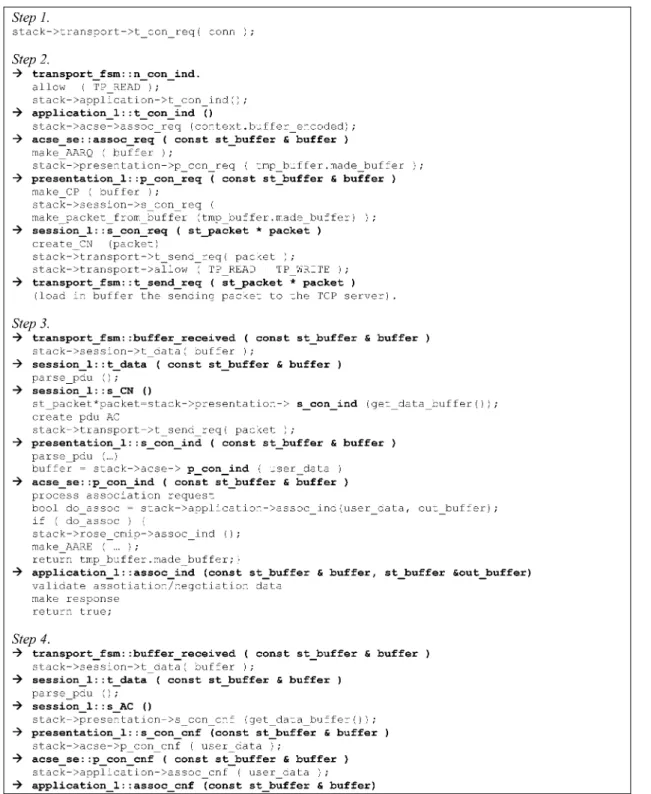
In the same way as described above, the implementation details are explained, step by step, according to the message exchange among the different layers and using implemen-tation scheme (see Fig. 5):
Step 1. The DCC controller (agent) initiates a connection to the BCC controller (manager).
Step 2. The BCC receives a connection request. It begins accepting incoming events and passes the request up to
the application layer. The BCC starts an association request to the DCC. The parameter is an encoded buffer containing the medical device service element structure, which is used for configuration and interoperability issues. Once the PDU has been generated, the request goes down through several layers, each adding its corresponding PDU header.
Step 3. The DCC receives an association request and sends a confirmation answer.
Step 4. The BCC receives the association confirmation. Step 5. The connection procedure is ended. Now the entities exchange messages according to the ROSE/CMIP protocol. Under normal operation, the DCC sends an event report to the BCC. After that, data go down through the lower layers, similarly to how it was previously described.
Step 1.
stack->transport->t_con_req( conn ) ;
Step 2.
-} transport_f sm: :n_con_ind.
allow ( TP_READ ) ;
stack->application->t_con_ind(); -> application_l: : t_con_ind ()
stack->acse->assoc_req (context.buffer_encoded); -} acse_se::assoc_req ( const st_buffer & buffer )
make_AARQ ( buffer ) ;
stack->presentation->p_con_req ( tmp_buffer.made_buffer ) ; -} presentation_l: :p_con_req ( const st_buffer & buffer )
make_CP ( buffer ) ;
stack->session->s_con_req f
make_packet_from_buffer (tmp_buffer.made_buffer) ) ; -^ session_l: : s_con_req ( st_j>acket * packet )
create_CN (packet)
stack->transport->t_send_req( packet ) ;
stack->transport->allow ( TP_READ I TP_WRITE ) ; -^ transport_f sm: : t_send_req ( st_packet * packet )
(load in buffer the sendinq packet to the TCP server).
Step 3.
"^ transport fsm::buffer received ( const st buffer & buffer )
stack->session->t_data( buffer ) ;
-> session_l::t_data ( const st_buffer & buffer )
parse_pdu ( ) ; -^ session_l: : s_CN ()
st_packet*packet=stack->presentation-> s_con_ind (get_data_buffer()); create pdu AC
stack->transport->t_send_req( packet ) ;
-} presentation_l: : s_con_ind ( const st_buffer & buffer )
parse_pdu (...)
buffer = stack->acse-> p_con_ind ( user_data ) -^ acse_se: :p_con_ind ( const st_buffer & buffer )
process association request
bool do_assoc = stack->application->assoc_ind(user_data, out_buffer); if ( do_assoc ) {
stack->rose_cmip->assoc_ind ( ) ; make_AARE ( ... ) ;
return tmp_buffer.made_buffer;}
-> application_l::assoc_ind (const st_buffer & buffer, st_buffer Sout_buffer) validate assotiation/negotiation data
make response
r e t u r n t r u e ;
Step 4.
-> t r a n s p o r t _ f s m : : b u f f e r _ r e c e i v e d ( c o n s t s t _ b u f f e r & b u f f e r ) s t a c k - > s e s s i o n - > t _ d a t a ( b u f f e r ) ;
-^ s e s s i o n _ l : : t _ d a t a ( c o n s t s t _ b u f f e r & b u f f e r ) p a r s e _ p d u ( ) ;
-^ s e s s i o n _ l : : s_AC ()
s t a c k - > p r e s e n t a t i o n - > s _ c o n _ c n f ( g e t _ d a t a _ b u f f e r ( ) ) ; -^ p r e s e n t a t i o n _ l : : s _ c o n _ c n f ( c o n s t s t _ b u f f e r & b u f f e r )
s t a c k - > a c s e - > p _ c o n _ c n f ( u s e r _ d a t a ) ;
•> a c s e _ s e : : p _ c o n _ c n f ( c o n s t s t _ b u f f e r & b u f f e r ) s t a c k - > a p p l i c a t i o n - > a s s o c _ c n f ( u s e r _ d a t a ) ; -^ a p p l i c a t i o n _ l : : a s s o c _ c n f ( c o n s t s t _ b u f f e r & b u f f e r )
4 EN13606 Implementation. EHR server • Transform. It transforms XML documents using XSLT style sheets.
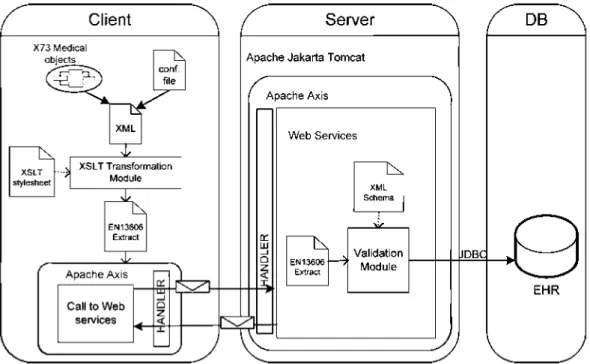
The proposed implementation experience is completed with the logging process of the medical device information in the EHR server, using the EN 13 606 standard. This information is received from the X73 gateway through the X73/ EN13606 monitoring server (see Fig. 3). The client/server architecture has been implemented with middleware tech-nologies, based on web services (WS), as it is shown in
Fig. 6. The used tools have been apache axis (open
source), the Servlets/JSPs container apache tomcat, exten-sible mark-up language (XML, WS-based framework con-sisting of an implementation of the SOAP server) and various utilities and APIs for generating and deploying WS applications. Data are transmitted using HTTPS proto-col. In order to gain security the apache WSS4J framework (a Java library that can be used to sign and verify SOAP messages with WS-security information) was used.
4.7 Client
On the client side, a developed Java application is used to read the X73 data (received from the X73 gateway through an XML document) and generate an intermediate EN13606 (archetype file using extensible style sheet language transformations (XSLT). After that, the WS will store this information in the EHR server (see Fig. 7). A set of classes is organised in packages for giving greater modularity. A representative package (cardioweb.client) is detailed. It contains the classes to invoke the web service, obtained by means of a WSDL compiler:
package, containing setting the userkey - cardioweb.client.handler. This
PWCallback.java class, allows password.
- cardioweb.client.utils. This packet contains classes with specific functionalities:
• XSLApply. It uses the Transform class and it informs if the process has been successful.
• StringUtils. It allows the client to make string operations such as filling or substitution.
• TextFile. It allows the client to write/read text files.
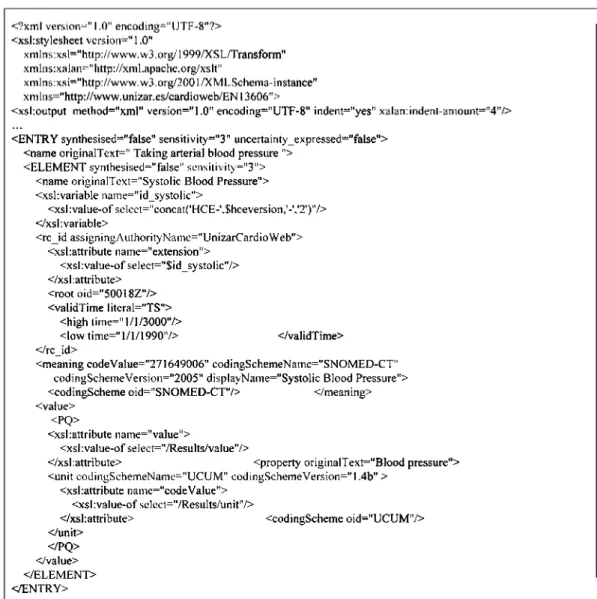
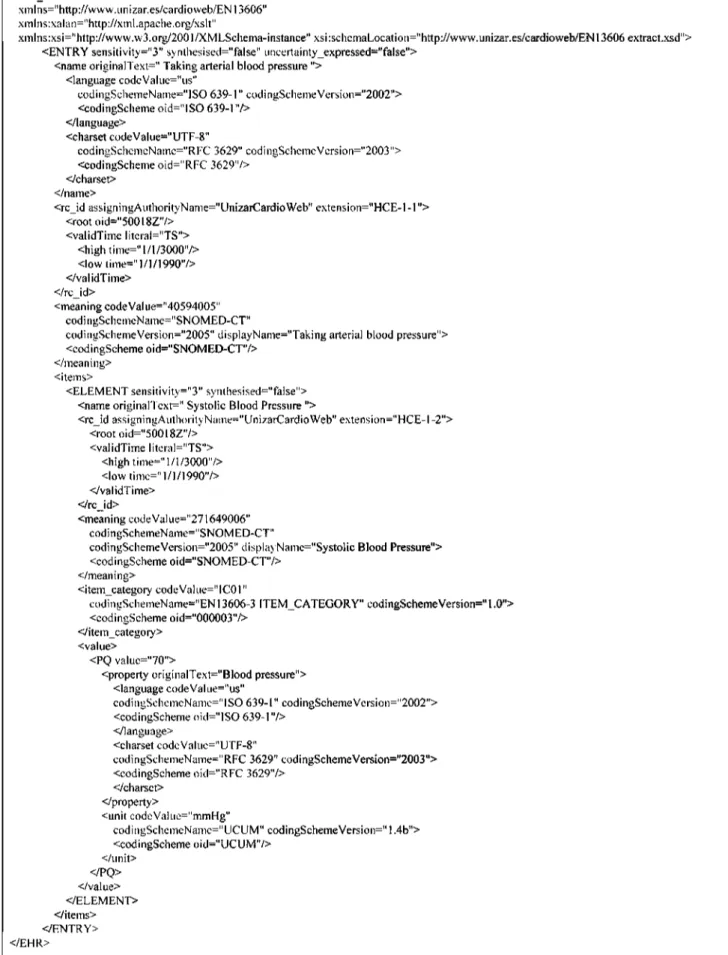
In order to obtain a XML document with EN13606 stan-dard format, XSLT style sheets (used by the Xalan pro-cessor and XML Xerces parser) have been developed. The document object model (DOM) API is used to work with XML documents stored in memory and for Java API XML processing (JAXP) which makes possible XSLT transformations from the Java code. Fig. 8 shows a piece of XML code that contains an extract of EN13606 standard.
4.2 Server
On the server side, a WS has been implemented for recei-ving and validating the XML extract, in END 606 format, sent by the client, using XML schemes (see Fig. 9). Once the XML extract is validated, an acknowledgment will be sent back to the client. If it was successful, the extract will be stored in the EHR server database. In the same way, as in the client implementation, classes are organised in packets achieving a greater modularity. A representative package (cardioweb.server.handler) is detailed:
- cardioweb. server.handler. It is used to verify the security requirements (usernames and passwords).
- cardioweb.server.services package. It contains the WSs available for the client:
• getExtractDevice: It creates an EN13606 extract from received data.
• WriteXMLExtract.java: It validates a XML file that contains an EN13606 extract using XML schemas. If the process is successful, it stores it in EHR database and sends a notification to the client.
- cardioweb. server.utils: It contains classes with specific functionalities:
• BDUtils: It allows the server to connect and disconnect the MySQL database.
• BDStoreExtract: It allows the server to record an EN13606 extract in the EHR database.
Client
X73 Medical objecte
-t3_:
XML
"K
XSLT stylesheet
3Z
XSLT TransformationModule
X
"K
EN13SOS Extract
3Z
Apache AxisCall to Web services
Sa-Server
DB
Apache Jakarta Tomcat
Apache Axis
K r
^
Web Services
~N
EN13606
Extract
Validation Module
JDBQ
J
EHR
<?xml version-' 1.0" encoding-'UTF-8"?> <xsI:stylesheet version^" 1.0"
x m 1 n s: xs 1-" http: // w w w. w3 - org/1999/XS L/Transform" x m In s: xa la n="http: //xm 1 .apache, o rg/xs It"
x m 1 n s: x s i - ' htlp: //www. w3. Org/2 001 /X M L Schema- in stance" xm ltis=" http://www.un izar.es/cardiowcb/EN 13606">
<xsl:outpui raethod="xml" version="1.0"encoding="UTF-8" indent-'yes" xalan:indent-amoui*="4"/>
<ENTRY synthesised-'false" scnsiiivity="3" uncertainly expressed="false"> <name originalText-' Taking arterial blood pressure ">
<ELEMENT synI liesised-'false" sensilivity="3"> <name originalTcxt="Systolic Blood Pressure"> <xsl:variable ]iame="id_systolic">
<xsl:value-ofscloct="concat('HCE-',Shceversion,'-'.'2')"/> </xsl:variable>
<rc_id as?iigningAuthorilyKLi[]K="UnizarCardioWeb"> < xs I: att r i bute n a me=" extens ion" >
<x s I: val ue-of se 1 e et=" $ i d s y s t o I ic 7 > </xsl:attribute>
<rootoid="50018Z7> <validTime litcral="TS">
<hightime="1/1/30007>
<low tdirte-"l/l/1990"/> </validTime> </rc_id>
<meaningcodeValue="271649006" eodingSchemcNamc="SNOMED-CT" cod in g Scheme Version="2 005" displayName="Systolic Blood Pressure"> <codingScheme oid="SNOMED-CT7> </meaning> <value>
<PQ>
<xsl:attribute name- 'value">
<x s I: va I tie-of se 1 c c t="/Res ults/v a I ue 7 >
</xsl:attribute> <property original] ext="Blood pressure";-<unit codingSehemeName-'UCUM" codingSchemeVersion="l,4b" >
<xsi attribute name-" code Value"> <xsl:value-of select="/Results/unit"/>
</xsl:attribute> <codingScheme o i d - ' U C U M " / > • unit •
</PQ> </value> </ELEMENT> </ENTRY>
Fig. 7 X73/EN13606XSLT style sheet
• StringUtils: It allows the server to make string operations such as filling or substitution.
• TextFile: It allows the server to write/read text files. • ValidateXMLSchema: It allows the server to validate an XML file using XML schemas.
5 Discussion and conclusion
The adoption of a complete end-to-end standard-based sol-ution for patient monitoring in bedside environments can be extremely useful for the integration and interoperability of the huge amounts of vital data collected every day, making a more efficient use of such information, allowing it to be shared among professionals, giving more facilities for the mobility of patients within the hospitals, reducing costs and increasing usability for patients, health care pro-fessionals and manufacturers.
The complexity and density of the documents that shape the bulk of the X73 family of standards are two of the key-points that are restraining its adoption. From this implemen-tation experience it was seen that X73 implemenimplemen-tation is feasible and the standard documents are reasonably under-standable; however, some guidelines could be of great help for developers that want to apply standards to a specific system. In this case, and without previous experience, the implementation of the two standards in the entire system took no more than 3 months and it was performed by a
group of five soft/hardware designers following the advice of the rest of the research group. Obviously, this is a prototype and there are still some important issues (i.e. size of the monitoring devices or battery consumption etc.) to address before a final implementation is done. Although the proposed design may appear to be complex this is completely transparent to the users (patients, doctors etc.), who only obtain its benefits (interoperability, plug-and-play functionalities, exchange of medical information etc.).
• 5:iIK i: '•[•:Nij6<)6-].o\jc20or>o2-<)'r
\ n 1111 s=" htt p:// w w w. u n i za r, es/ca rd i o web/EN 13606" x m I ti s: \a I a n=" htt p ://xtnl .apactie. o rg/xslt"
xmlns:xsi="http://www.w3.org/200f/XMLSchcma-instai!ce'' \si:schctnaLocatioti=''http://www.iinizar.es/cardioweb/ENI3606 extract.xsd"> <ENTRY sensitivity^"3" synthesised-'false" uncertaintyexpressed-'false">
<name originalText-' Taking arterial blood pressure "> <language codcVahie="us"
codingSchemeName- 'ISO 639-1" cod ingSc heme Version="2002"> <coditigScheme oid="ISO 639-l'7>
</langLiage>
<charset codeValue="UTF-8"
codingSchemeNamc-'RFC 3629" codingSchemeVcrsion="2003"> <codingSchemeoid="RFC 3629"/>
</charset> </namc>
<rc_id assigningAuthorityNanie="UnizarCardioWeb" extension-'HCE-1 -1 "> <rootoid="500l8Z7>
<valid'lime litcral="TS"> <hightime="l/l/30007> < l o w l i m e = " l / l / 1 9 9 0 7 > </valid I ime>
</rc_id>
<meaning cod eValue=" 40594005" c od i n gSc h c incNanie=" SNIO M E D-C T"
codingSchemeVersion='l2005" displayName-'Taking arterial blood pressure">
<cod i ngScheme o i d=" SNOM ED-CT7> </meaning>
••ik'ltlS "
<ELEMENT seiisitivhy="3" sy tit lies ised="false"> <name originall cxt=" Systolic lilood Pressure ">
<rc_id assignjngAuthorityName="UnlzaiCaidioWd)" extension- 'HCE-1 -2"> <rootoid="500l8Z7>*
<validTime literal—TS"> <hsghtime="l/l/30007> < l o w t i m e = " l / ] / 1 9 9 0 7 > <^validTime>
< / r c j d >
< mean i ng cod e Val a e- '2 71649006" c od i n gSc he meName=" SN O M E D-C T"
codingSchcmeVcrsion="2005" displayName-'Systolic Blood Pressure"> <codingScheme oid="SNOMED-CT"/>
</meaning>
<item_category codeValiie="[C01"
codin$:SchemeName="ENl 3606-3 1 T E M C A T E G O R Y " eodingSchemeVersion="1.0"> <codingScheme oid="00O003"/>
</item_category> <value>
<PQ value="70">
<property originalText="Blood pressure"> •language code Value-'us"
coditigSchcmcName="lSO 639-1" codingScliemcVersion-'2002"> <codingScheme oid="ISO 639-17>
</language>
<charset eodeVahie="UTF-8"
codi ngSchemeName="RFC 3629" codingScherneVersion="2003"> <codingScheme o i d - ' R F C 3629"/>
</charsct> </property>
<unit codeValue="mmHg"
coditigSchcmeName-'UCUM" codingSchcmc Version-'1.4b"> <codingScheme oid="UCUM7>
</tmit> </PQ> </value> </ELEMENT> </items> <^ENTRY> </EHR>
Fig. 8 Extract ofEN13606 standard - X73 compatible
Home telemonitoring has experienced an important growth in the past few years, and nowadays it has proved its efficiency as a follow-up option in scenarios such as chronic disease management, home hospitalisation, follow-up after ambulatory surgery and elderly patients'
<?xml version-' 1.0" encoditig="UTF-8"?>
<!-- edited with XMLSPY v5 U (http://www.xriilspy.com) by kk (kk) - >
<xs:schema xmlns:xs="http://www.w3.org/2001/XMLSchema" \mlns-"http://www.unizar.es/cardioweb/EN 13606"
target Namespace=" http://www.un izar.es/cardioweb/ EN 13606" element Form Default-'qua lifted" all ri buteFonriDefau 11=" unq ua I i fied" >
<xs: include schemaLocalion~"file:///d:/app/demographics.xsd"/>
< ! - RECORD. COMPONENT ~>
<xs:complexTypename="RECORD_COMPONENT"> <xs:sequence>
<xs:element name-'name" type="TEXT'7>
<xs:element name="archetype_id" type-'II" minOccurs="0"/> <xs:element name="rc_id" typc-"II"/>
<xs:element nami.--"meaning" type-'CV" minOccurs-'0"/>
<xs:element name="policy_ids" type="II" minOccurs-'0" maxOccurs="unbounded "/> <xs:element name="orig_parent_ref' type="H" mitiOccurs="0"/>
<xs:element name-'links" type="LlNK" minOccurs-'0" maxOccurs-'unbounded"/> <xs:element name="feeder_audit" type="AUDIT_[NFO" minOccurs-'O"
m axOccurs="unbo u nded" .•,,>
</xs:sec[ue^ce>
<xs:attribute name-'synthesised" lype^"xs: boo lean" tl xed=" false" /> <xs:attribute name="sensitivity" lvpe="xs:integer'7>
</xs: comple xTy pe>
<!-- ELEMENT -->
<xs:compIexType name-'ELEMENT"> <xs: c o mplexConte nt>
<xs:extension base="lTEM"> <xs:sequence>
<xs:element name-'value">
<\ s: comp I e x Ty pe>
<xs:choice>
<xs:element name="OID" type="OID" minOccurs="0"/> <xs:element namc="CS" type="CS" tnitiOccurs="0"/> <xs: element name="CV" lype="CV" minOccurs-'0"/> <xs:element name-'TEXT" type="TEXT" ininOccurs="07> <xs:element name="URI" typc-'URI" minOccurs="0"/> <xs:element name="TS" type="TS" niinOccurs="0"/> <xs: element name="IVL_T" type="IVL_TS" minOccurs="0"/> <xs:clcmcnt naiiie="ll" t; pc="ll" iiiin()ccurs="0"/>
<xs:element name="ED" lype="ED" minOccurs-'0"/> <xs:element name="PQ" lype="PQ" minOccurs="0"/>
<xs:element name-' boo lean" type="xs: boolean" minOccurs="0"/> <xs:element name="date" type="xs:date" minOccurs="0"/>
</xs:choice> </xs:complexType> </xs:element> </xs:sequence>
</xs:cxtension> </xs: com p I ex Con te nt> </xs:complexType>
</xs:schema>
Fig. 9 X73/EN13606XML schema
management workflow, usability and costs. The work pre-sented can be adapted for the implementation and design of a standard end-to-end solution for medical device com-munications in home and ambulatory environments, having an important impact in this promising market. Standard-based telemonitoring devices are critical for the e-Health sector, as they foster competitiveness between manufacturers and help service providers in a definitive adoption of telemedicine.
6 Acknowledgment
The authors wish to thank Mr. Melvin Reynolds, convenor of the CEN TC251 WGIV, for his invaluable suggestions
7 References
Meyer, C : 'Visions of tomorrow's ICU', Am. J. Nurs., 1993, 93, pp. 26-31
East, T.D.: 'Computers in the ICU: panacea or plague?', Respir. Care, 1992, 37, pp. 170-180
Barie, P.S.: 'Advances in critical care monitoring', Arch. Surg., 1997,
132, pp. 734-739
Kohli-Seth, R., and Oropello, J.M.: 'The future of bedside monitoring', Crit. Care Clin., 2000, 16, pp. 557-578
Seiver, A.: 'Critical care computing: past, present, and future', Crit.
Care Clin., 2000, 16, pp. 601-621
Clemmer, T.P.: 'Computers in the ICU: where we started and where we are now', J. Crit. Care, 2004, 19, pp. 201-207
Uckert, F., Ataian, M., Gorz, M., and Prokosch, H.U.: 'Functions of an electronic health record', Int. J. Computerised Dentistry, 2002, 5, pp. 125-132
O'Toole, M.F., Kmetik, K.S., Bossley, H., Cahill, J.M., Kotsos, T.P., Schwamberger, P.A., and Bufalino, V.J.: 'Electronic health record systems: the vehicle for implementing performance measures', Am.
Heart Hospital J., 2005, 3, pp. 88-93
Kalra, D.: 'Electronic health records: the European scene', Br. Med.
J., 1994, 309, pp. 1358-1361
Stead, W.W., Miller, R.A., Musen, M.A., and Hersh, W.R: 'Integration and beyond: linking information from disparate sources and into workflow', J. Am. Med. Inf. Assoc., 2000, 7, pp. 135-146
Pedersen, S., and Hasselbring, W.: 'Interoperability for information systems among the health service providers based on medical standards', Informatik - Forschung Und Entwicklung, 2004, 18, pp. 174-188
Kennelly, RJ.: 'Improving acute care through use of medical device data', Int. J. Med. Inf., 1998, 48, pp. 145-149
Sengupta, S.: 'Heterogeneity in health care computing environments'. Proc. Annual Symp. on Computer Applications in Medical Care, 1989, pp. 355-359
Kling, R.: 'Learning about information technologies and social change: the contribution of social informatics', Inf. Soc, 2000, 16, pp. 217-232
Galarraga, M., Serrano, L., Martinez, I., and Toledo de, P.: 'Standards for medical device communication: X73 PoC-MDC, Stud. Health
Technol. Inf., 2006, 121, pp. 242-256
'Point-of-Care Connectivity; Approved Standard - Second Edition Preview Sample Pages', 2006, available at: http://www.clsi.org/
source/orders/
HL7 health level seven, IEEE interoperability JWG available at:
http://www.ieeel073.org/related/hl7/jwg/hl7ieeeinterop.html
IEEE1073. Health informatics. Point-of-care medical device communication. Standard for Medical Device Communications -Overview and Framework,, available at: http://www.ieeel073.org
ENV13606 - CEN/TC251. Electronic Healthcare Record Communication. Parts 1, 2, 3 and 4, Pre-standard, 2000, available
at: http://www.medicaltech.org
IEEE13734 - 'CEN/TC251. VITAL Health informatics - Vital signs information representation' available at: http://www.medicaltech.org
ENV13735 'CEN/TC251. INTERMED. Health informatics -interoperability of patient connected medical devices. [1999]'. Available at: http://www.medicaltech.orgh
Kennelly, RJ., and Wittenber, J.: 'New IEEE standard enables data collection for medical applications'. Proc. Arrnu. Symp. Comput. Appl. Med. Care, 1994, pp. 531-535
Kennelly, RJ.: 'IEEE standards for physical and data communications', Biomed. Instrum. Technol., 1996, 30, pp. 172-175 Kennelly, RJ., and Gardner, R.M.: 'Perspectives on development of IEEE 1073: the Medical Information Bus (MIB) standard',
Int. J. Clin. Monit. Comput., 1997, 14, pp. 143-149
Susperregui, A., Paloc, C , Macia, I., and Garcia, I.: 'A standard-based mobile and wireless vital signs monitoring system', VICOMTech Association, 2005, available at: http://www.vicomtech.es/
publicaciones/
Warren, S., Craft, R.L., Parks, R.C., Gallagher, L.K., Garcia, RJ., and Funkrouser, D.R.: 'Proposed information architecture for telehealth system interoperability'. Annual Int. Conf. IEEE Engineering in Medicine and Biology — Proc, 1999, vol. 2, p. 702
Yao, J., and Warren, S.: 'Applying the ISO/IEEE 11073 standards to wearable home health monitoring systems', J. Clin. Monit. Comput., 2005, 19, pp. 427-436
Anagnostaki, A.P., Pavlopoulos, S., Kyriakou, E., and Koutsouris, D.: 'A novel codification scheme based on the "VITAL" and "DICOM" standards for telemedicine applications', Biomed. Eng., IEEE
Trans., 2002, 49, pp. 1399-1411
Weigand, C : 'VITAL: use and implementation of a medical communication standard in practice', 2005, pp. 319 — 322
Pavlopoulos, S., Anagnostaki, A., Koutsouris, D., Lymberis, A., Levene, P., Reynolds, M., Georgiadis, N., Lambrinoudakis, C , and Gritzalis, D.: 'Vital signs monitoring from home with open systems', Stud. Health Technol. Inf., 2000, 77, pp. 1141-1145 Zywietz, C , Kraemer, M., Fischer, R., and Widiger, B.: 'Integrating the ECG enterprise-HES-EKG with the built-in vital signs information nomenclature', Comput. Cardiol, 2004, 31, pp. 41-44
Kampmann, J., Lau, G., Kropp, St., Schwarzer, E., and Hernandez, S.C.: 'ER-Connection of electronic medical devices in ICU according to the standard "MIB" ', J. Clin. Monit. Comput., 1991, V8, pp. 163-166
Salvador, C.H., Pulido, N., Quiles, J.A., and Gonzalez, M.A.: 'An implementation of the IEEE medical information bus standard',
IEEE Eng. Med. Biol. Mag, 1993, 12, pp. 81-88
Lebak, J.W., Yao, J., and Warren, S.: 'Implementation of a standards-based pulse oximeter on a wearable, embedded platform'. Annual Int. Conf. IEEE Engineering in Medicine and Biology -Proc, 2003, vol. 4, pp. 3196-3198
Warren, S., Yao, J., Schmitz, R., and Lebak, J.: 'Reconfigurable point-of-care systems designed with interoperability standards'. Annual Int. Conf. IEEE Engineering in Medicine and Biology -Proc, 2004, vol. 26 V, pp. 3270-3273
'Continua Alliance web site', 2006, available at: http://www.
continuaalliance.org/home/
'Bluetooth SIG Medical Devices WG', 2006, available at: http://www.
bluetooth.com/Bluetooth/SIG/
Schadow, G., Fohring, U., and Tolxdorff, T.: 'Implementing HL7: from the standard's specification to production application',
Methods Inf. Med, 1998, 37, pp. 119-123
Ohe, K., and Kaihara, S.: 'Implementation of HL7 to client-server hospital information system (HIS) in the university of Tokyo hospital', J. Med. Syst, 1996, 20, pp. 197-205