A C
1FINITE ELEMENT FAMILY FOR KIRCHHOFF
PLATE BENDING
J. T O R R I i S , A. S A M A R T I N , V. A R R O Y O A N D J. D I A Z D E L V A L L E
Departamenlo de Andli\i\ de las Estrueturas, Escuela Tecniea Superior de Ingenieros de Caminos Universidad de Canlubria, Sunt under, Spain
S U M M A R Y
After a s h o r t i n t r o d u c t i o n t h e possibilities a n d l i m i t a t i o n s of p o l y n o m i a l s i m p l e e l e m e n t s with C ' c o n t i n u i t y are discussed with reference to p l a t e b e n d i n g analysis. A family of this kind of e l e m e n t s is p r e s e n t e d . T h e s e elements a r e a p p l i e d to simple cases in o r d e r t o assess their c o m p u t a t i o n a l efficiency. Finally s o m e c o n c l u s i o n s a r e s h o w n , a n d f u t u r e r e s e a r c h is also p r o p o s e d .
I N T R O D U C T I O N
T h e application of the finite element m e t h o d ( F - E - M ) to the analysis of K i r c h h o f f p l a t e b e n d i n g d e m a n d s the c o n t i n u i t y in the first derivative of the e x p a n s i o n of the deflection w. T h e reader is referred to Zienckiewicz's excellent b o o k1 for details.
T h e types of e l e m e n t s which satisfy this c o n d i t i o n a r e referred to in the l i t e r a t u r e as c o n f o r m i n g or c o m p a t i b l e elements. H o w e v e r , it has been s h o w n in References 2 a n d 3, that it is occasionally possible t o o b t a i n highly efficient c o n v e r g i n g results (with respect t o the energy f o r m ) with n o n -conformingelements. This convergence, which in such cases may n o t be m o n o t o n i c , m a y d e p e n d o n the mesh c o n f i g u r a t i o n of finite elements, i.e. in s o m e e x a m p l e s t h e r e m a y n o t be convergence. I r o n s4 thus p r o p o s e d his well-known p a t c h test, that w o r k s for all 'noil pathological" s i t u a t i o n s .5
F o r b e n d i n g c o m p a t i b l e finite elements two i m p o r t a n t aspects of c o n v e r g e n c e — m o n o t o n y a n d mesh independence— can be ensured w i t h o u t f u r t h e r tests, which in s o m e cases are of practical a n d theoretical interest. However, the task of c o n s t r u c t i n g c o n f o r m i n g b e n d i n g e l e m e n t s is n o t a n easy one. In fact it is n o t possible to achieve C1 c o n f o r m i t y in simple e l e m e n t s by using p o l y n o m i a l expressions with u n i q u e expressions in their interior.6 T h e several t e c h n i q u e s d e v e l o p e d u p to this d a l e for o b t a i n i n g c o m p a t i b l e elements 7 10 can be divided into t w o types, t h o s e c o n s i d e r i n g C ' compatibility a n d t h o s e a v o i d i n g it.
With C" there is n o p r o b l e m with the value of the second mixed derivative (tvvv) at the corners. T h e second mixed derivative (vvt,,) at the c o r n e r s of the e l e m e n t s can be a f u n c t i o n of o t h e r degrees of f r e e d o m (slave d.o.f.), or itself a n o t h e r degree of f r e e d o m (master d.o.f). If the first case is considered, a n d only first derivatives a r e t a k e n as m a s t e r d.o.f.s at the c o r n e r s , t h e r e a r e two possibilities to consider: (1) r a t i o n a l c o r r e c t i n g f u n c t i o n s a n d (2) division of t h e e l e m e n t s into areas (Figure 1).
I R E D U C T I O N OF ORDER II HYPERELEMENTS I I I P I E C E W I S E I V R A T I O N A L
LAGRANGE METHOD F U N C T I O N S CORRECTING
FUNCTIONS
F i g u r e I. T e c h n i q u e s lor o b t a i n i n g c o m p a t i b l e e l e m e n t s
b a n d e d matrix — a n d with C1 elements a b o u t which, in a d d i t i o n t o the a d v a n t a g e s m o n o t o n o u s convergence a n d mesh i n d e p e n d e n c e it m u s t be said that
1. T h e numerical i n t e g r a t i o n c a n be very a c c u r a t e because it is used in p o l y n o m i a l s . 2. T h e extension to shells has n o p r o b l e m s , so t h a t t h e e l e m e n t s used a r e simple.1 1
A general p r o c e d u r e is p r o p o s e d to c o n s t r u c t the s h a p e f u n c t i o n s , so t h a t an element family is achieved. In this way by varying the i n t e r p o l a t i o n f u n c t i o n s with the s a m e mesh (he a c c u r a c y is i m p r o v e d ( ^ - c o n v e r g e n c e ) .
In the following a hierarchic family of C1 e l e m e n t s based on the a p p l i c a t i o n of piecewisc p o l y n o m i a l s will be described. T h e s e piecewise p o l y n o m i a l s were first used by C l o u g h a n d T o c h e r '2 in t r i a n g u l a r elements, a n d e x t e n d e d later to p a r a l l e l o g r a m s by C l o u g h a n d F e l i p p a .1 J T r i a n g u l a r elements have also been used by C l o u g h a n d F e l i p p a .1 3
H I E R A R C H I C F A M I L Y
Introductory example
In o r d e r t o g r a s p t h e m a i n features of t h e family of t r i a n g u l a r finite elements, the m e m b e r c o r r e s p o n d i n g to the p o l y n o m i a l o r d e r N = 5 will be considered.
T h e t r i a n g u l a r element is divided i n t o a n o t h e r t h r e e as is s h o w n in F i g u r e 2, w h e r e for simplicity '13' is the centre of gravity. In each of these s u b e l e m e n t s a c o m p l e t e p o l y n o m i a l i n t e r p o l a t i o n f u n c t i o n of degree 5 is built ( F i g u r e 2).
3 dof w, wx , wy
^ I 1 I Subelement 1
• J 3 dof w , w„ , Ws
| # | 5 dof w, wg , ws s
wn . wn s
F i g u r e 2. T w o p o s s i b l e d i s t r i b u t i o n s of d.o.f. a l o n g t h e e x t e r n a l sides of t h e 5th d e g r e e e l e m e n t
This m e a n s that 2d.o.f. (w, />w/f*s) a n d I d.o.f. (<Hv/«Vi) can be t a k e n i n t o a c c o u n t in the C° a n d C1 continuity, respectively, a l o n g the external side. T h e n a l o n g this side, 2 ( = 6 — 2 x 2) d.o.f. a n d 3 ( = 5 — 2 x 1) d.o.f. for C ° a n d C1 c o n t i n u i t y h a v e t o be considered (Figures 3(b), (c)), i.e. a total of 5 d.o.f. a n d t h e r e f o r e only 10 ( = 21 — 5 x 3) internal d.o.f. r e m a i n ( F i g u r e 2).
It is interesting to p o i n t o u t t h a t several possibilities exist for placing the 5 ( = 2 + 3) d.o.f. along the external side. All of t h e m represent t h e s a m e c o m p l e t e p o l y n o m i a l a l o n g the side a n d give identical a p p r o x i m a t i o n levels.1 4 O n e c o r r e s p o n d s to using only first derivatives a l o n g the side a n d is s h o w n in F i g u r e 2(a). A n o t h e r possibility, p e r h a p s the m o s t simple one, is to c o n c e n t r a t e all t h e 5 ( = 2 + 3) d.o.f. at t h e m i d s i d e n o d e (Figure 2(b)).
A similar r e a s o n i n g t o the previous o n e allows us t o c o n c e n t r a t e t h e 10 r e m a i n i n g internal d.o.f. namely vv, dw/dx, i)w/dy, d2w/dx2,...,d3w/dy3 ( F i g u r e 2) at the n o d e 0. T h e n t h e c o n t i n u i t y a l o n g each internal side will be analysed. First, C° c o n t i n u i t y d e m a n d s 6 d.o.f., b u t a l r e a d y at its t w o e n d nodes 6d.o.f. = 2 d.o.f. (w, dw/ds) + 4 d.o.f. (w, cw/ds, d2w/ds2, d3w/ds3) exist ( F i g u r e 3(d)). T h i s in-ternal C ° c o n t i n u i t y always exists ( F i g u r e 4(a)). F o r the C1 c o n t i n u i t y 5 d.o.f. a r e needed. At the t w o end n o d e s there are 4 d.o.f. = 1 d.o.f. (dw/dn) + 3 d.o.f. (d w / d n , d2w/dn ds, d2w/dn d2s), (Figure 3). Therefore, in general, C internal c o n t i n u i t y d o e s n o t exist. H o w e v e r it is possible t o c h o o s e the internal d.o.f. at n o d e '0' in such a way that this C1 c o n t i n u i t y exists. T h i s m e a n s that 3 c o n d i t i o n s (one for each internal side) s h o u l d be i m p o s e d , or equally 3 d.o.f. s h o u l d be expressed in t e r m s of the r e m a i n i n g 7, a n d t h o s e of the external nodes, a n d t h e n e l i m i n a t e d at the s h a p e f u n c t i o n level (Figure 4(b)). This step w a s first m a d e analytically, b u t the expression b e c a m e so c o m p l i c a t e d t h a t it was decided to use a n u m e r i c a l p r o c e d u r e .
Node I
Polynomial 5 d e g r e e
6 coeficienfs
Node 3 w - d e f l e c t i o n Nodes 4 coeficienfs (dof )
side 2 dof is needed
( b )
Polynomial 4 degree 5 coeficienfs
Node I Node 3 wn -normal derivative Nodes 2 coeficienfs (dof)
side 3 dof are needed
(c)
w - P o l y n o m i a l 5 degree - 6 coeficienfs
Node 0 Node 3
deflection Nodes 4 + 2 = 6 c o e f i c i e n t s ( d o f ) side none dof is needed
( d )
Wns
Node 0
r
in- P o l y n o m i a l 4 d e g r e e
5 coeficienfs
Node 3
side I dof is n e e d e d
(e)
F i g u r e 3. C o n t i n u i t y a l o n g e x t e r n a l a n d i n t e r n a l s i d e s : lb) w - - d e f l e c t i o n at t h e n o d e s — 4 c o e f f i c i e n t s (d.o.f.); 2 s i d e d.o.f. a r e n e e d e d ; (c) w y - n o r m a l d e r i v a t i v e a t t h e n o d e s - 2 c o e f f i c i e n t s (d.o.f.) 3 s i d e d.o.f. a r e n e e d e d ; (d) w - d e f l e c t i o n at t h e n o d e s - 4 + 2 = 6 c o e f f i c i e n t s (d.o.f.); n o s i d e d.o.f. a r e n e e d e d ; (e) w„ n o r m a l d e r i v a t i v e a t t h e n o d e s 3 + 1 = 4
c o e f f i c i e n t s (d.o.f.); 1 s i d e d.o.f. is n e e d e d
(a) (b) (c)
f i g u r e 4. D e r i v a t i o n s of t h e 5th d e g r e e e l e m e n t of t h e family: (a) e l e m e n t with i n t e r n a l c o n t i n u i t y t " o n l y 3 4 d . o . f . ; (b) i n t e r n a l d.o.f. e l i m i n a t e d at s h a p e f u n c t i o n level: i n t e r n a l C1 c o n t i n u i t y 31 d.o.f., (c) i n t e r n a l d.o.f. e l i m i n a t e d by
s t a t i c c o n d e n s a t i o n : i n t e r n a l C1 c o n t i n u i t y 24 d.o.f.
Q 3 dof w, wx , wy
s (2 N - 5) dof w, Wg , w5 2 W SN- 1
wn < wn , . w„ « 2 . wn» N- 4
S( N-1 ) d o f w , w
f i g u r e 5. A g e n e r a l c l e m e n t N of t h e f a m i l y w i t h i n t e r n a l C" c o n t i n u i t y o n l y
Number and distribution of d.o.f. subeleinent interpolation function
T h e a b o v e ideas can be e x t e n d e d to a general m e m b e r of the family of elements. T h e t r i a n g u l a r element is divided into a n o t h e r three, as is depicted in F i g u r e 5. In each of t h o s e s u b e l c m e n t s is built a c o m p l e t e p o l y n o m i a l i n t e r p o l a t i o n f u n c t i o n of degree N.
T h e n u m b e r of d.o.f. a n d their d i s t r i b u t i o n a l o n g e x t e r n a l a n d i n t e r n a l sides will be discussed. T h e total n u m b e r of d.o.f. in a n Nth degree p o l y n o m i a l of t w o variables is
(N + l )(/V + 2)
where S(N) is the sum of the first N n a t u r a l n u m b e r s .
First, a l o n g a n external side the C1 c o m p a t i b i l i t y — i n vv a n d w „ — i m p l i e s t h e results of T a b l e I. F o r a p o l y n o m i a l of fifth degree this is explained in Figures 3(b) a n d 3(c).
T h e d.o.f. used at the central n o d e of t h e external side a r e s h o w n in F i g u r e 6.
As the n u m b e r of d.o.f. in the m i d d l e of a n external side is 2N-5 (Table I) the internal d.o.f. n u m b e r will be
S(N + 1) — 2 x 3 — (2/V — 5) = S(N — 1)
T h e c o n t i n u i t y a l o n g a n internal side is s h o w n in T a b l e II. O n e p r e s c r i p t i o n of c o m p a t i b i l i t y is imposed in o r d e r to o b t a i n c o n t i n u i t y in the n o r m a l derivative (vv,,) F i g u r e 3(e).
T h e c o n d i t i o n used here is to m a t c h the n o r m a l derivative between s u b e l e m e n t s in the m i d d l e of the internal sides, t h a t is
w l " ( 6 ) = - m'!,(5)
w L ( 6 ) = - M - : : ( 5 ) (2)
w:,'(6)= - < ( 5 )
where superscripts refer t o the s u b e l e m e n t s a n d t h e n u m b e r s in b r a c k e t s to t h e n o d e s indicated in Figure 7.
These prescriptions could be i m p o s e d at o t h e r p o i n t s a n d t h e r e could be m o r e with p o l y n o m i a l s of a higher degree t h a n three. It has been p r o v e d1 5 that it is n o t possible to enforce m o r e t h a n t h r e e c o n d i t i o n s between subelements. In this family of finite elements the 3 d.o.f. at the c e n t r e of gravity, chosen t o be d e p e n d e n t , a r c vv, dw/cx, dw/dy.
T a b l e I. D . O . F . d i s t r i b u t i o n o n an e x t e r n a l side
A B A + B F u n c t i o n vv(degree N) w„(degree N — I) \v + w„ D . O . F . for C c o n t i n u i t y N + 1 N IN + 1
II C o r n e r d.o.f. 2 x 2 2 x 1 6 111 = 1 — II side d.o.f. e x c l u d i n g t h e c o r n e r s iV — 3 N — 2 2N — 5
wn s( N - 4 )
f i g u r e 6. C o n t i n u i t y a l o n g a n e x t e r n a l side: (a) d.o.f. — 2 + 2 + /V - 4 + I = N + 1; n u m b e r of c o n s t a n t s in a p o l y n o m i a l of (Vth o r d e r = N + 1; (b) d.o.f. = iV; n u m b e r of c o n s t a n t s in a p o l y n o m i a l of ( N - - l ) t h o r d e r = / V ; d.o.f. a t a
T a b l e II. D . O . F . d i s t r i b u t i o n in a n i n t e r n a l side
II III
IV = 11 + I I I
F u n c t i o n
D . O . F . for C1 c o n t i n u i t y D.O.F'. at an e x t e r n a l c o r n e r D.O.F". at t h e c e n t r e of g r a v i t y ,
S ( N - 1)
D.O.F". o n an i n t e r n a l side
A B A + B w(degrec N) vv„(degree N — 1) vv + wn
N + 1
2
N - 1
N+ I
N
N-2
N-2 N + 1 3
2 N - 3
2 N
F i g u r e 7. I n t e r n a l c o n t i n u i t y C1 Analytical expression
As in a general F - E - M p r o c e d u r e , the general i n t e r p o l a t i o n f u n c t i o n is for each s u b e l e m e n t .
w(i) = La'" (3)
where i m e a n s the n u m b e r of the s u b e l e m e n t , L is a vector of S(N + 1) c o m p o n e n t s L\, L j , LC3(L; a r e baricentric c o - o r d i n a t e s ; see F i g u r e 8 for N = 4), a is a vector of S(N + 1) c o n s t a n t s aa b c.
If d are the d.o.f. (w a n d its derivatives) it c a n be o b t a i n e d f r o m (3) t h a t
d(0 = C(i)a(0
a n d hence t h a t
a<>) = c( i'd( i )
T h e n the i n t e r p o l a t i o n f u n c t i o n expression is
S ( N + 1) w(i) = LC(,)d(1) = <|>d(i) = X
j= i
(4)
(5)
(6a)
w ( 3 ) w „ ( 3 ) w (3)
w ( 4 ) wn( 4 ) »n <4)
4 0 0 L- L 2 3
L° L2 3 2
L32 3 L° 2 1 L2 L3
1 2
L2 L3 0 3
L 2 L3 ^
L° L2 3 4
W ( 1 ) », ( 1 )
Wy ( 1 ) w ( 2 ) wx ( 2 )
wy ( 2 )
w ( 3 ) >
wx ( 3 )
wy ( 3 )
w ( 4 )
wn ( 4 )
w„ ( 4 )
F i g u r e 8. B a r i e e n t r i c i n t e r p o l a t i o n coelTicients f o r N = 4. V e c t o r s I> a n d d("
(dU ), d(2>, d, 3 )) is f o r m e d , t a k i n g i n t o a c c o u n t t h e fact t h a t s o m e d.o.f. a r e the s a m e in different subelemcnts. It is possible t o divide d* i n t o t w o vectors (d^.d^)1, so that d* c o n t a i n s the linearly d e p e n d e n t d.o.f. a n d df the i n d e p e n d e n t , after i m p o s i n g C1 c o n t i n u i t y .
E q u a t i o n (6a) n o w has a n o t h e r form:
= LC( i )d( i ) = l^Cg',C( i ,)(dS,df )T = <|>(i)*d* = £ <l>(i)*Jdj w
where
M = 3(3 + 2N — 5) + S{N — 1)
a n d t h e e q u a t i o n system (2) can be expressed as
c|)*3)*(6)d*= — ct»:/ »*f5)d*
W>*(6)A* = -cj>!,2'*(5)d*
<j)'„2)*(6)d* = -<M,3 )*(5)d*
where
w„ = tJ>JI')* d*
a n d hence
Hod g + H1d * = 0
d* = - H o ^ H . d f ^ H d *
(6b) j= i
so t h a t (6b) b c c o m e s
vv<0 = Ltqj'C'/'MHdf , d ? )T = L(C<;>H +- C ' f t d f = LCdf = $<''»df ( 9 )
T h e s h a p e f u n c t i o n <j>' c o r r e s p o n d i n g t o the d i s p l a c e m e n t w at n o d e 3 in a s u b e l e m e n t for several degrees of p o l y n o m i a l s is given in F i g u r e 9.
In F i g u r e 10 the first t h r e e e l e m e n t s of t h e family a r e depicted.
Element stiffness matrix, static condensation and structural assembly
Using the plate g o v e r n i n g e q u a t i o n s a n d e q u a t i o n s (9) t h e e l e m e n t stiffness m a t r i x a n d equivalent forces a r e o b t a i n e d . O w i n g t o the fact that the internal n o d e is n o t needed, t h e d.o.f. t h a t are there can be e l i m i n a t e d by static c o n d e n s a t i o n .
A f t e r w a r d s the element stiffness m a t r i c e s a r e a d d e d t o g e n e r a t e t h e total stiffness m a t r i x for the plate s t r u c t u r e a n d in a similar way the c o m p l e t e e q u i v a l e n t force vector
P = Kd (10)
where
K = I i = 1 ( B ' )TD B ' d / l
' 1 I J J A
P = X i U B ' )TD£;) + (v|//)Tb + (vl»i)TPid/1i + (v|/'1) P s d.s ( I I )
N = 3
n1 = 15
n„ = 12
N = 4
a, = 21
N = 5
n, = 3 4
n „ = 3 1
o
(<Q)) I
A •
W , , wy
w> wx i wx x >W« , >Wy y
wn wn s / w
w„ w „ « , / w wc
n 5 s b
dof n u m b e r w i t h o u t internal c o m p a t i b i l i t y dof number with internal c o m p a t i b i l i t y
w ( e :
I *
w ( M ) w"'( Q )
*
A
S E C T I O N A] A2
F i g u r e 11. E v a l u a t i o n of t h e r e s u l t s
L
I A
Results
As there are three s u b t r i a n g l e s in each s u b e l e m e n t , t h e r e are t h r e e g r o u p s of s h a p e f u n c t i o n s as well. T h e r e a r e n o p r o b l e m s in deflection (w) a n d its first-order derivatives o n the f r o n t i e r between subclements, so t h a t C1 c o n t i n u i t y exists. In the s e c o n d - a n d t h i r d - o r d e r derivatives, t h a t represent the b e n d i n g m o m e n t a n d t h e shear force, there is no c o n t i n u i t y . T h u s the a v e r a g e of the s u b e l e m e n t results has been m a d e (Figure 11).
T h e element stiffness m a t r i x h a s been used as well in o r d e r t o o b t a i n t h e results. T h e a c c u r a c y is i m p r o v e d , especially in t h e shear force.
N U M E R I C A L R E S U L T S
Numerical results
T h e elements of this family have been applied t o n u m e r o u s cases in o r d e r t o k n o w their p e r f o r m a n c e in relation to several variables: influence of the l o a d type, b o u n d a r y c o n d i t i o n s , skewness of the elements, relation between t h e lengths of the sides a n d mesh p a t t e r n s .
Loading and boundary conditions. As a n e x a m p l e a typical case is tested: a s q u a r e p l a t e of side a with Poisson's r a t i o equal to 0-3. T w o cases arc p r e s e n t e d : a built-in p l a t e a l o n g t h e b o u n d a r y with a uniform load of intensity q (Table III), a n d a plate, s u p p o r t e d simply by its c o r n e r s u n d e r a p o i n t load P at the c e n t r e (Table IV).
poly-T a b l e III. S q u a r e p l a t e : b o u n d a r y b u i l t - i n
M e s h t y p e : a: side l e n g t h
q: u n i f o r m l o a d i n t e n s i t y v: 0 3 ( P o i s s o n ' s r a t i o ) vv: c e n t r e d e f l e c t i o n iIf: c e n t r e m o m e n t
A / , , M , : c e n t r e side m o m e n t s
Q: m i d d l e s i d e s h e a r
R: m i d d l e s i d e K i r c h h o f f r e a c t i o n s D O F 1 : t o t a l n u m b e r of d.o.f.
D O F 2 : n u m b e r of a c t i v e d.o.f. N D E G : p o l y n o m i a l d e g r e e
A A A A A A A A
N D E G D O F I D O F 2
3
4
5
6
7
E x a c t1 6
C o e f f i c i e n t 17
27
37
6
10
0 0 0 0 5 4 2 2
0 - 0 0 1 2 9 2 1
0 0 0 1 2 6 5
4 7
57 14
18
0 0 0 1 2 6 3
0001266
0-00126
qa4!D
M 0 - 0 1 4 8 0
0 - 0 3 3 4 3
0 - 0 2 4 6 6
0 - 0 2 0 5 6
0 - 0 2 4 1 0
0-0231
qa1
M,
0 - 0 0 3 9 0 4
0 - 0 1 1 2 3
0-01511
0 - 0 1 5 4 7
0 - 0 1 5 4 6
0 0 1 5 4 0
qa2
M2
- 0 - 0 1 3 0 1
0 - 0 3 7 4 4
- 0 - 0 5 0 3 8
- 0 - 0 5 1 5 6
0 - 0 5 1 5 2
- 0 0 5 1 3
qa2
Q K
0 - 0 5 2 0 5 0 - 0 4 7 5 0
0-2221
0 - 4 3 1 9
0 - 4 5 1 5
0 - 4 5 4 5
0 - 4 4 0 51
qa
0-2302
0 - 4 5 4 0
0-4714
0-4672
0 - 4 4 0 31
qa
T a b l e IV. S q u a r e p l a t e : s i m p l y s u p p o r t e d c o r n e r s M e s h t y p e : a: s i d e l e n g t h
P: c e n t r e p o i n t l o a d i n t e n s i t y v: 0-3 ( P o i s s o n ' s r a t i o ) vv: c e n t r e d e f l e c t i o n w,: c e n t r e side d e f l e c t i o n
M : c e n t r e m o m e n t Rc: c o r n e r r e a c t i o n D O F 1 : t o t a l n u m b e r of d.o.f. D O F 2 : n u m b e r of a c t i v e d . o . f N D E G : p o l y n o m i a l d e g r e e
N D E G D O F 1 D O F 2 3 17 11
4 27 19
5 37 2 87
6 4 7 35
7 57 4 3
E x a c t S A P 4 L C C T 9
C o e f f i c i e n t
0 - 0 3 7 6 5
0-03891
0 - 0 3 9 0 7
0-03911
0 - 0 3 9 1 2
0 - 0 3 9 0
Pa2 ID
0-02282
0-02286
0-02291
0-02291
0-02291
0 - 0 2 2 8 4
Pa2 ID
M
0 - 0 2 5 6 9
0 - 2 0 6 7
0 - 2 0 0 9
0 - 2 0 3 8
0 - 2 0 1 7
0 - 1 6 2 1 71'
P/a
K,
0 - 1 3 6 1 2
0-2658
0-2100
0 - 2 5 4 0
0-2260
0 - 2 4 3 01
Mesh type:
h: simply s u p p o r t e d side c: free side
h, c: sides lengths
q: u n i f o r m load intensity
T a b l e V. Skew plate
v: 0-3 ( P o i s s o n ' s ratio) \v: c e n t r e deflection
M\ c e n t r e m o m e n t
D O F 1 : t o t a l n u m b e r of d.o.f. D O F 2 : n u m b e r of a c t i v e d.o.f. N D E G : p o l y n o m i a l degree.
b =
a = 30
c = I-5a
l-9245« a = 4 5
h= 1-4 hi
c = 2 a a = 60 b = 2a
c = 2a
N D E G D O F 1 D O F 2 vv M vv M vv M
3 43 31 0-1045 0-46850 0 0 6 6 4 2 0-29507 0-01487 0-12848 4 75 59 0-1052 0-46789 0-06935 0-31064 0-01742 0-16652 E x a c t1 8 0-1183 0-368 0-07080 0-291 0 0 1 8 6 0 0 1 6 6 0 Coefficient qa*/D qa2 qa4/D qa 2 qa4'/!) qa
nomials of degree no higher t h a n the f o u r t h . T h e a c c u r a c y o b t a i n e d in the results c a n only indicate the tendency. T h e results a r e s h o w n in T a b l e V.
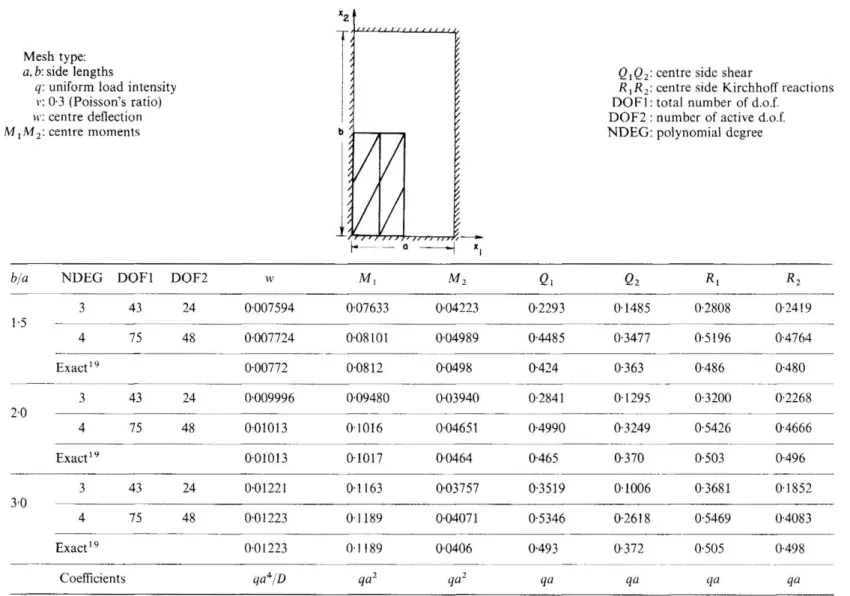
Different side relationships. T h e influence of t h e r a t i o between t h e lengths of the sides is s h o w n in T a b l e VI for a simply s u p p o r t e d r e c t a n g u l a r plate with u n i f o r m load.
Mesh dependence. T h e i m p o r t a n c e of the type of mesh p a t t e r n is depicted in F i g u r e 12 for a s q u a r e built-in plate u n d e r u n i f o r m loading. T h e best results a r e o b t a i n e d f r o m the C mesh type, especially 1 C a n d 2CE. Similar results c o u l d be s h o w n for a simply s u p p o r t e d s q u a r e plate u n d e r point loading. In a n y case the m o n o t o n o u s c o n v e r g e n c e is e n s u r e d because t h e e l e m e n t s a r e C1.
Comparative study with other elements
In order t o assess n o t only the speed of c o n v e r g e n c e of this family of the elements b u t its possible c o m p u t a t i o n a l efficiency as well, a c o m p a r a t i v e study with o t h e r e l e m e n t s is carried out. T h e c o m p a r a t i v e variable is the n u m b e r of d.o.f; h o w e v e r it d o e s n o t represent the total c o m p u t a t i o n a l effort, because in h i g h - o r d e r p o l y n o m i a l s the g e n e r a t i o n of the stiffness m a t r i x d e m a n d s c o n s i d e r a b l e c o m p u t e r time.
Table VI. Rectangular plate: boundary simply supported
3 43 24 0-007594 0-07633 0-04223 0-2293 0-1485 0-2808 0-2419 1-5
4 75 48 0-007724 0-08101 0-04989 0-4485 0-3477 0-5196 0-4764
Exact1 9 0-00772 0-0812 0-0498 0-424 0-363 0-486 0-480
3 43 24 0-009996 0-09480 0-03940 0-2841 0-1295 0-3200 0-2268 2-0
4 75 48 0-01013 01016 0-04651 0-4990 0-3249 0-5426 0-4666
Exact1 9 0-01013 0-1017 0-0464 0-465 0-370 0-503 0-496
3 43 24 0-01221 0-1163 0-03757 0-3519 0-1006 0-3681 0-1852 3-0
4 75 48 0-01223 01189 0-04071 0-5346 0-2618 0-5469 0-4083
Exact1 9 0-01223 0-1189 0-0406 0-493 0-372 0-505 0-498
w = deflection
M = bending moment
0 = shear force
w(0 4 0 % )
M (3 7 7 % )
Q(-18%)
2
1 R 1 C
w ( 0 - 4 0 % ) M(-1 00%) Q(-198%)
w(0 3 2 % )
M ( 3 T 7 % )
0(5'20%) VI Z '
s v / v"
> 6 II
/
IV //
1 / " ' •w ( 0 4 0 % ) M ( 3 7 7 % ) Q(-18%)
3 2 RE
w (0 4 0 % ) 7
M(-2 60%) Q ( - 1 7 % 4
2 CS
t
w ( 0 32 % ) M(-1 82%) Q ( 3 - 8 1 % )
4 0
-20
E
o
E
cn
S - 2 0
c d> CD
- 4 0
Deflection 0 . 5 % Bending moment 4 4 % Kirchoff force 6 2 %
ES7 (Family N = 7) "
•T1 (Diazdel Valle and Samartin)
,20
W (Wegmuller)
3 0 0 4 0 0 5 0 0
Dof number
F i g u r e 1.1 B e n d i n g m o m e n t e r r o r ( p e r c c n t ) v e r s u s n u m b e r of d.o.f. f o r a b u i l t - i n s q u a r e p l a t e u n d e r u n i f o r m l o a d
/ Deflection 0 1 7 % /
/
' Corner force 0 3 3 %
10
D " 1 0
- 2 0
ES7 (Family N = 7 )
T1 (Diaz del Valle and Samartin)1'
20 1=1 m e n W (Wegmuller)
ACM (Adini, Clough) M (Melosh)2'
2 2
P (Pappenfus)
B (Bogner, Fox and Schmit)
200
i
3 0 0 4 0 0 500
.42.
Dof number
F i g u r e 14. C e n t r a l d e f l e c t i o n e r r o r ( p e r c e n t ) v e r s u s n u m b e r of d.o.f. f o r t h e s i m p l y s u p p o r t e d s q u a r e p l a t e u n d e r p o i n t - l o a d i n g at t h e c e n t r e
A P P L I C A T I O N S A N D C O N C L U S I O N S
the d o m a i n , because the effort t o o b t a i n its stiffness m a t r i c e s is drastically r e d u c e d if they a r e c o m p u t e d only once.
In c o m p a r i s o n with h y p e r e l e m e n t s , this family h a s the a d v a n t a g e t h a t the s h a r p j u m p s in elastic or thickness characteristics c a n be easily considered. H o w e v e r the a c c u r a c y in the results, which imply higher derivatives, is better in h y p e r e l e m e n t s because they a r e the d.o.f Even t h o u g h it is possible t o h a v e the d u a l results (high o r d e r derivatives) of the d.o.f. by using the stiffness m a t r i x . T h e results have been o b t a i n e d with p o l y n o m i a l s between t h e third a n d seventh degrees a n d using numerical i n t e g r a t i o n . It h a s been observed t h a t high o r d e r derivatives p r e s e n t a great sensitivity a n d n u m e r i c a l noise m a y a p p e a r .
It is also very easy t o use this family in shells as t h e high o r d e r derivatives h a v e direct compatibility.1 1
P O S S I B L E E X T E N S I O N S
S o m e practical tables for special b o u n d a r y c o n d i t i o n s , c h a n g i n g of thickness, a n d elastic c o n s t a n t s are to be m a d e with the use of these elements.
T h e i n t e r s u b e l c m e n t c o n t i n u i t y achieved is C1. T h e possible m a x i m u m is still o p e n t o s t u d y .2 4 The analysis of the influence of the choice of d.o.f. to be e l i m i n a t e d at the c e n t r e n o d e in o r d e r to o b t a i n the internal c o n t i n u i t y is t o be carried out.
T h e noise p r o d u c e d in high o r d e r derivatives is to be assessed, especially for t h e matrix conditioning.
T h e results for the variables that a r e n o t d.o.f. can be o b t a i n e d (a) by using s h a p e f u n c t i o n s at t h e point, (b) by using t h e s h a p e f u n c t i o n s a n d their values at t h e i n t e g r a t i o n points, (c) by m e a n s of t h e stiffness matrix for the dual variables of the d.o.f. A c o m p a r i s o n between these t h r e e m e t h o d s w o u l d be of great interest.9 S o m e results of the third m e t h o d h a v e s h o w n a very g o o d accuracy.
T h e extension t o curved c o m p a c t s u p p o r t s w o u l d be very useful for the case of irregular b o u n d a r i e s .
T h e extensive n u m e r i c a l e x p e r i m e n t a t i o n has been c a r r i e d o u t only with p o l y n o m i a l s of degree less t h a n seven because the i n t e g r a t i o n tables for triangles a r e n o t available for higher degrees. T h e extension of these tables t o higher degree p o l y n o m i a l s w o u l d be very interesting.
T h e use of several k i n d s of elements within the family c a n relieve s o m e c o m p u t a t i o n a l effort. L o w degree elements can be used near t h e b o u n d a r y , n o r m a l l y in large n u m b e r s in o r d e r t o m o d e l the geometry, a n d o n l y a few high degree elements a r e usually required in the central a r e a of t h e plate. O b v i o u s l y t h e hierarchic family s h o u l d include t r a n s i t i o n a l elements. T h e s e can be o b t a i n e d either directly or f r o m a n o r m a l element by r e d u c t i o n of t h e o r d e r a l o n g s o m e sides of t h e element.
In o r d e r t o allow the s i m u l t a n e o u s use of elements of different orders, t h e i n t r o d u c t i o n of a general n o m e n c l a t u r e in t h e hierarchic families m a y be useful.
A C K N O W L E D G E M E N T S
T h e a u t h o r s wish t o a c k n o w l e d g e the c o m m e n t s of t h e reviewers t h a t h a v e helped t o i m p r o v e t h e clarity of this paper.
A P P E N D I X
Triangles formulation
a, a,
F i g u r e 15. T r i a n g l e p a r a m e t e r s
at = Xk - X j hi = y:, - yk with
i «,= i bt=o
w, = - (iij + ak)
b, = - (bj + bk)
, • n , , aiak + bibk
a, = ak sin Of + bk cos = —
^i
e, = at sin 0t + bt cos 0i = v (af + b f )
j j p i
• „ ai bi — biai
Hj = ak cos 0i — bk sin W, = — •
ei
u n u n " A - M *
— H, -— a,-cos 0, — fr.sin (/.• =
j J p c i
where
di +./; + e(- = 0
T h e triangle a r e a a n d intrinsic c o - c o r d i n a t e s are (for i— 1,2,3)
2A = ti;bk — b;ak = - (a;/); — fj.c/y)
A r e a 1 2 3
U = A r e a P 3 1
A r e a 1 2 3
A r e a P 1 2
^ H3
A r e a 1 2 3
F i g u r e 16. T r i a n g u l a r c o - o r d i n a t e s
, .
d,jU, = 1 — A; e.
T h e r e l a t i o n s h i p b e t w e e n the t r i a n g u l a r a n d C a r t e s i a n c o - o r d i n a t e systems ( F i g u r e 16) is as follows:
w i ~2A23 bl
Li
= 2 A
2A31 b2 = 2 A
2-^12 b3 where
- T . = V , R . - A , V,
a n d the inverse t r a n s f o r m a t i o n is
1 " i i r
X = X, X2 A,
T h e r e l a t i o n s h i p between general a n d side C a r t e s i a n c o - o r d i n a t e s ( F i g u r e 17) is
"i
x
V
+
hi aIhi - Hi
U: b,
X
y --J
n; X: Vi
F o l l o w i n g F i g u r e 18, side C a r t e s i a n c o - o r d i n a t e s a n d t r i a n g u l a r c o - o r d i n a t e s a r e related by
~>h~
Si
1
_
d, H,r
li 1
i1
t'jLk di
= 2 A J i = 2 A
J i 0
1
0 0 H i 0
- Hi 2A Li
U L:
T h e i n t e r e o - o r d i n a t e derivatives a r e
vl, SLt <7,
rx 2 / 1 ' dy _ 2A
dLi dL,
= 0 2 A' 7 )S, = 0
' J ; >: < /.: II: drij 2A' dSj 2 I
* = cl± dLk = / / ,
("'M; 2/1 ' ('.Vj 2A
T h e p a r a m e t e r s a n d t r i a n g u l a r c o - o r d i n a t e s of s u b e l e m e n t s a n d t h e c o m p l e t e element a r e related as follows ( F i g u r e 19, in which c e n t r e n u m b e r 3 is t h e baricentre):
a'/' = - a f = xk = - Xi + cij = - a\k> = + Xj = xt + ak
af = tf ;
h<?=-b<>> = yk = yi + bj
b f = - b r = - y j = -
y i+
b
kbf = b<
As the n o d e 3 of each s u b e l e m e n t is the baricentre:
x , + x2 + x3 = 0
T h u s we have:
... a, —a,- b: — b;
rM) _ak ~ a i , (i) bi
3 ' ' 3
= a,-, ft^fe;
a n d f o r the t r i a n g u l a r c o - o r d i n a t e s ( F i g u r e 20)
= 3L,,
3
r (0 - 1 _ 3/ + L' _ i - 1 | i l i a i / o> Lj - 2 2Lt+ 2 r L j - 2 6+2L J 2Lk
1 ^ I J I fw
L"> = 2 2L' 2 + 2' = t + W - ^
Expression of a polynomial and its derivatives
polynomial. If S(N) = N(N + l)/2
S(N+ 1)
p(L1,L2,L3)= X I °<-NnLNn
i.j.k = 0 u = 1
i + j + k=N
where
i = i(N,n), j = j{N,n), k = k(N,n)
Natural derivatives.
dx + P + YP S ( J V + D JI J I kl
P m = dT^dLfdlJj = „ ? , a / V" 1/ » ! ( T1! ) ! C ^1 y)! it is a p r o d u c t
S< (V+l) /! j! M
/ /
/ /
/ /
/ s
/
/ A \
/ ^ ^ 3 \
\
X
where
LNn.niiy = 0 if ' < « or j < [i or k < y
a = a (m), [1 = y = y(m)
General Cartesian derivatives.
d'+kp f 1 ] " ( 1 ]"<
^ = = ] 2 7( / , | /'J" + + ^P.iJ j j ? | ' ": / >' + > + I with
/ = /(m), k = k(m)
f 1 k.S'u + 1).V(* + 1)
p = [ y y 4 b - < P _
,m \2AJ M
with
. / i l ^ W
kl
B k" ~ M a n d
k1=kl(k,fi), k2 = k2(k, /(), k3 = k3(k,[i)
Local Cartesian derivatives.
, <" + kP f 1 , V
X { 2 / 1 (-h i l P-L' + + with
j=j{m), k = k(m)
(/,-,• = 0, alj=—Hi, aih = Hi a n d ( 0n= l )
a n d / is the n u m b e r of side.
/ I \ j + k S ( . / + l ) S ( k + 1 ) r j + ' n
o' = I — I Y Y / F ' B '
lm \2A) M M Jv k"dLi'+k'(lLf + k2(lLr
with
a n d
B[
3 ( h j
F i g u r e 21. T h i c k n c s s c s
kl
kfi
k |! /<T , A b n t M ^ h u f * 2! k3!
2 ( h )
./1 =./((./, >'), j2 = /2( . / , V ) , = / , ( / , I')
fc, =/c,(A:,//), k2 = k2(k,n), k3 = k3(k,n)
Thickness
T h e variation of (hiekness can be modelled as follows ( F i g u r e 21):
, i _Ll_ >h
+
h2+
h = h { l \ , l =In the s u b e l e m e n t n u m b e r /:
h{i)(L}\, L2\ L f ) = hUp + hjLf + hk L(j]
R E F E R E N C E S
1. O . ( ' . Zicnkiewicz, The Finite Elemenl Method in Engineering Science. M c G r a w - H i l l , L o n d o n , 1979.
2. A. Adini a n d R. W. C l o u g h . 'Analysis of p l a t e b e n d i n g by t h e finite e l e m e n t m e t h o d ' , A R e p o r t to t h e N a t i o n a l Science F o u n d a t i o n , U.S.A., G . 7337. 1961.
3. G . P. Bazeley, Y. K. Cheun. B. M . I r o n s a n d O . C. Zicnkiewicz. ' T r i a n g u l a r e l e m e n t s in b e n d i n g c o n f o r m i n g a n d n o n -c o n f o r m i n g s o l u t i o n ' . Proc. Conf. Matrix Methods in Struct. Mcch., Air F o r c e Inst, of Tech., W r i g h t - P a t t e r s o n A. F. Base, O h i o . O c t o b e r 1965.
4. B. M . Irons, ' T h e p a t c h test for engineers', Conf. Atlas Computing Centre. H a r w e l l U.I.. M a r c h 1974.
5. B. M . I r o n s a n d M . L o i k k a n c n , "An e n g i n e e r s ' d e f e n c e of t h e p a t c h test', Int. j. numer. methods eng.. 19, 1391 1401 (19X3).
6. B. M . I r o n s a n d J. K. D r a p e r , ' I n a d e q u a c y of n o d a l c o n n e c t i o n s in a stiffness s o l u t i o n for plate b e n d i n g ' , .I.A.I. A. A.. 3, 5 (1965).
7. J. L. Batoz. K. J. Bathe a n d L. W. Ho, 'A s t u d y of t h r e e - n o d e t r i a n g u l a r p l a t e b e n d i n g elements'. Int. j. nttmcr. methods eng.. 15, 1771 1812(19X0).
X. A. K. N o o r a n d W. D. Plikev. ' S t a t e of the art surveys of finite element m e t h o d s ' , AMD Special Publication, 19X1. 9. A. 1'eano, ' C o n f o r m i n g a p p r o x i m a t i o n s for K i r c h h o f f plates a n d shells". Int. j. numer. methods eng., 14, 1273 1291
(1979).
10. A. S a m a r t i n . ' A p l i c a c i o n del m e t o d o d e los e l e m e n t o s finitos al analisis e s t r u e t u r a l de pucnles". Discurso de itumgnracion de Curso Academico 1979 SO. U n i v e r s i d a d de S a n t a n d e r , 1979.
11. J. F. M o y a , I', L u s t e r a n d S. M o n l e o n . ' U n a t e o r i a v a r i a c i o n a l p a r a el analisis d c l a m i n a s h i p e r e l a s t i c a s b a s a d a en u n a j c r a r q u i / u c i o n a o r d e n N del m o d e l o c i n e m a t i c o t r a n s v e r s a l . A p l i c a c i d n d e p r i m e r o r d e n al e s t u d i o del c o m
Methods in Struct. Mech., Air F o r c e Inst, of Tcch.. W r i g h t - P a t t e r s o n A.F. Base, O h i o . 1965.
13. R. C l o u g h a n d C. F e h p p a . 'A refined q u a d r i l a t e r a l c l e m e n t f o r a n a l y s i s of p l a t e b e n d i n g ' , Proc. II. Conf. Matrix Methods in Struct. Mech., Air F o r c e Inst, of T e c h . , W r i g h t - P a t t e r s o n A . F . Base, O h i o , 1968.
14. A. S a m a r tin, ' U n e s t u d i o s o b r e la e x a c i t u d del m e t o d o d c los e l c m e n t o s f i n i t o s . A p l i c a c i o n a la b a r r a d e s e c t i o n v a r i a b l e b a j o e s f u e r z o s axiles". l l n i v e r s i d a d d e S a n t a n d e r . N o v i c m b r e d e 1980.
15. J . T o r r e s , ' U n a f a m i l i a d e e l c m e n t o s s i m p l e s c o n f o r m e s clasc C ' , Ph.D. Dissertation. D e p t . d c A n a l i s i s d e la E s t r u e t u r a s . F..T.S. d c Ing. d e C a m i n o s d e S a n t a n d e r . 1984.
16. T. H . E v a n s , Journal Appl. Mechanics. 6, A-7 (1939).
17. J. D i a z del Valle a n d A. S a m a r t i n , ' U n a c o n t r i b u c i o n al e s t u d i o d e h i p e r e l e m e n t o s f i n i t o s en p l a c a s ' . Ph.D. Dissertation, D e p a r t a m e n t o d c Analisis d c las F s t r u c t u r a s d e la L.T.S. d e Ing. d e C a m i n o s , S a n t a n d e r . 1980.
18. U. P. J e n s e n , Bulletin JJ2, Illinois U n i v e r s i t y , 1941.
19. S. T i m o s h e n k o a n d S. W o i n o w s k y - K r i c g e r , Theory of Plates and Shells, M c G r a w - H i l l , 2 n d c d n , 1959.
20. A. Vegmullcr, 'Finite element a n a l y s i s of e l a s t i c p l a s t i c p l a t e s a n d e c c e n t r i c a l l y stiffened plates', Ph.D. Dissertation, Civil F n g . D e p t . L e h i g h U n i v e r s i t y , 1971.
21. R. J. M e l o s h , 'A stiffness m a t r i x for t h e a n a l y s i s of t h i n p l a t e s in b e n d i n g ' . Journal of Aer<inauiical Sciences, 28, 34 (1961).
22. S. W. Pappcrfusn, 'Lateral p l a t e d e f l e c t i o n by stiffness m a t r i x m e t h o d s w i t h a p p l i c a t i o n t o a m a r q e e ' . M.S. Thesis, D e p t . of Civil Eng., U n i v e r s i t y of W a s h i n g t o n , S e a t l e 1969.
23. 1' . K. B o g n c r , R. L. F ox a n d L. A. S c h m i t , ' T h e g e n e r a t i o n of i n t e r e l e m e n t c o m p a t i b l e stillness a n d m a s s m a t r i c e s by t h e use of i n t e r p o l a t i o n f o r m u l a s ' , Proc. First. Conf. on Matrix Methods in Struct. Mech., W r i g h t - P a t t e r s o n A.F'. Base, O h i o , N o v e m b e r 1965.
24. M . G a s c a a n d J. 1. M a c z t u , ' O n L a g r a n g e a n d H e r m i t e i n t e r p o l a t i o n in Rk', Numer. Math., 39, I 14 (1982). 25. J. G a r c i a d c J a l o n , ' C o n t r i b u c i o n a la r e s o l u t i o n n u m e r i c a del p r o b l c m a t e r m o e l a s t i c o en s o l i d o s c o n simertia d e
r c v o l u c i o n ' , Ph.D. Dissertation, F..T.S. Ing. I n d u s t r i a l s , S a n S e b a s t i a n , 1977.