Structural style of formation of passive margins,
insights from dynamical modelling
Abstract:We use thermo-mechanical finite element model experiments to investigate factors that are potentially important controls during volcanic and non-volcanic passive margin formation which may explain these characteristic differences. Our focus is on processes that create shear zones, on the rheo-logical stratification of the lithosphere, and on processes that lead to differential thinning of upper and lower lithosphere during rifting. Dynamic modelling cases are compared where the crust is strong, weak, or very weak, and the mantle lithosphere is either strong or weak. Strain softening takes the form of a reduction in the internal angle of friction with increasing strain. Predicted rift modes belong to three fundamental types: 1) narrow, asymmetric rifting in which the geometry of both the upper and lower lithosphere is approximately asymmetric; 2) narrow, asymmetric, upper lithosphere rifting con-comitant with narrow, symmetric, lower lithosphere extension; and 3) wide, symmetric, crustal rifting concomitant with narrow, mantle lithosphere extension.
Keywords:modelling, lithosphere extension, rifting, strain localization.
1Dep. Earth Science, Bergen University, Bergen, Norway.
2Dep. Oceanography, Dalhousie University, Halifax, Canada.
*e-mail: [email protected]
R. S. H
UISMANS1*ANDC. B
EAUMONT2A large number of studies of continental rifts and rift-ed continental margins have producrift-ed high quality data (Keen et al., 1987a, b; Keen and de Voogd, 1989; Mutter et al., 1989; Boillot et al., 1992; Sibuet, 1992; Brun and Beslier, 1996; Louden and Chian, 1999; Dean et al., 2000; Funck et al., 2003; Hopper et al., 2004; Funck et al., 2004) that reveal a wide range of styles which both include wide and narrow rifts, and non-volcanic and volcanic passive margins. A unified understanding of the mechanical and thermal processes that control their extensional geometry is, however, still lacking.
Kinematic and dynamic models have been devel-oped to provide kinematic end-member templates and insight into the dynamic processes associated with these range of styles. The kinematic templates, pure shear (McKenzie, 1978), simple shear
(Wernicke and Burchfield, 1982; Wernicke, 1985) and combinations of these styles (Lister et al., 1986), referred to here as compound models, were primari-ly used in interpretations that ascribed symmetry or asymmetry to the large scale rift geometry. Dynamical modelling studies (Buck, 1991; Bassi et al., 1993; Buck et al., 1999), on the other hand, pro-posed a number of alternative explanations for the occurrence of narrow, wide, and core-complex modes of extension.
than the lithospheric thickness; and 3) narrow rift mode, with crust and mantle lithosphere thinning over a narrow area. Narrow rifting is attributed to local weakening factors such as thermal thinning of the lithosphere, local strain weakening of the strong layers in the system, or local magmatism (Buck, 1991; Buck et al., 1999) to be important, where extension is always localized in the weakest and thinnest area. Three explanations have been provid-ed for wide rifts: 1) a local increase of the integratprovid-ed strength resulting from replacement of crustal mate-rial by stronger mantle lithospheric matemate-rial and concomitant cooling during lithosphere extension causing extension to migrate to un-thinned weaker areas of lithosphere resulting in a wide rift mode (England, 1983; Houseman and England, 1986); 2) flow of weak lower crust to areas of thinned crust in response to pressure gradients related to surface topography that result in delocalization of deforma-tion (Buck, 1991; Buck et al., 1999); and 3) the degree of brittle-ductile coupling in systems contain-ing a frictional layer bonded to a viscous layer, where the occurrence of localized or distributed, pure shear modes depends on the coupling between the layers and the lower layer viscosity (Huismans et al., 2005). Core complex modes of extension are understood to result when rapid lower crustal flow removes the crustal thickness variations required for mechanisms that would results in a wide rift zone (Buck, 1991).
Upper mantle scale, plane strain viscous-plastic finite element models are used to explore the consequences of a range of initial mechanical conditions on the pre-dicted style of deformation. First-order variation of the thermo-mechanical structure of the lithosphere is accomplished by simple scaling of the viscous proper-ties of the crust and mantle lithosphere. This allows us to represent a range of conditions that occur in natu-ral systems, ranging from cold cratonic, through inter-mediate Phanerozoic, to very weak continental crusts. Rift styles are found to depend on the integrated strength of the model lithosphere, and on the propen-sity of sub-horizontal shear zones to form in the crust, thereby decoupling different levels of the models. The extensional deformation of the multilayer system results in distinct crustal and lithospheric thinning patterns and the associated basin architecture and heat flow characteristics.
Thermo-mechanical numerical model
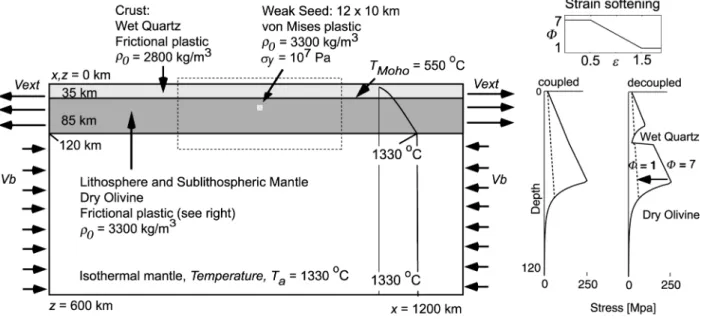
We use an Arbitrary Lagrangian-Eulerian (ALE) finite element method for the solution of thermo-mechani-cally coupled, plane-strain, incompressible viscous-plastic creeping flows (Fullsack, 1995; Willett, 1999; Huismans and Beaumont, 2003) to investigate exten-sion of a layered lithosphere with frictional-plastic and thermally activated power-law viscous rheologies (Fig. 1).
Figure 1.Model geometry showing crust and mantle lithosphere layer thicknesses, their corresponding properties, and the velocity boundary conditions, V, with Vb chosen to achieve a mass balance. Extension is driven by velocity boundary conditions and seeded by a small plastic weak region (“weak seed”). The model has a free top surface and the other boundaries have zero tangential stress (free slip). Whether materials deform plastically or viscously depends on the ambient conditions. At yield, flow is plastic. Below yield, defor-mation is viscous.
STRUCTURAL STYLE OF FORMATION OF PASSIVE MARGINS, INSIGHTS FROM DYNAMICAL MODELLING
When the state of stress is below the frictional-plas-tic yield the flow is viscous and is specified by tem-perature-dependent non-linear power law rheologies based on laboratory measurements on ‘wet’ quartzite (Gleason and Tullis, 1995) and ‘dry’ olivine (Karato and Wu, 1993). The frictional-plastic deformation is modelled with a pressure-dependent Drucker-Prager yield criterion which is equivalent to the Coulomb yield criterion for incompressible deformation in plane-strain. In addition to solving the equilibrium equations for viscous plastic flows, we also solve for the thermal evolution of the model in two dimen-sions. The mechanical and thermal systems are cou-pled though the temperature dependence of viscosi-ty and densiviscosi-ty are solved alternately during each time step. Initial conditions and other thermal prop-erties are given in figure 1. The initial thermal state represents reference continental lithosphere condi-tions with a surface heat flow of 45 mW m-2, a
tem-perature of 550 ºC at the Moho at 35 km, and a temperature of 1330 ºC at the base of the litho-sphere which is of reference thickness of 120 km (Fig. 1). In the models presented here the thermal conditions are not varied. However, the variation of crust and mantle strength could equivalently have been obtained by varying the thermal structure of crust and mantle lithosphere, and may be taken to represent a range of thermal conditions.
Thermo-mechanical models of lithosphere extension
We present an overview of a more comprehensive set of models from Huismans and Beaumont (2002, 2003, 2007, 2008) and Huismans et al.(2005). The models selected here have frictional-plastic strain softening and deformation is nucleated by determin-istic noise in the form of a single weak seed (Fig. 1). Most of the results can be classified as narrow rifts as defined by Buck (1991). We review the sensitivity of deformation style to the extension velocity and the strength of the middle and lower crust.
Sensitivity of model results to rifting velocity
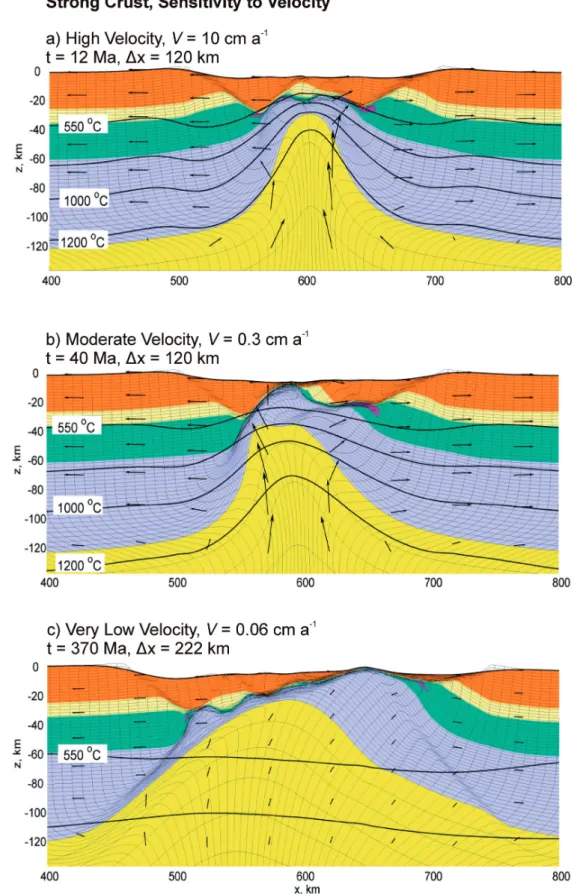
In order to demonstrate that rifting velocity is an important control on the extension mode we show results for a reference velocity of 0.3 cm a-1 and for
end member variations of velocity of 0.06 cm a-1and
10 cm a-1 (Fig. 2). The models have strong middle
and lower crusts and include strain softening of the frictional plastic rheology.
At the reference velocity (Fig. 2b), strain softening in the frictional plastic parts of the lithosphere results in
strong localization in a single system of ‘faults’, resulting in an asymmetric mode of extension. Middle and lower crust has been cut out and mantle lithosphere has been exhumed by large scale friction-al detachment. The proto-margins show distinct dif-ferences resembling an upper and lower plate conju-gate margin pair. The main cause of asymmetry in the model is the frictional plastic strain softening. After an initial phase of symmetric extension, feed-back of strain softening results in preferential weak-ening of one of the two conjugate shears. The single weak shear zone remains the weakest part in the sys-tem and results in lithosphere scale asymmetry. During later stages, thermal advection results in a vis-cous necking style and final break up phase is sym-metric. However, asymmetry remains from the initial stages of the model evolution.
At high rifting velocities (Fig. 2a) the style of exten-sion is markedly different. The proto-margins are essentially symmetric. We have interpreted (Huismans and Beaumont, 2002, 2003) this model behavior in terms of the increased role of viscous rhe-ologies in the system and a stronger viscous coupling, where higher strain rates equate to higher viscous stresses at the base of the frictional layer. The viscous layer promotes a distributed, symmetric style of extension and the tendency for localization and asym-metry given by the frictional plastic strain softening is suppressed.
The effect of an end-member low value for the exten-sion velocity, V = 0.06 cm a-1, is illustrated in figure
2c. The model is strongly asymmetric throughout its evolution. At this velocity thermal conduction is more efficient than thermal advection. Consequently frictional strain softening results in the localization of deformation along one major weak shear zone. As the thermal evolution in the model lithosphere is at the conductive limit (e.g. Pe<<1), the frictional weak shear zone remains the single major weakness in the lithospheric system which allows for ongoing asym-metric extension.
Sensitivity of model results to strength of the lower crust
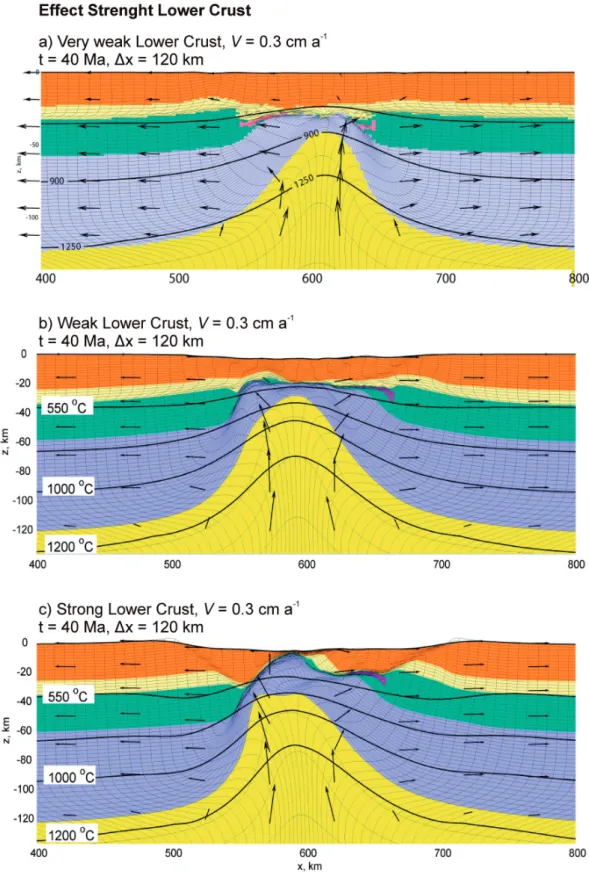
We examine the sensitivity of the model behavior to the strength of the lower crust. The viscous creep strength of the middle and the lower crust is varied as wet quartz viscous flow viscosities ×100 (Fig. 3c), through nominal wet quartz viscosities (Fig. 3b), to wet quartz viscosities /10 (Fig. 3a). In these models the mantle has a dry olivine power law rheology. The strong crust case is the same as shown in figure 2b.
For moderate weak lower crust (Fig. 3b, nominal wet quartz viscosity) the crustal asymmetry is diminished by comparison with the strong crust model because the conjugate frictional shears sole out in the weak ductile lower crust. Extension of the lower lithosphere remains asymmetric with deformation focused on one shear zone. Later, sets of synthetic crustal shear zones form on either side of the central rift zone, thereby creating blocks bounded by frictional shear zones that sole out in the viscous lower crust and that propagate outward beneath the rift flanks. During the later stages of deformation, the lower mantle lithosphere undergoes nearly symmetric ductile necking. The weak lower crust results in much reduced rift flank topography and slightly wider basin geometry com-pared to the strong crust model.
When the strength of the crust is further reduced by scaling the wet quartz flow law to η = ηwet quartz /10
deformation in upper crust is essentially decoupled from that of the mantle lithosphere over a broad region. During the initial stages (Fig. 3a), deformation in the mantle lithosphere remains asymmetric. This asymmetry is no longer transferred to the upper crust but is absorbed and lost in the deformation of the very weak lower crust and the upper crust extends in a dis-tributed wide rift mode. At later stages, the major dif-ferences between the thinning distributions of the upper crust and the mantle lithosphere results in com-plete removal of the mantle lithosphere from beneath the center of the system in contrast to moderate distrib-uted thinning of the middle and upper crust. The base of the crust is exposed to the sub-lithospheric mantle in the center of the rift zone. Crustal extension is accom-modated by large 50-70 km wide blocks of moderately thinned crust bounded by nascent sets of frictional shears that appear in the viscous lower crust. During the final stages of breakup (not shown here) continued attenuation and removal of low viscosity, lower crust results in progressively stronger coupling between the crust and the mantle lithosphere which facilitates ulti-mate localized thinning and breakup of the crust.
Conclusions
Here we have focused on models of extensional processes with application to lithospheric extension
during rifting and the formation of rifted conti-nental margins. Even though rifts and rifted mar-gins have been studied intensively for more than thirty years, a fundamental understanding of the factors that control the extensional process, the dis-tribution of extension and the associated rift and rift margin geometry is still lacking. The purpose of the model studies reported here and in associated articles (Huismans and Beaumont, 2002, 2003; Huismans et al., 2005; Buiter et al., 2008) is to test a limited range of conceptual models that combine distributed viscous-plastic flows with feedback mechanisms, specifically plastic strain-softening, that lead to localized deformation. This localiza-tion allows the models to represent faults and shear zones approximately.
Here we have demonstrated a strong sensitivity of rift mode to both extension velocity and rheolog-ical stratification of the lithosphere. Predicted rift modes belong to three fundamental types: i) nar-row, asymmetric rifting in which the geometry of both upper and lower lithosphere is approximate-ly asymmetric, ii) narrow asymmetric upper litho-sphere rifting concomitant with narrow symmet-ric lower lithosphere extension, and iii) wide sym-metric crustal rifting concomitant with narrow mantle lithosphere extension. If natural litho-sphere behaves in the same manner as the model lithosphere some general predictions can be made concerning non-volcanic rifts and rifted margins. Rifting of strong, cold cratonic lithosphere with a frictional-plastic upper lithosphere will adopt the narrow rift mode, with deep syn-rift basins and high amplitude flank uplifts. These systems will likely have an asymmetric crust and uppermost mantle architecture. At the opposite extreme, rift-ing of lithosphere in which the viscous mid/lower crust is very weak and the uppermost mantle is frictional-plastic will adopt the wide rift mode. Crustal extension occurs over a wide region and produces symmetric wide shallow syn-rift basins without significant flank uplifts. Intermediate modes, including the narrow rift mode that cou-ples asymmetric crustal extension with symmetric mantle lithosphere extension, occur for interme-diate viscosities of the mid/lower crust.
STRUCTURAL STYLE OF FORMATION OF PASSIVE MARGINS, INSIGHTS FROM DYNAMICAL MODELLING
References
BASSI, G., KEEN, C. E. and POTTER, P. (1993): Contrasting styles of rifting; models and examples from the eastern Canadian mar-gin. Tectonics, 12: 639-655.
BOILLOT, G., BESLIER, M. O. and COMAS, M. (1992): Seismic image of undercrusted serpentine beneath a rifted margin. Terra Nova, 4: 25-33.
BRUN, J. P. and BESLIER, M. O. (1996): Mantle exhumation at passive margins. Earth Planet. Sc. Lett., 142: 161-173.
BUCK, W. R. (1991): Modes of Continental Lithospheric Extension. J. Geophys. Res., 96: 20161-20178.
BUCK, W. R., LAVIER, L. L. and POLIAKOV, A. N. B. (1999): How to make a rift wide. Phil. Trans. R. Soc. Lond. A-Math., Phys., Eng. Sc., 357: 671-693.
BUITER, S. J. H., HUISMANS, R. S. and BEAUMONT, C. (2008): Dissipation Analysis as a Guide to Mode Selection during Crustal Extension and Implications for the Styles of Sedimentary Basins.
J. Geophys. Res., 113, B06406. doi:10.1029/2007JB005272.
DEAN, S. M., MINSHULL, T. A., WHITMARSH, R. B. and LOUDEN,
K. E. (2000): Deep structure of the ocean-continent transition in the southern Iberia abyssal plain from seismic refraction profiles; the IAM-9 transect at 40 degrees 20’N. J. Geophys. Res., 105: 5859-5885.
ENGLAND, P. (1983): Constraints on extension of continental
lith-osphere. J. Geophys. Res., 88: 1145-1152.
FULLSACK, P. (1995): An arbitrary Lagrangian-Eulerian formula-tion for creeping flows and applicaformula-tions in tectonic models.
Geophys. J. Int., 120: 1-23.
FUNCK, T., HOPPER, J. R., LARSEN, H. C., LOUDEN, K. E.,
TUCHOLKE, B. E. and HOLBROOK, W. S. (2003): Crustal structure of the ocean-continent transition at Flemish Cap; seismic refrac-tion results. J. Geophys. Res., 108, 20 pp. doi:10.1029/2003JB002434.
FUNCK, T., JACKSON, H. R., LOUDEN, K. E., DEHLER, S. A. and
WU, Y. (2004): Crustal structure of the northern Nova Scotia rift-ed continental margin (eastern Canada). J. Geophys. Res., 109, 19 pp. doi: 10.1029/2004JB003008.
GLEASON, G. C. and TULLIS, J. (1995): A flow law for dislocation
creep of quartz aggregates determined with the molten salt cell.
Tectonophysics, 247: 1-23.
HOUSEMAN, G. and ENGLAND, P. (1986): A dynamical model of lithosphere extension and sedimentary basin formation. J. Geophys. Res., 91: 719-729.
HOPPER, J. R., FUNCK, T., TUCHOLKE, B. E., LARSEN, H. C.,
HOLBROOK, W. S., LOUDEN, K. E., SHILLINGTON, D. and LAU, H. (2004): Continental breakup and the onset of ultraslow seafloor spreading off Flemish Cap on the Newfoundland rifted margin.
Geology, 32: 93-96.
HUISMANS, R. S. and BEAUMONT, C. (2002): Asymmetric
lithos-pheric extension: the role of frictional-plastic strain softening inferred from numerical experiments. Geology, 30, 3: 211-214.
HUISMANS, R. S. and BEAUMONT, C. (2003): Symmetric and Asymmetric lithospheric extension: Relative effects of frictional-plastic and viscous strain softening.J. Geophys. Res., 108, 22 pp. doi:10.1029/2002JB002026.
HUISMANS, R. S., BUITER, S. J. H. and BEAUMONT, C. (2005): The effect of plastic-viscous layering and strain-softening on mode selection during lithospheric extension. J. Geophys. Res., 110, 17 pp. doi:10.1029/2004JB003114.
HUISMANS, R. S. and BEAUMONT, C. (2007): Roles of lithospher-ic strain softening and heterogeneity in determining the geometry of rifts and continental margins. In: G. D. KARNER, G. MANATSCHALand L. M. PINHIERO(eds): Imaging, Mapping and Modelling Continental Lithosphere Extension and Breakup. Geol. Soc. Lond. Spec. Publ., 282: 107-134. doi: 10.1144/SP282.6.
HUISMANS, R. S. and BEAUMONT, C. (2008): Complex rifted con-tinental margins explained by dynamical models of depth-depend-ent lithospheric extension. Geology, 36, 2: 163-166. doi:10.1130/G24231A.1.
KARATO, S. and WU, P. (1993): Rheology of the upper mantle.
Science, 260: 771-778.
KEEN, C. E., BOUTILIER, R., VOOGD, B. D., MUDFORD, B. and ENACHESCU, M. E. (1987a): Crustal geometry and extensional
models for the Grand Banks, eastern Canada: constraints from deep seismic reflection data. In: C. BEAUMONTand A. J. TANKARD
(eds): Sedimentary basins and basin-forming mechanisms. Can. Soc. Petrol. Eng., 12: 101-115.
KEEN, C. E., STOCKMAL, G. S., WELSINK, H. J., QUINLAN, G. and
MUDFORD, B. (1987b): Deep crustal structure and evolution of
the rifted margin northeast of Newfoundland: results from LITHOPROBE East. Can. J. Earth Sci., 24: 1537-1549.
KEEN, C. E. and DEVOOGD, B. (1989): The continent-ocean boundary at the rifted margin off eastern Canada: new results from deep seismic reflection studies. Tectonics, 7: 107-124.
LISTER, G. S., ETHERIDGE, M. A. and SYMONDS, P. A. (1986): Detachment faulting and the evolution of passive continental margins. Geology, 14: 246-250.
LOUDEN, K. E. and CHIAN, D. (1999): The deep structure of
non-volcanic rifted continental margins. Phil. Trans. R. Soc. Lond. A-Math., Phys., Eng. Sc., 357: 767-804.
MCKENZIE, D. (1978): Some remarks on the development of sed-imentary basins. Earth Planet. Sc. Lett., 40: 25-32.
MUTTER, J. C., LARSON, R. L. and GROUP, N. A. S. (1989):
Extension of the Exmouth Plateau, offshore northwestern Australia: Deep seismic reflection/refraction evidence for simple and pure shear mechanisms. Geology, 17: 15-18.
SIBUET, J. C. (1992): Formation of non-volcanic passive margins: a composite model applied to the conjugate Galicia and southeast-ern Flemish Cap margins. Geophys. Res. Lett., 19: 769-773.
WERNICKE, B. and BURCHFIELD, B. C. (1982): Modes of exten-sional tectonics. J. Struct. Geol., 4: 105-115.
WERNICKE, B. (1985): Uniform-sense normal simple shear of the continental lithosphere. Can. J. Earth Sci., 22: 108-125.
WILLETT, S. D. (1999): Rheological dependence of extension in