Bounded non-deterministic planning for multimedia adaptation
Fernando López • Dietmar Jannach • José M. Martinez • Christian Timmerer • Narciso García •
Hermann Hellwagner
Abstract This paper proposes a novel combination of
arti-ficial intelligence planning and other techniques for improv-ing decision-makimprov-ing in the context of multi-step multime-dia content adaptation. In particular, it describes a method that allows decision-making (selecting the adaptation to perform) in situations where third-party pluggable multi-media conversion modules are involved and the multime-dia adaptation planner does not know their exact tion capabilities. In this approach, the multimedia adapta-tion planner module is only responsible for a part of the required decisions; the pluggable modules make additional decisions based on different criteria. We demonstrate that partial decision-making is not only attainable, but also in-troduces advantages with respect to a system in which these conversion modules are not capable of providing additional decisions. This means that transferring decisions from the
multi-step multimedia adaptation planner to the pluggable conversion modules increases the flexibility of the adapta-tion. Moreover, by allowing conversion modules to be only partially described, the range of problems that these modules can address increases, while significantly decreasing both the description length of the adaptation capabilities and the planning decision time. Finally, we specify the conditions under which knowing the partial adaptation capabilities of a set of conversion modules will be enough to compute a proper adaptation plan.
Keywords Bounded non-deterministic multimedia
adaptation • Planning • Decision-making • MPEG-7 • MPEG-21
1 Introduction
Planning is a branch of Artificial Intelligence (AI) [1] that has successfully addressed a wide range of automatic deci-sion applications. These applications include, for example, robot control, computer games, expert systems and medical applications [1]. This paper addresses multi-step multimedia adaptation decision-making with AI planning methods. Al-though the multimedia community has studied this issue to some extent [2, 3], this paper will deal with new challenges that so far have not been addressed.
adaptation of multimedia content in several steps; for the purpose of this research work each one of these steps will be referred to as a conversion.1 Software modules called con-version modules2 implement these conversions. When a set of available reusable conversion modules is given, it is possi-ble that none of these is capapossi-ble of adapting multimedia con-tent to the usage environment in one single step. However, multi-step conversions might reach this goal in several steps. For example, one of the conversion modules may be capa-ble of transmoding a video to a set of images and another may be capable of transcoding images to satisfy the termi-nal image decoding and transmission constraints. Therefore, the video can only be adapted to the constraints of the ter-minal by executing a sequence of both conversions. In this paper, we describe an AI planner that automatically identi-fies such sequences together with the parameters needed to execute each conversion. This multimedia adaptation plan-ner will be referred to as the Planplan-ner module.
1.1 Motivation and objectives
Multimedia adaptation offers content providers added value by increasing the range of terminals that can consume their contents. In addition, multimedia adaptation improves the quality of such content by offering both the content provider and its customers the capability to customize the content to either one's preferences. There is a large amount of research on multimedia adaptation. Special consideration has to be given to multimedia adaptation within the MPEG-21 frame-work [4]. In this frameframe-work a wide variety of methods— such as multi-attribute optimization methods [5], genetic algorithms [6] or knowledge-based methods [1, 3]—have been evaluated to determine the best way to modify media resources in order to make them available in the consumer's usage environment. For the purpose of multi-step multime-dia adaptation, mainstream research [2, 3, 7] has relied on MPEG-21 to describe the multimedia adaptation problem and on different AI planning techniques to find the solutions, i.e., the computational processes that transform the multime-dia content so that the terminal can consume it. This paper is also inspired by AI planning and extends the ideas that we introduced in [8].
The techniques described in this paper have been devel-oped to fulfill the objectives of CAIN-21 (Content Adapta-tion INtegrator in the MPEG-21 framework) [9]. CAIN-21 is a multimedia adaptation engine3 that is compliant with
MPEG-21 Part-7 defines a conversion as the process that changes the characteristics of a resource. In general a conversion performs the act as defined by the MPEG-21 Part-6 term adapt. One conversion can be
roughly seen as one set of actions in a Graphplan-like [20] planner.
Sections 2.4 and 4 explain the notion of conversions in detail.
2Throughout this paper, the term module refers to software modules.
3The source code of CAIN-21 together with an online demo of its
func-tionalities is available at http://cain21.sourceforge.net.
the MPEG-21 framework. The MPEG-21 framework pro-poses the notion of a Digital Item (DI) as a general me-dia resources container that can represent nearly every type of multimedia content. Most adaptation techniques [5, 6]
have been designed to deal with particular media (such as JPEG images or MPEG-4 Advanced Video Coding (AVC) video). Conversely, CAIN-21 is not restricted to particular media types. To this end, CAIN-21 supports the integration of third-party pluggable and reusable multimedia conver-sion modules referred to as Component Adaptation Tools (CATs) [10]. A CAT is characterized by the set of para-meters describing the media to be adapted and it explicitly specifies the set of conversions that it can perform. The goal of this work is to incorporate into CAIN-21 an automatic decision mechanism. This mechanism will identify which conversions must be executed to adapt a DI and which pa-rameters must be supplied to the conversion modules. For better readability of the paper, we start with a high-level de-scription of CAIN-21 in Sect. 3. In our previous work [11], we developed a mechanism that performs multimedia adap-tation decision-making by solving a Constraint Satisfaction Problem (CSP). The main limitation encountered, and the motivation for our current work, is the difficulty in apply-ing this mechanism to problems requirapply-ing more than one conversion step. Therefore, this paper focuses on the devel-opment and evaluation of the Planner module which, pro-vided with an MPEG-21 description of the adaptation prob-lem, computes all the sequences of conversions that adapt a DI (the media resources and corresponding metadata) to the usage environment. This paper does not address deci-sions regarding which of these sequences is best. However, some approaches dealing with this issue will be introduced in Sect. 7.3 and proposed as future work. This current pa-per includes a set of innovations with respect to previous work [7, 8, 11, 12]:
• Multimedia properties. All information required in the adaptation process is consistently described by using so-called multimedia properties. Multimedia properties refer to all the elements of the multimedia system, including the media resource, the usage environment, and the adap-tation capabilities. To access these properties, CAIN-21 implements a highly efficient addressing mechanism by means of XPath [13] expressions [10]. Section 3 describes this mechanism and Sect. 7.1 summarizes the advantages of using multimedia properties.
• Tolerating partial description. In order to allow for a com-pact description of the CAT adaptation capabilities, the Planner includes a mechanism that provides semantics for absent properties.
• Multi-valued properties. The Planner can manage ter-minals with multi-valued properties. Multi-valued prop-erties represent alternative values (e.g., screen_size = {320 x 240, 640 x 480}). Although AI research has ad-dressed this problem (e.g. [15]), previous multimedia adaptation research [1, 2, 7, 12] has not taken into ac-count this condition, which characterizes many practical scenarios.
• Internal decisions. CAIN-21 allows for the integration of third-party pluggable CATs capable of making in-ternal decisions regarding which adaptation to perform. Thus, the decision process is partially transferred from the Planner to the CATs. Depending on these internal de-cisions, the CATs can produce different outcomes. The multi-valued properties of the CATs have also been trans-ferred to the terminal. Consider, for instance, a specific CAT capable of receiving/ormai = {mpeg-l,mpeg-2} and producing a video with format = {mpeg-2,mpeg-4,flv}. If the Planner has selected these parameters, the CAT can produce any of these outputs and the subsequent CAT/terminal will accept all these video formats. 1.2 Methodology and structure of the paper
Section 2 reviews the state of the art of multi-step multime-dia adaptation and the existing AI concepts and techniques that have been selected to make decisions in our adaptation engine. Section 3 provides a high-level view of the modu-lar architecture of CAIN-21 and the control flow through its modules. Section 4 concentrates on its decision phase and describes the conceptual elements of the Planner. Section also sketches practical problems that may arise with a com-plete and rigid multimedia description model and proposes semantics that make it possible to tolerate a partial descrip-tion. Section 5 discusses the algorithms of the Planner, and proves (using a theoretical analysis) that the proposed al-gorithm is sound (i.e. the Planner always terminates) and that the produced plan infinite and complete. Section 6 pro-vides experiments, demonstrations and performance mea-surements. The major findings as well as their limitations and our future work are summarized in Sect. 7, and lastly Sect. 8 concludes the paper.
2 State of the art
2.1 Multimedia background technology
In the last two decades, at least two different communities have addressed multimedia: the coding community and the
metadata community. The main target of the first commu-nity is to represent multimedia content compactly and ef-ficiently with standard multimedia formats. One of the im-portant aims of standardization is to reduce the manufac-turing costs of terminals capable of consuming multimedia. For instance, the Joint Photographic Experts Group (JPEG) is well-known for image compression standards. Examples of audio compression standards are MPEG-1 Audio Layer 2 (MP2), MPEG-1 Audio Layer 3 (MP3) and Advanced Au-dio Coding (AAC). The Moving Picture Experts Group has defined widely used video compression standards such as MPEG-1, MPEG-2 or MPEG-4 [16]. The MPEG standards divide video formats into profiles and levels. A profile de-fines how complex the encoding is. Technically, a profile defines a subset of the syntax of the specification. For each profile there are a series of levels. A level defines a set of constraints on the values that may be taken by the parame-ters of the specification within a profile. For instance, DVD uses the MPEG-2 MainProfile@MainLevel video format. Frequently, uncompressed video is referred to as RAW video and the Waveform Audio Format (WAV) has been widely used to represent uncompressed audio.
Video containers such as AVI, MPEG, or WMV usu-ally consist of one visual stream and one audio stream. For instance, iPhone and Nokia N810 mobile phones use the MPEG-4 video container with an AVC visual stream and an AAC audio stream. Additional audio streams are fre-quently used to provide support for different languages (e.g., in DVDs). From now on, the term media resource will be used in this paper to refer to both media (e.g., MP3 audio) and multimedia resources (e.g., MPEG-4 video container with MP3 audio stream and AVC visual stream).
2.2 Existing multimedia adaptation decision-making techniques
As stated above, the work presented in this paper focuses on multimedia adaptation within the MPEG-21 framework. MPEG-21 Part 2 [4] provides a set of description tools for representing media resources and their metadata. Multime-dia elements are referred to as Digital Items (DIs). MPEG-7 Part 5 [18] specifies description tools which are frequently incorporated in the metadata of such DIs. For the adapta-tion of DIs to the usage environment, MPEG-21 Part 7 [4] specifies a set of tools referred to as Digital Item Adapta-tion tools (DIA tools).4 DIA tools address the problem of maximizing the adapted content quality [19]. The term DIA description is used to refer to instances of one or more DIA tools. Within MPEG-21 Part 7, the adaptation engines them-selves are not normatively specified. The scope of standard-ization of MPEG-21 Part 7 is limited to the DIA tools. Based on this scheme, authors can implement different MPEG-21 Part 7 compliant mechanisms to adapt the existing DIs.
MPEG-21 Part 7 provides, among other tools, two groups of DIA tools primarily intended to define the constraints of the environment. The first group is the Usage Environment Description tools (UED tools) that describe the terminal ca-pabilities, the network characteristics, the user preferences and other environment characteristics (such as location and time zone). The second group is the Universal Constraints Description tools (UCD tools), which allow for the multime-dia consumers and multimemultime-dia providers to further constrain the adaptation of the DI.
Typically, multimedia adaptation is done in two phases and executed in a sequential manner [2, 5, 7, 12, 19]. First, a decision phase is used to evaluate which adaptation best suits the constraints expressed in the UED and UCD. Sec-ondly, in the execution phase, these adaptation actions are performed on the media and metadata conveyed in the DI. In the decision phase, two main methods exist:
• Optimization-based methods [5, 19] aim at finding the adaptation parameters that maximize the quality of the content of the DI after its adaptation to the constraints of the terminal, the network and sometimes the user prefer-ences. This group of methods operates by solving an op-timization problem. Frequently this problem is described by metadata where the UED tools and UCD tools are used together to describe the constraints of the problem. The MPEG-21 Part 7 AdaptationQoS tools have been used in this case to describe the possible adaptations that can be performed on a media resource.
• Knowledge-based methods [2, 3, 7] have been used pri-marily to determine whether an action can be used and
4MPEG-21 capitalises and italicises XML description tools. This paper
adopts this rule.
which parameters must be supplied to adapt the content. These types of methods usually evaluate the concatena-tion of several acconcatena-tions in a sequence.
Knowledge-based methods frequently rely only on meta-data describing the content to make multimedia adaptation decisions. In contrast, optimization-based methods utilize the content of the resource to make decisions. In particular, optimization-based methods measure the quality of the me-dia content after adapting the content in several ways. The variation of the content that better fulfils the constraints of the UED and UCD and has the highest quality will be se-lected during the decision process.
Conversely, knowledge-based methods operate on the ba-sis of a description of the media format in the DI (e.g., via the MPEG-7 MediaProflleType DS). During the deci-sion phase, these methods search for actions that enable the media format of the DI to be consumable in the target en-vironment. Unlike optimization-based methods, knowledge-based methods usually do not consider the content of the DI resources until the execution phase starts.
Although in theory both the UED tools and the UCD tools may be used to describe the constraints of the envi-ronment, knowledge-based approaches (such as the ones scribed in [2] and [7]) have used only the UED tools to de-fine the constraints of the adaptation problem. Indeed, there exists a coupling between the UCD elements that define the constraints of the problem and the AdaptationQoS elements that span a solution space making references to the con-straints in the UCD. The Planner presented in this paper makes use of only metadata (DI and UED tools), that is, it does not access to the media resource during the knowledge-based decision phase.
Based on the above observations, both optimization and knowledge-based adaptation methods may be combined in sequence. First, the knowledge-based method uses the me-dia format to decide which actions adapt the content to the UED. Second, as further explained in Sect. 4.1, "intelligent" actions use optimization-based methods to select their out-put. At the moment, CAIN-21 includes several CATs capa-ble of performing such optimization decisions.
In this paper, we propose an improvement to the knowl-edge-based methods. Specifically, we are going to allow for the integration of conversion modules that make decisions during the execution phase.
2.3 Existing AI planning techniques
2.3.1 Planning 2.3.3 Non-deterministic planning
In AI, planning is the decision-making process that pre-cedes acting [14]. Formally, a planning problem is made up of a finite and recursively enumerable set of states S = [si,s2,...}, a finite and recursively enumerable set of actions A = {a\,a2,...}, and a state transition function y(s,a): S x A ^ S, which, given a specific state s¡ and a specific action a¡, take us to adifferent state si+\ e y(s¡, a;). In addition, each action is associated with a set of precon-ditions pre(cii) that must be true before the action can be executed and a set of effects effects{ai) that describes how the state changes when the action is executed. Under such conditions, planning algorithms commits to finding the cu-mulative effects of these actions to search for sequences of actions that lead from an initial state to a goal state.
Moreover, the set of effects effects{a\) can be further di-vided into a set of postconditions post{ai) that represent changes in properties of the state and a set of invariants invariants(ai) that represent properties of the state that must not change, i.e., effects{ai) = post(ai)U invariants^). Tra-ditionally, preconditions are represented as predicates that must be true before the action starts, postconditions are rep-resented as predicates that must be true when the action ter-minates, and invariants are represented as predicates that keep their true value from the beginning to the end of the executing action.
2.3.2 Neoclassical planners
In the 1980s the computational costs needed to solve the above-described planning problems using classical planners apparently could not be further reduced. However, in the 1990s the computational costs of planning systems were re-duced with the rise of techniques that have been qualified as neoclassical planners [14]. The most remarkable approach was Graphplan [20]. The main difference between classi-cal planning and neoclassiclassi-cal planning is that in classiclassi-cal planning every node of the search space corresponds to sin-gle state in a partial plan, whereas in neoclassical planning nodes correspond to the union of a set of postconditions that can be seen as a set of partial plans. The planning graph serves to gather similar actions forming a partially defined set of actions. In classical planning, actions were analyzed individually and fully instantiated. Conversely, neoclassical planning analyzes a partially defined set of actions. Addi-tionally, Graphplan proposes to build a reachability graph instead of a reachability tree to reduce the computational costs of the planning algorithm. Even though the first imple-mentation of this idea used forward search, further advances in this area included backwards search, i.e., with the goal state evaluated first (see for instance [21]).
This subsection introduces the notion of a non-deterministic planning and focuses on the difference between bounded and unbounded non-deterministic planners.
Classical and neoclassical planners make two restrictive assumptions [14]:
• Deterministic actions: In a given state, actions always produce the same effects. That is, for each action a;, if the action is applicable for the s¡ state, it will lead to no more than a single state si+i, i.e., \y(si, a¡)\ < 1. The planner terminates the expansion of search paths in those states s¡ in which for every action a; it holds that | y (s¡ , a¡) | = 0. • Full observability: The planner can monitor all the rele-vant features of the world, meaning that it can recognize all the properties of the states.
Non-deterministic planning relaxes these assumptions. Spe-cifically, non-deterministic planning introduces:
• Non-deterministic actions: Actions that under the same conditions (receiving the same input state) produce dis-similar outcomes, i.e., the exact outcome that is going to be produced is unknown before executing the action, i.e., 0 < \y(si,cii)\ < n, where n is any natural number. For instance, during a manufacturing process the equip-ment may fail, or throwing a dice has several possibili-ties, none of them are certain. Deterministic actions are a particular case of the non-deterministic actions in which
\y(si,ai)\ < 1.
• Partial observability: In some applications the state of the world is only partially observable, and as a consequence different states of the system become indistinguishable. Full observability is a specific case of partial observability in which all the states of the world are distinguishable. Probably the main problem of non-deterministic planning is that this may result in different execution paths. The usual way to address this uncertainty follows three basic rules: • Outcome probabilities. Non-deterministic actions are
modeled by associating probabilities with the outcomes of the actions. This rule allows taking into account the fact that some outcomes are more probable than others. • Belief states. States are replaced by belief states, which
associate a probability distribution across the state space. • Utility function. Goals are represented via a utility func-tion, i.e., numeric values that indicate the level of pref-erence of each possible goal state. Under these circum-stances, planning under uncertainty can be seen as an op-timization problem where the objective of the planner is to maximize the utility function.
subset of its potential instantiations. This paper will focus on the implementation of a neoclassical non-deterministic bounded planner. Specifically, Sect. 4.2 describes that pre-conditions and postpre-conditions partially define a group of states. Section 4.2 introduces the notion of conversion states. Section 4.3 explains that uncertainty is handled using non-deterministic conversion states. Section 4.3 also explains that such conversion states are bounded using so called source and target parameters.
2.4 Conversions vs. planning actions
A conversion is an action that changes the characteristics of a multimedia resource, represents its partial or complete state before and after its execution, and may perform internal decisions. The notion of conversion is the basic operation within the extensible Planner of CAIN-21. This term has been chosen following the MPEG-21 Part-7 nomenclature. Conversions have three main features:
(1) Internal decisions. Conversions include internal deci-sions; one conversion corresponds to a group of re-lated actions. Graphplan-like planners also include this idea and produce a planning graph in which each node corresponds to a set of related actions. However, in Graphplan-like planners, these sets of actions are par-tially instantiated states that will be fully instantiated be-fore the planner terminates. In the case of conversions, the parameters are partially instantiated and the Planner never fully instantiates these parameters because these decisions are postponed until the execution phase. (2) Bounded non-deterministic actions. Conversions are
bounded non-deterministic actions, which are a specific type of action. In the Planner, a conversion state can represent a set of possible states. In this case, the para-meter values of the conversion are multi-values.
(3) Tolerating partial description. Conversions incorporate semantics for absent properties that will be explained in Sect. 4.5.
3 Architecture and control flow within CAIN-21
This section describes the CAIN-21 software interfaces, the internal architecture and the control flow. Further details can be found in our previous publications [9, 10]. Subsequently, Sects. 4 and 5 focus on the Planner module.
3.1 External interfaces
CAIN-21 serves adaptation requests through two exter-nal software interfaces (see Fig. 1 below): (1) The media level transcoding interface performs blind adaptation (i.e., semantics-less adaptation) of a media resource. In addition
to the media level, this interface can also perform system level adaptation, i.e., videos composed of one or more au-dio and visual streams. The media level transcoding opera-tions are implemented inside the Tlib module. This module includes conventional software libraries such nsffmpeg, im-agemagick as well as Java Native Interface custom libraries. (2) The DI level adaptation interface is responsible for per-forming system level (semantic or blind) adaptations. In this case, metadata is exploited during the adaptation. During this DI level adaptation, all the modules from (2) to (7) de-scribed below are used.
The DI level adaptation interface deals with three types of MPEG-21 DIs: (1) the Content DI conveys the media re-source together with its metadata; (2) the Context Repository encloses usage environment information together with infor-mation that the adaptation engine employs on deciding and executing the most suitable set of adaptations. Three Context DIs implement the Context Repository: the Usage Env DI describes the available terminals, networks and user prefer-ences. The CAT Caps DI describes the conversion capabili-ties for each CAT in the CATs Repository. The Propercapabili-ties DI defines the set of properties to be taken into account and pro-vides the addressing mechanism described in the following subsection; (3) the Configuration DI states which UED— from the ones available in the Context DI—must be used to perform the adaptation. The purpose of the Configuration DI is to decouple the Content DI and the Context DIs. Usage examples and further explanations of this mechanism can be found in [10].
In CAIN-21, the adaptation is performed through the DI level interface and at the Component level. An MPEG-21 Component includes a media resource (in the Resource el-ement) and its metadata (in the Descriptor elel-ement). The DI level adaptation interface provides two different oper-ations. The first one modifies the existing Component and the second operation adds a new Component element to the DI. More specifically: (1) the transformo operation takes a Component from the Content DI and modifies its media resource and metadata to adapt it to the usage environment; (2) the addVariationQ operation takes a Component from the DI and creates a new Component ready to be consumed in the usage environment. At the end of the addVariationQ op-eration, CAIN-21 adds this adapted Component to the Con-tent DI.
3.2 Architecture
Fig. 1 Modules and control flow within CAIN-21
External représenla!ion (e.g. SMIL)
(1)
DI level adaptation interface tran.iform() I addVariationQ
Conten: Di
(2)
Traj
I
ranslater
D!
0)
J
(8)CAIN-21
Manager
(7)
Adapted
Content
DI
Adapted Component
" ( 6 )
Parser Properties
>
(4)
Planner
Initial Component + Sequence of conversions
(5)
E\ee uter
Context Repository CATs Repository
Usage Env DI CAÍ CapsDI Properties DI
c CP ct
CAÍ"
•> External software interface cal I /return
-> Control flow
• » Use the pointed out service
1Mb
(e.g. dynamic libraries)
Í
Media level transcoding interface
The distinction between the notion of adaptation module and execution module has been frequently proposed in the mul-timedia adaptation literature [5, 6]. CAIN-21 also includes this distinction with the Planner and the Executer modules. The Planner uses metadata to decide on the sequence of conversions and parameters that should be executed over a Component element of the Content DI [8]. Subsequently, the Executer is responsible for executing the corresponding se-quence of CATs on the initial Component. If CAIN-21 re-ceives multiple requests to adapt the same content to the same usage environment, a caching mechanisms speed up this process by bypassing the execution of the Planner and Executer several times.
The Context Repository includes three types of Context DIs (see Fig. 1). The Usage Environment DI describes the available usage environments using standard UED elements (i.e., instances of fheMPEG-21 UED tools). The CAT Capa-bilities DI describes de adaptation capaCapa-bilities of the plug-gable CATs. There are as many CAT Capabilities DIs as CATs are installed in the system. Each CAT Capabilities DI contains one or more ConversionCapabilities elements.
Each ConversionCapabilities element describes one conver-sion that the CAT can perform. Each Converconver-sionCapabil- ConversionCapabil-ities element has a set of valid input and output parame-ters: each parameter has an associated set of allowed values (multi-valued properties). The relationships among these el-ements are described in more detail in [10].
and corresponding XPath/XPointer expressions. Secondly, after resolving these expressions, the values of these proper-ties are generated. During this step, metadata is loaded from the Content DI, Configuration DI, Usage Environment DI and CAT Capabilities DI. The value of the properties that this mechanism obtains can be multi-valued (e.g., bitrate = [1000..200000], audio Jormat = [aac, mp3}). Representing the information by means of properties has additional ad-vantages that will be described in Sect. 7.1.
A wide range of multimedia representation standards ex-ists and CAIN-21 can be integrated into heterogeneous mul-timedia systems. The Translater module is the gateway to other multimedia systems that may be using external tech-nology (i.e., non-MPEG-21 techtech-nology) to represent mul-timedia content (e.g., HTML, SMIL, NewsML, MPEG-4 BIFS). The Translater enables the integration of CAIN-21 adaptation services into such heterogeneous multimedia sys-tems. With this purpose, this module transforms the exter-nal representation of multimedia into an MPEG-21 com-pliant input Content DI that afterward CAIN-21 processes. In addition, the Translater is responsible for transforming the adapted output Content DI into its external representa-tion. Different instances of the Translater are interchange-able modules created to interact with external multimedia systems.
3.3 Control flow
The numbers in Fig. 1 indicate the tasks control flow in the adaptation process. (1) When interacting with external timedia systems, the Translater transforms the external mul-timedia representation into a Content DI that CAIN-21 can process. (2) The Content DI and Configuration DI arrive to CAIN-21 via the DI level interface transformQ or addVaria-tion() operations. The Manager is in charge of coordinating the whole DI level adaptation process. Although Fig. 1 does not explicitly show it, the Manager is in charge of transfer-ring control to the Parser, Planner and Executer. Specifi-cally, (3) the Manager initiates the adaptation transferring the control to the Parser so that all the metadata can be col-lected as properties. Other modules use the Parser (e.g. to create the adapted Content DI), but for simplicity, the figure shows it used only to extract the relevant properties. (4) The Planner receives these properties to make a decision on the adaptation to perform. Subsequently, (5) the Executer re-ceives the initial Component to adapt and the calculated se-quence of conversions (together with the corresponding pa-rameters). The Executer uses the CATs services to execute the sequence of conversions. The CATs may also change or append information to the Descriptor element of the Com-ponent so that the subsequent CATs may use it. (6) When
all the conversions of the sequence have been executed, the Executer returns the adapted Component. (7) The Manager
replaces or appends the Component to the adapted Content DI, depending on the DI level interface operation (i.e., trans-formo or addVariationQ). (8) Frequently, the adapted Con-tent DI may need to be transformed to an external repre-sentation and in this case, the Translater will perform this transformation.
4 Planning with multimedia conversions
This section provides a conceptual view on the Planner and explains how to incorporate partial description to this model. Section 5 both contains algorithm descriptions and a theoret-ical analysis of the Planner.
4.1 Conversion modules that make decisions
Fig. 2 Conceptual view of the
Planner Instances
9
Component Component
Description schema
MPEG-21 Component
4.2 Conceptual view of the Planner
In Sect. 1 we explained that a conversion module comprises one or more actions that modify the media resource. In Sect. 3.2 we then explained that in the context of the CAIN-21 system, a CAT is a pluggable software tool that imple-ments one or more conversion modules. The CAT Capa-bilities and ConversionCapaCapa-bilities documents describe the CATs and the conversions that each CAT implements, re-spectively. This section provides a conceptual view of the Planner and its elements.
The input to the Planner are the multimedia Component to be adapted, the ConversionCapabilities describing the conversion modules installed in the system, and the UED providing the current usage environment. We refer to the properties of these three description elements as conversion states. The conversion states will be further formalized in the next section. The Planner uses conversion states to rep-resent the properties of a Component both before and af-ter converting it. Figure 2 shows the conceptual view of the Planner together with the description schema used to repre-sent each type of conversion state.
The term sequence of conversions soci will be used to re-fer to any sequence of conversion states cs„, csn-\,. ..,cs\ that leads from the initial content cs„ (i.e., the Compo-nent to be adapted) to the adapted content cs\ (i.e., the UED). Since our Planner is a backward planner, indices appear in reverse from « t o 1. As there may be several ways of adapting the input media resource to the usage environment, the Planner builds a virtual tree of conver-sions. In the virtual tree of conversions, the nodes corre-spond to the conversion states and the arrows correcorre-spond to changes in the conversion states. The term set of quences of conversions SSOC will refer to all of these se-quences of conversions, i.e., SSOC = {soc\,..., soct}. For
convenience reasons, our Planner creates several instances of the conversion state that represents the initial content (i.e., all of these instances represent the same Component that is going to be adapted). For example, in Fig. 2 soc\ =
{CSa4, CSa3,CSa2,CSai}, SOC2 = {CSb3, CSb2, CSbi], SOC3 =
[csC4, csC3, csci, csc\} and SSOC = {soc\, soc2, SOC3}. The output of the Planner is the SSOC that produces content that is ready for consumption on the terminal.
4.3 Multimedia conversion states
Since these CATs take internal decisions during the execu-tion phase, their outputs depend on these internal decisions and therefore are non-deterministic from the point of view of the planning algorithm, i.e., the Planner cannot antici-pate the outcomes of these CATs. In contrast to previous multimedia adaptation research [2, 3, 7], we use a bounded non-deterministic planner, i.e., the Planner binds the output of the internal decisions to a subset of its potential outputs. The existence of bounded internal decisions is a fundamen-tal reason for the development of a model for the conversion states that we will further described in the subsequent sub-sections.
4.3.1 Properties-based representation of the conversion states
Similarly, the term multi-valued property will refer to a label with multiple homogeneous values (e.g., format = [mpeg-l, mpeg-2, mpeg-4} or bitrate = [16000..780000]).
4.3.2 Conversion capabilities and conversion states
As explained in Sect. 2.3.3, non-deterministic planning has addressed uncertainty in the output of the actions with be-lief states. In this work, we propose an alternative approach to address non-deterministic actions with conversion states. Specifically, the term conversion capabilities cc¡5 will refer to the range of properties accepted and produced by the con-version module. The term selected concon-version state cs¡ (or conversion state, for short) will refer to the subset of prop-erties that the Planner is considering for the execution in a sequence of conversions. The term realized conversion state realized(csi) will refer to the result (set of single-valued property valuations) of executing a non-deterministic con-version. Therefore, given any conversion module the follow-ing relation holds: cci c csi c realized(csi). In the Plan-ner, only the properties in realized{csC) have to be single-valued. For example, when given a conversion capabilities element cci that accepts format = [mpeg-l, mpeg-2, divx} and produces format = [mpeg-l, mpeg-2, mpeg-4, divx}, the Planner may generate a conversion state csi that ac-cepts format = [mpeg-l, mpeg-2} and produces format = [mpeg-l, mpeg-2, mpeg-4}. In this example, the values ac-cepted by cs¡ are a subset of the values acac-cepted by cc¡. Sim-ilarly, the values produced by cs¡ are a subset of the values produced by cci. After its execution, the conversion mod-ule may end up receiving format = [mpeg-2} and producing format = [mpeg-4}. The result of executing the conversion
corresponds to realized(csi).
4.3.3 Preconditions, postconditions, source and target parameters
Section 2.3.1 described the difference between precondi-tions, effects, postconditions and invariants. Section 3.2 in-troduced the ConversionCapabilites element of the CAT Ca-pabilities. A ConversionCapabilities element contains two
subelements: the Preconditions element describes the condi-tions (using multi-valued properties); the Planner must se-lect one or more of its values before the conversion module can be executed The Postconditions element describes the changes (represented as properties) that occur after execut-ing it. These description elements correspond to the conver-sion capabilities cci, preconditions object pre(cci) and the
In this document the term conversion capabilities (shortened as cc) makes reference to the range of properties accepted and produced by the conversion module whereas the term ConversionCapabilities makes reference to its description using the MPEG-21 XML elements.
postconditions object post{cci) respectively. Invariants are not directly represented. Section 4.5 explains that if a prop-erty of the conversion module is not described in the precon-ditions and in the postconprecon-ditions, the property is invariant, i.e., its value is not altered in the conversion.
The term selected source parameters s_params(csi) (or source parameters, for short) will be used to refer to the subset of preconditions s_params(csi) ^pre(csi) that the Planner selects for executing a conversion. Similarly, the selected target parameters t_params(csi) (or target para-meters, for short) will be used to refer to the subset of post-conditions t_params(cs¡) c post(cs¡) that might be obtained during a specific conversion execution. The selected source and target parameters will be computed during the deci-sion phase. When the target parameters are multi-valued, the Planner transfers decisions to the conversion modules. In this case, they may decide which output to produce. In the same manner, the terms realized source parame-ters s e s_params(csi) and realized target parameparame-ters t e t_params(csi) (which names are not shortened in this pa-per) will be used to refer to the single-valued properties that the conversion module receives and produces during the ex-ecution phase.
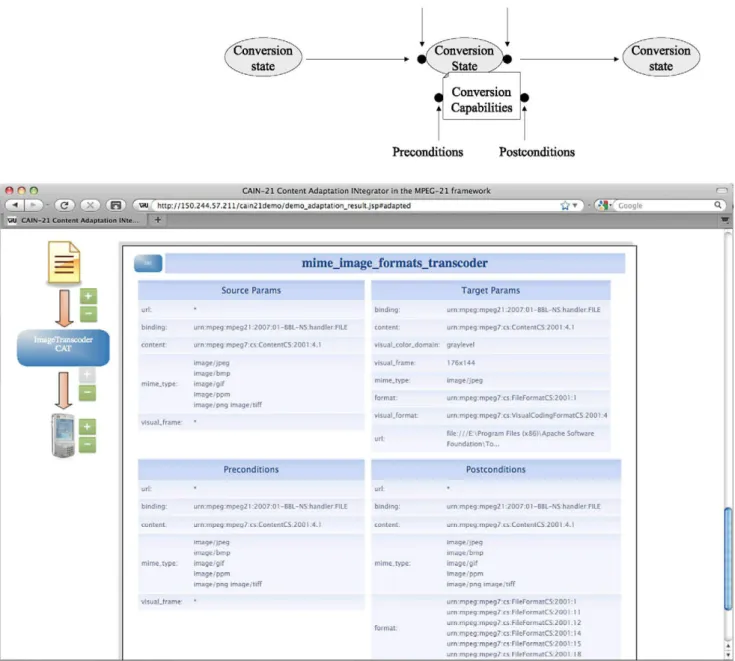
Figure 3 shows the elements that take part in a bounded non-deterministic multimedia conversion and Fig. 4 shows an example in the CAIN-21 demo. In Fig. 3, the conversion state is shown as an instance of the conversion capabilities: the source parameters are a subset of the preconditions and the target parameters are a subset of the postconditions. The source and target parameters in Fig. 3 will be selected pa-rameters at the end of the decision phase and realized para-meters at the end of the execution phase. Note that the con-version states are represented with only one object whose properties (in the case of selected conversion states) may be multi-valued.
Fig. 3 Elements of a bounded non-deterministic conversion
Source params
Target params
Preconditions Postconditions
C A I N - 2 1 Content Adaptation Integrator in the MPEC-21 framework
p»oo
( •* I - CO) ( ) ( W ) ( ™ nnp://150¿44,57,;u/cain;iaemo/den'w_iutapBlion_re5uH-jip*adipted
W I C A I N - 2 1 C o n t e n t A d a p t a t i o n INle... +
v^-<2F
i
ImageTrarificoder CAT
E
mime_image_formats_transcoder
b i n d i n g :
content:
Source Params
urn mpeg m p e g 2 1 : 2 0 0 7 : 0 1 -BBL-NS:handler FILE
urn:mp#g:mpe37:c5:ConlentCS:2001:4.1
i m a g e d peg
Image/bmp irnage/gif i m a g e ; p p m
¡ms.ge;'png ¡mage,-'tiff
visual_frame:
Preconditions
urJ:
b i n d i n g !
content: u r n !
u r n :
Tip«Lg:mpeg21:2007:01-BBL-NS:handler:FILE
Tipeg:mpe97:cs:Con1entCS:2001:4.1
i m a g e ; j peg
i m a g e ' b x n p
i m a g e / g i f imageyppm
i m a g e ; png i m a g e / t l f f
Target Params
b i n d i n g :
content:
visual_eolar_domain:
vi su al . f r a m e :
mi me . t y p e :
formar
vi su al .format:
uH:
urn:mpeg:mpeg2i:20O7:O1-EBL-NS:handler:FILE
u m : r n p e g : m p e g 7 : t 5 ;CantenlCS:2001 :4. 1
graylevel
1 7 6 x 1 4 4
image/jpeg
urn:rnpeg:mpeg7:cs:F¡leFormaiCS:20[)l:l
ufn:rnpeg:mpe^?:ts:VisualCodin9FormaiC5:20üT:4
file:///E:\Program F¡l« Ix86)\Apacbe Software FoLrrtfacion\To...
u r l :
b i n d i n g :
content:
Postconditions
( í r n . m p e g : m p e g 2 í : 2 0 0 7 : 0 1 - B B L - N S : h a n d l e r F I L E
urn:mpeg:mpeg7:cs:CantentCS:2C01:4.1
i m a g e / ; peg
¡jnage.'bjnp Image/gEf i m a g e / p p m
Image.'png image/MFF
u r n : m p e g : m p e g 7 : c 5 F i | e
ujTi:mpeg:mpeg7:r_5:File uj,n:mpeg:mpeg7:c5:Kile urn:mpeg:mpeo7:cs:File iírn:mpeg:mpeg7-c5-F-ile
m u C 5 ; 2 0 l ) l maídSiZOOl
istC&ZOOl matC5:2001 iatCS:2001
.
Fig. 4 Conversion state in the CAIN-21 demo available at cain21.sourceforge.net
during the decision phase the target parameters can be as-signed several values. In this case, the Planner is transfer-ring the decision of what value to produce to the conver-sion module. For instance, if the terminal accepts GIF and JPEG images, the target parameter would be mimejype = [image/gif, image/jpeg}.
4.4 Bounded non-deterministic conversions and planning According to their outcomes, conversions can be divided into three groups: (1) deterministic conversions, which are always bound to single-valued properties, (2) unbounded
non-deterministic conversions, where the outcome is not al-ways the same and the planner cannot select the outcome, and (3) bounded non-deterministic conversions, where the outcome can vary and the planner selects a subset of the postconditions. In this paper, multimedia conversions are modeled as bounded non-deterministic conversions where a conversion can be executed by providing a set of target para-meters. Subsequently, the execution of each conversion may produce these parameters (a subset of the set of the postcon-ditions).
planners (such as the one in [3]) is that the bounded non-deterministic planner must determine the source and target parameters settings to execute the conversions.
Finally, the bounded non-deterministic planner should not be confused with other techniques such as continuous planning [22] or planning under uncertainty [14]. These lat-ter two techniques implement unbounded non-delat-terministic planners wherein the actual outcome of an action is not known before its execution. Such situations can for example arise, when the execution of an action fails due to an unfore-seen change in the environment that has occurred since the planning phase. Therefore, this other group of techniques requires the existence of contingency decisions, that is, al-ternative decisions that are chosen depending on the out-come of executing an action (such as to repeat the action or to select an alternative action). Contingency decisions are needed in continuous planning and planning under uncer-tainty because if contingency decisions were not used, the plan would not always lead to a goal; the goal would be only reached when there was no "failure" in the sequence of actions. Moreover, these contingency decisions have the ef-fect that no linearly ordered sequence of conversions exists. Bounded non-deterministic planners, however, can build lin-ear sequence of actions that always succeed. The planner de-veloped in this paper uses conversions that—by definition— always produce one of the selected solutions. Therefore, this planner can calculate all the feasible sequences of conver-sions before the converconver-sions are executed.
4.5 Tolerating partial description
Multimedia adaptation systems such as CAIN-21 can be used in large real-world multimedia platforms, which might involve a relatively large number of multimedia properties. For the viewpoint of both the CAT implementer (i.e., the third-party that implements a pluggable CAT) and the user that needs to adapt his/her multimedia content, supplying accurate values for the entire set of properties may become tedious and error prone. For these reasons the Planner was designed to operate with partial description. Specifically, the CAT implementer is not forced to provide detailed descrip-tion of all the properties of the CAT Capabilities. Besides, the Content DI (i.e., the Component to be adapted) and Con-text DI (i.e., the UED) may arrive at the adaptation engine without all their properties values. The notion of partial de-scription relates to the notion of partial observability intro-duced in Sect. 2.3.3. When only a partial description is avail-able, the Planner assumes default meanings for the proper-ties of the conversions capabiliproper-ties. The following subsec-tions describe the mechanisms that tolerate partial descrip-tion.
4.5.1 Semantics of the properties of the conversion capabilities
We propose the following semantics for the properties of the preconditions, postconditions and invariants of the conver-sion capabilities. These semantics apply in extended form also to the corresponding properties in the conversion states: • Required preconditions. If a property appears in a
precon-dition of a conversion capability cc¡, this indicates that the conversion requires this property in the corresponding source parameter of the conversion state csi. Specifically, such a source parameter (represented as a property) must be a subset of the corresponding precondition property values.
• Produced postconditions. If a property appears in a post-condition of a conversion capability cci, this must be in-terpreted in the sense that the corresponding conversion state CSÍ produces such a property. In this case, the con-version state may create the property (represented as a tar-get parameter) if it does not exist in the source parameter, or modify it if it exists in the source parameters.
4.5.2 Incompleteness semantics
In addition to providing semantics to existing properties, in-completeness semantics have been implemented. These se-mantics define how to deal with absent or partially defined properties in the conversion capabilities and corresponding conversion states. Specifically:
• Optional properties. If a property does not appear in the preconditions of a conversion capability cc¡, this must be interpreted in the sense that every value is acceptable, in-cluding the situation where it is not provided at all. • Wildcard properties. If a property is marked with a
wild-card in the preconditions of a conversion capability cci, this configuration must be interpreted in the sense that every value is acceptable, but it must be provided. • Preserved properties. If a property appears neither in the
preconditions nor in the postconditions of a conversion capability cc¡, this situation must be interpreted in the sense that the conversion state csi preserves the value of such a property, that is, the target parameters take the property values of the corresponding source parameters without changes.
implementers to annotate all the invariant properties that the conversion module does not modify, which would become tedious for the CAT implementers. Alternatively, the algo-rithm that searches for the plan would have to systematically discard all the conversion modules that are not completely annotated.
4.5.3 Ignored properties and accumulated effects
In the incompleteness semantics there is a peculiar situation when a property appears in the preconditions of a conver-sion module, but does not appear in the postconditions or in the invariants of the conversion. In this case, it is not defined what the conversion does with this property and we say that the conversion capability ignores the property. Therefore, it is impossible to make any assumption involving the value of this property in the target parameters. The term "ignore" must not be interpreted in the sense that the execution of the conversion module necessarily "loses" the property, but in the sense that the conversion module does not provide infor-mation about what is going to happen with this property. An example of this is a conversion capability that defines the maximum frame rate that a conversion module accepts, but does not define the maximum frame rate that it can produce. This situation may arise simply because the media produced by the conversion does not have a frame rate at all (e.g., it produces an image as a summary of a video clip), or be-cause it does not specify the output frame rate (although the conversion module produces a video).
To avoid ignoring properties, we introduced the notion of accumulated effects, which refer to the set of properties that are produced or modified through a sequence of conver-sions. Given a conversion state csi, an algorithm can com-pute these accumulated effects as the union of the properties in the source and target parameters of the conversion states that appear along the path from csi to cs\. During each step of the sequence of conversions, the Planner imposes that the accumulated effects must always increase or remain, that is, the Planner does not allow the existence of conversion
capabilities that ignore properties (according to the above-mentioned ignore incompleteness semantic). In CAIN-21, the Parser currently detects this condition and reports it to the user.
5 Algorithm and theoretical analysis
5.1 The Planner algorithm
Figure 2 shows that the conversion states of a multimedia adaptation problem are instances of the MPEG-21 Compo-nent to be adapted, the existing CornersionCapabilities ele-ments and the UED tool. The Planner algorithm carries out a backwards search that finds all the sequences of sion states that are capable of adapting the initial conver-sion state (the Component) to the goal converconver-sion state (the UED). Section 4.2 proposes to represent those sequences of conversions soc¡ as a set of sequences of conversions
SSOC = {soc\, SOC2, • • •, sock}. Algorithm 1 is the top-level control structure of the Planner that computes these se-quences. It starts by extracting the properties of the goal conversion state from the UED. Subsequently, getSetOfSe-quenceOfConversionsQ (explained in Sect. 5.2) determines the sequences of conversions that lead to the goal conver-sion state. As the goal converconver-sion state is not part of the sequences of conversions that getSetOfSequenceOfConver-sionsQ produces, Algorithm 1 adds the goal conversion state to the tail of each sequence.
Every sequence of conversion states must have at least two conversion states: the initial conversion state and goal conversion state. Thus, if the Component to be adapted (the initial conversion state) fulfils the UED constraints (the goal conversion state) without further changes, the corresponding sequence of conversion states would only include these con-version states. Conversely, if there is no sequence of conver-sions that can adapt the Component to the UED, Algorithm 1
would return an empty SSOC. In this case, CAIN-21 reports this circumstance to the user using plain English explana-tion messages (e.g., "There is no sequence of CATs capable
Algorithm 1 Main structure of the Planner algorithm
Inputs: problem // The Component to be adapted, the CAT Capabilities and the UED Outputs: SSOC // Set of sequences of conversions that the Planner has found. Vars: goal_cs // A conversion state with the properties of the UED
empty_soc // Starts backwards search with an empty sequence of conversion states SSOC planner(problem)
goal_cs = problem.getUEDConversionStateO;
SSOC = getSetOfSequenceOfConversions(problem,goal_cs,[]); for (each soc in SSOC)
Algorithm 2 Set of sequences of conversions
Inputs: problem // The Component to be adapted, the CAT Capabilities and the UED subgoal // The goal or subgoal in each recursive step
visited_conversion_states // List of conversion state objects that have already been evaluated Outputs: SSOC // Set of sequences of conversions that the Planner has found.
Vars: prospective // The set of conversion states (instance of either a ConversionCapabilities element or // the Component element) that matches with the current subgoal
feasible // Subset of prospective conversion states that Algorithm 4 has selected sub_ssoc // The SSOC that reach the current subgoal
SSOC getSetOfSequencesOfConversions(problem, subgoal, visited_conversion_states) prospective = getProspectiveConversionStates(problem, subgoal);
feasible = {};
for (each cs in prospective)
if (isFeasibleConversion(cs, subgoal, visited_conversion_states)) feasible.add(cs);
SSOC= {};
for (each cs in feasible) if (cs isa Component)
soc = {cs}; SSOC.add(soc); else
visited_conversion_states.add(cs);
sub_ssoc = getSetOfSequencesOfConversions(problem, cs, visited_conversion_states); visited_conversion_states.remove(cs);
for (SequenceOfConversions soc : sub_ssoc) soc.addTailStep(cs);
SSOC.add(soc); return SSOC;
of converting DivX files to MPEG-4"). This message helps the adaptation engine administrator to configure the CATs installed in the adaptation engine.
5.2 Computing the set of sequences of conversions
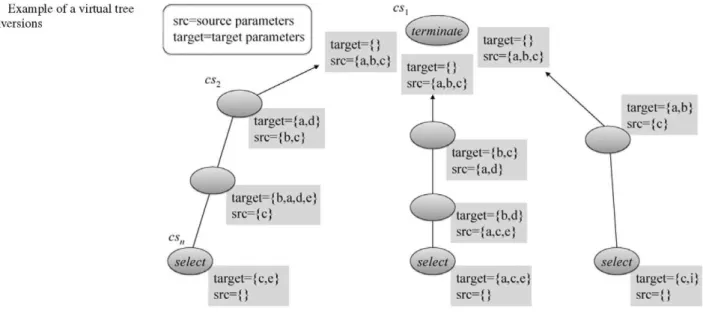
Algorithm 2, which gives details of the getSetOfSequenceof-ConversionsQ function, is a recursive process that produces a virtual tree of conversions (introduced in Sect. 4.2). An ex-ample of this virtual tree of conversions is given in Fig. 5.
This example shows the changes in the source and target parameters of the virtual tree of conversions' nodes. Thus, what Algorithm 2 produces is a set of sequences of conver-sions SSOC = {soc\,soc2, • • •, sock} that corresponds to the different paths.
The algorithm receives in the subgoal parameter either the goal conversion state (i.e., instance of the UED) or any subgoal conversion state (i.e., instance of either a Conver-sionCapabilities element or the Component element) in the virtual tree of conversions. In order to prune the search, the algorithm also receives a list of visited conversion states. Al-gorithm 2 has two parts:
(1) The first loop determines which conversion states can precede the current goal conversion state. The term prospective conversion states refers to the conversion states (instances of the conversion capabilities avail-able in the system) that match (according to Algo-rithm 6 explained in Sect. 5.5) the current goal conver-sion state. The term feasible converconver-sion states refers to those prospective conversion states that contribute to the adaptation. They are explained in Sect. 5.3.
(2) The second loop recursively composes the set of se-quences of conversions that go from each feasible con-version to the current goal. The visited concon-version states are also used to avoid infinite loops through the same group of states.
5.3 Prospective and feasible conversion states
The prospective conversion states are obtained from both the Component to be adapted and the ConversionCapabilities of the CATs currently installed in the system. In Algorithm 3,
Fig. 5 Example of a virtual tree
of conversions sre=souree parameters
target=target parameters
targct={a.d} src={b,c}
target={} src={a,b.c}
targct={}
src={a,b,c}
target={} src={a.b.c
Q
target=ib.a,d,e} src={c}
target={c,e} src={}
targel={b.e[ src={a,di
target={b,dj src={a,c,e}
target={a,c,e} src={¡
target={a,b} sre={e[
target={c.i} src={}
Algorithm 3 Prospective conversion states
Inputs: problem // The Component to be adapted, the CAT Capabilities and the UED subgoal // The goal of subgoal in each recursive step
Outpus: cs_set // Set of prospective conversion states.
Vars: child_cs // Conversion state that matches with the current goal conversion state SSOC getProspectiveConversionStates(problem, subgoal)
cs_set = {};
child_cs = match(subgoal, problem.getComponentConversionCapsO); if (child_cs T¿ null)
cs_set.add(child_cs);
for (each cc in problem.getCATsConversionCaps()) child_cs = match(subgoal, cc);
if (child_cs T¿ null) cs_set.add(child_cs); return cs set;
state. The second part of Algorithm 3 obtains the set of con-version capabilities that match the current goal.
The set of feasible conversion states is a subset of the prospective conversion states that contribute to the adapta-tion. Algorithm 4 shows the three conditions that make a prospective conversion state become a feasible conversion state. (1) It must not be previously visited, (2) it must con-tribute to the progress of the adaptation (according to Algo-rithm 5), and (3) the initial conversion states must not have unsatisfied preconditions. Unsatisfied preconditions mean that properties exist which have not been adapted through the sequence of conversions according to the constraints of the UED.
5.4 Obtaining the conversion states that contribute to the adaptation process
In each step within the backwards search process through the virtual tree of sequences of conversions of Fig. 5, the
Planner must determine which conversion states contribute to the adaptation process. The criterion to determine their contribution is as follows:
• If the intersection between the property list of the target parameters of the CSÍ+I conversion state and the property list of the target parameters of the csi goal conversion state is a set with one or more empty property values, then this configuration means that CSÍ+I contributes (with the empty properties in the intersection) to the progress of the adaptation. In this case, the CSÍ+I conversion state is maintained.
Algorithm 4 Feasible conversion states
Inputs: cs // Prospective conversion state to be determine as feasible conversion state subgoal // The goal of subgoal in each recursive step
visited_conversion_states // List of conversion state objects that have already been evaluated Outputs: Returns whether the prospective conversion state is feasible or not
boolean isFeasibleConversion (cs, subgoal, visited_conversion_states) if (visited(cs, visited_conversion_states))
return false;
if (!contribute(cs, subgoal)) return false;
if (cs isa Component AND NOT cs.hasUnsatisfledPreconditions()) return false;
return true;
Algorithm 5 Conversion states that contribute to the adaptation
Inputs: cs // Prospective conversion state. The algorithm determines whether it contributes to the adaptation subgoal // The goal of subgoal in each recursive step
Outputs: Whether the cs conversion state contributes to the adaptation (that produces the subgoal conversion state) or not boolean contribute(cs, subgoal)
intersected_props_values = cs.getTargetParams() n subgoal.getTargetParams(); for (each p intersected_props_values)
if (p.isEmptyO) return true; return false;
an empty set. This means that mpeg-4 visual format can be adapted by adding CJ¡+I to the virtual tree of conversions. Note that this discarding condition never occurs when the csi conversion state is the goal conversion state. This happens because getUEDConversionStateQ always returns a conver-sion state with an empty set of target parameters and in this case the source parameters corresponds to the properties of the UED (see Fig. 5).
Algorithm 5 starts by determining the intersection be-tween the target parameters of csi and csi+\. Subsequently, a property with empty values denotes the existence of states that cannot be reached without csi+\. This means that CSÍ+I
contributes to the adaptation. 5.5 The matching process
Classical planning algorithms represent changes in the state of the system with a state transition function (introduced in Sect. 2.3.1). Figure 6(a) shows the elements involved in the state transition function. The state transition func-tion si+\ = y (SÍ , a;) evaluates the precondifunc-tions of an acfunc-tion ai e A and determines if the action can be applied to the in-put state SÍ e S and the outin-put state J¡+I e S. Accordingly, classical planning algorithms are restrained by three rules: • States are fully observable. The system has complete
knowledge of the world, and therefore it observes the
out-comes in a single state, i.e., the current unique state of the system.
• Actions are deterministic. Actions have single-valued states, i.e., if applicable during the s¡ state, each action a¡ leads to a single new state si+i, so that \y(si, a¡)\ < 1. • Actions are always unbounded, i.e., they have no source
and target parameters. As the result of executing an action is always the same and it makes no sense to use parame-ters to select these single-values properties.
This research proposes that relaxing these traditional as-sumptions allows modeling and solving a wider range of problems. Thus, our proposal for a bounded non-determi-nistic planner replaces the state transition function y (s¡, a¡) with a matching process y(csi, cc¡+i). Figure 6(b) shows the elements of the matching process. The matching process is a function that receives as input the ¿-th conversion state CSÍ together with the (i + l)-th conversion capabilities cc¡+i and produces as output the (i + l)-th conversion state cs¡+i. In other words, the matching process identifies the csi+\ conversion state whose target parameters are acceptable by the CSÍ conversion state. In this case, the conversion capa-bilities cci+i matches with the conversion state CÍ¡. The ra-tionale behind this change is further developed in Sect. 7.1.
9
(execution phase) (decision phase)•
Preconditions Postconditions
(a) State transition function
(execution phase)
Source
(decision phase)
Target Source params params
(b) Matching process
C5¡
Target params
Fig. 6 Elements of the state transition function and of the matching process
the decision phase progresses from the target to the source, whereas the execution phase progresses from the source to the target. In this work, indices are always assigned to the states according to the order in which the decision phase evolves.
The state transition function used in classical planning al-gorithms creates an explicit intertwined sequence of states and actions as shown in Fig. 6(a). On the other hand, as Fig. 6(b) shows, the implied state of the Component that is being adapted can be removed from the sequence of sion states without losing information because the conver-sion state impliedly represent the state of such a Component through its source and target parameters. Speciflcally, the source parameters represent the Component before execut-ing the conversion module and the target parameters repre-sent the Component after executing the conversion module. In Sect. 4.3.3 the source and target parameters of a conver-sion state csi+i have been defined as a subset of, respec-tively, the preconditions and postconditions of its conver-sion capabilities cc¡+i. Therefore, the new converconver-sion state object csi+i would include its corresponding conversion ca-pabilities cci+i (represented as preconditions and postcon-ditions) together with the source and target parameters that the matching process has selected for the conversion state. The details of the matching process algorithm are given in Algorithm 6.
5.6 Analysis of the Planner algorithm
As the algorithm progresses from the goal conversion state to the initial conversion state, the source parameters are re-moved and the target parameters are added. Therefore, at the end of Algorithm 1 the goal conversion state must only con-tain source parameters. Likewise, the initial conversion state must only contain target parameters (see Fig. 5). That being said, note that:
(1) The number of properties in the goal conversion state is always the same, regardless of the sequence of con-versions that reaches the goal conversion state, i.e., in Fig. 5 all the sequences must lead to the same set of source parameters ({a, b, c} in this example). However, since the properties of the goal conversion state could be multi-valued, the values of the properties that each sequence of conversions produces may vary. This repre-sentation is consistent with the capability of the UED to accept alternative properties. For instance, suppose that in Fig. 5 the goal state accepts a = {mpeg-2, mpeg-4}, what means that the a property must be produced by every sequence of conversions. However some of these conversions might produce a = {mpeg-2}, other se-quences might produce a = {mpeg-4}, and even an-other group of conversions might produce both a = {mpeg-2, mpeg-4}.
(2) It is not guaranteed either that the source parameters will be monotonically removed, or that the target para-meters will be monotonically added. However, the ac-cumulated effects characteristic introduced in Sect. 4.5.3
guarantees that the accumulated effects (the union of the source and target parameters) of the CSÍ+I conversion
state are a superset of the source parameters of the csi conversion state. For instance, in Fig. 5, the goal con-version state has the source parameters src = {a, b, c} and the CS2 conversion state has the accumulated effects src = {a, d} U target = {b, c} = {a, b, c, d], which is a superset of the source parameters of the goal conversion state. The next section will make use of the accumu-lated effects to prove that the Planner algorithm always terminates.
5.7 Soundness and completeness
This subsection develops three theorems that prove that the Planner algorithm given in Algorithm 1 is sound (always terminates). In addition, this subsection proves that the plan is finite (always terminates) and complete (contains all the available solutions).
Theorem 1 Algorithm 1 is sound (always terminates).
Proof Given any goal conversion state csi, representing ei-ther the UED (cs\) or any subgoal conversion state, it can be derived that: