Optical Nonlinearities at the Interface
between Glass and Liquid Crystal
1P E D R O M E N E N D E Z - V A L D E S a n d J O S E A. M A R T I N - P E R E D A
Universidad Politecnica de Madrid, Escuela Tecnica Superior de Ingenieros de Teiecomunicacion, 28040 Madrid, Spain
(.Received August 8, 1986; in final form February 27, 1987)
In this paper, the optical behavior of a nonlinear interface is studied. The nonlinear medium has been a nematic liquid crystal, namely MBBA, and the nonlinear one, glasses of different types (F-10 and F-2) depending on the experimental needs. The anchoring forces at the boundary have been found to inhibit the action of the evanescent field in the case of total internal reflection. Most of observed nonlinearities are due to thermal effects. As a consequence, liquid crystals do not seem to be good candidates for total internal reflection optical bistability.
Keywords: nematic, nonlinear optics, bistability, interface, total internal reflection
I. INTRODUCTION
The optical behavior of the interface between a linear and a nonlinear material constitutes a very interesting subject in the field of nonlinear optics. Its fundamental applications are Optical Bistability (OB) and
Nonlinear Optical Waveguides.1 - 6 The optical bistable behavior of
nonlinear interfaces was studied by Kaplan in early works.7 Smith et
al.8 developed interesting experimental work to nonlinear interfaces
with different nonlinear materials in the search for OB. Some time ago, nematic liquid crystals have been introduced as nonlinear
ma-terial for such interfaces. The first studies by Khoo9 have shown a
switching action mainly due to a thermal effect. Some other studies have been carried out using non-aligned nematic liquid crystals, in
single interfaces by us,1 0 and in optical waveguides by other
au-thors.1 1'1 2 In the case of optical bistability, the aim of the
experi-mentation is, in most cases, to obtain a switch from Total Internal Reflection (TIR) to transmission. This switching has been shown by Kaplan to present a bistable hysteresis.
In nematic liquid crystals, nonlinearities are due to two different phenomena: optically induced molecular reorientation, and laser heating
giving rise to thermal indexing.1 3 , 1 4 Let us associate the nonlinearity
with the sign of the third order term in the susceptibility. Then, the molecular reorientation induces a "positive" nonlinearity both in ne-matic and isotropic phases. The laser heating induces a "negative" but very weak nonlinearity in the isotropic phase of a nematic com-pound (IP), while a positive one on the ordinary index of the nematic phase (NP). Therefore, laser heating could mask a possible
reorien-tation effect in the nematic phase at the interface9 , 1 5 or oppose it in
isotropic phase.
The aim of the experiments described in this paper is to establish the role of each one of the above effects. The possibility for re-orientation to be induced by the evanescent field in spite of the strong anchoring forces, has been investigated. The behavior of a nonlinear interface between glass and isotropic MBBA is also described. It is
known1 4 that IPs of nematics are nonlinear liquids of the Kerr type.
Therefore, they are suitable to the situation described in Kaplan's works. In both situations, a predominance of the thermal effects has been observed. The anchoring forces have been found to inhibit the molecular reorientation near the boundary, not only in nematic, but also in isotropic phase.
II. GLASS-NEMATIC INTERFACE UNDER TOTAL INTERNAL REFLECTION
D I R E C T O R O R I E N T A T I O N A T T H E S U R F A C E S
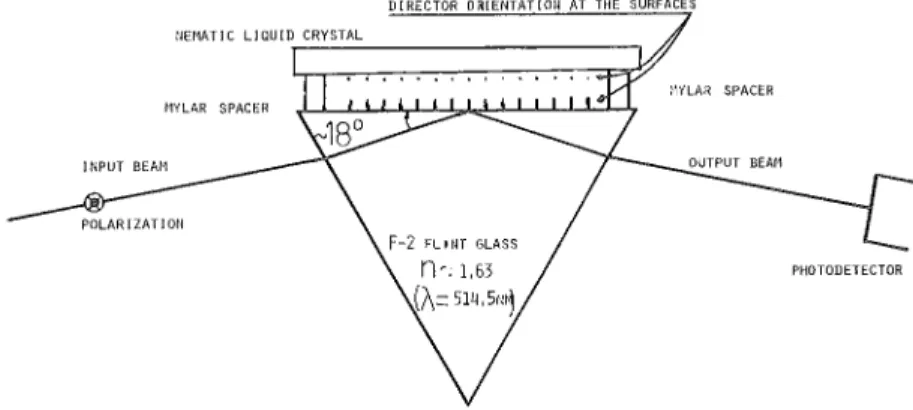
FIGURE 1 Experimental set-up.
Internal Reflection (FTIR). This switching has not been proved yet to display a hysteresis, and this is one of the unknowns of the present study.
In the previous work by Khoo,9 the experimental setup consisted
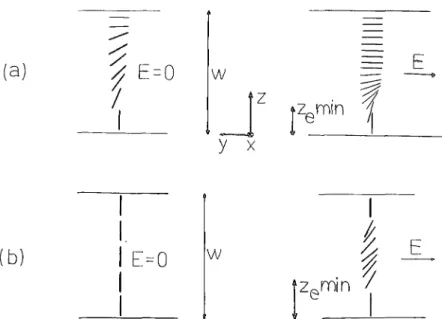
of a homeotropically oriented nematic between two prisms. The extra prism had a high refractive index in order to collect the transmitted beam. Here, a homogeneous alignment has been used at the other boundary of the nematic film as indicated in Figure 1. The hybrid alignment provides an initial bend distortion which avoids the
thresh-old effect when the field is normal to the director1 6. As can be seen
from Figure 2, this bend also reduces the minimum depth necessary for the evanescent field to induce reorientation. Moreover, the an-choring of the boundary molecules causes the ordinary refractive index to control the optical properties (and hence the TIR condition to be met) at both boundaries of the nematic film if the homeotropic alignment (Figure 2b) is used. A double FTIR should be necessary in order to obtain a transmitted wave.
The main problem in these experiments is to see if the evanescent field can reorientate the molecules at some distance from the bound-ary. In order to illustrate this problem, let us make some calculations on the field intensity and penetration depth of the evanescent field. The Fresnel formula for TE polarization takes a complex value for the TIR case. Its module yields the following amplitude of the eva-nescent field at the boundary (z = 0):
Ee = 2 sin cp/sin <pc Ei (1)
y x
(b)
E=0
wzemin
I
E
FIGURE 2 Orientation of the molecules at the nematic film without any field and with an ideal constant electric field: (a) hybrid aligned configuration; (b) homeotropic configuration.
nt and nh the refractive indices of the "transmission" and incidence
media, <p is defined as the angle between interface and wave normal.
Near the critical angle <pc,
9 cpc — A<p, where Acp < < 1
and (1) becomes
Ec « 2(1 - Acp/tan cpc)£;
The penetration depth defined in the usual way1 7 is
\n/ 2 i mt
(2 Acp tan cpc) 1/2
(2)
(3)
In our case, the transmission medium is MBBA (nt = n0 = 1,544)
and the incidence medium an F-2 prism («j = 1.627 at \ = 514.5 nm). Hence, the values for critical angle and penetration depth are
cpc - 18.38°
and
Ee » 2Z?i(l - 3Acp)
The penetration depth is found to be about one wavelength (ze =
X0) when Acp ~ 3°. In these conditions Ee(<f>) ~ 0.85 Ee{<$c) being
^e('Pc) = 22?,. Therefore, the penetration depth of the evanescent
field is a more critical parameter than its amplitude at the boundary. A small misalignment of the incidence angle can reduce the pene-tration depth to a few wavelengths.
The problem gets more complicated when the incident field is not a plane wave, but a Gaussian beam. In this case light impinges on the interface with different angles at the same time, and some of them can be quite far away from the critical one, especially if one wants the whole beam to be totally reflected. The energy impinging under those angles do not contribute substantially to the evanescent field. Several authors developed numerical solutions in order to
an-alyze such transversal inhomogeneity.1 8 Even though they obtain
con-tradictory results, they agree in the absence of OB. This fact seems
to be confirmed by some experimental work.8
III. EXPERIMENTAL RESULTS FOR THE GLASS-NEMATIC INTERFACE
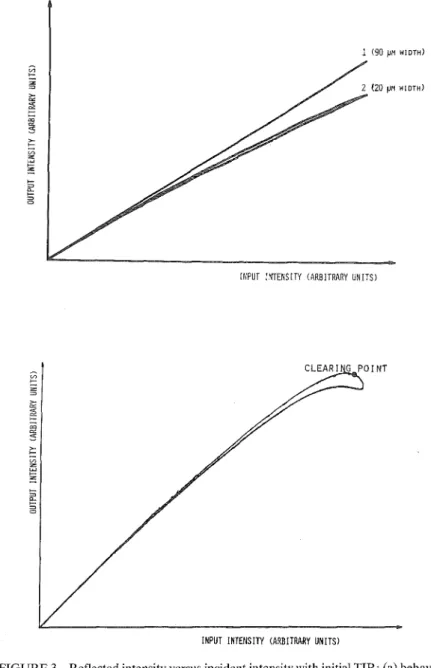
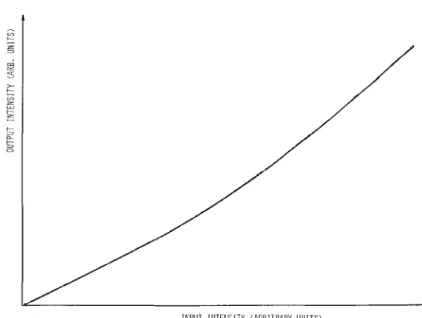
Several MBBA film thicknesses have been used with the configuration of Figure 1. Figure 3a shows reflected intensity versus incident in-tensity for two cell thicknesses, 90 |xm and 20 |xm. Thinner films display a higher nonlinearity for low intensities. The absence of switching points suggests that hysteresis and nonlinearity are mainly due to thermal effects. The stronger effect in thinner films can be due to the smaller volume of MBBA to be heated. There is also some absorption (and hence heat generation) in the prism; otherwise it would behave as a heat sink. In fact, very high laser powers can induce the damage to the glass. However, repetitive experimentation is very difficult
because of the small lifetime of thin hybrid aligned cells.1 9 This time
INPUT INTENSITY (ARBITRARY UNITS)
INPUT INTENSITY (ARBITRARY UNITS)
critical angle was 18.4°, and the temperature was 25°C. The scanning times for the results shown in Figure 3 were between 2 and 5 minutes. A more careful study shows that only points in the lower branch are stable. When thermal equilibrium is established this branch is reached.
When the incidence angle increases and a transmitted wave arises, the typical diffraction pattern produced by reoriented nematics ap-pears in the transmitted wave. However, the reflected wave is not affected by reorientation and its behavior is dominated by the thermal effect. This fact shows that the reorientation is not produced at the interface, but near the central part of the film. This is consistent with the assumption of strong anchoring.
The setup geometry was modified in order to definitely elucidate if there is an interaction between the evanescent field and the re-orientable region. This interaction may have not been detected in the previous experiments due to the masking of the thermal effect. The beam impinging on the interface was substituted by a low sity He-Ne laser (5 mW). An external normally incident high
inten-sity A r+ laser beam was focused on the MBBA film through the glass
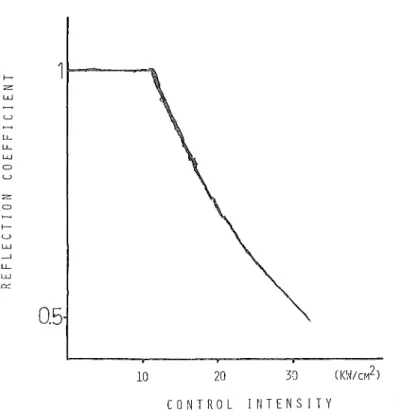
plate opposite to the prism. In this way, the behavior of the low intensity laser, induced by the changes produced in the nonlinear medium can be tested. When both beam polarizations are parallel, the result is a sort of "reflection coefficient-versus-transmitted inten-sity" plot which can illuminate the preceding results. Figure 4 shows the result when a 110 (xm homeotropic MBBA film is used. The clearing point is reached and hysteresis effects arise for incidence
intensities of about 37 kW/cm2. This is due to a misalignment of the
CONTROL I N T E N S I T Y
FIGURE 4 Behavior of the reflected beam as a function of the control beam intensity. The transmission medium is an homeotropic film of MBBA, and we are at TIR when control intensity is low.
IV. EXPERIMENTAL RESULTS FOR THE GLASS-ISOTROPIC MBBA INTERFACE
Thermal variations of refractive indices in NP are strong, especially
near the nematic-isotropic transition.2 0 On the other hand the
var-iation in IP is very smooth. It should be expected that the isotropic MBBA would behave as a Kerr liquid with a negligible thermal de-pendence, and therefore, suitable for experimentation in nonlinear interfaces. In order to reach TIR, an SF-10 prism (n ~ 1.74 at 514.5 nm) has been used as incidence medium, for refractive index of MBBA is about 1.64. The observed behavior has been linear: the system remains under TIR even for intensities high enough to produce laser damage in the glass.
INPUT INTENSITY (ARBITRARY UNITS)
FIGURE 5 Reflected intensity versus incident intensity when incidence angle allows transmission. The incidence medium is an SF-10 prism, and the transmission one is MBBA in isotropic phase.
Gaussian shape, while the transmitted one shows a diffraction pattern due to transversal inhomogeneities in the refractive index. Figure 5 suggests that high intensities enhance the reflection and therefore, the refractive index of the nonlinear medium decreases.
The alternative setup (low power reflected beam and high power external control beam) was used to obtain a more complete infor-mation. Experiments show that when the red beam is under TIR, the reflection is not affected by the control beam. When the trans-mitted beam through the (40 |xm thick) nonlinear medium is present, the reflected intensity behaves as shown in Figure 6. An increase of the reflectivity is produced by the external high intensity beam con-firming the negative nonlinearity suggested in Figure 5. This effect can also be proved by observing the transmitted red beam through
a filter which absorbs the A r+ scattered light. As the control beam
intensity increases, the transmitted low power beam becomes more and more grazing until TIR is met and it disappears.
10 2 0 30 ( K W / c h2)
C O N T R O L I N T E N S I T Y
FIGURE 6 Behavior of the reflected beam as a function of the control beam intensity. The transmission medium is a film of MBBA in isotropic phase and the incidence angle allows an initial transmission with low control intensities.
an ordinary one (in any other of its orthogonal orientations). Their
value should be 1 4 , 2 1
ye = x + 2/3 Axn Q
(4)
X o = x - 1/3 AX o Q
where Q is the order parameter, proportional to \E\2.
Our experiments, on the contrary, indicate that,
Xe ~ Xo ~ x(T) (5) where the temperature dependence has been included to explain the
observed negative nonlinearity. As it has been indicated above, the refractive index in IP smoothly decreases with temperature.
The observed behavior shows that the term containing the molec-ular order parameter Q is negligible. This can be justified through two different arguments.
The first of them comes from the relation between this parameter
and the temperature1 4:
Q « |£0|2/(T - T*) (6)
observable variation of the refractive index should have to be pro-duced by a high temperature increase. But when the temperature is very high, the order parameter vanishes.
The second argument might be the difficulty in reorienting the molecules which are in contact with the surface. This means that there exist anchoring forces in the surfaces. This assumption is sup-ported in the formation of a high aperture, annular-shaped diffraction pattern both in the transmitted and the control beams, but never in the reflected one. Thus, it can be concluded that a sharp transversal inhomogeneity of the refractive index is produced in the nonlinear-medium, but away from the boundary. Such inhomogeneity cannot be due to a thermal effect, because, in case of heat transmission the transversal variations of temperature should be smooth. In fact, ther-mal self-defocusing never produces such diffraction patterns, but a
smooth broadening of the beam.5 In conclusion, a Kerr effect is
present in the bulk whereas a thermal effect is dominant near the interface, showing a negative nonlinearity. Negative nonlinearities
also play an important role in bistability at nonlinear interfaces,2 2 but
they are not so useful when coming from a thermal heating. In this case, the incidence medium can heat the nonlinear one and modify its refractive index, even when no optical field is present in it.
V. CONCLUSIONS
wavelengths. Therefore, a laser induced glass heating can be ex-pected, and this can produce a temperature rise in the nematic near the boundary, which is not directly produced by the presence of an optical field within it.
Summarizing, it seems that nematic liquid crystals are not suitable materials to be used in the study of optical nonlinear interfaces if control of the refractive index with the transmitted field is attempted.
Acknowledgment
This work has been supported by the Spanish Comision Asesora de Investigation
Cientifica y Tecnica, grant No. 1564/82.
References
1. Optical Bistability, eds. C. M. Bowden, M. Ciftan and H. R. Robl (Plenum N.Y. 1981).
2. Optical Bistability 2, eds. C. M. Bowden,H. M. Gibbs, andS. L. McCall, (Plenum, N.Y. 1984).
3. Optical Bistability III, eds. by H. M. Gibbs, P. Mandel, N. Peyghambarian, and S. D. Smith (Springer-Verlag, Berlin, 1986).
4. H. M. Gibbs, Optical Bistability: Controlling Light with Light (Academic Press, Orlando, 1985).
5. Y. R. Shen, The Principles of Nonlinear Optics (Wiley & Sons, New York 1984). 6. F. A. Hopf and G. I. Stegeman, Applied Classical Electrodynamics, Volume 2:
Nonlinear Optics (Wiley & Sons, New York 1986).
7. A. E. Kaplan, JETP, 24, 114-119 (1976); Sov. Phys. JETP, 45, 896-905 (1977). 8. P. W. Smith, J. P. Hermann, W. J. Tomlinson, and P. J. Maloney, Appl. Phys. Lett. 35, 846-848, (1979); P. W. Smith, W. J. Tomlinson, P. J. Maloney and J. P. Herman, IEEE J. Quant. Electron. QE-17, 340-348, (1981); P. W. Smith and W. J. Tomlinson, IEEE J. Quant. Electron. QE-20, 30-36 (1984).
9. I. C. Khoo, Appl. Phys. Lett. 40, 645-647 (1982).
10. J. A. Martin Pereda, XIII International Quantum Electronics Conference, IQEC '84, WII13, Anaheim (CA), June 18-21, 1984; SPIE 492, 370 (1984).
11. H. Vach, C. T. Seaton, G. I. Stegeman, and I. C. Khoo, Opt. Lett. 9, 238-240 (1984).
12. E. S. Goldburt and P. St. J. Russell, Appl. Phys. Lett. 46, 338-340 (1985). 13. Y. R. Shen, Phil. Trans. R. Soc. Lond. A 313, 327-332 (1984); see also, Ref. 3,
pp. 148-151.
14. I. C. Khoo and Y. R. Shen, Opt. Eng. 24, 579-585 (1985). 15. I. C. Khoo and J. Y. Hou, J. Opt. Soc. Am. B2, 761-766 (1985). 16. G. Barbero, F. Simoni, and P. Aiello, J. Appl. Phys. 55, 304-311 (1984). 17. See, for example, K. Shimoda, "Introduction to Laser Physics," (Springer-Verlag,
Berlin) p. 43 (1984).
18. D. Marcuse, Appl. Opt. 19, 3130-3139 (1980); W. J. Tomlinson, J. P. Gordon, P. W. Smith, and A. E. Kaplan, Appl. Opt. 21, 2041-2051 (1981).
19. J. F. Palierne, N. V. Madhusudana, G. Barbero, and G. Durand, 10th Interna-tional Liquid Crystal Conference, York (U.K.), 15-21 July, 1984.
20. I. C. Khoo andR. Normandin, IEEE. J. Quant. Electron., QE-21,329-335 (1985). 21. G. K. L. Wong and Y. R. Shen, Phys. Rev. A10, 1277-1284 (1974).