Amongst evidence based treatments for depression in older adults (see review by Scogin, Welsh, Hanson, Stump, & Coates, 2005), the use of life review is gaining popularity, because this type of intervention may pertain to older adults in particular. Meta-analyses have shown that life review has signifi cant and substantial effects on both depression and psychological well-being (Bohlmeijer, Smit, & Cuijpers, 2003; Bohlmeijer, Roemer, Cuijpers, & Smit, 2007).
Our life review intervention is based on research about autobiographical memory. Autobiographical memories are memories of personally experienced events. Depressed adults have been shown to have diffi culty retrieving specifi c autobiographical memories in comparison with non-depressed controls (for reviews, see Healy & Williams, 1999; Williams, 1996, 2004). Specifi c memories include suffi cient detail to identify one particular incident (e.g., ‘the day I got married’). Depressed adults tend to retrieve more overgeneral memories than controls (Goddard, Dritschel, & Burton, 1996). Overgeneral memories may be either categorical (summaries of repeated events, e.g. ‘arguing with friends’) or extended (events that take place over extended periods, e.g. ‘when
I lived in Madrid’). Depressed patients retrieve more categorical but not more extended memories than controls (Williams, 1996).
This phenomenon has important clinical implications. The greater the extent to which people show reduced specifi city, the slower their recovery (e.g., Brittlebank, Scott, Williams, & Ferrier, 1993; Hermans et al., in press; Peeters, Wessel, Merckelbach, & Boon-Vermeeren, 2002; Raes, Hermans, Williams, Beyers et al., 2006). Moreover, when patients do recover, unless memory specifi city was targeted by the therapy, it does not improve (Brittlebank et al., 1993; Raes, Hermans, Williams, Beyers et al., 2006). Williams notes that specifi c autobiographical memory retrieval is frequently required in psychological therapies (e.g. when challenging unhelpful cognitions).
Only two studies have explored to what extent overgeneral memory retrieval can be modifi ed using a directly targeted intervention. Serrano et al., (2004) offered life review therapy to 20 older adults (aged 65-93) with clinically signifi cant depressive symptoms and no dementia; participants were randomly assigned to treatment or to no treatment. The life review treatment consisted of autobiographical retrieval practice. Relative to a control group (n= 23), at post-test two weeks after the last intervention session, participants who received the treatment increased in generating specific memories and showed decreased depression and hopelessness and increased life satisfaction.
Raes, Williams and Hermans (2009) carried out a group-based intervention program to increase specifi city of memory retrieval. Participants were inpatients, most of whom fulfi lled DSM-IV Fecha recepción: 23-9-10 • Fecha aceptación: 12-10-11
Correspondencia: Juan Pedro Serrano Selva Facultad de Medicina
Universidad de Castilla-La Mancha 02006 Albacete (Spain)
e-mail: [email protected]
Life review therapy using autobiographical retrieval practice for older
adults with clinical depression
Juan Pedro Serrano Selva
1, José Miguel Latorre Postigo
2, Laura Ros Segura
2, Beatriz Navarro Bravo
2,
María José Aguilar Córcoles
2, Marta Nieto López
2, Jorge Javier Ricarte Trives
2and Margaret Gatz
31 Universidad de Castilla-La Mancha, 2 Universidad Complutense de Madrid and 3 University of Shoutern California (Los Angeles)
The aim of this experiment was to examine the effi cacy of life review based on autobiographical retrieval practice for treating depression in older adults. Thirty-seven clinically depressed older adults aged 64-83, who were also receiving pharmacological treatment, were randomly assigned to life review therapy or to a placebo condition with supportive therapy. Results indicated decreased depression for both conditions, with no signifi cant differences between the two therapies. There was some indication of greater gain in production of specifi c memories among those in life review therapy. Patients who produced higher numbers of specifi c memories decreased their depression scores at a faster rate.
criteria for major depression. Following four one-hour weekly sessions including exercises using negative and positive cues, participants’ retrieval style became signifi cantly more specifi c.
Based on theory and research about the effects of depression on autobiographical memory, we conducted a randomized trial to test the effects of life review therapy in older adults with major depression. We have previously found that life review therapy led to improvement on depressive symptoms among those randomly assigned to treatment compared to those randomized to no treatment (Serrano, Latorre, Gatz, & Montañés, 2004). In the present study, we compare life review therapy to a supportive intervention, extending the prior work in three ways: all participants met criteria for major depression; a placebo control group equated for contact; and two follow-up assessments were added. Also in comparison with the prior study, all participants were receiving pharmacological treatment for depression at the health care centre where the study took place.
The aim and the approach that we took to life review were to provide practice for participants in producing specifi c autobiographical memories. We predicted that older adults who received autobiographical retrieval practice would improve their mood state, as refl ected in decreased symptoms, decreased hopelessness, and increased life satisfaction.
Method
Participants and design
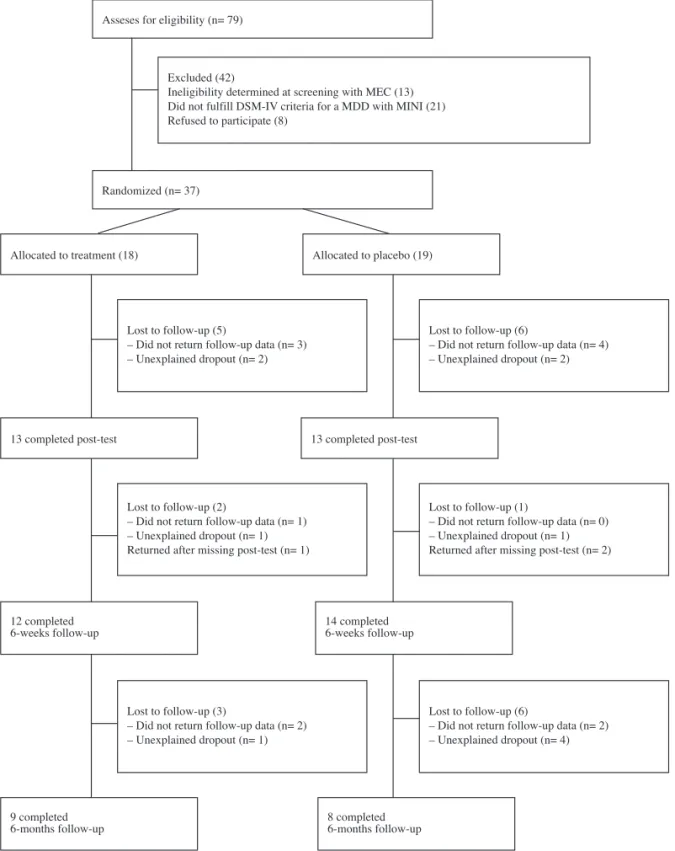
Seventy-nine older adults were recruited to participate in a study to receive therapy; participants were derived from a database of outpatients who received treatment for depression at six health care centres (Albacete). Criteria for inclusion in the study were as follows: major depression as determined by Mini International Neuropsychiatric Interview (MINI; Bobes, 1998); more than 65 years old; no evidence of dementia (as determined by a score of 24 or higher on the Mini-Mental State Examination [Miniexamen cognoscitivo, MEC; Lobo, Ezquerra, Gómez Burgada, Sala, & Seva-Díaz, 1979]); receiving pharmacological treatment for depression; not currently receiving psychotherapy. After verbal consent was given, two psychologist assistants screened all volunteers. Within this group, 34 did not fulfi l one of the inclusion criteria and 8 refused to participate in the study. The remaining 37 participants were randomly assigned to life review therapy (n= 18) or to the placebo control group (n= 19). Figure 1 shows the number who provided data at each time of measurement and reasons for drop out. When those who completed all times of measurement were compared to those who dropped out, the dropouts were signifi cantly older (by an average of 3.7 years) compared to completers, t(35)= -2.04, p= .049. There were no other signifi cant differences between dropouts and completers.
The fi nal sample included 37 older adults ranging in age from 64 to 83 years (M= 73.9 years); 31 were women and 6 were men. The educational levels were unable to read and write (13.5%), able to read and write (56.8%), completed elementary school (24.3%), completed secondary school (5.4%). The treatment and placebo groups did not differ signifi cantly on any demographic variable or on their mental status scores. The placebo group was more depressed at pretest than the treatment group, on both number of symptoms reported on the MINI and Geriatric Depression Scale scores, t(35)= 2.46, p<.05, t(35)= 2.63, p<.05, respectively. The two groups did not differ at pretest on any other outcome measure.
Instruments
MINI (Mini International Neuropsychiatric Interview). The Mini-International Neuropsychiatric Interview (MINI) is a brief structured diagnostic interview for DSM-IV and ICD-10 psychiatric disorders. The M.I.N.I. was designed as a brief structured interview for the major Axis I psychiatric disorders in DSM-IV and ICD-10. Validation and reliability studies have been done comparing the M.I.N.I. to the SCID-P and the CIDI. The results of these studies show that the M.I.N.I. has acceptably high validation and reliability scores, but can be administered in a much shorter period of time (mean 18.7 ± 11.6 min., median 15 min.) We used Spanish version MINI for depression (Ferrando et al., 1998).
Geriatric Depression Scale. The GDS (Yesavage et al., 1983) comprises 30 questions with a dichotomous yes/no response scored to indicate the presence of depressive symptoms. The GDS was found to have a 92% sensitivity and a 89% specifi city when evaluated against diagnostic criteria. We used Spanish version, where the validation of the 30 question version obtained sensitivity 0.87 and specifi city 0.63. Scores of 0 - 9 are considered normal, 10 - 19 indicate mild depression and 20 - 30 indicate severe depression, with the most effective Spanish GDS cut-point (9/10). The internal consistency of the GDS, measured by means of the Cronbach alpha coeffi cient, was .82. We used the Spanish version (Fernández et al., 2002).
Beck Hopelessness Scale. The BHS (Beck, Weissman, Lester, & Trexler, 1974) refl ects an individual’s negative expectancies of the probability of attaining important goals. Twenty items representing the types of pessimistic statements made by psychiatric patients are answered true or false, and the scale is scored for pessimism, with a score of 20 refl ecting the highest degree of pessimism. The authors of this article translated the BHS into Spanish. In the present sample, Cronbach’s alpha was .76.
Life Satisfaction Index. Life satisfaction was measured with the 18-item Life Satisfaction Index A (LSIA; Adams, 1969). This method assigns 2 points for positive answers, 0 for negative answers, and 1 for “don’t know” answers, providing a range of 0 to 36, with the highest scores indicating the greatest satisfaction. The scale was translated into Spanish by Stock, Okun, and Gómez (1994). In the present sample, Cronbach’s alpha was .64.
Quality of Life in Depression Scale. The QLSD is a 34-item “yes” (true) or “no” (false) items, such that scores range from 0 (good quality of life) to 34 (poor quality of life). depression-specifi c quality of life scale, designed to be responsive to change following psychopharmacological treatment (Gregoire, Leval, Mesters et al., 1994). We used the Spanish version had good test-retest reliability, 0.76 (rising to 0.96 when change in severity depression between administrations was controlled) and high internal consistency, the coeffi cient alpha were 0.94 at time 1 and 0.93 at time 2 (Cervera-Enguix, Ramírez, Girala, & McKenna, 1999).
recalled in 30 seconds, the interviewer repeated the question. If the participant did not produce a memory within 60 seconds, a score of missing was assigned. Each memory was rated as categorical, extended or specifi c. To be coded as specifi c, the recalled event could not last longer than a day. Because the total number of stimulus words was 10, the maximum score for any category was 10 and the sum of categorical, extended plus specifi c memories could not exceed 10. Additionally, each memory was rated for whether it was positive, negative, or neutral. Two psychologists served as raters and independently scored the responses of all participants; raters were blind to the hypotheses of the study, to experimental
or control group, and to pretest, posttest, or follow-up. Interrater reliability for general versus specifi c was .87 at pretest and .85 at posttest. Disagreements between ratings were resolved with the principal author.
Procedure
Six healthcare centers were visited, informed of the study objectives, and invited to collaborate in the study. Across the six centers, a total of 20 primary care physicians agreed to participate. The physicians called inpatients who were receiving
Asseses for eligibility (n= 79)
Excluded (42)
Ineligibility determined at screening with MEC (13) Did not fulfill DSM-IV criteria for a MDD with MINI (21) Refused to participate (8)
Randomized (n= 37)
Allocated to treatment (18)
13 completed post-test 13 completed post-test
12 completed
6-weeks follow-up 14 completed6-weeks follow-up
9 completed
6-months follow-up 8 completed6-months follow-up Lost to follow-up (5)
– Did not return follow-up data (n= 3) – Unexplained dropout (n= 2)
Lost to follow-up (6)
– Did not return follow-up data (n= 4) – Unexplained dropout (n= 2)
Lost to follow-up (2)
– Did not return follow-up data (n= 1) – Unexplained dropout (n= 1) Returned after missing post-test (n= 1)
Lost to follow-up (1)
– Did not return follow-up data (n= 0) – Unexplained dropout (n= 1) Returned after missing post-test (n= 2)
Lost to follow-up (3)
– Did not return follow-up data (n= 2) – Unexplained dropout (n= 1)
Lost to follow-up (6)
– Did not return follow-up data (n= 2) – Unexplained dropout (n= 4) Allocated to placebo (19)
pharmacological treatment for depression and were more than 65 years old, and invited them to receive a screening about their mood state in their health center with a psychologist. If the patient agreed, one of two researchers carried out the fi rst appointment to evaluate eligibility for the study. Following written informed consent, they received an explanation of the study and a pre-test questionnaire and were randomized to condition.Measures were administered two psychologists blind to the purpose of the study. There were 4 waves data collection: at baseline prior to randomization, just after the end of 4 weeks intervention, 6 weeks later intervention (fi rst follow-up) and 6 months after the end of intervention (second follow-up).
In the second week, participants completed the autobiographical memory pretest. During the third to sixth weeks, the life review therapy was carried out with the experimental group, and the placebo control group were seen by a psychologist for one hour each week for supportive therapy during which they talked about their present concerns.
Autobiographical memory posttesting for both groups took place the seventh week, and the eighth and fi nal week concluded with the postest mood measures administered by the same two psychologist blind to the design of the study.
Intervention Protocol. The life review therapy consisted of autobiographical retrieval practice that entailed focusing on a particular life period each week—childhood, adolescence, adulthood, and summary. This intervention was carried out by two psychologists trained specifi cally in life review therapy. For each period, 14 questions were prepared (based on Haight & Webster, 1995) that were designed to prompt specifi c positive memories. Examples of questions include, “What is the most pleasant situation that you remember from your childhood?”; “What did your mother or father do one day when you were a child that astonished you?”; “During adolescence, what moment do you remember as special because it was the fi rst kiss you received or because you shared something special with someone with whom you were in love?”; “Tell me about a day when you were an adolescent and you did something out of the ordinary”;“Tell me a time that you remember experiencing the most pride at work”;“Did someone close to you or someone you knew recuperate from a grave illness?”; “If everything in your life were to happen exactly the same, what moment would you like to re-live?” and “What do you consider to be the most important thing that you have done in your life?”
Intervention sessions were tape-recorded and later were scored by three psychologists blind to the purpose of the study to ensure that each prompting question was administered to each participant and that the participants performed the intervention.
Data analyses
Randomization was evaluated by comparing treatment and placebo groups at baseline on demographic variables and pre-test scores on the outcome measures, using t-pre-tests and chi-square. Selective dropout was tested by comparing those who provided complete data to those who did not, using t-tests and chi-square.
The primary test of the hypothesis employed intent-to-treat design principles by using PROC MIXED in SAS 9.1 (SAS Institute, 2006) to estimate individual growth trajectories for each patient using all available scores from all times of measurement, as recommended by Singer (1998). This procedure essentially replaces raw scores with estimated trajectories for each individual,
and no one is dropped from the analysis due to missing data. We used full maximum likelihood estimation to fi t an unconditional growth model including three latent variables: average score level centered at the last time of measurement; linear change; and quadratic change (measured as time-squared/2). The inclusion of quadratic change was due to the expectation that greater change would occur from directly before to directly after the treatment, with less change occurring during the follow-up period. In these models, level 1 represents individual change as a function of time and tests whether there is individual variability in level and slope. Level 2 models test whether there is variation in level and slope as a function of condition (treatment versus placebo). We report difference chi-square statistics indicate whether model fi t is improved by adding each additional parameter. The signifi cance of each parameter is indicated by t-tests.
To evaluate the hypothesized mechanism, we used PROC MIXED to test whether those who produced more specifi c memories were lower on depression and decreased on depression to a greater extent compared to those who produced fewer specifi c memories.
A secondary test of the hypothesis entailed a completers analysis conducted with repeated measures analysis of variance using PROC GLM in SAS 9.1 (SAS Institute, 2006). PROC GLM drops from the analysis all individuals with missing values at any time of measurement.
Results
Individual growth models. On the MINI measure of depression, there was signifi cant linear change, X2(1)= 10.5, p= .0011, and significant quadratic change, X2(1)= 17.9, p<.0001. Across conditions, participants decreased in depression, most markedly during the period between the pre-test and post-test. Condition significantly predicted individual differences in change on depression on the MINI, X2(3)= 9.6, p= .0222. Inspection of the estimated individual score trajectories shows that the two conditions had parallel decreases in depression scores from pre-test to post-test, but that change in the treatment group then levelled off to a greater extent than change in the placebo group. By six-month follow-up, the depression scores for the two conditions were similar.
Results were similar for the GDS measure of depression, where there again was signifi cant linear change, X2(1)= 5.9, p= .0151, and signifi cant quadratic change, X2(1)= 7.8, p= .0052. Condition did not signifi cantly predict individual differences in change in depression on the GDS, X2(3)= 7.5, p= .0575.
For LSI and for BHS, there was no signifi cant linear or quadratic change, and there were no signifi cant effects of condition. QLSD showed quadratic change, with an overall trend toward improvement. Condition predicted individual variation in level, X2(1)= 4.1, p<.0428, with higher scores for the placebo group than the treatment group, but condition did not predict individual differences in change.
linearly dependent, always summing to 5. Therefore, change on these variables is non-independent.
The key hypothesized mechanism for change in depression is increase in specifi c memories, with lower depression related to greater specifi c memories. In a linear growth model, number of specifi c memories predicted level, but at only trend signifi cance, t (26)= -2.03, p= .0532, and signifi cantly predicted slope, t(63)= -2.36, p= .0216. Those who produced higher numbers of specifi c memories were lower on depression scores on the MINI and decreased in depression at a faster rate.
Completers analysis. Mean scores for completers are shown in Table 1. The completers analysis showed a signifi cant effect of time on MINI, GDS, and LSI: F(3.42)= 8.41, p= .0002, F(3,45)= 6.52, p= .0009, F(3,45)= 3.68, p= .019, respectively. These results suggest that, among participants who continued to provide data, depression was reduced and life satisfaction increased over time. Examination of the mean scores makes it clear that the largest change occurred from pretest to posttest for both treatment and placebo groups. There were no signifi cant interactions, indicating that there were no differences between conditions in change over time.
On the AMT variables, in the completers analysis no signifi cant effects were observed for time or for the Condition X Time interaction. However, within the treatment group, there was an increase over time in the number of specifi c memories generated. This observation is supported by signifi cant matched pair t-tests for members of the treatment group, comparing baseline scores to scores at post-test, t(8)= 2.60, p= .035; six-week follow-up, t(8)= 1.93, p= .096; and six-month follow-up, t(8)= 2.60, p= .035. The corresponding comparisons were not signifi cant for the placebo group.
Finally, we calculated change on MINI by subtracting baseline from last time of measurement for the individual and computed a zero order correlation between that difference score and the last
score on specifi c memories. Consistent with the fi ndings from the longitudinal growth models, the correlation was .42, df= 27, p= .0289. Thus, greater production of specifi c memories was related to greater improvement on depression.
Discussion
In the present study, we found that life review therapy produced a signifi cant improvement in depressive symptoms on both the MINI and the GDS, but that there was not signifi cantly greater improvement for those randomized to life review therapy versus to a placebo control condition comprised of supportive therapy. Our previous study (Serrano et al., 2004) had reported that life review therapy produced signifi cantly greater improvement compared to no treatment. Taken together, these fi ndings indicate that specifi c autobiographical retrieval practice can reduce symptoms of depression in older adult outpatients.
The hypothesized mechanism for improvement in depression is increase in specifi c memories. There was modest evidence of greater improvement in specifi c memories among those who participated in the life review therapy and completed all times of measurement compared to the placebo control group. This effect was not signifi cant in the intent-to-treat analyses. However, the longitudinal growth model showed that those who produced higher numbers of specifi c memories tended to be lower on depression scores on the MINI, and that they decreased in depression at a signifi cantly faster rate. This analysis was complemented by the fi nding that improvement in depression scores on the MINI was positively correlated with the individual’s fi nal score on specifi c memories from the Autobiographical Memory Test. Similar analyses with the GDS were not statistically signifi cant.
The chief limitation of the study is the small sample size. Despite randomization, there were baseline differences in depression scores across conditions. Nonetheless, the pattern of results encourages
Table 1
Mean scores (and standard deviations) on outcome measures and autobiographical memory test for treatment and placebo groups, completers only
Outcome measure Treatment (N= 9) Placebo (N= 8)
Pre-test Post-test Six-week
follow-up
Six-month
follow-up Pre-test Post-test
Six-week follow-up
Six-month follow-up
MINI 6.0 (1.3) 03.1 (3.4) 04.1 (3.4) 03.3 (3.2) 06.7 (1.5) 04.1 (3.0) 02.4 (2.4) 03.0 (3.1)
GDS 17.3 (5.2) 14.1 (9.8) 13.1 (8.8) 12.0 (8.7) 22.5 (3.2) 18.5 (7.4) 14.8 (6.0) 15.5 (8.8)
LSI 16.3 (6.6) 17.2 (9.7) 18.2 (9.4) 19.6 (8.7) 10.0 (4.0) 14.1 (8.8) 17.0 (7.2) 17.4 (6.1)
BHS 09.6 (4.6) 09.1 (6.1) 08.4 (6.7) 08.7 (5.7) 09.5 (2.3) 10.3 (3.7) 06.3 (5.3) 08.5 (5.5)
QLSD 12.3 (6.3) 10.6 (6.6) 12.8 (9.8) 10.1 (8.7) 16.5 (7.9) 16.3 (8.4) 12.5 (8.6) 12.3 (9.2)
AMT variable Treatment (N= 8) Placebo (N= 6)
Pre-test Post-test follow-upSix-week Six-month follow-up Pre-test Post-test follow-upSix-week Six-month follow-up
Categorical memories 2.8 (1.0) 2.0 (1.8) 1.4 (1.5) 2.1 (1.7) 2.5 (0.8) 2.2 (1.2) 1.5 (1.6) 1.3 (0.5)
Extended memories 2.4 (1.9) 2.0 (1.3) 1.8 (1.4) 1.6 (0.9) 2.2 (1.3) 1.7 (1.4) 2.5 (2.3) 2.3 (2.1)
Specifi c memories 2.4 (2.2) 4.0 (1.9) 3.9 (1.7) 4.0 (1.9) 2.5 (1.0) 3.3 (2.1) 1.7 (1.6) 2.7 (2.2)
No response 2.5 (1.4) 2.0 (1.7) 3.0 (2.3) 2.3 (1.6) 2.8 (2.0) 2.8 (3.1) 4.3 (2.3) 3.7 (2.3)
further study of the potential of life review therapy for depressed older adults.
Finally, depressed older adults have been shown to seek care most often from a primary care provider rather than from a mental health specialist (Uebelacker et al., 2006). For this reason, integrated models of care have been developed in which the physician and mental health specialist together deliver pharmacological and psychological treatments within primary care settings (Bartels et al., 2004; Bruce et al., 2004; Unützer et al., 2002). This study demonstrates the feasibility of delivering life review therapy in
the same primary health care centers where the patients are also receiving pharmacotherapy.
Acknowledgements
This study has been supported by the Regional Government of Castilla-La Mancha (Consejería de Educación y Ciencia de Castilla-La Mancha, grant PII1I09-0274-8863) and the Ministry of Science and Innovation (Ministerio de Ciencia e Innovación, grant PSI2010-20088).
References
Adams, D. (1969). Analysis of a life satisfaction index. Journal of Gerontology, 24, 470-474.
Bartels, S.J., Coakley, E.H., Zubritzky, C.,Ware, J.H., Miles, K.M., et al. (2004). Improving access to geriatric mental health services: A randomized trial comparing treatment engagement with integrated versus enhanced referral care for depression, anxiety, and at-risk alcohol use. American Journal of Psychiatry, 161, 1455-1462.
Beck, A.T., Weissman, A., Lester, D., & Trexler, L. (1974). The measurement of pessimism: The hopelessness scale. Journal of Consulting and Clinical Psychology, 42, 861-865.
Bobes, J. (1998). A Spanish validation study of the mini international neuropsychiatric interview. European Psychiatry, 13(4), 198-199. Bohlmeijer, E., Smith, F., & Cuijpers, P. (2003). Effects of reminiscence
and life review on later-life depression: A meta-analysis. International Journal of Geriatric Psychiatry, 18, 1088-1094.
Bohlmeijer, E.T., Roemer, M., Smit, F., & Cuijpers, P. (2007). The effects of life-review on life-satisfaction and well-being. Aging & Mental Health, 11, 291-300.
Brittlebank, A.D., Scott, J., Williams, J.M.G., & Ferrier, I.N. (1993). Autobiographical memory in depression: State or trait marker? British Journal of Psychiatry, 162, 118-121.
Bruce, M.L., Ten Have, T.R., Reynolds, C.F. III, Katz, I.R., Schulberg, H.C., et al. (2004). Reducing suicidal ideation and depressive symptoms in depressed older primary care patients: A randomized controlled trial.
JAMA, 291, 1081-1091.
Cervera-Enguix, S., Ramírez, N., Girala, N., & McKenna, S.P. (1999). The development and validation of a Spanish version of the quality of life in depression scale (QLDS). European Psychiatry, 14, 392-399.
Fernández-San Martín, M.I., Andrade-Rosa, C., Molina, J.D., Muñoz, P.E., Carretero, B., Rodríguez, M., & Silva, A. (2002). Validation of the Spanish version of the geriatric depression scale (GDS) in primary care. International Journal Geriatrics Psychiatry, 17(3),279-287. Ferrando, L.F-AL, Soto, M., Bobes, J., Soto, O., Franco, L., & Gubert,
J. (1998). Mini International Neuropsychiatric Interview. Versión en español 5.0.0. DSM-IV. Instituto IAP, Madrid.
Goddard, L., Dritschel, B., & Burton, A. (1996). Role of autobiographical memory in social problem solving and depression. Journal of Abnormal Psychology, 105, 609-616.
Gregoire, J., Leval, N., Mesters, P., et al. (1994). Validation of the quality in depression scale in a population of adult depressive patients aged 60 and above. Quality of Life Research, 3, 13-19.
Haight, B.K., & Webster, J.D. (Eds.) (1995). The art and science of reminiscing: Theory, research methods, and applications. Bristol, PA: Taylor & Francis.
Healy, H., & Williams, J.M.G. (1999). Autobiographical memory. En T. Dalgleish & M.J. Power (Eds.), Handbook of cognition and emotion
(pp. 229-242). Chichester, England: John Wiley & Sons.
Hermans, D., Vandromme, H., Debeer, E., Raes, F., Demyttenaere, K., Brunfaut, E., et al. (in press). Overgeneral autobiographical memory predicts diagnostic status in depression. Behaviour Research and Therapy.
Lobo, A., Ezquerra, J., Gómez Burgada, F., Sala, J.M., & Seva-Díaz, A. (1979). El miniexamen cognoscitivo (Un “test” sencillo, práctico, para
detectar alteraciones intelectuales en pacientes médicos) [The Mini- Mental Exam (A simple “test” for practical detection of intellectual alterations in medical patients)]. Actas Luso Españolas de Neurología, Psiquiatría y Ciencia, 3, 189-202.
Peeters, F., Wessel, I., Merckelbach, H., & Boon-Vermeeren, M. (2002). Autobiographical memory specifi city and the course of major depressive disorder. Comprehensive Psychiatry, 43, 344-350.
Raes, F., Hermans, D.,Williams, J.M.G., Beyers, W., Brunfaut, E., & Eelen, P. (2006). Reduced autobiographical memory specifi city and rumination in predicting the course of depression. Journal of Abnormal Psychology, 115, 699-704.
Raes, F., Williams, J.M.G., & Hermans, D. (2009). Reducing cognitive vulnerability to depression: A preliminary investigation of Memory Specifi city Training (MEST) in inpatients with depressive symptomatology. Journal of Behavior Therapy and Experimental Psychiatry, 40, 24-38.
SAS Institute, Inc. (2006). SAS online documentation for Windows (Version Release 9.1). Cary, NC: Author.
Scogin, F., Welsh, D., Hanson, A., Stump, J., & Coates, A. (2005). Evidence-based psychotherapies for depression in older adults. Clinical Psychology: Science and Practice, 12, 222-237.
Serrano, J.P., Latorre, J.M., Gatz, M., & Montanes, J. (2004). Life review therapy using autobiographical retrieval practice for older adults with depressive symptomatology. Psychology and Aging, 19, 272-277. Singer, J.D. (1998). Using SAS PROC MIXED to fi t multilevel models,
hierarchical models, and individual growth models. Journal of Educational and Behavioral Statistics, 24(4), 323-355.
Stock, W.A., Okun, M.A., & Gómez, J. (1994). Subjective well-being measures: Reliability and validity among Spanish elders. International Journal of Aging and Human Development, 38, 221-235.
Uebelacker, L.A.,Wang, P.S., Berglund, P., & Kessler, R.C. (2006). Clinical differences among patients treated for mental health problems in general medical and specialty mental health settings in the National Comorbidity Survey Replication. General Hospital Psychiatry, 28,
387-395.
Unützer, J., Katon, W., Callahan, C.M., Williams, J.W. Jr., Hunkeler, E., et al. (2002). Collaborative care management of late-life depression in the primary care setting: A randomized controlled trial. JAMA, 288, 2836-2845.
Williams, J.M.G. (1996). Depression and the specifi city of autobiographical memory. In D.C. Rubin (Ed.), Remembering our past: Studies in
autobiographical memory (pp. 244-267). Cambridge, England:
Cambridge University Press.
Williams, J.M.G. (2004). Experimental cognitive psychology and clinical practice: Autobiographical memory as a paradigm case. In J. Yiend (Ed.), Cognition, emotion and psychopathology (pp. 251-269). Cambridge, England: Cambridge University Press.
Williams, J.M.G., & Broadbent, K. (1986). Autobiographical memory in attempted suicide patients. Journal of Abnormal Psychology, 95, 144-149. Yesavage, J.A., Brink, T.L., Rose, T.L., Lum, O., Huang, V., Adey, M.B.,