USE THEDIDACTICS IN ENGLISH IN THE LEARNING PROCESSES IN ELEMENTARY STUDENTS FROM THE PALMIRA VALLE SCHOOL
Monograph Presented
To
Universidad Nacional Abierta y a Distancia
Bachelor’s Degree in Teaching English as a Foreign Language Program School of Education
Colombia
As Required for a Degree in English as Foreign Language By
Alberto Moreno Rodríguez Code: 16605455
December 2018
ABSTRACT
The pedagogical and didactic practices used in the public educational institutions of the city of Palmira, Valle, are the subject of this research as they relate to the learning of English as a foreign language in the primary levels. A situation that is not very dynamic, since students do not have a permanent desire to develop competence in the English language or any other language. This research study identifies the different theories that can help strengthen the teaching processes and investigates the use of different tools to collect information regarding the permanent opinions of professionals at the educational level. Transforming the teaching methodologies in the learning and teaching processes of English as a foreign language is a pressing need identified during the development of this monograph.
ACKNOWLEDGMENTS
To my parents, family, friends for being there when needed advice in critical decisions. To my wife, who has been a life time companion in every adventure.
To my daughters and grandson for whom I want to become a better person every day. To the Universidad Nacional Abierta y a Distancia – UNAD, institution which will be my alma matter forever.
TABLE OF CONTENTS
ABSTRACT ... ii
ACKNOWLEDGMENTS ... iii
LIST OF FIGURES ... vi
INTRODUCTION...1
Statement of the Problem ... 2
Significance of the Study ... 4
Research Line... 4
Research Question ... 5
Objectives ... 6
General Objective ... 6
Specific Objectives ... 6
Justification ... 7
LITERATURE REVIEW ...9
Theoretical Background ... 9
The Didactics in Education ... 10
The new technologies in Didactics ... 11
The didactics in English Learning ... 12
Making Learning Stimulating And Enjoyable. ... 12
Setting Specific Learner Goals. ... 13
Protecting The Learner’s Self-Esteem And Increasing Their Selfconfidence. ... 13
Allowing Learners To Maintain A Positive Social Image. ... 13
Promoting Cooperation Among Learners. ... 14
Creating Learner Autonomy. ... 14
Promoting Self-Motivating Learner Strategies. ... 14
Didactic Processes in Elementary Schools ... ¡Error! Marcador no definido. The ELT Curriculum: A flexible model to change the learning process. ... 15
METHODOLOGY ... ¡Error! Marcador no definido. Research Paradigm... ¡Error! Marcador no definido. Research Approach ... 21
Type of Study ... 22
Population ... 23
Instruments ... 25
RESULTS ...27
LIST OF FIGURES
CHAPTER 1
INTRODUCTION
The study of English as a foreign language was a decision that the researcher undertook based on his experiences using the different learning methodologies developed by the public educational institutions in the city of Palmira. It was entirely clear to the researcher that there was constant nonconformity on the part of the different participants in the educational community about what was being taught and what process was used in elementary school in teaching and learning English as a foreign language.
Statement of the Problem
One of the main problems in the process of learning languages is due to the misuse of didactic tools. Language learning processes require different scenarios than those in general education; this means that learning languages are done through activities other than those used in other areas of knowledge.
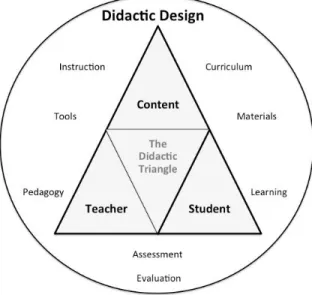
Figure 1 Didactic Design
Source: UC Berkley
The first thing to emphasize since it is constantly confused is the differentiation between pedagogy and didactic. Pedagogy is defined as: “any conscious activity by one person designed to enhance learning in another” (Watkins, 1999); While didactic is defined as: “A discipline of
human begins through the understanding and permanent change of the social communicative developments, and the receiving and appropriate growth of the teaching and learning process” (Medina, 2003). Under these premises, the analysis of the pedagogical processes that are being carried out regarding language learning, in this study of the English language learning, and the didactics processes to investigate the bad applications of the didactics tools in pedagogy that seeks the development of skills and abilities by elementary school students.
Undoubtedly, the training of teachers in languages is limited as far as pedagogical processes related to the use of ICT´s are concerned, this problem is coupled with the few technological and didactic resources that allow a natural immersion in the language, which is reflected in a low level of learning and a near zero development of communicative skills by elementary school students, although the picture is not much better at higher levels of education.
In the publication "Palabra Maestra", of December 2014, the practically nonuse of didactic tools related to ICTs is illustrated, which has a negative impact on the needed engagement by English language students in the country: “The instrumental position on ICT is evidenced by noting that despite the fact that in many of the experiences (48%) it is said to have implemented them, only 32.6% of the experiences show has given them a pedagogical use. In this same sense, and reinforcing the technocratic perspective, it is surprising that very few experiences (8%) will use them with the purpose of fostering self-learning processes.” (Rico, 2014)
This research will be carried out in educational institutions in the city of Palmira, focusing mainly on public institutions, since it is in these institutions that the dramatic learning processes that are not encouraging students to acquire the minimum skills to communicate in a foreign language such as English.
El Significance of the Study
A discussion of the significance of a study typically includes an explanation of the work's significance, its potential benefits, and its overall impact. The significance of a study often called the "rationale," attempts to explain to an audience why a researcher's work is worth performing. The rationale often explains which specific groups of people can benefit from the research. It typically indicates how the specific project fits within the developing body of knowledge. A researcher attempting to describe the significance of a study should consider why his or her work is important and what its implications are. This researcher should consider how the study might fill in knowledge gaps in their field, develop better theoretical models or point the way toward further study. One, as a researcher, should also examine what impact the study might have not just on the academic or scientific community but also on the public. One should present practical benefits and explain the unique perspectives you bring to the project.
Research Line
“ To develop didactic strategies for the development of argumentative competences at the basic,
middle and higher levels of education. To know the incidence of argumentative processes in learning and in the construction of knowledge ” (ECEDU, 2018).
We define the didactic strategies, as “the planning of the teaching-learning process for which the teacher chooses the techniques and activities that can be used to achieve the proposed objectives and the decisions that must be taken in a conscious and reflective manner.” (U Distrital, 2016).
In this line of research, it will be possible to support each of the objectives and expected results in this research process, seeking its integration to seek the development of new methodologies that can improve the use and application of didactic tools in teaching and learning processes Of English as a foreign language.
Research Question
After a first approach in the different educational institutions that are used in this research project in the city of Palmira, it is evident that the didactic processes that are developed for the learning of English as a foreign language are limited, this is affirmed as a result of the observation
and the information collected in the institutions under study; this is reflected in the lack of preparation of the students at the different levels of formal education that are developed in these institutions.
¿Which are the main factors that influence the scarce use of didactic tools, especially those related to ICTs, to allow the development of competencies and skills in the English language in the primary education students of the institutions’ object of this research project in the city of Palmira (Valle)?
Objectives
General Objective
To characterize the processes that are being carried out in the educational institutions of the city of Palmira that have elementary school programs, establishing a possible plan of improvement for the success of programs of learning English as a foreign language.
Specific Objectives
Perform the upgrading of the didactic and pedagogic processes in elementary school to the state of art level.
To inquire about the didactic tools those are used in the teaching and learning processes of English as a foreign language in the city of Palmira (Valle).
Justification
In Colombia, the level of funding appropriation for the English language is very low compared to other Latin American countries. (Colombia Aprende, 2014) This translates into a competitive disadvantage in relation to international markets and helps to ensure that there is no social, political and economic development in the country. The preparation of students from the most basic levels of education in the study of languages (the case of this English research) is at a low academic level; Product of the use of methodologies that are not very productive and the lack of use of didactic tools that allow the immersion of the students in these learning processes.
Figure 2 Colombia Aprende – inglés para Todos
Source: MEN – Colombia
proper learning of the language, this is not reflected in the results that show a lower perception of the language by the students as noted from each of the educational levels that are included in the Colombian educational system. (Colombia Aprende, 2014)
(Usma, 2009) says: “In 1999 the Curriculum Guidelines for Foreign Languages were created. These guidelines tended to limit teacher control over curriculum rather than promoting foreign language learning. Combined with the lack of resources and teachers that persists today, this means that many local authorities lack the incentives and motivation to adopt the guidelines.”, pointing out that the problem was not the guidelines but, on the one hand, the lack of motivation on the part of teachers for the development of educational processes and, on the other hand, the lack of didactic resources that allowed the natural immersion of the Students in the foreign language.
CHAPTER 2 LITERATURE REVIEW
Theoretical Background
This research is based on the theoretical postulate that learning a foreign language is easier to learn if one starts at the preschool and primary levels. What makes it essential to start using teaching tools such as those offered by ICTs is to develop skills from an early age in learning English. As expressed by (Deprez, 1994):
“Bilingualism from the preschool level facilitates the learning of other languages while developing the capacity for abstraction, the interaction between language and cultural skills, listening, adaptation, creativity, and criteria. The set of all these metalinguistic abilities that develop in each grade level favors the learning processes of other educational disciplines, prepares the student to conceptualize the two linguistic systems and contributes to the development of the mother tongue”.
Also, this research focuses on language learning during preschool and elementary school, based on (Piaget, 1961): “Puberty is the stage of formal operations, which appears from the age of twelve onwards. From that moment the brain is less enabled to learn a second language”.
Figure 3. Programa Nacional de Bilingüismo
Source: MEN – Colombia
The Didactics in Education
One of the main problems in the process of learning languages is due to the misuse of didactic tools. Language learning processes require different scenarios than those in general education; this means that learning languages are done through activities other than learning in other areas of knowledge.
of better human begins through the understanding and permanent change of the social communicative developments, and the receiving and appropriate growth of the teaching and learning process”. Under these premises, the analysis of the pedagogical processes that are being carried out regarding language learning, in the specific case of this study in the English language learning, and the didactics processes to investigate the bad applications of the didactics tools in pedagogy that seeks the development of skills and abilities by elementary school students.
Undoubtedly, the training of teachers in languages is limited as far as pedagogical processes are concerned, this problem is coupled with the few technological and didactic resources that allow a natural immersion in the language, which is reflected in a low level of learning and a near zero development of communicative skills by elementary school students, although the picture is not much better at higher levels of education.
On the other hand, there is little motivation in the teaching environment regarding improving the educational processes in students; (British Council, 2015) says: “English teachers go through economic, motivational and access challenges that continue to be barriers to positive and equitable learning of English in formal education, primary school teachers teach a range of subjects and therefore do not specialize in English.”.
The new technologies in Didactics
The use of technological tools to teach English is essential today. Language learning is greatly facilitated when audiovisual tools that exist in the world today are used. For example, the Internet offers many opportunities to practice oral and visual skills that allow students an immersion in the language.
need for teachers to use them enough to improve English fluency. It is for this reason that the teacher must be updated regarding these tools to take advantage significantly and make classes enjoyable and fun to get students to communicate in the new language and to encourage practicing pronunciation constantly.
Web 2.0 also allows students a face-to-face interaction with diverse students not only in the classroom but throughout the world with people who have the same interest to learn the language while having cultural exchanges with throughout the hemisphere.
The didactics in English Learning
Zoltan Dornyei in his book “Motivational Strategies in the Language Classroom”, (Dornyei, 2015) points out that is very important for maintaining and protecting motivation in the classroom. That is why the author explains the eight most powerful executive motivational areas:
Making Learning Stimulating and Enjoyable
This motivational area explains that one of the main features that must be learned is that learning should be fun for the student, find it an enjoyable process both inside and outside of the classroom. When the student finds learning enjoyable and fun, he will increase participation and pay more attention to what you are teaching.
It is for these reasons that one of the main functions of the teacher in the classroom is to avoid monotony at all costs to not bore the student during their education.
Presenting Tasks in Motivating Ways
them can help the object of learning in a didactic way while being pleasant. Hence, it is important to be clear that the motivational introduction of an activity fulfills at least three further functions: - It explains the purpose and the utility of the task.
- It sharpens the students' anticipation of the task. - It provides appropriate strategies for doing the task.
Setting Specific Learner Goals
Setting goals with specific deadlines those students can meet, with clear goals expectations of what you are looking for in the classroom. Be clear on the steps and point out to all the students the need to comply with the proposal within the academic strategy.
When timetables for achieving those goals are established, students may evaluate their performance in the classroom and what learning is about, what is expected of them based on the established curriculum.
Protecting the Learner’s Self-Esteem and Increasing Their Self-confidence.
In the same way that learning objectives are established, helping students to value themselves, taking care of their self-esteem, self-love, and self-confidence, will ensure that the student can feel comfortable and at ease in their academic process, achieving better willingness to learn and making the process as natural as possible.
Allowing Learners to Maintain A Positive Social Image
failure. It is for this reason that teachers must perceive each of the social behaviors of students, discovering why some students are shy and withdrawn, which students are the most active and energetic, to establish a profile for each student and how to help them to become better students.
Promoting Cooperation Among Learners.
In the 21st century, teamwork is essential for any organization. That is why instilling skills of cooperation among learners is important in the classroom. Teaching students to work together ensures first, that the relationship between them becomes closer and second, to avoid the individualism that has been common for a long time in the learning process. In addition, when students work together, they can help their peers overcome problems they encounter in the learning process, learning together and achieving the goals outlined in the curriculum.
Creating Learner Autonomy
The current learning requires autonomy, which is why the student should develop this ability from the start of their school life. Teachers should provide the tools to enable their self-development and to be a guide throughout the process.
The teacher should let the student know that the success of the process depends not only on what happens in the classroom, but he also must enhance his investigative capacity, seeking
information at home and using powerful and valuable tools such as encyclopedias or the internet.
Promoting Self-Motivating Learner Strategies
to reinforce the learning process. When the student discovers that he can learn in different ways, their motivation will grow exponentially.
The teacher should have the ability to help students develop skills of self-motivation, allowing the student to feel at ease with himself and exploiting all his educational capacity, not only in the classroom but also from self-learning spaces.
Didactic processes in elementary Schools.
The question that should be asked is: ¿How important is the age in learning a second language?
When is the right time to learn a new language?. There is a discussion of whether to start teaching a second language at childhood or can it be done at any age of the student. From my point of view, I think it is easier to learn at an early age since learning becomes more natural compared to when you are an adult; the learning process becomes more difficult because of cultural language acquisition habits. It is, therefore much easier for a person to learn a language when the person is a younger age at the time of learning.
For example, when a child is in the process of learning a second language alongside their first language, he is able to learn to think in both languages without any problem; while an adult that already used to think only in his native language it will make it very difficult to learn to think in that second language, your brain has to translate ideas constantly to express himself in a second language.
The ELT Curriculum: A flexible model to change the learning process.
studied, that is with all the contents and the sequence that they will be studying in the classroom. The curriculum contains, as expressed by the author in the text (Finney, 2015): "planning, implementing and evaluating the education program."
Figure 4 Curriculum
Source: University of Philippines
Models Definition Main Goals Advantages Disadvantages The Content Model: Classical Humanism The model focuses on the content of what is to be learned. It is a content-based curriculum. It is the most widely used model in the western educational system. - Establish the necessary content to develop the learning process. - Define and conceptualize the curriculum to suit the content of science required for student learning. - It focuses on teaching each of the branches of knowledge, giving the student a general knowledge of science. - In English, the student acquires good vocabulary and good grammar.
- It does not take into account the capabilities and problems of the individual Student.
- In English, it is based on the teaching of
grammar aside the issue of practicality. The Objectives Model: Reconstructionism This model focuses on the reconstructionism movement that - Clarifying learning objectives for - The model poses clarity on the goals of the
aims education social change, based on behavioral objectives. proper training. - Provides special skills in the area of vocational training.
program being studied.
- As the model have clear objectives, there easily evaluating them. autonomy, self-realization and personal development. - The generation of knowledge is not extensive because it comes down to simplified processes. The Process Model: Progressivism This model is based on concepts of student needs, interests and development processes. The model is presented for curriculum planning for - The model seeks the person can move toward self-realization - Express the content and the need for students to
- Take into account the needs of students in their learning process.
- In teaching
English, to be a model that focuses on the
- The model is less attractive than others for curriculum planning since their concepts are subjective.
resolving planning processes in education. develop learning - The model seeks to make an approach to curriculum planning
.
student, it allows for a more natural learning process.
plan of
communication studies and a methodology for communication.
The “New Prafmatism”: A Mixed – Focus Curriculum
This model is
presented as the result of trying to get the virtues of the other models and adapt them to a curriculum that is comprehensive to the learning process of students.
- Hold a subject of the curriculum of politics to establish the general principles and the effects of the curriculum. - It allows developing a methodology
- It is the approach best suited to the teaching of English.
- It performs syllabus design which allows an order in the contents to be developed in the course.
- This model to possess characteristics of various models tend to confuse its practical
that adapts and adjusts to learning English as a language.
CHAPTER 3 METHODOLOGY
Research Paradigm
The interpretative paradigm is the one that best fits the present research since this paradigm is oriented to the discovery from the investigation and looks for the interconnection between the elements that intervene in the events that are being investigated. (Quiroga, 2007) affirms that:
"With this paradigm, we can understand reality as dynamic and diverse, it is called qualitative, phenomenological - naturalistic or humanistic. Its purpose is to deny the scientific notions of explanation, prediction, and control of the positivist paradigm. Notions of understanding, meaning, and action.
This paradigm is the one to be applied to this research since the logic of the interpretive paradigm is that of knowledge, allowing the researcher to understand what is happening with his object of study, based on the interpretation of the context in which it is found.
Research Approach
“Guide for areas or significant research topics, however instead of clarity on the research
question and hypothesis precedes the collection and analysis of the data (as in most quantitative studies) qualitative studies can develop questions and hypotheses before, during, or after data collection and analysis. Often these activities serve first to discover what the most important research questions are and then to refine and answer them”.
In qualitative research, reflection is the bridge that links the researcher and the participants, it is for this reason that the analysis of the learning of English as a foreign language can be developed from this approach.
Type of Study
The first type of study that should be applied to the present research is the type of exploratory research study, since this type of study allows the formulation of a specific problem to enable a more realistic approach to the development of a hypothesis, allowing answering questions related initials on the level of language learning in elementary school students. (Lozano, 2012) says:
“These kinds of studies are common in behavioral research, especially in situations where there is little information; ” Exploratory studies serve to increase the degree of familiarity with relatively unknown phenomena, to obtain information about the possibility of carrying out a more complete investigation of a particular real-life context, to investigate human behavioral problems that are considered to be crucial to the professionals of a given area, identify promising concepts or variables, establish priorities for further research, or suggest verifiable assertions (postulates)”.
Source: MBA School
Population
For this investigation, the researcher will be taken the population of four public institutions of an elementary school in the city of Palmira, Valle, as the basis for the analysis of the management competencies acquired in the English language.
Source: Alcaldía de Palmira.
Being public institutions, they are in a popular social context, with students in socioeconomic strata 1, 2 and 3; in ages between seven (7) and fourteen (14) years old. The institutions studied are of a mixed nature, with boys and girls. A sample of approximately 5% of the total of students of the two (2) institutions will be taken.
Source: IE Gran Colombia Figure 9 IE Académico - Palmira
Source: IE Académico
Instruments
Documentary analysis: What is the entry point of the investigation to generate a base to
identify the problematic of what is being investigated; this analysis ends up being a circumstance of what is being investigated.
Observation Participant: It is a technique of data collection that aims to explore and
describe environments, involves deep penetration, social situations and maintain an active role, pending details, situations, events, events and interactions
The interview: It is done to obtain information, opinions or beliefs of one or more people about what is being investigated.
Figure 10 Qualitative Research
CHAPTER 4 RESULTS
RESULTS
After conducting the survey in the chosen population, interesting results were obtained that express the academic community's point of view regarding the situation of the teaching and learning processes of the English language in the elementary school institutions of Palmira.
To analyze the results of the survey, we tabulated that survey and proceeded to present the results question by question.
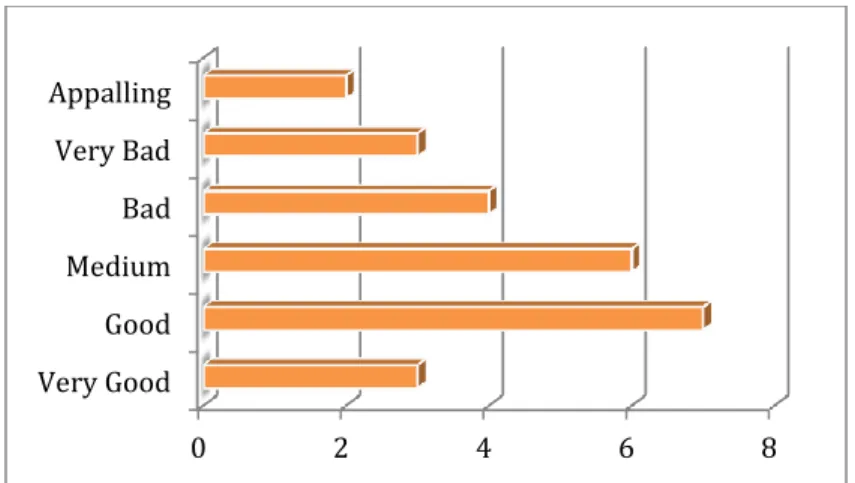
1. ¿Cómo cree usted que es el aprendizaje del inglés en Palmira? / How do you think is learning English in Palmira?
Source: The Author
Opinions as to the level of English are divided, however there is enough population that thinks the level is between medium and bad.
2. ¿Cree usted que la enseñanza de idiomas en Palmira se realiza de forma acertada? / Do you think that language teaching in Palmira is done wisely?
Figure 12 Language Teaching in Palmira
Source: The Author
0 2 4 6 8
Very Good Good Medium Bad Very Bad Appalling
Most people think that teaching English in Palmira is not done properly.
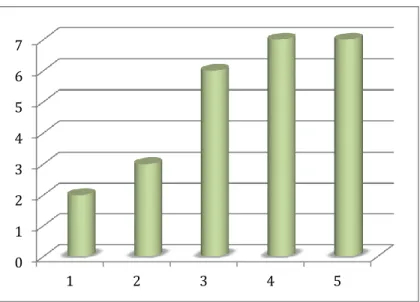
3. De 1 a 5, siendo 1 la calificación más baja y 5 la calificación más alta, ¿Cómo calificaría a los profesores de inglés que ha conocido? / From 1 to 5, with 1 being the lowest rating and 5 the highest rating, how would you rate teachers of English that you have known?
Figure 13 Rate Teachers
Source: The Author
Although people think that teaching English in the city is not appropriate, they generally have a good understanding of the teachers who teach the language.
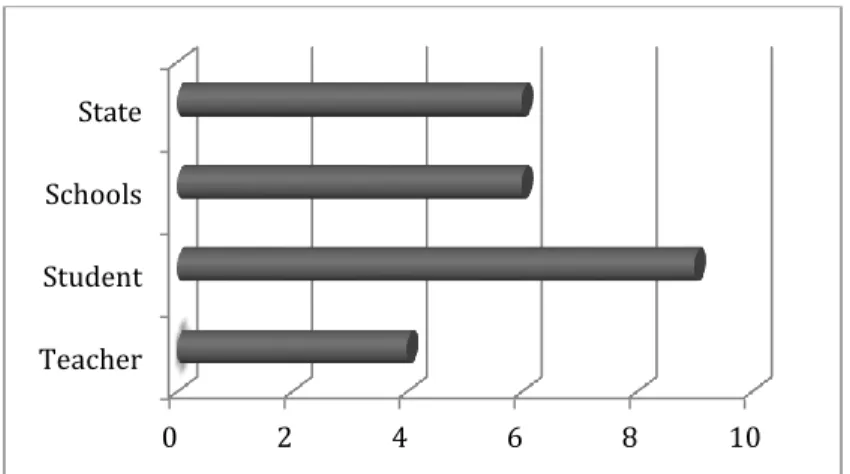
4. ¿De quién cree usted que es la responsabilidad por el poco aprendizaje del inglés en la escuela? / Who is responsible for the limited learning English process at school?
0 1 2 3 4 5 6 7
Figure 14 Limited Learning English Process
Source: The Author
Respondents believe that the greatest responsibility lies with the students, the school, and the state. Although there are some that express the lack of good training of teachers.
5. ¿Considera que se le dedica más tiempo a la gramática y a la escritura que a lo auditivo y conversacional? / Do you consider that more time is devoted to grammar and writing that listening and speaking?
0 2 4 6 8 10
Figure 15 More Time Devoted to Learn
Source: The Author
The result of this question is overwhelming, respondents believe that they do not spend enough time speaking and listening.
6. ¿Preferiría usted que se le enseñaran más las habilidades de hablar y escuchar? / ¿Would you prefer to be taught more skills of speaking and listening?
Figure 16 Prefer to be Taught
Source: The Author
This is another question with overwhelming results since all respondents say they would prefer to be taught less grammar and more communicative skills to speak and listen to the language.
7¿Cuándo usted ha sido estudiante de inglés qué es lo que más recuerda? / When you have been a student of English what you remember most?
Figure 17 Memories
Source: Google 0
5 10 15 20 25
Although question eight was open type, the clear majority of respondents replied that what they remembered most about English classes was that they did not understand anything and that the classes were very boring.
8. ¿Cree usted que las herramientas tecnológicas como el computador y el internet sirven para mejorar el aprendizaje desde el hablar y el escuchar? / ¿Do you believe that technological tools such as the computer and the Internet serve to improve learning from speaking and listening?
Figure 18 Technological Tools
Source: The Author
Respondents fully consider that the use of technological tools is vital and important for the English language learning process. 100% of the respondents stated in questions nine and ten that tools such as the internet and computer should be used for language learning.
9. ¿Considera usted que deberían utilizarse más herramientas tecnológicas para la enseñanza del inglés? / ¿Do you think technology tools should be used more to consider teaching English?
Figure 19 Should be Used
Source: The Author 0
5 10 15 20 25
CHAPTER 5 DISCUSSION
After interpreting each of the questions formulated in the survey, it is certain that the way in which the English language is being taught in the elementary school institutions of Palmira is not adequate. The classes are monotonous and boring, and the didactics used are far from vital tools such as the computer and the internet.
CHAPTER 6
CONCLUSION
After analyzing the theoretical postulates of the new didactic and pedagogical methodologies for the learning of English as a foreign language, together with the information collected from primary sources of collection such as the surveys, it is clear that the main problem of the learning process in elementary grades of formal basic education in the city of Palmira (Valle) is the methodology teachers are using to teach. Students are not being motivated enough to perform permanent exercises in order to develop each of the communicative skills which makes it very boring and in many cases very monotonous the process of teaching and learning the foreign language.
REFERENCES
British Council, (2015). El inglés en Colombia: Estudio de políticas, percepciones y factores influyentes, [on-line]. 2017 [Date: September 2017]. Available in:
https://www.britishcouncil.co/sites/default/files/colombia_version_final_-_espanol.pdf
Bygate, Martin. Language Skills: Speaking [on-line]. 2016 [Date: September 2017]. Available in: http://assets.cambridge.org/97805218/01270/sample/9780521801270ws.pdf
Deprez, Christine (1994), Les enfants bilingües, langues et familles, París, Didier. Dornyei, Zoltan. Motivational Strategies in the Language Classroom. [On-line]. 2015 [Date: September 2017]. Available in:
http://seas3.elte.hu/coursematerial/PohlUwe/2MotivationReading.pdf
Finney, Denise. The ELT Curriculum: A Flexible Model for a Changing World. [on-line]. 2015 [Date: September 2017]. Available in:
http://resourcelists.kent.ac.uk/items/9A997587-D100-952D-6E0F-1C0E2927593C.html
Garcia, Alberto (2011). Enfoques cualitativo y cuantitativo, [on-line]. 2017 [Date: July 2017]. Available in:
https://sites.google.com/site/metodologiadelainvestigacionb7/enfoques-cuantitativo-y-cualitativo
Herazo, S. (2012). Opportunity and incentive for becoming bilingual in Colombia: Implications for Program National of Bilingüismo.
http://janeth-investigacioniv.blogspot.com.co/2008/11/investigacion-exploratoria.html
Medina, A. (2003). La didáctica: disciplina pedagógica aplicada. En A. Medina y F. Salvador (Eds.). Didáctica general. Madrid: Prentice Hall.
Piaget, Jean (1961), La formación del símbolo en el niño, México, Fondo de Cultura Económica.
Quiroga, Esteban (2007). Los tres Paradigmas en Investigación, [on-line]. 2017 [Date: August 2017]. Available in:
https://es.slideshare.net/EstebanQuiroga/los-tres-paradigmas-en-investigacin
Rico, Carlos (2014). Rasgos Característicos de la enseñanza de ingles como lengua extranjera en Colombia. [on-line]. 2017 [Date: November 2017]. Available in:
https://compartirpalabramaestra.org/palabramaestrapdf/edicion37.pdf
Rost, Michael. Language Skills: Listening [on-line]. 2016 [Date: September 2017]. Available in: http://www.cambridge.org/download_file/763204/0/
Segura, Rocio. The importance of teaching listening and speaking skills [on-line]. 2016 [Date: September 2017]. Available in: https://www.ucm.es/data/cont/docs/119-2015-03-17-12.RocioSeguraAlonso2013.pdf
Universidad Nacional Abierta y a Distancia UNAD. Course Syllabus - Research Project. [on-line]. 2017 [Date: April 2017]. Available in:
http://campus07.unad.edu.co/ecedu09/pluginfile.php/2437/mod_folder/content/0/Syllabus_55102
20.pdf?forcedownload=1
U Distrital (2016). Estrategias Didácticas para el aprendizaje colaborativo. [on-line]. 2017 [Date: November 2017]. Available in:
Usma, J. (2009). Education and language policy in Colombia. Exploring processes of inclusion, exclusion and stratification in times of global reform. Universidad de Antioquia.
APPENDIX A: THE SURVEY
Estimad@ Encuestado@: La presente encuesta tiene como finalidad recoger su opinión
sobre el aprendizaje de una lengua extranjera como lo es el inglés en el ámbito educativo en
Palmira.
Dear Respondent: This survey aims to collect opinions about learning a foreign language
as is English in the Elementary School of Palmira.
7. ¿Cómo cree usted que es el aprendizaje del inglés en Palmira? / How do you think is learning English in Palmira?
Muy bueno / Very Good Bueno / Good Medio / Medium
Malo / Bad Muy Malo / Very Bad Pesimo / Appalling
8. ¿Cree usted que la enseñanza de idiomas en Palmira se realiza de forma acertada? / Do you think that language teaching in Palmira is done wisely?
a. Si / Yes b. No / Not
9. De 1 a 5, siendo 1 la calificación más baja y 5 la calificación más alta, ¿Cómo
lowest rating and 5 the highest rating, How would you rate teachers of English who has known?
1 2 3 4 5
10. ¿De quién cree usted que es la responsabilidad por el poco aprendizaje del inglés en la escuela? / Who do you think is responsible for the limited learning English
process at school?
El Profesor / The Teacher El Estudiante / The Student Las Escuelas / The Schools El Estado / The State
11. ¿Considera que se le dedica más tiempo a la gramática y a la escritura que a lo auditivo y conversacional? / Do you consider that more time is devoted to grammar and writing that listening and speaking?
a. Si / Yes b. No / Not
12. ¿Preferiría usted que se le enseñaran más las habilidades de hablar y escuchar? / ¿Would you prefer to be taught more skills of speaking and listening?
13. ¿Cuándo usted ha sido estudiante de inglés qué es lo que más recuerda? / When you have been a student of English what you remember most?
14. ¿Cree usted que las herramientas tecnológicas como el computador y el internet sirven para mejorar el aprendizaje desde el hablar y el escuchar? / ¿Do you believe that technological tools such as the computer and the Internet serve to improve learning from speaking and listening?
a. Si / Yes b. No / Not
15. ¿Considera usted que deberían utilizarse más herramientas tecnológicas para la enseñanza del inglés? / ¿Do you think technology tools should be used more to consider teaching English?