1
ESCUELA TÉCNICA SUPERIOR DE INGENIERÍA
INFORMÁTICA
INGENIERO EN INFORMÁTICA
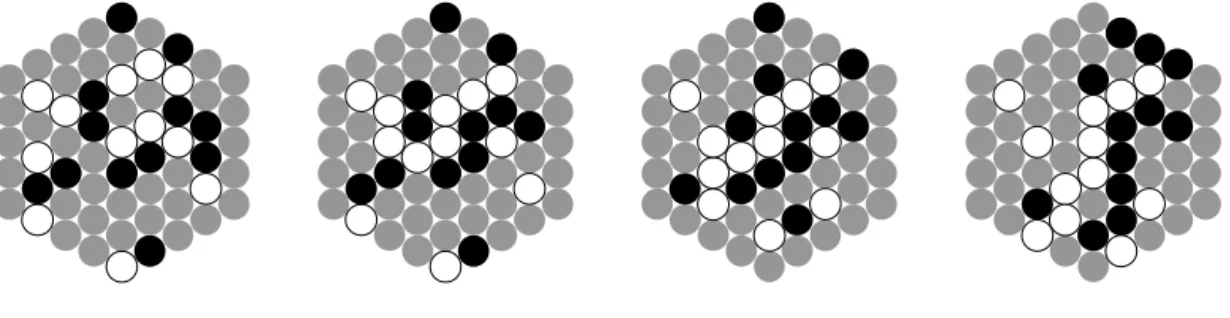
DISEÑO E IMPLEMENTACIÓN DE UNA ESTRATEGIA PARA UN
JUEGO DE CONEXIÓN
Realizado por
DAVID DANIEL ALBARRACÍN MOLINA
Dirigido por
FRANCISCO J. VICO VELA
Departamento
LENGUAJES Y CIENCIAS DE LA COMPUTACIÓN
UNIVERSIDAD DE MÁLAGA
3
UNIVERSIDAD DE MÁLAGA
ESCUELA TÉCNICA SUPERIOR DE INGENIERÍA INFORMÁTICA
INGENIERO EN INFORMÁTICA
Reunido el tribunal examinador en el día de la fecha, constituido por:
Presidente/a Dº/Dª. ______________________________________________________
Secretario/a Dº/Dª. ______________________________________________________
Vocal Dº/Dª. ___________________________________________________________
para juzgar el proyecto Fin de Carrera titulado:
Diseño e implementación de una estrategia para un juego de conexión
realizado por Dº. David Daniel Albarracín Molina
tutorizado por Dº. Francisco J. Vico Vela
ACORDÓ POR ________________________________ OTORGAR LA
CALIFICACIÓN DE __________________________________
Y PARA QUE CONSTE, SE EXTIENDE FIRMADA POR LOS COMPARECIENTES
DEL TRIBUNAL, LA PRESENTE DILIGENCIA.
Málaga a 18 de Marzo de 2010
El Presidente ___________________ El Secretario___________________ El Vocal_________________
5
6
ABSTRACT
The purpose of this project is developing an automatic strategy for playing Selfo, a connection game whose goal is to get arranged all the friendly pieces into a single connected group. The idea is to copy some kind of swarm conduct, like the observed in an ant colony or in a flock of birds, to play this game. The swarm behaviors consist on few simple inborn rules. But these simple rules applied in group usually bring complex dynamics. The ultimate goal is to check whether a computer player based on these principles can compete against a thinking trained human.
We first built a simple computer version of Selfo in order to deeply examine the dynamics of the game by running human-human and human-dummycomputer games. From this experience we proposed and developed a swarm behavior based strategy.
We built the program over the Zillions of Games platform. Zillions is a popular website where people can download and play a multitude of board games. This is a great tool to get the players experiences. And it also allowed us to easily define the user interface and game rules, letting us focusing on the game engine.
To evaluate the quality of the proposed strategy, we run several simulations of computer-computer games and played human-computer games. We noted that the computer opponent can defeat many times an average player and sometimes beat an experienced player. We also learned that it is very important the initial distribution of pieces and sometimes the strength of the first move. Finally we could observe the speed of the computer player, despite the computational complexity of the game.
7
INDEX
Chapter 1: Introduction ... 10
1.1Motivation ... 10
1.2 Aims ... 10
1.3Chapter overview ... 11
Chapter 2: Introduction to connection games ... 13
2.1 Definition ... 13
2.2 Board design ... 13
2.3 Scale ... 14
2.4 Rules of play ... 15
2.5 Clarity ... 15
2.6 First move advantage ... 15
2.7 More players ... 16
2.8 Defensive play ... 16
2.9 Classification ... 16
2.10 Examples ... 17
Chapter 3: Description of Selfo ... 20
3.1 Introduction ... 20
3.2 Definition ... 21
3.2.1 Board ... 21
3.2.2 Initial board position ... 22
3.2.3 Density ... 22
3.2.4 Winning condition ... 22
3.2.5 Number of players ... 23
3.2.6 Move length ... 23
3.2.7 What a Selfo game is not ... 23
3.2.8 Summarized rule set ... 24
3.3 Initial board position ... 25
3.3.1 Regular positions... 25
3.3.2 Irregular positions ... 26
3.4 Self-organized dynamics ... 28
3.4.1 An example of self-organized play ... 29
8
Chapter 4: Related technologies ... 32
4.1 Introduction ... 32
4.2 Zillions of Games ... 33
4.2.1 Introduction ... 33
4.2.2 Web ... 34
4.2.3 Zillions of Games program ... 36
4.3 Building a game in Zillions ... 38
4.3.1 ZRL Language ... 39
4.3.2 DLL Interface ... 41
Chapter 5: Proposal of a game strategy ... 45
5.1 Initial study ... 45
5.2 An approach ... 46
5.3 Definition of the strategy ... 47
Chapter 6: Simulation results ... 52
6.1 Introduction ... 52
6.2 Human-Computer results ... 52
6.3 Computer-Computer simulations ... 53
6.3.1 Setup 1 ... 54
6.3.2 Setup 2 ... 56
6.3.3 Setup 3 ... 58
6.3.4 Setup 4 ... 60
6.3.5 Setup 5 ... 62
6.4 General observations ... 64
Chapter 7: Conclusions ... 65
References ... 67
Appendix: Implementation ... 68
Diagrams ... 68
DLL Interface ... 68
Structures ... 68
Methods ... 69
Custom Strategy ... 70
Structures ... 70
10
Chapter 1: Introduction
1.1 Motivation
It has been shown that nature is a powerful source of inspiration in different fields of engineering. We have taken ideas which has bring to us inventions like planes, diving fins, radar, sonar, Velcro, computer viruses, self-cleaning surfaces and countless other gadgets. Particularly, in computer science we can see many ideas inspired by nature helping us to solve several kinds of problems, ideas like artificial neural networks, fuzzy logic, evolutionary computation or many techniques in computer vision.
Over the years, game theory has provided to computer science the possibility of applying and testing different strategies, behaviors or algorithm. MINIMAX strategies, application of artificial neural networks or the use of pattern databases are among the most common methods to face the problem of building computer intelligences for playing games.
Our proposal is to develop a game engine for a connection game, a kind of board game where the goal is to get certain configuration between the friendly pieces. To achieve that purpose we will think about bio-inspired strategies which will treat each piece like an independent individual following simple rules. That will bring a general and a more complex emergent behavior, similar to how the ant colonies find the shortest path to food simply dropping and following pheromones.
1.2 Aims
This project focuses in three main goals: building a computer version of the connection game Selfo, developing a bio-inspired computer play engine taking into account the dynamics of the game; and checking whether the developed strategy is capable of defeating a human player.
According to these objectives, we will first build a preliminary computer version of Selfo containing the following features:
- An on-line mode to provide another way to play. So people can play against an offline human player, an online human player and a computer player,
11 - different game variant,
- the computer game engine should be fast, so the people do not get bored waiting,
- Selfo should be placed on the Internet to increase the people who have access to it.
After studying executed games and in-depth understanding the dynamics of the game, we will design an advanced game strategy. The strategy will be bio-inspired and the execution of the game engine will remain fast, in order to keep the game fun.
The last phase will include a series of tests consisting of computer-computer and human-computer games to see if the new designed strategy has reached the desired level. The goal is that the new engine is able to defeat an experienced human player.
1.3 Chapter overview
This document has been structured as follows:
• Chapter 2: Introduction to connection games:
Here we provide a description of what a connection game is, what exactly characterizes a board game as such. We discuss features like board setups, rules or usual developments of a connection game and finally we give some examples of them.
• Chapter 3: Description of Selfo:
In this chapter we focus on the connection game named Selfo. It is given a precise definition of boards, kind of moves, goals and many other features. In addition we discuss some important issues related to Selfo, like its dynamic or the initial configurations of pieces.
• Chapter 4: Related technologies:
12
platform, the ZRL language and the DLL interface to engage a custom game engine to Zillions.
• Chapter 5: Proposal of a game strategy:
In this section we propose an artificial strategy to play Selfo. We give the definition of the strategy according to our experiences playing Selfo and we explain its functioning and some aspect related to the implementation.
• Chapter 6: Simulation results:
Here we show simulation results and experiences playing Selfo using the new developed strategy. We give some statistic data and graphics; and we expose our conclusion in relation to the kind and level of play developed by our game engine.
• Chapter 7: Conclusions:
13
Chapter 2: Introduction to
connection games
2.1 Definition
A connection game is a board game in which payers have to develop or complete a specific type of connection with their pieces. This might involve forming a path between two or more goals, completing a closed loop, or gathering all pieces together into a single connected group. In all cases, the size and shape of the connection do not matter; it is the fact of connection that counts.
Most board games feature at least some aspect of connection. This could be as fundamental as the adjacency of squares on a Chess board, or the fact that a winning pattern in Tic-Tac-Toe forms a connected line. But in both cases what really matters is not the fact of connection. Consider the game of Tic-Tac-Toe, we can set up a board position that connects opposite sides of the board or connects as many pieces as we want without either player winning. It is the pattern’s size and shape that is important here (three pieces in a line), the fact of connection is an irrelevant by-product of its formation.
2.2 Board design
As board geometry is a central element in most connection games, any singularities in board design can have profound effects upon the game. Players should take advantage of powerful cells and stay away from weaker cells. Powerful cells are those with greater connective potential or at which connective flow converges. The central point is usually the strongest point on the board. The right-most design, a hexagon tiled with hexagons called the hex hex board, is of particular interest. The absence of acute corners means that edge cells are more uniformly distant from the center of the board, resulting in a more even distribution of power over all cells.
14
Figure 2.1 Adjacencies on the triangular, square and hexagonal grids. Taken from Browne [2005].
Some games are played on grid intersections rather than cell interior. In addition, the rules of some games specify connective adjacencies between cells or board points that are not physical neighbors; for instance, points in Twixt are not connected to their immediate neighbors but to those a knight's move away.
Figure 2.2 Games played on cell interior and on grid intersections. Taken from Browne [2005].
2.3 Scale
15
Larger games are generally more satisfying, but can take much longer to complete. Players will generally find a board size that balances their skill and depth of interest in a game with their patience to play it.
2.4 Rules of play
Rules of play govern the interaction between pieces on the board, and shape the stages of play as the game progresses.
2.5 Clarity
Clarity is the case with which a player can understand what is going on. Games like Hex with transparently simple rules and goals, and no special conditions or hidden complexities to distract the mind have excellent clarity. The clarity of a game determines how far you can see down the games strategy tree. Games with overly complex move mechanics or excessive piece movement tend to have poor clarity and hence limited depth.
2.6 First move advantage
16
2.7 More players
Even though the Cut/Join nature of connection games is ideally suited to two-player games, games involving three or more two-players can be implemented successfully. However, care must be taken because the possibility of deadlocks could be increased.
2.8 Defensive play
A good rule of thumb for complementary-task connection games is that defense equals attack. Blocking the opponent’s connection by definition implies a win for the player. A strongly defended position is a good one, and players should resist the urge to play excessively aggressive mores that overreach and lead to disaster. An active form of defense is to exploit weak points of overlap in die opponent's potential connections. It is often important to block a group's progress across the board. Such positional defense is usually best done from a distance.
2.9 Classification
Connective Goal
Connective Goal games are those that end as soon as a specified connection, independent of size or shape, is achieved; connection is paramount in deciding the winner. Such games can be described as involving connection at a global or strategic level.
Connective Play
Connective Play games are those that feature at least some connective aspect and no non-connective aspects during general play; connection between pieces is paramount during play. Such games can be described as involving connection at a local or tactical level.
17
long as it is strictly connection-based (as in Go) and does not involve size or shape constraints.
Pure Connection
Pure Connection games are those with both strictly connective play and strictly connective goals. These can be described as games involving connection at both the local and global levels.
2.10 Examples
Hex
Figure 2.3 Hex board. Taken from Browne [2005].
Hex is the game that kick-starred the connection game genre in the middle of the twentieth century. It has extraordinarily simple rules yet remains one of the most difficult and interesting of all connection games. It is included in Pure Connection class.
Hex is played on a rhombus of hexagons, typically 11 x 11, which is initially empty. Two players, Black and White, own alternating sides of the board that bear their color. Players take turns placing a piece of their color on an empty cell.
18
advantage, especially if allowed to open near the center of the board. It is recommended that a single-move swap option be used.
Go
Figure 2.4 Go game. Taken from Browne [2005].
Go is one of the most influential of all abstract board games. It is played on the intersections of a square grid, typically 19 x 19, which is initially empty. Two players, Black and White, take turns placing pieces of their color on an empty intersection. All enemy groups with no remaining liberties (orthogonally connected empty points) are then captured and removed from the board.
Players may not place a piece that would commit suicide, that is, any piece placed on the board must have at least one liberty or become pan of a group that has at least one liberty. In addition, players cannot make a move that would result in a repeated board position.
Players may pass in lieu of making a move. If both players pass in succession then the game ends, and player scores are calculated based on the amount of territory under or surrounded by their pieces. Captured stones may also contribute to player’s scores, depending upon which version of the rules is used.
Go is widely regarded as one of the deepest games in existence. It is estimated to be 3.000 years old and boasts many textbooks, clubs, and professional players who spend their lifetimes studying the game.
19 Lines of action
Figure 2.5 Initial configuration of Lines of action. Taken from Browne [2005].
Lines of Action, the classic game of convergence, is played on an 8 x 8 square grid. Two players, Black and White, start with 12 pieces each, setup as shown in Figure 2.5
Players take turns moving one of their pieces in an orthogonal or diagonal line. The piece must move exactly the same number of squares as there are pieces of either color along that line. The piece may jump over friendly pieces but not enemy pieces, and may not leave the board. The piece may land on an enemy piece to capture it.
The game is won by the first player to move all of his remaining pieces into a single connected group. Connections within the group may be orthogonal or diagonal. If a capturing move creates single connected groups for both players simultaneously, then the mover wins.
Lines of Action is widely regarded as a game of the highest quality, achieving deep tactical and strategic possibilities with a simple and interesting move mechanism. It remained something of a cult game until the 1990s when it started enjoying a wider audience (much like Hex).
20
Chapter 3: Description of Selfo
3.1 Introduction
Selfo is defined as a class of abstract strategy board games subscribed to the category of connection games. Its name derives from the phenomenon of self-organization (i.e. the increase in a system’s self-organization without external guidance), since during the game the sets of pieces might flow in a coordinated way as they step on the board. Despite its very simple definition (“group all your pieces by moving in turns to adjacent cells”) complex self-organization processes takes place under concrete circumstances (a balanced distribution of pieces and similar levels of expertise in the players), and are the result of abrupt and deep changes in the tactics. Since a big number of variants have been found to meet the conditions for self-organization, the particular values given to the traditional parameters that define a game (i.e., board tiling, size and initial position, or number of pieces and players) are not so relevant. The Selfo class of connection games is defined, instead, by the interrelations among parameters in order to favor self-organization.
Since the invention of Go, traditional connection games have been widely played and studied. In the last decades this genre of games has proliferated, and now they constitute a significant contribution to strategy games. An ambitious compilation has been published by C. Browne [2005].
Some connection games are well-known and have become popular as board games: Lightning, the first connection game by several decades [Polczynski 2001]; Hex, devised by the mathematician and Nobel laureate John F. Nash, and whose publication [Gardner 1957] raised the connection game genre; Y, from which Hex is a special case, was proposed in the early 1950s by C. Shannon, the father of the Communication Theory; or Twixt, a game that has been marketed by six different companies since 1961.
Far from pure connection games, Browne classifies under the category “convergent connective goal” those connection games whose winning condition implies amalgamating a set of pieces into a single connected group. A number of games have been proposed under this convention, like Lines of Action (invented by C. Soucie [Sackson 1969]), or Groups (proposed in 1998 by R. Hutnik [Browne 2005]).
21
games (usually under 10 turns in Groups). On the contrary, the fun of playing Selfo will be more in going through balanced positions (like in Tetris); with a tempo that switches frequently among evenly matched players.
3.2 Definition
This section describes the main rules that apply to a game in this class.
After setting the board’s grid and size, move length, and the initial board position, each player is assigned a set of pieces, and a random order of play. Players move their pieces in turns, and after the first player’s turn, a swap option is given to the rest of the player on their first move. The game ends when a set of pieces gets arranged into a single connected group, or when all players decide a draw (e.g. if some pieces get isolated).
3.2.1 Board
Selfo does not impose any restriction on the particular board topology. This aspect of the game is indeed critical, since the adjacency graph (based on a triangular, square, hexagonal, or even irregular grid) strongly influences the particular dynamics of the game. But, as said before, self-organized dynamics does emerge on any particular grid if the connectivity is balanced with other parameters. For simplicity, in this report we will constraint ourselves to board surfaces with hexagonal tessellations, where board points will be cell interiors. With respect to board size, in principle Selfo can be played on a theoretically infinite board, where pieces are not confined, and can wander around without limits. This option reduces dramatically the possibilities of self-organized play, which easily turns into a race where any initial advantage cannot be neutralized by the opponents.
22 3.2.2 Initial board position
Some constraints apply to the initial position: the minimal number of moves necessary for a set of pieces to reach the winning condition (keeping the opponents’ pieces on their initial cells) must be high (proportional to the number of pieces) and similar for all sets. Also, subsets of pieces cannot be isolated by competing chains of pieces, neither in the initial position, nor after the first moves (i.e. there must be a chance for any piece to avoid isolation).
All the pieces are placed on the board before starting the game (players cannot place pieces, as in Go). This can be done according to a fixed arrangement, or by an algorithm that, respecting the previous constraints, randomly assigns pieces to empty cells. Section 3.3 develops some examples of fixed initial positions, and algorithms for randomly sorting the pieces.
In order to avoid first-move advantage, a swap option is offered to each player. Every player can (only on their first turn) either make a move, meaning that they keep the set, or swap sets with any other player. This determines the final assignment of sets of pieces to the players.
3.2.3 Density
Defined only for finite boards, the density of a Selfo game is the relation, as a percentage, between the overall number of pieces and the number of cells of the board (i.e. a ratio of empty vs. non-empty cells).
The density has to be high enough to provide a strong interaction among the sets of pieces. But a too dense game will raise the probability of a deadlocked game. Densities in the range 35-40% have demonstrated to favor self-organized play.
3.2.4 Winning condition
The winning condition of any Selfo game is to form a single group connecting all the pieces of a player. The connectivity in this group will be assumed to be that of the adjacency graph of the board, i.e. two pieces are connected if they are in adjacent cells. For example, on a square board where pieces could only move orthogonally, the winning condition would be to form a single orthogonally connected group.
23
move any more, they stay on the current cells, remaining as non-empty cells for the rest of the game.
3.2.5 Number of players
Selfo can be played by two or more players that are assigned the same number of pieces. Since the density of pieces has been defined as a very influencing parameter, and must be kept, the size of the sets of pieces will be the total number of pieces divided by the number of players. This size must be bigger than one in order to make groups, but less than four pieces per player is not recommended.
3.2.6 Move length
This parameter is defined as the maximum number of moves through empty adjacent cells that a player can perform with a single piece in a turn. The length of the move has a lower limit of zero (meaning that the player can pass the turn on). This is the parameter that influences the depth of the game more significantly, since the collection of possible movements increases exponentially with higher values of the maximum length allowed. For this reason the class will be divided into subclasses according to the maximum move length: Selfo-1 being the simplest subclass, where any piece can perform single moves by stepping onto one empty adjacent cell (and players can pass on turns), and Selfo-n being the class where a piece can make a sequence of up to n single moves in a turn.
3.2.7 What a Selfo game is not
Possible refinements and extensions of the class can be considered, but in order to keep the simplicity of its definition a number of restrictions should always be met:
- all pieces move according to the same rules,
- players cannot influence the initial position,
- the winning condition should not be altered.
24
The second condition is also important, since it affects the simplicity of the strategy: moving pieces on a densely populated board is one thing, and placing pieces on an empty board according to some rules is another. To reach a balanced initial position would mean that the players match also in their skills to select an advantageous constellation of cells.
The proposed winning condition is a standard one (see the Introduction section), and any deviation from this simple goal will increase the solutions, giving less chance for a balanced play.
3.2.8 Summarized rule set
All the above definition can be condensed on the following rules for the simplest variant of the class, and two players:
- A board with a given topology and size, and a number of pieces are
chosen,
- all black and white pieces are distributed on the board with a proper
algorithm,
- colors are randomly assigned to players,
- starting with blacks, players move in turns, and a swap option is given to
whites on the first movement,
- in each turn, a player can either pass on the turn, or move one piece to an
adjacent empty cell,
- the player that first arranges all her/his pieces in a single connected group
wins the game,
- players can decide a draw if the game lasts for too long or some pieces
get isolated.
Or even more concisely:
25
3.3 Initial board position
Given that the expertise of the players match (or has been balanced somehow), the main point for a Selfo game to develop self-organized dynamics is to start with a board position where the sets of pieces are distributed in a way that do not favor the grouping of one nor the other sets. Some initializations are proposed based on regular and irregular distributions of pieces.
3.3.1 Regular positions
Figure 3.1 shows a number of fixed initial positions of hex hex boards of size 6 (for clarity, hexagonal cells are painted as circles), for two players (first row) and three players (last row).
Figure 3.1 Regular initial positions for a hex hex board of size 6. Colors identify the different
sets. Taken from Vico [2007].
Similar positions can be obtained for a higher number of players by re-coloring the pieces in a way that keeps the symmetry. All these board positions contain 36 pieces (≈40% density).
26
define the pattern on two or three adjacent triangles, and copying and inverting colors three or two times, respectively.
This method is simple in its definition, and ensures a good distribution of the pieces on a hex hex board, whatever its size.
Figure 3.2 Shown in two differentiable gray tones are the six triangles that, arranged around the
central cell, form a hex hex board; and a pattern of black and white pieces (left). The resulting
position of 36 pieces (right). Taken from Vico [2007].
3.3.2 Irregular positions
Irregular initial positions of the board can be obtained by different algorithms. The main restriction is that the sets of pieces are balanced (see section 3.2.2). Two main strategies are proposed to determine an initial position: perturbing a regular position, and selecting random cells for each piece after indexing the board.
27
5
2
3 6
4 1
Figure 3.2 The six possible directions of movement from a given cell. Taken from Vico [2007].
Figure 3.3 An irregular position derived from a regular one. Taken from Vico [2007].
28
Figure 3.4 Trajectory followed on the hex hex board to place the pieces randomly. Taken from
Vico [2007].
The proposed methods give an initial position that warranties a balanced distribution of the pieces. But it could also happen that a piece gets isolated (or can be isolated with little effort) in this initial setting. In such a case, the procedure should be applied again.
3.4 Self-organized dynamics
As explained in previous sections, the development of the match in a Selfo game starts with a fixed board position. After the opening movement, and the consideration of the swap option by the rest of the players, pieces start to occupy strategic cells, and to form small groups. Each set of pieces will converge to a configuration that minimizes the overall distance inside a set, while obstructing the opponents’ options to group their pieces first. Given the conditions of equilibrium in the initial distribution of the pieces and similar experience among the players, the tightly coupled position reached during the opening should develop into a phase of self-organization.
29
preventing others from grouping their sets, allows a balance of forces that makes the pieces flow on the board in a self-organized fashion.
Self-organization occurs only over long lasting matches. It is a direct consequence of rapid changes in the tactics (alternating offensive and defensive movements), forced by the opponents’ recent actions, and it is characterized by global long-range displacements of the pieces on the board. This phenomenon can be measured in different ways. A simple indicator is the “mean number of turns since last movement” applied to a player’s set of pieces. A value of this mean fluctuating around the size of the set of pieces reveals a mobilization of the whole set, On the other hand, values significantly higher than the number of pieces are representative of the set having found a stable configuration (pieces that do not change positions, while a small number of them wander around).
3.4.1 An example of self-organized play
Figure 3.5 shows successive positions of a hex hex board of size 5 during a Selfo-1 game, played by players of similar experience. The initial board position is a regular one that soon shows the formation of some groups derived from the first black piece’s movement. After 28 turns, the two players compensate their movements by establishing two ladders aligned horizontally (position after 18 and 28 moves). But in deciding who will be first connecting both sides of the board, tension grows on the upper-right corner (position after 38 moves). At this point the initial strategy changes, when the whites break the ladder, allowing some of the black pieces to cross it (positions after 42 and 49 turns), and converge to new diagonal ladders (position after turn 57) that finally align vertically. This option finally forces a draw when both sets of pieces reach a configuration where some pieces would become isolated before any whole set can get arranged into a single group (final position after 77 turns).
30
Figure 3.5 Evolution of the board position after 0, 18, 28, 38, 42, 49, 57 and 77 turns (from left
to right and from top to bottom). Taken from Vico [2007].
3.5 Discussion
We are living in a time (the Internet era) where less and less time can be dedicated to learning from reading and mastering particular games. The success of new games is certainly influenced by this constraint. Traditional games, like backgammon or chess, could be categorized as complex to start playing, in the scope of the emerging family of online games and game consoles, operated by very simple rules and commands. Board strategy games will benefit much from the new Internet-based infrastructure, but simplicity will be a cutting factor for a game to become popular.
Taking this constraint as one of the main factors in game design, Selfo has been conceived in the spirit of E. de Bono’s L-game [de Bono 1968]: simplest possible definition, a considerable depth, and indecisiveness of the game (playing all players perfectly, the winning condition would never be met). The result is a game where the only difficulty is in establishing the initial board position, but this handicap vanishes when the game is played on the computer, since the methods proposed in section 3.2.2 can be programmed. For the rest, a child starts playing Selfo correctly within minutes.
Interesting extensions of the Selfo class can be derived from assigning unequal forces to the players: variable number of pieces, or different lengths of move. In principle, move length looks like an adequate way to balance unpaired players with different degrees of expertise, but the fact is that a player with a slightly longer move, has in practice too much advantage. In general, the depth of a Selfo game is influenced by move length (more significantly), the number of pieces of a player, and the number of players.
31
32
Chapter 4: Related technologies
4.1 Introduction
As discussed before, it was needed a programming support to build the program's user interface and implement the game engine. It was also required a website to publish Selfo to provide greater disclosure and elicit feedback with players.
One option may have been: choosing a programming language from scratch and deploy the application; locate and reserve a space on the internet where to place it; and make a small campaign to publicize the game and make it known. But we knew the existence of a platform called Zillions of Games which basically consists of a website where people can publish their board games to share them with others and a program that can be downloaded from the web to run those games.
Zillions of Games is a well-known platform among the people who likes board games. Publish Selfo in this place would greatly help us to disclose it. We could play games with known people, against the computer, make simulations between non-human players; and we would also have a host of players willing to spend time in our game and willing to share their experiences and saved games with us.
On the other hand, making use of Zillions will allow us do the auxiliary job, like providing a powerful and easy to use user interface, in a quick and simple way. The Zillions’s game interface includes all features you could ask for a programmed board game, such as choosing the color of pieces, choosing the type of players (human or computer), choosing between different variants of the game, providing user support, etc.
The integration of a game in Zillions of Games is a relatively simple and well documented process. It consists of three basic phases: definition of the game, game engine implementation and publication.
33
Zillions of Games provides three choices to have an artificial player for custom games. The first option is using the universal engine provided by Zillions. The second option is implementing the engine using a tool called Axiom, created by an expert user of Zillions to assist people in creating their own games. And there is a third option which is implementing the play engine directly through a DLL, following a predefined interface.
In order to publish a game inside Zillions of Games it is necessary to make a package with a predetermined structure and containing files with the definition of the game, the images used on it and optionally the game engine. It is also necessary to write some information about the game to be included in the download section of the game page in Zillions. The package is sent by email to the administration of the platform and no later than one week is obtained confirmation of the publication.
4.2 Zillions of Games
4.2.1 Introduction
Zillions of Games is a platform that consists of two main elements: the website and the program Zillions.
The program Zillions has been developed to manage and run a series of default games and games created by users. This program provides an interface where the user can configure the application, run a game and interact with it. Zillions also includes a generic game engine ready to play any game defined over the platform and it also has the ability to interact with a possible custom play engine.
34 4.2.2 Web
Figure 4.1 Zillions of Games homepage.
The Zillions of Games website is composed of a main section which allows the downloading of a demo version of program Zillions, purchase the full version and get updates. The main section also reports the existence of other services such as custom game development, free games downloading, the game development tools, an overview of all sections of the website and the latest published games.
In Features section it is explained in detail the features of the latest version of Zillions and it is offered the possibility to download the demo or purchase the full version on CD or through an unlocking code for the demo.
The FAQ section contains a helpful list of resolved questions about the acquisition and characteristics of Zillions programming platform.
In Press section, the references that have been made of Zillions in media and press dedicated to the world of computers and games are shown and discussed.
35
development tools necessary for creating games, all sorts of information about board games, technical support, programming guides and a forum for sharing information between users and game developers.
36 4.2.3 Zillions of Games program
Figure 4.3 Zillions of Games main window.
Zillions of Games program has a free trial version that allows access to 48 of the over 350 game variants that are installed; and disables features like opening and storing saved games, opening game rules files (games created by other users of Zillions), board editing and network / Internet play. The complete version can be obtained through an unlocking code from the demo for a current price of $ 24.98 or on CD sent by mail with a current total cost of $ 34.98. Currently the software is at version 2.0.1.
37
menu bar has enabled several options like saving games, printing the list of moves, choosing piece color, moving forward or backward along the states reached during the game, accessing to different game variants and getting some help and information about the current game. We also note that a new toolbar with buttons which provide access to the most frequent actions during the game has appeared. Finally, in the central area we can see the game board with the pieces placed according to the reached game state and a list of all performed moves at the right.
Handling the game interface is very intuitive. For instance, to move pieces over the board you just need to drag them using the mouse from the starting position to a valid final position. There are two important function that provides the interface which have not been mentioned: the Start Thinking button, used to indicate the engine may begin searching moves to perform (e.g. when established both players as non-human and want to start the simulation); and the Move Now button, used when the search engine is consuming too much time to find a proper move, so the engine will return best move found so far.
38
4.3 Building a game in Zillions
As already mentioned, a game created for Zillions of Games consists of a ZRF file which defines the game rules and refers to other resources.
Board and pieces images (BMP files) constitute the additional resources compulsory required. Optional resources could be sounds (win/loss/draw sound, background music…) or custom game engines.
For correctly integration of a custom game, it must be packaged according to the following structure: The main folder will be named like the game, inside this folder there will be the resources folders named with the resource type (audio, images, engines, include...), the ZRF file and an optional readme file. Inside each resource folder should be a folder with the name of the game and inside it there will be the applicable resources.
Figure 4.5 Game packaging.
Zillions of Games comes with a universal game engine which can run any game developed games inside the platform. This engine avoids having to create an independent game engine for simple games because it is capable of playing well such games, or if the game was designed to play between humans, for example, and the option of playing against the computer is a mere accessory. The default Zillions engine is generally very limited to play more complex games. In the web it is mentioned that this engine can behave properly in games similar to Checkers or Chess but it is really bad playing games whose win conditions are more complex to express in ZRL language, like connection games, where it behave like a random engine, fact that we have been able to test.
One of the options to implement a custom game engine is to make use of the Axiom development tool, created by an expert user of Zillions. Axiom is provided as a development kit designed to provide an interface between the programmer; and the ZRF file with the definition of the game and the DLL with the custom game engine. The game logic is defined in Axiom language, created for this purpose and based on Forth language.
39
when needed. Because Axiom language provided no advantage in terms of versatility in the implementation of the engine and because it would have been necessary spending some time in learning that language, we decided to build the engine directly into a DLL using the C language.
4.3.1 ZRL Language
The game definition in Zillions of Games is made in the so-called Zillions Rule Language (ZRL), whose syntax is based on S-expressions, in the same way as LISP language.
Those rules which define the game are stored in a Zillions Rules File (.zrf). When one is selected, Zillions loads the ZRF, and uses it to find out how to run the game. ZRF files have four main parts: the board, the pieces, the goals of the game, and additional information like help and strategy.
Main parts:
(game
;...players, help and extra information ;...board definition
;...piece definition ;...goals of game)
Players:
(players X O)
This line tells Zillions the names of the players. In this case, there are two players named X and O.
Board:
(board
(image "images\TicTacToe\TTTBoard.bmp") (grid
(start-rectangle 16 16 112 112) ; top-left position (dimensions ;3x3
("a/b/c" (0 112)) ; rows ("1/2/3" (112 0))) ; columns
(directions (n -1 0) (e 0 1) (nw -1 -1) (ne -1 1)) )
)
40
dimensions section has information about the placement and name of the positions. The directions statement indicates the directions linking each position (n for north, e for east and so on). The numbers after these names indicated which way to step for that direction. When Zillions reads this grid statement, then it will combine all this information to make a three by three grid, with names of positions like a1 and c3.
Pieces:
(piece
(name man)
(help "Man: drops on any empty square") (image X "images\TicTacToe\TTTX.bmp"
O "images\TicTacToe\TTTO.bmp")
(drops ((verify empty?) add)) )
The name section gives this piece a name: man. The help section gives the text which Zillions will automatically display in the Status bar when the user points to the piece. The image section gives the bitmap names for Zillions to use for each piece and for each player. The drops section tells Zillions that this piece is dropped onto the board when it moves. The (verify empty?) section tells Zillions to make sure a position is empty before adding it to the board.
Board Setup:
(board-setup
(X (man off 5)) (O (man off 5)) )
The board-setup section tells Zillions that there are 5 men for each player off the board at the start of the game.
Goals:
(draw-condition (X O) stalemated) (win-condition (X O)
(or (relative-config man n man n man) (relative-config man e man e man) (relative-config man ne man ne man) (relative-config man nw man nw man) )
)
The draw-condition statement tells us that if any side is stalemated (has no legal moves left), then the game is a draw.
a third man piece indicates a win. This line is repeated for the other three directions.
Creating Variants:
Zillions let defining game variants using the changing sections in new variant are included.
(variant
(title "Same game"))
There exist many other s
complex move rules or more sophisticated ending conditions.
4.3.2 DLL Interface
In order to indicate the use of a custom play engine to Zillions, the statement engine is used in the ZRF
(engine "Engines\myEngine.dll")
To make communication possible between Zillions and the play engine, it is necessary the implementation of a predefined interface
interface consists of four compulsory functions and two illustrate it we will use C
The engine returns a DLL_
DLL_OK under normal circumstances. code, Zillions of Games
plug-in. If an engine plug returned a move that Zillions using its built-in, universal engine. DLL_Result:
41
piece indicates a win. This line is repeated for the other three
Zillions let defining game variants using the variant statement, were only the in new variant are included.
)
There exist many other statements which let us, for example, complex move rules or more sophisticated ending conditions.
he use of a custom play engine to Zillions, the statement ZRF file.
myEngine.dll")
To make communication possible between Zillions and the play engine, it is necessary the implementation of a predefined interface inside de DLL. This
of four compulsory functions and two optional functions language.
DLL_Result constant back to the Zillions, which should be under normal circumstances. If the engine returns a negative error will report this to the user and then unload the engine If an engine plug-in is unloaded, either for this reason or because it
Zillions did not recognize as valid, Zillions in, universal engine.
piece indicates a win. This line is repeated for the other three
, were only the
defining more
he use of a custom play engine to Zillions, the statement
To make communication possible between Zillions and the play engine, it is inside de DLL. This optional functions. To
42 Functions:
DLL_Search:
This function will be called from Zillions to obtain the best movement to perform in a given game situation.
If it returns DLL_OK it should also return the best move found in bestMove, however, it should not make the move internally. A separate call to MakeAMove will follow to make move the engine returns. It can also return a negative error code.
lSearchTime: Target search time in milliseconds.
lDepthLimit: Maximum moves deep the engine should search. lVariety: Variety setting for engine. 0 = no variety, 10 = most variety. pSearchStatus: Pointer to variable where Zillions will report search status. bestMove: Pointer to a string where engine can report the best move found so far.
currentMove: Pointer to a string where engine can report the move being searched.
plNodes: Pointer to a long where engine can report number of positions searched so far.
plScore: Pointer to a long where engine can report current best score in search. plDepth: Pointer to a long where engine can report current search depth.
MakeAMove:
This function executes inside the engine the move given by the parameter move.
StartNewGame:
It should prepare the game to play a new game. It can be influenced by the current variant.
43
It must free memory and prepare the game unload.
Optional functions:
IsGameOver:
This optional routine is called by Zillions to see if a game is over. If not present, Zillions uses the goal specified in the ZRF to decide the winner.
lResult: Pointer to the game result which the DLL should fill in when called. If the game is over the routine should fill in WIN_SCORE, DRAW_SCORE, or LOSS_SCORE. Otherwise the routine should fill in UNKNOWN_SCORE.
zcomment: Pointer to a 500-char string in Zillions which the DLL can optionally fill in, to make an announcement about why the game is over, such as "Draw by third repetition". The DLL should not modify this string if there is nothing to report.
GenerateMoves:
It can be used in the DLL to tell Zillions the legal moves for any position in the game.
moveBuffer: Pointer to a 1024-char string which the DLL should fill in when called. Initial call should be with moveBuffer set to "". Each call to GenerateMoves should fill in the next available move from the current position, with a final "" when no more moves are available. All moves must be in valid Zillions move string format.
The engine does not call Zillions of Games. However, during a search it can find out from Zillions whether it should continue searching. When DLL_Search is called, the engine should store away the argument pSearchStatus and then refer to it during the search. If the user requests that the program move now or the time has expired, the value will change to kSTOPSOON. In this case the engine should return a result as soon as possible. If Zillions of Games needs to abort the search prematurely, e.g. the user has chosen to exit the program; the value will change to kSTOPNOW. In this case the engine should return as soon as possible, whether or not a good result is available. The engine should not change the value of pSearchStatus itself.
44
Moves are passed back and forth as move strings. These move strings are the same as those written out to a saved game, such as "Pawn e2 - e4".
For most games these strings are also the same as the move strings displayed in the move list, there are two exceptions: the moves involving setting piece attributes and partial moves.
45
Chapter 5: Proposal of a game
strategy
5.1 Initial study
After examining the platform functioning and the related technologies that we will use to build Selfo and its game strategy, we built an initial version comprising the game interface, all the necessary logic to define the game rules and a simple game engine. This engine was made in order to implement the Zillions imposed interface and to be used like an interface to the future and more advanced game strategy. The first version of the engine only consisted of a few simple rules to move the friend pieces to a certain area of the board. It was a very easy to defeat “intelligence” but it helped us to make the pieces move automatically with some criteria, so that sometimes avoided the need of a human player.
Tests using this first version allowed us to understand several aspects of the dynamics of Selfo:
We realize that thinking for a good move in Selfo do not takes a long time for a person. A move choosing is more an exercise in understanding the situation on the board than making a deep exploration into the possible moves that could happen in the future.
Another important and related issue is the fact that the goodness of a movement is not critical in this game, i.e. in general, there are not great moves or really bad moves; it has more to do with a good or bad concatenation of them. This usually leads to development of long games between two experienced players. To win in Selfo, a long-term strategy is needed more than execute a few brilliant moves. It should looks for improving the situation of pieces gradually, exploiting holes and blocking the opponent.
46
The study of the complexity of the game gave us some useful information as well:
Being N the number of squares on the board, taking into account that the optimal occupancy consist of around 40% of covered cells (20% for each color) and 60% of empty cells, considering the usually board in Selfo (hexagonal, 6-connective) and considering that between occupied neighbor cells and the limits of the board; on average, pieces has 3 possible movements. So that the branching factor of the search tree is around (N / 5) * 3. In the standard Selfo board: (90 / 5) * 3 = 54.
Complexity is relatively high compared to most connection games (except for Go) and because of nature of movement and the game goal, it's hard to develop a simple heuristic in order to indicate the goodness of the current board. Therefore, might be a good idea for the automatic strategy being similar to human in this sense, i.e. look for a method not based on a deep search but being sophisticated to deciding whether a situation is favorable.
5.2 An approach
Apart from traditional approaches to address the problem of creating an automatic playing strategy as the use of MINIMAX algorithms, the use of databases of patterns or learning making use of artificial neural networks, we wanted to base our game engine in the definition of a set of simple rules. The idea was to implement these simple rules on each piece, which were considered separate entities with certain autonomy of action. This mechanism combined with a few making centralized decisions should provide emergent behavior that would fit our problem.
The emergence in a given system consists on the appearance of complex behaviors or patterns from some simple interactions among its component entities. This concept, widely studied in fields such as philosophy, art or science, there has been present in many biological systems and help them in solving problems related to their adaptation to the environment. The human mind is considered an example emergency such originated in the neuronal interactions. This phenomenon is also present in the formation of flocks of birds or schools of fish or in the way ants organize to find the shortest path to the food.
47
environment, usually via pheromones expulsion and monitoring. Ants, for example, use this mechanism in its search process for the shortest path.
Our intention is the designing of a game strategy based on these ideas. And see if this behavior is sophisticated enough to compete with a person who knows how the game works and is capable of comprehending the board to decide a good move.
5.3 Definition of the strategy
Taking into account all the discussed ideas for designing the strategy and Selfo dynamics and goal, the fundamental idea, apart from many other calculations and further considerations is the need to construct a greedy algorithm to obtain a measure of the distance between particles, or rather between the groups of particles; and try to approach them.
The designed algorithm works as follows:
Game pieces act as entities that transmit signals across the board to report their presence and as receptors that capture the signals emitted by other particles. This signal is spread from one cell to its neighbors, decreasing the power at each step, so that a near particle receives a strong signal and a farther particle will capture a less intense signal.
48
Besides, if two particles are connected, they will throw a joint signal (same signal identifier) with a higher intensity (at source, will be twice the intensity that gives a single particle) and so increasing the number of particles connected to the group, increases the intensity of the signal emitted by the group.
Figure 5.2 Shows the higher signal power for group 1.
A signal will spread along neighboring empty cells and neighboring cells occupied by friendly pieces belonging to another group and the signal propagation will stop when the board limit is reached and also when reaching an enemy particle, which will be able to capture the signal but prevent its spread. If a group of pieces is behind a group of enemy pieces, the signal must go around the group and will arrive with less intensity.
A particle at a distance ݏ whose group has a size of ݃ܵ receives the signal with intensity:
ݓ݁ݎ = ሺܫ݊݅ݐ݈݅ܽܲܽݎݐ݈݅ܿ݁ܲݓ݁ݎ ∗ ݃ܵሻ௦
Thus, at a given time or state of the game, the game environment will be constituted by the board, the pieces placed according to the state and all signals propagated across the ground and generated by each group of particles, enemy or friends particles.
49
Next task is locating the group that has more presence on that are. This will be the most important group and all moves must be oriented to favor connection of the other particles with it.
Figure 5.3 Shows where the centroid probably is, and which would be the most important group.
The information obtained through these steps will be combined to calculate a value that is indicative of good or bad arrangement of friendly particles to achieve total connection. The above process is repeated for enemy pieces and both values will be combined to obtain a score representing the overall goodness of the current situation for the given team.
50
Figure 5.4 General scheme of the algorithm.
The algorithm developed to achieve connection of particles in Selfo has the same guidelines that the observed behavior of a species of amoeba known as Dictyostelium Discoideum. This species has a life cycle that lasts about 8 to 10 hours. One of the first phases of the cycle consists of consolidation of many of these spores in order to achieve the mature form of Dictyostelium.
Figure 5.5 Shows the life cycle of the Dictyostelium Discoideum. Taken from http://en.wikipedia.org/wiki/Dictyostelium_discoideum.
In the process of grouping, a substance called cyclic adenosine monophosphate is secreted, which acts attracting external spores to converge
State
Evaluation
Build the
Environment
Evaluate
Environment
for each team
Locate
centroid
Locate most
important
group
51
toward the central amoeba. This behavior consisting on following a chemical signal detected in the environment, through the gradient direction until the source of the signal is called chemotaxis. A previous version of the proposed algorithm worked in a more similar way to Chemotaxis of Dictyostelium, tracking the gradient of the stronger signal. But we had to make some modifications to fit the competition with the opponent and for possible inclusion in a MINIMAX strategy.
52
Chapter 6: Simulation results
6.1 Introduction
In order to check the level of play achieved by the proposed strategy, we published the game in Zillions again; we made local games between players whose level of play was known and finally we made several computer-computer games for collecting data like spent times, move trends, influence of the first move, initial distribution of particles, etc.
6.2 Human-Computer results
We made some games between the engine and human players. We classified human players into two categories: Inexperienced players and Experienced players. The division was somewhat subjective but in general we considered a person like an Inexperienced player if he/she has played Selfo less than 10 times, regardless the initial setup. The number of games for each setup depended on the interest (from previous experiences) using that initial configuration.
Inexperienced player Experienced player LOSS WIN DRAW TOTAL LOSS WIN DRAW TOTAL
Setup 1 14 1 6 20 3 7 10 20
Setup 2 3 1 2 5 0 3 2 5
Setup 3 4 0 1 5 0 3 2 5
Setup 4 16 0 4 20 4 5 11 20
Setup 5 5 0 5 10 1 5 14 20
Figure 6.1 Data from Human-Computer games.
53
In general, games between Inexperienced players and the artificial strategy ended in victory for the latter in almost all cases. Thus the computer player was perceived as a program capable of connecting its particles using a lower number of moves, easily blocking and delaying the union of particles belonging to this inexperienced human player.
On the other hand, the result of games between a player with more experience and the proposed algorithm was more unpredictable. The experienced human player defeated the engine more times than he lost, but most of times game ended with draw caused by mutual blocking.
6.3 Computer-Computer simulations
6.3.1 Setup 1
Figure 6.2 Setup 1.
Number of simulations: 20 Black Wins: 9
White Wins: 0
Draw (Stalemate): 11 Average move time: 0.54s Average game time: 22.83s
Figure 6.3 Simulation times for Setup
54 20
0.54s 22.83s
Figure 6.4 Some end situations for Setup 1.
Given the initial situation in this variant,
quickly. If the black player gets a rather favorable situation at the beginning, the game is a little longer because the white player tries to delay his
inevitable defeat.
The average time to perform a move is relatively low throughout the game. This is because particles are well organized from the beginning and there
many moves to consider.
The games had a relatively rapid and predictable result because the pieces are organized from the beginning and particle clusters are very close, leading to rapid blocking or rapid victory of the player with advantage.
55
Some end situations for Setup 1.
Given the initial situation in this variant, both artificial players tend to get blocked black player gets a rather favorable situation at the beginning, the game is a little longer because the white player tries to delay his
The average time to perform a move is relatively low throughout the game. This s are well organized from the beginning and there
many moves to consider.
a relatively rapid and predictable result because the pieces are organized from the beginning and particle clusters are very close, leading to
ing or rapid victory of the player with advantage.
artificial players tend to get blocked black player gets a rather favorable situation at the beginning, the game is a little longer because the white player tries to delay his almost
The average time to perform a move is relatively low throughout the game. This s are well organized from the beginning and there are not
6.3.2 Setup 2
Figure 6.5 Setup 2.
Number of simulations: 15 Black Wins: 1
White Wins: 1
Draw (Stalemate): 13 Average move time: 0.49 Average game time: 47s
Figure 6.6 Simulation times for Setup 2
56 15
0.49s
![Figure 2.1 Adjacencies on the triangular, square and hexagonal grids. Taken from Browne [2005]](https://thumb-us.123doks.com/thumbv2/123dok_es/6346752.783010/14.892.140.752.107.297/figure-adjacencies-triangular-square-hexagonal-grids-taken-browne.webp)
![Figure 2.3 Hex board. Taken from Browne [2005].](https://thumb-us.123doks.com/thumbv2/123dok_es/6346752.783010/17.892.134.543.470.756/figure-hex-board-taken-from-browne.webp)
![Figure 2.4 Go game. Taken from Browne [2005].](https://thumb-us.123doks.com/thumbv2/123dok_es/6346752.783010/18.892.132.514.246.531/figure-go-game-taken-from-browne.webp)
![Figure 2.5 Initial configuration of Lines of action. Taken from Browne [2005].](https://thumb-us.123doks.com/thumbv2/123dok_es/6346752.783010/19.892.131.355.160.382/figure-initial-configuration-lines-action-taken-browne.webp)

![Figure 3.2 The six possible directions of movement from a given cell. Taken from Vico [2007]](https://thumb-us.123doks.com/thumbv2/123dok_es/6346752.783010/27.892.127.722.101.742/figure-possible-directions-movement-given-cell-taken-vico.webp)
![Figure 3.4 Trajectory followed on the hex hex board to place the pieces randomly. Taken from Vico [2007]](https://thumb-us.123doks.com/thumbv2/123dok_es/6346752.783010/28.892.316.579.110.390/figure-trajectory-followed-board-place-pieces-randomly-taken.webp)