Health and Safety in Construction: Subject Pending to Be Included in the Curriculum of
Architecture in Spain and Lack of Regulations from the Professional Association of
Architects Regarding the Documentation Needed in the Building Implementation
Project
Antonio Eduardo Humero Martín, Manuel José Soler Severino, Antonio Rodríguez Rodríguez
Department of Construction and Technology in Architecture
Superior Technical School of Architecture of Madrid, Technical University of Madrid, Spain e-mail: [email protected], [email protected], [email protected]
Keywords: Safety and health; Directive 92/57/CEE; Directive 89/391/CEE; Coordinator in matters of safety and health during the development of the project; Academic curriculum.
Abstract
The art of construction is a risky activity that directly affects the life and physical integrity of persons.
Since the approval of Law 31/1995, of November 8, Prevention of Occupational Risks was the first legislation that established the current basis in all sectors and then transposed into Spanish law Directive 92/57/CEE called Royal Decree 1627/1997 of October 24, on minimum safety and health dispositions in construction works, measures have been proposed to develop a mixed body of scientific literature composed of researchers and professionals in the field of occupational safety and health, but even today there is still no clear and firm proposal, showing a lack of awareness in the occupational risk prevention and, therefore, a consolidation of the culture of prevention in society.
Therefore, the technicians, who make up the building process, can incur in very high responsibilities, such as: Author of the project, Coordinator of Safety and Health during the preparation of the project and during the execution of works, Site Management: Site Manager.
This involves the immediate creation of a general training in prevention for all architects starting when still studying, as well as specific training, appropriate and complementary to all the architects that will be devoted to the specialty of occupational safety and health in construction works.
That is, first, we must make the responsible bodies aware of the urgent need to integrate risk prevention in the curricula of architecture and later in the continuing education of the profession. It is necessary that our teaching must conform to the laws on safety and health, due to the fact that the law recognizes our academic degrees and professional qualifications to perform functions in that area.
organizational to schedule the various works or work stages which will take place simultaneously or successively and also when estimating the duration required for the execution of these works or work stages, all as provided in Royal Decree 1627/1997.
The most significant Community provision or cornerstone of the European Community area in the matter of occupational health is, without a doubt, the Council Directive of June 12, 1989 regarding the implementation of measures to promote the improvement of safety and health of workers in the workplace (89/391/CEE), Framework Directive result of the observation, by the European Union, of the existence of too many occupational accidents and diseases, of plural and different legislative systems in the matter of safety and health in the workplace, the need to avoid applying poor conditions in the matter of safety and health, will determine the harmonisation of legislation of the Member States against occupational hazards. As a transposition of the previous European Directive with the aim to incorporate into the Spanish law the Community regulatory background developed until the moment of its approval, Law 31/1995 on Occupational Risk Prevention (LPRL) was published in the Spanish State Official Gazette of November 10, 1995.
In the specific matter of construction and building the secondary Community legislation has Council Directive 92/57/CEE, of June 24, 1992, approved as envisaged in article 16 of Framework Directive 89/391/CEE, concerning the minimum safety and health requirements that should be applied in temporary or mobile construction works, which intends to promote better working conditions in this sector of activity which carries particularly high risks for the workers. It imposes the integration of safety and health in the design and organization stages of the project and the works. It also provides the creation of a chain of responsibility which links the various parties involved, in order to prevent any risk.
Directive 92/57/1992, of June 24, remains the standard which establishes the intervention premises of a legislator in this matter: on the one hand, the fact that “more of half of the occupational accidents in the construction sites in the EU relates to poor architectural and/or organizational decisions or a misplanning of the works in their design stage”, therefore, to deal with this situation, tightening the requirements concerning the safety and health analysis reports and the safety and health plans is necessary; and on the other hand, that “during the development of a project, the lack of coordination due, in particular, to the simultaneous or successive participation of various firms in the same temporary or mobile construction works, can lead to a high number of occupational accidents”, and therefore the need to “reinforce the coordination between the various intervening parts from the design stage, but also during the development of the works” follows.
And as with the aforementioned, as a transposition of the previous European Directive, Royal Decree 1627/1997 was published in the Spanish State Official Gazette of October 24, 1997, establishing the minimum safety and health requirements in construction works (RD 1627/97).
The essential Spanish body of legislation of reference in this matter is mainly in Law 31/1995, of November 8, on Occupational Risk Prevention (LPRL), in RD 39/1997, of January 17, by which the Regulation of Prevention Services (RSP) was approved, and, especially, in RD 1627/1997, of October 24, on minimum safety and health requirements in construction works (RD 1627/97); to these regulations was added Royal Decree 171/2004, of January 20, by which article 24 of LPRL in the matter of coordination of business activities was developed, and Law 32/2006, of October 18, on subcontracting in the construction sector.
Rehabilitation; h) Repairs; i) Dismantling; j) demolition; k) Maintenance; l) Conservation, painting and cleaning works; m) Sanitation.
As for the subjects, according to article 2 of Directive 92/57/CEE, article 2 of RD 1627/1997 specifies the subjects with responsibilities in the matter of occupational safety and health in the construction worksites: property developer, designer, safety and health coordinator during the development of the works project, safety and health coordinator during the implementation of the works, project management, contractor, subcontractor and self-employed worker.
We will define next the agents involved in the building process and who can, because of their academic and professional qualification as architects, be part of the technicians responsible during the development of the project or during the implementation of the works:
Designer: one of several professionals who, commissioned by the property developer, design and plan it totally or partially.
Project manager: the technician appointed by the property developer under whom the management and control of the works are done. The Urban Development Law refers to the project management as consisting of:
Safety and health coordinator: taking into consideration the Directive, RD 1627/1997 differentiates between:
Safety and health coordinator during the development of the works project: “competent technician appointed by the property developer to coordinate, during the works project stage, the application of the general principles relevant to the works project mentioned in article 8 (…)” (article 2.1 RD 1627/1997). Art. 8, in addition to referring to article 15 RD 1627/1997 where the general principles of prevention in the matter of occupational safety and health are listed, points out that said general principles shoub taken specially under consideration “when making constructive, technical and organisational decisions in order to plan the different works or work stages that will be developed simultaneously or successively” and “when estimating the required duration for the implementation of these different works or work stages”.
Coordinator during the implementation stage: the competent technician integrated in the project management appointed by the property developer to: a) coordinate the application of the prevention and safety general principles, both when making technical and organisational decisions in order to plan the different works of work stages that will be developed simultaneously or successively, and when estimating the required duration for the implementation of these different works or work stages; b) coordinate the worksite activities in order to guarantee that the contractors and, where appropriate, the subcontractors and the self-employed workers apply in a coherent and responsible manner the principles of the preventive action; c) approve the safety and health plan made by the contractor and, where appropriate, the modifications introduced in it; d) organize the coordination of business activities according to article 24 LPRL; e) coordinate the actions and control functions of the correct application of the work methods; f) adopt the necessary measures so that only authorized people can access the worksite.
The documents regulating specifically construction works in the matter of safety and health are the following:
A) The Safety and Health Analysis Report (ESS) is the fundamental tool of occupational risks prevention in construction sites.
Article 4.1 of RD 1627/1997 determines when an ESS should be prepared: “it is during the draft of the project” and it’s integrated into the widest and most general work project referred to in article 4 of the Building Management Act.
and list of the occupational risks that can’t be removed by everything aforementioned, specifying the preventive measures and technical protections tending to control and reduce said risks and assessing their effectiveness, especially when alternative measures are suggested. b) The particular conditions in which the legal and reglamentary terms applicable to the technical specifications attached to the works dealt with, as well as the prescriptions which will have to be covered concerning the characteristics, utilization and conservation of the machines, tools, systems and preventive equipment, will be taken into account. c) The plans in which the graphs and diagrams necessary for the better definition and comprehension of the preventive measures defined in the report will be developed, expressing the necessary technical specifications. d) Bill of quantities of all the units or elements of occupational safety and health defined or planned. e) Budget quantifying the set of expenses anticipated for the application and implementation of the safety and health analysis report.
B) The Occupational Safety and Health Plan (PSS), RD 1627/1997 describes the PSS as the “basic organization instrument of identification activities and, when appropriate, evaluation of the risks and planning of the preventive activity” (article 7.3).
The task of devising the PSS falls on the technician with advanced training in occupational risk prevention integrated within the preventive organization of the contracting firm, and it will be drawn up at the behest of the contractor and under his or her responsibility. The purpose of the plan will be the analysis, study, development and complement of “the predictions covered in the report or the basic report, depending on their system for the implementation of the works” (article 7.1 RD 1627/1997), although its modification during the implementation of the works is allowed, albeit with the same requirement of approval from the coordinator that the original plan (article 7.4 RD 1627/1997).
C) Incident book and other measures.
The third instrument serving the right to occupational safety and health in the construction sector regulated in RD 1627/1997 is the Incident book: it’s a new documentary obligation which requires that “each work center will have an incident book with the purpose of control and monitoring of the safety and health plan, which will consist of pages in duplicate, provided for such purpose”.
The book, that should be provided by the professional Association to which the technician who has approved the safety and health plan belongs or the Project Oversight Office or equivalent body when dealing with Civil Service’s works, and that must at all times be kept physically in the worksite and in possession of the safety and health coordinator during the implementation of the works or, when such coordinator’s appointment was not necessary, in possession of the project management. The coordinator, in order to facilitate the control and monitoring of the implementation of the safety and health plan, will have to make notes on the book of any incidents that happen in the worksite and have content or impact in preventive matters, that is, the non-fulfilment of the safety and health measures (article 14.1 of RD 1627/1997). And to attain its purpose, the book can be accessed by the works’ project management, contractors and subcontractors and self-employed workers, as well as the people or bodies with responsibilities in the matter of prevention in the firms participating in the works, the workers representatives and the technicians of the bodies specialized in the matter of occupational safety and health of the competent civil services.
place in Spain. In addition, a recent research from the Spanish National Institute for Occupational Safety and Health (INSHT) states that the costs stemming from occupational accidents amount in out country to a total of 12000 million euros, which equals 1.7% of the Gross Domestic Product. These costs are mainly distributed as follows: a) Firstly, the costs stemming from the workdays lost as a consequence of occupational accidents amount to a total of 1489 million euros. b) Secondly, the contribution costs, that is, the costs stemming from healthcare and the substitution of the salary by an allowance during the leave time, amount to a total of 5038 million euros. c) Thirdly, the costs generated by the occupational accidents suffered by the workers who render their services in the so-called “shadow economy” (a sector that, according to the most optimistic estimates done by the CC.OO. union, makes 12% of the labour force), amount to, approximately, a total of 2350 million euros. d) Forthly, and on the basis of a recent study from the Pompeu Fabra University, it is stated that the health expenditure stemmed from the action that, having an occupational origin are not acknowledged as such by the businessmen and the mutual insurance companies for Occupational Accidents and Diseases (16% of the health processes), amount to a total of 2176 million euros which are defrayed, via taxes, by the society as a whole.
Therefore, the responsibilities in which the architects who integrate with the building process in the field of safety and health can incur are quite high. The jurisprudence of the Supreme Court has recognized that: “The professional duty of the architect includes noticing the presence of danger and its seriousness, and it’s not counteracted by the existence of administrative checks, giving warnings of a general nature not being enough.”
This entails the immediate creation of a general education in the matter of prevention for all the architects even from university, in addition to a specific, adequate and complementary education for all the architects who will specialize in safety and health in the worksites.
Firstly, the bodies responsible have to be made aware of the urgent need of integrating the occupational risks prevention in the architecture academic curriculum and later in the continuing training of said profession. It is necessary that our education adjusts to the legislation in the matter of safety and health, since the legislation recognizes our academic and professional qualification to carry out functions characteristic in said matter. Secondly, the professional associations have to be made aware too of the need of a legislative change in the documentation required in the building implementation project in the sense of forcing the designer to comply what’s stipulated in article 15 of the Occupational Risks Prevention Act, that is, to apply in the stages of the project: conception, study and development, the general principles of prevention in the matter of safety and health, when making constructive, technical and organisational decisions in order to plan the different works or work stages that will be developed simultaneously or successively, and when estimating the required duration of the implementation of said works or work stages, as stipulated in Royal Decree 1627/1997, for the high number of disasters that can be prevented, in criminal jurisdiction, as well as the important saving in compensations generated in the civil jurisdiction.
Presently the regulated education in Spain in the matter of occupational risks, that is, the Master Degree in Occupational Risks Prevention, is given in organizations officially accredited, but which are definitely not a part of the degree or master degree of the architecture studies of plan 2010, adapted to the European Higher Education Area; these studies do not include the required training that the coordinator should receive in order to be able to do his or her work, said training should incude very specific contents on occupational risks prevention in construction sites, since it’s a sector with a high claims ratio and it’s subjected to very specific risks.
accidents of any person present in the worksite, and third parties involved, which could have been avoided if the person responsible of the coordination had the required training, specialization and experience. The possible solutions, which are to be adopted in this cases, lie in giving the occupational safety and health coordinators the necessary competences, and establishing legally the required training needed for the professional practice of this activity, by means of the appropriate training program for the coordinators, in accordance to their specific needs. It is necessary that our regulated official education adjusts to the legislation in the matter of safety and health, since subsequently it has recognized our academic and professional qualification to carry out functions characteristic in said matter. The general objectives of the Architect degree are described in the current Academic Curriculum:
Objective
number Objetives of the official degree
Obj. 1 Adequate knowledge of the history and the theories of architecture, as well as the related arts, technology and human sciences.
Obj. 2 Knowledge of the fine arts as an influence on the quality of architectural design.
Obj. 3 Adequate knowledge of urban design, planning and the skills involved in the planning process. Obj. 4 Understanding of the structural design, constructional and engineering problems associated with
building design, as well as their resolution techniques.
Obj. 5 Adequate knowledge of physical problems and technologies, as well as the function of buildings, so as to provide them with the internal conditions of comfort and protection against the climate.
Obj. 6 Adequate knowledge of the industries, organisations, regulations and procedures involved in translating design concepts into buildings and integrating plans into overall planning.
Obj. 7 Capacity of understanding the relationship between people and buildings, and between buildings and their environment, as well as the need to relate buildings and the spaces between them to human needs and scale.
Table 1: General objectives of the degree in Architecture.
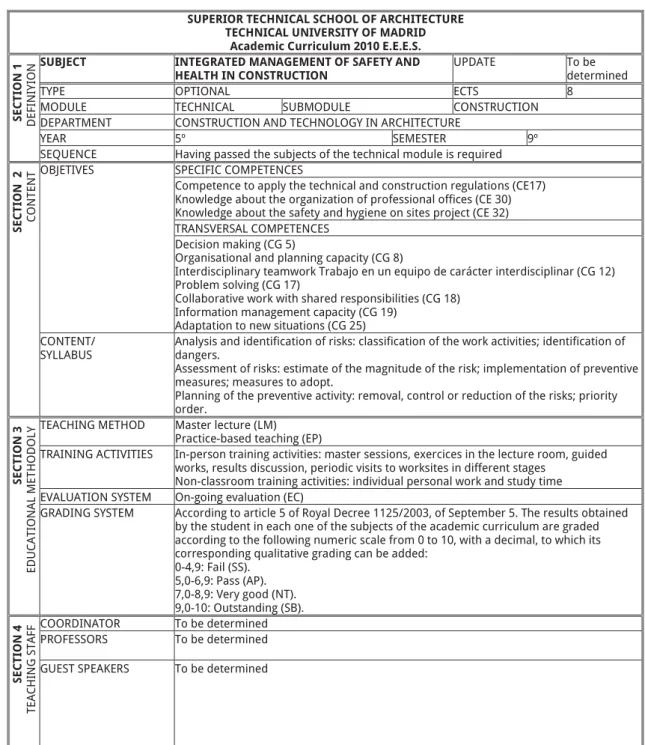
As shown, and as referred all along this paper, there’s no allusion whatsoever to the matter of occupational risks prevention or that of safety and health; therefore we propose a new subject to include within the curricular structure of the so-called optional subjects, whose content amounts to the minimum content of the training program in order to be able to carry out the functions of Safety and Health Coordinator in Contruction Sites and whose organisational, academic and educational structure, following the model of the Superior Technical School of Architecture of Madrid and therefore perfectly applicable to the rest of Spain, is as follows:
The general overview of specific and transversal competences is regulated by Law. There’s be a Section 5 concerning the quantitative training activities that we will not detail since it’s not a part of the current paper, but of merely academic aspects.
Conclusions
SUPERIOR TECHNICAL SCHOOL OF ARCHITECTURE TECHNICAL UNIVERSITY OF MADRID
Academic Curriculum 2010 E.E.E.S.
SEC TIO N 1 DEFI N IYIO
NSUBJECT INTEGRATED MANAGEMENT OF SAFETY AND HEALTH IN CONSTRUCTION UPDATE To determined be
TYPE OPTIONAL ECTS 8
MODULE TECHNICAL SUBMODULE CONSTRUCTION
DEPARTMENT CONSTRUCTION AND TECHNOLOGY IN ARCHITECTURE
YEAR 5º SEMESTER 9º
SEQUENCE Having passed the subjects of the technical module is required
SEC TIO N 2 CO N TEN
T OBJETIVES SPECIFIC COMPETENCES
Competence to apply the technical and construction regulations (CE17) Knowledge about the organization of professional offices (CE 30) Knowledge about the safety and hygiene on sites project (CE 32) TRANSVERSAL COMPETENCES
Decision making (CG 5)
Organisational and planning capacity (CG 8)
Interdisciplinary teamwork Trabajo en un equipo de carácter interdisciplinar (CG 12) Problem solving (CG 17)
Collaborative work with shared responsibilities (CG 18) Information management capacity (CG 19)
Adaptation to new situations (CG 25) CONTENT/
SYLLABUS Analysis and identification of risks: classification of the work activities; identification of dangers. Assessment of risks: estimate of the magnitude of the risk; implementation of preventive measures; measures to adopt.
Planning of the preventive activity: removal, control or reduction of the risks; priority order. SEC TIO N 3 ED UC AT IO NAL M ETH OD OLY
TEACHING METHOD Master lecture (LM)
Practice-based teaching (EP)
TRAINING ACTIVITIES In-person training activities: master sessions, exercices in the lecture room, guided works, results discussion, periodic visits to worksites in different stages
Non-classroom training activities: individual personal work and study time EVALUATION SYSTEM On-going evaluation (EC)
GRADING SYSTEM According to article 5 of Royal Decree 1125/2003, of September 5. The results obtained by the student in each one of the subjects of the academic curriculum are graded according to the following numeric scale from 0 to 10, with a decimal, to which its corresponding qualitative grading can be added:
0-4,9: Fail (SS). 5,0-6,9: Pass (AP). 7,0-8,9: Very good (NT). 9,0-10: Outstanding (SB).
SEC TIO N 4 TE AC HI NG STA FF
COORDINATOR To be determined
PROFESSORS To be determined
GUEST SPEAKERS To be determined