Facultad de Filosofía y Letras
MÁSTER DE PROFESOR EN EDUCACIÓN SECUNDARIA
OBLIGATORIA Y BACHILLERATO, FORMACIÓN PROFESIONAL Y
ENSEÑANZAS DE IDIOMAS
TRABAJO DE FIN DE MÁSTER
Teaching the Unteachable: Using Challenged Texts in
EFL Classrooms to Promote Values and Language
Skills
Marta Perrino Antúnez
Tutor: Sara Medina Calzada
Departamento: Filología inglesa
El presente trabajo está sujeto a una licencia de uso de Creative Commons de Reconocimiento
Literature has been contemplated throughout history as a possible means of language teaching;
nevertheless, it has not been completely established in EFL classrooms as contrary points of
view can be found regarding its implementation in the class, especially when referring to the
Spanish education system. The intervention proposal presented in this paper is aimed to assess
the value of including literary texts in the English teaching process as it has proven to reinforce
the learning experience of the students, allowing them to grow both academically and
personally. The relevance of selecting an appropriate writing that engages and motivates
youngsters will be crucial in order to fulfill the students’ needs and expectations, thus young
adult literature will be an adequate genre to appeal students since it speaks directly to them,
making them question their current vision of the world and society surrounding them. This is
expected to promote a critical thinking that prepares them to fight for a tolerant and respectful
society.
Keywords: literature, EFL teaching, language skills, values, culture.
RESUMEN
El uso de textos literarios como medio para la enseñanza de inglés como lengua extranjera se
ha contemplado a lo largo de la historia; sin embargo, no se ha establecido por completo, ya
que existen opiniones contrarias en cuanto a su integración en las aulas, especialmente en las
españolas. La presente propuesta tiene como propósito evaluar la valía de incluir textos
literarios en el proceso de enseñanza del inglés, ya que ha demostrado reforzar la experiencia
estudiantil de los alumnos, permitiéndoles crecer tanto académica como personalmente. Una
selección adecuada de textos que motiven a los jóvenes será determinante para cubrir las
necesidades y expectativas del alumnado; por lo tanto, la literatura dirigida a jóvenes adultos
será un género adecuado, dado que les afecta de forma directa, haciendo que cuestionen su
visión del mundo y de la sociedad que los rodea. Como fin último, se espera promover un
pensamiento crítico que los prepare para luchar por una sociedad más tolerante y respetuosa.
Palabras clave: literatura, enseñanza de inglés como lengua extranjera, destrezas lingüísticas,
1. Introduction ………...………..1
2. The EFL classroom………..3
2.1. The use of literature in the EFL classroom………..4
2.1.1. Benefits and disadvantages of using literature in teaching………....6
2.1.1.1. Literature in grammar teaching……….………9
2.1.1.2. Literature as a portrait of society………...…..10
2.1.2. The process of selecting adequate literary texts……….……… 11
3. Some previous studies on literature usage in English teaching…...………..14
4. Introduction to the intervention………....……….16
4.1.Context………..……….16
4.2.Objectives………...………17
4.3. Methodology……….……….23
4.3.1. Selected materials………..………..25
4.3.2. Tasks………..…………..27
5. Didactic proposal: Athletic Shorts….………..………..30
5.1. “A Brief Moment in the Life of Angus Bethune”………..30
5.2. “Telephone Man”………...………35
5.3.“In the Time I Get”……….………39
5.4. “Goin’ Fishin’”………...………45
6. Conclusion and further research………50
Works cited………..…52
1
1. INTRODUCTION
As one of the most spoken languages in the world, English is taught in classes of
almost every country. Classrooms, from primary to university education, are the spaces
destined to do so. However, teaching a language does not only involve teaching its grammar,
but also portraying the culture that is characteristic of English-speaking countries, since it is
indispensable to have some knowledge about the cultural background to communicate
successfully. Furthermore, the fact that education addresses directly to students who are
preparing both academically and personally to play a role in a community, makes teacher
responsible at some level of the social integration of these teenagers. Hence, the promotion of
proper values which allow students to shape their own thinking basing on respect and
tolerance, rejecting prejudices and fighting for a fair society.
Literature can achieve all those prompts. As literary texts are considered to be
authentic material, they can portray a faithful representation of reality, being the ideal resource
to use in the EFL classroom. This dissertation aims to propose an intervention plan which
covers all those previously mentioned areas, and that is intended to be applied in the first
course of Bachillerato. Secondary Education is indispensable for the growth of students, and
not only academically, but because of their age; teenagers will shape their personality during
those high school years, so presenting certain topics to them can be decisive for their future
behavior. Taking advantage of the versatility of literary texts, these issues that arise some
controversy can be treated in the EFL classroom by using “challenged texts”. The works under
this label have been banned in some institutions, e.g. high schools, or some countries since
the topics that they cover are considered to threaten the integrity of the students. Nonetheless,
what is thought to be dangerous is, indeed, the diversity that is found in our society, which
has to be respected and protected. Considering those topics menacing for teenagers only
distances them from the reality in which everyone is equal and valid. Following this line, the
objectives of the intervention plan will be: improving language skills attending to new lexicon
and already known grammatical structures, so they will not only learn new content but also
reinforce existing knowledge; promoting critical thinking by working with texts that are
familiar to the students, making them reevaluate their way of thinking and broaden their
minds, reminding them that they are part of a society thabt needs them to be in the side of
equality and respect towards others that may be different; and approaching students to the
2 Indirectly a taste for literary text is expected to emerge, making students interested in reading
not only as a compulsory past of their academic formation, but also outside the classroom.
In a broader sense, this dissertation tries to:
1. Present an alternative different from the traditional approaches that are followed
in the EFL classroom and explore the possibilities of introducing literature in
those classes, giving it a major role in order to encourage the students’ personal
and academic development.
2. Design a teaching proposal based on Chris Crutcher’s Athletic Shorts by which students are expected to assimilate both English grammatical aspects
(vocabulary and syntax) and ethical values that are useful for them in their lives,
opening their minds and preparing them for situations where lack of prejudice
is essential.
3. Improve and complete the teenagers’ learning experience with the employment
of other authentic resources —mainly for listening purposes—, so students will
be able to comprehend the usefulness of English in daily-life situations.
In order to accomplish those aims, the present paper will be divided into four main
parts. Section two will provide a theoretical background that result useful for the
substantiation of the didactic proposal, that is, the role of literary texts in the EFL classroom,
its benefits and drawbacks, and how they can be used to teach language and social values, as
well as which criteria should be followed to choose appropriate texts to present in the English
class. Following these contents, a selection of works dealing with the same topic that occupies
us will be mentioned, that is, using literature in EFL teaching. The fourth section will be
introducing the intervention plan, going through all the aspects that were taken into account
to design the proposal, such as the context and the methodology that were used. Next, in
section five the complete proposal will be explained, specifying everything that is required to
carry it out successfully (an appendix with all the necessary material can be found at the end
of the paper). To conclude, some final consideration about the use of literary texts in the
3
2. THE EFL CLASSROOM
Language is the basic system used for human communication; therefore, it seems
logical that governmental institutions support foreign language learning among the population
through their education systems. Primarily, and as seen in figure 1, English is one of the most
used languages to communicate worldwide, being present in every school and high school in
our country (i.e. Spain) to help them develop their communicational skills and, consequently,
improve their future academic and professional development.
Figure 1: Most spoken languages in the world (Statista, 2019)
For the purpose of this paper, English will be considered as a foreign (EFL) rather
than a second language (ESL) due to the fact that, as Broughton, Brumfit, Flavell, Hill and
Pincas state (1993, p. 6) in our context Spanish is “the normal medium of communication and
instruction: the average citizen does not need English or any other foreign language to live his
daily life”. Moreover, many Spanish students learn French or German in high school instead
of the language in question. Also, many teenagers are foreigners so their second language may
be Spanish. Thus, throughout this project we will refer to English classes in Spain as EFL
classrooms.
Language is alive and it is constantly evolving; students of English should work on
4 reading, and writing. To improve in these areas, many strategies can be followed, but if they
should have something is common, it is the intention to motivate learners. Fulfilling this
purpose partially relies on using the correct materials to conduct a class. This paper will be
focused on the use of literature in the EFL classroom.
2.1. THE USE OF LITERATURE IN THE EFL CLASSROOM
Traditionally, the main reason why people learnt English was so that they could
understand literary works that were originally written in this language (Broughton et al.,
1993). Therefore, reading English literature was seen as a goal, not as a tool to learn the
language. Also, literature was used as part of the Grammar Translation method since those
texts were considered faithful examples and demonstrations of grammatical rules (Bobkina
and Domínguez, 2014). With this approach, the content of the text was not relevant, there was
just a linguistic intention in the use of literature for teaching purposes.
The investigation dealing with the use of literary texts in the EFL classroom
continues until the twentieth century, when literature is excluded from these language classes
as it was claimed by many experts that it did not contribute to the language skills improvement
that teachers wanted to achieve during their sessions. This non-literary system was carried out
until the mid-1980s. Bobkina and Domínguez (2014) affirm that there was a social alarm;
students lacked both knowledge and language skills, even though the aim of scholars was
enhancing these areas. It was at this point when the role of literature in the English teaching
experience was taken into account again; perhaps the inclusion of literary texts was, indeed,
what foreign language education needed to success at its aspirations.
In the last 20 years, literary and cultural theories have experienced a great expansion
in the education fields, and “the reading of culturally authentic texts, has become one of the
central claims for curriculum reform in EFL teaching” (Bobkina and Dominguez, 2014, p.
248). Nonetheless, nowadays, the use of literature throughout the teaching process is
something that has not been fully or correctly established yet in the EFL classroom, at least
when dealing with the Spanish education system, in which the teaching of the English
language focuses mainly on the use of theoretical explanations and grammatical exercises; in
the words of Shaukat, “the role of literature within the mainstream of EFL/ESL is still not
5 order to check the students’ reading comprehension by means of a test; however, all its
possible applications have yet to be fully explored in the everyday classroom. Ortells supports
this line of thought concluding that:
Although it is generally accepted that literature plays a critical role in our lives by helping
us reflect on ourselves and the world, it is still one the most underrated subjects of study in
schools, especially when it comes to its use as a tool for the teaching of English language
in the EFL context (2013, p. 91).
Up to this point, one question arises. What do we understand by “literature”? In a
broad sense, literature is defined as “written artistic works, especially those with a high
and lasting artistic value” (Cambridge Dictionary), thus various types of genres can be found
within this field such as novels, poems, as well as song lyrics or even newspaper articles. In
this line, Mc Rae (1994) clarifies this concept, which can arise some controversy, and
differentiates two types of literature:
- “Literature” (capital L): this classification includes exclusively classical or
canonical texts; that is, pieces of writing considered to be of a great quality or whose
author is well-known.
- “literature” (small l): this subdivision refers to more popular writings. Here we
could include the rest of genres that are not identified as belonging to the canon
(e.g. articles or song lyrics).
The intervention that is proposed in subsequent sections will deal with the use of
“Literature” in the EFL classroom; however, texts conveyed within the “literature” category
would be equally useful depending on the teaching purpose.
Nevertheless, the implementation of literature cannot only be treated from one
perspective, but it can be approached in three different ways if following Lazar’s classification
6 Table 1: Approaches regarding the use of literary texts according to Lazar (1993)
APPROACH DEFINITION
Language-based approach If used appropriately, literature can be used to
develop language skills, and a “detailed analysis
of the language of the literary text will help
students to make meaningful interpretations or
informed evaluations of it” (p. 23).
Literature as content This approach is based on the explanation of
literary content as such, i.e. the history
surrounding the text or the author.
Literature for personal enrichment The personal enrichment perspective focuses on
the ability of the students to make concrete the
abstract concepts that appear in literature and
relate them to their personal experiences,
growing and learning from them.
2.1.1. BENEFITS AND DISADVANTAGES OF USING LITERATURE IN
TEACHING
Although there are some authors who doubt the effectiveness of using literary texts
to teach a foreign language, there are many benefits that have been contemplated by several
scholars. In this subsection, both the main advantages and disadvantages will be analyzed. In
the first place, it has to be stated that there is not an infallible theory, so both benefits and
withdraws should be borne in mind when incorporating literary texts into EFL classrooms.
On the one hand, authors such as Lazar (1993) and Paran (2008) shed some light
on the advantages that literature offers when used appropriately. We can find the following:
I. Basing lessons on literary works means using authentic material. Learners can
observe different patterns of the English language.
II. Working with pieces of writing may improve the intuitive abilities of the learners. If
facing any kind of unknown language, they can infer its meaning by the context
provided.
III. It provides social and cultural context. Literature is the perfect tool to captivate
students and introduce new lifestyles to them. Hall (2005, p. 55) shares this vision,
7 access to this English-using culture”. These types of texts are capable of portraying
a reality and bringing it closer to the students.
IV. Reading literature can be an engaging activity. As motivation is one of the main goals
of English —or any field of— teaching, stories may activate their creative capacity
and increase their interest in topics that they would not care about otherwise.
V. Finally, it can be used as a means of teaching students some values; in the words of
Ortells (2013, p. 94) “literature in the context of the EFL classroom is not only a tool
to teach communicative skills but also a cross-curricular element in learners’
education”.
Dealing with the benefits of using literature as a tool for English teaching purposes,
Maley (1989) mentions the positive characteristics we can see below:
VI. Universality: literary texts offer diverse plots that can be significant to every reader
since it deals with universal themes that are shared by all cultures, such as love, death
or tragedy.
VII. Non-triviality: this aspect refers to the capacity of literature to provoke a response:
nobody is indifferent. The point of this argument is that people react to what takes
place in a literary text, they have their own point of view, opinion and expectations
of what is happening in the story.
VIII. Personal relevance: in order to make learners enjoy the text they are provided with,
it has to be related to their interests; they will enjoy reading if the story that is being
told speaks directly to them, getting into the world they live in.
IX. Variety of themes: as it is said, variety is the spice of life. Literature conveys a great
variety of genres and topics that may be appealing to different readers. Not being
restricted to a unique storyline makes literary texts appropriate for different types of
readers and diverse situations, as there will always be a text covering the subject one
is interested in.
X. Imagination: realistic or fictional stories are the key to the stimulation of creativity.
Literature can implicate the reader in the plot and allow them to use freely their
imagination. Students are able to recreate the story in their minds.
XI. Ambiguity: this last benefit is closely related to the exploitability that can be granted
to literature. Each text portrays a unique plot and the reader can approach it from a
different point of view; it may be interpreted in numerous ways depending on the
8 dealing with personal evaluation of the writings, such as opening up a debate or
inventing alternative endings.
On the other hand, as authors such as Edmondson (1997) state, the use of literature in the EFL
classroom can imply these disadvantages:
I. Even though it has been mentioned as a benefit, not every teenager has developed a
taste for literary texts, so the idea of reading as a means of learning might not be as
appealing for them as it could be for the rest of students. Furthermore, it is virtually
impossible to select a text that everyone likes.
II. The level of difficulty, as well as the reading interest, may vary depending on the
learner. A teacher has to bear in mind that the English proficiency of each of their
students is not going to be the same. Once again, students may be demotivated for
not understanding the text.
III. In many cases, the reality that is portrayed in the writings has been modified, so it
may not be completely trustful for the students, creating in their minds a wrong idea
of a certain culture, or even an image that has been influenced by the author’s own
point of view.
IV. Lack of time to introduce this type of teaching in the EFL sessions. This problem
finds its explanation in the curriculum and the non-explicit obligation for the teachers
to use literary resources. As the curriculum is the foremost guide for teachers, they
tend to accomplish the objectives it conveys by means of a regular English textbook.
V. Ortells (2013) addresses what she considers a decisive drawback: the insufficient
formation of English teachers in the literary field. According to the author, this lack
of instruction would affect the way educators treat the subject and “their attitudes
towards the issue” (p. 95). This situation would result in an inefficient use of literary
material, or in the decision of not using literature in any sense.
VI. Some cultural issues can also entail a difficulty for the reader. The lack of awareness
about other cultures different from that of the learner may signify a difficulty and
eventually disrupt the correct understanding of the text. This problem can be avoided
providing students with information about the culture of English-speaking countries.
VII. Syntax and vocabulary also establish a barrier between some learners of English and
literary texts. In addition, the use of some grammatically incorrect words can be
9 way (e.g. “she don’t” instead of “she doesn’t”). As will be seen in section 2.1.2, this
issue can be dealt with so that students feel confident when facing a challenging text.
VIII. Even though it was seen as an advantage, the reality that is reflected in the story may
be influenced by the view of the author, modifying it according to their personal
beliefs.
IX. The last disadvantage is found in the difficulty that arises when facing text selection.
The teacher must be careful choosing the piece of writing they are going to ask their
students to read. The elements to take into account in this selecting process will be
developed in section 2.1.2.
As the focus of this paper will be on the use of literature to promote both the
academic and personal growth following a personal and linguistic model, the following
subsections will deepen in the use of literary texts in order to work on those two aspects.
2.1.1.1. LITERATURE IN GRAMMAR TEACHING
Although there are some researchers who dissent from the opinion that literature is,
indeed, helpful to teach such skills, other scholars, as mentioned above, support its utility
starting by the premise that literary texts, as any piece of writing, is based on language. Stories
are brought to the readers in form of words, so it is essential that they are able to understand
them, or at least, get a glimpse of what they could mean. Fenn and McGlynn (2018) have
explored this teaching approach in their work, providing a useful guidance on how to use
literature to teach grammar. Grammar, for the purposes of this research paper, is exclusively
related to vocabulary, morphology and syntax, and literary texts convey these aspects. As an
authentic material, literature is supposed to provide readers with English input that reflects the
correct use of the language; that way, students can naturally improve their proficiency
In the eyes of EFL learners, grammar is the most tiring part of the language learning
process, and “studying grammar as an abstract concept may give children the theory, but in
our experience it does not help them understand how to actually apply this theory in practice”
(Fenn and McGlynn, 2018, p. 1). Instead of working with a set of theoretical rules, the learner
is provided with practical and realistic English input which will enrich their linguistic
competence. For this reason, the supporters of the use of literature as a tool to learn the
10 - In the case of syntax or grammatical structures, seeing the same pattern repeated
numerous times may familiarize the learner with it; e.g. the structure TO BE +
PAST PARTICIPLE could be assimilated by reading passive sentences.
- Taking into account vocabulary, students can see real instances where terms that
they already know are used, or learn new words inferring their meaning by the
context or by looking them up in a dictionary.
2.1.1.2. LITERATURE AS A PORTRAIT OF SOCIETY
Among the many advantages that can be found in the use of literature for teaching
purposes, the most important for the personal growth of the students is that related to culture.
Literary texts offer the possibility to understand one’s own culture by means of learning about
others. This approach should be dealt with in consonance with other perspectives, as the
traditional one, which focuses on the appreciation of literature as such, and the linguistic
approach, which is one of the uses literary text can have if applied to an EFL classroom
(Shaukat, 2013). If we only pay attention to these two perspectives, the student will be lacking
an important part of the language learning experience, which is acquiring knowledge about
cultural aspects.
Literature, as any artistic conception, has its origin in society, as it is created by
people who are living in a determined period of time with specific social standards, and
affected by their life conditions and their personal circumstances. In consequence, many
different ideas will be found in those stories, and the reader has to face the text with an
openminded perspective. As Brumfit notes, “the fundamental ability of a good reader of
literature is the ability to generalize from the given text to either other aspects of the literary
tradition, or personal or social significances outside literature” (1985, p.108). This is the main
contribution of literature: transcending the limits of fiction and being applicable to real
situations; it is capable of conveying and portraying a society, its values and customs.
As seen throughout this section, there are some aspects of employing literary texts
in an EFL classroom which can be improved. After noticing these downsides, some solutions
should be proposed in order to facilitate the didactic labor so literature can be effectively used
11
2.1.2. THE PROCESS OF SELECTING ADEQUATE LITERARY TEXTS
In this section, one of the most important and controversial aspects of including
literature to the EFL classroom will be addressed. As seen in section 2.1.1., selecting an
appropriate text to work with the students is an arduous task, as many aspects shall be taken
into account if the teacher wants the experience to be successful and rewarding for the student
at an academic and personal level. Some variants to bear in mind while choosing a literary
text for teaching purposes are discussed below.
Before compiling all these elements, it has to be noted that the student and their
circumstances have to be considered in the first place. Bobkina and Domínguez remark that
the main focus should be on the learner, not on the text, as they are the protagonists of their
learning journey, and this is not possible exclusively using the textbooks that are designed for
EFL classrooms (2014).
The age of these youngsters will be essential to choose the right literary text as it is
closely related to other factors such as their interests, motivations and their level of
expertise. As a general rule more mature themes are relevant for them as they grow up, as
well as their proficiency in a foreign language increases. Therefore, the teacher can introduce
more adult contents as the students are closer to Bachillerato courses along with an increase
in the difficulty of the grammar that appears in the story. The main theme of the literary text
has to do with the motivation the students will demonstrate towards the writing since “in a
foreign language, learners might react well to literature that had been written specifically for
their own age group” (Paran, 2008, p. 488). This reaction, as Ortells notes, is expected to occur
by implementing Young Adult Literature (YAL) (2013, p. 94) since it will address directly
teenagers’ interests and lives.
However, it must be considered that not all students from the same class will have
the same level of expertise in the linguistic area, so the learner’s specific needs should be
covered somehow by means of the adaptation of materials, for instance, if the teacher and the
students find the text too difficult mainly in terms of language. In order to avoid this type of
situations, Lima highlights the necessity to give students texts of an appropriate level
according to all those discussed factors, being the ideal writing the one that finds a balance
being easy enough to be understandable and not hindering their reading process and being
12 The length of the text is another source of conflict for EFL teachers. On the one hand,
a long text that has not been reduced in any way may demotivate students as they may spend
too much time reading it. On the other hand, a shortened or adapted text tends to lose important
information, so the context may not be enough for the learners, leading as well towards an
inattentive behavior; if there is oversimplification, the text results in something similar to what
they have been reading through their school days, arising no interest, and being useless (Hall,
2005). Kirkness and Neill consider this idea, supporting the usage of rather short texts, adding
that
the length and complexity of many sentence structures is a challenge for the reader […].
Readers need to summarise and synthesise old and new information and the writers assume
the reader’s prior knowledge (e.g., the expectations of conference clients as well as
educational terminology)(2009, p. 9).
The cultural backgrounds, both the one of the learners and the one portrayed in the
text, are crucial for the acceptance of the text and the relevance of the role they are going to
play in the students’ lives; for this purpose the chosen text should deal with modern and
meaningful issues for the learners. A new system of ideas and beliefs is going to enter their
world, and it is by reading that they are going to broaden their limits and learn to be more
tolerant. Thus, indirectly, their critical thinking is being fomented by raising awareness of
their own culture and the discovery of new ones. Bobkina and Domínguez also cover this
aspect of literature in English teaching noting that these cultural approaches create bridges
between cultures, bringing both systems together (2014).
Lastly, the exploitability of the text shall be a decisive factor when selecting a
literary text. Once the teacher has set the goals they want to achieve during those sessions,
they have to plan how they are going to fulfill them. A text that can be treated from many
perspectives will be more suitable that one that lacks exploitability. Apart from the main
activities, the supplementary ones that can be introduced into the EFL class should be coherent
and challenging for the learners, making them evolve academically and personally. Two of
the most known complementary activities are role-plays and discussions:
a) Role-play is a useful tool to ease the English learning process, as it engages the
students by asking them to take action in the story (Liu and Ding, 2009).
b) Discussions are related to the communicative approach, as students have to be
capable not only of reflecting their linguistic abilities, but also of doing it
13 As seen throughout these sections, the incorporation of literature as a resource in
EFL teaching has gained popularity over the last years; however, much work and research on
the topic is yet to be made so that literary texts can be used to improve learners’ linguistic and
personal skills.
In the next section, some studies and proposals dealing with the use of literature as
14
3. SOME PREVIOUS STUDIES ON LITERATURE USAGE IN ENGLISH
TEACHING
The educational field is constantly changing in the sense that new methodologies
or approaches are integrated as the students’ necessities vary. The main aim of the education
community is to motivate students and help them obtain better results. The use of literature as
an instrument in language teaching has been discussed by many researchers in the field, most
of them coming to the conclusion that is beneficial for the students’ learning process. Even
though there are many studies dealing with the use of literature as a tool for English teaching,
a comprehensive literature review on the topic will not be provided. However, the following
three works illustrate three different approaches to the topic:
Floris (2004) studies the possible applications of literary texts in the Indonesian
EFL classroom, previously going over the benefits and the difficulties that teachers may find
through this task; nonetheless, she gives some pieces of advice to overcome those
complications and achieve better results. Her proposal is based on a specific genre, poetry,
more specifically on “A Child’s Sandal” (1998) by Agnes Lam. Floris suggests the application
of a “student-centered approach” (2004, p. 7). A total of five tasks are suggested in order to
increase the English input that students receive:
- Task 1: students are asked to guess the content of the poem just by reading the title;
next they will compare their answers.
- Task 2: their previous hypothesis will be checked reading the original text.
- Task 3: some questions about the narrative style of the text will be commented.
- Task 4: students are asked to relate the content of the poem to their personal
experience (parental role and responsibilities).
- Task 5: a traditional writing exercise is proposed to the class in which they have to
follow a rigid structure answering the questions indicated by the teacher.
In her final dissertation, Ferreres (2018) deals with the same issue of this
dissertation, the role and applicability of literature in Spanish EFL classrooms. Seven sessions
are proposed –and put into practice– for 4th course of E.S.O. (Secondary Education) using
15 aspects in which literary texts can be used for language teaching. Also, the author provides
some rubrics that can be used for the assessment of the suggested activities.
Finally, Losada (2015) introduces technology to the discussion. He bases his
intervention on the increasing influence that electronic devices have over teenagers nowadays.
Using WebQuest, a task-oriented webpage, he aims to introduce fantasy literature to EFL
classrooms in a Spanish context. Also addressing 4th courses of E.S.O., Losada proposes an
adaptation of an excerpt from “The Traditions of Karzh”, a short story written by Paula
Volsky, for the process of English teaching during seven sessions, including the final task.
This way, students not only have to test their language proficiency, but also their digital skills.
Even though all these projects deal with the same subject, each one approaches it
from a different perspective or considering diverse improvements (e.g. varied models, genres,
the digital competence). These three authors come, however, to the same conclusion: the
implementation of literature in the English learning process is necessary if not mandatory,
since it attempts to increase the students’ language competence at the same time they reflect
on culture and values.
In the next section, an intervention plan will be proposed taking into account the
16
4. INTRODUCTION TO THE INTERVENTION
Section four will be devoted to the proposal of an implementation plan for
Secondary Education after taking into consideration the aspects mentioned in the previous
sections of this paper. In order to analyze this teaching project, this section will be divided
into three main parts: the objectives of the intervention, the methodology used to carry it out,
and the sessions proposed to introduce literature in the EFL classroom.
4.1. CONTEXT
This intervention plan is designed to be put into practice in a public high school in
Castilla y León, as it will be based on the curricular contents appearing in the
ORDEN EDU/362/2015, which contains the evaluation criteria, contents and learning
standards that must be followed by every Secondary Education institution that is found in any
part of the region. Furthermore, this project is not aimed at being implemented in bilingual
programs, although it can be adapted to them.
Concerning the students to whom this proposal is addressed are those taking the
first course of Bachillerato. The reasons behind this choice are varied. First, the youngsters
that are in Bachillerato have made the decision to continue their studies, as it is not mandatory
to study further courses than 4º E.S.O. This fact –although there always are exceptions– leads
us to think that they are somehow curious about some subjects, know the importance of
learning English for their future careers, and that they are responsible and mature enough to
complete the tasks. Even though this proposal could also be applied to the second course of
Bachillerato, the pressure of the EBAU (Evaluación de Bachillerato para el Acceso a la
Universidad), the series of exams they have to take so that they can go to University, makes
students reluctant to practice something that they are not going to be evaluated about, and,
also, educators prefer to pay attention primarily to grammar and vocabulary exercises, so their
17
4.2. OBJECTIVES
As a result of the use of literary texts in the EFL classroom, the two and most
important general aims of this project are to improve students’ proficiency in their foreign
language —in this case, English— and to enable them to work on ethical matters, that is, to
manage their feelings and values. If applied, this intervention is expected to fulfill those goals.
Concretely, these aims can be broken down into the following prompts:
Regarding the students’ academic formation:
1. Enriching students’ lexicon. By reading and working with the chosen stories, they
will be expected and required to assimilate new topic-related vocabulary thought to
be useful for everyday communication.
2. Reinforcing already seen grammatical structures. The suggested texts will contain
syntax that is known by the students, whether for the simplicity of the structures or
for the level of the class.
3. Improving the communication skills of the students by suggesting activities which
reinforce the four language competences: speaking, listening, reading and writing.
4. Providing learners with authentic material. As seen in subsection 2.1.1., one of the
benefits of using literature for language teaching purposes is that students are
provided with “real” language, not the carefully selected input that they tend to see
throughout their English learning journey, for instance, the graded readers —stories
intentionally written for learners of English depending on their proficiency.
In respect of personal development:
5. Promoting values which prepare students to face social circumstances that require
tolerance and avoid prejudices. All the short stories that have been selected deal
with certain universal topics present in all the current worldwide societies.
6. Broadening teenagers’ minds by discovering new cultures, and, consequently, new
lifestyles, customs, and beliefs. The students will enjoy the plots portrayed in the
stories as they can connect at a personal level with the characters, and, in that way,
they will learn points of view different from theirs.
7. Encouraging the reading of literary texts both inside and outside the classroom. If
18 they had not experienced before, or, in the case they already enjoyed reading, they
may be curious about other genres or themes, eventually reading outside the
academic context and doing it for pleasure.
When it comes to curricular terminology, the BOCYL states that one of the leading
aims of English teaching is providing students with a means of communication, learning and
personal growth (2015). Overall, English language has to personally enrich the students so
that they are interested in other cultures different from their own; in consequence, making
their life fuller (ORDEN EDU/362/2015). Although there are no many explicit references to
the specific use of literary texts, as can be observed, many of the outcomes that are proposed
can result from the introduction of this type of texts into the EFL classroom. The government
gazette not contemplating the application of literature as a tool to learn the English language,
is one of the main causes why teachers decide not to include it in their syllabus, as language,
culture and values may be taught through other means. Nonetheless, on many occasions, this
is not the case, and students finish course by course without learning basic concepts they
should acquire.
According to the ORDEN EDU/362/2015, the contents, the evaluation criteria and
the learning standards belonging to each of the four competences (listening, speaking, reading
and writing) to be achieved with this proposal are shown in table 21.
19 Table 2: Contents, evaluation criteria and learning standards selected for the intervention (BOCYL, 2015).
Contents Evaluation criteria Learning standards LISTENING
Movilización de información previa sobre tipo de tarea y tema (p. 32785).
Inferencia y formulación de hipótesis sobre significados a partir de la comprensión de elementos significativos, lingüísticos y paralingüísticos (p. 32786).
Convenciones sociales, normas de cortesía y registros; costumbres, valores, creencias y actitudes (p. 32786).
Aspectos socioculturales y sociolingüísticos de las comunidades donde se habla la lengua meta (p. 32787).
Identificar las ideas principales, información relevante, hilo conductor o trama, e implicaciones generales de textos de cierta longitud, bien organizados y con estructuras lingüísticas de cierta complejidad, en una variedad de lengua estándar y articulados a velocidad media o normal (p. 32785-6).
Conocer con el suficiente detalle y saber aplicar adecuadamente a la comprensión del texto los aspectos socioculturales y sociolingüísticos relativos a situaciones cotidianas (p. 32786).
Reconocer léxico oral común y más especializado, relacionado con los propios intereses y necesidades en el ámbito personal (p. 32787).
Comprende, en una conversación informal o una discusión en la que participa, tanto de viva voz como por medios técnicos, información específica relevante sobre temas generales o de su interés, y capta sentimientos como la sorpresa, el interés o la indiferencia, siempre que los interlocutores eviten un uso muy idiomático de la lengua y si no hay interferencias acústicas (p. 32786)
Comprende los puntos principales y detalles relevantes en […] temas de interés personal o de su especialidad (p. 32787).
SPEAKING
Concebir el mensaje con claridad, distinguiendo su idea o ideas principales y su estructura básica (p.32787).
Apoyarse en y sacar el máximo partido de los conocimientos previos (p. 32788).
Construir textos coherentes y bien estructurados sobre temas de interés personal, o asuntos […] en un registro […] neutro o informal, utilizando adecuadamente los recursos de cohesión más comunes, y mostrando un control razonable de expresiones,
20 Definir o parafrasear un
término o expresión (p. 32788).
Léxico oral común y más especializado, dentro de las propias áreas de interés en el ámbito personal (p. 32789).
estructuras y un léxico de uso frecuente (p. 32787).
Ser consciente de los rasgos
socioculturales y sociolingüísticos salientes de
las comunidades en las que se utiliza la lengua meta, y de sus diferencias con respecto a las culturas propias, relativos a costumbres, usos, actitudes, valores y tabúes, y actuar en consecuencia, adaptándose adecuadamente a las características de los interlocutores y de la situación comunicativa en la producción del texto oral (p. 32788).
Conocer, y saber seleccionar y utilizar, léxico oral común y más especializado relacionado con los propios intereses y necesidades en el ámbito personal (p. 32788).
Participar con eficacia, aun cometiendo errores, en actividades de interacción oral dramatizadas tales como simulaciones globales, juegos de rol, etc., de larga duración, disponiendo de la posibilidad de preparar y gestiona su participación en las mismas (p. 32789).
cuyas ideas principales estén explicadas con una razonable precisión, y responde a preguntas complementarias de la audiencia formuladas con claridad y a velocidad normal (p. 32787).
21 explica y justifica sus opiniones y proyectos (p. 32788).
READING
Movilización de información previa sobre tipo de tarea y tema (p. 32789).
Formulación de hipótesis sobre contenido y contexto (p. 32790)
Convenciones sociales, normas de cortesía y registros; costumbres, valores, creencias y actitudes (p. 32790).
Intercambio de información, indicaciones, opiniones, creencias y puntos de vista (p. 32790).
Léxico escrito común y más especializado relativo a […] historia y cultura (p. 32791).
Léxico básico de las materias de la modalidad de bachillerato cursada (p. 32791).
Identificar las ideas principales, información relevante e implicaciones generales de textos de cierta longitud (p. 32789).
Conocer con el suficiente detalle, y saber aplicar adecuadamente a la comprensión del texto, los aspectos sociolingüísticos derivados de situaciones cotidianas y menos habituales en el ámbito personal, […] y los aspectos generales que permitan comprender, en su caso, el trasfondo sociocultural del texto (p. 32790).
Reconocer léxico escrito común y más especializado relacionado con los propios intereses, y necesidades en el ámbito personal (p. 32790).
Comprende instrucciones de una cierta extensión y complejidad dentro de su área de interés o su especialidad, siempre que pueda volver a leer las secciones difíciles (p. 32789).
Sigue sin dificultad la línea argumental de historias de ficción y de novelas cortas claramente estructuradas, de lenguaje sencillo y directo, en una variedad estándar de la lengua, y comprende el carácter de los distintos personajes y sus relaciones, cuando unos y otras están descritos claramente y con el suficiente detalle (p. 32790-1).
WRITING
Movilizar y coordinar las propias competencias generales y comunicativas con
el fin de realizar eficazmente la tarea (p. 32791).
Localizar y usar adecuadamente recursos lingüísticos o temáticos (p. 32791).
Convenciones sociales, normas de cortesía y registros; costumbres, valores, creencias
Escribir, en cualquier soporte, textos de estructura clara sobre una serie de temas generales y más específicos relacionados con los propios intereses o especialidad, haciendo descripciones con el suficiente detalle; redactando en palabras propias, y organizando de
manera coherente, información e ideas extraídas
de diversas fuentes, y justificando las propias opiniones sobre temas generales, o más específicos,
22 y actitudes; lenguaje no verbal
(p. 32792).
Narración de acontecimientos pasados puntuales y habituales, descripción de estados y situaciones presentes, y expresión de predicciones y de sucesos futuros a corto, medio y largo plazo (p. 32792).
Intercambio de información, indicaciones, opiniones, creencias y puntos de vista, consejos, advertencias y avisos (p. 32792).
utilizando elementos de cohesión y coherencia y un léxico de uso común, o más específico según el contexto de comunicación (p. 32791).
Ser consciente de los rasgos
socioculturales y sociolingüísticos salientes de
las comunidades en las que se utiliza la lengua meta, y de sus diferencias con respecto a las culturas propias, relativos a costumbres, usos, actitudes, valores y tabúes, y actuar en consecuencia, adaptándose adecuadamente a las características de los interlocutores y de la situación comunicativa en la producción del texto escrito (p. 32792).
Conocer, y saber seleccionar y utilizar, léxico escrito común y más especializado (p. 32792).
asunto y sobre futuras líneas de actuación (p. 32792).
[…] transmite información e ideas sobre temas abstractos y
concretos, comprueba información y pregunta sobre problemas y los explica con razonable precisión, y describe, de manera detallada, experiencias, sentimientos, reacciones, hechos, planes y una serie de temas concretos (p. 32792).
As can be seen in the table, all the competences rely on lexical and cultural aims;
however, explicit allusions to the development of personal growth cannot be found. For this
proposal three main controversial topics will be dealt with the students: parenting, racism and
homosexuality.
If we bear in mind the competences established in the Real Decreto 1105/2014 (2015),
23 a) Linguistic communication.
b) Digital competence.
c) Learning to learn.
d) Social and civic competences.
e) Sense of initiative and entrepreneurship.
f) Cultural awareness and expressions.
As has been seen, the perfect harmony between three variants, i.e. language, personal
growth and cultural awareness, will be the pillars of this intervention plan. To obtain the
results coming from the objectives set in this subsection, we have to think about the best way
related to how to present the materials; this will be discussed through the next part of this
paper.
4.3. METHODOLOGY
How materials are presented in class are as important as, or even more than, the
established objectives. A good and democratic environment is essential for the wellbeing and
the progress of a lesson, so the methods that will be used throughout the intervention plan
must work on those aspects. The two main methodologies that are going to be followed to
create the intervention plan are those below.
In the first place, the activities will be organized attending to what Jeremy Harmer
named the ESA pattern: Engage, Study and Activate. According to this method, during a
session, the students should go through those three phases in order to assimilate what is being
presented to them (1998).
- The first stage, Engage, should include games or activities that motivate students,
showing them something that draws their attention to the explanation of the teacher;
if possible, something funny or interesting, for example a short clip of The Simpsons
ora recent news that arises controversy. This phase should be somehow introducing
the content that is going to be seen at the following stage.
- The second step is Study. As can be expected, in this stage the theoretical content
that needs to be explained should be included; however, the explanation should not
24 - Lastly, the Activate stage is devoted to the practical use of what they have learnt
during the previous stages. Therefore, activities have to be designed so the abstract
concepts become concrete and are put into practice.
The stages on which we will focus are the first and the third ones, since the Study
part should be done at home, i.e. reading the passages that are established in the proposal.
Moreover, it is necessary that the students feel that their ideas are being heard and their
points of view, respected. Students will be required to express themselves by the two active
competences, i.e. speaking and writing, so that they improve their language skills at the same
time they interact at a more personal level using a foreign language, English, and this will be
done following the communicative method. Ideally, communication will be the basis of the
teaching-learning process, and that means that the teacher’s role will be to encourage the
students to produce linguistic output and use this foreign language to interact with the learners.
It will be carried out in three different ways:
1- Student – Student interaction.
2- Teacher – Student interaction.
3- Student – Teacher interaction.
With the purpose of introducing other type of activities to the intervention plan that
takes into account students requiring special attentions, such as ADHS, some dynamic
activities based on the Total Physical Response (TPR) method will be included. The principle
founding this methodology is that the movement as a reaction to oral or written input is useful
for helping the students assimilate and remember the content, mainly in language related
subjects.
The need of including more than one methodology relies on the variety of students
that can be found in a single class. There should be no fear to introduce as many approaches
as necessary in order to obtain the best results from the learners.
Next, the literary texts chosen for the proposal that occupies us will be presented in
25
4.3.1. SELECTED MATERIALS
One of the main purposes of this intervention plan is to work on personal-growth
aspects and the arising of cultural awareness with the students. For this cause, the literary text
selected has to portray reality as it is, bittersweet sometimes, and the characters appearing in
the story had to be relatable to the pupils. Young Adult Literature (YAL) encompasses this
aspect whilst being presented in an authentic format, including real language. After
researching on the topic, Athletic Shorts by Chris Crutcher is selected work as it conveys all the requirements established for the selection of the literary text. Crutcher is well-known for
his stories, portraying teenagers in the crucial years of their life facing difficult situations that
can be easily related to nowadays youngsters. In addition, all the stories are written in first
person, which enables the reader to establish a strong connection with the protagonists. Thus
teenage readers can relate to what they are reading. Verisimilar stories are enticements to
engage students, and, hopefully, they will teach them how to cope with some situations and
learn from the mistakes of the main characters. Which is characteristic of all of them is that
Crutcher’s characters grow up as the story comes to an end, when they finally accept the
circumstances which they have to live and respect others’ lifestyles and beliefs.
Athletic Shorts is a compilation of six short stories written in 1991. Even though it may seem outdated a priori, considering the date it was published, the writing is modern, and the
issues treated are still transcendent nowadays, some of them even being cause of social revolts
and protests. The text has been catalogued as challenged or banned in some American States
as it contains obscene vocabulary and it treats topics that are considered to be dangerous for
the children or the teenagers as homosexuality. The reason why challenged texts were chosen
is because they deal with everyday issues, illness, or social problems that students must be
aware of to elaborate their own point of view; avoiding talking about these topics just makes
them seem “prohibited” in some way, and leaves learners uninformed. Although there are six
stories in total, only four of them will be used in the EFL classroom:
a. “A Brief Moment in the Life of Angus Bethune”
This is the first story of the compilation. It introduces Angus Bethune to the reader, a
fat kid that has always been picked on by his classmates. His parents divorced and married
again with different people. Both discovered that they were homosexual, so Angus ended up
having two fathers and two mothers; another reason why their mates disturbed them. Through
26 Angus gets closer to the girl of his dreams, who also struggles with bulimia. Hence, varied
themes going from sexuality to eating disorders are treated in this text, complicated issues for
people their age.
b. “Telephone Man”
The protagonist of this plot is a kid known as “Telephone Man” as his main hobby
deals with these electronic devices. Racism is the main basis of this text; “Telephone Man” is
strongly influenced by the racist ideals of his father, who is always talking about how black
and Chinese people ruin everyone they come across. The kid starts realizing his father does
not have any reasons to hate people just for their skin color, being black kids the only ones
that stood for him when others wanted to pick on him, and questioning his father’s statements
or beliefs is one of the hardest things he has to do.
c. “In the Time I Get”
The main character, Louie Banks, who is dealing with the loss of his girlfriend, meets
Darren, his new co-worker and niece of his boss, and friend, Dakota. As for many people,
homosexuality is a taboo in the eyes of Louie, so when he finds out Darren is gay and that he
has AIDS —in addition to the fear he has of what will people say if they are seen together—
he tries to avoid him. However, he reconsiders what he is doing and makes the decision of
standing by Darren’s side until he finally dies, never regretting his choice.
d. “Goin’ Fishin’”
Forgiveness is the main theme of this story. Lionel Serbousek loses both of his parents
and his little brother in an accident while they were fishing caused by a collision with a boat
of an acquaintance of his, Neal Anderson, who was drunk. Some years later, Neil knocks on
his door asking for forgiveness which Lionel rejects. When Neil’s mother calls Lionel
informing him that her son is on drugs and dying, he decides to talk to his friend, Elaine, who
makes him understand that there always are risks, and something bad happening is matter of
chance most of the times.
The rest of short stories, i.e. “The Pin” and “The Other Pin”, have been excluded from
this project as the language used in them is more than challenging for the students of 1st of
Bachillerato, and the plots shown are of no interest for them, in comparison with the other
27 Besides these print resources, digital tools will also be used during the activities, since
its relevance has remarkably increased throughout these last years, and, also, it spreads
motivation among the students. Therefore, some activities will be carried out aiming to
improve students’ ICT skills.
In the next subsection, the distribution of the tasks for this intervention will be determined.
4.3.2. TASKS
The tasks proposed for the implementation of Crutcher’s Athletic Shorts will be devoted to the four selected texts. Taking into account that the academic year for high schools
is formed by three terms, the activities should be carried out during the entire course, as they
are complex and time-consuming activities. In the following tables (3-6), the aspects that can
be highlighted from each short story are mentioned so they are taken into account when
designing the proposal. As can be seen, they convey the three aspects previously mentioned
in Lazar (1993). The activities proposed for each text are designed to be completed both
individually and in groups, so students will learn how to work on their own as well as
cooperatively; they will have to respect others’ viewpoints and think about arguments that can
express their opinions without hurting other people. It is important to note that the groups will
be assigned by the teacher, so students have the opportunity to interact with classmates they
had not talked to before; in addition, each group should have the same number of members,
e.g. if there are 20 students in the class, 4 groups of 5 people will be formed.
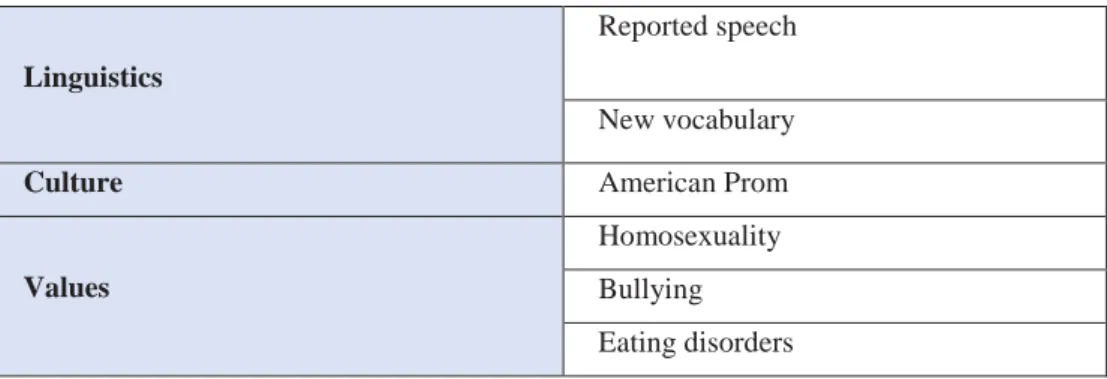
1. “A Brief Moment in the Life of Angus Bethune” will be introducing the following topics:
Table 3: “A Brief Moment in the Life of Angus Bethune”’s approaches.
Linguistics
Reported speech
New vocabulary
Culture American Prom
Values
Homosexuality
Bullying
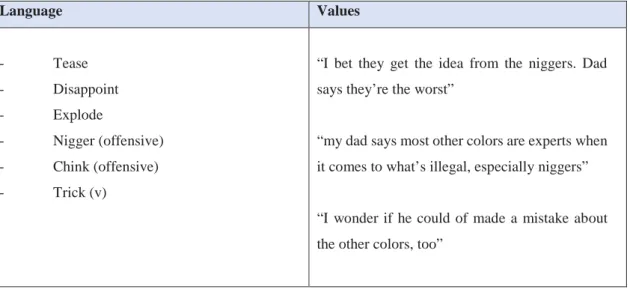
28 2. The second group will be using the short story “Telephone Man” to work on:
Table 4: “Telephone Man”’s approaches.
Linguistics
Relative pronouns
Offensive language
Culture Racial diversity
Values
Racism
Tolerance
Parental influence
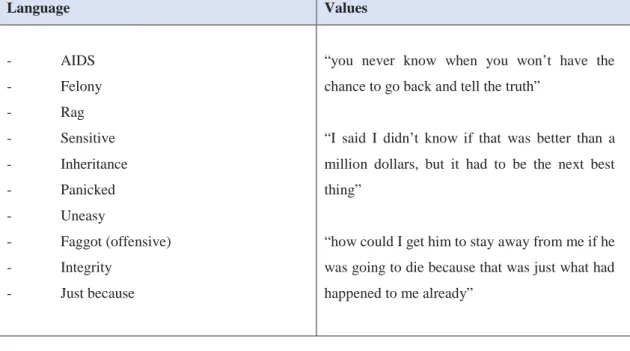
3. “In the Time I Get” is the perfect story for the students’ literary and self-discovery
journey. They will be dealing with very serious issues and hey have to be careful with how
they treat the topics.
Table 5: “In the Time I Get”’s approaches.
Linguistics
Infinitive and gerund forms
New vocabulary
Culture Illness
Values
Homosexuality
AIDS
Death
4. “Goin’ Fishin’” is the last short story, the group that is given this text will be focusing
on the following themes.
Table 5: “Goin’ Fishin’”’s approaches.
Linguistics
Past tenses
New vocabulary
Culture Going fishing
Values
Forgiveness
Drugs
29 Having established the different aspects that will be treated by means of the
intervention plan, the actual proposal is detailed in section 5, where the chosen activities are
30
5. DIDACTIC PROPOSAL: ATHLETIC SHORTS
In a broad sense, this intervention plan will be used to work from the three approaches
suggested by Lazar (1993) mentioned in the previous sections, so culture, personal-growth
and language will play an important role in the design of the activities. These three points of
view will be introduced at the same time the four competences are being improved, i.e.
speaking, writing, reading and listening. And, attending to the methodologies discussed in
subsection 4.3., the communicative method and the ESA pattern will be followed to obtain a
coherent and successful proposal.
5.1. “A BRIEF MOMENT IN THE LIFE OF ANGUS BETHUNE”
a. ENGAGING STAGE
Activity I
- Timing: 10 minutes
- Materials:
o blackboard
- Distribution of the class: individual work within the group
By looking at the title of the first short story the students will have to brainstorm
ideas about what they think the plot of the text is going to be. The teacher can interact with
the students and encourage them to speak in English by asking the following questions:
“Who do you think Angus Bethune is?”
“How do you picture his life?”
The answers of the students will be written down on the blackboard and, then, they
31
b. STUDY STAGE – READING (3 weeks)
The students will read the text at home, and they are allowed to use any print or online
resource (i.e. dictionaries) which helps them understand it.
c. ACTIVATE STAGE
Activity II – Debate
- Timing: 15 minutes
- Distribution of the class: individual work
The teacher will mention some interesting parts from the text so students can discuss
what were their thought while reading them (see table 6).
Table 6: Language and values treated in the debate2.
Language Values
- Maladies
- Bankrupt
- Prime
- Sensitive
- Tux
- Chest
- Sip
- Slur
- Humble
- Poke
- Tug
- Shadow (v)
“My dad’s divorced and remarried, and my
mom’s divorced and remarried, so my
mathematical account of my family suggests
simply another confused teenager from a broken
home. But my dads aren’t married to my moms.
They’re married to each other. Same with my
moms.”
“the fat kid with perverted parents”
“I want normal. I want socially acceptable”
“Best wear your rubber gloves, honey, in case he
has a cut”
“I’m bulemic. Do you know what that is?”
32 Activity III – Writing
- Deadline: one week
- Materials:
o pieces of paper (Din A4)
o print or online dictionaries
- Distribution of the class: individual and group work
The students will become journalists. They have to meet Angus and people related to
him for an interview after Prom, as he was the protagonist for the high school newspaper, The Relevant. They will have to write an article (200-250 words) about Angus, his father, his mother, Melissa and Alex. In that interview these journalists have to stay faithful to the words
of their interviewees, so the use of reported speech will be useful sometimes in order to write
some parts of their articles.
It is advisable to let students use their imagination and creativity to design the cover
of the newspaper including advertisements, images, and so on.
Students, apart from practicing their writing, will try to put themselves in the
characters’ place and avoid being led by the personal attitudes they, as readers, have towards
the characters.
Activity IV – Listening
- Timing:
o Video (twice) Æ 10 minutes
o Exercises Æ 15 minutes
o Discussion Æ 10 minutes
- Materials:
o Digital board
o What It’s Like to Be Bullied: (appendix 1)
o Exercise sheet (appendix 2)
33 A video of four people talking about their own experiences with bullying will be
played (as this activity is focused on listening skills, neither English nor Spanish subtitles will
be facilitated). The teacher will provide the students with an exercise sheet for them to
complete; there will be sheets devoted to each one of the people who appear in the video, so
each student will have to focus only on one story. The video will be played twice; one just to
give a general overview of the topic, and the second one to complete those exercises.
In the sheet they will have a series of questions and, also, some challenging keywords
that are important for the correct understanding of the story; students will have to answer to
the questions and write a short definition about what they think those terms mean.
For the final part of the activity they will have to discuss the meanings that they have
given to the offensive words that the people from the video were called. A debate can be
opened in order to let students explain their perspectives on what bullying is, or even sharing
with their classmates their personal experiences or cases they know related to this issue, as,
sadly, it has become something common in classes all around the world.
Activity V – Speaking
- Timing:
o Role-play Æ 10 minutes
- Deadline: 3 weeks
- Materials:
o Props and customs
o Camera (optional)
- Distribution of the class: group work
The aim of this activity is to work using both the communicative and TPR methods.
Students will have to write a summary of the short story “A Brief Moment in The Life of
Angus Bethune” based on dialogues so that they can perform a short play in front of their
classmates. They should be allowed to use digital resources if they want, as a recording of one
34 By this activity, they are expected to become aware of the importance that stopping
bullying has. To demonstrate this hypothesis, they can intervene in the story changing what
they think it is not admissible, e.g. when Alex insults Angus for being fat and having gay
parents, someone, such as Melissa can say something to protect him. The objective is that
students know that they cannot stay apathetic or be insensitive when people are hurting other