52. The use of structural eco-efficient mortars.
A critical review from a SWOT analysis.
González-Kunz, Rocío(1); Pineda, Paloma(2) ; Brás, Ana(3); Morillas, Leandro(4)
(1)PhD candidate, PhD Program in Architecture: Building and Civil Structures, Universidad de Sevilla, Seville, Spain
(2) Department of Building Structures and Geotechnical Engineering, School of Architecture, Universidad de Sevilla, Seville, Spain
(3) Department of Civil Engineering, NOVA University of Lisbon, Portugal
(4)Department of Building Construction, Geotechnical Engineering, Continuum Mechanics and Theory of Structures, Universidad de Valladolid, Spain
Abstract. One of the main climate trigger are CO2 emissions. In the field of archi-tecture and construction, one of the most harmful materials is the cement due to its employment and its polluting power (about 5 and 8% of the worldwide CO2 emis-sions). Thus, the search of an alternative material is essential.
This paper shows the possibility of using eco-efficient mortars as structural ma-terials, in order to guarantee both safety and environment preservation in the strengthening/refurbishment/retrofitting of structures. In those mortars, the binder can be substituted by organic or inorganic materials (e.g. fly ash, ground granulat-ed blast furnace slag, rice husk ash, palm oil fuel ash). From this strategy, the waste reduction is promoted, as wastes are immobilised without polluting the en-vironment essential. Thus, it is encouraged the re-use of architecture which is an essential factor to get a more sustainable habitat. The obtained results allow set-ting a guide that makes easier the selection of eco-efficient mortars (guaranteeing both structural safety and environment preservation) to the agents involved in pro-cesses of structural works.
Keywords Structural retrofitting, Refurbishment, Mortar, Eco-efficient.
1 Introduction
Over the last decade, the structural rehabilitation of existing buildings has increas-ingly attracted the attention of society.
and the re-use/recycling of building structures are great challenges for the present-day architecture.
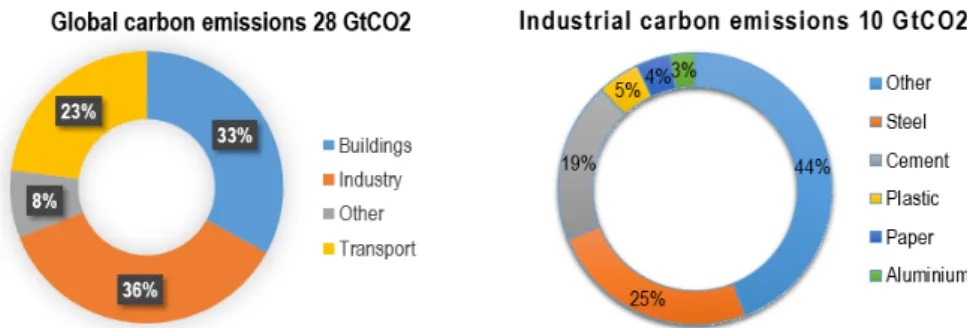
One of the most contaminant materials due to the amount of energy that needs to be generated is the cement, Fig. 1. Alternatives to Portland cement are regarded in codes (EC2, EHE2008), and are a current area of research.
Fig. 1 Analysis of global CO2 emissions in 2006 demonstrating the importance of five key
materials (Allwood J. et al, Material efficiency: A white paper, Resources, Conservation and Recycling, Volume 55, Issue 3, January 2011, Pages 362–381)
2 Eco-efficient mortars
In the following paragraphs a review on new materials which are formed replacing partially or totally cement by other material is provided. On the basis of the litera-ture review, this classification has been established:
(i) Cement binder mortar with organic substitutes; (ii) Cement binder mortar with inorganic substitutes; (iii) Lime binder mortar; (iv) Lime binder mortar with or-ganic substitutes; (v) Lime binder mortar with inoror-ganic substitutes.
2.1 Cement binder mortar with organic substitutes
combus-tion process. The fineness of RHA is its main characteristic, because it influences the rate of reaction and gains in mortar strength, workability, water-cement ratio, shrinkage and creep of concrete too. It is possible to achieve a compressive strength until 25 MPa at 28-d when 20%wt of cement is substituted (Potty, Vallyutham, Yusoff, Anwar, Haron, & Alias, 2014). The aforementioned data were obtained following the prescriptions of ASTM C109, with water-cement ratio of 0.50 and binder/sand 1:3.
- Palm oil fuel ash (Karim, Hossain, Newaz Khan, Zain, Jamil, & Lain, 2014):
it should be noted that thousands of tons of palm oil fuel ash (POFA) are produced annually worldwide (59.23 million tons of palm oil in 2014 (Fedepalma. Statistical Yearbook The Oil Palm Agroindutry in Colombia and the World 2010– 2014, 2015)). Thailand and Malaysia are the main producers of POFA, for in-stance, the last one produces 3.13 million tons annually (Abutaha, Abdul Razak, & Kanada, 2016). This production is growing every year and it is disposed on land-fills, which now became a noticed problem. Regarding the mortar composition, of the binder-sand ratio is 1:2.75, and w/b ratio is 0.55. Additionally, if cement is substituted by 10%wt POFA, the compressive strength raises the highest value, 48 MPa, measuring cubic specimens of 50 mm each side (Usman, Sam, Sumadi, & Ola, 2015).
- Sugarcane bagasse ash (Aprianti, Shafigh, Bahri, & Farahani, 2015): during the milling process of sugarcane is generated the raw sugar and the sugarcane ba-gasse. After that, the bagasse ash is generated from the cogeneration and combus-tion process. The worldwide produccombus-tion of sugarcane is around 1.68 million tons annually, being Brazil the main producer, with 43% of the total world production (Food and Agriculture Organization of the United Nations). About its mechanical properties, Ganesan et al. (Ganesan, Rajagopal, & Thangavel, 2007) demonstrated that if the mortar contains 10%wt bagasse ash and presents a proportion of w/b ra-dio of 0.53 and binder/sand 1:3, the specimens raise a 28-d compressive strength of 28.31 MPa, using cubic specimens of 100 mm.
- Wood waste ash (Ramos, Matos, & Coutinho, 2013): nowadays, more than 70% of the wood waste is disposed into the environment in various forms. Part of that waste, it is used as pellet and is burnt in plant fuel pellets. That quantity is es-timated around 13 million tons annually in Europe, which is the main area con-sumer of this product (Pirraglia, Gonzalez, Saloni, & Wright, 2010). Besides, it has a valuable use as a replacement of cement. García and Sousa-Coutinho (Garcia & Sousa-Coutinho, 2013) have demonstrated that this eco-efficient mortar can reach a compressive strength of 44 MPa at 28-d using a mixture of w/b 0.50, binder:sand 1:3 and 5%wt cement substituted. It is tested following the EN 196-1 Standards.
20wt%, which is comparable to the ordinary Portland cement. In this case, using cubic specimens with w/b ratio 0.48 and binder:sand 1:2.7, 60 MPa of compres-sive strength is achieved.
- Corn cob ash (Adesanya & Raheem, 1996): the compressive strength im-proves by 4.9% and 16.7% when 20% and 50% of ordinary Portland cement is re-placed by corn cob ash, and when the proportion are w/b 0.40 and binder:sand 1:3. In addition, the compressive strength of corn cob ash mortar is lower than the plain mortar at the early age. The main advantage of the usage of this product is its high production. For instance, the annual production is around 589 million tons, of which 8.04 million tons are generated in South Africa, the largest country produc-er (Aprianti, 2016).
2.2 Cement binder mortar with inorganic substitutes
Other types of substitutes are the inorganics ones. Thus, it tries to reduce wastes which are produced by:
-Fly Ash (Yu, Spiesz, & Brouwers, 2015): pulverized coal fly ash (FA) is an in-dustrial by-product of coal fuelled power plants (Kazemian, Gholizadeh Vayghan, & Rajabipour, 2015). The global coal ash production is around 390 million tonnes annually (Malhotra, 1999) and that production is increasing in China and India (Hardjito, Wallah, Sumajouw, & Rangan, 2004). For instance, India produced 163.56 MT of fly ash in 2012-2013 (Central Electricity Authority., 2014). The pozzolanic reaction of FA begins at the age of 3 days af-ter blending with cement and waaf-ter, which is much slower than the Portland ce-ment hydration. About the mechanical properties, cece-ment binder with fly ash substitute can reach around 37 MPa at 28-day of compressive strength where the mixture is formed by 52% of cement substituted and a w/c radio 0.30 (Berry, Hemmings, & Cornelius, 1990).
-Ground granulated blast furnace slag (Liu, Zhu, & Yang, 2016): ground granu-lated blast-furnace slag (GGBFS) is a by-product from the iron manufacturing industry. According to the American Iron and Steel Institute (American Iron and Steel Institute, 2011) only in U.S. the blast furnace slag production in 2011 was estimated to be in the range of about 8 to 9 million tons, and world output, 263 to 328 million tons. Mix-tures incorporating GGBFS generally develop strength more slowly than other ones that contain only Portland cement but can have similar or even superior long-term strength, release less heat during hydration, have reduced permeabil-ity, and generally exhibit improved resistance to chemical attack (van Oss, 2013). About mechanical properties, Barnett et al. (Barnett, Soutsos, Millard, & Bungey, 2006) the compressive strength with 35% of GGBFS at 20 ºC at 8-day is 24 MPa and at 32-day is 42 MPa with mixture proportions calculated from the concrete mixture proportions according to the requirements of ASTM C1074.
cement are not negatively affected by limestone powder added, but another grand group defended the contrary. Regarding mechanical properties, mortars formed with 10% of limestone substituting cement achieves 55.5 MPa compres-sive strength at 28-day (Benn, Baweja, & Mills, 2014). Regarding the flexural strength, with 10% of limestone 7.8 MPa is reached (Ghrici, Kenai, & Said-Mansour, 2007).
2.3 Lime binder mortar
Lime has been used as binder since the 6th millennium BC. Although the harden-ing and carbonation times are long, high strengths are obtained in the long term, and the strength-strain compatibility is guaranteed. (Pineda, Robador, & Perez-Rodriguez, 2013). According to Luso and Lourenço (Luso & Lourenço, 2016) lime mortar presents a good workability and, about mechanical properties, it reaches around 18 MPa of compressive strength.
2.4 Lime binder mortar with organic substitutes
Different organic materials have been proposed to replace partially the lime: - Hemp ash (Chabannes, Garcia-Diaz, Clerc, & Bénézet, 2015): the combination
of water, hemp husk aggregates and a lime-based binder produces a building material with an excellent thermal and sound insulation. Regarding mechanical properties, it reaches a compressive strength of 1.01 ± 0.08 MPa after 10 months. Moreover, it has strongly ductile behaviour.
- Elephant grass ashes (Nakanishi, et al., 2014): these ashes have been obtained from a Brazilian plant, the elephant grass. Brazil has the potential to produce 1.2 Gt of charcoal and a 2 Gt-average of bio-oils per year from elephant grass. Elephant grass ashes are mixed with least 85% of lime. According to Nakani-shi et al. (NakaniNakani-shi, et al., 2014), this activation is enough to obtain future supplementary cementing materials as an alternative to traditionally pozzolans to achieve environmental and social-economic benefits.
2.5 Lime binder mortar with inorganic substitutes
The materials that have been studied are:
Regard-ing its mechanical properties, the compressive strength of this mortar can reach 22.1 MPa and the elastic modulus is around 21 GPa.
- Silica fume (Grist, Paine, Heath, Norman, & Pinder, 2015): silica fume is a well-known pozzolan which is traditionally used in the civil construction in-dustry. 30% of lime binder mortar is substituted by silica fume and it was able to reach 19.8 MPa and an elastic modulus of 11.5 GPa.
- Silica fume and ground granulated blast furnace slag (Grist, Paine, Heath, Norman, & Pinder, 2015): the optimum substitution was 25% silica fume and 25% ground granulated blast furnace slag, leaving 50% of lime binder, in order to provide the best mechanical properties. This mortar can achieve a compres-sive strength of 28.1 MPa and an elastic modulus of 13.5 GPa.
- Silica fume and fly ash (Grist, Paine, Heath, Norman, & Pinder, 2015): the best behaviour is obtained with this composition: 50% of natural hydraulic lime, 25% of silica fume and 25% of fly ash. With these proportions, can achieve 22.3 MPa of compressive strength and 20.5 GPa of elastic modulus.
3 SWOT Analysis
A SWOT analysis is performed for the organic-cement binder mortars, due to their highest contribution to sustainability. As aforementioned, cement is one of the most polluting construction products. Therefore it is necessary focusing efforts to replace it.
At the same way, it is important to encourage the use of vegetal ashes as they are obtained from combustion of biomass, and provide energy with the process.
- RHA-cement binder mortar: the properties provided to the mortar and the high production levels of this waste generate a valuable material in order to im-prove construction sustainability.
Table 1 SWOT of RHA-cement mortar
STRENGHTS - High puzzolanic activity
- Compressive strength enough to be used as retro-fitting mortar
WEACKNESS
- Worse setting time due to its fineness, which requires more water to react
OPPORTUNITIES
- One of the plant products most consumed
world-wide.
THREATS
- Handling and transportation of rice husk ash is problematic due to its low density
Table 2 SWOT of POFA-cement mortar
STRENGHTS
- High compressive strength value with 10% substituted
WEACKNESS
- POFA decreases the flow tendency due to the increased fineness.
OPPORTUNITIES
- The high quantity of production and its grow-ing of palm oil annually.
THREATS
- Inexistent mechanism to take advance of the increasing use of palm oil waste.
- SCBA-cement binder mortar: this mortar presents the best values of com-pressive strength.
Table 3 SWOT of SCBA-cement mortar
STRENGHTS
- The compressive strength of SCBA-cement mortar increases directly to the amount of SCBA
WEACKNESS
- In the SCBA mortar, the higher porous texture increases the water demand, and consequently decreases the flow value, thus resulting in a reduced work-ability
OPPORTUNITIES
- Ethanol from sugarcane has been recognised as the principal biofuel for the gasoline mar-ket, consequently, it provides the SCBA grow-ing up.
THREATS
- The lack of sustainable system of man-agement for their waste.
- WWA-cement binder mortar: in spite of the fact that this mortar does not im-prove the mechanical properties significantly, now it is one of the most abundant and affordable ash.
Table 4 SWOT of WWA-cement mortar
STRENGHTS - Improving de mortar sustainability.
WEACKNESS - Low pozzolanic activity OPPORTUNITIES
- The world's production of plant fuel pellets is growing and the ashes production in the same way. Pellets consumption in Europe is predicted as 50 million tons in 2020
THREATS
- The incineration of wood waste produces relatively little fly ash
Table 5 SWOT of BLA-cement mortar
STRENGHTS - High puzzolanic activity.
WEACKNESS
- Compressive strength of BLA-cement mortar
is comparable but less than reference OPC mortar
OPPORTUNITIES
- Bamboo presents the fastest growth of plants studied in this research
- The bamboo cane is used worldwide, but its leaf ends in landfills or burned in an uncon-trolled manner
THREATS
- The becoming bamboo leaf into BLA is not development therefore its use is limited.
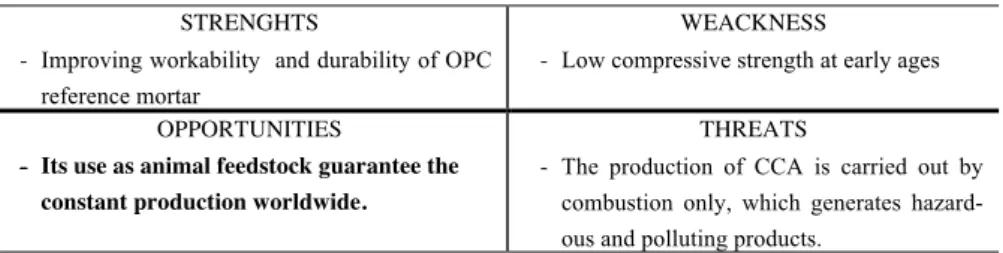
- CCA-cement binder mortar: its advantages are focused in durability of mortar and increase production of energy from corn cob.
Table 6 SWOT of CCA-cement mortar
STRENGHTS
- Improving workability and durability of OPC reference mortar
WEACKNESS
- Low compressive strength at early ages
OPPORTUNITIES
- Its use as animal feedstock guarantee the constant production worldwide.
THREATS
- The production of CCA is carried out by combustion only, which generates hazard-ous and polluting products.
4 Conclusions
5 References
(2015). Fedepalma. Statistical Yearbook The Oil Palm Agroindutry in Colombia and the World
2010–2014. Javegraf, Bogotá, Colombia.
(2015, Diciembre). Seguimiento del mercado del arroz de la FAO. Organización de las Naciones Unidas para la Alimentación y la Agricultura.
Abutaha, F., Abdul Razak, H., & Kanada, J. (2016). Effect of palm oil clinker (POC) aggregates on fresh and hardened properties of concrete. Constructuion and Building Materials(112), 416-423.
Adesanya, D., & Raheem, A. (1996). Evaluation of blended cement mortar, concrete and stabilized earth made from ordinary Portland cement and corn cob ash. Construction and
Building Materials, 10(6), 451-456.
Alamgir Kabir, S. M., Johnson Alengaram, U., Zamin Jumaat, M., Sharmin, A., & Islam, A. (2015). Influence of Molarity and Chemical Composition on the Development of Compressive Strength in POFA Based Geopolymer Mortar. Advances in Materials Science
and Engineering, 2015.
Amer Salih, M., Abang Ali, A., & Farzadnia, N. (2014). Characterization of mechanical and microstructural properties of palm oil fuel ash geopolymer cement paste. Construction and
Building Mateials(65), 592-603.
American Iron and Steel Institute. (2011). Annual statistical report: Washington, DC. In
American Iron and Steel Institute (pp. 121-126). Washington, DC.
Aprianti, E. (2016). A huge number of artificial waste material can be supplementary cementitious material (SCM) for concrete production e a review part II. Journal of Cleaner
Production, Article in press, 1-17.
Aprianti, E., Shafigh, P., Bahri, S., & Farahani, J. N. (2015). Supplementary cementitious materials origin from agricultural wastes – A review. Construction and Building
Materials(74), 176-187.
Barnett, S., Soutsos, M., Millard, S., & Bungey, J. (2006). Strength development of mortars containing ground granulated blast-furnace slag: Effect of curing temperature and determination of apparent activation energies. Cement and Concrete Research, 36, 434-440. Benn, B., Baweja, D., & Mills, J. (2014). 23rd Australasian Conference on the Mechanics of
Structures and Materials. The compressive strength of mortar made with cement containing
limestone mineral addition, cement kiln dust and fly ash. Southern Cross University:
ePublications@SCU.
Berry, E., Hemmings, R., & Cornelius, B. (1990). Mechanisms of Hydration Reactions in High Volume Fly Ash Pastes and Mortars. Cement &Concrete Composites(12), 253-261. Central Electricity Authority. (2014). Report on Fly ash generation atCoal/Lignite Based
Thermal Power Stations andIts Utilization inThe Country,For The Years 2011-12 And 2012-13. Central Electricity Authority, Governmentof India, New Delhi.
Ferreira, L., Branco, F. G., Costa, H. S., Júlio, E., & Maranha, P. (2015). Characterization of alkali-activated binders using the maturity method. Construction and Building
Materials(95), 337-344.
Food and Agriculture Organization of the United Nations. (n.d.). Chapter 3 Sugar cane. Retrieved 2016, from FAO Corporate document repository: http://www.fao.org/
Ganesan, K., Rajagopal, K., & Thangavel, K. (2007). Evaluation of bagasse ash as supplementary cementitious material. Cement and Concrete Composites, 29, 515-524. Garcia, M., & Sousa-Coutinho, J. (2013). Strength and durability of cement with forest waste
bottom ash. Construction and Building Materials(41), 897-910.
Ghrici, M., Kenai, S., & Said-Mansour, M. (2007). Mechanical properties and durability of mortar and concrete containing natural pozzolana and limestone blended cements. Cement
and Concrete Composites(29), 542-549.
Grist, E., Paine, K., Heath, A., Norman, J., & Pinder, H. (2015). Structural and durability properties of hydraulic lime–pozzolan concretes. Construction and Building Materials(62), 212-223.
Hamidi, M., Kacimi, L., Cyr, M., & Clastres, P. (2013). Evaluation and improvement of pozzolanic activity of andesite for its use in eco-efficient cement. Construction and Building
Materials(47), 1268-1277.
Hardjito, D., Wallah, S., Sumajouw, D., & Rangan, B. (2004). On the Development of Fly Ash-Based Geopolymer Concrete. ACI Materials Journal(101), 467-472.
Karim, M. R., Hossain, M., Newaz Khan, M. N., Zain, M. F., Jamil, M., & Lain, F. C. (2014). On the Utilization of Pozzolanic Wastes as an Alternative Resource of Cement. Materials(7), 7809-7827.
Karim, M. R., Zain, M. F., Jamil, M., & Lai, F. C. (2015). Development of a Zero-Cement Binder Using Slag, Fly Ash, and Rice Husk Ash with Chemical Activator. Advances in
Materials Science and Engineering, 2015(247065), 1-15.
Kazemian, A., Gholizadeh Vayghan, A., & Rajabipour, F. (2015). Quantitative assessment of parameters that affect strength development in alkali activated fly ash binders. Construction
and Building Materials(93), 869-876.
Khan, R., Jabbar, A., Ahmad, I., Khan, W., Khan, A., & Mirza, J. (2012). Reduction in environmental problems using rice husk ash in concrete. Construction and Building
Materials, 30, 360-365.
Liu, Y., Zhu, W., & Yang, E.-H. (2016). Alkali-activated ground granulated blast-furnace slag incorporating incinerator fly ash as a potential binder. Construction and Building Materials, 112, 1005-1012.
Luso, E., & Lourenço, P. B. (2016). Experimental characterization of commercial lime based grouts for stone masonry consolidation. Construction and Building Materials(102), 216-225. Malhotra, V. (1999). Making Concrete "Greener" with Fly Ash. Concrete International, 21(5),
61-66.
Muramatsu, H., Ahm Kim, Y., Yang, K., Cruz-Silva, R., Toda, I., & Yamada, T. (2014). Rice Husk-Derived Graphene with Nano-Sized Domains and Clean Edges. Small, 10(14), 2766-2770.
Nakanishi, E., Frías, M., Martínez-Ramírez, S., Santos, S., Rodrigues, M., Rodríguez, O., et al. (2014). Characterization and properties of elephant grass ashes as supplementary cementing material in pozzolan/Ca(OH)2 pastes. Construction and Building Materials(73), 391-398. Nguyen, H.-A., Chang, T.-P., Chen, C.-T., Yang, T.-R., & Nguyen, T.-D. (2015).
Physical-chemical characteristics of an eco-friendly binder using ternary mixture of industrial wastes.
Materiales de Construcción, 65(316).
Pineda, P., Robador, M. D., & Perez-Rodriguez, J. L. (2013). Characterization and repair measures of the medieval building materials of a Hispanic–Islamic construction.
Construction and Building Materials(41), 612-633.
Pirraglia, A., Gonzalez, R., Saloni, D., & Wright, J. (2010). Biomass magazine. Retrieved 05 21, 2016, from http://www.biomassmagazine.com/articles/3853/woodpellets-an-expanding-market-opportunity
Potty, N. S., Vallyutham, K., Yusoff, M., Anwar, A., Haron, M., & Alias, M. (2014). Properties of Rice Husk Ash (RHA and MIRHA) Mortars. Research Journal of Applied Sciences,
Engineering and Technology, 7(18), 3872-3882.
Ramos, T., Matos, A., & Coutinho, J. (2013). Review- Mortar with wood waste ash; mechanical strength, carbonation resistance and ASR expansion. Construction and Building
Materials(49), 343-351.
Rhee, I., Ahm Kim, Y., Shin, G.-O., Hoon Kim, J., & Muramatsu, H. (2015). Compressive strength sensitivity of cement mortar using rice husk-derived graphene with a high specific surface area. Construction and Building Materials(96), 189-197.
Somma, K., Jaturapitakkul, C., Kajìtvichyanukul, P., & & Chindaprasirt, P. (2007). NaOH-activated ground fly ash geopolymer cured at ambient temperature. Fuel, 301(1-3), 246-254. Usman, J., Sam, A., Sumadi, S., & Ola, Y. (2015). Strength development and porosity of blended
cement mortar: Effect of palm oil fuel ash content. Sustainable Environment Research, 25, 47-52.
van Oss, H. (2013). Slag, Iron and Steel. In U. G. Survey, 2011 Minerals Yearbook (pp. 69.1– 69.9).
Wei Ken, P., Ramli, M., & Chee Ban, C. (2015). An overview on the influence of various factors on the properties of geopolymer concrete derived from industrial by-products. Construction
and Building Materials(77), 370-395.
Yang, W., Xue, Y., Wu, S., Xiao, Y., & Zhou, M. (2016). Performance investigation and environmental application of basic oxygen furnace slag – Rice husk ash based composite cementitious materials. Construction and Building Materials, 123, 493-500.
Yiping, L., Yanxia, L., Buckingham, K., Henley, G., & Guomo, Z. (2010). Bamboo and climate
change mitigation. International Network for Bamboo and Rattan. Beijing, China: Technical
Report.
Yu, R., Spiesz, P., & Brouwers, H. (2015). Development of an eco-friendly Ultra-High Performance Concrete (UHPC) with efficient cement and mineral admixtures uses.