Barcelona
City Council
Digital Plan
p
tem
b
er 2
0
17
Ba
rc
el
on
a Ciu
ta
t D
igi
ta
l
A government measure
for open digitisation:
free software and agile
development of public
administration services
The Open Digitisation Programme from Barcelona City Council’s Office for Technology and Digital Innovation
CO
NTE
NT
S
EXECUTIVE SUMMARY ...
1. INTRODUCTION AND JUSTICATION
FOR THE MEASURE ...
2. OBJECTIVES OF THE MEASURE ...
3. GOVERNING THE DIGITISATION PROCESS ...
4. CONTEXT ...
5. THE OPEN DIGITISATION
AND AGILE SERVICE- DELIVERY PROGRAMME ...
6. THEMES AND OBJECTIVES ...
7. LINES OF ACTION ...
8. FLAGSHIP PROJECTS WITHIN
THE COURSE OF ACTION ...
9. SUCCESS METRICS AND RESULTS ...
10. IMPLEMENTATION SCHEDULE ...
11. BUDGET ...
12. ANNEXES ...
3
6
7
8
9
15
20
26
In September 2016, Barcelona City Council embarked on an important digital transforma-tion process announcing that public services must be provided through digital channels from the outset, following new guidelines oriented towards citizens and the use of open standards and open software and in accordance with an ethical data strategy that puts privacy, trans-parency and digital rights at the forefront. The decision taken by the city government is based on the Barcelona Digital City Plan, a government measure approved in October 2016 and new Spanish Law 39/2015 on Com-mon Administrative Procedures for Public Au-thorities. This Law states that by 2020, digital channels must take priority in the provision of public services in the Spanish State. The Barcelona Digital City Plan establishes a ra-dical improvement in digital public services as one of its main objectives, with the aim of providing services to citizens on a 24/7 basis that are of higher quality and better adapted to their needs.
The Municipal Institute of Information Tech-nology (IMI) is instrumental in enabling this transformation to be carried out. In 2016, Barcelona City Council created a Digital Transformation Committee, and the IMI put together a group for the promotion of Digital Transformation made up of professionals from various technological areas. Both of these mechanisms were set up to drive and govern this important process.
The Open Digitisation Programme: Free Software and Agile Development of Services, created by the Commissioner and the IMI in October 2016, following the launch of the
Digi-Executive
Summary
tal Transformation Plan, is the impetus behind technical innovation and excellence focused on the delivery of results. In addition, this pro-gramme promotes a culture of innovation, transparency and continuous development throughout the whole of the City Council, em-phasising:
· The promotion of the development and delivery of agile, open and ethical digital ser-vices.
· The promotion of the development of internal design skills and capabilities focusing on users and agile methodologies, for the pur-poses of regaining control of digital services.
· Opening up public procurement, making it more transparent, simple and objective, while reducing the bureaucracy involved. Inno-vation in the procurement processes will also enable diversification in technology providers.
· The creation, through a digital market platform, of a diversified group made up of expert local providers.
· The promotion of the use of agile me-thodologies in digital services, both internally and in provider relations.
· The revision of procurement procedures for technology assets and services to reinforce technological and data sovereignty.
· The establishment of technological practices based on open architectures and standards.
This government measure provides an overview of the transformation programme and the proposed incremental changes. It sets forth the structure how the transforma-tion will be governed, its eminently practical orientation, based on establishing clear mea-sures and specific deliverables, and provides a shared roadmap.
The measure will provide savings in resources and more efficiency through the implementa-tion of agile processes, while providing citizens with the tools they need to interact with the local authority more efficiently. Through open data management and the use of free software tools, we will be guaranteeing universal ac-cess, improvements in transparency and laying the foundations for new initiatives based on harnessing data and creating a network of open source experts that will make the local authority more resilient and independent. This measure focuses on the delivery of agile digital services, the process for accomplishing technological sovereignty and the migration to free and open software and open standards. The annexes to this government measure con-tain documents that define the main standards and give guidelines for the core areas in the programme.
These documents include:
• The Digital Services Standard.
• The Code of Technological Practices.
• Agile Methodologies of Barcelona City Council.
• Technological Sovereignty Guide.
• Details of the Migration Plan to Open Source.
• Public Procurement of Technology Guide. The responsible and ethical use of data is a key element within Barcelona City Council’s Digital Transformation Plan, especially the Open Data and Data Commons strategies, “Data Driven” projects and interoperability based on open data formats. The corresponding directives
and their implementation will be developed in a new government measure on the Strategy for Responsible and Ethical Use of Data in Barce-lona City Council, where its technical details, processes and responsibilities will be detailed. This government measure also explains how agile development methodologies will be applied in Barcelona City Council, by trans-forming vertical product teams into agile ser-vice-orientated work groups through flagship projects. That is why the IMI is putting an Agile Technical Office and an agile projects team into operation.
From a purely technological perspective, the objective is to create a public and open ecosystem and infrastructure composed of interoperable and reusable applications and services. So, the way in which the public autho-rity operates must be changed through the use of open standards and free and open source software, by implementing open, public and well-documented application-programming interfaces (APIs) that provide access to the City Council’s open data for the purposes of enabling the ICT sector, and even other au-thorities, to collaborate with the City Council to deliver agile, open and ethical applications and digital services.
The services which will be first to benefit from these changes include: the new citizen help and information portal, mobile phone services for citizens, the new calendar of events and facilities in the city, the open city dashboard for citizens, the technology providers portal and the new mobile digital identity service. The formation of new agile teams will enable us to acquire the capabilities we need and to develop a recruitment plan and an inter-nal-skills creation programme for promoting this transformation. At the same time, internal capabilities will be complemented with skills and services provided by the most innovative companies in the sector, brought in by the City Council, through innovative procurement and the creation of a digital procurement platform.
steps are repeated one after the other until the desired result is reached. Digital products and services and their interfaces are evolving, like a living organism, in accordance with the needs of citizens and changes in technology. viu, d’acord amb les necessitats dels ciutadans i el canvi tecnològic.
The digital era is making profound and rapid changes to our society and, as a result, the model of citizens’ relations with companies and public authorities. By bringing together digital transformation, citizen participation and transparency we are obliged to change the models used by public bodies so that they have the capacity to adapt to the new needs that are created. This transformation represents a great challenge for the City Council, with activities that are highly regulated by legal, economic and human resource requirements. The Open Digitisation Programme: Free Sof-tware and Agile Development of Services at Barcelona City Council aims to provide gui-delines focused on service delivery and te-chnological sovereignty in order to revitalise the entire municipality, by consolidating the governance of digital services, by genera-ting profiles and capabilities in free and open source software and the ethical use of data and by transforming public procurement. The implementation of this approach, based on agile methodologies and the use of open te-chnologies, has demonstrated efficiency in
Introduction
and justification
for the measure
1
performance and costs, which the City Council must take advantage of.
It is along these lines that the measure opens up public procurement and makes it more transparent, simple and objective, by crea-ting the right conditions for participation from a diverse set of local-industry talent and encouraging the country’s small and me-dium-sized businesses. Likewise, the current procurement processes are being reviewed to ensure technological and data sovereign-ty. Procurement procedures must also be transformed for the purposes of bringing them into line with the reality of the services offered to the public and making it possible for these measures to be applied.
Objectives
of the measure
The measure sets out the Barcelona City Council’s Open Digitisation: Free Software and Agile Service Development Programme. This measure focuses on giving the City Coun-cil the ability to rapidly develop digital services centred on the real needs of citizens, achie-ving technological independence based on free software and the use of open standards, making data from Public Authorities available to citizens so that they bring them more va-lue, and ensuring that they can access these services by safeguarding their right to privacy.
1. Focusing on a ucentred digital ser-vices model and greater collaboration to gene-rate more value using the same resources.
2. Broadening and expanding agile me-thodologies for the construction of new digital public services.
3. Developing the internal capabilities for the agile management of public services throughout the City Council.
4. Opening up public procurement, ma-king it more transparent, simple and objective.
5. Preferential use of free and open sof-tware, with the aim of its becoming mandatory
in the future, to ensure technological and data sovereignty.
6. Establishing an open architecture and practices based on open standards.
7. Revising procurement processes so that these objectives and innovations can be incor-porated into relations with the industrial sector.
8. Improving access to the authority’s data, respecting privacy and evaluating the ethical risks of smart cities and large databa-ses, including legal compliance with data pro-tection regulations, by establishing an ethical code of technological practices and defining a data strategy.
9. Developing new technology-acquisition guidelines that will be integrated into the ge-neral framework of public contracts as well as followed and implemented by all the City Coun-cil’s public contracts and civil servants.
Finally, we will present the flagship projects through which we will begin to achieve these objectives and implement the new practices that are necessary for this.
Governing the
digitisation
process
This transformation constitutes a lengthy pro-cess requiring the involvement of the local au-thority, as well as the ICT sector and society. The process must have a specific form of go-vernance so that it can meet its objectives and keep to the established schedule.
Several mechanisms will be used for the gover-nance of this process, including, notably, the Commissioner for Digital Technology and In-novation, the Barcelona Digital Transformation Commission and the Innovation Committee, not to mention other players in the city such as companies and representatives of civil society. The main governance methods include:
• Commissioner for Digital Technology and Innovation. One of her missions is to go through a process of redesigning and reorien-ting Barcelona’s technology and digital innova-tion strategies and policies through a process involving the active participation of key players in the city. Two of the main areas are the digi-tisation of public services and the promotion of an innovative digital ecosystem, which in-cludes the relationship between public
autho-rities, citizens, businesses and the academic world. The commissioner has an office availa-ble for monitoring and promoting projects in-tended to ensure municipal coordination and measure the impact of the implementation of this programme.
• Barcelona Digital Transformation Commission. This is a transversal municipal mechanism created to govern the definition and implementation of the Digital Transforma-tion Plan and ensure its alignment with the City Council’s strategy. Part of its main function for prioritising and coordinating the City Council’s ICT initiatives will also involve analysing the si-tuation and development of the digitisation programme and constituting a space for de-bate, discussion and proposals among the va-rious municipal areas and sectors.
• Digital Innovation Committee. This is a cross-cutting municipal mechanism within the City Council’s various areas, tasked with put-ting the design and implementation of the in-novation strategy and policies into operation. Its function will be to ensure, among other things, the involvement and alignment of the various municipal areas in this process.
Approved in October 2016, the Barcelona Di-gital City Plan (PBCD) is a cross-cutting Plan which aims to guarantee a coherent, standard technology policy within the City Council, in the areas of Government and City, Enterprises and Social Entities and Citizens.
The PBCD must ensure that digital techno-logy and innovation act as facilitators in the
The Barcelona City Council’s Digital Transfor-mation Plan (PTDA) is the comprehensive road-map for ICT projects for this term of office, and for each Manager’s Office, in accordance with political priorities. This plan also includes
Context
4
4.1. Barcelona City Council
fulfilment of fair and efficient public policies geared towards covering better the needs of citizens and boosting their capabilities, to create greater-quality public services, with the optimum allocation and use of public re-sources and talent.
Three strategic areas have been defined wi-thin the PBCD, with the following objectives (Figure 1):
projects for updating technology and adap-ting it to the new legal framework established under Act 39/2015 of 1 October, on Common Administrative Procedures for Public Autho-rities (LPCAP).
AREAS
GOVERNMENT
AND CITY
ENTERPRISE
AND SOCIAL
ENTITIES
CITIZENS
AREAS
Creating a more open and efficient government
using technology for transformation and innovation
Developing the digital and socio-economic
community and the local innovation ecosystem
Empowering the people
Law 39/2015 of 1st October, on Common Ad-ministrative Procedures for Public Authorities (LPACAP), which comprehensively promotes digital administration - not just citizen rela-tions but also the electronic management of administrative procedures, electronic docu-ments and files, interoperability, etc. - defines a new legal framework which requires profound changes to be made in the provision of public services and, as a consequence, in municipal organisation and their information systems. Note that in addition to compliance with the LPACAP, we can find other legal texts in the regulatory context of the EU and in Spanish and Catalan legislation that have to be responded to:
• The EU eGovenment Action Plan 2016-2020, that aims to remove existing digital ba-rriers to the Digital Single Market and to prevent further fragmentation arising in the context of the modernisation of public administrations.
• The new EU General Data Protection Re-gulation (GDPR), approved in May 2016, which the entire public authority must adapt to and comply with.
• Act 19/2014, of 29 December, on trans-parency, access to public information and good government. The aim behind this Act
Given the current situation where changes come about at an incredibly fast pace and changes within changes are occurring, we to develop and implement models for digital services that will help us to adapt to these transformations. This is even more the case in the information and communication te-chnologies (ICT) sector, where speed and agility are essential in the face of change. Hence the appearance of agile methodo-logies, given the difficulties and occasional
4.2. Legal Framework
4.3. New Trends in the development of agile digital services,
technological sovereignty and ethical data management
is to provide citizens with information on the actions of regional public authorities and control and transparency in the destination of public money.
• Act 11/2007, of 22 June, on citizens’ electronic access to public services, known as LAESCP. In this context, free software, open standards and open source technologies are considered the best option for the develop-ment of a technological model for e-Govern-ment, tailored to the specific needs and ob-jectives of public authorities, based on the strategic criteria of transparency, control, se-curity, interoperability, access and conservation of information, economics, reuse of data and cooperation between organisations, which clo-sed technologies can hardly compete against.
• Royal Decree 4/2010, of 8 January, re-gulating the National Interoperability Scheme, which includes the security criteria and recom-mendations, standardisation and conservation of information, and the formats and applica-tions that public authorities must take into account to ensure an appropriate level of or-ganisational, semantic and technical interope-rability for data, information and services that they manage in exercising their powers and to prevent discrimination against citizens on the grounds of their choice of technology.
failures experienced with traditional methods of project management.
ma-nagement that encourages constant revision and adaptation to the needs of the users and to the changes. These methods provide an organised system that allows and facilitates teamwork and self-organisation and helps to reduce development times.
As for technological and data sovereignty, we can confirm that free software is “technically feasible, economically sustainable and socially fair”1. This is reflected in specific benefits to the local authority.
• It is technically viable because it allows us to reuse existing free software projects, redu-cing the implementation efforts required to co-ver our own needs. Eco-very IT company, regardless of its size, depends on free software to some degree. The fact that the local authority wishes to make direct use of this is a logical step.
The freedom to choose tools also means the freedom to choose the provider for maintaining and developing them. Wor-king with open formats and standards does away with the need to depend on large com-panies and enables permanent access to the information generated.
Participating directly in the community provides access to the consolidated knowledge of other entities, enabling them to contribute through documentation, code or shared expe-riences implementing projects in the authority.
• It is economically sustainable becau-se it removes the requirement for ubecau-ser licenbecau-ses and cuts down on costs. Such a reduction in costs does not mean a loss of quality or securi-ty. On the contrary, it can enable projects that would not be possible with proprietary softwa-re, and keep systems up to date and protected at the lowest possible cost.
These cost savings can be reinvested in suitable hardware for new tools or items that require additional resources. Thus the local au-thority is showing responsibility towards public money and responsibly managing it.
Freedom to select providers without res-trictions can boost the reinvestment of
pu-blic funds into the region while benefiting the local economy. Generating a virtuous circle where any SME, cooperative or freelance can offer their services, under equal conditions. In a country where 90% of businesses are either small or medium-sized, this opens up a large window of opportunity.
It also provides freedom to choose the municipal management of the IT infrastructure, without the need for expertise in exclusive, hi-gh-cost tools. The public and private jobs gene-rated will be available to more of the territory’s professionals.
• It is socially fair because it guarantees the fundamental rights of citizens. Access to the source code and its collective control helps us to know what it does and to ensure that it does not have any gateway or security vulnera-bilities. Data privacy and security are ensured.
Such benefits either do not exist or requi-re much higher economic and social costs with proprietary software.
Royal Decree 4/2010 (see more in section 04.2) has existed since 2010, and makes it mandatory for Public Authorities to use open formats when sharing information with citi-zens. The list of formats is not a choice for each public entity, but rather a list of standards that is specified and regularised for interoperabi-lity. As such, Public Authorities will use open standards to guarantee independence in the choice of technological alternatives made by citizens and public authorities, preserving do-cuments over time, and adaptation to progress in technology.
Where appropriate, documents, electronic ser-vices and applications made available by public authorities to citizens and other public authori-ties will be displayable, accessible and functio-nally operational, under conditions which su-pport the principle of technological neutrality and avoid discrimination against citizens on the grounds of their choice of technology.
Data were of little and limited interest until re-cently, although computer processing capaci-ties have reached the stage where we can now
harness and reuse data. At the same time, there has been an exponential growth in the amount of such data. For security reasons, this situation makes it crucial both to control and release these data, for the purposes of boosting their reuse, with the conviction that public data can
generate business and social improvement for the entire population. Combining free tools and open data puts us in a whole new ball game, where transparency and a willingness to share and work on a community basis create a new organisation of public administration.
AGILE METHODOLOGIES
While Agile methodologies have mainly been implemented in private enterprise, their use is not unknown in public administration. Since 20122 the British government Has been pro-moting them, as well as the US Department of Defense. A good example is the development of a new British service to manage vehicle ins-pections (MOTs).
Closer to home, the Regional Government of Andalusia in 2010, put out to tender the service for the development of the website entitled “DEVELOPMENT OF THE CONSUMER RESPONDS WEBSITE”, using the Scrum agile methodology, certainly the most popular of the agile metho-dologies in software development. In 2010, the regional government of the Canary Islands also put out to tender the maintenance service for the IT records system in the field of tourism using these methodologies.
Vitòria-Gasteiz City Council published an invita-tion to tender in 2013, for “the procurement of a redesigned municipal website using adaptive design”. The technical specifications stated that the methodology to be used was SCRUM. March 2017 saw the Provincial Council of Ba-dajoz commence procedures to procure deve-lopment and implementation services for new functionalities and the technological evolution of its current management applications, also using the agile SCRUM methodology.
Public-private institutions including the Thys-sen Museum, Hospital Clínic de Sant Carlos in Madrid and its Smart Health Lab and the
4.4. Agile methodologies and free software in other public
authorities
Tax Agency are starting to use and apply agile techniques such as Lean Government.
Barcelona started introducing agile methodo-logies in 2013 for the development and mana-gement of municipal websites and it will now be the first big city in southern Europe to launch and implement this type of methodology on a global basis within the City Council.
OPEN TECHNOLOGIES
Regarding experiences in free software at a lo-cal level, public authorities have for a long time now started implementing Open Technology policies and deploying free and open-source based services. Regionally, we have the exam-ple of the University of Lleida (UDL), which is a pioneering public university in the use of free software in Catalonia, together with the Open University of Catalonia (UOC). It has been using free systems for years, yielding excellent results. A new team, one of whose goals was to promote the use of free software, took over the vice-chancellor’s office in 2003 and commen-ced a migration process for all the systems. In 2006, the Generalitat of Catalonia published its own Free Software roadmap.
The University of Murcia signed up for the Open Academic Environment (OAE) in 2014,an inter-national initiative to create a free software pla-tform which allows the development of an open collaborative academic network. This project is headed by the University of Cambridge, and the University of Murcia was the first Spanish university to take part in it. The university
ted migrating its computers to Linux in 2015. This resulted in savings of €100,000 in user licenses and another €300,000 by not having to renew equipment. Recently Barcelona City Council released the code of Sentilo, its sensor data management platform, as free software and won an EU award for Sharing and Reuse. The government in Brazil launched seve-ral digital-inclusion projects in paseve-rallel in several areas, based on the installation of call centres, whose aim was to reduce di-gital exclusion, increase professional skills, distribute free software and increase public participation in new technologies. Free sof-tware has played a fundamental role in the creation of these centres and is enabling those who have just arrived in the digital world to do so with legal software.
On a European level, Germany’s Foreign Ministry started migrating its 11,000 computers to GNU/ Linus and free software applications in 2003. This enabled a considerable reduction in costs compared to those of other ministries. The aims are for 230 embassies and consulates around the world to migrate to open technologies. The Gendarmerie Nationale’s IT team decided to review their existing Microsoft-based environ-ment in 2014 so it could offer a responsible and profitable service at a national level and reduce its growing IT infrastructure costs. It migrated to OpenOffice and Firefox and its PCs were upgraded to Ubuntu. This resulted in savings of 2 million euros annually in license rights alone as well as a drastic reduction in hardware expenses.
In 2014, Italy chose free software as the first choice for its public administration. It created a document titled, “Guides for comparative as-sessment (of software)”, which teaches people a method to follow to make the right decisions when choosing software. The Italian example is very important as it is concerned with not just regulations but also their implementation. The guide developed by the Italian Digital Agency was drafted with both the Free Software Foun-dation Europe and representatives from several proprietary software companies taking part. Open technology policies for the European public administrations are supported by the
action of the European Commission, that pu-blishes to his own free licence for Public Admi-nistrations, the EUPL, and centralises efforts in his “Join Up” platform where one finds literally hundreds of experiences of migration or de-velopment of free software for the European public authorities.
At an international level, the Brazilian gover-nment initiated in parallel several projects of digital inclusion in different areas, based in the establishment of telecentres, the aim of which was to reduce digital exclusion, increa-se professional capabilities, disincrea-seminate free software and increase popular participation in new technologies. Free software has played a fundamental role in the creation of these centres and is allowing that those who are just arriving in the digital world to do it with legal software.
Malaysia’s public administration launched its Master Plan on 16 June 2004 to promote, adopt and develop the use of free software in the public sector. The Open Source Competen-cy Centre (OSCC) went into operation. The OSCC became established as a national ben-chmark centre for managing and supporting the application of free software within the administration. More recently, in December 2013, India invested in computers with free software (Ubuntu) for its students. This is one of the most important programmes in the world for government-endorsed laptops, installed on 1.5 million laptop computers.
the Barcelona Digital City strategy, the project is based on the main international standards and recommendations, adopting the features of open data by default, quality and quantity of information, data for everyone, data for the improvement of the governance and the promotion of innovation.
The open digitisation
and agile
service-delivery programme
Public services currently must be designed to be “digital first”, putting citizens at the centre of the design process and contributing more public value. Services must be constructed in a more agile and open way and must be simpler, more modular and more interoperable. At the same time, we must avoid creating dependen-cies on vendors and suppliers of specific pro-prietary solutions, hence the need to promote the development, use and reuse of free and open source software and open standards. Services must be usable and accessible to everyone, including citizens with low levels of digital skills and people with disabilities. The Open Digitisation and Agile Service De-velopment Programme provides a focus on digital services to revitalise the City Council as a benchmark for technical innovation and excellence. It will bring quality digital services, adapted to the needs of citizens and orien-tated towards safeguarding citizens’ right to privacy (data privacy), services which, by ma-king use of free and open source software and open standards, will end the dependency on proprietary formats, products and solutions (technological sovereignty).
Digital public services need to become true as-sets of today’s society, with their reuse made possible in other cities. That is why initiatives are needed in the area of public procurement of technology which can foster a more matu-re approach to the provision of technology to the public sector, by proposing multi-supplier contracting models that promote competition and diversity of suppliers, enable the adoption
of new innovative technologies and move away from big contracts, by creating a new market for open and collaborative SMEs.
What’s more, the programme generates profi-les and capacities in user-centred design and agile methodologies, to bring the flexibility to and accelerate the development and delivery of these services, while opening public procu-rement and increasing its transparency, simpli-city and objectivity, thereby providing a route to technological and data sovereignty.
The programme will establish a framework for an open architecture and designs based on open standards, through a series of incremen-tal changes with a clear governance structure, results orientated, with clear measurements and indicators and a shared roadmap.
As a starting point, the programme defines the basic principles to guide the way for developing new services. These principles are contained in the Decalogue titled “Our Digital Service Stan-dards” (see Annexe 12.1):
• Multi-disciplinary teams for services:
Setting up a multidisciplinary sustainable team that can design, build and operate a service, led by a qualified senior service manager, that has decision-making responsibilities.
• Beginning with the needs of users:
Users’ needs have to be understood and re-search carried out to develop more knowled-ge on who the service users are and what this means for the service design.
5
• Using agile development methodolo-gies and iterative building methods. Building the service using agile and iterative user-cen-tred methodologies.
• Reducing the burden on citizens.
Existing information will be used in the muni-cipal systems during new interactions with ci-tizens, with interoperation with other public authorities to gather the required information and avoid having to ask the citizens to provide it again. Unnecessary documents will be removed in the digital version of the service and the City Council will ensure that citizens give their con-sent for their personal documents to be used.
• Following the guidelines on visual de-sign and accessibility. A coherent service will be built based on the experiences of users of the rest of Barcelona City Council, in terms of existing visual design and accessibility guidelines.
• Having a plan available for people who need digital assistance. Use of digital services will be encouraged among all users and plans made for people who cannot access digital services for whatever reason without support. As for the provision of essential services, the City Council will need to ensure that it adapts to citizens who do not have digital devices.
• Considering security, privacy and ethi-cal aspects. An assessment will be made of which user data and information will be provi-ded or stored in the digital service, taking into account the level of security, legal obligatoins, privacy issues and the risks associated with the service. (consulting with experts if necessary).
• Open source software and open standards will be used. Open source softwa-re and open standards will be used whenever possible. Likewise, all new code will be open source and reusable so that it can be publi-shed under appropriate licenses.
• Having a plan available for digitisation.
We will ensure that all digital services provi-de citizens with the digital means to produce, sign and authenticate their documents. In the event that there are citizens who do not have their own digital resources, we will have to
ensure there is a service available at the City Council for digitising these documents.
• Making a plan for going off-line in case of unforeseen circumstances. A plan will be available in case the digital service is tempo-rarily down, as users expect an online service to be available 24 hours a day, 365 days a year.
• Tools, systems and services will be evaluated. Assessments will be made to en-sure that the technological code of conduct is followed and the associated technical risks are understood.
• Reusing the existing infrastructure and shared functions as far as possible. A coherent service experience will be created that enables time and resources to be saved by eliminating the need for existing functiona-lities to be rebuilt.
• Defining a plan for managing the chan-ge for the transition of the service. There will be continuity service plans to facilitate the transition between the current non-digital service and the new digital service. Any inte-rruption to citizens’ access to the service has to be avoided.
• Feedback and continuous user assess-ment. A plan will be implemented under which we will be continuously open to feedback from users and carrying out usability tests to gather users’ opinions continuously and thereby be able to improve the service.
• Measuring and publishing the service’s results. Performance indicators of the servi-ce will be identified, establishing a referenservi-ce point for each measurement and making a plan for enabling improvements.
• Making a maintenance and servicing plan for the digital service. There will be a “response and escalation” plan to minimise ser-vice interruption when incidents occur.
The following four main action areas have been identified for the purposes of the digitisation programme’s optimum development and ob-taining open, interoperable, ethical and agile digital services for the public:
• Agile methodologies in the delivery of digital services
• Technological Sovereignty (free software and open standards)
• Sovereignty and the responsible use of data
• New public procurement model
While the programme is transversal, and both the IMI and City units are involved, each area of action will be led by a different team. It is based on our services standards and a new code of technological practices supported by a guide for the introduction of agile methodologies, and a guide for the transition to free and open source software (software, hardware, systems), The guides on open public procurement and of innovative procurement complete the documentary framework supporting the programme. The next government measure will set out the management of data for the City of Barcelona and will express the strategy of responsible
and ethical use of data and its concrete im-plementation.
This is an internal transformation so the pro-cess must be led by the City Council itself, involving its own staff, working to develop the capacity for acquiring skills and results. Support will occasionally be necessary from external experts in the sector who, along with training and experience from the new agile team, will provide help in understanding the skills and competencies that will be needed in the immediate future. A procurement plan and a skills-creation programme will be im-plemented to meet these needs and keep the transformation alive. This process will lead to major internal involvement.
The whole transformation process will be ca-rried out under the same agile philosophy. So, the programme will begin with a discovery stage followed by successive iterations that will gradually allow the new culture and new practices to be introduced.
New practices will be developed and refined based on real projects, which we will call exem-plary or flagship projects (described in section 08 of this document). The new methodology will gradually extend to all projects where such practices are applicable.
5.2. Priorities and methods for creating digital services
The discovery stage in Barcelona City Coun-cil began in September 2016, with support from external experts. Four work groups were created in which more than 40 workers from several municipal areas participated. These groups worked for 4 months with help from 4 external experts to generate a base that would help to drive change.
Throughout 2017, as many as 3 sessions were held with the sector (free software and open
technologies, agile digital services and public procurement of technology), involving more than 200 representatives of the City and industry. Internally, between April and June this year, within the Transformation Plan, four workshops were organised (tools workshop, management workshop, training workshop and an organisation workshop).
In the first quarter of 2017, the agile metho-dology was applied to its first real project,
a community around a free software pro-ject, a place that also aims to be a meeting point where cities and companies can co-llaborate to enhance the platform, provi-de support and provi-develop business around Sentilo. Organisations besides Barcelona currently using Sentilo are: Terrassa, Reus, Cambrils, Barcelona Provincial Council, the Catalan Water Agency (ACA), Barcelo-na Metropolitan Area (AMB) and the Dubai Municipality.
In the field of open data, the Open Data BCN portal, the open data service of the Barce-lona City Council must be highlighted. It is a multi-language and easy-to-access space, where users can find a data set (dataset ca-talogs) that the Barcelona City Council makes available in a reusable way. The information is classified into 5 major issues (administration, population, territory, economy and company and city and services), each with its corres-ponding sub-themes, allowing filtering. Since the beginning of July 2017, it has the “reusers” section, a community space aimed on the one hand at developers, to facilitate the work of this more technical group in the use of data, and on the other, “views and applications”, a section that gives visibility to projects carried out with data from the Portal. Barcelona alre-ady has experience and has started the path indicated by the Digital Transformation Plan, exceeding expected benefits. The moment has come to reinforce and formalize it. This measure and its expression through various documents that are the result of this discovery process, clearly establish the foundations, standards, and main processes of open digiti-zation and the rapid development of services:
• The digital services standard (see Annexe 12.1).
• The code of technological practices (see Annexe 12.2).
• Agile methodologies in Barcelona City Coun-cil (see Annexe 12.3).
• Technology Sovereignty Guide (see Annexe 12.4)
the municipal management dashboard. This was used for defining the actions for introdu-cing agile methodologies to the City Council, choosing the most appropriate projects to begin applying them, identifying the necessary external support needed and defining the internal training plan and the organisation and necessary tools for new practices.
Between 2016 and 2017, the City Council launched Decidim.Barcelona and Sentilo, applications that hace been developed as its own free software.
• Decidim.barcelona is the most advan-ced free software to be developed by Barcelona City Council and has enabled one of the biggest open, transparent and traceable participatory processes in the world among its citizens in the collective construction of the city’s strategic plan. Its mission is to provide support, open up and broaden participation and democra-cy in Barcelona in the coming years, by advancing towards a greater ability for co-llaboration between the City Council and citizens, greater decision-making free-dom for people, with particular emphasis placed on the collective dimension, and ultimately, in creating and delivering so-cial power. Principles that are still in force today in many free software communities. Decidim is deployed in 9 cities in Catalo-nia and the Basque Country, as well as the French Commission for National Debate.
• As regards Barcelona’s sensor platform,
• Action plan for free and open source sof-tware (see Annexe 12.5).
• Guide for the public procurement of ICTs: Technology Acquisition Manual with ethical and open clauses (see Annexe 12.6).
• Guide for innovative public procurement. The guides, which accompany this government measure as supporting documents, will be published as a comprehensive body of work
and continuously improved throughout the process of agile transformation during this term of office.
Themes and
objectives
If the objectives of the Open Digitisation: Free Software and Agile Service Development Pro-gramme are to be achieved, work must be ca-rried out to deliver agile digital services centred on users, through three main action areas:
• Strengthening technological sovereign-ty, through the adoption of free software and open public procurement
• Adopting agile methodologies, introdu-cing an agile work framework
• • Improving data governance, through a new data strategy
This will be achieved through a series of ac-tions in each of the areas that make up the programme (Figure 2)
6
FIGURE 2
CAPACITY AND CULTURE
DIGITAL SERVICES STANDARD
DELIVERY OF DIGITAL SERVICES
TECHNOLOGICAL
SOVEREIGNTY
METHODS
AGILE
DATA SOVEREIGNTY
We need to change the way we design and build new public services, by considering them as digital from the outset, in other words, “digital first”. They need to be designed by putting the citizen at the centre and built in an agile and gradual way to reduce waiting times for their launches. Municipal workers who are responsi-ble for the service, as well as citizens, have to play an active role in the design, construction and maintenance of these services. This pro-cess of change, inspired by the examples of Anglo-American administrations, will provide new public services that are better adapted to the real needs of citizens, while reducing development time.
Agile methodologies will provide the tools needed for designing, building and delive-ring digital services to citizens and municipal workers in a flexible and efficient way. The introduction of an agile working fra-mework will require:
• The creation of multi-disciplinary teams
• An global overview of the entire service life-cycle
• The gradual introduction of agile me-thodologies
• The involvement of the whole organi-sation
• Carrying out of pilot projects
• Continuous improvement based on contributions from all the parties.
Starting from these action lines, as listed in point 07, we will be able to:
Agile digital services form the starting point for achieving the objectives of this digitisa-tion programme. These services allow citizens, businesses and organisations to interact with the city government in an easier, faster and more economical way. These simple, fast and interactive services will be available at all ti-mes and anywhere and which will have been designed to satisfy the needs of citizens and municipal workers. We will develop services considered digital from the outset and easily adaptable to new needs.
Please consult the Digital Services Standard (Annex 12.1) as the reference document on this topic.
• Put more focus on the end-user and em-power users in the decision-making process.
• Shorten development time and simulta-neously improve technical quality.
• Increase the frequency of improve-ments and implement continuous im-provements. Deliver more frequently and reliably, to advance the return on investment, and standardise continuous improvement based on short monitoring and adaptation cycles.
• Put the focus on collaboration and transparency.
• Increase the orientation towards value by keeping control of developments, be-ing more flexible and deliverbe-ing more va-lue to end-users.
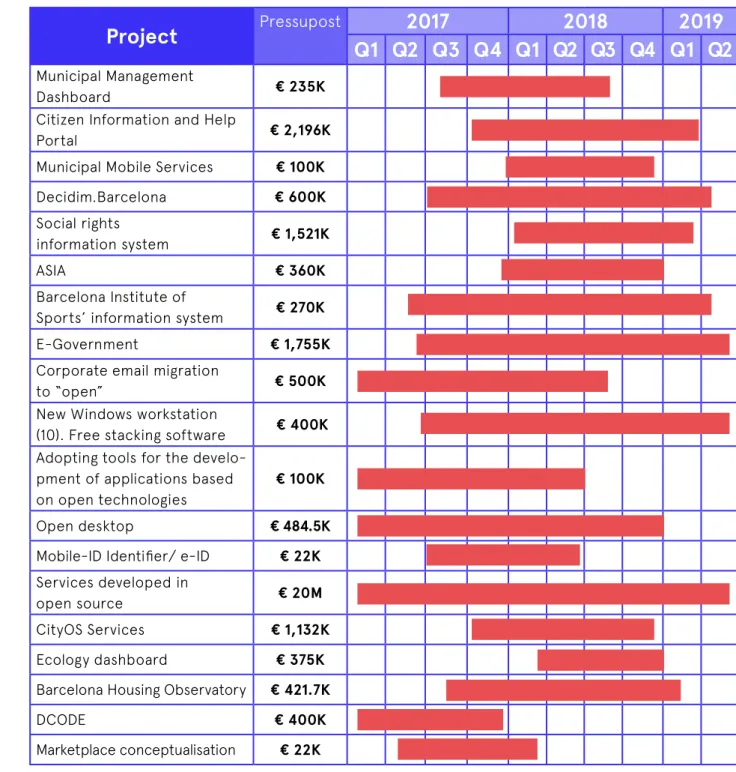
The total budget for the flagship projects in this area is 7 million euros. The timetable for these projects runs from the middle of the second quarter of 2017, up to the end of the second quarter of 2019.
6.1. Agile and user-centred digital services
These projects are:
• Municipal Management Dashboard.
• Citizen Help and Information Portal.
• Mobile Municipal Services.
• Decidim.Barcelona.
• Information system for social rights.
• ASIA.
• Municipal Sports Institution’s Informa-tion System.
• E-Government.
The reference document for this topic is the Barcelona City Council’s Guide to Agile Me-thodologies (see Annexe 12.3).
Barcelona requires technological sovereignty, and is decisively tackling the transition to free software and open standards for this purpose. The best practices in this area are being stu-died and a migration plan will be designed and a code of best practices on open technologies established to guide internal transformation and promote third-party reuse and sharing of software and the development and/or use of shared government solutions. The transition to open source software and open standards is aimed at reinforcing technological sovereignty (see Annex 12.5).
Systems based on free software and open standards offer multiple benefits:
• Transparency: the source code can be examined and audited by anyone who has su-fficient technical knowledge, without the ex-plicit permission of the developer or the City Council. Without this property it is difficult to rely on the neutrality and security of an increa-sing number of governmental and administra-tive processes that are implemented through software, such as voting processes.
• Interoperability: the use of open for-mats and standards allows different systems, possibly from different manufacturers, to work together without any legal and technical obs-tacles. This opens up possibilities for integra-tion between different systems, for example to reuse data and improve processes. It also
gua-rantees that citizens are not obliged to use te-chnological solutions from specific providers to interact with the Administration.
• Sovereignty: transparency and inte-roperability greatly reduce dependence on commercial strategies of manufacturers. The user, in this case the City Council, can decide with greater freedom what systems to evolve, resize or replace, as well as establish its own policies regarding security, privacy, updates and access to systems. In the case of organi-zations, sovereignty also fosters control over their own processes and the generation and conservation of knowledge.
• Flexibility: systems can be better adap-ted to the needs of users and users, and can be adapted and extended as these needs evolve, without depending on any particular provider. Not only is development more flexi-ble, also the evaluation of alternatives is easier and cheaper, and the conditions of operation and maintenance can be modified more easily.
• Sustainability: interoperability allows you to replace those parts of the systems that need to be renewed without the data being ever useless. Greater sovereignty also implies a lower risk of obsolescence of any part of the systems, including hardware. Collaboration (between people and entities) that promote free licenses can be a great help in making a system more stable and lasting.
• Efficiency: factors such as the cost sa-vings associated with the payment of licenses, increased competition among suppliers, a lower risk of obsolescence, and the possibility of sharing costs with other users and entities, make free and standard-based open sour-ce software the best option to guarantee the efficiency that the law demands from the Ad-ministration. The huge base of existing combi-nable software allows us to reach solutions in many domains that are adapted to end users with a low use of resources.
• Reliability and security: the indepen-dence from commercial strategies makes users able to demand higher quality services and take advantage of all the corrections and improvements provided by a community of users and developers of each tool.
• Innovation: transparency, and a fortu-nate combination of collaboration and compe-tition, make free software an enormously ferti-le ground for technological, social and process innovation. This production of knowledge di-rectly benefits producers and users, and indi-rectly the whole society.
The main points we need to work on are:
• Implementing a migration plan and the gradual development of free software.
• Publishing and sharing Barcelona City Council’s software and contents under free software and content licenses.
• Making changes to public procurement to boost the creation, use and reuse of free and open source software.
• Requiring the use of open standards for the city’s technology, data and other infor-mation.
• Identifying development and/or migra-tion opportunities to open architectures and systems in the short term.
The reference document for this topic is the Guide to Technological Sovereignty (see Annex 12.4).
Data are becoming increasingly important for cities because they enable cities to devise better public policies to combat social dis-parities, promote development and improve the quality of life for citizens. The exponential growth of data and rapid evolution of techno-logy promotes new service models to appear and causes profound changes in habits. This context requires ICT organisations to take a flexible but constant approach to adapt and to how they manage the data they handle. A new stage has been entered, where data are of considerable importance in the mu-nicipal and city environment, and there is a clear need for defining and operating a new municipal government data model that acts with sovereignty and which is cross-cutting across the entire City Council. This involves
organisational changes, as well as changes to functions and responsibilities, making it necessary to create a position with the City Council for a data manager or Chief Data Officer (CDO).
The main aspects to be examined further in this area are:
• New rules for data governance.
• Open architecture for data.
• From data to information, from infor-mation to city indicators.
• Ethical and responsible uses of data for innovation.
• Privacy and sovereignty.
As a cross-cutting policy to help the abo-ve-mentioned objectives and topics to be achieved, the usual processes and practices in purchasing technology must be changed to adapt to the agile methodologies to be implemented, to the transition to free sof-tware and open standards and to the new data strategy.
The new method for procuring technology will be open, transparent and more agile. It will extend the range of providers that can access it, facilitating the procurement of solutions based on open source and open standards. In addition, it will consider the aspects of data ownership and privacy, while observing compliance with legal regulations on data protection, including assessment of the ethical risks implied in using data. As a result, we will have new procurement pro-cesses, technology acquisition guides and new digital services not just for potential The “Data Directive” for the City will be pu-blished with the next government measure on data management in Barcelona, where the policy for responsible and ethical data management will be established in a trans-versal way, with the municipal structure of
providers but also for citizens and municipal procurement teams.
New approaches, rules and tools will be de-veloped in order to have:
• Simpler procurement processes.
• Open procurement with more transpa-rent processes.
• Guides for the procurement of solu-tions and services based on open tech-nologies and the development of agile methodologies.
• A digital market platform to facilitate access for small and local suppliers. The reference documents for this topic in-clude the Public Procurement of Technology Guide (see Annex 12.6) and the Innovative Public Procurement Guide (see Annex 12.7). data management, a Data Office and data managers, etc., and it will also include the processes and obligations for maximum com-pliance with the regulations for data protec-tion and improving security.
This transformations will help train and develop existing teams, turning them into well-pre-pared internal teams with skills and capa-bilities to take full possession of the city’s digital services, data and architectural and procurement decisions.
These skills and capabilities will be supported by a series of behaviours and practices
(or-ganisational culture) and an service oriented organisational structure, facilitating team co-llaboration with prompt support from external teams that can complement and enrich the knowledge of internal staff while opening up new professional opportunities.
Figure 3 below shows the more important results that have already been achieved in the aforementioned areas:
6.6. Capability, culture and management
of organisational changes
Technology Code of Practice
A set of criteria to help Barcelona select appropriate open technologies and define
the commitments to open source sof-tware, open standards, interoperability,
security and transparency.
Technology Buying Handbook
A set of guidelines to help Barcelona to select appropriate open technologies
and technology services and thereby avoid vendor lock-in caused by
proprie-tary solutions and closed architectures.
Data Strategy
An approach to handling the city’s data with ownership, privacy, sovereignty and ethical use & innovation at the core.
De-fines a city-scale data architecture and infrastructure for Barcelona.
New Procurement Framework & Digital Marketplace
A new procurement instrument optimized for buying agile services from pre-evaluated
suppliers. This will allow more efficient pro-curement cycles and reduce supplier risk.
Digital Service Delivery Standard
A set of criteria to help Barcelona create and run good & agile digital services. Ser-vices will be consistent and of high quality.
Capability Plan & Hiring
A proposal to develop and maintain the skill and capabilities required for
delivering digital services and a sta-ffing approach for securing new skills
Lines of action have been established for each of the topics mentioned in the previous section
The introduction of agile development metho-dologies is essential for the development of user-centred digital services.
The following actions were carried out during the first quarter of 2017:
4 workshops were organised (tools, agile ma-nagement, skills acquisition, culture and orga-nisation) with internal employees from the IMI, developers, service managers, sectoral managers and directors.
By implementing these methodologies, we will achieve the agreed lines of action:
• BCN will transform 209 new digital servi-ces following the Digital Service Standards and the Technology Code of Conduct (all the new services are listed in section 0.8).
Lines
of action
7
7.1. Agile and user-centred digital services
• We will focus more on the end-user, giving them a leading role in decision-making.
• We will reduce development times and si-multaneously improve technical quality.
• We will offer more public value while main-taining control of the developments.
Based on the lines of action identified, we will be able to:
• Transform the organisational culture, promoting collaboration and transparency, while being more flexible and delivering more public value.
• Implement continuous improvement by implementing practices in the organisation that require system-based processes to be improved.
which will be elaborated upon below, together with their associated actions.
Technological sovereignty will be achieved through migration to free software, the de-ployment of open standards, changes in pu-blic procurement to promote open source software and the identification of migration opportunities to open architecture in the short term.
7.2. Technological sovereignty and migration to free software
The lines of actions here are:
• Ensuring that 70% of investments in new software developments go towards open sour-ce software.
Data are of considerable importance in the municipal and city environment and there is a clear need to define and put into operation a new cross-cutting municipal government model for reinforcing sovereignty. Given its importance, the City Council will devote a government measure to express the data management policy and its implementation throughout all the units of the City Coun-cil. Here, we indicate the action lines and projects that will fall under the scope of this forthcoming measure, an essential element of the Digital Transformation Plan.
7.3. Responsible and ethical data strategy
The lines of actions here are:
• Designing and carrying out initiatives to adapt to the new GDPR for processing perso-nal data in Barcelona City Council.
• Defining and implementing new pro-cesses which allow privacy and security to be incorporated by default, in the design of new computer applications.
• Establishing the level of proactive con-trol required by the new regulation.
• Incorporating open corporate worksta-tions which function using open systems and programmes into the municipal systems.
During the first half of 2017, the following ac-tions were carried out:
• Identify opportunities for development and / or migration to architectures and open systems in the short term.
• Preparation of a migration and develop-ment plan for free and open source code.
• Definition of guidelines for publishing and sharing software and content of the City Coun-cil under free software and content licenses.
• Introduce into public procurement pro-cesses the promotion of the creation, use and reuse of free and open source software.
• Introduce guidelines at corporate level for the use of open standards for technologies, data and other information in the city.
Based on the lines of action identified, we will achieve the following:
•An increase in technological sovereignty.
•Improvement of our image and positio-ning among society.
•Reduction in development costs (low).
•Reduction maintenance costs (effective).
•Reduction of technology evolution costs (notable when we introduce new functionalities developed by the community).
•Reduction in costs of migration to new solutions (important).
Flagships projects in this area, with a total bud-get of 21.5 million euros and a timetable ranging from the first quarter of 2017 until the end of the second quarter of 2019, are included in the Open Source Migration Plan (Annex 12.5).
• Migration of corporate e-mail to open tech-nologies
• Adaptation of the Windows workstation (Win-dows 10) with a set of free software applications.
• Adoption of development tools for applica-tions based on open technologies.
• Open workstation and desktop.
• Mobile ID / e-ID.
• Defining the role of the municipal office of data analytics and the Chief Data Officer.
• Creating a Chief Data Analytics Office, bringing new capabilities for privacy related data improvement and analysis.
• Creating a Data Challenges program-me to involve SMEs and companies in devising data-driven applications for solving the city’s challenges.
We worked on the following initiatives during the first quarter of 2017:
• Establishing new rules for data gover-nance.
• Defining the open architecture of data.
• Creating platforms for big data analysis for public policies and services.
• Creating a guide for ethical and respon-sible uses of data, guaranteeing privacy and sovereignty.
Based on the lines of action that have been identified, we will be able to:
• Improve effectiveness and efficiency.
• Democratise access to data.
• Create new and improved public services.
• Achieve greater democratic quality, res-pecting citizens’ rights, data protection and access to informatoin.
• Generate Transparency and accountability.
• Regain citizens’ trust.
The total budget for the flagship projects in this area is 2.3 million euros and their timetable runs from the first quarter of 2017 up to the middle of the first quarter of 2019.
• CityOS Services (pollution, mobility, tourism)
• Ecology dashboard.
• Barcelona Housing Observatory (OHB).
• DCODE: An EU wide project to develop a block-chain based architecture for data sovereignty.
Through achieving the main objective of the new procurement model, outlined in section 06.5, we can guarantee technological and data sovereignty, promote technological innovation and lever social and economic change.
The lines of action here are:
• New Procurement Framework: Con-ceptualising a new orientation in the procure-ment process.
• ICT Procurement Guide: A guide which gives an overview of the municipal strategy and facilitates the application of va-rious measures.
• Implementing the Innovative Procure-ment Guide: A guide which orientates its
rea-7.4. New procurement model
ders towards considering innovation as a fun-damental element which is inseparable from and boosts sustainable procurement.
• Drafting standard procurement do-cuments: for standardisation and agility in procurement.
• Creation of the Digital Marketplace: A space for continuous dialogue and interac-tion between providers, citizens and the City Council.
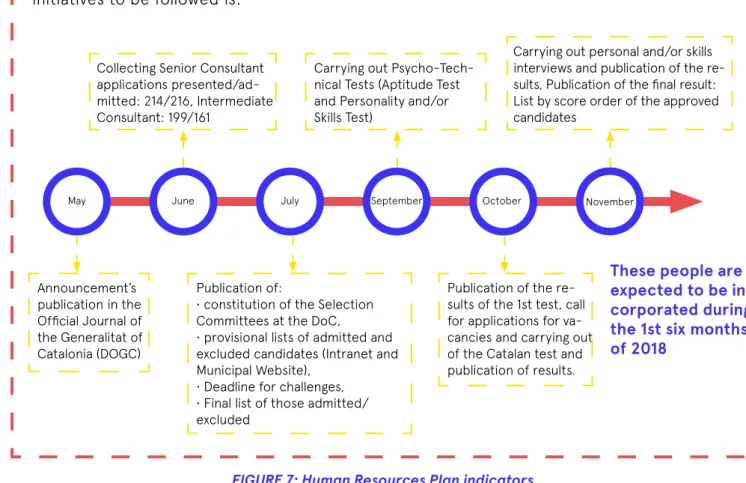
For the transformation of the existing teams the-re is a plan to train internal staff, with workshops aimed at the organization, training and culture, agile management and learning new tools. In parallel, in the first half of 2017, a process to cover 64 new positions for computer te-chnicians (superior and middle level) has also begun, through 2 job boards. This process should last until the end of 2017 and the in-corporation of people will take place during the first half of 2018.
We are also planning an organic restructuring that provides for the creation of 16 new
de-7.5. Culture and organisation of the change
partments, in accordance with differentiation criteria for sectoral areas by technical specializa-tion, which will reinforce management, delegate responsibilities for middle management and the coordination of the different working groups. To finish, the emblematic projects that have been pointed out in each one of the lines of action and that are detailed in the section 08, are part of the Mandate Plan that consists of 3 plans: Sectoral, Legal and Technological, as is set out in the following diagram (Figure 4). We also show how progression has been made, and consumption of the 2017 budget.
• Creating the guide for the procurement of technology and the guide for innovative pro-curement.
• The development of these standard pro-curement documentation.
• Work sessions with the ICT sector to for-tify the measures linked to the procurement of technology
• Surveys to build a digital market platform (Marketplace).
The total budget for the flagship project in this area is 22 million euros. The timetable runs from the beginning of the second quarter of 2017 to the end of the first quarter of 2018.
• Digital Marketplace.
Sectorial Plan Initiatives pending startup Initiatives
in progress Initiativesfinalized
% Execution initiatives
Sectorial Plan The Plan of Law (LPACAP)
Initiatives
The Plan of Law (LPACAP)
Initiatives
71,3% 42,6% 75,9%
Technological Plan
Technological Plan
Initiatives Sectorial Plan 53
3 31 105 5 70 10 0 6 64% 62,4% 65,4% Initiatives The Plan of Law (LPACP)
Initiatives Technological Plan The Mandate Plan is made up of:
The degree of execution of the 2017 budget for each plan up to June 2017 is as follows: