Internationalization Process of
Medical Services:
A Comparative Analysis of the Current State of Medical
Tourism in Medellin, Colombia and San Jose, Costa Rica
By:
Ana María Arboleda Díaz
[email protected]
A thesis presented to the School of Business Administration at EAFIT
University in fulfillment of the thesis requirement for the degree of Master
in International Business.
Author’s Declaration
I hereby declare that I am the sole author of this thesis. This is a true copy of the thesis,
including any required final revisions, as accepted by my examiners.
Abstract
The world economy has been experiencing a progressive trend toward the
internationalization of markets, and service industries have provided avenues to link
geographically disperse economic activities. International entities and especially Western
governments have liberalized their markets by fueling initiatives to deliver healthcare and
other welfare services that thanks to advances in technology can now be traded more
efficiently and faster. One flourishing sector has been the Medical Tourism industry; a way
for developing countries to increase revenues, strengthen their economies and upgrading their
national healthcare systems.
This research traces and compares the internationalization process and success factors
of a sample of medical organizations from two Latin American cities, Medellin, Colombia
and San Jose, Costa Rica. The Uppsala Model of Internationalization proposed by Johanson
and Vahlne (1977, 1990, 2009), and some service internationalization strategies will serve to
analyze data and find validity of this theory when applied to the services sector.
Resumen
La economía mundial ha venido experimentando una progresiva tendencia hacia la
internacionalización de las empresas, y el sector servicios ha proporcionado vías para
conectar actividades comerciales geográficamente dispersas. Muchas organizaciones, y en
especial los gobiernos occidentales, han liberalizado sus mercados desarrollando iniciativas
en servicios de salud y bienestar que gracias a los avances tecnológicos ahora pueden ser
comercializados más rápida y eficientemente. Un sector realmente próspero en la actualidad
ha sido la industria de Turismo Médico; una manera que los países en desarrollo han
encontrado para aumentar sus ingresos, fortalecerse y actualizar sus sistemas de salud.
Esta investigación rastrea y compara los procesos de internacionalización y factores de éxito
de una muestra de organizaciones médicas en dos ciudades latinoamericanas, Medellín,
Colombia, y San José, Costa Rica. El Modelo de internacionalización Uppsala propuesto
por Johanson y Vahlne (1977, 1990, 2009), y algunas estrategias de internacionalización de
servicios son usados para analizar las entrevistas a estas organizaciones y encontrar validez
de esta teoría en el sector servicios.
Acknowledgements
This thesis would not been possible without the help and support of a number of people.
This research allowed me to understand better the current state of the Medical Tourism
industry worldwide and to discover the importance and potential of this sector in the Latin
American Region.
I would like to thank my family and specially my beautiful daughter Valentina for her
company and good vibes during this process. To my wonderful advisor Dr. Treutler for his
wisdom, guidance and ongoing support. I feel privileged to have worked with such an
expertise in the MT field. Thanks also to the Master in International Business professors at
EAFIT University, who taught me the theoretical foundations of this research and made
valuable comments and suggestions along the way.
To all the interviewees from Medellin, Colombia and San Jose, Costa Rica for opening a
space in their busy agendas and letting me learn about their Internationalization processes. I
am delighted to have met and talk to some of the most representative people in the MT
industry.
Finally, I thank to all my MIB classmates. I am grateful to have shared the classroom
Dedication
Table of Contents
List of Figures………ix
List of Tables.………..x
List of Abbreviations……….……….xi
Introduction………..……...1
1.1Conceptual Background………..1
1.2Medical Tourism Concept..………...2
1.3Study Purpose and Research Objectives….……….4
1.4Organization of the Research Paper……….………4
Literature Review………5
2.1 Context……….5
2.1.1 Entry Modes Applied in Health Care Services Exports……..………...6
2.1.2 Internationalization Strategies Applied in Medical Services………...7
2.1.3 Accreditations to Medical Services Providers……….…..8
2.1.3.1 Joint Commission International………..8
2.1.3.2 International Society for Quality Health Care……….9
2.1.3.3 IQ Certification Network……….9
2.1.4 Success Factors in Medical Tourism………..9
2.1.5 Medical Tourism Facilitators………...11
2.2 Medical Tourism Costa Rica………..12
2.2.1 PROMED………13
2.3 Medical Tourism Colombia………15
2.3.1 Medical and Dental Services Cluster………..19
2.3.2 Salud Sin Fronteras ……….…20
Theoretical Framework……….22
3.1 Uppsala Model of Internationalization………..…22
Methodology……….26
4.1 Hypotheses………26
4.2 Research Methodology....……….26
4.2.1 Unit of Analysis………27
4.2.2 Data Collection Methods………..30
4.2.2.1 Interviews………..30
4.2.3 Data Analysis………...30
Findings………..……….32 5.1 Analysis……….32 5.2 Internationalization Strategy……….39
Discussion………..………..45 6.1 Hypotheses………45
6.1.1 Choice of Geographical Locations………45 6.1.2 Entry Mode and Internationalization Strategy Choice………….…...……..46 6.1.3 Foreign Venturing Motivation……….46
Conclusions………..……48
List of Figures
Figure 2.2 Framework for Internationalization of Services 9
Figure 3.1 Uppsala Model of Internationalization 1977 and 2009 23
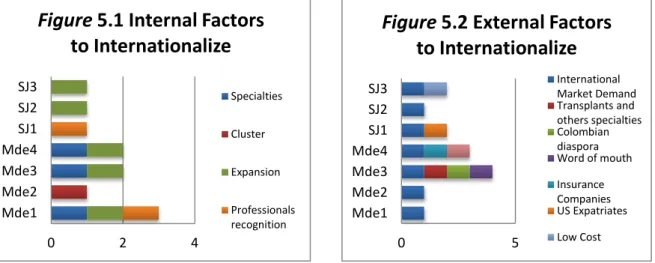
Figure 5.1 Internal Factors to Internationalize 32
Figure 5.2 External Factors to Internationalize 32
Figure 5.3 Units in Charge of IPs 34
Figure 5.4 Certifications 36
Figure 5.5 Medellin 1st IP Origins 37
Figure 5.6 San Jose 1st IP Origins 37
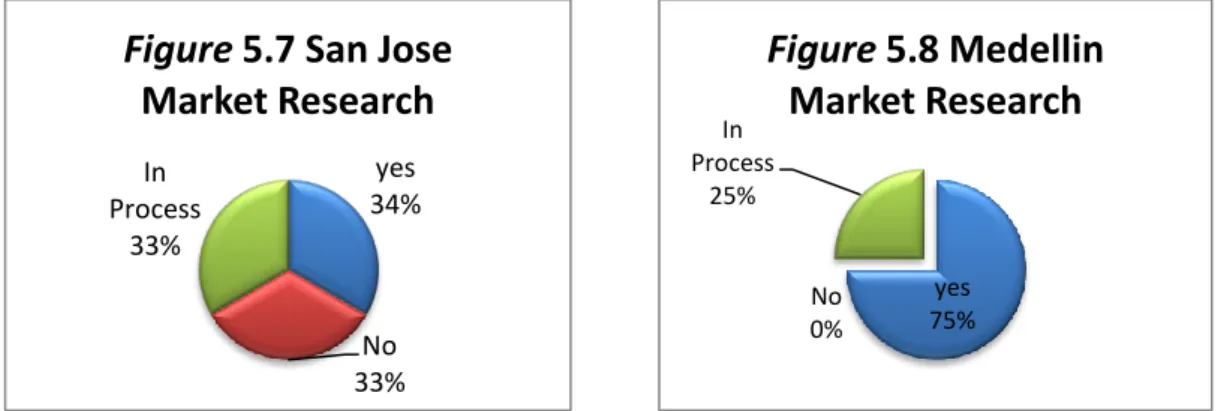
Figure 5.7 San Jose Market Research 38
Figure 5.8 Medellin Market Research 38
Figure 5.9 San Jose Criteria for Market Research 39
Figure 5.10 Medellin Criteria for Market Research 39
Figure 5.11 Methods to Learn about other Markets 39
Figure 5.2.1 Internationalization Strategy Design 40
Figure 5.2.2 Internationalization Strategy Design 42
Figure 5.2.3 Medellin MT Development Motors 43
List of Tables
Table 2.1 Entry Modes Applied to the Internationalization of Healthcare Services 6
Table 2.2 Key Success Factors for a MSO to Internationalize 10
Table 2.3 Medical Tourism SWOT Costa Rica 15
Table 2.4 Medical Tourism SWOT Colombia 20
Table 4.1 Sample Profiles from Medellin, Colombia 27
Table 4.2 Sample Profiles from San Jose, Costa Rica 31
List of Abbreviations
ANDI National Industry Association
ACI Colombian Association of Industrials BPO Business Process Outsourcing
CONPES National Council for Economic and Social Policy EPS Health Promoting Entity
EU European Union
FDI Foreign Direct Investment FOSYGA Solidarity and Guarantee Fund FTA Free Trade Agreement
GATS General Agreement on Trade in Service HDI Human Development Index
IB International Business
ICONTEC Colombian Institute for Technical Standards and Certification ICT Information and Communication Technology
IP International Patient IPS Healthcare provider IQnet IQ Certification Network
JCI Joint Commission International MSO Medical Services Organizations MT Medical Tourism
PND National Development Plan POS Mandatory Health Plan
PTP Productive Transformation Program R&D Research and Development
SBA Strategic Business Area SENA National Learning Service
SISBEN Sistema de Selección de Beneficiarios para Programas Sociales SWOT Strengths, weaknesses, opportunities and treats
TIC Technology Information and Communication UPC Capitation Payment Unit
UN United Nations US The United States
Introduction
1.1Conceptual Background
The global trend toward the internationalization of service firms is a growing
phenomenon happening especially in developing countries (Outreville, 2007). Primo-Braga
(1996) explains this event as a reaction to the informal employment and chaotic urbanization
increase, while in developed nations, this is owed to deindustrialization. Service industries
provide avenues to link geographically disperse economic activities; services that were before
considered non-tradable are now actively traded thanks to technological advances (Chetty,
2011).
Services are understood as “…deeds, performances, and efforts that provide benefit to
customers” (Cloninger, 2000, p. 9). They can also be “activities that link two or more
economic agents, with the objective to generate or prevent a given change in the current
condition of a good or person, and that gives room to commercial relations, national or
international, independently of the way contracts are made” (Dangond, 2008, p.3).
According to Carneiro & Ferreira (2008), the most relevant difference between a good and a
service is this last is intangible, heterogeneous, perishable, and its production tends to be
inseparable from its delivery and consumption. Some services may be similar to goods in
different aspects.
In the European Union (EU) service industries account for about 70% of the total GDP
and employment, and 20% of transnational trade (Pluta-Olearnik, 2011). Meanwhile, in
Latin-American and the Caribbean, services count for more than a half of the total exports in
the region (Hurtado, 1998; BBVA, 2012).
Services are exposed to border policies and domestic regulations as any other industry.
The General Agreement on Trade in Services (GATS)1 presents guidelines on how to
regulate and commercialize services worldwide (Holden, 2003; Pluta-Olearnik, 2011). Some
of the commercial activities considered as services by GATS are communication,
traveling, healthcare, among others. The agreement also describes four entry modes in which
services can be commercialized:
Mode 1, cross-border delivery;
Mode 2, consumption abroad;
Mode 3, commercial presence of a foreign supplier in the host country;
and Mode 4, temporary movement of natural persons to another country to provide services (WTO, 2012).
Another important concept to understand in this analysis is the term „Internationalization‟ described by Welch & Luostarien (1998) as an “increase in
involvement in international operations which can be outward or inward” (p.45). It also
“refers to an expansion across borders in the core Strategic Business Area (SBA) of the firm
and the degree of internationalization measured by the ratio of foreign sales to total sales”
(Rugman & Brain 2003, p. 222). The internationalization process is the result of constant
interactions between knowledge development and operations abroad, and the growing
commitment of resources in the host country (Johanson & Vahlne, 1997).
However, given the nature of this particular research, which focuses on the
internationalization of healthcare services, also known as Medical Tourism2 (MT), this term
will be defined as a set of activities3 that a Medical Services Organization (MSO) in the
Latin-American region performs on a foreign agent or person resulting in the promotion and
increased consumption of medical services.
1.2Medical Tourism Concept
In order to understand the reasons why and how medical services providers internationalize, we first need to discuss the following concepts. First, the word „Health‟ is
defined by the World Health Organization (WHO) as “a complete physical, mental and social
2 Also called “Healthcare Globalization,” “Health Vacation,” “Wellness Tourism,” “Medical Outsourcing” or “Generation
Next Health Holidays” (Khan, 2010).
wellness, not just the absence of ailments and sickness” 4
. This complete state of wellness
depends on economic, organic and situational factors that when are not satisfied force people to consider other alternatives and latitudes; “early civilizations […] were drawn toward the
healing properties of “bath” or “spring” waters, traveling long distances in order to obtain
such benefits” (Khan, 2010, p.1).
The traditional model of international medical travel describes how patients from
developing nations sought professionals and different treatments in highly developed nations
since these services were not available at home (Horowitz, Rosensweig, Jones, 2007). For
instance, advance medical centers in Europe and the United States used to be the only
alternatives in the global market for international patients. However, current studies have shown an opposite activity; “…people from developed countries are traveling to developing
countries for affordable healthcare” (Khan, 2010, p.1).
Renee Stephano (2012), the president of the Medical Tourism Association, defines MT as “patients traveling from one country to another for healthcare. The drivers can be different,
sometimes is cost, some time is access. For the most part it is for better quality and more
affordability.” MT constitutes a “form of tourism to preserve, enhance and retrieve physical and mental health of individuals that takes over 24 hours and less than a year” (Taleghani,
Chirani, & Shaabani, 2011, p.32). This sector is divided into four specialties; healing
medicine5, preventive medicine6, cosmetic medicine7 and inspired wellness8.
The MT industry has been flourishing in developing nations, especially over the last two
decades. Here we analyze the experiences of some MSOs from two cities in Latin-America
ranked as leading competitors in international magazines like America Economia9 and
Ranking Web10.
4 WHO. (2009). Health Cluster Guide. Retrieved from http://www.who.int/topics/health_services/es/ Accessed on: 12/13/11
5 Promotes good health across multiple modalities to treat, understand and improve the quality of life (Mincomercio, 2009). 6 To prevent and identify risk factors (Ibid.)
7 Improvement of physical appearance and self-steam (Ibid.)
8 The Social - satisfaction with relationships and social role performance ▪ Spiritual / mental - the degree to which a person feels positive and enthusiastic about oneself and life ▪ Physical / environmental - physical activity, healthy food
9 America Economia. (2012). Clinicas y Hospitales Ranking 2012. Retrieved from
1.3Study Purpose and Research Objectives
The focus of this project is to understand how MSOs from Latin-America have
internationalized, and to confirm validity of the Uppsala Model proposed by Johanson &
Vahlne (1977, 2009) when applied to the health care sector. The premises of this model are
compared to the internationalization process followed by a sample of MSOs from San Jose,
Costa Rica and Medellin, Colombia.
This analysis is expected to contribute to the International Business (IB) field of
knowledge with a new case in which a theory, originally applied to manufacture industries,
can also explain how medical services internationalize in a similar way. Exploring these
processes allow us not only to discover effective business and marketing strategies but also
to identify the regional and local forces that drive MT development.
1.4Organization of the Research Paper
This paper is divided into six sections. It starts with a clear understanding of the MT and
Internationalization concepts, followed by an analysis of the MT industry context in two
countries specifically. The theoretical framework used in this paper is the Uppsala Model of
Internationalization proposed by Johanson and Valhne (1977, 1990, 2009), which is then
compared to the internationalization processes described by a sample of MSOs identifying
common patterns and testing the three hypotheses proposed. Data collection methods and
ethical considerations are explained. Finally, findings are presented followed by a discussion
Literature Review
2.1Context
The liberalization of trade in medical and social services has provided a wide variety of
alternative treatments at a lower cost, and the possibility of enjoying the amenities offered by
the places where these are performed. Although there are not accurate statistics that can
reveal the actual global performance of this sector, there is evidence of an increase on the
search for low pricing and qualified healthcare abroad (Horowitz et al., 2007). For instance, Deloitte‟s Medical Tourism report (2008) states that during the year 2007, an amount of
750,000 North Americans traveled abroad looking for affordable healthcare and different
medical treatments. This represents an average of $21 billion annual income to developing
countries only from the US. The worldwide revenue of this sector is expected to reach the
$100 billion by 2012 (Herrick, 2007).
The growth of this particular sector in developing countries can also be explained by the
spread of technological advances; medical procedures not covered by a regular insurance;
long wait medical attention; different economic crisis suffered by developed nations, and
regional integration among others (Deloitte, 2008; Khan, 2010; Taleghani et al., 2011). The most common procedures and services internationally on demand nowadays are “cosmetic
surgery, dental procedures, bariatric surgery, assisted reproductive technology,
ophthalmologic care, orthopedic surgery, cardiac surgery, organ and cellular transplantation, gender reassignment, and executive checkups” (Horowitz et al. 2007, p. 2)
The worldwide competition is already set. India and Philippines currently hold the
highest percentage of medical tourists worldwide, followed by Malaysia, Singapore and
Thailand (Ehrbeck, et al., 2008). These countries are well positioned in the international arena
mostly because of cardiology and orthopedics (Horowitz et al, 2007). The success of these markets seems to be a joined effort between government efforts, professionals‟ recognition,
On the other hand, Latin-American countries such as Brazil, Costa Rica, and Mexico
hold high positions in the regional MT industry ranking11. Argentina, Colombia, and
Uruguay seem to be still in the warm-up zone, working hard and getting ready to be
internationally certified (Cortez, 2008; Kahn, 2010; Woodman, 2010). The region is also seen
as a promising retirement land; Costa Rica and Mexico are targets for thousands of US
veterans who are seeking for a friendly environment to retire, with affordable medical
services that they cannot otherwise access at their home country (Pronacomer 2008; Kahn,
2010; Tattara, 2010). The region is recognized worldwide for procedures like cosmetic and
plastic surgery, bariatric treatments and dental care (Horowitz et al., 2007).
2.1.1. Entry Modes Applied in Health Care Services Exports
As it was explained at the beginning, GATS describes four ways in which services can be
commercialized. Bolis (2001) and Outreville (2007) apply them to the export of Health care
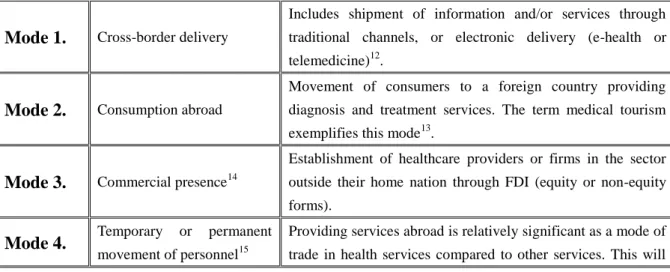
services as shown in Table 2.1.
Table 2.1 Entry Modes Applied in the Internationalization of Healthcare Services
Mode 1. Cross-border delivery
Includes shipment of information and/or services through
traditional channels, or electronic delivery (e-health or
telemedicine)12.
Mode 2. Consumption abroad
Movement of consumers to a foreign country providing
diagnosis and treatment services. The term medical tourism
exemplifies this mode13.
Mode 3. Commercial presence14
Establishment of healthcare providers or firms in the sector
outside their home nation through FDI (equity or non-equity
forms).
Mode 4. Temporary or permanent
movement of personnel15
Providing services abroad is relatively significant as a mode of
trade in health services compared to other services. This will
11 America Economia. (2012). Clinicas y Hospitales Ranking 2012. Retrieved from
http://rankings.americaeconomia.com/2012/clinicas-y-hospitales/ranking.php Accessed on: 10-03-2012. 12 These are in developed and developing countries.
13 Consumption abroad was originally limited to travel to specific places and benefit from natural amenities, such as hot
springs and spas.
14 The most common way of foreign participation (mainly in hospitals and specialized clinics) is to invest in existing
facilities or enter a joint venture with local partners or alliances to develop health care networks and chains.
require sponsorship of a firm in contentment host country
policies and regulations.
Source: Bolis (2001) and Outreville (2007)
These entry modes are especially important when describing the ways MSOs approach
other markets and in what way. Some of these entry modes can result in alliances and
eventually turn into regional clusters. According to Porter (1998), competitive success occurs
within a sector with strong local and regional demand. It boosts innovation, high-quality
standards and classification.
2.1.2 Internationalization Strategies Applied in Medical Services
Internationalization strategies are very diverse; therefore a firm can design its own
strategy according to its goals and needs. Pluta-Olearnik (2011) proposes a set of strategies
suitable for the internationalization of medical services. He claims that depending on the level
of contact between providers and consumers, firms require high expertise and professional
credentials as well as a great deal of control over the distribution channel. In this case,
Foreign Direct Investment (FDI), subsidiaries and branches, and Mergers and Acquisitions
(M&A) are suggested in this particular field.
In the article “Foreign direct investment in the health care sector and most-favored
locations in developing countries,” Outreville (2007) describes some determinants to invest
on MSOs abroad; "cultural distance, country risk, governance level of socio-economic
development, and availability of quality inputs" (p. 305). For host countries, FDI represents a
source of capital, complements domestic private investment, and contributes to economic
development and transfer of technology (Ibid).
On the other hand, Javalgi & Martin (2007) suggest a framework for the
internationalization of service firms that assesses different elements within the organization,
strategies to internationalize, and target market considerations. These aspects must be clearly
defined and mapped before starting to Internationalize. From Top to Bottom Figure 2.2
describes some indicators to understand better where the organization is and where does it
Figure 2.2 Framework for Internationalization of Services
Source: Javalgi & Martin (2007)
2.1.3 Accreditations to Medical Services Providers
Furthermore, concerns about quality and safety in any medical or cosmetic procedure
are common when considering MT. International organisms and governments have created
standards that can guarantee transparency in all processes performed by medical services
providers. For some people, an international or national accreditation makes a difference
while making a decision.
2.1.3.1 Joint Commission International (JCI)
The Joint Commission International is considered the most important accreditation
given to medical organizations worldwide. This certifies the quality, safety, and efficiency
standards that a medical firm must fulfill to be able to compete in the international arena; “Health care providers everywhere must keep pace with globalization and match demand for
high-quality, accessible care” (JCI, 2012). JCI was created in 1994 and so far has made
2.1.3.2 International Society for Quality Health Care (ISQua)
Founded in 1985, the International Society for Quality Health Care (ISQua) promotes
and supports continuous improvement in the safety and quality of health care worldwide.
With certified medical organizations in more than a 100 countries in the five continents, the
ISQua provides guidelines to reach world class levels (ISQua, 2012).
2.1.3.3 IQ Certification Network (IQnet)
The IQ Certification Network (IQnet) was originally creates in 1990. This network
provides different types of certifications that should be present in any organization or firm.
The ISO 9001 certifies on business management quality. They help manufacture and services
firms to achieve business objectives and follow up processes. The ISO 14001 certifies on
environmental sustainability, and the OHSAS 18001 certifies on effective management of
Occupational Health and Safety (OHS). These and many other certifications can be provided
depending on the business purposes and type (IQnet, 2012).
Countries have also designed their own parameters and indicators to certify medical
organizations providers. Examples of national certifications are PROMED from Costa Rica,
Acreditacion Nacional de Excelencia en Servicios de Salud from Colombia and many more.
2.1.4 Success Factors in MT
Several interviews to some of the most representative professionals in the MT
industry were performed in order to identify some key success factors for a medical
organization to internationalize. These factors are listed in Table 2.2. Notice that authors
descriptions lead to a set of common aspect such us, joining a cluster, good reputation and
international recognition, certification of professionals and facilities, excellent management
of marketing tools, transparency in pricing and efficiency, clear internationalization
Table 2.2 Key Success Factors for a Medical Organization to Internationalize.
Author Concepts
Ehrbeck, Guevara, and Mango (2008)
• Having a clear strategic development plan;
• Quality shall be equal or higher than the one offered in the patient‟s country of origin;
• World class sufficient infrastructure ; • Low prices;
• Professional human resources; • Accessibility.
Stephano (2012)
• Transparency in quality; • Transparency in pricing;
• Being able to identify who the doctors are and what services they have offered.
Rua-Acosta (2012)
• Work with competitors. Joining a cluster and working together creates an overall positive atmosphere. Organizations can benefit from the group in different ways. • Individually, organizations should respect each other. Reference to competitors
must be positive.
• Getting certified by international accreditation bodies like JCI, AAAHC and AAAASF.
• Internationalization must be induced by creating conditions (legal and environmental) as similar as possible to the target market. Language and cultural aspects must be taken into account during this process.
• Marketing tools. Good English use in all communicates, website and marketing tools properly translated.
Cardenas (2012)
• Brand and quality differentiation
• The second language in all scenarios as a city culture. • A website that has all the elements in different languages.
• An office or a clearly defined process for each organization to serve international patients.
• Reputation is a key factor. Doctors and dentists that are certified and recognize internationally.
Cook (2012)
• Must be a facility that has quality services, that has something special about it. • Find out what your Niche is, what procedures can you compete with, better prices • Surgeons with experience and success rates.
• If you have all that, you have the recognition and a certification like the JCI or something similar.
• Good country image. What is the perception of the country, how far away is the population you want to attract.
• Provide quotes, doctors interested in the program, and a group of people called International department who work together, that can answer e-mails quickly and
effectively, giving the information patients need, and transportation.
These aspects are later compared to the internationalization process of the research
MSOs sample from San Jose and Medellin.
2.1.5 MT Facilitators
It is also important to add that the term Tourism in MT involves also other type of
industries and services that are important to complement the International Patient (IP)
experience abroad. Hotels, transport, airlines, recreation, marketing agents, insurance companies and more are called “Facilitators.” These “provide pricing of healthcare services,
options for hotels and aftercare facilities, travel and tourism options for the patient‟s medical trip” to potential patients (Stephano, 2009). Also, Facilitators bring valuable information to
insurance companies; it is useful for instance, to assess the suitability of patients and
providers (Enderwick & Nagar, 2011).
In a conversation with Mauricio Castillo (2012), International business director at
Coomeva prepaid medicine, he explains briefly this process:
We have an International Business division that acts as MT facilitator. We manage the referral and care of patients in logistics, administrative, financial and healthcare. Our approach is to work B2B. not directly with patients, but insurers, and governments abroad. We currently have agreements with thirteen international institutions in eight countries allowing a steady flow of patients every year. Usually we sign a contract with a customer or insurer; we show them our service portfolio and become what is called one-stop shopping. They have access to a clinical network in Colombia, to hotels, transport and more. If something goes wrong and the patient dies we handle the entire process of repatriation of the body. We take care of all that and then send you a bill for services rendered to the insurer. We focus only on highly complex events.
Another type of Facilitator agent might focus on the marketing area mediating between
hospitals and IPs. Luis Alejandro Rojas (2012), from THG – Travel Healthy Group explains
this process:
Mr. Rojas states that the majority of IPs that Colombia is currently receiving are
nationals who reside in the United States, Canada and Spain. There is also a large market to
develop in the Caribbean countries, specifically from Aruba, Curacao, Dominican Republic
and also Puerto Rico.
All these aspects are important to understand how MT develops in every context. Given
the nature of this study, we need to then contextualize MT in two scenarios mainly; Costa
Rica and Colombia.
2.2 Medical Tourism in Costa Rica
Costa Rica is located in Central America; it is one of the most promising MT
destinations in Latina America. A recent country report provided by HIS Global (2012) presents a positive panorama regarding Costa Rica‟s economic growth. Labor market should
continue to strengthen over the years 2012-13 thanks to the transformation of manufacture,
mining, and tourism industries. The overall economy is expected to expand 5% during 2012
(Ibid.).
Because of its geographical proximity Costa Rica‟s main trading partner is the United
States (Deloitte, 2008). Several studies16 demonstrate that US patients are saving between
30%-40% of the total cost for procedures and healthcare services they have to pay at home
when traveling to Costa Rica; dental and cosmetic procedures are among the most requested
services.
Besides the number of US citizens that visit Costa Rica every year for medical purposes,
there is also a wave of retirees considering this and other Latin-American countries as
possible destinations to retire (PRONACOMER, 2008). The forecast shows an amount of
900,000 to 2.3 million US seniors going to live abroad within the next few years
(Mincomercio, 2009). Between the US and EU there are 60 million people at the age of 65
that is expected to grow 50% more by the year 2025 (Ibid.); these people will most likely
require high complexity procedures not covered by regular insurances. Just in the US there
16
are about 50 million adults without health insurance (Mincomercio, 2009).
In a conversation with Mr. Brad Cook (2012) from the Medical Tourism Association in
Costa Rica, he mentioned that the large US population living in Costa Rica corresponds
mostly to retirees and multinational employees. Therefore, US insurance companies have
seen the need to establish different types of alliances with MSOs in Costa Rica; to their
advantage is the number of bilingual cosmetic surgeons and physicians usually trained in the
US, besides a desirable nurse to patient ratio (Horowitz et al., 2007). It is also important to
mention that most insurance companies verify professional credentials and certifications
before reaching an agreement with any foreign MSO. In Costa Rica, and specifically in San
Jose, there are currently three MSO that count with the JCI accreditation. They are Hospital
Clinica Biblica and Clinica CIMA (JCI, 2012).
The Programa Nacional de Competitividad y Mejora Regulatoria (PRONACOMER) is a program designed by the government of Costa Rica, the ministry of health and the Costa
Rican tourism institute. These have promoted the creation of an association Public/Private,
with the aim to position the country internationally as a world class medical tourism destination, and as a center of high quality complex medicine. “Medical tourism is no
longer a possibility of savings in plastic surgery and other treatments, but instead, it is now the only solution to the health concerns of millions of uninsured patients worldwide”
(PRONACOMER, 2008, p. 32). Table 2.3 presents a SWOT analysis of the MT industry in
Costa Rica.
2.2.1 PROMED
A medical organization cluster was formally founded in 2008. The Council for the International Promotion of Costa Rica Medicine (PROMED) “brings together health service
providers, health professionals, tourism service providers, academia, and other marketers of goods and services related to health and tourism,” coordinating different functions and
bringing the sector concerns to higher levels in government (PROMED, 2012). This
non-for-profit institution formulates standards to guarantee the quality and confidence on
Central Valley, San Jose.
Some statistics recently published by PROMED revealed that a total of forty-eight
thousand patients entered the country in 2011 laying revenues for about 675 thousand dollars.
This amount was higher than the one generated by coffee exports from January to September
same year (Brenes, 2012). Just in the central Valley, San Jose, there are 1,223 business
linked to MT with an average of 38 procedures performed by each center. While in other
areas, there were identified 109 clinics with an average of 16.3 patients. To determine the
total amount of centers, PROMED filtered the list of MSOs certified by the Ministry of
Health, by regions, location and, website accessibility (Ibid.).
In 2010, PROMED reported a total of 36,000 IPs (20% more than the previous year)
generating 504 thousand dollars in profits. However, PROMEDs Executive Director,
Massimo Manzimo declared these figures not to be precise. Data was provided by PROMEDs
associates that represent about 50% to 60% of MSOs nationwide. He claims figures are only
estimates since it has been difficult to access representative data in every institution.
Government is still responsible for measuring the sector (Brenes, 2012).
Also, PROMED also included a qualitative study to IPs through interviews performed
in different MSOs. Results show that most IPs learned about Costa Rican MT through
Internet. 50% of the surveyors cared about the MSOs and physicians certifications as an
important factor to make decisions. The cluster has join efforts with other sectors and
governmental institutions in order to make more scientific studies and creating statistics that
can represent the progress of the cluster. “Hospitals are the main sources of data and are
Table 2.3 Medical Tourism SWOT Costa Rica
STRENGHTS WEAKNESSES
• Decades of experience and development in the best qualified medical tourism in Latin America. • Appropriate condition to be selected as a
retirement destination.
• The medical tourism industry is the platform to develop a Health City, as a vehicle to develop a
knowledge-based economy.
• Available land field at the northwest of the Central Valley to develop the health cluster
Master Plan
• Touristic places and other areas to develop retirement projects.
• Bilingual physicians (Horowitz et al., 2007).
• PROMED
• The current economic model is based on primary production or manufacturing
"offshore".
• There is one last "land bank" available located in the West Central Valley region to be used in
mega developments.
• Need to insert the country into a knowledge economy.
• The basis of scientific R&D is loose and scattered, unable to make a significant impact
still.
• Statistics are based on estimates. Organizations are still reserved and will not disclose
information on how many international patients
do they have and what specialties are on
demand.
OPPORTUNITIES THREATS
• The global population aging has opened two huge markets for Costa Rica: Medical Tourism
and destination Retiree.
• Medical Tourism and Retirement are based on low labor cost and retiree‟s lifetime savings. • The market economies of retirees and medical
tourists open space for large corporations and
insurance funds retirement and pensions.
• OBAMACARE
• When the U.S. experiences a financial crisis, Costa Rica feels it as well.
• Medical Tourism regional competition includes Panama and the southern neighbors. They are
developing high value-added clusters in
transport, Logistics & distribution, financial
centers, insurances and Reinsurances, high
Technology, Software, Multimedia, etc.
Based on Horowitz et al. (2007); PRONACOMER (2008).
2.3 Medical Tourism in Colombia
Colombia is geographically located in a very strategic place; with access to two oceans,
limiting with five countries, and a time zone that agrees with important cities in the US East
Coast. In spite the harsh recession that the country experienced during the 1990s, its
economy has been recovering thanks to important economic measures made by recent
presidential campaigns (Datamonitor, 2011). Its current GDP 5.7% has been fueled by the
The country still ranks poorly on the Human Development Index (HDI), an indicator of
the UN development program that measures poor living standards. Out of a set of 169 countries, Colombia‟s position in this rank is the 79th; “nearly 60% of the Colombian
households live below the poverty thresholds” ((Datamonitor, 2011, p.4). However, while the
country presents a slide growth in the Information and Communication Technology (ICT)
sector, research and development (R&D) seems to lag behind. Different industry sectors
undermine the importance of innovations and patent awards to remain and survive in a
competitive international arena (Datamonitor, 2011).
Colombia counts with a robust welfare system. Government has created different
programs to manage the health care system appropriately. The Social Security Institute
(Instituto de Seguridad Social in Spanish) opened in 1993 is in charge of assisting the low
income population with medical services, subsidies and other benefits (Datamonitor, 2011).
The SISBEN (Beneficiary Selection System for Social Programs) is a system implemented to
obtain specific data across states, districts and municipalities that allows the classification of
poor people ensuring them healthcare.
In Colombia the competition among MSOs led to a price war during the second half of
the 1990s which still continues (Bardey & Castaño, 2007). Quality was compromised since
technical quality is not fully observable to patients (Ibid), and as a result, predatory lenders
could reduce risk without losing market share, at least in the short term. To solve this issue,
providers proposed for several years a tariff base below which no payment contracts may be
negotiated per event.
Regarding MT, the sector seems to be still raw in many aspects17. MSOs need to
undergo changes in human resources, legal norms and standards (Mincomercio, 2009). Even
though the access to the US market is a comparative advantage, the country must increase its
hospital infrastructure, insufficient to cover the internal demand in some regions (Ibid.). As
for bilingualism levels, the country is in disadvantage when compared to other countries18.
17 Perceived quality, number of personnel working in the sector, bilingualism, perceived risk and safety, customs
procedures, infrastructure and innovation (R&D) (Mincomercio, 2009).
18 While India holds the highest levels in the chart with 100% bilingual physicians and nurses, and Thailand has 80%
bilingual doctors and 50% nurses, Colombia counts with a critical 55% of physicians that are bilingual and only 8% of the
MSOs productivity can exponentially improve with competition; however, it is still difficult
to determine the total number of exports performed by the sector. Some studies have used
quality indicators, such as mortality rates, competences, and market concentration, but still
the results are ambiguous (Bardey & Castaño, 2007).
A report presented by the Ministry of Commerce in Colombia (2009) showed that 2.2%
of the tourists that visit the country every year are medical tourists; most of them were
interested in cosmetic surgery, prosthodontics and restoration, cardiovascular interventions,
bariatric surgeries, and in vitro fertilization (Garavito, 2007; Mincomercio, 2009). 29% of
this population that visited the country during the year 2008 cared about service quality as an
important factor to make a choice; 21% because of low pricing, and the same percentage did
it because of technological advances in medicine (Mincomercio, 2009). Out of the 7,000 IPs
that were attended in 2008, the majority came from the Colombian Diaspora in the US; 9%
were US born citizens, 7% from Spain, 21% from the Caribbean, 18% from Surinam, and the
remaining figures from neighbor countries such as Panama, Venezuela, Ecuador and other
countries (Ibid.).
The National Development Plan (PND in Spanish) 2010-2014 has undertaken
sector-specific investments, land reforms and education in order to create employment and
reduce poverty rates. The plan is expected to lay revenues for about 6.3 billion dollars from
IPs by the year 2032 (Mincomercio, 2009). In 2010, it was created the CONPES19 3678 or
Productive Transformation Program (PTP)20, which has not only moved economic sectors
like electric energy, textiles, graphic communication, BPOs, TICs, and MT, but also, has
promoted other supportive networks like SENA21, and partial certifications by the ICONTEC
and ISQUA (CONPES, 2010).
The MT report made by ANDI22 (Jurado & Estupinan, 2010) presents a map with the medical services related academic programs.
19 Consejo Nacional de Politica Economica y Social Republica de Colombia Departamento Nacional de Planeacion.
20 “The PTP Improves productivity and sector competitiveness; facilitates coordination between public and private actors;
helps sectors and companies to benefit from the opportunities arising from trade agreements, to have a stronger export
supply; It helps to improve the quality of life of Colombians as a result of good performance of productive sectors and companies that generate more and better jobs” (PTP, 2012).
strategic regionalization of the MT sector where Antioquia, Santander, Valle del Cauca and
Cundinamarca will develop the curative, preventive, and cosmetic medicine type of business,
while the Caribbean and the Coffee-grower axis will focus on Inspire Wellness medical
tourism. Also, regions like Cundinamarca, the Caribbean and Antioquia count with Free trade
zones23; which can be attractive for FDI during the Free Trade Agreement (FTA) with the
US24 (Garavito, 2007).
All resources should be administered by Bancóldex. In Antioquia for example, the
government plan has been embraced by the Medical and Odontological Services Cluster, the
tourism cluster, Proexport and the ACI25 (Jurado & Estupinan, 2010). Claudia Perdomo
(2012) MT advisor at ANDI, explains the importance of PTP and the role of this institution in
the development of MT industry,
Our role is basically to support the private sector and the initiatives that the MT industry has by bringing all proposals, especially concerns about trade barriers to the Ministry of Health which has designed the PTP. This partnership is a public/private partnership. We have a strategic plan for 2012 focused primarily on the four columns PTP brings leadership they are Human Resource, Infrastructure, Building and industry promotion, standards and regulation.
Mr. Moreno-Diaz (2012), regional director at Saludcoop Rionegro, described several
ways in which public and private MSOs obtain resources to maintain their business and
eventually internationalize. For instance, in the case of private MSOs, these get resources
from contracts with EPS in the following ways:
By UPC: where EPS and MSOs agree on attending a given number of patients on a monthly base. By event: where MSOs charges the EPS or health insurance company on the attention of a patient‟s emergency or urgent procedure. By charging fees to FOSYGA26or finally by individual consult or own means.
The amount collected from the previous sources has to be distributed into payments to
suppliers, administrative fixed expenses, saving funds, and investments in technology and
development. These must correspond to the pre-established quality policies of the MSO and
23 Centers of massive industrial development with fiscal benefits.
24 Colombia gives special considerations to facilitate foreign patients‟ immigration (Garavito, 2007).
25 Agencia de Cooperacion e Inversion de Medellin y el Area Metropolitana.
26 According to the provisions of Article 218 of Law 100 of 1993 and Article 1 of Decree 1283 of 23 July 1996 which
regulated the operation of the social security system, the Solidarity and Guarantee Fund (FOSYGA) is an account under
controlled by the help of auditing companies.
Furthermore, he also mentioned that private MSOs can also apply for different public
bids and governmental development plans. A well designed expansion plan can be supported
by programs like Plan Vallejo27, the Productive Transformation Program28 (PTP in Spanish),
and more. In the case of Public MSOs resources are directly provided by the government on
a monthly budget base. These organizations are mostly located in municipalities and directed
to attend general public and specially subsided individuals with low income or benefited by
SISBEN. Special procedures are generally hired directly with private MSOs. They also
receive resources from Lottery, tobacco and liquor business taxes.
As this research focuses on San Jose, Costa Rica and Medellin, Colombia, it is important
to mention that in the case of Medellin, there have been two main institutions that represent
the healthcare clusters in the city. They are the Medical and Dental Services Cluster and
Salud Sin Fronteras. These two institutions will be briefly presented next.
A SWOT analysis of the MT sector in Colombia is proposed in Table 2.4
2.3.1 Medical and Dental Services Cluster
Colombia and specially Medellin city have been recognized as an important center of
medical R&D. Famous procedures like refractive surgery, cardiology, Hakim Valve
(Hydrocephaly), transplants, oncology treatment and plastic surgery of high quality standards
are performed in this city. The Medical and Odontological Services Cluster29, the City hall
of Medellin, Mincomercio, ProAntioquia, and Proexport Colombia under the MTA30
sponsorship, have designed an internationalization campaign based on the PTP called
Medellin Health City (Medellin Health City, 2011). This institution integrates important
private and public Medical and odontological service firms as well as other economic sectors
in order to promote the MT. Medellin Health City campaign displays a detailed list of
27 The Plan Vallejo is the formulation of economic policy in Colombia that allows the entry of raw materials, inputs and
capital goods duty-free, in exchange for exports equivalent (Productos de Colombia, 2010).
28 The PTP, is a public-private partnership created by the Ministry of Commerce, Industry and Tourism, which promotes
productivity and competitiveness of sectors with high export potential, through more efficient coordination between the
public and private sector (PTP, 2012).
treatments and pricing. Some of the most advanced firms in the Internationalization process
are the Hospital Universitario San Vicente Fundacion31 , Hospital Pablo Tobon Uribe,
Clinica Las Americas, among others.
Table 2.4 Medical Tourism SWOT Colombia
STRENGHTS WEAKNESSES
o Strategic Location.
o National Development Plan and Medical
Tourism Focus Plan.
o Integrated welfare system.
o Growth in the TICs sector.
o Free trade zones.
o Facilitate foreign patients Immigration process.
o Health Services Clusters
o Tariff regulations
o Poor HDI ranked 79th (60% of the Colombian
households live below the poverty thresholds).
o Changes on human resources, legal norms and
standards in the Medical industry.
o Economy based on primary sources
o Low bilingualism levels in comparison with
other Latin American and Asian medical
tourism destination countries.
o No accurate records on Health services exports.
OPPORTUNITIES THREATS
o Diaspora in the US, and Spain. Inflow of
patients from the Caribbean, and the neighbor
countries
o Join forces with public and private industries
and auditory firms to develop the PTP.
o FTA with US. Participation in international
healthcare Congresses. Few alliances with
hospitals in the US32 OBAMACARE.
o To promote and commercialize Medical services
internationally it is important to be certified;
only two medical institutions in the country are
accredited by the JCI.
o Refional competitors: Costa Rica, Brasil,
Mexico.
Based on Garavito, 2007; Mincomercio, 2009; Jurado & Estupinan, 2010; CONPES, 2010; Datamonitor, 2011; JHMI, 2012.
2.3.2 Salud Sin Fronteras
In 1998 a group of medical organizations in Medellin and PROEXPORT joined forces
to create a special health services export program to promote the sector internationally; this
program was named Salud Sin Fronteras. It is integrated by the eight medical organizations in
the city33. The group has selected a service portfolio to offer mainly to Nicaragua, Panama, El
31 also located at the Free Trade Zone.
32 JHMI (2012). Home. John Hopkins Medicine International. International Collaboration. Fundacion Santa Fe de Bogota.
33
Cardiovascular Clinic, Clinica Las Americas, Clinica Oftalmologica San Diego, Clinica el Rosario, Clinica las Vegas,
Salvador, Honduras, Aruba, Curacao, Guatemala and other nations with high demand for
medical infrastructure, scientific expertise and high complexity procedures. These countries
send their people to the United States and other developed countries in the health sector
(Giraldo & Gómez, 2001).
Felipe Giraldo (2012), executive director at Salud Sin Fronteras shared some
interesting statistics generated by the group. A total of 2.023 patients visited different
facilities during 2011, from which 20% came from Netherlands Antilles, 18% from USA, 6%
from Spain, 4% from Venezuela, 3% from Panama and Aruba respectively, 2% from Ecuador,
Canada and Israel respectively, and the remaining total from other latitudes in small
percentage. 10% of this population requested plastic surgery, 7% general medicine, 6%
orthopedics, 5 % ophthalmology and Cardiology and more. IPs also present patterns of
seasonal demand. For example, June, July and August displayed an average between 8% to
12% frequency, while February, March, April and May visits are lower, but still very close in
numbers. Also, 53% of the international patients surveyed by the group are men, and 29%
Theoretical Framework
3.1 Uppsala Model of Internationalization (Johanson & Vahlne, 1977, 2009)
The „Uppsala model of internationalization‟ proposed by Johanson & Vahlne in 1977
has been an important contribution to the international business studies. This was revised 32
years later by the authors in 2009. The model focuses on the relevance of the cognitive
process on the incremental decision making and the step by step emerging course of
internationalization (Johanson & Vahlne, 1977).
According to the authors‟ empirical observations, firms will tend to internationalize
when certain cognitive conditions are appropriate to start with direct exports to a single
country, through an agent; then, the firm establishes a sale subsidiary, and the last step
comprehends the full production abroad (Johanson & Vahlne, 1977). They also affirm that
exporting is a way of reducing the costs related to market development34.
Another important feature of the internationalization process described by Johanson
& Vahlne (1977) is that it happens first in neighbor countries because of „psychic distance‟ 35.
In this sense, the firm will start its process in close countries and gradually move to more
psychic distant markets (Ibid). “The larger is the psychic distance the larger is the liability of
foreignness36” (Johanson & Vahlne, 2009, p.1412). By making two main assumptions,
uncertainty avoidance and bounded rationality, the approach explains that firms change by
learning from the different experiences they gain when operating in a foreign market.
Therefore, the level of commitment37 abroad is learning-driven. They claim that the “lack of knowledge”38
, is an important obstacle to decision making connected with the development
34 “Even if investment is necessary in the future, esporting helps to determine the nature and size of the market” (Johanson
& Vahlne, 1977, p.28).
35 Factors that make difficult to understand foreign environments (Johanson & Vahlne, 1977). Pschic Distance is explained
in terms of cultural dissimilarities, education, upbringing, business culture, language, government structure and industrial
development level.
36 A term that describes foreign companies‟ low survival rate than local companies for many years after they begin their
operations (Johanson & Vahlne, 2009).
37 Defined by the authors as “the product of the size of the investment times its degree of inflexibility” (Johanson & Vahlne,
2009, p. 1412).
of international operations” (Johanson & Vahlne, 1977, p. 26)
The scheme and posterior reform are presented in Figure 3.1 and complete
description of every conponent is offerd in appendix A.
Figure 3.1 Uppsala Model of Internationalization 1977 and 2009.
Source: Johanson & Vahlne (1977, 2009).
Johanson & Vahlne (1977) cite Penrose (1966) when describing different types of knowledge.
For intance, the objective knowledge can be taught, while experiencial knowledge is acquired
during the development of an activity, thus, gaining skills in a particular labor39. When
internationalizing, the firm lacks these types of knowledge in foreign operations, therefore, it
must be gained throught the process; “the less structured and well defined the activities and the required knowledge are, the more important is experiential knowledge” (Ibid, p.28). It is
important then, to find the right balance between general knowledge and market-specific
knowledge when performing operations abroad.
Opportunities for the firm come depending on how alternative decisions raised and
how they are made (Johanson & Vahlne, 1977). Issues are mainly identified and handled by
the units of the organization directly related to foreign operations and those who work in the
target market. The firm can also find opportunities in a foreign market through customers
abroad (Ibid).
payment conditions and the transferability of money and those things vary from country to country and from time to time”
(Johanson & Vahlne, 1977, p.28). Then the lack of knowledge is due to differences between countries with regards to
In The Uppsala Internationalization Process Model Revised: From liability of Foreignness to Liability of Outsidership (2009), the authors add two more components of the internationalization process of the firm. First, markets represent networks of relationships in
which firms are bounded to each other and to a consideable extent. And second, learning and
building trust and commitment happens thanks to relationships as well. If a firm attemts to
enter a foreign market where it has no relevant network position, it will suffer from a „liability of ousidership40‟. The new model adds the “recognition of opportunities” (Johanson
& Vahlne, 2009). Needs, skills, strategies, and networks connected to the firm represent
opportunities to increase market knowledge.
Authos also added “Network position” to “Market commitment”, where it is believed
that the internationalization iniciative emerges within a network once the firm has positioned
in the local market and benefites from the learning, trust and commitment building of partners. Furthermore, in the change variables, the term “current activities” becomes
„„learning, creating, and trust-building‟‟ (Johanson & Vahlne, 2009). Here authors emphasize
the speed, intensity, and efficiency of the learning process, creating knowledge, and building
trust; these are concepts of intellectual and social capital.
Finally, they highlight the importance of relationships to the “Commitment decisions”
component. In this way, the firm is autonomous to decide whether to increase or decrease its
levels of commitment to one or more relationships within the network. Johanson & Vahlne
(1990) analyze several studies affirm that the lack of market knowledge is not longer an
impediment to internationalize, and that the world is becoming more and more homogeneus, so that such thing as “psychic disance” will tend to disappear.
This approach was originally designed to explain the internationalization proceses of
manufacture industries, however, Coviello & Munro (1997), Trujillo et al. (2006), and Petrou
(2008) have appplied the model to explain the internationalization process of service firms. In
the Uppsala Model of 1977, the authors considered this model of internationalization as a
good fit for empirical observations, and to find validity in this approach, they recommended
two types of empirical studies:
1. One or two case studies where the model explains empirical situations41.
2. A comparative study of the internationalization process of different firms42. “Firms that
differ with respect to those factors also differ with respect to the patterns of internationalization” (Johanson & Vahlne, 1977, p.30).
Let us remember that the main purpose of this model is to understand foreign
investment behavior and to highlight the importance of some factors that affect the
decision-making process of firm internationalization. This research might serve as a new
example where the Uppsala Model is applied to the services industry while understanding
how a sample of MSOs from San Jose, Costa Rica and Medellin, Colombia have
internationalized.
41 These cases should give an account of internationalization variables, market commitment and market knowledge and
how do these factors evolve during the internationalization process (Johanson & Vahlne, 1977, p.30).
42 Factors like size, technology, product line, home country and others, laid against the model affect the course of the firm
Methodology
4.1 Hypotheses
Based on the previous theory, there were formulated the following hypotheses
focused on three factos Choice of Geographical Locations, Entry Mode and
Internationalization Strategy Choice, Foreign Venturing Motivation:
Choice of Geographical Locations:
H1: Medical services organizations from Latin-American countries are likely to internationalize to neighbor markets given the principle of „psychic distance‟ described by
Johanson & Valhne (1977, 2009).
Entry Mode and Internationalization Strategy Choice:
H2: Medical services organizations in Latin-American countries will start their
internationalization following a step-by-step process as suggested by the Uppsala Model.
Foreign Venturing Motivation:
H3: Medical services organizations from Latin American countries are likely to be driven by
relationships to enhance reputation and knowledge when entering foreign markets.
4.2 Research Methodology
In order to find answers to our three hypotheses, we use the Case Study which “tries to
illuminate a decision43 or set of decisions why: they were taken, how they were implemented, and its outcome” (Schramm, 1971). It consists of an empirical enquiry that investigates a
current event within its own context, especially when gaps between reality and a specific
event are not obvious (Yin, 2003). In other words, the case study covers and understands
contextual conditions related to the research question (Ibid). This research is a multiple-case
analysis in which the internationalization processes followed by a sample of MSOs from two
cities, Medellin and San Jose, are compared to the Uppsala Model of Internationalization
while trying to find common patterns and factors of success.
43