Study and Restoration Proposal for the Maison en Bord de
Mer: E.1027 by Eileen Gray and Jean Badovici.
C. Espegel Alonso
Profesora Titular, Directora del Grupo de lnvestigaci6n en Vivienda Colectiva Universidad Politecnica de Madrid
D. Movilla Vega
PhD, Miembro del Grupo de lnvestigaci6n en Vivienda Colectiva Universidad Politecnica de Madrid
This study constitutes an establishment of the main guidelines for the restoration of modern architecture, considering the E.1027 Maison en Bord de Meras a prototype for theortical and technical features. E.1027 Maison en Bord de Mer is a small villa built by Eileen Gray and Jean Badovici between 1926 and 1929 in Roquebrune Cap-Martin, France. Later on, the original project was modified because of successive interventions, altering the spatial qualities until being eventually abandoned in 2008. As a consequence of these varia-tions, a meticulous documentation of the building turns essential in order to undertake its restoration. For that purpose, a description of the house and its historical evolution has been made, comparing plans of its different transformations and ending with a detailed survey of the current state. After presenting the particular pathologies of Cray's villa, the research concludes with the restoration proposal for E.1027 itself
E.1027: MAISON EN BORD DEMER
Between 1926 and 1929, both Eileen Gray and Jean Badovici designed E.1027, a small villa in Roquebrune also known as Maison en bord de mer, for Badovici' s own use. The name of the house is an alphanumeric code for their intertwined initials: E for Eileen, 10 for J (Jean), 2 for B (Badovici), and 7 for G (Gray), indicating the collaborative and sentimental nature of the mission. Gray was responsible for much of the design and for the supervision of the site. Badovici provide theoretical knowledge and technical matters.
It is located on the French Mediterranean coast between St. Tropez and Menton, on parcels 249 and 250 of the AN n.e.s section of the cadastral sector in Roquebrune Cap Martin. The property occupies an area of 790 square meters, and the two story house has merely 150 square meters of construction. It was hailed as a landmark of modern architecture, and then forgotten. Time and neglect have taken their toll, and today the villa stands abandoned, a shadow of its former self (Hecker, S. 1993).
1926. Original project
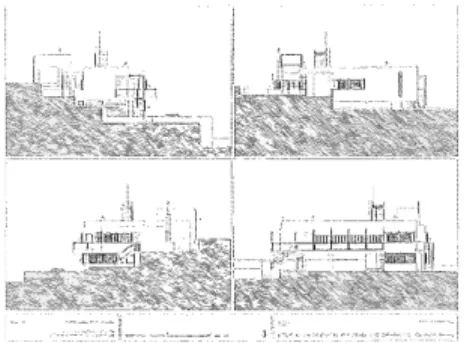
The initial project of E.1027 house was drawn in 1926 upon a precise geometry and implied a clear relationship between the whole volume and its individual parts (figs. 1-3). The complexity of the structure can already be appreciated in sketches of a previous ver-sion of the house. The preliminary project is represented with great simplicity, in very abstract renderings. The interior design of each room was exhaustively developed. There was a vertical chimney-like element located where the glass hood and spiral staircase were later built.
Fig. 1. Ground and first floor. The.oretical project, 1926
Fig. 2. Cross and longitudinal sections. Theo-retical project, 1926
Fig. 3. Elevations. Theoretical project, 1926
C. Espegel Alonso, D. Movilla Vega
1929. Hypothetic state of the house in its original state
The built house differs from the original project in various ways. Due to difficult accessibility to the site, or to problems encountered when laying foundations, or per-haps to Gray's inexperience as a builder, the project was deformed and lost its orthogo-nal character, as well as some of the pristine clean-cut nature of its details: the north wall was not laid out parallel to the southern facade, which is the main axis in relation to which all other walls are perpendicular or parallel.
On the other hand, the layout of the north wall, which swings away from the access platform, emphasizes the idea of creating sort of a funnel to receive visitors.
1929-1972. Transformations
Beginning in 1938, Le Corbusier painted a series of murals that modified the clean pristine quality of Gray' s spaces. This is particularly evident in the living room: the original layout was designed with gathering places (divan, music and dining areas) that created tensions from one side of the room to the other. When Le Corbusier' s mural was painted on the wall at the far end of the room, it prevented the use of that area as a backdrop for the conversation corner around the divan, and the furniture tended to be arranged in a conventional layout at the center of the room.
A diagonal wall was built in the service entrance, which eliminated the ambiguity of the original elegant double entry from the atrium under the marquee, changing the complex circulation system that the house had. Besides this, Gray built the main ter-race sloping to the inside of the house. As a result, rain water was supposed to drain through the recessed channel under the folding windows, but this apparently did not function well and water would flood the living room. Finally, a step was built between the living room and the terrace, which altered the sense of continuity between both spaces, and caused the folding windows to be shortened.
MODERN INHERITANCE
The value of great architecture transcends the context in which it was created. Un-derstanding the scientific, social and artistic background of the construction of the Maison en bord de mer is mainly necessary to support the new space created by the house rather than the particular relationship of the architect and her time.
In relation to science, modern architects did not transcribe the physical discover-ies of their time, but interpreted the ever evolving intuitions of it. Their eagerness to prove their scientific spirit led many of them to adopt scientific terminology without actually knowing what it meant. Thus, the «fourth dimension» in modern architecture represented time as a measure of movement, and since buildings do not move, the «fourth dimension» factor might necessarily be provided by the spectator.
As regards society, the question of the role of woman was established as a conse-quence of the industrial revolution. The First World War put an end to nineteenth century society and its traditional bourgeois morale, and brought about the swinging twenties. Meanwhile, the bolsheviks in the Soviet Union were inventing a future of their own. Emancipated and liberated women entered the scene in those years. They flew airplanes, and made architecture. By 1933 the revolution was over. The parallel
development of the arts, and particularly of architecture, was such that the Modern Movement would be unthinkable without the contributions of the Russian and Soviet avant-garde.
In accordance to this, as happened within other artistic expressions, painting sought to articulate a new language, and the permanent formal dichotomy presented in other arts was also found in painting: cubism and constructivism on the one hand, and expressionism and surrealism on the other. Picasso, whom we could define as eclectic, surpassed both. His eclecticism, like Gray' s, was a protest against the cult of originality. Finally, the necessary techniques and modern machines were mastered and produced in an extraordinarily short period of time. As a result, a new idea of architec-ture developed before and after the First World War.
Studying the work of Eileen Gray and preserving the history and memory ofE.1027 constitutes an attempt to establish guidelines for the theoretical and technical aspects for restorations of architecture of the Modern Movement, using the study of the Mai-son en bord de mer as an example. The restoration of a modern building requires thoughtful analysis. On the one hand, it seeks to restore those parts of the building that are damaged, or whose construction techniques led to rapidly deteriorating struc-tures. On the other hand, restoration implies a re-evaluation of the architectural ideas that inspired those buildings.
CASE STUDY: MATERIALS AND PATHOLOGIES IN E.1027
It was not possible to conduct any probes nor retrieve any samples of materials from E.1027. The information presented in this text is based on visits to the villa, on photographs, and on descriptions by Gray and other authors. Any restoration work would have to reevaluate this study according to preliminary probes and samples of materials taken from the house.
Reinforced concrete structure
Most of the house, with the exception of a few brick walls, is built of reinforced concrete. The visible damage to the structure consists mainly of cracks and crumbling of the concrete surface. In some areas corroded steel reinforcement is exposed, and there are also humidity stains. As usually happened in other buildings of the Modern Movement, the concrete covering the steel reinforcing bars was not thick enough to protect the steel from corrosion, which was accelerated both by weather exposure and the marine humid environment of E.1027: in these cases the carbonation front has reached the steel reinforcing bars. One can also suspect the porousness of the concrete as a cause of accelerated decay in some areas.
Steel carpentry
All steel carpentry in the house is rusted to some degree, depending on location and weather exposure. The protective layer of paint that once covered these elements is gone in most places, or in bad condition. However, none of the steel frames are twisted or deformed. Some railings have decreased in section where they are embedded in
C. Espegel Alonso, D. Movilla Vega
concrete slabs. Several window frames have been replaced by new profiles of different section and subdivisions. Finally, some exterior railings were at one time replaced with galvanized steel railings, which have also lost their protective paint coating.
Wboden shutters and doors
Practically all shutters are rotten, and many have broken slats. The mechanism that allowed them to slide along the steel profiles is rusted and they do not move easily; in some instances these mechanisms appear to have been replaced by metal profiles screwed to the bottom and top of the shutter. Some of the shutters have been replaced by sheets of metal. The terrace folding windows were cut shorter and fitted with an intermediary horizontal transom that has subdivided the tall windows into two panes. Exterior doors are rotten on the bottom, and the two outer doors fitted with pivoting slats (in the alcove and the main bathroom) are now missing.
RoofS, drainpipes and waterproofing
The system used for roof construction appears to have withstood the passing of time in remarkably good condition, although this should be closely examined. The roof's main problem was that it lacked enough drainpipes; others were added later, and they were placed on the exterior against the facades. An important project mistake made by Gray was to drain the terrace through the recess or channel built under the folding windows. It proved insufficient and led to the construction of a 20 cm step that runs under the folding windows, which had to be shortened.
Interior finishings and furniture
ther many pathologies have been detected in relation with the entrances, differ-ent livable areas or staircases, specially related to humidity, cracks and rendered and painted walls or ceilings. Damages to the frescos are particularly relevant in this case. On the wall of the entrance hall, a fresco by Le Corbusier was painted over Gray's in-scriptions and fresco; rendered surfaces painted white and black. Other Le Corbusier's frescos were rendered and painted white.
RESTORATION PROPOSALS FOR E.1027
Aesthetic and technique are closely linked and dependent on each other. The resto-ration process demands a close collaboresto-ration of architects and technical experts alike.
In ancient stone, masonry or wooden buildings, the damaged sections of the structure can be altogether replaced without modifying the aspect of the building. Monolithic concrete structures demand a different approach and are more complicated to restore, since the structure is visible. It is important to try to achieve an appearance as similar as possible to the original, since later additions that bear witness to transformations are generally not considered as worth maintaining in this type of architecture.
One must analyze the various options for restoration: whether to return the build-ing to its original state, or maintain the buildbuild-ing with its current transformations, or deny all architectural value and adapt the building to new functional requirements. In
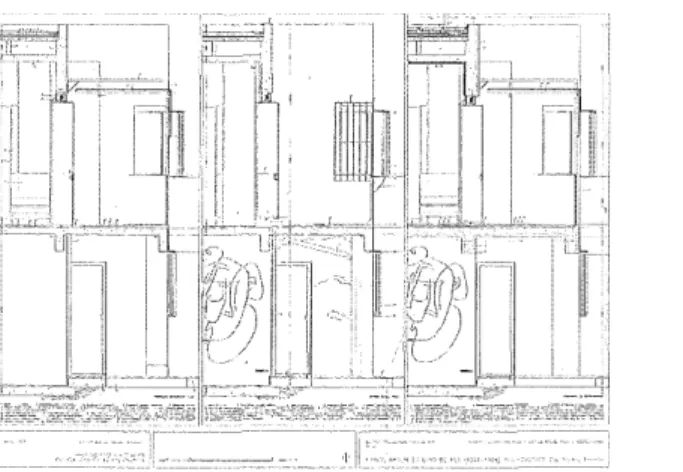
Fig. 4. Cross section, Southern fas:ade. Built project, 1929 /Current state, 1997 /Theoretical restoration
practice an intermediate solution is often adopted, since one can rarely embrace such a pure or radical solution. In the case of the restoration of E.1027, it is proposed to return the house to its original state. Its value resides in the spirit and ideas it embod-ies, as well as in the formal and technical solutions that convey those ideas. It is such a complex and complete work of architecture, interior and furniture design, implanted on the site with such sensibility, that any transformation detracts from its purity and spirit.
The main aspects of this restoration aim to recover the total original spatial con-ception, remove later additions and reconstruct missing elements, and preserve the ty-pologies of materials and construction techniques. The project itself would recover the original 1929 state of the house and remove later additions, particularly those which transformed the multiple and complex circulation scheme of the house and those that invalidated spatial continuity between the interior, the covered exterior (terrace) and the outdoor grounds (fig. 4).
It is planned to restore the built-in furniture that remains in the house: Spine-screen, staircase cupboards, partition and cupboard of the dressing and shower area, main bedroom headboard, slanted cupboard and other pieces in the main bathroom, guest room wardrobe, and servant's room cupboard. The missing built-in and mobile furniture would be reconstructed, since all pertinent information is available to do so, or would be replaced with originals when possible, since many of them belong to museums or private collections.
A special consideration must be given to Le Corbusier' s mural paintings, however. They transformed the perception of space as conceived by Eileen Gray, and in all rigor should be eliminated. Yet they deserve to be preserved for their intrinsic value. That is
C. Espegel Alonso, D. Movilla Vega
why a solution has been devised to allow, to a certain extent, for perception of Gray's original space while preserving the murals: concealing Le Corbusier' s fresco with a can-vas shade sliding on stainless steel tensors. For some time now the office of the Services Techniques de Roquebrune has thought about creating a protected area encompassing E.1027 and the Cabanon of Le Corbusier. The proposal is organizing a circuit for visi-tors to walk through both buildings, and then perhaps to proceed to the graves of Le Corbusier and his wife above Roquebrune. The visit could extend to Tempe
a
Pailla, which is close by in the mountains of Menton. The objective is to create a Museum for the works of Eileen Gray, Jean Badovici, and Le Corbusier. The lives and works of these three architects were closely related to the coastal area of Cap Martin, and people there are not really aware of the value of E.1027, or Maison Blanche, as it is locally known.FINAL CONSIDERATIONS
Over the years many transformations ofE.1027 have been carried out. Some sought to correct design mistakes of the original project, others were meant to further embel-lish the house or modify its disposition. All the original furniture that conformed and specialized interior spaces has been removed; the last pieces were auctioned by Sotheby's in Monte-Carlo in 1991 and are now scattered in various collections. These changes have altered the spatial qualities of the original project. As a result of it, a thorough documentation of a building turns essential to undertake its restoration. In the case of E.1027, all the compiled information sheds light on the design process as undertaken by Eileen Gray and Jean Badovici, and on the house itself.
The important role of documentation reveals a description that make it almost possible to reconstruct the villa through the written and graphic ·materials studied. In spite of all this data, many incoherences appeared during the study and remain as uncertain assertions in some issues of the research, since they reflect an own particular interpretation. The most urgent task was to document the Maison en bord de mer, to promote its conservation and restoration. This led to specify the restoration project as much as possible, to include building materials and technical details, and not just define general intervention guidelines that may be interpreted in a variety of ways. The analysis presented in this study is based on the previous research published by several authors. In the same way, future studies on E.1027 will improve upon this thesis and add new contributions.
REFERENCES
Adam, P. 1987. Eileen Gray, Architect/Designer. New York: Harry N. Abrams, Inc. Constant, C. 2000. Eileen Gray, London: Phaidon Press Limited.
Garner, P. 1993. Eileen Gray: Design and Architecture, 1878-1976. Koln: ed. Benedikt Taschen Verlag GmbH.
Hecker, S.; Miiller, C.F. 1993. Eileen Gray, Obras y Proyectos. Barcelona: ed. Gustavo Gili. Loye, B. 1984. Eileen Gray, 1879-1976: Architecture Design. Paris: Analeph/J.P.Viguier.
Rubino, L. 1979. «Eileen Gray (1879-1976): una designer contro il "camping style"» in vol. Le spose del vento. Verona: G. Bertani ed.
Rykwert,J. 1968. «Un Omaggio a Eileen Gray. Pioniera del Design», Domus, n.469, Milan, p. 21-34.