Correlation effects in Cr-Zinc chalogenides
C. Tablero
Instituto de Energia Solar, Universidad Politecnica de Madrid, Ciudad Universitaria s/n, 28040 Madrid, Spain
A B S T R A C T
The electronic properties and self-interaction effects of Zn5 xCrxTe (with x= 0.03125 and 0.0625), using the local spin density Approximation with a Hubbard term to improve the description of the d-Cr orbitals, is presented. These materials have potential technological applications as half-metallic and intermediate band materials. For a sufficiently high density of Cr substituting the Zn atoms they have an intermediate band in the host semiconductor band gap for a one spin component, with the Fermi energy located within the impurity band. An increase in the Cr concentration causes an overlap of the intermediate band with the valence band, leading to only half-metallic behaviour. One would expect a substantial shift in the position of the Cr d-bands due to the local Coulomb interaction. However, the Coulomb interaction induces almost no changes in the occupied bands. The expected shift is indeed observed in the conduc-tion band. This point is analyzed and a comparison with other zinc chalogenides is made in accordance Keywords: with the interactions Cr-host semiconductor.
Self interaction
Intermediate band materials Impurity band
Correlation Solar cells Spintronic Lasers
1. Introduction
Cr-doped II—VI compound materials have been the subject of extensive research since the early 1960s. There is a large body of literature on these compounds as materials for light emission in the blue and green spectral regions. These materials have been of interest for their use in light emitting diodes, as well as blue lasers and fluorescent displays. These crystals have very recently at-tracted the attention of researchers as magnetic semiconductors for spintronics, transparent conducting oxides, up and down-con-verters and intermediate-band solar cells. Moreover, Cr can be incorporated into the wide-bandgap semiconductor, such as ZnS or ZnSe, and exhibit room-temperature operation in the mid-infrared.
For spintronic applications it is highly desirable to explore sat-isfactory half-metallic (HM) ferromagnetic materials compatible with traditional III—V and II—VI semiconductors. After the discovery of the ferromagnetism of Ga0.947Mn0.o53As with a high Curie temperature, the diluted magnetic semiconductors (DMS) became the subject of intensive experimental and theoretical studies as they were considered to be promising materials for semiconductor spintronics. Very recently a Zn!_xCrxTe sample with a high Cr
con-centration of x = 0.20 has been grown Therefore, it is of much interest to explore the electronic and magnetic properties and structural stability of ternary transition metal compounds based on ZnTe.
for a spin component. Therefore, if the IB for a spin component mixes with the host bands, the material will no longer be an IBM, although it will continue to be an HM material. Of course, also there are IBMs that are not HM materials, when the IB is present for the two spin components.
It is also important to note that the Cr-doped zinc chalogenides combine the properties of semiconductors with those of the tradi-tionally used dielectric laser materials As a result, they possess the excellent laser properties along with interesting physics as well as optical and nonlinear properties, distinguishing them from the traditionally used dielectric laser media. This opens up an exciting wide field of research and new opportunities for the use of these materials in laser and nonlinear optical applications.
Several zinc chalogenides, Zn!_xCrxY with Y = S and Te, have
been studied both theoretically and experimentally. the bulk systems Zn!_xCrxTe with x from 0.25 to 0.75 are analyzed
the-oretically. Samples with a high Cr concentration (x = 0.2) have also been grown These systems are characterized by a high Curie temperature and HM behaviour with only spin-up states present at the Fermi energy. The spin-up and spin-down impurity bands do not overlap, which leads to strong HM behaviour with only spin-up states present at the Fermi energy. For these x values, an isolated, partially filled IB is not seen. However, theoretical studies indicate the possibility of the presence of an IB for much smaller concentrations (x = 1/32 = 0.03125 and 1/108 = 0.00926).
To date, the main body of theoretical studies has been carried out within the framework of the density functional theory (DFT) For instance, many DFT calculations for the III—V, II—VI DMS and IBM have been carried out with the local spin density approximation (LSDA) and generalized gradient correction (GGA) for the exchange and correlation term. However, the currently used exchange and correlation functionals are built from a homo-geneous electron gas so that interactions are treated in a mean field approach which is not accurate enough to describe correla-tions properly or account for other many-body effects. The LSDA and GGA tend to underestimate the Coulomb repulsion of elec-trons occupying different orbitals of the same d shell. In particu-lar, this leads to equal occupations of different orbitals of the same manifold and prevents stabilization of the orbitally-ordered solutions.
Because of the narrow and partially filled IB characteristics, the correlation effects should be very important. The IB electrons are supposed to spend their time in regions (around the ions) where the presence of other particles would make them feel strong Cou-lomb repulsion, thus making their motion correlated. The band structure LSDA calculations are not the best approach to observe this physical behaviour, because it is the manifestation of a sin-gle-particle problem, whereas the correlation is the result of many-body interactions. Because of the correlation effects, the IB could split into two sub-bands, a full one and an empty one. There-fore, a more profound study of these materials with respect to the correlation effect would be desirable to analyze whether this band overlaps with the VB, similar to what happens for larger concentra-tions. In this case, as has been previously mentioned, the material would be transformed from an IBM and HM material to just an HM material. The possible approaches [7] for this study are Green func-tions with screened interaction (GW), the self-interaction correc-tion to the LSDA (LSDA-SIC), the Exact Exchange Kohn-Sham formalism (EXX), and to include in the LSDA a Hubbard term U to improve the description of the many-body effect (LSDA+U). The GW, SIC and EXX formalisms are currently prohibitively expensive for large cells. For an intermediate level, the LSDA + U method with a Hubbard term (U) greatly improves the description of the IB states and allows relatively larger supercells to be ana-lyzed. Moreover, it generates an orbital-dependent potential which favours solutions with broken orbital degeneracy.
the bulk systems Zni_xCrxY with Y = S and Se and x sg 0.0625, with an IB for the majority spin component, are ana-lyzed theoretically with the LSDA + U methodology for a wide range of U (from U = 0 to U = 6 eV). Nevertheless, the theoretical calculated values of U (overestimated) for these systems are around 2 eV.
for U > 6 eV, Y = S and x = 1/32 = 0.03125, a metal insulator transition takes place. for U = 6 eV, Y = S and x = 2/32 = 0.0625 this transition does not happen. However, for U > 6 eV, a splitting of the dxz-Cr and the py-Cr orbitals produces two Hubbard sub-bands, a full one below the Fermi energy and an empty one above the Fermi energy. The metal-insulator transition does not happen because the other contributions to the IB are not separated by a gap, and therefore, the band is not split,
for Y = Se it is emphasized that the correlation effects when Cr sub-stitutes Zn atoms in the ZnSe host semiconductor are lower than when the host semiconductor is ZnS.
Summarizing, the Zn!_xCrxTe with x = 0.2 has been grown and has been analyzed theoretically for x > 0.2 presenting HM behaviour with only spin-up states present at the Fermi en-ergy. Theoretical studies, using the LSDA methodology , indicate the possibility of the presence of an IB for much smaller concentra-tions (x sg 1/32). Therefore, it is desirable to extend the study of the Zn!_xCrxTe beyond the LSDA to analyze whether a smaller Cr con-centration, as well as the HM behaviour, leading to the formation of a partially filled IB. Note that the overlapping of the IB with the VB has, as a consequence, the HM behaviour observed experi-mentally and theoretically for x = 0.2.
The present work is important in a number of aspects. We will analyze the theoretical results for Zn!_xCrxTe with x = l/32 and x = 2/32 in order to check whether the IB mixes with the VB. Be-cause of the DFT-LSDA limitations, a further extension beyond the LSDA is carried out using the LSDA + U method. The results of the LSDA + U method seem surprising due to the small influence of the U-parameter on the electronic properties of the IB. These re-sults and the variation with the host semiconductor will be ana-lyzed, and the differences discussed.
2. Calculations
The computation of total energies from first principles requires the finding of solutions to the Schrodinger equation using DFT [12]. Initially, we simplify the many-body electronic problem by making use of the DFT-LSDA. For the exchange and correlation term, the LSDA has been used as proposed by Ceperley-Alder A well-known consequence of using the LSDA is the fact that the band gap is usually underestimated. On the other hand, the use of the LSDA considerably simplifies the solution of the Schrodinger equa-tion by mapping it into a single-electron equaequa-tion. The electronic structure calculations were carried out by using pseudopotentials for core electrons. The standard Troullier-Martins pseud-opotential is adopted and expressed in the Kleinman-Bylander
factorization. The standard Kohn-Sham (KS) equations are solved self-consistently and the KS orbitals are repre-sented by using a linear combination of confined numerically-localized pseudoatomic orbitals
neighbor cell-internal atom positions were allowed to relax in accordance with the calculated quantum mechanical forces until the forces became smaller than 0.004 eV/A.
In the currently used exchange and correlation functionals, the interactions are handled in a mean field approach which is not suitable for describing correlation effects properly. One of the fun-damental problems intrinsic to the LSDA is the presence of self-interaction. This is the spurious interaction of an electron in a given KS orbital with the Hartree and the exchange-correlation potential generated by itself. In order to remove the self-interaction, in LSDA + U one replace the LSDA exchange and correlation energy associate to the correlated orbitals with the Hubbard-U energy. Then, the LSDA + U method corrects the spurious self-interaction for the shells where it is applied, while the remaining ones are still affected by the self-interaction error. Therefore, in order to analyze the effect of the self-interaction in the IB, a further extension be-yond the LSDA is carried out using the LSDA + U method, including an orbital-dependent one-electron potential to account explicitly for the important Coulomb repulsions not adequately handled in the LSDA approach. Several forms and implementations have pro-posed to date The LSDA + U method used here has been ap-plied to similar systems using the same calculation methodology A weakness of the LSDA + U method is that U is an external parameter. The screened U parameter has been esti-mated theoretically using constrained LSDA calculations by vary-ing the occupation numbers of the d orbitals. The value obtained gives U ~ 2.0 eV. However, in many cases the value of U obtained theoretically is different from the optimal value determined empir-ically as a fitting parameter to experimental results. Therefore, this theoretical value must be considered as an approximate value. Therefore, we present the results as a function of U and will argue that the correct physics is obtained within the interval 0 < U < 6 eV analyzed in this work.
a 2
3. Results
Using the methods described above, we have explored the Zn!_xCrxTe, based on the zinc blende ZnTe host semiconductor, where x takes values of 1/32 and 2/32 to simulate heavy doping. The doping of x = 1/32 (2/32) is obtained by replacing the Zn by Cr at the apex and/or face-centre sites of the unit cell of zinc blende ZnTe with 64 atoms. For the host semiconductor, the Zn site is tet-rahedrally surrounded by four equivalent Te atoms. However, when a Zn atom is substituted by Cr the Te atoms can be broken down into two groups: those directly bonded to the Cr atoms (Te!) and those which are not (Te2). Therefore, the Cr atoms will interact mainly with the Te^ atoms. In these structures the antifer-romagnetic alignment is less stable than the ferantifer-romagnetic (around 0.11 eV per cell for x = 2/32). It is in agreement with the literature Therefore we will focus our study on the ferromag-netic alignment.
The energy-band diagram in the principal directions of the BZ is shown in Fig. 1 with U = 0 eV. First of all, we see the HM behaviour in the sense that at the Fermi energy the density of states is finite for the majority spin and zero for the minority spin. For the minor-ity spin components (-) there is a gap, similar to that of the host semiconductor. Moreover, an isolated IB for the majority spin com-ponent, made up of a group of three and six sub bands for x = 1/32 (Fig. la) and x = 2/32 (Fig. lb) respectively, appears between the full band (VB) and the empty band (CB). The Fermi energy (hori-zontal line in the figure) cuts this IB showing that the band is par-tially filled. The IB for x = 2/32 has a bandwidth greater than x = 1/32 because of the larger concentration of Cr atoms.
When the positions of the Cr and of its nearest neighbors are re-laxed (according to the calculated quantum mechanical forces until the forces became smaller than 0.004 eV/A), the distances Cr-Te
Fig. 1. Energy bands (eV) in the principal directions of the Brillouin zone for Zn^*
(XTe with (a) x = 1/32 and (b) x = 2/32, for the majority (solid lines) and minority spin component (dotted lines). The Fermi energy as zero has been chosen in this figure.
increase with respect to the distances Zn-Te of the host semicon-ductor (2.64 A) and the local tetrahedral symmetry (considering the immediate Cr neighbors) is reduced to C3v: there are three same distances (2.78 A) and a different one (2.69 A). The Cr-neigh-bors suffer an outward non-symmetrical displacement. Moreover, the relaxing of the atomic positions causes a downward shift of the IB with respect to the VB. Nevertheless, this distortion does not produce a split of the occupied and the empty IB states.
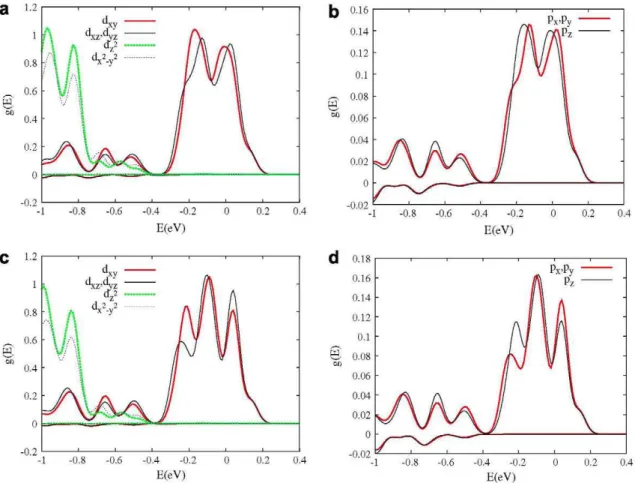
In order to identify the atomic and orbital composition of these bands, the projected density of states (DOS) of the atoms and Cr orbitals is represented in Fig. 2. For all concentrations, it can be seen that the IB is created for combination of the Cr and Te^ orbi-tals (direct bonding to the Cr atoms). From the figure, it can also be seen that the Cr orbitals that contribute more to the IB are the d orbitals with t symmetry (dxy, d^ and dyz), and in a lower
propor-tion, the p orbitals (also oft symmetry). Although both, the dxy, d^
Fig. 2. Projected DOS for the Zn] _xCr„Te systems on the Te and Cr atoms (per atom, with x = 1/32 (a) and with x = 2/32 (c)), and thed (t and e) and the p Cr orbitals ((b) with x = 1/32 and (d) with x = 2/32). The Fermi energy as zero has been chosen in this figure.
The total integrated DOS between the bottom of the IB and the Fermi energy is two and four electrons per cell for x = 1/32 and x = 2/32, respectively, and between the Fermi energy and the top of the IB is one and two electrons per cell for x = 1/32 and x = 2/ 32. This confirms the partial occupation of the IB. An analysis in a wider range of energy indicates that the t_-Cr orbitals (t-Cr orbi-tals for minority spin component) contribute mainly to the VB, and the t+-Cr orbitals (t-Cr orbitals for majority spin component) to the VB and IB. Therefore, the t-Cr orbitals mix with the t-Te! orbitals, forming a bonding component in the VB and an anti-bonding com-ponent in the IB for the majority spin comcom-ponent. This point will be discussed later.
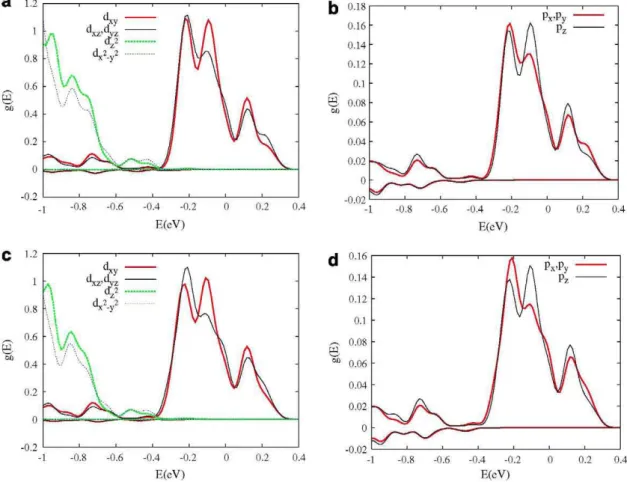
For computational ease, in LSDA calculations with partially filled bands the one-particle charge density belongs to the totally symmetric representation of the physical symmetry group. For this, the contribution of the three t-Cr orbitals is equal. The same effect happens with the two e-Cr and three p-Cr orbitals. This symmetrization deprives a part of spatial correlation to the system allowing, for example, a different orbital occupation to minimize the effects of the Coulomb self-repulsions. LSDA + U methodology, with orbital-dependent potential, favours solutions with broken orbital degeneracy, i.e. a different spatial occupation. This fact can be seen in Figs. 3 and 4 for x = 1/32 and x = 2/32, and U = 3 and 6 eV
In these figures, the t-Cr, the e-Cr and the p-Cr orbitals are split into several components. The three t-Cr orbitals are divided into two groups, one made up of the dxy orbital and the other one of
the dxz and the dyz orbitals. The e-Cr orbital group is separated in
its components. The three p-Cr orbitals are divided into two groups, one formed by the pz orbital and the other one by the px
and the py orbitals. However, these separations are small,
indicat-ing that the U effect does not significantly affect the IB. This fact also can be seen in Tables 1 and 2.
In Table 1 the gaps and bandwidths for U = 0, 3 and 6 eV are shown. For the majority spin component (+), A£{,|', A£J+) and AE[p are the gap between the VB maximum and the IB minimum, the IB bandwidth (the difference between the IB maximum and IB minimum), and the gap between the IB maximum and the CB min-imum. Similarly, A£^-' is the gap between the VB maximum and the CB minimum for the minority spin component. As U increases from 0 to 6 eV, the variation in these magnitudes is small, indicat-ing, as mentioned, the small influence of the U-Hubbard term. The gaps Af^' and A£(J' (A£{,|' + A£J+) + AE[p) in our calculations are about half of the value known from experiments of the host semiconductor (2.3 eV). The calculated gap with the same 64-cell atoms of the host semiconductor and equal conditions is 1.50 eV Comparing this value with those of Table 1, the introduction of Cr increases the band gap slightly with respect to the host semi-conductor. This gap dependence on the Cr concentration is similar to other results with more Cr concentration [5]. Nevertheless, it is necessary to point out that the LSDA underestimates the gaps and that LSDA + U method does not correct the spurious self-interac-tion for the host semiconductor.
C. Tablero/Computational Materials Science 44 (2008) 303-309 307
c
w
00
1.2
1
0.8
0.6
0.4
0.2
0
-0.2
Fig. 3. Projected DOS for the Zn,_„CrJe with x = 1/32 on: (a) d-Cr orbitals with U =
U = 6 eV. The Fermi energy as zero has been chosen in this figure.
3 eV; (b) p-Cr orbitals with U = 3 eV; (c) d-Cr orbitals with U = 6 eV; (d) p-Cr orbitals with
the difference between the two spin components, proportional to the atomic polarization, increases with U.
As an important conclusion, the results indicate that the corre-lation effects are not very important compared with other semi-conductors . These ternary compounds, and others based on III—V and II—VI host semiconductors could have applica-tions in the near future, as HM materials, or IBM for lower concen-trations, especially those with x< 1/32. As HM materials, quite high Curie temperatures would be expected in many of them because of their quite wide HM gaps
4. Discussion
4.1. Comparison with others zinc chalogenides
Zinc chalogenides Zni_xCrxY with Y = S and Se and with x = 1/32 and x = 2/32 (and to x = 108 using only LSDA) have been studied
using the same methodology as for Y = Te in this work. Firstly, the main conclusions of these works will be summarized, and later on we will carry out a comparative analysis of the Cr doped zinc chalogenides.
The correlation effects of the Zn!_xCrxS are analyzed
for U > 6 eV and with x = 1/32, a me-tal insulator transition takes place. for U = 6 eV and x = 2/32 the IB is not split, although for U > 6 eV, the dxz and py
components for the majority spin component are split from the t-Cr and p-Cr orbitals. This fact results from an increase in the Cr concentration which produces an increase in the width of the IB, and the correlation effects diminish. For the Zn!_xCrxSe analyzed in Ref. [11], no splitting of the IB is seen and the correlation effects are lower than for Zn!_xCrxS.
The values estimated theoretically of the screened U for these systems, using constrained LSDA calculations by varying the occu-pation numbers of the d orbitals, are around 2 eV. The results ob-tained for Zn!_xCrxSe with x = 1/32 using total energy calculations in different charge states and atomic positions as difference between donor and acceptor levels is ~1.3 eV, in good agreement with the results of the literature (~1.5 eV ).
The results for Zn!_xCrxTe, and the other results for Zni_xCrxY with Y = S and Se, mean that the variations in the characteristics of the VB and IB with U are very small. The contribution to the pro-jected DOS with U of the Cr-d bands (Figs. 2-4) remains largely in-tact and the changes in orbital occupancies are fairly small. The LSDA + U method usually favours the complete occupancy of cer-tain orbitals, while empty ones are shifted upwards in energy. However, in the present case, the d-bands of the Cr atom remain uniformly occupied. Of course, there are slight variations between the t, e and p-Cr orbitals because the LSDA + U include a spatial correlation degree associated with the anisotropy in the occupa-tion numbers.
The Coulomb interaction induces almost no changes in the occupied bands (the full VB and the partially filled IB). One would expect a substantial shift in the position of the empty Cr d-bands in LSDA + U due to the local Coulomb interaction U. This expected shift of the Cr d-bands is indeed seen in the CB. It is due to the interactions between the Cr and the host.
This can be analyzed using a simple model, considering the host and impurity states without interaction (ip^'and <pj0)), separated for an energy A^°\ and coupled for the matrix element V. When the interaction takes place, the initial states mix, giving rise to the new states cpff = COS e • (0) sinfl •
V, (0) and V,
m
= sinfl • cos0-<p}\ separated for an energy A (6) = A(0)-0.8 -0.6 -0.4 -0.2
E(eV)
0.8 -0.6 -0.4 -0.2
E(eV)
0.2 0.4
-1 -0.8 -0.6 -0.4 -0.2 E(eV)
Fig. 4. Same legend as Fig. 3 with x = 2/32.
Table 1
Energies (eV) of the Zni xCvxTe systems for several x and U (eV) values
X 1/32 1/32 1/32 2/32 2/32 2/32 1/328
U
0 3 6 0 3 6 0
AF(+)
0.17 0.24 0.21 0.19 0.16 0.13 0.24
AE<+>
0.36 0.37 0.41 0.52 0.53 0.55 0.31
< + > 1.16 1.16 1.16 1.10 1.11 1.12 1.22
A FH
1.58 1.57 1.56 1.68 1.66 1.64 1.56
AEj,', AE\p and AEj+) are the VB-IB gap, the IB-CB gap and the IB width for the majority spin component. AE^' is the VB-CB gap for the minority spin component.
a With the atomic positions relaxed.
Table 2
Mulliken population analysis of the Cr atoms and the Cr orbitals
X 1/32 1/32 1/32 2/32 2/32 2/32 l/32a
U
0 3 6 0 3 6 0
q+/q-5.48/0.91 5.50/0.87 5.51/0.85 5.49/0.91 5.50/0.87 5.51/0.85 5.48/0.88
t+/t-0.86/0.05 0.86/0.04 0.86/0.02 0.86/0.05 0.86/0.03 0.90/0.02 0.86/0.05
e+/e_
0.96/0.01 0.97/0.01 0.97/0.01 0.96/0.01 0.97/0.01 0.97/0.01 0.96/0.01
P+/P-0.17/0.11 0.18/0.11 0.18/0.12 0.17/0.11 0.18/0.11 0.18/0.12 0.17/0.11
The spin component is shown in subscript: (+) for majority and ( - ) for minority spin respectively. In the table q± is the total atomic charge.
a With the atomic positions relaxed.
tan 20 = 2V/A<0). If initially the occupation number of the <pj0) state without interaction is nf\ the occupation numbers of the state <pje) and <pjf are n («) •,("), *2 8 and nj? Therefore, as is
well known, the states are repelled when increasing the interaction, moving the one with smaller energy to lower energy and the one with higher energy to larger energy, thus increasing their energetic separation A^e\ Moreover, the resulting states after of the
combina-tion reduce the character (contribucombina-tion) of the initial energy nearest state. The <pje) and cpff states have anti-bonding (larger energy) and bonding (smaller energy) character, respectively. From this simple model we can obtain significant consequences. For example, it explains the small effective l/e ) in the solid, because the atomic l/0 ) value is renormalized in the solid as a consequence of the interaction. The Mott-Hubbard Coulomb repulsion in the <pje) is E~(Um/2)[rif>]2 = (Um/2)[rija>]2, w h e r e U{e)/U{0) = cos4 8 < 1.
Therefore, an increase in the interaction produces a reduction in the effective Coulomb repulsion. This is why the Zrii_xCrxY with Y = S, Se, and Te the Cr-d bands remain largely intact and the changes in orbital occupancies are fairly small with an increase in U.
From another point of view, this can be explained using directly the LSDA + U methodology. From the LSDA + U, the energy of a monoelectronic level is s(°\lSDA+u] = ^'[LSDA] + 1/^(1/2 - nff), where
n S are the elements of the occupation number matrix for spin a of the m orbital, which is calculated self-consistently within this ap-proach. Therefore, the occupied and unoccupied orbitals are shifted by - l / ^ / 2 ( n S = 1) and U<£/2(n$ = 0), respectively, reproducing the correct physics of a Mott-Hubbard transition qualitatively. Nevertheless, regarding this qualitatively interpretation some as-pects must be pointed out. The key to the understanding lies in nff, the elements of the occupation number of the m orbital ma-trix. It should not be it confused with the occupation of the bands. They are two different things. If a band is only formed by the m orbital, the previous qualitative reasoning is correct. However, if the contribution of the m orbital to the band is very small, then the split is also very small, or equivalently, the effective U is re-duced by combination of the m orbital with the host-semiconduc-tor. It explains the small shift in the IB because of the combination of the t-Cr orbitals with the anion Y-orbitals. Moreover, as the t+ and e+ spin up components contribute principally to the VB and the spin down components contribute principally to the CB, the majority components experience a downward shift in the VB and the minority components and upward shift in the CB. These shifts are low in the VB because of the larger combination of the Cr-Y orbitals.
As we move to lighter impurities (Y), the orbitals of the impu-rity atom become closer to those of the t-host states. The availabil-ity of host states of the same symmetries and compatible energies then leads to the formation of a broad t contribution to the VB (i.e., t-d of the Cr atom and t(pJ-host bonding combination). This inter-action leads to a stronger repulsion of the anti-bonding combina-tion and to the appearance of a band (i.e. the IB) in the gap. Therefore, as the interaction increases, an IB can arise in the gap with lower proportion of d-Cr character and lower effective U. An analysis of the DOS confirm that the contribution of the t+-Cr to the IB is larger for the S and smaller for Te. Accordingly, when Y = Te, the IB has more energy (it is more strongly repelled by the VB) and lower effective U because of the larger interaction with the host, with respect to Y = S and Se atoms. However, there is an-other effect opposite to the previous one: the energy of the VB in-creases as we move to lighter impurities. To achieve this, the IB overlaps with the VB for Y = Te, although the interaction between the host and impurity orbitals is larger (lower proportion of d-Cr character into the IB).
5. Conclusions
Summarizing, the electronic properties of Zn!_xCrxTe with x = 1/ 32 and 2/32 have been studied. This alloy is HM and it has been grown for x = 0.2. These compounds present an IB for majority spin component and for x < 1/32. For a larger concentration the IB mixes with the VB, resulting in the HM behaviour. The electronic proper-ties when LSDA + U methodology is used present slight variations with respect to LSDA. The broken orbital-occupation degeneracy is almost not observed.
The shift in the position and splitting of the partially filled IB be-cause of the local Coulomb interaction U is very small. The Cou-lomb interaction induces almost no changes in the occupied bands (the full VB and the partially filled IB). The expected shift in the Cr d-bands is indeed observed in the CB. It is caused by the interactions between the Cr and the host. The interactions be-tween the Cr and host orbitals of the zinc chalogenides are
ana-lyzed, showing that the U effect decreases from S to Te. Moreover, these interactions are responsible for the effective de-crease in the value of U.
References
H. Ohno, A. Shen, F. Matsukura, A. Oiwa, A. Endo, S. Kutsumoto, Y. lye, Appl. Phys. Lett. 69 (1996) 363.
H. Saito, V. Zayets, S. Yanagata, K. Ando, Phys. Rev. Lett. 90 (2003) 207202. A. Luque, A. Marti, Phys. Rev. Lett. 78 (1997) 5014;
A. Luque, A. Marti, Prog. Photov, Res. Appl. 9 (2) (2001) 73;
A. Marti, L Cuadra, A. Luque, in: Proceedings of the 28th IEEE Photovoltaics Specialists Conference, 940, New York: IEEE, 2000;
K.M. Yu, W. Walukiewicz, J. Wu, W. Shan, J.W. Beeman, iM.A. Scarpulla, O.D. Dubon, P. Becla, Phys. Rev. Lett. 91 (24) (2003) 246403-246411.
L.D. DeLoach, RH. Page, CD. Wilke, S.A. Payne, W.F. Krupke, IEEE J. Quantum Electron. 32 (1996) 885;
V.A. Kasiyan, R.Z. Shneck, Z.M. Dashevsky, S.R. Rotman, Phys. Status Solidi 229 ;2002) 395.
L.M. Sandratskii, P. Bruno, J. Phys.: Condens. Matter 15 (2003) L585; Q, Wang, Q, Sun, P. Jena, Y. Kawazoe, J. Appl. Phys. 97 (2005) 043904; Wen-Hui Xie, Bang-Gui. Liu, J. Appl. Phys. 96 (2004) 3559.
C. Tablero, Sol. Energy Mat. Sol. C 90 (2006) 588; C. Tablero, Comput. Mater. Sci. 37 (2006) 483.
R.M. Martin, Electronic Structure, Basis Theory and Practical Methods, Cambridge University Press, 2004;
K. Ohno, K. Esfarjani, Y. Kawazoe, Computational Materials Science, From ab initio to Monte Carlo Methods, Springer, 1999;
R.G. Parr, W. Yang, Density Functional Theory of Atoms and Molecules, Oxford, New York, 1989;
|.F. Dobson, G. Vignale, M.P. Das, Electron Density Functional Theory, Recent Progress and New Directions, Plenum Press, New York, 1998.
C. Tablero, Solid State Commun. 133 (2005) 97-101; C. Tablero, Phys. Rev. B 72 (2005) 035213-035221; C. Tablero, Sol. Energy Mat. Sol. 90 (2006) 203; C. Tablero, Sol. Energy Mat. Sol. C 90 (2006) 1734. C. Tablero, J. Chem. Phys. 123 (2005) 114709. C. Tablero, Phys. Rev. B 74 (2006) 195203.
C. Tablero, J. Chem. Phys. 126 (2007) 164703-164707. P. Hohenberg, W. Kohn, Phys. Rev. 136 (1964) B864. D.M. Ceperley, B.J. Alder, Phys. Rev. Lett. 45 (1980) 566. N. Troullier, J.L Martins, Phys. Rev. B 43 (1991) 1993. L Kleinman, D.M. Bylander, Phys. Rev. Lett. 48 (1982) 1425; D.M. Bylander, L Kleinman, Phys. Rev. B 41 (1990) 907. W. Kohn, L.J. Sham, Phys. Rev. 140 (1965) A1133.
SIESTA code: J.M. Soler, E. Artacho, J.D. Gale, A Garcia, J. Junquera, P. Ordejon, D. Sanchez-Portal, J. Phys. Condens. Matter 14, 2002, 2745 and references therein.
O.F. Sankey, D.J. Niklewski, Phys. Rev. B 40 (1989) 3979.
V. I Anisimov, F. Aryasetiawan, A.I. Lichtenstein, J. Phys: Condens. Matter 9
(1997)767;
A.I. Lichtenstein, V.I. Anisimov, J. Zaanen, Phys. Rev. B 52 (1995) R5467; S.L. Dudarev, G.A. Botton, S.Y. Savrasov, C.J. Humphreys, AP. Sutton, Phys. Rev. B 57 (1998) 1505.
The used code is a private modification of SIESTA code [17] where the author has implemented the DFT+U method. Details of this implementation can be found in the Ref. [11].
J. Kiibler, Phys. Rev. B 67 (2003) 220403-220411. C. Tablero, Solid State Commun. 143 (2007) 399.
M. Godlewski, M. Kaminska, J. Phys. C: Solid State Phys. 13 (1980) 6537; V.A. Kasiyan, R.Z. Shneck, Z.M. Dashevsky, S.R. Rotman, Phys. Status Solidi 229
(2002) 395;
CI. Rablau, J.O. Ndap, X. Ma, A. Burger, N.C. Giles, J. Electron. Mater. 28 (1999)
678;
G. Grebe, G. Roussos, H.J. Schulz, J. Phys. C 9 (1976) 4511;

![Fig. 2. Projected DOS for the Zn] _ x Cr„Te systems on the Te and Cr atoms (per atom, with x = 1/32 (a) and with x = 2/32 (c)), and thed (t and e) and the p Cr orbitals ((b) with x = 1/32 and (d) with x = 2/32)](https://thumb-us.123doks.com/thumbv2/123dok_es/6764350.830087/4.892.135.737.98.575/fig-projected-dos-systems-atoms-atom-thed-orbitals.webp)