SOLID STATE MORPHOLOGY AND SIZE TUNING OF NANOSTRUCTURED PLATINUM USING
MACROMOLECULAR COMPLEXES
CARLOS DÍAZ*
a, MARÍA LUISA VALENZUELA*
b, RODRIGO BAEZ
cAND MARJORIE SEGOVIA
aaDepartamento de Química, Facultad de Ciencias, Universidad de Chile, Las Palmeras 3425, Ñuñoa, Casilla 653, Santiago, Chile.
bUniversidad Autónoma de Chile, Instituto de Ciencias Quimicas Aplicadas, Inorganic Chemistry and Molecular Materials Center, el Llano Subercaseaux 2801, San Miguel, Santiago, Chile.
cUniversidad Andres Bello. Facultad de Ciencias Exactas. Doctorado en Fisicoquimica Molecular. Av. Republica 275. Santiago, Chile.
ABSTRACT
The macromolecular complexes Chitosan●(PtCl2)n and PSP-co-4-PVP●(PtCl2)n, were prepared from the respective polymer and PtCl2 in metal:polymer molar
ratios 1:1 and 1:5. Pyrolisis of the macromolecular complexes Chitosan●(PtCl2)n and PSP-co-4-PVP●(PtCl2)n at 800 °C under air affords cubic nanostructured Pt in
the pure phase. The morphology of the pyrolityc products depends on the molar metal:polymer ratio; i.e. a “cotton” 3D shape for the 1:1 ratio and a “foamy” 3D
shape for the 1:5 ratio. On the other hand, the particle size depends on the polymer nature, obtaining Pt nanoparticles as small as 6 nm for the chitosan precursors
in both molar ratio.
Keywords: Nanoparticles, Solid State, Polymers, Plasmon.
INTRODUCTION
Platinum plays an important role in some industrial applications [1], being -for a long time- the classic catalyst . Pt acts as catalyst in hydrogenations [2], in
the reduction of polluting gases expelled during the combustion of gasoline in
automobiles [3], in the industrial synthesis of nitric acid (from decomposition of petroleum) [4] and in proton-exchange fuel cell [5]. All of these applications use Pt finely divided [6]. It has also been established that both, the reactivity and selectivity of nanostructures of Pt catalysis, are highly dependent on the size and morphology of the nanoparticles of Pt [7-9]. In this context, crystal
planes exposed to the surface of the nanoparticles are crucial in the catalytic
activity [10-13].
Thus, much research in this field has focused on new methods of manufacture Pt nanoparticles with appropriate sizes and morphologies [14,15]. General chemical methods of nanoparticles preparation depart from a Pt precursor, usually a salt of Pt (II) or Pt (IV) (e.g. H2PtCl4 or H2PtCl6) in
presence of a reducer such as an alcohol, NaBH4 or H2 and polymer stabilizers
(also CO or other ligand) [16-20]. The use of Pt(acac)2 or Pt(dba)2 as a metallic
forerunner with various reducers and stabilizers has also been reported [21-24].
One of the most promising applications has been in cells combustion of low temperatures due to easy adsorption and dissociation of molecules
of hydrogen, oxygen and various other molecules [25]. Also Nanoporous or mesoporous Platinum has been especially useful in these applications [26]. However, the methods of preparation of porous Pt are scarce.
One of the most used methods to prepare Pt nanoparticles is reducing H2PtCl4 or H2PtCl6 with H2, metallic borohidruros or alcohols in presence of
polyvinylpyrrolidone as stabilizer [14, 27].
To improve the catalytic efficiency, it is common to use the Pt nanoparticles supported on a SiO2 matrix [28-30], in polymeric fibers [31, 32] carbon [33],
carbon nanotubes [34, 35] and Al2O3 [36]. Most of these applications require a
direct solid incorporation to the solid devices. However no solid-state method to prepare Pt nanoparticles have been reported.
In this work we report a novel solid-state method for the preparation of nanostructured Pt, from the pyrolysis of macromolecular precursors PSP-co-4-PVP•(PtCl2)n and Chitosan•(PtCl2)n 1:5 and 1:1 molar relationship [37-39].
EXPERIMENTAL Synthesis of the macromolecular precursors
Macromolecular precursors were prepared according preious works [37-39]. In a typical synthesis the respective metallic salt PtCl2 was added in a
Schlenk tube over the CH2Cl2 (50 mL) solvent under magnetic stirring and
then the respective polymer PSP-co-4-PVP and Chitosan was added amount according the 1:1 and 1:5 molar ratio for 15 days at room temperature. After
this the supernatant solution was extracted with a syringe and the solid dried under reduced pressure to obtain a dry solid with diverse brown colors. The molar relations indicate the initial stoichiometric relation used in the reagent
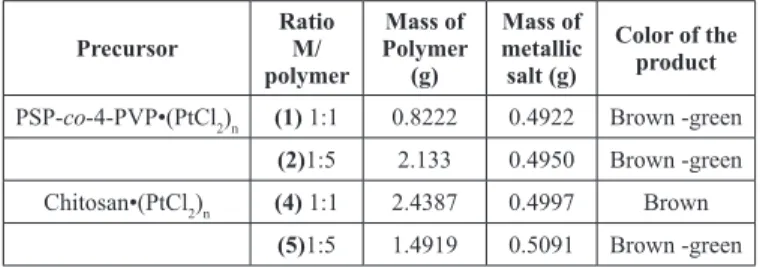
and not necessarily the coordination degree of the metal in the polymeric chain. Other details for each metallic salts reaction are given in Table 1.
Subsequently, the supernatant solution was extracted with a syringe and the
solid was dried under reduced pressure, see Table 1.
Table 1. Experimental details of the reactions for the formation of the
precursors.
(2)1:5 2.133 0.4950 Brown -green Chitosan•(PtCl2)n (4) 1:1 2.4387 0.4997 Brown
(5)1:5 1.4919 0.5091 Brown -green
Pyrolysis
The pyrolysis experiments were made by pouring a weighed portion
(0.05–0.15 g) of the precursor 1-10 into aluminum oxide boats that were placed in a furnace (Daihan oven model Wise Therm FHP-12) under a flow of air,
heating from 25°C to upper temperature limits of 300°C, and then to 800 °C,
followed by annealing for 2-4 h in each case.
Characterization
Solid pyrolytic samples were characterized by room-temperature X-ray diffraction (XRD) using a Siemens D-5000 diffractometer with θ-2θ geometry
and the data was collected using Cu-Kα radiation (40 kV and 30 mA). Images of scanning electron microscopy (SEM) were obtained with a Philips EM 300 microscope, transmission electron microscopy (TEM) analysis was conducted on a JEOLSX100 transmission microscope and infrared spectroscopy (IR) on Perkin Elmer model spectrum BX II. The optical absorbance was measured using a UV-Visible absorption spectrophotometer Shimadzu model Shimadzu UV- 2460 equiped with an accesory for solid samples.
RESULTS AND DISCUSSION
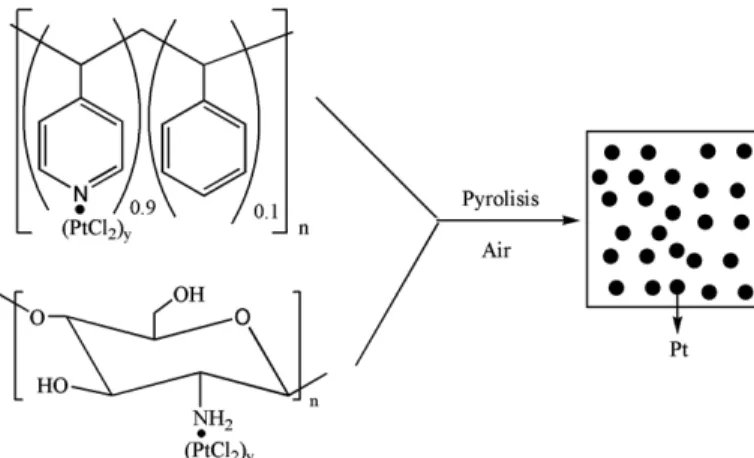
Pt nanoparticles were obtained from the precursors Chitosan●(PtCl2)n and
PSP-co-4-PVP● (PtCl2)n. See figure 1.
Figure. 1 Diagram of the synthesis in solid state using polymers such as molecular precursors.
Figure. 2 XRD pattern for the pyrolytic products from Chitosan●(PtCl2)y 1:1 and 1:5 and PSP-co-4-PVP● (PtCl2)y 1:1 . The red bars
correspond to the pattern of Pt Cubic (01-087-0646).
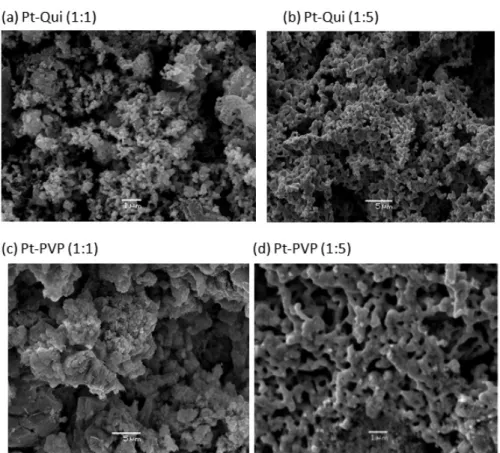
The morphology of pyrolytic products was analyzed by SEM microscopy. In general, the morphology of the product depends on the stoichiometric ratio
between metal and polymer.
Figure 3 shows the foam morphology for the pyrolytic product from the precursor 1:1 and 1:5 ratio PSP-co-4-PVP•(PtCl2)n. This particle is one of the
smallest solid-state Pt nanomaterials obtained. Another interesting aspect is the “foam like” morphology observed for pyrolytic products from the precursors 1:5 ratio PSP-co-4-PVP•(PtCl2)n. Few Pt metallic sponges have been reported,
Figure. 3 SEM image for the pyrolytic products from Chitosan●(PtCl2)y (a) 1:1 and (b) 1:5 and
PSP-co-4-PVP● (PtCl2)y (c) 1:1 and (d) 1:5.
Figure 4. TEM image for the pyrolytic products from Chitosan●(PtCl2)y (a) 1:1 and (b) 1:5 and
The TEM images also exhibit a dependence of the particle size with the molar ratio of the PSP-co-4-PVP•(PtCl2)y precursors. The small size
particle (6 nm), were obtained from the pyrolytic product from the precursors Chitosan•(PtCl2)n in a 1:1 molar ratio. As the polymer content enhance ie. the
ratio metal/polymer decrease the particle size and agglomerates increases as
is shows in figure 4.
As is shown in figure 4 (c) the as obtained Pt nanoparticles exhibit varied shapes and size, some of them with the typical truncated octahedron form
[43-48]. This can be also observed as an image of a cubohedral structure viewed along the [110] zone axis.
Aditional characterization was achieved by the observation of the expected surface plasmon for the pyrolytic product of precursors PSP-co-4-PVP● (PtCl2) n and Chitosan●(PtCl2)n in 1:1 molar ratio (see figure 5). Those exhibit a broad
absoption at 293 nm, typical of the plasmon of nanostrucured Pt [49-51].
Figure5. Uv-visible spectra of pyrolytic product from (a) PSP-co-4-PVP● PtCl2)n (1:1),
(b) Chitosan●(PtCl2)n (1:1).
On the other hand, further evidence of the structure of the Pt nanoparticles was obtained by the electron diffraction obtained from the TEM analysis, see figure 6. TEM image obtained from another side of the pyrolytic product from PSP-co-4-PVP● PtCl2)n in molar ratio 1:1 , see fig.6a, showed an electron
diffraction image , fig. 6b, which can be index to the typical planes of Pt with a for structure ie. the (111) , (200) , (200) and (311) planes [15].
Figure 6. TEM image Pt-PVP (1:1) (a) and their electron diffraction with
their main planes (b).
Although several solution preparation of Pt° nanoparticles have been
reported [14-27] no solid state methods for to prepare Pt° nanoparticles are available. The first way, solution methods, in spite of that to allow the size
and morphology control, their incorporation to a solid state device could be
not easy. In solution, small nanoparticles as small as 1 nm have reported [8] and using the here reported solid-state method, nanoparticles of 6 nm have
observed, although with a low dispersity, however the latter aspect is a common
characteristic of the solid-state methods to prepare nanoparticles [52]. Furthermore using the here reported method some control of the morphology can be made. In fact by varying the nature of the polymer as well
as the metal:polymer ratio the morphology can by choose : with precursor
having the PSP-co-4-PVP and with a 1:5 ratio, Pt° with a “cotton” 3D
morphology was obtained while with the precursors having chitosan in 1:1
ratio metal: polymer affords most irregular shape. Also the particle size can be
controlled by select both the polymer as well the metal polymer ratio from the precursor ie. the chitosan in a ratio metal polymer 1:1, afford the most small particles size.
Furthermore the here reported solid state method could permit the easy incorporation of Pt° nanoparticles to solid matrix , for instance of SiO2 .
CONCLUSIONS
The morphology of polymers can be controlled by the metal/polymer ratio
of the precursor. For both polymers, SEM shows “metal foam” in relations
1:5 metal:polymer. Chitosan induces the formation of smaller nanoparticles
(6 nm) for the 1:1 molar ratio than for 1:5 ratios. Unlike to the previously reported other solid state method [53-60] which start from precursor contained phosphazene derivatives linked to metal and organometallic fragments the here
reported method allow the formation of phase pure metal oxides.
This method is a general alternative for the preparation of Pt nanostructured
material in solid state wich could permit an ease incorporation to solid matrix for a possible practical application as microelecronic devices and solid high temperature catalyst.
In sumary the two parameters precursors, nature of the polymer and the
ACKNOWLEDGEMENT
To Project Fondecyt 1120179 for financial support.
REFERENCES
1. F.A Cotton, G. Wilkinson, “Advanced Inorganic Chemistry”, 6ta Edicion,
Wiley, New York, (1999), 1001.
Journal of Colloid and Interface Science.352, 379, (2010)
8. H. Wang, Y. Wang, Z. Zhu, A. Sapi, K. An, G. Kennedy, W. Michalak, and
11. L.Y. Chang, A.S. Barnard, L. Cervera, and R.E. Dunin-Borkowski, Nano Lett.10, 3073, (2010).
12. D. Pham Minh, Y. Oudart, B. Baubet, C. Verdon, and C. Thomazeau, Oil & Gas Science and Technology64, 697, (2009).
13. M. Min, C. Kim, Y. In Yang, J. Yi, and H. Lee Phys. Chem. Chem. Phys. Olesiak, Langmuir24, 9011, (2008).
19. J. Liu, N. Ruffini, P. Pollet, V. Llopis-Mestre, C. Dilek, C. Eckert, C. Liotta, and C. Roberts, Ind. Eng. Chem. Res.49, 8174, (2010).
20. S.H. Chang, M.H. Yeh, C.J. Pan, K.J. Chen, H. Ishii, D.G. Liu, J.F. Lee, C.C. Liu, J. Rick, M.Y. Cheng, and B.J. Hwang, Chem. Commun.47,
3864, (2011).
21. Y. Kang, J. Pyo, X. Ye, R. Dias, T. Gordon, E. Stach, and C. Murray, ACS Nano, 7, 645, (2013).
22. Y. Sun, M. Delucchi, and J. Ogden, International Journal Of Hydrogen Energy, 36, 11116, (2001).
23. V. Huc, K. Pelzer, Journal of Colloid and Interface Science 318, 1,
(2008).
24. K. Pelzer, M. Hävecker, M. Boualleg, J.P. Candy, and J.M. Basset, Angew. Chem.123, 5276, (2011). 32. H. Dong, and J.P. Hinestroza, ACS Appl. Mater. Interfaces1, 797, (2009). 33. M. Chen, and Y. Xing, Langmuir21, 9334, (2005).
34. P.L. Kuo, and C.H. Hsu, ACS Appl. Mater. Interfaces3, 115, (2001). 35. Z. Gan, X. Zheng, D. Wei, Q. Hu, A. Zhao, X. Zhang, and G. Li,
Superlattices and Microstructures47, 705, (2010).
36. J.W. Yoo, D. Hathcock, and M.A. El-Sayed, J. Phys. Chem A106, 2049, (2002).
37. C. Diaz, M.L. Valenzuela V. Lavayen, K. Mendoza, O. Peña and C.
O’Dwyer, Inorganica Quimica Acta. 377, 5, (2011).
38. C. Diaz, S. Platoni, A. MolinaM.L. Valenzuela, H. Geaney and C.
O’Dwyer, J. Nanoscience and Nanotech. 14, 7648, (2014).
39. C. Diaz, M.L. Valenzuela, G.A.Carriedo and N. Yutronic, J.Chil.Chem. Soc.58, 1994,(2014). 47. N. Viet Long, N. Duc Chien, T. Hayakawa, H. Hirata, G. Lakshminaraya,
M. Nogami, Nanotechnology21, 035605, (2010).
48. J. Wu, L. Qi, H. You, A. Gross, J. Li, H. Yang, J. Am. Chem. Soc.,134,
11880, (2012).
49. A. M. Garcia, M. L. Ruiz-Gonzalez, G. F. de la Fuente, P. Crespo, J. M. Gonzalez, J. Llopis, J. M.Gonzale-Clabet, M.Vallet-Regi, A.Hernaldo,
Chem. Mater., 19, 889, (2007).
50. Y. Luo, Materials Letters61, 1873, (2007).
51. A. Chen, P. Holt-Hindle, Chem. Rev.110, 3767, (2010).
52. C. Díaz, M.L Valenzuela, in “Metallic Nanostructures Using Oligo and Polyphosphazenes as Template or Stabilizer in Solid State” in Encyclopedia of Nanoscience and Nanotechnology, H.S Nalwa Ed., American Scientific Publishers; California, 16, 239, (2010).
53. G.A. Carriedo, F.I. Fidalgo, F.J. Garcia-Alonso, A. Presa, C. Diaz and
M.L. Valenzuela, Macromolecules37, 9431, (2004).
54. C. Diaz, P. Castillo and M.L. Valenzuela, J. Cluster Science 16, 515,
60. C. Diaz, M.L. Valenzuela, V. Villalobos, N. Yutronic, J. Cluster Science