FACULTAD DE EDUCACIÓN
PROGRAMA DE MAGÍSTER EN LA ENSEÑANZA DEL INGLÉS COMO LENGUA EXTRANJERA
The Effects of the Top-Down Model on EFL Upper-intermediate Chilean Students’ Oral Reading Skills at a Suprasegmental Level
A Quasi-experimental Research Design
Tesina presentada para optar al grado de Magíster en Enseñanza del Inglés como Idioma Extranjero
JOHN NELSON CANCINO TAPIA Profesora Guía Jennie A. Popp Ward Universidad Andrés Bello, Concepción, Chile.
Acknowledgements
I would like to thank all those people who have helped me in the contribution to write a better research.
First, I would like to say thank you to my advisor Jennie Popp for her great support, experience and contribution in the design of this research.
Professor Jorge Lillo, a university teacher who was in charge in the area of phonetics. He was a source of inspiration who delighted me with one of his classes on connected speech.
Professor José Brauchy, a university professor of Andres Bello University. Thanks for his suggestions and contributions in the research questions.
Professor Mauricio Véliz, a person with extensive experience in the area of phonetics. Thanks for his comments and contributions about research methodology.
Professor Roxana Balbontín for her support, experience and expertise in the area of research methodology. She was a great source of inspiration in the research design.
Professor Carmen Caballero, who I consider a role model for her teaching ability, expertise and professional experience.
Professor Rodrigo Sagredo A., Master in Linguistics and EFL Teaching. Thanks for his support and contributions in the objectives of this research.
My friend Abigail McDonals, a friend from the United States who helped me a lot in the exchanges of ideas about the American Accent.
Two teachers of English who were a source of mental inspiration when I was at the high school: Edgardo Sepulveda and Maria Escobar.
Some Words from the Author
When I was a kid, I always dreamt of becoming a writer someday. Today that dream came true and now I want to share with you one of my greatest passions which is English
pronunciation. This area attracted my interest when I was a student at the undergraduate level and one teacher expressed his personal opinion about pronunciation and said that pronunciation was one of the most important things when you learn to speak a foreign language. Native speakers immediately judge you because of your pronunciation and accent. If you have a good
pronunciation, they are going to believe that you have an advanced level, that you are very smart and that you speak like them regardless if you do not have an extensive vocabulary or an
extensive knowledge of grammar. I started thinking about his words inside my mind and that surprised me a lot.
TABLE OF CONTENTS
CHAPTER 1: RESEARCH PROBLEM Pages
1.0 Introduction 1
1.1 Description of the Research Problem 1
1.2 Rationale, Justification and Relevance 3
1.3 General Objective 4
1.3.1 Specific objectives 5
1.4 Research Questions 5
CHAPTER 2: REFERENTIAL FRAMEWORK
2.0 Introduction 6
2.1 Contextual Factors of the Research Problem 6
2.2 The Top-Down Approach from a Discourse Perspective 7
2.3 The Segmental vs Suprasegmental Level 8
2.4 How to Teach Pronunciation 10
2.5 Context of this Research 16
CHAPTER 3: THEORETICAL FRAMEWORK
3.0 Introduction 18
3.1. Brief Historical Overview about Pronunciation 18
3.2 Primary Orientations in the Teaching of Pronunciation 20
3.3 The Importance of Fluency and Intelligibility 21
3.4 The Suprasegmental Structures 23
3.5 The Importance of the Suprasegmental Structures 24
3.6 Organization of the Theoretical Framework 25
3.7.1 Chunking Ideas with Natural Pauses in Different Parts of the Sentence 28
3.7.2 Making Pauses in Longer Sentences 29
3.7.3 Pauses in Coordinating Conjunctions 29
3.7.4 Pauses in Subordinating Conjunctions 29
3.7.5 Parenthetical Statements 30
3.7.6 Exercise 1: Stressing the Focus Words in Thought Groups 30
3.7.7 Chunking Ideas: Identifying Collocations 30
3.7.8 Exercise 2: Identification of Collocations 31
3.8 Part 2: Connected Speech 32
3.8.1 Linking 33
3.8.2 Contractions 33
3.8.3 Reductions 34
3.8.4 Elisions 34
3.8.5 Vowel Reductions 34
3.8.6 Exercise 3: Linking the Sounds in Thought Groups 35
3.9 Part 3: What is Rhythm? 36
3.9.1 Components of Rhythm 37
3.9.1.1 Content Words vs Function Words 37
3.9.1.2 Linking and Phrasing 37
3.9.1.3 Reductions 37
3.9.2 Specific Features of Rhythm 38
3.9.3 Example of Rhythm 40
3.10 Part 4: Word Stress in Sentences 41
3.10.2 Function Words 42
3.10.3 Phrasing and Linking 42
3.10.4 Word Stress and Sentence Stress 43
3.10.5 Contrastive Stress in the Sentences 46
3.10.6 Distressing Function Words 47
3.11 Part 5: Intonation 50
3.11.1 Intonational Patterns from a Discourse Perspective 51
3.11.2 Functions of Intonation 53
3.11.3 Application of Intonational Patterns in Expressive Reading 53
3.12 Summary of the Chapter 55
CHAPTER 4: METHODOLOGICAL FRAMEWORK
4.0 Introduction 56
4.1 Methodology and Paradigm 56
4.2 Method 58
4.3 The Participants 58
4.4 Research Instruments 59
4.4.1 Recordings of 3 Native Speakers from the United States 60
4.4.2 Phonetic Transcription Software 62
4.4.3 Example of the Analytic Rubric 65
4.5 Procedures 66
4.5.1 Pre-test 66
4.5.2 Intervention 67
4.5.3 Post-test 69
4.7 Ethical Concerns 70
4.8 Expected Contributions of the Study 71
4.9 Limitations of the Study 72
4.10 Summary of the Chapter 73
CHAPTER 5: ANALYSIS OF THE RESULTS
5.1 Introduction 74
5.2 Pre-test 74
5.2.1 Student 1: Pre-test 76
5.2.2 Student 2: Pre-test 79
5.2.3 Student 3: Pre-test 83
5.2.4 Student 4: Pre-test 86
5.2.5 Results of the Pre-test: Marks in Percentages 89
5.3 Results of the Post-test 90
5.3.1 Student 1: Post-test 91
5.3.2 Student 2: Post-test 95
5.3.3 Student 3: Post-test 98
5.3.4 Student 4: Post-test 101
5.3.5 Results of the Post-test: Marks in Percentages 104
5.4 Comparison of the Results of the Pre-test and Post-test 105
5.4.1 Results of the Mode 107
5.4.2 Results of the Standard Deviation 108
5.5 Analysis of the Results of the Pre-test and Post-test 108
5.5.3 Comparison of the Pre-test and Post-test: Student 3 115 5.5.4 Comparison of the Pre-test and Post-test: Student 4 118
5.6 Group Results 121
5.6.1 Group Results of the Pre-test 121
5.6.2 Group Results of the Post-test 122
5.6.3 Comparison of the Pre-test and Post-test: Learning Gains of the Whole Group 123
5.6.4 Raters‟ Agreement: Results of the Pre-test 124
5.6.5 Raters‟ Agreement: Results of the Post-test 125
5.6.6 Results of the Raters‟ Agreement: Pre-test and Post-test 126
5.7 Findings of the Research 127
5.8 Summary of the Chapter 128
CHAPTER 6: CONCLUSIONS OF THIS RESEARCH
6.1 Conclusions 130
6.2 Discussion 136
6.3 Recommendations 138
6.4 Future Projections 140
References 143
Appendix 149
Organization of the Lesson Plans 150
Lesson Plan 1: Chunking Ideas in Thought Groups 151
Lesson Plan 2: How to Link Ideas in Connected Speech 152
Lesson Plan 3: Word Stress and Sentence Stress 153
Lesson Plan 4: Working with English Rhythm 154
Exercises for the Intervention Program 156
Written Consent 158
List of Exercises at a Suprasegmental Level 159
Text: Jack and the Beanstalk 164
List of Tables Used in this Research
Table 1. Features of English Pronunciation 9
Table 2. Suprasegmental Features of Speech 26
Table 3. The Prosody Pyramid (Gilbert, 2008, p. 10) 27
Table 4. The Focus Word in the Though Groups (Gilbert, 2005, 171) 30 Table 5. Identification of Collocations. McCarthy and O‟Dell (2007. p. ) 31
Table 6. Linking Sounds (Gilbert, 2005, 171) 35
Table 7. Stress and Unstressed Syllables (Ashton and Sheperd, 2012, p. 121). 40
Table 8. Content and Uncontent Words (Gilbert, 2005, 171) 41
Table 9. Function Words (Gilbert, 2005, 171) 42
Table 10. Phrasing and Linking (Gilbert, 2005, 171) 42
Table 11. Mastering the American Accent (Mojsin, 2009, 84) 45
Table 12. The American Accent Guide (Lujan, 2006, 8.8) 46
Table 13. Function Words (Gilbert, 2005, p. 50) 47
Table 14. Distressing Personal Pronouns. (Lane, 1993, p. 122) 48
Table 15. Prepositional Phrases (Lane, 1993, p. 128) 48
Table 16. Unstressed h words (Lane, 1993, p. 105) 48
Table 17. Example of Word and Sentence Stress. (Lane, 1993, p. 125) 49
Table 18. Summary of the Suprasegmental Features of Speech 55
Table 19. Research Techniques 60
Table 20. Phonetic Transcription of the Story of King Midas 63
Table 21. Rubric – Assessment of Expressive Reading of a Narrative Text 166
Table 22. Results of the Pre-test 67
Table 23. Organizations of the Lessons based on the PPP Model. 150
Table 24. Results of the Post-test. 69
Table 26. Results of the Pre-test 75
Table 27. Results of the Pre-test: Student 1 76
Table 28. Results of the Pre-test: Student 2 79
Table 29. Results of the Pre-test: Student 3 83
Table 30. Results of the Pre-test: Student 4 86
Table 31. Results of the Post-test of the 4 Students 90
Table 32. Results of the Post-test: Student 1 91
Table 33. Results of the Post-test: Student 2 95
Table 34. Results of the Post-test: Student 3 98
Table 35. Results of the Post-test: Student 4 101
Table 36. Comparison of the Results of the Pre-test and Post-test 105
Table 37. Results of the Mode 107
Table 38. Results of the Standard Deviation 108
Abstract
This is a quasi-experimental research design that focuses on the impact of the suprasegmental features of speech on expressive reading. Its main purpose is to determine the effect of the Top-down approach1 on EFL upper-intermediate Chilean students‟ pronunciation when reading a narrative text with fluency, accuracy, intelligibility and expression based on the different
components of the suprasegmental features of speech such as: intonation, rhythm, sentence stress, word stress and connected speech at a discourse level. The results of the pre-test were compared with the results of the post-test to determine whether they had improved upontheir production of the suprasegmental features after 5 training sessions of two hours. Their performance was measured with an analytical rubric by 3 external raters who are native speakers from the United States. The results of the research show that the participants had a slight and moderate
improvement in their ability to use the suprasegmental features of speech after the intervention. Key words: Top-Down model, suprasegmental structures of speech, expressive reading.
1The Top-Down Approach is used for teaching students how to read different kinds of text-types out aloud with
Resumen
Esta es una investigación de diseño cuasi-experimental que se focaliza en el impacto de las características suprasegmentales en la lectura expresiva. El principal propósito es determinar el efecto del Modelo del Top-Down Approach2 en estudiantes chilenos de nivel intermedio
avanzado para leer un texto narrativo con fluidez, precisión, inteligibilidad y expresión basado en los diferentes componentes de las características suprasegmentales3, tales como: la entonación, el ritmo, el estrés de la oración, el estrés de las palabras y la enlace de ideas a nivel textual. Se compararon los resultados del pre-test con los resultados del post-test para verificar si ellos mejoraban en la producción de las características suprasegmentales después de cinco sesiones de entrenamiento de dos horas. Tres evaluadores externos de Estados Unidos midieron el desempeño de los estudiantes con una rúbrica analítica. Los resultados de la investigación señalan que los participantes sufrieron una leve y moderada mejoría en su habilidad para usar las características suprasegmentales del habla después de la intervención.
Conceptos Clave:Modelo del Top-Down, estructuras suprasegmentales del habla, lectura
expresiva
2 El modelo del „Top-Down Approach‟ se utiliza para enseñar a los estudiantes a cómo leer un texto de forma oral y
expresiva con una pronunciación clara, fluida y comprensible. La tesis central que defiende este modelo consiste en enseñar a los estudiantes a leer grupos de palabras en vez de palabra por palabra.
3 Con el objetivo de desarrollar la lectura expresiva, los estudiantes deben aprender agregarle una entonación, ritmo,
CHAPTER 1 – REASEARCH PROBLEM
1.0 Introduction
Learning to speak a foreign language implies mastering the phonological rules in order to communicate ideas fluently and naturally. However, students may usually have difficulties expressing their ideas without a foreign accent. According to Lane (1993), “a heavy accent can trigger a negative impression from native speakers” (p. viii). This means that students often use incorrect rhythmical and intonational patterns, which have a negative effect on their performance.
The main purpose of this research is to determine the effects of the top-down model on students‟ oral reading expression from a discourse perspective. It involves the prosodic features
of the suprasegmental structures of speech and their impact on expressive reading. The basic idea was to help students improve their pronunciation by asking them to read a text orally after listening to a native speaker‟s model from the United States. They wereasked to read a short tale
with proper rhythm, intonation, stress and connected speech. More detailed information is provided below.
1.1 Description of the Research Problem
The problem of pronunciation has been an issue that has had negative impact on language learners when interacting with native language speakers. According to Nunan (2003), “how we
pronounce words, phrases, and sentences communicates others considerable information about who we are, and what we are like, as people” (p. 112). Language users are usually judged by their
may have lack of education, may not be intelligent or may not be competent for a job position (Research Centre, 2002).
The subject that has caused a big controversy in the scientific community is whether students should be required to achieve perfect pronunciation like a native speaker or an intelligible pronunciation (Harmer, 1993). One the one hand, many language teachers of the audio-lingual approach used to support the formal instruction of native pronunciation models, which included practical exercises with correct pronunciation that forced students to answer questions automatically through short dialogs, oral drills and the comparison of minimal pairs (Nunan, 2003, p.113). The main goal of the audio-lingual approach was to develop students‟ automaticity in order to communicate quickly. On the other hand, another group of teachers and supporters of the current perspectives of the communicative approach have argued that it is impossible to acquire a perfect pronunciation like a native speaker and that this objective is completely unachievable (Celce-Murcia, 2001; Gilbert, 2008; Harmer, 1993). They claim that the goal should be to prepare students to achieve an intelligible pronunciation instead of a perfect pronunciation.
Old language approaches used to reject the explicit classroom instruction of pronunciation as the grammar translation method. This old approach included exercises that requested students to translate literary texts, learn several grammatical rules and memorize list of irregular verbs out of context (Celce-Murcia, 2001, 117). All lessons were mostly conducted in the students‟ mother tongue. There was no real emphasis on communication and pronunciation was not really
important. In rejection to this method, other teaching approaches started incorporating new teaching methodologies that requested students to learn pronunciation. These teaching
thecommunicative approach, among others which have paid attention to the development of communicative competences.
Current perspectives in language teaching lay great emphasis on teaching students how to achieve effective communication (Burns, 2003; Celce-Murcia, 2001; Nunan, 2003; Gilbert, 2008) among others. Effective communication involves that students should acquire a wide range of linguistic competences in the 4 integrated skills in terms of speaking, reading, listening and writing along with grammar, pronunciation and vocabulary. This means that pronunciation is one of the important components that may help students develop their linguistic skills in order to express their own ideas clearly, naturally and effectively.
The purpose of this research is to determine the effect of the top-down approach on EFL upper-intermediate Chilean students to read a narrative text fluently, accurately, intelligibly and expressively based on the suprasegmental features of speech at a discourse level. According to Gilbert‟s model, the top-down approach focuses on the suprasegmental features of speech such as
connected speech, intonation, word & sentence stress and prosody (2008). This model is quite coherent and consistent with the model proposed by Burns (2003). Her model focuses on the classification of the segmental and suprasegmental features of English pronunciation; however, our main priority focuses on the effect of the top-down model on expressive reading based on the suprasegmental features of speech in terms of linking, intonation, rhythm and stress (word and sentence stress) (Burns, 2003).
1.2 Rationale, Justification and Relevance
such as Jenkins (2002), Celce-Murcia (2001), Underhill (2005), Nunan (2003), Burns (2003), Hewings (2007), Cook (2000), Moijsin (2009), among others. These authors claim that students should be taught pronunciation, rhythm and sentence stress at a suprasegmental level based on the top-down approach. Due to the strong emphasis that new methodologies have paid on communication, it is of paramount importance that students may be taught how to communicate effectively with intelligible and fluent pronunciation so that they may express their ideas
naturally without any barriers that may phonologically interfere with effective communication. Nowadays, companies and industries demand that their workers may know how to speak English. The fact is that many workers may have an extensive knowledge about grammar, reading or writing, but if they do not have a clear mastery of the English pronunciation system, they may usually fail when talking to native speakers. This is a common problem in Chile, where many employees lose important job opportunities, scholarships to study abroad or job promotions because of their inability to communicate their ideas fluently and intelligibly (Ministry of
Education, 2015). This is the specific case in the place where I work with students who are usually requested to take English courses to improve their level of English because they usually have to interact with people from abroad. After some years of training, employers feel satisfied when their employees are able to interact with native speakers in real-life working conditions.
1.3 General Objective
1.3.1 Specific Objectives
To identify which of these suprasegmental features of speech get(s) more learning gains.
To identify which of these prosodic features get(s) less learning gains.
To analyze which prosodic features measured during the pre-test and post-test get(s) a higher
level of agreement among the external raters. 1.4 Research Questions
What is the effect of the top-down approach on EFL upper-intermediate Chilean students to
read a narrative text fluently, accurately, intelligibly and expressively based on the suprasegmental features of speech at a discourse level?
Which of the suprasegmental features of speech get(s) more and less learning gains?
Which of the suprasegmental features measured during the pre-test and post-test get(s) a
CHAPTER 2: REFERENTIAL FRAMEWORK
2.0 Introduction
This chapter attempts to contextualize the important factors that are involved in the study of the suprasegmental structures of speech and their impact on expressive reading based on the top-down model from a discourse perspective along with the strategies and techniques used to teach pronunciation. It also refers to the context where this research took place.
2.1 Contextual Factors of the Research Problem
A large number of students are often judged by their bad pronunciation. Due to the problems of linguistic interference from their mother tongue, students are not able to speak fluently, clearly and accurately. As a result, native speakers have a hard time trying to understand what they are saying.
This problem usually happens when students transfer the intonation, rhythm, stress and melody of their mother tongue to the target language that they are learning (Lane, 1993). As a result, native speakers judge students because of their bad pronunciation.
One solution to solve this problem would be to teach them how to correct their pronunciation through the top-down approach, which focuses on the prosody pyramid. This means that students are trained to analyze the music of the language.
An alternative solution would be to train students to develop their skills in expressive reading at a discourse level. The basic idea is to improve their fluency, accuracy and
intelligibility of the message so that they may be understood more easily.
However, some teachers may argue that teaching pronunciation at a suprasegmental level is very technical for upper-intermediate students. As a matter of fact, it is suggested to avoid the excessive use of jargon when working with students. The idea is to encourage students to monitor their pronunciation and use self-correction strategies in order to improve their pronunciation.
Based on the top-down approach, it can be important to devote more time to the study of the suprasegmental structures instead of the segmental level. According to Gilbert (2005), the teaching of the suprasegmental features has more impact than the study of the segmental structures on students‟ intelligibility.
It is clear that more emphasis should be paid in language course programs to the study and analysis of the suprasegmental structures of speech in order to reduce the students‟ linguistic
interference of their mother tongue when speaking the target language.
2.2 The Top-Down Approach from a Discourse Perspective
Since message intelligibility has become the focus of modern language practitioners, the top-down approach from a discourse perspective proves to be an effective model to improve students‟ pronunciation.
Examples of text-types include narrative, descriptive, argumentative and expositive texts with different organizational patterns and language registers.
Furthermore, the top-down model encompasses the suprasegmental structures of speech. In other words, students pay attention to how to read a text aloud by using proper intonation, rhythm, stress and connected speech. What it is really important is the overall performance of the task as well as its components.
In addition to this, students are exposed to texts being read aloud by native speaker models. Students usually get important benefits from this kind of activities because they have the chance to analyze and imitate the melody of the language. Gilbert (2005) explains that students can learn whole expressions and utterances by learning them as a song.
However, it is usually argued that reading aloud activities may present a potential problem for students due to the irregular spelling of the English language. Although this problem is true, it can be recommended that more listening comprehension exercises can be incorporated to develop students‟ comprehension skills so that they can learn whole word clusters as fixed expressions.
2.3 The Segmental vs Suprasegmental Level
The top-down approach focuses on the suprasegmental structures, which help language learners get the music of the language. Supporters of the top-down approach claim that learners should be able to learn whole expressions, utterances and sentences instead of studying
According to Burns (2003), the difference between the segmental and the suprasegmental features depend on the level in which sounds are produced. The segmental level focuses on the microlevel in which sounds are produced; whereas the suprasegmental level refers to the macrolevel in which sounds are connected inside a speech chain. In order to clarify this distinction, see table 1.
Table 1.Features of English Pronunciation (Burns, 2003).
As it can be observed, the study of the segmental features includes the analysis and recognition of consonants and vowels. In the segmental level, teachers usually help students how to pronounce minimal pairs by comparing two similar sounds or phonemes such as hit and heat
or ship and sheep. In the suprasegmental level, teachers are usually concerned with linking,
Therefore, it is important to analyze how pronunciation can be taught from an operational perspective. This analysis includes pronunciation approaches, teaching models and some teaching strategies to work with students at the suprasegmental level.
2.4 How to Teach Pronunciation
According to Goodwin, Brinton and Celce-Murcia (2008), there are two general approaches which have been used to teach students how to improve their pronunciation.
The first model was based on an intuitive-imitative approach, which focuses on the direct imitation of native speakers‟ models. In this teaching approach, students were requested to listen
to dialogs and imitate phrases and expressions from the dialogs without any explicit explanation. One of the disadvantages of this approach was that students could make errors that later became fossilized due to their inability to pay attention to small details. As a consequence, they substitute sounds with sounds from their mother tongue. For example, many students could say “sank you” instead of “thank you” or “fader” instead of “father”. In other words, this approach was based on
common-sense knowledge, which depended on the students‟ ability to figure out the phonological rules of the language (Goodwin et. al., 2008, p. 2).
A second model is the analytic-linguistic approach, which focuses on the explicit analysis in terms of how native speakers use the language from a phonological perspective. In this
suprasegmental level. It is important to highlight that the analytic-linguistic approach is
considered a complement of the intuitive-imitative approach rather than an alternative view that opposes the first model (Goodwin et. al., 2008, p. 2).
In order to teach students how to read a text expressively, fluently and accurately, it is necessary to have a clear teaching model. Biancarosa & Snow, (2006); National Reading Panel, (2000); Torgesen et al., (2007) have concluded that students become highly successful readers when they receive effective reading instruction through explicit teaching strategies and skills that are of paramount importance in order to develop a high level of reading competence. For
practical reasons, a direct instructional model (PPP model) has been chosen for the purpose of this research because it is considered a very successful skill-oriented teaching approach that involves teacher and students‟ face-to-face instruction in which units are carefully well-organized
and ideas are analyzed in comprehensible chunks (Carnine, 2000, pp. 5-6; Traub, 1999).
According to Joyce, Weil, & Calhoun (2000), some of the most important elements of the direct instructional model include “modeling, reinforcement, feedback, and successive approximations”
(p. 337).
Gronlund (2003) explains that it is important to have certain conditions in order to guarantee students‟ success. The first priority involves presenting the information clearly to
expected to learn, how well those contents should be mastered and what specific skills they are expected to demonstrate after achieving the goals (Perkins, 1992). Now, the main components of the PPP model are explained below according to Magliaro, Lockee and Burton (2005, pp.45-46) as well as some practical techniques discussed by Egwuogu (2012) Celce-Murcia (2008), Ur (1999), Underhill (2005), et al.
Presentation. This part of the lesson involves presenting the information clearly to the students step by step by explaining the central concept by modeling the skills, giving several examples, showing videos, using diagrams, among others.
Modeling: The teacher makes specific demonstrations about how words, phrases and sentences are pronounced by providing concrete examples in terms of intonation, rhythm, word stress, sentence stress and linking (Ur, 1999, p. 20).
Visual Aids: The teacher uses visual aids such as pictures, images of the vocal tract in order to show the place of articulation and the manner of articulation of specific sounds (Celce-Murcia, Brinton, Goodwin, 2008, p. 9)
Videos: the teacher uses videos to show students how native speakers use the language in real examples. Students observe and imitate chunks from the video (Gilbert, 2008).
Recordings: the teacher presents students recorded dialogs, conversations and interviews so that they can develop their listening comprehension (Ur, 1999, p. 20).
Practice.This part of the lesson involves applying the rules, concepts and ideas that have been learned during the presentation. The exercises include guided practice and independent practice. In this part, students are given several opportunities to exercise and rehearse in order to achieve the learning objectives.
Oral Drills: these exercises include multiple repetitions of phrases and sentences by imitating the teacher or a recording. Examples of drills include oral drills, substitution drills,
Listening Exercises: These exercises help students understand the gist of conversations, analyze details, summarize important ideas and draw conclusions (O‟Connor, 1998, p.4).
Controlled practice exercises: multiple-choice questions, true or false, filling in the gaps, matching pairs, completing diagrams, labeling pictures (Nunan, 2003).
Analysis of transcripts: students are given the transcripts of dialogs, conversations or recorded audios. Then, these transcripts are analyzed in detail (Celce-Murcia, Brinton, Goodwin, 2008, p. 9).
Notation system: students are encouraged to develop their own notation system to represent intonation, rhythm, sentence stress, word stress and linking (Kenworthy, 1988, p. 116).
Production. This part of the lesson includes freer activities, in which students have to transfer their knowledge and skills in communicative situations.
Reading Aloud: students listen to audio stories read by native speakers with their
transcriptions. Then, they mark the intonational patterns in the text and read it aloud (Celce-Murcia, Brinton, Goodwin, 2008, p. 8).
Oral presentations: students are requested to make oral presentations about different topics. Then, they receive feedback from the teacher about what they need to work on (Celce-Murcia et. al., 2008, p. 10)
Impromptu Speech: students are requested to make a speech for 5 minutes. They have to be able to improvise on the spot (Lane, 1993, p. 255).
Dialogs: students listen to short dialogs and analyze the speakers‟ own intonation, rhythm, stress and linking. Then, they present the dialogs in front of the class (Nunan, 2003).
Interviews: students work in pairs or in groups to practice their abilities to answer questions for a job interview (Celce-Murcia, 2001).
Expansion. In this part of the lesson, students are requested to complete tasks or assignments outside the classrooms as homework so that they can reinforce the contents analyzed in class.
Reading articles. Students are assigned reading tasks that talk about pronunciation. Then, they are asked to discuss the articles next class (Kenworthy, 1988, p. 116).
Record texts. Students are assigned to record texts that have been analyzed in class and apply the prosodic features discussed with the teacher (Kenworthy, 1988, p. 116).
There is a wide range of teaching techniques that have been used to teach pronunciation that are coherent with the communicative approach. The current trend is to pay attention to the suprasegmental features of speech at a macro-level instead of the segmental level. The point is not to teach students how to speak like a native speaker, but to communicate ideas intelligibly, fluently and accurately (Celce-Murcia, Brinton, Goodwin, 2008, p. 8). These authors argue that it is unrealistic to achieve a native speaker‟s pronunciation and that a more achievable objective would be to enhance students‟ fluency, intelligibility and accuracy instead of focusing on perfect
pronunciation. Therefore, most of the current teaching techniques used in education nowadays are oriented towards this goal according to Kelly (2001), Goodwin, Brinton, Celce-Mucia (2008), Ur (1999). Some of the techniques are briefly explained below.
To begin with, pronunciation can focus on receptive and productive skills. Clear
pronunciation can be modelled for receptive purposes through listening comprehension activities by listening to dialogs with their transcripts as well as watching pronunciation podcasts and video tutorials with English subtitles. In this way, students will be able to recognize how native
intonation and stress more naturally. Another way pronunciation is usually taught involves the training of productive skills, in which students are requested to pronounce words, phrases,
clauses and whole sentences by applying oral drilling techniques such as chain drills, substitution drills, transformation drills, expansion drills, question-answer drills, among others (Kelly, 2001, pp. 15-20).
The following set of techniques represents a summary proposed by Brinton, Goodwin and Celce-Murcia (2008). These teaching techniques include a) imitating ideas directly from a
recording, b) reading texts with phonetic transcriptions, c) contrasting minimal pairs at a word level, then at a sentence level (generally out of context), d) pronouncing contextualized minimal pairs (words and sentences in context), e) using visual aids to represent how sounds are
articulated in the vocal tract, f) working with tongue twisters to correct the pronunciation, modulation and articulation of sounds, g) stressing words according to their prefixes, roots and suffixes, h) reading different kinds of texts aloud with proper intonation, linking, rhythm and sentence stress such as dialogs, speeches, poems, short stories, among others (2008, pp. 8-10).
Other teaching techniques proposed by Ur (1999) to help students improve their
pronunciation include a) imitating the teacher‟s pronunciation of specific words, phrases, clauses
and sentences, b) recording a text aloud by comparing it with the pronunciation of a native speaker‟s model, c) listening to the teacher‟s explanation of the articulation of sounds in the
Given the fact that this is a quasi-experimental design, it is important to clarify some important factors about the context of this research.
2.5 Context of this Research
The main purpose of this research was to determine the level of influence of using the top-down approach to improve the production of suprasegmental features of speech in EFL upper-intermediate Chilean students. In other words, the researcher‟s main intention was to analyze the
impact of the suprasegmental features of speech on students‟ pronunciation when reading a short story aloud. This investigation was conducted with four EFL upper-intermediate language students from Chile who are studying English at a language center in order to become competent language users. They are between 20 to 30 years old and they are highly motivated learners who are interested in passing an institutional exam that measures the four integrated language skills in speaking, reading, listening and writing. In terms of knowledge and skills, they have studied functional language courses for communicative purposes; nevertheless, they still have some problems of pronunciation due to the lack of language exposure outside classes.
courses. The idea is to provide students with several opportunities to interact all the classes in the target language.
Some of the main inquiries as a researcher were: What is the effect of the top-down approach on EFL upper-intermediate Chilean students to read a narrative text fluently, accurately, intelligibly and expressively based on the suprasegmental features of speech at a discourse level? Which of the suprasegmental features of speech get(s) more and less learning gains? Which of the suprasegmental features measured during the pre-test and post-test get(s) a higher level of agreement among the external raters?
CHAPTER 3: THEORETICAL FRAMEWORK
3.0 Introduction
The purpose of this chapter is to analyze the specific components of the suprasegmental structures of speech from a discourse perspective based on the top-down model and their impact on expressive reading. It includes a brief historical overview of pronunciation, its primary orientations in the teaching of pronunciation and the importance of achieving intelligibility in communication. The analysis of the top-down model focuses on the segmentation of ideas of the text into thought groups with proper intonation, rhythm, stress and connected speech. Some theoretical examples and specific rules are used to illustrate how the top-down model works on reading aloud activities from a practical perspective.
3.1. Brief Historical Overview about Pronunciation
In the past, pronunciation was irrelevant and strongly rejected when studying classical languages. This was the case of the grammar translation approach, in which the most important emphasis was reading literature texts, making list of words out of context and learning
grammatical rules (Celce-Murcia, 2001). After that, the natural approach reacted against the grammar translation approach in which the emphasis was on communication. Other teaching approaches were incorporated and their main objectives were focused on communication such as the audiolingual approach, the community language learning, the silent way, the task-based learning, the communicative approach, among others (Celce-Murcia, 2001, p. 117).
Pronunciation instruction was usually integrated with other skills such reading, listening, speaking and writing. According to an article written by Goodwin included in one of the chapters by Celce Murcia in the book Teaching English as a Second Foreign Language (2001),
the comparison of specific phonemes such as Bet and Pet. Nowadays, the emphasis is on teaching pronunciation at a suprasegmental level, which incorporates important aspects of pronunciation such as connected speech, intonation, sentence stress and rhythm.
A strong discussion has emerged between these two views on the way that pronunciation has been taught. The discussion is whether teachers should teach pronunciation at a segmental or suprasegemental level and which of these two levels is more effective when dealing with
pronunciation problems. In recent years, pronunciation instruction has changed to fluency instead of focusing on accuracy by paying special attention to the suprasegmental features. According to Bott (2005), “Empirical research and pronunciation materials‟ writers suggest that teaching suprasegmentals before segmentals to intermediate and advanced (non-native speakers) NNSs could be more beneficial in a shorter period of time” (p. 5). This research study clearly
demonstrates that suprasegmental structures have an impact on students‟ learning process and
could potentially help them enhance their message intelligibility. Similarly, Derwing et al. (1998) show in a study that instruction on suprasegmental structures seems to have better results and a significant impact on students‟ pronunciation in comparison to segmental structures.
In addition to this, the importance of teaching pronunciation is to help students speak intelligibly so that they may be understood. The idea is that the importance is not to sound like a native speaker with a perfect English sounding accent, but to convey their ideas naturally and fluently so that they may be understood (Harmer, 1993). According to Ur, the main teachers‟
in class by working with phrasing, flow, intonation, rhythm, sentence stress, prosody, voice inflections, expressive reading, fluency, accuracy, connected speech, pitch tones and body language (Bot, 2005).
3.2 Primary Orientations in the Teaching of Pronunciation
The teaching of pronunciation has had drastic changes over the last 55 years. Language teachers have taught pronunciation by using different methodological decisions depending on the kinds of students they are working with, their language program and, above all, the theories and approaches in which their lessons are grounded. According to Nunan (2003), there are 3 main orientations which have focused on different aspects:
a) First orientation: 1940s-1950s - “Listen carefully and repeat what I say”
b) Second orientation: 1960s – 1970s – “Let‟s analyze these sounds closely to figure out how to pronounce them more clearly.”
c) Third orientation: 1980s and beyond (communicative and task-based language
teaching) – “Let‟s start using these sounds in activities as soon as we can while I provide clues and feedback on how well you are doing”. (Nunan, 2003, pp. 113-114)
Based on these three main orientations, it is important to clarify that the first orientation in the 1940s-1950s was centered on a behaviorist theory which was mainly focused on stimulus and response. Students used to imitate phrases and sentences of dialogs and short conversations through oral drills: chain, substitution and transformation drills until they were able to reproduce automatic responses.
teachers back in the 60s and 70s used to teach pronunciation by using the International Phonetic Association (IPA) along with diagrams, charts and video clips to show students the correct articulation of sounds in the mouth. They used to work with word stress, intonation, rhythm, sentence stress and prosody (Nunan, 2003; Celce-Murcia, 1996).
The third orientation in the 1980s until nowadays has placed considerable importance on communication. The basic idea is that students can learn pronunciation in order to be able to communicate and express their ideas in interactive classroom activities that emulate real-life situations based on controlled, guided and freer activities. These communicative activities involve dialogs, role-plays, oral interviews, discussions, oral reports, among others. In this way, they are able to integrate pronunciation in practical situations that are related to students‟ background knowledge (Nunan, 2003, pp. 113-114).
These three main orientations provide us with a better insight about how pronunciation has changed and evolved during these last 55 years. Now, for the purposes of this investigation, we would like to pay special emphasis to the suprasegmental structures that promote students‟
fluency and intelligibility of the message.
3.3 The Importance of Fluency and Intelligibility
Fluency can be understood as the ability of a speaker to use the language easily without hesitation, pauses and interruptions. This concept has also evolved through the course of time. According to Zutell and Rasinski (1991), fluency is considered “the effortless or automatic
reading in which readers group words into meaningful phrases, while using correct pitch and intonation.” In this definition, they imply that oral reading must be automatic. This means that
clauses or short sentences as a single sense unit. Another important point of this definition is that pitch and intonation are essential to add emphasis, emotions, feelings and attitude to the most important ideas in the text, especially in expressive reading.
Nowadays, the concept of fluency has included other components that help language readers become more fluent such as intonation, rhythm, stress, prosody, voice inflections and the comprehension of the ideas portrayed in the text (Wolf & Katzir-Cohen, 2001). According to Wood (2001), speech rate is considered the most important factor to indicate how fluent a person is. This means that the number of words that a person speaks per minute can be a valuable measure to prove if a person is able to speak fluently or not. There are several reasons why it is important to teach students to speak fluently in English.
The first most important reason is to help them understand fluent native speakers. A typical problem that usually happens is that students frequently complain that they cannot understand what native speakers are saying. For example, when they have to take listening comprehension tests, they are not able to understand the main ideas, identify important details or interpret basic information because the native speakers‟ fluency, rhythm, stress and intonation
tend to be so fast that it is very difficult for them to decode the message simultaneously in real time. The fact is that native speakers use very relaxed pronunciation which is not focused on a well-articulated modulation of the sounds at a suprasegmental level. They frequently use linking, contractions, reductions, elisions, assimilations in connected speech (Celce-Murcia (2001), Underhill (2005), Burns (2003), Hewings (2007), Cook (2000) & Moijsin (2009).
other words, students should pay attention to rhythm, sentence stress, prosody and intonation so that they may sound more fluently and naturally.
In addition to this, it is important to teach students how to speak fluently by providing authentic communicative activities that may encourage them to express their ideas. Some authors that support the use of pronunciation in communicative activities include Celce-Murcia (2001), Nunan (2003), Underhill (2005), among others. Some examples of communicative activities comprise the use of dialogs, interviews, oral reports, group discussions, debates, among others.
3.4 The Suprasegmental Structures
The suprasegmental structures of speech deal with components beyond the word level. According to Flores (1998), suprasegmental features extend beyond individual sound production. The different components that are part of the suprasegmental structures include connected
speech, word stress and sentence stress, intonation and rhythm. These components go beyond the segmental level, which focuses on the individual perception and production of words and sounds such as vowels and consonants that are usually pronounced out of context. In the mid 1970s, Bray (1995: 3) explains that a large number of specialists composed by linguists, theorists and language teachers decided to focus their attention on the suprasegmental structures to help
students develop their communicative competence. After that, teachers started analyzing prosodic features of language with their students in class such as word stress, intonation and rhythm in order to develop their intelligibility (O‟Brien, 2004; Bailly & Holm, 2005; Gauthier, Shi, & Yi,
2009).
segmental features such as phonemes, allophones and minimal pairs (Hall, 1997). This means that teaching students how to pronounce groups of words, large phrases, clauses and sentences as whole utterances by using connected speech, natural rhythm, intonation and sentence stress is more meaningful and significant for students‟ overall intelligibility of the message. He
emphasizes that it is important to teach students how to mark thought groups in the texts, how to stress content words and de-stress uncontent words, how to link words in thought groups by using connected speech, how to use natural rhythmical and intonational patterns.
3.5 The Importance of the Suprasegmental Structures
One of the reasons why suprasegmental structures are very important is because they help students develop their fluency, intelligibility and expressiveness, especially when reading short stories aloud in English. Expressive reading has been considered a great teaching technique to enhance students‟ pronunciation through reading aloud activities. This is known as the Reader‟s
Theater, which focuses mainly on an interpretive reading activity that request students to read fables, legends, myths and short stories aloud with proper phrasing, intonation, rhythm, sentence stress, voice inflections and pacing (Martinez, Roser, & Strecker, 1999). The basic idea is that students can rehearse with the scripts in groups by bringing characters to life by imitating the characters‟ dialogues, emotions, attitudes and feelings in the story. This technique is practically
the same that professional voice-over actors, who narrate stories of books, do in radio programs. Another reason why suprasegmental features are very important is because they help students copy the music and the rhythm of the language. Based on the Reader‟s Theater, students develop their listening skills by paying attention to professional storyteller‟s pronunciation. Storytellers‟ use a wide range of pronunciation techniques such as rhythm, intonation, sentence
pauses and eye contact which have a remarkable impact on the audience. According to the National Reading Panel (2000), Kuhn and Stall (2000), there are two methods which have shown to have a significant improvement in students‟ overall fluency, intelligibility and expressiveness:
a) assisted reading and b) repeated reading. These two methods have proved to be effective by modelling expressive and fluent reading in front of students, by providing effective scaffolding with intonation, rhythm and stress and by monitoring progress through repeated readings in the group rehearsals.
3.6 Organization of the Theoretical Framework
There are two main approaches in how pronunciation can be studied: one is the discourse perspective and the other one is the prosodic perspective following Gilbert‟s top-down model.
The discourse perspective includes information about how ideas are chunked in the text, how are they divided into comprehensible sense units and where pauses should be made. With this approach, students are taught how to chunk simple, compound and complex sentences in dependent and independent clauses which are divided into noun, verb, adjective, adverb and prepositional phrases. This view helps students to have a holistic view of the suprasegmental structures by analyzing the discoursal aspects and features of the text-types and genres.
The other perspective is the prosodic level which includes information about the personal interpretation of the speaker when reading the text. The specific features that are used to convey a personal interpretation of the message comprise the use of intonation, rhythm, word stress,
sentence stress, voice inflections, mood, delivery, tempo, tone shifts, body language, eye contact, among others. The speaker‟s personal interpretation depends on his/her purpose, intention, the
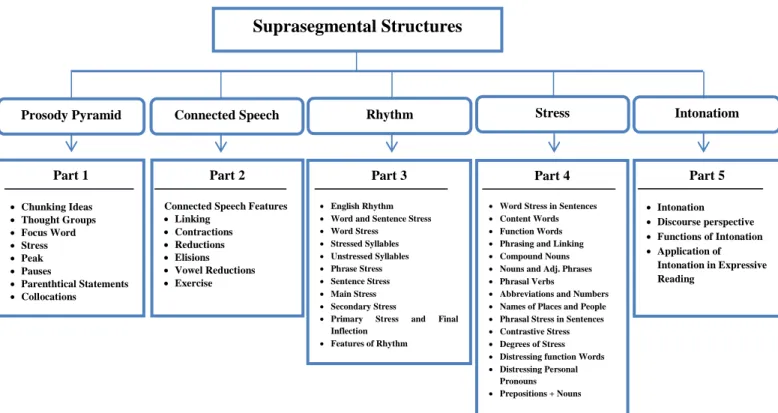
investigation, a brief diagram is provided in order to outline the core concepts of this study. We will focus our attention on:
how to teach our students to chunk their ideas in thought groups with natural pauses
how to link ideas by using connected speech features at a suprasegmental level
how to read a text with natural rhythmical patterns
how to stress content words and de-stress function words in the sentence
how to use the different intonational patterns when reading a text expressively
Table 2. Suprasegmental Structures
Adaptation from Burns(2003) and Gilbert (2008) Suprasegmental Structures
Prosody Pyramid Connected Speech Rhythm Intonatiom
Part 1
Word Stress in Sentences
Content Words
Phrasal Stress in Sentences
3.7 Part 1: The Prosody Pyramid at a Suprasegmental Level
The prosody pyramid is a pronunciation model proposed by Judy Gilbert (2008) and is builded upon previous authors such as Chafe (1970), Bolinger (1989), Brown (1990) and Cauldwell (1992). This model explains how ideas are divided into groups of words. She states that native speakers do not speak word by word like a robot, but groups of words. This means that native speakers divide ideas into thought groups, which can be phrases or clauses, which are parts of larger sentences (Gilbert, 2008, p. 10). This means that in order to sound much more fluent, it is necessary to teach students how to read groups of words that are pronounced smoothly and naturally as whole chunks.
The prosody pyramid is composed by 4 main components: thought groups, focus word, stress and peak. Gilbert (2008) explains that inside a thought group, there is a focus word which is stressed and stands out among the other words. The word that receives more stress is
considered the peak of a thought group (10). Based on her article Teaching Pronunciation, Gilbert clarifies and defines the following concepts very briefly (2008, p. 10):
a) thought group: it involves “a short sentence, a clause, a phrase within a longer sentence” Chafe 1970, Bolinger 1989, Brown 1990, Cauldwell 1992);
b) focus word: “the most important word in the thought group” (Gilbert, 2008, p. 10).
c) stress: it involves one syllable of the focus word that receives the main emphasis in the thought group.
d) peak: the most important stressed syllable in the focus word that receives the main stress is considered the peak or the nucleus in the thought group.
All the components of the prosody pyramid are interconnected. The fact is that this model allows teachers to help students how to chunk ideas in a text by making natural and appropriate pauses by respecting the punctuation marks in phrases, clauses and short sentences. One of the first practical applications of the prosody pyramid is to teach students to chunk ideas into thought groups with natural pauses. Another application is to help students to stress the focus word which is the most important word in the thought group.
3.7.1 Chunking Ideas with Natural Pauses in Different Parts of the Sentence
When reading a text aloud expressively, native speakers divide their ideas into
comprehensible sense units or thought groups. They make natural and dramatic pauses to have an impact on the audience and to highlight the most important ideas in the text. This is usually done when people are giving an oral speech. Making pauses in natural places help the listeners
understand the most important points that the speaker is trying to convey. The words in the thought groups are linked and blended smoothly and naturally (Orion, 2012, p. 53). According to Gerst and Peralejo (2011), native speakers use thought groups to emphasize ideas in the middle of short sentences and phrases such as noun, verb, adjective, prepositional, adverbial and parenthetical phrases as well as subordinate clauses by respecting punctuation marks such as commas, colons, semicolons, periods, question marks and exclamation marks (p. 2).
The segmentation of ideas in thought groups involves dividing the ideas into
comprehensible chunks. Marks (2007) explains, “The words are pronounced all joined together like one long word” (p. 94). All the words within the thought groups are linked fluently,
correspond with clauses – the clause being either a simple sentence, a complex one or a compound” Gimson (1994, p. 240). For example:
Chunking Ideas in Different Parts of the Sentence a) Subject of a Clause
/The workers / have got a rising standard of living/ b) Sentence Adverbials and Adverbs of Time and Place
/ I go to London / regularly /
Seriously / it seems to me / that the crucial issue / is… c) Parentheticals and Parallel Constructions
/Lucy / will you please stop making that noise? d) Non-restrictive Relative Clauses
/ The old man / who was clearly very upset / denied the charge. /
3.7.2 Making Pauses in Longer Sentences
“Conjunctions connect thought segments or clauses into sentences. A conjunction may
occur at the beginning of a sentence or between clauses. A slight pause between the clauses and changed inflection, make the clauses in a sentence clearer” (Lujan, 2006, 8.16). Examples of
conjunctions include:
3.7.3 Pauses in Coordinating Conjunctions
Coordinating conjunctions are used when two clauses are independent and can stand alone as two important ideas that are linked with the following conjunctions: but, and, for, yet, so, because.
3.7.4 Pauses in Subordinating Conjunctions
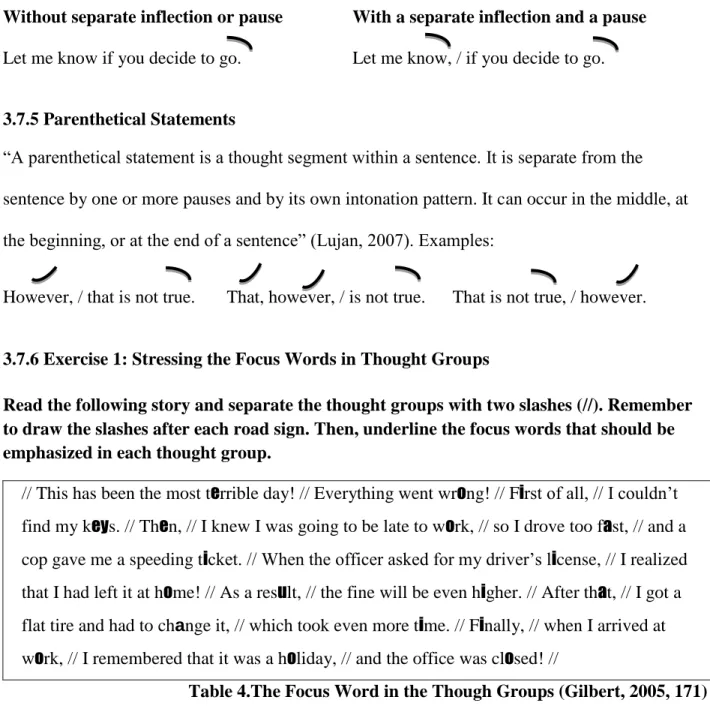
Without separate inflection or pause With a separate inflection and a pause
Let me know if you decide to go. Let me know, / if you decide to go.
3.7.5 Parenthetical Statements
“A parenthetical statement is a thought segment within a sentence. It is separate from the
sentence by one or more pauses and by its own intonation pattern. It can occur in the middle, at the beginning, or at the end of a sentence” (Lujan, 2007). Examples:
However, / that is not true. That, however, / is not true. That is not true, / however.
3.7.6 Exercise 1: Stressing the Focus Words in Thought Groups
Read the following story and separate the thought groups with two slashes (//). Remember to draw the slashes after each road sign. Then, underline the focus words that should be emphasized in each thought group.
// This has been the most terrible day! // Everything went wrong! // First of all, // I couldn‟t find my keys. // Then, // I knew I was going to be late to work, // so I drove too fast, // and a cop gave me a speeding ticket. // When the officer asked for my driver‟s license, // I realized that I had left it at home! // As a result, // the fine will be even higher. // After that, // I got a flat tire and had to change it, // which took even more time. // Finally, // when I arrived at work, // I remembered that it was a holiday, // and the office was closed! //
Table 4.The Focus Word in the Though Groups (Gilbert, 2005, 171)
3.7.7 Chunking Ideas: Identifying Collocations
Learning to read fluently and naturally requires that students can learn how to read different kinds of expressions as whole chunks. According to McCarthy and O‟Dell (2007), collocations are considered “a pair or groups of words that are often used together. These combinations sound natural to native speakers…” (p. 6). In the category of collocations, it is possible to find word
compoundadjectives, among others. It is important to teach students how to identify and recognize these ready-made phrases in the text so that they can read them as a whole chunk instead of word by word.
There are different patterns of combinability that are very useful to study to teach our students how to identify them in the text. Some examples of collocations include:
a) Adjective + Noun: heavy cold, record company, fast-food restaurant
b) Nouns + Verbs: the company boomed in 2012.
c) Noun + of + Noun: the president of the United States
d) Verb + Direct Object: make a decision, play the guitar, write songs
e) Verb + Prepositions: my daughter burst into tears yesterday
f) Verb + Adverb: She smiled proudly as she looked at the photos of her family.
g) Adverb + Adjective: bitterly disappointed, strongly forbidden, happily married
3.7.8 Exercise 2: Identification of Collocations
Read the following text and underline all the collocations and phrases as whole chunks. After that, read the whole text aloud by reading these collocations as whole chunks.
When I left university / I made a decision to take up a profession / in which I could be creative. // I could play the guitar, / but I‟d never written any songs. //
Nonetheless, / I decided to become a singer song-writer. // I made some recordings, / but I had a rather heavy cold, / so they didn‟t sound good. // I made some more, / and sent them to a record company / and waited for them to reply. //
So, / while I was waiting to become famous, / I got a job in a fast-food restaurant. // That was five years ago. / I‟m still doing the same job. //
3.8 Part 2: Connected Speech
Connected speech involves the smooth flow of words inside a speech unit (Hewings, 2007). This means that words change their pronunciation when they are used in context inside a sentence. That is to say, words are linked together without stopping inside a speech unit.
Concerning Underhill (2005), continuous connected speech “consists of a flow of sounds which
are modified by a system of simplifications through which phonemes are connected, grouped and modified” (p. 58)
According to Burns (2003), some important features at a suprasegmental level include linking, intonation and stress. In relation to this point, Jenkins (2002) agrees with Burns that suprasegmental production is more important than the segmental level when talking about the development of the communicative competence. In other words, connected speech includes “assimilation (the changing of sounds), elision (the omission of sounds), vowel reduction, liaison, linking and intrusive sounds, and juncture” (Underhill, 2005, p. 58).
According to Lane (1993), native speakers link their ideas by making connections to sound more fluently. She makes a list of practical rules which help them convey their ideas naturally without stopping the stream of speech. Several features of connected speech were taken from different authors who have studied these characteristics of spoken language. These authors include Hewings (2007), Underhill (2005), Burns (2003), Jenkins (2002), Lane (2002), among others.
3.8.1 Linking
technique to help students link words is the concept of resyllabication. “The final consonant sound of a word is transferred to the next word” (Mortiner, 1997, p. 45). For example:
The phrase Put it off sounds like pu-ti-toff
The phrase Throw it away sounds like thro-wi-ta-way
There are different rules which are used when linking ideas inside a sense unit:
a) Linking C+V. When one word finishes with a consonant and the following word starts with a vowel sound, the final consonant is attached to the following word (Hewings, (2007), Underhill, (2005), Cook, (2000), Moijsin, (2009), Lane, (1993).
Richard is an American actor Peter is a good friend of mine She has a lot of experience
b) Linking C+C. When a word finishes with a consonant and the following word starts with a consonant, the two consonants are linked together (Hewings, (2007), Underhill, (2005), Cook, (2000), Moijsin, (2009), Lane, (1993).
A red car my brother from Canada your parents live in Germany our friends from France
c) Linking V+V. When a word finishes with a vowel and the following word begins with a vowel sound, the two words are linked by adding /j/ or /w/ (Hewings, (2007), Underhill, (2005), Cook, (2000), Moijsin, (2009), Lane, (1993).
He (j) is my best friend You(w) are late They (j) are tired She (j) is friendly
3.8.2 Contractions
When native speakers use relaxed pronunciation, they use short forms by using the contracted forms of the auxiliary verbs (Hewings (2007), Underhill (2005), Cook (2000), Moijsin (2009), Lane (1993). According to Ravin (2004), “Most contractions are pronounced as one syllable” (p. 84). Some examples of contractions include:
He‟s got They‟ll She‟d You haven‟t They mustn‟t We couldn‟t She can‟t
3.8.3 Reductions
Want to: They wanna go to the cinema Have to: You hafta do your homework
Going to: She‟s gonna watch TV Has to: Helen hasta finish her report
3.8.4 Elisions
When a word that starts with a h-sound is in the middle of a sentence, it is usually deleted. This means that it is dropped and it is not pronounced (Hewings, 2007 &Lane, 1993).
Tell him Give her my regards Come here You don‟t have a car Call him
When the consonants /t/ and /d/ are between two other consonants, they are elided, omitted or not pronounced (Underhill, 2005, p.61). For example:
Nex(t) please I don‟(t) know ol(d) man you an(d) me san(d)wich stan(d) there
3.8.5 Vowel Reductions
Uncontent words are de-stressed and are reduced to the schwa sound. Different kinds of uncontent words are pronounced faster and softer such as pronouns, prepositions, articles and conjunctions.
Can I have a bottle of water and a glass of orange juice, please?
The words a, of, and are de-stressed and are produced with “the lips and jaw relaxed and with the tongue in a central, neutral position” (Underhill, 2005, p. 62). Sometimes, there are some
syllable reductions inside words that are not pronounced. For example:
That sounds int(e)resting = sounds like in-tres-ting Let‟s go to a rest(a)urant = sounds like
res-trant
3.8.6 Exercise 3: Linking the Sounds in Thought Groups
O‟Connor explains (2004), “When we talk, we do not talk in single words but in groups of
words spoken continuously, with no break or pause; we may pause after a group, but not during it” (p. 90) This means that native speakers express their ideas in thought groups that are
Hewings, (2007), Underhill, (2005), Cook, (2000), Moijsin, (2009), Lane, (1993) agree with O‟Connor (2004) that ideas are pronounced in groups of words as complete sense units. The fact
is that native speakers run among words inside thought groups very smoothly and naturally because they pronounce them as whole word clusters, expressions and utterances very
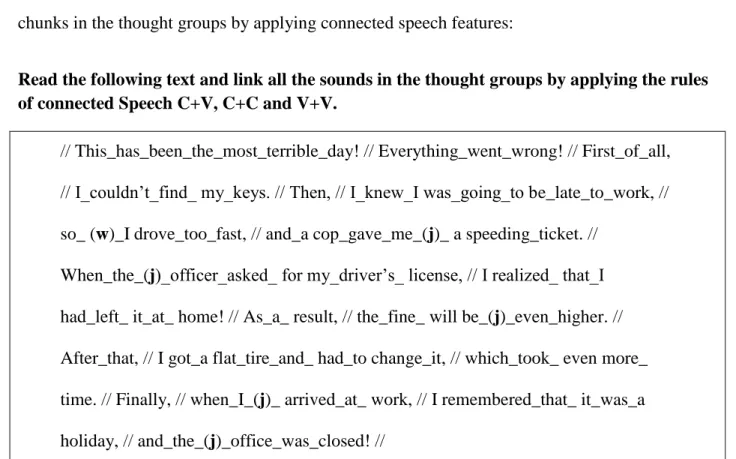
automatically. The following example illustrates how native speakers link their ideas as whole chunks in the thought groups by applying connected speech features:
Read the following text and link all the sounds in the thought groups by applying the rules of connected Speech C+V, C+C and V+V.
// This_has_been_the_most_terrible_day! // Everything_went_wrong! // First_of_all, // I_couldn‟t_find_ my_keys. // Then, // I_knew_I was_going_to be_late_to_work, //
so_ (w)_I drove_too_fast, // and_a cop_gave_me_(j)_ a speeding_ticket. // When_the_(j)_officer_asked_ for my_driver‟s_ license, // I realized_ that_I
had_left_ it_at_ home! // As_a_ result, // the_fine_ will be_(j)_even_higher. // After_that, // I got_a flat_tire_and_ had_to change_it, // which_took_ even more_ time. // Finally, // when_I_(j)_ arrived_at_ work, // I remembered_that_ it_was_a holiday, // and_the_(j)_office_was_closed! //
3.9 Part 3: English Rhythm
3.9 What is Rhythm?
Rhythm is composed by the timing of stressed and unstressed syllables in connected speech. Stressed syllables are pronounced “longer and stronger” within a thought group, whereas “unstressed syllables are said quicker and lighter” (Lujan, 2006., p. 1.8). Lujan explains (2006), “The rhythm of speech is based on the timing of sound segments. In English, these segments are word syllables” (p. 4.1).
Ramus and Mehler (1999) explain that stressed-timed rhythm has heavy syllables which attract stress. These kinds of syllables have long vowels and/or end in consonant clusters,
whereas unstressed syllables are shorter than stressed syllables and vowels in unstressed syllables may be reduced.
According to Ramus and Mehler (1999) as cited in Lane (1993), English rhythm is composed by a stressed-timed rhythm, which is divided into open and closed syllables. Open syllables end in vowels, whereas closed syllables of various types end in consonants. For example: | My BROther was at the HOSpital YESterday. |