
Culture and tourism Ex post evaluation of Cohesion Policy programmes 2007 2013, focusing on the European Regional Development Fund (ERDF) and the Cohesion Fund (CF): regional case study Madrid, work package 9
43
0
0
Texto completo
(2) EUROPEAN COMMISSION Directorate-General for Regional and Urban Policy Directorate B - Policy Unit B.2 Evaluation and European Semester Contact: Violeta Piculescu E-mail: [email protected] European Commission B-1049 Brussels.
(3) EUROPEAN COMMISSION. Ex post evaluation of Cohesion Policy programmes 20072013, focusing on the European Regional Development Fund (ERDF) and the Cohesion Fund (CF) Work Package 9: Culture and Tourism Regional Case Study Madrid. Contract: 2014CE16BAT034. Directorate-General for Regional and Urban Policy 2016. EN.
(4) Europe Direct is a service to help you find answers to your questions about the European Union. Freephone number (*):. 00 800 6 7 8 9 10 11 (*) The information given is free, as are most calls (though some operators, phone boxes or hotels may charge you).. LEGAL NOTICE This document has been prepared for the European Commission however it reflects the views only of the authors, and the Commission cannot be held responsible for any use which may be made of the information contained therein. More information on the European Union is available on the Internet (http://www.europa.eu). Luxembourg: Publications Office of the European Union, 2016 ISBN 978-92-79-58801-3 doi: 10.2776/183229 © European Union, 2016 Reproduction is authorised provided the source is acknowledged..
(5) Ex post evaluation of Cohesion Policy programmes 2007-2013, focusing on the European Regional Development Fund (ERDF) and Cohesion Fund (CF) – Work Package nine: Culture and Tourism. Table of contents FORWARD ............................................................................................ 7 EXECUTIVE SUMMARY.......................................................................... 9 1. THE REGIONAL CONTEXT .............................................................. 11 1.1. The geo-institutional context .............................................................................. 11. 1.2. The economic context........................................................................................ 11. 1.3. The tourism and culture sectors .......................................................................... 12. 2. THE REGIONAL ERDF 2007-2013 STRATEGY IN THE CULTURE AND TOURISM SECTORS ............................................................................ 17 2.1. Rationale and objectives of the ERDF strategy ...................................................... 17. 2.2. The main elements of the ERDF strategy ............................................................. 19. 2.3. Governance and supportive features of the ERDF strategy ..................................... 22. 3. EFFECTIVENESS AND SUSTAINABILITY OF THE STRATEGY: OUTPUTS AND RESULTS ..................................................................... 25 3.1. Outputs achieved .......................................................................................... 25. 3.1.1 3.1.2 3.1.3 3.1.4 3.2. Conservation and improvement of natural spaces ............................................ 27 Improvement of tourism services .................................................................. 28 Conservation and restoration of cultural heritage ............................................. 29 Cultural infrastructures ................................................................................ 31. Results achieved ........................................................................................... 33. 4. CONCLUSIONS AND LESSONS LEARNT ......................................... 35 REFERENCES ...................................................................................... 37 ANNEX 1. LIST OF INTERVIEWS......................................................... 39 ANNEX 2. STATISTICS ....................................................................... 40. October 2015 5.
(6) Ex post evaluation of Cohesion Policy programmes 2007-2013, focusing on the European Regional Development Fund (ERDF) and Cohesion Fund (CF) – Work Package nine: Culture and Tourism. List of abbreviations AIR. Annual Implementation Report. CF. Cohesion Fund. DG REGIO. Directorate General for Regional and Urban Policy. EC. European Commission. ERDF. European Regional Development Fund. EU. European Union. GDP. Gross Domestic Product. ICT. Information and Communication Technologies. MA. Managing Authority. OP. Operational Programme. October 2015 6.
(7) Ex post evaluation of Cohesion Policy programmes 2007-2013, focusing on the European Regional Development Fund (ERDF) and Cohesion Fund (CF) – Work Package nine: Culture and Tourism. Forward The European Commission, Directorate-General for Regional and Urban Policy (DG REGIO) is undertaking an ex post evaluation of Cohesion Policy programmes financed by the European Regional Development Fund (ERDF) and the Cohesion Fund (CF) during the period 2007-2013 in regions covered by the Convergence, Regional Competitiveness & Employment and European Territorial Cooperation objectives in 28 member states. Within this framework, the Consortium IRS-CSIL-CISET-BOP has been selected to undertake the ex post evaluation on ‘Culture and Tourism’ (Work Package 9). An important element within the exercise is a series of case-study analyses of NUTS2 regions covering interventions co-financed by ERDF during the 2007-13 programming period. The case-studies are designed to obtain a better understanding of the ERDF contribution to the overall objectives of CP in the culture and tourism sectors and to set out what has been implemented on the ground, with a particular focus on the interface between the wider context of the intervention and the rationale and design of intervention strategies. In doing so, the relative effectiveness of the adopted strategies will be revealed. The case-studies are designed to identify and assess the effectiveness of the different types of ERDF strategies implemented in the culture and tourism sectors. This report provides the results of a detailed case study of ERDF approaches to culture and tourism pursued in Community of Madrid region (ES) during the 2007-13 programming period. The case study analysis has been based upon the following: . desk-based analysis of relevant statistical and socio-economic data sourced from Eurostat, the National Statistics Office and Madrid city council and Observatory on Tourism;. . desk-based analysis of documents relating to the programming period and covering items such as Operational Programme (OP) materials, Annual Implementation Reports (AIRs) and various other regional reports and documents;. . semi-structured interviews with seventeen interviewees. These include senior members of the national, regional and local authorities, policy makers, and consultants implementing specific projects (Annex 1 sets out the names and contact details of the interviewees).. October 2015 7.
(8)
(9) Ex post evaluation of Cohesion Policy programmes 2007-2013, focusing on the European Regional Development Fund (ERDF) and Cohesion Fund (CF) – Work Package nine: Culture and Tourism. Executive summary The ERDF Operation Programme for the Community of Madrid allocated 33.5 million for operations in the fields of tourism and culture, which is about 10% of the total value of the programme. The objectives of the strategy in the two sectors are: . improving the quality of life for all regional residents by improving cultural endowments and accessibility to natural areas at local level;. . enhancing assets and tourist services in those municipalities of the Community holding tourist potentials linked to historical and cultural heritage.. The underlying rationale lies in the positive socio-economic effects that both culture and tourism goods and services are expected to generate as drivers of social cohesion. To implement the strategy, the following investment priorities have been defined by the regional authorities: . Conservation and improvement of natural spaces.. . Improvement of tourism services.. . Conservation and restoration of cultural heritage.. . Cultural infrastructures.. The municipalities with a population of more than 35,000 inhabitants are the only recipients eligible for funding. At the same time, they are also entrusted with the selection, management and implementation of the projects. By far, infrastructural investments are the main project type. Soft measures, such as development of digital platforms and advertising campaigns, have been used to limited extent to update the existing touristic services supplied in the City of Madrid. The Managing Authority has not set up a system of indicators to measure the results of the strategy. The number of projects is the only indicator offered, which is not a relevant measure of achievements. The main reason underlying the lack of an appropriate monitoring system is that the areas of investment and the typology of projects the municipalities would have presented were unknown when the strategy was defined. However, the indicator system was not updated into the course of programme implementation, once the operations were being presented and approved for financing. The implementation of the programme achieved limited results. The financial execution stood at about 85% of the planned expenditure. Yet, out of 25 eligible municipalities, operations have been developed in 13 only. The municipalities with larger financial and institutional capacities are those which have been able to implement projects. Also, the existence of urban development programmes at municipal level and their integration with the ERDF strategy fastened the processes of project selection and implementation. Vice-versa, those municipalities with more limited capacities (also resulting from a process of fiscal consolidation) have not been able to profit from the opportunity provided by the operational programme. In total, 22 projects have been financed for total ERDF expenditure of EUR 28.6 million. In those municipalities which have been able to implement projects with the help of ERDF, the physical results have been achieved. In this regard, worth. October 2015 9.
(10) Ex post evaluation of Cohesion Policy programmes 2007-2013, focusing on the European Regional Development Fund (ERDF) and Cohesion Fund (CF) – Work Package nine: Culture and Tourism. mentioning are the investments made by the city of Madrid in improving tourism services, including business tourism, which have been a modernization of its resources. Also there have been improvements in the tourist resources of some municipalities, both in relation to cultural tourism, such as recovery of the Palace of the Infante Don Luis de Borbón in Boadilla del Monte, and in relation to ecotourism, such as investments in Boadilla del Monte, Pozuelo de Alarcón or Las Rozas. Cultural facilities for residents, as in the case of the House of Culture of Alcobendas, the Music School Auditorium Parla or "Miguel Rios" of Rivas Vaciamadrid, have also been implemented. All financed projects are operated and managed by the public sector, either directly by the city councils or by companies with 100% municipal ownership and, in most cases the services are rendered to users free of charge. Hence, the sustainability of the interventions depends on the wealth and long term commitment of the municipalities. Although the results of the projects may have been successful in increasing visitor numbers to the facilities developed, however, the use of EU support is not necessarily justified because the more deprived areas did not benefited from the operational programme. This raises a question about the justification for supporting the growth of tourism in Madrid through the ERDF.. October 2015 10.
(11) Ex post evaluation of Cohesion Policy programmes 2007-2013, focusing on the European Regional Development Fund (ERDF) and Cohesion Fund (CF) – Work Package nine: Culture and Tourism. 1. The regional context 1.1 The geo-institutional context The Community of Madrid is one of the seventeen autonomous communities (regions) of Spain. It is located at the centre of the country, the Iberian Peninsula, and the Castilian Central Plateau. Its capital is the city of Madrid, which is also the national capital of Spain. The population of the Community has experienced in recent years a significant growth mainly due to the incorporation of a large number of foreign workers. With 6.4 million inhabitants, in 2013, it is the third most populous region in Spain after Andalusia and Catalonia. Population density is 779.4 hab/km², much higher than the national average of 91.3 hab/km².1 The great majority of the population lives in the capital and its metropolitan area, which is the most populated in Spain. In light of the demographic (and economic) weight of its metropolitan area, the Community of Madrid can be de facto grouped into three statistical areas, namely: . The capital of Madrid: it is the main centre of activity and businesses in the region, including most of the state administrative activities.. . A large metropolitan area around the city of Madrid with outstanding industrial activities and services, but reduced agricultural potential.. . Peripheral areas with rural character, lower infrastructure and limited provision of services.. population. density,. poor. From an institutional point of view, the Community of Madrid is organized politically within a parliamentary system. That is, the executive branch of government is dependent on the direct support of the legislative power, whose members elect their president by majority. The government of the Community, Government Council, is the collegiate institution that heads the politics and the executive and administrative powers of the community.. 1.2 The economic context The Community of Madrid has experienced in the last decades a process of growth and diversification that makes it one of the most prosperous and dynamic economy in Europe, as well as a major industrial pole.2 The strengths of its economy can be summed up in: unemployment rate lower than national level (19% vs. 26%), high investments in research, relatively high development and added-value services, as well as high level of tertiary education (46%) and a rate of people at risk of poverty lower then national average (20% vs. 27%- Table 1.1). Service and industry are the prominent sectors in the regional productive structure. The most active branches of activity are businesses, retail and wholesale trades, construction, tourism, property activities and transports. 1. Population density varies with the community itself; the municipality of Madrid has a density of 5,160.57 hab/km², whereas the Sierra Norte has a population density of less than 9.9 hab/km². 2. See Plan Estratégico de Posicionamiento Internacional de la Ciudad de Madrid (2012 - 2015).. October 2015 11.
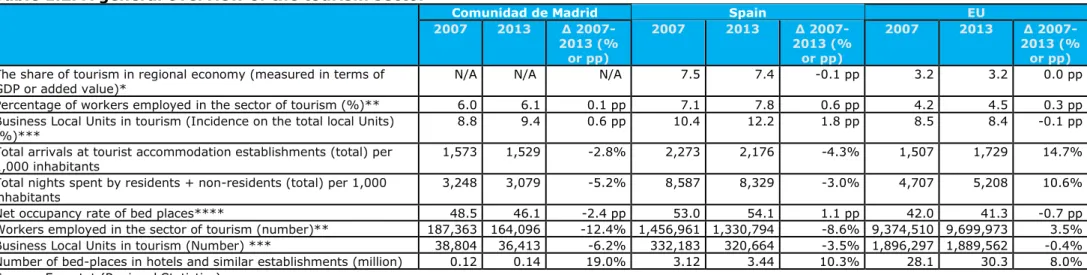
(12) Ex post evaluation of Cohesion Policy programmes 2007-2013, focusing on the European Regional Development Fund (ERDF) and Cohesion Fund (CF) – Work Package nine: Culture and Tourism. As of 2009, the regional GDP was of EUR 219.8 billion, which is second in Spain only to Catalonia. Indeed, along with the Basque country, it is the autonomous community with the highest income per capita in Spain (EUR 34,100 in 2009), significantly above both national and EU averages. On the other hand, the crisis has impacted on the regional economy, as shown by a shrink of -10% of GDP per capita from 2007 and 2013, in line with the overall negative trend reported at the national level (-9%). Today, the main economic weaknesses include the low penetration of broadband and new technologies of information and an unequal male to female occupation. Table 1.1. A general overview of the social and economic conditions Comunidad de Madrid. Total Population (million) Population Education level (% of tertiary educated Level 5-6) GDP per inhabitant (PPS, Index Number EU=100)*. 2007. 2013. 6.1. 6.4. 39.0. 46.0. ∆ 20072013 (% or pp). Spain. EU. 2007. 2013. ∆ 20072013 (% or pp). 2007. 2013. ∆ 20072013 (% or pp). 5.6%. 44.8. 46.7. 4.3%. 498.4. 507.2. 1.8%. 7.0 pp. 29.3. 33.7. 4.4 pp. 23.5. 28.5. 5.0 pp. 137. 128. -10 pp. 105. 96. -9 pp. 100. 100. 0 pp. Total Employment rate (15-64) (%) Total Unemployment rate (15 and over) (%) People at risk of poverty or social exclusion (%). 71.4. 62.5. -8.9 pp. 65.8. 54.8. -11 pp. 65.2. 64. -1.2 pp. 6.2. 19.8. 13.6 pp. 8.2. 26.1. 17.9 pp. 7.2. 10.8. 3.6 pp. 16. 20.1. 4.1 pp. 23.3. 27.3. 4.0 pp. 24.4. 24.5. 0.1 pp. NEET rate 15-24 (%). 10.0. 14.4. 4.4 pp. 12.0. 18.6. 6.6 pp. 10.9. 13.0. 2.1 pp. Source: Eurostat (Regional Statistics) Note: Variations (∆ 2007-2013) are expressed in percentage variation between two years (%) when figures are expressed in values (as for total population), and in pp (percentage points) when they are referred to indicators already expressed in % (i.e. total employment rate).. 1.3 The tourism and culture sectors Both tourism and culture sectors have a relevant role for the economy of the Community and are seen by the regional authorities as drivers of growth and social cohesion. Focusing on tourism, the Community of Madrid can be classified as a “specialized tourist region”3 based on both intensity of the tourist pressure and contribution of tourism to the territorial welfare. Also, the current levels of infrastructure endowment and transport service provision enhances the accessibility of the region and makes Madrid a major logistical base4. As illustrated in Table 1.2, the regional performance of the tourism industry experiences a deceleration from 2007 to 2013 due to the impact of the crisis. For example, in the period of reference the total arrivals at tourist accommodation establishments decreased by 2.8% (but at the national level the impact is even sharper, -4.3%), while the average length of staying, as measured by the number of nights spent per 1,000 inhabitants, decreased by 5%. The market reacted to the crisis with a rationalisation of resources and improved system efficiency. For instance, against an increase in the number of bed-places in hotels and similar establishments (+19%), the business local units decreased 3. See First Interim Report. 4. See Plan Estratégico de Turismo de la Ciudad de Madrid 2008-2011.. October 2015 12.
(13) Ex post evaluation of Cohesion Policy programmes 2007-2013, focusing on the European Regional Development Fund (ERDF) and Cohesion Fund (CF) – Work Package nine: Culture and Tourism. significantly (-6%), as well as the number of workers employed in the sector (-12%) (see table 1.2). That is, lower resources have been used to supply a given amount of tourism services. More detailed statistical data about the performance of the sector is provided in Annex 2. Turning to culture, according to the Strategic Plan of Culture of Madrid (PECAM), the cultural resources of the Community contribute to a large part (about 80%) of the tourism sector. The importance of the culture sector is highlighted by the increase in the number of business local units from 2008 to 2012 (+5.6%), against a national decrease -6%. Again, a rationalisation of resources took however place, as e.g. witnessed by the lower incidence of workers in the sector (-0.5%, against a slight increase at national level).. October 2015 13.
(14) Ex post evaluation of Cohesion Policy programmes 2007-2013, focusing on the European Regional Development Fund (ERDF) and Cohesion Fund (CF) – Work Package nine: Culture and Tourism. Table 1.2. A general overview of the tourism sector Comunidad de Madrid 2007 2013 ∆ 20072013 (% or pp) N/A N/A N/A. 2007. Spain 2013. ∆ 20072013 (% or pp) -0.1 pp. 2007. EU 2013. The share of tourism in regional economy (measured in terms of 7.5 7.4 3.2 3.2 GDP or added value)* Percentage of workers employed in the sector of tourism (%)** 6.0 6.1 0.1 pp 7.1 7.8 0.6 pp 4.2 4.5 Business Local Units in tourism (Incidence on the total local Units) 8.8 9.4 0.6 pp 10.4 12.2 1.8 pp 8.5 8.4 (%)*** Total arrivals at tourist accommodation establishments (total) per 1,573 1,529 -2.8% 2,273 2,176 -4.3% 1,507 1,729 1,000 inhabitants Total nights spent by residents + non-residents (total) per 1,000 3,248 3,079 -5.2% 8,587 8,329 -3.0% 4,707 5,208 inhabitants Net occupancy rate of bed places**** 48.5 46.1 -2.4 pp 53.0 54.1 1.1 pp 42.0 41.3 Workers employed in the sector of tourism (number)** 187,363 164,096 -12.4% 1,456,961 1,330,794 -8.6% 9,374,510 9,699,973 Business Local Units in tourism (Number) *** 38,804 36,413 -6.2% 332,183 320,664 -3.5% 1,896,297 1,889,562 Number of bed-places in hotels and similar establishments (million) 0.12 0.14 19.0% 3.12 3.44 10.3% 28.1 30.3 Source: Eurostat (Regional Statistics) * Gross value added (at basic prices), % on the All NACE Activities of I- Accommodation and food service activities, and N79 - Travel agency, tour operator reservation services and related activities . ** 2008 instead of 2007. ***2008 instead of 2007, 2012 instead of 2013; For tourism we have considered I- Accommodation and food service activities, N79 - Travel agency, tour operator reservation service and related activities;. ****2012 instead of 2007. Note: Variations (∆ 2007-2013) are expressed in percentage variation between two years (%) when figures are expressed in values (as for total population), and in pp (percentage points) when they are referred to indicators already expressed in % (i.e. total employment rate).. October 2015 14. ∆ 20072013 (% or pp) 0.0 pp 0.3 pp -0.1 pp 14.7% 10.6% -0.7 pp 3.5% -0.4% 8.0%.
(15) Ex post evaluation of Cohesion Policy programmes 2007-2013, focusing on the European Regional Development Fund (ERDF) and Cohesion Fund (CF) – Work Package nine: Culture and Tourism. Table 1.3. A general overview of the culture sector Comunidad de Madrid 2007 2013 ∆ 20072013 (% or pp ). 2007. Spain 2013. ∆ 20072013 (% or pp ) 0,0pp. 2007. EU 2013. ∆ 20072013 (% or pp). The share of culture in regional economy (measured in terms of na na na 2,7 2,7 2,6 2,6 GDP or added value)* Workers employed in the sector of culture (%)** 3.6 3.1 -0.5 pp 2.1 2.3 0.2 pp 2.3 2.3 Number of workers employed in the sector of culture** 112,780 84,802 -24.8% 432,714 392,816 -9.2% 5.038.695 5,029,484 Business Local Units in culture (Incidence on the total local units) 2.1 2.7 0.6 pp 1.7 2.0 0.3 pp 2.0 2.0 (%)*** Number of business Local Units in culture*** 9,642 10,184 5.6% 55,920 52,613 -5.9% 453,942 460,542 Source: Eurostat (Regional Statistics) *Gross value added (at basic prices), % on the All NACE Activities of 59 — Motion picture, video and television programme production, sound recording and music publishing activities; 60 — Programming and broadcasting activities; 90 – Creative, arts and entertainment activities; 91 – Libraries, archives, museum and other cultural activities; 93 - Sports activities and amusement and recreation activities. ** 2008 instead of 2007 *** 2008 instead of 2007, 2012 instead of 2013 for culture; For culture we have considered J58 - Publishing activities; J59 - Motion picture, video and television programme production, sound recording and music publishing activities; J60 - Programming and broadcasting activities; G476 - Retail sale of cultural and recreation goods in specialised stores Note: Variations (∆ 2007-2013) are expressed in percentage variation between two years (%) when figures are expressed in values (as for total population), and in pp (percentage points) when they are referred to indicators already expressed in % (i.e. total employment rate). Source: Eurostat (Regional Statistics) Note: Variations (∆ 2007-2013) are expressed in percentage variation between two years (%) when figures are expressed in values (as for total population), and in pp (percentage points) when they are referred to indicators already expressed in % (i.e. total employment rate).. October 2015 15. 0,0 pp 0.0 pp -0.2% -0.1 pp 1.5%.
(16) Ex post evaluation of Cohesion Policy programmes 2007-2013, focusing on the European Regional Development Fund (ERDF) and Cohesion Fund (CF) – Work Package nine: Culture and Tourism. The performance of both the tourism and culture industries in the region has been driven by the capital city. Thanks to a large offer of tourism services, including in primis art centres, museums and buildings of historical interest, in the year 2007 Madrid was the fourth most visited city in Europe and the first of Spain, with more than seven million tourists (Figure 1.1). 80% of tourism is cultural. According to the municipal statistics, the average daily expenditure of a person visiting Madrid is 140-150 euro per tourist, the largest in Spain (against a national average of 94 Euro). Figure 1.1. Tourism offer of Madrid 982 hotel infrastructures with 40,287 rooms. 82 museums, 2,170 monuments, 104 cultural centres and 61 theatres. Seventh European city in companies’ location preferences. 3 international fair centres (IFEMA with more than 200,000 m2). More than 50,000 businesses in the city of Madrid. More than 20,000 bars, cafés, pubs, clubs… and 2,825 restaurants. 80% of the touristic resources are cultural 15,646 taxis, 317 metro stations, 69 cities with direct flights and 128 with daily flights. Source: Madrid Strategic Tourism Plan 2012-15. Even if to a lower extent, the towns of Alcalà de Henares, Aranjuez and San Lorenzo de El Escorial also occupy a bright spot in this scenario, by attracting visitors from around the world thanks to their historical heritages. On the contrary, the remaining municipalities in the region (even if with their own history and possibly an artistic and cultural heritage) are not typical tourist destinations. The central, pivotal, role played by the capital has therefore determined the competitive advantage of the region in the two sectors, while also shaping its economic geography and defining its challenges: . . On the one hand, the capital of Madrid, with huge potential for tourism and challenges related to sustainable management and competitiveness of the industry in the long run, including e.g. preservation of historical assets, environmental sustainability and upgrading of the services already offered. On the other, a multitude of municipalities of different sizes gravitating towards the capital, with no or limited potential for tourism and challenges related to well-being and social integration, e.g. upgrading their local cultural and natural assets, supporting sport and cultural infrastructures and promoting events.. October 2015 16.
(17) Ex post evaluation of Cohesion Policy programmes 2007-2013, focusing on the European Regional Development Fund (ERDF) and Cohesion Fund (CF) – Work Package nine: Culture and Tourism. 2. The regional ERDF 2007-2013 strategy in the culture and tourism sectors This chapter analyses the rationale of the ERDF intervention in the sectors of culture and tourism and describes the main elements of the strategy.. 2.1 Rationale and objectives of the ERDF strategy The Tourism Plan of the Community of Madrid is the reference document setting up the regional policy framework on tourism. The Plan outlines trajectories of growth and investment priorities but does not provide for projects financing and implementation. This is left to the policy implemented with the ERDF, which is the operational tool adopted by the regional authorities to put in practice the policy framework directives. Thus, according to the interviewees, the ERDF strategy coincides de facto with the regional policy for tourism and culture. The ERDF Operational Programme (OP) for the Community of Madrid 2007-2013 dedicated Priority Axis 4 to the Local and Sustainable Urban Development. Policy makers have focused on this area in developing the strategic framework on culture and tourism. Therefore, the strategies in the two sectors are oriented to the overarching purpose of the Axis, that is, achieving improved economic and social conditions in the municipalities of the Community of Madrid from a sustainability perspective. In other words, tourism and culture are not seen as self-standing priorities but as integral elements of urban development and planning. However, as illustrated in the previous chapter, urban development needs are very different depending on the type of city concerned. Factors that are relevant to detect the needs of urban areas include for example population dynamics and economic growth, but also inter-relationship with other cities, that is, if municipalities are configured as part of a metropolitan area, or instead as single urban centres. Taking these factors into account, the regional authorities of the Community of Madrid have assessed the urban development needs of their territory and classified municipalities according to the following challenges: . cities with high population growth, due to the dynamism of their economy, mainly facing problems of congestion, resource consumption and sustainability of growth. These are large and medium cities belonging to the large metropolitan area of Madrid (including the capital itself);. . cities with stagnant or loss of population, which face challenges related to improving their attractiveness and competitiveness in order to become centres of development. These are small cities located in the peripheral areas of the community.. To meet these challenges and to turn them into opportunities, the OP purses two general objectives in the sectors of tourism and culture, as elicited from the Managing Authority (MA) survey (carried out by the study team in early 2015) and confirmed during the onsite data gathering. These are:. October 2015 17.
(18) Ex post evaluation of Cohesion Policy programmes 2007-2013, focusing on the European Regional Development Fund (ERDF) and Cohesion Fund (CF) – Work Package nine: Culture and Tourism. . improving the quality of life for all regional residents by improving cultural endowments and accessibility to natural areas at local level;. . enhancing assets and tourist services in those municipalities of the Community holding tourist potentials linked to historical and cultural heritage.. The underlying rationale lies in the positive socio-economic effects that both culture and tourism goods and services are expected to generate as drivers of social cohesion. These include inter alia improving quality of life, preserving cultural identity and local values and creating jobs. To this regard, the ERDF OP 2007-2013 presents a line of continuity with the previous period, which already provided tourism and culture among its objectives. In the period 2007-2013, however, the role of municipalities on investment decision making has been reinforced (see section 2.3). Considering the taxonomy developed in Task 1, the ERDF strategy developed for the Community of Madrid in the two sectors is therefore a mix of the following typologies: . Regeneration and social cohesion. This strategic approach is common to all the relevant priority themes under Axis 4 and to all municipalities addressed by the OP (including the capital). The upgrade of local cultural and natural assets to improve wellbeing and social integration is the trait d’union of the whole regional strategy for local and sustainable urban development.. . Socio-economic and environmental sustainability. This approach is specific to the city of Madrid, which is heavily dependent on the tourism sector, and to those (few) municipalities belonging to a wider touristic circuit of international relevance of (such as Alcalà de Henares and, in forward perspective, Boadilla del Monte). The objective is to preserve historical assets and provide services that are sustainable in the long run.. . Support for innovation and competitiveness. This approach is pursued by the priority theme on improvement of tourism services and is specific to the city of Madrid only. The objective is to upgrade the quality of the already supplied services in order to remain competitive in the international scenario.. The following Table reviews the specific objectives of the ERDF regional strategy for tourism and culture, as structured in priority themes (see next section), and their contribution to the policy approaches identified in Task 1. Table 2.1. ERDF Regional strategy for tourism and culture. Policy approaches Priority theme Conservation and improvement of natural spaces Improvement of tourism services Conservation and restoration of cultural heritage Cultural infrastructures. Policy approach to culture and tourism Regeneration and Socio-economic and Support for innovation social cohesion environmental and competitiveness sustainability √ √ √. √ √. √. NB: the priority theme “Other forms of support to improve cultural services” is not included in the table because it is a residual category Source: Authors. October 2015 18.
(19) Ex post evaluation of Cohesion Policy programmes 2007-2013, focusing on the European Regional Development Fund (ERDF) and Cohesion Fund (CF) – Work Package nine: Culture and Tourism. Also, even if not explicitly mentioned in the OP, during the interviews the regional authorities have identified a number of market failures that are at the basis of the justification for national public intervention in the tourism and culture sectors, including: . . For tourism: o. Poor accessibility to some facilities and sites.. o. Ensuring that tourism development supports cultural and industries, and/or cultural and natural heritage preservation.. creative. For culture: o. Market forces cannot always ensure adequate long-term funding for investment.. o. Lack of cultural/leisure infrastructures.. To conclude, the rationale of the ERDF 2007-2013 regional strategy in these sectors is assessed relevant because it is built on the assessment of the needs faced by the municipalities, given their demographic and socio-economic features.. 2.2 The main elements of the ERDF strategy Five Priority themes have been identified within Priority Axis 4 to sustain the ERDF regional strategy for tourism and culture:5 . Priority theme 56: Conservation and improvement of natural spaces;. . Priority theme 57: Improvement of tourism services;. . Priority theme 58: Conservation and restoration of cultural heritage;. . Priority theme 59: Cultural infrastructures;. . Priority theme 60: Other forms of support to improve cultural services. 6. In the programming phase (2007), the planned ERDF expenditure in the sectors of tourism and culture was EUR 33.5 million.7 Considering a 50% co-financing rate (applicable to the entire OP), the total public expenditure in the two sectors amounted to EUR 67 million (corresponding to about 10% of the total programme value and 46% of the Priority Axis). Within it, conservation and restoration of cultural heritage is by far the prevailing priority of investment with an ERDF allocation of EUR 20.1 million (Table 2.2). The ERDF expenditure allocated for tourism and culture amounted therefore to about 5.200 EUR per 1000 inhabitants. It shall be pointed out that the financial distribution is, still, considered indicative by 5. A sixth priority, “Integrated projects for urban and rural regeneration”, is included in Axis 4 but without a link (or support) to the culture and tourism industries. Rather, it is complementary to the regional strategy for tourism and culture towards the achievement of sustainable urban development goals, as it consists of a set of integrated interventions with local focus (from regeneration of urban spaces to support to rural trade, from social housing to programmes of coexistence with immigrants, social networking and communication, etc.). 6. These Priority themes are included in Priority Axis 4 only. Other priorities linked to tourism and culture such as Priority theme 14 «Hotels and restaurants » are not envisaged in the OP. 7. Note that during programme implementation (2014) the ERDF allocation has been reduced to EUR 28.6 million (see section 3.1). Financial data from the MA monitoring system and from the WP13 database are consistent with each other.. October 2015 19.
(20) Ex post evaluation of Cohesion Policy programmes 2007-2013, focusing on the European Regional Development Fund (ERDF) and Cohesion Fund (CF) – Work Package nine: Culture and Tourism. the regional authorities. This is because, since the adoption of the OP, the areas where the municipalities would have decided to invest, as well as the nature of the projects, were unknown (see below In light of that, no expenditure reallocations across Priority themes have been applied by the MA during the programme implementation period. Table 2.2. Regional expenditure Code. strategy. Priority Theme. for. tourism. and. culture.. ERDF. planned. Planned ERDF expenditure (EUR). National contribution (EUR). Total public expenditure (EUR). % Priority axis. % total OP. 56. Conservation and improvement of natural spaces. 3,350,000. 3,350,000. 6,700,000. 4.64. 0.99. 57. Improvement of tourism services. 3,350,000. 3,350,000. 6,700,000. 4.64. 0.99. 58. Conservation and restoration of cultural heritage. 20,100,000. 20,100,000. 40,200,000. 27.28. 5.97. 59. Cultural infrastructures. 3,350,000. 3,350,000. 6,700,000. 4.64. 0.99. 60. Other forms of support to improve cultural services. 3,350,000. 3,350,000. 6,700,000. 4.64. 0.99. 33,500,000. 33,500,000. 67,000,00. 46.37. 9.94. Total tourism and culture. Source: ERDF Operational Programme for the Community of Madrid 2007-2013. Turing to the typologies of intervention foreseen by the regional strategy in the two sectors, the focus is by large on physical, infrastructural, investments aimed at increasing the accessibility to sites, recovering already existing natural or historical assets, or constructing new cultural facilities such as art centres, auditoriums, libraries, etc. To a minor extent “soft”, non-infrastructural, investments aimed at upgrading an already existing supply of tourism services are also included in the strategy. These include activities such as promotional campaigns, support to events (e.g. installations in fairs) and investments in ICT (e.g. website), developed de facto by city of Madrid only (Table 2.3). Table 2.3. Regional strategy for tourism and culture. Types of intervention Sector. Type of intervention Hard Physical investments for the promotion and development of the tourism sector Regeneration of public spaces Tourism Infrastructure to improve accessibility Investments to improve the safety and protection of natural assets Infrastructural interventions to improve accessibility to cultural sites Improvement of public spaces through infrastructural or other types of intervention Culture Refurbishment/recovery and protection of historical monuments, buildings or archaeological sites Construction/extension/recovery of infrastructure providing cultural services Source: Authors based on interviews. Soft Promotional campaigns Support to events to attract visitors Investments in ICT. As far as the territorial dimension is concerned, the regional strategy for tourism and culture applies to urban areas only.. October 2015 20.
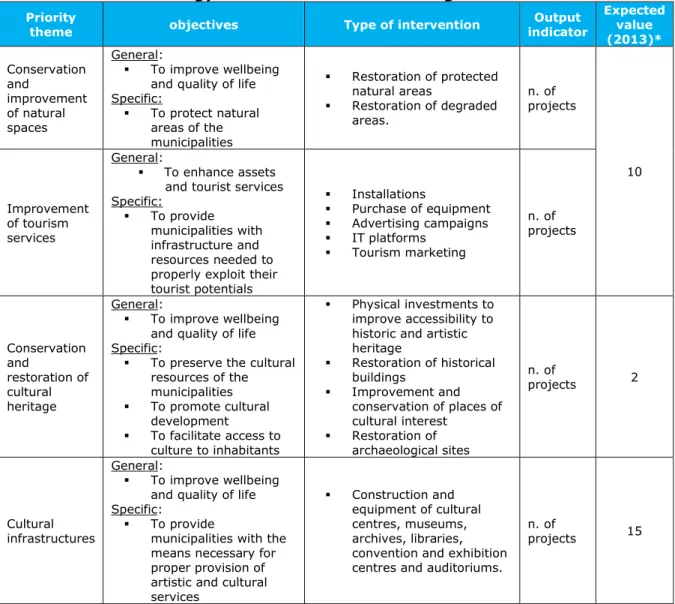
(21) Ex post evaluation of Cohesion Policy programmes 2007-2013, focusing on the European Regional Development Fund (ERDF) and Cohesion Fund (CF) – Work Package nine: Culture and Tourism. Only one type of beneficiary is eligible for funding, that is, all municipalities in the Community of Madrid with a population equal to or greater than 35,000 inhabitants. This involves the participation of 25 municipalities, representing 88.9% of the total population of the Community, including the city of Madrid itself (which accounts for 52.9% of the total population of the Community). The municipalities are the direct beneficiaries of the funds, while the final beneficiaries are both inhabitants and visitors. No private entities have been entrusted as final beneficiaries. They are therefore the local governments that implement the investment priorities of Axis 4 by selecting, case by case, the most appropriate type of action, based on their closer status to citizens and better knowledge of urban development needs. This is why the expenditure allocated to each of the priority areas from 56 to 60 of the OP has been considered merely indicative by the regional authorities and subject the changes during implementation. The same logic has been applied also to the indicator system. Accordingly, only the indicator “number of projects” has been used to measuring the progress of the strategy, while result indicators (e.g. jobs created or induced gross private investment) have not been set up. As for the financial distribution, target values of the output have been first set indicatively and then updated in view of the specific projects that local governments have been presenting during the implementation of the programme. 8 Table 2.4 below provides a summary of the main elements of the ERDF strategy by reflecting its logic of intervention, from objectives to outputs. As shown in Table 2.4, the ERDF regional strategy for tourism and culture has been designed as a general and flexible framework for investment. This is at the same time a strength and a weakness (as it will be evidenced in the next chapter). On the one hand, it maximises the relevance of the projects to be implemented in the two sectors. On the other, it discourages the implementation of a rigorous monitoring system capable of measuring, quantitatively, the actual achievements and, somehow, it prevents a coherent real strategy for the region as a whole from being developed. The added value of the EU intervention should be rather found at the local level. Indeed, the municipalities are the recipients of the funding but they are also entrusted with the selection, management and implementation of the projects, thus contributing to shaping the strategy. At the same time, as local governments, they develop their own policies and plans in the fields of urban development, culture and, where relevant, tourism. In the case of the city of Madrid, for example, the municipal council is currently governing two larger plans, one in the field of tourism (Tourism Strategic Plan of the City of Madrid 2012 to 2015) and one in the field of urban regeneration (Plan Rio Madrid), in which they coordinate national (CF), regional (ERDF) and own municipal resources to develop projects in an integrated manner. As illustrated in the next chapter, the existence of programmes at municipal level and their integration with the ERDF strategy is a main element of success and is the area where the ERDF generates added value.. 8. Last update of the target values was carried out in July 2011.. October 2015 21.
(22) Ex post evaluation of Cohesion Policy programmes 2007-2013, focusing on the European Regional Development Fund (ERDF) and Cohesion Fund (CF) – Work Package nine: Culture and Tourism. Table 2.4. ERDF strategy for tourism and culture. Logic of intervention Priority theme. objectives. Type of intervention. Output indicator. Expected value (2013)*. General: To improve wellbeing Restoration of protected and quality of life natural areas n. of Specific: Restoration of degraded projects To protect natural areas. areas of the municipalities General: 10 To enhance assets and tourist services Installations Specific: Improvement Purchase of equipment To provide n. of of tourism Advertising campaigns municipalities with projects services IT platforms infrastructure and Tourism marketing resources needed to properly exploit their tourist potentials General: Physical investments to To improve wellbeing improve accessibility to and quality of life historic and artistic Conservation Specific: heritage and To preserve the cultural Restoration of historical n. of restoration of resources of the buildings 2 projects cultural municipalities Improvement and heritage To promote cultural conservation of places of development cultural interest To facilitate access to Restoration of culture to inhabitants archaeological sites General: To improve wellbeing and quality of life Construction and Specific: equipment of cultural Cultural To provide centres, museums, n. of 15 infrastructures municipalities with the archives, libraries, projects means necessary for convention and exhibition proper provision of centres and auditoriums. artistic and cultural services *updated at July 2011. NB: The priority theme “Other forms of support to improve cultural services” is not included in the table because it is a residual category and was further abandoned by the regional authorities. Source: ERDF Operational Programme for the Community of Madrid 2007-2013 Conservation and improvement of natural spaces. 2.3 Governance and supportive features of the ERDF strategy Three main institutional actors are involved in the governance of the ERDF strategy within Priority Axis 4. On the one hand, the Ministry of Economy, DG de Fondos Comunitarios, which is the OP Managing Authority (MA), and the government of the Community of Madrid, DG de Asuntos Europeos y Cooperación con el Estado, which is co-responsible for operational execution, supervision and monitoring. On the other, the municipalities in the region with a population of over 35,000 inhabitants, who have been entrusted the identification, management and implementation of projects within priority themes 56 to 60. That is, the national and regional authorities have been involved in formulating the strategic directives, the municipalities in putting them into practice. These latter can be seen therefore at the same time as recipients, implementer and “owner” of the. October 2015 22.
(23) Ex post evaluation of Cohesion Policy programmes 2007-2013, focusing on the European Regional Development Fund (ERDF) and Cohesion Fund (CF) – Work Package nine: Culture and Tourism. strategy. Before its submission to the EU, the strategy developed within Priority Axis 4 was the subject of consultations with the regional federation of municipalities, although no proposals were formulated at that time. Following, two warrants were held to distribute ERDF aid among municipalities. The approach chosen by the national/regional authorities to distribute the financial resources was based on population criteria, and not on competitive selection process, so that each municipality was entrusted a maximum ERDF amount based on their number of inhabitants. With this approach, the projects presented by the local governments do not compete with each other. The resulting financial allocations are presented in Table 2.5. Obviously, the city of Madrid absorbs the largest share (with 19.5 out of EUR 33.5 million available), while for up to seven municipalities the ERDF is less than EUR 300,000. These preliminary allocations have been, however, subject to even substantial modifications during implementation. Indeed, as better discussed in Chapter 4, the process of fiscal consolidation that has affected all the Spanish administrations has in the end prevented many municipalities from implementing their projects. As a consequence, resources had to be redistributed across the recipients. As to the supportive measures adopted to bring to implementation the ERDF regional strategy on tourism and culture, these are briefly reviewed below: . Selection criteria and procedures. As mentioned, projects implemented under priority themes 56 to 60 are not competing each other, each municipality having the opportunity to apply for funding within a given financial threshold 9. The criteria adopted for project approval are: consistency with the relevant priority theme’s objectives, technical feasibility, financial capacity, and (as emerged during the interviews) also the non-revenue generation nature of the operation10 (so that its eligible expenditure is not reduced).. . Use of public – private partnerships. All financed projects have been implemented and are operated exclusively by the public sector, either directly by the municipality or be means of companies with 100% public ownership.. . Tools used to analyse impacts. No specific quantitative or qualitative tools have been put in place at the programme level to measure the impact of the strategy (e.g. induced demand of users/visitors).. . Monitoring system. A monitoring system of good quality has been developed to measure the financial performance of the programme. 11 On the contrary, as far as monitoring of results is concerned, the system of indicators of Axis 4. 9. This is, however, in contrast with the MA survey, where it was indicated that beneficiaries are selected by open competitive and/or negotiated procedures. 10. Operations are defined non-revenue generating when they do not generate revenues or the revenues do not fully cover the operating costs (Art. 55 of Reg. 1086/200). 11. A new computer system (Fondos 2007) has been developed to allow the MA and the Monitoring Committee (MC) monitoring the financial execution of the programme. The system transmits the data necessary for financial verifications, including: indicative annual allocation of each Fund in each operational programme, as specified in the national strategic framework; the financing plans for operational programs at priority axis level; statements of expenditure and requests for payment; annual forecasts of likely payment of expenditure; the financial section of the annual reports and final implementation reports.. October 2015 23.
(24) Ex post evaluation of Cohesion Policy programmes 2007-2013, focusing on the European Regional Development Fund (ERDF) and Cohesion Fund (CF) – Work Package nine: Culture and Tourism. encompasses only output indicators (number of projects financed) so that any quantitative measurement of socio-economic effects is pre-empted. . Typologies of contracts. ERDF grants have been used for the delivery of the interventions in tourism and culture.. Table 2.5. ERDF strategy for tourism and culture. Financial caps Total eligible Cost (EUR) Madrid 3,128,600 39,133,345 Móstoles 206,301 2,580,467 Alcalá de Henares 201,380 2,518,914 Fuenlabrada 193,715 2,423,038 Leganés 182,471 2,282,395 Alcorcón 164,633 2,059,273 Getafe 156,320 1,955,291 Torrejón de Ardoz 112,114 1,402,351 Alcobendas 104,118 1,302,335 Parla 95,087 1,189,373 Coslada 83,233 1,041,100 Pozuelo de Alarcón 79,581 995,420 75,719 947,113 Las Rozas de Madrid San Sebastián de los Reyes 67,351 842,444 Majadahonda 62,270 778,889 Rivas Vaciamadrid 53,459 668,679 Collado Villalba 52,083 651,468 Valdemoro 48,517 606,863 Aranjuez 46,283 578,920 Arganda del Rey 45,085 563,935 Colmenar Viejo 40,878 511,313 San Fernando de Henares 40,048 500,931 Tres Cantos 39,826 498,154 Pinto 39,462 493,601 Boadilla del Monte 37,926 474,388 Total 67,000,000 Source: ERDF Operational Programme for the Community of Madrid 2007-2013 Municipality. October 2015 24. Population. Max. ERDF amount (EUR) 19,566,672.50 1,290,233.50 1,259,457.00 1,211,519.00 1,141,197.50 1,029,636.50 977,645.50 701,175.50 651,167.50 594,686.50 520,550.00 497,710.00 473,556.50 421,222.00 389,444.50 334,339.50 325.734.0 303,431.50 289,460.00 281,967.50 255,656.50 250,465.50 249,077.00 246,800.50 237,194.00 33,500,000.00.
(25) Ex post evaluation of Cohesion Policy programmes 2007-2013, focusing on the European Regional Development Fund (ERDF) and Cohesion Fund (CF) – Work Package nine: Culture and Tourism. 3. Effectiveness and sustainability of the strategy: outputs and results 3.1 Outputs achieved This section sets out the performance of the ERDF regional strategy for tourism and culture in terms of both financial and physical realisations. It shows the original OP targets and reported achievements. As illustrated in Table 3.1, against a total programme ERDF expenditure of EUR 33.5 million, the financial resources allocated to projects during implementation amounts to EUR 28.6 million (i.e. EUR 5 million have been reallocated to other Priority Axes). Of this, the absorption capacity at December 2014 was 89%. In terms of number of projects, 22 out of 25 programmed operations are being implemented (16 of which have been concluded). According to the regional authorities of the Community of Madrid, the main reason underlying the non-achievement of targets lies in the process of fiscal consolidation that has affected all the Spanish administrations, including the local ones. Following the requirements of fiscal consolidation, the municipalities have to anticipate the full cost of the projects and many were, therefore, forced to give up the implementation of the projects due to a lack of financial capacity. This situation was exacerbated by the economic recession occurred during the years of programme implementation. In fact, only 13 out of the 25 municipalities eligible for funding have been able to implement projects. These are the richest municipalities of the Community, which could take over project implementation thanks to larger institutional, technical and financial capacities. On the one hand, the existence of specific urban development plans at the municipal level facilitated project design and planning. On the other, the availability of financial resources and budgetary autonomy made this implementation possible. The regional authorities tried to remedy this situation during the programme implementation by redistributing ERDF allocations across municipalities and allowing those with lager capabilities (except for Madrid) to spend more than originally planned. In this way, resources have been concentrated to value added areas and financial absorption capacity raised.12 However, in view of granting equal opportunities and balance of aid, it was decided to keep a financial envelope for financing projects that the remaining municipalities could have possibly presented in the latest stages of the programme. This approach was based on the consideration that the financial situations of some city councils have improved after 2012. The strategy achieved, in the end, a mixed result. In fact, few additional municipalities have been actually able to implement projects in the last resort. Thus, the distribution of resources (and effects) across the Community was larger. Yet, almost half of the eligible recipients have not benefitted from the opportunities provided by the operational programme in the two sectors. 12. In principle, it was even possible to spend all the total programmed expenditure (EUR 33.5 million), e.g., by entitling the city of Madrid with more than EUR 19.5 million (its financial cap).. October 2015 25.
(26) Ex post evaluation of Cohesion Policy programmes 2007-2013, focusing on the European Regional Development Fund (ERDF) and Cohesion Fund (CF) – Work Package nine: Culture and Tourism. Table 3.1. ERDF strategy for tourism and culture. Financial and physical achievements Programming Priority theme. Conservation and improvement of natural spaces Improvement of tourism services Conservation and restoration of cultural heritage Cultural infrastructures Other forms of support to improve cultural services Total. Number Projects - OP Target*. Total Financial allocation (mil. euro) 6.7. ERDF allocation Amount (mil. euro). %. 3.35. 10%. 6. Number projects. Total Financial allocations to projects (mil. euro) 2.4. Amount (mil. euro) 1.2. 4%. 2.1. 88%. 1.1. 9 6.7. 3.35. 10%. 13. 40.2. 20.1. 60%. 3. 6.7. 3.35. 3. 6.7. 25. 67. 6 11.4. 5.7. 20%. 9.6. 84%. 4.8. 5. 26.4. 13.2. 46%. 22.7. 86%. 11.4. 3. 10%. 8. 16.9. 8.45. 30%. 16.6. 98%. 8.3. 7. 3.35. 10%. 0. 0. 0. 0%. 0. 0%. 0.0. 0. 33.5. 100%. 22. 57.1. 28.6. 100%. 51.0. 89%. 25.5. 16. * Originally planned in 2007 ** Updated at 31.12.2013 Source: Regional monitoring database of ERDF projects (updated at 31.12.2014). October 2015 26. Implementation Total Certified expenditure ERDF Certified Projects Total Total % expenditure Concluded** Amount % certified (mil. euro) (mil. expenditure euro). ERDF allocations.
(27) Ex post evaluation of Cohesion Policy programmes 2007-2013, focusing on the European Regional Development Fund (ERDF) and Cohesion Fund (CF) – Work Package nine: Culture and Tourism. 3.1.1 Conservation and improvement of natural spaces Only three projects have been implemented within the Priority theme. The ERDF contribution ranged from EUR 0.2 to 0.5 million. This typology of projects has been developed by those municipalities holding natural assets that can be exploited for recreational uses. The projects fit within the activities of the regional government to promote rural tourism in the region with definition of circuits, routes and destinations to encourage excursions and getaway weekends around the capital. Hence, the beneficiaries are both municipal residents and local tourists at regional level. All financed projects have a public nature and are provided to users free of charge. Therefore, maintenance duties are taken over by the municipal budget and long run sustainability depend on financial resources. No implementation problems have been reported by the competent authorities. Table 3.2. ERDF support. Conservation and improvement of natural spaces Priority theme. N° of projects. Conservation and improvement of natural 3 spaces Source: Regional monitoring database. ERDF support (total and per project) Total (mil. euro). Median (mil. euro). Minimum (euro). Maximum (mil. euro). 1.2. 0.5. 0.2. 0.5. The following projects have been implemented: 13 . Environmental rehabilitation of Lazarejo river basin area (ERDF contribution: EUR 0.5 million). The project consisted of a set of interventions for environment protection and provision of recreational services in the town of Las Rozas, including: landscape restoration of the natural area Fuente del Cura; supply of outdoor sports; forestation; building of hunting protection infrastructures; management of the wild boar population.. . Ecological and landscape restoration of Cerro de los Perdigones (ERDF contribution: EUR 0.5 million). The project consisted in the environmental restoration of a degraded area in the municipality of Pozuelo de Alarcón, which was suffering from a lack of maintenance of roads and public services, for its transformation into an urban park.. . Improvement of Fresneda natural heritage for recreational use (ERDF contribution: EUR 0.2 million). The project involved the requalification of the natural area around the Fresneda River in Boadilla de Monte for provision of leisure activities. Visitors can choose among the following activities according to their interests: o. the healthy circuit with 10 exercise elements;. o. the jogging circuit with 16 fitness equipment integrated into the environment;. 13. For each project, only the ERDF contribution is reported. To know the total financial allocation, the ERDF contribution shall be doubled.. October 2015 27.
(28) Ex post evaluation of Cohesion Policy programmes 2007-2013, focusing on the European Regional Development Fund (ERDF) and Cohesion Fund (CF) – Work Package nine: Culture and Tourism. o. the bird-watching centres and the lagoon, an artificial pond naturalized and integrated into the Fresneda river;. o. dog training and a pets’ recreational area circuit.. 3.1.2 Improvement of tourism services Six projects have been implemented within the Priority theme. The ERDF contribution ranged from EUR 0.1 to 3.8 million, for a total expenditure of EUR 5.7 million. These projects do not envisage infrastructural realisations, but the development of supporting measures, events, instruments and tools to provide both public and private institutions operating in the tourism sector with additional capacities. The final beneficiaries of the operations are tourists and residents of the city of Madrid. All projects have been implemented in city of Madrid, directly by the City council. The projects are integrated into the Tourism Strategic Plans of the City of Madrid 20082011 and 2012-2015 (Plan Estratégico de Turismo de la Ciudad de Madrid), which are the main policy framework documents setting the overall strategy of the city in the tourism sector. The plans encompass, amongst other, the following activities: . expansion of areas of interest to tourists and increase in tourism consumer spending;. . support for cultural events interesting for tourists;. . unique selling points in destination promotion;. . creation of the Madrid Tourism Advisory Council;. . creation of the network of major Spanish city destinations;. . new online communications model.. According to information gathered at the City council, the reference framework provided by the Tourism Strategic Plans facilitated the process of identification, design and planning of the activities to be financed with the ERDF. These projects contributed to the system of both public and private interventions supporting o tourism industry in Madrid. The City council, however, has not set up an indicator system to single out and to measure the effectiveness of these projects, because their effects are considered useful, but intangible. Given the non-revenue generation nature of these projects, their operations and maintenance is upon the relevant departments of the City council. Table 3.3. ERDF support. Improvement of tourism services Priority theme. N° of projects. Improvement of tourism services. 6. ERDF support (total and per project) Total (mil. euro). Median (mil. euro). Minimum (euro). Maximum (mil. euro). 5.7. 0.3. 0.1. 3.8. Source: Regional monitoring database. The following projects have been implemented: . Advertising campaigns based on innovative techniques of experiential marketing (ERDF contribution: EUR 3.8 million). The project aimed at supporting the tourism industry of Madrid with a set of advertising campaigns. October 2015 28.
(29) Ex post evaluation of Cohesion Policy programmes 2007-2013, focusing on the European Regional Development Fund (ERDF) and Cohesion Fund (CF) – Work Package nine: Culture and Tourism. that put the services offered by the city in each market segment in relation to a specific experience or a feeling.14 These actions were complemented with the development of a handbook to be used by tour operators and travel agents for online promotions. . FITUR Madrid Event 2013 (ERDF contribution: EUR 1.1 million). The project involved the development and management of the stand ‘Destination Madrid’ at the International Tourism Trade Fair (FITUR) held in Madrid in 2013. Beside expositions featuring high levels of representations on the part of the international tourist industry, the fair promoted the international trade circuit for the travel industry presenting a series of different projects designed to boost businesses within the field of tourism.. . New tourism portal of the city of Madrid (ERDF contribution: EUR 0.3 million). The project consisted of the redefinition, restyling and upgrade of www.esMadrid.com website in order to target new markets and to improve the services offered to foreign tourist (e.g. e-commerce). The implementation of the project required the conceptual, functional and technical definition of the adequacy of the new portal for incorporation of new digital services.. . Creation of a tourism observatory (ERDF contribution: EUR 0.2 million). The observatory collects and process information about the performance of the tourism industry in Madrid to support the decision-making process of the public sector. The creation of the observatory was embodied in the development of a computer-based application for data collection, analysis and reporting based on s system advanced tourism indicators.. . Renewal of Madrid Convention Bureau (ERDF contribution: EUR 0.2 million). The projects involved the optimisation of resources for the management of the Madrid Convention Bureau (MCB), including: creation of a new web platform for the MCB; implementation of an automation system for processes management; adoption of a quality system for office management.. . Creation of a web-based platform for knowledge exchange (ERDF contribution: EUR 0.1 million). The purpose of this platform was to optimize and make available information and data to tourism operators for better promoting the city of Madrid. The project implementation was developed in three phases: o. conceptual, functional and technical definition of the platform;. o. development and implementation of the platform.. o. acquisition of hardware and software.. 3.1.3 Conservation and restoration of cultural heritage Five projects have been implemented within the Priority theme. The ERDF contribution ranged from EUR 0.1 to 10.6 million, for a total expenditure of EUR 13.2 million. Projects have been developed by those municipalities with added value in terms of 14. Since 2010 the following campaigns took place: i) "When you come to Madrid" to promote vitality and authenticity of Madrid; ii) "Madrid, a lifestyle" to convey the uniqueness of life in Madrid and to promote revitalization of the city for leisure and entertainment; iii) "Madrid, making business a pleasure" to promote Madrid as a place for congresses, conventions and business tourism.. October 2015 29.
(30) Ex post evaluation of Cohesion Policy programmes 2007-2013, focusing on the European Regional Development Fund (ERDF) and Cohesion Fund (CF) – Work Package nine: Culture and Tourism. historical and cultural heritage. Two main typologies of intervention have taken place: . Projects restoring/improving the public areas surrounding a major cultural/historical facility. These projects are a mix between urban development and cultural interventions and purse a two-fold objective: i) to improve urban quality; and ii) to support the tourism-culture industry by improving the conditions of access and the overall liveability and functionality of the areas. These projects do not any generate revenue and are usually managed by the urban planning department of the city councils.. . Projects involving the conservation and restoration of a major cultural/historical facility. The objective is to address the cultural heritage as a key element in the tourism development of the municipality. To access the facility a ticket is paid by users, which is however not sufficient to cover the operating costs.. In terms of measurement of effectiveness, data about number of visitors are usually collected by the municipality, or the public company, managing the facility. When projects are greenfield investments (i.e. before the intervention there were no infrastructure operations, as in the cases of Matadero Madrid and Palace “Infante Don Luis” – see below), the generation of visitors is an effect directly imputable to the projects. Vice-versa, in case of pre-existing assets such as the archaeological site of Complutum a counterfactual scenario analysis is necessary to single out the net effect of the ERDF intervention. Also, other information, such as visitor numbers at other archaeological sites elsewhere, would be of very little use due to the incomparability across projects of this typology. No other indicators are collected at municipal level. Table 3.4. ERDF support. Conservation and restoration of cultural heritage N° of projects Conservation and restoration of cultural heritage. 5. ERDF support (total and per project) Total (mil. euro). Median (mil. euro). Minimum (euro). Maximum (mil. euro). 13.2. 0.3. 0.1. 10.6. Source: Regional monitoring database. The following projects have been implemented: . Rehabilitation of Matadero Madrid surroundings (ERDF contribution: EUR 10.6 million). This is project that received the largest ERDF financing within the regional strategy for tourism and culture. The project is part of the activities carried out by the city council of Madrid, Directorate General of Cultural Heritage and Urban Landscape, to develop the Matadero cultural complex. It consisted of enhancing pedestrian accessibility, removing architectural barriers, configuring wide green spaces and repaving streets and squares to improve citizens’ access to the cultural activities supplied in Matadero, as well as to increase the urban quality of the neighbouring districts. The main beneficiaries of the infrastructure are both residents of Madrid, especially in the districts of Usera, Carabanchel and Arganzuela, and tourists.. . Construction of pedestrian bridges over Manzanares river (ERDF contribution: EUR 1.9 million). This operation involved the construction of. October 2015 30.
(31) Ex post evaluation of Cohesion Policy programmes 2007-2013, focusing on the European Regional Development Fund (ERDF) and Cohesion Fund (CF) – Work Package nine: Culture and Tourism. two pedestrian bridges on the Manzanares River to incorporate the urban areas located beyond the river into a new urban complex, by connecting them to the Arganzuela park and the Matadero cultural complex. De facto, even if formally split in a single operation, it operationally belongs to the project “Rehabilitation of Matadero surroundings.”15 . Restoration works in the Palace Infante Don Luis (ERDF contribution: EUR 0.1 million + EUR 3.8 million from other OP priority themes). The project involved the restoration to their original form of the gardens of the Palace, which is a building of national historical interest, located in the town of Boadilla del Monte. The project is included in larger programme which aims at the progressive restoration of the entire Palace through other integrated projects, which are being carried out by the city council thanks to other public and private financial sources that complement the actions taken within in the ERDF strategy. In the last seven years, about EUR 7 million have been spent. Depending on availability of resources, the City council expects the Palace to be fully rehabilitated in five to ten years. Once completed, the Palace will be a major attraction to be included into the international tourism circuits. At present, the gardens of the Palace are open to the public, with 10.719 estimated visitors since opening in March 2015. Also, some areas inside the Palace are currently used for organized visits mainly for didactical proposes. According to the data available at the city council, in 2014, there have been 380 school visits, 717 group visits and 350 individual visits.. . Recovery of Huerto de Los Leones: Jardín de las palabras (ERDF contribution: EUR 0.3 million). The project entailed the improvement of gardens and public areas surrounding the ‘Magistral al norte’ Church, one of the most representative historic asset of the city of Alcalá de Henares. The project covered an area of 5,339 m2 and was developed by the architect Ms. Blanca Sanchez Lara, winner of the international contest held in 2001, in collaboration with UNESCO, for the development of thematic cultural areas.. . Restoration works in Complutum archaeological (ERDF contribution: EUR 0.3 million). The Roman city of Complutum is located on the Westside of Alcalá de Henares and was declared as archaeological zone of cultural interest in 1992. The rehabilitation works interested the area corresponding to the Forum, including basilica, baths and market. A symbolic price of 2 Euros (not increased after the project) is currently paid to visit the Forum. According to the city council’s data, the expected number of visitors, including international tourists, in 2015 is 11,000.. 3.1.4 Cultural infrastructures Eight projects have been implemented within the Priority theme. The ERDF contribution ranged from EUR 0.2 to 4.6million, for a total expenditure of EUR 8.5 million. These projects mainly concern the construction of centres where multidisciplinary cultural services are provided to users: visual arts, music, library, internet, films, astronomy etc. 15. The two projects (Rehabilitation of Matadero Madrid surroundings and Construction of pedestrian bridges over Manzanares river) are, toghther, the object of the “Matadero Madrid” mini-case study, where their relevance, effectiveness and sustainability are discussed.. October 2015 31.
(32) Ex post evaluation of Cohesion Policy programmes 2007-2013, focusing on the European Regional Development Fund (ERDF) and Cohesion Fund (CF) – Work Package nine: Culture and Tourism. There is no tourism component here. Rather, they add to the provision of cultural services objectives of social integration and wellbeing since they are often implemented in those neighbours with social concerns owing to high immigration rate and/or lack of basic services (e.g. spaces for children). The main beneficiaries are therefore the residents of the districts where projects are implemented. When projects are large in relation to population (as in the case of Centre of Arts of Alcobendas), they will also contribute to renovate the “cultural identity” and image of their towns. On the other hand, issues of long term sustainability may arise. Table 3.5. ERDF support. Cultural infrastructures N° of projects Cultural infrastructures. ERDF support (total and per project) Total (mil. euro). Median (mil. euro). Minimum (euro). Maximum (mil. euro). 8.5. 0.4. 0.2. 4.6. 8. Source: Regional monitoring database. The following projects have been implemented: . The Centre of Arts of Alcobendas (ERDF contribution: EUR 3.9 million). The project consisted of the construction of the new ‘Casa de la Cultura’ in Alcobendas. Main services and activities supplied in the centre are: o. exhibitions of visual arts;. o. children, youth and workshops, etc.);. o. didactic and experimental workshops;. o. theatre for classic concerts with 400 seats.. adult. media-theques. (Wi-Fi,. reading. room,. Due to the size of the investment (the total investment cost is EUR 26 million) this project is particularly interesting and has been selected as mini case study.16. 16. . School of music, dance and library (ERDF contribution: EUR 2.3 million). The facility was to build to host a school of music, a school of dance, a local library and an auditorium with 290 seats to the residents of the town of Parla.. . Civic-Social Centre Espartales Sur (ERDF contribution: EUR 0.8 million). The design and construction of the centre was developed within an urban development plan addressing the southwest neighbourhood of Alcalá de Henares. The centre is located in a three floors building of 450 m2 and offers services such as library, reading room a conference hall with about 100 seats.. . Arroyo Civic Centre (ERDF contribution: EUR 0.5 million). The construction of the Centre has provided a district of Fuenlabrada with a new infrastructure promoting social and cultural activities. The Centre covers a total area of 1,224 m2 and hosts cultural activities and courses (computer, languages, crafts, photography, painting, dance etc.) to its residents.. See the Mini case studies report, where the project effectiveness and sustainability are discussed.. October 2015 32.
Figure



+7





Documento similar
In the preparation of this report, the Venice Commission has relied on the comments of its rapporteurs; its recently adopted Report on Respect for Democracy, Human Rights and the Rule
We advance the hypothesis that fraudulent behaviours by finan- cial institutions are associated with substantial physical and mental health problems in the affected populations.
By distinguishing between the quality and quantity of access to information and communication technologies, together with institutional and geographical factors, and using a sample
Focusing on regional variations, firms in Addis Ababa and Oromia account for both the largest number of firms in the survey (75%) and for over 70 percent of the total
Additionally, slightly negative relationship between the level of regional inequality and the level of economic development is found out regarding regional inequality within
These radio programmes have a large number of active followers, interested in the information they post in their accounts, which is basic to succeed because quality
Once we achieve an instrument to analyse the socio-economic vulnerability of EU regions in terms of the 2021–2027 Cohesion Policy goals, the next step is to study how a situation
In particular, this work has tried to examine the growing role of regional multilateralism in Chinese foreign policy, and illustrate how China as a rising power attempts
