
Citizens’ competences and perceptions about the Smart Cities: a case study
58
0
0
Texto completo
(2) 2.
(3) Index 1. Introduction………………………………………………………………………………… 5 2. Concept of Smart City…………………………………………………………………….. 6. 3. Dimensions of a Smart City……………………………………………………………… 8 3.1. Smart Governance…………………………………………………………………. 9 3.2. Smart Environment…………………………………………………………………. 12 3.3. Smart Living…………………………………………………………………………… 14 3.4. Smart Mobility………………………………………………………………………….16 3.5. Smart People………………………………………………………………………… 18 3.6. Smart Economy………………………………………………………………………. 20 4. Citizens’ views about the Smart Cities …………………………………………………… 22 5. Citizens’ competences needed efficient use of the services that a Smart City offers. 24 6. Study case………………………………………………………………………………… 26 6.1. Methodology……………………………………………………………................... 26 6.2. Castellón as a Smart City: Actions developed……………………………………. 27 6.3. Citizens’ perceptions of Castellón as a Smart City: Analysis and results……… 33 7. Conclusions……………………………………………………………………………….. 45 8. Bibliography……………………………………………………………………………….. 46 9. Annex………………………………………………………………………………………… 53 9.1. Survey about the Smart Cities …………………………………………………….. 53 9.2. Profile of respondents………………………………………………………………. 56. 3.
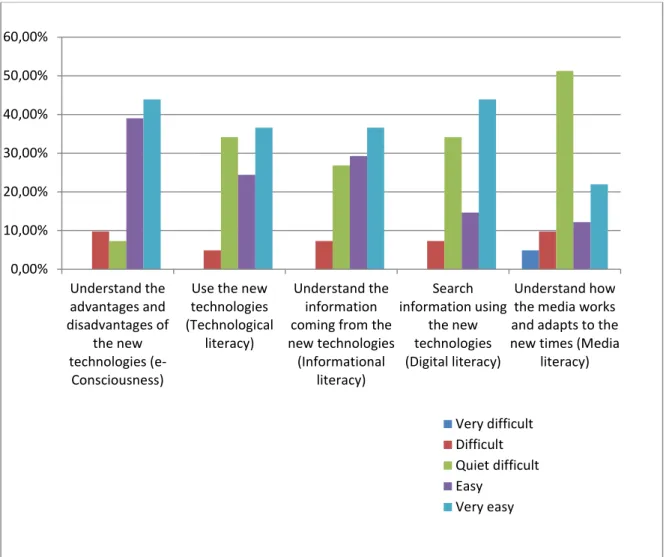
(4) Index of figures Figure 1. Level of awareness of the concept of Smart City……………………........ 34 Figure 2. Concepts related to the Smart Cities………………………………………. 35 Figure 3. Opinion about the implementation and use of new technologies……….. 37 Figure 4. Aspects where the new technologies improve the quality of life………... 38. Figure 5. Citizens’ assessment Castellón as Smart City......................................... 40 Figure 6. Ease of use of the 5 competences by the citizens of Castellón…………. 42 Figure 7. Age of the respondents……………………………………………………… 56 Figure 8. Studies of the respondents………………………………………………….. 57. Figure 9. Occupation of the respondents…………………………………………...... 57 Figure 10. Area of residence of the respondents…………………………………….. 58. Index of tables Table 1. Different proposals for identifying the dimensions of a Smart City………. 9. Table 2. Services of Castellón as Smart City………………………………………... 32. Table 3. Concepts related to the Smart Cities………………………………………. 35. Table 4. Awareness and use of services of Castellón as Smart City…………...... 36. Table 5. Opinion about the implementation and use of new technologies……….. 38. Table 6. Aspects where the new technologies improve the quality of life………... 39. Table 7. Citizens’ assessment Castellón as Smart City……………………………. 40. Table 8. Ease of use of the 5 competences by the citizens of Castellón…………. 42. Table 9. Evaluation of the 6 dimensions of Castellón………………………………. 43. 4.
(5) 1. Introduction There has always existed the need to use the limited quantity of resources that we have in the most efficient and effective way. Moreover, now, due to the social awareness about environmental protection, we also have to do it in the most ecologic way (Colado, et al., 2014). In addition, we must take into account the raise of the world population, of which the experts expect that the 70% will be massed in big cities due to the higher standard of living that we can found in those places, which raises potential problems of geographic management. For those reasons, we need a more organized city to know the current and future situation, having the possibility of act accordingly (Cebrián, et al, 2012). To solve those problems, the “Smart Cities” are being implanted, which can implement a set of procedures which allow to satisfy the needs that the city could have. This objective is achieved by the unification of the systems of the cities in only one using the new technologies, increasing production and improving the quality of life of its inhabitants (Colado, et al., 2014).. The reason why we have considered appropriate to talk about the topic of the Smart Cities are its many advantages and benefits, among which we can found the cost reduction they pose to the public administration and the citizens, the possibility to adapt itself to the needs of the city in real time, facilitate the implementation of the tasks of the citizens, etc. (Azkuna, 2012). All these advantages are of great interest due to the fact that today is very important to act in the most sustainable way, and the Smart Cities are a good option to achieve this objective, thanks to its optimal use of resources and cost saving.. Furthermore, in the process of implementation of a Smart City, citizens have a very high importance, since the services that will be implemented will have better chance of success if the citizens have the perception that they really are necessary (Morcillo, 2013), and if they have the competences and skills needed to use them correctly (Cobo, J., 2009).. The objectives of this work are to review the concept of Smart City, identify its elements, and examine the importance of its citizens’ view and competences. Additionally, we aim at analyzing a specific case to find out which Smart Cities services are offered in a particular city, which perception have the citizens about the actions taken in this Smart Cities, if the. 5.
(6) services of these type of cities are really useful in their daily lives, and if they think that they have the necessary competences to use the available services properly, taking advantage of the facilities offered by the Smart Cities.. The structure of this work consists of an initial theoretical part where the concept of Smart City and its dimensions are described. Subsequently we talk about the importance of the citizens for the Smart Cities and the skills needed to take full advantage of them. Later we will talk about the case study, where we describe the methodology used in order to examine the case of Castellón as a Smart City and to gather information about the citizens’ perception about it. Finally, we point out the conclusions reached.. 2. Concept of Smart City In 1992 a comprehensive action plan called Agenda 21 was ratified by 178 countries in the city of Rio de Janeiro. This plan set to use the latest technologies to carry out the sustainable development of urban infrastructures, creating a transparent government, and integrating all society members, can be considered the first step to the creation of Smart Cities (Colado et al., 2014).. Since Agenda 21 was created, there have been other institutions that have been developing the concept of Smart City to reach develop the concept as the one we know today. Some of them, among which we can appoint are the II World Summit of Cities and Local Authorities which have the objective of crate a true Global Alliance for digital solidarity, the Committee of Digital and Knowledge-based Cities with the objective of create an efficient network of cooperation, and Horizon 2020 which objective is secure Europe's global competitiveness. The reason why this topic is recently gaining more popularity is because the urban areas will be denser in the future, creating management problems that can be solved only through good planning and sustainability (Azkuna, 2012).. Currently there are several definitions of what is a Smart City, highlighting the following models: Colado et al. (2014) says that the Smart Cities are cities that are able to manage resources and energy sources optimally to improve the quality of life of people and the environment, and optimize services. Azkuna (2012) says that the Smart Cities are cities that use new technologies to be more livable, functional, modern and competitive through. 6.
(7) the use of new technologies, the promotion of innovation and knowledge management. According Cebrian et al. (2012) Smart City consists generally of certain key elements: an infrastructure system, an urban space, a complex and intelligent network platforms and citizens who exercised backbone.. Taking into account these concepts, we can say that the Smart Cities are urban spaces with a complex system of infrastructure, networks and platforms that turn around their inhabitants. The objective that we want to reach with them is a more efficient and effective management in all areas of the city, fulfilling the needs of citizens using the new technologies.. The principles to be applied in the implementation of a Smart City are that the technological infrastructure has to facilitate the communication wisely but being respectful with the environment; use renewable energy and energy saving methods in the energetic sector; integrate public and private services so that they complement each other; and create a transparent government with accessible data (Cebrián et al., 2012). However, municipalities with small populations usually don’t have all the services that they should offer as Smart City because they have limited resources. To prevent this from happening, small towns have the need to associate with other small municipalities so that they can enjoy all these services thanks to the creation of economies of scale, achieving a reduction of administrative burdens and costs, plus increased control and consolidation of information (Azkuna, 2012).. There are currently three visions of what is sought in a Smart City: On the one hand, the improvement of governance in terms of organizational and monetary aspects. On the other hand, improve citizens' quality of life by satisficing their domestic, social, leisure and work needs. And finally, improve the business models to improve the social and economic competitiveness (Morcillo, 2015).. Among the many advantages that result from the implementation of the model of Smart Cities in our cities, we can found an easier internet access, new services and business models, more efficient and automated management of urban infrastructures, improvement of the environment and green areas, and the reduction of costs thanks to the increased. 7.
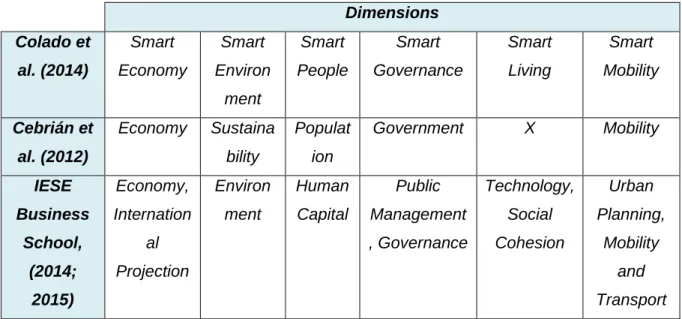
(8) optimization (OVACEN, 2013). But the implementation of Smart Cities also involves some drawbacks and disadvantages such as the high costs of their technological components, dependence on third parties to get the technology, reduction of privacy by the large amount of information required, the rise of the building prices because they are more expensive to build, and the big quantity of electronic waste discarded after becoming obsolete (OVACEN, 2013).. To improve the infrastructures and services of the cities in Spain, the Spanish Network of Intelligent Cities (RECI)1 was officially created in 2012, which uses the Information and Communications Technology (ICT) to generate progress in cities. Its main objective is to get cities to work together to achieve to be more sustainable and improve the quality of life of its inhabitants. Currently it has 60 Spanish cities that are part of it, which are assisted by technical staff of the organization via videoconference. (Red de ciudades inteligentes, 2015).. 3. Dimensions of a Smart City When people analyze Smart Cities, they are often structured into several dimensions. Currently there are several proposals to describe the elements of a Smart City, which differ basically in the number of dimensions to be considered.. The proposal that identifies the largest number of elements was performed by the IESE Business School, (2014; 2015), which has made a work comparing the biggest Smart Cities of the world using 10 dimensions (Governance, Urban Planning, Governance, Technology, Environment, International Projection, Social Cohesion, Mobility and Transport, Human Capital, and Economy). Colado et al. (2014), in his work about the description of the Smart Cities, distinguishes the following 6 elements: Smart Economy, Smart Environment, Smart People, Smart Governance, Smart Living, and Smart mobility. Cebrián et al. (2012), in his White Book about Smart Cities, just use 5 elements: Mobility, Sustainability, Population, Economy, and Government. Below we have included a table with the most common division of dimensions, relating them.. 1. Organization which aims to create a sustainable management model and improve the quality of life of citizens.. 8.
(9) Table 1. Different proposals for identifying the dimensions of a Smart City. Dimensions Colado et. Smart. Smart. Smart. Smart. Smart. Smart. al. (2014). Economy. Environ. People. Governance. Living. Mobility. Sustaina. Populat. Government. X. Mobility. bility. ion. ment Cebrián et. Economy. al. (2012) IESE. Economy,. Environ. Human. Public. Technology,. Urban. Business. Internation. ment. Capital. Management. Social. Planning,. School,. al. , Governance. Cohesion. Mobility. (2014;. Projection. 2015). and Transport. Source: Own elaboration.. As it can be observed, the proposal that made Cebrián et al. (2012) and Colado et al. (2014) are very similar, except for the fact that Cebrian et al. (2012) don’t have the Smart Living dimension, which is included in the Population dimension. IESE Business School, (2014; 2015) separate Smart Government in “Governance” and “Public Management”, Smart Mobility in “Mobility and Transport” and “Urban Planning”, Smart Economy in “Economy” and “International Projection”, and Smart living in “Social Cohesion” and “Technology”. They use 10 dimensions because the more dimension they have, the more detailed will be their analysis (Azkuna, 2012).. Among all the ways to classify a Smart City, in this work we have chosen to use the 6 dimensions, because it is the format most commonly used in most works and reports about the Smart Cities, as stated Cebrián (2012). The 6 dimensions will be described individually and their more usual services will be listed below.. 3.1. Smart Governance Smart Governance wants the quality, effectiveness, efficiency and good course of the acts of the government. Taking in account that citizens are important at the time of take governmental decisions, when this element is described we include factors such as civic participation, the involvement of the business leaders, and the implementation of government projects (IESE Business School, 2014; 2015).. 9.
(10) The cornerstone of Smart Governance is the investment in Information and Communication Technologies (ICT) to improve the efficiency of public administrations and the tax system, since new technologies can be used to enhance democratic processes and increase opportunities of individuals and communities to interact with the government. Incorporate these services also involves other advantages such as the reduction of costs and waiting time, and the improving of the quality, timing, efficiency, transparency, reliability and availability of the information (Colado et al., 2014). Moreover, nowadays it’s important that the government take into account the opinions of citizens when they are making decisions. In this way, they ensure that their decisions reflect better the values of citizens, avoiding dissatisfactions and misunderstandings. That's how the abstention from voting is reduced, and how the citizens feel that they are part of the political system (Colado et al., 2014). In addition, the participation of the inhabitants favors the effectiveness of measures by including citizens and social groups, strengthens the democratic system, gives priority to social interests above the individual ones, and helps to get the support of citizens (Azkuna, 2012).. To know what the citizens think there are a series of direct channels of communication that allow the easy exchange of information between people and the administration. Among them we mainly find the website of the public administration or the digital suggestion box, but the creation of virtual communities or a profile on the social networks is also very beneficial because it encourages the participation of the citizens and generates common interest groups (Cebrián, et al., 2012).. Thanks to these communication channels, the citizenship can be informed by providing them with all the information needed to solve problems, get their feedback to know what they think about it, encourage citizens to take part in the decision-making process, figure what is the solution wanted by the public, and empower citizens to feel that their contributions really have value (United States Environmental Protection Agency, 2014).. Among the most common services offered by the Smart Governance we find the next ones (Colado, et al., 2014):. 10.
(11) ●. Electronic voting: Electronic voting is the method by which the people can exercise their right to vote electronically. Although there are several methods, the one that will be implanted in the future will be remote e-voting, which allows voters to use their personal computer (Téllez, 2010).. ●. Electronic government: e-government is based on the incorporation of ICT in the public administration with the objective of improving the experience of citizens when they perform their administrative procedures. This is achieved through the implementation of procedures that can be performed anytime and anywhere through the Internet, saving time and unnecessary travels thanks to its flexibility, being a great advantage for people with disabilities, and avoiding the hassle that would be the fact of travel to a physical location. Furthermore, the incorporation of ICT, apart from providing security to the administrative procedures, optimizes the resources management, saves energy resources like paper, and avoids having to hire more workers (Confederación de Empresarios de Andalucía, 2010).. ●. Open Data: With the implantation of the Open Data what is wanted is that certain kinds of data can be accessible to everyone without any patent or license that limits their use. The data that must be of public domain is the cultural, scientific, financial, statistical, time, environmental, and transportation data. Also, the more data is accessible to everyone, the easier is start commercial and social activities, promoting entrepreneurship. It also seeks to increase the participation and commitment of citizens, since they only make decisions once every four years when they go to vote. However, if all the data is accessible, the public will be better informed and more likely to be involved in the decision-making process (The Open Knowledge Foundation, 2012).. ●. Analytical applications: The large amount of data provided by sensors that are along the whole city must be processed optimally in order to take full advantage of them. The analytical applications have the function of analyze in detail the environment of the city, being able to make the necessary changes at the right time to solve current and future problems, and implement other improvements (Colado et al., 2014).. 11.
(12) In view of the above, we can say that thanks to Smart Governance the administration can incorporate services that allow citizens to interact with government and obtain information on a reciprocal basis, avoiding unnecessary travels and costs, thanks to these computerized and automated services. Of this form we can achieve a greater citizen participation and transparency, and the impression that the government acts on the backs of citizens is eliminated.. 3.2. Smart environment. The objectives of the Smart Environment are the development and satisfaction of the needs of today's citizens without harm the development and satisfaction of the needs of the future inhabitants of the city. That’s why is important to care for the environment by limiting pollution, green building, alternative energy use, the use of eco-friendly transports, optimal use water, and any other measure to help combat climate change and its effects (IESE Business School, 2014; 2015).. To achieve this, the administration must create plans of environmental protection to detect and correct errors, and enhance the strengths to reduce costs and increase efficiency. To satisfy this objective, many cities have sensors that measure air and water pollution, and that information can be used to solve this problem. The population is becoming more aware about caring for the environment, so every time more and more people are carrying out the measures previously mentioned to pollute less and reduce energy consumption (Cebrián, et al., 2012).. Moreover, urban planning is the urban design of cities well-connected, compact and with accessible public services for everyone, besides creates green spaces for public use. It’s important to create a good urban planning, since it has an important role in the sustainability of the city, the quality of life of its inhabitants, investments, logistics costs, and the displacement of its citizens (IESE Business School, 2014; 2015).. However, cities tend to require every time more energy consumption and building materials, causing over time more unsustainable and damage to the environment. That’s the reason why it’s of vital importance to perform an efficient and sustainable urban planning, with the support and participation of their inhabitants. For it we can perform a series of actions such as the creation of more compact cities to save costs and. 12.
(13) unnecessarily long travels, favor the compatibility between the different sectors (residential and industrial), rehabilitate the old houses to save the costs that would suppose build a completely new one, the maintenance of green spaces such as parks and rivers, create pedestrians streets, and give priority to public transport (Cebrián, et al., 2012).. Among the most common services related to Smart Environment we found (Colado, et al., 2014): ●. Smart Energy Grid: With this system, what is sought is the real-time adjustment to consumption of the energy production to avoid wasting energy. But for that to be possible, it is important that consumers have instant consumption meters that allow two-way communication, called Smart Meters (Endesa educa, 2013). The main benefits provided by the Smart Energy Grids are a more efficient power transmission by reducing production costs and administration, improving safety even in case of electrical faults or natural disasters, allow the incorporation of renewable energies, and better forecasting the demand (U.S. Department of Energy, 2011).. ●. Water management: Use measurement systems, and remote leak repair systems to correct any damage as soon as possible to save water (Cebrián, et al., 2012).. ●. Measurement of environmental parameters: In order to know the environment state in real time, different measurement tools are used, among which we include sensors of the quality of the air, water, noise, humidity and temperature, concentration of pollen, etc. Once these data have been obtained for the quality of the environment, they can be used to make predictions (Colado, et al., 2014).. ●. Waste management: Due to the current system of waste management is very inefficient, what is sought is to apply new technologies to increase its efficiency. This is achieved by the use of a good bilateral information system working in realtime to know the filling level of the containers and can set the path of the truck remotely. You can control what containers are filled with sensors that allow to establish efficient waste collection routes (Urbiotica, 2014).. 13.
(14) ●. Management of buildings and homes: building automation and home automation: In the case of the technology used for the automation of public buildings or in the commercial field, they are called “building automation” (Colado et al, 2014.). Instead, the technology used for the automation of a home is called “home automation”. Both have in common sensors and actuators incorporated that act automatically, managing the temperature, light, water, security, blinds, and any other system that we can found in a home, providing significant energy savings and comfort. However, the initial investment is quite high, so it doesn’t compensate for use in all the buildings (Asociación española de domótica e inmótica, 2014).. On the basis of the above, Smart Environment allows to apply a model of sustainable city, by incorporating a series of sensors and services which can reduce the quantity of city waste, and save water and energy. This saving means that the impact on the environment is lower than before, harming to a lesser extent future generations.. 3.3. Smart Living. Smart Living wants the incorporation of policies and services that enhance the quality of life of the citizens, improving their health, safety, and social cohesion. To know its current status, we must analyze certain factors such as the level of immigration, security of citizens, the proper use of the health system, the care of elderly people, and the community development (IESE Business School, 2014; 2015).. ICT give autonomy and independence for people with special needs, providing remote health treatments or telecare, plus online medics (Colado et al., 2014). This is important to eliminate the separation between the people that use ICT daily and those who can’t use or don’t have access to them (Azkuna, 2012). Among the advantages we find the feeling of confidence in patients who improved their quality of life, reduce costs of institutions in terms of resources and time, ongoing support, and the reduction of barriers and limitations (Colado, et al., 2014).. Regarding the topic of security, new technologies make new cities much safer thanks to better security system that gives a good response capacity to any anomaly, since the level of risk can be higher in those areas open to terrorism, crime and natural disasters (Azkuna, 2012). Moreover, social cohesion is the feeling of belonging to a common group,. 14.
(15) or the social interaction of the inhabitants of the cities, which can be improved by providing services to immigrants or groups at risk of social exclusion (IESE Business School, 2014; 2015).. Among the most common services of Smart Living that a Smart City offers we can found (Colado, et al., 2014): ●. Telecare and social services: They provide assistance to persons with disabilities, senior citizens and sick people. These systems can incorporate a GPS to locate patients. Telecare is performed by an electronic device with a button that can be pressed in emergency situations to contact with a qualified center. This service provides security to those adults who are usually found alone or at risk, assuring them an immediate intervention by professionals (Consellería de bienestar social, 2013).. ●. Telecommunications and Telemedicine: Telemedicine uses ICT to increase the efficiency and productivity of traditional medicine, and interaction between the patient and the doctor without having to make unnecessary travels thanks to remote diagnostics. For example, vital signs of patients can be monitored using biosensors and act in case that something goes wrong (Ricur, 2012).. ●. Electronic prescription: Using a medical card you can access to your prescribed medications and pick up them at any pharmacy. The advantages of its incorporation is the ease of access to prescribed medications without having the recipe on paper, learn more in detail what transactions made, facilitate the work to the doctor, and promote the rational use of medicines (Ministerio de sanidad, servicios sociales e igualdad, 2006).. ●. Prevention and detection of anomalies: Through the incorporation of networks of electronic devices we can detect intruders and immediately send this information so that the security guard can act accordingly. One of the most common one is the video cameras in strategic locations, which determine patterns of behavior and anticipate what may happen. You can also use sensor networks to detect fires, natural disasters or accidents, may communicate this fact as soon as possible to can act accordingly (Colado, et al., 2014).. 15.
(16) Account taken of the above, Smart Living wants to incorporate a series of services that improve the quality of life of citizens, either by offering an improvement in their health by remote medical devices, more security by providing an immediate response if any anomaly, or an increase of social cohesion by providing facilities for groups who have a difficulty access to the services offered by a Smart City.. 3.4. Smart mobility With the Smart Mobility what is wanted is the ability to move around the city and access to public services via the Internet. Mainly they are taking into account factors such as road infrastructure or public transportation, which influence the quality of life of citizens, also favoring labor mobility and the output of goods and services produced (IESE Business School, 2014; 2015).. Sustainable Urban Mobility Plans (PMUS) are a series of actions with which it seeks to achieve the objective of introduce forms of travel within the city that are more sustainable, provide economic growth, increase social cohesion and promote the defense of environment (Cebrián, et al., 2012). All this cause the improvement of the quality of life of the inhabitants, and accessibility locally and internationally through the improvement of the transport system (Azkuna, 2012).. Improving traffic makes travels easier, plus they are reduced the travel time since there are less traffic jams, reducing environmental and noise pollution. The easier is to navigate a city, the more competitive it can be, and its international image will be significantly improved. So cities evolve towards more fast, efficient, better coordinated and more integrated transport systems in order to improve the sustainability, safety, efficiency, maintenance, and use of systems and transport infrastructures (Colado, et al., 2014). However, if we want to extend the use of public transport, it’s not only necessary build the necessary infrastructure, but also have to convince people to use it. For this reason it’s advisable to take certain actions to encourage its use, such as the government have to aware the inhabitants of the advantages of the use of the public transport, provide discounts for people who have a limited budget, emphasize its quality and access for disabled people, etc. (Cebrián, et al., 2012).. 16.
(17) It’s also important to create free WIFI access points in cities in as many points as possible, allowing citizens to move around the city without having to worry about when they will have access to the Internet to enjoy the services offered by the city (Azkuna, 2012).. Among the services related to Smart Mobility there are (Colado, et al., 2014): ●. Car-share platform: Is the use of an online platform where you can find people with the same route as you and at the same time, and make a deal to share the same vehicle, avoiding leading more vehicles than necessary, sharing costs, avoiding traffic jams, and reducing environmental damages (Cebrián, et al., 2012).. ●. Parking management: Through the identification of available parking spaces using sensors, the consumption is reduced and the comfort is increased for drivers. Payments can also be made from cellphone (Colado, et al., 2014).. ●. Bicycle rental and mobility: Bicycles are a mean of transport respectful with the environment, and the creation of infrastructures to facilitate their mobility within the city (or between them) is a sign of commitment of the city for the sustainability. Furthermore, the bikes provided by the system of public rental have sensors that give information about their location, speed and overall condition (IESE Business School, 2014; 2015).. ●. Traffic management: We can regulate the traffic of the city depending on time of day, based on the data provided by sensors and cameras. This is mainly achieved by controlling the network of traffic lights that can be modified to adapt the current situation. Accident management and prioritization of traffic routes are important too (Azkuna, 2012).. ●. Management of means of transport: User satisfaction is improved by keeping him informed all the time about the estimated arrival time of a vehicle, letting him to buy tickets online, or giving him other kinds of useful information. Efficiency is also improved by reducing downtime. Video cameras in public vehicles are vital to ensure the safety of the people who carried on board (Colado, et al., 2014).. 17.
(18) ●. Charging points: Adding charging points for electric cars in every possible place ensures that the drivers of these vehicles have full mobility throughout Europe, and it makes sure that run out of power won’t be a problem (Cebrián, et al., 2012).. ●. Traceability and logistics applications: Thanks to pagers and sensors that have these vehicles we can handle routes in real time and make changes that are necessary from the administration center (Colado et al, 2014.). You can also follow a load during its transport all the way using positioning technologies such as RFID, and even control other important factors such as temperature, humidity and other environmental factors (Colado, et al., 2014).. Taking all this into consideration, the objective of the Smart Mobility is the implementation of services that allow the citizens of a city to move freely without having to worry about traffic jams and being as environmentally friendly as possible. In addition, it facilitate the access to the Internet from anywhere in the city so citizens can access to the services of the city.. 3.5. Smart People Human capital is one of the most important features of a Smart City, because without Smart People there can’t be Smart Cities. Therefore it’s important to attract talent from outside and retain the talent we have in our own city, creating projects that are necessary to improve education, creativity and research (IESE Business School, 2014; 2015).. The incorporation of new technologies in the field of education and ongoing training is becoming increasingly important for citizens to have more opportunities to contribute to the development of the city. Moreover, with the improvement of vocational training and the level of productivity, we can reinvest those profits in educating even more the people, entering into a process of continuous improvement. Furthermore, by incorporating technology into all sectors of a population, it’s possible that the entire population becomes better informed, making it much easier to deal with problems (Cebrián, et al., 2012).. The inhabitants of a city should have the right to participate and give their opinion on the development of public projects, because if we all row in the same direction, it will be easier. 18.
(19) to make projects a success thanks to the support and cooperation of citizens, and it will increase the sense of transparency and credibility. Moreover, it is important that citizens have a good cultural level so that new technologies can be used by as many citizens as possible, because the higher is the cultural level; the higher is the quantity of people able to use that available resources properly. That’s the reason why is important to introduce ICT in that sectors that aren’t very familiar with new technologies, such as the sectors at risk of social exclusion (Cebrián, et al., 2012).. The key is to have a citizenship formed through new digital learning resources and promoting continuous learning throughout life, being vital for the globalized world in which we live. That’s why digital development plans for the classrooms are of big importance, since they can promote digital skills and encourage the incorporation of a new generation of digital learning resources. Virtual education offers many benefits, such as lower costs, making it possible to offer courses to more people than using traditional methods, without schedules, creating interaction, and increasing interest helping people who are too shy to join a working group through discussion forums and other online discussion methods (Colado, et al., 2014). Another key element is the university education, so it’s important to a university in the city to adapt the educational offer to the labor demand of the current market. Universities and research centers are responsible for developing leaders who can link universities with companies, creating knowledge among students and the business world for the sake of the economy and the social development (Azkuna, 2012).. Among the main services related to Smart People we can found (Colado, et al., 2014): . e-learning: It’s the digital learning through the use of ICT, which can train citizens at their own pace without too high costs, and provide to the students forums and networks where they can talk about the knowledge provided. The Internet is used because it’s a system of interactive multimedia communication easy to use from anywhere and whenever, where the distance between sender and receiver isn’t a problem. There are also other advantages such as saving costs, or the fact that you can give the same content to more students in less time. Within the e-learning are different modalities depending on the electronic device that is used: e-Learning. 19.
(20) for computers, m-Learning for mobile phones, and u-Learning is a mix of both (Seoane and García, 2012). . Online culture: Formerly there were many limitations in access to culture, either by geographic location or by its limited availability. However, nowadays everyone can use the Internet to access a wealth of cultural and heritage digitized services without the limitations that previously existed, facilitating access to culture (Colado, et al., 2014). On that basis, if we want that the inhabitants of a city are able to take full advantage of the services it offers, it’s important to have a good educational and socio-cultural level. This can be easily achieved through learning or training via the Internet, and facilitating access to culture through the digitized assets that can be viewed from any electronic device.. 3.6. Smart Economy Smart Economy is all those factors that promote the economic development of a city, among which may include the promotion of local businesses, transition plans, industrial plans, generation of clusters, promotion of innovation and support all the entrepreneurial initiatives (IESE Business School, 2014; 2015).. However, there is the risk that those with high formation abandon their homes and move to more attractive cities. That's why one of the priorities of the cities should be to maintain the existing talent, and try to attract it from outside (Azkuna, 2012). The support of entrepreneurship is also vital to facilitate the implementation of business projects in the cities, which can be achieved by developing support programs for entrepreneurs (Azkuna, 2012).. Another highlight is the specialization around a specific sector, which can bring great benefits to attract international headquarters. Currently one of the most attractive sectors is the technology sector since it’s one in which major investments are made in the integration of data and technology, needing many technological elements. Besides the business that are generated around the internet, cellphones and e-commerce (Cebrián, et al., 2012).. 20.
(21) Thanks to the incorporations of the Smart Cities, the competitiveness of the cities and the quality of life of its inhabitants are being improved, making it more attractive to investors. Moreover, it’s important to improve the image or mark by which a city is recognized internationally to promote the attraction of tourists, foreign investment, and has representation abroad. This is measured using international tourism and international congresses and meetings (IESE Business School, 2014; 2015).. Tourism is a major source of income in many cities, so that ICT can be very useful for managing bookings via mobile, plus other information of interest in the city with respect to topics of leisure, sport and culture. There are also audio guides using podcasts and applications using cross-selling to provide complementary services to tourists (Colado, et al., 2014). In countries like Spain tourism it’s vital due to the large number of visitors to national territory, so that the implementation of Smart cities can give a good image and attract future tourists. Therefore it’s important that all areas of interest and hotel areas are connected by a good public transport system. In addition, it is also important that the hotel is sustainable and efficient, meeting basic quality requirements (Cebrián, et al., 2012). The cities of today shouldn’t act in isolation, but must take into account the environment around them to seize the opportunities for development. For this reason the internationalization allows to attract foreign investment and facilitate participation in projects in collaboration with other governments. Among the measures of international projection of the city we can find agreements or arrangements between cities, multilateral agreements, networks of cities, activities promoting foreign investment and exports, and holding events, fairs and congresses (Borrell, 2012).. Among the most common financial services available in a Smart City we can found (Colado, et al., 2014): . e-commerce: It’s the sale of products and services through the Internet. Currently online shopping is booming, since you can buy almost anything through it, although users still prefer buying those sites that also have a physical establishment. Regarding the sale of content online, it’s increasingly common for customers to purchase content in digital form rather than in physical form. Because of this, there have been several Internet platforms that allow purchase audiovisual content such. 21.
(22) as Amazon, Apple, Netflix or CinemaNow. Ebooks, which let you read books with professional, educational or entertainment content downloaded via the Internet (AECEM, 2011). . Applications for cross-selling: Thanks to cross-selling we can sell other products that the customer wants and increase profits. This business tactic is easier to do through the Internet, where data from purchases by customers are stored, and using that data to perform a custom sale to supplement what they have previously purchased. For this reason over the past few years have appeared new models based on cross-selling business, in which is used the information of the database to generate the best possible offer to customers (Kotler and Keller, 2012).. From the above, Smart Economy have the objective of promoting the development of the economy of the city by the ease of make financial transactions, support the entrepreneurship to harness the potential of citizens, and attract foreign investors and tourists through internationalization policies.. 4. Citizens’ views about the Smart Cities Although the recent addition of services related to Smart Cities should increase citizen satisfaction, the reality is that citizens are skeptical about their benefits (Morcillo, 2013). That’s because the public administration has given priority to those services that citizens don’t find important or don’t value (Abella, 2015).. Therefore, the implemented services will be more successful if there are a good communication and citizen participation with the entities responsible of implement the city services. The greater is the collaboration that citizens have with the implementation of these services, the greater is the perception of reduced cost and time than those implanted elements provide (Morcillo, 2013). Since it’s vital to ask the inhabitants of a city what their preferences and needs, it is important to select which media will through which get this information. (Abella, 2015).. Information from citizens can be gathered from different sources: through social networks, citizen portals, citizen service telephone number, websites administration, etc. In addition,. 22.
(23) the information collected must be public so that the whole community can benefit from them, generating possible ideas for improvement or business (Morcillo, 2013).. Several initiatives have been developed by councils and other institutions to collect information about the view of the citizens, among which I can appoint the following ones:. A relevant case about the importance of the vision of citizens would be the one of the city of Pamplona. To know the awareness and use that the citizens have about the services related with the Smart Cities and new technologies in general, the Pamplona City Council created a survey that was answered by the inhabitants of the city using the administration website and via telephone during the month of May 2013 (Urdaniz, G., 2013.) Among the main results obtained, it was concluded that the citizens of Pamplona has a good level of knowledge about new technologies and the Smart Cities, and the most valued services was the online administrative procedures, the free WIFI areas, and the Call Center service (Urdaniz, G., 2013.). Another example, this time internationally, was the survey conducted by the Indra group where citizens from more than 200 cities around the world was asked during 2014 about the following topics: time spent to work, perception of safety, assessment of emergency response, quality of health services, level of sustainability, e-administration and cleaning. Thanks to the results, it was determined that the best valued aspect was the perception of safety with a punctuation of 6.1/10, and the worst rated were the sustainability and eAdministration with a punctuation of 5.2. The best rated continents were Europe and Asia, and the worst rated were Africa and America (INDRA, 2014).. In view of the above, to ensure success when implementing a Smart City, it is vital to know about the needs and preferences of citizens, because in this way you can prioritize those services you really need and count on your cooperation to also have staff assessment.. 23.
(24) 5. Competences needed for the efficient use of the services that a Smart City offers Thanks to the initiative to implement the Smart Cities, a series of services are available to the public, which allow them to query, create, and manage all types of content and information. However, these services and their potential will be wasted if citizens don’t have the necessary competences to use them properly, among which we find the following ones (Ortega, 2009): . e-consciousness: It’s the understanding by citizens of the role of Information and Communication Technologies (ICT) on the development of society, including both its positive and negative aspects. One of the main uses of ICT is its incorporation in the classroom to improve education, but if we want this to be successful, it’s important that they have the ability to understand and manage these technologies (Cobo, J., 2009). The problem is that the incorporation of new technologies has been so abrupt that many people haven’t had time to properly assimilate them, or to realize the true potential that they have. That is why is important that the government provide to the students access to these new technologies and get a good education so that they can achieve their full potential (Educ, 2009).. . Technology Literacy: It’s the ease with which electronic devices are used to improve any aspect of everyday life, whether for work, study or have fun. This is an improvement in productivity, communication and management thanks to the tools provided by new technologies (Cobo, 2009). Those persons who have these competences are able to find, generate, organize and evaluate any kind of information through ICT, communicate more effectively through them, find collaboration over the Internet, and understand the impact of technology on development of our society (Bernabeu, et al., 2011).. . Informational Literacy: It’s the ability to understand, evaluate and interpret the information that has been obtained through the different services that offers a Smart City, thanks to which you can analyze, weigh, connect and integrate this information (Cobo, 2009). The acquisition of this competence let to know what kind of information is needed, where it’s available and how to access it, how to find the. 24.
(25) most relevant information in the most efficient way possible, evaluate certain characteristics of the information found as its authenticity or value, how work with the information for a results faithful to the reality, how to act in an ethical manner to learn to respect the confidentiality and proprietary information that is used, and know store, manage, and share that information generated to be used by all the world (Bernabeu, et al., 2011). . Digital Literacy: It’s the ability to generate new knowledge or information through the use of ICT, as well as the fact of understand that exchange information across different networks benefit all the parties (Cobo, 2009). The training to acquire this competence is an individual right and a social necessity, because the fact of not having this competence creates inequalities in access to the labor market or collaborate with others due to not being able to generate new information from existing data (Fundación Telefónica, 2012).. . Media Literacy: It’s the understanding of how the media works and is organized, and how the traditional media are adapting to new times through their expansion using electronic devices. It is also the fact to know how the media contribute to our society through their involvement in political, social, legal and economic topics (Cobo, 2009). Therefore, the individual who has a good level of media literacy is the one that has the competence of use easily the traditional and electronic media, taking advantage of their potential. For this reason it’s important that students acquire the cognitive competences needed to act on their own, evaluating and selecting the media available (Bernabeu, et al., 2011).. From the above, we can say that if we want that the citizens can effectively use the services that are put at their disposal, they have to be able to understand the importance of the introduction of new technologies, have the facility to use them properly, be able to obtain information from them, use the information obtained to generate new knowledge and share it, and understand how the media works to take advantage of it.. 25.
(26) 6. Study case 6.1. Methodology In order to get a closer view about the services offered by a city from the Smart City perspective and to find out what perceptions have the citizens about the Smart Cities, we use a case study methodology. In this work, the use of this methodology involves the investigation of certain aspects of a city, and uses them to create a survey and send it to a particular sector of the population to find out that vision has them. While most questions are quantitative, it’s a good idea to incorporate a qualitative question so that citizens can offer their personal opinion.. In this study case we are going to analyze a particular city (Castellón), seeking documentary information to identify actions taken by this Smart City, and gathering information through a survey to collect the view of the citizens about the services of Castellón as Smart City. Secondary information was taken mainly from the municipal website and other local sources.. To examine in greater depth which view have the citizens about the Smart Cities, if that kind of cities are really useful, and if they have the necessary skills to use the services offered appropriately, we have developed a survey about Castellón as a Smart City. The survey has been sent to members of neighbor associations; who are the representation of citizens from different parts of the city of Castellon, since each of these associations belongs to a different neighborhood and represent the citizens of these neighborhoods. In addition, those who are responsible of neighborhood associations often have a direct interest in improving the lives of the citizens that they represent, so they tend to be more informed about such improvements.. The instrument used to collect the view of citizens has been a survey with a total of 15 questions. To get the information about the perception of the services, we have chosen some questions used by the survey that the city of Pamplona used to know the view of its inhabitants about Pamplona as Smart City (Urdaniz, G., 2013). Respondents are asked if they know the concept of Smart City, if they have used any smart service, and if they are in favor of new technologies.. 26.
(27) There are also a series of questions based on the 6 dimensions of a Smart City, and the 5 competences needed to use the most of the services that these kinds of cities offer. Finally, the personal data of respondents have been asked to have a general profile of the people who answered the survey. The annex contains a copy of the survey.. Thanks to the information provided by the Castellón City Council (2014), we have been able to identify a total of 53 neighborhood associations in the city of Castellon. There have been a total of 41 answers from 27 neighborhood associations. The survey was been distributed to the respondents mainly through their emails and Facebook accounts in May 2015.. 6.2. Castellón as a Smart City: Actions developed The city of Castellon is one of the founders and part of the Spanish Network of Intelligent Cities (RECI), mainly consisting of provincial capitals seeking to implement a system which allow them to improve their economic and political efficiency, benefiting their social, cultural and urban development (Red española de ciudades inteligentes, 2015).. In early 2013 in the city of Castellon launched the "Smart City" plan, in order to adopt a series of measures to convert Castellón in a Smart City. Among the most notable elements of this plan we find the use of the TRAM as a method to get around the city from the university to the Grao, or the installation of Smart Meters that allow the optimal management of the energy of the city. In addition, the city is also getting involved in other projects, such as the launch in the city of the Castellon Center for Energy and Sustainability Innovation (CIES-CS) to promote the implementation of innovative and efficient projects. It has also started other projects such as Pioneers in Action with the aim of favoring energy experts so they can put their knowledge under way (Vive Castellón, 2013).. Moving on to talk about the services offered by Castellón as Smart City, in the Smart Governance dimension this city offers a great variety of services to facilitate the exchange of information between citizens and public administration, which are described below:. 27.
(28) ●. Municipal Consumer Information Office (OMIC): In this place any citizen of Castellón can inquire or make a complaint about consumer issues, which will be solved as soon as possible (Ayuntamiento de Castellón, 2015a).. ●. Electronic signature: It’s a system of identification and authentication of citizens that facilitates the steps taken using the municipal website of Castellón to avoid the identity theft (Registro mercantil de Castellón, 2010).. ●. Municipal website: It contains all kinds of information of municipal interest about Castellón and can be used in all types of devices (Ayuntamiento de Castellón, 2015b).. ●. Online administrative procedures: There are 68 municipalities in the province of Castellon which have their operational electronic site linked from the municipal website. This allows certain procedures, such as issuing a registration certificate, submit an electronic invoice or a building permit. Through this means saving time, money, unnecessary travel, and paper (Portal de administración electrónica, 2015).. ●. Public buildings rent: Currently there are tracks of soccer, football-7, indoor football, basketball, handball, tennis, paddle tennis, racquetball, etc. (Ayuntamiento de Castellón, 2015c).. ●. Call Center service (010): With the number 010, or 964 226 010 if you are calling from outside of the city of Castellón, the citizens can access to the information that they require about their services and procedures about the city (Navas, 2015).. ●. Social networks (Facebook, Twitter) of the Council: Castellón City Council believes that is important to approach the citizens of all possible forms, for this reason they have profiles on the following social networks (Ayuntamiento de Castellón, 2015d): ○. https://www.facebook.com/pasionpor.castellon. ○. https://twitter.com/AytoCastellon (@AytoCastellon). ○. http://www.youtube.com/user/aytocastellon. ○. https://plus.google.com/+ayuntamientocastellon/posts. ○. https://es.foursquare.com/aytocastellon. 28.
(29) ○. http://paper.li/AytoCastellon/1385474864. ○. https://www.linkedin.com/company/ayuntamiento-de-castell-n. Regarding the Smart Environment, Castellon has only one service, which is related with the energy efficiency: . Smart Grid: Thanks to Iberdrola Electrical Distribution and the STAR project, Castellón became in 2012 the first Spanish city with a Smart Grid. This involved the installation of more than 100,000 Smart Meters in the city, allowing to manage electricity consumption remotely and in real time (Iberdrola distribución eléctrica, 2012).. To improve this element of this Smart City, the administration could incorporate environmental and water measurement systems, a better waste management, or the integration of building automation and home automation in the city.. Regarding the Smart Living, Castellón only has a service: ●. Maintenance Service of the City (SMC): This service allows any citizen of Castellón to communicate the existence of a malfunction or urban incidence to solve any problems as soon as possible (Ayuntamiento de Castellón, 2015e).. To strengthen this element of the Smart Cities, they could include other services, such as telecare, telemedicine, or the incorporation of networks of electronic devices for detecting intruders.. Regarding the Smart Mobility, Castellón has a great variety of services to satisfy the travel needs of the people of Castellón, among which we can found:. . TRAM: Line of public urban transport, which is a trolley that circulates through the city of Castellon, offering an environmentally friendly alternative that improves access to certain areas of the historic center of the city and its Grao, reducing traffic problems. Because it works through an electrical system, it is possible to reduce pollution, benefiting the environment (Castellón Turismo, 2013).. 29.
(30) ●. Map city: It’s an interactive street map available on the municipal website of Castellón, from which you can access all types of information about the streets of the city, such as street names, distance measurement, location of a building, etc. (Ayuntamiento de Castellón, 2015f).. ●. Charging points for electric car: Castellón City Council seeks to promote the introduction of electric cars in the city to be more sustainable and efficient, making available to the public 3 charging points for electric cars. This service solves the great fear of the owners of such vehicles of run out of power half way (Pérez, 2015).. ●. Free WIFI zones (WifiCas): It’s a service through which the City of Castellón aims to facilitate access to the Internet via a public wireless network. By which is meant that citizens have access to the electronic services offered by city, or just access to all the information that the Internet provides (Ayuntamiento de Castellón, 2015g).. ●. Payment of the Blue Area using the cellphone: Thanks to a system of payment through cellphone, users only need to download to their smartphone a free application from which they can easily manage the payment of their parking (Pérez, 2014).. ●. Free parking spaces detector: Castellón City Council has installed sensors in the parking of the Blue Zone of the Rey Don Jaime avenue, letting the drivers know the number of free places they can park. Thus is achieved that the drivers save time, which avoids traffic jams and decreases pollution (Castellón Información, 2015).. ●. Bicycle rent (bici-CAS): It's a public service located in the city of Castellon, which uses a network of automated bicycle parking with the aim of offering a fast, flexible and convenient alternative (Bicicas, 2012).. Regarding to the dimension of Smart People, the city of Castellon has only a few cultural centers:. 30.
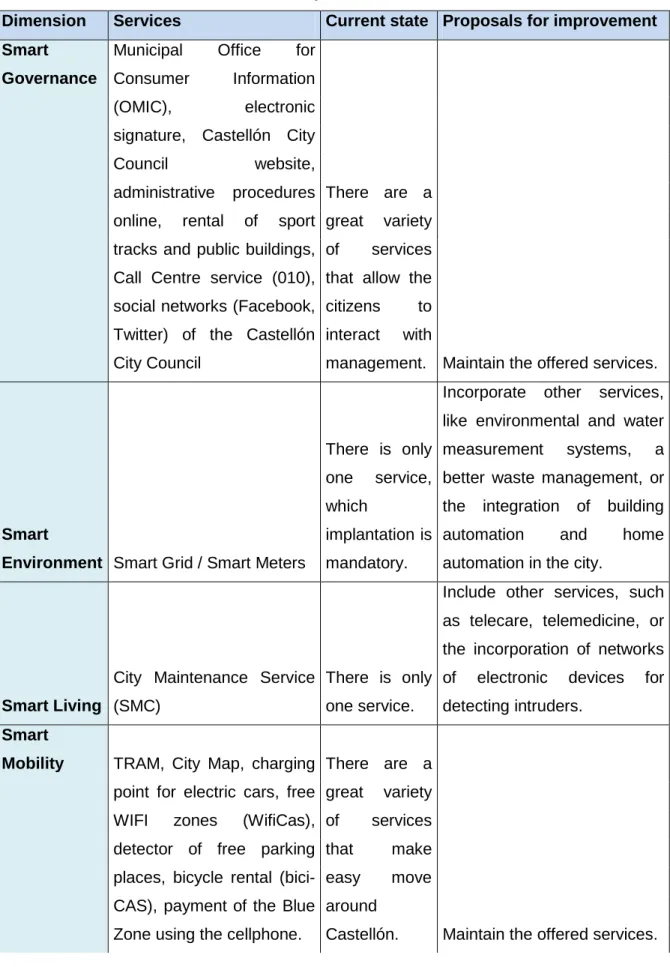
(31) ●. Museums, art galleries and theaters: Castellón has 6 art galleries, 21 museums, and 3 theaters (CulturArts Castellón, 2013).. To improve this situation, they could incorporate new services, such as creating platforms for learning or training via the Internet, or access to culture via electronic devices.. Another of the weaknesses of Castellon as Smart City is located in the Smart Economy, since this dimension has only one service: ●. Electronic bill: It’s a digital document similar to traditional bill, but it incorporates a digital signature that guarantees a degree of security to ensure that the information can’t be manipulated. Thanks to electronic bill, they payment procedures will speed up in the province of Castellon, and finish the waste of conventional paper bills. (Cámara de Castellón, 2012). This dimension could be improved by incorporating other related services at the Smart Economy dimension, such as the incorporation of cross-selling services or promoting the implementation of e-commerce.. In the next table you can see a summary of the Smart services of Castellón, which include their dimension, their current state, and proposals for improvement:. 31.
(32) Table 2. Services of Castellón as Smart City Dimension. Services. Current state Proposals for improvement. Smart. Municipal. Office. Governance Consumer (OMIC),. for. Information electronic. signature, Castellón City Council. website,. administrative online,. rental. procedures There are a of. sport great. tracks and public buildings, of. variety services. Call Centre service (010), that allow the social networks (Facebook, citizens. to. Twitter) of the Castellón interact. with. City Council. management. Maintain the offered services. Incorporate. other. services,. like environmental and water There is only measurement one. systems,. a. service, better waste management, or. which. the. integration. Smart. implantation is automation. Environment Smart Grid / Smart Meters. mandatory.. of. building. and. home. automation in the city. Include other services, such as telecare, telemedicine, or the incorporation of networks. City Maintenance Service There is only of Smart Living (SMC). one service.. electronic. devices. for. detecting intruders.. Smart Mobility. TRAM, City Map, charging There are a point for electric cars, free great WIFI. zones. (WifiCas), of. variety services. detector of free parking that. make. places, bicycle rental (bici- easy. move. CAS), payment of the Blue around Zone using the cellphone.. Castellón.. Maintain the offered services.. 32.
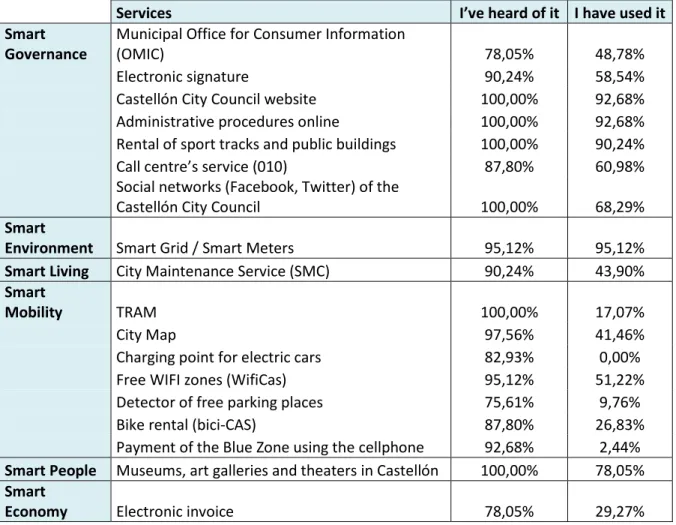
(33) Although there is only Incorporate one. new. services,. service, such as creating platforms for. there are a lot learning or training via the Smart. Museums, art galleries and of. People. theaters in Castellón.. cultural Internet, or access to culture. centers.. via electronic devices. Incorporate other services, such as the incorporation of cross-selling services or. Smart Economy. Electronic Bill.. There is only. promoting the implementation. one service. of e-commerce.. Source: Own elaboration.. From the above described, we can say that the city of Castellon as Smart City stands out for the variety of services offered at the Smart Government and Smart Mobility dimensions. However, in the other 4 dimensions of a Smart City, services are lacking, so it’s advisable to incorporate new services in Castellón, if we want that this city becomes a true Smart City in all dimensions in which it’s divided.. 6.3. Citizens’ perceptions of Castellón as a Smart City: Analysis and results. From the 41 surveys that have been collected from the members of the 27 neighborhood associations in Castellon who responded to the survey, we can say that citizens have the following perception of Castellón as Smart City:. Regarding the profile of respondents, most of them are aged between 25 and 40 years, followed closely by those between 40 and 65 years. In addition, people from these associations often have university studies (43.90%), and no one without them. Moreover, the occupation of respondents is very varied, highlighting the employed persons with a 34.15% of the total. Moreover, those who are retired (2.44%) represent a very small part of the total because of the small percentage of older people who responded to the survey. Also noteworthy is that all the areas or Castellón are represented because we have. 33.
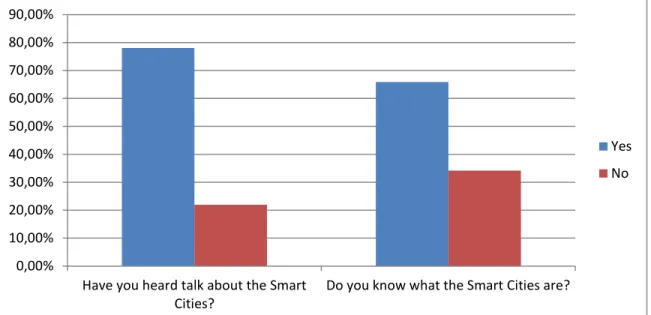
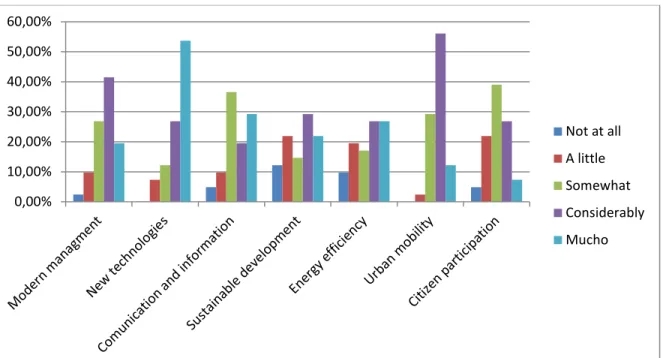
(34) received surveys from all the sectors. You can find more precise information about the profile of the respondents in the Annexed data.. Regarding the degree of awareness about the Smart Cities (Figure 1), the 78% of respondents claimed to have heard about the Smart Cities, but only the 66% know what they really are. This indicates that the concept is well known among the citizens of Castellón, since more than half of them have heard of it and know it, possibly because of the services and promotion that have been carried out from the city of Castellon.. Figure 1. Level of awareness of the concept of Smart City. 90,00% 80,00% 70,00% 60,00% 50,00% Yes. 40,00%. No. 30,00% 20,00% 10,00% 0,00% Have you heard talk about the Smart Cities?. Do you know what the Smart Cities are?. Most of the respondents relate the concept of Smart City with new technologies, due to the large amount of computerized services that are offered in this type of cities (Figure 2). Many people also related the concept with urban mobility, probably due to the large number of services that have been implemented in Castellón (Such as the TRAM, the BiciCas, etc.) that enhance this aspect of Castellon as Smart City.. 34.
(35) Figure 2. Concepts related to the Smart Cities. 60,00% 50,00% 40,00% 30,00% Not at all. 20,00%. A little. 10,00%. Somewhat. 0,00%. Considerably Mucho. Table 3. Concepts related to the Smart Cities. Not at A. Somew. Consider. A. Avera. Standard. all. little. hat. ably. lot. ge. deviation. Modern managment. 1. 4. 11. 17. 8. 3,65. 6,22. New technologies. 0. 3. 5. 11. 22. 4,26. 8,70. and 2. 4. 15. 8. 12. 3,58. 5,40. 5. 9. 6. 12. 9. 3,26. 2,77. Energy efficiency. 4. 8. 7. 11. 11. 3,41. 2,94. Urban mobility. 0. 1. 12. 23. 5. 3,78. 9,52. Citizen participation. 2. 9. 16. 11. 3. 3,09. 5,80. Comunication information Sustainable development. Source: Own elaboration.. 35.
(36) Moreover, more than three-quarters of respondents say that they know all the services offered by Castellón as Smart City. However, the number of people who have used them vary depending on the particular service (Table 4).. Table 4. Awareness and use of services of Castellón as Smart City Smart Governance. Smart Environment Smart Living Smart Mobility. Services Municipal Office for Consumer Information (OMIC) Electronic signature Castellón City Council website Administrative procedures online Rental of sport tracks and public buildings Call centre’s service (010) Social networks (Facebook, Twitter) of the Castellón City Council. I’ve heard of it I have used it 78,05% 90,24% 100,00% 100,00% 100,00% 87,80%. 48,78% 58,54% 92,68% 92,68% 90,24% 60,98%. 100,00%. 68,29%. Smart Grid / Smart Meters City Maintenance Service (SMC). 95,12% 90,24%. 95,12% 43,90%. TRAM City Map Charging point for electric cars Free WIFI zones (WifiCas) Detector of free parking places Bike rental (bici-CAS) Payment of the Blue Zone using the cellphone Museums, art galleries and theaters in Castellón. 100,00% 97,56% 82,93% 95,12% 75,61% 87,80% 92,68% 100,00%. 17,07% 41,46% 0,00% 51,22% 9,76% 26,83% 2,44% 78,05%. 78,05%. 29,27%. Smart People Smart Economy Electronic invoice Source: Own elaboration.. The most used services are the online administrative procedures (92.68%), the municipal website of Castellón (92.68%), renting of public buildings (90.24%) and Smart Meters (95, 12%) because its installation is mandatory. The services least used are the charging point for electric cars (0%), payment of the Blue Zone with the cellphone (2.44%), the detector of free places of parking (9.76%), and the TRAM (17.07%).. To gather ideas to improve Castellon as Smart City, we raised an open-ended question, and the main responses were to increase the amount of free WiFi access points throughout the city because the current number is not enough; create a rechargeable card. 36.
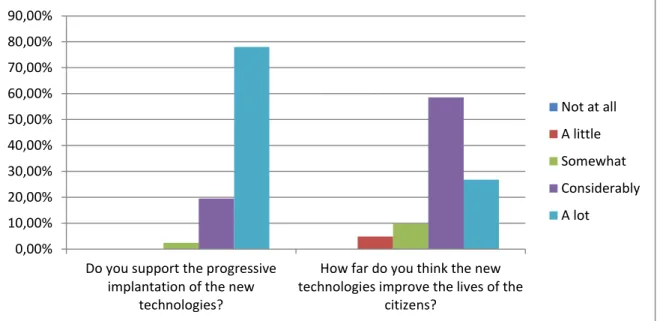
(37) service for the bus; implement a garbage fee that penalizes those that generate a greater amount of waste and encourage the people to recycle more, increase the number of administrative procedures that can be performed via the Internet since the current number seems insufficient, and improve the communication between the several public entities to improve their efficiency.. Moreover, although the vast majority of respondents are strongly in favor of the gradual implementation of new technologies, when we asked them how many the new technologies improve the lives of citizens; its valuation is somewhat smaller. This shows that they are in favor of its implementation, because they are useful in their daily lives (Figure 3).. Figure 3. Opinion about the implementation and use of new technologies. 90,00% 80,00% 70,00% 60,00%. Not at all. 50,00%. A little. 40,00%. Somewhat. 30,00%. Considerably. 20,00%. A lot. 10,00% 0,00% Do you support the progressive implantation of the new technologies?. How far do you think the new technologies improve the lives of the citizens?. 37.
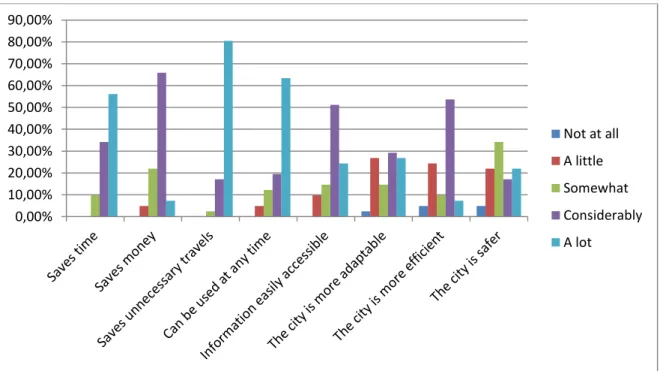
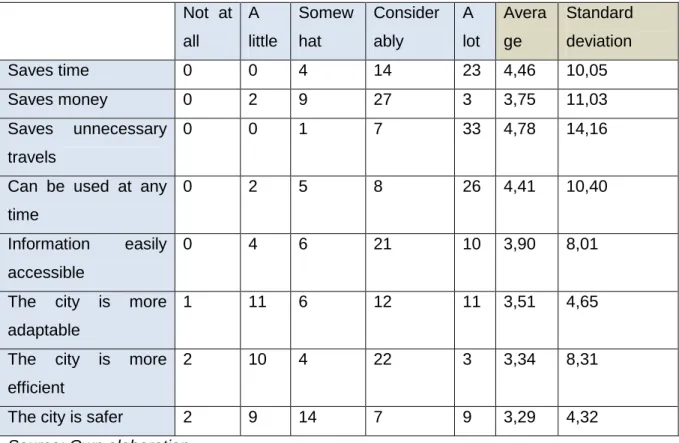
(38) Table 5. Opinion about the implementation and use of new technologies. Not. A. Some. Consid. A. Average. Standard. at. little. what. erably. lot. 0. 1. 8. 32. 4,75. 13,71. 2. 4. 24. 11. 4,07. 9,75. deviation. all Do. you. progressive. support. the 0. implantation. of the new technologies? How far do you think the 0 new technologies improve the lives of the citizens? Source: Own elaboration.. When we asked the respondents who they thought was the biggest advantage of Smart Cities, most of them answered that it was saving travels, because they are occupying a position of responsibility and they are forced to perform many administrative procedures, and being able to do them using the Internet instead of having to go to the council is a great advantage. Other advantages are that due to the no need of make these displacements and the possibility to do them anywhere, they save time and money (Figure 4).. Figure 4. Aspects where the new technologies improve the quality of life. 90,00% 80,00% 70,00% 60,00% 50,00% 40,00% 30,00% 20,00% 10,00% 0,00%. Not at all A little Somewhat Considerably A lot. 38.
(39) Table 6. Aspects where the new technologies improve the quality of life. Not at A. Somew. Consider. A. Avera. Standard. all. little. hat. ably. lot. ge. deviation. Saves time. 0. 0. 4. 14. 23. 4,46. 10,05. Saves money. 0. 2. 9. 27. 3. 3,75. 11,03. unnecessary 0. 0. 1. 7. 33. 4,78. 14,16. Can be used at any 0. 2. 5. 8. 26. 4,41. 10,40. easily 0. 4. 6. 21. 10. 3,90. 8,01. is. more 1. 11. 6. 12. 11. 3,51. 4,65. is. more 2. 10. 4. 22. 3. 3,34. 8,31. 9. 14. 7. 9. 3,29. 4,32. Saves travels. time Information accessible The. city. adaptable The. city. efficient The city is safer. 2. Source: Own elaboration.. We made a series of questions about the six dimensions that are part of the Smart Cities applied to Castellón. The dimension that worst score received was the Smart Goverment (2,09/5), implying that citizens don’t feel involved with the measures taken by the city of Castellon. Regarding the other 5 dimensions, except in the Smart People which have a high score (3,56), all the others dimensions have a quite good score, implying that although their quality isn’t bad, it's not all the good that them might be (Figure 5).. 39.
Figure
+7

Documento similar
A variety of advanced technologies such as intelligent robots, communication systems (e.g., 5G), and the Internet of Things (IoT) are expected to enhance the fourth
Some cities in the world have implemented smart water grids on their network distribution, and many studies have been published about factors and incorporate
On the other hand, the Open Cities project, designed to test the open innovation methodologies in Smart Cities services , has also experimented extensively with the possibility
At the moment she is working on E-Governance in Smart Cities: New Opportunities for Recommender Systems, together with Iván Cantador (Escuela Politécnica, Universidad Autónoma
Firstly, it is important to note that Gili Trawangan offers a wide range of services to its customers, with the added value that good quality services are offered, both by
This contribution analyses two smart card deployments for the authentica- tion of users in public services, comparing their respective characteristics and capabilities: the
Enlightening ICT skills for youth employability in the European Union”, “Smart Cities for wellbeing: Youth employment and their skills on computers”, “Sustainable
We want to reaffirm the commitment of the entire USC Government team to knowledge transfer and entrepreneurship services, including AVTE that assumes the essential tasks
