
Pollen carriers of Cocos nucifera L (Palmae) in Costa Rica and Ecuador (neotropical región)
5
0
0
Texto completo
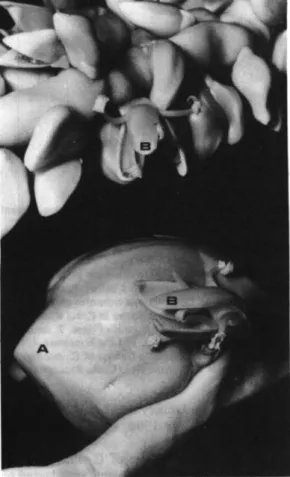
(2) ?. 298. REVISTA DE BIOLOGIA TROPICAL. Fig. 2. The study sitc in Cahuita National Par k 01" Costa Rica. Fig. 1. The dimorphic flowers of Cocus nucifera. - A : Inmature pistillate flower. -B: Newly opened sta minate flowers. Cahuita National Park, Costa Rica, June 1 985.. on June 1 5 , 1 985 ( 1 5 :00- 1 6 :00 hours), along the Caribbean beach at Cahuita National Park (Fig. 2 ), by sitting perched at the hight of the inflorescences of C. nucifera. The same method was utilized in Guayaquil and Cerecita, Province of Guayas, on the Pacific lowlands, on respectively November 1 1 , 1 986 (1 5 :00-16 :00) and November 1 2 , 1 986 (10 :30- 1 1 :00 hours). Field observations and collection of foraging insects on C. nucifera were also conducted in Pacuarito (30 m) , Guácimo ( 1 00 m), Bribrí (30 m) and River Dantas (200 m), at the upper, northern border of Barbilla Biological Reserve , Province of Umón, and in La Garita (700 m) and in Turrúcares (680 m), Province of Alajuela, Costa Rica, one June 1 5 , 1 985 (8 :30-9 : 30 hours), on January 1 2 , 1 985 (5 :30 and 1 8 :00 hours), on July 24, 1 986 (1 5 :001 6 :00 hours), on July 20 , 1 986 (7 :00- 1 8 : 30 hours), on January 1 9 , 1 985 ( 1 6 :00- 1 7 :00. hours), and on July 27, 1 986 ( 1 0 : 1 5 -1 2 :30 hours), respectively. These seven sites have been ascribed by Holdridge (Tosi, 1 969) tu the ecological zones of tropical moist forest (Cahuita, Bribrí, Guácimo), tropical wet forest (Barbilla), premontane wet forest (Pacua rito), and premontane moist forest (La Garita, Turrúcares. Close observations of the behaviour of visiting insects on the flowers of C. nucifera at all study sites were carried out in order to determine their efficiency in transferring pollen between individuals of the palm species. Visiting insects on the flowers of C. nucifera were collected with a net or by the quick use of a killing bottle with one hand kept behind the flowers to prevent escape. Flower visitors were killed and the presence of pollen grains attached to their body was investigated . On August 20-:f5 , 1985 , in Turrúcares, Costa Rica, individual f�male flowers (n = 20) of C. nucife ra were bagged between 1 7 :00-D7 :00 hours during the receptive period , in order to hinder insects active at night to pollinate the flowers..
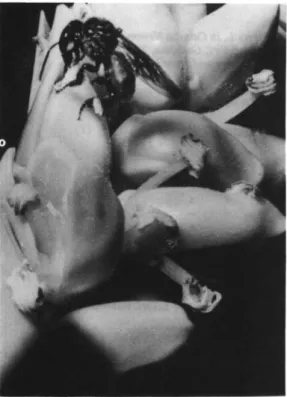
(3) HEDSTROM: Pollen carriers of Cocos. 299. Fig. 4. Interference competition between two indivi duals of Trigona fulviventris facing off in the air. Pacuarito de Siquirres, Costa Rica, J une 1 985.. that approached that particular inflorescence of e nucifera landed directly on the newly opened pistillate flowers in order to extract nectar . 83% (n 1 8 ) of these be es carried light-yellow coloured pollen grains of e nuci fera in their corbicula , obviously from previously visited staminate flowers of the same species. After visiting the pistillate flowers of the inflorescence , 33% of the bees were observed visiting the staminate flowers on the same inflorescence . By now the bees had beco me rather "sticky" from the nectar attached to all parts of their bodies. In Guácimo , both staminate and pistillate flowers of e nucifera were visited by T. testa cea and T. corvina (Table 1 ). In Pacuarito and La Garita, T. fu/viven tris and T. corvina, re spectively, were the only observed visiting spe· cies on e nucifera. Observed T silvestriana on pistillate flowers in Turrúcares carried heavy loads of pollen of e mucifera packed in the corbiculae. Pollen carriers on flowers of e mu cifera in Cahuita National Park, Barbilla Bio logical Reserve and Guácimo, Costa Rica were active all day from early sunrise till sunset. Unidentified species of Vespidae (Hymenop tera), Lepidoptera, Coleoptera (Cetoniinae) and Diptera were occasionally observed visiting both staminate and pistillate flowers of e nucifera, but few or no pollen grains at al!, were found attached to the body of these non-a pis species. Of the pistillate flowers of e nucifera, bagged at night , 20 % (n = 20) developed fruits. What 1 interpreted as intraspecific interfer ence competition between individuals of T. fulviventri�. was observed in Pacuarito de Siqui rres and Cahuita National Park . The aggressive bees faced off in the air and rose together up to =. Fig. 3. Trigona fulviventris (Apidae) feeding on poLlen from anthers of the male flower of Cocus nucifera. Pacuarito de Siquirres, Costa Rica, J une 1 985.. RESULTS At the study sites in Cahuita National Park the most common ponen vector on both staminate (male) and pistillate (female) flowers of e nucifera was the comparatively large and dark coloured species of Trigona silvestria na Vachal , followed by the smaller and somewhat lighter coloured species T. fu/viven tris Guérin (Fig. 3), T. testacea Klug, T. fronta lis Friese and T. tataira Smith, all stingless meliponid bees (Hymenoptera ; Apidae). Specimens of Melipona fasciata Latreille and Apis me/lifera Linneus, both members of the same insect family (Apidae ), were also observed on the flowers of e nucifera in the same study site, but in low numbers. In Ecuador, large numbers of A. mellifera, together with unidentified species of Vespidae (Hymenoptera) and Diptera, were observed visiting both staminate and pistillate flowers in both study areas. A most interesting observation was made at the study site in Guácimo , Costa Rica . One of the inflorescences in that area had both staminate and pistillate flowers. All observed potential pollen vectors of T. corvina (n = 1 8).
(4) REVISTA DE BIOLOGIA TROPICAL. 300. TABLE I Visiting bees on unisexual flowers ofCocos nucifera L. in Cahuita National Park, Barbilla Biological Reserve, Pacuarito de Siqui"es, Bribrí, Guácimo, Turrúcares and La Garita, Costa Rica, November 1 984, January and June 1 985, and July 1 986. Observation sites (C). (B ). (Br). x. x. x. x. x. x. (LA). (G). (P). (T). Apidae Trigona (Trigona} silvestrüzna Vachal T. (Partamona) testacea Klug T. (Plebeüz) frontalis Friese T. ( Trigona) fulviventris Guérin T. (Oxytrigona) tataira Smith T. (Trigona) corvina Cockerell Melipona fasciata Latreille Apis mellifera Linneus. le x. x x. x x x. x x x. 1(') Cahuita National Park, (B) Barbilla B iological R eserve, (Br) Bribrí, (G) = Guá cimo, (LG) La Garita, (P) = Pacuarito de Siquirres, and (T) = Turrúcares. -=. =. =. =. a height of approximately 20 cm or more (Fig. 4). This behaviour was described by John son ( 1 983), who studied the behaviour of T fulviventris in lowland habitats of Guanacaste Province, Costa Rica . When observed in Cahuita National Park and Pacuarito de Siquirres, respectively , T sil vestriana and T fulviventris were the only for aging Trigona be es on the same inflorescence of e nucifera ; presumably these species, which never were seen together, had displaced other Trigona species from the same energy source . However, comparatively large bees of Melipona fasciata and Apis mellifera were occasionaIly observed on flowers of e nuclfera in the pres ence of T silvestriana and T fulviventris in Cahuita National Park. There was no c1ear sign of interference com petition between the medium sized T testacea and T corvina, foraging on the same inflores cense of e nucifera in Guácimo. DISCUSSION Some palms are poIlinated by night-active insects ( Hendersson, 1 98 5 , unpubl.). In Costa Rica, pejibaye Bactris gasipaes H . B.K. is poI linated by nocturnal coleopterans (Mora-Urpí & Solís, 1 980, Beach , 1 984). At least two species of nectarivarous, pollen-dusted , bats in West Malaysia visited e nucifera (Burley & Sty les, 1 976). Although it is possible that night-ac tive insects and/or nocturnal bats may pollinate. the flowers of C. nucifera, they are not the only pollinators since sorne of the during the night isolated pistillate flowers of e nucifera (20 % n = 20) set fruit. Vandermeer { l 983) stated that staminate flowers of e nucifera normalIy open before pistillate flowers (protandry) and thus female flowers usualIy do not open until the male flowering period (on the very same inflores cense) is over, However, one observed inflor escence of e nucifera in Cahuita National Park had receptive pistillate flowers when only 80% (n = 1 85) of the male flowers of that same inflorescence had withered. Hence cross pollination, between two genetically different individuals of the same species, is not necessa rily the usual rule for e nucifera. On the Caribbean coast of Costa Rica, Wille and Michener ( 1 973) found that T silvestriana usually build their nests resting on Iarge branches or between "coconut bases" of the flower (rachilIae), 3- 1 2 meters aboye ground. This close relationship between the insect and the paIm tree might explain the high number of T silvestriana on the flowers of C. nucifera along the beaches of Cahuita National Park, where e nuclfera is very abundant . Johnson and Hubbel { l 974) reported several cases of interspecific interference competiton between species of Trigona from Turrialba , Costa Rica. In one contest between large { l O mm) T silvestriana and medium-sized (7 mm) T testacea, the latter species spent an ,.
(5) •. H EOSTROM : Pollen carriers of Cocos. average of 5 seco hovering and 1 1 seco feeding in the absence of T. silvestriana. Once large T. silvestriana started to utilize the same food source, smaller-sized T. testacea spent around 1 1 seCo hovering and only 3 se C o feeding. Heinrich ( 1 978) commented that smaller, less aggressive bee species may specialize on widely spaced plants which provide relatively slight amounts of pollen and nectar. In this case small T. testacea could make an energy profit at less rewarding food that is inadequate for large bees like T. silvestriana. The aggressive strategy of large Trigona bees is therefore presumably only profitable at high quality food sources, in this case on the inflorescence of e nucifera. RESUMEN Se hicieron observaciones sobre las especies de insectos que visitan las flores del cocotero, Cocos nucifera L. (palmae), en Guayaquil y Ce recita, provincia de Guayas, Ecuador, y en el Parque Nacional de Cahuita, la Reserva Biológi ca de Barbilla , BribrÍ y en Guácimo, provincia de Limón, en Turrúcares y en La Garita, provin cia de Alajuela, Costa Rica, en noviembre de 1 984 , en enero y junio de 1 985 , y en julio y no viembre de 1 986. Entre los vectores potenciales de polen más abundantes en Costa Rica fueron observadas las siguientes especies de abejas (Hymenoptera ; Apidae): Trigona silvestriana Vachal , T. testacea Klug, T. fulviventris Guérin, T. frontalis Friese ,..LJ.Qtaira Smith, T. c0'!'.!!:!E Co�erell, Melipona fasciata Latreille , y Apis mellifera Linñeus. El vector de polen en e ?fu cifera más observado en el Ecuador era fi'iéTl[fera. Además se demuestra la existencia de interferencia por competencia entre algunas de las especies de Trigona. ACKNOWLEDGMENTS For identification of the stingless bee species I thank Dr. Alvaro WilIe at the Museo de Insec tos, Universidad de Costa Rica . 1 am also in debted to the Servicio de Parques Nacionales de Costa Rica and the personnel at Parque Nacio nal de Cahuita, for perrnission to carry out this investigation and for working facilities, respec tively . 1 also thank Dr. J im Beach, Organization for Tropical Studies, Washington, D.C . , Dr. Christine Dahl, Uppsala University , and M .Sc. Luis Fernando Jirón, Universidad de Costa Ri-. TK � ...;. , l �.N.-AMlo. t- -1. " .I0_ �. 301. ca , for kindly reviewing an earlier draft of the manuscript. REFE RENCES Beach, J.H. 1 984. The reproductive biology of the Peach or "Pejibayc" Palm (Dactris gasipaes) and a Wild Congener (D. porschiana) in the Atlantic low lands of Costa Rica. Principes 2 8 : 1 07- 1 19. Burlcy, J. & B.T. Styles. 1 976. Tropical trees: varia tion, brecding and conservation. Linnean Society Symposium Series. No. 2. London. 24 3 p. Johnson, L.K. 1 983. Trígono fUlvíventris, p . 7 70-772. In O.H. Janzen (ed.). Costa Rican Natural History. Univcrsity of Chicago Press. 8 1 6 p. Johnson, L.K. & S.P. Hubbel. 1 974. Aggression and competition among sting-Iess bees: field studies. Ecology 5 5 : 1 20-1 27. Gruezo, W.S. & H.C. Harries. 1 984. Self-sown, wild-ty pc coconuts in thc Philippines. Biotropica 1 6 :40- 1 47. Heinrich, B. 1 9 78. The cconomics of insect sociality, p. 97- 1 28. In J.R. Krebs & N . B. Oavies (eds.). Bahavioural Ecology: an evolutionary approach. Blackwell, Oxford. Heywood, V.H. (ed.). 1 978. Flowering plants of the World. Oxford University Prcss, 336 p . Mora-Urpí, J. & E . M . Sol ís. 1 980. Polinización en Dactris gasípaes H.B.K. (Palmae). Rey. Biol. Trop. 28: 1 5 3-1 74. Sauer, J. 1 983. Cocos nucífera (Coco, Cocotero, Co conut), p. 2 1 6-2 1 9. In O.H. Janzen (ed.) Costa Rican Natural H istory. Uniycrsity of Chicago Press. 8 1 6 p. Sholdt. L.l. & W.A. Mitchcll. 1 976. Thc pollination of Cocos nucifera L. in Hawaii. Trop. Agriculture, Trin. 44 : 1 3 3- 1 4 2. Standlcy, P.C. & J.A. Steyermark. 1 95 8_ Flora of Gua tcmala. C'hicago Natural History Museum. 478 p. Purscglovc, J.W. 1 972. Tropical Crops: Monocoty le dons. Vol. 2. J ohn Wiley, New York. Tosi, J.A: J T. 1 969. Mapa Ecológico de Costa Rica. Centro Cient ífico Tropical, San J osé, Costa Rica. Vandermecr, J. 1 983. Coconut (Coco), p. 85 -86. In O.H. Janzen (e d.). Costa Rican Natural History. Uniycrsity of Chicago Press. 8 1 6 p. Willc. A. & C.D. Michencr. 1 9 7 3. The Nest Architec ture of Stinglcss Becs with Special Reference of those of C'osta Rica (Hymenoptcra ; Apidae). Rev. Biol. Trop. 2 1 (Supl. 1 ) : 1 -278. .L. l.n .. _. _. t. ..
(6)
Figure
Documento similar
The draft amendments do not operate any more a distinction between different states of emergency; they repeal articles 120, 121and 122 and make it possible for the President to
Fatta-Kassinos, Long-term wastewater irrigation of vegetables in real agricultural systems: Concentration of pharmaceuticals in soil , uptake and bioaccumulation in
17,18 Contrary to graphene, the band gap in ML-MDS separating the valence and conduction bands is naturally large and due to the absence of inversion symmetry in ML-MDS the
Accordingly, macrophages are the major leukocyte subpopulation present in ADM and PanINs (Clark et al., 2007) and, importantly, it has been shown that in response to
From 1947 at the latest, the CEA Scientific Committee had every intention of producing radioisotopes, and the CEA’s first high commissioner, Frédéric Joliot, had dreamed of
This study is inspired by the previous works published this decade by the authors of this article, including Gender in Spanish Daily Newspapers (Matud, Rodríguez and Espinosa,
Therefore, it is observed that color flyers, printed both sides, were much more usual in the group of Company and Asian (100%), that in the group of Independent or Group,
The landscape of media and communication companies in Ecuador is little known, in terms of their corporate organisation, structure, human resources, and products and
