
A Prospective and Public Policy Approach to Mexico´s Hydrocarbons External Balance and Public Sector´s Oil Related Budgetary Income 2012 2025 Scenarios Edición Única
154
0
0
Texto completo
(2) INSTITUTO TECNOLÓGICO Y DE ESTUDIOS SUPERIORES DE MONTERREY C A M P U S MONTERREY E S C U E L A DE GRADUADOS EN ADMINISTRACIÓN PÚBLICA Y POLÍTICA PÚBLICA. TECNOLÓGICO DE MONTERREY A PROSPECTIVE A N D PUBLIC POLICY A P P R O A C H TO MEXICO'S H Y D R O C A R B O N S EXTERNAL B A L A N C E AND PUBLIC S E C T O R ' S OIL-RELATED BUDGETARY INCOME 2012 - 2025 SCENARIOS. TESINA PRESENTADA C O M O REQUISITO PARCIAL P A R A OBTENER EL GRADO ACADÉMICO DE: MAESTRO EN PROSPECTIVA ESTRATÉGICA POR EDUARDO VÁZQUEZ SERNA. MONTERREY, N. L.. MAYO DE 2012.
(3) INSTITUTO TECNOLÓGICO Y DE ESTUDIOS SUPERIORES DE MONTERREY CAMPUS MONTERREY ESCUELA DE GRADUADOS EN ADMINISTRACIÓN PÚBLICA Y POLÍTICA PÚBLICA. TECNOLÓGICO DEMONTERREY®. A PROSPECTIVE AND PUBLIC POLICY APPROACH TO MEXICO'S HYDROCARBONS EXTERNAL BALANCE AND PUBLIC SECTOR'S OILRELATED BUDGETARY INCOME 2012 - 2025 SCENARIOS. TESINA PRESENTADA COMO REQUISITO PARCIAL PARA OBTENER EL GRADO ACADÉMICO DE:. MAESTRO EN PROSPECTIVA ESTRATÉGICA. POR: EDUARDO VÁZQUEZ SERNA. MONTERREY, N.L.. MAYO DE 2012. 1.
(4) INSTITUTO TECNOLÓGICO Y DE ESTUDIOS SUPERIORES DE MONTERREY CAMPUS MONTERREY. ESCUELA DE GRADUADOS EN ADMINISTRACIÓN PÚBLICA Y POLÍTICA PÚBLICA. TECNOLÓGICO DE MONTERREY. A PROSPECTIVE AND PUBLIC POLICY APPROACH TO MEXICO'S HYDROCARBONS EXTERNAL BALANCE AND PUBLIC SECTOR S OILRELATED BUDGETARY INCOME 2012 - 2025 SCENARIOS. TESINA. PRESENTADA COMO REQUISITO PARCIAL PARA OBTENER EL GRADO ACADÉMICO DE:. MAESTRO EN PROSPECTIVA ESTRATÉGICA. POR:. EDUARDO VÁZQUEZ SERNA. MONTERREY, N.L.. MAYO DE 2012. 2.
(5) Dedication To God who has given me everything, To my beloved parents, "I will always be grateful. I promise to always give my best". 3.
(6) Acknowledgement To Gloria Pérez and Vidal Garza, For your guidance. To the World Economic Forum, Thanks for receiving me with such warmth during the writing of this thesis.. 4.
(7) INSTITUTO TECNOLÓGICO Y DE ESTUDIOS SUPERIORES DE MONTERREY. CAMPUS MONTERREY. E S C U E L A DE GRADUADOS EN ADMINISTRACIÓN PÚBLICA Y POLÍTICA PÚBLICA. Los miembros del comité de tesina recomendamos que el presente proyecto de tesina presentado por el Lic. Eduardo Vázquez Serna sea aceptado como requisito parcial para obtener el grado académico de:. Maestro en Prospectiva Estratégica. Comité de Tesina:. 5.
(8) Table of Contents Dedication. 3. Acknowledgement. 4. List of Figures, Tables, and Graphs. 9. Chapter I: Introduction. 11. 1.1 Background. 11. 1.2 Problem. 15. 1.3 Hypothesis. 16. 1.4 Research Objectives. 16. 1.5 Research Scope and Limitations. 17. 1.6 Audience. 19. 1.7 Thesis Structure. 19. Chapter II: Theoretical Framework. 21. 2.2 System Dynamics. 24. 2.3 MACTOR and Essence of Decision Models. 28. 2.4 Merilee Grindle's Political Economy of Public Sector Reform. 31. Chapter III: System Dynamics. 34. 3.1 Problem Definition. 34. 3.2 Conceptualization. 40. 3.2.1 Cycle Descriptions. 43. 3.3 Simulation Model Design. 45. 3.3.1 Submodel 1 Crude Oil. 47. 3.3.2 Submodel 2 Gasoline. 48. 3.3.3 Submodel 3 Hydrocarbons External Balance. 50. 3.3.4 Submodel 4 Hydrocarbon Royalties. 50. 3.3.5 Submodel 5 Federal Hydrocarbon Royalties. 50. 3.3.6 Submodel 6 PEMEX Taxes. 51. 3.3.7 Submodel 7 Public Sector's Oil Related Income. 51. 3.4. Assumptions of the Mathematical Model. 52 6.
(9) 3.5 Behavior of the Model. 53. 3.5.1 Clarification of Graphs and Tables Generated by the Simulator. 54. 3.5.2 Analysis of Oil Production. 54. 3.5.3 Analysis of Gasoline Production and Demand. 56. 3.5.4 Analysis of the Hydrocarbon External Balance. 58. 3.5.5 Analysis of the Public Sector's Oil-Related Income. 59. 3.5.6 Summary of Model Behavior. 61. 3.6 Model Evaluation. 62. 3.7 Model Analysis and Uses. 66. Chapter V: Scenarios. 67. 5.1 Stall Scenario (low oil prices - high oil production). 69. 5.2 Growth Scenario (high oil prices - high oil production). 72. 5.3 Crisis Scenario (low oil prices - low oil production). 74. 5.4 Vulnerable Scenario (high oil prices - low oil production). 77. Chapter VI: MACTOR and Essence of Decision Models. 81. 6.1 MACTOR. 81. 6.1.1 Actors. 82. 6.1.2 Strategic Stakes and Associates Objectives. 84. 6.1.3 Analysis. 85. 6.1.4. Strategic Recommendations 6.2 Essence of Decision Model 6.2.1 Analysis 6.2.2 Strategic Recommendations Chapter VII: Merilee Grindle's Political Economy of Public Sector Reform..... 93 94 95 101 102. 5.1 Issue. 103. 5.2 Context. 106. 5.2.1 Characteristics of the Political Elites. 106. 5.2.2 Background of Political Choices. 111 7.
(10) 5.3 Policy Agenda Setting. 116. 5.3.1 Perception. 116. 5.4 Decision Making Process and Policy Characteristics. 117. 5.4.1 Areas of Conflict 5.5 Resource Requirements. 123 125. 5.5.1 Public Policy Requirements. 125. 5.5.2 Political Requirements. 126. Chapter VIII: Conclusions. 127. 7.1 Main Contributions to Knowledge. 129. 7.2 Future Work. 131. Bibliography. 133. Annex 1. Dynamic system model variables dictionary. 139. Annex 2. Dynamic system model equations. 143. Annex 3. MACTOR Input. 148. 8.
(11) El capítulo IV de dicha tesis, no se encuentra disponible debido a un error en el edición del documento..
(12) List of Figures, Tables, and Graphs Figure 1. Small system dynamics models in public policy. 35. Figure 2. Causal diagram representing the interaction among the elements of the system under study. 36. Figure 3. System under study. .40. Figure 4. Crude oil causal diagram. 43. Figure 5. Causal diagram for the rest of the hydrocarbons external balance products (oil refined products, gasoline, diesel, turbosine, fuel oil, LP gas, and natural gas). 44. Figure 6. Submodels of the hydrocarbons external balance. 47. Figure 7. Submodels of the public sector's oil-related budgetary income. 48. Figure 8. Hydrocarbons external balance model. 64. evaluation. Figure 9. Public sector's oil-related income model evaluation. 65. Figure 10. 2011 - 2025 Mexican energy and finances scenarios. 70. Figure 11. Stall scenario: low oil prices - high oil production. 72. Figure 12. Growth scenario: high oil prices - high oil production. 75. Figure 13. Crisis scenario: low oil prices - low oil production. 77. Figure 14. Vulnerable scenario: high oil prices - low oil production. 80. Figure 15. Map of influences and dependences between actors. 87. Figure 16. Histogram of competitiveness. 89. Figure 17. Histogram of actors mobilization towards its objectives. 91. Figure 18. Map of order 3 divergences between actors. 92. Figure 19. Histogram of actors ambivalence. 93. Figure 20. Mexican oil industry timeline. 105. Figure 21. Conceptual map for the systemic analysis of PEMEX's current issues. 106. Figure 22. Model interface: Simulation Instructions. 131. Figure 23. Model interface: Inputs of the simulation. 131. Figure 24. Model interface: Outputs of the simulation. 132. Table 1. Small system dynamics models in public policy. 27 9.
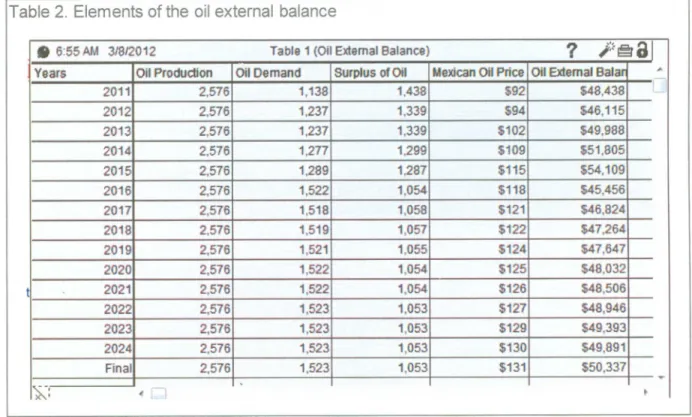
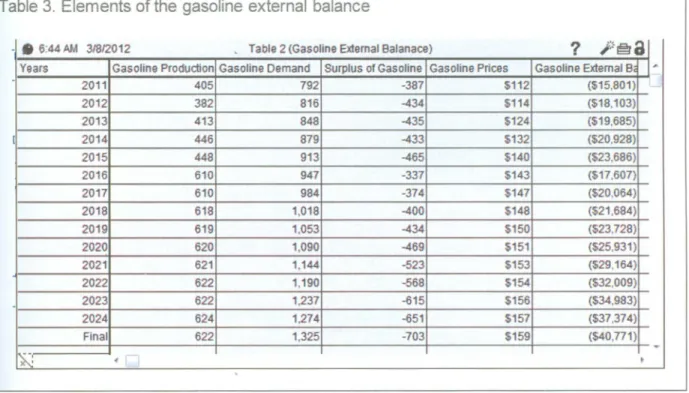
(13) Table 2. Elements of the oil external balance. 56. Table 3. Elements of the gasoline external balance. 58. Table 4. Elements of the hydrocarbons external balance. 60. Table 5. Public sector's oil-related income. 61. Table 6. Stall scenario: low oil prices - high oil production. 72. Table 7. Growth scenario: high oil prices - high oil production. 74. Table 8. Crisis scenario: low oil prices - low oil production. 77. Table 9. Vulnerable scenario: high oil prices - low oil production. 80. Table 10. Composition of Mexico's 2006 - 2012 Legislative branch. 110. Table 11. Alternatives to an energy sector's governance comprehensive. 121. Table 12. Schemes of production sharing agreements reform ...... 122. Table 13. Fiscal reform alternatives in Mexico. 123. Graph 1. Mexican oil production. 37. Graph 2. Mexican gasoline production and imports. 38. Graph 3. A deterioration in the hydrocarbons external balance could offset the public sector's oil-related income. 39. Graph 4. Overshoot and collapse model. 42. Graph 5. Oil external balance baseline forecast. 57. Graph 6. Gasoline external balance baseline forecast. 59. Graph 7. Hydrocarbons external balance baseline forecast. 60. Graph 8. Public sector's oil-related Income. 62. Graph 9. Mexican oil production 1900-1974. 98. Graph 10: Cantarell contribution to the national oil production. 100. 10.
(14) Chapter I: Introduction 1.1 Background Mexico is in the midst of major political and economic changes. Political alternation and a divided Legislative branch have increased the need of a constructive dialog and consensus. Meanwhile, the oil industry and the economic engine of the country, seems to be running out of power.. The national political landscape changed dramatically in 1997 when the Institutional Revolutionary Party (PRI) lost its majority in the Legislative branch. The 2000 federal •. election marked the beginning of a new dynamic between the government's Executive and Legislative branches as Vicente Fox became the first non- PRI affiliated president. Since then, a political gridlock has created a rather dysfunctional legislature that has not been able to address the major social, economic and political reforms needed in the country. (The Economist, 2012) A mayor issue that needs to be addressed is the role that the oil industry will play in the future of Mexico. There is no question with regards to the pivotal role the oil sector plays in the Mexican economy. According to official data, it contributes to more than 5% of the country's GDP, represents 30% of the public sector budgetary revenues and accounts for 15% of its total merchandise exports.. Mexico has a unique governance model that regulates the energy sector. The federal government has the constitutional mandate of planning and conducting all the activities related to oil, gas and their derivatives. Petroleos Mexicanos (PEMEX) is the governmental entity under an administrative figure, known as a paraestatal, which is the entity responsible for carrying out all activities related to the exploration, exploitation and refinement of hydrocarbons in Mexico. The fact that the energy business in Mexico is conducted through the federal government generates a series of challenges because, as opposed to other international oil companies, PEMEX must balance its objectives between being efficient and playing its role in the national economy. However, the 11.
(15) current constitutional framework allows stakeholders and interest groups to influence strategic oil-sector decisions. (Camara de Diputdos del H. Congreso de la Union). The revenue transfers from PEMEX to the public sector have severely hampered its financial health. PEMEX has suffered fiscal losses since 1998. (SENER, 2008) The company's latest income statement shows total liabilities rose 264% from 2000 to 2011 and now account for 108% of their total assets. (PEMEX, 2011). The precarious financial condition has resulted in insufficient investment in exploration and exploitation of hydrocarbons. Because of this, total and proven hydrocarbon reserves plunged 2 6 % and 45% respectively from 2000 to 2011. Extraction of oil fell 15% during this same period. Moreover, the scarcity of funds has prevented the construction of new oil refineries thus limiting Mexico's capacity to produce gasoline. Gasoline imports have double and account for 40% of the national consumption. (SENER). The hydrocarbons sector external balance is the result of the difference between the exports and imports of hydrocarbon products. The two most important components of the hydrocarbons external balance are crude oil exports and petroleum refined products. Crude oil accounts for the 88% of the total oil exports. Petroleum refined products such as gasoline represents 70% of the total imports. (BANXICO, 2011). The deterioration of oil production has limited the positive effects of oil price hikes. From 2005 to 2011 oil prices more than doubled going from $42 to $99 dls per barrel. Nonetheless, the decline in production caused oil export volume to fall 26% limiting the increase in the value of oil exports to only 74%. The value of total crude oil exports went from $28,329 to $49,363 million dollars.. Failure to increase refinement capacity is leading to an incrase of gasoline imports. From 2005 to 2 0 1 1 , the price and volume of gasoline imports rose 66% and 6 1 %. 12.
(16) respectively. As a result, the value of gasoline imports increased 266% going from $4,915 to $18,021 million dollars.. The combination of lower oil production and increasing gasoline imports is hurting the hydrocarbons external balance. In 2011 the hydrocarbons external balance reported $13,722 million dollars which is still less than the $15,495 million dollars registered in 2005. A lesser net positive hydrocarbons external balance will ultimately result in less available money to either PEMEX or the public sector.. Oil related revenues have historically accounted for around 30% of the total public sector revenue. This income depends on PEMEX direct contributions and the federal government's royalties to hydrocarbons, advantage on excessive yields, excise taxes and oil yields taxes. (Law of PEMEX, 2008). The variations in the peso/dollar exchange rate plays an important role in the public sector's budgetary income as most oil revenues are US dollar denominated. Fortunately for the public sector's budgetary income, since the Aztec currency began to trade in a flexible exchange rate regime in 1994, it has been constantly weakening against the greenback. From 2000 to 2011 the peso depreciated 32% going from an annual average of 9.46 to 12.44 pesos/dollar. This has somehow alleviated the negative effects the plunge in oil export volume has had in the overall oil-related revenues.. Since 2005, oil-related revenues have grown only 17% in real terms despite oil prices have more than doubled. Furthermore, oil price variations can easily destabilize the public sector's budget. In 2009 the global economic downturn caused Mexican oil prices to plunge 3 2 % going from an annual average of $85 to $57 usd/barrel. While non-oilrelated income grew 2.2% oil-related revenues dropped 21.3% in real terms causing the total public sector's budget to shrink by 6.5%.. The delicate balance between funding PEMEX's exploration and exploitation needs and contributing to the public sector's budget has been a matter of concern not only to 13.
(17) f government officials but to international organisms. According to the Organization for Economic Co-operation. and. Development. (OECD),. Mexico faces a number. of. challenges that limit its capacity to achieve healthy and sustainable public finances in the long term. These include the country's high dependency on oil revenues, the need to improve the efficiency of public expenditure and strengthen fiscal sustainability and the need to improve expenditure accountability at the different government levels. These factors have an impact on the Mexican economy's growth potential. (OECD, 2012). Government officials have tried to address these concerns with several attempts to enact major fiscal and energy reforms. Nonetheless, the political gridlock has blocked, th. delayed or watered down all major attempts. In October 2 8 2008 an energy reform was approved after a heated debate between the federal government and the Legislative branch. Seven decrees were published in an attempt to modernize the regulatory framework of the Energy Sector by allowing private entities to participate in the energy business. Unfortunately, a political gridlock diluted the initiative beyond recognition and prevented a major reform from going through. In fact, in 2009 S&P lowered Mexico's foreign-currency debt rating to BBB, the second-lowest investment grade, from BBB+. The rating agency cited "...weakens in the Mexican government capacity to contain fiscal pressures from diminished oil production" as the main reason for the downgrade. (Bloomberg, 2009). The need to anticipate and create scenarios on Mexico's energy sector is evident, especially amid the vast amount of information available. Many attempts to reform the Mexico's energy sector's governance model have been made. Nonetheless, the political gridlock and scarcity of decision making dynamic models have complicated mayor transformations, especially considering the nationalism model that is still present among many Mexicans and politicians ever since the Mexican oil nationalization back in 1938. New dynamic modeling tools capable of simplifying and creating scenarios based on hypothetical decision might be what policy makers need to take bolder decisions. Dynamic modeling tools can and should be used to introduce policy recommendations. 14.
(18) Meanwhile, PEMEX is doing what it can to improve its financial and operational conditions. In 2010, the parastatal introduced its investment portfolio for the period 2010-2025. The portfolio includes a set of 80 projects divided in areas such as exploration, exploitation and infrastructure. (SENER, 2011) The information includes cost and impact of such projects. With the help of their internal foresight team, in 2011, the energy ministry published a comprehensive set of forecasts on hydrocarbon production and consumption. In addition to this, international organisms such as the Energy Information Administration (EIA) and the Organization of Petroleum Exporting Countries (OPEC) have also released forecasts on Mexico's future hydrocarbon capacity.. The need to anticipate and create scenarios on Mexico's energy sector is evident especially amid the vast amount of information available. Many attempts to reform Mexico's energy sector's governance model have been made. Nonetheless, the political gridlock and scarcity of decision making dynamic models have complicated mayor transformations. New dynamic modeling tools capable of simplifying and creating scenarios based on hypothetical decision might be what policy makers need to take bolder decisions. Dynamic modeling tools can and should be used to introduce policy recommendations.. Nonetheless identifying possible scenarios of the hydrocarbons external balance and the public sector's oil-related income might not be enough to create the correct incentives that lead stakeholders reach consensus. Therefore, it is important to analyze the influences, motivations, goals and strategies of the different stakeholders in order to identify the political gridlocks that might be preventing them from reaching consensus.. 1.2 Problem Mexican hydrocarbons external balance could soon yield a deficit. Oil production is slowly declining, gasoline imports are rising and oil prices are more volatile than ever. Mexico's current energy sector governance model has not been able to revert this trend. Furthermore, the political gridlock between the Executive and Legislative branches have 15.
(19) prevented the enacting of major reforms. Ceteris paribus a deficit in the hydrocarbons external balance could create a national budget crisis as oil-related income accounts for more than 30% of Mexico's public sector's income.. 1.3 Hypothesis The deterioration in Mexico's hydrocarbons external balance and Mexico's public sector's budgetary income will continue unless the current political gridlock is broken and bold energy and fiscal reforms are enacted.. 1.4 Research Objectives General Objective: Identify the factors and actors that could cause a deficit in Mexico's hydrocarbons external balance and a crisis in the public sector's budgetary income by 2025 in order to identify the public policies that could maximize the energy sector's potential.. Specific Objectives: 1. Build a dynamic modeling tool capable of identifying the effects oil prices, oil production, and refinery capacity variations have on Mexico's hydrocarbons external balance and public sector's budgetary income. 2. Build and analyze Mexico's hydrocarbons external balance and public sector's oil-related income 2012 - 2 0 2 5 scenarios. 3. Identify four scenarios of Mexico's hydrocarbons external balance and the public sector's oil-related income that broaden the span of stakeholders thinking about different possibilities. 4. Gauge the balance of power between actors involved in the Mexican energy governance model and study their convergences and divergences when faced with associated stakes and objectives. 5. Identify the bureaucratic elements that could obstruct the construction of consensus between the Executive and Legislative branches that would allow meaningful reforms to the energy sector's governance model.. 16.
(20) 6. Identify the potentially viable public policies aimed at preventing a hydrocarbons sector external balance and public sector's budgetary income crisis by 2025 using an Interactive Model of Policy Formation approach. 7. Identify the political and bureaucratic gridlocks faced by reforms aimed at maximizing the hydrocarbons sector external balance and public sector's budgetary income and provide possible solutions to them.. 1.5 Research Scope and Limitations The study aims to portrait a broad view of the scenarios Mexico's hydrocarbons external-balance and the oil-related public budgetary income might face during 20122025. Therefore, it intentionally simplifies the components that make up these two systems aiming to portrait general trends and not exact numbers. This allowed the construction of a dynamic modeling tool capable of portraying such results safeguarding accuracy through methodological tests.. The Dynamic System model will not determine the optimal amount of investment in exploration, exploitation and refinement. The model aims to give insight in the effects different oil production and refinement capacity levels and oil price variations have on the hydrocarbons external balance and the public sector's oil-related income.. The scope of the research does not include the analysis of the effects a hydrocarbons external balance deficit might have on PEMEX finances or economic variables such as growth, income, interest rates, exchange rates, liquidity and others.. The Mexican energy scenarios presented in Chapter V are not necessarily the ones with the highest occurrence probability. There are more plausible scenarios that this research does not include. The idea behind the four scenarios discussed is to establish thinking about possible futures which can minimize surprises and broaden the span of stakeholders thinking about different possibilities.. 17.
(21) MACTOR structural analysis results depend on the opinions of the expert group consulted and could be subjective. The outcome does not consider the effect of an actor changing its strategies or goals. The analysis considers the Legislative Branch as one actor even though it is made up by legislators from various political parties.. The multiple potential outcomes of the Interactive Model of Policy Formation are the result of subjective input and interpretation. Nonetheless the intention of this exercise is to provide stakeholders with a framework that allows them to evaluate the success possibilities of future policy proposals given a complex political and. ideological. environment.. This research will not signal a one public policy capable of helping Mexico avoid a crisis, safeguard its budgetary revenues and reach its economic potential. Rather, it will provide intelligence to identify the possible policy outcomes given the complex political and bureaucratic environment that prevails in Mexico.. There are multiple methods that could have also been included in this research to further elaborate on the creation of scenarios. Game Theory or Smic-Prob Expert Cross-impact probabilities are couple of the available options. Nonetheless, this research aims to increase span of thinking regarding the plausible scenarios rather than define which scenario will most likely occur.. The research will elaborate only the economic contribution the oil sector and specially Petroleos. Mexicanos. (PEMEX) has to the country. Nonetheless, it is important to point. out that PEMEX is also an agent of social en environmental development. The actions carried out by Petroleos Mexicanos regarding social development are aimed to support the Oil Industry and collaborate with the improvement of life conditions of the population living in the oil States and Municipalities. PEMEX also actively participate in the preservation and compensation of the ecosystems associated to oil activity.. 18.
(22) 1.6 Audience The Mexican Energy Sector has a wide range of stakeholders. This thesis is designed to provide a set of tools that enables them to understand the implications decisions on the energy sector's governance model has on the future of Mexico's public finances. Furthermore it intends to identify the political and ideological gridlocks that might become obstacles in the decision making process.. Energy sector's constituents may use this research to enhance the tools they use in future energy sector reform debates. Scenarios may be built based on the implications hypothetical policy reforms might have on oil production and refinement capacity.. Academics are invited to enrich this research by enhancing the capability and usability on the dynamic system model. Much work is still to be done to fully exploit foresight as a tool for policy analysis.. This research simplifies the complexity of the Mexican Energy Sector and its implications on the public sector's budgetary income. Therefore it will be useful for the general population that wants to understand the implications of the different policy options presented by politicians.. 1.7 Thesis Structure This thesis will provide an outlook of Mexico's hydrocarbons external balance and its impact in the public sector's budgetary income. It presents an analysis of the political and ideological elements that influence the stakeholders' decision making process. The research signals possible public policies that aim to prevent a crisis in the hydrocarbons external balance and public sector's oil-related income in 2025 taking into consideration the complex political and ideological environment.. Chapter II presents the theoretical framework of the tools that were used in this research. This will include the relevance of Foresight as a tool to build scenarios and how System Dynamics was used to build a dynamic model capable of constructing 19.
(23) scenarios based in changes of key variables. The relevance of MACTOR structural analysis and how Essence of Decision models complement it to better understand the bureaucratic, political and ideological factors that influence the stakeholders' decision making process will be discussed. Finally the Merilee Grindle's Political Economy of Public Sector Reform Model will be introduced as a framework to consider the system's condition as an important factor in the viability of public policies.. Chapter III guides the reader through the methodology used to build the dynamic model. It also includes the problem definition as well as the conceptualization, behavior and evaluation of the model. This section presents the baseline scenario that takes into consideration the current inertia of the system.. Chapter IV uses the Peter Schwartz scenario methodology to introduce four possible scenarios for. Mexico's. hydrocarbons. external balance and the public. sector's. budgetary income. It also discusses what the author considers to be the optimal scenario and some of the conditions needed to achieve it.. Chapter V introduces MACTOR as a tool to identify relevant stakeholders in the Mexican energy governance model, recognize their stakes and objectives, distinguish their simple and valued positions incorporating the balance of power in order to spot convergences and divergences among actors. Furthermore, this chapter will also use Allison's Governmental Politics Model to analyze the policy decision making process in light of stakeholders' goals, interests, supports, power and channels of actions.. Chapter VI presents M.Grindle's Interaction Model of Policy Formation as a tool to identify the conditions public policies aimed at preventing a hydrocarbons sector external balance and public sector's budgetary income crisis will face. The model includes elements influencing the setting of agenda and elaborates on the possible policy characteristics. Afterwards, it analyzes the areas of conflict among stakeholders in order to identify the resources requirements that can maximize potential outcomes of policies. 20.
(24) Finally Chapter VII presents the conclusions, the main contributions to knowledge, future work and final remarks of the research.. Chapter II: Theoretical Framework This section will introduce the different methodologies used in this research and will show how they relate to the subject under study.. 2.1 Foresight The struggle to know and shape the future has been present throughout history. Three periods of time stand out in the evolution of foresight as a means to achieve this. (Miklos & Tello, 2007). 2500 BC - 1700 AC was dominated by a mystic approach. Throughout 4,200 years oracles, wizards, soothsayers and horoscopes dominated the field. During this period of time, the oracles of Delfos and I Ching, the Mayan prophesies and the Utopia by Platon showed how humans looked towards the future in hand with the gods and with no other tool but their imagination.. This approach changed during 1700 - 1950 as prophetic fiction, science fiction and the first scientific approaches began to emerge. In 1798 Thomas Malthus became widely known for his theories about population and its increase or decrease in response to various factors. In 1860 Jules Verne wrote about space, air, and underwater travel before air travel and practical submarines were invented, and before practical means of space travel had been devised. In 1887, Edward Bellamy published his Utopian novel,. Looking Backward, where a rich man wakes up in the distant future of the year 2000 and faces an Utopian socialist society. By 1900 Herbert Wells, William Ogburn and Alvin Toffler among others began to introduce foresight as a science and formal discipline that might help understand and shape the future.. 21.
(25) Finally Chapter VII presents the conclusions, the main contributions to knowledge, future work and final remarks of the research.. Chapter II: Theoretical Framework This section will introduce the different methodologies used in this research and will show how they relate to the subject under study.. 2.1 Foresight The struggle to know and shape the future has been present throughout history. Three periods of time stand out in the evolution of foresight as a means to achieve this. (Miklos & Tello, 2007). 2500 BC - 1700 AC was dominated by a mystic approach. Throughout 4,200 years oracles, wizards, soothsayers and horoscopes dominated the field. During this period of time, the oracles of Delfos and I Ching, the Mayan prophesies and the Utopia by Platon showed how humans looked towards the future in hand with the gods and with no other tool but their imagination.. This approach changed during 1700 - 1950 as prophetic fiction, science fiction and the first scientific approaches began to emerge. In 1798 Thomas Malthus became widely known for his theories about population and its increase or decrease in response to various factors. In 1860 Jules Verne wrote about space, air, and underwater travel before air travel and practical submarines were invented, and before practical means of space travel had been devised. In 1887, Edward Bellamy published his Utopian novel,. Looking Backward, where a rich man wakes up in the distant future of the year 2000 and faces an Utopian socialist society. By 1900 Herbert Wells, William Ogburn and Alvin Toffler among others began to introduce foresight as a science and formal discipline that might help understand and shape the future.. 21.
(26) Since 1940 systematic and participatory approaches to build the future have began to emerge. Foresight has become a serious, scientific and strategic matter that strongly influenced the survival of countries and companies. Henry H. Arnold, general of the US Air Force, became a strong advocate of developing studies that might help its government plan its future defense system. He is attributed to have built the first Think Tank. Through the next couple of years the foresight field grew exponentially. Michel Godet, Gaston Berger, Tomas Milkos are just a few of the researchers that are shaping the areas of influence of Foresight. In the last 20 years, Foresight has become a science that identifies possible futures and allows stakeholders to shape it by taking proactive actions in the present. Organizations such as the Roma Club and World Future Society are now creating interdisciplinary approaches to enrich Foresight.. Foresight is a creative process which crafts conscience and reflection about today's context and provides articulation and convergence process that allows stakeholders to build a desirable future. It is important to point out that, unlike other approaches to the future, the path of foresight comes from the future to the present.. Organizations will be better prepared to capitalize on the potential of the future and to reduce the risks and threats it may present if they manage to understand what changes and developments. may. define. and. shape the future,. (DCU, 2011). Foresight. encompasses a range of approaches that combine a set of tools and orientations that include: futures (forecasting, forward thinking, prospective), planning (strategic analysis, priority setting) and networking (participatory, dialogic).. As foresight continues to evolve, the increasing need to capture the interdisciplinary knowledge generated in universities and research institutions around the world and relate it to the knowledge of risks and opportunities that might arise in the future becomes more evident. Foresight should aim to provide fully evidence-based policy advice to governments.. 22.
(27) A growing amount foresight literature points towards the need for foresight to impact policy through actionable recommendations that fit with today's policy environment. (Calof & Smith, Critical success factors for goverment-led foresight, 2010). Foresight can play an important role in policy formation and implementation as it impacts stakeholders in different ways. Ladikas and Decker identified 21 benefits of foresight in areas such as raising knowledge, forming attitudes/opinions and initializing actions. (Ladikas & Decker, 2004). Calof and Smith complied fourteen recent case studies that show how foresight was used .as a tool to influence policy formation. The sectors under study ranged from oceans regional economy in North America, energy options and policies in the APEC region, governance readiness model in the UK, to public health in Russia. (Calof & Smith, 2012). The interaction between the energy sector and a national economy has been researched using foresight. Pourezzat et al. present a scenario planning of the Persian Gulf post-oil economy and propose three main policies to be undertaken by Arab countries. Their recommendations include investing the oil income in miscellaneous economic baskets in order to minimize the vulnerability and maximize the profits, transforming the one-product oil economy to a value added petrochemical economy and seeking. new sources of income and wealth. (Pourezzat,. Nejati, Attar, &. Sharifmousavi, 2011) Furthermore, organizations such as the Energy Information Administration (ElA) in the United States, the Organization of the Petroleum Exporting Countries (OPEC) and even the Mexican Energy Ministry (SENER) are currently developing foresight studies on oil supply and demand.. The present research will take advantage of existing work and contribute to existing knowledge by combining several foresight tools to create a dynamic model that allows stakeholder to identify the effects current decisions will have on the future of the Mexican hydrocarbons external balance and the public sector's budgetary income. This approach will allow the construction of scenarios. 23.
(28) Scenario planning offers a robust framework for developing more resilient policies when faced with uncontrollable and irreducible uncertainty. The scenarios presented in this research are therefore an account of plausible futures. Scenario planning consists of using a few contrasting scenarios to explore the uncertainty surrounding the future consequences of a decision. (Peterson, Bareme, & Carpenter, 2003) This recollection of different foresight tools will allow decision makers to take more informed and rational policy decisions.. 2.2 System Dynamics Complex dynamic problems arise in virtually all areas that are of relevance in the human, natural and economic realm. Efforts to understand complexity have been a constant throughout history. System Dynamics is based on the premise that the structure of any system is as important in the determination of its behavior as the individual components that make up the system. (Miklos & Tello, 2007) System Dynamics has a relatively short history but has drawn from other fields as diverse as Mechanical Engineering, Biology, and Social Sciences.. In 1947 Norbert Wiener's book on cybernetics introduced the concept of system thinking as a scientific category. (Wiener, 1947) A system is a complete entity that consists of two or more parts, with relations to each other and to an environment. Every part has an effect on the totality. One must continually view the part and the whole system in context, as the parts influence the behavior of the total system. Therefore, a system is a whole which cannot be divided into independent parts. This might appears to be trivial but it is revolutionary in relation to mechanistic thinking. (Johanessen, Olaisen, & Olsen, 1999) With this in mind, System Dynamics focuses on the flow of feedback that occurs throughout the components of a system and the system behaviors that result from those flows.. In 1950 Jay Forrester joined the MIT Sloan School of Management and began the first formal work on System Dynamics. Forrester showed how the employment instability in 24.
(29) General Electric (GE) was a result of the structure of the firm and not an external force such as the business cycle. To do so, he identified the stock-flow-feedback structure of GE plants. Stock-flow-feedback structure arises from the Principle of Accumulation. More precisely, this principle states that all dynamic behavior in the world occurs when flows accumulate in stocks. In terms of a metaphor, a stock can be thought of as a bathtub and a flow can be thought of as a faucet and pipe assembly that fills or drains the stock. (System Dinamics Society , 2012) Forrester published the first, and still classic, book in the field titled Industrial Dynamics in 1961.. From the 1950s to the late 1960s, System Dynamics was applied almost exclusively to corporate/managerial problems. In 1970 Forrester was invited by the Club of Rome to develop the System Dynamics model of the world's socioeconomic system that would later be published in a book titled World Dynamics. (Forrester, 1971). Richard Bennett, Phyllis Fox and Alexander Pug moved the emerging field of System Dynamics from the hand simulation stage to the formal computer modeling stage. Software such as SIMPLE (Simulation of Industrial Management Problems with Lots of Equations) and DYNAMO (Dynamic Models) set the stage for Barry Richmond's STELLA/IThink modeling software which is widely used by researchers and is the platform in which the dynamic model of this research is built. (System Dinamics Society ,2012). Contemporary System Dynamics is bringing together principles and concepts from Ontology, Philosophy of Science, Physics, Computer Science, Biology, Engineering, Geography, Sociology, Political Science, and Economics among others. Today, John David Sterman focuses on improving managerial decision making in complex systems; especially in corporate and economic systems. (Sterman, 2000) In other words, this System Dynamics becomes a complement to econometric models. The first gives the user the ability to build a future using a wide range of qualitative and quantitative variables and the latter uses a dominant quantitative approach.. 25.
(30) In recent years, Dynamic Systems theory has been used to review and evaluate public policy options. Ghaffarzadegan Et Al, present strong arguments on why and how small System Dynamic models help policymakers. (Ghaffarzadegan, Lyneis, & Richardson, 2009) £ Table 1. Small system d y n a m i c s models in public policy. Aggregate approach Feedback Approach (stock-flow instead of agent based)_ TheDolicv • resistance 6n vtronrn6nt t. Feedback is major t v source or policy resists nee. e. e. o. s. d. Small Model Size. Simulation can illustrate. Smaii models aliowfor. Accumulations why some intuitive policies exhaustive (stocks) are essential lead to policy resistance experimentations, wise to understanding and allowforthe design interpretation of policy resistance _. _ N. Simulation Approach. and testing of more robust policies _. parameters and parameterchanges. t. ° ^andmentalsimulation decreases the cost of exhaustive expenmentation expenrnen and (though)must developmgand andgamesfor . substitute here for ^ningmodels, pohcymakereswrthout expenmentmg . , ,. . . , a bwingformore acuta socia and _ _ actual pohcytnals economical costs. e x p e r i m e. c. t. o. f. t. e. Need to .. Feedback dia rams H it f. x. p. e. r. i. m. e. n. t. a. t. i. o. V. y d. e a s i l y. u. n. d. e. r. s. t. o. o. d. . ,• _ , by policymakers. n. Aggregate approach. t n s can be fully. P a n. Simulations can help build Smaii size facilitates consensus around difficult presentation of lessons. facilitates. different a n a S T a n con tribute Presentation policy problems that may to others. Short ainerem analysis can contnDute | otherwise have multiple exposition and holistic stakeholders to policy discussions . . ... . . ... _ interpretations view made possible. Causal loop „. | f nseffectiv I Ensuresthat model (feedback) diagrams Failure to understand . , insights are fully . _ . reveal new insights the dynamics of communicate tne counter|| Overconfident . . „ ' .. . intuitive nature of po icy ,. . . .. . and challenge accumulation is a problems to Dolicvmakers policymakers to p i yma e policymakers to be ' common sourceof . • „ • appreciate and address , ,. who otherwise may remain wary of over policy error . . theirown _. ' unpersuaded ... confidence P.y. ..[C9.riU .P. . _____Aggregateapproach" 'smallsize allows helps policymakers T^nJTJe Simulations allow individuals to see the Need to have learn whatan —ASLjL " policymakers to explore feedbackstructureasa anendogenous endogenous view is ^ ^ how behaviors are created wholeand notbe perspective and why it is feedb^kaVd develop 9 y through a frustrated by the need to necessary to effective , broad model boundary track many variables ,. ,. anendogenous ... , . policy making perspective " f. e. s. s. o. n. s. t. o. o. t. h. e. r. s. r. a. 0. y. u. 3. K. y. v. n. d. e. r. s. t. o. o. d. a. o w i n g. v. 1. e. 1. de. c e. W l. e n d o. e n o u s ,. a. n. d. n. k. s a t. o n c e. Source: Navid Ghaffarzadegan, John Lyneis and George P. Richardson. In 2010, scholars at Scuola Mattei developed a dynamic model to study the impact of alternative patterns of public expenditure on the well-being of a heterogeneous population in Italy. The analyses provided useful and tangible advices for policy makers who have to implement policies aimed at sustainable human development. (Canova,. 26.
(31) Guilio, Migliavacca, & Vaglio, 2007) Other efforts have been made to construct models capable of representing the complexity of oil industry. Ali N. Mashayekhi (2001) used System Dynamics to present a dynamic hypothesis for oil price oscillations and the reactions of net exporting and importing countries. Greenman (1994) used a System Dynamics approach to capture the complicated lag structures that characterized the response of oil supply to price volatility. Samii & Pard (2010) simulated the interaction between global oil demand, real oil price, and world economy showing the responses of each factor to a variation of any of the other factors.. In fact,, the System Dynamics Group at the Massachusetts Institute of Technology has conducted a series of projects aiming at energy modeling. A natural gas discovery and production model was one of the disaggregated, resource-specific, System Dynamics analyses conducted in support of the world modeling efforts. (Nail, 1972) Roger Naill based his model on the life cycle theory of oil and gas discovery and production put forth by petroleum geologist M. King Hubbert. In formulating his theory, Hubbert considered the amount of oil and gas in the United States as finite. As a result, according to Hubbert, the cumulative production of domestic oil and gas must be less than or equal to the ultimately recoverable amount of oil and gas in the United States. (Hubbert, 1950) Using System Dynamics, Richard C. Duncan (1996) combined Naill's and Hubbert's findings and applied them to Mexico's oil governance model. He concluded that a sharp decline in oil production in Mexico was imminent.. This research will take advantage or existing knowledge and will use System Dynamics tools to simplify a complex problem that involves the Mexican oil industry as a whole and the public sector's budgetary income. The model will develop scenarios based on the premises of different public policy implementations. The results will yield important insight on what can policy makers expect in the future if Mexico's current energy sector governance model remains unchanged.. The ability to simplify complexproblems is one of the characteristics System Dynamics embodies and is highly valuable to this research. The dynamic model will allow 27.
(32) stakeholders to fully comprehend the implications of the policy options currently on the table. It is not the intention of this methodology to portrait an exact picture of reality but to simplify the problem and allow them to easily modify the model assumptions to construct different scenarios.. 2.3 MACTOR and Essence of Decision Models Mathematical models of complex systems have limited utility when the future is also the result of the present decision of multiple actors. (Lorez, 1972) For some, the view of the future should not be focus only in forecasting, because the future cannot be foreseen, although it could, in a large extent, be built. (Franco, Canen, & Pizzolato, 2011) The actions aimed at building the future should therefore be focused on. strategic. interactions which according to Bennett and Tait (1993), occur when the actors don't have complete control over the future and should therefore consider the actions others might take.. Thus it is important to recognize which actors have a stake and/or might influence the outcome of the desirable future. The term stakeholder identifies individuals that have something at risk. (Clarkson, 1995) In other words, stakeholder analysis is a term that refers to the action of analyzing the attitudes of stakeholders towards something, most frequently a project. It is frequently used during the preparation phase of a project to assess the attitudes, goals and strategies of the stakeholders regarding the potential changes.. Michel Godet (2008) postulates that stakeholder analysis constitutes one of the crucial steps of prospective as it aims to resolve, or at least recognize, the conflicts among actors who are all pursuing their own interests. The interplay of these actors will certainly condition the evolution of the system under study. By emphasizing stakeholder participation. during. the future. oriented. vision. development. and. policy. making. processes, Foresight can enhance the capabilities of stakeholders to tackle long-term issues. (Nugroho & Saritas, 2009). 28.
(33) John F. Nash created one of the first approaches to include this method in the analysis and prediction of outcomes. In the article "Non-Cooperative Games' (Nash, 1951), developed theoretical tools that allowed the analysis of a wider variety of strategic interaction models and presented a concept of balance that was not restricted to zerosum games. This concept, which became known as the "Nash Balance", states that "a combination of strategies is a Nash balance when each strategy is the best possible response to the strategies of other players, and this is true for all players" (Fiani, 2004). According to Holt and Roth (2004), the notion of Nash balance "has been modified, generalized and refined, but the basic analysis of balance has been placed at the beginning (and sometimes at trie end) of the analysis of strategic interactions, not only in economics but also in law, policies, and many other fields.. In the early 1990s, a team led by Michel Godet developed the Matrix of Alliances and Conflicts: Tactics, Objectives and Recommendations (MACTOR) method. It aims to examine the correlation of forces between actors and to study their similarities and differences regarding a given number of challenges and associated goals in order to assist the implementation of alliances and reduction of conflicts. (Godet M. , 2000) The tools of Godet expanded the work of French philosopher Gaston Berger who in 1950 emphasized the importance to considering interactions among actors to define and measure the probability of occurrence of different plausible scenarios.. Godet's methodology begins by defining actors and then gathering intelligence about their goals and means of influence. He then defines the issues where there are agreements or disagreements in a matrix. This information allows researchers to visualize and map stakeholder influence. (Bourne & Walker, 2005). Martinez and Harto de Vera (2011) used this tool to show the positions different countries and international organisms had in the 2001- 2005 Venezuela conflict and negotiation period. Furthermore, Yamira et al (2008) showed the advantages of using MACTOR in local government policy decisions. 29.
(34) It is important to point out that MACTOR is a diagnostic tool that determines the viability of policies considering the current interests and means of influence of the system of actors. The methodology does not consider the future effects of the strategies actors may take and therefore should not be consider itself as a tool for creating scenarios. Nonetheless, MACTOR successfully identifies alliances in a defined time horizon under the condition that neither interests, means of influence and actors vary. (Osorio, 2008) Nonetheless, to successfully achieve the objectives of this research it is necessary to combine the MACTOR analysis results with a model that allows the creation of scenarios.. In 1971, Graham T. Allison published the book "Essence of Decision: Explaining the Cuban Missile Crisis" and presented a breakthrough analysis of governmental decision making process. Allison contended that political science was saturated with rational expectations theories from disciplines such as game theory. He believed that "rational" analysts must ignore a lot of facts in order to make the analysis fit their models. In response, he constructed three different ways (or "lenses") through which analysts can examine events: the "Rational Actor" model, the "Organizational Behavior" model, and the "Governmental Politics" model. (Allison, 1971). Allison incorporates the work of March and Simon (1958) by identifying the deficiencies of the classical model of government decision making analysis. With this, he develops a model that recognizes the role of attitudes, values, and goals in determining the behavior of government members. To build his Governmental Politics Model, Allison considers, among other things that: 1) A nation's actions are best understood as the result of politicking and negotiation by its top leaders. 2) Even if they share a goal, leaders differ in how to achieve it because of such factors as personal interests and background. 3) Even if a leader holds absolute power, the leader must gain a consensus with his underlings or risk having his order misunderstood or, in some cases, ignored.4) Leaders have different levels of power based on charisma, personality, skills of persuasion, and personal ties to decision-makers.5) If a leader is certain enough, 30.
(35) they will not seek input from their advisors, but rather, approval. Likewise, if a leader has already implicitly decided on a particular course of action, an advisor wishing to have influence must work within the framework of the decision the leader has already made. 6) If a leader fails to reach a consensus with his inner circle (or, at least, the appearance of a consensus), opponents may take advantage of these disagreements. Therefore, effective leaders must create a consensus. (Grahan & Zelikow, 1999) Beers et al (2003) argue the increasing need of policy makers to have information on linkages between policy problems and stakeholders.. The present research will contribute to existing knowledge by using an interdisciplinary approach between Foresight and Public Policy. It will aim to show how today's energy sector's governance model might affect tomorrow's Mexico's hydrocarbons external balance and public sector's budgetary income. Furthermore, it will portrait the current stakeholder's power struggle and how it affects the viability of some public policies aimed at maximizing the energy sector's potential.. MACTOR and Essence of Decision Models will contribute to the simplification and understanding of Mexico's energy sector and will give light to policymakers on what actions need to be taken in order to increase the possibilities of building the desirable future.. 2.4 Merilee Grindle s Political Economy of Public Sector Reform One must acknowledge that government decisions are needed to alter any of the elements and systems of Mexico's energy sector governance model and thus affect the hydrocarbons external balance and the public sector's budgetary income. Therefore the knowledge of how government policies may or may not influence the scenarios presented in this research is of the upmost relevance.. A form of government has somehow directed human interaction since they began to group themselves. into communities. According to the Oxford English. Dictionary,. government refers to the authority that rule and direct the affairs of a state or community 31.
(36) (OED Online, 2012). Throughout history many attempts have been made to define the objectives and best forms of governance of such leadership bodies. Nonetheless, the social science aiming to rationalize the decision making process of such groups is relatively recent. In 1887, Woodrow Wilson brought forward the need to study the actions of governments aiming to maximize their results. He believed the object of administrative study should discover, first, what government can properly and successfully do, and, secondly, show how it can do them with the utmost possible efficiency and at the least possible cost of either money or energy. (Woodrow, 1887). Simon Herbert pointed out that for almost every proposition made to the body of any administrative. government,. one. can. find. an. equally. plausible. and. acceptable. contradictory principle. Although the two principles of the pair will lead to exactly opposite organizational recommendations, there was nothing in the theory to indicate which one was the best option. (Simon, 1946). It was during the 1950s post-WWII European reconstruction efforts when governments incorporated.scientific approaches to efficiently allocate money and efforts. It was then that Public Policy Administration emerged as a social discipline. It soon became evident that a linear traditional scientific approach would not be enough to evaluate and decide which government actions were better as public sector's problems are interconnected. Furthermore, there are no social agreements on what is a desirable outcome, time for taking decisions is limited and so are available resources. In other words, policy decisions are complex problems that required specific frameworks.. In fact, by 1971, H.Geroge Frederiskon was already raising the need to create a method to tangibly measure the quality of public administration policy and/or of demonstrating a correlation between those actions and the effects seen in the field. He also pointed out the importance of identifying which actors were influencing the public policy and called on analyzing four subjects: the problem, actors, policy results and communication of those results. 32.
(37) Nonetheless,. identifying. the. needed. policy. reforms. does. not. guarantee. its. implementation. Considering this, several public policy models have emerged. From Ostrom's Framework for Institutional Analysis, and David Easton's Black Box Model to Merilee Grindle's Political Economy of Public Sector Reform. For the purpose of this research we will focus on Grindle's Framework as it complements the foresight work and provides relevant guidelines that give light to reasons that may be hindering the approval of a new policies in Mexico's energy sector and the public sector's budgetary income.. Grindle considers state capacity as an important factor in the enacting and implantation viability of policies. This implies a condition where the state is able to take any reform measure decisively. This state capacity is thus characterized by institutional, technical, administrative and political factors that place influence on actors, policy decision and implementation. (Grindle, 199,6). Furthermore, she considers policy characteristics, political context, policy perception, agenda setting, conflict areas and implementation resources as key elements to consider in any policy reform. It is important to evaluate these elements in the construction of policy recommendations and thus plausible scenarios.. Monica Uribe (2007) used Grindle's Framework to evaluate and recommend social policy formulations for Latin American countries. Sarker (2006) presents an analysis of success and failure in new public management models in Singapore and Bangladesh. The methodology was also applied to analyze economic reforms in Central Europe during the 1989-1996 period (Muller, 2002) and has even been used to evaluate the roll of the governments in the fight against global poverty (Cimadamore, Dean, & Siquiera, 2009).. This research will use Merilee Grindle's Political Economy of Public Sector Reform to analyze the elements, factors and actors that might determine the success or failure of the public policy reforms that need to be implemented in order to achieve a desirable scenario. Its outcome will give light to stakeholders on the plausibility of their goals and desirable. scenarios.. Furthermore, this. research will provide. with. precise. policy 33.
(38) recommendations aiming to achieve a scenario that maximizes Mexico's hydrocarbon industry and secures the public sector's long term budgetary income.. Chapter III: System Dynamics 3.1 Problem Definition Statistics of the last twelve years signal a deterioration in the hydrocarbons external balance and the public sector's oil-related income might be imminent. See Figure 1. Figure 1 . Problem timeline. Hydrocarbons External Balance (million dls) Public Sector's Oil-related Income Proven Oil Reserves (volume) Oil Prodiction (volume) Oil Exports (volume) Gasoline Imports (volume). According to articles 27 and 28 of the Mexican Federal Constitution the federal government has complete control over all hydrocarbon exploration, exploitation and refinement revenues. Furthermore, every year PEMEX must submit its budget for government approval. (Law of PEMEX art.24, 2008) In other words, PEMEX fiscal burden determines how much of the company's income stays as part of the oil-related public sector's budgetary income and how much is returned to PEMEX. This ratio. 34.
(39) recommendations aiming to achieve a scenario that maximizes Mexico's hydrocarbon industry and secures the public sector's long term budgetary income.. Chapter III: System Dynamics 3.1 Problem Definition Statistics of the last twelve years signal a deterioration in the hydrocarbons external balance and the public sector's oil-related income might be imminent. See Figure 1. Figure 1 . Problem timeline. Hydrocarbons External Balance (million dls) Public Sector's Oil-related Income Proven Oil Reserves (volume) Oil Prodiction (volume) Oil Exports (volume) Gasoline Imports (volume). According to articles 27 and 28 of the Mexican Federal Constitution the federal government has complete control over all hydrocarbon exploration, exploitation and refinement revenues. Furthermore, every year PEMEX must submit its budget for government approval. (Law of PEMEX art.24, 2008) In other words, PEMEX fiscal burden determines how much of the company's income stays as part of the oil-related public sector's budgetary income and how much is returned to PEMEX. This ratio. 34.
(40) determines how much will PEMEX invest in exploration, exploitation and refinement of hydrocarbons. Mexico's hydrocarbon production is first use to satisfy the national market demand. Any surplus is exported and deficits are imported. As shown by statistics, at the current level of investment, crude oil production, crude oil reserves and refinement capacity are either falling or not increasing fast enough to prevent a deterioration the in hydrocarbons volume balance. Even though hydrocarbons prices have been on the rise, the hydrocarbons external balance is deteriorating and represents a threat to PEMEX's income thus the whole system. The relationship is described in Figure 2.. The need of a comprehensive reform in Mexico's energy sector has become more evident in recent years. Oil production has decreased dramatically since 2004 as the biggest oil well in Mexico began to dry up (see Graph 2). 35.
(41) Graph 1 . Mexico's oil production Million of oil barrels per day. Source: SENER. In addition to this, no new refineries have been built since 1979. Thus, increasing demand for hydrocarbon refined products has been satisfied with imports (see Graph 2).. 36.
(42) Graph 2. Mexico's gasoline production and imports Thousands of barrels per day. Source: SENER. Even though oil prices have more than quadrupled since 1990 going from $19 to $101 usd/barrel, this decline in production and rise in gasoline imports has limited the improvement of the hydrocarbons sector external balance and the public sector's oilrelated income (see Graph 3).. 37.
(43) Graph 3. A deterioration in the hydrocarbons external balance could offset the public sector's oil-related income Annual data. The aim of this research is to evaluate the impact different oil production and refinement capacity levels would have on the hydrocarbons external balance and the public sector's oil-related income to identify public policies that could maximize the energy sector's potential. Thus, dynamic systems will be used to model the hydrocarbons external balance and the public sector's oil-related income. Because the peso/dollar exchange rate and international oil prices are elements out of the policy makers' control, the model will consider these two variables as exogenous. Figure 3 shows the elements under study.. 38.
(44) Figure3. System u n d e r s t u d y. A national debate on a comprehensive energy sector reform began in 2008. President Felipe Calderon introduced a comprehensive set of reforms on the energy sector's governance model aiming to increase the company's capability of investing. in. exploration, exploitation and refinement using private investment to complement a larger budget. Nonetheless, discussions were rough: there was a takeover of Congress by some legislators, road closures and even some public confrontation. The end results were watered down decrees that modified some laws but in failed to produce important changes. New regulations were created but none of the old regulations were abolished.. 3s.
(45) The main advances were in the role the Energy Ministry will have in assessing and planning long term energy policies. Meanwhile PEMEX will continue with a heavy tax burden and won't be able to freely tap on private investment or technology in its hydrocarbons exploration, exploitations and refinement efforts.. As a result of the increasing awareness of the need to stop the decline in oil production and increase Mexico's refinement capacity, in 2010, PEMEX introduced its investment portfolio for the period 2010-2025. The portfolio increases the parastatal's investment levels and aims to stop the decline in production and even increasing it by 2025. It considers all the implications of the latest energy sector reform and includes a set of 80 projects divided in areas such as exploration, exploitation and infrastructure. (SENER, 2011) Nonetheless, the portfolio has so far missed its goals in production and refinement.. At this stage, the need to evaluate the implications of the current investment portfolio has been more than justified. It will be on the next stage of this research when the impact of different production and refinement levels will be evaluated.. 3.2 Conceptualization The structural design of the model is based on the following dynamic hypothesis: If oil production remains constant, the hydrocarbons external balance would soon yield a deficit and the public sector's oil-related income will begin to shrink.. The research will consider two systems: A) Hydrocarbons External Balance: Refers to the result of the difference between the money brought in from the exports of hydrocarbon products and the money spent on imports. Hydrocarbons external balance includes nine products: crude oil, gasoline, diesel, turbosine, fuel oil, other oil refined products, LP gas, natural gas and petrochemicals.. 40.
(46) B) Oil Related public sector's budgetary income: Refers to the public sector income that is somehow related to Mexico's hydrocarbons industry. There are two main sources of oil-related income: PEMEX revenue taxes and federal government. hydrocarbons. royalties.. The conceptualization of the hydrocarbons external balance models consider an Overshoot and Collapse system behavior (see graph 4). At first, the system's behavior seems satisfactory as the stock of crude oil grows exponentially.. Exponential growth,. however, is not sustainable as oil reserves do not increase at the same rhythm. The increasing stock soon starts to cause the depletion the nonrenewable resource. The stock's growth slows down. Then, after some time, the declining resource causes the growth to stop completely. Because of the lack of the resource, the stock starts decreasing and quickly collapses.. 41.
(47) Causal diagrams, will show the relationship between different variables. A positive sign means that there is a direct relationship between the variables: an increase in X causes an increase in Y. On the contrary, a negative signs signals there is reverse relationship between the variables: an increase in X causes a decrease in Y. The determination of the polarity of the relationship among variables is the most important input of the model. Feedback loops are identified by letters and not signs (+/-). The nomenclature is equivalent as a positive feedback is identified by a letter "R" which refers to a reinforcing loop, and a negative cycle is represented by the letter "B", which refers to a balancing loop.. As previously mentioned, the hydrocarbons external balance is composed of nine different products that may be modeled using two types of causal diagrams. Figure 4 is a representation of the Crude Oil sub-system and Figure 5 portraits the relationship seen in the rest of the hydrocarbons external balance products.. 42.
(48) Figure 5. Causal diagram forthe rest of the hydrocarbonsexternal balance products (oil refined products, gasoline, diesel, turbosine, fuel oil, LP gas, and natural gas),. The conceptualization of the Oil Related public sector's budgetary income involves direct relationships between taxes, royalties, PEMEX income, expenses and investments. The mathematical assumptions used to build this model will be addressed in the next section and the description of each variable is found in Annex 1.. 3.2.1 Cycle Descriptions A) Crude oil causal diagram R1 (oil production cycle): The capacity of oil production is determined by the previous amount of oil available to sale and the rate of change in production which is determined by technical factors (level of investment). The greater the capacity of production the more oil production will be achieved and thus oil available to sell will increase. Nonetheless, this cycle is balanced by the rate of change in production which is considered an exogenous variable determined by the energy policy in place. The energy policy determines how much is invested in oil exploration and exploitation as well as the level of exploitable reserves at a given year.. R2 (national oil demand): The National Refinery Oil Requirement is the amount of oil barrels the Refinery System in Mexico requires and is determined by the previous amount of oil domestic purchases and the national capacity of refinement that may increase or decrease depending on investment levels. The National Refinery Oil Requirement level determines the level of domestic oil demand thus the amount of oil domestic purchases.. 43.
(49) The surplus of oil the result from the difference between the oil domestic purchases and the amount of oil available to sell. If the amount of oil available to sell is greater than the oil domestic purchases, the surplus will be exported and thus a the oil external balance will yield a positive result. The oil external balance is the result of the surplus of oil and its price at international markets.. B) Causal Diagram for the rest of the hydrocarbons external balance products (gasoline, diesel, turbosine, fuel oil, other oil refined products, LP gas, natural gas. and. petrochemicals):. R3 (gasoline produced in Mexico): The Capacity of Gasoline Production is determined by the previous level of gasoline available to sell, the effects fractional improvement in gasoline production and new capacity of gasoline may have. Fractional improvement is a result from improvements in existing refineries while capacity of gasoline may change if a new refinery is built. The capacity of gasoline production determines the gasoline production levels and thus the available gasoline to sale.. R4 (gasoline needs) National Gasoline requirements are the result of the previous level of gasoline purchases and the effects of fractional increase of gasoline requirements. Fractional. increases. of. gasoline. requirements. are the. result of economic. and. demographic conditions. The national gasoline requirement determines the gasoline demand and thus the gasoline purchases.. The Surplus of Gasoline is the result of the difference between the gasoline available to sell and the. gasoline purchases. When gasoline purchases exceed the available. gasoline to sell, the government must import the gasoline from the United States. This means the surplus in gasoline will be negative and when multiplied by the price of gasoline the gasoline external balance is determined.. It is important to remember that the hydrocarbons external balance is the result of the sum of the external balance of all 9 hydrocarbon products. Furthermore, its impact on the 44.
(50) public sector's. oil-related income will be explained by direct relationships that are. detailed further in this research.. 3.3 Simulation Model Design The model includes the necessary elements to evaluate the effects a change in oil production, an increase in refinement capacity or a variations in oil prices have on the hydrocarbons external balance and the public sector's oil-related income.. Figure 6 presents three submodels that exemplify the way the dynamic interaction among the all nine products of the hydrocarbons balance was modeled. Figure 7 introduces the mathematical relationships that were used to estimate the public sector's oil-related income and its elements taking into consideration the latest fiscal regime of PEMEX is detailed in the Federal Law of Duties (2011) and the Federal Revenue Law (2010).. 45.
(51) 48.
(52) 3.3.1 Submodel 1 Crude Oil Elements in submodel 1 reflect the interaction of the crude oil subsystem.. Oil production is determined by the capacity of production for a given year. The rate of change in oil production embodies the effects oil exploration and exploitation efforts have on the previous oil production level. This rate is the average annual percentage change rate in the capacity of production for the period under study.. Oil production represents the average annual flow of thousands of barrels per day. PEMEX seeks to maximize its revenues, thus it sales all its oil production to either domestic or external markets.. 47.
(53) On the other hand, oil demand is given by the national refinery oil requirements. Oil requirements may change each year as ongoing remodeling of existing refineries is needed to maintain and/or increase the refinery capacity. In addition to this, any decision to build a new refinery will also be reflected in the National Refinery Capacity as soon as the project is completed. Oil demand is measured by the average annual flow of thousands of barrels per day and must be satisfied as oil-refined production represents a matter of national security and is essential for the national economic activity. Thus, all the stock must be satisfied each year.. The surplus of oil results from the difference between the amount of oil available to sell and oil domestic purchases. Today, Mexico's production exceeds its domestic needs so the surplus is then sold to foreign markets.. In order to measure the oil external balance, the surplus or deficit must be multiplied by the price the of the Mexican oil mix in international markets. To determine this price in the future, forecasts of the West Texas Intermediate oil prices must be multiplied by the historic Mexican oil/WTI price ratio. Prices are measured in usd/barrel. The result needs to be multiplied by 365, as the surplus of oil is measured in annual flow of thousands of barrels per day, and divided by 1000 in order to get the oil external balance in millions of dollars.. 3.3.2 Submodel 2 Gasoline Elements in submodel 2 reflect the interaction of the gasoline oil subsystem and its structure was used to model natural gas, LP gas, Diesel, Fuel oil and Turbosine subsystems.. Gasoline production is determined by the capacity of production of gasoline for a given year. The fractional improvement in gasoline embodies the effect investment in reconfiguration of existing refineries have on the previous production of gasoline level. This rate is the annual percentage change rate in the capacity of production for the period under study considering PEMEX investment portfolio for 2010-2025. In addition 48.
Figure



+7




Documento similar
The relevance of this theory to study the interdependence between the American public communication and political systems in the context of the transnational and
Causality between external balance and (some) fiscal variables: Preliminary results for the Eurozone
In this article, we present preliminary results, analyzing the causality between external balance and fiscal variables (primary public balance, interest paid on debt and overall
This thesis presents a body of work on the modeling of and performance predictions for carbon nanotube field-effect transistors (CNFET) and graphene field-effect transistors
These reforms have spread to Latin-American countries and include changes in governmental accounting systems, where the implementation of International Public Sector
14 Fazzari & Petersen (1993) argue that much of the cyclical variation of inventories may arise from firms' smoothing of fixed investment relative to profits'
Figure 3.8: RMSE between the historical and the estimated OD matrix, and RMSE between the observed and the estimated traffic counts, for the different methods, and using the LD
Peter (being copies), one sees with how much felicitousness. Jusepe de Ribera works in this way, for among al1 the great paintings the Duke of Alcalá has, [Ribera's] figures
Meanwhile in compounds 1 and 2, the K atoms are located simultaneously on a C-ring hollow site and on a S-S bridge of the [M(SC 6 H 4 S) 2 ] 2- units (in 2 the K2 atom coordinates
