
Disaster risk management programs for priority countries
431
0
0
Texto completo
(2) Disaster Risk Management Programs for Priority Countries Global Facility for Disaster Reduction and Recovery. 2011.
(3) This volume is a product of the staff of the The World Bank. The findings, interpretations, and conclusions expressed in this volume do not necessarily reflect the views of the Executive Directors of The World Bank or the governments they represent. The World Bank does not guarantee the accuracy of the data included in this work. The boundaries, colors, denominations, and other information shown on any map in this work do not imply any judgment on the part of The World Bank concerning the legal status of any territory or the endorsement or acceptance of such boundaries. Design: [email protected].
(4) / iii. Contents. Foreword / v 2009 Priority Countries Africa Burkina Faso / 2 Ethiopia / 17 Ghana / 32 Malawi / 47 Mali / 70 Mozambique / 97 Senegal / 108 Togo / 138 East Asia and Pacific Indonesia / 154 Marshall Islands / 164 Papua New Guinea / 177 Solomon Islands / 188 Vietnam / 198 Europe and Central Asia Kyrgyz Republic / 216. Donor Earmarked Countries East Asia and Pacific Cambodia / 288 Lao PDR / 297 Philippines / 305 Vanuatu / 316 Latin America & Caribbean Colombia / 332 Costa Rica / 342 Ecuador / 354 Guatemala / 364 South Asia Bangladesh / 376 Pakistan / 386 Sri Lanka / 399 Prospective Country. Latin America & Caribbean Haiti / 228 Panama / 242 Middle East & North Africa Djibouti / 256 Republic of Yemen / 264 South Asia Nepal / 278. Fiji / 412.
(5)
(6) / v. Foreword. This is the 2nd edition of the Disaster Risk Management Program for Priority Countries, originally published by GFDRR in 2009. It now includes the country programs missing in the first edition (Burkina Faso, Malawi, Mali, Senegal, and Philippines1) as well as an update of the DRM Country Program for Haiti (to take into account the impact of the January 2010 earthquake), Panama, Guatemala, Ecuador, Colombia, Costa Rica As indicated in the previous edition, the presented programs are indicative; as the detailed planning and implementation phases have started, further dialogue with the Governments and other partners has refined the agendas and prioritized interventions. 13 country programs have already received an initial allocation totaling $22.86M, representing 25.25% of the total $90.522M planned for these country programs. Ethiopia ($1.75M), Malawi ($1M), Mali ($1.4M), Mozambique ($1.46M), Nepal ($1.8M), Senegal ($1.4M), Solomon Islands ($2M), Togo ($1.75M), Indonesia ($2M), Vietnam ($2M), Djibouti ($1M), Haiti ($4.8M) and Panama ($500k). In each priority country, GFDRR has hired DRM Specialists to facilitate a more effective implementation of the respective country programs as well as a greater DRR harmonization at the country level among all the key partners, including better integration of the DRR and climate adaptation as part of the overall national development agendas. GFDRR is in the process of implementing its Results Agenda, which remains one of its top priorities. The GFDRR Results Model provides an innovative way forward and a methodology for quantifying DRM Mainstreaming Progress and Impacts across all priority countries, which will further strengthen the strategic positioning of our efforts. Preliminary operationalization of the GFDRR Results Framework has resulted in unearthing key findings, which in turn completes the virtuous cycle of mainstreaming a results-based thinking in everything that GFDRR does. The ability to view GFDRR impact on country performance helps GFDRR strategically focus on its portfolio of countries. The ability to measure our impact in a country and to be able to look at the performance of that country simultaneously would help us in strategically positioning our efforts to be able to extract the most return on investment with respect to developmental impact. At its 5th meeting in Copenhagen in November 2008, the GFDRR Consultative Group asked the Secretariat to focus on a select group of priority countries to achieve increased impact. In GFDRR’s Track II, Mainstreaming Disaster Risk Reduction in Development, this lead to a prioritization of operations in 20 core countries, including Burkina Faso, Djibouti, Ethiopia, Ghana, Haiti, Indonesia, Kyrgyz Republic, Madagascar, Malawi, Mali, Marshall Islands, Mozambique, Nepal, Panama, Papua New Guinea, Senegal, Solomon Islands, Togo, Vietnam, and Republic of Yemen. 1 The formulation of the DRM program for Madagascar was put on hold because of the political situation but should resume soon..
(7) vi / Disaster Risk Management PROGRAMS FOR PRIORITY COUNTRIES. The countries were selected due to their high vulnerability to natural hazards and low economic resilience to cope with disaster impacts including anticipated climate change and variability. Two thirds of the countries are least developed countries and twelve are highly indebted poor countries. Nine are from Africa and several others are Small Island States at high risk. These 20 core countries will receive 80 percent of available funds while 20 percent will be made available for flexible, innovative, high impact grants, such as those that catalyze increased investment programs and integration of disaster risk reduction and climate change adaptation in development in any disaster prone country. GFDRR will also systemize and deepen its engagement in eleven single donor trust fund countries, including Bangladesh, Cambodia, Colombia, Costa Rica, Ecuador, Guatemala, Lao PDR, Pakistan, Sri Lanka, Philippines, and Vanuatu, using funding made available by the concerned donors. To develop a strategic and integrated vision, GFDRR is preparing comprehensive programs for disaster risk management and climate change adaptation for the next three to five years in each of the priority and donor earmarked countries.. The Development Process of Programs A multi-stakeholder planning process lays the foundation for the comprehensive national programs for disaster risk reduction and climate change adaptation. The process ensures the facilitation of ownership by governments for their risk reduction agenda and the initiation of larger strategic partnerships and disaster risk reduction platforms. In each priority country, the following steps are undertaken to develop the country programs: 1. Investigation of a) the underlying risk factors and b) the progress in the five priority areas of the Hyogo Framework for Action; 2. stocktaking of ongoing risk reduction and climate change adaptation programs by key stakeholders, including UN agencies, multilateral and bilateral donors, and other partners; 3. identification of key gaps at national, sector, and local levels; 4. solicitation of proposals from different government and non-government entities and concerned donor agencies; 5. analysis of the solicited proposals and consensus building in a consultative process involving a range of stakeholders, including relevant government ministries, UN organizations, multilateral and bilateral donors, IN GOs and civil society actors; 6. development of strategic comprehensive programs of support based on the gathered information. Criteria used for the selection of the proposed activities include the relevance in addressing underlying risk factors, the leveraging potential of future disaster risk management interventions, and meeting the challenge of increased risk reduction activity synchronization and synergy building across various donors and thereby improving the quality and effectiveness of donor aid in the DRM arena.. Achieving Outcomes A set of priorities has emerged which will drive the GFDRR supported risk reduction agenda for the next three to five years. Knowledge, advisory, and capacity building on all levels. Many countries are undergoing a substantial shift in DRM structures, roles and responsibilities away from classical disaster response functions to multi-sectoral and ministerial development agendas around risk reduction and climate change. It will require a strong investment in national capacities.
(8) Global Facility for Disaster Reduction and Recovery / vii. for Governments to lead and implement the comprehensive risk reduction agendas and to coordinate between ministries. Local authorities at district level will also require technical support to put new strategies into practice. Intensified support for sectoral mainstreaming. The programs identify the Governments’ demand for technical and managerial support to develop sector specific risk reduction strategies and priority program investments. The most urgent investments are linked to the hydro-meteorological sector in flood protection and mitigation of storm damages due to increased severity of changing weather patterns. Coordination of disaster risk management and climate change adaption agendas. Disaster risk reduction and climate change adaptation should largely be managed as one integrated agenda. Both agendas have a few differences but many overlaps. Many of the country programs aim to integrate the two agendas and strengthen the coordination between climate change adaptation and disaster risk reduction institutions. The resulting climate risk management approach treats existing and future climate-related risks as one continuum, generates social and economic benefits in the short term, while also reducing vulnerability to long-term changes in climate. Comprehensive risk assessments. Many countries have made progress in sector specific hazard assessments but there is practically no targeted country within the GFDRR framework that has developed a comprehensive hazard risk assessment system where data is easily collected, analyzed and shared with various stakeholders either within the government or with external constituencies. Generally, the scope of monitoring systems will have to be expanded in most countries while investments in advanced technology are required. Better risk financing models to alleviate macro and micro economic loss of assets due to disasters. The area of risk financing is emerging as a macro-economic issue of great importance, most notably as all countries face significant loss in GDP by a wide range of natural hazards. Most GFDRR core countries therefore strive to develop innovative finance instruments including Disaster Management Funds for response and recovery activity as well as Catastrophe Insurance risk financing models to cover losses to state and private sector assets. Pooling risks at a macroeconomic level as well as finding micro-insurance schemes for individuals at a community setting prove how complex and diverse the needs are for innovative finance instruments. Improved engagement of civil society and community actors in building resilience on local levels to ensure a bottom up process to mainstreaming risk reduction priorities. The country programs address the need for an increased decentralization of DRM management responsibilities to local authorities on provincial, district and communal level. Mainstreaming and leveraging of DRM programs at national level will be complemented through strengthening human resources, appropriate tools and empowerment of institutions at the point of service delivery. Strategic partnerships with other development actors including regional Banks, bilateral donors, the UN system, INGOS and civil society. The GFDRR funding requests are built on a thorough in-country assessment process with relevant government ministries, the UN system, the Red Cross and Red Crescent movement, IN GOs, local civil society actors, and other partners. All country assessments have clearly concluded that one single organization cannot tackle the rising demands of integrating a comprehensive risk reduction and climate change adaption agenda alone. However, the coordination mechanisms are often still weak and a large number of donors with specific technical agendas are not part of a broader risk reduction platform. GFDRR will strengthen existing and initiate new partnerships for its work as a technical engine for DRM excellence and a catalyst for leveraging investments into mainstreaming risk reduction and climate change in a larger development agenda. The new round of program proposals is built on a promising commitment by many in-country partners to a joint DRM agenda that is executed by a wide range of partners, including the Governments, UN, civil society, bilateral donors, and other partners..
(9) viii / Disaster Risk Management PROGRAMS FOR PRIORITY COUNTRIES. Table: GFDRR Priority and Donor Earmarked Countries HIPC. LDC. #. Country. Region. (Least Developed Country). Income group. Lending Category. (Heavily Indebted Poor Country). SIDS. (Small Islands Developing State). LLDC. (Landlocked Developing Country). 2009 Priority Countries 1. Burkina Faso. AFR. Yes. Low. IDA. Yes. Yes. 2. Ethiopia. AFR. Yes. Low. IDA. Yes. Yes. 3. Ghana. AFR. Low. IDA. Yes. 4. Madagascar. AFR. Yes. Low. IDA. Yes. 5. Malawi. AFR. Yes. Low. IDA. Yes. Yes. 6. Mali. AFR. Yes. Low. IDA. Yes. Yes. 7. Mozambique. AFR. Yes. Low. IDA. Yes. 8. Senegal. AFR. Yes. Low. IDA. Yes. 9. Togo. AFR. Yes. Low. IDA. Yes. 10. Indonesia. EAP. Lower middle. IBRD. 11. Marshall Islands. EAP. Lower middle. IBRD. Yes. 12. Papua New Guinea. EAP. 13. Solomon Islands. EAP. 14. Vietnam. 15. Kyrgyz Republic. 16. Haiti. LAC. 17. Panama. LAC. 18. Djibouti. MNA. 19. Yemen, Rep.. MNA. 20. Nepal. Low. Blend. Yes. Low. IDA. Yes. EAP. Low. IDA. ECA. Low. IDA. Yes Yes. Yes. Yes. Low. IDA. Upper middle. IBRD. Yes. Lower middle. IDA. Yes. Low. IDA. SAR. Yes. Low. IDA. Yes Yes. Yes. Yes. Donor Earmarked Countries 1. Cambodia. EAP. Yes. Low. IDA. 2. Lao PDR. EAP. Yes. Low. IDA. 3. Timor-Leste. EAP. Yes. Lower middle. IDA. Yes. 4. Vanuatu. EAP. Yes. Lower middle. IDA. Yes. 5. Colombia. LAC. Lower middle. IBRD. 6. Costa Rica. LAC. Upper middle. IBRD. 7. Ecuador. LAC. Lower middle. IBRD. 8. Guatemala. LAC. Lower middle. IBRD. 9. Bangladesh. SAR. Low. IDA. 10. Pakistan. SAR. Low. Blend. 11. Sri Lanka. SAR. Lower middle. IDA. Yes. Yes. Income Group: All economies are divided based on 2007 gross national income (GNI) per capita, calculated using the World Bank Atlas method. The groups are: low income, $935 or less; lower middle income, $936–3,705; upper middle income, $3,706–11,455; and high income, $11,456 or more. Lending category: IDA countries are those that had a per capita income in 2007 of less than $1,095 and lack the financial ability to borrow from IBRD..
(10) ETHIOPIA / 1. DISASTER RISK MANAGEMENT. Africa Burkina Faso / Ethiopia / Ghana / Malawi / Mali / Mozambique / Senegal / Togo.
(11) 2 / Disaster Risk Management PROGRAMS FOR PRIORITY COUNTRIES AFRICA. BURKINA FASO Burkina Faso is one of the priority countries of the World Bank’s Disaster Risk Management (DRM) team for 2009/11. this country note on Disaster Risk Management and Adaptation to Climate Change (DRM/ACC) is a baseline document for priority investments in those areas, and for the support the World Bank will provide to Burkina Faso through funds allocated under the “Global Facility for Disaster Reduction and Recovery” (GFDRR). Based on analysis of the impact of climate variability and change on various development sectors in Burkina Faso, and on national strategies and interventions formulated by Government and its partners, and taking into account the five (5) priorities1 of the Hyogo Action Framework (CAH) and objectives set in Burkina Faso’s National Adaptation Program of Action (NAPA), this document identifies major problems, suggests key priority actions to be undertaken in the area of Disaster Risk Management and addresses adverse impacts of climate change. The document provides an outline of current weather conditions in Burkina Faso, long and medium term trends and establishes linkages with major disaster risks. It analyzes the institutional framework, related policies and investments, problems, challenges, and identifies priorities, as well as recommendations for supporting GFDRR. This country document was drafted after a participatory process carried out in close consultation with the National Council for Emergency Relief and Rehabilitation (CONASUR), which is Burkina Faso’s risk prevention and humanitarian action co-ordination institution. Key government and non-government stakeholders were also involved.. 1. DISASTER RISK PROFILE Current climate and expected change Burkina Faso is a flat landlocked country with an area of 274,200 sq km. Located between 10 and 15 degrees northern latitude, the country is found in the Niger River Loop, despite a close link to the Gulf of Guinea through Volta River. Burkina Faso is bordered by six countries from the sub-region (see map). Due to its geographical position, Burkina Faso is characterized by a dry tropical climate which alternates between a short rainy season and a long dry season. Burkina Faso’s climate is prone to strong seasonal and annual variation due to its location in the hinterland and within the confines of the Sahara. The country has three climatic zones: the Sahelian zone in the north receiving less than 600mm average annual rainfall; the north-sudanian zone in the center receiving an average annual rainfall between 600 and 900mm; and the south-sudanian zone in the south with an average annual rainfall in excess of 900mm. 1 Ensure that disaster risk reduction is a national and local priority with a strong institutional implementation base, (2) Identify, assess and monitor disaster risks and enhance the early warning system, (3) Use knowledge, innovations and education to build a safe and resilient society at all levels, (4) Reduce underlying risk factors, and (5) Enhance disaster preparedness for efficient response at all levels..
(12) BURKINA FASO / 3. Climate change may affect the Sahelian region of Africa through severe variations in rainfall, water shortage and low agricultural yield. This should amplify drought risks and evaporation, and reduce agricultural productivity (a 10% drop in rainfall is expected by 2050; GIEC, 1997). In addition, climate change will probably result in higher temperatures (a 1.41.6°C rise is expected by 2050; GIEC, 1997), potentially increasing the risk for forest fires or bushfires. The simulations made by theoretical models and adapted to current conditions in Burkina Faso do not always show the same evolution values for parameters. Values adopted by Government under the National Adaptation Program of Action (NAPA) 2 were instrumental in assessing vulnerability and adaptation capacities to climate variability and change. These simulations indicate that Burkina Faso shall experience: • a 0.8°C rise in average temperature by 2025 and a 1.7°C rise by 2050; • a relatively low drop in rainfall of -3,4% by 2025 and -7.3% by 2050. The decrease in rainfall would be coupled • with a very strong seasonal and inter-annual variability of climatic factors. Whatever model is used, it is evident that climate variability and change is real in Burkina Faso, with strong impacts on key economic sectors such as agriculture, water resources, animal husbandry and forestry (NAPA, 2007 – table 1).. TABLE1. CLIMATE CHANGE AND VARIABILITY EVIDENCE AND THEIR IMPACTS ON MAIS SECTORS (adapted from SP/CONEDD, 2006) Evidence of Climate Change and Variability (CCV). EXCESS RAINFALL Floods and erosion; Crop destruction; Drowning of livestock; Surface water pollution. VARIATION AND DROP IN RAINFALL Drop in the water table level; Recurrent droughts; Unfavorable isohyets migration; drought events in the course of the season; sudden drop in rainfall; Shift of the rainy season. RISE IN TEMPERATURE Aggravated evaporation of waterways; Accelerated soil lateritization; Increased water needs for crops. INCREASED WIND SPEED Violence; Frequency of (desert) wind storms; Soil erosion. Impacts of CCV on Water sector. Existing structures may be destroyed by heavy flooding. Siltation of lakes and waterways. Draining of wells and drainage wells; Low filling of lakes; Insufficient water for various uses; Water stress aggravation. Draining of surface water bodies; Increased water needs; Aggravated evaporation. Increased evaporation of water bodies; Siltation of lakes; Water pollution. Impacts of CCV on Agriculture. Low productivity, runoff and water erosion; Rice production in flooded areas; Soil drainage; Loss of crops. Disruption of the agricultural calendar; Reduction in agricultural output; Risk of extinction of species less resilient to climate change; Water deficit for crops; Food insecurity. Degradation of the agronomic condition of soils; Extension of farming areas to make up for the low yields; Extinction of certain species; Outbreak of crop pests (locusts, caterpillars); Drop in market gardening output. Destruction of fruit trees; De-blossoming of crops; Low production; Lodging of crops not conducive to crop production. Impacts of CCV on livestock. Drowning of livestock in water; Prevalence of moisture-related diseases. Fodder resource deficiencies; Loss of livestock; Water scarcity for livestock; Drop in productivity. Poorer fodder quality; Quick drainage of watering points. Poor water accessibility and fodder deficiencies. 2 MAGICC/SCENGEN: Models for climatic variable projections.
(13) 4 / Disaster Risk Management PROGRAMS FOR PRIORITY COUNTRIES AFRICA. Types of disasters Burkina Faso is a Sahelian country faced with several weather constraints. In Burkina Faso, droughts and floods are the most serious constraints. Between 1991 and 2009, the country has experienced eleven (11)3 major floods which have affected 383,203 people and claimed 93 lives, three (3) major droughts which have affected 96,290 people, an invasion of locusts and many episodes of epidemic diseases. Frequent flooding is the major disaster facing authorities each year. Over the past twenty years, especially in 1988, 1992, 1994 and 1999, some zones were severely affected. For example, loss of agricultural production due to flooding of agricultural fields was estimated at 1.803 billion FCFA in 1992 and at CFAF 63,937,680,000 in 1994. Also, the cost of rehabilitating damaged dams in 1994 was estimated at CFAF 192,776,576 (Integrated Water Resource Management Project, 2000). Great weather and hydrological variability is demonstrated for example by the 1994 floods which affected over 650,000 people and were immediately followed by a drought in 1995, which in turn affected about 75,500 people and destroyed initial maize production in the Haut Plateau and northern districts. The severe floods of September 2009 affected more than 150,000 people4 in Ouagadougou. Long-term impacts on the regional economy are not well-known yet, but damages alone exceed US$ 130 million (PDNA, 2009). Over the past thirty years, Burkina Faso (the north and center most especially) has witnessed several food disasters resulting from successive drought periods. Major crises were recorded in 1972/73 and 1983/84, and minor crises in 1990/91, 1995/96 and 1997/98 (PNOCSUR, June 1999). Burkina Faso was also affected by crop pests (grasshoppers, aphids, cantharides, caterpillars, seed-eaters, migratory locusts, diseases) in 1986, 1988, 1989, 1990, 1991, 1992, 1994 and 2004. The most affected provinces were Yatenga, Soum, Séno, Bam, Yagha, Sourou, Passoré, Sanmatenga, Houet, Gourma and Kouritenga. These pests resulted in serious crop losses, tree destruction and low yields. Locust invasions from reproduction areas in neighboring countries such as Mauritania, Niger, Chad and Mali have been particularly disastrous. The most recent and most serious invasion in 2004 affected the entire country, with a peak in the northern regions. Meningitis outbreaks are recurrent in Burkina. The most serious one which occurred in 1996/97 affected 42,000 people and claimed 4,000 lives. Recent outbreaks were as follows: 2006, 19,134 victims, 674 deaths; 2007, 26,878 victims, 1,923 deaths; 2008 (up to week 21), 9,609 victims, 942 deaths. Cholera outbreaks also pose a cyclical threat during the rainy season.. Vulnerability and disaster exposure With its geographical position, its tropical climate with drought periods and heavy rainfall, the flooding of the major rivers (Niger, Comoé and Volta), Burkina Faso is characterized by a strong structural vulnerability. This vulnerability is further accentuated by current weather features as well as development choices. Burkina Faso’s economy is essentially based on the primary sector (agriculture, livestock farming, silviculture and fisheries) which accounted for about 40 percent of GDP in 2003. Unfavorable soil climate conditions (low quality of minerals in the soil and insufficient rainfall) and continued soil degradation (due to wind and water-induced erosion) result in poor agricultural output, and Burkina Faso is the lowest performing agricultural country in Africa. 3 EM-DAT 4 EM-DAT: The OFDA/CRED International Disaster Database, www.emdat.be - Université catholique de Louvain - Brussels - Belgium”.
(14) BURKINA FASO / 5. Burkina Faso’s population has doubled over the past 25 years. In 20065, the population was estimated at 13.7 million inhabitants, with a 2.3 percent annual growth rate. This strong population growth puts pressure on natural resources and induces (i) an extensive agriculture, (ii) increased deforestation, (iii) depletion of the vegetation through overgrazing, (iv)resettlement of the population in flood-prone areas, which poses pose an additional dilemma to the land use planners. Widespread poverty of Burkina Faso’s populations increases their vulnerability to climate change impacts. Burkina Faso is one of the poorest countries in the world, with a GDP per capita of 345 US$ and a human development index of 0.302, compared to an African average of 0.480. In 2004, Burkina Faso was ranked 175th out of 177 countries (UNDP, 2004). Findings from three priority surveys conducted by Government in 1994, 1998 and 2003 indicate increasing incidence of poverty (revised CSLP, 2004). Expected climate variability and change will exacerbate these constraints and negatively impact the economy of rural populations, especially the poorest people (more than 80 percent of the country’s population live directly on agriculture). With the frequency and severity of natural disasters, Burkina Faso Government has devised strategies, plans/programs and bills to build capacities at all levels and avert and manage disaster risks, as well as climate change impacts. The government has established perennial institutions such as CONEDD6 and CONASUR to address these issues. The government has also signed and ratified various international conventions and agreements (in particular the three Rio Conventions implemented through projects), as well as the Hyogo Action Framework. Government initiative has gone through an in-depth analysis in accordance with Hyogo Action Framework priorities to identify strengths and weaknesses and recommend actions to be undertaken by GFDRR in support of such initiative.. 2. ACTIVITIES UNDER HYOGO FRAMEWORK OF ACTION HFA Priority # 1: Strengthening institutional and political coordination at all levels In the face of climate-related crises, Burkina Faso Government has developed numerous policy instruments, planning and action programs that often overlap and with limited the implementation is very limited. This is further aggravated by the lack of any common vision for all interventions or actions. Burkina Faso devised the National Adaptation Program of Action (NAPA), the Strategic Framework for the Fight against Poverty (CSLP), the Rural Development Strategy (SDR), the National Action Plan for Desertification Control (PAN/ LCD), the National Biodiversity Strategy and Action Plan, the Action Plan for Integrated Water Resource Management (PAGIRE), as well as other instruments aimed at regulating energy, cereal and food security policies. Legislative and regulatory instruments were also formulated, including the bill on Agrarian and Land Reforms (RAF), the Environment Code, the Forestry Code, the Orientation Law on Pastoralism, the Orientation Instruments on Decentralization, the Orientation Instruments on Water Management and the decree to establish CONASUR. These legislative instruments are quite often incomplete and some too old, without any implementing instruments; hence the need to raise awareness and enforce their implementation. Most international conventions have been signed or ratified, but their implementation remains low. 5 Preliminary 2006 GPHC data, April 2007 6 CONEDD: National Council on Environment and Sustainable Development, CONASUR: National Council for Emergency Relief and Rehabilitation.
(15) 6 / Disaster Risk Management PROGRAMS FOR PRIORITY COUNTRIES AFRICA. At the institutional level, Disaster Risk Reduction (RRC) activities are placed under the coordination of the National Council for Emergency Relief and Rehabilitation (CONASUR) 7 which is attached to the Ministry of Social Action and National Solidarity. CONASUR has a Permanent Secretariat, regional (CORESUR), provincial (COPRSUR), district (CODESUR) and village (CODEVI) committees. Though NGOs like the Burkina Faso Red Cross and Catholic Relief Services (CRS) may be endowed with excellent technical capacities, their working relations with CONASUR are not good. Some key CONASUR institutions have very limited technical capacities both in terms of skilled human resources and technical and operational resources. Senior officials of technical departments in ministries, local authority and civil society organization officials, opinion leaders may be called to action in case of disaster, and yet most of them have never been trained in crisis prevention, management and recovery. To address climate change impacts, the government has established the National Council on Environment and Sustainable Development (SP/CONEDD) in charge of promoting environment and sustainable development policies and regulation. Its mission is to ease effective mainstreaming of key environmental management principles into national and sectoral development policies to promote sustainable development. SP/CONEDD is made up of the Focal Point on Climate Change as well as the Designated National Authority (AND) for the Clean Development Mechanism (MDP). Though they have the same technical structure, SP/CONEDD and SP/CONASUR address climate change adaptation and mitigation, and disaster risk reduction and management separately. There is a lack of communication because there is no functional relationship between the two entities. Implementation of an integrated programmatic RRC and ACC approach is the most efficient way of building population and ecosystem resilience to climate impacts and improving disaster prevention. This is recommended by the Hyogo Action Framework (for resilient States and Communities 2005-2015), the Bali Action Plan (2007), the Stockholm Action Plan (2007), the World Bank Strategic Framework on Development and Climate Change (CSBMCC), and the Climate Change Strategy for Sub-Saharan Africa (2010). Also, institutional and technical capacity building of the stakeholders through support to the drafting of orientation instruments on disaster prevention and management, technical training of officials of CONASUR institutions, focal points and technical partners involved in the process are as many priority actions likely to improve the national mechanism for disaster risk reduction and management.. HFA Priority # 2: Strengthening the formulation and publication of information on climate risks In Burkina Faso, assessment of hydro-meteorological risks and disaster prevention is carried out only selectively and solely through projects. Assessment of the country’s vulnerability to climate change (CC) was carried out during NAPA formulation in 2006. This assessment enabled to prioritize risks and to highlight the most relevant threats, thereby allowing for a more realistic planning in the formulation of contingency plans. Meanwhile, no such follow-up has been undertaken since then. 7 Members are: the Minister of Foreign Affairs; the Minister in charge of Agriculture, Hydraulics and Fishery Resources; the Minister in charge of Health; the Minister in charge of Defense; the Minister in charge of Security; the Minister in charge of Finance; the Minister in charge of Communication; the Minister in charge of Housing; the Minister in charge of Transport; the Minister in charge of Animal Resources; the Minister in charge of Disenclavement; the Minister in charge of Secondary and High Education and Scientific Research; the Minister in charge of the Environment; the Minister in charge of Basic Education; the Minister in charge of Women’s Promotion; the Minister in charge of Youth Affairs or his representative; Region Governors; the Regional Council Chair; the President of the Burkina Faso Red Cross; the Permanent Secretary of NonGovernmental Organizations; the Ministry of Social Action and National Solidarity..
(16) BURKINA FASO / 7. Assessment of adaptive capacities to climate change in the city of Ouagadougou carried out by the Science Application and Popularization Institute (IVAC) paved the way for: (i) issuance and production of information on the impacts of extreme climatic events and climate change within an urban and peri-urban context of Ouagadougou with emphasis on water supply and sanitation and on human health (malaria and waterborne diseases); (ii) production of particular toolkits and strengthening of existing information systems to raise awareness of the populations and decision-makers to extreme climate events; (iii) mainstreaming of climate-related risks into programs and projects to develop the city of Ouagadougou. Though interesting, this study remains selective and has no follow-up envisaged for ensuring sustainability of findings. As concerns major hydro-meteorological hazards (floods and droughts), issuing of information and warnings is carried out by relevant technical structures. . . . . The Department of Meteorology assesses and continually monitors climatic factors such as precipitation and temperatures and provides forecasts relating to the beginning and end of the rainy season, and also droughts and floods. It ensures regular transmission of data and warnings through radio and televised bulletins and broadcasts (daily or decadal). However, the scarcity of reporting stations adversely impacts the quality and accuracy of forecasts, hence the need to improve the coverage of radars and reporting stations. The Directorate General for Water Resources (DGRE) assesses and monitors the level of major rivers and waterways through reporting stations whose coverage is incomplete. Though this monitoring is permanent, it does not provide useful real time data along the rivers. Weekly information bulletins on the hydrological situation are issued and forwarded to the Council of Ministers. A multifunctional data collection framework would be of great use. Sub-regional projects such as the Niger Hycos with the Niger Basin Authority (ABN on the Niger) Volta Hycos with the Volta Basin Authority (ABV on the Volta) carries out modeling on the behavior of the main rivers and waterways, and maps are drawn up. However, spatial analysis of the vulnerability of exposed elements (populations and infrastructures), combined with analysis of potential socioeconomic impacts would allow for an assessment and a complete cartography of flood risks. The Directorate General of Plant Protection (DGPV) permanently assesses and monitors locust invasion risks. With modern equipment and advanced transmission techniques coupled with field surveillance by agents as well as the people’s contribution through locust monitoring brigades, the Locust Control Project (PLUCA) ensures real time and permanent surveillance of the locust threat.. Other information systems also contribute to the dissemination of information on climate variability and disaster risks, including: the National Environmental Information System (SNIE), the National Water Information System (SNIEAU), the National Agricultural Forecasts and Statistics System as well as the Early Warning System (EWS) geared towards food security promotion. Despite the various information systems, no link has been established between them to account for disaster risk reduction and management. Research centers also play an important role in data production and transfer using programs at national and regional levels. The main centers are the following: . . The West African Seasonal Forecast (PRESAO) initiated in 1998 by various institutions such as the African Center of Meteorological Applications to Development (ACMAD), AGRHYMET and the Niger Basin Authority (ABN). This initiative aims to build national capacities in the area of weather forecasts in the sub-region. The AGRHYMET Regional Center of CILSS which has activities on climate change notably the “Support to Adaptive Capacities to Climate Change in the Sahel” program. This program aims at building the capacities of both AGRHYMET Center staff and local authorities in Sahelian countries. Pilot projects on adaptation to climate change in the agricultural and livestock sectors are also implemented..
(17) 8 / Disaster Risk Management PROGRAMS FOR PRIORITY COUNTRIES AFRICA. . . . The CIFOR Regional Office in Ouagadougou which is currently conducting two research projects in the region on climate change impacts. TroFCCA (Tropical Forests and Climate Change Adaptation Program) seeks to promote understanding of tropical ecosystem adaptation to climate change. The “Semi-Arid Water Balance” Project which aims to predict the impact of climate change on the water level in semi-arid environments, especially in Western Africa, through research on the role of forests in regulating the water cycle. The University of Ouagadougou (Department of Geography and Department of Sociology) which carries out research on climate change in relation to human adaptation, Integrated Water Resources Management (IWRM) and migration. The Science Applications and Popularization Institute has built curricula, and intends to set up a research station to collect climate change data in West Africa and assess climate change impacts on ecosystems and mankind. The Development Research Institute (IRD) in Burkina Faso plays a key role in the AMMA project. IRD coordinates the Priority Solidarity Fund (FSP) Interdisciplinary and participatory Research on West African Ecosystems, Climate and Society (RIPIECSA). FSP RIPIECSA supports interdisciplinary research on climate change impact on the environment and society, with a view to building relations between West African scientific societies working in the area of climate change.. Yet, findings from these studies/programs are poorly capitalized in national planning. Thus, national strategies or programs and plans to implement environmental conventions do not take into account potential climate change impacts or disaster risk management and reduction. In summary, in terms of early warning system, Burkina Faso has a good experience with regard to assessing, detecting, monitoring and predicting risks related to droughts and food insecurity. In addition, there is no harmonized mechanism uniting all of the available information on climate change and disaster risk. Efforts carried out in the area of early warning system would need to be strengthened to monitor climate factors and rapidly developing hazards such as floods. Coordination of existing information and early warning systems, in particular in order to monitor message content and format, as well as transmission, coverage and effective use by recipients, needs to be permanently ensured (monitoring system) through an adequate mechanism.. HFA Priority # 3: Capacity and knowledge building There are no programs devoted to capacity building in the area of DRR and CC, trainings are not systematically carried out but are done using projects though without any coordination. Since 2003, civil protection training is organized annually by the DGPC. Open to everybody, such training is carried out with assistance from the International Civil Protection Organization (ICPO). The Burkina Faso Red Cross is also very active in the area of training volunteers. Each year, training modules on first aid and basic first aid are sent to national and provincial teams of volunteers. The Red Cross also organizes awareness raising to guide stakeholders involved in GRC on their role and responsibilities. A series of common or specific trainings meant for CONASUR senior officials, focal points and technical partners in the area of disaster risk reduction and management is provided for under the capacity building project to be implemented by CONASUR. Such trainings will allow for the diffusion of knowledge in the area of R/GRC, and also raise awareness to the stakeholders’ roles as enshrined in legal and statutory instruments. Advocacy campaigns targeting decision-makers and sensitization and information drives for Burkina’s high-level staff and local communities are regularly organized by CONASUR..
(18) BURKINA FASO / 9. As part of NAPA implementation, two (2) projects being designed will contribute in building knowledge of the adverse impacts of climate change, and in enhancing civil society contribution to the implementation of the national CC program. These projects will also lead to the translation of NAPA documents into the three main national languages (Mooré, Dioula, and Fulfuldé). Research equally contributes to capacity building and awareness raising on climate risks in Burkina Faso. Generally, a research unit or structure is attached to the technical ministry to support implementation of its mandate and work plan. Research is also carried out on actions geared towards disaster risk reduction through the National Scientific Research Center (CNRS), where research on optimal and quality animal productivity (improvement of pastoral zones with veterinary posts and boreholes, delineation of grazing areas and creation of pathways for livestock, intensifying current pest control) resulted in conditions conducive to improved livestock production. Despite the various actions and initiatives by the authorities to drill the population on climate change impacts, awareness to DRR is far from satisfactory. This is partly due to poor resources; it is also due to communication tools used by climate change and disaster management adaptation and mitigation agencies in order to inform and educate the stakeholders on potential hazards and on means to mitigate their impacts. While knowledge about the risks associated with drought (food insecurity and malnutrition) are relatively well understood, awareness about long-term reduction of flood risk is only partially addressed. There is need to ensure capacity building for authorities of the Directorate General of Town Planning and Land Ownership Works (DGUTF) on land use planning and better site planning to avoid flood plains are occupied by vulnerable, both in urban, peri-urban and rural areas. Territorial development plans, zoning regulations and urban development planning instruments should also be implemented. Large scale and systematic awareness-raising of the population and council authorities on improving and developing drainage systems and adequate sanitation is necessary, particularly in urban areas, as in Ouagadougou, where short but heavy rains may quickly lead to floods (September 2009). In several parts of the country, the population already lives in flood-prone areas made up of river and waterway beds and basins. To protect and mitigate looming disaster impacts, steps to sensitize the population on the risks they run and urge them to leave threatened areas for more secure areas should be taken.. HFA Priority # 4: Financing climate resilience The financing mechanism for disaster risk management and climate resilience is not yet sufficiently developed and adapted. Operations specifically aimed or directed towards reducing the risk factors underlying the natural disasters are financed, particularly in the areas of environment and natural resources management, sustainable management of land and water resources management planning, energy and food security. PNOCSUR funding is ensured through the Cereal Development Fund (FODEC). The mechanism’s financial instrument which is administered and managed by the Joint Management Committee (CPG) brings together representatives of the State and donors. It is made up of two funds:.
(19) 10 / Disaster Risk Management PROGRAMS FOR PRIORITY COUNTRIES AFRICA. . . The Food Security Actions Fund (FASA) accredited to intervene within the framework of the constitution/ reconstitution and maintenance of the National Security Stock, management of the financial stock whose volume should make it possible to purchase 25,000 tons of cereals, and the financing of food distribution operations in disaster-stricken zones; The Incentive Activities and Cereal Sector Promotion Fund (FIAP) designed to promote the initiatives of stakeholders of the cereal sector, this fund sets aside credit lines and guarantee funds in local financial institutions meant for private businessmen in the area of production, processing, storage and marketing.. NAPA implementation is mainly supported by GEF, Japanese and Danish cooperation. Among the twelve (12) priorities identified, two (2) are under implementation and one (1) is being prepared. The first project, which is sponsored by GEF/ LCDF (US$ 2.9 million) with UNDP as executing agency, is focused on implementation of the best agro-sylvo-pastoral adaptation practices. The second project is funded by Danish cooperation and executed by WWF (US$ 870,000); its activities focus on capacity building of civil society organizations in the area of climate variability and change. The project under preparation is funded by Japanese cooperation (US$ 3 million) and targets mainstreaming of climate-related aspects to regional and local development action plans and will also step up meteorological services and CONASUR through purchase of equipment. The “National Capacity Building on Prevention, Preparedness and Response” Project being formulated will support community adaptive activities to climate variability and change by sponsoring micro-projects and innovative initiatives taken by village communities or divisions to showcase behavioral change, practices or adaptive technologies to climate variability and change in accordance with priority actions defined in the National Adaptation Program of Action to Climate Change (NAPA). These interventions are mainly supported by external resources and therefore there is no sustainability of actions taken. Besides, the weakness of national structures to raise funds other than GEF funding is one of the key obstacles to disaster risk management. Burkina Faso has been confirmed as pilot country for the forest investment program (FIP). In fact, with the framework for Reducing Emissions from Deforestation and Forest (REDD), the Strategic Investment Fund for Climate (FISC) was established to provide financial resources and test new development strategies or widen the scope of activities based on a particular specific climate issue or sectoral measures as part of targeted programs. The Forest Investment Program (FIP) was thus set in motion to devise policies and measures, and markedly provide funding to control deforestation and forest degradation and promote sustainable forest management to reduce GHG emissions and protect forest carbon stocks. Important challenges need to be taken up in the area of funding. To optimize response, a suitable, flexible and easily used financial mechanism granting funds to address various multisectoral needs is necessary. Strengthening of PNOCSUR financing system and its adaptation to a multi-sectoral and broad-based environment for the fight against climate variability and change effects could contribute in improving the RRC national funding mechanism. For a country such as Burkina Faso, which is continuously faced with permanent climate variability and natural risks, a good disaster funding strategy and mechanism is essential to sustainable development. Inclusion of the RRC into NAPA will enable additional financial resources to be tapped..
(20) BURKINA FASO / 11. HFA Priority # 5: Strengthening the preparedness to respond to climate variability and change Burkina Faso Government and development partners have formulated and implemented short and long term programs geared towards preventing and managing successive food crisis; the prevention and management of food crisis are ensured by three distinct structures: . . . The Food Security Information Coordination Committee (CO) is in charge of coordinating collection, processing and dissemination of data on Burkina’s agricultural and food situation. It is more specifically in charge of managing the Early Warning System (EWS) which makes it possible to apprehend the food situation in risk-prone areas. The National Stock Security Management Company (SONAGESS) manages the national buffer stock whose conventional volume is 35,000 tons. SONAGESS also ensures receipt and conservation of food aid granted to the State, as well as management of the Market Information System (SIAI). The National Council for Emergency Relief and Rehabilitation (CONASUR) is responsible for coordinating disaster response at national, regional, provincial, divisional and village levels.. Within this framework, the National Emergency Aid Organization and Coordination Plan (PNOCSUR) was established to lend support to CONASUR but it remains solely focused on promoting food security. Burkina Faso developed a multi-risk contingency plan in 2009. This contingency plan is the main tool for disaster preparedness and response management in Burkina Faso. This national plan has the following objectives: i) clarify relations/responsibilities between the various technical State services and humanitarian partners; ii) facilitate coordination of actions and provide consistency of sectoral plans ; iii) identify and mitigate the most obvious risks; iv) propose a joint general planning framework on emergency risks; v) mainstream prevention, preparedness and response to emergencies into national development plans and programs; vi) reduce intervention delays and the number of deaths. It covers three (3) stages of disaster management: • The pre-disaster phase consists in organizing rapid operational and intervention structures. This induces minimum preparedness of both tools and intervention equipment to come to the aid of victims. Hence the importance of early information, which will make it possible to obtain good forecasts for efficient intervention. The training of stakeholders is very important in the course of this phase. • The disaster phase or emergency situation or crisis situation in which the disaster has to be identified, victims saved, damage assessed, authorities informed, assistance organized and first aid transported to the premises. • The post-disaster phase or post-crisis or post-disaster situation which corresponds to the rehabilitation/reconstruction/ rebuilding phase and which seeks to restore normal living conditions, and improve such conditions if need be. The contingency plan was put to test in 2009 through the use of a “life-size” simulation exercise, which was reviewed in 2010. The working out of Relief Organization Plan assistance organization plans (ORSEC) and the pre-positioning of goods and equipment in regions would contribute to the effective implementation of the plan. This implementation is currently curtailed by the low skilled human capacity and sustainable financial sources. The Directorate General of Civil Protection (DGPC) and the Red Cross are the main stakeholders in the area of emergency relief and first aid. Relief organization plans (ORSEC) should be appended to the multi-risk contingency plan, but funding remains the major limiting factor of this project. ORSEC plans are the operational part of the contingency plan in a given zone and deserve to be strengthened..
(21) 12 / Disaster Risk Management PROGRAMS FOR PRIORITY COUNTRIES AFRICA. The Catholic Relief Services (CRS) NGO uses a global DRR integration approach in its sectoral development programs. Concerning food crisis prevention and mitigation, its intervention is done through school canteens, humanitarian assistance and emergency aid in the country’s most vulnerable zones. CRS also plays a key role in the resettlement project of September 2009flood victims. However, these operations still hinge on external funding provided by USAID. Despite these achievements, important needs should be addressed, especially in relation to rebuilding after floods. In fact, the rebuilding practice is a rather new experience for most authorities at council, central and regional levels. Knowledge, guides and reference models (concrete examples and experiences) on rebuilding are some of the needs expressed by these authorities. Rebuilding needs assessment is generally done at a much later phase, after emergency needs assessment and the availability of reports is delayed. The loss and damage assessment report on September 1, 2009 floods (PDNA, 2009) has become a baseline document for the country’s mid-term reconstruction. It would be advisable to reinforce the damage and post-emergency needs assessment system as well as the mid-term and longer term rebuilding responses. It will notably include strengthening the mechanism for needs planning and response implementation assessment as well as building knowledge for implementing these mechanisms. The implementation of action 2009 plan prepared by the government to cope with the effects of the global financial crisis and flooding will be a springboard to better secure the affected public including schools and hospitals.. 3. INTEGRATION OF DISASTER RISK MANGEMENT IN DEVELOPMENT STRATEGIES The disaster risks reduction and strengthening resilience to climate variability and change are objectives stated in environmental and natural resources management policies and plans; Natural resource protection is in Burkina Faso’s constitution. The Ministry of the Environment and Livelihoods formulated and implemented sustainable environmental management policies and programs. Since the United Nations Conference on the Environment and Development held in Rio de Janeiro in 1992, the fight against climate change impacts is a priority of Burkina Faso Government. The country’s priority is rather centered on forecasts, variations and potential impact management given the country’s great vulnerability. In July 2007, Burkina Faso Government formulated and adopted the National Social Action Policy, which takes into account the issue of disaster risk reduction (part 2; program 7). This policy is now the baseline for all interventions in the area of disaster prevention and management in the country. Social development policies and plans have been developed to reduce the vulnerability of high-risk populations. These programs, policies and funds are put to use in sectoral ministries, namely: Health, Agriculture, Environment, Infrastructure, Animal Husbandry, Basic Education, Social Action, Housing, Economy and Transport (Meteorology). Since 2007, CONASUR receives technical support from SNU for identifying activities under the mainstreaming of Disaster Risk Reduction (DRR) into the Burkina Faso’s education system. This initiative which involves the Ministry of Basic Education and Literacy through its Department of Allocation of Specific Means to Schools (DAMSE) should be pursued with the organization of brainstorming workshops with all stakeholders involved in educational activities or disaster risk reduction, including pupils and communities..
(22) BURKINA FASO / 13. Sectoral economic and production policies and plans are set up for ACC and DRR and implemented as part of the reforestation and forest management program; community investment and agricultural fertility; natural resource management and land ownership security; rural transport and electrification. Though adaptation to climate variability and change and disaster risk reduction is taken into account in sectoral programs, it should be noted that the Strategic Framework for Poverty Alleviation (CSLP) does not specifically address the issue. Mainstreaming climate resilience and disaster risk reduction in planning and implementation of the CSLP priority sectors is not clearly specified. This mainly explains the selective nature of interventions funded by the State budget with support from technical and financial partners. Considering that the vulnerability to climate risks can undermine the development process and destroy years of effort, at times regressing people to lower poverty levels it is recommended to include climate variability and change adaptation and disaster prevention and management in the PRSP as a crosscutting issue in itself. The exposure of the economy of Burkina Faso to exogenous shocks such as those from climate risks is highlighted in the (2009-2012) Country Assistance Strategy8 of the World Bank (CAS). World Bank interventions contribute to adaptation to climate variability and change and disaster risk reduction, especially through activities in the “Rural Development and Environment” as well as “Energy and Transport” sectors. Priority actions undertaken within this framework are the following: promotion of sustainable land management techniques; reduction of agricultural pressure on natural resources; and promotion of the use of alternative energy sources to firewood. Environmental and disaster risk management issues are a priority intervention provided for by the (20082012) United Nations Development Assistance Framework (UNDAF). The country document program (DPP) of the United Nations Development Programme (UNDP) supports five UNDAF effects. Among these five effects features notably the “improvement of food security for the most vulnerable groups and natural resource management”. In order to contribute to the improvement of food security and natural resource management, objectives pursued by the Country Action Plan Program (CAPP) are as follows: (i) promotion of small-scale agricultural production; (ii) promotion of the crisis prevention and management mechanism due to climate hazards; (iii) diversification and increase of rural household income especially for women and youths and (iv) sustainable natural resource management with increased participation of women in decision-making. Despite the apparent priority granted to disaster risk reduction, its systematic integration as an adaptive tool to climate change in the planning and implementation of CLSP priority sectors should be clearly made known. Its better anchoring in the CSLP document and more information on the country’s vision for its effective implementation are also required to pave the way for their real integration, in a broad-based manner, in the CSLP sectoral priority policies and programs and give partners the opportunity to include it considering the importance it deserves in their cooperation strategies and programs with Burkina Faso.. 4. KEY DONOR ENGAGEMENTS Burkina Faso’s technical and financial partners often intervene in DRR/ACC through wider programs aimed at improving natural resource and land management. Integration of the environmental component in the European Union’s policy in Burkina Faso found expression essentially in two sub-regional sectoral programs in the area of water and sanitation, education and health. However, inclusion of the environment at large remains insufficient, notably in rural development and transport. 8. Country Assistance Strategy for FY10.
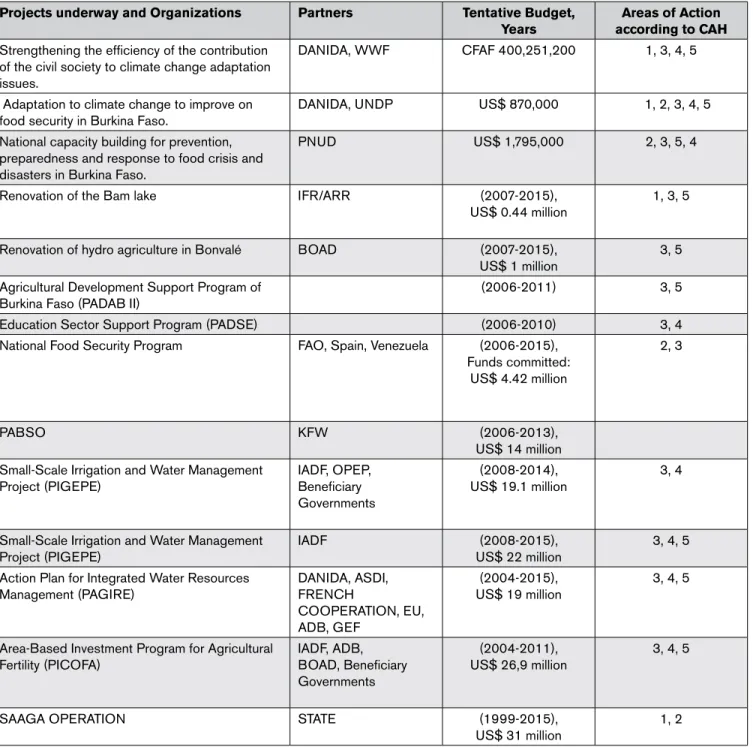
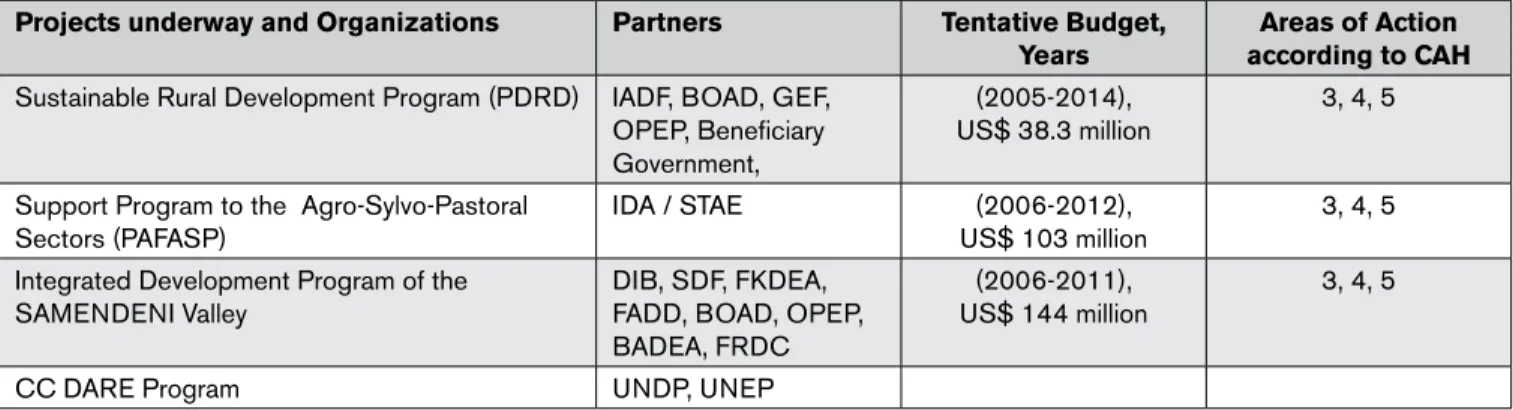
(23) 14 / Disaster Risk Management PROGRAMS FOR PRIORITY COUNTRIES AFRICA. Concerning multilateral organizations, UNDP, WWF, FAO, CILSS, UNITAR and the World Bank intervene at various levels in the area climate variability and change. However, UNDP has developed many more activities as compared to other organizations and which mainly consist in supporting CONEDD in the conduct of activities linked to the operationalization of UNFCCC in Burkina Faso. At the bilateral level, Danish, Japanese and Swedish cooperation are the major partners on environmental and climate risk management issues. Approximately fifteen projects involving close to twenty partners and worth about US$ 350 million are currently implemented in the area of rural development, environmental protection and energy in Burkina Faso. Table 2. Projects underway Projects underway and Organizations. Partners. Tentative Budget, Years. Areas of Action according to CAH. Strengthening the efficiency of the contribution of the civil society to climate change adaptation issues.. DANIDA, WWF. CFAF 400,251,200. 1, 3, 4, 5. Adaptation to climate change to improve on food security in Burkina Faso.. DANIDA, UNDP. US$ 870,000. National capacity building for prevention, preparedness and response to food crisis and disasters in Burkina Faso.. PNUD. US$ 1,795,000. 2, 3, 5, 4. Renovation of the Bam lake. IFR/ARR. (2007-2015), US$ 0.44 million. 1, 3, 5. Renovation of hydro agriculture in Bonvalé. BOAD. (2007-2015), US$ 1 million. 3, 5. Agricultural Development Support Program of Burkina Faso (PADAB II). (2006-2011). 3, 5. Education Sector Support Program (PADSE). (2006-2010). 3, 4. (2006-2015), Funds committed: US$ 4.42 million. 2, 3. National Food Security Program. FAO, Spain, Venezuela. PABSO. KFW. Small-Scale Irrigation and Water Management Project (PIGEPE). IADF, OPEP, Beneficiary Governments. Small-Scale Irrigation and Water Management Project (PIGEPE). 1, 2, 3, 4, 5. (2006-2013), US$ 14 million (2008-2014), US$ 19.1 million. 3, 4. IADF. (2008-2015), US$ 22 million. 3, 4, 5. Action Plan for Integrated Water Resources Management (PAGIRE). DANIDA, ASDI, FRENCH COOPERATION, EU, ADB, GEF. (2004-2015), US$ 19 million. 3, 4, 5. Area-Based Investment Program for Agricultural Fertility (PICOFA). IADF, ADB, BOAD, Beneficiary Governments. (2004-2011), US$ 26,9 million. 3, 4, 5. SAAGA OPERATION. STATE. (1999-2015), US$ 31 million. 1, 2 (Cont.).
(24) BURKINA FASO / 15. Projects underway and Organizations. Partners. Tentative Budget, Years. Areas of Action according to CAH. Sustainable Rural Development Program (PDRD). IADF, BOAD, GEF, OPEP, Beneficiary Government,. (2005-2014), US$ 38.3 million. 3, 4, 5. Support Program to the Agro-Sylvo-Pastoral Sectors (PAFASP). IDA / STAE. (2006-2012), US$ 103 million. 3, 4, 5. Integrated Development Program of the SAMENDENI Valley. DIB, SDF, FKDEA, FADD, BOAD, OPEP, BADEA, FRDC. (2006-2011), US$ 144 million. 3, 4, 5. CC DARE Program. UNDP, UNEP. 5. GLOBAL FACILITY FOR DISASTER REDUCTION AND RECOVERY (GFDRR): ACTION PLAN An in-depth analysis of the disaster risk management and climate change adaptation in Burkina Faso enabled us to distinguish four (4) priority areas of interventions which could be supported within the framework of GFDRR (see table below); they are: • • • •. Strengthening CONASUR, improving its relations with other institutions; Establishing a functional early warning system; Strengthening the response capacity of CONASUR institutions; Implementing climate change adaptation actions at village level. Table No 3. List of defined priority key areas. Actions proposed for GFDRR funding. Potential partners. Tentative total action and years covered (in US$). Potential products and remarks. Priority actions of the concerned Hyogo Action Framework (CAH). Strengthening CONASUR. GFDRR, UNDP, Government of Burkina Faso. 490,000. Diagnostic analysis of the organizational and institutional capacities of CONASUR, Support to capacity building. 1, 2, 4. Devising an early warning system. GFDRR, Government of Burkina Faso. 2,000,000. Diagnostic analysis of the organizational, technical and material capacities of du CONASUR, support to capacity building. 2, 4. Capacity building for response institutions. GFDRR, Government of Burkina Faso. 550,000. Diagnostic study of the state of the equipment, devising a support plan, support by funding equipment acquisition. 3, 5. Investments: Development microprojects. GFDRR, Government of Burkina Faso. 2,000,000. Investment in sustainable development projects. 1, 2, 3, 4, 5.
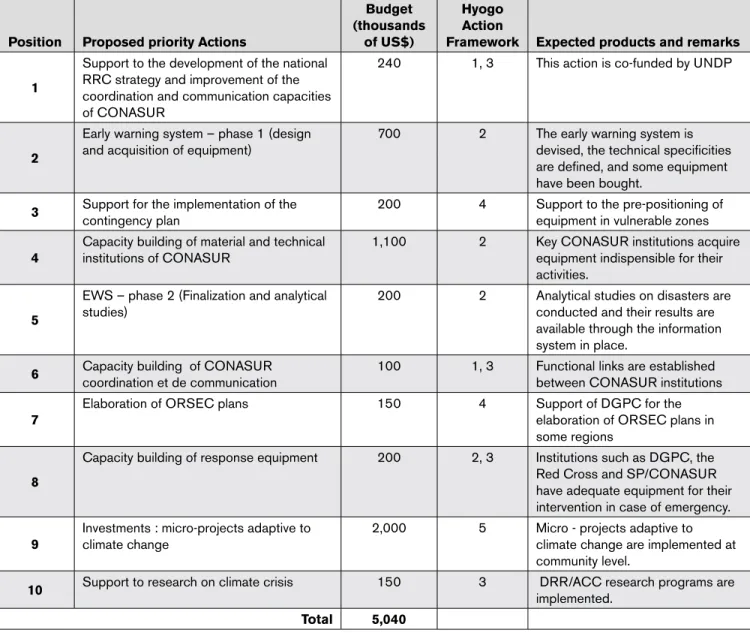
(25) 16 / Disaster Risk Management PROGRAMS FOR PRIORITY COUNTRIES AFRICA. Each key area includes several actions covering various aspects of the Hyogo Action Framework. A total number of ten (10) tentative actions proposed for GFDRR funding are listed in the following table, in decreasing order of priority. For each action proposed, the tentative budget, priority actions of the concerned Hyogo Action Framework and an outline of expected products and possible comments are presented in the table below. Actions were classified taking into consideration the following five (5) criteria: 1- The non realization of the action implies a negative impact on DRR/ACC interventions underway 2- The implementation of action improves the quality of current and future interventions. 3- The quality of other proposed actions in the DRM Country Note depend on the application of this action. 4- The implementation of the action will have positive impact on the people. 5- The Implementation of the action will have a positive impact on the economy at national and decentralized levels. Table No 4: List of priority actions proposed for GFDRR support. Position 1. 2. 3 4. 5. 6. Budget (thousands of US$). Hyogo Action Framework. Support to the development of the national RRC strategy and improvement of the coordination and communication capacities of CONASUR. 240. 1, 3. This action is co-funded by UNDP. Early warning system – phase 1 (design and acquisition of equipment). 700. 2. The early warning system is devised, the technical specificities are defined, and some equipment have been bought.. Support for the implementation of the contingency plan. 200. 4. Support to the pre-positioning of equipment in vulnerable zones. Capacity building of material and technical institutions of CONASUR. 1,100. 2. Key CONASUR institutions acquire equipment indispensible for their activities.. EWS – phase 2 (Finalization and analytical studies). 200. 2. Analytical studies on disasters are conducted and their results are available through the information system in place.. Capacity building of CONASUR coordination et de communication. 100. 1, 3. Functional links are established between CONASUR institutions. Elaboration of ORSEC plans. 150. 4. Support of DGPC for the elaboration of ORSEC plans in some regions. Capacity building of response equipment. 200. 2, 3. Institutions such as DGPC, the Red Cross and SP/CONASUR have adequate equipment for their intervention in case of emergency.. Investments : micro-projects adaptive to climate change. 2,000. 5. Micro - projects adaptive to climate change are implemented at community level.. 150. 3. DRR/ACC research programs are implemented.. Proposed priority Actions. 7. 8. 9 10. Support to research on climate crisis Total. 5,040. Expected products and remarks.
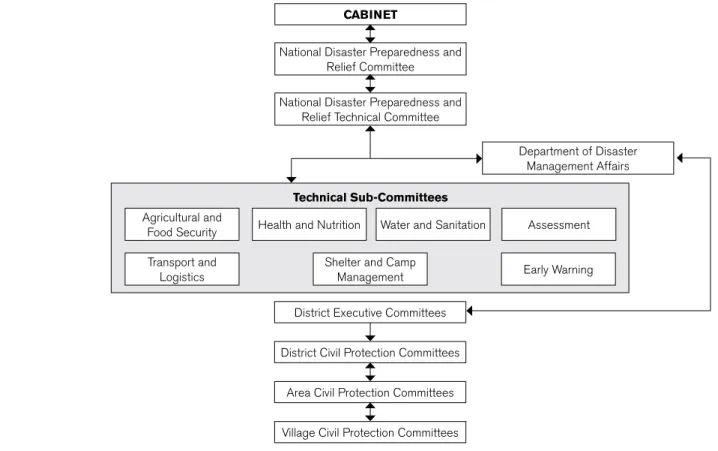
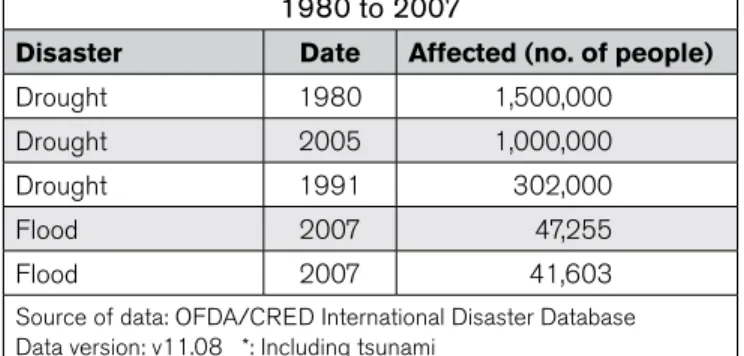
(26) ETHIOPIA / 17. ETHIOPIA The preparation of the Ethiopia Disaster Risk Management (DRM) Plan comes at a very opportune moment because of: a) the recent (and ongoing) Business Process Re-engineering (BPR) throughout the government, which has considerably transformed structures and staffing at several ministries, including the Ministry of Agriculture and Rural Development; b) the development of a new National Policy on Disaster Risk Management, which is expected to be submitted to Parliament by July 2009 and potentially ratified in 2010; and c) a new mandate and approach for Disaster Management and Food Security Sector (DMFSS) to shift from a focus on ex-post emergency response and relief work to the much broader ex-ante disaster risk reduction. DMFSS is also a lead agency for issues related to climate change. To prepare the Country DRM Note, consultations were undertaken with members of the World Bank’s Ethiopia Country team and the DMFFS, and meetings were held with Ministry of Health, Ministry of Water Resources, National Meteorological Agency, Environmental Protection Authority, European Commission, WFP, UN-OCHA, UNDP, UN-ECA, UNICEF, FAO, DFID, USAID, FEWS-NET, DMFSS Livelihood Integration Unit, SC-UK, IFPRI, Oxfam-US, CARE, Relief Society of Tigray, and the Ethiopian Red Cross. The matrix of priority areas and actions for DRM and estimated budget allocations were discussed and cleared at a debriefing meeting held at DMFSS on May 15, 2009 with wide participation of stakeholders from Government, donors, and NGOs. There is strong support and ownership and endorsement by DMFSS for the matrix of priority areas and actions.. 1. Disaster Risk Profile A wide range of natural hazards are present in Ethiopia, including drought, floods, landslides, human and animal diseases, pests, earthquakes, and urban and forest fires. Recurrent drought and floods in particular have the most severe impacts on people’s lives in Ethiopia (refer to Figures 1 and 2). The country’s vulnerability to natural disasters is due to a number of inter-linked factors. These include dependence on rain-fed agriculture, under-development of water resources, land degradation, low economic development, and weak institutions. Furthermore, with a population of 80 million people, Ethiopia is the second most populous country in Sub-Saharan Africa, and has a relatively rapid annual population growth rate of 3.2%. With a GDP of US$200 per capita, Ethiopia is also one of the world’s poorest countries. Drought is the most significant and recurrent climate-related hazard affecting the country. Ethiopia has mainly dry sub-humid, semi-arid and arid regions, all of which are prone to desertification and drought. Ethiopia has a long history of recurring drought; however, since the 1970s, the magnitude, frequency, and impacts of droughts have become more severe. Moreover, due to climate change and human-induced factors, the areas affected by drought and desertification are expanding in Ethiopia. Flash floods and seasonal river floods are becoming increasingly common due to deforestation, land degradation, increasing climate variability, and settlement patterns. During the past two decades, major floods in.
(27) 18 / Disaster Risk Management PROGRAMS FOR PRIORITY COUNTRIES AFRICA. Top 10 Disasters in Ethiopia, 1999-2009. Natural Disaster Occurrence Reported, 1980-2008. Hazard. People Affected. Drought. 12,600,000. 2003. Drought. 4,500,000. 2008. Drought. 2,600,000. 2005. Flood. 361,600. Oct 2006. Flood. 239,586. Flood. 0. Date. 10. 20. 30. 40. Mass mov. dry 1 Wildfire 1 Mass mov. wet. 2. July 2007. Volcano. 2. 235,418. Apr 2005. Insect infestation. Flood. 110,000. Apr 2003. Flood. 79,000. Oct 1999. Flood. 45,000. Oct 1999. Flood. 38,000. Aug 2006. Drought. 4 8. Epidemic Flood. 18 42. Source: EM-DAT: The OFDA/CRED International Disaster Database, Université catholique de Louvain, Brussels, Belgium.. 1988, 1993, 1994, 1995, 1996 and 2006 have caused significant loss of life and property. Large-scale flooding is limited to the lowland areas of the country; however, intense rainfall in the Highlands causes flooding of settlements in a number of river basins, particularly the Awash River Basin in the Rift Valley. Annual flooding in urban areas, especially in Addis Ababa, causes property damage along streams descending from the nearby hills. Flash floods are common in most parts of the country, especially when rains occur following prolonged dry spells. Ethiopia’s climate is highly variable, and is projected to become more variable due to climate change, with the potential for increased frequency of extreme weather events including floods and droughts. Rural areas are very vulnerable to climate variability. The most vulnerable sectors to climate variability are agriculture, water, health, and energy.1 Smallholders dependent on rain-fed crop production and pastoralists in drought-prone areas are the most vulnerable rural livelihood systems. Approximately 85% of the population lives in rural areas and depends on the local natural resource base to meet their basic welfare needs. The relatively under-developed, semiarid, and arid regions of Afar and Somali have been historically vulnerable to unfavorable climatic conditions, which are being exacerbated by climate change. The Amhara and Oromia regions are characterized both by areas of good agricultural production in the highlands and midlands and by recurrent droughts. The Tigray region, vulnerable to recurrent drought, is also vulnerable to climate change.2 Recurrent droughts, conflict, rising food prices and isolation of affected populations have resulted in persistent and high levels of food insecurity, and recurrent emergency situations. In 2008, more than six million Ethiopians required emergency food assistance due to drought and rising food prices. In recent years the value of emergency food and non-food aid has reached over US$350 million on average per year. Although once self-sufficient in food and a net exporter of food grains, since the 1980s, Ethiopia has been a net importer of grain due to a decline in crop production caused by land degradation, soil erosion, and a decline in farm sizes, and rapid population growth and increasing demand for grains as livestock feed. Food aid has tended to be managed through emergency mechanisms that hand out food to needy households, rather than being provided as part of development programs that build and/or 1 Most of Ethiopia’s electricity is from hydro-electric power. 2 ‘Measuring Ethiopian Farmers’ Vulnerability to Climate Change Across Regional States.’ Temesgen Deressa, Rashid M. Hassan, Claudia Ringler. IFPRI Discussion Paper 00806, October 2008..
Figure
+7

Documento similar
Internet privacy is a priority item for the IETF, the Internet Architecture Board (IAB), and the Internet Society. IAB Statement on
Different assessment procedures have been used for toxicity (bioluminescent inhibition test with V. fischeri, respirometry assay with activated sludge and growth inhibition test
In the more effective model (Model C), the visit day, how customers find out about the express pass, the number of people in the party, the culture, the attitude toward
Proteomic prediction and Renin angiotensin aldosterone system Inhibition prevention Of early diabetic nephRopathy in TYpe 2 diabetic patients with normoalbuminuria (PRIORITY):
The American College of Surgeons’ ‘COVID 19: Elective Case Triage Guidelines for Surgical Care Guidelines on Surgery’ describe the fol- lowing conditions as priority indications
The remaining four drivers are perceived to be currently priori- tized as relatively similar and “below average.” In the first round, panel- ists diverged widely on the current
Correlation between structural complexity, proportion of species included in the Red Lists at world and national level, proportion of threatened species included
i) Low priority given to innovation by public leaders, businesses and civil society, which is often reflected in lack of broad-based societal commitment to
