
Electoral Mathematics and Asymmetrical Treatment to Political Parties: The Mexican Case
9
0
0
Texto completo
(2) World Academy of Science, Engineering and Technology International Journal of Law and Political Sciences Vol:11, No:1, 2017. basic concepts. Section III presents the implementation of the Mexican Electoral Law for the 2015 election, showing how the obtained results yield inequities concerning the treatment to political parties. Section IV deals with inconsistencies and paradoxes of the Mexican electoral system, considering specific examples that clearly make evident such failures. Section V shows how the implementation of the Electoral Law causes asymmetrical treatment of political parties: Specifically, big parties take advantage of the small ones. In Section VI a proposal for electoral reform in Mexico with a fairer treatment to political parties is suggested. Finally, in Section VII, some conclusions are presented.. Open Science Index, Law and Political Sciences Vol:11, No:1, 2017 waset.org/Publication/10006370. II. BASIC CONCEPTS A. Notation Let be the number of voters, the number of parties and the number of seats to be distributed; , ,…, is the ∑ , vector of votes obtained by each party, so that , ,…, is the vector of seats assigned to each party, and ∑ where ; finally, and are the proportion of votes and seats that party receives, respectively. Thus, ⁄ and ⁄ . The quota is the number of seats that the party should votes. That receive in exact proportionality after obtaining is, the quota for party is , 1,2, … , . The lower quota is the closest integer number that does not . Likewise, the upper exceed ; it will be denoted by quota is the smallest integer number bigger than or equal to ; . Those apportionment methods that it will be denoted by will be used in this paper (Highest Remainder, Sainte-Laguë and Biproportional apportionment method) will be introduced in what follows (see [13] for more details). Under the Highest Reminder method (HR), also called Hamilton Rule, each party first receives as many seats as the . Then, the remainders integer part of its quota, are ordered from the largest to the smallest one. Finally, the remaining seats are assigned to parties with highest reminders up to seats are completed. Saint-Laguë method (also called Webster rule) is one of the apportionment divisor methods which considers for each party successive quotients of its number of obtained votes , calculated as. where 0,1,2 … 1. The S highest quotients determine both the number of seats for each party and the order in which they are allocated. For practical purposes the previous quotients are equivalent to 1,3,5 … those obtained dividing by Biproportional apportionment methods has been described by Balinski and Pukelsheim [14] as: […] a novel approach of translating electoral votes into parliamentary seats. A two-way proportionality is achieved, to districts relative to their populations, and to. International Scholarly and Scientific Research & Innovation 11(1) 2017. parties relative to their total votes. The methods apply when the electoral region is subdivided into several electoral districts, each with a prespecified “district magnitude”, that is, the number of seats per district. The input data thus consists of a matrix with rows and columns corresponding to districts and parties, and entries to party votes in districts. A biproportional apportionment method converts the party votes into an apportionment matrix of corresponding seat-numbers such that, within a district, the sum of the seat-numbers matches the prespecified district magnitude, while within a party, the seat-numbers sum to the overall party seats that are proportional to the vote totals across the whole electoral region. Due to the calculus difficulty (pointed out in [15]), computer programming is necessary to perform biproportional method. Currently there exists free software, called BAZI, which is simple to use [16]. B. General Description of LGIPE The current Mexican Chamber of Deputies has 500 members. 300 of them are elected by RM in 300 uninominal districts. The remaining 200 seats are allocated under PR through the system of regional lists considering 5 constituencies made up of 40 seats each. In order to obtain its regional lists registration, a political party must present RM candidates in at least 200 districts. Once this requirement satisfied, any political party that reaches at least 3% of the Valid Cast Votes (sum of the votes casted at the polls minus null votes and votes for unregistered candidates) will be allowed to participate in the distribution of PR deputies. Concerning the number of seats that a party can reach in total (RM and PR modalities), there are two restrictions. On one hand, no political party can obtain more than 300 seats in total. And, on the other hand, the percentage of deputies obtained by a political party cannot exceed 8% of Effective National Votes (VCV minus the number of votes obtained by independent candidates and by political parties that did not reach 3% of VCV). The second limit does not apply to political parties obtaining under RM a percentage of total Chamber seats higher than the sum of its percentage of ENV plus 8%. For example, if a political party obtains 35% of ENV, it cannot receive more than 43% of all seats in the Chamber; that is, no more than 215 of the 500 deputies. The allocation of the 200 PR seats is codified in articles 1421 of LGIPE. The implementation of these articles is developed in the next section for 2015 elections results. III. IMPLEMENTATION OF LGIPE ON 2015 ELECTIONS In this section, the 2015 PR seats allocation results will be derived step-by-step. Data of votes in this section are obtained in [17]. First of all, Table I shows the basic data for applying the allocation method: VCV and ENV.. 215. ISNI:0000000091950263.
(3) World Academy of Science, Engineering and Technology International Journal of Law and Political Sciences Vol:11, No:1, 2017. TABLE I VCV AND ENV FOR 2015 ELECTIONS [17] Total vote emitted 39,864,082 Nulls votes 1,900,449 Not registered 52,371 VCV 37,911,262 Independent candidates 225,029 Parties under 3% VCV 1,990,817 ENV 35,695,416. of):. Open Science Index, Law and Political Sciences Vol:11, No:1, 2017 waset.org/Publication/10006370. The votes and VCV percentages for each political party, the null votes and the votes cast for Independent (IND) and NonRegistered (NR) candidates in 2015 elections are shown in Table II. Likewise, results for RM seats appear in last column of Table II. It can be observed that PT and Humanista parties did not get 3% of VCV, so they had no right to participate in the distribution of PR seats. The remaining parties were allowed to participate in the allocation of PR seats. TABLE II DEPUTY ELECTIONS 2015 [18] Party Votes VCV (%) RM seats PRI 11,636,957 30.70 155 PAN 8,377,535 22.10 56 PRD 4,335,321 11.44 28 MORENA 3,345,712 8.83 14 PVEM 2,757,170 7.27 29 MC 2,431,063 6.41 10 NA 1,486,626 3.92 1 PES 1,325,032 3.50 0 PT 1,134,101 2.99 6 Humanista 856,716 2.26 0 Nulls 1,900,449 IND 225,029 0.59 1 NR 52,371 Total 39,864,082 100 300 TABLE III MAXIMUM LIMIT OF SEATS BY PARTY Party. Votes. PRI 11,636,957 PAN 8,377,535 PRD 4,335,321 MORENA 3,345,712 PVEM 2,757,170 MC 2,431,063 NA 1,486,626 PES 1,325,032 Total 35,695,416. ENV (%). ENV(%)+8. 32.60 23.47 12.15 9.37 7.72 6.81 4.17 3.71 100. 40.60 31.47 20.15 17.37 15.72 14.81 12.16 11.71. Limit of seats by party 203 157 100 86 78 74 60 58. Once calculated the VCV and known what parties do not reach the 3% threshold, the next step consists in determining the ENV percentage for each party and checking if there is some party out of the established limits: No party may seat more than 300 deputies and no party’s seat share may exceed more than eight percent its ENV share, as mentioned. These requirements can be checked in Table III. Now, articles 16, 17.1 and 17.3 of the LGIPE [7] establish how to assign the PR seats (English version of LGIPE deals with “districts” instead. International Scholarly and Scientific Research & Innovation 11(1) 2017. Article 16. 1. For the allocation of representatives by proportional representation according to the provisions of section III of article 54 of the Constitution, a pure proportionality formula integrated by the following elements will be applied: a) Natural Quotient, and b) Largest Remainder. 2. Natural Quotient: is the result of dividing the national cast votes by the 200 representatives by proportional representation. 3. Largest Remainder: is the highest remainder between the remaining votes cast for each political party, once the allocation of seats is done by the natural quotient. The largest remainder is used when there are still seats left to distribute. Article 17. 1. Once the formula mentioned in the previous article has been developed, the following procedure will be observed: a) It will be decided which representatives will be allocated to each political party, according to the number of times that its votes contain the natural quotient, and b) The representatives that will be distributed by largest remainder, if there are remaining seats to assign after applying the natural quotient, follow the descending order of the votes not used for each of the political parties in the distribution of seats. […] 3. Once the excess number of representatives by proportional representation has been determined, the political party affected by the terms of the previous paragraph will be allocated its corresponding seats for each district, according to the following terms: a) The distribution ratio will be obtained by dividing the total number of votes of the political party which finds itself in this situation by the seats to be allocated to the same political party; b) The votes obtained by the political party in each electoral district will be divided by the distribution ratio, allocating in whole numbers the seats for each of the districts, and c) If there are still representatives left to be allocated, the largest remainder method will be used, as stated in the previous article. Table IV shows the implementation of the procedure described for 2015 elections. To this aim, the Natural Quotient (NQ) appearing in the Mexican Law is: NQ. 35,695,416 200. 178,477.08. Notice that the method appearing in Articles 16 and 17.1 exactly corresponds with the Highest Remainder method described in Section II, where for each party, Votes/NQ coincides with its quota.. 216. ISNI:0000000091950263.
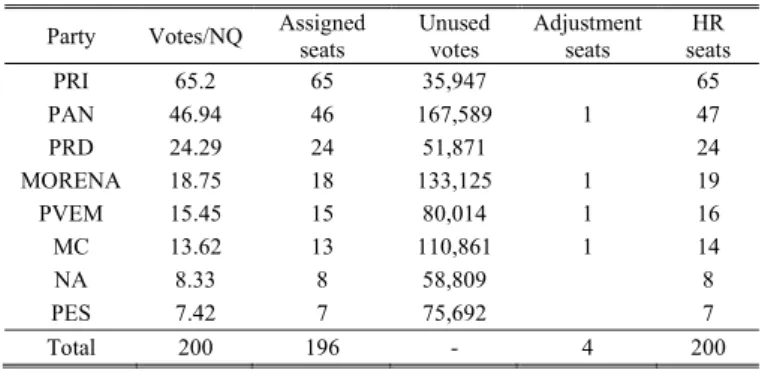
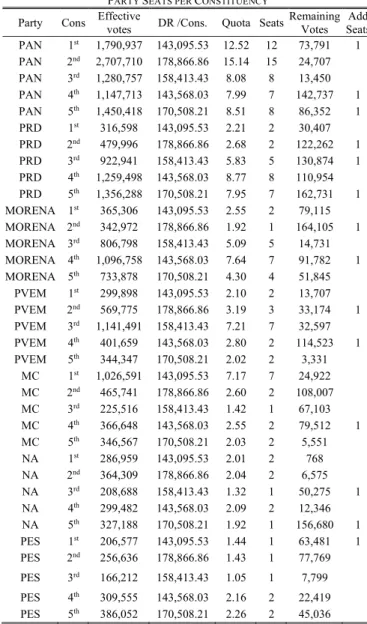
(4) World Academy of Science, Engineering and Technology International Journal of Law and Political Sciences Vol:11, No:1, 2017. Party. TABLE IV ESTIMATION OF PR SEATS BY PARTY Assigned Unused Adjustment Votes/NQ seats votes seats 65.2 65 35,947 46.94 46 167,589 1 24.29 24 51,871 18.75 18 133,125 1 15.45 15 80,014 1 13.62 13 110,861 1 8.33 8 58,809 7.42 7 75,692 200 196 4. HR seats 65 47 24 19 16 14 8 7 200. object of a new distribution among the other parties, taking into account ENV, is presented in Table VI.. Article 18.1a […] II. The effective national votes will be divided by the number of seats of parliament to be allocated, to obtain a new natural quotient; III. The effective national votes obtained by each political party will be divided by the new natural quotient. The result in whole numbers will be the total number of representatives to be allocated to each political party, and IV. If there would still be seats left to be distributed, these would be allocated according to the largest remainders of Table V summarizes the number of RM and PR seats the political parties. obtained by each party at this moment. The new natural quotient for the 2015 elections is: PRI PAN PRD MORENA PVEM MC NA PES Total. Open Science Index, Law and Political Sciences Vol:11, No:1, 2017 waset.org/Publication/10006370. Party PRI PAN PRD MORENA PVEM MC NA PES PT Total. TABLE V RM AND PR ESTIMATED SEATS BY PARTY Total Limit of seats by RM seats HR seats assignment party 155 65 220 203 56 47 103 157 28 24 52 100 14 19 33 86 29 16 45 78 10 14 24 74 1 8 9 60 0 7 7 58 6 0 0 300 200 -. There is not party over 300 seats. On the other hand, it can be observed that PRI party is the only one that exceeds the limit given by its percentage of ENV plus eight points (with 17 seats). For this reason, PRI gets just 48 HR seats instead of those 65 initially assigned. In order to allocate such 48 seats per constituency according to the obtained votes in each one, the distribution ratio (DR) considered in article 17.3 is: DR. 11,636,957 48. 242,436.60. Dividing the PRI votes in each constituency by this coefficient the corresponding number of seats for this party is obtained (Table VI).. Cons. Votes PRI. 1st 2nd 3rd 4th 5th Total. 2,336,569 2,689,712 2,334,043 1,585,747 2,690,886 11,636,957. TABLE VI PRI SEATS BY CONSTITUENCY Votes PRI Deputies Unused /DR number votes 9.6378 9 154,640 11.0945 11 22,909 9.6274 9 152,114 6.54087 6 131,127 11.0993 11 24,083 46. Reman. seats 1 1. Total seats 10 11 10 6 11 48. Once the distribution of seats per constituency of the party that exceeds the limit has been done, the remaining seats are. International Scholarly and Scientific Research & Innovation 11(1) 2017. New NQ. 35,695,416 11,636,957 200 48. 152,303.59. The total number of seats for the remaining parties is obtained with this new natural quotient, as appears in Table VII.. Party PAN PRD MORENA PVEM MC NA PES. TABLE VII SEATS FOR THE REMAINING PARTIES IN 2015 Not used Seats Votes Seats Votes adjustment 8,377,535 52 147,010 1 4,335,321 27 61,779 3,345,712 21 21,846 2,757,170 17 66,421 1 2,431,063 15 56,873 1,486,626 9 62,112 1 1,325,032 8 58,797. Total seats / party 53 27 21 18 15 10 8. Now, the procedure to distribute the seats of each party among the five constituencies is described in Article 18.2 of the LGIPE [7], it says: Article 18.2 […] b) The effective vote by electoral districts will be divided by the number of seats to be allocated in each multi-member regional electoral district in order to obtain the distribution ratio in each district; c) The effective vote for each political party in each of the multi-member regional electoral district will be divided by the distribution ratio, and the result in whole numbers is the total number of representatives to be allocated in each multi-member regional electoral district, and d) If some seats are left to be distributed to the political parties after applying the distribution ratio, the largest remainder of votes that each political party received in the electoral districts will be used, in descending order, until they are exhausted, so that each multi-member regional electoral district has forty representatives. According to the described process, the quotients of distribution in each district appear in Table VIII. With these results and the ENV for each party, seats for the remaining. 217. ISNI:0000000091950263.
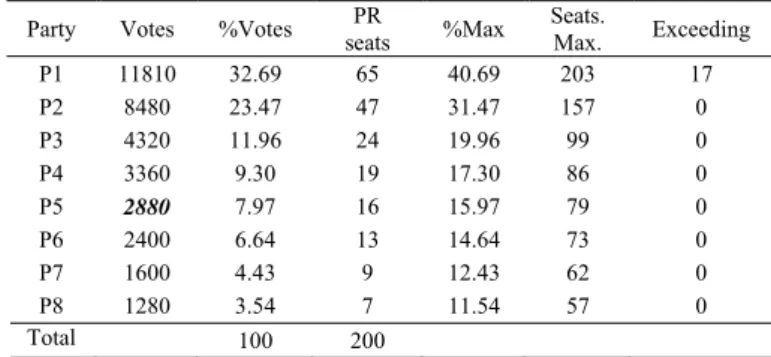
(5) World Academy of Science, Engineering and Technology International Journal of Law and Political Sciences Vol:11, No:1, 2017. parties per constituency are obtained (Table IX).. Open Science Index, Law and Political Sciences Vol:11, No:1, 2017 waset.org/Publication/10006370. TABLE VIII DISTRIBUTION COEFFICIENT FOR EACH CONSTITUENCY Votes Effective PRI Remaining Cons Votes DC PRI votes seats seats 1st 6,629,435 2,336,569 4,292,866 10 30 143,095.53 2nd 7,876,851 2,689,712 5,187,139 11 29 178,866.86 3rd 7,086,446 2,334,043 4,752,403 10 30 158,413.43 4th 6,467,060 1,585,747 4,881,313 6 34 143,568.03 5th 7,635,624 2,690,886 4,944,738 11 29 170,508.21 TABLE IX PARTY SEATS PER CONSTITUENCY Effective Remaining Add Party Cons DR /Cons. Quota Seats votes Votes Seats PAN 1st 1,790,937 143,095.53 12.52 12 73,791 1 PAN 2nd 2,707,710 178,866.86 15.14 15 24,707 8 13,450 PAN 3rd 1,280,757 158,413.43 8.08 PAN 4th 1,147,713 143,568.03 7.99 7 142,737 1 PAN 5th 1,450,418 170,508.21 8.51 8 86,352 1 PRD 1st 316,598 143,095.53 2.21 2 30,407 479,996 178,866.86 2.68 2 122,262 1 PRD 2nd PRD 3rd 922,941 158,413.43 5.83 5 130,874 1 PRD 4th 1,259,498 143,568.03 8.77 8 110,954 PRD 5th 1,356,288 170,508.21 7.95 7 162,731 1 MORENA 1st 365,306 143,095.53 2.55 2 79,115 342,972 178,866.86 1.92 1 164,105 1 MORENA 2nd MORENA 3rd 806,798 158,413.43 5.09 5 14,731 MORENA 4th 1,096,758 143,568.03 7.64 7 91,782 1 MORENA 5th 733,878 170,508.21 4.30 4 51,845 PVEM 1st 299,898 143,095.53 2.10 2 13,707 569,775 178,866.86 3.19 3 33,174 1 PVEM 2nd PVEM 3rd 1,141,491 158,413.43 7.21 7 32,597 PVEM 4th 401,659 143,568.03 2.80 2 114,523 1 PVEM 5th 344,347 170,508.21 2.02 2 3,331 MC 1st 1,026,591 143,095.53 7.17 7 24,922 MC 2nd 465,741 178,866.86 2.60 2 108,007 225,516 158,413.43 1.42 1 67,103 MC 3rd MC 4th 366,648 143,568.03 2.55 2 79,512 1 MC 5th 346,567 170,508.21 2.03 2 5,551 NA 1st 286,959 143,095.53 2.01 2 768 364,309 178,866.86 2.04 2 6,575 NA 2nd NA 3rd 208,688 158,413.43 1.32 1 50,275 1 NA 4th 299,482 143,568.03 2.09 2 12,346 NA 5th 327,188 170,508.21 1.92 1 156,680 1 PES 1st 206,577 143,095.53 1.44 1 63,481 1 256,636 178,866.86 1.43 1 77,769 PES 2nd PES. 3rd. 166,212. 158,413.43. 1.05. 1. 7,799. PES PES. 4th 5th. 309,555 386,052. 143,568.03 170,508.21. 2.16 2.26. 2 2. 22,419 45,036. assigned. A similar fact occurred with PES (one seat from this party was transferred from district 2 to 1). With these seats movements, exactly 40 seats per constituency were achieved. Consequently, the law favors the biggest parties to assure their seats in the corresponding constituencies, while the smallest ones sometimes have to transfer seats among constituencies. Therefore, an asymmetrical treatment to some parties with respect to others may arise. TABLE X ALLOCATION OF TOTAL SEATS PER POLITICAL PARTY Constituency Party 1st 2nd 3rd 4th 5th Total PRI 10 11 10 6 11 48 PAN 13 15 8 8 9 53 PRD 2 3 6 8 8 27 MORENA 2 2 5 8 4 21 PVEM 2 4 7 3 2 18 MC 7 3 1 2 2 15 NA 2 2 2 2 2 10 PES 1 2 1 2 2 8 Independent 0 0 0 0 0 0 39 42 40 39 40 200 Total. IV. INCONSISTENCIES AND PARADOXES AFFLICTING THE MEXICAN ELECTORAL SYSTEM The previous section showed an asymmetrical treatment among parties, where two small ones had to transfer a seat among constituencies. Nonetheless, they maintained their amount of seats in a global way. Now a hypothetical example will demonstrate that this kind of agreements is not always possible and some party might be forced to lose seats. As a consequence, the formulas described in the Mexican electoral law may yield inconsistencies that directly demonstrate its inapplicability. First of all, suppose that there exists eight parties whose RM seats appear in Table XI and also assume that the votes’ distribution per constituency is reflected in Table XII. Notice that, although this is an unreal example, the number of votes for each party, if multiplied by 1000, would be similar to those obtained in 2015 by the participant parties. First, all 200 PR seats are distributed using the highest remainder method (Table XIII). Notice that P1 exceeds 17 seats the limit of those it can obtain. Thus, P1 only receives 48 PR seats. TABLE XI NUMBER OF SEATS PER PARTY Party RM seats P1 155 P2 56 P3 29 P4 28 P5 14 P6 10 P7 1 P8 0 Independent 7. Summing up, the application of the law produces the PR seats allocation appearing in Table X. Notice that the mere implementation of the law does not always guaranty an exact allocation of 40 seats per constituency. In order to avoid this problem, one seat that should correspond to MC party in district 2 was transferred to the same party in district 4. The reason of this adjustment was that 108,007 votes of MC did not obtain representation in district 4, while with 79,512 votes in district 2 one seat were. International Scholarly and Scientific Research & Innovation 11(1) 2017. 218. ISNI:0000000091950263.
(6) World Academy of Science, Engineering and Technology International Journal of Law and Political Sciences Vol:11, No:1, 2017. TABLE XII NUMBER OF VOTES PER PARTY PER CONSTITUENCY Constituency. Open Science Index, Law and Political Sciences Vol:11, No:1, 2017 waset.org/Publication/10006370. Party P1 P2 P3 P4 P5 P6 P7 P8 Total. Party. 1st. 2nd. 3rd. 4th. 5th. Total. P1 P2 P3 P4 P5 P6 P7 P8 Total. 2440 3600 800 400 400 400 200 200 8440. 2700 3600 800 200 200 400 400 200 8500. 2400 360 720 480 600 600 480 360 6000. 1600 320 1280 1920 960 640 160 160 7040. 2670 600 720 360 720 360 360 360 6150. 11810 8480 4320 3360 2880 2400 1600 1280 36130. TABLE XIII MAXIMUM NUMBER OF SEATS AND REMAINDERS PER PARTY PER CONSTITUENCY Seats. PR Exceeding %Max Votes %Votes Max. seats 11810 32.69 65 40.69 203 17 8480 23.47 47 31.47 157 0 4320 11.96 24 19.96 99 0 3360 9.30 19 17.30 86 0 7.97 16 15.97 79 0 2880 2400 6.64 13 14.64 73 0 1600 4.43 9 12.43 62 0 1280 3.54 7 11.54 57 0 100 200. The distribution of seats per constituency of P1 according to Article 17 of the LGIPE is presented in Table XIV. In this case, the corresponding DR is DR of P1. ,. 246.04. Then, the remaining 152 seats are distributed among the other parties. The new NQ is 24320/152 = 160. The result is shown in Table XV. TABLE XIV TOTAL NUMBER OF SEATS OBTAINED BY P1 PER CONSTITUENCY Seats Remaining Adjustment Total Const Votes number voting seats seats 1st 2,440 9 226 1 10 2nd 2,700 10 240 1 11 3rd 2,400 9 186 1 10 1,600 6 124 6 4th 5th 2,670 10 210 1 11 Total 11,810 44 48 TABLE XV TOTAL NUMBER OF SEATS OBTAINED PER REMAINING PARTIES Party Votes Seats Total PR seats 8480 P2 53 53 4320 P3 27 27 3360 P4 21 21 2880 P5 18 18 2400 P6 15 15 1600 P7 10 10 1280 P8 8 8 Total 24320 152 152. International Scholarly and Scientific Research & Innovation 11(1) 2017. DRs for multi-member constituencies are displayed in Table XVI. Using these DRs, the allocation of PR seats per constituency is displayed in Table XVII. TABLE XVI DISTRIBUTION RATIO FOR CONSTITUENCY Constituency Votes Available seats 1ª 6,000 30 2ª 5,800 29 3ª 3,600 30 4ª 5,440 34 5ª 3,480 29 Total 24,320 152. DR 200 200 120 160 120. TABLE XVII FINAL ASSIGNMENT OF SEATS PER PARTY PER CONSTITUENCY Party/Const. 1st 2nd 3rd 4th 5th Seats P1 10 11 10 6 11 48 P2 18 18 3 2 5 46 P3 4 4 6 8 6 28 P4 2 1 4 12 3 22 P5 2 1 5 6 6 20 P6 2 2 5 4 3 16 P7 1 2 4 1 3 11 P8 1 1 3 1 3 9 Total 40 40 40 40 40 200. It can be observed that, for parties P2 to P8, the numbers of obtained seats in Table XVII differ from those appearing in Table XV. This is an example where the Mexican electoral system is inconsistent. Now it will be shown how the so-called No-show paradox (The No-show paradox occurs when part of the electorate may be better off by not voting than voting (see [19] and [20]) may arise in the Mexican electoral system. Consider data of the 2015 elections in Mexico, and suppose that 900 abstaining electors decided to vote for NA party. Also assume that this do not affect the RM results (Table XVIII). In such situation, the maximum number of seats for PRI party decreases one unit (from 203 to 202) as shown in Table XIX. TABLE XVIII FINAL ASSIGNMENT OF RM SEATS PER PARTY Party Votes RM seats PRI 11,636,957 155 PAN 8,377,535 56 PRD 4,335,321 28 MORENA 3,345,712 14 PVEM 2,757,170 29 MC 2,431,063 10 NA 1,486,626+900 1 PES 1,325,032 0 PT 1,134,101 6 IND 225,029 1. Now, PRI party receives 65-18=47 seats and the remaining 153 seats must be distributed among the other parties. The result appears in Table XX.. 219. ISNI:0000000091950263.
(7) World Academy of Science, Engineering and Technology International Journal of Law and Political Sciences Vol:11, No:1, 2017. Party PRI PAN PRD MORENA PVEM MC NA PES. TABLE XIX MAXIMUM AND EXCEEDING SEATS PER PARTY Seats. Votes PR % Max Votes Max. % seats 11,636,957 32.59 65 30.59 202 8,377,535 23.47 47 31.47 157 4,335,321 12.15 24 20.15 100 3,345,712 9.37 19 17.37 86 2,757,170 7.72 16 15.72 78 2,431,063 6.81 14 14.81 74 1,486,626+900 4.17 8 12.17 60 1,325,032 3.72 7 11.72 58. Open Science Index, Law and Political Sciences Vol:11, No:1, 2017 waset.org/Publication/10006370. Party PAN PRD MORENA PVEM MC NA PES Total. TABLE XX PR SEATS PER PARTY Votes Quota 53.27 8,377,535 27.58 4,335,321 21.28 3,345,712 17.53 2,757,170 15.46 2,431,063 9.45 1,486,626 8.43 1,325,932 24,059,359 153. Seats excess 18 0 0 0 0 0 0 0. PR Seats 53 28 21 18 16 9 8 153. Comparing with the 2015 results (see Table X), it can be observed that NA, with 900 more votes, would obtain one seat less. In other words, these voters participation would have been against their interests. Moreover, notice that two wellknown apportionment paradoxes of PR (see [12]) are involved in this fact. On one hand, when allocating all 200 PR seats, the Population paradox arises: NA loses one seat in spite of obtaining 900 more votes. On the other hand, when allotting the 153 remaining seats (once the PRI excluded), a stronger version of the Alabama paradox also appears: With one more seat in the PR apportionment (153 instead of 152), and 900 more votes, NA would lose one seat. V. EFFECTS OF THE THRESHOLD CHANGE ON THE TREATMENT TO POLITICAL PARTIES The 2014 reform established a more restrictive requirement than previous electoral laws for parties to participate in PR allocation, increasing from 2% to 3% the exclusion threshold. In this way, when applied the new electoral law in 2015, such change excluded two parties (concretely, the PT and the Humanist parties) that would participate with the previous codification. Even more, it should be noted that PT party obtained a little more than 2.99% of the VCV, so that with 0.001% more votes (3,337), this party would have received at least 6 seats. Thus, the threshold outlined in the LGIPE means that 1,134,101 citizens did not obtain representation in the Chamber. On the other hand, with 190,931 votes more than those obtained by PT, the PES obtained 8 PR seats, being this amount of votes just a little more than that required to obtain a seat (see last column in Table X). The next hypothetical situation compares the real voting data from 2015 elections with those obtained if PT party had got 3,337 additional votes (needed for getting 3% of the VCV).. International Scholarly and Scientific Research & Innovation 11(1) 2017. TABLE XXI SEATS PER PARTY CONSIDERING SUPPOSED DATA AND SEATS ASSIGNED IN 2015 ELECTION Party Votes 2015 PR seats 2015 New votes New PR Seats PRI 11,636,957 PAN 8,377,535 PRD 4,335,321 MORENA 3,345,712 PVEM 2,757,170 MC 2,431,063 NA 1,486,626 PES 1,325,032 PT 1,134,101. 48 53 27 21 18 15 10 8 0. 11,636,957 8,377,535 4,335,321 3,345,712 2,757,170 2,431,063 1,486,626 1,325,032 1,137,438. 42 53 27 21 17 15 10 8 7. It can be observed how the PRI, jointly with its partner in 2015 elections, PVEM, are the only benefitted parties from increasing the threshold barrier from 2% to 3%. This example shows again an asymmetrical treatment to political parties: notice how without those 3,337 additional votes of PT (needed to reach the threshold), the PRI obtains six more seats. Moreover, big parties take advantage of the votes that are obtained by independent candidates, because their votes are valid but they do not take part on the PR allocation. Again, a differentiated treatment is given to big political parties versus independent candidates. VI. PROPOSAL OF APPORTIONMENT METHOD FOR MEXICAN ELECTORAL SYSTEM As shown along this paper, the current Mexican electoral system presents inconsistencies, paradoxes and asymmetrical treatment to political parties. Due to its serious problems, a new apportionment method for the Mexican electoral system is proposed, intended be clearer, applicable, free of the inconsistencies and paradoxes, and fairer with all political parties. The proposal is: First, it is proposed to define the VCV as all votes cast, minus the sum of null votes, and those of unregistered candidates and independent candidates. The reason for the exclusion of independent candidates’ votes relies on they do not participate in the allocation of PR seats. Second, the seats allocation to the parties is obtained according to its percentage of the ENV, with the current threshold and limits, but using the Sainte-Laguë apportionment method (Simulations with biproportional apportionment methods have confirmed Sainte-Lagüe as one of the best procedures in order to avoid seats biases [21]). Finally, with the implementation of biproportional apportionment method, the allocation of party seats per constituency is obtained, again using the Sainte Laguë apportionment method. Applying the first two steps to 2015 Mexican elections the results would be those appearing in Table XXII. Notice that, with this proposal, PT party has participation on PR seats, which does not happen with the current system. Finally, the obtained seats by each party are distributed among the five constituencies, using the biproportional method (Table XXIII). Hence, with this proposal all 200 PR seats have been distributed in a comprehensive way avoiding. 220. ISNI:0000000091950263.
(8) World Academy of Science, Engineering and Technology International Journal of Law and Political Sciences Vol:11, No:1, 2017. inconsistences and paradoxes that may arise with the current system.. Open Science Index, Law and Political Sciences Vol:11, No:1, 2017 waset.org/Publication/10006370. TABLE XXII PR ESTIMATED SEATS PER PARTY (SAINTE-LAGUË METHOD) Party Votes Percentage of VCV RM seats PR seats PRI 11,636,957 30.88 155 42 PAN 8,377,535 22.23 56 53 PRD 4,335,321 11.50 28 28 MORENA 3,345,712 8.88 14 21 PVEM 2,757,170 7.32 29 17 MC 2,431,063 6.45 10 15 NA 1,486,626 3.94 1 9 PES 1,325,032 3.52 0 8 PT 1,134,101 3.01 6 7 Humanista 856,716 2.27 0 Nulls 1,900,449 IND 225,029 1 NR 52,371 Total 39,872,757 100 300 200 TABLE XXIII ALLOCATION OF TOTAL SEATS PER POLITICAL PARTY BY BIPROPORTIONAL METHOD Constituency Party 1st 2nd 3rd 4th 5th Total PRI 9 9 9 6 9 42 PAN 13 15 8 8 9 53 PRD 2 3 6 9 8 28 MORENA 3 2 5 7 4 21 PVEM 2 3 7 3 2 17 MC 7 3 1 2 2 15 NA 2 2 2 1 2 9 PES 1 2 1 2 2 8 PT 1 1 1 2 2 7 40 40 40 40 40 200 Total. VII. CONCLUSIONS Along this paper the Mexican Electoral System has been analyzed. To this aim, the 2015 electoral results (where internal negotiations for some parties were needed in order to reach a final allocation of PR seats) and other hypothetical (but plausible) data have been used. As shown, the application of the current law may lead to undesirable effects: Inconsistencies, paradoxes and asymmetrical treatment to political parties. It is important to point out such failures of the LGIPE because this might help to improve the Mexican electoral system and achieve a greater democratic quality in this country. Although it is known after the Balinski and Young theorem [13] that is not possible a perfect apportionment method for allocating seats, it is necessary to have a clear, fair and free of paradoxes electoral system, as much as possible. Contrary to the current system, with the biproportional method proposed in this paper a distribution of seats without inconsistencies in any electoral situation is possible. The allocations based on this method will be free of drawbacks as those presented in this paper; even more, the differences in treatment to political parties will become reduced and. International Scholarly and Scientific Research & Innovation 11(1) 2017. agreements for interchanging their constituencies will not be needed.. seats. among. the. REFERENCES [1]. [2] [3]. [4]. [5]. [6]. [7]. [8] [9] [10] [11] [12] [13] [14]. [15]. [16] [17]. [18]. 221. Federal Law of Politics Organizations and Electoral Process 1977 (Ley Federal de Organizaciones Políticas y Procesos Electorales 1977). Available at: http://www.diptados.gob.mx/museo/s_nues11.htm, accessed Dec/14/2016. Electoral Federal Code 1986-1986 (Código Federal Electoral 19861987) Available at: http://www.diputados.gob.mx/museo/s_nues12.htm, accessed Dec/14/2016. Federal Code of Institutions and Electoral Process 1990 (Código Federal de Instituciones y Procedimientos Electorales 1990). Available at: http://www.diputados.gob.mx/LeyesBiblio/abro/cofipe/COFIPE_abro.pd f, accessed Dec/14/2016 Federal Code of Institutions and Electoral Process 1994 (Código Federal de Instituciones y Procedimientos Electorales 1994). Available at: http://www.diputados.gob.mx/LeyesBiblio/abro/cofipe/COFIPE_ref05_ 18may94_ima.pdf, accessed Dec/14/2016 Federal Code of Institutions and Electoral Process 1996 (Código Federal de Instituciones y Procedimientos Electorales 1996). Available at http://www.diputados.gob.mx/LeyesBiblio/abro/cofipe/COFIPE_ref08_ 22nov96_ima.pdf, accessed Dec/14/2016 Federal Code of Institutions and Electoral Process 2008 (Código Federal de Instituciones y Procedimientos Electorales 2008) Available at: http://www.diputados.gob.mx/LeyesBiblio/abro/cofipe_2008/COFIPE_a bro.pdf, accessed Dec/14/2016 General Law of Institutions and Electoral Process 2014 (Ley General de Instituciones y Procedimientos Electorales 2014) Available in English at: http://portales.te.gob.mx/ccje/sites/default/files/GENERAL%20LAW%2 0ON%20ELECTORAL%20INSTITUTIONS%20AND%20PROCEDU RES.pdf, accessed Dec/14/2016 M. Balinski, V. Ramírez, (1996): “A case study of electoral manipulation: The Mexican laws of 1989 and 1994”, Electoral Studies, vol. 15, 1996, pp. 203-217. M. Balinski, V. Ramírez, “Mexican electoral law: 1996 version”, Electoral Studies, vol. 16, 1997, pp. 329-340. M. Balinski, V. Ramírez, “Mexico’s 1997 apportionment defies its electoral law”, Electoral Studies, vol. 18, 1999, pp. 117-147. M.S. Shugart and M.P. Wattenberg. “Mixed-Member Electoral System the Best of Two Worlds?” Oxford University Press, New York, 2001, pp. 209-230. M.S. García, “Las reformas electorales a nivel federal en México”, El Cotidiano, vol. 166, 2011, pp. 79-91. M. L. Balinski, H. P. Young, “Fair Representation: Meeting the Ideal of One Man, One Vote”, New Haven: Yale University Press, 1982. M. Balinski, F. Pukelsheim, “Matrices and politics”, Festschrift for Tarmo Pukkila on his 60th Birthday, Eds. E.P. Liski, J. Isotalo, J. Niemelä, S. Puntanen, and G.P.H. Styan, University of Tampere, Finland, 2006, 233–242. V. Ramírez, A. Palomares, A. López, M.A. Fortes, P. González, C.M. Ramirez, J. A. Martínez, M.L. Márquez, M. Pasadas, B.L. Delgado, “Sistema electoral para el Congreso de los Diputados, propuesta para un Parlamento más ecuánime, representativo y gobernable”, Editorial Universidad de Granada, 2013. F. Pukelsheim and team: BAZI software. Available at: https://www.math.uni-augsburg.de/htdocs/emeriti/pukelsheim/bazi/, accessed Dec/14/2016 Data Bases of Mexican Elections Available at web site of Electoral National Institute: http://siceef.ine.mx/atlas.html?p%C3%A1gina=1#siceen accessed Dec/14/2016 Agreement of the general council of the national electoral institute of validity of the election of deputies for the principle of proportional representation for the period 2015-2018. (acuerdo del consejo general del instituto nacional electoral por el que se efectúa el cómputo total, se declara la validez de la elección de diputados por el principio de representación proporcional y se asignan a los partidos políticos nacionales acción nacional, revolucionario institucional, de la revolución democrática, verde ecologista de méxico, movimiento ciudadano, nueva alianza, morena y encuentro social, los diputados que les corresponden para el periodo 2015-2018) Available at:. ISNI:0000000091950263.
(9) World Academy of Science, Engineering and Technology International Journal of Law and Political Sciences Vol:11, No:1, 2017. Open Science Index, Law and Political Sciences Vol:11, No:1, 2017 waset.org/Publication/10006370. http://www.ine.mx/archivos3/portal/historico/recursos/IFE-v2/DS/DSGacetasElectorales_INE/2015/Gaceta-009/GE_009_002.pdf accessed Dec/14/2016 [19] V. Dančišin, “Negative vote weight and the No-Show paradox in partylist proportional system. Available at https://www.academia.edu /7312330, accessed Dec/14/2016 [20] J. Pérez, “The Strong No Show Paradoxes are a Common Flaw in Condorcet Voting Correspondences” Social Choice and Welfare, Vol. 18, No. 3, 2001, pp. 601- 616. [21] P. Zachariassen, M. Zachariasen. “A Comparison of Electoral Formula for the Faroese Parliament” in B. Simeone and F. Pukelsheim (eds.): Mathematics and Democracy Recent Advances in Voting Systems and Collective Choice,” Springer, New York, 2006, pp. 235-251.. International Scholarly and Scientific Research & Innovation 11(1) 2017. 222. ISNI:0000000091950263.
(10)
Figure
![TABLE II D EPUTY E LECTIONS 2015 [18]](https://thumb-us.123doks.com/thumbv2/123dok_es/7215985.426232/3.892.76.430.447.950/table-ii-d-eputy-lections.webp)
+3


Documento similar