
TítuloFundamentals of TGA and SDT
7
0
0
Texto completo
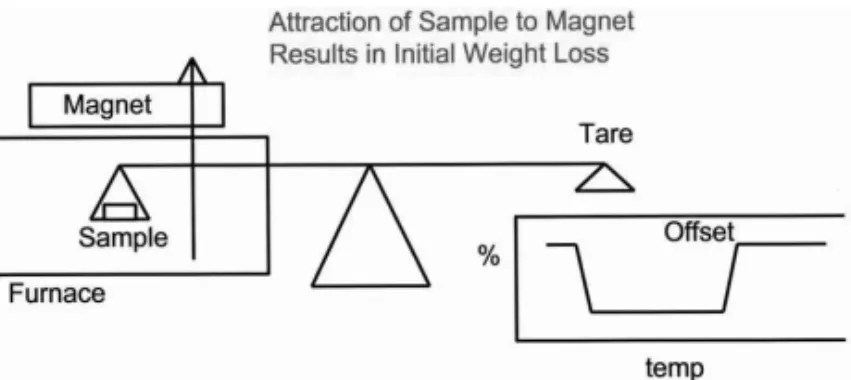
(2) 2. WEIBING XU, SEN LI, NATHAN WHITELY AND WEI-PING PAN. Figure 1. Horizontal temperature calibration configuration. Figure 2. Vertical temperature calibration configuration A small lab jack can be used to adjust the magnet’s distance from the sample such that a 2-3% weight gain or weight loss occurs once the magnet is positions above or below the sample. Figure 3 shows the Curie point determination for nickel and alumel. Note that the Curie point is denoted as the offset.. Figure 3. Curie point determination for vertical TGA SDT also has an alternate method for temperature calibration. The melting points of standard materials can be determined by the onset of the endotherms and compared to the theoretical melt temperature. A good exercise for both TGA and SDT is to perform multiple analyses of calcium oxalate monohydrate. By performing such.
(3) FUNDAMENTALS OF TGA AND SDT. 3. an analysis the performance and precision of both you and the instrument can be measured. An overlay of five calcium oxalate experiments is shown in Figure 4.. Figure 4. Performance testing using calcium oxalate monohydrate Although calcium oxalate monohydrate is not typically a standard material, it does hold good utility in intra-laboratory analysis. The weight change and peak temperature can be inputted into a spreadsheet program to check your instrument and operators performance. The accuracy of the instrument can be used to assess your instruments long-time performance, and help single out a damaged component of the instrument. The baseline can also be quite usual in quantifying your instrument’s performance and sensitivity. Small weight losses become increasingly difficult to measure if the instrument’s baseline is large compared to that of the instrument. TGA is the foremost analysis technique in determining quantitative properties of the original sample. A polyethylene (PE) sample filled with CaCO3 was analyzed as shown in Figure 5.. Figure 5. TGA curve of polyethylene sample filled with calcium carbonate By knowing the degradation reaction of CaCO3, the initial percentage of CaCO3 in the PE can be calculated. At approximately 550ºC the PE is completely decomposed; thus, the weight loss occurring at approximately 650ºC is due to the decomposition of CaCO3. The weight loss is a direct result of the evolution of CO2 gas. The residue is the remaining CaO that fails to decompose. From the weight change and the residue,.
(4) 4. WEIBING XU, SEN LI, NATHAN WHITELY AND WEI-PING PAN. the stoichiometric relationships can be used to determine a percentage of CaCO3 that exists in the original PE sample. Calculating the initial percentage of CaCO3 from the weight change is more accurate than calculating it from the residue. Most polymers contain fillers; hence, the residue is a combination of CaO and these fillers making this calculation less accurate. TGA and SDT can also be used to demonstrate the important of reaction atmosphere. Calcium oxalate monohydrate was analyzed under the same experimental conditions except the purge gas. The sample was analyzed in air, CO2, and nitrogen of equal flow rates. Figure 6 illustrates Le Chatilier’s principle.. Figure 6. Le Chatilier’s principle shown using TGA Because the degradation of CaC2O4 produces CO2, the reaction is inhibited when it occurs in a CO2-saturated atmosphere. Figure 7 shows the heatflow data collected with the SDT.. Figure 7. DSC Curve of calcium oxalate monohydrate in multiple atmospheres The CaC2O4 oxidizes in air as shown by the endotherm at approximately 500ºC while in nitrogen and CO2 oxidation does not occur but rather pyrolysis. Hi-Resolution TGA is useful to separate overlapping weight losses. HiResolution TGA exposes the sample to an isotherm once a weight loss is detected. The isotherm allows the weight loss occurring at the lower temperature to complete before the second weight loss begins. Figure 8 shows that as the resolution increases, the two weight losses are more separate and defined..
(5) FUNDAMENTALS OF TGA AND SDT. 5. Figure 8. TGA curves at multiple hi-resolution settings Quality control testing often exposes a product to a particular atmosphere for very extended periods of time which can be costly and time consuming. TGA in conjunction with kinetics software can be used to decrease the time and money spent on tedious lifetime testing procedures. A sample is analyzed over the same temperature range using at least four different heating rates. Software is then used to generate numerous plots that can predict the product’s performance over time. The activation energy, rate constant, and other kinetics related information can be provided as seen in Figure 9.. Figure 9. Log[heating rate] curve at multiple conversions Figure 10 shows the lifetime of the sample at varying isotherms..
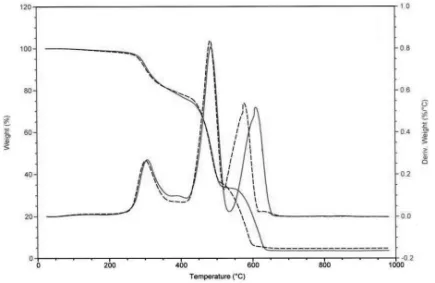
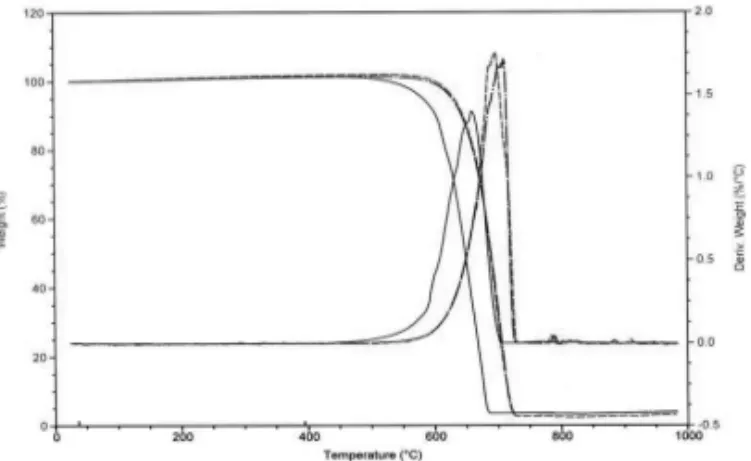
(6) 6. WEIBING XU, SEN LI, NATHAN WHITELY AND WEI-PING PAN. Figure 10. Lifetime plot for polymer sample Although this lifetime plot may not eliminate the need for lengthy quality control testing, it may help predict poorly performing products at an earlier stage in the production process. Two automotive belts composed of alkylated chlorosulfonated polyethylene (ACSM) were tested using TGA to identify the reason why one belt performed at 10% of a normal functioning belt. The belts were analyzed under the exact heating rates under an air atmosphere. The belts each showed the typical degradations profile of a rubber sample as seen in Figure 11.. Figure 11. TG and DTG Curve of Passed and Failed Belt Sample in Air Oil was decomposed first followed by the decomposition of the polymer, and finally the carbon black combusted with the oxygen in the air. This analysis showed that both the oil and polymer portions of the rubber were not the cause of the bad belt’s failure. The decomposition of the bad belt was approximately 20ºC lower than the good belt. Figure 12 shows that the bad belt was composed of carbon black 1, which has the lower decomposition temperature..
(7) FUNDAMENTALS OF TGA AND SDT. 7. Figure 12. TG and DTG Curves of Carbon Black Components of Failed Belt Sample TGA and SDT can used be in nearly any application to gather information. TGA and SDT provide a method of analysis that is fast and easy to operate, but provides precise and accurate results. In situations where TGA and SDT cannot be used to study a system directly, TGA and SDT can provide estimations that help alleviate some of the difficulty in using more complicated analysis methods.. Acknowledgements Many thanks to Len Thomas of TA Instruments who allowed use of his short course presentation given at Western Kentucky University..
(8)
Figure


![Figure 9. Log[heating rate] curve at multiple conversions Figure 10 shows the lifetime of the sample at varying isotherms](https://thumb-us.123doks.com/thumbv2/123dok_es/7235645.431795/5.892.215.678.666.939/figure-heating-multiple-conversions-figure-lifetime-varying-isotherms.webp)
+3
Documento similar
