
Value contribution of immigrants to society through entrepreneurship
12
0
0
Texto completo
(2) Journal for Educators, Teachers and Trainers, Vol. 6 (2) ISSN 1989 – 9572 http://www.ugr.es/~jett/index.php. Value contribution of immigrants to society through entrepreneurship El valor de la contribución de los inmigrantes a la sociedad a través del emprendimiento Miguel Osorio García de Oteyza, [email protected] Alfonso Urquiza Echevarren, [email protected] Rosana Rodríguez Gómez, [email protected] Francisco of Victoria University, Spain Abstract Immigration today is a reality that is transforming the social and economic landscape, particularly in some European developed countries as in Spain. Moreover, Entrepreneurship is considered as a key driver in today‟s economy recovery processes, particularly in relation to the innovative, change searching and opportunity seeker nature of entrepreneurs. Despite these facts, very little academia research has been published to date on the relationship effects between Immigration and Entrepreneurship. The main objective of this article is to analyze the differential values that immigrants introduce in the entrepreneurship process, starting with the motivation and discovery of the opportunity (Fiet and Patel, 2008), business start up (use of resources) and further economic and job creation effects associated to new business developments. Our approach starts with a comprehensive review of the different approaches and definitions associated to Entrepreneurship, considering that this process has not been yet defined as a basic and fundamental term (Fernandez, 2012). This review will be the basis for a wide analysis of immigrant Entrepreneurship reality, including motivations, abilities and specific challenges to achieve success. Resumen La inmigración, hoy en día, es una realidad que está transformando el panorama económico y social, particularmente en algunos países europeos desarrollados como España. Además, el emprendimiento está considerado como una pieza clave en el proceso de reconversión económica actual, particularmente en relación a la capacidad de innovación, adaptación al cambio y búsqueda de oportunidades de los emprendedores. A pesar de esto, se han publicado muy pocas investigaciones académicas hasta la fecha sobre la relación entre inmigración y emprendimiento. El principal objetivo de este artículo es analizar el valor diferencial que los inmigrantes introducen en el proceso de emprendimiento, comenzando por la motivación y la búsqueda de oportunidades (Fiet y Patel, 2008), posibilidades de negocio (uso de recursos), y la promoción económica y de creación de empleo como efectos asociados al desarrollo de nuevos negocios. Nuestra aproximación comienza con una revisión amplia de los diferentes enfoques y definiciones asociadas al emprendimiento, considerando que este proceso todavía no ha sido definido como un término básico y fundamental (Fernández, 2012). Esta revisión será la base para un análisis amplio sobre la realidad del emprendimiento inmigrante, incluyendo motivaciones, habilidades y capacidades específicas para lograr el éxito. Keywords Entrepreneurship; Immigrants; Motivations; Characteristic Palabras clave Emprendimiento; Inmigrantes; Motivaciones; Característica. Journal for Educators, Teachers and Trainers JETT, Vol. 6 (2); ISSN: 1989-9572. 102.
(3) 1. Introduction During the 1970s and 1980s, in a context shaped by economic stagnation, rising unemployment and tightening immigration policies in most Western countries, some American researchers focused attention and developed new ideas around what is known today as "sociology of ethnic entrepreneurship" (Light, 1972; Bonacich, 1973; Bonacich & Modell, 1980; Wilson & Portes, 1980; Portes & Stepick, 1985; Portes & Bach, 1985; Waldinger, 1986a & 1986b; Light & Bonacich, 1988; cited by Riesco-Sanz, 2014), highlighting valuable benefits derived from selfemployment initiatives, introduced by minority populations. From a global perspective, immigration is a phenomenon characteristic of most developed societies. This phenomenon causes socio-economic impacts and is analyzed from different theoretical perspectives. In this article, we will focus on analyzing immigrant self-employment effects and the entrepreneurial behavior of various groups of immigrants; this has led to the emergence of a new phenomenon, known as "Business created by Immigrants" (Baycan-Levent y Nijkamp, 2009). There is substantial empirical evidence that the intensive process of new jobs creation, driven and occupied by immigrants, has occurred, in parallel with a reduction in native citizens unemployment rates, thus allowing new employment opportunities within the native population or transition to different jobs under better working conditions(Conde Ruiz et al, 2008; cited by Aboussi & García-Caro, 2012). Thus, in this article we will focus on the entrepreneur, defined as the individual coming to a country, and settled down in a city and having started a business as a self-employed person. Due to the complete absence of official data directly related to immigrant entrepreneurs in Spain, we will just reference official data on foreign, self-employed persons. We are fully aware that ideally, we should analyze at the entire volume businesses immigrants; but due to the limitations, we will focus on self-employed workers. We will start addressing some general considerations prior to address immigrant, specific entrepreneurship concerns. First, we will briefly review the concept of entrepreneurship, followed by analyzing specific characteristics of immigrant entrepreneurship, in order to better understand how they face entrepreneurship challenges and all this in order to get know ledge about the following question: what values immigrants bring to entrepreneurship?. 2. The entrepreneurship concept In order to specifically analyze new businesses developments driven by immigrants in our society, we have to consider that the entrepreneurship domains still considered as a relatively young research field (Copper, Lambert & Pagh, 1997), although during its short history, has been analyzed by economists, sociologists as well as researchers from other disciplines. The delimitation of this concept-entrepreneurship -has been a difficult task, and in fact, the economy has not been able to define entrepreneurship as a basic and essential element specifically associated to economic performance (Fernández, 2012). Actually, there are some difficulties in finding consensus on what entrepreneurship features deserve research activities (Audrestch, Thurik, Verheul y Wennekers, 2002).These difficulties in the definition itself, limit us in measuring the immigrant entrepreneurship complicating also the study of its economic and social impacts. Entrepreneurial‟s activities, lack an adequate conceptual framework and many authors in their researches on entrepreneurship, suffer from this lack of consensus on the definition(Shane & Ventakaraman, 2000).In this article we will refer to entrepreneurship or entrepreneurial activity, just considering self-employed, immigrant‟s occupation activities, although we will not discard in future research efforts analyzing as well entrepreneurship effects in existing companies (development of new, innovative revitalization. Journal for Educators, Teachers and Trainers JETT, Vol. 6 (2); ISSN: 1989-9572. 103.
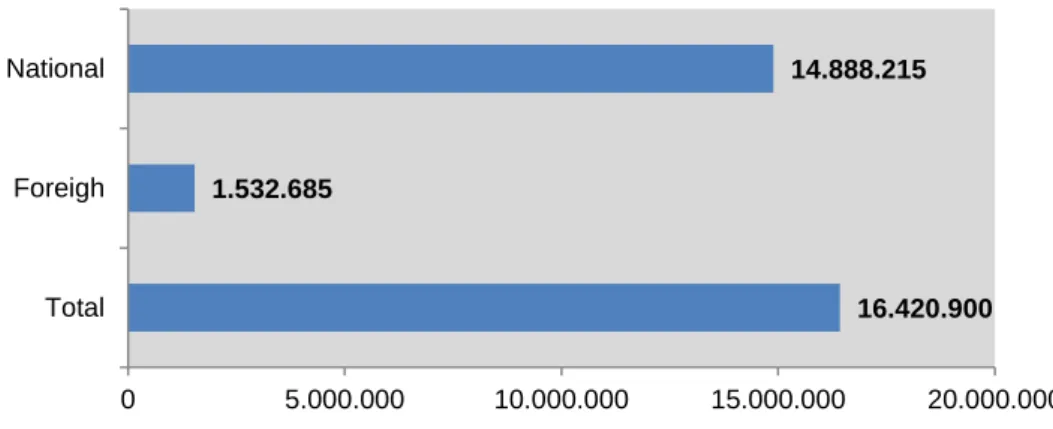
(4) initiatives in already established businesses)as well as in start-ups &new employment creation opportunities (Guzmán & Santos, 2001). This brief approach can be useful to better understand the differentiation that in the Scandinavian countries is commonly identified as "opportunity entrepreneurs" and "forced or necessity-driven entrepreneurship”. The first is the one that claims to have created a company or start up business, driven by a lack of formal employment alternatives (Bustamante, 2004). The second one relates to persons assuming the risks associated to exploiting apperceived opportunity. As indicated by Solé, Parella & Alarcón (2008), many immigrants arrive at entrepreneurship as their single option in order to overcome the difficulties associated in labor market‟s access and social integration. This differentiation provides interesting evidence on immigrant‟s arguments to seriously consider entrepreneurship as the best alternative to overcome social integration difficulties and to help them to achieve better social and labor status in a society that, in many cases offers them a hostile and difficult opportunities scenario. It is also important to consider that, in addition to its importance and implications within the entrepreneur‟s private domain and personal environment, the phenomenon of immigrant entrepreneurship, has also social implications in the public domain. These processes actively contribute to parallel social, cultural & economic integration processes, in a way that these immigrants do not lose out previous ties and identity (Díaz y González, 2005). 3. Immigrant entrepreneurship’s characteristics Immigrant‟s entrepreneurship global contribution in Europe, clearly promotes economic growth and employment benefits. The companies act as an important links with the world markets, favor globalization and are fundamental to the integration of immigrants into the labor market, because they creating jobs for themselves and, increasingly, also for other immigrants or the native population (DOUÉ C315, 2012). The EU has publicly acknowledged the importance of immigrant entrepreneurs and their contribution to growth and sustainable employment development (DOUE C315, 2012). In fact, data from the Ministry of Employment and Social Security (2014) in Spain shows that the total labor population (employed and self-employed persons) totals 16,420.9 millions, of which 1,532,685 of them are foreign nationals (Chart 1). These data reveal us that9.3% of workers are foreign nationals, but if we focus on the self-employment workers (Chart 2), we note that 7.3% are foreign entrepreneurs, this indicating that 14, 8% of foreigners having a job in Spain, have created their own business.. National. 14.888.215. Foreigh. 1.532.685. Total. 16.420.900 0. 5.000.000. 10.000.000. 15.000.000. 20.000.000. Figure 1: Total employment record figures in Spain Source: Own Creation by data from the Ministry of Employment and Social Security (2014). Journal for Educators, Teachers and Trainers JETT, Vol. 6 (2); ISSN: 1989-9572. 104.
(5) National. 2.872.075. Foreigh. 226.925. Total. 3.099.000 0. 1.000.000. 2.000.000. 3.000.000. 4.000.000. Figure 2: Self-employed persons in Spain Source: Own Creation by data from the Ministry of Employment and Social Security (2014) Last year‟s economic growth record in Spain had some sort of „magnet effect‟ for immigrants, but today, due to the fact that recent crisis is lasting much longer than expected, the situation is changing, and many of those immigrants that significantly contributed to last decade‟s expansion, are now forced to pack and return back to their country of origin. The total foreign population in Spain began its decline in 2011 and during 2013, return rates of migrants to their country of origin has contributed to a drop in the overall population in Spain, for the first time since 1996, date in which the INE started recording these data (INE, 2013). Nevertheless, immigrants continue undertaking new businesses developments, despite Spain‟s current financial crisis and additional specific immigration-related difficulties. They have to face, for example, discrediting myths such as the supposed tax benefits that autonomous migrants enjoy under our current legislation. These myths falls under its own weight, particularly considering that it is an essential requirement for them to be up to date on payments to the Social Security, condition without which they cannot renew their residence card. The latter is major complaint of many entrepreneurs who consider that taxes are too high and difficult to cope with during crisis periods. Immigrants undertaking entrepreneur‟s initiatives face difficulties that can often be discouraging, however, facing difficult situations is not new for them, because they have developed abilities to adapt and successfully deal with this type of situations. Entrepreneurial activity is multidimensional and incorporates multidisciplinary features. Davidsson (2004) mentions that multidimensionality is the basic characteristic of entrepreneurship, as it encompasses different levels, including: individual level, business level, and regional / industry level, national or international levels. (Wennekers et al, 2002) claim that entrepreneurship should be based on a variety of disciplines. Miller (1983) defines an entrepreneurial company as an innovation-oriented, ready to assume risks and developing proactive management. Other authors such as Santos (1998) and Guzman & Santos (2001) clearly identify innovation as the first and main element characterizing this concept. According to Osorio and Florez-Estrada (2010), the businesses developed by immigrant‟s initiative, make a clear contribution to the development of the areas in which they are located, introducing new and unusual features in the Spanish commerce and marketplace system:. • •. Broad and extensive opening hours: something valued by large consumer populations, as they cannot easily afford to do business or shopping under traditional, limited time schedules. Skilled craftsmen work as demanded by households: footwear, clothing alterations, plumbing, electricity, home reforms, carpentry.... Journal for Educators, Teachers and Trainers JETT, Vol. 6 (2); ISSN: 1989-9572. 105.
(6) • • •. Products and services demand associated to new, valued cultural diversity: restaurants, fruit shops and stores selling food products from other countries, dance lessons, art ... New products and services derived from the needs of other cultures: religious services from uncommon religions in Spain, specialized mobile communication companies, call centers, real estate… Variety, proximity, highly sensitive price goods: stores providing wide variety of products, low price, located in every neighborhood.. A study conducted by Zolin & Schlosser (2013), states that immigrant entrepreneurs are comprehensively educated, have international connections, adequate college degrees, and technical training. Various researchers have shown that entrepreneurship has close dependencies with various conditions, such as environmental factors and certain characteristics of individual entrepreneurs (Peterson and Bergen, 1972; Jinshi and Guth, 1990; Zhara, 1993, Tyson et al, 1994; Moreno and Casillas, 2008, cited by Yu Zhikun, 2013). Among these conditions we will mention in this article, as some of the basic characteristics of immigrant entrepreneurship, the following: risk taking features, pro-activity, meaning &motivation, enterprise analysis models, support networks and social capital.. 4. Assumption of risk Risk-taking in entrepreneurship is seen as a key factor, risk and uncertainty been basic elements to start an entrepreneurial idea (Dess & Lumpkin, 2005). Hébert & Link (1989) highlights that any entrepreneur is a person who takes a risk associated with uncertainty. Entrepreneurs always have to deal with risks when starting new business: introducing new products, discovering new markets& customer responses, etc. (Bhide, 1996). In the particular case of immigrant entrepreneurs, it is very common in them to seek financial support and collect money from friends & family prior to launching the business idea. The emigration decision-taking process and further „set into action „implies risks (establishing new life prospects in another country) and could be considered as a similar situation as starting a business. As indicated by Osorio & Lopez-Estrada (2010), a large percentage of immigrant entrepreneurs invest all their savings in the process of creating new businesses.. 5. Proactivity The proactivity is a personality trait, based on a responsibility assumption to act, doing the right thing and influence in the environment to initiate a change, been this something typical and characteristic in any business initiative (Bateman and Crant, 1993). Current research in this field clearly identifies that proactivity is positively and significantly related to the development of most organizational improvement initiatives (Parker, 1998). Besides, acting upon entrepreneur‟s behavior, proactivity usually generates positive effects on any individual or organization activity, in any field. Similarly as it happens in other developed countries viewing immigration from a proactive approach, our State should apply regulations and manage immigration under these principles, such as using specific selection criteria for potential migrants. The purpose of defining selection criteria responds to the need to ensure a wide range of skills provided by immigrants about to come, since immigrants are not assigned to any particular job at their destination. Such criteria could be based on skills and abilities, such as language skills, profile / level of education, etc. (Sandell, 2005).. Journal for Educators, Teachers and Trainers JETT, Vol. 6 (2); ISSN: 1989-9572. 106.
(7) 6. Motivation There may exist several reasons favoring the creation of a new, start-up company but motivation (having a meaning) can be considered as the major one. Any person who migrates to another country aims first at achieving a better work situation, and then afterwards, additional entrepreneurial motivations arises (Ndoen, Gorter, Nijkamp & Rietveld, 2002). Motivation can be intrinsic or extrinsic (Gúzman & Santos, 2001; cited by Yu, 2013). Extrinsic motivation refers to achieving an objective that belongs to the outer sphere of individuals (Dorsh, 1996, cited by Yu, 2013) and intrinsic motivation refers to the will or pleasure derived from performing an activity (Yu, 2013). The driving motivations in immigrants developing entrepreneurial initiatives are very closely linked to their intention to establish themselves in the new host society (Ndoen, et al, 2002; Diaz & Gonzalez, 2005). In their work, these researchers reflect the importance of economic, social and personal variables such as market or consumer‟s accessibility, access to financial sources or tolerance within the host society (Díaz & González, 2005).. 7. Immigrant Entrepreneurship Analysis Models Research literature considers various models when analyzing immigrant entrepreneurship, the most frequently used were the following:. -. The interactive model (Waldinger, Aldrich & Ward, 1990; Aboussi & García-Quero, 2012): it provides a specific opportunity structure associated to immigrant entrepreneurs. The embedded mixed model (Kloosterman, 2000; Aboussi & García-Quero, 2012): it integrates the networks (family, friends, fellow citizens ...) within market‟s impact. The light and gold model used by Aboussi & García- Quero, 2012): it classify factors in groups, such as class and ethnic factors, which are further translated into cultural motivations and solidarity indications within the host community.. None of these models fully conforms to immigrant‟s entrepreneurship in Spain, been this the reason why Arjona and Checa created what is known today as the South-European Model. In this model, ethnic entrepreneurs have to overcome a huge amount of obstacles to successfully achieve the objective of establishing a new business and then make it flourish afterwards. They will have to cope with various contextual decisions (external) with little room for (internal) business initiatives (Arjona & Checa, 2006).. 8. Social networks The social and family networks play a key role in the decision to undertake any start up business, not only as a network to launch the new idea but also as an example of cognitive and social development. This affirmation has been observed in the case of businesses where there exists evidence on the influence of entrepreneur parents when making entrepreneurial decisions (Scherer, Brodzinski & Wiebe, 1991; Schiller & Crewson, 1997; cited by Diaz & Gonzalez, 2005). The already established relatives or friends tend to act as social networks, thus helping the entrepreneur to better do his job and facilitating a less dramatic social integration. They also produce a "call effect" due to the fact that if they have been previously successful concerning their exodus decision, the decision becomes much easier and challenging. Nevertheless, there will be many situations in which reality, as indicated by friends & family is very different from the real situation that the new immigrant has to face. This distance between found reality and what. Journal for Educators, Teachers and Trainers JETT, Vol. 6 (2); ISSN: 1989-9572. 107.
(8) the immigrant has idealized in his head, becomes the final driver that triggers interest and push decisions to become one's own boss. The family or friend‟s network offers entrepreneurs (and to organizations) access to information, knowledge and other required resources (Nahapiet&Ghoshal, 1988; Hoing & Davidsson, 2003; Elfring & Hulsink, 2003, Lechner & Dowling, 2003; Batjargal, 2007; cited by Yu, 2013). Many business premises run by immigrants become more than just commercial point of sales, they also serve as meeting points with fellow citizens, in a way that new support networks are then created (or existing ones are enlarged). These scenarios facilitate the development of mutual trusted financing deals, thus enlarging the immigrant‟s potential business and commercial networks. These new attitudes finally shape the way in which new businesses develop, having also positive effect in the revitalization of many urban areas, driving also native, traditional businesses to start offering new products to their customers that were at first considered as exotic and eventually become adopted as regular, consumer products. Cueto (2002) notes that any migration process, is build upon social networks, replicating itself through generations, building contacts between social partners and creating new ties between both, original and destination‟s countries.. 9. Social capital Social capital has been defined by different authors, but we highlight Putnam‟s statement, indicating that it can be considered as a combination of rules and social trust facilitating coordination and cooperation aiming at achieving mutual benefits (Putnam, 1995). In today´s knowledge economy, the concept of social capital has gained importance in entrepreneurship analysis (Doh & Zolnik, 2011). Research on social capital argues that this concept plays an important role in knowledge-based economies, in the way that it facilitates knowledge & information‟s acquisition (Dosi, 1988, Hofstede, 1991; Maillat & Lecoq, 1992; Maillat, 1995 1998; Stoper 1995; Knack & Keefer, 1997, Fountain, 1999; Maskell, 2001; Landry et al, 2002; cited by Yu, 2013). Entrepreneur‟s Capital theory (Asc & Audretsch, 2003; Audretsch, 2003 & Keibach, 2004, cited by Yu, 2013) highlights that social capital promotes innovation and economic growth. Audretsch, Keilbach, and Yu Zhikun suggest that entrepreneurial activity is closely linked to social capital (Audretsch & Keilbach, 2004); Yu Zhikun, 2013). Some authors argue that social capital can be one of the key elements for individuals when identifying new business opportunities derived from changes in the economy (Doh & Zolnik, 2011). The contribution to the economy derived from enterprises created by immigrants has played a major role, both at micro and macro levels, as several studies reflect in their conclusions (Froschauer, 2001, Saxenian, 2002; Clydesdale, 2008; Kloosterman, 2003; cited by Aliaga- Isla, 2010). In addition to these authors, Zuckerberg (2013) states that in a knowledge economy, the most important resources are talented people, leading us to growth and new and better jobs creation. Immigrants, as any other entrepreneur, provide economic values that are commonly analyzed and measured in terms of profitability, but additionally, they empower shared human values, innovation and creativity ... among other features.. Journal for Educators, Teachers and Trainers JETT, Vol. 6 (2); ISSN: 1989-9572. 108.
(9) 10. Immigrant path to entrepreneurship The immigrant entrepreneurship is a response to situations of precarious wage& income conditions (Dieng, 2002; cited by Abussi & García-Quero, 2012), employment discrimination, unemployment or reduced social mobility (Ward & Jenkins, 1984; Aldrich & Waldinger, 1990, Sassen, 1995; Hones ... [et al], 2000, cited by Abussi & Garcia-Quero, 2012). Blanco (2000) notes that sometimes, the mere fact of being an immigrant, can lead to rejection in the host society. However, we have observed that besides undertaking start-up businesses as the unique labor option, many immigrants assume this path because they essentially prefer running their own business (Osorio & Lopez -Estrada, 2010). Immigrants start their personal adventure driven by various motivations, but in most cases they just want to improve their living conditions, all influenced by different factors such as poor economic situation in their home country, commitment in helping their families, etc. There may sometimes exist other reasons, as political or personal driven decisions leading to emigrate, but they are uncommon (Oyarzun, 2008). Immigrants willing to become self-employed are not easily discouraged if they fail developing a particular project, they soon will start and try again. This does not mean that the path is easy because, in addition to specific credit and financial difficulties, as the topic been repeatedly identified as the biggest obstacle when starting the business, in most cases they have to cope with very tough situations in which giving up is frequently considered. In general, their personal, intuitive and limited business demand research studies, as outlined in their minds, create situations in which the business end up running just because of individual commitment (CM, 2006). As Osorio & Lopez-Estrada (2010) point out, not all immigrants count on native, Spanish friends, they often suffer discrimination or think that entrepreneurship and integration are not related, but this does not stop them going forward. There is empirical evidence that the intensive process in immigrant‟s occupied job creation has taken place in parallel with native labor unemployment reduction rates scenarios, thus facilitating native national‟s employment growth and transition to better jobs, offering higher valued labor conditions(Conde Ruiz et al, 2008, cited by Aboussi & García-Quero, 2012). In different cities and municipalities in Spain we can easily spot commerce and trade run by immigrants. They largely concentrate in large cities, because they offer larger potential for business success (Muñiz, Li & Scheilecher, 2011). Many of the immigrant‟s run business initiatives are created upon self-employment conditions, in order to facilitate residency in their host countries, thus creating jobs and wealth as a result of entrepreneurship (Law 14/2013 of 27 September, created to support entrepreneurs and internationalization). All these new business projects do contribute to the country‟s global wealth creation so it is now common the emergence of new immigration laws and regulations specifically devoted to immigrant investors, entrepreneurs and self-employed persons. Law 14/2013, 2nd, V; has granted the acquisition of a series of granting rights to immigrants, improving and facilitating legal opportunities to create their own business initiatives. To finish this section it seems appropriate to consider also that under the current crisis situation and after encountering multiple difficulties, many immigrants often debate about important decisions and challenges for them: to remain in Spain or return to their home country. Most of them, particularly if they have family and children here, prefer to stay and often think and try to consider entrepreneurship adventures as an effective option (CM, 2006).. 11. Conclusions As we have explained all along this article, we can assume that immigration is a characteristic phenomenon that occurs in most developed societies, having highly relevance and economic. Journal for Educators, Teachers and Trainers JETT, Vol. 6 (2); ISSN: 1989-9572. 109.
(10) and social significance. In fact, as a consequence of immigrant self-employment and entrepreneurial behavior of different groups of immigrants, the phenomenon known as "the creation of companies by immigrants" (Baycan-Levent and Nijkamp, 2009) has emerged. Immigrant entrepreneurship‟s contribution in Europe keeps growing. The EU has publicly acknowledged the importance of immigrant entrepreneurs and their contribution to growth and the creation of more sustainable employment settings (Unión Europea, 2012). If we focus on official data in Spain, 14.8% of the total amount of Social Security‟s registered foreign nationals currently run their own business (Ministry of Employment and Social Security, 2014). The immigrant entrepreneurship can highlight by be an employment generated by need, generally the immigrant often pass through different jobs until it reaches self-employment as the only alternative employment. In fact, today many immigrants arise a dilemma: stay in Spain or to return to their country of origin. The most part, especially if their family and children is here, they prefer to stay and begin in the world of entrepreneurship (CM, 2006). We also have analyzed the close relationships conditions been established in entrepreneurship experiences, such as risk taking attitudes, proactivity, motivation, the considered analytical models and the creation of support networks and social capital. Each of these conditions has differential characteristics, in the case particular the entrepreneurship immigrants, between them we highlighting:. -. -. Assumption of Risk: often tend to invest all their savings and borrow their family for starting your business idea. Motivation: the motivation in the enterprising immigrant´s is related their intention to stay in the host society. (Ndoen, et. al., 2002; cited by Díaz y González, 2005) South-European Model: this model explains the case of the Spanish immigrant entrepreneurship. Social Networks: the relatives and friends in addition to contribute with aid to start the business link favored of integration in the host society. Social Capital: the contribution of immigrant business has played a major role in the economy both at the micro level as at the macro level, exist different studies that clearly reflect these contributions (Froschauer, 2001; Saxenian, 2002; Clydesdale, 2008; Kloosterman, 2003; cited by Aliaga- Isla, 2010). Differential Value: the business of immigrants: facilitate the development of areas where they are located; most capacity to adapt to difficult situations and changing; they stimulate the internationalization of the business and are a point of meeting with their compatriots. (Osorio & Florez-Estrada, 2010).. Immigrants provide clear contributions to revitalizing and increasing overall social capital in any country. They have initiative and are capable (and willing) to become entrepreneurs, thus generating new businesses in larger proportions then native citizen‟s populations (Constant & Zimmermann 2006, Kalantaridis & Bika 2006, Levie 2007, cited by Mancilla, 2009). The immigrant‟s labor roadmap can be complex and arduous in most situations, but however, they are not easily discouraged even under entrepreneurship, hard to cope with personal failure life experiences.. 12. References Aliaga-isla, R. (2010). ¿Los inmigrantes latinoamericanos buscan sistemáticamente Las oportunidades emprendedoras? Un análisis de la coincidencia de patrones basado en estudio de casos en Barcelona. Disponible en SSRN: http://ssrn.com/abstract=2334734 o http://dx.doi.org/10.2139/ssrn.2334734 AboussI, M. y García-quero, F. (2012). Una aproximación institucional al emprendimiento de los inmigrantes. Revista del CLAD Reforma y Democracia, 53, 97-130.. Journal for Educators, Teachers and Trainers JETT, Vol. 6 (2); ISSN: 1989-9572. 110.
(11) ArjonA, Á. y ChecA, J.C (2006). Economía étnica: Teorías, conceptos y nuevos avances. Revista Internacional de Sociología, 64 (45), 117-143. Audretsch, D.B; ThuriK, R.; Verheul, I. y WennekeRS, S. (2002). Entrepreneurship: Determinants and policy in a european- U.S. comparison. (1)(27) Boston: Kluwer Academic Publishers. Audretsch, D., & Keilbach, M. (2004). Entrepreneurship capital and economic performance. Regional studies, 38(8), 949-959. Bateman, T.S. y Crant, J.M (1993). The Proactive component of Organizational Behavior. Journal of Organizacional Behavior, 14 (2), 103-118. Baycan-Levent, T., y Nijkamp, P. (2009). Characteristics of migrant entrepreneurship in Europe. Entrepreneurship y Regional Development: AnInternational Jornal, 21(4). Bhide, A. (1996). The questions every entrepreneur must answer. Harvard business review, 74(6), 120. Blanco, C. (2000). Las migraciones contemporáneas. Madrid: Alianza Editorial. Bustamante, J.C (2004). Crecimiento económico, nuevos negocios y actividad emprendedora. Visión Gerencial, 1(3), 3-15. Comunidad de Madrid (2006). “Inmigrantes emprendedores en la Comunidad de Madrid”. [Consultado: 9 de Mayo 2014] Disponible en: http://goo.gl/EQng5s Cooper, M.; Lambert, d. y Pagh, J. (1997). Supply chain management: More than just a name for logistics. The international Journal of Logistics Management, 8(1), 1-14. Cueto, A.Z. (2002). El enjambra miento cultural de los bolivianos en Argentina. Transnacionalismo: Migración e Identidades. Revista Nueva Sociedad, 89-103. Davidsson, P. (2004). Researching Entrepreneurship: international studies in Entrepreneurship. Boston/New York/Heidelberg/Dordrecht: Springer. Dess, G.G y Lumpkin, G.T. (2005). The role of entrepreneurial orientation in stimulating effective corporate entrepreneurship. Academy of Management Executive, 19, 147-156. Diaz, F. y Gonzalez, J.M (2005). Comportamiento emprendedor e inmigración. Revista Internacional de Ciencias Sociales y Humanas, 15 (2) ,85-101. Doh, S. y Zolnik, E.J. (2011). Social capital and entrepreneurship: An exploratory analysis. African Journal of Business Management, 5 (12), 4961-4975. Fernández, J. (2012). Crecimiento, Desarrollo y Función Empresarial. Tesis Doctoral. Sevilla: Universidad de Sevilla. Fiet, J., y Patel, P. (2008). Entrepreneurial Discovery as Constrained, Systematic Search. Small Business Economics, 30(3), 215-229. Guzmán, J. y Santos, F.J (2001). The booster function and entrepreneurial quality. An application to the province of Sevilla. Entrepreneurship and Regional Development, 13(3), 221-228. Hébert, R.F y Link, A.N (1989). In search of the meaning of entrepreneurship. Small Business Economics, 1, 39-49. ine (2013). Notas de prensa, sobre “Cifras de Población a 1 de julio 2013.Estadística de Migraciones. Primer semestre de 2013” (actualizado: 27 enero 2014). [Consultado: 1 de Abril 2014] Disponible en: http://www.ine.es/prensa/np822.pdf Kloosterman, R. (2000). Immigrant entrepreneurship and the institutional context: A theoretical exploration. Immigrant businesses. The Economic, Political and Social Environment, Macmillan, Basingstoke, 90-106. LEY 14/2013, de 27 de septiembre de apoyo a los emprendedores y su internacionalización. Boletín Oficial de Estado, España, 28 de septiembre de 2013. [Consultado en: 10 de mayo de 2014] Disponible en:http://noticias.juridicas.com/actual/3221-publicada-la-ley14-2013-de-27-de-septiembre-de-apoyo-al-emprendedor.html Mancilla, C. (2009): “El impacto de la inmigración extranjera y la ruralidad en elemprendimiento: el caso de España”. Master Thesis. Departamento de EconomíaAplicada-Universidad Autónoma de Barcelona. Recercat. Available online:http://www.recercat.net/handle/2072/14521 Ministerio de Empleo y Seguridad Social (2013). “Resumen de los últimos datos”. [Consultado: 12 de Mayo 2014] Disponible en: http://www.empleo.gob.es/es/estadisticas/resumenweb/RUD.pdf Miller, D. (1983). The correlates of entrepreneurship in three types of firms. Management Science, 29 (7), 770-791. Journal for Educators, Teachers and Trainers JETT, Vol. 6 (2); ISSN: 1989-9572. 111.
(12) Muñiz, O.; LI, W. y Scheleicher, Y. (2011) ¿Por qué las personas se movilizan para trabajar en otro lugar o país? [En linea] Washington: AAG Center for Global Geography Education. Disponible en:http://cgge.aag.org/Migration1e/ConceptualFramework_Jan10ESP/ConceptualFrame work_Jan10ESP_print.html Ndoen, M.L; Gorter, K.; Nijkamp, P. y Rietveld, P. (2002). Entrepreneurial Migration and Regional Opportunities in Developing Countries. TheAnnals of Regional Sciences, 36, 421-436. Osorio, M y Flórez-Estrada, L. (2010). Inmigrantes Emprendedores en Tiempos de Crisis. Madrid. Universidad Francisco de Vitoria. Oyarzun, J. (2008). Causas y efectos económicos de la inmigración. Un análisis teóricoempírico. Papeles del Este. 17, 4-20. Parker, S. (1998). Enhancing role breadth self-efficacy: The roles of job enrichment and other organizational interventions. Journal of Applied Psychology, Vol 83 (6), 835-852 Putnam, R. (1995). Bowling alone, America's declining social capital. Journal of Democracy, 6 (1), 65-78. Riesco-Sanz, A. (2014). Economía (étnica) y sociedad. Inmigración y trabajo por cuenta propia en la sociología contemporánea. Cuadernos de Relaciones Laborales, 32, 1. Sandell, R. (2005). La inmigración en España: ¿problema u oportunidad? [Consultado: 12 de Mayo 2014] Disponible en: http://biblioteca.ribei.org/731/1/ARI-13-2005-E.pdf Santos, F.J (1998). La Teoría de la Función Empresarial. Una Aproximación Cualitativa al Empresariado Sevillano. Sevilla: Universidad de Sevilla. Shane, S. y Venkataraman, S. (2000). The promise of entrepreneurship as a fiel of research. Academy of ManagermetReview, 25 (1), 217-226. Sole, C.; Parella, S y Alarcón, A. (2009). El autoempleo de las trabajadoras inmigradas. ¿Una alternativa a la discriminación laboral? Cuadernos de Relaciones Laborales, 27 (1), 171200. Unión Europea (2012). Dictamen del Comité Económico y Social Europeo, sobre “La contribución de los emprendedores inmigrantes a la economía” (dictamen de iniciativa). (DOUE núm. C315 15 de noviembre 2012). [Consultado: 1 de Abril 2014] Disponible en: http://www.empleo.gob.es/es/sec_leyes/trabajo/norma_empleo/entes/anos/2012/112012/ CCAA/UnixnEuropea02.pdf Waldinger, R; Aldrich, H.& Ward, R. (1990). Ethnic entrepreneurs. Inmigrant Business in industrial societies. Newbury Park, CA: Sage Publications Wennekers, A.R.M; Uhlaner, L.M y Thurik, A. R. (2002). Entrepreneurship and its conditions: A macro perspective. International Journal of EntrepreneurshipEducation, 1, 25-64. Yu Zhikun (2013). “la Actividad Emprendedora de los Inmigrantes. Un estudio de los Emprendedores Chinos en Andalucía”. Tesis Doctoral. Sevilla: Universidad de Sevilla. [Consultado: 10 de Abril 2014] Disponible en: http://fondosdigitales.us.es/tesis/tesis/1925/la-actividad-emprendedora-de-losinmigrantes-un-estudio-de-los-emprendedores-chinos-en-andalucia/ Zolin, R. y Schlosser, F. (2013). Characteristics of Immigrant Entrepreneurs and Their Involvement in International New Ventures. Thunderbird International Business Review. 55, 271-284. Zuckerberg, M. (2013). “Immigration and the knowledge economy”. [Consultado: 12 Mayo 2014] Disponible en: http://www.washingtonpost.com/opinions/mark-zuckerberg-immigrantsare-the-key-to-a-knowledge-economy/2013/04/10/aba05554-a20b-11e2-82bc511538ae90a4_story.html. Journal for Educators, Teachers and Trainers JETT, Vol. 6 (2); ISSN: 1989-9572. 112.
(13)
Figure
Documento similar