
Bacterial composition of microbial mats in hot springs in Northern Patagonia: variations with seasons and temperature
14
0
0
Texto completo
(2) 124. 2003; Papke et al. 2003; Miller et al. 2007), as well as for biotechnology (Brock 1997; Klatt et al. 2011). Moreover, a better knowledge of these systems will allow better sustainable management of the ecosystems (Smith-Ramı́rez 2004). One aspect that has received little attention is the seasonal variations in the hot spring communities, maybe assuming that the supposedly stable physico-chemical condition of the source water would attenuate seasonal changes. The few studies carried out, however, did show significant seasonal changes (Ferris and Ward 1997; Lacap et al. 2007). Here, we compared the composition of the mat communities at two different seasons. Finally, hot springs can be considered as biogeographic islands (Papke et al. 2003) and useful to explore the potential existence of biogeography in microorganisms (Martiny et al. 2006). Here, we analyzed three different hot springs at different distances from each other. Different molecular methods have been used to analyze the composition of microbial mats in hot springs, for example, in Yellowstone (USA, Ward et al. 1998), Kamchatka (Russia, Perevalova et al. 2008), Seltun and Hveradalir (Iceland, Aguilera et al. 2010), Boekleung (Thailand, Portillo et al. 2009), and El Coquito (Colombia, Bohorquez et al. 2012). DGGE has been effective in allowing efficient comparison of different communities (Nocker et al. 2007) including some studies of hot springs (Perevalova et al. 2008; Portillo et al. 2009). Here we used DGGE with two different sets of primers: general for bacteria and specific for cyanobacteria and chloroplasts. Cahuelmó and Porcelana Hot Springs have only received a few sporadic visits determining a few physicochemical parameters (Hauser 1989; Waring 1965), but no microbiological studies have been carried out. The Porcelana Geyser, in turn, has not been described at all. The purpose of the present study was to obtain information on the bacterial community composition and its changes in space and time.. Extremophiles (2013) 17:123–136. Hot Spring and Porcelana Geyser, 25.4 km between Porcelana and Cahuelmó, and 20.6 km between Cahuelmó and Porcelana Geyser (Fig. 1). Cahuelmó Hot Spring is in the coast of Cahuelmó Fjord (at sea level), exposed to brackish water influence (salinity 3 %) and wind. This system is located in a metamorphic rock complex, closer to the Andes mountain chain, so it is rich in metallic minerals and elements such as pyrite, polonium, magnetite, and chalcopyrite (Duhart et al. 2000). Porcelana Hot Spring and Porcelana Geyser are located in Huequi Peninsula. They are in an area of shallow depth geothermic events whose outflow pours over volcanic rocks originated in the Quaternary Period and are encircled by active Quaternary volcanoes such as the Huequi Volcano (Duhart et al. 2000). The volcanic rocks in this region are formed mainly by silicates and carbonates and are rich in metallic minerals and elements such as pyrite, chalcopyrite, arsenopyrite, and Antimony (Fortey et al. 1992). Four points were sampled per transect. The different points along the transects were defined by the differences in water temperature encountered along the gradient. Thus, some sampling points were slightly different in the June and December visits. Environmental characteristics of hot springs and sample collection Temperature and conductivity were determined using a conductivity meter (Oakton, model 35607-85); dissolved oxygen was measured using a dissolved oxygen probe (YSI, model 550I), and pH using pH-indicator paper (Merck, Germany). Salinity of Cahuelmó Fjord was measured using a refractometer (ATAGO S/Mill-E, Japan). Two-milliliter samples of microbial mats at each selected temperature point (in triplicate biological replicates) were collected in sterile plastic cryovials, and frozen in liquid nitrogen in situ for DNA analyses. Nucleic acid extraction, PCR and DGGE. Materials and methods Sampling sites Microbial mat samples were obtained from hot springs Porcelana (428 270 29.100 S–728 270 39.300 W), and Cahuelmó (428 150 11.800 S–728 220 4.400 W) in June (austral winter) and December (austral summer) 2009. Porcelana Geyser (428 240 5100 S/728 290 02.200 W) was sampled only in June 2009 due to the trail being impassable in December. These hot springs are located in the surroundings of Comau and Cahuelmó Fjords, North Chilean Patagonia. The linear distance between hot springs is 5.1 km between Porcelana. 123. Samples were thawed and approximately 200 ll of microbial mat was added to a bead beating tube with different glass beads for rapid and thorough homogenization. Nucleic acids were extracted using a modified phenol: chloroform: IAA protocol, and purified using Amicon Ultra-15 (Millipore, MA, USA). Resulting total DNA was measured in a Nanodrop (Thermo Scientific, DE, USA). The 16S rRNA gene was amplified using universal bacterial primers (358Fgc—907R) (Muyzer et al. 1995), as described by Schauer et al. (2003); cyanobacterial-specific primers [CYA106Fgc—CYA781R(a) and CYA781R(b)], as described by Dı́ez et al. (2007). Each PCR reaction contained 1.25 ll of 10 mM primer (each), 0.5 ll of.
(3) Extremophiles (2013) 17:123–136. 125. Fig. 1 Map of Los Lagos District, Chile. Hot springs included in the present study are indicated by numbers 1 Cahuelmó Hot Spring, 2 Porcelana Geyser, 3 Porcelana Hot Spring. deoxynucleoside triphosphates (dNTP Mix 10 mM, Applied Biosystems), 2.5 ll of PCR Flexi colourless buffer 1X, 0.75 ll of MgCl2 solution 25 mM, 1.25 ll of BSA 3 mg/ml, 0.125 U polymerase (HotStar Taq polymerase, Qiagen), and a 2-microliter aliquot of the DNA template for each PCR reaction. All reactions were made up to 25 lL with DNAse/RNAse free H2O (ultraPURE, Gibco). DGGE was carried out using a DGGE-2000 system (CBS Scientific Company) as described by Muyzer et al. (1995). All DGGEs were carried out casting a 6 % polyacrylamide gel, with gradients of DNA-denaturant agent of 50–75 % for universal bacterial primers, and 45–75 % for cyanobacterial specific primers. Approximately 800 ng of PCR product was loaded for each sample and the gel was run at 100 V for 16 h at 60 °C in 19 TAE buffer [40 mM Tris (pH 7.4), 20 mM sodium acetate, and 1 mM EDTA]. Gels were stained with SybrGold (Molecular Probes) for 30 min, rinsed with MilliQ water, removed from the glass plate to a UV transparent gel scoop, and visualized with UV in a Fluor-S MultiImager (Bio-Rad) with the MultiAnalyst software (Bio-Rad), and recorded. Image analysis was performed using the Quantity One 1D Analysis software (Bio-Rad, CA, USA). Bray–Curtis similarity index was calculated based on DGGE fingerprints of hot springs, using the Primer 6 Software (V 6.1.2).. The 43 most intense bands from both bacterial and cyanobacterial DGGE gels (25 and 18 bands, respectively) were excised, reamplified, and sequenced. Closest relatives were determined with BLAST. The 16S rDNA gene sequences from this study have been deposited in the European Nucleotide Archive under accession numbers HE979738 to HE979757. Sequence analysis was carried out using the Chromas Software V 2.33 and the BioEdit Sequence Alignment Editor software V 7.0.5.3. Phylogenetic trees were constructed using the MEGA Software V 5.01. Diversity graphics were constructed using the OriginPro 8 SR0V. 8.0724 (MA, USA), summing up the intensity of bands belonging to the same bacterial phylum and calculating the proportion of each phylum in the total bacterial community.. Results and discussion Physico-chemical characteristics The three hydrothermal systems studied showed a continuous water discharge with temperature ranging from 45 to 68 °C. In all cases temperature decreased and oxygen increased downstream, as expected (Table 1). Both temperature and oxygen values at the sources were very similar. 123.
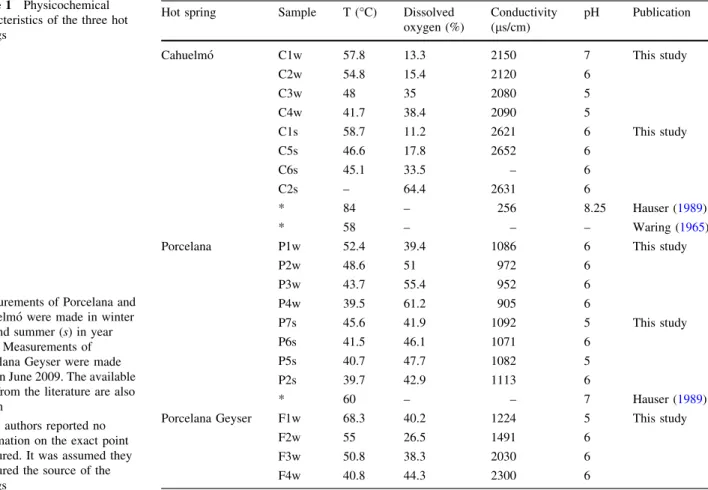
(4) 126 Table 1 Physicochemical characteristics of the three hot springs. Extremophiles (2013) 17:123–136. Hot spring. Sample. T (°C). Dissolved oxygen (%). Conductivity (ls/cm). pH. Publication. Cahuelmó. C1w. 57.8. 13.3. 2150. 7. This study. C2w. 54.8. 15.4. 2120. 6. C3w. 48. 35. 2080. 5. C4w. 41.7. 38.4. 2090. 5. C1s. 58.7. 11.2. 2621. 6. C5s. 46.6. 17.8. 2652. 6. C6s. 45.1. 33.5. –. 6. C2s. –. 64.4. 2631. 6. *. 84. –. 256. 8.25. Hauser (1989). *. 58. –. –. –. Waring (1965). P1w P2w. 52.4 48.6. 39.4 51. 1086 972. 6 6. This study. P3w. 43.7. 55.4. 952. 6. P4w. 39.5. 61.2. 905. 6. P7s. 45.6. 41.9. 1092. 5. P6s. 41.5. 46.1. 1071. 6. P5s. 40.7. 47.7. 1082. 5. P2s. 39.7. 42.9. 1113. 6. Porcelana. Measurements of Porcelana and Cahuelmó were made in winter (w) and summer (s) in year 2009. Measurements of Porcelana Geyser were made only in June 2009. The available data from the literature are also shown * The authors reported no information on the exact point measured. It was assumed they measured the source of the springs. Porcelana Geyser. This study. *. 60. –. –. 7. Hauser (1989). F1w. 68.3. 40.2. 1224. 5. This study. F2w. 55. 26.5. 1491. 6. F3w. 50.8. 38.3. 2030. 6. F4w. 40.8. 44.3. 2300. 6. in winter and summer in Cahuelmó and Porcelana Geyser. In Porcelana hot spring there was a difference of seven degrees between the two seasons. This difference in temperature was due to the presence of several sources at this place that are not always active and, thus, the source sampled in June could not be sampled in December. Porcelana Geyser showed the highest temperature (68.3 °C) followed by Cahuelmó (*58 °C) and Porcelana (45.6– 52.4 °C). In fact, temperature at the source in Porcelana Geyser was 99 °C, but it cooled down quickly before reaching the first microbial mats that was possible to sample. Temperature in Porcelana Hot Spring was higher during winter than in summer, with almost 7 °C difference in the hottest point sampled. Dissolved oxygen was lower in Cahuelmó (11.2–13.3 % saturation) than at the two other springs (around 40 % saturation). Hauser (1989) provided data such as temperature, conductivity, or pH for 20 different hot springs in the same area, with temperatures ranging from 18 to 84 °C, while Waring (1965) reported some data from 9 hot springs in the area, covering a temperature range between 22 and 60 °C. Table 1 summarizes the information from those studies, together with the data obtained in this study. In the case of Cahuelmó, Waring (1965) reported a. 123. This study. temperature essentially identical to that found in our study. However, in a study published two decades later, Hauser (1989) reported 84 °C in Cahuelmó. The temperature difference in these two decades is approximately 26 °C. Hauser (1989) also reported that the Porcelana Hot Spring was at 60 °C, 8 °C higher than that reported in our study. As mentioned above, the Porcelana Geyser had not been studied earlier. Conductivity and pH only showed minor differences between seasons and among sampling points. The pH was slightly acidic (around 5–6) or neutral. The pH reported by Hauser (1989) was also higher than the pH detected in this study in Cahuelmó and Porcelana (Table 1) and was measured by electrometric determination. On the contrary, conductivity was ten times higher in Cahuelmó in the present study than in Hauser (1989). Hauser reported no conductivity data for Porcelana. Conductivity was higher in Cahuelmó (above 2000 lS cm-1) than in the other two springs (around 1000 lS cm-1). Sulfate ranged between 0.43 and 7.89 mg L-1 in Cahuelmó, between 40.6 and 66.9 mg L-1 in Porcelana, and between 46.1 and 61.7 mg L-1 in Porcelana Geyser. Clearly, the two Porcelana springs were about 10 times richer in sulfate than Cahuelmó..
(5) Extremophiles (2013) 17:123–136. 127. These results indicate that these geothermal systems experience substantial environmental shifts, probably related to the variable volcanic activities in the area. Bacterial assemblages Comparison among bacterial communities at the three hot springs A dendrogram comparing DGGE fingerprints from all samples showed differences among all three hot springs (\50 % Bray–Curtis similarity). All samples from Porcelana Geyser formed a separate cluster, higher than 55 % Bray–Curtis similarity. Porcelana Hot Spring winter samples also formed a separate cluster (Bray–Curtis index larger than 55 %). However, the Porcelana Hot Spring samples collected in summer were more different from each other, in particular points P2s and P5s, within this spring and season (Fig. 2a). Cahuelmó samples showed the largest differences with temperature and season, resulting in a complex pattern of clusters when analyzing its DGGE fingerprints. This is probably due to human influence, since Cahuelmó is the only hot spring of the three used by tourists. Even though the human presence is very low, and only in summer, tourists change the water courses to take hot baths in pools nearby, disrupting the stability and development of microbial communities in the mats.. All three hot springs showed a dominance of Phyla Cyanobacteria (23.5 % on average), Bacteroidetes (21.5 %), and the Order Thermales (19.6 %) (Fig. 2b). Combined they accounted for 71 % of total band intensity in Porcelana Geyser, 58 % in Porcelana, and 65 % in Cahuelmó. The remaining groups detected, Acidobacteria, Green Non-sulfur Bacteria, and Beta-, Gamma-, and Epsilon Proteobacteria, were present in small amounts and not in all samples. In general, the retrieved sequences had a higher phylogenetic resemblance with uncultured members of these phyla rather than with cultured species. As expected, most of the closest relatives in GenBank had originated in high-temperature environments. In Porcelana Geyser, only 3.7 % of the total band intensity could not be assigned to any group. The percentage of undetermined band intensity in Porcelana was 32.5 % in winter and 22.3 % in summer. In Cahuelmó percentages were 16.1 % in winter and 8.7 % in summer (Fig. 2b). Phylum Cyanobacteria Cyanobacteria are usually the dominant phototrophic organisms in non-acidic hot environments (Ferris et al. 1996; Ward et al. 1998; Roeselers et al. 2007; Klatt et al. 2011; Miller et al. 2007). In our study, the presence or. 0. A. 20. Similarity. Fig. 2 a Dendrogram comparing all samples according to the relative band intensities of the different bacterial groups. The vertical axis is shown as the Bray–Curtis similarity distances. b Relative composition of each bacterial assemblage based on 16S ribosomal RNA DGGE band intensities. The letters w and s in sample code indicate winter and summer, respectively. Temperature (°C) appears below sampled points. Bacterial community composition at the three hot springs. 40 60 80. B. 123.
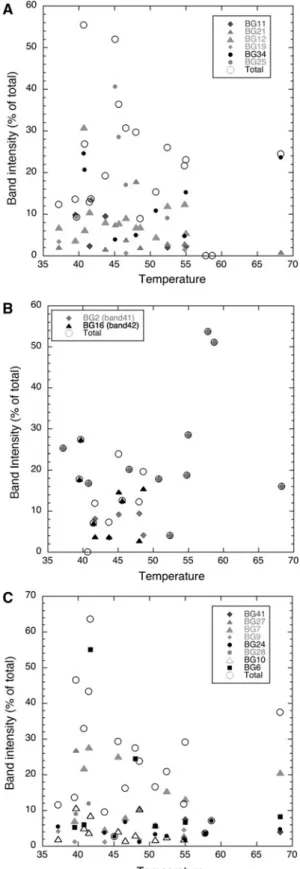
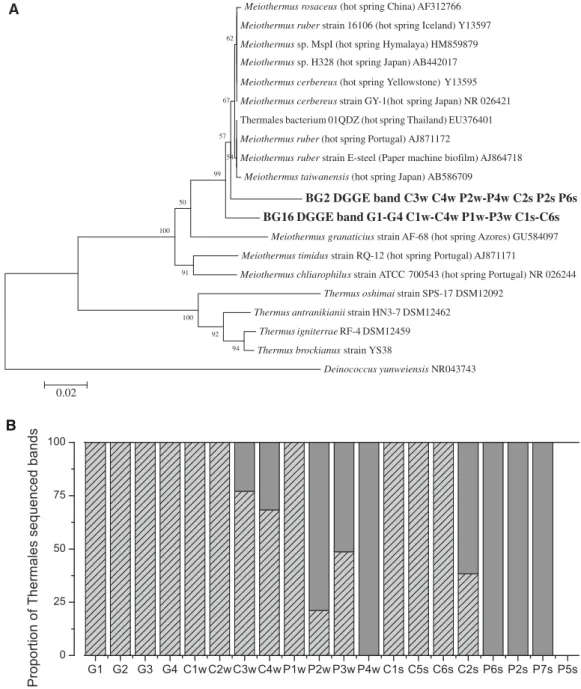
(6) 128. Extremophiles (2013) 17:123–136. dominance of Cyanobacteria was confirmed in all samples except for P5s at Porcelana Hot Spring. This sample had the largest percent of unaccounted band intensity (46 %) and only Bacteroidetes sequences could be retrieved (see below). Perhaps the absence of Cyanobacteria sequences was related to this large percent of unidentified DGGE bands (Fig. 2b). On average, Cyanobacteria accounted for 29 % of total band intensity in Porcelana Geyser. In Cahuelmó their contribution decreased from 26.6 % in winter to 9.3 % in summer. On the contrary, in Porcelana, it increased from 16.9 % in winter to 29.8 % in summer, similar to Porcelana Geyser. Our analysis of 16S rRNA genes with general bacterial primers detected several bands affiliated to Cyanobacteria which were separated in two major groups: filamentous heterocystous (HCYA) and filamentous non-heterocystous. A. 20 40 60 80. C. 123. 0. B. Similarit y. Fig. 3 a Proportion of filamentous heterocystous and non-heterocystous cyanobacteria in each sample according to their relative band intensity in 16S rRNA-DGGE fingerprints obtained with general bacterial primers. Temperature (°C) appears below the sampled points. b Dendrogram comparing all samples according to the relative band intensities of the different cyanobacterial groups. The vertical axis is shown as the Bray–Curtis similarity distances. c Relative composition of each cyanobacterial assemblage based on DGGE band intensities with specific cyanobacterial primers. The letters w and s in sample code indicate winter and summer, respectively. cyanobacteria (NHCYA) (Fig. 3a). NHCYA were present in all samples, while HCYA were absent from six samples, five from Cahuelmó and one from Porcelana Hot Spring. Cyanobacterial specific primers were used to analyze these important organisms in more detail. Unicellular cyanobacteria not retrieved with the general bacterial primers were found using the specific primers. These unicellular Synechococcus-type sequences only appeared in samples C1w and C5s from Cahuelmó Hot Spring (Fig. 3c). In general, when using the specific primers, we were rather successful in identifying most of the important DGGE bands present at the Porcelana Geyser and Hot Spring fingerprints, with an average of only 0.4 and 4 % of the total bands not identified, respectively. In Cahuelmó, however, a substantial percent (29 % approx.) could not be.
(7) Extremophiles (2013) 17:123–136. identified, mainly due to sample C5s (Fig. 3c) that showed difficulties in amplification and further sequencing of the extracted bands. As expected, most bands retrieved belonged to the filamentous cyanobacteria, either HCYA (four bands) or NHCYA (nine bands). The former fit into two different clusters: Mastigocladus and Calothrix (Fig. 4a). In turn, the NHCYA could be placed in three clusters that we have named LPP-I, LPP-II, and LPP-III (Fig. 4b). One of the most important bands in all hot springs, CYA22, together with other two bands (CYA27 and CYA46), were affiliated with the genus Mastigocladus, a typical thermophylic, branching, heterocyst-containing cyanobacterium of the order Stigonematales. Band CYA22 accounted for the highest band intensity, particularly in Porcelana Geyser and Hot Spring in winter. It was present in low abundance in Cahuelmó and showed intermediate values in Porcelana Hot Spring in summer. Band CYA15 was closely affiliated with Calothrix spp., another HCYA (Fig. 4a). Nine bands were related to cyanobacteria of the filamentous non-heterocystous Order Oscillatoriales. Many of these were members of the thin filamentous genera Leptolyngbya and Oscillatoria, which lack distinctive morphology and have a poorly resolved taxonomy (Litvaitis 2002). Bands CYA21, CYA20, and CYA28 were widespread among all three hot springs and accounted for large percentages of the total band intensity (over 40 %) in Porcelana Hot Spring in winter and Porcelana Geyser. However, none of them were present in all samples. The other bands corresponded to ill-defined environmental clones from diverse hot spring mats all over the world, and always occurred in low percentages (Figs. 3c, 4b). At the highest temperature of 68.3 °C at Porcelana Geyser mats, the Mastigocladus-like band accounted for 20.6 % of the total band intensity, and two Oscillatorialesrelated bands accounted together for 13 %. The temperature at Porcelana Geyser is above the currently accepted upper limit for filamentous cyanobacteria, which is around 55–62 °C (Seckbach 2007). Mastigocladus is a genus commonly found in hot environments such as Yellowstone, USA (Miller et al. 2007, 2009), Costa Rica (Finsinger et al. 2008), Italy, Iceland, New Zealand, Russia, and Chile (Miller et al. 2007), among others. As described by Miller et al. (2007), the presence of Mastigocladus in such distant places, and the high resemblance of sequences could be related to a recent dispersal event, and with time, new strains or even species might arise in each of these biogeographical islands. A cluster analysis with all DGGE bands retrieved (including the non taxonomically identified ones) separated Cahuelmó samples from those of Porcelana and Porcelana Geyser with only a few exceptions (Fig. 3b). It appears,. 129. therefore, that the cyanobacterial assemblages do not follow the same geographical distribution as the total bacterial assemblages (Fig. 2a). In this case, geographical proximity might be the reason for the closer clustering of Porcelana Geyser and Porcelana Hot Spring. When the dendrogram is compared with the percent composition of each sample in Fig. 3c, it seems that the significant presence of members of the Mastigocladus clade determines the clustering together of most Porcelana Hot Spring and all Porcelana Geyser samples. This clade was absent from most Cahuelmó samples. In fact, when this group was removed from the analysis, the similarity index between all samples decreased almost 20 % between Porcelana Hot Spring and geyser, and 6 % between both springs and Cahuelmó. This was already the case with our general bacterial primers analysis. The cluster formed by four Cahuelmó samples and sample P2s from Porcelana Hot Spring seemed to be determined by the massive presence of members of other cyanobacteria, the Calothrix clade. Therefore, among the HCYA, the Mastigocladus clade predominated in Porcelana Geyser and Hot Spring, while the Calothrix clade did so in Cahuelmó, although not in all samples. Thus, different heterocystous cyanobacteria were dominant in different springs. A possible explanation for this finding could be the origin of both genera. While Calothrix has both freshwater and marine species and is not reported as a thermophylic genus, Mastigocladus is a typical thermophylic genus that has only been reported in freshwater hot springs. As mentioned, Cahuelmó Hot Spring is in close proximity to the fjord waters, and the mats are partially submerged in marine or brackish waters during high tides. Independently of the primer sets used, Mastigocladusrelated sequences were detected in 13 samples and were absent in five samples (all from Cahuelmó, three in winter and two in summer). The only discrepancies between both sets of primers were found in samples P2s and C5s. In sample C2w, the relative representation of this cluster was close to 50 % with general bacterial primers but only a very small percent with the cyanobacterial primers. Both samples C5s and C2w had a large proportion of the band intensity unidentified with the cyanobacterial primers, and this could be the reason for the discrepancies. We do not have an explanation for the case of sample P2s. Order Thermales The Order Thermales is commonly found in hot environments (Brock 1997). A Thermus species was detected for the first time in a hot spring in Yellowstone, USA by Brock and Freeze (1969). The heterotrophic nature of this group places them as consumers of the organic matter. 123.
(8) 130. Extremophiles (2013) 17:123–136 CYA27 DGGE Band. G4 P1-P4w C6s P6s P7s HE979747. A. CYA22 DGGE Band. G1-G4 C2w P1-P4w C6s P6s P7s HE979748 Fischerella thermalis AB075987 Mastigocladus laminosus CCMEE5193 (hot spring Chile Puyehue) EF566844 Mastigocladus laminosus CCMEE5319 (hot spring Guatemala) EF566860 51. Mastigocladus laminosus CCMEE5318 (hot spring El salvador) EF566862 Fischerella sp. RV14 DQ786173. Clade I Mastigocladus laminosus. Fischerella sp. RV14 DQ786172 Fischerella sp. MV11 DQ786171 72. Fischerella sp. MV11 DQ786170 Fischerella sp. MV9 DQ786169 68. Mastigocladus laminosus CCMEE5320 (hot spring Iceland) EF566837 Mastigocladus laminosus CCMEE5331 (hot spring Japan) EF566864. 63. Mastigocladus laminosus CCMEE5202 (hot spring New Zealand) EF566846 86. CYA46 DGGE Band. P1-P4w P6s P2s P7s P5s HE979746 Mastigocladus laminosus CCMEE5272 (hot spring Portugal) EF566852. 63 99. Mastigocladus laminosus (hot spring Greenland) DQ431003. 26. Uncultured cyanobacterium (hot spring Phillipines) AY236480. Clade II Calothrix spp.. 82. CYA15 DGGE Band. G3 C3w C4w P1w C1s C2s P6s P2s P7s Calothrix sp. (freshwater India) AJ133164. 52. Calothrix sp. PCC 7715 (hot spring France) AM230701. 85 99. Clade III Calothrix spp.. Calothrix sp. X99213 Gloeobacter violaceus AY768399. 0.02. B. 100. 51. Cyanobacterium enrichment culture clone 3 RT 3.5.8 C04-T7 JQ310422 Leptolyngbya frigida ANT.LMA.1 AY493573. 100. Leptolyngbya sp. 1T12c FR798935 Uncultured Oscillatoriales cyanobacterium clone QB46 FJ790618. 39. Leptolyngbya sp. MMG-1 FJ839352. 25. CYA13 DGGE band G1 G2 P2s CYA20 DGGE band G3 G4 P2-P4w P2s. 20 11. Uncultured Oscillatoriales cyanobacterium clone G11-00YK9 EU376443 42. 100. 99. CYA21 DGGE band G1 G2 G4 C1w P1-P4wC5s 92 CYA16 DGGE band C2w C6s C2s CYA28 DGGE band G1 G2 G4 P1-P4w. Clade LPP I. Uncultured cyanobacterium clone Alchichica AQ1 1 1C 09 JN825340. 22 75. Leptolyngbya sp. DQ431002. CYA14 DGGE band C2s CYA50 DGGE band C3w C4w C2s. 99. 68. Uncultured cyanobacterium EF429514. 100 88 63. Uncultured bacterium clone Drod-B36 FJ206777 Cyanobacterium sp. L04709. CYA12 DGGE band. P7s P5 s Limnothrix redekei EU078512. 96 10 0. Clade LPP II. Limnothrix sp. CENA EF088338. CYA48 DGGE band. P2w C2s Oscillatoria neglecta AB003168. 97. Plectonema sp. AY430152. 100. Clade LPP III. Leptolyngbya nodulosa EF122600. 60 47. 100. Leptolyngbya sp. AJ639893. Clade Gleiterinema spp.. 5. Fig. 4 Phylogenetic reconstruction including the partial 16S rRNA gene sequences obtained by DGGE bands of a cyanobacterial populations with heterocysts; b cyanobacterial populations without heterocysts, denominated Leptolyngbya, Phormidium, and Plectonema (LPP). 123. group. The 16S rRNA gene sequences used to generate the reconstructions were obtained with specific cyanobacterial primers. Samples where every band was present are indicated after the name of the band.
(9) Extremophiles (2013) 17:123–136. produced by Cyanobacteria and other phototrophic, as well as lithotrophic, primary producers in these extreme ecosystems. This order was well represented in most of our samples, but its contribution varied significantly among sites. Its average contribution to the total band intensity was 20.6 %, ranging between 4 and 53.7 % with one exception: no Thermales sequences could be retrieved from sample P5s. This sample was already mentioned in the section on Cyanobacteria as it had a large percent of undetermined bands (Fig. 2b). The presence of Thermales decreased from 24.1 and 30.1 % in Cahuelmó (in winter and summer, respectively) to 19.8 % in Porcelana Geyser, and down to 12 % in Porcelana in both winter and summer. Considering each sample individually, the percent contribution of Thermales ranged between 4 and 26 % throughout the temperature gradient (except the above mentioned sample P5 s). Two points with temperatures between 57 and 59 °C showed the highest contributions around 52 % (Fig. 5b). If this can be taken as an indication of the temperature optima of the Thermales present in these springs, it would coincide with the optimum found for members of the genus Meiothermus (50–65 °C in different species, Nobre et al. 1996). The genus Meiothermus was formerly included in the genus Thermus (Nobre et al. 1996), but the former has lower temperature optima, and the two genera use different niches (Chen et al. 2002). The lower percentage of Thermales found at the highest temperature (16 % at 68.3 °C) suggests that no representatives of the genus Thermus were present (with optimal temperatures around 70–75 °C, Nobre et al. 1996). In fact, the two DGGE bands that could be assigned to the Thermales (bands BG2 and BG16) clustered with the genus Meiothermus (Fig. 6a). Their closest relatives were Meiothermus ruber and an environmental sequence recovered from a hot spring in Thailand (Portillo et al. 2009). Band BG16 was absent from samples with temperatures above 50 °C (Fig. 5b). This band was absent from Porcelana Geyser, increased with decreasing temperature in Cahuelmó (up to 30 % in winter, and to almost 60 % in summer), and was more represented in Porcelana not only at temperatures around 40 °C, but also at 45 °C in sample P7s (Fig. 6b). Band BG2, on the other hand, thrived throughout the temperature gradient, but reached its highest relative abundance above 55 °C. This was absent from Porcelana in summer and was less important than BG16 in winter, and its importance decreased with decreasing temperature in Cahuelmó. Thus, it appears that some other environmental parameter besides temperature was influencing the distribution of these two possible ecotypes.. 131. Fig. 5 a Relative abundance of the cyanobacterial affiliated bands with respect to temperature. b Relative abundance of the Thermales affiliated bands with respect to temperature. c Relative abundance of the Bacteroidetes affiliated bands with respect to temperature. 123.
(10) 132. Extremophiles (2013) 17:123–136 Meiothermus rosaceus (hot spring China) AF312766. A. Meiothermus ruber strain 16106 (hot spring Iceland) Y13597 62. Meiothermus sp. MspI (hot spring Hymalaya) HM859879 Meiothermus sp. H328 (hot spring Japan) AB442017 Meiothermus cerbereus (hot spring Yellowstone) Y13595 Meiothermus cerbereus strain GY-1(hot spring Japan) NR 026421. 67. Thermales bacterium 01QDZ (hot spring Thailand) EU376401 57. Meiothermus ruber (hot spring Portugal) AJ871172 54. 99. Meiothermus ruber strain E-steel (Paper machine biofilm) AJ864718 Meiothermus taiwanensis (hot spring Japan) AB586709. BG2 DGGE band C3w C4w P2w-P4w C2s P2s P6s P7s BG16 DGGE band G1-G4 C1w-C4w P1w-P3w C1s-C6s. 50. 100. Meiothermus granaticius strain AF-68 (hot spring Azores) GU584097 Meiothermus timidus strain RQ-12 (hot spring Portugal) AJ871171 91. Meiothermus chliarophilus strain ATCC 700543 (hot spring Portugal) NR 026244 Thermus oshimai strain SPS-17 DSM12092 Thermus antranikianii strain HN3-7 DSM12462. 100. Thermus igniterrae RF-4 DSM12459. 92 94. Thermus brockianus strain YS38 Deinococcus yunweiensis NR043743. 0.02. B. Fig. 6 a Thermales phylogenetic reconstruction including sequences retrieved from partial 16S rRNA sequences obtained from DGGE bands using universal bacterial primers. Each sequence includes the. sites where they were found. b Percent of relative contributions in each sample of the two Thermales bands identified in the DGGE analysis using the universal bacterial primers. Phylum Bacteroidetes. by Cyanobacteria and other autotrophic organisms such as the green non-sulfur bacteria from the genus Chloroflexus, also detected in the study. Class Bacteroidetes was a very well represented group in most of our samples, accounting for 22.4 % of the total band intensity in Porcelana Geyser, 15.8–22.7 % in Cahuelmó (winter and summer, respectively) and 16.9–28.5 % in Porcelana (winter and summer, respectively). No relationship with temperature was apparent for any of the clades retrieved (Fig. 5c). This group of bacteria. The class Bacteroidetes is a heterotrophic bacterial group not associated specifically with hot springs. Nevertheless, in the past decade, some studies have reported Bacteroidetes as an important group in hot springs from Thailand (Kanokratana et al. 2004; Portillo et al. 2009). The high diversity of species in this group also includes a wide variety of heterotrophic metabolisms, representing potentially important consumers of the organic matter produced. 123.
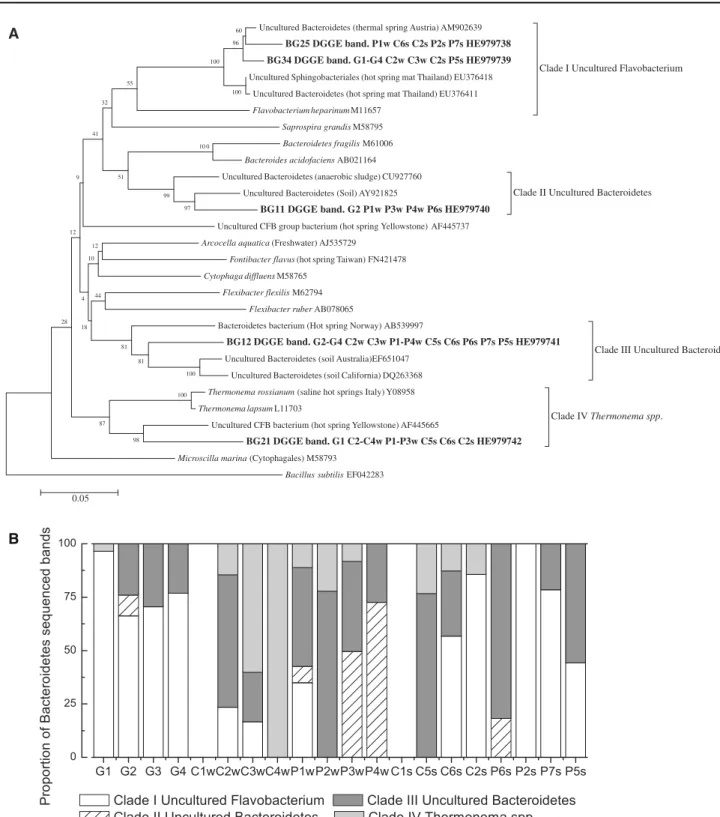
(11) Extremophiles (2013) 17:123–136. 133. A. 60 96. Uncultured Bacteroidetes (thermal spring Austria) AM902639. BG25 DGGE band. P1w C6s C2s P2s P7s HE979738 BG34 DGGE band. G1-G4 C2w C3w C2s P5s HE979739. 100. Clade I Uncultured Flavobacterium. Uncultured Sphingobacteriales (hot spring mat Thailand) EU376418. 55 100. Uncultured Bacteroidetes (hot spring mat Thailand) EU376411. 32. Flavobacterium heparinum M11657 Saprospira grandis M58795. 41 10 0. Bacteroidetes fragilis M61006 Bacteroides acidofaciens AB021164 Uncultured Bacteroidetes (anaerobic sludge) CU927760. 51. 9. Uncultured Bacteroidetes (Soil) AY921825. 99 97. Clade II Uncultured Bacteroidetes. BG11 DGGE band. G2 P1w P3w P4w P6s HE979740 Uncultured CFB group bacterium (hot spring Yellowstone) AF445737. 12. Arcocella aquatica (Freshwater) AJ535729. 12. Fontibacter flavus (hot spring Taiwan) FN421478. 10. Cytophaga diffluens M58765 4. Flexibacter flexilis M62794. 44. Flexibacter ruber AB078065 28. Bacteroidetes bacterium (Hot spring Norway) AB539997. 18. BG12 DGGE band. G2-G4 C2w C3w P1-P4w C5s C6s P6s P7s P5s HE979741. 81. 100 100. Uncultured Bacteroidetes (soil California) DQ263368 Thermonema rossianum (saline hot springs Italy) Y08958 Thermonema lapsum L11703. 87. Clade III Uncultured Bacteroidetes. Uncultured Bacteroidetes (soil Australia)EF651047. 81. Clade IV Thermonema spp.. Uncultured CFB bacterium (hot spring Yellowstone) AF445665 98. BG21 DGGE band. G1 C2-C4w P1-P3w C5s C6s C2s HE979742 Microscilla marina (Cytophagales) M58793 Bacillus subtilis EF042283. 0.05. B. Fig. 7 a Bacteroidetes phylogenetic reconstruction including partial 16S rRNA sequences retrieved from DGGE bands using universal bacterial primers. Each sequence includes the sites where they were. found. b Percent of relative contributions of the four clades of Bacteroidetes retrieved in the different samples. was absent only from the two hottest points, around 58 °C, in Cahuelmó (Fig. 2b). Since Bacteroidetes were present at higher temperatures in Porcelana Geyser, clearly high temperature was not the reason for this absence in Cahuelmó. In the other Cahuelmó samples the contribution of. Bacteroidetes ranged between 9 and 55 %. In both Porcelana and Cahuelmó, their contribution seemed to increase with decreasing temperature in summer, but not in winter. It is worth noting that the temperature range was very similar in both seasons (Table 1).. 123.
(12) 134. Five discrete bands provided good sequences related to Bacteroidetes and were incorporated into the phylogenetic reconstruction of this class (Fig. 7a). They appeared in four different clusters, named I to IV for the present discussion. The relative band intensity contributions to the total Bacteroidetes can be seen in Fig. 7b. Clade I was the most abundant in Porcelana Geyser and in the summer samples from both Cahuelmó and Porcelana Hot Spring (Fig. 7a). The two bands in this cluster were related to sequences from hot springs in Thailand as their closest relatives (Portillo et al. 2009). Clade II was related to Bacteroidetes sequences from soil and was detected in low-temperature samples from Porcelana Hot Spring, and in one sample from Porcelana Geyser. Clade III, on the other hand, was significant in almost all samples. It was related to the Bacteroidetes bacterium sequence AB539997, with over 95 % of similarity. Clade IV was represented by only one band associated with the genus Thermonema and its closest relative was a sequence from a saline hot spring in Naples, Italy (Tenreiro et al. 1997) (Fig. 7a). This population was well represented in Cahuelmó, especially in winter, and it was present also in Porcelana (winter only). The Thermonema isolate sequence reported by Tenreiro et al. (1997) was slightly halophilic, which could explain its presence in Cahuelmó, as it is the only hot spring studied subjected to seawater influence. Other bacterial groups Acidobacteria, Green Non-sulfur Bacteria, and Beta-, Gamma-, and Epsilon Proteobacteria, were detected in small relative abundances and not in all the samples investigated in this study. A high diversity of Proteobacteria and Acidobacteria members have been also reported in hot environments from volcanic areas in the Canary Islands (Portillo and Gonzalez 2008), and in western Thailand (Portillo et al. 2009). Phototrophic green nonsulfur bacteria Chloroflexi were also well represented in tropical hot spring from the island of Luzon, in the Philippines (Lacap et al. 2007). The metabolisms found among these bacterial groups in hot springs are diverse, from autotrophic photosynthetic Chloroflexi (Lacap et al. 2007) and chemolithotrophic epsilon-proteobacteria (Takai et al. 2005) to anaerobic heterotrophs, which have been shown to be abundant in hot springs well above the temperature limit for photosynthesis (Kristjansson et al. 1985). The three hot springs in this study have different surrounding environmental conditions, and the diversity of organic substrates must be causing differences in the development of the heterotrophic fraction of microbial communities, as shown in our fingerprinting analyses (Figs. 2b, 8). Altogether, the overall similarity found in bacterial communities from Porcelana Hot Spring and Porcelana Geyser. 123. Extremophiles (2013) 17:123–136 P5s. Bray– Curtis similarity 2D stress: 0.15 40%. P3w. P4w. 50% 60%. P6s. G1G3G4 G2. C1w. P1wP2w P2s. 65%. P7s C1s. C6s C5s. C2w C2s C3w. C4w. Fig. 8 Multidimensional scale analysis of all samples by Bray– Curtis similarity distances. Similarity distances between samples are shown in circles. microbial mats and the differences of both with Cahuelmó (Fig. 8) suggest the influence of geographical distance as well as differences in the geological substrate in these hot spring environments. Additionally, the influence of seawater in Cahuelmó hot sprint, although with low salt concentration (3 %), might also affect bacterial diversity, for example, in the case of the slightly halophilic Thermonema spp. Small seasonal variations in bacterial communities were detected in Porcelana Hot Spring (Fig. 8). Porcelana Hot Spring samples were clustered with over 40 % similarity in both seasons except for samples P5s and P2s, both from summer, although this hot spring showed a variation of 7 °C in the hottest points (P1w and P7s) between winter and summer. On the other hand, Cahuelmó Hot Spring did not show a temperature variation between winter and summer. No clear similarities were observed among samples in this hot spring, except for samples C1s and C1w, with the same temperature, which showed over 50 % similarity. As mentioned before, Cahuelmó Hot Spring is the only hot spring of the three that experience to some extent human intervention, except for points C1s and C1w (source of the spring) where the temperature is so high that remains free of attention by tourists. Our results suggest that the temperature at these hot springs is differently affected by seasons. According to the results retrieved, the temperature would be the main—but maybe not the only—environmental factor influencing the bacterial community structure and composition in the microbial mats present in these ecosystems. Also, the fingerprint similarity between Porcelana Hot Spring and Geyser and the dissimilarity of both with Cahuelmó Hot Spring may be due to geographical distance and rock-substrate differences. As the economical value of these hot springs is being assessed in terms of ability to attract tourists, it is now very important to document the biodiversity of these biologically unknown environments and to recognize other potential values such as their genetic resources for the developing field.
(13) Extremophiles (2013) 17:123–136. of biotechnology. Thus, a more sustainable management can be achieved in the coming years for these hot springs in Northern Patagonia. Acknowledgments The authors are thankful for the sponsorship given by Fundación Huinay (Huinay Scientific Field Station) and their staff, who made possible the visits to the hot springs. We thank Boris Hernández for guiding us to Porcelana Geyser. This is the publication number 63 of Fundación Huinay. Special thanks to Rosa Soto and Vannesa Balagué. This work was supported by the project TERMOCHILE (CGL2009-06449-E/BOS), Spanish Ministry of Science and Innovation, and project FONDECYT n8 1110696 funded by CONICYT, Chile.. References Aguilera Á, Souza-Egipsy V, González-Toril E, Rendueles O, Amils R (2010) Eukaryotic microbial diversity of phototrophic microbial mats in two Icelandic geothermal hot springs. Int Microbiol 13:21–32 Arroyo MTK, Marquet PA, Marticorena C, Simonetti JA, Cavieres L, Squeo F, Rozzi R (2004) Chilean winter rainfall-Valdivian forests. In: Mittermeier RA, Gil PR, Hoffmann M, Pilgrim J, Brooks T, Mittermeier CG, da Lamoreux J, Fonseca GAB (eds) Hotspots revisited: Earth’s biologically wealthiest and most threatened ecosystems. CEMEX, México DF, pp 99–103 Bohorquez LC, Delgado-Serrano L, López G, Osorio-Forero C, Klepac-Ceraj V, Kolter R, Junca H, Baena S, Zambrano MM (2012) In-depth characterization via complementing cultureindependent approaches of the microbial community in an acidic hot spring of the Colombian Andes. Microbial Ecol 63:103–115 Brock TD (1997) The value of basic research: discovery of Thermus aquaticus and other extreme thermophiles. Genetics 146:1207– 1210 Brock TD, Freeze H (1969) Thermus aquaticus gen. n. and sp. n., a non-sporulating extreme thermophile. J Bacteriol 98:289–297 Chen M, Lin G, Lin Y, Tsay S (2002) Meiothermus taiwanensis sp. nov., a novel filamentous, thermophilic species isolated in Taiwan. Int J Syst Evol Microbiol 52:1647–1654 Dı́ez B, Bauer K, Bergman B (2007) Epilithic cyanobacterial communities of a marine tropical beach rock (Heron Island, Great Barrier Reef): diversity and diazotrophy. Appl Environ Microbiol 73(11):3656–3668 Duhart P, Crignola P, Ordoñez A, Muñoz J (2000) Franjas metalogénicas en Chiloé Continental (41°–44°S). In: IX Congreso Geológico Chileno, Actas, Barcelona, pp 1–5 Dunckel AE, Cardenas MB, Sawyer AH, Bennett PC (2009) Highresolution in situ thermal imaging of microbial mats at El Tatio Geyser, Chile shows coupling between community color and temperature. Geophys Res Lett 36:1–5 Fernandez-Turiel JL, Garcia-Valles M, Gimeno-Torrente D, Saavedra-Alonso J, Martinez-Manent S (2005) The hot spring and geyser sinters of El Tatio, Northern Chile. Sediment Geol 180:125–147 Ferris MJ, Palenik B (1998) Niche adaptation in ocean cyanobacteria. Nature 396:226–228 Ferris MJ, Ward DM (1997) Seasonal distributions of dominant 16S rRNA-defined populations in a hot spring microbial mat examined by denaturing gradient gel electrophoresis. Appl Environ Microbiol 63:1375–1381 Ferris MJ, Muyzer G, Ward DM (1996) Denaturing gradient gel electrophoresis profiles of 16S rRNA-defined populations inhabiting a hot spring microbial mat community. Appl Environ Microbiol 62:340–346. 135 Ferris MJ, Nold SC, Revsbech NP, Ward DM (1997) Population structure and physiological changes within a hot spring microbial mat community following disturbance. Appl Environ Microbiol 63:1367–1374 Finsinger K, Scholz I, Serrano A, Morales S, Uribe-Lorio L, Mora M, Sittenfeld A, Weckesser J, Hess WR (2008) Characterization of true-branching cyanobacteria from geothermal sites and hot springs of Costa Rica. Environ Microbiol 10:460–473 Fortey R, Pankhurts R, Hervé F (1992) Devonian trilobites at buill, Chile (42° S). Rev Geol Chile 19:133–139 Glennon JA, Pfaff RM (2003) The extraordinary thermal activity of El Tatio Geyser Field, Antofagasta region, Chile. GOSA Trans 8:31–77 Hauser A (1989) Fuentes termales y minerales en torno a la carretera Austral, Regiones X-XI, Chile. Rev Geol Chile 16(2):229–239 Jones B, Renaut RW (1997) Formation of silica oncoids around geysers and hot springs at El Tatio, Northern Chile. Sedimentology 44:287–304 Kanokratana P, Chanapan S, Pootanakit K, Eurwilaichitr L (2004) Diversity and abundance of bacteria and archaea in the Bor Khlueng hot spring in Thailand. J Basic Microbiol 44(6): 430–444 Klatt CG, Wood JM, Rusch DB, Bateson MM, Hamamura N, Heidelberg JF, Grossman AR, Bhaya D, Cohan FM, Kühl M, Bryant DA, Ward DM (2011) Community ecology of hot spring cyanobacterial mats: predominant populations and their functional potential. ISME J 5:1262–1278 Kristjansson JK, Ingason A, Alfredsson GA (1985) Isolation of thermophilic obligately autotrophic hydrogen-oxidizing bacteria, similar to Hydrogenobacter thermophilus, from Icelandic hot springs. Arch Microbiol 140:321–325 Lacap DC, Barraquio W, Pointing SB (2007) Thermophilic microbial mats in a tropical geothermal location display pronounced seasonal changes but appear resilient to stochastic disturbance. Environ Microbiol 9:3065–3076 Lahsen A (1988) Chilean geothermal resources and their possible utilization. Geothermics 17:401–410 Lahsen A, Muñoz N, Parada MA (2010) Geothermal development in Chile. In: Proceedings World Geothermal Congress 2010, Bali, pp 1–7 Litvaitis MK (2002) A molecular test of cyanobacterial phylogeny: inferences from constraint analyses. Hydrobiologia 468:135–145 Martiny JBH, Bohannan BJM, Brown JH, Colwell RK, Fuhrman JA, Green JL, Horner-Devine MC et al (2006) Microbial biogeography: putting microorganisms on the map. Nature 4:102–112 Miller SR, Castenholz RW, Pedersen D (2007) Phylogeography of the thermophilic cyanobacterium Mastigocladus laminosus. Appl Environ Microbiol 73:4751–4759 Miller SR, Williams C, Strong AL, Carvey D (2009) Ecological specialization in a spatially structured population of the thermophilic cyanobacterium Mastigocladus laminosus. Appl Environ Microbiol 75:729–734 Muyzer G, de Waal EC, Uitterlinden AG (1993) Profiling of complex microbial populations by denaturing gradient gel electrophoresis analysis of polymerase chain reaction-amplified genes coding for 16S rRNA. Appl Environ Microbiol 59:695–700 Muyzer G, Teske A, Wirsen CO, Jannasch HW (1995) Phylogenetic relationships of Thiomicrospira species and their identification in deep-sea hydrothermal vent samples by denaturing gradient gel electrophoresis of 16S rDNA fragments. Arch Microbiol 164: 165–172 Nobre MF, Trüper HG, Da Costa MS (1996) Transfer of Thermus ruber (Loginova et al. 1984), Thermus silvanus (Tenreiro et al. 1995), and Thermus chiliarophilus (Tenreiro et al. 1995) to Meiothermus gen. nov. as Meiothermus ruber comb. nov., Meiothermus silvanus comb. nov., and Meiothermus. 123.
(14) 136 chilarophilus comb. nov., respectively, and emendation of the genus Thermus. Int J Syst Bacteriol 56:604–606 Nocker A, Burr M, Camper AK (2007) Genotypic microbial community profiling: a critical technical review. Microb Ecol 54:276–289 Nold SC, Ward DM (1996) Photosynthate partitioning and fermentation in hot spring microbial mat communities. Appl Environ Microbiol 62:4598–4607 Nübel U, Garcia-Pichel F, Muyzer G (1997) PCR primers to amplify 16S rRNA genes from cyanobacteria. Appl Environ Microbiol 63:3327–3332 Papke RT, Ramsing NB, Bateson MM, Ward DM (2003) Geographical isolation in hot spring cyanobacteria. Environ Microbiol 5(8):650–659 Perevalova AA, Kolganova TV, Birkeland NK, Schleper C, BonchOsmolovskaya EA, Lebedinsky AV (2008) Distribution of Crenarchaeota representatives in terrestrial hot springs of Russia and Iceland. Appl Environ Microbiol 74:7620–7628 Phoenix VR, Bennett PC, Engel AS, Tyler SW, Ferris FG (2006) Chilean high-altitude hot-spring sinters: a model system for UV screening mechanisms by early Precambrian cyanobacteria. Geobiology 4:15–28 Portillo MC, Gonzalez JM (2008) Microbial communities and immigration in volcanic environments of Canary Islands (Spain). Naturwissenschaften 95:307–315 Portillo MC, Sririn V, Kanoksilapatham W, Gonzalez JM (2009) Differential microbial communities in hot spring mats from Western Thailand. Extremophiles 13:321–331 Roeselers G, Norris TB, Castenholz RW, Rysgaard S, Glud RN, Kühl M, Muyzer G (2007) Diversity of phototrophic bacteria in microbial mats from Arctic hot springs (Greenland). Environ Microbiol 9:26–38 Schauer M, Balagué V, Pedrós-Alió C, Massana R (2003) Seasonal changes in the taxonomic composition of bacterioplankton in a coastal oligotrophic system. Aquat Microb Ecol 31:163–174 Seckbach J (ed) (2007) Algae and cyanobacteria in extreme environments. Springer, Dordrecht Smith-Ramı́rez C (2004) The Chilean coastal range: a vanishing center of biodiversity and endemism in South American temperate rainforests. Biodivers Conserv 13:373–393. 123. Extremophiles (2013) 17:123–136 Sompong U, Hawkins PR, Besley C, Peerapornpisal Y (2005) The distribution of cyanobacteria across physical and chemical gradients in hot springs in Northern Thailand. FEMS Microb Ecol 52:365–376 Stal LJ, Caumette P (1994) Microbial mats: structure, development and environmental significance. Springer, Berlin Takai K, Campbell BJ, Cary SC, Suzuki M, Oida H, Nunoura T, Hirayama H, Nakagawa S, Suzuki Y, Inagaki F, Horikoshi K (2005) Enzymatic and genetic characterization of carbon and energy metabolisms by deep-sea hydrothermal chemolithoautotrophic isolates of Epsilonproteobacteria. Appl Environ Microbiol 71:7310–7320 Tassi F, Aguilera F, Darrah T, Vaselli O, Capaccioni B, Poreda RJ, Delgado-Huertas A (2010) Fluid geochemistry of hydrothermal systems in the Arica-Parinacota, Tarapacá and Antofagasta regions (Northern Chile). J Volcanol Geotherm Res 192:1–15 Taton A, Grubisic S, Brambilla E, De Wit R, Wilmotte A (2003) Cyanobacterial diversity in natural and artificial microbial mats of Lake Fryxell (McMurdo Dry Valleys, Antarctica): a morphological and molecular approach. Appl Environ Microbiol 69:5157–5169 Tenreiro S, Nobre MF, Rainey FA, Miguel C, da Costa MS (1997) Thermonema rossianum sp. nov., a new thermophilic and slightly halophilic species from saline hot springs in Naples, Italy. Int J Syst Bacteriol 47:122–126 Ward DM, Ferris MJ, Nold SC, Bateson MM (1998) A natural view of microbial biodiversity within hot spring cyanobacterial mat communities. Microbiol Mol Biol Rev 62:1353–1370 Waring GA (1965) Thermal springs of the United States and other countries of the world—a summary. In: Blankeship RR, Bentall R (eds) US Government Printing Office, Washington DC West NJ, Schönhuber WA, Fuller NJ, Amann RI, Rippka R, Post AF, Scanlan DJ (2001) Closely related Prochlorococcus genotypes show remarkably different depth distributions in two oceanic regions as revealed by in situ hybridization using 16S rRNAtargeted oligonucleotides. Microbiology 147:1731–1744 Whitaker RJ, Grogan DW, Taylor JW (2003) Geographic barriers isolate endemic populations of hyperthermophilic Archaea. Science 301:976–978.
(15)
Figure

+3

Documento similar