
A comparison of temporal turnover of species from benthic cnidarian assemblages in tropical and subtropical harbours
13
0
0
Texto completo
(2) Marine Biology Research, 2015 Vol. 11, No. 5, 492–503, http://dx.doi.org/10.1080/17451000.2014.955804. ORIGINAL ARTICLE. A comparison of temporal turnover of species from benthic cnidarian assemblages in tropical and subtropical harbours. MARINA O. FERNANDEZ1*, SERGIO A. NAVARRETE2 & ANTONIO C. MARQUES1,3. Downloaded by [Pontificia Universidad Catolica de Chile] at 09:46 18 May 2016. 1. Departamento de Zoologia, Instituto de Biociências, Universidade de São Paulo, São Paulo, Brazil, 2Estación Costera de Investigaciones Marinas, Las Cruces, and Center for Marine Conservation, Pontificia Universidad Católica de Chile, Santiago, Chile, and 3Centro de Biologia Marinha, Universidade de São Paulo, São Sebastião, Brazil. Abstract An important component of species diversity which has recently received significant attention is the change in species composition across space, or beta diversity. Temporal turnover of species is an equally important component of species diversity, which can by itself account for diversity patterns, but has received much less attention, especially in marine communities. Indeed, patterns of diversity of marine epifaunal assemblages may be better understood through the study of variability in richness and composition of recruits that colonize and survive long enough to start a population, but before species interactions mask the diversity initially settled. Here we document temporal patterns in richness and composition of recruits of a speciose benthic cnidarian assemblage, contrasting a tropical and a subtropical site to evaluate simple predictions about latitudinal diversity and richness stability. Recruitment variation was quantified during five three-month periods at two harbour areas (Pecém at 3°32′S and Ilhabela at 23°46′S) in Brazil separated by 20° latitude. Results show that: (1) species richness of benthic cnidarian assemblages was higher at the more tropical location, as expected from general patterns in marine species global distribution; (2) contrary to the expectation of a negative association between richness and species turnover, temporal turnover of species was similar at both sites, although more seasonal at the higher latitude site; and (3) species temporal persistence was greater at the subtropical site. Results are discussed in the context of how different environments and different regional richness may influence temporal patterns in species turnover and local richness, and how this may vary across latitudes. Key words: Latitude, sampling, species richness, species temporal distribution, temporal turnover. Introduction Over ecological timescales, spatial and temporal variation in local species richness of marine epifaunal assemblages is determined by factors affecting propagule arrival from a source within dispersal distance (‘settlement’), by those affecting their subsequent survival that culminates in recruitment (metamorphosis, and survival until observation; Keough & Downes 1982), and by those causing mortality of individuals in the locally established population of the species (Underwood & Keough 2001; Navarrete 2007). Decades of experimental field studies, mostly focusing on subsets of common species, have shown how the latter set of ‘post-recruitment’ processes. can, in many cases, swamp the ‘signal’ of the initial settlement on local community diversity. However, many other field studies, mostly those focusing on a larger number of species, have shown that a spatially and temporally variable propagule supply can be the determinant of final community richness and patterns of spatial occupancy and abundance (Sutherland 1974; Witman et al. 2004; Lee & Bruno 2009; Freestone & Osman 2011; Palardy & Witman 2011, 2014). Thus, understanding spatio-temporal variation in local biodiversity, especially when considering species-rich communities, cannot be complete without some understanding of patterns of variability in richness of the recruits that manage to colonize and survive long enough to start a population, even. *Correspondence: Marina O. Fernandez, Departamento de Zoologia, Instituto de Biociências, Universidade de São Paulo, R. Matão, São Paulo, Brazil. E-mail: [email protected] Published in collaboration with the Institute of Marine Research, Norway (Accepted 14 August 2014; first published online 6 December 2014) © 2014 Taylor & Francis.
(3) Downloaded by [Pontificia Universidad Catolica de Chile] at 09:46 18 May 2016. Temporal turnover of benthic cnidarians before species interactions become a significant source of mortality (Navarrete 2007; Palardy & Witman 2014). Indeed, temporal turnover of species is one important component of beta diversity that characterizes all natural assemblages of plant, animal, phytoplankton and protozoan species (Andrushchyshyn et al. 2003; Soininen & Eloranta 2004; Bouvy et al. 2006; Shurin et al. 2007; Korhonen et al. 2010). In marine systems, oceanographic processes affect circulation, flow and consequent larval transport and arrival at the coast (Shanks 1995; Abelson & Denny 1997; Flores et al. 2002; Largier 2003; Narváez et al. 2006; Pineda et al. 2010). Survival during dispersal is clearly influenced by larval behaviour, physiological tolerances, food provision and predation (Morgan 1995; Shanks 1995; Vargas et al. 2006; Storch et al. 2011). Arriving larvae can select habitats using different physical and chemical cues, bacterial biofilms, substrate rugosity or micro-scale water flows (e.g. Butman et al. 1988; Abelson & Denny 1997; Jenkins 2005; Hadfield 2011). Physiological stress, predation, competition and facilitation among settlers will affect survival to recruitment stage (Osman & Whitlatch 1995; Gosselin & Qian 1997; Porri et al. 2008, Blythe & Pineda 2009). Marked temporal patterns of larval release are also common among marine invertebrates, usually following environmental cycles, and they can certainly modulate settlement patterns (Morgan 1995; Flores et al. 2002; McQuaid & Lawrie 2005; Tapia & Navarrete 2010). All these factors vary significantly over time and are expected to affect different species in different ways (e.g. Pandit & Kolasa 2012), thus modulating turnover rates of species and temporal patterns of species richness and composition. The environment’s temporal heterogeneity and consequent temporal variation in community richness and composition (‘temporal turnover’: Korhonen et al. 2010) is therefore important for understanding the species composition of any location. In aquatic ecosystems there are a handful of studies of temporal variation in species richness and composition, including temperate streams (Townsend et al. 1987; Boulton et al. 1992; Lancaster et al. 1996; Woodward et al. 2002), lakes (Mengestou et al. 1991; Sonntag et al. 2006) and marine planktonic (Modigh & Castaldo 2002; EskinaziSant’Anna & Björnberg 2006) and infaunal assemblages (Carrasco & Moreno 2006; Sitran et al. 2007). Yet, comparatively few studies on benthic marine systems have quantified temporal patterns of species richness over short timescales (see Piazzi et al. 2002; Foster et al. 2003; Wernberg & Goldberg 2008 for exceptions), and hardly any at multiple locations or comparing patterns across latitudes. Because the magnitude of environmental. 493. seasonality, especially seawater temperature, varies between latitudes, with relatively warm summers and colder winters at higher latitudes (strong seasonality) and little variation at lower latitudes (weak seasonality, Longhurst 1998), and as sea surface temperature (SST) has been associated with species richness through a variety of mechanisms (Roy et al. 2000; Valdovinos et al. 2003; Fernández et al. 2009), one would expect contrasting patterns of temporal species turnover and richness across latitudes, at least within similar assemblages. Using a data set of zooplankton species composition from 36 different lakes, Shurin et al. (2007) evaluated the hypothesis that higher diversity systems were characterized by lower species turnover (greater temporal stability) within a given latitude and that the relationship changed across latitudinal gradients. They found that at temperate latitudes increased richness was associated with decreased species turnover within and among years. However, the turnover of zooplankton species was lower at the less-speciose, lower-latitude lakes, i.e. the relationship between richness and turnover varied with latitude. Using a more extensive data set, Korhonen et al. (2010) showed that lake assemblages had higher species turnover than streams and marine systems, and that species turnover over intra-annual timescales was faster in the tropics than at higher latitudes. Interestingly, the pattern reversed when considering interannual variability, with lower species turnover in the tropics. Here, we focus on documenting patterns of temporal turnover of species in recruits of benthic epifaunal organisms, contrasting a tropical and a subtropical site. We examine species turnover and composition of benthic cnidarians, animals that have diverse life cycles and can disperse at different stages, from planula or actinula larvae of variable durations (Sommer 1992; Campos et al. 2012), to the medusa stage (Gili & Hughes 1995), and buds and frustules (Gravier-Bonnet 1992; Mizrahi et al. 2014). Their polyps can also be transported by floating structures, such as algae (Gili & Hughes 1995) and ship hulls (Carlton 1987), which confers long-distance dispersal capabilities. The Hydrozoa is by far the most speciose group of benthic cnidarian of the fouling community in tropical and subtropical waters (Migotto et al. 2001; Karlson & Osman 2012). A comprehensive list of the hydrozoans of Brazil includes 348 species, with apparently greater richness in the southern region, which probably is a consequence of the greater scientific attention given to this region (Marques et al. 2003). Hydroids (those in the subclasses Anthoathecata and Leptothecata; Collins et al. 2006) are common organisms in hard substrate communities around the world (Gili &.
(4) Downloaded by [Pontificia Universidad Catolica de Chile] at 09:46 18 May 2016. 494. M. O. Fernandez et al.. Hughes 1995) and may recruit soon after a substrate becomes available (Migotto et al. 2001) or late during community succession (Morri & Boero 1986). Thus, cnidarians represent a speciose group with a variety of dispersal and colonization strategies at different latitudes, which makes it possible to assess and compare patterns of species turnover. Through deployment and replacement of fouling plates, we quantified patterns of temporal turnover in cnidarian species and composition in harbour areas separated by 20° latitude in Brazil – equatorial– tropical Pecém (3°32′S) and tropical–subtropical Ilhabela (23°46′S). Because the equatorial site is characterized by higher and more stable temperatures than the subtropical site, we made three simple predictions: (1) total richness will be greater at Pecém, the more tropical location; (2) species temporal turnover will be greater at the higher latitude and more variable environment of Ilhabela; and (3) temporal persistence of species will be greater at Pecém. Material and methods Study sites One of our study sites was located near the equator at the Pecém Harbour (3°32′S, 38°48′W, hereafter Pecém), in the state of Ceará, northeastern Brazil (Figure 1a). The region enjoys a characteristic yearround equatorial hot climate, with rainy (January– July) and dry (August–December) seasons (FUNCEME 2012). The other study site was located 20 latitudinal degrees south at Ilhabela Yacht Club (23° 46′S, 45°25′W, hereafter Ilhabela) in the São Sebastião channel in subtropical southeastern Brazil (Figure 1a), near São Sebastião harbour. The climate in the region is warm-temperate, with warmer summers and colder winters. Sea surface temperatures are distinctly different, with higher and more stable temperatures year-round at Ceará and colder and more seasonally variable temperatures at Ilhabela (Figure 1b). The minimum temperature observed at Ceará was slightly higher than the maximum temperature recorded at São Sebastião in summer months. Surface salinity was high at both sites (> 35 psu) and slightly higher at Ceará throughout the year, with a light decrease during the rainy season (Figure 1c). Sea temperature and salinity were measured at the surface, and data correspond to the average of observations collected between 1955 and 2006 using different sensors, analysed and compiled in the World Ocean Atlas 2009 on a one-degree latitude–longitude grid (Locarnini et al. 2010; Antonov et al. 2010; Schlitzer 2012). These sites were chosen for ease of accessibility and logistics (allowing frequent sampling, sample. Figure 1. (a) Sites of the study areas in Brazil. (b) Ranges and mean (horizontal bar) of monthly mean sea surface temperature and (c) mean surface salinity for the different sampling periods (see Data Sampling) at Ceará (for Pecém) and São Sebastião (for Ilhabela). Sea temperature and salinity data correspond to measurements at the surface, collected between 1955 and 2006, obtained from the World Ocean Atlas 2009 (Locarnini et al. 2010; Antonov et al. 2010).. preservation, avoiding vandalism), as well as representing a tropical (Pecém) and a subtropical (Ilhabela) environment (see Table I for general characteristics). Together with air and sea surface temperature, other local environmental conditions vary somewhat between these sites, such as precedence of water masses, water turbidity, distance from.
(5) Temporal turnover of benthic cnidarians. 495. Table I. Local environmental conditions at the study sites. Pecém Depth Main currentsa Exposure Water turbidity Distance to closest river Mean air temperature (AT) Maximum monthly mean AT Minimum monthly mean AT Annual rainfall (mean)b. ~4 m at low tide North Brazil Current Breakwater present Moderate to high 18 km 26.4°C 30.8°C 21.6°C 1100 mm. Ilhabela ~2 m Coastal Water and South Atlantic Central Water Breakwater present Low 8 km 21.5°C 28.7°C 12.2°C 1550 mm. Silveira et al. 1994 and Castro et al. 2008; bNational Water Agency (ANA), 1961–2007.. Downloaded by [Pontificia Universidad Catolica de Chile] at 09:46 18 May 2016. a. rivers and annual rainfall (Table I), but these might have relatively minor direct effects on assemblage richness patterns, especially when compared to broader-scale factors, such as temperature, climate and regional richness. Both sites are surrounded by natural habitats and at least for cnidarian assemblages, this is indicated by the rarity of exotic cnidarian species (Rocha et al. 2013).. Quantifying recruitment richness and structure To characterize the patterns of arrival of species over time, we used artificial substrate panels made of two polyethylene plates (12 × 12 cm each) separated by a 2 cm long PVC tube that left a gap between plates in the form of a ‘sandwich’. The panels therefore provided two sheltered (within the gap) and two exposed surfaces. Recruitment panels were suspended under a floating pier at Ilhabela (~2 m depth), and between pier columns at Pecém (~4 m depth at low tide). Over 15 months (November 2010–February 2012), 15 replicate panels 5–20 m from each other were submerged and replaced with new panels every three months at each study site (Table SI, supplementary material). Five different time intervals were then obtained, totalling 75 samples for each site (Table II). Cnidarian species. Table II. Experimental design of the study, showing number of replicates per site, periods of panel submersion, and time interval of panel submersion at Pecém Harbour (3°32′S) and Ilhabela Yacht Club (23°46′S). Replicates per site Pecém and Ilhabela. Total. 15 15 15 15 15 75. Period (submersion – retrieval) Nov 10–Feb 11 Feb 11–May 11 May 11–Aug 11 Aug 11–Nov 11 Nov 11–Feb 12. Time interval 3 3 3 3 3 15. months months months months months months. were identified on all surfaces of each sample. Only organisms identified to species-level and those characterized as distinct morphotypes were included in analyses.. Statistical analyses To provide estimates of species richness for each period and for the entire duration of the study, we used the Jackknife2 estimator based on the 15 replicates per period or the 75 panels for the study. This estimator considers the frequency of occurrence of rare species in the total richness estimates (Colwell & Coddington 1994). Sample-based rarefaction curves were calculated by permutation (Gotelli & Colwell 2001) in PRIMER v. 6 (Clarke & Gorley 2006). To characterize temporal patterns of species richness and evaluate the contribution of temporal variability (temporal turnover) to total species richness we calculated for each site: (1) the proportion of the total number of species observed over the 15 months of study that was present in any single threemonth period, and (2) the proportion of species turnover between consecutive periods. Additionally, the proportion of species turnover was calculated separately for species unique to each site and for species shared between sites, allowing us to determine whether the patterns were species-specific or site-specific. We calculated turnover as the number of species that do not overlap between temporally consecutive periods (e.g. Anderson et al. 2011). Significant differences between sites and between unique and shared species for each site were estimated by bootstrapping using 10,000 repetitions to test if the average of the turnover values was different between sites. These analyses were carried out in R (R Core Team 2012). To quantify the temporal persistence we calculated the number of times (periods) a species was observed on at least one panel out of the five observation periods. To provide an estimate of relative population abundance, we calculated the number of.
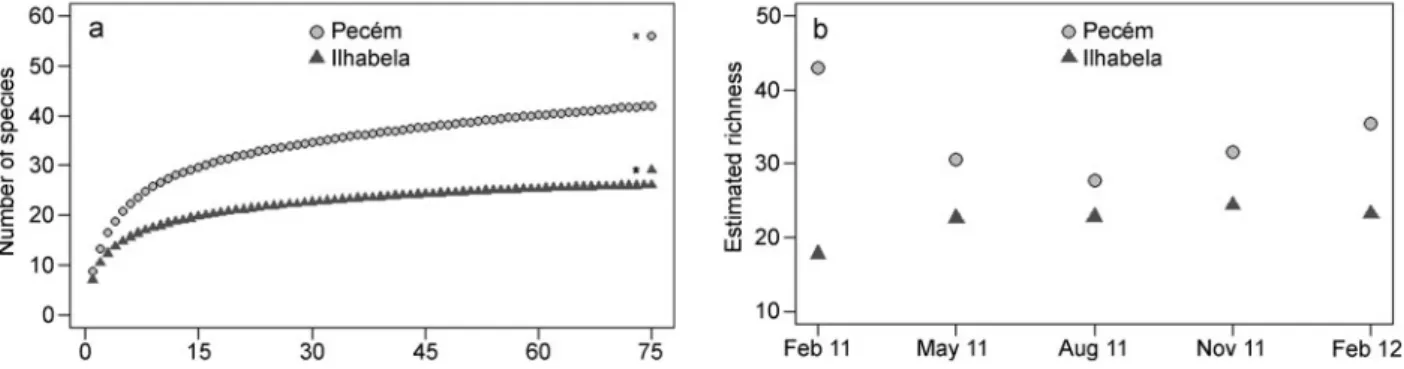
(6) Downloaded by [Pontificia Universidad Catolica de Chile] at 09:46 18 May 2016. 496. M. O. Fernandez et al.. panels on which a species was observed, for each period, out of the total number of replicate panels. This measure of local population abundance (occurrence on different panels) is therefore only a proxy for the number of individuals, but previous studies at Ilhabela show it correlates well with individual-based counts on plates (Fernandez et al. 2014; Marina Fernandez 2014, personal observation). We then evaluated whether temporal persistence was associated with local abundance using bivariate scatterplots and determined whether the bivariate space formed by these variables was non-random using EcoSim v. 7.71 (Gotelli & Entsminger 2012). Following Hanski (1982), species were categorized as ‘core’ when they were present in all periods and on 80–100% of the panels, as ‘satellite’ when present in all periods but at low abundance (occupancy ≤ 20% of all panels), or ‘rare’ when found in only one period and with spatial occupancy ≤ 10%. Cutoff values were set for convenience, as there are no conventional values to be assumed. To evaluate whether the structure (richness and composition) of the cnidarian assemblages varied over time, we compared them between periods, within each site, using permutation multivariate analyses of variance (PERMANOVA; Anderson 2001) based on 9999 unrestricted permutations of raw data for each site, considering the factor ‘Time’ as random. To visualize any pattern of aggregation or gradual change of samples from different periods, we plotted two-dimensional nMDS (non-metric multidimensional scaling; Clarke 1993) of the five periods for each site. Samples without species from Ilhabela were removed from nMDS ordinations. To better visualize differences between periods, we plotted nMDS based on the distances among centroids, calculated using principal coordinate axes from Bray–Curtis similarities for assemblages from each site (Anderson et al. 2008). To identify subsets of species that contributed most to the nMDS patterns we used BVSTEP analysis (Clarke & Warwick 2001; Clarke & Gorley 2006), a stepwise procedure that. considers the smallest subset of species whose similarity matrix has a minimum of 0.95 Spearman rank correlation with the original similarity matrix. All multivariate analyses were carried out in PRIMER v. 6 (Clarke & Gorley 2006) and PERMANOVA v. 1.0.5 (Anderson et al. 2008) using Bray–Curtis similarities for presence–absence data.. Results Species richness During the course of the study we recorded a total of 42 cnidarian species/morphotypes at Pecém and only 26 at Ilhabela (see Tables SII and SIII, supplementary material, for complete lists). A total of 14 species were shared between these sites (Tables SII and SIII, supplementary material). Despite the comparatively large sample size (75 panels), rarefaction curves did not saturate at either site and, therefore, estimates for total species richness must be taken with caution. Ilhabela’s rarefaction curve was closer to reaching an asymptote than Pecém’s (Figure 2a), and the Jackknife estimator estimated a total of 56 species at Pecém, significantly higher (Bootstrap, P = 0.0046, Figure 2b) than the 29 species estimated for Ilhabela. Spatial and temporal variation in recruitment Between 52% and up to 80% of the total number of species recorded during the study were observed in a single three-month sampling period, with no significant differences between sites (Bootstrap, P = 0.0628; Figure 3a). Similarly, temporal turnover of species (Figure 3b) was similar at the two sites (Bootstrap, P = 0.30), although Ilhabela exhibited increased species turnover from May to August 2011, and turnover at Pecém was more temporally constant. Turnover for shared and site-exclusive species was similar in Ilhabela (Bootstrap, P = 0.2158), while at Pecém, turnover for site-exclusive species was. Figure 2. Species richness in Pecém and Ilhabela after 15 months of sampling. (a) Sample-based rarefaction curves and estimated species richness (indicated by *). (b) Estimated species richness in each sampled period..
(7) Downloaded by [Pontificia Universidad Catolica de Chile] at 09:46 18 May 2016. Temporal turnover of benthic cnidarians. 497. Figure 3. (a) Proportion of total species richness for each period. (b) Proportion of species turnover between periods of the total species richness. (c) Proportion of species turnover of shared species. (d) Proportion of species turnover of site-exclusive species from Pecém and Ilhabela (Brazil).. significantly greater than that for shared species (Bootstrap, P = 0.0382, Figure 3c,d). Although at both sites the distribution of temporal persistence was bimodal (Figure 4a), temporal persistence of species was higher at Ilhabela, with 42% of the total number of species present in all time periods, as compared to only 29% of the species present at all times at Pecém (Figure 4a). The relationship between temporal frequency and abundance (as estimated from occupancy of plates) showed that species with low temporal frequency have generally low occupancy, but species with high temporal frequency may have either low or high occupancy of the plates (for both, Pecém, P = 0.0002, and Ilhabela, P = 0.0009, 10,000 iterations, Figure 4b,c). Species classified as ‘core’ species at Pecém (Bimeria vestita Wright, 1859, Stragulum bicolor van Ofwegen & Haddad, 2011) were different from those at Ilhabela (Obelia dichotoma (Linnaeus, 1758), O. bidentata Clark, 1875). ‘Satellite’ species were also different (Pecém: Cladocoryne floccosa Rotch, 1871, Plumularia cf. strictocarpa Pictet, 1893; Ilhabela: Filellum sp., Turritopsis nutricula McCrady, 1857). The number of ‘rare’ species was nine at Pecém and three at Ilhabela (Tables SII and SIII, supplementary material). The structures (richness and composition) of cnidarian assemblages were different among time periods for both Pecém (PERMANOVA, Pseudo-F = 7.3755, P(perm) = 0.0001) and Ilhabela (PERMANOVA,. Pseudo-F = 7.0388, P(perm) = 0.0001). Sample structure overlaps for different periods at both sites (nMDS ordination, Figure 5), and showed no clear contrast between periods both at Pecém and Ilhabela. A subset of 20 species (48% of the total) explained nMDS temporal patterns with 0.954 correlation at Pecém, while 13 species (50% of the total) explained temporal patterns with 0.957 correlation at Ilhabela (Table III).. Discussion Species richness Despite previous descriptions of higher regional cnidarian richness in subtropical than tropical Brazil, probably due to previous unequal sampling effort in each region (Marques et al. 2003), subtropical Ilhabela had fewer species of benthic cnidarians than equatorial Pecém, as predicted by theories of latitudinal gradients and global patterns of marine invertebrate species diversity (Stehli & Wells 1971; Roy et al. 1998, 2000; Macpherson 2002; Hillebrand 2004a,b; Cairns 2007; but see Clarke 1992 and Fautin et al. 2013 for exceptions). Both observed and predicted cnidarian richness were greater at Pecém than Ilhabela. In fact, the rarefaction curve was far from reaching an asymptote at Pecém, which: (1) makes it difficult to estimate total species richness for this site, and (2) suggests the community is underestimated in comparison to Ilhabela..
(8) Downloaded by [Pontificia Universidad Catolica de Chile] at 09:46 18 May 2016. 498. M. O. Fernandez et al.. Figure 4. Species temporal persistence and frequency on plates from Pecém and Ilhabela (Brazil). (a) Percentage of species in one (20%), two (40%), three (60%), four (80%) or five (100%) periods. (b) Correlation between temporal frequency and frequency on plates at Pecém. (c) Correlation between temporal frequency and frequency on plates at Ilhabela. Core species are indicated by red, satellite species by green and rare species by blue.. Spatial and temporal variation in cnidarian recruitment Contrary to our expectations, temporal turnover across the study period was the same for tropical Pecém and subtropical Ilhabela, and does not support the hypothesis of lower temporal variability in tropical latitudes due to a more homogeneous climate (although more species are available at Pecém). However, while temporal turnover in Pecém was generally constant throughout the year, in Ilhabela the turnover rate was more seasonal, with a large replacement of species in the transition from warmer. to colder months (Figure 1). The hypothesis of a greater temporal persistence of species at Pecém, the more tropical location, was also rejected, as persistence was greater at Ilhabela. Unfortunately, our study was too short in duration to properly evaluate interannual variability, but a two-year study at Ilhabela found a similar turnover of species between years, and patterns of species persistence held within both years encompassed by that study (Fernandez et al. 2014). Our results contrast with recent studies that examined variation in species turnover across latitudes. The study by Shurin et al. (2007) showed faster zooplankton turnover rates at lower latitude lakes than at the less-speciose higher latitudes. The comprehensive meta-analysis by Korhonen et al. (2010) also found increased turnover rates at low latitudes over intra-annual timescales. In our study, and despite great differences in species richness, cnidarian species showed moderate and similar turnover rates at both latitudes studied, although rates were slightly more variable through the year (seasonal) at higher latitudes. It is possible that variation in environmental conditions across the 20 degrees of latitude was not sufficiently large to produce a strong latitudinal trend. Apart from the significant differences in mean SST throughout the year, the seasonal signal of SST was stronger at the higher latitude, but salinity was higher and more seasonally variable at the lower latitude. These differences drive several other environmental variables, such as water turbidity and productivity, and are typically associated with changes in species composition (Boero 1994). It is also possible that the study sites represented ‘unusual’ locations in terms of species dynamics, for each of the regions, but we have no indication that that could be the case. Moreover, authors use different measures of turnover, weighting different aspects of the assemblages – some account for the presence of different species among samples, others consider species relative abundance or taxonomic relationship, and others use multivariate measures based on resemblance or dissimilarity – which makes it difficult to make comparisons between studies (Adler et al. 2005; Anderson et al. 2011). Thus, further studies with the same method at an increasing number of sites and a larger latitudinal scope to include temperate zones will be needed to further evaluate the relationship between species turnover, species richness and latitude in this assemblage. Despite the difference in species richness between sites, the proportion of species in each time period in relation to the number of species recorded during the study was the same for both sites. This means that the true proportion of species from the regional.
(9) Downloaded by [Pontificia Universidad Catolica de Chile] at 09:46 18 May 2016. Temporal turnover of benthic cnidarians. 499. Figure 5. Comparison of cnidarian assemblages between Pecém and Ilhabela (Brazil) based on nMDS between sample periods (green triangle = February 2011, blue inverted triangle = May 2011, light blue square = August 2011, red diamond = November 2011, magenta circle = February 2012).. pool that were present on a given plate and at a given time must be much higher at Ilhabella than at Pecém. Increased ‘regionalization’ of local communities at higher latitudes (greater proportion of species from the regional pool found at the local scale) has been documented before in benthic communities along a latitudinal gradient in the Northern Hemisphere (Freestone & Osman 2011) and globally (Witman et al. 2004) and attributed to latitudinal changes in the relative importance of local ecological interactions versus regional-scale processes (Witman et al. 2004; Harrison & Cornell 2008; Freestone & Osman 2011). In our study, for each sampling period we observed the same. proportion of the total number of species recorded for each site. If this observed number of species throughout the experiment is used as an estimate of the ‘regional’ species pool (see Rivadeneira et al. (2002) and Freestone & Osman (2011) for a similar approach but over space), we may say that the proportion of species from the ‘regional’ pool found in each period was the same at both locations, concluding a similar level of regionalization in tropical and subtropical cnidarian assemblages. Now, if we considered either the estimated total species richness for each region using our sample data (which underestimates total richness at Pecém), or geographic richness from literature compilations. Table III. BVSTEP results on the smallest subsets of species/morphospecies generating the temporal patterns in the nMDS for Pecém and Ilhabela (Brazil). Species in bold are those shared by both sites. Pecém Bimeria vestita Wright, 1859 Clytia cf. gracilis (M. Sars, 1851) Halopteris alternata (Nutting, 1900) Lafoeina amirantensis (Millard & Bouillon, 1973) Obelia bidentata Clark, 1875 Obelia dichotoma (Linnaeus, 1758) Turritopsis nutricula McCrady, 1857 Antennella spp.a Bougainvillia sp.1 Bougainvillia sp.2 Cladocoryne floccosa Rotch, 1871 Corydendrium parasiticum (Linnaeus, 1767) Eudendrium carneum Clarke, 1882 Filellum serratum (Clarke, 1879) Macrorhynchia philippina Kirchenpauer, 1872 Mitrocomium cirratum Haeckel, 1879 Nemalecium lighti (Hargitt, 1924) Octocorallia indet.1 Octocorallia indet.2 Stragulum bicolor van Ofwegen & Haddad, 2011 a. A. secundaria and A. siliquosa.. Ilhabela Bimeria vestita Wright, 1859 Clytia cf. gracilis (M. Sars, 1851) Halopteris alternata (Nutting, 1900) Lafoeina amirantensis (Millard & Bouillon, 1973) Obelia bidentata Clark, 1875 Obelia dichotoma (Linnaeus, 1758) Turritopsis nutricula McCrady, 1857 Ectopleura crocea (L. Agassiz, 1862) Bougainvillia muscus (Allman, 1863) Clytia linearis (Thornely, 1900) Eudendrium caraiuru Marques & Oliveira, 2003 Halecium bermudense Congdon, 1907 Sertularella tenella (Alder, 1856).
(10) Downloaded by [Pontificia Universidad Catolica de Chile] at 09:46 18 May 2016. 500. M. O. Fernandez et al.. (e.g. Rivadeneira et al. 2002; Witman et al. 2004), then the proportion of species from the regional pool observed in any given period was much greater at Ilhabela, suggesting increased regionalization at higher latitudes. Thus, conclusions about levels of regionalization can vary depending on how we define and on how well we estimate the ‘regional species pool’. Therefore, more attention needs to be paid to the inevitable effects of changes in effective sample size at different latitudes, i.e. the same number of replicates would most likely sample a lower proportion of the total species pool at more speciose regions. Inferences about the mechanisms underlying variation in regionalization across latitudes must also be considered with caution. For instance, Shimadzu et al. (2013) proposed that species temporal turnover might reduce species interspecific competition, allowing species coexistence in space by segregating in time. However, in our case, patterns of species turnover are probably largely dominated by processes driving settlement and initial interactions, before the onset of interspecific competition. Interestingly, at tropical Pecém, temporal turnover was lower for species shared by both sites than for site-exclusive species. Although species have populations that may vary by habitat (Koumoundouros et al. 2001; Kappes & Sinsch 2002), leading to intraspecific variation in eco-physiologies, this may demonstrate that species with a wider geographical distribution also have a wider temporal distribution, i.e. there may be a correlation between geographical and temporal distribution, in agreement with Rapoport’s rule (Stevens 1989). That is, greater environmental tolerance of species should be associated with greater latitudinal distribution of those species. Nevertheless, the same pattern was not observed at Ilhabela, where site-specific and shared species had similar turnover rates. To find species at both sites implies that either they are widely distributed geographically, or that they are only found at the two sites and not in between. If the latter, this suggests the introduction of some species in one or both harbours and if so, the temporal structure of the communities could be influenced by anthropogenic activities (Bertness 1984; Reise et al. 1999; Wallentinus & Nyberg 2007). However, of the species recorded in this study, only Stragulum bicolor van Ofwegen & Haddad, 2011 is reported in the literature as introduced (van Ofwegen & Haddad 2011). Further studies identifying native and exotic species will allow addressing of the temporal changes of introduced species and their roles in community structure, providing a better understanding of the influence of human-mediated activities in global and temporal. distributions of species in natural habitats (Steneck & Carlton 2001). At Ilhabela, community composition may change seasonally, following variation in temperature, but community structure variation also occurs over the scale of years at all sites (Sutherland & Karlson 1977) and we recognize that our comparative analysis was restricted to just 15 months. Better temporal samplings, as well as the addition of comparative studies of other taxa, and at different latitudes with more pronounced seasonality, may significantly extend and further test the patterns reported here. However, our results do illustrate the importance of generating a temporal series of species composition at a given site to improve assessments of local richness (Magurran 2008) and to better interpret spatial variability in richness, i.e. beta diversity, and in the geographic distribution of species (Magurran 2007). Acknowledgements We thank Alvaro Migotto and Centro de Biologia Marinha (CEBIMar) of the Universidade de São Paulo for providing laboratory facilities during field studies, the Ilhabela Yacht Club and the Pecém Harbor for allowing sampling on the piers, Rosana Rocha and Tito Lotufo for their contributions throughout the study, colleagues in the Marine Evolution Laboratory, USP, for their support and suggestions, James Roper for language assistance, and three anonymous reviewers for their valuable suggestions. Funding MOF held a MSc scholarship from the Fundação de Amparo à Pesquisa do Estado de São Paulo (FAPESP) and PhD scholarships from CNPq (Consellho Nacional de Desenvolvimento Científico e Tecnológico) and FAPESP. SAN is grateful for support from FAPESP through a visiting science grant (#2012/0519-3) which made this collaboration possible. ACM was supported by FAPESP, Coordenação de Aperfeiçoamento de Pessoal de Nível Superior (CAPES), and CNPq. This study was funded by the project CAPES PROCAD and PROTAX, FAPESP 2010/52324-6, 2011/50242-5, 2013/50484-4, and CNPq 563106/2010-7, 458555/2013-4, 305805/2013-4. This publication is a contribution of NP-BioMar, USP.. Supplementary material (Tables SI–SIII) The supplementary material for this article is available via the Supplemental tab of the article’s online page at http:// dx.doi.org/10.1080/17451000.2014.955804. References Abelson A, Denny M. 1997. Settlement of marine organisms in flow. Annual Review of Ecology and Systematics 28:317–39..
(11) Downloaded by [Pontificia Universidad Catolica de Chile] at 09:46 18 May 2016. Temporal turnover of benthic cnidarians Adler PB, White EP, Lauenroth WK, Kaufman DM, Rassweiler A, Rusak JA. 2005. Evidence for a general species-time-area relationship. Ecology 86:2032–39. Anderson MJ. 2001. A new method for non-parametric multivariate analysis of variance. Austral Ecology 26:32–46. Anderson MJ, Gorley RN, Clarke KR. 2008. PERMANOVA+ for PRIMER: Guide to Software and Statistical Methods. Plymouth: PRIMER-E Ltd. 214 pages. Anderson MJ, Crist TO, Chase JM, Vellend M, Inouye BD, Freestone AL, et al. 2011. Navigating the multiple meanings of β diversity: A roadmap for the practicing ecologist. Ecology Letters 14:19–28. Andrushchyshyn O, Magnusson AK, Williams DD. 2003. Ciliate populations in temporary freshwater ponds: Seasonal dynamics and influential factors. Freshwater Biology 48:548–64. Antonov JI, Seidov D, Boyer TP, Locarnini RA, Mishonov AV, Garcia HE, et al. 2010. World Ocean Atlas 2009, Volume 2: Salinity. Washington, DC: U.S. Government Printing Office. 184 pages. Bertness MD. 1984. Habitat and community modification by an introduced herbivorous snail. Ecology 65:370–81. Blythe JN, Pineda J. 2009. Habitat selection at settlement endures in recruitment time series. Marine Ecology Progress Series 396:77–84. Boero F. 1994. Fluctuations and variations in coastal marine environments. Marine Ecology 15:3–25. Boulton AJ, Peterson CG, Grimm NB, Fisher SG. 1992. Stability of an aquatic macroinvertebrate community in a multiyear hydrologic disturbance regime. Ecology 73:2192–207. Bouvy M, Ba N, Ka S, Sane S, Pagano M, Arfi R. 2006. Phytoplankton community structure and species assemblage succession in a shallow tropical lake (Lake Guiers, Senegal). Aquatic Microbial Ecology 45:147–61. Butman CA, Grassle JP, Webb CM. 1988. Substrate choices made by marine larvae settling in still water and in flume flow. Nature 333:771–73. Cairns SD. 2007. Deep-water corals: An overview with special reference to diversity and distribution of deep-water scleractinian corals. Bulletin of Marine Science 81:311–22. Campos CJA, Migotto AE, Pinheiro U, Marques AC. 2012. Sponges as substrata and early life history of the tubulariid Zyzzyzus warreni (Cnidaria: Hydrozoa) in the São Sebastião Channel, Brazil. Marine Biology Research 8:573–83. Carlton JT. 1987. Patterns of transoceanic marine biological invasions in the Pacific Ocean. Bulletin of Marine Science 41:452–65. Carrasco FD, Moreno RA. 2006. Long-term dynamics (1990 to 2004) of the polychaete fauna from the sublittoral soft-bottoms off Punta Coloso (Antofagasta), northern Chile. Scientia Marina 70S3:169–78. Castro BM, Miranda LB, Silva LS, Fontes RFC, Pereira AF, Coelho AL. 2008. Processos físicos: Hidrografia, circulação e transporte. In: Pires-Vanin AMS, editor. Oceanografia de um Ecossistema Subtropical: Plataforma de São Sebastião, SP. São Paulo: Editora da Universidade de São Paulo, p 59–121. Clarke A. 1992. Is there a latitudinal diversity cline in the sea? Trends in Ecology and Evolution 7:286–87. Clarke KR. 1993. Non-parametric multivariate analyses of changes in community structure. Australian Journal of Ecology 18:117–43. Clarke KR, Gorley RN. 2006. PRIMER version 6: User Manual/ Tutorial. Plymouth: PRIMER-E Ltd. 190 pages. Clarke KR, Warwick RM. 2001. Change in Marine Communities: An Approach to Statistical Analysis and Interpretation, 2nd edition. Plymouth: PRIMER-E Ltd. 172 pages. Collins AG, Schuchert P, Marques AC, Jankowski T, Medina M, Schierwater B. 2006. Medusozoan phylogeny and character. 501. evolution clarified by new large and small subunit rDNA data and an assessment of the utility of phylogenetic mixture models. Systematic Biology 55:97–115. Colwell RK, Coddington JA. 1994. Estimating terrestrial biodiversity through extrapolation. Philosophical Transactions of the Royal Society of London B 345:101–18. Eskinazi-Sant’Anna EM, Björnberg TKS. 2006. Seasonal dynamics of mesozooplankton in Brazilian coastal waters. Hydrobiologia 563:253–68. Fautin DG, Malarky L, Soberón J. 2013. Latitudinal diversity of sea anemones (Cnidaria: Actiniaria). The Biological Bulletin 224:89–98. Fernández M, Astorga A, Navarrete SA, Valdovinos C, Marquet PA. 2009. Deconstructing latitudinal species richness patterns in the ocean: Does larval development hold the clue? Ecology Letters 12:601–11. Fernandez MO, Navarrete SA, Marques AC. 2014. Temporal variation in richness and composition of recruits in a diverse cnidarian assemblage of subtropical Brazil. Journal of Experimental Marine Biology and Ecology 460:144–52. Flores AAV, Cruz J, Paula J. 2002. Temporal and spatial patterns of settlement of brachyuran crab megalopae at a rocky coast in Central Portugal. Marine Ecology Progress Series 229:207–20. Foster MS, Nigg EW, Kiguchi LM, Hardin DD, Pearse JS. 2003. Temporal variation and succession in an algal-dominated high intertidal assemblage. Journal of Experimental Marine Biology and Ecology 289:15–39. Freestone AL, Osman RW. 2011. Latitudinal variation in local interactions and regional enrichment shape patterns of marine community diversity. Ecology 92:208–17. FUNCEME. 2012. Fundação Cearense de Meteorologia e Recursos Hídricos. http://www.funceme.br (accessed 18 November 2014). Gili JM, Hughes RG. 1995. The ecology of marine benthic hydroids. Oceanography and Marine Biology: An Annual Review 33:351–426. Gosselin LA, Qian P-Y. 1997. Juvenile mortality in benthic marine invertebrates. Marine Ecology Progress Series 146:265–82. Gotelli NJ, Colwell RK. 2001. Quantifying biodiversity: Procedures and pitfalls in the measurement and comparison of species richness. Ecology Letters 4:379–91. Gotelli NJ, Entsminger GL. 2012. EcoSim: Null models software for ecology. Version 7.71. Victoria, Canada: Acquired Intelligence Inc. Computer program. Gravier-Bonnet N. 1992. Cloning and dispersal by buoyant autotomized hydrants of a thecate hydroid (Cnidaria; Hydrozoa). Scientia Marina 56:229–36. Hadfield MG. 2011. Biofilms and marine invertebrate larvae: What bacteria produce that larvae use to choose settlement sites. Annual Review of Marine Science 3:453–70. Hanski I. 1982. Dynamics of regional distribution: The core and satellite species hypothesis. Oikos 38:210–21. Harrison S, Cornell H. 2008. Toward a better understanding of the regional causes of local community richness. Ecology Letters 11:969–79. Hillebrand H. 2004a. On the generality of the latitudinal diversity gradient. American Naturalist 163:192–211. Hillebrand H. 2004b. Strength, slope and variability of marine latitudinal gradients. Marine Ecology Progress Series 273:251–67. Jenkins SR. 2005. Larval habitat selection, not larval supply, determines settlement patterns and adult distribution in two chthamalid barnacles. Journal of Animal Ecology 74: 893–904. Kappes H, Sinsch U. 2002. Temperature- and predator-induced phenotypic plasticity in Bosmina cornuta and B. pellucida (Crustacea: Cladocera). Freshwater Biology 47:1944–55..
(12) Downloaded by [Pontificia Universidad Catolica de Chile] at 09:46 18 May 2016. 502. M. O. Fernandez et al.. Karlson RH, Osman RW. 2012. Species composition and geographic distribution of invertebrates in fouling communities along the east coast of the USA: A regional perspective. Marine Ecology Progress Series 458:255–68. Keough MJ, Downes BJ. 1982. Recruitment of marine invertebrates: The role of active larval choice and early mortality. Oecologia 54:348–52. Korhonen JJ, Soininen J, Hillebrand H. 2010. A quantitative analysis of temporal turnover in aquatic species assemblages across ecosystems. Ecology 91:508–17. Koumoundouros G, Divanach P, Anezaki L, Kentouri M. 2001. Temperature-induced ontogenetic plasticity in sea bass (Dicentrarchus labrax). Marine Biology 139:817–30. Lancaster J, Real M, Juggins S, Monteith DT, Flower RJ, Beaumont WRC. 1996. Monitoring temporal changes in the biology of acid waters. Freshwater Biology 36:179–201. Largier JL. 2003. Considerations in estimating larval dispersal distances from oceanographic data. Ecological Applications 13: S71–S89. Lee SC, Bruno JF. 2009. Propagule supply controls grazer community structure and primary production in a benthic marine ecosystem. Proceedings of the National Academy of Sciences 106:7052–57. Locarnini RA, Mishonov AV, Antonov JI, Boyer TP, Garcia HE, Baranova OK, et al. 2010. World Ocean Atlas 2009, Volume 1: Temperature. Washington, DC: U.S. Government Printing Office. 184 pages. Longhurst A. 1998. Ecological Geography of the Sea. San Diego, CA: Academic Press. 398 pages. Macpherson E. 2002. Large-scale species-richness gradients in the Atlantic Ocean. Proceedings of the Royal Society of London B 269:1715–20. Magurran AE. 2007. Species abundance distributions over time. Ecology Letters 10:347–54. Magurran AE. 2008. Diversity over time. Folia Geobotanica 43:319–27. Marques AC, Morandini AC, Migotto AE. 2003. Synopsis of knowledge on Cnidaria Medusozoa from Brazil. Biota Neotropica 3:1–18. McQuaid CD, Lawrie SM. 2005. Supply-side ecology of the brown mussel, Perna perna: An investigation of spatial and temporal variation in, and coupling between, gamete release and larval supply. Marine Biology 147:955–63. Mengestou S, Green J, Fernando CH. 1991. Species composition, distribution and seasonal dynamics of Rotifera in a Rift Valley lake in Ethiopia (Lake Awasa). Hydrobiologia 209:203–14. Migotto AE, Marques AC, Flynn MN. 2001. Seasonal recruitment of hydroids (Cnidaria) on experimental panels in the São Sebastião Channel, Southeastern Brazil. Bulletin of Marine Sciences 68:287–98. Mizrahi D, Navarrete SA, Flores AAV. 2014. Uneven abundance of the invasive sun coral over habitat patches of different orientation: An outcome of larval or later benthic processes? Journal of Experimental Marine Biology and Ecology 452:22–30. Modigh M, Castaldo S. 2002. Variability and persistence in tintinnid assemblages at a Mediterranean coastal site. Aquatic Microbial Ecology 28:299–311. Morgan SG. 1995. The timing of larval release. In: McEdward L, editor. Ecology of Marine Invertebrate Larvae. Boca Raton, LA: CRC Press, p 157–91. Morri C, Boero F. 1986. Catalogue of Main Marine Fouling Organisms. Volume 7: Hydroids. Brussels: Office d'Etudes Marines et Atmosphériques ODEMA. 91 pages. Narváez DA, Navarrete SA, Largier J, Vargas CA. 2006. Onshore advection of warm water, larval invertebrate settlement, and. relaxation of upwelling off central Chile. Marine Ecology Progress Series 309:159–73. Navarrete SA. 2007. Maintenance of biodiversity. In: Denny MW, Gaines SD, editors. Encyclopedia of Tidepools and Rocky Shores. Los Angeles: University of California Press, p 76–81. Osman RW, Whitlatch RB. 1995. The influence of resident adults on recruitment: A comparison to settlement. Journal of Experimental Marine Biology and Ecology 190:169–98. Palardy JE, Witman JD. 2011. Water flow drives biodiversity by mediating rarity in marine benthic communities. Ecology Letters 14:63–68. Palardy JE, Witman JD. 2014. Flow, recruitment limitation, and the maintenance of diversity in marine benthic communities. Ecology 95:286–97. Pandit SN, Kolasa J. 2012. Opposite effects of environmental variability and species richness on temporal turnover of species in a complex habitat mosaic. Hydrobiologia 685:145–54. Piazzi L, Pardi G, Balata D, Cecchi E, Cinelli F. 2002. Seasonal dynamics of a subtidal north-western Mediterranean macroalgal community in relation to depth and substrate inclination. Botanica Marina 45:243–52. Pineda J, Porri F, Starczak V, Blythe J. 2010. Causes of decoupling between larval supply and settlement and consequences for understanding recruitment and population connectivity. Journal of Experimental Marine Biology and Ecology 392:9–21. Porri F, Jordaan T, McQuaid CD. 2008. Does cannibalism of larvae by adults affect settlement and connectivity of mussel populations? Estuarine, Coastal and Shelf Science 79:687–93. R Core Team. 2012. R: A Language and Environment for Statistical Computing. R Foundation for Statistical Comput‐ ing, Vienna. http://www.R-project.org/ (accessed 5 August 2012). Reise K, Gollasch S, Wolff WJ. 1999. Introduced marine species of the North Sea coasts. Helgoland Marine Research 52:219–34. Rivadeneira MM, Fernández M, Navarrete SA. 2002. Latitudinal trends of species diversity in rocky intertidal herbivore assemblages: Spatial scale and the relationship between local and regional species richness. Marine Ecology Progress Series 245:123–31. Rocha RM, Vieira LM, Migotto AE, Amaral ACZ, Ventura CRR, Serejo CS, et al. 2013. The need of more rigorous assessments of marine species introductions: A counter example from the Brazilian coast. Marine Pollution Bulletin 67:241–43. Roy K, Jablonski D, Valentine JW, Rosenberg G. 1998. Marine latitudinal diversity gradients: Tests of causal hypotheses. Proceeding of the National Academy of Sciences 95:3699–702. Roy K, Jablonski D, Valentine JW. 2000. Dissecting latitudinal diversity gradients: Functional groups and clades of marine bivalves. Proceedings of the Royal Society of London B 267:293–99. Schlitzer R. 2012. Ocean Data View. http://odv.awi.de (accessed 9 April 2012). Shanks AL. 1995. Mechanisms of cross-shelf dispersal of larval invertebrates and fish. In: McEdward L, editor. Ecology of Marine Invertebrate Larvae. Boca Raton, LA: CRC Press, p 323–67. Shimadzu H, Dornelas M, Henderson PA, Magurran AE. 2013. Diversity is maintained by seasonal variation in species abundance. BMC Biology 11:98. 9 pages. Shurin JB, Arnott SE, Hillebrand H, Longmuir A, Pinel-Alloul B, Winder M, et al. 2007. Diversity–stability relationship varies with latitude in zooplankton. Ecology Letters 10:127–34..
(13) Downloaded by [Pontificia Universidad Catolica de Chile] at 09:46 18 May 2016. Temporal turnover of benthic cnidarians Silveira ICA, Miranda LB, Brown WS. 1994. On the origins of the North Brazil Current. Journal of Geophysical Research 99:22501–12. Sitran R, Bergamasco A, Decembrini F, Guglielmo L. 2007. Temporal succession of tintinnids in the northern Ionian Sea, Central Mediterranean. Journal of Plankton Research 29:495–508. Soininen J, Eloranta P. 2004. Seasonal persistence and stability of diatom communities in rivers: Are there habitat specific differences? European Journal of Phycology 39:153–60. Sommer C. 1992. Larval biology and dispersal in Eudendrium racemosum (Hydrozoa, Eudendriidae). Scientia Marina 56: 205–11. Sonntag B, Posch T, Klammer S, Teubner K, Psenner R. 2006. Phagotrophic ciliates and flagellates in an oligotrophic, deep, alpine lake: Contrasting variability with seasons and depths. Aquatic Microbial Ecology 43:193–207. Stehli FG, Wells JW. 1971. Diversity and age patterns in hermatypic corals. Systematic Biology 20:115–26. Steneck RS, Carlton JT. 2001. Human alterations of marine communities: Students beware! In: Bertness MD, Gaines SD, Hay ME, editors. Marine Community Ecology. Sunderland, MA: Sinauer Associates, p 445–68. Stevens GC. 1989. The latitudinal gradient in geographical range: How so many species coexist in the tropics. The American Naturalist 133:240–56. Storch D, Fernández M, Navarrete SA, Pörtner H. 2011. Thermal tolerance of larval stages of the Chilean kelp crab Taliepus dentatus. Marine Ecology Progress Series 429:157–67. Sutherland JP. 1974. Multiple stable points in natural communities. The American Naturalist 108:859–73. Sutherland JP, Karlson RH. 1977. Development and stability of the fouling community at Beaufort, North Carolina. Ecological Monographs 47:425–46. Tapia FJ, Navarrete SA. 2010. Spatial patterns of barnacle settlement in central Chile: Persistence at daily to inter-annual. 503. scales relative to the spatial signature of physical variability. Journal of Experimental Marine Biology and Ecology 392:151–59. Townsend CR, Hildrew AG, Schofield K. 1987. Persistence of stream invertebrate communities in relation to environmental variability. Journal of Animal Ecology 56:597–613. Underwood AJ, Keough MJ. 2001. Supply-side ecology: The nature and consequences of variations in recruitment of intertidal organisms. In: Bertness MD, Gaines SD, Hay ME, editors. Marine Community Ecology. Sunderland, MA: Sinauer Associates, p 183–200. Valdovinos C, Navarrete SA, Marquet PA. 2003. Mollusk species diversity in the Southeastern Pacific: Why are there more species towards the pole? Ecography 26:139–44. van Ofwegen LP, Haddad MA. 2011. A probably invasive new genus and new species of soft coral (Octocorallia: Alcyonacea: Clavulariidae) from Brazil. Zootaxa 3107:38–46. Vargas CA, Manríquez PH, Navarrete SA. 2006. Feeding by larvae of intertidal invertebrates: Assessing their position in pelagic food webs. Ecology 87:444–57. Wallentinus I, Nyberg CD. 2007. Introduced marine organisms as habitat modifiers. Marine Pollution Bulletin 55:323–32. Wernberg T, Goldberg N. 2008. Short-term temporal dynamics of algal species in a subtidal kelp bed in relation to changes in environmental conditions and canopy biomass. Estuarine, Coastal and Shelf Science 76:265–72. Witman JD, Etter RJ, Smith F. 2004. The relationship between regional and local species diversity in marine benthic communities: A global perspective. Proceedings of the National Academy of Sciences 101:15664–69. Woodward G, Jones JI, Hildrew AG. 2002. Community persistence in Broadstone Stream (U.K.) over three decades. Freshwater Biology 47:1419–35.. Editorial responsibility: David McKinnon.
(14)
Figure



+2

Documento similar
scleroxylon, one of the most valuable and fragile timber species from the Chiquitano forest in Santa Cruz de la Sierra, Bolivia, (ii) to quantify the changes in
Observed number of species was relatively high in comparison with other studies in the Mediterranean, and we found no effects of fragment characteristics on species density,
Correlation between structural complexity, proportion of species included in the Red Lists at world and national level, proportion of threatened species included
alteration of marine circulation patterns, the abundance, distribution, and structure of marine species, and the frequency and intensification of atmospheric processes such
Cadmium, Lead, Copper, Zinc, and Iron Concentration Patterns in Three Marine Fish Species from Two Different Mining Sites inside the Gulf of California, Mexico..
The abundance determinations presented in Table 3 show the following behaviour: ionic abundances determined from CELs of once ionized species are always higher in the shock than in
The results of the ecological analysis pointed out that increasing tree species richness is more 435. important than establishing a shrub layer or creating a
species are ecosystem type and altitude; some species tolerated evergreen forest and others prefer dry forest, in terms of elevation, in some species is limited from lowland to
