
A new species of Trinectes (Pleuronectiformes: Achiridae), with comments on the other eastern Pacific species of the genus
9
0
0
Texto completo
(2) 178. R E V I S TA DE BIOLOGIA T R O P I C A L. SL, decreasing with increasing SL; upper eye length 4.5-6.8% of SL, decreasing with increasing SL. Scales ctenoid; enlarged scales on anterior head region of ocular side, enlarged scales and tufts of cirri over much of head and area above pelvic fins on blind side; scales along most of the lengths of the dorsal, anal-, and caudal-fin rays. Anterior dorsal (ca. 20-24) and anal- (ca. 8) fin rays of blind side with cirri for most of their lengths. Pelvic fins more or less symmetrical, that of ocular side connected to anal fin by a thin membrane; cirri on all pelvic-fin rays of blind side, smaller cirri on anterior rays of ocular side. Caudal fin rounded posteriorly. Lateral line nearly straight on both sides, with a slight rise over area of opercular opening. No cirri on nostrils; cirri on lip of lower jaw, ocular side only. Upper eye slightly in advance of lower. Mouth small, reaching to a vertical through anterior portion of lower eye; teeth tiny, villiform, in multiple rows in upper and lower jaws of blind side; few, if any, teeth on ocular side. Overall background color of ocular side light to medium brown, occasionally with 511 thin, approximately vertical, interrupted bars and numerous dark spots; dorsal and anal fins without light or dark spots or blotches; anterior dorsal and anal fins usually matching body color; blind side usually almost devoid of pigment, but occasionally with the posterior one-third to one-half of body lightly to moderately pigmented; posterior dorsal and anal fins of both sides matching body color. San Miguel, ca 8o15’N, 78o25’W, 1959 (no other data available). Paratypes: 230 specimens (18.5-95 mm). Colombia: UCLAW53-20 (1). Panama: SIO 63-292 (30); SIO 63-293 (23); SIO 63-295 (1); SIO 64-965 (3); SIO 69386 (5); UCLA W53-275 (28); UCLA W53-317 (4); UCLAW58-55 (3); UCLAW58-304 (41); UCLAW58305 (40); LACM W53-331 (1); GCRL V72-9100 (1); GCRL V72-9101 (2); GCRL V72-9106 (1); USNM 361978 (3), formerly SIO 63-292. Costa Rica: UCR 970.005 (12); UCR 136.083 (3); UCR 296.007 (7); UCR 1216.002 (1); LACM 9754-14 (1); LACM 30714-14 (3); LACM 30715-4 (1); LACM 30716-6 (1); LACM 30745-4 (3); LACM 32542-6 (2); LACM 33805-27 (6). Nicaragua: UCR 360.005 (1). El Salvador: SIO 73-276 (2).. Diagnosis: A relatively small species of Trinectes (maximum length examined, 95 mm) characterized by the following: caudal fin yellow or light brown, without pattern; posterior dorsal and anal fins black to dark brown; dorsal-fin rays usually 57-60; anal-fin rays usually 43-46; pelvic-fin rays usually 55; caudal vertebrae usually 21-22; dorsal and anal fins without light or dark spots or blotches; pectoral fins usually absent; opercular flap of blind side mostly scaled; no ring of cirri on margin of anterior naris on ocular side. Description: Dorsal-fin rays 54-61 (Table 1); anal-fin rays 41-48 (Table 2); vertebrae 810 + 20-22 = 29-31, holotype with 9+21; total caudal-fin rays 16, branched rays usually 12; pelvic-fin rays 5-5 (186 of 198 specimens, holotype with 5-5). Pectoral fins almost always absent, occasionally one ray on ocular side (6 of 198 specimens; holotype 0-0). Body depth 53.1-63.2% of SL; head length 27.6-33.1% of SL, slightly increasing with increasing SL; interobital width 2.5-4.1% of. TABLE 1 Frequency distributions of dorsal-fin rays in Pacific species of Trinectes.. T. T. T. T. T.. fimbriatus fluviatilis fonsecensis opercularis xanthurus. * count of holotype.. 48. 49. 50. 51. 52. 53. 54. 55. 56. 57. 58. 59. 60. 61. 62. 63. 64. 5. 6. 12. 31. 34. 17. 12. 4 1 6 1 8. 2 2 19. 5 42. 8 54. 7 69. 4 50. 3 30. 20. 10. 1. 16. 41. 49*. 47. 21. 12. 1 1. 2 4.
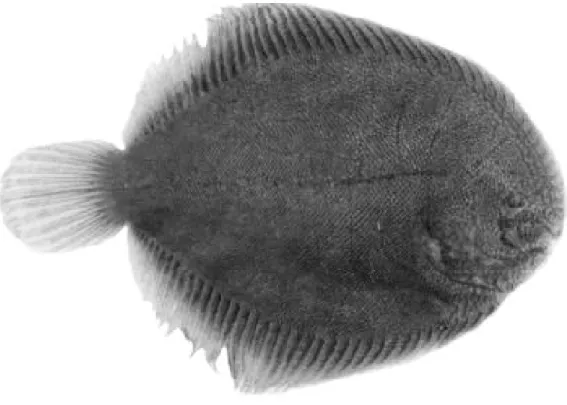
(3) I N T E R N AT I O N A L J O U R N A L OF T R O P I C A L B I O L O G Y AND CONSERVAT I O N. Fig. 1. Trinectes xanthurus, SIO 63-292, upper: 75.4 mm, Holotype; lower: 73 mm, Paratype.. 179.
(4) 180. R E V I S TA DE BIOLOGIA T R O P I C A L. Fig. 2. Trinectes fimbriatus, Uncatalogued, 71 mm total length, Chiapas, Mexico, 6 Sep 1966, showing a ring of cirri on the margin of the anterior naris.. proximally, but much darker distally; caudal fin pale yellow, yellow in life (Krupp 1995), to light brown with no markings; pigmentation on ocular-side pelvic fin matching that on anal fin, blind-side pelvic fin without pigment; peritoneum and opercular cavity lightly to moderatly punctate on ocular side and usually lacking pigment on blind side; mouth devoid of pigment. Etymology: From the Greek, xanthos, yellow, plus oura, tail, for the pale yellow or light brown caudal fin.. Distribution: From the mouth of the Orapu River, Colombia, ca. 4°34’N, 77°20’W, to the Golfo de Fonseca, El Salvador, ca.13°06’N, 87°59’W. Found on sand or mud bottoms in rivers (occasionally) and shallow coastal waters of 2-40 m, but usually less than 18 m. Comparisons: Trinectes xanthurus can be distinguished from all other congeners, except T. fluviatilis, in having 21-22 (vs. 1920) caudal vertebrae. It has a plain or unpatterned caudal fin in contrast to the banded. TABLE 2. Frequency distributions of anal-fin rays in Pacific species of Trinectes.. T. fimbriatus T. fluviatilis T. fonsecensis T. opercularis T. xanthurus * count of holotype.. 33. 34. 35. 36. 37. 38. 39. 40. 1. 3. 16. 33. 41. 21. 6. 2. 1. 7. 1. 1. 41. 42. 43. 44. 45. 46. 47. 48. 27. 56. 6 85. 7 66. 8 37. 8 20. 5. 1. 7. 8. 35. 59*. 62. 19. 4. 3. 3.
(5) I N T E R N AT I O N A L J O U R N A L OF T R O P I C A L B I O L O G Y AND CONSERVAT I O N. Fig. 3. Trinectes fimbriatus, UCR 136.038, 6(60-68.5 mm), illustrating variation in this species.. 181.
(6) 182. R E V I S TA DE BIOLOGIA T R O P I C A L. Fig. 4. Trinectes opercularis, UCLAW51-283, 52.5 mm.. Key to the eastern Pacific species of Trinectes 1A.. Ring of cirri on margin of anterior naris of ocular side (Fig. 2); anal-fin rays usually 35-38; opercular flap of blind side mostly naked . . . . . . . . . . . . . . . . . . . . . . . . . . . . . . . . . . . . . . . . . . . . . . . . . . . . . . . . . . . . . . . . . . . . . . .2. 1B.. No cirri on anterior naris of ocular side; anal-fin rays usually 41-46; opercular flap of blind side mostly scaled .3. 2A.. Body and vertical fins with white or pale spots on ocular side . . .T. fimbriatus (Peru to Chiapas, Mexico; Fig. 3). 2B.. Body and fins without spots, head occasionally with spots on posterior operculum . . . . . . . . . . . . . . . . . . . . . . . . . . . . . . . . . . . . . . . . . . . . . . . . . . . . . . . . . . . . . . . . . . . . . . . . . . .T. opercularis (Equador to Colombia; Fig. 4). 3A.. Posterior dorsal and anal fins black to dark brown; caudal fin without distinct pigment pattern; pectoral fins usually absent (192 of 198 specimens) . . . . . . . . . . . . . . . . . . . . . . . . .T. xanthurus (Colombia to El Salvador; Fig. 1). 3B.. Dorsal and anal fins spotted or light brown; caudal fin usually spotted or barred; pectoral fin, when present, with one to three rays on ocular side . . . . . . . . . . . . . . . . . . . . . . . . . . . . . . . . . . . . . . . . . . . . . . . . . . . . . . . . . . . . .4. 4A.. Pectoral fin usually present (272 of 304 specimens); ocular side with fairly distinct, dark bars; caudal vertebrae 1920 (202 of 215 specimens) . . . . . . . . . . . . . . . . . . . . . . . .T. fonsecensis (Panama to Agiabampo, Mexico; Fig. 5). 4B.. Pectoral fins usually absent (19 of 30 specimens); ocular side with indistinct, dark bars and small spots or large blotches; caudal vertebrae 21 (16 of 17 specimens) . . . . . . . . . . . . . . . . . . . . . . . . .T. fluviatilis (Panama to Costa Rica, almost always found in freshwater; Fig. 6).
(7) I N T E R N AT I O N A L J O U R N A L OF T R O P I C A L B I O L O G Y AND CONSERVAT I O N. Fig. 5. Trinectes fonsecensis, SIO 62-39, upper: 85 mm; lower: 84 mm.. 183.
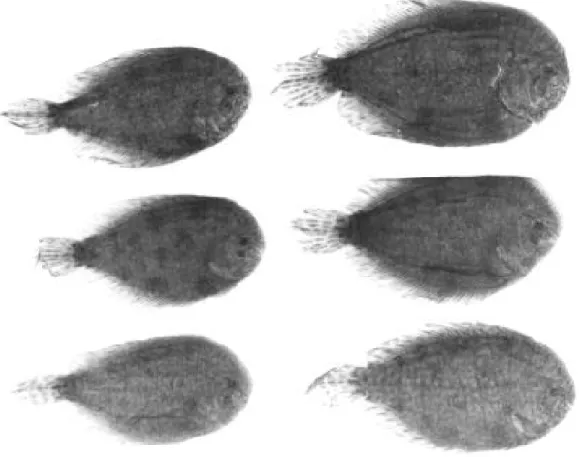
(8) 184. R E V I S TA DE BIOLOGIA T R O P I C A L. Fig. 6. Trinectes fluviatilis, USNM 81668, 6(30-39 mm).. caudal-fin pattern of T. fluviatilis and also has a greater body depth and smaller eyes. Trinectes fimbriatus and T. opercularis have fewer anal-fin rays than T. xanthurus and also possess a ring of cirri on the margin of the ocular-side anterior naris. Trinectes fimbria tus also has conspicuous white or pale spots on its ocular side. In contrast to T. xanthurus, T. fonsecensis usually has at least one or two ocular-side pectoral-fin rays and pigment patterns on the vertical fins. Trinectes inscriptus (western Atlantic) is unique in having one or more pectoral-fin rays on the blind side and at least two, usually three or more, on the ocular side. It also has a distinctive network of dark lines on a brown to gray background. Trinectes maculatus (wA) usually has 4-4 (vs. 5-5) pelvic-fin rays, distinguishing it from all other species in the genus, and has a variable. pattern of caudal-fin pigment to distinguish it further from T. xanthurus. Trinectes paulis tanus (wA) can appear quite similar to T. xan thurus, but has much smaller eyes, and usually a shorter head, shallower body depth, and narrower interorbit.. ACKNOWLEDGMENTS We are grateful to Carl L. Hubbs (deceased) for instigating this study.We thank the following individuals for the loan of specimens and/or for correspondence related to this study: W. Bussing (UCR), D. Buth (UCLA), R. Feeney and J. Seigel (LACM), S. Poss and C. Aadland (GCRL), N. Wilimovsky (UBC), D. Catania (CAS), S. Jewett and J. Williams (USNM). We appreciate the timely.
(9) I N T E R N AT I O N A L J O U R N A L OF T R O P I C A L B I O L O G Y AND CONSERVAT I O N. data supplied by W. Bussing and D. Buth and the photo in Figure 3 provided by W. Bussing. This paper is dedicated to S. Walker, J. Walker, T. Walker, B. Walker, and D. Walker for inspiration and support. We thank P. Hastings, R. Rosenblatt, and C. Klepadlo for assistance at SIO. This paper is also dedicated to T. Collins, Deputy Director of SIO, for his unwavering support of the SIO Marine Vertebrates Collection.. RESUMEN Se describe una nueva especie, Trinectes xanthurus, de aguas someras del Pacífico desde Colombia hasta El Salvador. El género Trinectes tiene cuatro especies en el Pacífico Oriental más una de agua dulce en Panamá. Solo Trinectes fonsecensis existe en todo el Pacífico Oriental.. 185. REFERENCES Dawson, C.E. 1978. Soleidae. In W. Fischer (ed.). FAO species identification sheets for fishery purposes. Western Central Atlantic (Fishing area 31). vol. V. FAO, Rome. Hubbs, C.L. & K.F. Lagler. 1958. Fishes of the Great Lakes region. Cranbrook Inst. Sci. Bull. No. 26, Bloomfield Hills, Michigan. Krupp, F. 1995. Achiridae. p. 845-850. In W. Fischer, F. Krupp, W. Schneider, C. Sommer, K. E. Carpenter & V. H. Niem (eds.). Guía FAO para la identificación de especies para los fines de la pesca. Pacífico Centro-Oriental. FAO, Roma. Leviton, A.E., R.H. Gibbs, Jr., E. Heal & C.E. Dawson. 1985. Standards in herpetology and ichthyology. Part I. Standard symbolic codes for institutional resources collections in herpetology and ichthyology. Copeia 1985: 802-832..
(10)
Figure

Documento similar
The new species possesses cervical alae abruptly interrupted at mid-length of esophageal bulb form an acute angle, distinguishing it from 5 of the 17 species in the genus.. The
The species can be distinguished from all others of the genus by the head and pronotum metallic, dark blue; the elytra metallic purplish, green or golden; the head round, with
The drawings and description of this species by Jurine (1820), where he noticed a pattern of concentric lines on the valves similar to growth annuli of bivalves (as also
On the other hand at Alalakh Level VII and at Mari, which are the sites in the Semitic world with the closest affinities to Minoan Crete, the language used was Old Babylonian,
spent less time inside the nest-box brooding small nestlings and showed higher frequency of nest sanitation behaviours than the other species, while provisioning rates
Observed number of species was relatively high in comparison with other studies in the Mediterranean, and we found no effects of fragment characteristics on species density,
Correlation between structural complexity, proportion of species included in the Red Lists at world and national level, proportion of threatened species included
naledi differs from Middle Pleistocene (MP) and Late Pleistocene (LP) Homo (here we include specimens sometimes attributed to the putative Early Pleistocene taxon Homo antecessor,
