
Community structure of zooplankton in the main entrance of Bahía Magdalena, México during 1996
13
0
0
Texto completo
(2) 546. REVISTA DE BIOLOGÍA TROPICAL. zooplankton community structure related to the California Current System are relatively well known (Hernández-Trujillo 1991, GómezGutiérrez 1995, Gómez-Gutiérrez et al. 1996). Two different environments have been described inside Bahía Magdalena. A marginal shallow water area (< 5 m) with antiestuarine conditions and a relatively simple zooplankton community structure, and a deep area (> 20 m) with strong influence of neritic and oceanic waters located near the main entrance and a more complex zooplankton community that exhibits strong seasonal changes through the year (Palomares-García 1992, Funes et al. 1998). However, little is known about time of residence, ecotone gradients, and possible interchange of organisms between the lagoon complex and the continental shelf. Intense larval drift through the main entrance of Bahía Magdalena was proposed by using indirect observations of monthly distribution patterns of the zoeal stages of the blue crab (C. bellicosus) and the red crab (Pleuroncodes planipes). The blue crab usually spawns in the main entrance during summer and then drifts offshore. The zoeae develop to the megalopa stage and return, apparently by subsurface currents, to settle inside the bay (Sánchez-Ortíz and Gómez-Gutiérrez 1992). Aurioles-Gamboa et al. (1994) reported annual mass stranding of the pelagic phase of the red crab. This species forms dense swarms over the continental shelf and strand at the beaches inside of Bahía Magdalena, suggesting an active oceanographic interaction between the two ecosystems. Sampling of zooplankton over diel cycles made at one station near the main entrance of Bahía Magdalena showed the abundance of the sardine S. sagax was related to changes of tidal currents (Aceves-Medina et al. 1992, Palomares-García and Vera-Alejandre 1995). These studies only had one sampling station, and the workers were unable to test movements through the mouth of the bay. The goal of this study is to determine the changes of the zooplankton community structure focused on four zooplankton groups; copepods, euphausiids, chaetognaths, and decapod larvae,. including the micronektonic crustacean P. planipes, in the main mouth of Bahía Magdalena during three months (March, July, and December 1996). We could expect a defined transition zone across the mouth, separating the antiestuarine conditions inside the bay and the upwelling area over the continental shelf, however, strong currents and tidal mixing can be playing an important role diffusing gradients between both sides of the mouth of the bay. In this study we described in terms of the zooplankton community structure the magnitude of the interaction between both systems.. MATERIALS AND METHODS Field sampling: During 19-21 March, 9-11 July, and 6-8 December 1996 on board the R/V “El Puma”, one 18 km transect through the main mouth of Bahía Magdalena was made (25°15 to 24°20 N, 111°30 to 112°30 W) (Fig. 1). The oceanographic transect was set to cover three zones, each approximately six kilometers long: i) an inside zone, which covers the deepest part inside the bay (20 to 30 m deep), ii) a middle zone covering the mouth of the bay (30 to 40 m deep), and iii) the neritic zone over the continental shelf, which is the deepest (+ 100 m deep) and the offshore part of the transect. Along the hydrographic transect, we established three oceanographic stations. Two stations were located at the ends of the hydrographic transect and one in the middle at the mouth of Bahía Magdalena. The area was monitored for about 48 hours in March (27 stations sampled), and July (40 stations sampled), and 24 h in December (18 stations sampled). Replicates of samples taken at each station were obtained as follows: starting from the neritic station, heading to the station inside the bay, returning to the middle station (mouth of the bay), and finishing at the neritic station about four hours later. For the present paper, our interest is not to analyze circadian cycles per se but to determine zooplankton community structure inside and outside the bay using zooplankton samples obtained at different times (day and night.
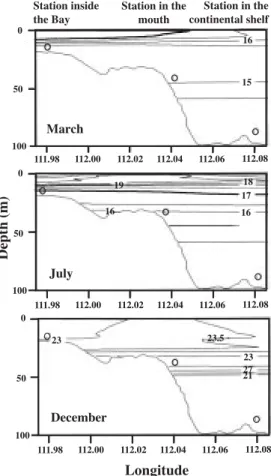
(3) INTERNATIONAL JOURNAL OF TROPICAL BIOLOGY AND CONSERVATION. samples). At each station, vertical profiles of temperature, δt, and salinity were recorded using a CTD Inter-Ocean SO4. Variation in the vertical density gradient was calculated for every sampling day to estimate the stability of the water column as estimated by Gómez Gutiérrez et al. (1999) in the following way: Density gradient = ∆δt /∆z Where ∆ δt is the difference between surface and bottom δt and ∆z is the difference between surface and bottom depth.. 547. P. planipes were identified to species level. Because taxonomy of most of decapod larvae is not well known in the study area, most of the identifications were to family level only. Samples were analyzed entirely. To determine recurrent groups of the zooplankton species, a multivariate analysis was used, using the Principal Factor Analysis (PFA) method (Preisendorfer, 1988). PFA was used on the data set after normalizing by log-transformation (x + 1). Zooplankton species and decapod families found at less than 10% of the stations were not included. Using this criteria, from the 120 species (copepods, euphausiids, and chaetognaths) and 31 decapod families we chose only 64 to run the PFA. The purpose of this PFA ordination was to determine the temporal variations in community structure over time in response to environment conditions and show community structure distribution (inside the bay, the mouth, or over the continental shelf) during the three oceanographic surveys.. RESULTS. Fig. 1. Map of the study area, indicating the sampling stations covered in March, July, and December 1996 in Bahía Magdalena on the southwest coast of Baja California, México. July included a fourth sampling station (empty circle) located between the inside station and the mouth station of Bahía Magdalena.. Zooplankton sampling: Zooplankton samples during March and July were collected by means of Bongo nets fitted with 500 µm mesh nets towed obliquely from about 5 m above the sea bottom to the surface at each station. During December, zooplankton samples were towed vertically. In all months, the net was towed from 5 m above the bottom to the surface. Samples were preserved in 10% formalin buffered with sodium borate. Copepods (only CIV, CV, and adults), euphausiids, chaetognaths, decapod larvae, and the micronektonic red crab. Environmental conditions: Robinson et al. (2000) described the environmental conditions of same the three oceanographic surveys and only a brief summary is presented here. The scattered patterns of the temperature and salinity values (TS) showed significant differences among the three months studied (two-way ANOVA p < 0.01, F = 2 001.7, using data only from 0-30 m), suggesting strong temporal fluctuations in environmental conditions (Fig. 2). During March, a well-mixed water column having a temperature between 14 and 17.5 °C and relatively low salinity (< 34.5) was recorded. These environmental conditions indicated a clear influence of modified California Current water and local upwelling processes. A weak thermocline (17 to 15.5 °C) was recorded between 8 and 10 m. During July, temperature increased to 15 to 21 °C with a wider range of salinity (34.3 to 35). These values suggest the beginning of the North-Equatorial current influence in Bahía Magdalena and an.
(4) 548. REVISTA DE BIOLOGÍA TROPICAL. enhancement of the thermocline, which decreased from 21 °C at the sea surface to 17 °C at 15 m. However, the depth of the thermocline was similar to March (± 10 m). The transition from a vertical mixed regime to a stratified is frequently marked by a well-defined boundary front during early summer (March to July conditions). During December, with the arrival of the Tropical Surface Water (TSW) at this latitude, the highest temperatures (20.5 to 23 °C) and salinity (34.6 to 34.9) were recorded, the thermocline sank to about 30 m with the temperature 23 °C above the thermocline (Figs. 2 and 3). During the three months, the lowest water densities were found in the surface layers suggesting high physical stability in the water column. The highest dt was found during March (25 to 25.6) and the lowest during December 1996 (23.5 to 24.3). The average vertical density gradients for all available data for the three stations were for March 0.0121, July 0.0383, and December 0.0069. These data indicate how during March and December these were a relatively more homogeneous density distribution in contrast to July when the stratification was enhanced. The picnocline was detected at about 10 m during March and July and relatively homogeneous low-density surface water dominated the first 40 m depth. During December, no picnocline was recorded.. Fig. 2. Temperature-salinity diagram of transects during March (black circles), July (white circles), and December (black triangles) 1996.. Fig. 3. Vertical temperature (°C) distribution along transects during March (a), July (b), and December 1996 through the mouth of Bahía Magdalena. The open circles indicate the longitudinal location and the maximum depth of the CTD casts.. Zooplankton abundance: The zooplankton community structure during the three oceanographic surveys included 105 species of copepods, eight species of euphausiids, six species of chaetognaths, and several meroplanktonic crustacean decapods including one species (Pleuroncodes planipes) and 31 families. A strong temporal change in community structure was found. During March 1996, eight species accounted for 90% (total 75 species) of total abundance (Calanus pacificus, P. planipes, Nyctiphanes simplex, Acartia clausi,.
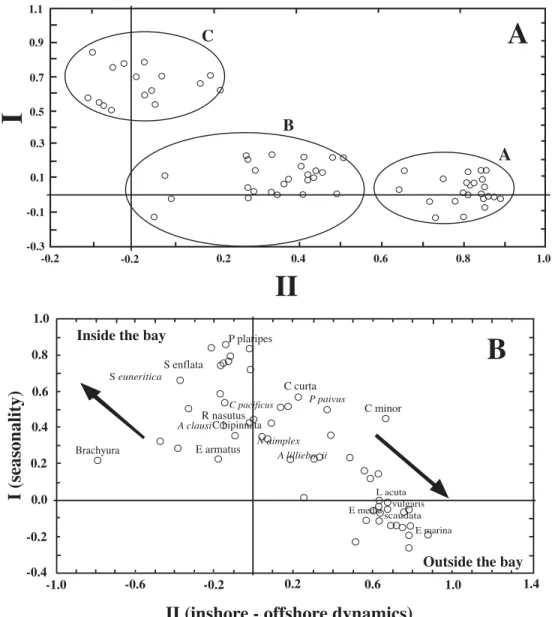
(5) INTENATIONAL JOURNAL OF TROPICAL BIOLOGY AND CONSERVATION. Sagitta euneritica, Clausocalanus arcuicornis, Oithona plumifera, and Labidocera trispinosa; listed in order of abundance). During July only three species accounted for 90% from a total of 29 species (C. pacificus, N. simplex, and A. clausi). During December about 41 species made up 90% (total 92 species) of total abundance of zooplankton community. During this month an increase in diversity of the community was recorded (N. simplex, Paracalanus parvus, Calanus minor, Canthocalanus pauper, C. pacificus, Acartia danae, Subeucalanus subcrassus, Subeucalanus crassus, Euchaeta marina, Centropages furcatus, and 31 more species). Zooplankton biomass was relatively high during March and July with an average of 9.3 and 5.5 ml 1 000 m-3 respectively and the zooplankton biomass reduced significantly during December having an average of 0.37 ml 1 000 m-3. Multivariate analysis of the zooplankton community structure: A Principal Factor Analysis (PFA) defined species groups. The purpose of this analysis was to determine the zooplankton community structure as a function of temporal changes in the environmental conditions. This analysis was used in a matrix with abundance per species by pooled stations (analysis Q). Only the first two components derived showed a relation to variations in the zooplankton assemblages. The first two components explain 59% of the total variance. The first factor (49% of the total variance) was related to a temporal change in the zooplanktonic community, and defined three groups (Fig. 4A). One group was characterized by the dominance of temperate species typical of the California Current (C. pacificus, P. planipes, and N. simplex). The second group comprises species found in the stratified water column in July. Although temperate species (C. pacificus and N. simplex) kept their role as dominant species, the increase of tropical species, the copepods like C. arcuicornis, Clausocalanus jobei, Euchaeta longicornis, and Pleuromamma gracilis, is evident. The third group reflected the. 549. presence of tropical waters with high diversity. This group includes species characterized as tropical and equatorial; the copepods A. danae, Acartia lilljeborgii, Temora discaudata, Rhyncalanus nasutus, Labidocera acuta, E. marina, Euchaeta media, and Undinula vulgaris, the endemic Equatorial Tropical Pacific euphausiids Euphausia tenera, Euphausia distinguenda, and Nematoscelis gracilis, and the decapod groups Diogenidae, Thallassinidea, Palaemonidae, and Hippolytidae. Decapods were significantly more abundant in December than in March or July (three-way ANOVA p < 0.01). A three-way ANOVA analysis by month (March, July, and December), time (day-night), and location (inside, the mouth, and the continental shelf off Bahía Magdalena) was calculated for six of the most abundant species found in the oceanographic surveys. This analysis included the euphausiid N. simplex, the copepods C. pacificus, A. clausi, A. lilljeborgii, and the chaetognaths S. euneritica, and S. enflata. This analysis showed significant differences in the abundance of Sagitta enflata, S. euneritica, and A. lilljeborgii as a function of the season. The first two species were more abundant in March and the last in December 1996. This supports the idea that the zooplankton community structure showed strong temporal succession changes of those dominant species. No significant seasonal differences were found for the other three species (p > 0.01) (Table 1). In the PFA (analysis R), we assumed the first component is the location and no welldefined groups were formed. This evidence supports the hypothesis that community structure does not have strong gradients between inside and outside the bay (Fig. 4B). However, some species typically found inside the bay, like the chaetognaths S. euneritica, S. enflata, and the Brachyuran larvae, appear separate from some of the neritic copepods species like L. acuta, U. vulgaris, E. marina, E. media, and T. discaudata found only over the continental shelf off Bahía Magdalena..
(6) 550. REVISTA DE BIOLOGÍA TROPICAL. Fig. 4. A) First vs. second component weights of PFA made with all months pooled (analysis Q) each point is a station. The two components explain 49 and 10% of the variance. Circles indicate the sampling units which were grouped on species found during the coolest period March (spring), species found during stratified column water in July (summer), and species found during the warmest period December (fall) 1996. B) First vs. second component weights of PFA made with all months pooled for the dominant species (analysis R) each point is a species or a decapod family. The two components explain 49 and 10% of the variance. Bay and continental shelf assemblages are represented in the first component. Most dominant species were found along whole hydrographic transect only some few species showed a preference for habitat inside or outside the bay.. The decapod families were related to the temporal variability in the PFA first component. According to our data, decapoda fauna included ten tropical families (Paguridae, Alpheidae, Penaeidae, Crangonidae, Callianassidae,. Pandalidae, Oplophoridae, Diogenidae, Hippolytidae, and Palaemonidae) and six temperate groups (P. planipes, Axiidae, Ocypodidae, Pinnotheridae, Porcellanidae, and Majidae). The virtual absence of larvae and.
(7) INTENATIONAL JOURNAL OF TROPICAL BIOLOGY AND CONSERVATION. 551. another three-way ANOVA eliminating data from the mouth. This analysis showed significant inside-outside differences of the abundance of N. simplex (p < 0.01, F = 5.43), S. enflata (p < 0.01, F = 4.98) both more abundant outside, and S. euneritica (p < 0.01, F = 5.91) more abundant inside. No significant differences were found for the copepods C. pacificus (p > 0.01, F = 0.95), A. clausi (p > 0.01, F = 1.39), and A. lilljeborgii (p > 0.01, F = 0.81) (Table 1). Several species were found only inside or outside the bay, and can be assigned as bay resident or species of the continental shelf. Table 2 shows that during December 1996 (particularly during the night and over the continental shelf), more exotic species were recorded (about 75% from the species of this table). This suggests the arrival of a complex community structure during December from the south. Our records indicate northward incursions with the Surface Tropical Water masses carried by the Costa Rica Coastal Current (CRCC). This current transports tropical water from Cabo San Lucas, so the confluence with the California Current is found off Baja California (Badan-Dangon, 1997).. adults of holoplanktonic shrimps as the Pasiphaeidae, Sergestidae, and Oplophoridae, and species in which adults have a bentopelagic habits (excepting the red crab P. planipes) like the Crangonidae and Pandalidae is noteworthy. The last two families were found only outside the bay. A three-way ANOVA analysis by month, time, and location done for six of the most abundant species found in the oceanographic surveys (Table 1) showed no significant differences in the abundance of any species by time and location (p > 0.01) indicating two things: i) A negligible influence of daytime, net avoidance, and diel vertical migration on the estimation of the abundance during the day-night period in the studied area. ii) The abundance of these species along the hydrographic transect (18 km) has no significant differences at the three stations, suggesting strong zooplankton exchange and the lack of evident ecotonal transition between both ecosystems for the dominant species (Table 1). To emphasize the inside-outside differences in zooplankton community structure, we did. TABLE 1 Three-way ANOVA for abundance of six of the most abundant zooplankton species found during March, July, and December 1996 in Bahía Magdalena.. Source of variation. Nyctiphanes simplex (E). Calanus pacificus (C). Acartia clausi (C). Acartia liljeborgii (C). Sagitta euneritica (Ch). Sagitta enflata (Ch). Mean. Mean. Mean. F. Mean. F. Mean. F. Mean. Month Mar Jul Dec. F. 4 240 4 235 6 970. 0.7. 12 960 12 500 3 890. 2.1. 1 250 2 025 540. 2.2. 25 35 560. *5.4. Time Day Night. 5 000 5 290. 0.1. 9 170 10 390. 0.1. 1 360 1 180. 0.1. 230 180. Location Bay Mouth Shelf. 2 100 7 360 5 990. 2.8. 5 130 12 990 11 230. 1.7. 1 820 1 050 930. 1.13. 160 170 290. F. F. 1 040 *14.4 290 36. 310 *14.3 15 4. 0.1. 350 510. 0.8. 120 9 800. 0.1. 0.3. 700 380 210. 3.1. 50 146 130. 1.3. Mean abundance (ind. 1000 m-3) is shown for each month, day-night, and location. * Significant differences p < 0.01. (E) = Euphausiids, (C) = Copepods, and (Ch) = Chaetognaths..
(8) 552. REVISTA DE BIOLOGÍA TROPICAL. DISCUSSION Temporal changes of the zooplankton community structure: Environmental conditions are widely variable in the mouth of Bahía Magdalena with temperatures ranging from 14 to 17.5 °C in March and 15 to 21 °C in July, and strong stratification and during December with the arrival of the CRCC are recorded the warmest conditions (20.5 to 23 °C). The seasonal phytoplankton community structure described within the bay suggests variable food availability (Nienhuis and Guerrero 1985, Nienhuis 1986, Gárate-Lizárraga and Siqueiros-Beltrones 1998). Apparently, during our sampling surveys, there was low phytoplankton abundance because our sampling dates coinciding with the lowest phytoplankton abundance reported during summer and winter (Gárate-Lizárraga and Siqueiros-Beltrones 1998). These authors reported the estimated annual phytoplankton standing crop had two peaks of abundance, in April (spring) and October (fall) during a study of several years. During 1996, the most important changes in the zooplankton community were related to the intense temporal changes of the environmental conditions, particularly temperature and stratification. The variability of distribution and abundance can be ascribed to the effect of the local current system in the area, whereas variations in species composition can be related to the seasonality of the zooplankton community. In March there was the typical zooplankton community structure of the California Current. Temperate species like N. simplex, A. clausi, and C. pacificus, along with a bulk of the larvae production of the red crab P. planipes, dominated the abundance. No significant difference in the abundance of P. planipes larvae was recorded between stations and day-night (two-way ANOVA p > 0.01; F = 1.65 and 1.67). March is the peak of the reproductive activity of the P. planipes in Bahía Magdalena and the main reproductive area of this species is over the continental shelf. After April, the increasing upwelling causes a strong offshore larval drift (Gómez-Gutiérrez and. Sánchez-Ortíz 1997). This phenomenon explains the virtual absence of these larvae during July and December 1996 in the inshore waters off Bahía Magdalena. During the transition from spring to summer, there is dramatic increase in temperature, enhancing the vertical density gradient. This stratification was responsible for the shifting of the zooplankton community structure, reducing the number of species to less than half of those recorded in March. The local heating rate within the water column depends on energy input by solar radiation and on heat exchange across the surface as controlled by wind and convection. The heating results in thermal stratification of the water column, which in turn affects the vertical transport of nutrients. The reduction of species recorded during July in our study can be an immediate effect of reduction of nutrients and primary productivity over the continental shelf and the invasion of tropical southern populations. The dramatic decrease of abundance and productivity of the neritic euphausiid N. simplex during midsummer (Gómez-Gutiérrez et al. 1996) supports the observation of the dramatic decrease in number of species, and probably zooplankton biomass during the studied period. December showed an unusually high diversity (90 copepod species) related to the lowering of the thermocline (40 to 50 m) and higher temperature in the water column (> 23 °C in the first 40 m). Palomares-García and Gómez-Gutiérrez (1996), in a study inside Bahía Magdalena, reported 46 copepod species as the maximum number of copepod species found per month (March and October 1983). This difference is because we found an additional number of species (at low abundance) recorded only outside the bay over the continental shelf particularly during December (see Table 2). This table shows the presence of some species like the copepods Copilia quadrata, Oithona setigera, the euphausiid E. tenera and N. gracilis which have been recognized as indicators of tropical waters for this region, and are related to the weakness of the California Current and the maximum.
(9) INTENATIONAL JOURNAL OF TROPICAL BIOLOGY AND CONSERVATION. advance of the CRCC. According to BadanDangon (1997) the CRCC carries tropical subsurface water north from Panama Bight to the Gulf of California and another fraction appears to feed the northward-flowing California Undercurrent that hugs the coast of Baja California. Robinson et al. (1997) reported a tropical community structure of plankton and nekton (Euphausia eximia, the red crab P. planipes, and the mesopelagic fish Vinciguerria lucetia) sampled with an Isaacs-Kidd midwater net and recorded by mean of an echosounder immediately offshore of the shelf break (offshore of Bahía Magdalena) in December 1993 suggesting that the deep scattering layer is more dense over the break shelf than near the mouth of Bahía Magdalena. Horizontal distribution throughout the main entrance of Bahía Magdalena: From several studies inside Bahía Magdalena, it is possible to define two different environments. The inner shallower waters featured strong temporal environmental variations where the proportion of resident autochthonous species is high, and the mouth area, where the influence of the neritic and oceanic waters is a typical characteristic throughout the year (PalomaresGarcía 1992, Palomares-García and GómezGutiérrez 1996, Funes et al. 1998). These conditions enable the entrance of nonresident (allochthonous) zooplanktonic species into the bay. An ecotone, defined as the transition zone between two different communities, seems not to exist in the main mouth of the bay dividing the antiestuarine conditions of the bay and the upwelling area over the continental shelf. We hypothesized that strong currents and tidal mixing cause relatively diffuse gradients in the community structure between the continental shelf and the middle part of the bay. However, some species could display strategies to keep them in greater abundance inside the bay (estuarine resident species) or on the continental shelf (neritic species). We identified those species in table 2. To maintain a maximum in concentration at some location throughout this ecotone gradient zooplankton requires a mechanism for overcoming the net. 553. seaward flux caused by net flow and dispersal down the concentration gradient (Kimmerer et al. 1998). The mouth of Bahía Magdalena “per se” apparently is not an ecotone zone dividing the zooplankton assemblage that inhabits the bay and the continental shelf. With exception of relatively few species (about 10%), which clearly preferred to be distributed inside or outside the bay, most species did not show preference to a particular habitat in the area studied. We think the real ecotonal zone is the shelf breaks about 37 km offshore (GómezGutiérrez et al. 1996, Robinson et al. 1997) and the abrupt change in depth from the navigation channels and shallow areas in the inner part of the bay. This means that the zooplankton community structure begin to be different on these two regions. In these shallower waters, the current speed, temperature, and salinity can change significantly (Funes et al. 1998, GómezGutiérrez et al. 1999). How do zooplankton populations of both environments maintain their horizontal distribution patterns? Kimmerer et al. (1998) discussed four potential mechanisms of position maintenance of zooplankton in an estuary (see their Table 1, p. 1698). Using previous data published from Bahía Magdalena and results of this study we are attempting to resolve what possible mechanisms are working at the main mouth of this bay. We believe the main physical force to transport and disperse zooplankton through the main entrance of Bahía Magdalena is the tide. The tide data during period studied (about 1.5 to 2 m difference between flood and ebb-tide) suggests asymmetry in velocity, which can produce strong tidal currents in a semidiurnal frequency. Tidal currents have been proposed as the main mechanisms of exchange of zooplankton patches inside and outside Bahía Magdalena (Aceves-Medina et al. 1992, Sánchez-Ortíz and Gómez-Gutiérrez 1992, Palomares-García and Vera-Alejandre 1995). Apparently zooplankton populations can maintain their horizontal distributions by the interaction of vertical movement with current shear. At least for some of the most important.
(10) 554. REVISTA DE BIOLOGÍA TROPICAL. species of zooplankton (N. simplex and C. pacificus) is well know that display daily vertical migrations in response to the tides, with abundance higher in the water column on the flood than on the ebb, however the daynight abundance of these species recorded in this study were not significant different. In the case of resident species (autochthonous) organisms adjust buoyancy or vertical swimming speed to remain in layer with landward residual transport. Modelling studies support the idea that semidiurnal internal tides and vertical migration of plankton can be responsible for maintenance strategies to stay under the most favorable environment for resident and nonresident species (Kamykowski 1976). Our statistical analyses showed that, at least on our sampling space scale (about 18 km long), no significant difference in the abundance of these key species of the whole zooplankton community structure of inside and outside areas was found. This indicates the intensity of the interaction between both ecosystems is more dynamic than earlier thought and ecotonal gradients more diffuse than first thought. Several individual key species showed significant differences when data of the mouth station was not included indicating these species could have maintenance strategies to keep their greater abundance in one of these ecosystems. Excellent examples are the chaetognath species S. euneritica and S. enflata, which showed complementary distribution inside the bay. Cota-Meza et al. (1992) reported a total of ten chaetognaths species inside Bahía Magdalena. S. euneritica was the most abundant and broadly distributed inside the bay, followed in decreasing abundance by S. enflata and S. minima. The last was related to the lower temperature at the mouth of Bahía. Magdalena. They found that during October a tropical assemblage was also detected, composed of S. regularis, S. neglecta, S. pacifica, and S. bieri, increasing the number of species. Our data support these observations showing a dominance of S. enflata and increasing the number of chaetognath species during last months of the year. High production rates of S. euneritica can play an important role to maintain relatively abundance of this species within the bay. Another example is the euphausiid N. simplex, which was more abundant over the continental shelf than inside the bay. Previous observations inside the bay indicate very low abundance of larvae stages suggesting unfavorable conditions for euphausiids and high mortality rate can be responsible for the inside-outside distribution pattern observed of this species. For the rest of the zooplankton groups studied, most of the less frequent species, which were found only at the inside bay station, are decapods that inhabit shallow waters and the copepod Pseudiaptomus eurialinus (see Table 2). The limits between the neritic and antiestuarine habitat is not easily determined, at least on the space scale used in this work. This study has demonstrated both the value and the difficulty of performing field studies in the mouth of this bay. Further investigations should be focused to analyze the properties and dynamics of this bay, especially in the interaction area of the main mouth. Our results indicate the influence of the adjacent coastal area over the bay could be more extensive, and that the ecotone is far away, probably about 10 to 20 km offshore. This hypothesis only can be completely proved by means of a study including more sampling stations and a longer oceanographic transect than transect used in this work..
(11) Mar Mar Mar Mar Mar Mar & Dec Jul Jul Dec Dec Dec Dec Dec Dec Dec Dec. Centropages bradyi (C) Leucossidae (De) Metridia sp. (C) Candacia pacifica (C) Pterosagitta draco (Ch) Sergestidae (De) Hyppidae (De) Monstrilla sp. (C) Upogebiidae (De) Euchirella amoena (C) Palaemomidae (De) Portunidae (De) Copilia quadrata (C) Euphausia tenera (E) Nematoscelis gracilis (E) Sapphirina metallina (C). D D D N N D N N D D D D D-N D-N D-N D-N. Time Bay Bay Bay Bay Shelf Shelf Bay Bay Bay Shelf Shelf Shelf Shelf Shelf Shelf Shelf. Location Acrocalanus longicornis (C) Calanus bungii californicus (C) Candacia discaudata (C) Centropages gracilis (C) Copilia longistilis (C) Corycaeus crassiusculus (C) Corycaeus latus (C) Cosmocalanus darwinii (C) Euaetideus acutus (C) Euaetideus bradyi (C) Eucalanus hialinus (C) Oithona rigida (C) Oithona setigera (C) Pontella princeps (C) Sapphirina nigromaculata (C) Subeucalanus mucronatus (C). Species Dec Dec Dec Dec Dec Dec Dec Dec Dec Dec Dec Dec Dec Dec Dec Dec. Month. C = Copepods, De = Decapod, E = Euphausiids, and Ch = Chaetognaths. Time of positive station is indicated as day (D) or night (N).. Month. Species. Species with low frequency (<10% positive stations) found only inside (Bay) or outside (Shelf) of Bahía Magdalena during March, July, and December 1996.. TABLE 2. N N N N N N N N N N N N N N N N. Time. Shelf Shelf Shelf Shelf Shelf Shelf Shelf Shelf Shelf Shelf Shelf Shelf Shelf Shelf Shelf Shelf. Location. INTENATIONAL JOURNAL OF TROPICAL BIOLOGY AND CONSERVATION 555.
(12) 556. REVISTA DE BIOLOGÍA TROPICAL. ACKNOWLEDGMENTS Thanks to Carlos Robinson and Virgilio Arenas from ICMyL-UNAM for allowing us to collect zooplankton samples during the three SIMSUP cruises. This research was supported by funds provided by the Dirección de Estudios de Posgrado e Investigación (DEPI 970123) and by the Consejo Nacional de Ciencia y Tecnología (CONACyT 940511, N511-N9108). The author J.G.G. is supported by Sistema Nacional de Investigadores (SNI) and by a Ph.D. CONAC y T grant (122676) at Oregon State University. J.G.G., P.G.R., and H.T.S. are supported by Comisión de Operación y Fomento Actividades Acádemicas del Instituto Politécnico Nacional (COFAA) and P.G.R. and H.T.S. by Estímulo al Desempeño en Investigación (EDI) fellowships.. RESUMEN La estructura de la comunidad de zooplancton, incluyendo copépodos, eufáusidos, quetognatos y larvas de decápodos, fue monitoreada durante seis ciclos circadianos usando muestras de redes Bongo (red de 500 µm de poro) de bahía Magdalena, en la costa suroeste de Baja California, México. Las muestras se obtuvieron durante tres viajes oceanográficos (marzo, julio y diciembre de 1996) para describir los cambios en la estructura de la comunidad de zooplancton por toda la boca principal de la bahía Magdalena. La estructura de la comunidad de zooplancton mostró cambios fuertes con una relación cercana a las condiciones ambientales. Durante marzo, una columna de agua bien mezclada con baja temperatura y salinidad indicó una influencia del agua de la Corriente de California y de procesos de afloramiento local. Durante julio, la temperatura aumentó y se registró un ámbito de salinidad amplio. La estratificación de la columna de agua fue intensa durante el verano, realzando la termoclina. Las temperaturas y salinidad más altas fueron registradas en diciembre, relacionadas a la presencia de la Corriente Costera de Costa Rica (CRCC). La termoclina se hizo más profunda al aumentar la temperatura del agua. Una estructura de una comunidad templada típica con una riqueza específica baja dominada por Calanus pacificus, Nyctiphanes simplex y Acartia clausi y una biomasa de zooplancton alta (promedio 9.3 y 5.5 ml 1 000 m-3 respectivamente) durante marzo y julio cambió a una estructura de una comunidad tropical más compleja con biomasa de zooplancton baja en diciembre (promedio 0.37 ml 1 000 m-3). La boca de la bahía Magdalena tiene un intercambio vigoroso de agua causado por corrientes.. La estructura de la comunidad de zooplancton no fue significativamente diferente entre la parte central de la bahía Magdalena y la plataforma continental afuera de la bahía en todos los meses. Los resultados sugieren una interacción de adentro hacia afuera más dinámica de los grupos de zooplancton que lo antes pensado.. REFERENCES Aceves-Medina, G., M.R. Saldierna & M. HernándezRivas. 1992. Variación diurna de la abundancia de larvas de peces en la boca de Bahía Magdalena, Baja California Sur, México. Rev. Invest. Cient. U.A.B.C.S. 3: 61-70. Aurioles-Gamboa, D., M.I. Castro-González & R. PérezFlores. 1994. Annual mass stranding of pelagic red crabs, Pleuroncodes planipes (Crustacea: Anomura: Galatheidae), in Bahía Magdalena, Baja California Sur, México. Fish. Bull. 92: 464-470. Badan-Dangon, A. 1997. La corriente costera de Costa Rica en el Pacífico Mexicano, p. 99-112. In M.F. Lavín (ed.). Contribuciones a la oceanografía física en México. Monografía No. 3, Unión Geofísica Mexicana. Cota-Meza, M.S., M.J. Haro-Garay & R.V. Masse-Zendejas. 1992. Distribución y abundancia de quetognatos en el complejo lagunar de Bahía Magdalena, Baja California Sur, Mexico durante el ciclo estacional 1988-1989. Invest. Mar. CICIMAR 7: 47-59. Funes-Rodríguez, R., R. González-Armas & R. AvendañoIbarra. 1998. Distribución y abundancia de larvas de peces en el sistema lagunar de Bahía MagdalenaAlmejas, Baja California Sur, México. Hidrobiológica 8: 55-66. Gárate-Lizárraga, I. & D.A. Siqueiros-Beltrones. 1998. Time variation in phytoplankton assemblages in a subtropical lagoon system after the 1982-1983 “El Niño” event (1984 to 1986). Pacif. Sci. 5: 79-97. Gómez-Gutiérrez, J. 1995. Distribution patterns, abundance and population dynamics of the euphausiids Nyctiphanes simplex and Euphausia eximia in the west coast of Baja California, México. Mar. Ecol. Progr. Ser. 119: 63-76. Gómez-Gutiérrez, J., R. De Silva-Dávila & E.B. Lavaniegos. 1996. Growth production of the euphausiid Nyctiphanes simplex at the coastal shelf off Magdalena Bay, Baja California Sur, México. Mar. Ecol. Progr. Ser. 138: 309-314..
(13) INTENATIONAL JOURNAL OF TROPICAL BIOLOGY AND CONSERVATION Gómez-Gutiérrez, J. & C. Sánchez-Ortíz. 1997. Larval drift and population structure of Pleuroncodes planipes (Simpson) (Crustacea: Galatheidae) along the west coast off Baja California, México. Bull. Mar. Sci. 61: 305-325. Gómez-Gutiérrez, J., R.J. Palomares-García, R. De SilvaDávila, M.A. Carballido-Carranza & A. MartínezLópez. 1999. Daily copepod egg production and growth rates in Bahía Magdalena, México. J. Plankt. Res. 21: 2227-2244. Hernández-Trujillo, S. 1991. Latitudinal variation of copepod diversity on the west coast of B.C.S., Mexico 1982-1984. Cien. Mar. 17: 83-103. Kamykowski, D. 1976. Possible interactions between plankton and semidiurnal internal tides. II. Deep thermoclines and trophic effects. J. Mar. Res. 34: 499-509. Kimmerer, W.J., J.R. Burau W.A. & Bennet. 1998. Tidally oriented vertical migration and position maintenance of zooplankton in a temperate estuary. Limnol. Oceanogr. 43: 1627-1709. Nienhuis, H. 1986. La composición específica, diversidad y biomasa del fitoplancton de Bahía Magdalena de septiembre de 1980 hasta junio de 1984. Atlas Invest. Mar. CICIMAR. 5: 1-70. Nienhuis, H. & R. Guerrero. 1985. A quantitative analysis of the annual phytoplankton cycle of the Magdalena lagoon-complex. J. Plankt. Res. 7: 427-441. Palomares-García, R.J. 1992. Analysis of the taxocenosis of copepods in the lagoon complex of Magdalena-Almejas bay, B.C.S., in 1985-1986. Cien. Mar. 18: 71-92.. 557. Palomares-García, R.J. & R. Vera-Alejandre. 1995. Predation upon larvae of the pacific sardine Sardinops sagax by cyclopoid copepods. J. Crust. Biol. 15: 196-201. Palomares-García, R. & J. Gómez-Gutiérrez. 1996. Copepod community structure at Bahía Magdalena, Mexico during El Niño 1983-1984. Estuar. Coast. Shelf Sci. 43: 583-595. Preisendorfer, R.W. 1988. Principal component analysis in meteorology and Oceanography. Elsevier, Develops in Atmospheric Science, Amsterdam. 17: 1-425. Robinson, C.M., J. Gómez-Gutiérrez & F.V. Arenas. 1997. On the structure of a deep scattering layer on the coastal shelf off Bahía Magdalena, Baja California, Mexico. Cien. Mar. 23: 141-154. Robinson C.J., J. Gómez-Gutiérrez, R. Félix-Uraga & V. ArenasFuentes. 2000. Seasonal hydroacoustical observations of small pelagic fish behaviour in Magdalena Bay, México. Aquat. Living Resour. 13: 11-18. Saldierna-Martínez, R., C. Sánchez-Ortíz & R. VeraAlejandre. 1987. Estudios sobre los primeros estadios de vida de la sardina crinuda (Opisthonema libertate) y sardina monterrey (Sardinops sagax), en Bahía Magdalena, B.C.S. I. Descripción de huevos. II Distribución y abundancia de huevos y larvas. III Mortalidad larval. Tesis de licenciatura, Universidad Autónoma de Baja California Sur, México. Sánchez-Ortíz, C. & J. Gómez-Gutiérrez. 1992. Distribución y abundancia de los estadios planctónicos de la jaiba Callinectes bellicosus (Decapoda: Portunidae) en el complejo lagunar de Bahía Magdalena, B.C.S., México. Rev. Invest. Cient. UABCS. 3: 47-60..
(14)
Figure

Documento similar
In the preparation of this report, the Venice Commission has relied on the comments of its rapporteurs; its recently adopted Report on Respect for Democracy, Human Rights and the Rule
In the “big picture” perspective of the recent years that we have described in Brazil, Spain, Portugal and Puerto Rico there are some similarities and important differences,
We studied the concentrations of Olea and all of the pollen types during the Olea Main Pollen Season in the three cities of the Region of Murcia Aerobiological Network, in
No obstante, como esta enfermedad afecta a cada persona de manera diferente, no todas las opciones de cuidado y tratamiento pueden ser apropiadas para cada individuo.. La forma
3p orbitals, as shown in Figure 8 for 100 K and Figures S1 and S2 for 300 K structures. As mentioned above, the EXSCI approach has been employed to reduce the
The Dwellers in the Garden of Allah 109... The Dwellers in the Garden of Allah
Enlargement will be much easier if the Community is strong and if it has made headway with economic and monetary union; in that case it would be possible to ensure that
As a means to probe the possible fractal structure of the galaxy distribution we have studied the scaling of the num- ber density and angular correlation function of galaxies
