
An introductory study of common grasps used by adults during performance of activities of daily living
32
0
0
Texto completo
(2) *2) Title Page (with author details). TITLE: Most commonly used grasps in activities of daily living: results of a field study AUTHORS: Margarita Vergara, PhD, Eng. J-L Sancho-Bru, PhD, Eng. V. Gracia-Ibáñez, MSc, Eng. A. Pérez-González, PhD, Eng.. AFFILIATION: Dpto. de Ingeniería Mecánica y Construcción. Universitat Jaume I CORRESPONDING AUTHOR : Margarita Vergara [email protected] Tel. +34 964728121 Fax +34 964728106 Departamento de Ingeniería Mecánica y Construcción, Avda. Sos Baynat, Universitat Jaume I, E12071 - Castelló, Spain..
(3) *3) Blinded Manuscript (without author details). 1. ABSTRACT. 2. This paper presents the results of a descriptive survey on human grasps. Sixty-four videos. 3. were selected to represent tasks performed in activities of daily living (ADL) main areas. 4. (personal care, meal preparation, eating, housekeeping, etc.). Elementary grasps were. 5. identified for each hand, and the grasp type (from a 9-type classification), the hands involved,. 6. and the duration were registered for each case. The results show that most commonly used. 7. grasps are: pinch, non-prehensile, cylindrical, lateral pinch and lumbrical. The presence of. 8. these grasps in the ADL areas is, however, very different (e.g. pinch is widely used in food. 9. preparation and very little in driving). Some grasps were used more frequently with one hand. 10. or when both hands were used simultaneously (e.g. special pinch was hardly used by the left. 11. hand). Knowing the grasp types most frequently used in ADL is essential to assess grasp. 12. rehabilitation processes or hand prostheses development.. 13. KEY TERMS. 14. Grasp taxonomy, frequency of grasps, daily life activities, right and left hand, simultaneous. 15. use of hands. 16. ABBREVIATIONS:. 17. ADL: activities of daily living. 18. ATUS American Time Use Survey. 19. EGA: elementary grasp action. 20. 1. INTRODUCTION. 21. The study of the performance of the human hand has been traditionally focused on areas such. 22. as biomechanics, hand surgery, and rehabilitation. 1-5. . Different types of grasp are often used.
(4) 2. 23. for simulation in biomechanical research to perform studies conducted for very different. 24. purposes. 25. knowledge about the effects of pathologies and the surgical procedures used to treat them,. 26. and to help in the design of prostheses and biomedical implants. However, the importance of. 27. the different types of grasp with respect to the ability to perform activities of daily living. 28. (ADL) should be considered in order to obtain useful conclusions from all these simulations.. 29. In particular, it would be very interesting to know the frequency and duration of use of the. 30. different types of grasps for performing everyday activities in different areas (feeding,. 31. personal care, etc.). These data can also be useful to help in the objective assessment of the. 32. functional recovery of the hand during rehabilitation after injury or disease. This process is. 33. nowadays performed using different functional assessment tests. 34. subjective questions together with the qualitative evaluation of the patients’ performance. 35. when trying to perform specific movements or actions required by the therapist. Furthermore,. 36. the frequency of use of the different types of grasps for everyday activities is a critical input. 37. to guide the development and control of artificial manipulators intended to replace human. 38. hands. Their design is usually oriented towards and optimized for some particular previously. 39. selected grasp 17.. 40. The use of time by the population in the USA has been investigated in a continuous way. 41. through the American Time Use Survey (ATUS) since. 42. measure the average amount of time per day that individuals spend working, doing household. 43. activities, and engaging in leisure and sports activities. However, neither the use of the hands. 44. nor the type of grasp used is specified in these reports. There are few recent studies that. 45. address the analysis of the frequency of use of the different types of grasps in daily living 19-. 46. 21. 47. only distinguished two grasps (digital and whole-hand grasps), while Zheng et al. registered. 6-11. : to understand the role of the different anatomical elements, to deepen the. 18. 12-16. that consist mainly of. . The objective of the survey is to. . Moreover, these studies are biased: Kilbreath and Heard were limited to older adults and.
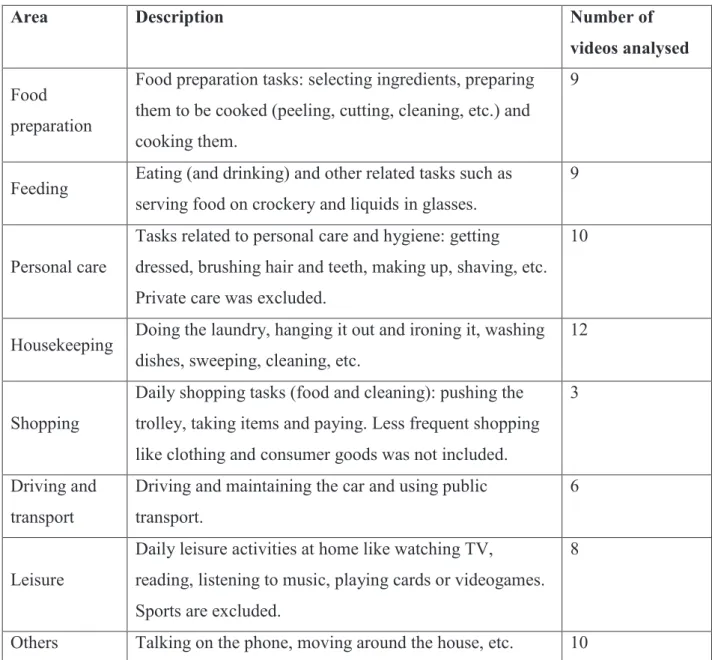
(5) 3. 48. the use of the hands in two professional jobs for one person in each (a professional. 49. housemaid and a machinist) with a wider classification of grasps (31 types of grasps).. 50. Sollerman and Ejeskär 19 reported the percentage of use of the eight most common hand-grips. 51. in ADL from other previous studies. However no information about the areas of the activities,. 52. total time of use and details of the study are provided.. 53. In this work we present the results of a field study aimed at investigating the frequency and. 54. duration of use of the different types of human grasps in ADL, excluding professional tasks.. 55. This was accomplished by recording and analysing real tasks performed in real environments.. 56. 2. MATERIAL AND METHODS. 57. The field study consisted in recording and selecting videos showing different areas of ADL.. 58. The chosen videos were analysed in detail to identify the different types of grasps used and to. 59. obtain data related to frequency and time of use of each of the grasps. Each step is described. 60. in detail afterwards.. 61. The study was approved by the Ethical Committee of the University and all participants. 62. provided informed consent prior to their participation.. 63. 2.1 SELECTION OF VIDEOS. 64. About 180 videos of daily tasks were filmed. The recordings were made in real environments,. 65. with subjects performing real, not simulated, tasks during their normal lives. Eight different. 66. areas of ADL were considered (Table 1). Tasks related to work, study, sport and hobbies. 67. were not taken into account and should be addressed separately because of their specificity.. 68. The areas considered represent a total of 8.42 hours on average per day, according to the data. 69. reported by ATUS. From the 180 videos a total of 64 videos were chosen to be analyzed in. 70. depth. The videos were selected in such a way as to ensure, as far as possible, that they were.
(6) 4. 71. representative of all the tasks and areas of ADL, and more recordings were used in those. 72. areas where tasks were more varied (Table 1). The recordings discarded for the in-depth. 73. analysis were revised to check that the way other subjects performed the same activities were. 74. similar to those selected. A total of 24 right-handed subjects (11 men and 13 women, mean. 75. age 31 years, range 19 to 53 years) participated in the selected videos.. 76. Insert Table 1 here. 77. 2.2 ANALYSIS OF THE VIDEOS SELECTED. 78. The first step consisted in dividing the task up into consecutive elementary grasp actions. 79. (EGA) for each hand. An EGA was considered to be any complete action in which the hand. 80. performed a particular action using a fairly constant hand posture configuration. Once the. 81. task had been divided into EGAs, each grasp action was analyzed to identify the hand (right. 82. or left), the type of grasp used (see the taxonomy used in the next subsection), the total time. 83. spent on the EGA and the simultaneity (whether at any time during the performance of the. 84. EGA the other hand is used simultaneously or not). More than 1500 EGAs were analyzed.. 85. 2.3 GRASP TAXONOMY. 86. In the literature there are different grasp taxonomies that have been developed for different. 87. purposes. A widely used classification in robotics is Cutkosky's taxonomy 22. This is a very. 88. extensive grasp classification that was developed for the mathematical modeling of the hand,. 89. which required a high level of detail. This taxonomy includes details such as the orientation. 90. of the hand relative to the object, or the number of fingers involved, which makes it. 91. impossible to use for the characterization of human grasps while performing real tasks in a. 92. real environment 23. Some grasp taxonomies. 93. are not proper grasps (e.g. wiping down a window pane without holding the cloth, just. 94. pressing on it, which would be a non-prehensile grasp in Cutkosky’s taxonomy). In other. 22, 23. exclude functional actions of the hand that.
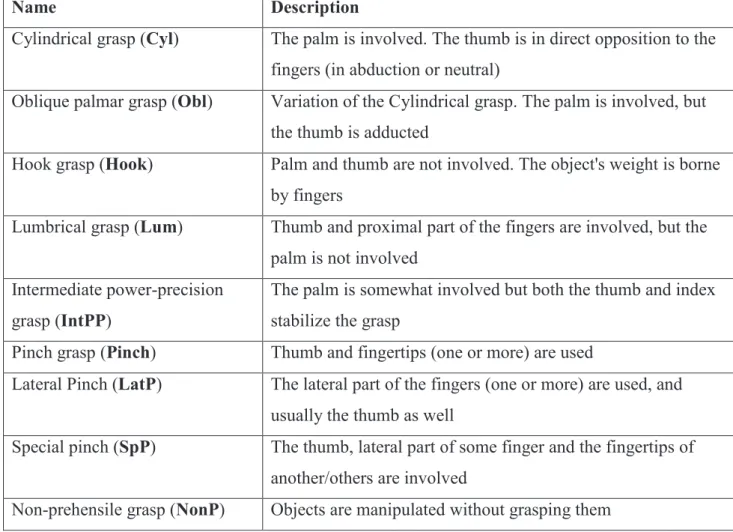
(7) 5. 95. areas, such as rehabilitation 21, 24, the taxonomies are usually quite poor: digital/whole hand or. 96. lateral/cylindrical. Edwards et al.. 97. that takes into account 24 different types of grasp.. 98. Therefore, we used a specific grasp taxonomy for this study that is based on, but not as. 99. detailed as, the classification of Edwards et al. The taxonomy consists of 9 grasps, which are. 100. described in Table 2. Figure 1 shows an example of each type of grasp considered. Grasps. 101. have been grouped according to the type of interaction of the hand with the object, without. 102. taking into account the number of fingers involved or the shape of the object being grasped.. 25. presented a very complete functional grasp classification. 103. Insert Table 2 here. 104. Insert Figure 1 here. 105. 2.4 ANALYSIS OF DATA. 106. The time analysed for each area of ADL was not proportional to the time that people spent on. 107. average in each area in real life (more time was recorded in those areas where tasks are more. 108. varied). Therefore, in order to get results that are representative of the activities of one day,. 109. the data were weighted so that the results presented do correspond to time in a day. The. 110. weighting coefficients were estimated as the ratio of: the daily time that hands are used in. 111. each area and the time analysed in each area in the study. Data on daily time spent in the. 112. different areas of ADL are reported in statistical reports like ATUS. 113. lack the time that hands are used (although we may spend much more time watching. 114. television than driving, the percentage of time of use of the hands when watching TV would. 115. be less than when driving). Therefore, the first term of the ratio for estimating the weighting. 116. coefficients (daily time that hands are used in each area of ADL) was estimated by. 117. multiplying two factors: the daily time spent in each area (from the ATUS report for the year. 118. 2010) and the percentage of time of hand use in the area (from our own videos that were. 119. especially recorded for this purpose). The data from ATUS were selected and adapted to. 18. , although these data.
(8) 6. 120. match exactly the areas of ADL considered in our study, since the areas of ATUS were. 121. slightly different. Long periods of time performing real tasks in all the areas considered were. 122. recorded and then used to estimate the percentage of time of hand use in each area.. 123. For each type of grasp, daily frequency (measured as the number of EGAs performed in a. 124. day) and daily total time are presented. As different results were obtained for both ways of. 125. measuring the use of the grasps (frequency or time), mean durations of each type of grasp. 126. were calculated. An ANOVA was performed to check whether the differences observed in. 127. mean duration were statistically significant or not (dependent variable: duration of the grasps;. 128. independent variable: type of grasps). Note that this analysis was performed with the. 129. unweighted data, i.e. with the real time spent on each grasp analyzed, not the weighted time.. 130. Tukey post-hoc test with pԝ =ԝ 0.05 was used to detect individual differences between. 131. grasps.. 132. Time and frequency of the different grasps are also presented, with a distinction drawn. 133. between the areas of ADL.. 134. Time and frequency of the different grasps, and mean duration of grasps are also presented. 135. with a distinction drawn between the hand involved (left/right or alone/simultaneously with. 136. the other hand). An ANOVA was performed to check whether mean duration of the grasps. 137. was statistically different depending on the hand used (right/left) and on simultaneity (one. 138. factor with four levels: right hand alone or simultaneously, and left hand alone or. 139. simultaneously). Tukey post-hoc test with pԝ =ԝ 0.05 was used to detect individual. 140. differences between the levels of the factor.. 141. Time in which both hands are used simultaneously and each hand is used alone with a. 142. distinction drawn between areas of daily activities is also presented.. 143. All the analyses were performed with IBM SPSS Statistics 19..
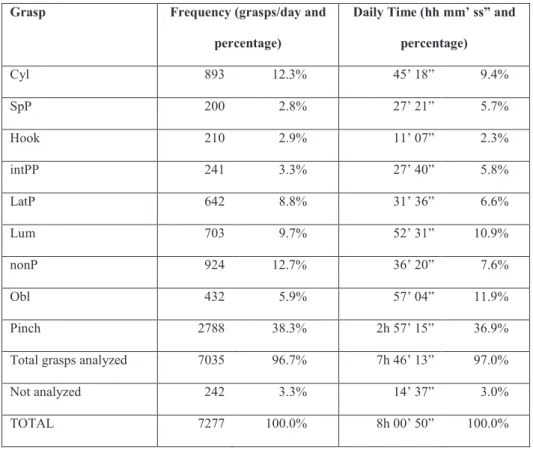
(9) 7. 144. 3. RESULTS. 145. Table 3 shows the estimated mean hours that hands are used per day in each area of the study. 146. (from ATUS data and video recordings) used to weight the results. Notice that an estimation. 147. of more than 5 hours a day is obtained for the use of hands while performing the activities. 148. considered in the study, which represent a total of 8h 25min a day, according to the data from. 149. the ATUS study 18.. 150. Insert Table 3 here. 151. From the results of our study, of these 5 hours and 6 minutes, 57% of the time (2h 55') both. 152. hands were used simultaneously, usually collaborating on the same task but not always; 28%. 153. of the time (1h 26') the right hand was used alone and 15% of the time (45') only the left hand. 154. was used.. 155. Table 4 shows the daily frequency for each type of grasp and the estimated total time that. 156. each grasp was used in one day. It can be observed that total frequency and time do not. 157. account for 100% of the data registered. This is because of problems encountered in trying to. 158. classify 3.3% of the grasping actions (labeled as ‘Not analyzed’ in Table 3). Sometimes this. 159. was due to complex grasps in which several objects are held at the same time, as is the case. 160. shown in Figure 2; some fingers are used in opposition to the palm and others are used in. 161. opposition to the thumb, so that it was not possible to assign a type of grasp from the. 162. classification. In other cases, the hand was hidden in the recording during a small period of. 163. time. Furthermore, it can be observed that the total time is higher than the 5 daily hours of use. 164. of hands that was estimated previously. This is because both frequency and time data refer to. 165. grasps with either hand, i.e. when both hands are used at the same time, each hand is. 166. considered separately for the analysis as each of them can present a different type of grasp.. 167. Insert Table 4 here. 168. Insert Figure 2 here.
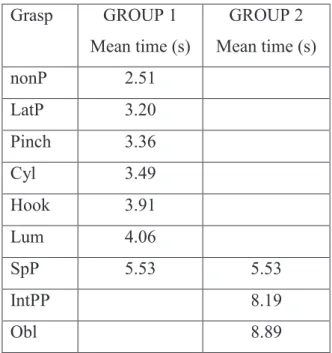
(10) 8. 169. Regarding the time of use, the most frequently used grasps in daily activities were, in this. 170. order: pinch grasp, oblique palmar grasp, lumbrical grasp, cylindrical grasp and non-. 171. prehensile grasp. However, if the frequency of grasp is considered, the order changes slightly. 172. and becomes: pinch grasp, non-prehensile grasp, cylindrical grasp, lumbrical grasp and lateral. 173. pinch. This is because of the difference in duration between the different types of grasp. The. 174. ANOVA performed to check for differences in mean duration depending on the type of grasp. 175. confirmed that these differences were statistically significant (pԝ <ԝ 0.05). The Tukey post-. 176. hoc test (pԝ =ԝ 0.05) was used to detect individual differences between grasps. Table 5 shows. 177. homogeneous groups of grasps ordered by mean duration of the grasp. The groups should be. 178. interpreted so that no significant differences in the grasp duration time existed between. 179. grasps of the same group.. 180. Insert Table 5 here. 181. The pie charts in Figure 3 show the frequency distribution of each grasp type both globally. 182. and distinguishing by the areas of daily life activities for an easier comparison. Table 6 shows. 183. the total time that each grasp is used in a day, also drawing a distinction between areas of. 184. activities. It can be observed that the use of the grasps is quite different between the areas.. 185. Insert Figure 3 here. 186. Insert Table 6 here. 187. Figure 4 shows pie charts with the distribution of daily time and frequency of the different. 188. grasps distinguishing by hand involved in the grasp (left, right and simultaneously or alone).. 189. It can be observed that the results obtained with both ways of measuring the use of the grasps. 190. (frequency or time) show different percentages for some grasps. Differences in the. 191. percentages in which grasps are used with the right and left hands and when both hands are. 192. used simultaneously or alone can also be observed.. 193. Insert Figure 4 here.
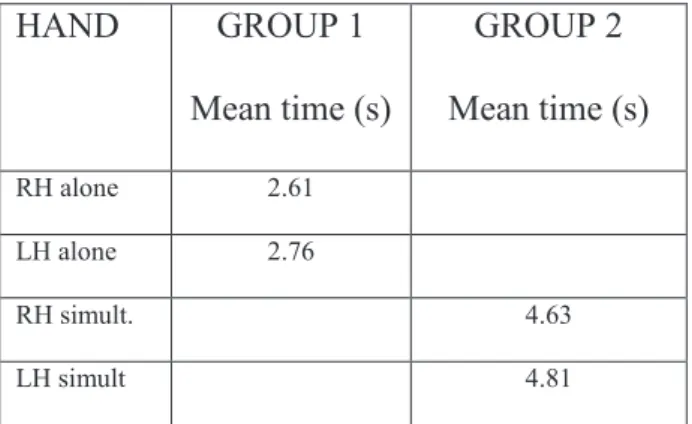
(11) 9. 194. The ANOVA that was performed to check for differences in the mean duration of grasps. 195. depending on the hands used and the simultaneity confirmed that these differences were. 196. statistically significant (pԝ <ԝ 0.001). The Tukey post-hoc test (pԝ =ԝ 0.05) (see groups. 197. identified in Table 7) revealed no significant differences between mean duration of the grasps. 198. performed with the left and right hand alone, and no significant differences in duration of. 199. grasps performed simultaneously. However, the mean duration of the grasps when hands are. 200. used simultaneously was statistically different from (pԝ <ԝ 0.001) – and higher than – the. 201. duration when they are used alone.. 202. Insert Table 7 here. 203. The dexterous hand was used for a longer time than the other hand (all participants were. 204. right-handed). Figure 5 shows pie charts of time (with total daily time in seconds) that each. 205. grasp is used with each hand, either simultaneously or alone. Almost all the grasps were used. 206. with both hands, although some differences can be observed.. 207. Insert Figure 5 here. 208. Figure 6 shows the percentages of time in which both hands are used simultaneously and. 209. each hand is used alone, but in this case drawing a distinction between the different areas of. 210. daily activities. The differences between areas of ADL are also appreciable.. 211. 212. Insert Figure 6 here. 4. DISCUSSION. 213. A field study about grasps used in ADL was performed. The grasps that were observed were. 214. classified into nine types and both the frequencies and the duration of these types of grasps. 215. were recorded. This information is essential to be able to optimize the design of artificial. 216. manipulators and to address the process of rehabilitating hands in order to increase the.
(12) 10. 217. independence of persons with severely damaged hands. Moreover, the results of the study. 218. may also serve to better understand the operation and use of hands.. 219. It has been estimated that the total daily time in which people use their hands, not including. 220. working time and other specific activities such as sports, is more than 5 hours a day. For. 221. more than half of this time both hands are used simultaneously, either performing the same. 222. task or not. The areas in which hands are used for the most time are Feeding and Leisure,. 223. each of them accounting for more than 1h. According to the ATUS report 18, the amount of. 224. time that people spend on activities that are not working or sleeping is about 9.5 hours daily,. 225. and the activities included in this study account for 8h 25min. Hands are needed during most. 226. of that time. These high time percentages evidence the importance of the study presented.. 227. A classification with 9 types of grasps, adapted from other works, was used in the study. A. 228. non-prehensile grasp was included, in contrast to most grasp classifications, since it is not. 229. actually a grasp. But in this work it has been shown that manipulation of objects without. 230. being grasped is the second most common grasp (almost 13% of the grasps). Fewer grasps. 231. were used in this study than in other studies 23, which used Cutkosky’s classification 22.. 232. However, their aim was to overview and to summarize the grasping taxonomies reported in. 233. the literature without any specific purpose. To date the only study with similar purposes to. 234. this work known by authors. 235. are used, at least in the field of their research (Daily Household and Machine Shop Tasks), so. 236. that using a simpler classification as in this study is reasonable.. 237. From the results of this study, the most commonly used grasp, in terms of both time and. 238. frequency, is the Pinch grasp. Other common grasps (also in term of time and frequency) are. 239. the Cylindrical, Lumbrical and the Non-prehensile grasp. Apart from the NonP, these most. 240. widely used grasps involve the thumb in opposition to the palmar side of fingers, i.e. the. 241. thumb is in abduction. Less commonly used grasps, both in terms of time and frequency,. 20, 26. showed that just a few grasps from the long classification.
(13) 11. 242. either do not involve the thumb or the thumb is in opposition to the lateral side of the fingers. 243. (Special pinch and Intermediate power-precision grasp), i.e. the thumb neutral or adducted.. 244. We have shown that the mean time is statistically different for the different grasps. Average. 245. values range from about 3 seconds for the Lateral Pinch until about 9 seconds for the Oblique. 246. palmar grasp. So, if we look at time of use, Oblique palmar grasp becomes used more, while. 247. if we focus on frequency of use, Lateral Pinch is used more. Mean duration is statistically. 248. higher for Oblique and Intermediate power-precision grasps, i.e. grasps with the thumb in. 249. neutral or adducted posture. This confirms why the Oblique palmar grasp is, looking at the. 250. time of use, one of the most common, but it is not when looking at the frequency. The. 251. opposite is true for the lateral pinch, which has a very low average duration, and is especially. 252. true for the non-prehensile grasp, which has the lowest average duration and is used very. 253. frequently.. 254. With regard to the use of the grasps in the different areas of ADL, it has been found that. 255. almost all grasps were used in all areas, although their distribution changed considerably. 256. across them. For example, although the Pinch grasp is the most common in general, it is. 257. highly used (54%) in food preparation and leisure, but is used less in the field of driving and. 258. transport (14%). In this area of ADL, the Oblique palmar grasp is more frequently used,. 259. while Pinch grasp is less commonly used. The Cylindrical grasp stands out in areas such as. 260. shopping, driving and housekeeping, but is little used in Food preparation or personal care.. 261. The Lumbrical grasp stands out in shopping.. 262. Another interesting result has to do with mean duration of grasps for each hand. When hands. 263. are used simultaneously, grasps are statistically higher than when they are used alone.. 264. However there were no differences in duration of right and left grasps, when used. 265. simultaneously or alone. In all, the differences in duration are related to the simultaneous use.
(14) 12. 266. of the hands and the type of grasp, but there is no difference between using the right or the. 267. left hand.. 268. The dexterous hand was used longer than the other hand, especially when used alone.. 269. Regarding the use of different grasps with each hand, almost all the grasps were used by the. 270. left and right hands, although not in the same proportion of time. For example, the Special. 271. pinch was hardly used with the left hand (only 11% of the time with this grasp), while the. 272. non-prehensile grasp was used more with the left hand. This is true either for its simultaneous. 273. use with the right hand or alone. The reason may be that the SpP is a grasp that requires more. 274. dexterity (all participants were right-handed) so that it is used primarily with the right hand.. 275. However, the NonP requires less dexterity and is used in many cases to help the other hand,. 276. so that it is used longer with the left hand.. 277. For some grasps, the right and left hands present a different percentage of use when the hands. 278. are used simultaneously or alone. For example, for the right hand, the Special Pinch and. 279. Lumbrical grasps are employed much more frequently when they are used simultaneously. 280. than when they are used alone. However, for the Lateral pinch, the right hand is more. 281. common when used alone. The opposite is true for the left hand in the same grasp (LatP),. 282. which is used simultaneously far more often than alone. All these differences may be. 283. explained by the different role that each hand plays. Although all the grasps are used by both. 284. hands, when the two hands are used simultaneously, the right hand usually performs the grasp. 285. that requires more dexterity or force.. 286. It has also been shown that the hand use distribution is very different between the different. 287. areas of ADL. For example, in leisure and housekeeping both hands are used more often than. 288. the average, while the left hand is less frequently used, especially in leisure. However, for. 289. shopping and other activities (opening doors, using the telephone, etc.) the time that both. 290. hands are used simultaneously is considerably shorter than average, while the right hand.
(15) 13. 291. alone is used for more time. The only area in which the left hand is used for a longer time. 292. than the right hand (although by only a small difference, since the time is almost the same) is. 293. driving, because the left hand is almost always on the steering wheel while the right hand. 294. may be moving to perform a secondary action like changing gear.. 295. As a result of the data recorded, a classification of the most commonly used grasps (both in. 296. terms of frequency and in time of use) in ADL is now available. This study is presented as a. 297. starting point that can be critical to other more specific studies within the field of robotics,. 298. prostheses or rehabilitation, assuming that for these specific studies an approach to the most. 299. widely used grasps in ADL could be necessary. Further work could address how these grasps. 300. are used in real-life activities. For example, the classification used includes all Pinch grasps. 301. within the same group; however, for the development of prosthetics it could be interesting to. 302. study how many fingers (and which) are the most frequent for this type of grasps. Other data. 303. of interest could be the grasps used depending on the action to be performed (holding,. 304. transport, pulling, squeezing, etc.) and the shape, weight and size of the object.. 305. 306. ACKNOWLEDGEMENTS. 307. We thank the Spanish Ministry of Research and Innovation and the EU (FEDER funds) for. 308. their financial support throughout project DPI2010-18177. We also thank Joan Serrano and. 309. Luna Fernández for their work in recording and analyzing the videos.. 310.
(16) 14. REFERENCES. 311. 312. 1. Kapandji AI. Fisiologie Articulaire. Membre Supérieur. Paris: Editions Maloine; 1998.. 313. 2. Brand PW, Hollister AM. Clinical Mechanics of the Hand. third edition ed. St. Louis:. 314. Elsevier Science Health Science div; 1992.. 315. 3. Napier JR. Hands. New Jersey: Princeton University Press; 1980.. 316. 4. Clarkson HM. Musculoskeletal Assessment :Joint Motion and Muscle Testing. 3rd ed.. 317. Philadelphia: Wolters Kluwer/Lippincott Williams & Wilkins Health; 2013.. 318. 5. Gillen G. Stroke Rehabilitation: A Function-Based Approach. Elsevier Health Sciences;. 319. 2010.. 320. 6. Fok KS, Chou SM. Development of a finger biomechanical model and its considerations. J. 321. Biomech. 2010;43(4):701-713. doi: 10.1016/j.jbiomech.2009.10.020.. 322. 7. Kurita Y, Onoue T, Ikeda A, Ogasawara T. Biomechanical Analysis of Subjective Pinching. 323. Effort Based on Tendon-Skeletal Model. ; 2009.. 324. 8. Sancho-Bru JL, Giurintano DJ, Pérez-González A, Vergara M. Optimum tool handle. 325. diameter for a cylinder grip. J Hand Ther. 2003;16(4):337-342.. 326. 9. Sancho-Bru JL, Perez-Gonzalez A, Vergara M, Giurintano DJ. A 3D biomechanical model. 327. of the hand for power grip. J Biomech Eng. 2003;125(1):78-83.. 328. 10. Valero-Cuevas F. An integrative approach to the biomechanical function and. 329. neuromuscular control of the fingers. J Biomech. 2005;38(4):673-684. doi:. 330. 10.1016/j.jbiomech.2004.04.006..
(17) 15. 331. 11. Vigouroux L, Quaine F, Labarre-Vila A, Moutet F. Estimation of finger muscle tendon. 332. tensions and pulley forces during specific sport-climbing grip techniques. J Biomech.. 333. 2006;39(14):2583-2592. doi: 10.1016/j.jbiomech.2005.08.027.. 334. 12. Pulman J, Buckley E. Assessing the efficacy of different upper limb hemiparesis. 335. interventions on improving health-related quality of life in stroke patients: A systematic. 336. review. Top Stroke Rehabil. 2013;20(2):171-188. doi: 10.1310/tsr2002-171; 10.1310/tsr2002-. 337. 171.. 338. 13. De Smet L. The DASH questionnaire and score in the evaluation of hand and wrist. 339. disorders. Acta Orthop Belg. 2008;74(5):575-581.. 340. 14. Changulani M, Okonkwo U, Keswani T, Kalairajah Y. Outcome evaluation measures for. 341. wrist and hand: Which one to choose?. Int Orthop. 2008;32(1):1-6. doi: 10.1007/s00264-007-. 342. 0368-z.. 343. 15. Schuind FA, Mouraux D, Robert C, et al. Functional and outcome evaluation of the hand. 344. and wrist. Hand Clin. 2003;19(3):361-369.. 345. 16. Faria-Fortini I, Michaelsen SM, Cassiano JG, Teixeira-Salmela LF. Upper extremity. 346. function in stroke subjects: Relationships between the international classification of. 347. functioning, disability, and health domains. J Hand Ther. 2011;24(3):257-64; quiz 265. doi:. 348. 10.1016/j.jht.2011.01.002; 10.1016/j.jht.2011.01.002.. 349. 17. Weir RF. Design of artificial arms and hands for prosthetic applications. In: Standard. 350. Handbook of Biomedical Engineering and Design. McGraw-Hill; 2004:32.1.. 351. 18. Bureau of Labor Statistics. American time use survey (ATUS), 2010.. 352. http://www.bls.gov/tus/2013..
(18) 16. 353. 19. Sollerman C, Ejeskar A. Sollerman hand function test: A standardised method and its use. 354. in tetraplegic patients. Scand J Plast Reconstr Surg Hand Surg. 1995;29(2):167-176.. 355. 20. Zheng JZ, De La Rosa S, Dollar AM. An investigation of grasp type and frequency in. 356. daily household and machine shop tasks. Proc IEEE Int Conf Rob Autom. 2011:4169-4175.. 357. 21. Kilbreath SL, Heard RC. Frequency of hand use in healthy older persons. Aust J. 358. Physiother. 2005;51(2):119-122.. 359. 22. Cutkosky MR. On grasp choice, grasp models, and the design of hands for manufacturing. 360. tasks. IEEE Trans Rob Autom. 1989;5(3):269-279. doi: 10.1109/70.34763.. 361. 23. Feix T, Schmiedmayer H, Romero J, Kragić D. A comprehensive grasp taxonomy. 2009.. 362. 24. Meiners T, Abel R, Lindel K, Mesecke U. Improvements in activities of daily living. 363. following functional hand surgery for treatment of lesions to the cervical spinal cord: Self-. 364. assessment by patients. Spinal Cord. 2002;40(11):574-580. doi: 10.1038/sj.sc.3101384.. 365. 25. Edwards S, Buckland D, McCoy-Powlen J. Developmental and Functional Hand. 366. Grasps. . Thorofare: Thorofare: Slack Incorporated; 2002.. 367. 26. Bullock IM, Zheng JZ, De La Rosa S, Guertler C, Dollar AM. Grasp frequency and usage. 368. in daily household and machine shop tasks. Transactions on Haptics.. 369.
(19) 17. 370 371 372. FIGURE LEGENDS Figure 1. Examples of the grasp in the taxonomy. Images from the video recordings.. 373 374. Figure 2. Grasp outside of the classification.. 375 376. Figure 3. Distribution of daily frequencies of use of each type of grasp: total (bottom right). 377. and by area of daily life activities. Note that the total time considered in this graph is. 378. 8hԝ 00’ԝ 50”.. 379 380. Figure 4. Frequency and time distribution of the different grasps for each hand (LH: left. 381. hand; RH: right hand) when used simultaneously with the other hand and when used alone.. 382. Note that the total time considered in this graph is 8hԝ 00’ԝ 50”.. 383 384. Figure 5. Pie charts of the time that each hand is used simultaneously or not, both by each. 385. grasp and globally. The numbers in the sectors are total time in seconds. Note that the total. 386. time considered in this graph is 8hԝ 00’ԝ 50”.. 387 388. Figure 6. Time in which hands are used both simultaneously and each one separately, by area. 389. and globally. Note that the total time considered in this graph is 5hԝ 06’. Time of sectors is in. 390. seconds..
(20) Table1. Table 1. Areas of the ADL in the study with number of videos analysed. Area. Description. Number of videos analysed. Food preparation. Feeding. Food preparation tasks: selecting ingredients, preparing them to be cooked (peeling, cutting, cleaning, etc.) and cooking them. Eating (and drinking) and other related tasks such as. 9. serving food on crockery and liquids in glasses. Tasks related to personal care and hygiene: getting. Personal care. 9. 10. dressed, brushing hair and teeth, making up, shaving, etc. Private care was excluded.. Housekeeping. Doing the laundry, hanging it out and ironing it, washing dishes, sweeping, cleaning, etc. Daily shopping tasks (food and cleaning): pushing the. Shopping. 12. 3. trolley, taking items and paying. Less frequent shopping like clothing and consumer goods was not included.. Driving and. Driving and maintaining the car and using public. transport. transport. Daily leisure activities at home like watching TV,. Leisure. 6. 8. reading, listening to music, playing cards or videogames. Sports are excluded.. Others. Talking on the phone, moving around the house, etc.. 10.
(21) Table2. Table 2. Description of the grasps considered in the taxonomy. Name. Description. Cylindrical grasp (Cyl). The palm is involved. The thumb is in direct opposition to the fingers (in abduction or neutral). Oblique palmar grasp (Obl). Variation of the Cylindrical grasp. The palm is involved, but the thumb is adducted. Hook grasp (Hook). Palm and thumb are not involved. The object's weight is borne by fingers. Lumbrical grasp (Lum). Thumb and proximal part of the fingers are involved, but the palm is not involved. Intermediate power-precision. The palm is somewhat involved but both the thumb and index. grasp (IntPP). stabilize the grasp. Pinch grasp (Pinch). Thumb and fingertips (one or more) are used. Lateral Pinch (LatP). The lateral part of the fingers (one or more) are used, and usually the thumb as well. Special pinch (SpP). The thumb, lateral part of some finger and the fingertips of another/others are involved. Non-prehensile grasp (NonP). Objects are manipulated without grasping them.
(22) Table3. Table 3. Daily time (hours and minutes) per day spent in each area, adapted from ATUS, and estimated time per day that hands are used in each area of ADL. *Time spent on sports is excluded.. Area of daily activities. Daily time (ATUS). Daily time of hand use. Food preparation. 34'. 30'. Feeding. 1h 15'. 1h 9'. Personal care. 48'. 46'. Housekeeping. 34'. 32'. Shopping. 27'. 19'. Driving and transport. 49'. 25'. Leisure*. 3h 37'. 1h 5'. Others. 21'. 20'. TOTAL. 8h 25'. 5h 6'.
(23) Table4. Table 4. Daily total frequency and time that each type of grasp is used. Grasp. Frequency (grasps/day and. Daily Time (hh mm’ ss” and. percentage). percentage). Cyl. 893. 12.3%. 45’ 18”. 9.4%. SpP. 200. 2.8%. 27’ 21”. 5.7%. Hook. 210. 2.9%. 11’ 07”. 2.3%. intPP. 241. 3.3%. 27’ 40”. 5.8%. LatP. 642. 8.8%. 31’ 36”. 6.6%. Lum. 703. 9.7%. 52’ 31”. 10.9%. nonP. 924. 12.7%. 36’ 20”. 7.6%. Obl. 432. 5.9%. 57’ 04”. 11.9%. Pinch. 2788. 38.3%. 2h 57’ 15”. 36.9%. Total grasps analyzed. 7035. 96.7%. 7h 46’ 13”. 97.0%. 242. 3.3%. 14’ 37”. 3.0%. 7277. 100.0%. 8h 00’ 50”. 100.0%. Not analyzed TOTAL.
(24) Table5. Table 5. Mean duration of each type of grasp. The groups represent grasps between which there is no statistically significant difference in mean time of use. Grasp. GROUP 1. GROUP 2. Mean time (s). Mean time (s). nonP. 2.51. LatP. 3.20. Pinch. 3.36. Cyl. 3.49. Hook. 3.91. Lum. 4.06. SpP. 5.53. 5.53. IntPP. 8.19. Obl. 8.89.
(25) Table6. Table 6. Daily time of use of each grasp type globally and distinguishing between the areas of ADL. Driving Personal Feeding. Food. and. care. Shopping. Housekeeping. transport. Leisure. preparation. Others. Total. Cyl. 4’13”. 2’25”. 6’43”. 3’34”. 11’47”. 10’16”. 3’43”. 2’36”. 45’18”. SpP. 3’23”. 7’40”. .. .. 1’03”. 14’59”. 0’10”. 0’06”. 27’21”. Hook. 1’41”. .. 2’47”. 1’57”. 2’03”. .. 2’22”. 0’16”. 11’07”. intPP. 15’13”. 0’52”. .. 0’08”. 0’13”. 2’08”. .. 9’05”. 27’40”. LatP. 4’30”. 8’04”. 1’00”. 3’35”. 5’24”. 2’24”. 3’55”. 2’45”. 31’36”. Lum. 5’04”. 1’02”. 7’36”. 1’37”. 7’17”. 24’30”. 2’28”. 2’58”. 52’31”. nonP. 9’35”. 4’01”. 1’59”. 4’15”. 3’46”. 7’57”. 3’28”. 1’20”. 36’20”. Obl. 1’41”. 12’16”. 0’05”. 19’15”. 5’20”. 6’11”. 3’53”. 8’21”. 57’04”. 56’05”. 23’17”. 3’31”. 3’43”. 15’41”. 50’18”. 4’27”. 20’14”. 2h57’15”. 0’51”. 8’08”. 1’12”. 1’21”. 1’57”. 0’43”. .. 0’26”. 14’37”. 1h 42’16”. 1h 07’44”. 24’56”. 39’24”. 54’31”. 1h59’26”. 24’26”. 48’07”. 8h00’50”. Pinch Not analyzed Total.
(26) Table7. Table 7. Mean duration of grasps for each hand (LH: left hand; RH: right hand) when used alone or simultaneously. The groups represent grasps between which there is no statistically significant difference in mean time of use. HAND. GROUP 1. GROUP 2. Mean time (s). Mean time (s). RH alone. 2.61. LH alone. 2.76. RH simult.. 4.63. LH simult. 4.81.
(27) Figure1 Click here to download high resolution image.
(28) Figure2 Click here to download high resolution image.
(29) Figure3 Click here to download high resolution image.
(30) Figure4 Click here to download high resolution image.
(31) Figure5 Click here to download high resolution image.
(32) Figure6 Click here to download high resolution image.
(33)
Figure

+4

Documento similar
The draft amendments do not operate any more a distinction between different states of emergency; they repeal articles 120, 121and 122 and make it possible for the President to
On the other side, models with n = 3 present notably larger values of TWRSS and AIC, what suggests that the participation of three active sites in the
Note that, for the same linear drift rate β, and once the values for time detector δ and threshold h have been set to approximately achieve the same percentage of
Beta coefficients (p value) for the association between categories of baseline yogurt consumption and follow-up SF-12 health
La coordinación vertical debe apo11ar coherencia al conjunto del plan de estudios, estableciendo bien sus objetivos y adecuando a ellos todas las actividades docentes
Using data from the Well-being Module of the 2010, 2012, and 2013 American Time Use Survey (ATUS), we found that more time spent in commuting is related to higher levels of
This booklet includes top tips for those who experience a mental health condition to help improve their quality of life and think about their sense of belonging and place in
From the very beginning the Annual Conference of the Sociedad Mexicana de Ciencia y Tecnología de Superficies y Materiales (SMCTSM, Mexican Society of Science and Technology
